Category Archives: Grit

ESPN, Mansplaining, and the U.S. Media

What do NPR, conservative talk radio/media, and ESPN radio have in common?

Upon first blush, likely nothing. And that proves both what they have in common as well as how that unrecognized is the problem.

Let’s start with NPR, as Tracie Powell reports:

Anya Kamenetz, NPR’s education team lead blogger, used one of the network’s official Twitter accounts to tweet that she reaches out to diverse sources, but “only white guys get back to” her. Naturally, the post is catching a lot of attention on Twitter, and rightfully so.

And while this admission is being framed as controversial, I have noted that NPR represents a pattern of whitewashing (see HERE, HERE, and HERE); in other words, what is presented as objective or balanced journalism is actually honoring a white male (and thus dominant) perspective as the unexamined given.

From George Will and Cal Thomas—the old-guard right-wing punditocracy—to Rush Limbaugh, Fox News, and others in the so-called new conservative media, whitewashing is the not-so-subtle racism, misogyny, and classism that pass for credible public discourse.

But as long as media objectivity remains a thin mask for (white) mansplaining, the so-called liberal media (NPR, for example) and the right-wing media are fundamentally indistinguishable. It is, then, important that we look closely at ESPN radio, the tour-de-force of (white) mansplaining.

ESPN, Mansplaining, and the U.S. Media

ESPN radio offers listeners a line up that is the antithesis of diversity: Mike & Mike, The Herd with Colin Cowherd, and SVP & Russillo.

This is hour upon hour of white guys holding forth as if their perspective has credibility (often it does not), as if their topics are monumentally important (often they are not), and as if their 20-something, fraternity view of the universe deserves our undivided attention (and that never does).

While the ESPN radio line up is solidly a bunch of white guys (and mostly snarky, arrogant white guys), it is also worth noting that African Americans and women serve roles as side-kicks (and on-air, the women look awfully similar to the eye-candy norm of Fox news).

Instead of careful, nuanced, or informed journalism, ESPN radio offers discourse driven by personality, arrogance, and the corrosive power of (white) mansplaining.

And while it may seem easy or justifiable to discount the danger of this dynamic because this is just sports, the obscene professional sport complex in the U.S. (like ESPN radio itself) is actually fertile ground for exploring lingering issues of race, class, and gender plaguing U.S. efforts at democracy and equity. If anything in the U.S. remains a man’s hostile world, it is professional sport (see HERE and HERE).

If only some in the media would step away from the alluring norm of (white) mansplaining that lulls us deeper into complacency.

The U.S. needs a critical free press whether that press is covering things great or small because major and so-called mainstream media continue to carry George Will and Cal Thomas as if their world views are credible, and not the toxic nastiness they perpetuate.

I invite you to suffer through 20 or 30 minutes of Limbaugh and then about the same time spent with Colin Cowherd. The nearly incoherent navel-gazing mansplaining between the two of them is indistinguishable—but it takes a bit of care to understand that among almost all of the mainstream media the space between right-wing talk radio, ESPN radio, and so-called credible outlets such as NPR, The New York Times, The Wall Street Journal, U.S. News & World Report, and many others is negligible.

If a white man isn’t telling us what and how to think (with a heaping dose of arrogance and juvenile glee), then the foundation of any and all being presented is (white) mansplaining—whether someone is contemplating whether LeBron James is holding the NBA hostage or NPR is fawning over schools teaching impoverished children of color “grit” through the whitewashed story of Steve Jobs.

For those of us fighting the fight and working daily in public education, that the teaching profession is dominated by women and that the students most in need of public education are living in poverty and children of color represent the pervasive and corrosive power of (white) mansplaining at all levels of society, but nowhere is that more distinct than in all aspects of the media, whether we are considering news or entertainment (as if there is a difference).

Too often, as well, when mainstream media allow surface diversity (gender [1] or race), those journalists are throttled by the fair-and-balanced norms—(white) mansplaining—that whitewashes any real diversity of thought.

In the 21st century, the U.S. is ample evidence that we have failed democracy, the free press, and universal public education. And those failures feed the current state of inequity that constitutes the country.

It cannot be stated often enough, then, that the U.S. needs a critical free press and that public narratives need a new mythology, one that not only replaces but refutes the current culture of (white) mansplaining that surrounds us daily.

[1] Consider the female lead of Gravity and how the narrative and motifs of the film play to and re-enforce a rugged individualism theme. The woman (played by Sandra Bullock) has a man’s name, Ryan Stone, and presents a physical presence that walks a thin line between objectifying a woman and highlighting her man-like “look,” athletic, hair cropped short. This is no celebration of a powerful female, but a message that this woman deserves our praise because she rises to the norms of men, created by men. Again, this is not substantially different than the motif on ESPN of praising African American athletes as “articulate.”
U.S. and Education Reform Need a Critical Free Press

Few things are worse than mainstream media coverage of education.

Except for that sentence above, which stretches hyperbole beyond credibility.

But that is exactly where the mainstream media finds itself when covering education. Journalists, in their quest to maintain the traditional commitment to “fair and balanced” journalism [1], consistently endorse and perpetuate organizations without credibility (such as NCTQ) and baseless claims (such as cries of “bad” teacher, “bad” teacher certification, and “bad” unions).

With yet another report released by NCTQ, that failure of the mainstream media has been highlighted once again—notably at NPR [2] and Education Week: Study Delivers Failing Grades For Many Programs Training Teachers, Claudio Sanchez and Juana Summers; Alternative Certification Deemed Weak by NCTQ in New Teacher-Prep Report, Stephen Sawchuk; Most Teacher Preparation Falls Short on Strategies for ELLs, NCTQ Finds, Lesli A. Maxwell.

First, the mainstream coverage of NCTQ’s reports remains trapped inside assumed crises that have no basis in fact; NCTQ’s reports and then the media begin with the givens that education suffers under the burden of “bad” teachers, “bad” teacher certification, and “bad” unions. However, at the very least, these claims are disproportional, if not outright erroneous:

  • If we maintain the current context that student achievement is accurately reflected in test scores (and it isn’t), then we must acknowledge that teacher quality (10-15%) and school quality account for only about 20% of that measurement, but “60 percent of achievement outcomes is explained by student and family background characteristics (most are unobserved, but likely pertain to income/poverty),” as Di Carlo details.
  • If we accept that value-added methods (VAM) can accurately and consistently identify “good” and “bad” teachers (and the evidence is that it cannot) and if we accept the much repeated claim by Chetty et al. that teacher quality can add $50,000 to the lifetime earning potential of a student (and that also is a significantly contested claim, as well as another example of advocacy and media hyperbole since that lifetime earning figure equates to about 1.5-2 tanks of gas per month), the enormity of the claims about “bad” teachers and the urgency expressed about creating and implementing huge and expensive test-based systems to address teacher quality are at best overstated. No rational person would endorse the cost-benefit analysis of such schemes.
  • Finally, claims that teachers unions are primary or significant negative influences on educational quality are powerfully refuted by the historical and current fact that the states in the U.S. with the lowest standardized test scores tend to be those that are right-to-work (non-union) states. Unionization correlates positively with measurable student achievement, in fact, while poverty is the greatest correlation with low measurable student outcomes (for the record, union bashing is a straw man because U.S. public education has a poverty problem, not a union problem).

Next, NCTQ has established a sort of immediate appearance of credibility through three strategies: partnering itself with U.S. News & World Report, garnering significant and influential sources of funding, and bombarding the mainstream media with a series of reports without vetting those reports as is common in traditional scholarship (which slows down and greatly harnesses higher-quality research from reaching the public [3]. But scholars don’t issue press releases, and apparently, journalists respond primarily to press releases instead of conducting investigative journalism [4].)

Finally, once I engaged Sawchuck (EdWeek) and then Summers (NPR) on Twitter, several key aspects of this phenomenon were highlighted. Both journalists argued that their pieces on NCTQ were fair, and even critical—which I will examine below—but even more significant is a comment on Twitter from Summers:

@plthomasEdD I’m not sure it’s my place to say whether the study is credible, but we both note the significant criticism of the methods.

— Juana Summers (@jmsummers) June 18, 2014

My two reactions to Summers deferring from examining the credibility of NCTQ are, first, to strongly disagree, and second, note that no journalists need to do any real investigative journalism to uncover that NCTQ has no credibility because all of that work has been done already by a number of scholars (see those critiques catalogued here and here).

As disturbing, however, as that stance is, examining carefully the coverage of NCTQ reveals that the mainstream media does in fact endorse NCTQ implicitly (despite claims of impartiality) and also marginalizes the credible critiques of NCTQ.

All three articles (see above) have headlines that establish immediately for any reader that NCTQ’s report is worthy of major media coverage. Next, all three articles have ledes that also present NCTQ positively:

The nation’s teacher-preparation programs have plenty of room for improvement, according to a new report. (Sanchez and Summers)

Alternative-certification programs for preparing teachers suffer from many of the same problems that the National Council on Teacher Quality has identified in traditional, university-based programs, the Washington-based group concludes in a new pilot study. (Sawchuk)

More than 75 percent of elementary teacher-preparation programs are failing when it comes to readying future teachers to work effectively with English-language learners, a new report from the National Council on Teacher Quality contends. (Maxwell)

Sanchez and Summers (again, note that Summers argues it isn’t her job to assign credibility to the study) certainly imply that the study is credible by using this language: “The study is a dismal read, given that the U.S. spends more than $6 billion each year to prepare teachers for the classroom.”

The NCTQ study is only a “dismal read” if it is accurate (and it isn’t). NCTQ has been carefully discredited in scholarship (for example, see Fuller here and here) for serious conflicts of interest (Teach For America and KIPP leaders sit on the Advisory Board, for example), for a flawed study design, and for shoddy methodology [5].

So how are credible academic critiques of NCTQ characterized in the journalism that claims not to take evaluative positions?:

When NCTQ released a version of this report last year, it was met with some skepticism among educators and those responsible for preparing teachers. Critics said the advocacy group should have visited individual teacher-prep programs and talked to graduates and students, rather than relying on syllabi. (Sanchez and Summers)

Last year’s inaugural teacher-prep review was immediately rejected by most teacher colleges and, especially, by their main membership body, the American Association of Colleges for Teacher Education.

Criticism focused on the NCTQ’s tack of reviewing syllabi and other course materials rather than visiting institutions; its use of open-records requests and current students to obtain documents; the complaint that its standards weren’t agreed to by the profession; and the fact that its research products aren’t peer reviewed. Additionally, critics have claimed that the project is ideologically driven, given NCTQ’s role as incubator of an alternative-certification group, the American Board for Certification of Teacher Excellence (ABCTE), which received federal funding from the George W. Bush administration.

The latter complaint seems less viable now that the NCTQ has turned its green eyeshade toward alternative-certification programs. (Sawchuk)

“Some skepticism” and “critics” clearly position credible scholarship negatively while maintaining the implied endorsement of NCTQ as an organization and NCTQ’s reports. And while Sawchuk appears to address more directly NCTQ’s lack of credibility, he still marginalizes scholars as “critics” and then in the last paragraph above, simply discounts the criticism [6].

Further in Sawchuk’s piece, the contrast between lacking credibility (NCTQ) and credibility (scholarship discrediting NCTQ) is reduced to a simple misunderstanding and a matter of tone (not substance):

Notably, the report’s introduction this year contains a number of mea culpas regarding the bad blood between the NCTQ and teacher colleges. And Walsh agreed that her group bore some of the blame.

“At times we were a bit arrogant about what it is we think teacher education should be doing,” she said. “Even if we agree to disagree, we can be more respectful.”

Again, this trivializes criticism of NCTQ and further equates NCTQ (an advocacy think tank) with scholarship—while also painting NCTQ as apologetic (despite the organization maintaining its threat of ranking programs whether they cooperate or not; a powerful tool afforded NCTQ because of its media partnership with U.S. News & World Report).

One of my strongest criticisms of teachers is that we far too often allow ourselves to be trapped within traditional calls that we take neutral stances; however, the U.S. needs critical teachers (political teachers) if our public schools are to be a foundation for our democracy.

What I have detailed above is that journalists in the U.S. have bowed to the same call for neutrality, one that cannot be accomplished but can serve as a shield for maintaining the status quo.

The U.S. needs critical journalists, ones who see their job as maintaining a commitment to seeking out and identifying the credibility of things they report. Only those in power benefit when the free press is mostly free of taking to task those in power.

Nowhere is that more apparent than in how the mainstream media fails the education reform debate.

[1] Journalists and teachers share the burden of traditional expectations that they should never be “political,” but taking a neutral stance is, in fact, taking a passive stance endorsing the status quo. In other words, taking a dispassionate pose is a political stance (see The Politics of Calling for No Politics).

[2] See a similar example with NPR’s coverage of “grit.”

[3] See the following in terms of how the mainstream media disproportionately reports on think tank (non-peer reviewed) reports as compared to peer-reviewed and university-based research:

Molnar, A. (2001, April 11). The media and educational research: What we know vs. what the public hears. Milwaukee, WI: Center for Education Research, Analysis, and Innovation. Retrieved from http://epsl.asu.edu/epru/documents/cerai-01-14.htm

Yettick, H. (2009). The research that reaches the public: Who produces the educational research mentioned in the news media? Boulder, CO and Tempe, AZ: Education and the Public Interest Center & Education Policy Research Unit. Retrieved from http://epicpolicy.org/publication/research-that-reaches

[4] I make this claim not as a direct attack on any journalists, but teachers and journalists now experience very similar and negative influences on their ability to conduct their professions. While education reform tends to impeded good teaching, the contracting media market has tended to overburden journalists. As a result of newspapers and magazines disappearing and contracting their staffs, many journalists resort to press-release journalism as a survival technique, similar to teachers teaching to the tests. The conditions of both professions, teaching and journalism, are stark reasons why both teachers and journalists must exert their political selves in their professional work.

[5] As a brief glimpse into NCTQ’s accidental admission of their methodology, in an effort to twist criticism of their practices, this post adds at the end “As one teacher candidate who is working on our office this summer said,” highlighting that anecdote is enough for NCTQ, as long as it matches their advocacy.

[6] Sawchuk fails to recognize that NCTQ is working within a scorched-earth policy as part of the large disaster capitalism driving education reform in the U.S. For a vivid example of how this works, and why NCTQ, TFA, and KIPP benefit once the traditional education system is dismantled, see the events that have occurred since Katrina in New Orleans where the public school system has been replaced by charters schools, many KIPP and many staffed by TFA recruits.

George Saunders’s Allegory of Scarcity and Slack

The stories themselves, literally, are powerful and engaging or George Orwell’s 1984 and Arthur Miller’s The Crucible would not have endured as they have as literature people read again and again—and possibly should read again and again.

However, ultimately, 1984 is not about the future (especially since we have long since passed the future Orwell may have envisioned), and The Crucible is not about the past (although Miller built his play on the very real and troubling history of Puritan witchcraft hysteria). These works are about the complicated present of both authors’ worlds as that speaks to the enduring realities of the human condition.

All of that may seem weighty stuff to step into a look at what appears to be a children’s book, but the paragraphs above should be more than a hint that looks can be deceiving—and enlightening.

The Very Persistent Gappers of Frip, written by George Saunders and wonderfully illustrated by Lane Smith (whose It’s a Book I cannot recommend highly enough), is a fanciful and satirical tale that proves in the end to be an allegory of scarcity and slack—a perfect companion read to Ursula K. Le Guin’s allegory of privilege, “The One’s Who Walk Away from Omelas.”

The Very Persistent Gappers of Frip

Realizing that the Human Heart Is Capable

“Ever had a burr in your sock?” sets the story in motion—one sentence centered on the page over a giant question mark. It is an opening worthy of a child and all of us who cling to the wonder of childhood.

While Le Guin is often described as a science fiction writer, in her work I recognize the blurring of genres that joins science fiction, speculative fiction, and fantasy; it is that “other world” about which Le Guin and Margaret Atwood appear to argue, and it a stark but rich other world Saunders conjures and Lane pictures.

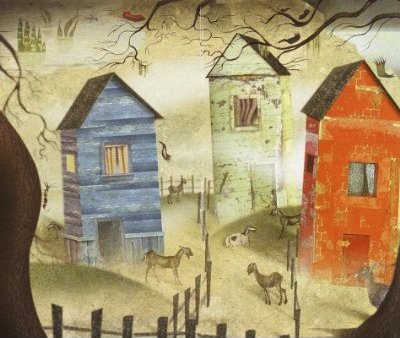
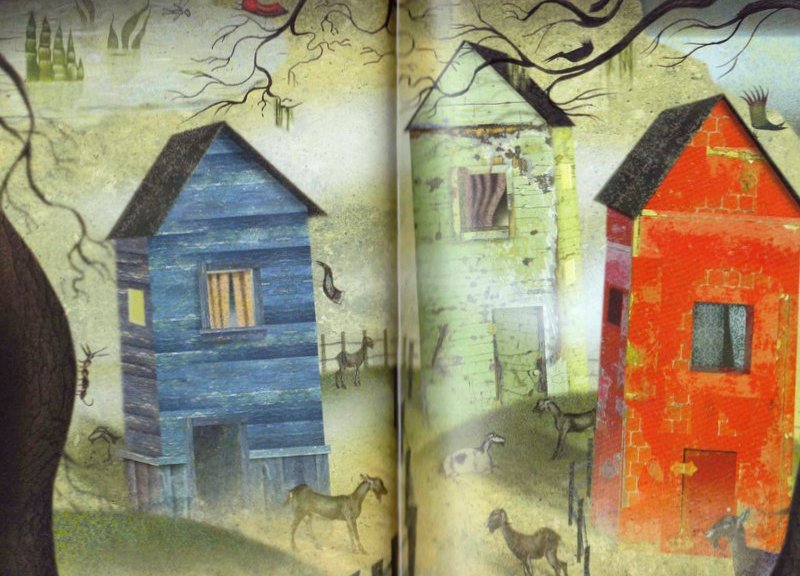
The story of Frip involves three houses for three families, all with children at the center. The houses are distinguished with primary colors—child-like blue, green, and red—but Lane’s artwork adds the ominous to Saunders’ seemingly simple narrative tinged with more than a bite of satire. The illustrations echo the haunting works about and for children found in Neil Gaiman and Tim Burton.

“Frip was three leaning shacks by the sea.” (p. 6) Artwork by Lane Smith

A child standing precariously close to the end of a slanted cliff over an angry ocean catches the eye on page 7 and then the crux of the story pulls you back to the text on page 6:

Frip was three leaning shacks by the sea. Frip was three tiny goat-yards into which eight times a day the children of the shacks would trudge with gapper-brushes and cloth gapper-sacks that tied at the top. After brushing the gappers off the goats, the children would walk to the cliff at the edge of town and empty their gapper-sacks into the sea. (p. 6)

Gappers, orange burr-like creatures with many eyes and the size of a baseball, come to represent throughout the story the power of the systemic inevitable: The presence of the gappers determines the lot of the families (and their goats), but most of the people in the tale remain unable to see beyond their own fixed and mostly misguided worldviews.

“A gapper’s like that, only bigger, about the size of a baseball, bright orange, with multiple eyes like the eyes of a potato.” (p. 2) Artwork by Lane Smith

When the gappers cling to the goats of all three families, there is an ironic appearance of equality among them. But when the fortune of one family shifts, the gappers fulfill their name by creating the gap:

So that night, instead of splitting into three groups, the gappers moved into one very large and impressive shrieking group directly into Capable’s yard. (p. 12)

Before this shift in how the gappers behave, of course, the three families are not equal because Capable is an only child living with her father and who has lost her mother. Capable works as all the children are expected to work (removing gappers in a daily Sisyphean nightmare of chores) and seeks to serve the needs of her grieving father, who along with his grief is a prisoner of nostalgia:

“I myself was once an exhausted child brushing off gappers. It was lovely! The best years of my life. The way they fell to the sea from our bags! And anyway, what would you do with your time if there were no gappers?” (p. 11)

This nostalgia masking an unnecessarily burdensome childhood, however, is but one ideology weighing on Capable because as soon as the other two families are relieved of gappers on their goats, those families reveal themselves to be very much like the people of Le Guin’s Omelas:

“It’s a miracle!” Mrs. Romo shouted next morning, when she came out and discovered that her yard was free of gappers. “This is wonderful! Capable, dear, you poor thing. The miracle didn’t happen to you, did it? I feel so sorry for you. God has been good to us, by taking our gappers away. Why? I can’t say. God knows what God is doing, I guess! I suppose we must somehow deserve it!” (p. 17)

Capable becomes the sacrificed child, and despite her misfortune, the relieved families read the events as their merit (and of course the ugly implication that Capable and her father deserve the burden of the gappers).

What follows from this shift in fate is the central story of Frip with Capable as our main character. The message becomes clear, and Saunders and Lane make the ride one you’ll want to visit again and again. If you are lucky, the book could become one of those read alouds requested by son or daughter, or by a classroom of children.

And while I will leave the rest of the story to you, I think it is necessary to note here that this allegory is both a cautionary tale about how we view children and childhood as well as a brilliant call to reconsider how we view education and education reform.

George Saunders’s Allegory of Scarcity and Slack

The U.S., like the characters (except for Capable) in Saunders’s story, is tragically blinded by a belief in cultural myths that have little basis in evidence: That we live and work in a meritocracy, that competition creates equity, that children need to be “taught a lesson” about the cold cruel world lest they become soft, and such.

As a result of these beliefs, schools often reflect and perpetuate rather harsh environments for children—or to be more accurate, schools often reflect and perpetuate rather harsh environments for other people’s children, as Capable personifies.

Here, then, I want to make the case that The Very Persistent Gappers of Frip is a powerful allegory of scarcity and slack as examined by Sendhil Mullainathan and Eldar Shafir in their Scarcity: Why Having Too Little Means So Much.

Mullainathan and Shafir detail that the conditions of poverty, scarcity, so overburden people psychologically, mentally, and physically that their behavior is often misread (poor people are lazy, poor people make bad decisions, etc.). In Saunders’s story, scarcity and its burden are portrayed by the gappers, and readers witness how the coincidence of the onslaught of the gappers changes the families involved. In other words, the behavior of people is determined by the environment, and not by the inherent goodness or deficiencies of any individual.

The Very Persistent Gappers of Frip goes further, however, by showing that one person’s scarcity (Capable) allows other person slack: privilege is built on the back of others, and those conditions are mostly arbitrary. While Mullainathan and Shafir argue that the slack enjoyed by those living in relative privilege provides the sort of cognitive space needed to excel, Saunders speaks to more than the slack enjoyed by the two families relieved of gappers and the compounding scarcity suffered by Capable (her lot in life and the addition of the gappers):

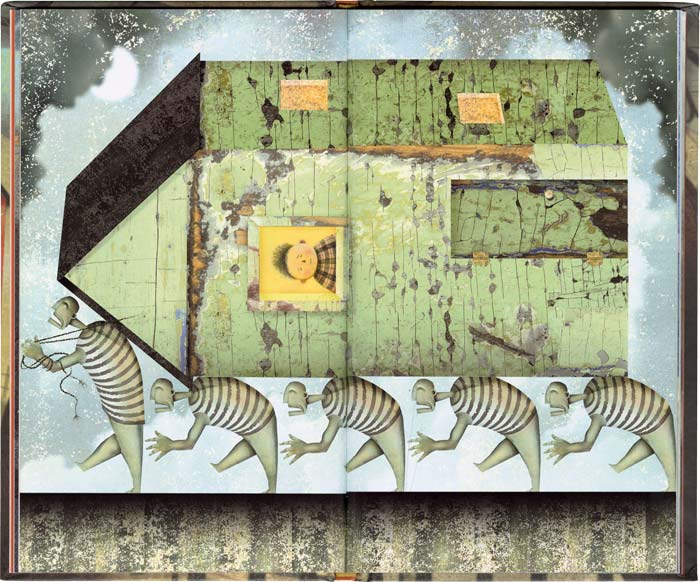
“And the men succeeded in lifting the house and moving it very very close to the third and final house in Frip, which belonged to Sid and Carol Ronsen, who stood in their yard with looks of dismay on their nearly identical frowning faces.” (p. 23) Artwork by Lane Smith
  • Capable represents a counter-narrative to claims that impoverished children lack “grit.” As her name suggests, this child is more than capable, but the world appears determined to defeat her.
  • Capable also embodies Lisa Delpit’s confrontation of “other people’s children”—that those with privilege (slack) are willing to allow one set of standards for other people’s children (often living and learning in scarcity), standards they will not tolerate for their own.

As I stated in the opening, allegory seeks to open our eyes by diversion, creating an other world that helps us see both the flaws with our now and the enduring failures of humans to embrace our basic humanity, a failure Capable teeters on the edge of making herself but cannot:

And [Capable] soon found that it was not all that much fun being the sort of person who eats a big dinner in a warm house while others shiver on their roofs in the dark.

That is, it was fun at first, but then got gradually less fun, until it was really no fun at all. (p. 70).

In the end, it is this sort of charity, this sort of recognition of the community of humanity, a call for the kindness found in Kurt Vonnegut’s similar mix of dark humor that Saunders appears to suggest we are all capable.

Companion Reads for The Very Persistent Gappers of Frip

Scarcity: Why Having Too Little Means So Much, Sendhil Mullainathan and Eldar Shafir

“The Ones Who Walk Away From Omelas,” Ursula K. Le Guin

“The Soul of Man under Socialism,” Oscar Wilde (1891)

“The Silenced Dialogue: Power and Pedagogy in Educating Other People’s Children,” Lisa Delpit

Other People’s Children: Cultural Conflict in the Classroom, Lisa Delpit

“NPR Whitewashes ‘Grit’ Narrative” 

Competition: A Multidisciplinary Analysis, Wade B. Worthen, A. Scott Henderson, Paul R. Rasmussen and T. Lloyd Benson, Eds.

Kindness as Antidote to Fatalism of “Grit”

For all the advocates of “grit”—along with the disturbing racism and classism—the world is a horrible place, a fixed horrible place—one requiring children to be treated horribly as practice for that horrible world. (I imagine “grit” advocates see the world in Cormac McCarthy’s The Road when they are planning how to “toughen our children up.”)

And thus, it is that fatalism I find nearly as disturbing as the racism and classism (apparently “grit” advocates fail to notice or acknowledge that the world is not horrible for a select few, mostly white and wealthy).

The antidote to the horrible world, of course, is kindness:

our job

Post-apocalyptic Mindset in a Civilized World

The mass of men lead lives of quiet desperation.

Henry David Thoreau, Walden

Since October 1999, when I experienced several weeks of unrelenting panic attacks, I have been negotiating my lifelong struggle with anxiety—many of those years spent completely unaware of the problem and then coming to recognize and even understand a condition that to most people seems completely irrational (even silly).

Not to slip into being simplistic, one of the foundational ways in which I have come to understand better anxiety is that my body responds to the civilized world in ways that prehistory demanded.

In other words, when human existence depended on a constant state of vigilance, anxiety, that quality was passed on from human to human since those humans most vigilant—most aware of the world around them—lived long enough to procreate.

Now, although no mountain lion lies in wait to pounce upon me and make me its lunch, I live in a constant state as if that were true—hyperaware of both the world and every possibility about that world.

And that is the seemingly irrational part for those who do not experience incessant anxiety. Of course, I know better, but anxiety of the type I experience is beyond rationality.

Thus, for me (and possibly my fellow sufferers of anxiety), The Walking Dead (both the graphic series and the TV series) serves as a powerful allegory for our condition because surviving humans in that imagined post-apocalyptic world actually must exist always aware of the omnipresent possibility of zombie attack.

Post-apocalyptic Mindset in a Civilized World

But there is something here far beyond my personal wrestling with anxiety: The cultural and educational post-apocalyptic mindset in a civilized world.

To survive and thrive as a human has always been, is currently, and likely will be in the context of finite resources for survival and thriving.

For much of human history (and in our imagined post-apocalyptic worlds), those finite resources were necessarily the focus of human competition.

In the 21st century, humanity has not yet eradicated existence-as-survival among large numbers of people (disproportionately children, with no political power) born into and living in extreme poverty. However, in so-called developed countries, we do have pockets of organized societies that have built resources that, although still finite, are adequate to eradicate existence-as-survival if those people had the political will to address the distribution of those resources.

The U.S. is one such country that does not suffer under a scarcity of resources, but under an inequitable distribution of resources, one that allows (and even perpetuates) scarcity for some and abundance for others (primarily determined by anyone’s accident of birth).

I want to pose two claims now:

  1. The U.S. as a civilized nation could establish an equitable society in which the basic minimum human condition would insure that all have access to those resources that support both the need to survive and the urge to thrive.
  2. That ideal cannot be attained as long as the U.S. remains entrenched in ideologies committed to rugged individualism, competition, and institutional pursuits of “grit” and “zero tolerance.”

Not only are U.S. commitments to #2 counter to achieving #1, but also those commitments serve only to support the minority elite class that benefits from those ideologies despite having rarely exhibited those qualities.

In other words, the ruling elite have been born into abundance and haven’t experienced the anxiety of scarcity, but they demand that those born into and living in scarcity rise through a manufactured culture of competition—even though we have an abundance of resources to make such social Darwinism unnecessary.

As just one example, researchers and advocates of “grit” actually recommend placing impoverished and minority students in fabricated situations of scarcity to teach them the “grit” those researchers and advocates claim is the source of achievement among the affluent (a claim that, in fact, is at best misleading, and at worst, simply false).

And to add insult to injury, those outliers who have risen through scarcity to thrive have been co-opted into the post-apocalyptic mindset maintaining that since some have fought to survive, others must fight to survive.

The alternative of a society in which such base struggles do not have to occur is either ignored or trivialized as a soft option beneath our ruggedly individualistic culture. We boast, in fact, when we make other people suffer: “I taught him a lesson.”

As someone trapped in an irrational existence governed by anxiety—an existence dramatized in the fabricated world beyond the zombie apocalypse—I treasure the possibility of rejecting the post-apocalyptic mindset in a civilized world.

We know that scarcity creates anxiety and that any person suffers under the weight of scarcity, notably if that scarcity is avoidable. We also know that everyone benefits from a condition of abundance (see Scarcity).

And thus, I remain offended by the incessant refrain offered by those with the loudest voices in our society, voices that demand the least among us must work twice as hard as everyone else to earn the basic dignity of human existence the privileged have handed to them.

It is, ultimately, a shallow call against the world we could create, a world unlike our prehistoric past and unlike our fabricated post-apocalyptic future.

It is world where we no longer foster competition, but make competition unnecessary—as it already could be if we recognized we are no longer slaves to scarcity but to the inequitable distribution of resources that erases our humanity in very real ways that have nothing to do with zombies.

Many people throughout the world and in the U.S.—many children—lead lives of quiet desperation, desperation about food, shelter, health, and happiness.

One new fact of the human condition, however, is that those people do not have to lead lives of desperation. For those living in abundance, the choice to end scarcity is ours.

That we appear unwilling (not unable) to do so causes me great, and for once, justifiable anxiety.

On Children and Childhood

children guessed(but only a few
and down they forgot as up they grew

“[anyone lived in a pretty how town],” e.e. cummings

In one of those early years of becoming and being a teacher, when I was still teaching in the exact room where I had been a student (a school building that would eventually be almost entirely destroyed by a fire set by children), it was the first day of school, and I was calling that first roll—a sort of silly but important ritual of schooling for teachers and students.

Toward the back of the room and slightly to my left sat a big young man, a white male student typical of this rural upstate South Carolina high school in my home town; like me, he would accurately be considered in that context as a Redneck.

Just about everyone knows everyone in my hometown, and we are very familiar with the common names of that town. So when I came to this young man’s name—Billy Laughter (it rhymes with “slaughter”)—I said “Billy Laughter” (rhyming the last name with “after”).

Smiling, I scanned the room and then turned my eyes back to Billy; he was red-faced and on the edge of having a very bad first day, one that was likely going to result in his being punished for my having done a very stupid thing. I raised my hand, palm facing him, and said, “Billy, my mistake. I’m sorry. I was trying to be funny but it wasn’t.” And then I said his name correctly.

Billy had suffered a life of people mangling his name, and he wasn’t in any mood for my being clever on the first day of school.

Several years later, when I was teaching a U.S. history class as part of  my usual load as a member and chair of the English department, while I was having students form small groups, two young white males bumped into each other, back to back, while moving their desks. I caught the moment out of the corner of my eye and had to rush over to deter the fight that was about to occur.

I wasn’t surprised—this was typical of my small community, along with fights starting because “he/she looked at me wrong”—but some time after this, I saw a research study that explained how people in the South and North handled personal space differently. In the South, bumping into someone or looking at someone wrong is often interpreted as challenging someone’s honor, requiring a response. People in the North, conditioned by mass transit and crowded cities (I suspect the study was as much about rural and urban, as South and North), are not as apt to find acts of close proximity anything other than that.

So setting aside the urge to examine the Redneck honor code, I want to add just one more event from my coaching life in those middle years of my teaching.

While running a drill at soccer practice, I heard a comment from a player in a group behind me. My mind heard a player with whom I had been having trouble. He was difficult in class and on the team, and worst of all, he was very disruptive at practice.

I turned and, without hesitating, I announced, “You are out of here,” pointing with my finger up the hill. Throwing him out of practice? No, I kicked him off the team.

As the young man was walking up that hill, a timid player on the team said, “Coach, that was me.”

I had just kicked a young man off the team who had, in fact, not said a thing.

A day or so ago, I received an email from Alfie Kohn about his new book, The Myth of the Spoiled Child. Alfie was apologetic about self-promotion so I replied, thanked him for the book, and noted a book I am co-editing that appears to be of a similar mind about children and childhood, Pedagogies of Kindness and Respect: On the Lives and Education of Children.

I also noted that our perspectives on children—on how parents, teachers, and society treat children—appears to be a minority view.

I have been mulling, then, or more likely stewing about this for some time: What makes adults—even the ones who choose to spend their lives with children—so damned negative and hateful about those children?

That, I must admit, is the source of my palpable anger at the “grit,” “no excuses,” and “zero tolerance” narratives and policies.

I grew up and live in the South where the default attitude toward children remains that they are to be seen and not heard, that a child’s role is to do as she/he is told. If a child crosses those lines, then, we must teach her/him a lesson, show her/him who is boss—rightfully, we are told, by hitting that child: spare the rod spoil the child.

That Christ’s love comes in the form of corporal punishment has never made any sort of sense to me, but I find that same deficit view of children is not some backwoods remnant of the ignorant South; it is the dominant perspective of children throughout the U.S.

Barbara Kingsolver explains in “Everybody’s Somebody’s Baby”:

This is not the United States.

For several months I’ve been living in Spain, and while I have struggled with the customs office, jet lag, dinner at midnight and the subjunctive tense, my only genuine culture shock has reverberated from this earthquake of a fact: People here like kids. They don’t just say so, they do. Widows in black, buttoned-down c.e.o.’s, purple-sneakered teen-agers, the butcher, the baker, all have stopped on various sidewalks to have little chats with my daughter. Yesterday, a taxi driver leaned out his window to shout ” Hola, guapa !” My daughter, who must have felt my conditioned flinch, looked up at me wide-eyed and explained patiently, “I like it that people think I’m pretty.”

With a mother’s keen myopia, I would tell you, absolutely, my daughter is beautiful enough to stop traffic. But in Santa Cruz de Tenerife, I have to confess, so is every other person under the height of one meter. Not just those who agree to be seen and not heard. When my daughter gets cranky in a restaurant (and really, what do you expect at midnight?), the waiters flirt and bring her little presents and nearby diners look on with that sweet, wistful gleam of eye that before now I have only seen aimed at the dessert tray. Children are the meringues and eclairs of this culture. Americans, it seems to me now, sometimes regard children as a sort of toxic-waste product: a necessary evil, maybe, but if it’s not their own they don’t want to see it or hear it or, God help us, smell it.

I just don’t get it.

A child is not a small adult, not a blank slate to be filled with our “adult weariness,” or a broken human that must be repaired (I won’t belabor, but the whole Original Sin idea doesn’t help and justifies the drive to use the rod).

But it is also certainly true that children are not angels, not pure creatures suited to be simply set free to find the world on their own.

Seeing children through deficit or ideal lenses does not serve them—or anyone—well.

And within the U.S. culture there is a schizophrenia—we worship young adulthood in popular media, but seem to hate children—that is multiplied exponentially by a lingering racism and classism that compounds the deficit view of childhood. Consider the research showing how people view children of color:

Asked to identify the age of a young boy that committed a felony, participants in a study routinely overestimated the age of black children far more than they did white kids. Worse: Cops did it, too….

The correlation between dehumanization and use of force becomes more significant when you consider that black boys are routinely estimated to be older than they are….

The less the black kids were seen as human, the less they were granted “the assumption that children are essentially innocent.” And those officers who were more likely to dehumanize black suspects overlapped with those who used more force against them.

In the enduring finger-pointing dominant in the U.S.—blaming the poor for their poverty, blaming racial minorities for the burdens of racism, blaming women for the weight of sexism—we maintain a gaze that blinds us to ourselves, allows us to ignore that in that gaze are reflections of the worst among us.

Why do the police sweep poor African American neighborhoods and not college campuses in search of illegal drugs? Why do we place police in the hallways of urban high schools serving mostly poor African American and Latino/a students, demanding “zero tolerance”? Why are “grit” narratives and “no excuses” policies almost exclusively targeting high-poverty, majority-minority schools (often charter schools with less public oversight)?

When I raise these questions, I can rest assured I will inspire the same sort of nasty response I often encounter when cycling. A few motorists make their anger known when we are riding our bicycles, and I am convinced that while some are genuinely frustrated with our blocking temporarily the road, the real reason they are angry is that we are enjoying ourselves as children do.

And nothing angers a bitter adult as much as the pleasures of a child.

Children are not empty vessels to be filled, blank hard drives upon which we save the data we decide they should have. Children are not flawed or wild, needing us neither to repair nor break them.

And children are not to be coddled or worshipped.

They are children, and they are all our children.

Yes, there are lessons to be taught, lessons to be learned. But those driven by deficit or idealized views are corrupted and corrupting lessons.

Each and every child—as all adults—deserves to have her/his basic dignity respected, first, and as adults charged with the care of any child, our initial question before we do anything with or to a child must be about ourselves.

In 31 years of teaching, I can still see and name the handful of students I mis-served, like Billy above. Those faces and names serve as my starting point: With any child, first do no harm.

The ends can never justify the means.

Snow Blind: “Trapped in the Amber of This Moment”

What is wrong with the following claims?

  • The rich and successful are rich and successful because of their work ethic.
  • The poor are poor because they fail to take advantage of the American Dream.
  • Women are paid less than men because they choose fields/careers that pay less and choose family over career.
  • Prisons are overwhelmingly populated by African Americans because they are trapped in the cycle of poverty.
  • Work hard and be nice.
  • Education, especially college, is the main path for rising above the conditions of any person’s home or community.

Before I examine the answer, consider this enduring claim:

  • In 1492, Columbus sailed the ocean blue, and thus, Columbus discovered America. [The original poem ends “The first American?  No, not quite./ But Columbus was brave, and he was bright.”]

And how about this blast from the past:

Dewey Defeats Truman

As Lienhard explains:

Gallup brought science to that process. Richard Smith tells how, by the time Landon challenged Roosevelt, the prestigious Literary Digestmagazine was America’s leading pollster. The Digest featured a regular poll called “America Speaks.” It drew samples from phone books and auto registrations. Gallup knew that such samples were biased toward people with means….

Then, in 1948, Gallup blew the Truman-Dewey prediction. How? His mistake was to quit polling two weeks before the election with fourteen percent of the electorate still undecided. After that humiliation, Gallup went back to analyze his error. He emerged with the maxim, “Undecided voters side with the incumbent.”

By 2012, then, you’d think polling would have reached some higher and clearer process for predicting presidential outcomes, but instead, we had the Nate Silver element, yet another case about how the science of polling has flaws, human flaws.

Even, it seems, as science inspects itself—acknowledging and addressing confirmation bias, for example—we are always “trapped in the amber of this moment,” since the human condition is itself necessarily a subjective experience.

And now, in order to answer my initial question, I want to turn to history; while history as a discipline is distinct from the hard sciences, both are dependent on evidence and then the conclusions drawn from that evidence—conclusions I call narratives (more on that below). Consider Howard Zinn on Christopher Columbus:

My viewpoint, in telling the history of the United States, is different: that we must not accept the memory of states as our own. Nations are not communities and never have been, The history of any country, presented as the history of a family, conceals fierce conflicts of interest (sometimes exploding, most often repressed) between conquerors and conquered, masters and slaves, capitalists and workers, dominators and dominated in race and sex. And in such a world of conflict, a world of victims and executioners, it is the job of thinking people, as Albert Camus suggested, not to be on the side of the executioners.

Thus, in that inevitable taking of sides which comes from selection and emphasis in history, I prefer to try to tell the story of the discovery of America from the viewpoint of the Arawaks, of the Constitution from the standpoint of the slaves, of Andrew Jackson as seen by the Cherokees, of the Civil War as seen by the New York Irish, of the Mexican war as seen by the deserting soldiers of Scott’s army, of the rise of industrialism as seen by the young women in the Lowell textile mills, of the Spanish-American war as seen by the Cubans, the conquest of the Philippines as seen by black soldiers on Luzon, the Gilded Age as seen by southern farmers, the First World War as seen by socialists, the Second World War as seen by pacifists, the New Deal as seen by blacks in Harlem, the postwar American empire as seen by peons in Latin America. And so on, to the limited extent that any one person, however he or she strains, can “see” history from the standpoint of others.

In other words, shaping narratives bound by evidence does not insure that those narratives are pure and certainly does not insure that those narratives are above bias or absent the urge to mold them in order to secure someone’s agenda (likely someone in power). [1]

Snow Blind

Misleading narratives around Columbus or “I cannot tell a lie” George Washington—and the whitewashing of Steve Jobs to promote the “grit” narrative (compare the Jobs lesson to the original 1492 poem about Columbus)—are not problematic because of the evidence, but because of the lens through which the narratives are shaped and by whom those narratives are created and in whose interest.

Consider Billy Pilgrim in a telepathic conversation with a Tralfamadorian in Kurt Vonnegut’s Slaughterhouse Five:

“Welcome aboard, Mr. Pilgrim,” said the loudspeaker. “Any questions?”

Billy licked his lips, thought a while, inquired at last: “Why me?”

“That is a very Earthling question to ask, Mr. Pilgrim. Why you? Why us for that matter? Why anything? Because this moment simply is. Have you ever seen bugs trapped in amber?”

“Yes.” Billy, in fact, had a paperweight in his office which was a blob of polished amber with three ladybugs embedded in it.

“Well, here we are, Mr. Pilgrim, trapped in the amber of this moment. There is no why.”

And that brings me to the “grit” debate, one in which advocates point to scientific research and prestigious grants. From that evidence, we have three contexts of narratives: disciplinary narratives (Angela Duckworth, Carolyn Dweck), popular narratives (Paul Tough, Jay Mathews), political narratives (Arne Duncan, Michelle Rhee)—all of which are trapped like bugs in amber, or as I prefer to suggest, that “grit” narrative advocacy is snow blind.

If evidence and the narratives surrounding the evidence appear to support a privileged agenda, and since the privileged have a larger megaphone in a culture, then that evidence and narrative are disproportionately likely to gain momentum—regardless of how accurate they are in the context of the oppressed or marginalized (consider again history and the Zinn points above).

And that inability by the privileged to see beyond their privilege is, I think, a state of being snow blind.

Thus, my answer to the initial question at the beginning is that those claims as narratives built on evidence are ideological distortions of the evidence. The “grit” narrative is similar to the education = income argument that falls apart when analyzed: Education is a marker for privilege (since privilege leads to advanced education) just as “grit” qualities are markers for privilege.

Systemic Inequity v. Rugged Individualism

In Slaughterhouse Five, the work of Howard W. Campbell (previously the main character in Vonnegut’s Mother Night) is quoted:

America is the wealthiest nation on Earth, but its people are mainly poor, and poor Americans are urged to hate themselves….

Americans, like human beings everywhere, believe many things that are obviously untrue….The most destructive untruth is that it is very easy for any American to make money. They will not acknowledge how in fact hard money is to come by, and, therefore, those who have no money blame an blame and blame themselves. This inward blame has been a treasure for the rich and powerful, who have had to do less for their poor, publicly and privately, than any other ruling class since, say, Napoleonic times. (pp. 164, 165)

Snow blind and bugs trapped in amber, the privileged by their privilege and the impoverished by the blinding but misleading promise of the American Dream—the narratives become the product of those who shape them and for whose benefit, regardless of the evidence, the artifacts, the data.

Let me end, then, with a couple of points to consider, one from the 1973 satire Sleeper  [2] and the other from Vonnegut’s Cat’s Cradle.

First, a scene from the film:

And then, John and Mona in Cat’s Cradle discuss Boko-maru (a sacred foot ceremony) and their culturally-bound and conflicting perceptions of love:

“Mona?”

“Yes?”

“Is—is there anyone else in your life?”

She was puzzled. “Many,” she said at last.

“That you love?”

“I love everyone.”

“As—as much as me?”

“Yes.” She seemed to have no idea that this might bother me….

“I suppose you—you perform—you do what we just did—with other people?’

Boko-maru?”

Boko-maru.

“Of course.”

“I don’t want you to do it with anybody but me from now on,” I declared.

Tears filled her eyes. She adored her promiscuity; was angered that I should try to make her feel shame. “I make people happy. Love is good, not bad.”

“As your husband, I’ll want all your love for myself.”

She stared at me with widening eyes. “A sin-wat!”

“What was that?

“A sin-wat!” she cried. “A man who wants all of somebody’s love. That’s very bad.” (pp. 207-208)

John is trapped in the amber of the moment, his patriarchal and possessive love leaves him snow blind to Mona’s perspective. He either cannot see, or refuses to see.

So I have made a decision—one shared by Zinn, expressed by Eugene V. Debbs, and reflected in the research of Sendhil Mullainathan and Eldar Shafir—that the perspectives of the marginalized must be honored in the context of systemic inequities.

This is a position of humility and a recognition that any human arrogance—whether it be scientific or not—is likely to lead to the sort of pettiness captured in the Sleeper clip: both the satire aimed at the foolish dietary beliefs of the past and the incredulity of the scientists in the film’s present (“You mean there was no deep fat…?” exposes that despite the scientists recognizing the misguided stances of the past, they remain trapped in their own certainty).

Both the “grit” narrative and the “grit” research fail that litmus test. They both speak from and to a cultural norm that privileges individual characteristics (rugged individualism) as if they are indistinguishable from the systemic context of privilege (again, a claim refuted by Mullainathan and Shafir, but that narrative doesn’t serve the privileged, and thus, isn’t embraced as the “grit” narrative is).

Many novelties have come from America,” the cited monograph from Campbell notes, adding:

The most startling of these, a thing without precedent, is a mass of undignified poor. They do not love one another because they do not love themselves. (p. 165)

The human intellect is a wonderful thing, and thus, we must pursue our efforts to understand the world and the human condition—a thing we call science. But as humans, it is not ours to somehow remove our basic humanity from that process (the folly of objectivity), but to choose carefully just how we shape the narratives from the evidence we gather.

I am then compelled to manipulate Einstein once again. His “Science without religion is lame, religion without science is blind,” I think, is a call for the necessity of human kindness, decency, and compassion in the shaping of our narratives. The “grit” narrative does no such thing. It is a snow blind story that is also deaf to the basic human dignity shared among all people.

Your Honor, years ago I recognized my kinship with all living beings, and I made up my mind that I was not one bit better than the meanest on earth. I said then, and I say now, that while there is a lower class, I am in it, and while there is a criminal element I am of it, and while there is a soul in prison, I am not free.

Eugene V. Debs: Statement September 18, 1918

[1] See Robert Pondiscio’s citing of Kurt Vonnegut’s “Harrison Bergeron,” a misleading use of Vonnegut in the name of choice that is well outside Vonnegut’s ideological leanings; see my posted comment.

[2] While citing a Woody Allen work is problematic, I am in no way endorsing Allen or any efforts to absolve him of guilt or responsibility in the ongoing controversy surrounding him.

Shiny Happy People: NPR, “Grit,” and “Myths that Deform” pt. 2

hagiography (n.) ha·gi·og·ra·phy \-gē-ˈä-grə-fē, -jē-\ (1) a book about someone’s life that makes it seem better than it really is or was, (2) a biography that praises someone too much

[A]s we put into practice an education that critically provokes the learner’s consciousness, we are necessarily working against myths that deform us. As we confront such myths, we also face the dominant power because those myths are nothing but the expression of this power, of its ideology. (Freire, 2005, p. 75)

For most people in 2014, that children were taught for many years in U.S. public schools that George Washington could not tell a lie (the old cherry tree myth) may seem quaint, and to others, a remnant of the distant past.

But the whole truth about this mythologizing of a Founding Father is that much of the knowledge imparted to students through formal schooling remains more propaganda than fact.

From Hellen Keller to Martin Luther King Jr. to Nelson Mandela, children are spoon-fed passive radical myths and distortions of selected exceptional people in order not to capture who those people were but to perpetuate cherished cultural myths (regardless of their veracity).

So if we return to NPR’s whitewashing of the “grit” narrative, we can see how corrosive “myths that deform us” are. The “grit” narrative is itself false, and thus, personal narratives must be manufactured to reinforce that foundational but false narrative.

All of this works, of course, among the shiny happy people who push the “grit” narrative.

Everyone is very happy.

But about those “myths that deform us”; recall the grit lesson in the NPR piece concerning Steve Jobs:

That message underlies every lesson at the Lenox Academy for Gifted Middle School Students in Brooklyn, N.Y., a public school that has been trying to make kids grittier for the past three years. On a recent day, in a typical lesson, a social studies class is studying Steve Jobs. Kids raise their hands to offer examples of Jobs’ grit.

“He had failed one of the Mac projects he was creating,” says one student.

“He used his mistakes to help him along his journey,” says another.

I wonder if students will be told the full story?:

One thing he wasn’t, though, was perfect. Indeed there were things Jobs did while at Apple that were deeply disturbing. Rude, dismissive, hostile, spiteful: Apple employees—the ones not bound by confidentiality agreements—have had a different story to tell over the years about Jobs and the bullying, manipulation and fear that followed him around Apple. Jobs contributed to global problems, too. Apple’s success has been built literally on the backs of Chinese workers, many of them children and all of them enduring long shifts and the specter of brutal penalties for mistakes. And, for all his talk of enabling individual expression, Jobs imposed paranoid rules that centralized control of who could say what on his devices and in his company.

Just as we conveniently ignore the full story about other shiny happy billionaires filled with grit.

There might be some problems with that story too:

Eichenwald’s conversations reveal that a management system known as “stack ranking”—a program that forces every unit to declare a certain percentage of employees as top performers, good performers, average, and poor—effectively crippled Microsoft’s ability to innovate. “Every current and former Microsoft employee I interviewed—every one—cited stack ranking as the most destructive process inside of Microsoft, something that drove out untold numbers of employees,” Eichenwald writes. “If you were on a team of 10 people, you walked in the first day knowing that, no matter how good everyone was, 2 people were going to get a great review, 7 were going to get mediocre reviews, and 1 was going to get a terrible review,” says a former software developer. “It leads to employees focusing on competing with each other rather than competing with other companies.”

And despite what valid criticisms we can offer about Malcolm Gladwell, he makes a pretty compelling case that Gates’s success is the result of as much good fortune as it is talent and effort.

The truth is that “grit,” or effort, is at best a secondary quality (and even then it is likely overemphasized as a key element in success) because the most powerful element at the causational level for most success (and failure) is the context in which any person finds her/himself.

Privilege and slack are conducive to excelling while scarcity tends to breed failure.

The root cause is systemic, not personal. The same person in a condition of slack and a condition of scarcity performs differently and experiences different outcomes.

The lesson, then, is if your primary message for children requires that you make up stories (or cherry-picking, if you will) to prove the myth is accurate, you are likely telling children “myths that deform us” (and that isn’t very hagiography-George-Washington of you).

And in no case is that justifiable.

Reference

Freire, P. (2005). Teachers as cultural workers: Letters to those who dare to teach (D. Macedo, D. Koike, & A. Oliveira, Trans.). Boulder, CO: Westview Press.

bootstraps