Category Archives: growth mindset

The Unbearable Lightness of Being a Practitioner in Education

In the final days of my Summer I graduate course, my department chair asked me to switch from the Summer II graduate course I was assigned (a new preparation I had worked on diligently to teach for the first time) to a literacy course in which the instructor could no longer teach the class.

This course was one I have never taught, and thus, would have to prepare in just a few days to take on—scrambling as I did to understand the other instructor’s syllabus and schedule while also facing the herculean task of teaching from four assigned books that I have never read.

This afternoon, then, when I face these graduate students, I will confess that I have never taught elementary literacy (the course is a graduate literacy methods class)—having all my experience and expertise in teaching high school and college literacy, primarily writing—and thus, I will be relying on their practitioner expertise (the students are mostly practicing elementary teachers) while performing the role myself of facilitator.

In my Summer I class, as well, one assignment required students to read a professional book on literacy, and share with the class. Part of our discussion revolved around professional books in education emphasizing classroom practice (over theory and philosophy) while being written by education personalities.

The credibility of these books are often grounded in the assumption these personalities are credible; issues of validity and reliability—and even thorough citation—are ignored or de-emphasized. So I cautioned them that professional books (and education personalities) are not to be viewed as scripture, not as sacred directives, but as opportunities to think along with these education personalities in order to develop and sharpen their own practitioner expertise.

My journey as an educator has included 18 years as a classroom high school English teacher followed by 16 years as a teacher educator, and concurrently, an education scholar and public intellectual.

I lived, then, nearly two decades of sitting in mandated workshops and presentations where education consultants spoke down to us practitioners while earning in a few hours what no practicing teacher earned. These consultants and speakers may have had some classroom experience, but it was vividly clear to us they had all eagerly jumped ship to talk to lowly practitioners because the hours and the pay were much better.

K-12 teachers tend to loath this traditional aspect of being a teacher—the torture of being treated unprofessionally and the waste of our precious time that we could all better use to do the stuff of teaching, planning and responding to student work.

The edu-guru market is an ugly beast that perpetuates the notion that K-12 teachers are not professional or experts themselves, that practice is somehow just a mechanical thing that can be imposed onto a passive and compliant workforce (let us hasten to add, a passive and compliant workforce in which 3 of 4 teachers are women with undergraduate and graduate degrees and years of experience).

So when I teach or provide in-service for teachers, I emphasize my own classroom experience above all else, and couch my scholarly expertise in that practice now edging toward 40 years.

The accountability era has ratcheted up this divide, in part perpetuated by authoritarian structures (prescriptive legislation and top-down managerial styles of administrators) and in part by the market.

This latter influence must not be ignored. Publishers depend heavily on the cult of personality to drive textbook and professional book sales as well as the related consultant appearances.

Too often, however, what is being mandated and sold proves to be mostly hokum beneath the shimmer and shine of well-formatted books and over-confident edu-gurus.

Paul Murphy’s Teachers Are Tired of Robert Marzano highlights nearly everything that is wrong with this cult of personality that de-professionalizes teachers while also blaming them for the outcomes driven by the practices they are mandated and coerced to implement.

Murphy stresses: “For years, teachers were asked (or, more often, told) to swallow a lot of crap. More and more of us are done eating it” (emphasis in original).

In a powerful and thorough interrogation of this dynamic, Benjamin Doxtdator challenges Doug Lemov and Dave Burgess:

Both Lemov and Burgess construct masculine, individualistic heroes. Champion teachers, according to Lemov, “routinely do what a thousand hand-wringing social programs have found impossible: close the achievement gap between rich and poor, transform students at risk of failure into achievers and believers, and rewrite the equation of opportunity.” For Burgess, Pirates are “entrepreneurs”, “daring, adventurous, and willing to set forth into uncharted territories with no guarantee of success. They reject the status quo and refuse to conform to any society that stifles creativity and independence.”

I have spent a great deal of my work as a scholar and public intellectual raising the same concerns about Angela Duckworth’s grit and Carol Dweck’s growth mindset.

Scholars of poverty and social class began lining up more than a decade ago to refute the popular but invalid training provided by Ruby Payne, who continues to profit greatly off the uncritical edu-guru poverty circuit funded mostly by tax dollars.

There are patterns to all this madness:

  • Practitioners are framed as or assumed to be unprofessional and inexpert.
  • Experts are, then, the consultants themselves, who are beyond reproach (criticize the work of Duckworth, or John Hattie, and expect to be accused of attacking the people themselves, to be shamed for the criticism).
  • Both educational research and teacher practices are trivialized as secondary to the gimmick (grit, teaching like a champion, visible learning, etc.) and the edu-guru who peddles the gimmick.
  • Teaching and learning are necessarily narrowed and over-simplified. Marzano and Hattie direct a laser focus on the impact of teachers; Duckworth and Dweck keep the accusatory eye on weaknesses and flaws in the children/students themselves.
  • Teacher and student voices are muted or entirely ignored.
  • Teachers are conditioned to behave in unprofessional ways that are used to justify treating them unprofessionally.
  • Divisions of labor and compensation for labor are disturbingly skewed so that practitioners are underpaid and under-appreciated while consultants and administrators (farthest from the day-to-day experiences of students) are overpaid and overvalued.

When I met with a colleague who designed the course I will be teaching for the first time this afternoon, she empathized with the abrupt change in course assignments and then helped me tremendously by noting that when she taught the course, she used elements of the National Writing Project (NWP) model for summer institutes.

I was co- and lead instructor of a writing project in South Carolina at the end of my high school teaching career just before entering higher education in 2002. Being a participant in and then facilitating for a NWP site were by far the greatest experiences for me as an educator and a professional.

Why? The sacred elements of these summer seminars were the professionalism of the teachers and the community of scholars that was fostered and developed.

One of the most important refrains of these communities was the call to check ourselves regularly against the allure of edu-gurus and gimmicks (we at first embraced the term “best practice” and then quickly felt it had become a mandate and not a healthy generalization for how any teacher works from a toolbox of practices with the needs of the learner guiding those fluid decisions).

K-12 practitioners remain trapped in a hellish contradiction created by the cult of personality driving edu-gurus and gimmicks: Teachers are simultaneously posed as the singular and most important factor in student learning (a verifiable lie) and then treated as incompetent technicians.

Teachers need to be relieved of edu-gurus and gimmicks; they deserve professional experiences that include the time, support, and conditions that are conducive to what is best for each student taking a seat in any of their classrooms.

Teachers must not be reduced to technocrats, must not be compelled to be martyrs and missionaries.

If we can resist the allure of celebrity and cashing in, we must ultimately acknowledge the humanity of teachers and their students, while admitting the ugly influences of sexism and consumerism that too often trump our stated goals of democracy and equity.

Everything You Know Is Wrong

My adolescence was profoundly shaped by hours alone in my room listening to comedy albums, memorizing them—George Carlin and Richard Prior. My aunts and uncle also introduced me to the comedy group Firesign Theatre, whose Everything You Know Is Wrong may serve as the ideal message for educators.

Recently, Jessica McCrory Calarco reported in Why rich kids are so good at the marshmallow test:

The failed replication of the marshmallow test does more than just debunk the earlier notion; it suggests other possible explanations for why poorer kids would be less motivated to wait for that second marshmallow. For them, daily life holds fewer guarantees: There might be food in the pantry today, but there might not be tomorrow, so there is a risk that comes with waiting. And even if their parents promise to buy more of a certain food, sometimes that promise gets broken out of financial necessity.

And from Science DailyStudy finds popular ‘growth mindset’ educational interventions aren’t very effective:

A new study co-authored by researchers at Michigan State University and Case Western Reserve University found that “growth mindset interventions,” or programs that teach students they can improve their intelligence with effort — and therefore improve grades and test scores — don’t work for students in most circumstances.

Also consider Will Thalheimer’s People remember 10%, 20%…Oh Really?:

People do NOT remember 10% of what they read, 20% of what they see, 30% of what they hear, etc. That information, and similar pronouncements are fraudulent. Moreover, general statements on the effectiveness of learning methods are not credible—learning results depend on too many variables to enable such precision. Unfortunately, this bogus information has been floating around our field for decades, crafted by many different authors and presented in many different configurations, including bastardizations of Dale’s Cone. The rest of this article offers more detail.

Yet another example is the zombie that will not die, the “word gap”—debunked again in Reexamining the Verbal Environments of Children From Different Socioeconomic Backgrounds, by Douglas E. Sperry, Linda L. Sperry, and Peggy J. Miller:

Abstract

Amid growing controversy about the oft‐cited “30‐million‐word gap,” this investigation uses language data from five American communities across the socioeconomic spectrum to test, for the first time, Hart and Risley’s (1995) claim that poor children hear 30 million fewer words than their middle‐class counterparts during the early years of life. The five studies combined ethnographic fieldwork with longitudinal home observations of 42 children (18–48 months) interacting with family members in everyday life contexts. Results do not support Hart and Risley’s claim, reveal substantial variation in vocabulary environments within each socioeconomic stratum, and suggest that definitions of verbal environments that exclude multiple caregivers and bystander talk disproportionately underestimate the number of words to which low‐income children are exposed.

But let’s not forget higher education: Arthur G. Jago asks Can It Really Be True That Half of Academic Papers Are Never Read?, discovering:

Frustrated, I ended my search for the bibliographic equivalent of “patient zero.” The original source of the fantastical claim that the average academic article has “about 10 readers” may never be known for sure.

So what’s going on as educators and scholars are confronting that everything you know is wrong? I think have some ideas, outlined below:

  • Teachers, notably K-12 educators, are practical to a fault. Teachers want what works in the day-to-day tasks of teaching students (a more than reasonable expectation) but often feel educational philosophy and theory are a waste of their very limited time (again, this time-crunch is a rational response to unreasonable working conditions for most K-12 teachers). The problem with a what works mentality absent a philosophical and theoretical lens is that the wrong basis for determining “works” often guides our practices. As a brief example, many classroom strategies can seem to “work” when students are quiet and complete the assignment, but those may be achieving compliance and not the larger (assumed) academic goal—actually working counter to those goals in fact.
  • Too often teaching can become almost entirely focused on implementing a program (think reading programs or International Baccalaureate) or fulfilling an ideology (think grit and growth mindset) at the exclusion of the instructional goals those programs or ideologies are supposed to achieve. This happens, I think, in part because of the concern for practicality noted above as that is impacted by the historical focus in education on efficiency—what is the easiest and most manageable ways to make this think called teaching and learning happen?
  • Programs and ideologies, however, are often flawed from the beginning because the research they are grounded in is distorted and oversimplified by publishers and advocates. Compounding these oversimplifications and distortions are the media, also complicit in framing complex research in ways that mislead the public and educators. Too often as well, the misconceptions are compelling and robust because they match social norms (stereotypes, biases, cultural myths) more so than reflecting the nuances and limitations of the research. As I have detailed, for example, academic and economic success and failure are far less about any person having or not grit or a growth mindset and more about systemic privilege and disadvantage.
  • Classrooms, teachers, and students are more likely to reflect all aspects of communities and society than to work as change agents for any person or community/society. Teaching and learning, then, become about normalizing, and thus, regardless of what research shows (especially when much of that research is counter to norms), it becomes a tool for the normalizing. One study on the “word gap” by Hart and Risley has become an unexamined fact, not because it is quality research (it isn’t) but because it reinforces cultural myths about social class, deficit ideologies that praise the wealthy and demonize the poor.
  • Teaching and learning are incredibly complex and the consequences of teaching—learning—are rarely easily linked to a single cause (a teacher, a class, a program or ideology) and may not manifest themselves until years later.
  • Too many researchers, consultants, administrators, and teachers become personally, professionally, and financially invested in programs and ideologies—at the expense of everything else, notably students.
  • From K-12 to higher education, teaching and learning are mostly corporatized; in that environment, research, nuance, and uncertainly have no real chance. K-12 schools and universities/colleges are incentivized for many outcomes other than teaching and learning.
  • Educators, the public, and the media embrace contradictory ideas about “scientific” and “research”—simultaneously idealizing and trivializing.

In the big picture, I think the problem of research and evidence as that becomes teaching practices can be better understood through the lens of what is wrong with Teach For America—an organization that very likely has good intentions and invites as well as promotes missionary zeal.

Good intentions are never enough, and missionary zeal is guaranteed to distort everything it touches.

It may well be true that everything you know is wrong, but that doesn’t mean it must stay that way. Good intentions and missionary zeal must be replaced by greater philosophical awareness and the sort of skepticism a critical lens provides.

This is not about fatalism—giving up on research—but about finding a better way forward, one that rejects programs and blanket ideologies and keeps our focus on students and learning along with the promises of formal schooling as a path to equity and justice, not test scores and compliant students.

More on Rejecting Growth Mindset, Grit

When I posted a recent study on growth mindset—Study finds popular ‘growth mindset’ educational interventions aren’t very effective—on my blog Debunked!, growth mindset advocates quickly bristled at the blog title, notably this Tweet:

Several patterns in the subsequent Twitter discussion are worth addressing in a format more detailed than Tweets.

First, I have been a consistent critic of both growth mindset and grit best captured in the following posts:

I immediately shared these posts as part of the discussion—often guided by Wormeli’s thoughtful and welcomed concerns about my stances.

Next, however, many advocates (mostly for growth mindset) offered typical rebuttals, including (1) arguments that both growth mindset and grit in practice are often counter to the intent of Carol Dweck  (growth mindset) and Angela Duckworth (grit), noting that both have raised concerns about those misuses and misconceptions, (2) chastising me for “conflating” growth mindset and grit, and (3) requesting practical alternatives to growth mindset and grit practices.

To the first point, I want to be clear that I am strongly aware of the gender problems inherent in me, a white male academic, challenging Dweck and Duckworth, including critiques that can be and have been viewed as attacking them personally.

I do think it is fair to address the character of those scholars advocating character education for children (see this on Duckworth, for example), but I also have taken care to monitor gender biases inherent in how we police women scholars versus men scholars.

But, while I am aware that both Dweck and Duckworth have raised concerns about the misuses of growth mindset and grit, I contend that both scholars have reaped a great deal of financial and professional capital from that misuse, primarily, and haven’t refused those profits. I find their cautions hollow, then.

I reject the second point—that I conflate growth mindset and grit—and recognize that growth mindset advocates often seek ways to distance themselves from the grit movement and that research has begun to challenge both growth mindset and grit research by Dweck and Duckworth, although far more challenging claims have been made against Duckworth’s research.

In short, I absolutely recognize that growth mindset and grit are not the same, and may not even be on the same level of validity and credibility as research.

However, while I do not conflate the two, I do highlight in my critiques that both are grounded in deficit ideologies: Both growth mindset and grit, I contend, mistake growth mindset/grit as the dominant or even exclusive quality causing success in student learning (ignoring the power of systemic influences) and then create an environment in which some students (too often black, brown, and poor) are defined in deficit terms—that they lack growth mindset/grit.

Yes, growth mindset and grit are unique approaches, but they share the failure of being complicit in deficit practices. And while the science of growth mindset may be more solid than the science of grit, both are prone to the problem of scientific racism—the failure to unpack “high-quality research” for biases.

Now, to the final point, I would recommend Paul Gorski’s work on equity practices, specifically this second edition which directly confronts both growth mindset and grit: Reaching and Teaching Students in Poverty: Strategies for Erasing the Opportunity Gap. Here, also, are some starting points with Gorski’s work:

Ultimately, then, I do reject growth mindset and grit, both as programs that are misused and thus harmful to the students who need formal education the most. I also see little room to justify the research behind either, or to excuse Dweck or Duckworth even when they raise cautions about the misuses.

My concerns are driven by an equity lens that recognizes and confronts the problems masked by narrow views of research and science as well as the myopia inherent in accountability that demands in-school-only approaches to teaching, testing, and reform that tend to be driven by bootstrap ideologies.

Teaching and learning as well as success and failure are incredibly complex. Often in education, our rush to find the key to success and failure in order to improve teaching and learning is ruined by a missionary zeal corrupted by biases—both of which must be confronted and resisted.

Growth mindset and grit fail as overzealous programs, and students are better served by equity practices couched in efforts to alleviate the systemic forces that shape how they live and learn regardless of their character.

Education’s Fatal Flaw: “[T]he considerable gap”

In my upper-level writing and research course, Scholarly Reading and Writing in Education, students have been practicing critical discourse analysis of how media cover selected issues in education in order to compare that coverage to the research base on that topic.

They have recently submitted initial drafts of the major scholarly essay and are now drafting a public commentary drawn from the same analysis. One student in last evening’s seminar approached me with a question.

She was very concerned that her topic seemed to show a distinct disconnect between education policy and the research base, wondering if that was unique to her topic, and why that failure existed.

Her question came during the workshop time after we had read and discussed a recent public commentary of mine on school safety and the threat of gun violence as a model for their commentaries. I noted that her observation was accurate, and that it was not simply her topic, but common across all of public education—as I noted in my commentary that challenges popular school safety measures not supported by research

Coincidentally, I came across the next morning a Twitter thread about the broader failure in education to embrace progressivism:

While progressivism in education (often linked directly to John Dewey) has been routinely blamed for causing educational failure, as Alfie Kohn has addressed, the reality is that education has failed progressivism:

The rarity of this approach, while discouraging to some of us, is also rather significant with respect to the larger debate about education. If progressive schooling is actually quite uncommon, then it’s hard to blame our problems (real or alleged) on this model. Indeed, the facts have the effect of turning the argument on its head: If students aren’t learning effectively, it may be because of the persistence of traditional beliefs and practices in our nation’s schools.

Kohn’s analysis is a mere decade old, and if anything, his observations have intensified as the U.S. continues to double-down on traditional and technocratic practices such as standards and high-stakes testing.

However, if we look back to 1942, Lou LaBrant exposed the exact same dynamic grounded in a public outcry over low literacy among men enlisted in the military:

Within the past ten years we have made great strides in the teaching of purposeful reading, reading for understanding (the kind of reading, incidentally, which the army and navy want). Nevertheless, we hear many persons saying that the present group of near-illiterates are results of “new methods,” “progressive schools,” or any deviation from the old mechanical procedures. They say we must return to drill and formal reciting from a text book. (p. 240)

However, LaBrant completely discredits the blame:

1. Not many men in the army now have been taught by these newer methods. Those few come for the most part from private or highly privileged schools, are among those who have completed high school or college, and have no difficulty with reading.

2. While so-called “progressive” schools may have their limitations, and certainly do allow their pupils to progress at varied rates, above the second grade their pupils consistently show superior ability in reading. Indeed, the most eager critics have complained that these children read everything they can find, and consequently do not concentrate on a few facts. Abundant data now testify to the superior results of purposeful, individualized reading programs.

3. The reading skills required by the military leaders are relatively simple, and cause no problem for normal persons who have remained in school until they are fourteen or fifteen. Unfortunately the large group of non-readers are drop-outs, who have not completed elementary school, come from poorly taught and poorly equipped schools, and actually represent the most conservative and backward teaching in the United States. (pp. 240-241)

Just 5 years later, LaBrant penned what would become a refrain of her six-plus decades as an educator: “A brief consideration will indicate reasons for the considerable gap between the research currently available and the utilization of that research in school programs and methods” (p. 87).

“[T]he considerable gap” between policy/ practice and research has, then, defined public education throughout the twentieth and into the twenty-first centuries.

Again, as I confront about fortifying schools against gun violence and the research base on those so-called safety measures, practices such as grade retention and even corporal punishment [1] remain policy all across the U.S. despite decades of evidence overwhelmingly rejecting their use. Grade retention, for example, has been formally refuted by the National Council of Teachers of English (NCTE), yet states continue to adopt grade retention based on high-stakes tests for third graders.

As LaBrant challenged decades ago, literacy today is failing students because policy remains anchored to discredited practices and ideologies such as the “word gap,” reading programs, leveled texts, isolated phonics and grammar instruction, and test-prep.

Possibly one of the most troubling examples of this phenomenon is the relentless and bi-partisan obsession with charter schools, especially the abusive practices found in so-called “no excuses” charters. As this review details,

A report, Charter Schools and the Achievement Gap, finds that, though charter schools on average perform no better than traditional public schools, urban “no-excuses” charter schools—which often use intensive discipline to enforce order—demonstrate promising results. It recommends that these schools and their practices be widely replicated within and outside of the charter school sector. We find three major flaws with this conclusion.

This endorsement of “no excuses” charter schools, again, simply ignores the broader research base that cautions against charter schools broadly and “no excuses” practices more specifically.

So, as I answered my student’s insightful question, I noted a few important ways to understand “the considerable gap” between policy/practice and research.

First, educators—unlike doctors and lawyers, for example—have never controlled the field of education. Public education has always been hostage to partisan politics and mind-numbing bureaucracy.

Let me caution here that I am not making a narrow Libertarian swipe at “government” schooling—since we are government—but acknowledging that just as education has failed progressive and critical theory and practice, public institutions have mostly failed the promise of democratic government because of partisan politics and bureaucracy.

Next, and related, the evidence vacuum that exists in the dynamic between political leaders and the public, again, can be witnessed in the school safety debate. Politicians both speak to and perpetuate public misconceptions about fortifying school—the public’s irrational trust in armed police on campuses, surveillance cameras, and metal detectors (all of which have been shown to make schools more dangerous, not safer).

But that same evidence vacuum occurs throughout the adoption and implementation of education policy.

LaBrant’s 1947 unmasking of “the considerable gap” ends with her imploring English teachers and NCTE:

This is not the time for the teacher of any language to follow the line of least resistance, to teach without the fullest possible knowledge of the implications of his medium. Before we, either as individuals or as a Council, experiment with methods of doing specific things or block out a curriculum, let us spend some time with the best scholars in the various fields of language study to discover what they know, what they believe uncertain and in need of study. Let us go to the best sources, and study the answers thoughtfully. (p. 94)

As teachers strike across the U.S. in 2018, let’s us carry LaBrant’s message forward because the only hope that exists for our schools and the students they serve is to close the gap by allowing teachers as professionals to practice our field guided by the evidence too long ignored by the political bureaucracy that has defined public education for more than a century.


[1] The list of ideologies and practices that represent “the considerable gap” is far too long to include in the discussion above, but here are many of the key ones worth recognizing: “grit,” growth mindset, merit pay, VAM, standards, and high-stakes testing. Please refer to the Categories in the right menu for posts related to each of these.

The Lingering, and Powerful, Legacy of “Scientific Racism” in America

Writing about the class of 2017’s performance on the newly redesigned SAT, Catherine Gewertz notes, “The number of students taking the SAT has hit an all-time high,” and adds cautiously:

What appear to be big scoring increases should be understood not as sudden jumps in achievement, but as reflections of the differences in the test and the score scale, psychometricians said.

More test takers and higher scores, albeit misleading ones, are the opening discussion about one of the most enduring fixtures of U.S. education—standardized testing as gatekeeping for college entrance, scholarships, and scholastic eligibility.

However, buried about in the middle of Gewertz’s article, we discover another enduring reality:

The 2017 SAT scores show inequities similar to those of earlier years. Asian (1181), white (1118), and multiracial (1103) students score far above the average composite score of 1060, while Hispanic (990) and African-American (941) students score significantly below it.

Throughout its long history, the SAT, like all standardized testing, has reflected tremendous gaps along race, social class, and gender lines; notable, for example, is the powerful correlation between SAT scores and takers’ parental income and level of education as well as the fact that males have had higher average scores than females for the math and verbal sections every year of SAT testing (the only glitch in that being the years the SAT included a writing section).

The SAT is but one example of the lingering and powerful legacy of “scientific racism” in the U.S. Tom Buchanan, in F. Scott Fitzgerald’s The Great Gatsby, punctuates his racist outbursts with “‘It’s all scientific stuff; it’s been proved.'”

Buchanan represents the ugly and rarely confronted relationship between “scientific” and “objective” with race, social class, and gender bigotry. In short, science has often been and continues to be tainted by bias that serves the dominant white and wealthy patriarchy.

Experimental and quasi-experimental research along with so-called standardized testing tends to avoid being implicated in not only identifying racism, classism, and sexism, but also perpetuating social inequity.

As I noted recently, since Carol Dweck and Angela Duckworth have produced mainstream scientific studies and published in reputable peer-reviewed journals, their inherently biased work has been nearly universally embraced—among the exact elites who tend to ignore or outright reject the realities of inequity and injustice.

As just one example, Duckworth grounded her work in and continues to cite a Eugenicist, Francis Galton, with little or no consequences.

Racism, classism, and sexism are themselves built on identifying deficits within identifiable populations. Science allows these corrupt ideologies to appear factual, instead of simple bigotry.

“Scientific” and “objective” are convenient Teflon for bias and bigotry; they provide cover for elites who want evidence they have earned their success, despite incredible evidence that success and failure are more strongly correlated with the coincidences of birth—race, social class, gender.

It takes little effort to imagine a contemporary Tom pointing to the 2017 SAT data and arguing, “‘It’s all scientific stuff; it’s been proved.'”

Such ham-fisted scientism, however, mutes the deeper message that SAT data is a marker for all sorts of inequity in the U.S. And then when that data have the power to determine college entrance and scholarships, the SAT also perpetuates the exact inequities it measures.

The SAT sits in a long tradition including IQ testing that speaks to a jumbled faith in the U.S. for certain kinds of numbers and so-called science; when the data and the science reinforce our basest beliefs, we embrace, but when data and science go against out sacred gods, we refute (think climate change and evolution).

Science that is skeptical and critical, questioning and interrogating, has much to offer humanity. But science continues to be plagued by human frailties such as bias.

Science, like history, is too often written by the winners, the oppressors. As a result, Foucault details, “[I]t is the individual as he[/she] may be described, judged, measured, compared with others, in his[/her] very individuality; and it is also the individual who has to be trained or corrected, classified, normalized, excluded, etc.” [1]

“Scientific racism,” as a subset of science that normalizes bigotry, allows the accusatory white gaze to remain on groups that are proclaimed inherently flawed, deficient, in need of correction. “Scientific racism” distracts us from realizing that the tests and science themselves are the problem.

And thus, we must abandon seeking ever-new tests, such as revising the SAT, and begin the hard work of addressing why the gaps reflected in the tests exist—a “why” that is not nested in any group but our society and its powerful elite.


[1] Foucault, M. (1984). The Foucault reader. Ed. P. Rabinow. New York: Pantheon Books, p. 203.

See this thread:


Rejecting Growth Mindset and Grit at Three Levels

[Header Photo by Dave Lowe on Unsplash]

As the academic year began at my university, I was confronted with how the very worst of K-12 public education reform continues to creep upward, engulfing higher education.

In this case, growth mindset was central to the faculty keynote address, prompting me to resist an outburst in front of my colleagues. I did, however, weigh in on social media, including Facebook—where a few faculty were intrigued and reached out by email.

Last week, then, we held a faculty discussion on growth mindset, and of the three panelist, I was the only one calling for at least a skeptical view if not an outright rejection of the concept (along with grit, which was mentioned in the keynote but not central to the presentation).

For simplicity and clarity, I want to outline here briefly (since I have written extensively about both growth mindset and grit; see the Categories here on the blog) why I call for skepticism and even rejecting the practices associated with the terms.

At the first level, I question the ideological motivation for doing research to find the source of success and failure within individuals—assuming that individual character and behaviors are primarily or solely the source of both success and failure.

As a colleague noted during comments after the keynote, this is a “very American” way of thinking; and I would add, a flawed view of the relationship between human behavior and social forces.

Here, I recommend Scarcity: Why Having Too Little Means So Much by Sendhil Mullainathan and Eldar Shafir, and argue that social forces are primary to human behaviors. I also call into question the rush to characterize what is success and failure—since a tremendous amount of both outcomes are more strongly correlated to a person’s environment of birth than any accomplishments by the person.

At the second level, I am cautious about the quality of growth mindset and grit research as valid, and that caution is grounded in the first level—both concepts fit well into American myths about rugged individualism and the Puritan work ethic; thus, even so-called dispassionate researchers are apt to see no reason to challenge the studies (although some have begun to unpack and question Angela Duckworth’s studies on grit).

Scarcity, mentioned about, is a compilation of powerful studies that make a case unlike what most Americans believe about success and failure: those living in scarcity struggle because of the scarcity (think poverty), and those living in slack are often successful because of the slack. This work has not been embraced or received the celebrity of growth mindset and grit because it works against our narratives.

Privileged researchers blinded by their own belief in American myths as well as trust in their own growth mindset and grit, I fear, are not apt to challenge research that appears even to a scholar to be obvious.

The third level is the most damning since growth mindset and grit speak to and reinforce powerful cultural ideologies and myths about meritocracies and individual character—ones that are contradicted by the evidence; and thus, growth mindset and grit contribute to lazy and biased thinking and assumptions about marginalized groups who suffer currently under great inequities.

K-12 applications of growth mindset and grit have disproportionately targeted racial minorities and impoverished students, reinforcing that most of the struggles within these groups academically are attributable to deficits in those students, deficits linked to race and social class.

All three levels, then, are born in, protected by, and prone to perpetuate race and class stereotypes, and as a result, work against inclusive pedagogy and culturally relevant pedagogy.

Finally, stepping back from these levels, I also remain skeptical of growth mindset and grit because they are very difficult to disentangle from deficit perspectives of students and from monolithic, thus reductive, views of identifiable groups by race, class, gender, or educational outcomes.

Instead I endorsed what Paul Gorski argues about equity literacy principles:

Equity literate educators recognize and draw upon the resiliencies and other funds of knowledge accumulated by poor and working class communities, reject deficit views that focus on fixing marginalized students rather than fixing the conditions that marginalize students, and understand the structural barriers that cheat some people out of the opportunities enjoyed by other people.

Please Support #FixInjusticeNotKids

Paul Gorski, currently preparing a revised edition of Reaching and Teaching Students in Poverty: Strategies for Erasing the Opportunity Gap, has initiated #FixInjusticeNotKids on social media, a hashtag that captures perfectly the primary fracture between mainstream education reformers and social justice education reformers.

As some examples, here are Tweets of mine addressing this powerful message:

Many elements of mainstream reform embrace a deficit view of children and students, specifically black and brown students as well as students living in poverty. This ideology blames the victims of social inequity, racism, classism, and sexism; it creates a laser focus on the individual and blinds us to systemic injustice.

Support #FixInjusticeNotKids in word and action to seek ways to reject deficit ideology and to end inequity and injustice so that the potential of all children can be achieved among a people who genuinely believe all children matter,

Hiding Behind Rhetoric in the Absence of Evidence

Having been extensively cited in recent news articles on education, I have received the typical responses, both by email and an Op-Ed (High expectations lead to achievement).

What is notable about these disgruntled responses can be seen directly in the headline above—a dependence on soaring and idealistic rhetoric to mask a complete failure to either discount my evidence or to provide any credible evidence for the counter arguments.

A recent email argued that I was causing more harm than good for emphasizing the impact of racism on literacy education and achievement by students; the rebuttal, however, was peppered with “I believe” and not a single effort to rebut the dozens of research studies I provided on both grade retention and racism/sexism.

While I pressed that point in a few replies, the offended person only ever produced as some sort of evidence a TED Talk, an unintended confession that his world-view depends on whiz-bang showmanship and seeing in any outlier example a confirmation of his biases—what Maia Szalavitz identifies as “’fundamental attribution error’. This is a natural tendency to see the behavior of others as being determined by their character – while excusing our own behavior based on circumstances.”

The emails were almost entirely rhetorical, like a TED Talk, and then divorced from any sort of empirical evidence.

The Op-Ed reflects in a more public way this same disturbing pattern. William W. Brown, founder and chairman of the board of Legacy Early College, holds forth in defense of the charter school’s “no excuses” approach to educating poor and mostly black/brown students, an ideology and set of policies that I have rejected for many years as inherently racist and classist.

While Brown quotes a few of my comments from a news article and then suggests he aims to rebut them, he merely slips each time into restating the ideology of the charter school, the rhetoric of high expectations.

Early in the commentary, Brown notes: “However, Thomas does not acknowledge that a college education is the single most reliable way to lessen the effect of systemic racism and end poverty.”

Here is the exact strategy employed by Arne Duncan throughout his tenure as Secretary of Education: make a grand rhetorical claim that most people in the U.S. believe (education is the “great equalizer”), and then offer no evidence it is true while hoping no one calls you on it.

The truth is hard to swallow, however, because education can be shown through ample evidence to have very little impact on erasing inequity driven by racism and sexism. For just a few of many examples, please consider the following:

Whites with only high school completion earn more than Blacks/Hispanics having completed 2 years of college. (Bruenig, 24 October 2014)

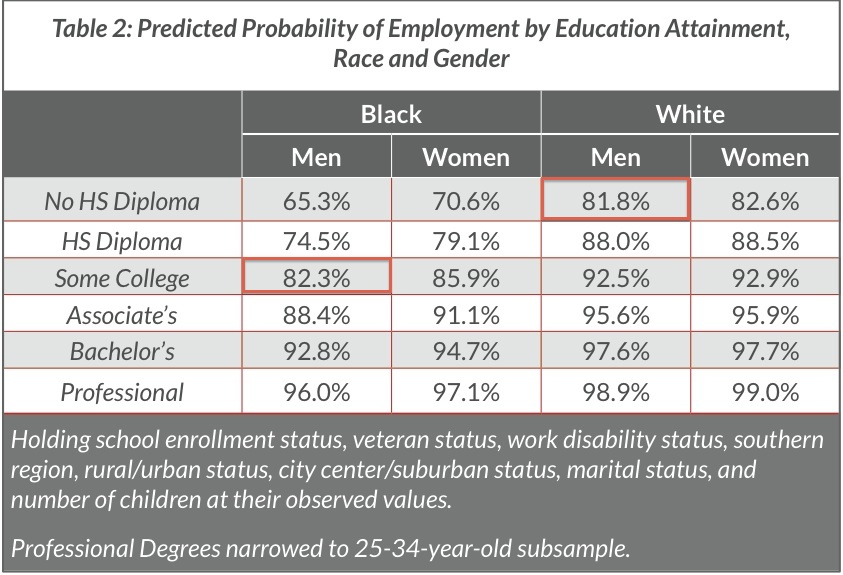
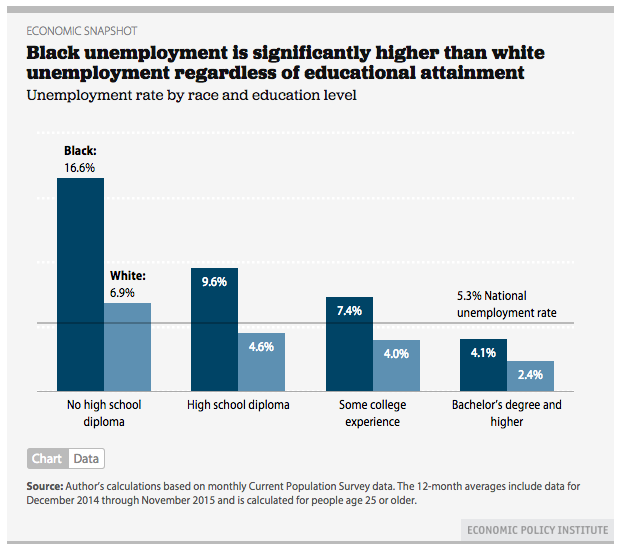
White men with no high school diploma have the same employment opportunities as black men with some college completion. (Closing the Race Gap)

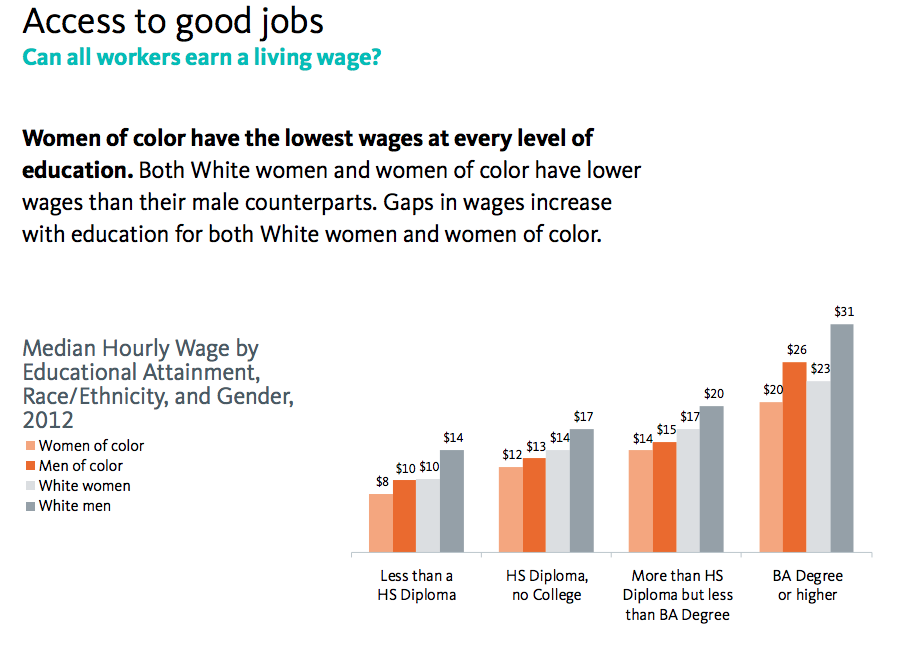
Race and gender remain powerful sources of inequity despite educational attainment. (Access to good jobs)

Brown also cites this: “He goes on to say, ‘Successful people in the United States tend to be white and come from privilege and they’re not necessarily working harder than anybody else but they have incredible advantages.'”

And then makes no effort to address why he believes my comment is “problematic.” Perhaps he could consider the following:

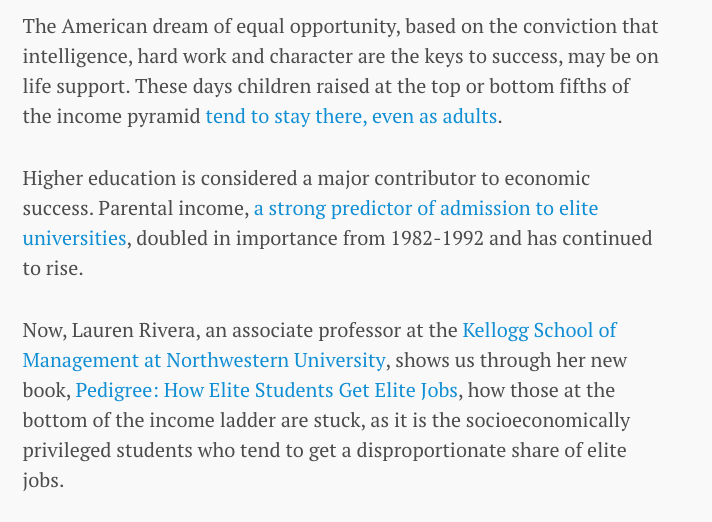
The best way to nab your dream job out of college? Be born rich

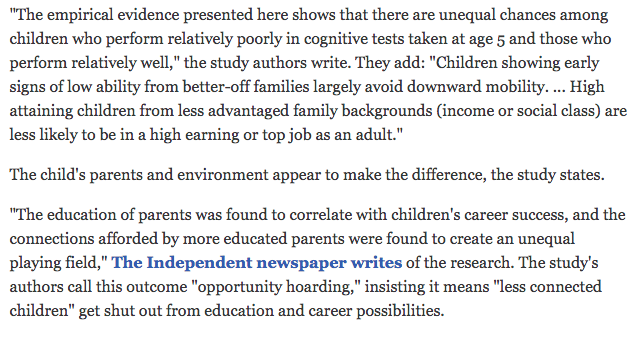
Why rich kids do better than smarter, less advantaged kids: ‘opportunity hoarding’

 Black unemployment is significantly higher than white unemployment regardless of educational attainment | Economic Policy Institute

Abstract

Racial discrimination in labor markets is a critical process through which organizations produce economic inequality in society. Though scholars have extensively examined the discriminatory decisions and practices of employers, the question of how job seekers try to adapt to anticipated discrimination is often overlooked. Using interviews, a laboratory experiment, and a résumé audit study, we examine racial minorities’ attempts to avoid discrimination by concealing or downplaying racial cues in job applications, a practice known as “résumé whitening.” While some minority job seekers reject this practice, others view it as essential and use a variety of whitening techniques. When targeting an employer that presents itself as valuing diversity, however, minority job applicants engage in relatively little résumé whitening and thus submit more racially transparent résumés. Yet, our audit study shows that organizational diversity statements are not actually associated with reduced discrimination against unwhitened résumés. Taken together, these findings suggest a paradox: Minorities may be particularly likely to experience disadvantage when they apply to ostensibly pro-diversity employers. These findings illuminate the role of racial concealment and transparency in modern labor markets and point to an important interplay between the self-presentation of employers and the self-presentation of job seekers in shaping economic inequality. (Whitened Résumés: Race and Self-Presentation in the Labor Market, Sonia Kang, Katy DeCelles, András Tilcsik, and Sora Jun)

One other tactic I experience is the subtle and not-so-subtle effort by the “no excuses” crowd to turn charges of racism toward those of us calling out the racism of “no excuses” practices: “If you believe the zip code where you were born should determine your educational outcome, you basically believe that some people aren’t built for success, which is — to put it bluntly — racist.”

Two aspects of this strategy are important to highlight. First, Brown here and others must misrepresent my claims (I have never and would never embrace or suggest that we ask less of any child or that some group of people have less ability than others because of inherent deficiencies; in fact, my scholarship and public work directly reject deficit ideologies).

Second, this rhetorical slight of hand is designed to point anywhere other than the person making the claim.

This second part of the move is important for charter advocates and the “no excuses” crowd because evidence is not on their side.

The Legacy Charter school endorsed by Brown has three consecutive years of “below average” state report cards (2012-2014, the most recent since report card assessments have been suspended in SC until this coming fall).

And my analysis of two years of data on SC charter schools has shown:

  • Using 2011 SC state repost cards and the metric “Schools with Students Like Ours,” charter schools performed as follows: 3/53 ABOVE Typical, 17/53 Typical, and 33/53 BELOW Typical.
  • Using 2013 SC state repost cards and the metric “Schools with Students Like Ours,” charter schools performed as follows: 2/52 ABOVE Typical, 20/52 Typical, 22/52 BELOW Typical.

The “high expectations” movement, again mostly aimed at black/brown and poor children, has some serious flaws because the rhetoric is discredited by the evidence.

In short, education is not the “great equalizer” in the U.S. And committing to “high expectations” for children living inequitable and overburdened lives suggests their struggles are mostly their fault because they simply are not working hard enough.

That is a calloused and racist/classist lie.

As I detailed above, success in the U.S. is mostly about advantages, not working hard.

Brown concludes with a flurry of rhetoric: “You could burn the world down as it is because it’s too hard to fix systemic injustices, or you could build it up to the sky because you know in your heart that’s where we belong. Keep your matches. I’m grabbing a hammer and a ladder.”

What should disturb us is how easily the winners (even those claiming good intentions) in the U.S. are willing to throw up their hands when challenged to address systemic racism, classism, and sexism.

In fact, this admission is awash in excuses and absent the exact resilience needed to address inequity that these adults demand of children, who must somehow set aside their lives each day they walk through the doors of school and behave in ways the adults refuse to do.

Our Gladiator Culture: On “Grit,” Competition, and Saving Future Generations

my father moved through griefs of joy;…
his shoulders marched against the dark

“my father moved through dooms of love,” e.e. cummings

This place could be beautiful,
right? You could make this place beautiful.

“Good Bones,” Maggie Smith

While sitting in the ER with my father a few nights ago before he was admitted into the hospitals’ heart center—a few days after my mother’s stroke sending her to another, larger hospital 40-minutes away—I was reminded of Alice Walker’s The Color Purple, a novel, among other things, about the abusive power imbalance between men and women.

Late in the novel, Celie explains to her sister Nettie: “Take off they pants, I say, and men look like frogs to me. No matter how you kiss ’em, as far as I’m concern, frogs is what they stay.”

The most powerful and imposing man in my life, my father, sat in the ER—stooped, shrunken, pot-bellied, tongue hanging out of his mouth and bowed head like an aged human-sized toad somehow in a wheelchair. My father has always been my physical and athletic superior, despite my being in my mid-50s and quite successful in my career and my athletic hobby; he has always cast a shadow, darkening my lingering insecurities and anxieties.

This morning, Father’s Day 2017, I visited my father still in the heart center after spending almost all my time at my mother’s side as the number of family members able to help has dwindled as the day-count grows. Although improved, frog-like and frail, my father declared to me: “Nothing is wrong with me. I need to go home.”

For some time now, his heart has been working at only about 33%, wearing him and his pacemaker out at an accelerated rate.

In times of great medical stress, when families are brought together, stories spring forth to stabilize the chaos and restore our delusion that we have some sort of control.

One of the many myths of my father: In high school, because of fights and sports (my father was a four-sport letterman and captain of his high school’s first state championship football team in the 1950s), by age 18, my father had a full set of false teeth. So many teeth had been knocked out, his dentist eventually pulled the remaining 10 or 12 one day.

After the procedure, my father played in a baseball game, prompting his father to track him down, trying to make him come home to rest.

Like him, my mother is a gendered twin of the fanatic 1950s template for self-sacrifice, rugged individualism, and blind faith in the whitewashed American Dream—the racialized lie about hard work paying off and good guys winning.

I believe I am not being hyperbolic to recognize that my parents lie now in hospitals, broken and frail, because they bought the hokum, the hard-work hokum that makes people define their dignity in how fervently they sacrifice themselves, in how they work moment by moment to prove they are not lazy, soft, or in any way dependent on others.

My parents passed onto me a neurotic work ethic; my father instilled in me an incredibly unhealthy obsession with being athletic as proof of my manhood.

Although I have been trying to ween myself off sports fandom, I remain often connected to the sports fanaticism of the U.S.—one most solidly grounded in college and pro football, the perfect metaphor for the gladiator culture that defines us.

Dragged kicking and screaming, college football and the NFL have begun paying lip-service to acknowledging that [gasp!] the sport is cruelly violent, that football players are turning their brains into mush because of the relentless concussions that are simply part of the game.

The stories linked to the concussion debate in football are powerful and disturbing because they reveal a subtext that also came to mind as I sat with each of my parents: pro football players, many retired, admit that they have and would continue to lie about concussion symptoms to remain on the field.

The gladiator culture of the U.S. is replicated exponentially in the NFL [1]—toxic and hyper-masculinity, anything necessary including sacrificing health and even life.

And while the NFL and football mania of the U.S. are disturbing, the most troubling reality is that our neo-work-ethic of the twenty-first century targets children, specifically black and brown children from impoverished backgrounds.

The “grit” and growth mindset movements have become (mainstream) socially acceptable ways to wink-wink-nod-nod that black, brown, and poor people are simply too lazy, unwilling to work themselves, like my dad and mom, into decrepitude for the 1%.

Frantic—we are a nation with a ruling class snowblinded by their own privilege and terrified they won’t have a servant class—the whitewashed American Dream for black, brown, and poor children.

The U.S. has devolved into a perverse and inverted gladiator culture with the 1% in the stands and the rest of us reduced to a dog-eat-dog existence, an artificial and unnecessary dog-eat-dog existence.

Visit the elderly of this country, worn down by the demands that they work hard and depend on no one.

Look into their faces and if you can their eyes.

This is the future we are demanding of “other people’s children.”

But it is also a future we can reject, choosing instead an ethic of community and compassion.

As I look at my parents—discardable white working class Americans—I think that they deserved better, despite their own culpability in our whitewashed American Dream.

On this awful Father’s Day 2017, I would prefer above all else to be on the couch with my granddaughter, who yesterday kept imploring me “Wake up, Papa!” as I tried to doze between sessions with my mother, as she snuggled against me, her futon.

I know she deserves better—as does every single child having come to this planet and country by no choice of their own.

“This place could be beautiful,/right? You could make this place beautiful”—a haunting image of everything that I wish for this world in a poem by Maggie Smith that confesses:

The world is at least
fifty percent terrible, and that’s a conservative
estimate, though I keep this from my children.

On this awful Father’s Day 2017, I have kept much from my father and my mother in ways substantial and indirect.

But there is no way to justify the lies we tell children—that they fail to work hard enough, that they are somehow not good enough unless they act as if they do not matter, that they should shut up and suck it up.

Few things are worth fighting for, but one is to keep every child from the gladiator’s ring, to promise every child if not a beautiful world, at least the possibility of one.


[1] In the same way the NFL promotes the great lie that the U.S. is a meritocracy:

Despite this, NFL Commissioner Roger Goodell rejected on Friday the idea that any kind of blackballing was taking place. He called the NFL “a meritocracy,” saying, “If they see an opportunity to get better as a football team, they’re going to do it. They’re going to do whatever it takes to make their football team better. So, those are football decisions. They’re made all the time. I believe that if a football team feels that Colin Kaepernick, or any other player, is going to improve that team, they’re going to do it.”

Easter 2017 Reader: Grit, Poetry, Educational Rankings, Poverty

Grit

Forget Grit. Focus on Inequality, Christine Yeh (Education Week)

Grit is an easy concept to fall in love with because it represents hope and perseverance, and conjures up images of working-class individuals living the “American dream.” However, treating grit as an appealing and simple fix detracts attention from the larger structural inequities in schools, while simultaneously romanticizing notions of poverty….

Perhaps this idea of grit resonates with so many people who believe in the popular American adage that if you work hard and pull yourself up by your bootstraps, then you can achieve anything. This belief unfortunately, assumes that individuals have the power, privilege, and access to craft their own futures, regardless of circumstance and systemic barriers.

Statistics on educational access consistently reveal vast differences in resources in affluent versus poor neighborhoods. Predominantly white, middle- and upper-income school districts tend to spend significantly more money per student than the districts with the highest percentages of marginalized students. Our poorest schools also tend to have large class sizes, unsafe school transportation, damaged and outdated facilities, and high staff turnover. All of these conditions directly contribute to low educational outcomes and underscore the link between access to school resources and improvements in students’ success. Schools that focus on grit shouldn’t ignore structural inequities because they assume that regardless of your race, class, or social context you can still triumph.

Telling children ‘hard work gets you to the top’ is simply a lie, Hashi Mohamed (The Guardian)

What I have learned in this short period of time is that the pervasive narrative of “if you work hard you will get on” is a complete myth. It’s not true and we need stop saying it. This is because “working hard, and doing the right thing” barely gets you to the starting line. Furthermore, it means something completely different depending on to which context you’re applying this particular notion. So much more is required.

I have come to understand that the systems that underpin the top professions in Britain are set up to serve only a certain section of society: they’re readily identifiable by privileged backgrounds, particular schools and accents. To some this may seem obvious, so writing it may be superfluous. But it wasn’t obvious to me growing up, and it isn’t obvious to many others. The unwritten rules are rarely shared and “diversity” and “open recruitment” have tried but made little if any difference.

Those inside the system then naturally recruit in their own image. This then entrenches the lack of any potential for upward mobility and means that the vast majority are excluded.

Check out Neoliberalism: A Concept Every Sociologist Should Understand, Peter Kaufman (Everyday Sociology)

The end result of neoliberal ideology, Monbiot continues, is that we are led to believe in the myth of the self-made person:

“The rich persuade themselves that they acquired their wealth through merit, ignoring the advantages – such as education, inheritance and class – that may have helped to secure it. The poor begin to blame themselves for their failures, even when they can do little to change their circumstances. Never mind structural unemployment: if you don’t have a job it’s because you are unenterprising. Never mind the impossible costs of housing: if your credit card is maxed out, you’re feckless and improvident. Never mind that your children no longer have a school playing field: if they get fat, it’s your fault. In a world governed by competition, those who fall behind become defined and self-defined as losers.”

See Also

Failing Still to Address Poverty Directly: Growth Mindset as Deficit Ideology

SchoolED Podcast: Paul Thomas on Grit, Slack, and the Effects of Poverty on Learning

UPDATED (Again): Grit, Education Narratives Veneer for White, Wealth Privilege

“Grit” Takes another Hit (with Caveats)

Rejecting “Grit” While Embracing Effort, Engagement

Poetry/ National Poetry Month 2017

Perspective | Poet: Why I would never tell a student what a poem means, Sara Holbrook (The Answer Sheet/ Washington Post)

A few months ago I wrote an essay, “I Can’t Answer These Texas Standardized Test Questions About My Own Poems,” in which I questioned those of unknown academic distinction who anonymously compose proficiency test questions. Many teachers wrote to tell me that they too are unable to answer these vaguely written test questions being used to evaluate their students. One teacher reported that her kids had to endure 17 days of testing this year. Considering there are only about 20 days of school in a month and that every test requires preparation on the devices and manner of testing, that’s a lot of lost instructional time.

Parents wrote. I did a few television interviews and radio programs. It was my 15 minutes. Additionally, I took some heat from a (very) few academics who jumped to inform me that authors do not own the meaning of a poem, it is up to literary critics to make this determination. Good grief.

It was not my intent to kick off an argument on of the relative merit of learned literary analysis. I’ll leave that to those with letters after their names. But friends, parents, educators, learned folks, please remember, middle-schoolers are not just short college sophomores. They are not lit majors. These are kids like Paul. Kids who are often grappling with a world of unseen and sometimes unspeakable challenges.

See Also

Investigating Poetry Because We Love It (and Our Students)

In Defense of Poetry: “Oh My Heart”

“So We must meet apart”: #NationalPoetryMonth 2017 and My Journey with Emily Dickinson

Educational Rankings

Are South Carolina schools really the worst in the nation?, Cindy Landrum (Greenville Journal)

Furman University education professor Paul Thomas said the education ranking is far less about education than socioeconomics.

“This ranking is a direct reflection of political negligence,” he said. “Our schools don’t legislate. It’s not like our schools are without any fault, but how schools function is a reflection of political leadership. South Carolina is failing our children, not our children are failing school.”

U.S. News & World Report used 11 metrics to measure a state’s education ranking, including college and high school graduation rates and standardized test scores. Three of the six pre-kindergarten-12 categories are test scores (ACT and National Assessment of Educational Progress), while the others are high school graduation rates, pre-K quality, and preschool enrollment. South Carolina ranked high in quality of its public pre-kindergarten program, but ranked low in test scores and college readiness.

“Schools in South Carolina and the U.S. reflect the inequities of communities, the failure of our policies, and as a result, they are ineffective as mechanisms of change,” Thomas said.

At least 60 percent of test scores are correlated with out-of-school factors such as parental education levels, poverty, hunger, mobility, lack of health care, safety, and community resources, he said. Only 10 percent to 15 percent of test scores can be traced to teacher quality.

Thomas said it has been known for decades that poverty and inequity are the greatest hurdles for children learning. But instead of addressing the problems, instead grade-by-grade standards are changed and students tested.

“Our states have social and educational pockets of poverty,” Thomas said. “Food and home insecurity directly contribute to low academic output, and once they get into school, we make horrible decisions. High-poverty children are sitting in larger classes with early-career and uncertified teachers. We do the exact opposite of what we should be doing.”

See Also

South Carolina Ranks First in Political Negligence

Poverty

America’s Shameful Poverty Stats, Sasha Abramsky (The Nation)

But there’s a deeper significance to the numbers: how they compare with the figures from recent decades. The percentage of people in poverty is roughly the same as in 1983, in the middle of the Reagan presidency, as well as in 1993, at the end of twelve years of Reagan/Bush trickle-down economics. A far higher portion of the population lives in poverty than was the case in the mid-1970s, after a decade of investment stemming from Lyndon Johnson’s War on Poverty; and far more live in poverty today than did at the end of Bill Clinton’s eight years in office—years in which the earned-income tax credit was expanded, unemployment was kept to near-historic lows, and poverty rates fell significantly.

That our poverty numbers have risen to such a high level exposes the fact that as a society, we are choosing to ignore the needs of tens of millions of Americans—as we have done for much of the period since the War on Poverty went out of fashion and the harsher politics of Reaganism set in. These ignored Americans include kids like the ones I interviewed in Los Angeles, forced to choose between applying to college or dropping out of school and getting dead-end jobs to support parents who had lost not only their jobs but their homes, too. They include the elderly lady I met outside Dallas, who was too poor to retire but too sick to take the bus to her work at Walmart. Her solution? She paid her neighbors gas money to drive her to a job that paid so little she routinely ate either 88-cent TV dinners or went to bed hungry. They include, too, the residents of New Orleans’s Lower Ninth Ward I met in 2011, who, six years after Hurricane Katrina, were still living in appalling conditions in a largely obliterated community.

See Also

the world