Category Archives: Gun Control

In the U.S. Guns Matter More than Any Lives Matter

While I remain adamant that the All Lives Matter response to the #BlackLivesMatter movement is code for the exact racism BLM is confronting, I am also concerned that the tension created in that debate helps mask a much larger reality in the U.S.—one that fuels many of the issues confronting us as a people.

The truth is in the U.S., guns matter more than any lives matter.

°

“Since Sept. 1, 2015, when the state required the new reports,” reports Eva Ruth Moravec, “Texas law enforcement officers shot at least 169 people, 20 percent of whom were unarmed.”

°

I live in Spartanburg County and teach in Greenville County, both part of the Upstate of South Carolina. Nearby is Anderson County, about an hour’s drive away.

Last week in Anderson County, a 14-year-old white boy, homeschooled, shot and killed his father before driving to a nearby elementary school where he shot an adult and children on the playground. A few days later, one of the shot 6-year-olds died from the leg wound.

Media reports detailed that the 14-year-old shooter had been bought weapons, such as explosives and guns, by his mother, despite having been expelled from school.

This boy-shooter lives in a multi-layered gun culture—the U.S., the South, and his own home.

°

It is exhausting to write about gun violence in the U.S., but I feel compelled to offer briefly here something that must be confronted with care.

The caveat is that I am in no way arguing sameness of degree here. However, among those involved in gun violence as both ones using guns and ones being shot, there is a commonality of being victims within the larger gun culture created and/or tolerated by virtually everyone in the U.S.

In the U.S., a perverse cycle of gun culture exists that uses the manufactured and mostly exaggerated threat of gun violence to justify the obsessive ownership of guns.

Gun ownership and the right to own guns have been waved like the flag for so long as bedrocks of individual liberty and rights that we have lost the ability to be reasonable and ethical people, able to see through the false patriotism and bogus strict constitutionalism that are a thin veneer for crass commercialism: “gun rights” is an NRA campaign to fuel gun sales, period.

°

If any really want to move toward a society in which all lives matter (and I am deeply skeptical many of those people exist), the first step is to change course as a people who act as if guns matter more than any lives matter.


See Also

Trust Has Never Existed Between Cops and Black Communities, Stacey Patton
Who Do Sacred Texts Serve?

This rigid refusal to look at ourselves may well destroy us; particularly now since if we cannot understand ourselves we will not be able to understand anything.

“Lockridge: ‘The American Myth,'” James Baldwin

In my sixth decade as a son of the South, I know more than a little bit about Bible thumping.

Fundamentalist preachers, street preachers, and the faithful who hold the literal truth of Biblical texts sacred—these all embody literally and figuratively what “Bible thumping” represents: a sacred text.

The great irony of fundamentalism in the South where the King James Version of the Bible is thumped, slammed, waved, and quoted includes the problems with translation as well as the many contradictions in that text. Eye for an eye or turn the other cheek?

Not to dwell also on the cherry picking necessary for literalists: condemning homosexuality by jamming a finger on a passage from Leviticus but conveniently not pointing out the dozens of other Jewish laws those literalists trespass daily.

Throughout the U.S., however, there is also a powerful secular sacred text, The Constitution (notably the most thumped Second Amendment), that serves as a disturbing and extra layer of irony.

Yes, often, those most fervent about their Christianity are equally fervent about their guns. It seems what is important is being fervent, not making sure ones ideologies match up.

But in the wake of tragedy, we may have hope.

The Orlando massacre has spurred a powerful message about the importance of a diversity of voices in a free society.

In 2016, white males continue to have too many megaphones—we labor under, for example, the relentless drumbeat of many David Brooks who know little but pontificate endlessly simply because they can—but with the rise of social media, we hear more and more from women, people of color, and LGBT+.

After Orlando, those diverse perspectives have been willing to challenge that sacred text, the Second Amendment, noting that when the Constitution and Amendments were codified, the voices of women, people of color, and LGBTQ+ were absent.

In other words, our secular sacred text is necessarily incomplete, likely flawed.

And the problem rests in by whom, why, and how “sacred” is deemed.

There is a straight and clear line from the genesis of the South Baptist denomination—thumping the Bible to justify slavery—and the perversion of the Second Amendment—the right to bear arms to form a militia—to suit the gun fetish, gun industry, and culture of violence that all characterize the U.S., a so-called Christian nation.

Sacred texts most often serve the wants and needs—and status—of the privileged, those who have the power to thump the text and anoint it with the power of God or State.

And those powerful depend on the powerless to cling to those sacred texts, empowered by that clinging through the sheer proximity of “it’s in the Bible” or “the Second Amendment!”

So we stand in a particular part of history now, one in which some voices have been “deliberately silenced,” “preferably unheard.”

But the oppressed and suppressed are demanding that they be heard, in part by challenging, as Adrienne Rich wrote, the “book of myths/in which/our names do not appear.”

In the U.S., sacred texts are as deadly as the murderous guns we cling to—until we choose to look at ourselves, to listen, and to act in ways that hold all humans sacred.


[Grammar Note: There was a time when we made a distinction between “who” and “whom”—a sacred distinction like “they” always being plural—but “whom” has died so long live “who” as a versatile part of speech!]

In the U.S., Where the Female Nipple Is More Dangerous Than a Gun

Frank Miller and Robert Rodriguez are back with  the long-awaited Sin City sequel, Sin City: A Dame to Kill For. The films are both based on Miller’s graphic novels—with the graphic novels and films sharing distinct visual impacts on readers and viewers.

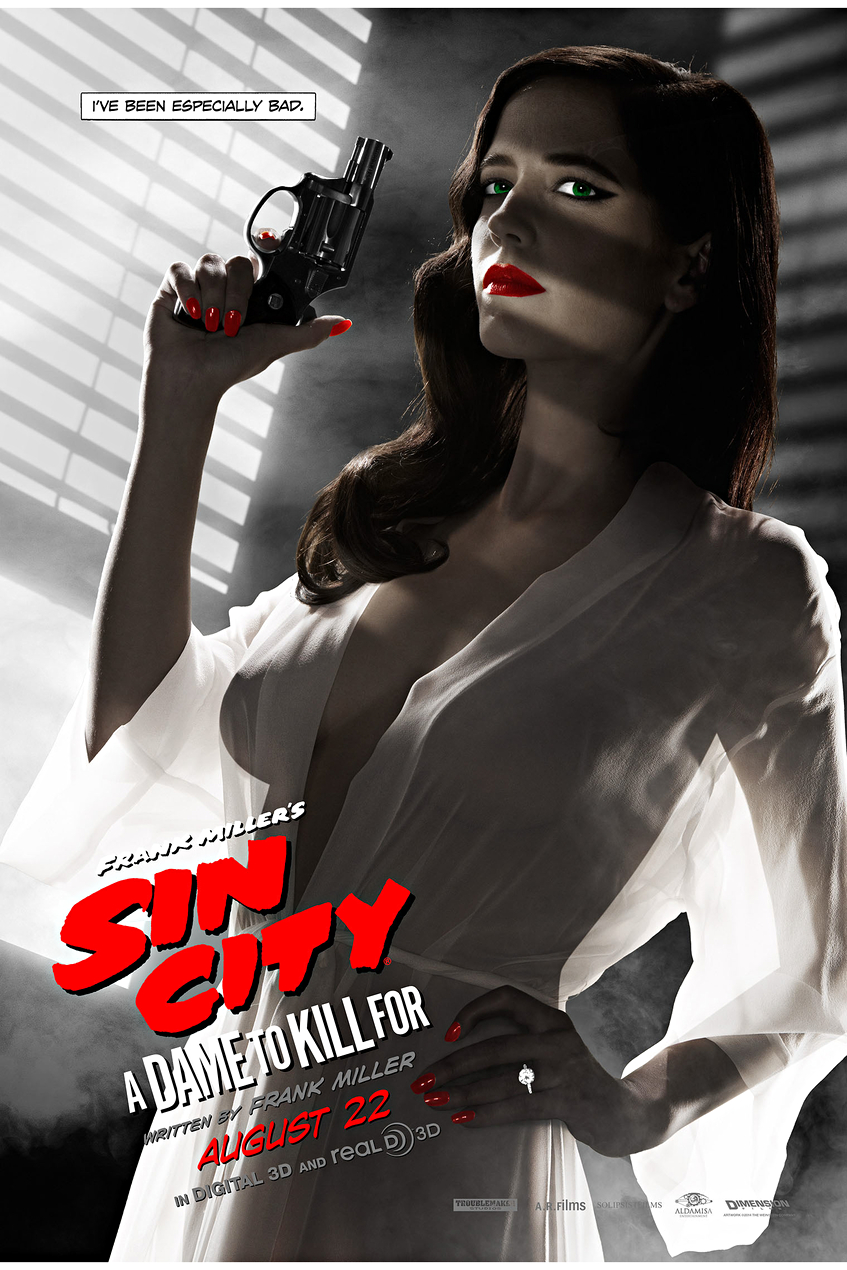
So it is fitting that the first released poster for the second film is visually provocative:

Eva Green in the Sin City poster banned by the MPAA. Photograph: Troublemaker Studios

As an unapologetic comic book and film nerd, I must admit that the first things I noticed about this poster were the gun, immediately, as well as the visual similarities (and differences) with the first film (the red nail polish and lipstick, her green eyes, the glistening diamond). In fact, the poster made me wonder if this film will maintain the striking mostly black-and-white look of the first.

But not the Motion Picture Association of America, as reported at The Guardian:

A poster for the upcoming Sin City sequel, Sin City: A Dame to Kill For, has been banned by the Motion Picture Association of America for depicting its star, Eva Green, in a state of relative undress.

Green appears in the poster wearing a revealing thin gown – to use the powerfully erotic words of the censor board, the poster was banned “for nudity — curve of under breast and dark nipple/areola circle visible through sheer gown.”

It’s a fittingly controversial image for a film whose first installment became notorious for its ultraviolence.

Other than giving Scout Willis more fodder for her “free the nipple” campaign, this censoring of a film poster captures once again the baffling Puritanical streak in the U.S. that exists beside something between a dull ambivalence toward and a brutal bloodlust for violence—represented in our near fetish for guns.

There is brilliant and nuanced routine by George Carlin I first heard on his albums Class Clown and Occupation: Foole. As part of his classic seven words you can’t say on television (including the censoring of the word “tit,” which Carlin finds outrageous), Carlin muses about replacing the word “kill” with the word “f***” in memorable lines like “OK, Sheriff, we’re going to kill you now, but we’re going to kill you slow,” “Kill the ump,” or “You better watch out, Bob, you’re going to kill that engine”:

And here we are forty-odd years later in the U.S.—where no one ever has been killed by a nipple/areola, but where school and mass shootings are more common than in any other so-called civilized country—censoring film posters while states have moved since the Sandy Hook school shooting to relax, not restrict, gun ownership.

Perhaps there was a time when all other nations looked up to the U.S., wanted to be the U.S., maybe. But increasingly we are a people to be laughed at, not with because we are wont to have both our guns and the female nipple concealed.

If the U.S. were a Carlin comedy album, it’d have to be Nation: Fooles.

UPDATE 1: Appears Rihanna has failed to understand the right to a concealed weapon (and she has already been banned by Instagram!).

UPDATE 2: As I note here, “Apparently Eva Green’s thinly-veiled nipples are not only more dangerous than the gun she is holding in the new Sin City sequel, Sin City: A Dame to Kill For, poster, but also more offensive than Jackman’s nipples (despite the violence and extended sequences of a topless Jackman, the film is rated PG-13 “for sequences of intense sci-fi action and violence, some sexuality and language”).”

UPDATE 3: Appears GQ offers a series of shots that sort of prove the point. Can you figure out what is taboo?

UPDATE 4: Bosom Baddies

In Memory: Sandy Hook Elementary, One Year After

I fear that we have become either callous or numb—either is a tragic consequence of mass shootings, even those at schools, becoming commonplace.

Here, I invite you to read from a group of pieces I wrote after and about the mass school shooting at Sandy Hook Elementary in Newtown, CT, one year ago, December 14, 2012:

“They’re All Our Children” (AlterNet)

  • Alongside discussions of mental health and gun control, we must use the lessons of Sandy Hook to reframe the debate around education reform.

Remembering Sandy Hook: Protecting Guns, Sacrificing (Some) Children

Misreading the Right to Bear Arms (AlterNet)

  • Confronting gun ownership is an argument about violence — not about autonomy and freedom.

Protecting Guns, Sacrificing (Some) Children

Protecting Guns, Sacrificing (Some) Children

“In 2008, 2,947 children and teens died from guns in the United States and 2,793 died in 2009 for a total of 5,740,” details Protect Children Not Guns 2012 (Children’s Defense Fund), “—one child or teen every three hours, eight every day, 55 every week for two years” (p. 2).

Tragedy is often reserved for single catastrophic events, but cumulative loss is no less tragic, particularly when the lives of innocent children and teens are placed in the context of daily violence.

continue reading at Truthout