Category Archives: inequity

U.S. Education a Scam and a Rigged Game

iceberg on water
Photo by James Eades on Unsplash

Many years ago while I was a high school English teacher, I began to advocate strongly against the influence of the SAT, and all standardized testing. One of the few sources for that criticism was work by Alfie Kohn, whose publications received pretty harsh resistance from the testing industry.

One of my best friends and colleagues while teaching high school left for higher education before I did, and as I would several years later, found himself teaching at a selective liberal arts college. He taught education foundations, where he included some of my work and Kohn’s confronting the failures of testing and the SAT specifically.

What my friend and former colleague discovered is that students at a selective liberal arts college did not receive well his message or the evidence about the inequity in high-stakes standardized testing and college admission exams.

As the recent college admissions scandal, Operation Varsity Blues, is gradually unmasking, people with privilege are powerfully invested in proving their merit—even if that veneer has to be manufactured at great expense.

I have been very successful at every level of formal education, attaining what is ominously called a “terminal degree.” Along that journey, I worked very hard, and simultaneously, the journey was nearly effortless because it required skills that I have mostly been quite adept at completing.

As well, I have been a professional educator for 35-plus years, at both the K-12 and higher education levels, including public and private schools.

In those experiences, I have been afforded incredible privilege because I am white and male. But I also have been often at arm’s length from that privilege in some ways because of my working-class background and my ideological alienation from my personal and professional communities.

Most difficult has been that despite my educational accomplishments and career as an educator, I have witnessed and then argued that while formal education is often framed as powerful in terms of how it shapes society and people (the “great equalizer” and “game changer” mantras), the reality of K-12 and higher education in the U.S. is that they mostly reflect and reinforce our inequities along racial, economic, and gender lines.

With the so-called college admissions scandal before us, I hope we can have larger discussions of what the purpose of education is and how access to education must be as sacred as what happens once students enter school.

The scandal exposes that education is not a game changer, but a marker for privilege. The wealthy are always branding, always seeking ways to be associated with the aura of quality.

Wealthy celebrities needed a daughter to attend USC for the prestige that attending Arizona State did not offer. This is no outlier, but an extreme example of how the wealthy perpetuate and are drawn to “elite” institutions, whether it be selective pre-schools, private K-12 academies, or the Ivey League.

Some experiences I have noticed throughout my teaching career include a misunderstanding of teaching and learning compounded at selective (mislabeled as “elite”) colleges by a wish among faculty to take credit for the existing so-called excellence in students admitted.

Let me explain with some historical context first.

The concept of universal public education in the U.S. is expressed very well as an ideal by the deeply flawed elitist Thomas Jefferson in the following passages:

The object [of my education bill was] to bring into action that mass of talents which lies buried in poverty in every country for want of the means of development, and thus give activity to a mass of mind which in proportion to our population shall be the double or treble of what it is in most countries. ([1817], pp. 275-276)

The less wealthy people, . .by the bill for a general education, would be qualified to understand their rights, to maintain them, and to exercise with intelligence their parts in self-government; and all this would be effected without the violation of a single natural right of any one individual citizen. (p. 50)

I… [proposed] three distinct grades of education, reaching all classes. 1. Elementary schools for all children generally, rich and poor. 2. Colleges for a middle degree of instruction, calculated for the common purposes of life and such as should be desirable for all who were in easy circumstances. And 3d. an ultimate grade for teaching the sciences generally and in their highest degree… The expenses of [the elementary] schools should be borne by the inhabitants of the county, every one in proportion to his general tax-rate. This would throw on wealth the education of the poor. (p. 791)

To all of which is added a selection from the elementary schools of subjects of the most promising genius, whose parents are too poor to give them further education, to be carried at the public expense through the colleges and university.  (p. 275)

By that part of our plan which prescribes the selection of the youths of genius from among the classes of the Door, we hope to avail the State of those talents which nature has sown as liberally among the poor as the rich, but which perish without use, if not sought for and cultivated. But of all the views of this law none is more important none more legitimate, than that of rendering the people the safe, as they are the ultimate, guardians of their own liberty. (p. 276)

The tax which will be paid for this purpose is not more than the thousandth part of what will be paid to kings, priests and nobles who will rise up among us if we leave the people in ignorance. (p. 278)

The recent college admissions scandal is but the tip of the iceberg of privilege that has already sunk the Titanic plan detailed above by Jefferson, himself an original elitist unable to make his ideal real.

So, since these lofty claims established formal education in the U.S., we have instead embraced a deficit ideology—framing students needing to learn as a flaw of the student and a burden on the teacher (misunderstanding teaching and learning)—and creating formal education as a mechanism of enculturation (institutions that either label and shame those deemed deficient or label and praise those deemed elite).

If we pull back from the scandal and how this is the tip of the iceberg in terms of the wealthy gaming everything along a spectrum from inequitable and unethical to outright criminal, we must also interrogate that we have failed the ideals of not only universal public education (K-16), but also the potential of education to revolutionize society and individuals.

Many students who need that ideal education the most are disenfranchised from or disillusioned by formal schooling while many privileged students are deeply invested in the game of formal schooling even as the education itself mostly washing over and by them.

In both cases, education is a scam and a rigged game.

While we are hand wringing over the college admissions scam, my home state of South Carolina has rejected provisions in a new education bill calling to lower some student/teacher ratios, claiming such mandates are too expensive.

However, in public schools across the state, mostly white and affluent students sit daily in Advanced Placement and International Baccalaureate classes with incredibly low student/teacher ratios, classes often next door to so-called regular classes at and above state maximums for student/teacher loads.

Inequity serving the wealthy and white and mis-serving everyone else—this is a feature of our systems and institutions, including schools, not a glitch—as some seem to suggest about the admissions scandal.

Today, in 2019, formal education in the U.S. is mostly a disturbing snapshot of how we are a people mostly using rhetoric to hide the power and momentum of privilege.

There is really nothing shocking about the admissions scandal, unless you want to pretend it is something other than the tip of a very old and very large iceberg of privilege that defines the good ol’ U.S. of A.

Operation Varsity Blues: One Corrupt Tree in the Forest of White Wealth Privilege

It’s called the American Dream because you have to be asleep to believe it.

George Carlin

Andrew Lelling, the US attorney for Massachusetts, made a nearly laughable opening claim in his press conference about a college admissions scandal named “Operation Varsity Blues”:

“This case is about the widening corruption of elite college admissions through the steady application of wealth combined with fraud,” Lelling said. “There can be no separate college admission system for the wealthy, and I’ll add that there will not be a separate criminal justice system either.”

He added, “For every student admitted through fraud, an honest, genuinely talented student was rejected.”

Nearly laughable, in part, because this grandstanding of justice wants to proceed from the position that discovering the wealthy gaming a system they already control is somehow shocking (it isn’t), and nearly laughable as well because Lelling offered as context and with a straight face the following:

We’re not talking about donating a building so that a school’s more likely to take your son or daughter.

We’re talking about deception and fraud – fake test scores, fake athletic credentials, fake photographs, bribed college officials.

The layers of bullshit in what is being called a “massive admissions scandal” are nearly as complicated as the story itself, an intricate web of complicit parents, college and athletics officials, SAT/ACT shenanigans, and a charlatan mastermind at the controls—as reported by Kirk Carapezza:

Here’s how Lelling says it worked. Between 2011 and 2018, wealthy parents paid Rick Singer, the head of a foundation and a for-profit admissions consulting service, more than $25 million. Singer would then use that money to pay a ringer to take the SAT or ACT for children or correct their answers. He’d also bribe Division 1 coaches.

Here’s one layer: Despite the very serious tone and facial expressions at the Department of Justice’s press conference, Lelling’s rhetoric remains complete bullshit. In the U.S., these has always been and continues to be two distinct admissions processes for college and two distinct justice systems.

In fact, in every way possible there are two Americas [1], neatly divided by wealth and race. Being wealthy and being white provide significant privileges and then those who enjoy those privileges routinely and without consequence leverage that privilege for even more advantages at the expense of everyone else.

The great irony of the so-called college admission scandal is that the wealthy in the U.S. promote false narratives about merit and rugged individualism while actively perpetuating their own privilege, which buoys mediocrity, at best, and a complete absence of merit or effort at worst.

The wealthy are driven to maintain the veneer of “well-educated” because it provides cover for that mediocrity and privilege.

To be white and wealthy allows them to skip college and still thrive while people of color and the poor scramble to gain more and more eduction even as the rewards remain beneath the truly lazy and undeserving rich:

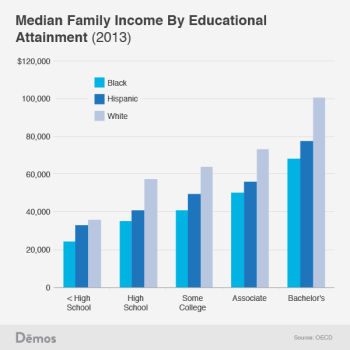
[F]amilies headed by white high school dropouts have higher net worths than families headed by black college graduates.

…First, understand that blacks and Hispanics have lower incomes than whites up and down the educational spectrum.

On average, black families at a given level of educational attainment receive incomes that are just 66% of what white families at the same level of educational attainment receive. For Hispanic families, that figure is 79%. Naturally, when education-controlled income disparities like this exist, education-controlled wealth disparities will exist.

Second, understand that even blacks, Hispanics, and whites with the same incomes have dramatically different net worths.

On average, black wealth is 26% of white wealth, even controlling for income. For Hispanics, the figure is 31%. Peruse the studies above to try to tease out why. Note here though that, according to Gittelman and Wolff, this is not because blacks have lower savings rates. Inheritance and in-life wealth transfers also appear, in all of the studies, to play a non-trivial role. (Bruenig, 2014)

Lori Loughlin and her social media star daughter are not some sort of outlier evil geniuses who found a loop-hole in the system; they are the faces of the system.

This is how America works.

Ivanka Trump, also, is no evil genius, no outlier, and also not a deeply delusional woman. She believes the narrative that she has been taught even as her life completely contradicts those myths of meritocracy and bootstrapping.

I imagine those parents implicated—and the many more who will skirt by this time as wealthy people most often do—have convinced themselves they used their means for the good of their own children, as anyone would do if having those same means.

And this is the myopia of white wealth privilege in the U.S., the blindness of rugged individualism that allows some to believe they are either above or somehow disconnected from everyone else.

As reported by Cydney Henderson, Loughlin’s daughter used her celebrity and a dorm room someone else more deserving did not have to promote her brand, and make money of course:

Olivia Jade moved into her college dorm in September 2018, documenting the milestone on Instagram through a paid partnership with Amazon’s Prime Student. It’s a standard practice for social media influencers to earn money from companies by advertising products to their followers.

“Officially a college student! It’s been a few weeks since I moved into my dorm and I absolutely love it,” she captioned the post. “I got everything I needed from Amazon with @primestudent and had it all shipped to me in just two-days.”

This is America, at least one of the Americas, the one we worship despite it being a gigantic lie, as Carlin says, the club we will not be allowed to join.

“Operation Varsity Blues” is not a surprise, then, but we must guard against it being yet another gear in the privilege machine, a distraction.

This so-called college admissions scandal is but one tree in the much larger and more powerful forest of white wealth privilege.

As we become fixated on Aunt Becky, we continue to ignore legacy admissions, a criminal justice system best understood as the New Jim Crow, the lingering racism and sexism in high-stakes standardized testing, the school-to-prison pipeline and schools as prisons, and a list far too long to include here.

Like whiteness itself, wealth must remain invisible in the ways it perpetuates privilege and inequity.

This college admissions scandal is an opportunity to pull back and take a long and critical look at the whole forest, a much uglier reality than we have been led to believe.


[1] See the following:

The NFL and the Politics of Lies

Much Gesture, from the Pulpit –
Strong Hallelujahs roll –

“This World is not Conclusion” (373), Emily Dickinson

I taught throughout the 1980s and 1990s in my small rural hometown in Upstate South Carolina. That town literally had a railroad track separating the black and white sides of town.

The very small school district includes only four schools—primary, elementary, middle (junior, when I attended), and high—that encircled the largest church in town, Woodruff First Baptist, its steeple looming prominently over the schools and the town.

white church near trees at daytime
Photo by Aaron Burden on Unsplash

Many of my students attended that church, and for a time, virginity pledges became a thing. Sunday morning services included girls and young women coming forward to pledge their virginity until marriage.

These young women received praise and recognition throughout the town and at school. At one point when this trend was at a peak, a group of young women came to me upset that, as they explained, most of their peers taking the virginity pledge were far from virgins, before the pledge or after.

These young women taking the pledge were playing a powerful game of making public displays that gave them social capital but required in no way that they practice what they proclaimed.

The young women who had not pledged, were mostly not sexually active, and felt a great deal of resentment also informed me that one of the young women who had recently been praised in front of the student body, and was also a very popular student and cheerleader, was among a secret group of young women who helped each other pay for and acquire abortions.

I have dozens and dozens of these stories, since I grew up in the deep South and am well acquainted with the power and hypocrisy of the Christian veneer.

While I have mostly stopped watching all organized sports, college or professional, I was wrangled last night into viewing the 2019 Super Bowl. What resonated with me above the lackluster game itself and the disappointment of another success story for the New England Patriots (with a coach and quarterback who personify all that is wrong with the NFL and the U.S.) was the clear drumbeat throughout the event by the NFL that the organization is deeply committed to social justice.

Over the past few years, the NFL has ostracized Colin Kaepernick for political protests and perpetuated the vapid notion that some of the athletes have sullied the game with their politics.

This same NFL began the most recent Super Bowl, as usual, with nothing except politics, the National Anthem and a military flyover. But most disgusting of all was the use of Martin Luther King Jr., ostensibly since the game was played in Atlanta, GA, to associate billionaire owners and the league with social justice.

I have never seen anyone look more out of place than the images of Commissioner Roger Goodell touring Atlanta and marking great places and moments in civil rights.

The NFL is a master of the politics of lies, playing up its own brand while simultaneously beating down any millionaire worker who has the audacity to be anything other than a player-drone for the billionaires who own them.

I understand how many NFL players feel compelled to remain stooges for the corporation that pays many of them well, even as the evidence is mounting that almost all of them are being physically and mentally maimed, that virtually all of them are just cogs, expendable. None the less, I cringed when Marshawn Lynch showed up in one of the most popular feel-good spots portraying the NFL as all that is good and happy:

There is a world unlike this one in which I imagine Marshawn Lynch as the hero and not bent by the great burdening weight of the NFL.

But that is not this world.

Concurrent with the Super Bowl has been a brewing controversy about the governor of Virginia, which Chris Emdin confronts broadly:

Today, as everyone indicts the governor for his racism and everyone professes to stew in anger at how he has let down his constituents, I am most disturbed by the ways that we allow folks to construct progressive public personas that are allowed to mask a problematic past even as the country endorses the past and the masking. WE have allowed people to use buzzwords like equity and social justice to mask their racism. WE have allowed sitting next to the right people or hanging the right painting to erase things they have done that cause pain. WE have failed to allow folks to face their history and the part they play in what they profess to fight against. It is easy to advocate for something without acknowledging that you are part of what caused it. It is easy for the governor to denounce the hatred in Charlottesville without acknowledging that he is a branch of the tree that the hate there grew from.

Emdin unmasks the progressive veneer that works like the Christian veneer—for some. Mostly for the privileged who use that veneer to maintain a death-grip on their unearned power.

In this age of Trump politics, we must recognize that billionaire NFL owners are no more committed to social justice than Trump is to Christianity.

Billionaires have been afforded their billions because of inequity, and the only real threat to their egregious wealth is equity, the cleansing sunshine of social justice.

The NFL exists on lies, it needs lies. The NFL is a microcosm of U.S. capitalism that exists on poverty, that needs poverty.

Kaepernick was sacrificed exactly because he was the Truth, unadulterated because the banishment was swift and seemingly invisible, silent. Allowed to return to the NFL, like Lynch, Kapernick likely and excusably would have merged into the fold in some uncomfortable way—like Jim Brown’s face if the commercial above is paused just right.

The NFL’s lie is just another Great America Myth, another cultural lie. The Super Bowl was its crowning act of this year’s season of lies.

The perfect team, the Patriots, now sit on that throne of duplicity like an arrogant middle finger to all that is decent and humane.

Like the church steeple ringed by my home town’s only schools.

Much Ado about Politics (Not Reading)

As new legislation was being debated in South Carolina, what was destined to become Read to Succeed, I was in contact with some strong advocates for public education who were seeking ways to shape effective reading policy in the state.

My input was focused on acknowledging the research base that refuted the popular political agendas mostly mimicking Florida reading policies driven by standardized high-stakes testing and grade retention for third graders.

First, decades of research reveal that despite popular support for grade retention (and bending to public antagonism for social promotion) grade retention is overwhelmingly harmful to students, especially our most vulnerable students (students living in poverty, black and brown students, English language learners).

Second, the Florida model has enough data and research to conclude that test-based third-grade retention produces some short-term bumps in test scores (what I would call false positives since this may be simply that students are taking the test again, and likely is not indication of reading growth) but those mirage-gains disappear over time (see Jasper’s doctoral dissertation on the data).

None the less, I was soon informed that there would be bi-partisan support for a new reading policy (Read to Succeed), even though it was flawed, because there would be an influx of more funding for reading.

Fast forward to now, the fall of 2018, when the first students are being impacted by this legislation—documented well by Paul Bowers at The Post and Courier (Charleston, SC):

South Carolina schools held back about 354 students in third grade for the 2018-19 school year under a new law designed to retain students with reading deficiencies.

That figure represents about one-half of 1 percent of the third-graders who took the state SC READY reading subtest in the spring — and only about 8.5 percent of the students who earned the lowest possible grade, “Not Met 1.”

While many will read this as either failure or success in terms improving reading and literacy in the state, the real lessons here are about politics, and the essential failure of bureaucratic measures for educational purposes.

Let me unpack some of how the consequences of Read to Succeed for 300-plus students is much ado about politics (not reading):

  • Is SC 47th in reading proficiency in the U.S. as Bowers reports? This may seem obvious, or at least non-partisan data, but educational rankings are inherently flawed, thoroughly debunked by Gerald Bracey. SC is doomed to low rankings in reading if those rankings remain anchored to high-stakes standardized tests (which reflect socio-economic status of any child’s home and community than educational attainment) and if SC political leadership refuses to address the state being also mired in the bottom quartile of high-poverty states. To claim SC ranks at the bottom of reading proficiency is a distraction from the root cause of those scores—inequity and poverty.
  • Is retaining 300+ students too many or too few? Bowers coverage seems to imply that Read to Succeed has fallen well short of having an effective impact while, as I was referenced in the article, I remain adamant that 345 students retained are 345 too many. Here is why. This legislation has created a bureaucratic mandate for a great deal of time and tax-payer money to be spent on more bureaucracy than valid reading instruction or reading opportunities for students. More high-stakes testing (which distorts what counts as reading), greater stigmas and misguided demands on vulnerable populations of students, more data collecting and analysis (without regard for the quality of that data), more prescriptions and mandates for teachers that result in less effective reading instruction—this in a nutshell is why Read to Succeed is a waste of time and money as well as a fraud in terms of addressing or improving reading in the state.
  • What really is going on—the politics that trumps reading? Read to Succeed has been exposed as legislation more dedicated to political viability (the public loves grade retention, and remains naive about high-stakes testing) than funding and supporting public education or teacher professionalism and autonomy. Read to Succeed is a political mirage, generating political capital at the expense of student achievement (see also Florida).
  • What are the negative lessons so far of Read to Succeed? (1) Stop mimicking the politics-of-the-day from other states, (2) reject education policy grounded in high-stakes testing and punishment (grade retention), (3) resists political agendas and embrace research and educational expertise , and (4) stop isolating political attention on schools as if they are not subsets of and influenced by larger and more powerful social realities such as poverty and inequity.
  • What should SC be committed to instead? Most importantly, political leadership and the public in the state must admit that social policy is the first line of educational policy; SC needs to address historical pockets of poverty in the state often linked to racism and generational inequity. This big picture failure of political leadership, however, does not mean there is nothing we can do in our schools concerning reading. Schools also must be reformed to end the inequities they often reflect and perpetuate—tracking, teacher assignments, school funding, experimentation (schools choice and charter schools, for example) that refuses to address directly public school reform. Finally, reading instruction can and should be reformed to include the following: much lower student/teacher ratios to facilitate effective instruction; guaranteeing student access to books and reading in their homes, communities, and schools; creating and supporting teacher professionalism and autonomy in terms of strong foundations in high-quality reading instruction not driven by raising test scores; patience for student growth in reading that rejects the flawed (and false) crisis response to third-grade literacy; and a robust campaign to inform better the public and parents about effective reading instruction, healthy student growth in reading, and how educational outcomes are more often than not a reflection of society and community affluence, not school or teacher quality.

Read to Succeed is yet another story about political motivation coupled with the good intentions of those charged with implementing truly flawed policy (see No Child Left Behind and the current Every Student Succeeds Act).

Good intentions are never enough, and good intentions can never overcome political negligence.

Since we remain enamored by ranking, let’s confront a very ugly fact: SC ranks first (or at least at the top) in political negligence, and Read to Succeed is just one more lesson in that embarrassing reality, one that has bitter consequences for the most vulnerable children in the state.

Free Speech, Free Market, and the Lingering “Rigid Refusal”

In the documentary Corridor of Shame, which explores the historical inequities of school funding in South Carolina along lines of race and social class, Senator (R, SC) Lindsey Graham claims while speaking at MLK Day in 2005: “We have a disparity of funding in a region of our state…. The reason we have disparity in funding is not cause we are prejudiced at the governmental level. It’s because we collect taxes based on property value. And our property value in those counties are pretty low because there’s no industry.”

Graham’s denial of systemic racism represents what Ta-Nehisi Coates called “elegant racism” while confronting the “oafish racism” of Cliven Bundy and former L.A. Clippers owner Donald Sterling:

The problem with Cliven Bundy isn’t that he is a racist but that he is an oafish racist. He invokes the crudest stereotypes, like cotton picking. This makes white people feel bad. The elegant racist knows how to injure non-white people while never summoning the specter of white guilt. Elegant racism requires plausible deniability, as when Reagan just happened to stumble into the Neshoba County fair and mention state’s rights. Oafish racism leaves no escape hatch, as when Trent Lott praised Strom Thurmond’s singularly segregationist candidacy.

Elegant racism is invisible, supple, and enduring. It disguises itself in the national vocabulary, avoids epithets and didacticism. Grace is the singular marker of elegant racism. One should never underestimate the touch needed to, say, injure the voting rights of black people without ever saying their names. Elegant racism lives at the border of white shame. Elegant racism was the poll tax. Elegant racism is voter-ID laws.

Graham acknowledges inequity, but uses “prejudiced” instead of “racist,” and casually rejects systemic racism.

As Coates explains, whites in the U.S. are more apt to acknowledge oafish racism while almost always employing elegant racism, such as denying systemic racism; therefore, Graham’s obfuscation is a powerful and effective political ploy, especially in the South.

In the matter of a few days recently, this distinction has played out in a public way with the NFL instituting a new policy about players protesting during the National Anthem and Roseanne Barr having her ABC sit-com canceled after a racist outburst on social media.

The NFL Anthem policy and Barr’s show cancelation have two important elements in common: what they represent in terms of how the U.S. confronts and understands racism, and how many in the U.S. have a deeply flawed understanding of free speech.

First, when former NFL quarterback Colin Kaepernick initiated protests during the National Anthem, the public and political response has tended to misrepresent the actions. Kaepernick and other players were protesting systemic racism, inequitable policing of blacks often resulting in death, during the Anthem.

Notably, Barr’s oafish racism, comparing a person of color to an ape, has resulted in a similar outcome for Barr and Kaepernick—the loss of work—although the former is a racist and the latter is protesting racism.

While Kapernick and other protesting NFL players have been condemned for being political (disregarding they are taking credible stands against a reprehensible social reality), Barr has a history of being bigoted.

Writer Roxane Gay has examined that history and then the recent cancelation, in fact.

Also significant about these two situations is that the new NFL policy does in fact limit when and how NFL players can express themselves, but Barr was perfectly free to share her comments, with an incredibly wide audience.

That comparison leads to the now common aspect of the public discussion of Barr’s cancelation, claims that they are about free speech: Since the NFL and ABC are not the government, neither of these situations is an issue of free speech.

As Katherine Timpf explains:

First of all, this is in no way a free-speech or First Amendment issue. The First Amendment protects us from facing consequences from the government over our speech, not consequences from our peers or our employers. Yes, what Barr said, although abhorrent, absolutely was constitutionally protected speech, and, of course, it should be. After all, giving the government the power to decide what is and is not “acceptable” speech would be giving the government the power to silence whatever kind of speech it felt like silencing, which would be very dangerous indeed. Anyway, the point is, a free-speech-rights violation would be someone trying to, say, arrest Barr for her comments, not firing her for them. Her rights were in no way violated in this case. ABC simply exercised its own rights as a private company to decide whom it does and does not want to associate with, and it’s my view that no one should blame its executives for making the decision that they made.

Therefore, the NFL policy on the National Anthem and the cancelation of Barr’s sit-com are not about free speech but the free market. Both the NFL and ABC are hedging that their actions preserve their audiences, their bottom line.

And what those concerns about their audiences reinforce is that the public has a much lower tolerance for oafish racism (Barr) than for confronting elegant racism (NFL protests). The NFL believes its audience either denies or cannot see systemic racism, and thus does not support the so-called politics of NFL players who protest while ABC feels that continuing to give an oafish racist a major platform will erode their audience.

Here is where we must confront the problem with trusting the free market since doing the right thing is linked to the moral imperative of the majority, the consumers. Currently in the U.S., that majority remains insensitive to systemic inequity and injustice; therefore, elegant racism survives—even bolstered ironically when oafish racism is shamed and seemingly blunted.

When each oafish racist is given their due, those denying systemic racism have their worldview confirmed since they see individual punishment as justice.

These actions by the NFL and ABC reflect that in the U.S. whites are still in the early adolescent stage of racial consciousness. Being able to confront oafish racism isn’t even fully developed yet.

Many in the media called Barr’s slurs “racially insensitive,” showing the same sort of refusal to call a lie, a lie that now characterizes mainstream media. But a few in that media are calling Barr’s words “racist,” and ABC folded under the weight of that fact—although we should be asking why Barr had this second chance considering her history of bigotry.

As a people, white America is not adult enough, however, to move past finger-wagging at oafish racists and to acknowledge systemic racism because, as Coates recognizes, “to see racism in all its elegance is to implicate not just its active practitioners, but to implicate ourselves.”

James Baldwin’s “Lockridge: ‘The American Myth'” remains a chilling warning then: “This rigid refusal to look at ourselves may well destroy us; particularly now since if we cannot understand ourselves we will not be able to understand anything.”

That anything, as the NFL and ABC have exposed, is racism—the cancer destroying our democracy and our free market.

As consumers, we have a moral obligation to tell the NFL it is wrong; we will not stand for systemic racism. And we must tell ABC that canceling Barr’s sit-com is a start, but it isn’t enough.

As citizens, we have to look at ourselves in the mirror of the voting booth—something we have failed to do yet in the good ol’ U.S. of A.

Recommended

Who Me?

Does Your Academic Institution Value Diversity, Equity? (Probably Not)

Several years ago, my university was forced to acknowledge it has a gender problem. As a selective liberal arts university, the institution had already begun addressing its race and diversity problems among students admitted and faculty hired.

Two gender concerns could not be ignored: Women were paid less than men at the same ranks, and faculty attrition was overwhelmingly among women professors, who constitute only about 30% of the faculty.

A gender equity study was commissioned, but when the report was issued, a group of male faculty circulated an open letter challenging the methodology of the report, raising concerns about a lack of empirical data and expressing the need for quantitative versus qualitative methods.

This response certainly had an image problem—white male faculty calling into question a gender equity study—and the concerned faculty did eventually withdraw the letter in deference to the good of the university community.

However, this study and the response illustrate a serious problem in academia, the pervasive power of traditional structures (expectations about what data matter, what types of research matter, and a lingering argument that objectivity can be achieved) to serve as a veneer for entrenched, and thus rendered invisible, sexism, racism, and classism.

A parallel example is when my university seeks to increase the diversity of the faculty, that effort is always contested with “Let’s just hire the best candidate,” again often voiced by white male faculty [1].

“Best,” of course, like quantitative methods and empirical data is a veneer for the embedded biases that have been normalized (and thus seemingly invisible to the power structure itself and those who benefit from the bias).

White and male privilege, then, are institutionalized in higher education (see here and here for ways those privileges exist, again, invisibly to white men). Despite the popular claim that higher education is some liberal indoctrination factory, higher education is incredibly traditional and conservative at its core; only the edges appear liberal.

But, I can feel many wanting to interject, how can calling for high-quality research to address gender equity on campus and expecting candidates for open faculty positions to be the best constitute flawed practices in academia?

Let me often another example, one that calls into question the grounding of those arguments themselves, the claims of fidelity to high standards.

Another traditional practice in higher education is the use of Student Evaluations of Teaching (SET), feedback gathered from students and then used in various ways to evaluate faculty for tenure and promotion.

Notably, a significant body of research [2] has revealed that SET lack validity and negatively impact women, faculty of color, and international faculty (in the U.S.).

Concurrently, the use of SET positively impact the existing and skewed white male faculty at most universities, who disproportionately dominate higher ranks and salaries.

Guess what happens when concerns are raised about SET based on high-quality empirical data and quantitative studies? The same faculty crying foul over gender equity reports and hiring practices toss up their hands and say, “O, well, we have to have something.”

As Colleen Flaherty explains:

While some institutions have acknowledged the biases inherent in SETs, many cling to them as a primary teaching evaluation tool because they’re easy — almost irresistibly so. That is, it takes a few minutes to look at professors’ student ratings on, say, a 1-5 scale, and label them strong or weak teachers. It takes hours to visit their classrooms and read over their syllabi to get a more nuanced, and ultimately more accurate, picture.

For example, my university’s self-evaluation form and the connected chair evaluation directly instructs in the teaching evaluation section: “Give particular emphasis to evidence of teaching quality, which could include numerical results from student opinion survey forms, written comments from student opinion survey forms, and comments from faculty or other consultants visiting your classes.”

“Evidence” is bolded and then the first example is “numerical results from student opinion survey forms.” There are clear biases here that privilege an instrument invalidated by a body of high-quality research—exactly what some faculty deemed missing in our gender equity study.

Junior faculty explain, often in private, that they are aware numerical data from the SET are the most important element of their case for tenure and promotion. As well, our Faculty Status Committee has provided workshops directly detailing which data from those forms are most influential, providing, as the committee claims, ways to distinguish faculty from each other.

Virtually every college and university has a diversity and equity statement and a perpetual formation and reformation of diversity and equity committees.

No statement or committee can make existing institutional sexism, racism, and classism disappear—especially if those words and that work are forced to work within existing biased structures.

“Research is reviewed in a rigorous manner, by expert peers,” writes Flaherty. “Yet teaching is often reviewed only or mostly by pedagogical non-experts: students. There’s also mounting evidence of bias in student evaluations of teaching, or SETs — against female and minority instructors in particular. And teacher ratings aren’t necessarily correlated with learning outcomes.

As long as calls for “high-quality” and “best” to guide policies and practices remain selective—and clearly in the service of the existing inequities and lack of diversity—we must admit the real commitment is not to”high-quality” or “best,” but to the status quo.

While not the only litmus test, a powerful way to determine if your academic institution values diversity and equity is if it continues to implement SET. Almost all do, so the answer remains, probably not.

See Also

Is Your University Racist? Bedelia Nicola Richards


[1] See how “merit” can work in the service of privilege in this reconsideration on Jordan Peterson:

I met Jordan Peterson when he came to the University of Toronto to be interviewed for an assistant professorship in the department of psychology. His CV was impeccable, with terrific references and a pedigree that included a PhD from McGill and a five-year stint at Harvard as an assistant professor.

We did not share research interests but it was clear that his work was solid. My colleagues on the search committee were skeptical — they felt he was too eccentric — but somehow I prevailed. (Several committee members now remind me that they agreed to hire him because they were “tired of hearing me shout over them.”) I pushed for him because he was a divergent thinker, self-educated in the humanities, intellectually flamboyant, bold, energetic and confident, bordering on arrogant. I thought he would bring a new excitement, along with new ideas, to our department.

[2] See:

They Were Born for This Moment: How the student activists of Marjory Stoneman Douglas High demonstrate the power of privilege.

Dahlia Lithwick’s take on the impact of teenagers from Parkland, Florida after yet another mass school shooting is a flawed Bob Dole read on the power of education. The most telling moment that this misreading of why America seems to embrace these teenagers comes here:

Despite the gradual erosion of the arts and physical education in America’s public schools, the students of Stoneman Douglas have been the beneficiaries of the kind of 1950s-style public education that has all but vanished in America and that is being dismantled with great deliberation as funding for things like the arts, civics, and enrichment are zeroed out. In no small part because the school is more affluent than its counterparts across the country (fewer than 23 percent of its students received free or reduced-price lunches in 2015–16, compared to about 64 percent across Broward County Public Schools) these kids have managed to score the kind of extracurricular education we’ve been eviscerating for decades in the United States. These kids aren’t prodigiously gifted. They’ve just had the gift of the kind of education we no longer value.

Political analysis of Dole’s last failed run for president often includes that Dole’s narrative focused on going back to an idealized and whitewashed past, while Bill Clinton focused on the future.

To suggest a “1950s-style public education” is a major element of the good ol’ days is an incomplete and ultimately offensive view of history.

Public schools reflected and perpetuated in mid-twentieth century all of the very worst aspects of American society, including segregation and corrosive inequity along race, social class, and gender lines.

The disturbing irony of the flawed central thesis of this argument is that the student activists from Stoneman Douglas High do in fact represent the realities of 1950s-style public education: Privileged children in the U.S. also benefit from privileged schooling—a fact of the 1950s and of the 2010s.

There are, however, two lessons from the activism of these Parkland, Florida teens:

  1. It provides another entry point into debunking that education is the great equalizer, and
  2. it represents in contrast to how America has responded to #BlackLivesMatter activism the lingering racial divide about whose voices, and thus lives, matter.

To the first lesson, consider the following:

And as a powerful visual for understanding that educational attainment does not level racial inequity, consider this (as well as a wealth of research contradicting education as the great equalizer):

fig_2
Source: Bruenig, 24 October 2014

Yet, Lithwick maintains:

Part of the reason the Stoneman Douglas students have become stars in recent weeks is in no small part due to the fact that they are in a school system that boasts, for example, of a “system-wide debate program that teaches extemporaneous speaking from an early age.”

The mistake here is that educational opportunities are a marker for the accident of birth most children enjoy or suffer; highlighting the rich schooling experiences of the Parkland, Florida students receive is a veneer for confronting that they mostly are the beneficiaries of privilege, first in their homes and communities, and then in their schools, which reflect and perpetuate their privilege.

To be clear, this is no condemnation of these teen activists, but their access to widespread national recognition is driven mostly by their privilege in many of the same ways that the Bush family and the Trumps have parlayed generational wealth into more (often ill-got) power, regardless of their merit.

This misreading of the reasons why the Parkland, Florida teens are being heard provides cover for the more damning and problematic second lesson, as Sarah Ruiz-Grossman confronts:

For some black activists who have long been mobilizing around gun violence, the current wave of public attention and outrage over the issue is welcome. But it also invites the question of why there’s been comparatively little attention and outrage focused on the even more common reality of routine gun homicides in the country, which disproportionately affect communities of color, and specifically black Americans.

Prominent black organizers and public figures have also noted the largely positive public response to the student activists from Parkland ― most of whom are not black and who attended school in a largely white, relatively affluent Florida suburb ― compared to the frequent vilification of young black activists protesting gun violence, particularly police shootings.

The Stoneman Douglas High teens are no more credible in their activism than the many black teen activists who have responded to the equally disturbing normal of police shootings that disproportionately kill blacks.

When affluent and a certain kind of articulate young people confront mass gun violence, their privilege sparks responses that are distinct from the responses to a differently racialized and classed protest against gun violence perpetually killing one person at a time.

Kurt Vonnegut, who died of lung cancer, confessed in the preface to a collection of short stories: “The public health authorities never mention the main reason many Americans have for smoking heavily, which is that smoking is a fairly sure, fairly honorable form of suicide.”

Beyond the macabre humor and stark reality of Vonnegut’s admission, we must see that he is deconstructing the power of normal; once something become normal, it projects the impression that is also right.

In the U.S., the messengers and the messaging are more powerful than the message. And this is the large scale lesson of the Parkland, Florida activism: Privileged voices and lives matter.

Public schools in the U.S. are not game changers, not great equalizers. Further, as the Parkland, Florida teens argue, no public school should be tasked with defending children against a negligent political class bought and owned by the NRA.

1950s nostalgia also ignores the celebrity class, often movie stars, doing the dirty work for Big Tobacco, ruining the health of America’s youth for the sake of commerce, and this too fits in an ironic and ugly way with misreading why privileged Stoneman Douglas High teens are now waging a battle with the NRA controlling negligent political leaders.

Simply saying something is true doesn’t make it true, and just because it is normal doesn’t mean it is right.

The Stoneman Douglas High teen activists were born for this moment. They demonstrate the power of privilege.


Please see these Twitter exchanges as well:


Margins

Although I am sure more people have blocked me on social media, I remain aware of and concerned about two of those—both women, one black and one white.

The reason for my concern is that I would count them both members of the communities I support, ideologically and practically. Also, since I am blocked, I remain mostly uncertain of why, although with one I did have an exchange on an email forum about her perceptions of me (what I view as unwarranted assumptions).

Being blocked, I recognize however, was the result of both these women functioning in much narrower margins than I do because of my privileges of gender, race, and economics. In other words, regardless of my good intentions, regardless of whether or not I behaved in any way that warranted being blocked, these women do not have the margins to risk examining whether I am part of the toxic masculinity, toxic whiteness, or toxic affluence that threatens them moment by moment.

Sendhil Mullainathan and Eldar Shafir in their Scarcity: Why Having Too Little Means So Much label the margins of economic privilege and disadvantage as “slack” (privilege and thus huge margins) and “scarcity” (disadvantage and thus very thin margins). I think those terms apply equally as well to gender and race.

In retrospect, I am reminded of a moment from my teaching high school English when a white boy brushed a copy of Martin Luther King Jr.’s “Letter from Birmingham City Jail” from his desk when I handed them out, announcing that he wasn’t reading that “[racial slur].” The student was adamant that King was an adulterer, having a pamphlet that excoriated King; the pamphlet, if one bothered to look carefully, had been created by the KKK, which had a vibrant following in the small town just south of the high school.

The margins (scarcity) for MLK—using “adultery” as a veneer for racism—must be placed against, for example, the social slack afforded John F. Kennedy, who is allowed his claimed accomplishments despite his personal indiscretions, unlike how any small failure by MLK is used to discredit all of his work.

More recently, the US has witnessed eight years of unrelenting discrediting of Barack Obama as president through unfounded claims about his birthplace; Obama as the first black president had to be perfect or completely discredited.

Immediately succeeding Obama is Donald Trump, who survived video/audio evidence of language and attitudes toward women most people would not tolerate in children; in other words, Trump’s gender, race, and economic privilege (slack) is so powerful, he appears nearly capable of doing anything with impunity.

Trump himself declared this himself during his campaign:

This is the most vivid and gross example of the power of slack grounded in race, gender, and economic privilege.

Black Film/ White Film: More on Slack and Scarcity

Since I am a comic book advocate, having collected Marvel comics throughout the 1970s and more recently published scholarship on the intersections of race and gender in superhero comics, I have watched and listened carefully to the public responses to Black Panther, the most recent Marvel Universe film.

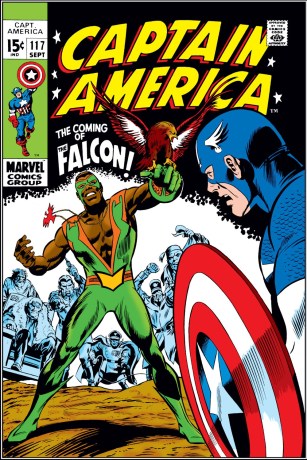
While I have not yet seen the film, I have followed the sputtering path of the character Black Panther since he was introduced in the 1960s; as a teenager collecting comics, I was a fan of Black Panther as well as The Falcon, who was cover-billed along with Captain America throughout much of the 1970s.

Black_Panther_Vol_1_1  Captain_America_Vol_1_117

I lacked critical discernment as a teen, but can recognize that these two characters laid a foundation for my discovering black authors and thinkers in college as I struggled to cast off the worst aspects of my upbringing in the racist and intolerant South.

Most have responded to Black Panther the film with enthusiasm and even glee, and the box office has reflected some powerfully positive messages about black films and actors. But a few have begun to unpack problems with nationalism and the white savior trope in the narrative.

Here we may be inclined to argue that the highest form of equity, the absence of racism, would require that the film receive something akin to objective analyses—not unduly criticized (veneers for racism) and not sheltered from criticism as a sort of inverse racism.

There, however, this claim is not as simple as it may seem—especially if we ground how we respond to the film in terms of slack and scarcity, in terms of the King/Kennedy inequity.

Certainly, the film cannot be above credible criticism, but in that pursuit, we must guard against the perfection bar often manifested as scarcity when applied to disadvantages associated with race, class, and gender.

White films, for example, are not called “white,” but simply films. Adam Sandler and Kevin James, for example, have long resumes of films that certainly have been allowed an incredible amount of slack—forgiven the nearly unforgivable (think Trump) for hopes of some glimmer of humor nestled among the truly cliche, offensive, and just plain lazy.

Black Panther, even in the praise, is rendered into scarcity as a black film, and by implication must carry the weight of all black films, all black actors, all black writers (although the character was spawned by white creators in a very white, often racist industry).

Since Kevin James was allowed Paul Blart: Mall Cop 2, just how close to perfect does Black Panther need to be?

The truest test of equity may be that all films have the same degree of slack.

School Safety: Slack and Scarcity as a Matter of Life and Death

While many in the US are reveling in the pop culture frenzy around Black Panther, the ugliest aspects of American culture once again expose how our on-screen violences pale against our gun culture and the ever-present threat of mass shootings, especially at the expense of students in school.

Although most mass shooters are white men, gun violence tends to prompt concerns about gangs and black-on-black crime, yet another demonstration of inequitable margins: White male mass shooters never prompt outcries about all white men (since the shooters are often framed as mentally ill) even though simply the threat of terrorism evokes blanket narratives and even policies about Muslims.

The paradox of gun violence and mass shootings in the US is that Americans have experienced increasingly less crime over the past four or so decades, even as the rate of mass shootings and gun violence remains disturbingly high when compared to other countries.

Debates about gun violence become yet more evidence of slack and scarcity linked to race.

Why has the country responded so positively to the teens speaking out after the shooting in Parkland, Florida but tended to reject or ignore the outcries from teens surrounding the all-to-frequent police shootings of young blacks, the #BlackLivesMatter movement?

Simply stated, when anything appears to encroach on the huge slack whites perceive (safety in this case), mainstream responses flair, but the margins for safety are so thin for blacks, for example, that to live in danger as a black person has become normalized beneath the implication that blacks themselves are the ones perpetuating violence.*

Whites as victims (slack), and blacks as violent (scarcity).

Taking care about whether or not we criticize Black Panther holds some important symbolic value, but in terms of how we respond to a school shootings, we are now making decisions that are life and death.

Responses to the Parkland, Florida shooting have focused on how to make schools safer—in part, to avoid the larger gun control debate that is muted by the NRA.

Arming teachers is one extreme, but in an Op-Ed for The State (Columbia, SC), Will Britt argues:

My recommendations are all achievable and avoid the most controversial ideas, so that they have a chance of happening. Still, they will require unified and emphatic parental endorsement: Install metal detectors, restrict campus and building access and connect 360-degree interior and exterior video monitoring for every public school.

This is a compelling argument to those living in the slack of race privilege, but is a red flag to those living in slack, in very thin margins.

First, Britt’s argument is solidly refuted by evidence:

Impact of Security Measures on Violence

  • There is no clear evidence that the use of metal detectors, security cameras, or guards in schools is effective in preventing school violence, 8,9,10,11 and little is known about the potential for unintended consequences that may accompany their adoption.12
  • There has not been sufficient research to determine if the presence of metal detectors in schools reduces the risk of violent behavior among students. 13
  • Some researchers have expressed concern about the widespread use of guards, cameras, and other security technologies, given that so little is known about their effectiveness. 14,15
  • Research has found security strategies, such as the use of security guards and metal detectors, to be consistently ineffective in protecting students16 and to be associated with more incidents of school crime and disruption17 and higher levels of disorder in schools. 18
  • Evidence from a school–police partnership implemented in New York City reveals that students in these schools continue to experience higher than average problems linked directly to future criminality, compared to students in other New York City schools not involved in the partnership. 19
  • Surveillance cameras in schools may have the effect of simply moving misbehavior to places in schools or outside of schools that lack surveillance. Even more troubling, it’s possible that cameras may function as enticement to large-scale violence, such as in the case of the Virginia Tech shooter who mailed video images of himself to news outlets.20
  • Research suggests that the presence of security guards and metal detectors in schools may actually increase levels of violence in schools by strengthening the influence of youth “street” culture with its emphasis on self-protection.21

If these measures do not work, why are they compelling?

Calls for more security, research shows, in fact is more veneer for racism since extreme measures such as metal detectors and surveillance cameras are more common in high-minority schools even when discipline issues are not more pronounced.

White slack dictates that white safety must be protected at all costs; black/brown scarcity dictates that there is no margin of error for protecting against black/brown violence.

American culture is today awash in a triumphant celebration of Black Panther jammed against a national scramble to confront our daily violences in the form of guns.

Turning our schools into fortresses if not prisons, and even arming teachers, presents those with race, gender, and economic slack a much different picture (more safety) than those with race, gender, and economic scarcity (more violence).

Margins still define us, and margins left unchecked are apt to destroy us in the end.


* The mainstream media and political focus on black-on-black crime allows whites to ignore that all crime is mostly same-race since white-on-white crime rates are nearly identical to black-on-black crime rates.

Research excerpt sources:

8 Garcia, C. A. (2003). School safety technology in America: Current use and perceived effectiveness. Criminal Justice Policy Review, 14, 30-54.

9 Addington, L. A. (2009). Cops and cameras: Public school security as a policy response to Columbine. American Behavioral Scientist, 52, 1424-1446.

10 Borum, R., Cornell, D. G., Modzeleski, W., & Jimerson, S. R. (2010). What can be done about school shootings? A review of the evidence. Educational Researcher, 39, 27-37.

11 Casella, R. (2006). Selling us the fortress: The promotion of techno-security equipment in schools. New York: Routledge.

12 Addington, L. A. (2009). Cops and cameras: Public school security as a policy response to Columbine. American Behavioral Scientist, 52, 1424-1446.

13 Hankin, A., Hertz, M., & Simon, T. (2011). Impacts of metal detector use in schools: Insights from 15 years of research. Journal of School Health, 81, 100-106.

14 Birkland, T. A., & Lawrence, R. G. (2009). Media framing and policy change after Columbine. American Behavioral Scientist, 52, 1405-1425.

15 Green, M. B. (2005). Reducing violence and aggression in schools. Trauma, Violence and Abuse, 6, 236-253.

16 Schreck, C. J., & Miller, J. M., & Gibson, C. L. (2003). Trouble in the school yard: A study of the risk factors of victimization at school. Crime & Delinquency, 49, 460-484.

17 Nickerson, A. B., & Martens, M. R. (2008). School violence: Associations with control, security/enforcement, educational/therapeutic approaches, and demographic factors. School Psychology Review, 37, 228-243.

18 Mayer, M. J., & Leaone, P. E. (1999). A structural analysis of school violence and disruption: Implications for creating safer schools. Education and Treatment of Children, 22, 333-356.

19 Brady, K. P., Balmer, S., & Phenix, D. (2007). School-police partnership effectiveness in urban schools: An analysis of New York City’s Impact Schools Initiative. Education and Urban Society, 39, 455-478.

20 Warnick, B. R. (2007). Surveillance cameras in schools: An ethical analysis. Harvard Educational Review, 77, 317- 343.

21 Phaneuf, S. W. (2009). Security in schools: Its effect on students. El Paso, TX: LFB Scholarly Publishing LLC.

Changing the Odds So No Child Has to Overcome Them

[Header Photo by Library of Congress on Unsplash]

There are several challenging, and therefore uncomfortable, scenes in Little Rock Central: 50 Years Later (2007); however, when I show this documentary in my courses, few students recognize those scenes as either challenging or uncomfortable.

At one point, several black men from the Little Rock, Arkansas community are gathered outside the school, and they speak directly about the need for blacks to take care of their own, clean up their own communities. These men directly mention the damage of black-on-black crime (which is about the same as white-on-white crime, although the latter is almost never mentioned).

Throughout the documentary, as well, a number of black students confront how hard they work and how some of their fellow black students simply do not try—echoing a rugged individualism and personal responsibility narrative that a white teacher/coach and her white golf team members express.

I use these scenes as teachable moments about the negative impact of respectability politics on marginalized groups:

What started as a philosophy promulgated by black elites to “uplift the race” by correcting the “bad” traits of the black poor has now evolved into one of the hallmarks of black politics in the age of Obama, a governing philosophy that centers on managing the behavior of black people left behind in a society touted as being full of opportunity. In an era marked by rising inequality and declining economic mobility for most Americans—but particularly for black Americans—the twenty-first-century version of the politics of respectability works to accommodate neoliberalism. The virtues of self-care and self-correction are framed as strategies to lift the black poor out of their condition by preparing them for the market economy.

…Today’s politics of respectability, however, commands blacks left behind in post–civil rights America to “lift up thyself.” Moreover, the ideology of respectability, like most other strategies for black progress articulated within the spaces where blacks discussed the best courses of action for black freedom, once lurked for the most part beneath the gaze of white America. But now that black elites are part of the mainstream elite in media, entertainment, politics, and the academy, respectability talk operates within the official sphere, shaping the opinions, debates, and policy perspectives on what should—and should not—be done on the behalf of the black poor.

Respectability politics works in conjunction with seemingly innocuous narratives (rugged individualism, lifting yourself by your bootstraps, personal responsibility) to keep the accusatory gaze on individuals and away from systemic inequity. In other words, political and economic elites are more secure if the majority of people believe all success and failure are primarily determined by individual traits and not by privilege and disadvantage beyond most people’s control.

This semester that discussion has coincided with Laura Ingraham attempting to publicly shame LeBron James to “shut up and dribble,” a not-so-clever self-promotion for one of Ingraham’s vapid books.

Along with Kevin Durant’s heated response, James (see video in the link above) stressed, “We will definitely not shut up and dribble.”

Watching James, however, and listening carefully present us with the dangers of his “defeating the odds” motivation (listen to about minutes 1:50-2:15), his own powerful and impressive rise to being King James.

I am not criticizing James, however, and fully support his response, refusing to shut up and dribble.

But a message that suggests anyone can or should be able to achieve what an outlier, James, has achieved is ultimately harmful, speaking through and to the most corrosive aspects of respectability politics.

This call to teach children to beat the odds, in fact, is shared all along the political spectrum from right to left.

The ultimate flaw in a beat-the-odds mentality is, again, that it suggests success and failure lie mostly or solely in the individual, a matter of choice and effort—like having “grit,” a growth mindset, or a positive attitude (all ways to fix inadequate children).

This is a terrible message for children especially since success and failure are mostly determined by systemic forces—except for rare outliers—and the message allows those with the power to change the odds to escape accountability.

LeBron James, I believe, is right about his importance as a role model, as a stellar example of what black success looks like despite the odds being unfairly against him in the form of racism and economic inequity.

And as long as we as a society choose to ignore the odds, choose to allow racism, sexism, and classism to exist, I suppose we should find humane and supportive ways to encourage children to work so that a few of them may hit the life lottery and beat the odds.

But to be blunt, that’s a pretty shitty cop-out for the adults who could, in fact, change the odds so that no child has to overcome them.

It is ultimately a heartless and ugly thing to see children as lacking the drive to beat odds that shouldn’t exist in the first place.

It is political cowardice and public negligence to remain fatalistic about the odds as we watch those odds destroy the hopes and dreams of our children.

If anyone should shut up, that would be Ingraham and her entire cadre of right-wing know-nothings who shovel the very worst narratives that help guarantee those odds will remain in their favor.

And as we listen to James instead, let’s resist demanding that he or any so-called racial minorities somehow erase racism and then begin to demand that those who benefit the most from the odds use those privileges to dismantle those odds.

That, I know, is a powerful ask, but it is one that certainly holds more credence than asking children to be superhuman because we have James dribbling across our flatscreen TVs.