Category Archives: inequity

14 June 2017 Reader

How to Call B.S. on Big Data: A Practical Guide, Michelle Nijhuis

Mind the Bullshit Asymmetry Principle, articulated by the Italian software developer Alberto Brandolini in 2013: the amount of energy needed to refute bullshit is an order of magnitude bigger than that needed to produce it. Or, as Jonathan Swift put it in 1710, “Falsehood flies, and truth comes limping after it.”Plus ça change.

Who Is Dangerous, and Who Dies?

ERROL MORRIS: I found an innocent man who came very close to being executed. [Adams’s execution was scheduled for May 8, 1979, but Supreme Court Justice Lewis F. Powell Jr. ordered a stay only three days before he was to be strapped into the lethal-injection gurney. Ultimately, the court overturned his death sentence, but not his conviction.] I uncovered all of these appalling details 30 years ago and then opened up a newspaper recently and read about Buck. It’s as if nothing ever happened. That’s both depressing and infuriating. Mitt Romney, when he was governor of Massachusetts, was told that the death penalty is problematic because it’s fallible. You could execute an innocent person, and given our current state of knowledge, there is really no way to bring them back. Once executed, they stay executed.

CHRISTINA SWARNS: And so what was Romney’s reply?

ERROL MORRIS: He said: Oh, that’s simple. We’ll just make it infallible. We’ll make it foolproof. You said it’s fallible. We’ll just fix that.

Stop Pretending You’re Not Rich, Richard V. Reeves

So imagine my horror at discovering that the United States is more calcified by class than Britain, especially toward the top. The big difference is that most of the people on the highest rung in America are in denial about their privilege. The American myth of meritocracy allows them to attribute their position to their brilliance and diligence, rather than to luck or a rigged system. At least posh people in England have the decency to feel guilty.

In Britain, it is politically impossible to be prime minister and send your children to the equivalent of a private high school. Even Old Etonian David Cameron couldn’t do it. In the United States, the most liberal politician can pay for a lavish education in the private sector. Some of my most progressive friends send their children to $30,000-a-year high schools. The surprise is not that they do it. It is that they do it without so much as a murmur of moral disquiet.

Beneath a veneer of classlessness, the American class reproduction machine operates with ruthless efficiency. In particular, the upper middle class is solidifying. This favored fifth at the top of the income distribution, with an average annual household income of $200,000, has been separating from the 80 percent below. Collectively, this top fifth has seen a $4 trillion-plus increase in pretax income since 1979, compared to just over $3 trillion for everyone else. Some of those gains went to the top 1 percent. But most went to the 19 percent just beneath them.

50 years after the Loving verdict, a photo essay looks back on their love, Priscilla Frank

Monday, June 12, marks the 50th anniversary of the landmark United States Supreme Court decision Loving v. Virginia, which quashed anti-miscegenation laws in 16 states around the nation, ushering restrictions against interracial marriage to the wrong side of history.

The date is now remembered as Loving Day in honor of Richard and Mildred Loving, the couple who defied the state’s ability to dictate the terms of their love based on their skin color. Mildred, who was of African American and Native American descent, and Richard, who was white, wed in 1958 in Washington D.C., because interracial marriage was illegal in their native rural Virginia, as well as 15 other Southern U.S. states.

When the Lovings returned to Virginia, however, local police raided their home one early morning after being tipped off by another resident. They declared the Lovings’ marriage license invalid within the scope of the state, placing the couple under arrest.

What counts as language education policy?: Developing a materialist Anti-racist approach to language activismNelson Flores and Sofia Chaparro

Abstract: Language activism has been at the core of language education policy since its emergence as a scholarly field in the 1960s under the leadership of Joshua Fishman. In this article, we seek to build on this tradition to envision a new approach to language activism for the twenty-first century. In particular, we advocate a materialist anti-racist approach to language activism that broadens what counts as language education policy to include a focus on the broader racial and economic policies that impact the lives of language-minoritized communities. In order to illustrate the need for a materialist anti-racist framing of language education policy we provide portraits of four schools in the School District of Philadelphia that offer dual language bilingual education programs. We demonstrate the ways that larger societal inequities hinder these programs from serving the socially transformative function that advocates for these programs aspire toward. We end by calling for a new paradigm of language education policy that connects language activism with other movements that seek to address societal inequities caused by a myriad of factors including poverty, racism, and xenophobia.

The difficulties scholars have writing for a broad audience, Christopher Schaberg and Ian Bogost

Scholars have insights, experience and research that can help the public navigate the contemporary world, but scholarly work all too often goes unseen. Sometimes it gets sequestered behind exorbitant paywalls or prohibitively steep book prices. Other times it gets lost in the pages of esoteric journals. Other times yet, it’s easy to access but hard to understand due to jargon and doublespeak. And often it doesn’t reach a substantial audience, dooming its aspirations to impact public life.

How can scholars write for wider audiences without compromising their lives as disciplinary researchers?

The Confederate flag largely disappeared after the Civil War. The fight against civil rights brought it back, Logan Strother, Thomas Ogorzalek, and Spencer Piston

But what is less well-known is the actual history of these symbols after the Civil War — and this history sheds important light on the debate. Confederate symbols have not always been a part of American or Southern life. They largely disappeared after the Civil War. And when they reappeared, it was not because of a newfound appreciation of Southern history.

Instead, as we argue in a newly published article, white Southerners reintroduced these symbols as a means of resisting the Civil Rights movement. The desire to maintain whites’ dominant position in the racial hierarchy of the United States was at the root of the rediscovery of Confederate symbols.

Pride or Prejudice: Racial Prejudice, Southern Heritage, and White Support for the Confederate Battle Flag, Logan Strother, Spencer Piston, and Thomas Ogorzalek

Abstract: Debates about the meaning of Southern symbols such as the Confederate battle emblem are sweeping the nation. These debates typically revolve around the question of whether such symbols represent “heritage or hatred:” racially innocuous Southern pride or White prejudice against B lacks. In order to assess these competing claims, we first examine the historical reintroduction of the Confederate flag in the Deep South in the 1950s and 1960s; next, we analyze three survey datasets, including one nationally representative dataset and two probability samples of White Georgians and White South Carolinians, in order to build and assess a stronger theoretical account of the racial motivations underlying such symbols than currently exists. While our findings yield strong support for the hypothesis that prejudice against Blacks bolsters White support for Southern symbols, support for the Southern heritage hypothesis is decidedly mixed. Despite widespread denials that Southern symbols reflect racism, racial prejudice is strongly associated with support for such symbols.

Reader 22 May 2017 [UPDATED]: Connecting Dots

Why people are rich and poor: Republicans and Democrats have very different views

See: UPDATE 21 (20 May 2017): Grit, Education Narratives Veneer for White, Wealth Privilege

Minorities Who ‘Whiten’ Résumés More Likely to Get Interview, Michael Harriot

“Whitening” is an all-encompassing term for when prospective employees scrub their résumés of anything that might indicate their race. Applicants with cultural names will sometimes use their initials. Community or professional work with African-American fraternities, sororities or other organizations are deleted. One student omitted a prestigious scholarship he was awarded because he feared it might reveal his race.

Although the practice sounds demeaning and reductive in the year 2017, apparently it works. In one study, researchers sent out whitened résumés and nonwhitened résumés to 1,600 employers. Twenty-five percent of black applicants received callbacks when their résumés were whitened, compared with 10 percent of the job seekers who left their ethnic details on the same résumés.

The results were the same for employers who advertised themselves as “equal opportunity employers” or said that “minorities are strongly encouraged to apply.”

Whitened Résumés: Race and Self-Presentation in the Labor Market, Sonia Kang, Katy DeCelles, András Tilcsik, and Sora Jun

Abstract

Racial discrimination in labor markets is a critical process through which organizations produce economic inequality in society. Though scholars have extensively examined the discriminatory decisions and practices of employers, the question of how job seekers try to adapt to anticipated discrimination is often overlooked. Using interviews, a laboratory experiment, and a résumé audit study, we examine racial minorities’ attempts to avoid discrimination by concealing or downplaying racial cues in job applications, a practice known as “résumé whitening.” While some minority job seekers reject this practice, others view it as essential and use a variety of whitening techniques. When targeting an employer that presents itself as valuing diversity, however, minority job applicants engage in relatively little résumé whitening and thus submit more racially transparent résumés. Yet, our audit study shows that organizational diversity statements are not actually associated with reduced discrimination against unwhitened résumés. Taken together, these findings suggest a paradox: Minorities may be particularly likely to experience disadvantage when they apply to ostensibly pro-diversity employers. These findings illuminate the role of racial concealment and transparency in modern labor markets and point to an important interplay between the self-presentation of employers and the self-presentation of job seekers in shaping economic inequality.


Experts: Conflicts over Confederate names and symbols likely to continue, Paul Hyde

But Thomas said school administrators should encourage student debate over historical figures such as Wade Hampton — as an important lesson in democracy.

“If we really think that public education is to prepare people to live in a democracy, children need to have experiences with democratic processes,” Thomas said. “I think this specific protest should be seen as an opportunity for students to see what the democratic process looks like, with everybody’s voice mattering. Principals and superintendents of public schools — they have incredibly hard jobs — but they are the people who have to show students what moral courage is. If administrators and teachers can’t show moral courage, how do we expect our children to?”

See: Dismantling Monuments: History as a Living Document


When Standardized Tests Don’t Count | Just Visiting, John  Warner

And yet, when it comes to marginalized and vulnerable populations within Charleston County Schools, these standardized assessments provide a rational for top-down oversight and control.

This is entirely common and predictable. “Accountability” is often weaponized against those without the means to defend themselves.

I have no wish to upend the academic culture of the Citadel over their terrible CLA scores, but maybe some of those who are willing to give our elite storied places a pass can extend the same spirit to those who have no such protections.

See Are America’s top schools ‘elite’ or merely ‘selective?’

Why The New Sat Is Not The Answer, Akil Bello and James Murphy

If anything, the discord between them is likely to grow as the College Board pursues an equitable society using a test that is designed to mark and promote distinctions.

For all the positive changes the College Board has made, the new SAT shouldn’t be counted among them. It is a test, not a solution.

Every attempt to manage academia makes it worse, Mike Taylor

The problem is a well-known one, and indeed one we have discussed here before: as soon as you try to measure how well people are doing, they will switch to optimising for whatever you’re measuring, rather than putting their best efforts into actually doing good work.

In fact, this phenomenon is so very well known and understood that it’s been given at least three different names by different people:

  • Goodhart’s Law is most succinct: “When a measure becomes a target, it ceases to be a good measure.”
  • Campbell’s Law is the most explicit: “The more any quantitative social indicator is used for social decision-making, the more subject it will be to corruption pressures and the more apt it will be to distort and corrupt the social processes it is intended to monitor.”
  • The Cobra Effect refers to the way that measures taken to improve a situation can directly make it worse.

America has locked up so many black people it has warped our sense of reality, Jeff Guo

According to a Wonkblog analysis of government statistics, about 1.6 percent of prime-age white men (25 to 54 years old) are institutionalized. If all those 590,000 people were recognized as unemployed, the unemployment rate for prime-age white men would increase from about 5 percent to 6.4 percent.

For prime-age black men, though, the unemployment rate would jump from 11 percent to 19 percent. That’s because a far higher fraction of black men — 7.7 percent, or 580,000 people — are institutionalized.

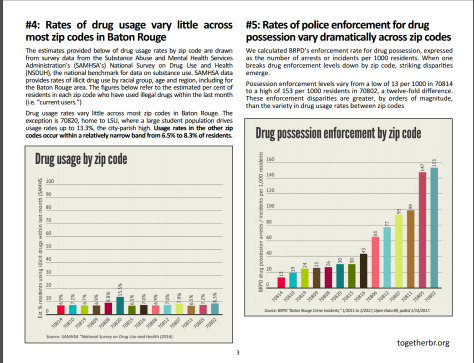
UNEQUAL ENFORCEMENT: How policing of drug possession differs by neighborhood in Baton Rouge

BR inequity

Dismantling Monuments: History as a Living Document

Disturbance at the Heron House
A stampede at the monument
To liberty and honor under the honor roll

“Disturbance At The Heron House,” R.E.M.

“And on the pedestal, these words appear:
My name is Ozymandias, King of Kings;
Look on my Works, ye Mighty, and despair!”

“Ozymandias,” Percy Bysshe Shelley

Possibly one of the greatest failures of formal K-12 schooling has been not only what students are taught in history and social studies, but how history as a discipline has been misrepresented (paralleled, I think, by a similar message about science) as fixed and objective.

History is never fixed or objective, but always a living document—one written by those who have power, access to the telling.

A powerful and vivid example of this fact is how Howard Zinn has been marginalized as more an activist than a historian because his work was committed to changing the perspective of history from the power elites to the people. Zinn was both heralded and demonized, for example, when his work asked everyone to rethink Christopher Columbus and the concept of “discovering” lands already occupied.

Traditionalists remain trapped in the belief that history has been and can be objective, can avoid being political, and once anyone seeks to better understand a person or the narratives of the past, those traditionalists shout “revisionism,” as if that new understanding is something to be shunned.

That any human expression can be objective, apolitical, is a naive position. In response to those arguing Ivanka Trump’s new book is not a political work, Ani Kokobobo reveals:

She claims she wrote it before her father’s election, “from the perspective of an executive and an entrepreneur.” And though they criticize her for being trite, derivative, out of touch and racially tone-deaf, most readers have accepted the premise that this is a largely apolitical book.

Yet as every scholar of literature knows, each book contains what theorist Fredric Jameson has dubbed a “political unconscious.” In other words, through the sheer act of narrating, a book reinforces one particular point of view while policing others.

This last point perfectly captures the reality of all history. And thus, the great irony of slurring history with “revisionism” is that history as a living document should be a constant act of revisionism as a retelling history in an effort to make the story clearer, more accurate—not an erasing of history.

Teaching that Washington never told a lie or that Columbus discovered America was in the moment an act of revisionism since they both are distortions in the name of some agenda. To seek ways that better portray Washington and how Europe reaching the West began what is now the U.S. and other countries is the great promise history and historical thought can offer a free people.

In a time now characterized by the rise of Trump (as a marker for nationalism masking racism) against the #BlackLivesMatter movement (as a confrontation of the racial inequities in policing and the justice system), we become witnesses to the power of monuments to maintain racism: calls for renaming Tillman Hall at Clemson University, New Orleans removing Civil War statues, and near my university, black students petitioning to rename a high school.

These efforts to revise history, bending it toward a greater clarity, a more credible Truth, cannot be divorced from how political, media, and public responses frame calls for dismantling monuments to the flawed and often awful past.

As a recent example, local coverage of students’ petitioning to rename a high school has a revealing title, Petition calls for dropping ‘racist’ name of Wade Hampton, and lede paragraph:

Wade Hampton III was a Confederate lieutenant general, one of the largest slaveholders in the Southeast and, by today’s standards, a blatant “racist,” according to historians.

When I raised concern about the word racist being placed in quote marks in the article, the journalist noted that it was to identify “charged language” and to avoid bias.

Couched within the lingering racism driven by denying and tip-toeing about confronting racism is the pervasive failure of both-sides journalism that refuses to acknowledge that some perspectives are credible while others are not.

The article itself quotes a historian acknowledging the fact of racism that the article treats as “charged language,” and thus, possibly lacking credibility.

A revised view of history allows us to acknowledge what is not debatable—many with power in the past, mostly white men, were racists—and is essential for helping us resolve what is debatable—whether or not we rename buildings/institutions and dismantle monuments.

If we believe in an optimistic view of human history, associated with Martin Luther King Jr. (“How long? Not long, because the arc of the moral universe is long, but it bends toward justice”), that we can somehow shape the world for the good of all, there is much to dismantle—the monuments grounded in human actions devoid of a more refined moral view as well as a tentative discourse that refuses to name and steps around the very facts that allow us to engage in robust debate.

It is an anemic approach to wait for monuments to crumble under their own baselessness, and thus, it is our duty to hasten the process on the path to justice, even when that duty is hard and seemingly unpopular.

We make history with each step we take, and we reshape history necessarily in that procession.

See Also

Opinion: Leave Wade Hampton in the history books, Asha Marie

The Young Black Activists Targeting New Orleans’s Confederate Monuments, Clint Smith

Elite or Selective?: Reconsidering Who We Educate and How

Sharde Miller’s California teen describes his road from Compton to Harvard University offers a powerful subtext about the American Dream as well as the enduring belief in education as the “great equalizer,” embodied by Elijah Devaughn Jr.:

Devaughn grew up in a single-parent household in Compton, California, a city that has been plagued by gun violence and gang activity for decades….

“Getting accepted into a prestigious university like Harvard, I think it means the world,” Devaughn said. “It means God is able. It means that hard work pays off. It means that, you know, struggles end.”

What if we unpack the label of “prestigious” by making an important caveat: Is Harvard University elite or selective?

As a point of reference, over the past three decades of high-stakes accountability in public education, schools have been annually labeled as excelling and failing; however, once we look beneath the A-F rankings, a strong and consistent correlation persists between schools identified as excelling or failing and the socio-economic status of the students [1] (as well as the racial and language demographics).

Consider also that for every year of the SAT being administered, average scores have fallen perfectly in correlation with parental income and parental years of education [2].

My university has begun gathering data to analyze our impact on students. The university is selective, having high standards for the academic backgrounds and achievements of students.

Some initial data are telling. When students with high preparation are compared to students with low preparation, extrapolating over four years of college, high preparation students are more successful and the gap with low preparation students widens during years 2 and 3 and then never closes by year 4 (year 1 and year 4 gaps are about the same).

If we persist in suggesting that education is the great equalizer (despite ample evidence education does not, in fact, equalize) and a foundational mechanism of the American Dream, we must reconsider how and why we identify any schools as “prestigious.”

Alexander W. Astin’s Are You Smart Enough? seeks to examine if our prestigious and excelling schools are elite or merely selective. Astin exposes part of the problem with labeling colleges, for example, as “prestigious”:

The “quality” or “excellence” of a college or university is thus judged on the basis of the average test score of its entering students, rather than on how well it educates them once they enroll.

What is lost in the rush to ascribe success and failure to schools is, as Astin argues, the essential charge of any formal schooling:

On the contrary, the quality of our national talent pool depends heavily on how well colleges and university develops the students’ capacities during the college years. And this mean all students.

And thus, Astin asserts: “More parents need to be asking, ‘Why should an educational system invest the least in the students who may need the most in higher education?'”

Here, then, is the dirty little secret: “Prestigious school” (K-12 as well as colleges/universities) is a veneer for “selective,” not “elite” in terms of the educational impact but in terms of the conditions at those schools.

Public universities are less selective than private liberal arts colleges, and the former experience is distinct from the latter in, for example, faculty/student ratios, class size.

In other words, more academically successful students tend to be from more affluent and well educated parents, and then are afforded higher education experiences that are identifiably superior to relatively less successful students from lower levels of affluence and education.

Reconsidering how we label schools, the “selective” versus “elite” divide, is a first step in seeking ways to turn a tarnished myth (“education is the great equalizer”) into a reality.

Too often “prestigious” and “elite” are code for “selective,” praising a college/university for gatekeeping, and not educating; too often “excellent” and “failing” are code for student demographics, ranking K-12 schools for proximity, and not educating.

Testing, ranking, and accountability in the U.S. have entrenched social and educational inequity because, as Astin confronts, “there are two very different uses for educational assessment: (a) to rank, rate, compare, and judge the performance of different learners and (b) to enhance the learning process.”

We have chosen the former, pretending as well that those metrics reflect mostly merit although they are overwhelming markers of privilege.

Let’s return to Devaughn as a rags-to-riches story.

Late in the article we learn Devaughn attended private school before his acceptance to Harvard—again bringing us back to the issue of opportunity and what we are learning at my university about well prepared students versus less prepared students.

Devaughn’s story should not be trivialized, but carefully unpacked, it does not prove what I think it intended to show. The American Dream and claims education is the great equalizer are, in fact, deforming myths.

Race, gender, and the socioeconomic factors of homes and communities remain resilient causal factors in any person’s opportunities and success:

Access to good jobs
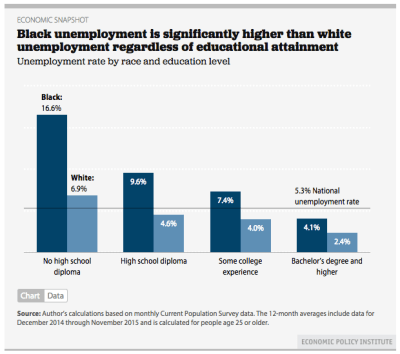
Black unemployment is significantly higher than white unemployment regardless of educational attainment | Economic Policy Institute

All schools at any level must re-evaluate who has access to the institution, and why, and then focus on what impact the educational experience has on those students. Therein must be the evidence for determining excellence and prestige.


[1] See here and here for examples in South Carolina.

[2] See The Conversation: Tests don’t improve learning. And PARCC will be no different.

Easter 2017 Reader: Grit, Poetry, Educational Rankings, Poverty

Grit

Forget Grit. Focus on Inequality, Christine Yeh (Education Week)

Grit is an easy concept to fall in love with because it represents hope and perseverance, and conjures up images of working-class individuals living the “American dream.” However, treating grit as an appealing and simple fix detracts attention from the larger structural inequities in schools, while simultaneously romanticizing notions of poverty….

Perhaps this idea of grit resonates with so many people who believe in the popular American adage that if you work hard and pull yourself up by your bootstraps, then you can achieve anything. This belief unfortunately, assumes that individuals have the power, privilege, and access to craft their own futures, regardless of circumstance and systemic barriers.

Statistics on educational access consistently reveal vast differences in resources in affluent versus poor neighborhoods. Predominantly white, middle- and upper-income school districts tend to spend significantly more money per student than the districts with the highest percentages of marginalized students. Our poorest schools also tend to have large class sizes, unsafe school transportation, damaged and outdated facilities, and high staff turnover. All of these conditions directly contribute to low educational outcomes and underscore the link between access to school resources and improvements in students’ success. Schools that focus on grit shouldn’t ignore structural inequities because they assume that regardless of your race, class, or social context you can still triumph.

Telling children ‘hard work gets you to the top’ is simply a lie, Hashi Mohamed (The Guardian)

What I have learned in this short period of time is that the pervasive narrative of “if you work hard you will get on” is a complete myth. It’s not true and we need stop saying it. This is because “working hard, and doing the right thing” barely gets you to the starting line. Furthermore, it means something completely different depending on to which context you’re applying this particular notion. So much more is required.

I have come to understand that the systems that underpin the top professions in Britain are set up to serve only a certain section of society: they’re readily identifiable by privileged backgrounds, particular schools and accents. To some this may seem obvious, so writing it may be superfluous. But it wasn’t obvious to me growing up, and it isn’t obvious to many others. The unwritten rules are rarely shared and “diversity” and “open recruitment” have tried but made little if any difference.

Those inside the system then naturally recruit in their own image. This then entrenches the lack of any potential for upward mobility and means that the vast majority are excluded.

Check out Neoliberalism: A Concept Every Sociologist Should Understand, Peter Kaufman (Everyday Sociology)

The end result of neoliberal ideology, Monbiot continues, is that we are led to believe in the myth of the self-made person:

“The rich persuade themselves that they acquired their wealth through merit, ignoring the advantages – such as education, inheritance and class – that may have helped to secure it. The poor begin to blame themselves for their failures, even when they can do little to change their circumstances. Never mind structural unemployment: if you don’t have a job it’s because you are unenterprising. Never mind the impossible costs of housing: if your credit card is maxed out, you’re feckless and improvident. Never mind that your children no longer have a school playing field: if they get fat, it’s your fault. In a world governed by competition, those who fall behind become defined and self-defined as losers.”

See Also

Failing Still to Address Poverty Directly: Growth Mindset as Deficit Ideology

SchoolED Podcast: Paul Thomas on Grit, Slack, and the Effects of Poverty on Learning

UPDATED (Again): Grit, Education Narratives Veneer for White, Wealth Privilege

“Grit” Takes another Hit (with Caveats)

Rejecting “Grit” While Embracing Effort, Engagement

Poetry/ National Poetry Month 2017

Perspective | Poet: Why I would never tell a student what a poem means, Sara Holbrook (The Answer Sheet/ Washington Post)

A few months ago I wrote an essay, “I Can’t Answer These Texas Standardized Test Questions About My Own Poems,” in which I questioned those of unknown academic distinction who anonymously compose proficiency test questions. Many teachers wrote to tell me that they too are unable to answer these vaguely written test questions being used to evaluate their students. One teacher reported that her kids had to endure 17 days of testing this year. Considering there are only about 20 days of school in a month and that every test requires preparation on the devices and manner of testing, that’s a lot of lost instructional time.

Parents wrote. I did a few television interviews and radio programs. It was my 15 minutes. Additionally, I took some heat from a (very) few academics who jumped to inform me that authors do not own the meaning of a poem, it is up to literary critics to make this determination. Good grief.

It was not my intent to kick off an argument on of the relative merit of learned literary analysis. I’ll leave that to those with letters after their names. But friends, parents, educators, learned folks, please remember, middle-schoolers are not just short college sophomores. They are not lit majors. These are kids like Paul. Kids who are often grappling with a world of unseen and sometimes unspeakable challenges.

See Also

Investigating Poetry Because We Love It (and Our Students)

In Defense of Poetry: “Oh My Heart”

“So We must meet apart”: #NationalPoetryMonth 2017 and My Journey with Emily Dickinson

Educational Rankings

Are South Carolina schools really the worst in the nation?, Cindy Landrum (Greenville Journal)

Furman University education professor Paul Thomas said the education ranking is far less about education than socioeconomics.

“This ranking is a direct reflection of political negligence,” he said. “Our schools don’t legislate. It’s not like our schools are without any fault, but how schools function is a reflection of political leadership. South Carolina is failing our children, not our children are failing school.”

U.S. News & World Report used 11 metrics to measure a state’s education ranking, including college and high school graduation rates and standardized test scores. Three of the six pre-kindergarten-12 categories are test scores (ACT and National Assessment of Educational Progress), while the others are high school graduation rates, pre-K quality, and preschool enrollment. South Carolina ranked high in quality of its public pre-kindergarten program, but ranked low in test scores and college readiness.

“Schools in South Carolina and the U.S. reflect the inequities of communities, the failure of our policies, and as a result, they are ineffective as mechanisms of change,” Thomas said.

At least 60 percent of test scores are correlated with out-of-school factors such as parental education levels, poverty, hunger, mobility, lack of health care, safety, and community resources, he said. Only 10 percent to 15 percent of test scores can be traced to teacher quality.

Thomas said it has been known for decades that poverty and inequity are the greatest hurdles for children learning. But instead of addressing the problems, instead grade-by-grade standards are changed and students tested.

“Our states have social and educational pockets of poverty,” Thomas said. “Food and home insecurity directly contribute to low academic output, and once they get into school, we make horrible decisions. High-poverty children are sitting in larger classes with early-career and uncertified teachers. We do the exact opposite of what we should be doing.”

See Also

South Carolina Ranks First in Political Negligence

Poverty

America’s Shameful Poverty Stats, Sasha Abramsky (The Nation)

But there’s a deeper significance to the numbers: how they compare with the figures from recent decades. The percentage of people in poverty is roughly the same as in 1983, in the middle of the Reagan presidency, as well as in 1993, at the end of twelve years of Reagan/Bush trickle-down economics. A far higher portion of the population lives in poverty than was the case in the mid-1970s, after a decade of investment stemming from Lyndon Johnson’s War on Poverty; and far more live in poverty today than did at the end of Bill Clinton’s eight years in office—years in which the earned-income tax credit was expanded, unemployment was kept to near-historic lows, and poverty rates fell significantly.

That our poverty numbers have risen to such a high level exposes the fact that as a society, we are choosing to ignore the needs of tens of millions of Americans—as we have done for much of the period since the War on Poverty went out of fashion and the harsher politics of Reaganism set in. These ignored Americans include kids like the ones I interviewed in Los Angeles, forced to choose between applying to college or dropping out of school and getting dead-end jobs to support parents who had lost not only their jobs but their homes, too. They include the elderly lady I met outside Dallas, who was too poor to retire but too sick to take the bus to her work at Walmart. Her solution? She paid her neighbors gas money to drive her to a job that paid so little she routinely ate either 88-cent TV dinners or went to bed hungry. They include, too, the residents of New Orleans’s Lower Ninth Ward I met in 2011, who, six years after Hurricane Katrina, were still living in appalling conditions in a largely obliterated community.

See Also

the world


Dear People with Privilege: On Freeing the Pelican

The first men to deny sexism are sexists themselves; the first white people to deny racism are racists themselves.

One of the profound tensions of the U.S. is that the country founded on the ideals of individual liberty—life, liberty, and the pursuit of happiness—was in fact built by sexists and racists. This is no easy or comfortable contradiction.

We have settled into an ends justifying the means narcotic as a people to avoid that contradiction.

The great praise the U.S. does deserve (although not unique to the U.S.) is the concept of pursuit; a great many people have pursued and continue to pursue the elusive equity of our founding principles.

To identify, admit to, and then confront racism or sexism, we must reach to the people with the most power in the country—white men, who believe they have earned that power, their success.

Racism and sexism are not mere abstractions because some people must be complicit in the perpetuation of both.

Even among the victims of racism and sexism, we find people complicit, but the main people responsible for our failures in the pursuit of equity are the ones with the most power, power gained from privilege.

Most of us, then, when confronted with the ugliest truths of racism and sexism immediately tell our stories of struggle: “I cannot have privilege,” we proclaim, “because I have struggled!”

So consider the invisibility of privilege to those with privilege.

You buy a pair of Nike shoes, and if someone asks you if you are for child labor or slave wages for women forced to work in cramped factories as their homes, you are very likely to strongly reject being for those abstractions—while wearing the shoes made in horrifying conditions for women and children workers earning slave wages.

The problem of privilege is that most of us with privilege are complicit through negligence, not through conscious decisions to oppress.

Consequences, however, make those distinctions irrelevant.

As Roxane Gay navigates wonderfully in Peculiar Benefits, many people have contexts within which they have privilege, unearned advantages—even people for whom much of their life is spent as the victim of other people’s privileges.

And white heterosexual men can struggle mightily in life, even as we celebrate the apparent success of a black homosexual woman.

Outliers are some of the most powerful blinders for confronting privilege.

But I believe I can offer here a simple test.

First, to admit to having privilege is not opening yourself to scorn; the fact of having privilege is not justification for condemning anyone.

From there, then, we must move to the key question: What do you do with your privilege(s)? Perpetuate your own needs and desires? Or use your privilege(s) in the service of others who are oppressed, who are victims of other people’s privileges?

Some tests include whether or not you acknowledge your own and systemic privilege (racism and sexism, for example), and then if or not you develop an ability to feel compassion for anyone who is struggling, recognizing that human failure may often be the consequence of systemic forces and not individual flaws.

This last point is important. Racism, for example, persists because as a culture, people in the U.S. have made the default stance about human struggle and failure to be flawed individuals: People who succeed, we assume, worked hard, and people who struggle and fail, we assume, are lazy.

Each of us must come to acknowledge our privilege(s) and proceed with the understanding that systemic inequity is the root cause of individual struggle and failure.

To use your privilege in the service of others [1] even when that act creates risk for you and especially when that act works to dismantle the privilege that allows you to serve others.

A picture (or in this case, a video [2]) is worth a 1000 words, so let me end by suggesting, this is what it looks like to acknowledge your privilege, to identify those who suffer inequity, and then to act in the service of that other:


[1] To serve others, as well, must avoid paternalism. It is not substituting arrogance for your privilege in order to save those who are lesser than you; it is seeking out anyone without your privileges and then asking, How may I help you?

[2] Too often, when confronted with systemic inequity (racism, sexism, etc., represented by the fishing line on the pelican’s beak), people either refuse to acknowledge the fishing line, blame the pelican for being in the situation that caused the line tangle, or argue, “I didn’t put the fishing line around the beak.” Yet, we are complicit if we fish (even carefully), eat fish, or if we do nothing while aware of the dangers of fishing for pelicans and other animals—even if we believe we are compassionate to or hold no prejudice against pelicans.

See Also

Montclair SocioBlog: The Winds of Privilege

Toxic Masculinity, Predatory Men, and Male Paralysis

How can anybody know
How they got to be this way?

“Daughters of the Soho Riots,” The National

This is my sixth decade as a human, as a white, straight male.

Here I want to attempt confession, possibly seeking greater understanding, but fully aware of the huge complexities of making these claims, raising these personal struggles in the context of my many privileges.

I am treading lightly but committed to rise above the problematic satire of Ben Folds’ “Rockin’ the Suburbs”—which both speaks to me and makes me cringe:

Let me tell y’all what it’s like
Being male, middle-class, and white
It’s a bitch, if you don’t believe
Listen up to my new CD

My formative years over the 1960s and 1970s were spent in the redneck South. Just as I was reared to be a racist, I was taught very clearly to objectify women, even as that was tempered in my immediate family by direct and indirect messages about respecting and loving women/girls.

Growing up, I was a Mama’s boy, I was very close to my sister (my only sibling), and I had strong and warm relationships with aunts and my maternal grandmother.

As a so-called pre-sexual boy, then, I genuinely learned to feel deep and healthy affection for women/girls—to whom I have always been drawn more strongly than any male bonds.

As a teen, however, I was significantly enculturated into objectifying women, sowing the seeds for potentially behaving in ways that fed into and participated in predatory masculinity and even the various degrees of rape culture.

My classroom was, at first, superhero comic books and then soft-core pornography (such as Playboy and Penthouse)—but the wider popular culture was always reinforcing the worst possible models for how men treat women.

But as all this colored my attempts to be a sexual person, seeking out romantic relationships throughout high school and college, I was also being shaped in how I interacted with the world aesthetically, notably in that I was actively teaching myself visual art by drawing from both comic books and nude photography in the euphemistically named men’s magazines.

One can see a theme in my adolescent artwork:

Storm
Storm from the X-Men
Vargas
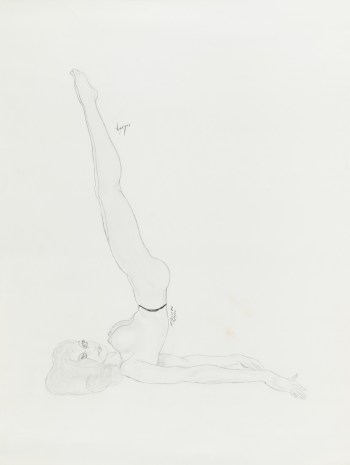
I shifted from comic books to men’s magazines and copying the objectifying artwork of Alberto Vargas, popularized in Playboy.

As a teen and young man, I was certainly trapped in very unhealthy but subtle patterns that could only be overcome by gaining critical awareness over my mid-20s into and my mid-30s (when I completed my doctoral program).

Some of that critical awareness was powerfully acquired through my commitment to learning from and teaching important literature such as Alice Walker’s The Color Purple and Margate Atwood’s The Handmaid’s Tale as well as poetry units I taught on Adrienne Rich, Anne Sexton, and Sylvia Plath.

Ultimately, writing an educational biography grounded in feminist theory stands in hindsight as the crowning experience as I approached 40 for a healthy awakening into fully appreciating toxic masculinity, predatory men, objectifying women, the male gaze, and rape culture.

Just as I would explain about my racial awareness, my sexual and gender awareness remains a journey, and as such, I find myself often paralyzed because, as a man, I represent still the potential for abuse through my status, the threat men pose for women in a society that continues to objectify and marginalize females—especially in terms of failing to listen to women who risk telling of their experiences with predatory men and rape culture.

My adult life has been spent as a partner, friend, parent, grandparent, teacher, and coach—all requiring me to monitor my status of power granted by being male and by my professional and familial positions in relationship with females.

As a coach and teacher, I have been (and continue) to be prone to call young women “darling” in casual moments—rightfully prompting some of my closest friends and colleagues who are women to call me on the language, the positioning.

I remain aesthetically drawn to photography and artwork of women nudes—entirely unsure if I can disentangle my toxic past from what I consider non-objectifying appreciation of art.

And so, as I noted above, I stumble toward 60, a man with good intentions who understands that is never enough; I am often reduced to paralysis in how to navigate the world in ways that are equitable and healthy for everyone regardless of race, gender, sexuality, or class.

I am genuinely terrified of ever making any woman/girl feel discomfort because of my masculine presence, my inadvertent gaze, my language, or the implicit threat of my status in relationship to her.

Often these days, I must confront these tensions as I snuggle with my granddaughter who I dearly want to grow up with healthy views of gender and sexuality, who I want to avoid any sort of predatory world.

My daughter was raised without corporal punishment, and now her children have been gifted that same dignity.

I work hard to practice what I preach and feel I make contributions small and even large to a kinder and more compassionate world—a world in which women and children need not ever fear men.

But even the best men walk in the wake of the worst men have given this world—the worst men continue to give to this world, and the women and children who must suffer for that.

Each man must moment by moment examine how he is culpable, where and how he stands in this world in relationship to women and children.

The dilemma of navigating the world as a man is couched in the unearned privilege, the potential for an abuse of unearned power that shouts out “First, do no harm.”

For a man committed to that, however, how does he live a full life without being paralyzed by the worst of being a man, behaviors that often go unpunished and even masked to protect some men from consequences.

How does any man avoid paralysis reading about the Stanford rape case or the stories of women as victims of predatory men?

This remains a rhetorical question for any man with an ethical imperative for his life—not a question for any woman or any child to offer their compassion.

For any man, for each man, this is ours to confront, to answer, and to act.

As long as men hold most of the power that shapes the world, it is ours to build a consensual environment in which human dignity supersedes the brute force of power.

Between acquiescing to the basest of male behaviors and paralysis is the true way, about which Franz Kafka wrote: “The true way is along a rope that is not spanned high in the air, but only just above the ground. It seems intended more to cause stumbling than to be walked upon.”

Pause. Listen. Look carefully before taking any step.


For Further Reading

Experts in the FieldBonnie Nadzam

Roxane Gay, Aimee Bender, and More on Assault and Harassment

The Predatory Men of Academic Creative Writing, John Warner

“He knows, or thinks he knows”: It’s Still a Man’s (Hostile) World

True Detective: It’s Still a Man’s (Hostile) World, pt. 2

Doubling Down (Again) on the White Man’s World

“Gravity”: The Unbearable Lightness of Being a Woman

In the U.S., Where the Female Nipple Is More Dangerous Than a Gun

Give Me Your Soda, Your iPhone, Your Sick Yearning for Healthcare

The public is stunningly misinformed about issues and concepts that are essential to understand if a democracy is going to thrive.

The Trump candidacy and presidency have exposed a powerful example of that problem since many who support Trump believe that the Affordable Care Act and Obamacare are different programs.

This important policy confusion is grounded, I believe, in larger concepts about which most in the U.S. are just as misinformed: race and social class.

Even among my college students who are well educated, few are aware that race has no basis in biology, but is a social construction. And people in the U.S. routinely over self-identify as middle-class, while also associating ethical and moral qualities to the classes (the poor as deserving their poverty due to character flaws; the wealthy as earning their wealth due to superior work ethics).

Further complicating the national beliefs about race and class is how the two overlap, specifically how lingering racism lurks beneath negative stereotypes about the poor.

Political leadership in the U.S., then, includes two powerful facts: most of those leaders are affluent, often among the very elite of wealth, and virtually all of those leaders speak to the public’s flawed but powerful beliefs about social class and race (although usually in coded ways).

As the Trump administration and Republican Party prepare to end the ACA and offer new healthcare legislation, what is being put disturbingly on display is a resurgence in attacks on the undeserving poor.

Three examples serve well to expose how Republicans and the mainstream media speak to and perpetuate the image of the undeserving poor in order to promote public policy that abandons the vulnerable and rewards the privileged.

As I have examined, just before Trumps inauguration, The New York Times published a damning and false story about people on welfare purchasing soda, In the Shopping Cart of a Food Stamp Household: Lots of Soda.

Joe Soss refuted the article, noting that welfare recipients, the USDA studied actually showed, had very similar purchasing patterns as those not on welfare.

Yet, multiple states have begun legislation to bar soda purchases by any on welfare.

The NYT article, despite being provably flawed, and the proposed legislation reveal a social belief that people trapped in poverty somehow don’t deserve luxuries (sodas), that the poor must have higher standards of self-control than people in other social classes.

This example from the media helps us understand the Republican use of “choice” to mask how their policies benefit the wealthy and ignore the poor.

Next, consider Paul Ryan’s and Mike Pence’s groundwork for repealing the ACA—both of whom Tweeted about choice and freedom as the ideals driving their work.

Market-based healthcare shifts all the responsibility onto individuals, and Republicans are masters at manipulating the misinformed public.

Finally, as Republicans unveil how they will replace ACA, the realities of that plan (shifting the burden to individual medical savings accounts, despite most Americans without healthcare are also without savings or the ability to save) are being masked by the same sort of undeserving poor language found in the NYT:

“Americans have choices. And they’ve got to make a choice. And so maybe rather than getting that new iPhone that they just love and they want to go spend hundreds of dollars on that, maybe they should invest in their own health care. They’ve got to make those decisions themselves,” [Rep. Jason Chaffetz (R-UT)] said on CNN’s “New Day” when pressed on insurance for low-income Americans under the latest draft legislation to replace the Affordable Care Act.

The illogic of such claims—does the cost of an iPhone really equal healthcare costs?—cannot stand up without cultural assumptions about the undeserving poor.

Rep. Chaffetz and the Republican Party depend on most people hearing this nonsense and thinking, “That is not me. That is not anyone I know or care about,” even when the consequences of the legislation is about them, about people they know and care about.

But even more damning is that the healthcare policy of the U.S. will always necessarily effect everyone; in other words, to view policy as “about me,” or not, is the best way to support legislation that will not serve you well.

The ignored truth, for example, about poverty helps expose how misguided the Republican agenda is.

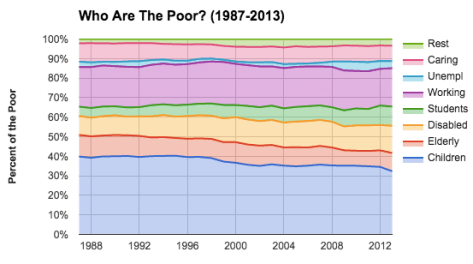
The ignored truth is, Who are the poor?:

poor1987

As you can see, more than 80% of the officially poor are either children, elderly, disabled, students, or the involuntarily unemployed (while the majority of the remaining officially poor are carers or working people who didn’t face an unemployment spell). I bring up these 80%+ because these are the classic categories of people that are considered vulnerable populations in capitalist economies. These are the categories of people that all welfare states target resources to in one form or another, the good ones very heavily.

The poor in the U.S. as vulnerable populations who are not lazy or deserving of their poverty—this is what confronts a people who must make an ethical decision about the role of public policy.

That over 30% of the poor who are children, they should have to depend on a medical savings account, the whims of the market?

In America, we are a misinformed people, and that results in a political dynamic in which many vote against their own best interests.

Welfare is not about purchasing sodas, and healthcare is not about choosing between care and an iPhone.

These are calloused lies driven by the media and political leaders who are trapped themselves in stereotypes about the undeserving poor.

Public policy as well as media and political discourse is much different when we reject the undeserving poor framing and seek ways to practice that all people “are created equal, that they are endowed by their Creator with certain unalienable Rights, that among these are Life, Liberty and the Pursuit of Happiness.”

Unalienable rights for the most vulnerable among us must have nothing to do with competing in a market and everything to do with the collective will of a people who see ourselves in everyone.

South Carolina Ranks First in Political Negligence

Based on a U.S. News & World Report ranking, The Post and Courier (Charleston, SC) announced South Carolina ranks last in education.

South Carolina also ranks first in women being murdered by men.

Rankings are popular in the U.S., but more often than not, terrible ways to understand what is being ranked as well as distracting fodder for both the media and politicians.

Ranking itself is problematic since the act itself requires finding data that supports that ranking, and then by ranking we are ascribing both a range of quality as well as some degree of blame for the relative status.

When saying SC is last in education and first in violence toward women, we must take greater care in clarifying what these rankings mean and where the accountability lies for both outcomes and the causes for those outcomes.

I suspect many would fault SC public schools for the education ranking, but almost no one would blame heterosexual domestic relationships for the inordinate rate of men’s violence toward women in the state.

But even more important here is that both of these rankings reveal something in common nearly entirely ignored: political negligence in SC.

The U.S. News ranking of education is far less about education, in fact, than about socio-economics.

Three of the six data categories to rank states by education are test scores (ACT and NAEP math and reading), and the other three are graduation rates as well as Pre-K quality and preschool enrollment.

At least 60% of test scores prove time and again to be correlated with out-of-school factors. In short, what we routinely label as “education” is in fact more significantly a reflection of poverty and wealth.

And thus, if we are compelled to say SC is last in education, we are actually saying that SC’s social and education policy are utter failures. The key here is that this ranking is about policy, a direct reflection of political will, political negligence.

And SC is easily in competition for elite status in political negligence of education as shown in the twenty years it took for the courts to address the Corridor of Shame, finally admitting that high-poverty schools serving high-poverty communities result in students being doubly disadvantaged by their lives and their school opportunities.

For comparison, consider SC’s violence toward women ranking and the state being one of 13 states that treat marital rape differently than rape of a non-spouse:

Men or women raped by a spouse have just 30 days to report the incident to authorities. For the rape to count, it must have involved “the use or the threat to use a weapon … or physical violence of a high and aggravated nature.” The offense is treated as a felony but has a maximum sentence of 10 years, whereas rape of a non-spouse has a maximum sentence of 30 years.

In both rankings, then, we must ask how policy creates the environments reflected in measurable outcomes—such as test scores and graduation rates or incidences of violence toward women.

There is a political advantage to keep media and public focus on schools with educational rankings; that focus, however, is akin to blaming hospitals for housing the sick.

Schools in SC and across the U.S. reflect the inequities of our communities, the failures of our policies, and as a result, they are ineffective as mechanisms of change.

While we have known for decades that poverty and inequity are the greatest hurdles for children learning, we have committed to decades of changing standards and testing students—and we appear poised to waste time and funding next on school choice scheme.

None of this addresses the root causes of the outcomes we continue to use to rank educational quality, a process that masks, misinforms, and guarantees to maintain the status quo.

Ranking invariably proves to be much ado about nothing because it tends to misrepresent and misinform, especially in terms of why conditions exist and what reforms would improve those conditions.

Policy is at the core of both any state’s educational outcomes and what threatens the safety of women.

Policy reflects what truly matters, and in SC, our rankings in terms of education and violence toward women are commentaries on who we are as a people, who we are willing to ignore and who we are willing to protect.

Ultimately, both of these rankings expose that SC ranks first in political negligence, negligence of equity in the lives and education of children, negligence in the safety of women.

Education Reform in the Absence of Political Courage: Charleston (SC) Edition

Words matter, and thus, I must apologize by opening here with a mundane but essential clarification of terms.

As I have written over and over, everything involving humans is necessarily political, even and especially teaching and learning. Therefore, no teacher at any level can truly be apolitical, objective. Taking a neutral or objective pose is a political choice, and an endorsement of the status quo.

Key to that claim is recognizing the difference between political and partisan. Partisan politics involves allegiance to and advocacy for organized political parties, notably Republicans and Democrats.

A partisan feels compelled to place party loyalty above ideology or ethics. To be political can be and should be a moral imperative.

We can avoid being partisan, even as that is political. And when many people call for education and educators to avoid being political, what they really are seeking is that education and educators not be partisan—a position that is achievable and one I endorse.

This distinction matters in public education and public education reform because all public institutions in the U.S. are by their tax-supported status at the mercy of partisan politics.

From around 1980, in fact, politicians at the local, state, and national levels have discovered that public education is a powerful and effective political football. The standard politician’s refrain is “Schools are horrible, and I can make them better!”

The current rise of the inexpert ruling class at the presidential level has been foreshadowed for more than three decades by the partisan politics around education reform—politicians and political appointees with no experience or expertise in education imposing pet reform initiatives onto public schools because these policies appeal to an equally mis-informed public.

Even with large failed crucibles such as New Orleans post-Katrina, political leaders remain committed to finding themselves in a hole and continuing to dig.

In my home state of South Carolina, infamous for our Corridor of Shame, Charleston, on the east coast and part of that corridor, continues to represent the savage inequalities that result from a combination of an inexpert ruling class and an absence of political courage.

Charleston schools reflect the most stark facts about and problems with K-12 education across the U.S.: private and gate-keeping public schools (such as academies, magnet schools, and some charter schools) that provide outstanding opportunities for some students in contrast to grossly ignored high-poverty, majority-minority public schools that mis-serve “other people’s children.”

As a result of these inequities and dramatically different student outcomes exposed by the accountability era obsession with test scores, Charleston has played the education reform game, committing to provably failed policies over and over: school choice, school closures and takeovers, school turnaround scams, overstating charter schools as “miracles,” and investing in Teach For America.

Why do all these policies fail and what ultimately is wrong with inexpert leadership? The absence of political courage to address directly the blunt causes of inequitable student outcomes in both the lives and education of students.

Currently in Charleston, the closing of Lincoln High and transferring those students to Wando High (see here and here) highlight that the gap between commitments to failed edureform and political courage to do something different persists.

The debates and controversy over how former Lincoln students are now performing at Wando offer some important lessons, such as the following:

  • The media and the public should be aware of partisan political code. A garbled reach for “the soft bigotry of low expectations” has been used to explain why Lincoln students’ grades have dropped while at Wando. The “soft bigotry” mantra is a conservative slur triggering the public’s belief in “bleeding heart liberals,” who coddle minorities. But the more damning part of the code is that it focuses blame on the administration and teachers in high-poverty, majority-minority schools and thus away from political leadership.
  • And thus, the public needs to distinguish between blaming educators at Lincoln for low expectations (again, garbled as “low standards”) and the expected consequences of high-poverty, majority-minority schools suffering with high teacher turnover, annual under-staffing, and persistent teacher workforces that are new and/or un-/under-certified. Additionally, the accountability era has unrealistic demands of these schools when compared to low-poverty, low-minority schools that have much greater percentages of experienced and certified teachers.
  • The apparent drop in student grades and test scores from Lincoln to Wando is extremely important data that deserve close scrutiny, but so far, that scrutiny has been reduced to partisan politics and deflecting blame. Dozens of reasons could explain the grade differences, including the transfer as well as the staffing differences between the two schools (neither of which is the simplistic “soft bigotry” argument used primarily to justify closing a community school).

The partisan political approaches to schools and education reform are tarnished by both willful ignorance and a confrontational blame game.

The willful ignorance of politicians and the public refuses to acknowledge huge social inequity driven by racism and white privilege; the blame game seeks ways to blame the victims of those inequities instead of confronting systemic forces.

What should political leaders be doing and what should the public be demanding that is different from the patterns identified above, than the policies already proven as failures?

  • Recognize that in-school only reform creates two serious problems: (1) unrealistic demands with high-stakes consequences produce unethical behavior among otherwise good people (see the Atlanta cheating scandal), and (2) since out-of-school factors overwhelmingly influence measurable student achievement, even the right in-school only reform is unlikely to result in measurable improvement.
  • Interrogate the proclaimed cause of low student achievement—”low expectations”—and instead seek to understand the complex reasons behind that low achievement by poor and black/brown students based on available evidence that includes carefully interviewing the administrators, teachers, and students involved.
  • Advocate for public policy that addresses serious inequity in the lives of children—policy impacting access to health care, a stable workforce, access to safe and stable housing, and high-quality food security.
  • Refuse to ignore needed in-school reform, but reject accountability-based reform for equity-based reform focusing on equitable teacher assignment for all students, articulated school funding that increases funding for schools serving struggling communities, guaranteeing the same high-quality facilities and materials for all children regardless of socioeconomic status of the communities served, and eliminating gate-keeping policies that track high-needs students into test-prep while advantaged students gain access to challenging courses such as Advanced Placement and International Baccalaureate.

Ultimately, the absence of political courage in SC and across the U.S. is where the real blame lies for inequitable student achievement along race and class lines.

Many students, the evidence shows, are doubly and triply disadvantaged by the consequences of their lives and their schools.

Trite and misleading political rhetoric, along with “soft bigotry of low expectations,” includes soaring claims that a child’s ZIP code is not destiny.

Well, in fact, ZIP code is destiny in SC and the U.S.; it shouldn’t be, but that fact will remain as long as political leadership chooses to ignore the expertise within the field of education and continues to lead without political courage.

Political courage requires direct action, even when it isn’t popular, and refuses to deflect blame, refuses to wait for what market forces might accomplish by taking the right action now.

Political courage, as James Baldwin expressed, embraces that “[t]he challenge is in the moment, the time is always now.”


For More on Political Courage

Support Betsy Devos Shoot Yourself In The Foot, Andre Perry

Black Activists Don’t Want White Allies’ Conditional Solidarity!, Stacey Patton