Category Archives: inequity

Cinco de Mayo 2016: A Reader

Let us hope we can resist the urge to trivialize and appropriate the wonderful history, traditions, and people of Mexico because of the silliness that is making a holiday another way to churn up crass commercialism (a redundant term). [Also, lost in the shuffle, today is the birthday of Karl Marx.]

So below, please read a gathering of important articles, somewhat loosely connected because they have crossed my path.

First, let me note that since I have relentlessly criticized edujournalism of late (and it is well deserved criticism), I start with an edujournalism unicorn—a very good piece on NAEP.

Read on:

The simple truth is that NAEP is not designed to provide causal explanations. It’s a test given every two years to a representative sample of students who happen to be in fourth, eighth, or twelfth grade that particular year. It does not follow students over time, so it’s impossible to say that a policy or practice “caused” the results….

Put together, the findings paint a picture of unequal opportunities to learn challenging content. Low-performing students spend less time explaining their reading or doing projects, and more time on test prep. Once again, these are correlations: they do not suggest that these patterns caused the low performance. But why do they exist? What can be done about them? That’s the challenge for educators and policy makers.

Clinton has been a card-carrying feminist for decades, she started her career doing advocacy for children and women, she’s famous for her UN speech about women’s rights are human rights, she’s been reliably pro-choice and so on. So if that all fits into this sort of recognition side, she’s been there, and in a more explicit, and front-and-center way than Sanders. But, on the other hand, What kind of feminism is this? Clinton embodies a certain kind of neoliberal feminism that is focused on cracking the glass ceiling, leaning in. That means removing barriers that would prevent rather privileged, highly educated women who already have a high amount of cultural and other forms of capital to rise in the hierarchies of government and business. This is a feminism whose main beneficiaries are rather privileged women, whose ability to rise in a sense relies on this huge pool of very low-paid precarious, often racialized precarious service work, which is also very feminized that provide all the care work

It’s called the American Dream because you have to be asleep to believe it.

Black students will always underachieve when they are perceived as needing fixing.

The irony is that black students aren’t the ones who need fixing.

Deficit thinking corrupts the potential effectiveness of even the most competent teachers.

White folk must unlearn their negative expectations. That’s the only way we’re ever going to change the structures that really hold students back.

And now, a musical extra:

https://youtu.be/Cl4jJF1-HV4

Outliers Never Evidence of Normal in Education

In Money, Race and Success: How Your School District Compares, the NYT, like most of mainstream media, is begrudgingly coming to admit that race and class inequity in the U.S. has a profound impact on the education of children—and that simply tinkering (badly) with school policy is not enough to change that reality:

We’ve long known of the persistent and troublesome academic gap between white students and their black and Hispanic peers in public schools.

We’ve long understood the primary reason, too: A higher proportion of black and Hispanic children come from poor families. A new analysis of reading and math test score data from across the country confirms just how much socioeconomic conditions matter.

Children in the school districts with the highest concentrations of poverty score an average of more than four grade levels below children in the richest districts.

But then there is this:

The data was [sic] not uniformly grim. A few poor districts — like Bremen City, Ga. and Union City, N.J. — posted higher-than-average scores. They suggest the possibility that strong schools could help children from low-income families succeed.

“There are some outliers, and trying to figure out what’s making them more successful is worth looking at,” said Mr. Reardon, a professor of education and lead author of the analysis.

Well, no, if we find outliers—and virtually all data have outliers in research—we should not waste our time trying to figure out how we can make outliers the norm.

The norm is where we should put our efforts in order to confront what is, in fact, not “puzzling” (used earlier in the article) at all; the data are very clear:

What emerges clearly in the data is the extent to which race and class are inextricably linked, and how that connection is exacerbated in school settings.

Not only are black and Hispanic children more likely to grow up in poor families, but middle-class black and Hispanic children are also much more likely than poor white children to live in neighborhoods and attend schools with high concentrations of poor students.

Our great education reform failure is one of failing to rethink our questions and our goals.

Let’s stop trying to find the “miracle” in a rare few schools where vulnerable students appear to succeed despite the odds against them. With time and careful consideration, we must admit, those appearances almost always are mirages.

Let’s instead put our energy in eradicating the poverty, racism, and sexism that disadvantages some students, vulnerable populations easily identified by race and social class, so that we can educate all students well.

And while we are making efforts at social policy, let’s end the in-school policies that we know “exacerbate” inequity: tracking, teacher assignments (and TFA), high-stakes testing, grade retention, discipline policies grounded in zero tolerance and “no excuses,” and segregation through school choice (including charter schools).

Education reform, as was highlighted in the original court case examined in the South Carolina documentary The Corridor of Shame, is obsessed with playing the hero by seeing who can pull the most babies out of the river.

And then examining the ones who survive the potential drowning in order to “make” all babies survive the trauma of being cast down stream.

But no one seems interested in walking upstream to stop babies being thrown in.

Life and learning do not need to be something children survive—and we must confront that we have decided that this is exactly what we are willing to accept for “other people’s children.”

It would not be so if we believed and acted upon that “they’re all our children.”


The Allegory of the River

How Good Is the Best Edujournalism?

A recurring theme running through my blog posts—one that could be addressed daily—is that education journalism is almost always significantly misleading and way too often completely inaccurate.

Mainstream media and journalists are trapped in false but compelling narratives about schools, learning and teaching, children, poverty, and race. Journalism itself fails education as a field because of a simplistic “both sides” to a rather cartoonish “objective” journalism.

As I have detailed too often, media coverage of education includes primarily voices and perspectives of people with no or very little experience or expertise in education, but when a few contrary perspectives are offered, those are typically framed as “some critics”—with no effort to establish which claims are credible or not.

Sadly, the best unmasking of the essential failure of the media has been by one of our faux-media comedians, John Oliver, who highlighted that even if there are two sides to an issue, one can be overwhelmingly credible while the other is mostly baseless; therefore, placing them as one-versus-one misleads the public on the weight of the arguments.

So when I received yet another email from the Education Writers Association (EWA)—who is extremely proud of itself—announcing their top award for education reporting, I wondered: How good is the best edujournalism?

The EWA Fred M. Hechinger Grand Prize for Distinguished Education Reporting was awarded for Failure Factories (The Tampa Bay Times), written by Cara Fitzpatrick, Lisa Gartner and Michael LaForgia. The series includes the following:

Without question, this series is comprehensive and it confronts some incredibly important issues about public schooling: the significant relationship between race/poverty and student achievement; the plague of segregation and resegregation in public institutions such as schools; and the huge inequities of education faced by racial minorities and impoverished students such as teacher assignments, school safety, funding, and discipline practices.

And while the series does a solid job of raising these issues, my first response is that these are all old news—I mean very old news.

That our public schools have failed poor and black/brown students is a recurring message over the last century—little different before or after the Civil Rights movement.

Therein lies a real problem with even the so-called best edujournalim—journalists without a historical lens afforded those with expertise in a field are ripe to fall prey to the lens of a novice.

One such failure of this series and then how the EWA praised the series can be found in the quoted judge’s comment:

Bravo to this team and the paper for taking an all-too-common story (low achievement in a high-poverty area) and digging past the excuses to reveal a shameful history of indifference and, most troubling, willful neglect. I was awed by the dogged reporting, the sheer volume of interviews and data-crunching, and the courageous analysis that put the blame exactly where it needed to be. But the true brilliance of this work is found in the stories of the children who were robbed of an education they deserved. How many other school districts in America might have the same story to tell?

The series title “Failure Factories” is but one of many triggers for the pervasive and ugly “no excuses” narrative that is all the rage in the U.S.

You see, once again, this series oversimplifies the story of educating vulnerable populations of students: racism and classism are merely excuses for the schools charged with high concentrations of vulnerable students.

And as the judge notes above, this is all about “blame”—and keeping the focus on those damn failing schools.

The shame is that without this corrosive and ugly framing, there is an incredible amount of work in this series that does deserve praise. We should be asking: Why do we need yet anther round of test scores to admit and confront race and class inequity—especially when high-stakes standardized testing itself is racist and classist?

The truth is that schools in the U.S. have never been, are not now, and never will be anything other than reflections of our society—unless we do things different in both our social and educational policy.

Yes, public schools almost entirely reflect and perpetuate the race, class, and gender inequities that remain powerful in our wider society, and much of that is embedded in the very reforms being championed in the media and among political leaders: accountability, standards, high-stakes testing, grade retention, zero tolerance policies, “no excuses” practices, charter schools, school choice, Teach For America, school report cards, value-added methods of teacher evaluation, and the worst of the worst—”grit.”

That is not simply a fact of the schools targeted by this series. That is a fact about public education across the entire country.

And many educators as well as education scholars have been yelling that for decades; that’s right—decades.

Possibly the most telling problem with the series is the end, where the condemnations of Arne Duncan and John King are treated as if they are somehow credible.

If this weren’t so tragic, it would be laughable—nearly rising to the level of an article in The Onion.

Therefore, here is a little message about the best of edujournalism.

Dear EWA:

Public schools have been reflecting and perpetuating the worst aspects of our society for over 100 years. People in power really don’t care, and politicians in the last three to four decades have learned that education policy is a powerful political football.

Since the Reagan administration, public schools have failed students even more significantly because of inane obsessions with accountability, standards, and tests.

Duncan and King are the personifications of all that is wrong with education policy: lots of soaring rhetoric masking policy cures that are part of the disease; thus, the accountability movement is intensifying race, class, and gender inequity—not overcoming it.

Racism, classism, sexism, and homophobia are never excuses, but facts, and these burdens are more than micromanaged and technocratic in-school only policies can address.

Yes, we need much more equitable school practices and polices—but none of what politicians are doing now meets those standards—and those alone will never accomplish what we seem to want without concurrent changes to public policy that also addresses equity.

Edujournalism, as well, is part of the problem because it remains trapped in false narratives, committed to simplistic “both sides” frames of issues, and unwilling to listen to the voices of the practitioners and scholars in the field of education.

Nearly everything addressed in “Failure Factories” was raised by novelist Ralph Ellison in a 1963 speech to teachers. Your best journalism is old news wrapped in a false frame and too often fumbled badly with good intentions.

I remain concerned that education-bashing journalism has become so lucrative for your flailing field that it is in fact as pressing that we address the journalism crisis as we do the need to significantly reform our public schools.

As agents of the public good, journalists and educators have a great deal in common that is being squandered; neither can afford as a field or in the name of that public good to remain the tools of those who have interests other than the public good.

We both can and should do better.

The Real Test

This post is not about high-stakes testing.

It is not about testing in schools of any kind. Or even education.

This post is about human dignity—to put a fine point on it, about our very human propensity to indignity.

So what is the real test? The real test is about whether or not you will stand in solidarity with others not like you for the human dignity and freedoms you demand for yourself and people like you.

In my 55 years as a Southerner, in the Bible belt, I have witnessed daily that those who are loudest about moralizing are least likely to be willing to pass this test.

I demand mine, they shout, but you cannot have yours—thumping their bible all the while. Religious texts were thumped to deny women their full humanity, to reduce blacks in the U.S. to property. When will we unmask these refrains as the worst types of unethical behavior?

You see, religious fervor, moral certitude are the mothers of intolerance.

If any of us expect the basic human dignity of access to a public restroom, we must extend that to anyone, everyone, regardless of whether we understand or know the experiences of others unlike us.

Your religious freedom must not supersede the religious freedom of people holding a different faith—or no faith at all.

And that is the real test—Will you stand in solidarity with others not like you for the human dignity and freedoms you demand for yourself and people like you?—one too many fail on a regular basis.

Until we all are willing to take and pass this test, none of us are free, none of us have the human dignity everyone deserves at birth.

And all of us carry the shame of the daily failures of this test.

Day on Diversity at the University of South Carolina

I am participating as a discussion leader and speaker for a day on diversity at the University of South Carolina 14 April 2016. Below are my notes which may be of value to some addressing race and class in both social and educational contexts.

University of South Carolina

April 14 1:30 pm

Svec. M., & Thomas, P.L. (2016). The classroom crucible: Preparing teachers from privilege for students of poverty. In A.L. Hurst & S.K. Nenga (Eds.), Working in class: recognizing how social class shapes our academic work. Landham, MD: Rowman & Littlefield Publishers.

http://www.heinemann.com/blog/wp-content/uploads/2015/12/Confronting-Privilege-to-Teach-About-Privilege.pdf

https://radicalscholarship.wordpress.com/2014/11/13/my-redneck-past-a-brief-memoir-of-twos/

https://radicalscholarship.wordpress.com/2015/12/20/i-dont-belong-heremy-otherness-my-privilege/

April 14 6 pm

“How do we look at systemic issues of equity in institutional settings?”

20 minutes

Scarcity: The New Science of Having Less and How It Defines Our Lives, Sendhil Mullainathan and Eldar Shafir

For White Folks Who Teach in the Hood… and the Rest of Y’all Too: Reality Pedagogy and Urban Education, Chris Emdin

Police in the Hallways: Discipline in an Urban High School, Kathleen Nolan

Hope Against Hope, Sarah Carr

Reaching and Teaching Students in Poverty: Strategies for Erasing the Opportunity Gap, Paul Gorski

No Caste Here? Toward a Structural Critique of American Education, Daniel Kiel

Abstract:

In his famous dissent in Plessy v. Ferguson, Justice John Marshall Harlan argued that in the United States, there was “no caste here.” Justice Harlan was rejecting the idea that American society operated to assign preordained outcomes to individuals based upon classifications, including racial classifications. This Article questions whether Justice Harlan’s aspirational assertion accurately reflects contemporary American education. Identifying: (1) multiple classification mechanisms, all of which have disproportionate racial effects, and (2) structural legal, political, and practical impediments to reform, the Article argues that the American education system does more to maintain the nation’s historical racial hierarchy than to disrupt it. This is so, the Article suggests, despite popular agreement with the casteless ideal and popular belief that education can provide the opportunity to transcend social class. By building the framework for a broad structural critique, the Article suggests that a failure to acknowledge and address structural flaws will preclude successful comprehensive reform with more equitable outcomes.

Privilege

Racism, classism

deficit perspectives (word gap, achievement gap, grit)

Paternalism

Accountability v. equity — academics and discipline policies

https://radicalscholarship.wordpress.com/2014/12/04/grit-education-narratives-veneer-for-white-wealth-privilege/

https://radicalscholarship.wordpress.com/2016/04/06/are-racially-inequitable-outcomes-racist/

https://radicalscholarship.wordpress.com/2016/03/29/race-and-education-a-reader/

https://radicalscholarship.wordpress.com/2014/02/11/what-these-children-are-like-rejecting-deficit-views-of-poverty-and-language/

https://radicalscholarship.wordpress.com/2014/05/01/revisiting-james-baldwins-black-english/

https://radicalscholarship.wordpress.com/2016/03/29/race-and-education-a-reader/

https://radicalscholarship.wordpress.com/2015/06/12/recommended-reaching-and-teaching-students-in-poverty-paul-c-gorski/

https://radicalscholarship.wordpress.com/2016/03/22/a-crack-in-the-dam-of-disaster-capitalism-education-reform/

https://radicalscholarship.wordpress.com/2016/01/23/understanding-poverty-racism-and-privilege-again-for-the-first-time/

https://radicalscholarship.wordpress.com/2014/12/30/bearing-witness-hypocrisy-not-ideology/

https://radicalscholarship.wordpress.com/2014/12/31/responsibilities-of-privilege-bearing-witness-pt-2/

http://www.heinemann.com/blog/wp-content/uploads/2015/12/Confronting-Privilege-to-Teach-About-Privilege.pdf

https://radicalscholarship.wordpress.com/2014/11/20/thomas-race-matters-in-school-discipline-and-incarceration-opinion-columns-the-state/

https://radicalscholarship.wordpress.com/2015/09/03/criminalizing-black-children-begins-in-our-schools/

https://radicalscholarship.wordpress.com/2014/11/30/creating-crime-criminals-to-justify-deadly-force/

http://cedar.wwu.edu/cgi/viewcontent.cgi?article=1184&context=jec

Confronting the “Soft Bigotry of Low Expectations”

A a political refrain and mantra from the “no excuses” reform movement, the “soft bigotry of low expectations” has resonated among many stakeholders in education.

As Education Week has reported, a new report seems to confirm that among vulnerable populations there is a significant concern about low expectations for black and brown children (and likely among poor, English language learner, and special needs children as well).

The problem with the “low expectations” claim, however, is that the political and education reform use of the slogan is dishonest and misleading, while the new report offers an excellent reframing of how significant and important the concern is.

The “no excuses” movement has positioned the public against schools and teachers serving vulnerable populations as simply not trying hard enough, thus “low expectations.” Concurrently, vulnerable students themselves have been characterized as lacking “grit,” not trying hard enough.

In that vacuum created by politicians and reformers, education policy has increasingly demanded less and less of schools, teachers, and those vulnerable students by increasing the standards and testing focus of education.

The great and disturbing irony of the “no excuses” and “low expectations” movement is that test-prep is cheating black/brown students, poor students, ELL students, and special needs students of challenging educations—while mischaracterizing the ways in which traditional schooling has failed those students historically.

Is there a problem among progressives and white, middle-class teachers who view black/brown and poor students through paternalistic and reductive/deficit lenses?

Yes, there absolutely remains a failure among too many educators who lack a culturally responsive view of teaching, who remain trapped in deficit ideologies such as the “word gap” and a need for “other people’s children” to have basic skills (see the work of Lisa Delpit).

And even more troubling is that among many educators, there is a problem with distorted “high expectations” about discipline, resulting in the criminalization of black and brown children in our schools.

Therefore, I am in no way discounting that there exists a “soft bigotry of low expectations,” but I am rejecting the use of that slogan among “no excuses” reformers who push for racist and classist high-stakes testing as gate keepers and for the expansion of segregating charter schools that increase harsh and racist discipline policies also found in traditional public schools.

New Education Majority: Attitudes and Aspirations of Parents and Families of Color offers a chance for education advocates to reconsider the sloganification of education reform, and to listen to the exact vulnerable populations many “Superman” and “miracle school” saviors (most of whom have no education background, but so have paternalistic missionary zeal) claim to be serving.

The reality of low expectations for vulnerable populations of students include the following:

  • Underfunding and inequitably funding schools serving vulnerable populations of students.
  • Failing to address teacher certification and years of experience for schools and courses serving vulnerable populations of students.
  • Continuing to allow gatekeeping to track “other people’s children” into test-prep while white and affluent students have inequitable access to Advanced Placement, International Baccalaureate, and gifted programs.
  • Masking student/teacher class ratios behind school averages while vulnerable populations of students sit in large classes in the same schools where white and affluent students benefit from low ratios (typically in those AP, IB, and gifted courses).

The problems we continue to ignore in society and education are anchored in race and class inequity: being white and affluent continues to heap tremendous benefits while being of color and poor is a stunning and often inescapable burden.

Those inequities, as well, cannot be overcome by school-only reform policies, particularly when the most popular reforms are themselves perpetuating race and class inequity.

If parental choice and the market place matter (more refrains you hear among the “no excuses” crowd), why do we ignore that the most affluent parents in the U.S. tend to choose private schools with rich curricular options (including a wide array of the arts), low student/teacher ratios, and a glaring absence of test-prep, standards-based coursework?

The answer isn’t pretty: the “no excuses” reform movement is not about the best interests of vulnerable populations of students or vulnerable communities, but about their own investments in education reform.

As I have noted before, we must not trust advocates invested in education reform at the expense of the children and communities those reforms claim to serve.

We must, instead, begin to listen to vulnerable populations who are suffering the negative consequences of race and class inequity, advocates of children and communities.

It is among the “we” who are privileged to listen and then act to create both social and educational policy from an equity of opportunity perspective and not an accountability perspective that further marginalizes children and communities who need our public institutions the most.

Are Racially Inequitable Outcomes Racist?

Among what may seem to be marginally related policies and conditions, these all have one startling thing in common—grade retention, school discipline, NCAA athletics, incarceration, “grit,” “no excuses,” zero-tolerance, high-stakes testing (such as the SAT and ACT), charter schools and school choice—and that commonality is observable racially inequitable outcomes that are significantly negative for blacks.

My own experiences with exploring and confronting race and racism through my public writing has shown that many people vigorously resist acknowledging racism and will contort themselves in unbelievable ways to avoid accepting facts and data that show racism exists.

Common responses include “I am not a racist,” “I am sure the people who started X didn’t intend to be racist,” “White people experience racism too,” and “Everyone has the same opportunities in this country.”

And while I continue to compile a stunning list of ways in which racial inequity and racism profoundly impact negatively black people, resistance to terms such as “white privilege” and “racism” remain robust.

In the wake of the NCAA Final Four, Patrick Hruby has attempted a similar tactic I have used in order to unmask the racial inequity in college athletics by carefully working readers through the evidence in order to come to an uncomfortable conclusion about the financial exploitation of college athletes (money-making sports being disproportionately black) by the NCAA and colleges/universities (leadership and those profiting being overwhelmingly white) along racial lines:

Understand this: there’s nothing inherently racist about amateurism itself. And there’s no reason to believe that its defenders and proponents—including current NCAA president Mark Emmert—are motivated by racial animus….

And yet, while the NCAA’s intent is color-blind, the impact of amateurism is anything but. In American law, there is a concept called adverse impact, in which, essentially, some facially neutral rules that have an unjustified adverse impact on a particular group can be challenged as discriminatory….Similarly, sociologists speak of structural racism when analyzing public policies that have a disproportionately negative impact on minority individuals, families, and communities. State lottery systems that essentially move money from predominantly lower-class African-American ticket buyers to predominantly middle-and-upper-class white school districts fit the bill; so does a War on Drugs that disproportionately incarcerates young black men; so does a recent decision by officials in Maricopa County, Arizona, to drastically cut the number of presidential primary polling stations in and around Phoenix, which unnecessarily made voting far more difficult for the residents of a non-white majority city.

Big-time college sports fall under the same conceptual umbrella. Amateurism rules restrain campus athletes—and only campus athletes, not campus musicians or campus writers—from earning a free-market income, accepting whatever money, goods, or services someone else wants to give them. And guess what? In the revenue sports of Division I football and men’s basketball, where most of the fan interest and television dollars are, the athletes are disproportionately black.

And herein lies the problem with refusing to equate racially inequitable outcomes with racism.

Hruby’s detailed unmasking of the NCAA comes also during the troubling rise of Trump in presidential politics—another marker for how many scramble to find any cause other than racism.

Trump’s rise is not exclusively the result of overt and unexamined racism, but a significant amount of his success is easily traced to a wide spectrum of racism.

However, from the rise of Trump to the so-called popularity of charter schools to the school-to-prison pipeline and to the spread of third-grade retention policies, all of these and more are fueled by racism because racism, we must acknowledge, is most insidious when it isn’t overt, when the racist person or the racist act is unconscious, unacknowledged.

The impact of racism in NCAA sports, as Hruby details, is the elegant racism Ta-Nahisi Coates unpacked when Donald Sterling became the NBA’s face for oafish racism (along with Clive Bundy in popular culture).

What has occurred in the U.S. since the mid-1960s is an end to placard racism, the end of “White Only” signs on bathroom and restaurant doors.

What has not occurred in the U.S. yet is an end to seeing black boys as significantly older than their biological ages, an end to tracking black children into segregated schools and reductive courses, an end to incarcerating black men—and this is a list that could go on for several pages.

Racial (and class) equity will never occur in the U.S. until the white power structure admits that racially inequitable outcomes are in fact racist.

White privilege is a powerful narcotic that numbs white elites to the harm that privilege causes black and brown people, but it is also a powerful narcotic that pits poor whites against black and brown people because poor whites believe their whiteness gives them the chance at great wealth held by only a few.

That the NCAA maintains a structure within which black athletes produce wealth enjoyed almost exclusively by white elites is an undeniable fact and a startling example of the elegant racism eroding the soul of a free people—an elegant racism eating at the roots of public education, the judicial system, the economic system, and nearly ever aspect of the country.

Racially inequitable outcomes are racist, and this must be admitted in order to be confronted and then to be eliminated.

MLK Day 2016: A Reader

In the US in 2016—and specifically for educators—the need to confront racism must remain central to all efforts to overcome inequity and injustice. Among the privileged—white-, male-, heterosexual-skewed—there is no room for “yes, but,” although there remains ample room for stepping back, being silent, and then listening as first steps to offering solidarity in the action needed to confront the false narratives of “meritocracy” and “rugged individualism,” and then to overcome the irrefutable inequities linked to race, class, gender, and sexuality.

One commitment is to resist the whitewashing of Martin Luther King Jr. as a passive radical. So here, I offer some readings, varied and important, but pathways to honoring the radical MLK and to resisting the lingering dream deferred.

Final Words of Advice/ “Where do we go from here?” (1967), Martin Luther King Jr.

MLK poverty

The Trumpet of Conscience, Martin Luther King Jr.

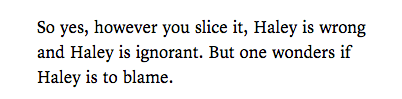
Leonard Pitts Jr.: Haley’s fairy tale ignores our history

haleyEnslaved Africans of George Washington Depicted as ‘Happy and Joyful’ in New Children’s Book

The Forgotten, Radical Martin Luther King Jr., Matt Berman

Martin Luther King, Jr.: Christian Radical—And Saint, Elizabeth Stoker Bruenig

Read This Before Co-Opting MLK Jr., Jose Vilson

The Revisionist’s Martin Luther King Jr., “I Have A Dream For Most Of Us,” Jose Vilson

Harlem, Langston Hughes

Let America Be America Again, Langston Hughes

The white man pathology: inside the fandom of Sanders and Trump, Stephen Marche

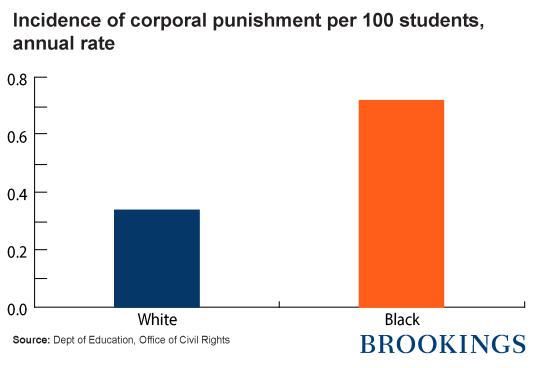
Schools, black children, and corporal punishment, Dick Startz

figure-1

“Please—a little less love, and a little more common decency.”

The Causal Effects of Cultural Relevance: Evidence from an Ethnic Studies CurriculumThomas Dee, Emily Penner

Questioning Payne | Teaching Tolerance

Toolkit for “Questioning Payne” | Teaching Tolerance

50 Years After Selma, White Lives Still Matter More, Stacey Patton

The Oscars’ Racist Refusal to Honor Modern Black Heroes, Stereo Williams

Should We Marvel at a Black Captain America?

The Martian: Allegory of Whose Lives Matter

Nicolas Sparks and the Allegory of Pretty White People Who Struggle until Everything Works Out

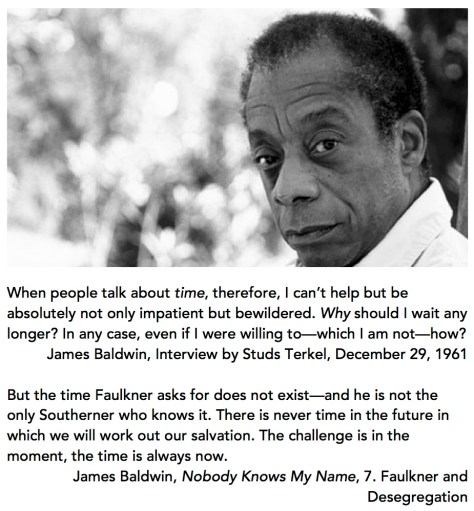
James Baldwin: “the time is always now”

the-time-is-always-now

Confronting Privilege in the New Year: “when you’ve been used to privilege, equality feels like prejudice”

A former student and current wonderful early-career teacher texted me yesterday because someone had shared with her the inane “I’m not going to apologize for my white privilege” article that is all the rage among white privilege deniers.

Nearly as disturbing as the pervasive and corrosive influence of racism is the reality that the more whites are confronted with evidence of white privilege and racism, the more likely whites are to cling to their denial. Research from 2015 confirms:

What happens when people are faced with evidence that their group benefits from privilege? We suggest such evidence will be threatening and that people will claim hardships to manage this threat. These claims of hardship allow individuals to deny that they personally benefit from privilege, while still accepting that group-level inequity exists. Experiments 1a and 1b show that Whites exposed to evidence of racial privilege claim to have suffered more personal life hardships than those not exposed to evidence of privilege.

Throughout 2015, I have been cataloguing the overwhelming evidence of white privilege and racism, but I am discouraged about both the abundance of that evidence and the ineffectiveness of presenting it to those clinging fervently to their white denial.

Humans are drawn to patterns, both the recognition of patterns and the creation of patterns. Maybe anthropologists and sociologists would argue that in part that attraction is about survival and comfort. I suspect this pattern fetish in humans is also at the root of seeking out others like us (see any school lunch room where students are allowed to sit where they please), and I fear it is also the foundation for the very worst of humans—our racism, sexism, classism, and seething anger at the Other.

This is not some historical low point of human history—U.S. slavery, the Holocaust, the Japanese internment—but a seemingly credible point of debate among presidential hopefuls and their supporters who are calling from banning Muslims from U.S. soil.

And as the hashtags have continued to increase (#BlackLivesMatter, #TamirRice, and then too, too many to list) so has the backlash, the denial—just as the research above confirms.

We stand at the cusp of one of our greatest pattern urges, the arbitrary designating of the passing of time. Soon a new year will be upon the West (yes, even the calendar is a force of privilege, a way to mask subjectivity as objective, universal), and at least one voice has suggested there is hope: “I believe – I hope – that a great rewriting is slowly, surely underway,” writes Laurie Penny.

Penny’s examination of the latest Star Wars film offers a much more detailed and powerful investigation than my own look at The Martian, but we do tread similar ground; notably Penny explains:

The people who are upset that the faces of fiction are changing are right to worry. It’s a fundamental challenge to a worldview that’s been too comfortable for too long. The part of our cultural imagination that places white Western men at the centre of every story is the same part that legitimises racism and sexism. The part of our collective mythos that encourages every girl and brown boy to identify and empathise with white male heroes is the same part that reacts with rage when white boys are asked to imagine themselves in anyone else’s shoes.

I struggle to share Penny’s optimism—because of the horrifying specter of the unfathomable nastiness in both our presidential politics and our pop culture, both of which expose the “white interpretive horizon.”

Yet, I think Penny makes a powerful observation that may be the key to believing change is upon us:

Let’s not get carried away here. These stories and retellings are still exceptions. Women are still paid less, respected less and promoted less at almost every level of every creative industry. For every Jessica Jones there’s a Daredevil, whose female characters exist solely to get rescued, provide the protagonists with some pneumatic exposition, or both. For every Orphan Black there’s Mr Robot and Narcos and you know, sometimes I wonder if perhaps I watch too much television. The point is that what we have right now isn’t equality yet. It’s nothing like equality. But it’s still enough to enrage the old guard because when you’ve been used to privilege, equality feels like prejudice. [emphasis added]

White privilege is an iceberg; very little is visible above the surface, and for those of us with that privilege, it is ours to interrogate what lies beneath in order to understand and dismantle it.

“I came to explore the wreck,” explains the speaker of Adrienne Rich’s “Diving into the Wreck”:

the thing I came for:
the wreck and not the story of the wreck
the thing itself and not the myth

As Penny explains when unpacking “[t]he rage that white men have been expressing, loudly, violently”:

Like a screaming toddler denied a sweet, it becomes more righteous the more it reminds itself that after all, it’s only a story.

Only a story. Only the things we tell to keep out the darkness. Only the myths and fables that save us from despair, to establish power and destroy it, to teach each other how to be good, to describe the limits of desire, to keep us breathing and fighting and yearning and striving when it’d be so much easier to give in. Only the constitutive ingredients of every human society since the Stone age.

Only a story. Only the most important thing in the whole world.

This is our wreck, a story of a people blinded by the myth of meritocracy while steering the ship headlong into the iceberg we pretend isn’t there.

We must write better stories, fictional and real. A new year is arbitrary, yes, but it serves us well to listen to the refrain “the time is always now.”

See Also

What to do when you’re not the hero any more, Laurie Penny

On Nerd Entitlement, Laurie Penny

Hello from the same side, Robin James

The horrifying lesson of Tamir Rice: White America will use “objectivity” to justify the murder of black children, Brittney Cooper

Confronting Privilege to Teach about Privilege

Bearing Witness: Hypocrisy, Not Ideology

Responsibilities of Privilege: Bearing Witness, pt. 2

White Denial

High Cost of White Denial (Updated)


High-stakes, Standardized Tests Are “Master’s Tools,” Not Tools for Social Justice

Christina Duncan Evans argues that the high-stakes testing opt-out movement “ignores a major function of testing,” which she identifies as: “A major reason we use standardized tests is to make the case that there’s large-scale educational injustice in our nation.”

As an advocate for educational equity and social justice, Evans explains:

States don’t have a very good track record of providing equitable access to education to all of their students, and the federal government should ensure that American school quality is consistent. This has made me an advocate of standardized testing, following the logic that we can’t solve achievement gaps unless we measure them first.

Before examining this commitment to standardized testing (also found among civil rights organizations), I want to highlight that public education and state government have had a long history, continuing today, of failing miserably black, brown, and poor children and adults.

The evidence of lingering race and class inequity in the U.S. is staggering, and that inequity is too often replicated and perpetuated in public schooling—through inequitable access to rich curriculum and experienced, qualified teachers, for example.

As well, there is a troubling aspect to the opt-out movement along with the backlash against Common Core; as Andre Perry states, reinforcing Evans:

Take it from black and brown children who are used to being tested. Students will overcome. However, privileged adults who aren’t used to being tested may never stop crying.

The opt-out and Common Core backlash have exposed an unintended lesson about U.S. public education and society: As long as punitive and biased practices impact mostly or exclusively black, brown, and poor children (think “grit” and “no excuses”), the mainstream world of white privilege and wealth remains silent.

However, Perry also concedes that “having the ability to compare performances among groups hasn’t brought educational justice to black and brown students.”

In other words, and this is my main concern, the accountability era over the past thirty years—based significantly on standards and high-stakes testing—has not confronted and eroded race and class inequity, but in fact, and notably because of the central roles of standardized testing, race and class inequity has become even more entrenched in our schools and society.

Standardized testing remains biased by race, class, and gender, and thus, continues a warped tradition in the U.S. of masking bias as science; consider IQ testing and the current claims about “grit.”

High-stakes, standardized tests are, as Audre Lorde stresses, “the master’s tools.”

For those of us seeking educational and social equity and justice, then, we must heed Lorde’s call:

For the master’s tools will never dismantle the master’s house. They may allow us temporarily to beat him at his own game, but they will never enable us to bring about genuine change….

The essential flaw with continuing to cling to high-stakes standardized testing is two-fold: (1) the tests are race, class, and gender biased, and (2) the demand that we raise test scores keeps all the attention on outcomes (and not the policies and practices that create the inequity).

As such, the demand remains that black, brown, and poor children (and adults) are themselves flawed and must be “fixed” (see Paul Gorski on “blaming the victim”).

This second flaw is also addressed by Lorde: “This is an old and primary tool of all oppressors to keep the oppressed occupied with the master’s concerns.”

Testing is never any better than a proxy, a representation of something else (student learning, teacher quality, school quality), but testing is never a valid proxy for equity or justice—always instead a fatal distraction. As I have argued before:

Testing, in effect, does not provide data for addressing the equity/achievement gap, testing has created those gaps, labeled those gaps, and marginalized those below the codified level of standard.

The accountability movement and the increased stakes linked to standardized testing have focused the gaze even more narrowly on individual children and educators. That tunnel-vision allows the privileged to avoid addressing social and educational inequity because marginalized groups are forced to work at the “master’s concerns,” not their own.

If we are determined to find data to highlight educational inequity so that we can address it, let us turn that gaze to the inequity of opportunity. For example, Rebecca Klein reports:

In Mississippi’s Carroll County school district, there are no advanced placement courses, no foreign language classes and not enough textbooks for children to take home at night. Until last year, students on the high school football team had to change clothes in a makeshift room that previously functioned as a chicken coop….

Schools in Mississippi are provided with some of the lowest levels of state and local funding in the nation, according to two reports released simultaneously Monday detailing disparities in school resources around the country. For most of the past 10 years, the state has failed to live up to its own law requiring certain funding levels for schools.

Unfortunate circumstances like the ones in Carroll County can be seen across the country, say the reports from the Leadership Conference Education Fund and the Education Law Center, a New Jersey legal and advocacy group.

The abundance of evidence of social and educational inequity is overwhelming, and continuing to mis-measure it through relentless and punitive standardized testing is inexcusable.

Lorde concludes:

Racism and homophobia are real conditions of all our lives in this place and time. I urge each one of us here to reach down into that deep place of knowledge inside herself and touch that terror and loathing of any difference that lives there. See whose face it wears. Then the personal as the political can begin to illuminate all our choices.

Advocating for social justice in our schools must include the choice not to bend to high-stakes standardized testing, but to unmask “raising test scores” as the “master’s tools”—and then to demand we turn our gaze to the inequity of opportunities condemning another generation of children to the “master’s concerns,” and not their own.