Category Archives: James Baldwin

The Bootstrap Lie and the Politics of Privilege

This is going to be difficult and uncomfortable.

I invite you, then, to be patient while I start with something slightly less uncomfortable but just as difficult.

The tragic but real story of Pat Tillman is many things—one of which is a complete unmasking of how powerful and dangerous cultural mythologies are and how often our cultural mythologies prove to be both false and serving the interests of privilege (primarily white, male, and wealth privilege).

Tillman believed in the sacred duty of a person to serve his country, and then, in that service, Tillman not only lost his life, but also had his death story fabricated to perpetuate the very false myth that failed him.

Those with power sullied Tillman’s legacy to reinforce that the false myth of patriotism could be preserved in the service of their power — and were willing to sacrifice anyone buying the myth.

Again, that is a very hard discussion, a nearly impossible reality to recognize and digest.

But this is even more difficult because it entails race and racism as well as the very ugly stereotypes the U.S. perpetuates and embraces about people in poverty.

And as a very privileged and successful white man, I am walking onto very thin ice by confronting and naming black leaders who, as I will outline, represent a tragedy similar to Tillman’s.

Next, before I become more pointed, my caveat here is that I offer this as a witness in the tradition of James Baldwin, to whom I will return at the end. These are critical views of the world that I have learned by listening carefully, by setting aside my own urge to mansplain, whitesplain—to be the authority.

I am not the authority, but I am a diligent student.

To be considered:

Lawyer Michelle Alexander has detailed a disturbing dynamic: many black communities have advocated against their own best interests by embracing the “get tough on crime” myth perpetuated in the service of privilege. Alexander’s best example, I think, is that police often sweep black neighborhoods (are often invited to do so by blacks themselves), but choose not to do similar sweeps in white and affluent areas such as college campuses—although both are likely to have recreational drugs being used and sold.

Critical educator Chris Emdin, writing on his Instagram page, confronts a parallel paradox in education: “Black teachers with white supremacist ideologies [are] just as dangerous as white folks who don’t understand culture.” From Geoffrey Canada to Steve Perry to Joe Clark—many black educators have embraced the essentially racist “no excuses” ideologies that target black, brown, and poor children while perpetuating that the problems with educating these children lies in deficits of the children, and not any systemic forces. Education designed to correct, “fix,” fundamentally broken children (racial minorities, impoverished children) is inherently racist and classist.

Scholar Stacey Patton advocates against corporal punishment, specifically addressing how many blacks have internalized racist demands that the black body be punished, reaching back to U.S. slavery. As Patton explains:

Dr. Stacey Patton: People think that hitting a child is a form of teaching. We think it will protect them.  And people grow up to invert the violence they experience as children as something that was good, particularly in African-American culture.  As a people, we attribute our success to having had our bodies processed through violence and quite frankly what it does is confirm a long-standing racist narrative about Black bodies. The only way to control us, the only way to make us “good,” law-abiding, moral people is with a good whupping. It seems that we unconsciously agree with that narrative.

Alexander, Emdin, and Patton represent a much larger body of work that recognizes how often privilege recruits outliers of marginalized groups in order to distort those outliers as proof of false myths, specifically pointing to any successful black person as proof that the bootstrap myth is real, that we have achieved a meritocracy.

Popular culture is filled with examples—O.J. Simpson, Ben Carson, Clarence Thomas, Bill Cosby, just to name a few who have become spokespersons in the service of privilege, who, as Emdin notes, are “just as dangerous.”

So here is the very hardest and most uncomfortable part, forced by the nomination of Betsy DeVos as Secretary of Education, an ideologue billionaire hell-bent on perpetuating the choice myth that serves only people like her at the expense of marginalized people, especially children who should not have to wait for the Invisible Hand and who should be served immediately by leaders of the wealthiest country in human history.

Senator Tim Scott (R-SC) has eagerly supported DeVos within his own unwavering advocacy for choice, often invoking that poor and minority families and children deserve the same choices as white and wealthy families and children.

Scott has sold his political soul (much like Clarence Thomas) to an ugly and harmful bootstrap myth, as expressed on his biography page:

An unbridled optimist, Senator Scott believes that despite our current challenges, our nation’s brightest days are ahead of us. As a teenager, Tim had the fortune of meeting a strong, conservative mentor, John Moniz. Moniz helped instill in Tim the notion that you can think your way out of poverty, and that the golden opportunity is always right around the corner. The American Dream is alive and well, and Tim’s story is a concrete example of that.

Scott is an outlier, and his story of success is commendable—except it is an ugly thing to hang one’s success over the heads of others, demanding that their not reaching a similar success is simply due to not “think[ing] [their] way out of poverty.”

No, the American Dream is not alive and well:

access-to-good-jobs-race-gender

At the same levels of effort, women and racial minorities remain disadvantaged by systemic forces that work against them; these inequities are not the result of the ugly “laziness” myth about black, brown, and poor people that lies underneath the bootstrap myth, the rugged individual myth, the meritocracy myth.

The free market and all sorts of choice are crap shoots, and they are in no way mechanisms for equity, for justice.

Scott’s “notion that you can think your way out of poverty” is a slap in the face of adults and children who are already working and trying as hard as they can, and worst of all, this bootstrap mantra maintains the very systemic forces it refuses to recognize.

Billionaires from Trump to DeVos are spreading cultural lies, and they depend along the way on recruits into these narratives, recruits—as Alexander, Emdin, and Patton reveal—who may even look just like the people being cheated.

And so I will end by coming back to Baldwin, whose legacy is being renewed, and whose message still resonates as Rich Blint concludes:

As the latest entry of the brilliance of James Baldwin on film, I Am Not Your Negro (along with Baldwin’s scathing account of American film-making, The Devil Finds Work) lays bare the rhetorical and imagistic sleight of hand that enables the fiction and terror of race in American life to persist with such a renewed and deadly power. As he suggests, the extent to which we truly wrestle with our psychic need for the myth of the “nigger,” will determine the future of the country. It is still the only song left to sing.

To Kill a Mockingbird, White Saviors, and the Paradox of Obama and Race

[Header Photo by Kabiur Rahman Riyad on Unsplash]

White progressives, academics, and book lovers were all atwitter on social media because in his farewell address, Barack Obama quoted from literature:

obama-af-tkam

Similar to my concern about Michelle Obama’s recent comments on education and teachers, my response to this excitement was tempered:

Obama quoting Finch/TKAM (white savior “race” novel) proves he remains anchored to appeals to white privilege, not dismantling it

— Paul Thomas (@plthomasEdD) January 11, 2017

During the praise tour for the Obamas, I have taken this stance on social media:

Praise for Michelle and Barack Obama has begun as Obama’s presidency comes to an end. That praise poses a few problems:

Praise is warranted, must be supported against the inherent racism that demands perfection from minorities and not from white males.

However Michelle and Barack have allowed, supported policies that contradict the often wonderful rhetoric, notably about education.

Michelle’s recent praise of teachers and the power of education is hard to let lie since Obama’s 8 years have been horrible for education.

The policies and rhetoric from the DOE/SOE have been horrible for black, brown, poor students since they have fed deficit ideology.

Let us be careful to honor but not idealize, not gloss over the failure of policy beneath the veneer of rhetoric.

Here, I want to deal directly with the paradox of race surrounding Obama’s presidency as that is reflected in Obama’s choice to quote Atticus Finch and not, for example, the essays of James Baldwin or the literature and public commentary of Toni Morrison.

This is offered specifically to white people, in the context of my awareness and rejecting of whitesplaining, and as an ally to all people seeking racial equity in a country that denies its racism daily.

Also this is informed by the wide spectrum of reactions to Obama and his role in confronting racism in the U.S. Black academics and intellectuals are not uniform in how to assess Obama, not uniform in either praise or criticism of Obama.

A powerful touchstone for Obama and race/racism in the U.S. has been Ta-Nehisi Coates’s My President Was Black.

Tressie McMillan Cottom and William A. Darity Jr. have challenged both Coates and Obama.

Cottom offers a wonderful and nuanced response, but concludes:

The essay is also infuriating. It attributes so much of Obama’s improbable presidency to his inimitable faith in white Americans’ higher self, something I can only describe as Obama’s painful rejection of black folks’ agency. The theory that Obama could be elected president because his white family had imbued him with an authentic love for and faith in white people that the typical black American does not have is intuitive but wrong. I suspect, given Obama’s own words over hours of conversations with Coates, that he believes he really does have some special insight into white people’s better angels. Nothing is more emblematic of the problem with this theory than Obama’s assessment of Donald Trump’s election chances to Coates: “He couldn’t win.” Obama’s faith in white Americans is not better insight into their soul where, presumably the mythical “racist bones” can be found. Obama’s faith, like the theory that it made Obama’s presidency possible, misunderstands race as something black folks can choose without white folks’ assent. White voters allowed Barack Obama because they allowed him to exist as a projection of themselves. It is seductive to believe Obama could shape that in some way, much less control and direct it. But, as Coates details in painful case after case of political obstructionism among Democrats and Republicans during the first black president’s terms, Obama never had the ability to shape white people’s attitudes. White people’s attitudes, the contradictions of their racial identities and class consciousness, made Obama. Obama did not make them.

But Darity is more pointed:

I had a queasy feeling about Barack Obama’s candidacy from the moment I heard his 2004 Democratic National Convention speech that lifted him into national prominence, a speech that Coates summarizes in the profile. Toward the end of the speech Obama observed that black families in urban centers realized “that government alone can’t teach our kids to learn … that children can’t achieve unless we raise their expectations and turn off the television sets and eradicate the slander that says a black youth with a book is acting white.” “The acting white” libel—a myth that will not die—argues that low school performance for black students is a product of a culturally based black opposition to high academic achievement.

Among these many diverse and brilliant voices—and the rhetorical legacy of Obama—I feel both nervous about expressing and compelled to address how Obama choosing Finch and To Kill a Mockingbird to quote offers yet another reason to believe Cottom’s “White people’s attitudes, the contradictions of their racial identities and class consciousness, made Obama. Obama did not make them.”

My short response is Obama has been successful and effective (admitting reasonable people may disagree about what “effective” means) because he is the type of person who knows to quote TKAM when trying to persuade whites about the need to overcome racism.

My longer response must address why white people are so enamored with Finch and TKAM: Like Obama, it is a middle-class and respectable way to confront something very ugly and likely not to be changed by that politeness.

With the controversial posthumous publishing of Harper Lee’s Go Set a Watchman, most people fell prey to the debate about Finch as a racist in that pre-quel and ignored the long critical examination of TKAM and Finch as a failed work on race and racism that is enduring because white privilege loves the white savior narrative, which is the foundational element of TKAM (see Katie Rose Guest Pryal’s Walking in Another’s Skin: Failure of Empathy in To Kill a Mockingbird).

“In many ways, Atticus’s subtle racism in Mockingbird is the story’s brilliance,” explains Catherine Nicols.

That “subtle racism,” notes Jennifer Polish, appeals to the Left:

“To Kill a Mockingbird” is widely valorized as a “progressive” book. And this is the larger problem with the book and with Atticus’s character and racism—Atticus was always positioned as a white savior.

And Osamudia R. James adds the need to re-consider TKAM (a call that may be equally relevant to how we praise and critique Obama):

Atticus Finch presented an enduring model to which many white liberals still cling. But besides being a fictional character, Atticus Finch is a myth. And a dangerous myth because he keeps good white liberals from reconsidering the fact that they live in white neighborhoods; from challenging administrators about the racial segregation of their children’s schools or white supremacy advanced in the curriculum; or from acknowledging how they benefit from a system that keeps people of color laboring in their homes but excluded from their social and professional spaces. Like Finch, it is sufficient that they simply “do their best to love everybody.”

James concludes then:

It would be easier to ignore “Watchman” and stick to white saviors and the triumph of individual values over structural oppression. But if we choose this account, racism is not overcome, black children still encounter anti-blackness at their schools, and whites – despite their individual goodness – remain complicit in it all.

Ironically, I guess, the debate around Lee’s Watchmen failed to prompt either an impactful reconsideration of TKAM or race/racism/white privilege (see here and here also).

It now seems unlikely that Obama’s presidency (at least a significant symbolic moment in race for the U.S.) or the rise of Trump and the concurrent normalization of white supremacy will prompt an impactful reconsideration of race/racism in the country either.

In fact, it seems that the circumstances have been reduced so that we must cling with glee in some way to Obama’s anemic confrontation of race tempered by the conventional expectations of respectability governed by white privilege.

Just as the white savior myth needs to be retired from literature and pop culture, the role of white privilege must be eradicated, allowing the equity of all spaces for everyone.

I am skeptical that appeasing white privilege is the course needed for that to occur.

I am nervous about incrementalism—the belief that Obama is a necessity along the path to racial equity.

I am fearful that Obama’s symbolic and rhetorical moment in history has spawned the worst sort of backlash, one we could not have imagined—or one that whites were unable to imagine while mired in the white savior myth, the lie of post-racial America, and the delusion that systemic racism is not fed by virtually every single white person.

Despite the good that Michelle and Barack Obama have fostered for this country, today we are still being asked to tip-toe around the sensibilities of racists—not to call racism “racism,” racists “racists.

This I am certain is not progress.

“How can anybody know/How they got to be this way?”

How can anybody know
How they got to be this way?

“Daughters of the Soho Riots,” The National

It’s 7 January 2017, Zore Neale Hurston‘s birth day; Hurston passed away 28 January 1960, a couple days short of one year before my birth 26 January 1961.

So my 56th birth day looms fewer than 3 weeks away.

Today, the world looks unusual for us in South Carolina:

snow-2
Skylar contemplates the necessity of pants for her snow adventure at the new home.

snow-1
The view from my back door for Flurrypocalypse 2017. Throughout the area, grocery stores have no bread or milk.

New years are arbitrary measures of time, and we humans seek any ways possible to understand and control the human condition. The calendar and holidays are some ways we have manufactured to name, organize, and maintain our grip.

As I have detailed lately, today also marks two weeks since I and several other cyclists were struck by a motorist. Writing this now, I notice in just a few minutes, the time will be about exactly when that happened on the morning of Christmas Eve 2016.

I have also confessed that my life has changed. Over the past week, I must admit that it has changed even more than I thought.

Without cycling, I have way too much time, but I also have found it difficult to commit to things the same way I have before. Pain is a problem—distracting and the most potent fertilizer possible for my chronic anxiety and occasional depression.

Yesterday, I finally had a visit with the orthopedist who viewed my x-rays at the emergency room, and almost immediately, I felt better just knowing more from someone with the sort of expertise I do not have.

My medication ran out a few days before this appointment, and along with the increased pain, my fretting was nearly debilitating.

It is embarrassing, but when the anxiety increases, my life is significantly reduced. I worry, and worrying is a very deep well I have trouble climbing out, a very deep well from which I fear I can never climb out.

I have confronted that my life as a road cyclist is likely over; a decision made for me, and a consequence of the accident about which I may be the most viscerally angry.

Anxiety for me is also fed by not knowing—the lowest pit of hell. And I am now swamped by not knowing how the insurance will work out (except to know this is going to be problematic), and not really knowing how soon I will be physically 100% again (I mean as 100% as a 56-year-old man can be).

Just normal aging has always terrified me in terms of the specter of knowing that human behaviors of many kinds will end, and likely without warning. Many things I love to do will no longer be possible just because that is one fact of the human condition.

I have a plan—a way to be hopeful: climbing on the dreaded cycling trainer by week 3 or 4 of the recovery, and as my orthopedist offered without me having to ask, being back on the MTB in 6 weeks or less.

Being mostly immobile and mostly inside has not helped any of this. A huge part of my cycling addiction is connected to constant and extended movement while being outside in the sunshine.

Most bicycle rides are 1.5 hours to 3-4 hours—even once a year, 11-12 hours of riding over 220 miles.

In 2016, I did 246 rides in 365 days, basically riding 2 of every 3 days. There simply is no physical activity possible to replace that.

For two weeks now, I have ridden only the couch.

radical eyes for equity: “Reality bites”

This has been a long build up to explaining why I renamed and chose a different template for this blog.

Blogging, I have discovered, is a powerful way for a writer to gain some of that understanding and control at the center of the human urge.

I started blogging at established but open sites many years ago, and then committed to this WordPress blog four years ago—completely unsure if or why anyone would read my work.

At the beginning, I already had come to terms with rejecting the liberal (versus conservative) tag too strongly anchored in partisan politics, and fully embraced Howard Zinn’s reclaiming the term “radical.” [1]

Naming my blog “the becoming radical” sought to acknowledge being a writer and being a critical educator were always a journey, not a destination, not static—again speaking to Zinn’s “moving train” metaphor.

Especially after working on a volume about James Baldwin in 2014, my focus, my refrain has shifted strongly toward Baldwin:

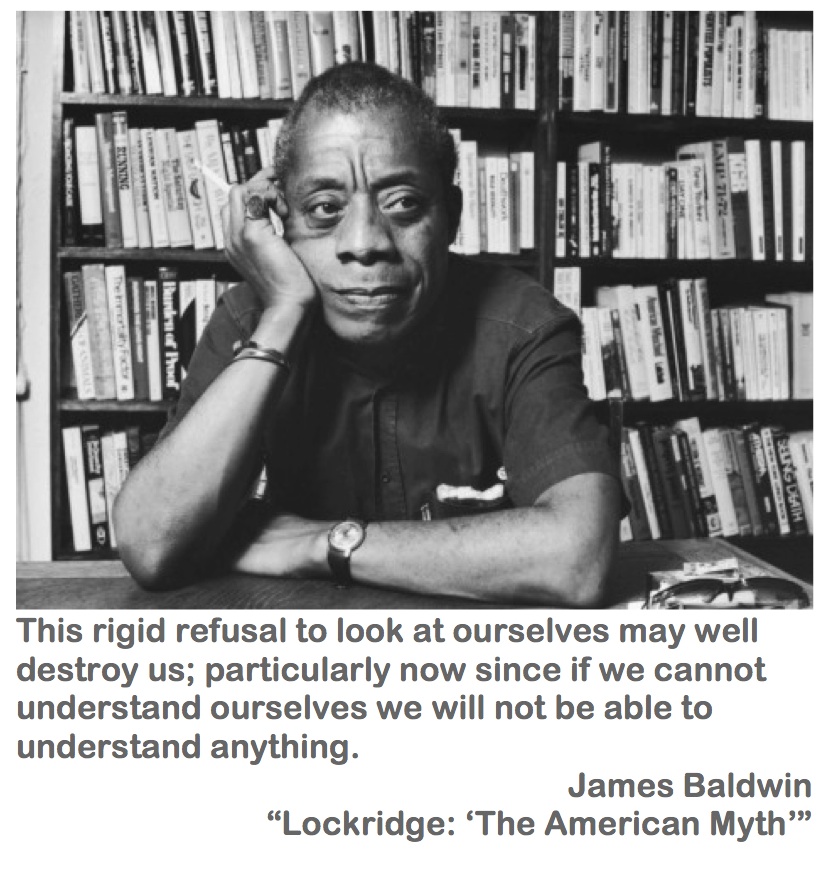
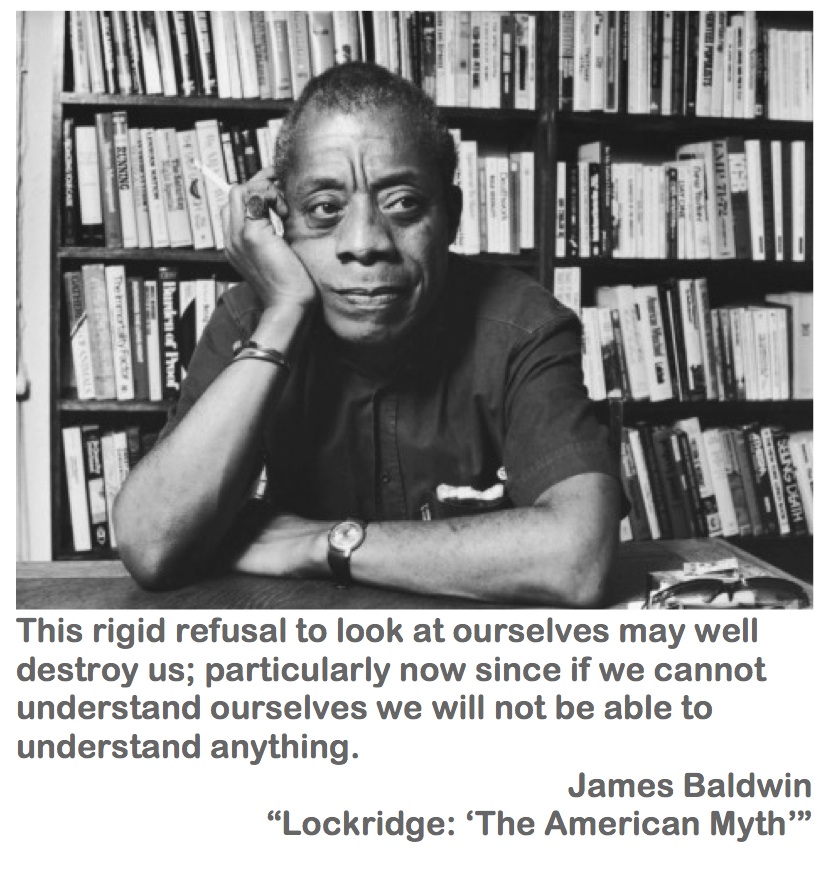
rigid refusal

As I noted in the prolonged opening, naming and organizing are efforts to understand and control; therefore, as I have changed—and as some of that has been against my will, not of my design—this new year and the horror of Trump before us (just when you think things cannot be worse) have converged with my personal development and my evolution as a writer/thinker/educator.

First, the new template.

I have always wanted a blog that doesn’t look like the stereotype of a blog as something not serious or possibly scholarly (since many people, especially in the academy, don’t value blogging), and I have distinct color and font proclivities.

Immobile and in pain (a dear friend quipped, “You have too much time on your hands”), I searched the free WordPress templates and found what you see now. The green, lower-case lettering of the header, font choices, and ability to control a sidebar all clicked with me. This seems relatively clean and accessible.

I hope my blog readers agree.

But all of that is cosmetic. The main shift has been the new title—radical eyes for equity—which incorporates word play (“radical eyes” = “radicalize”), an allusion to Baldwin’s “rigid refusal to look at ourselves,” and a more clear statement about my grounding in the pursuit of equity—race, class, gender, and sexuality equity.

I cannot explain how I got here, or even fully who I am or what “here” is, but I am here, and this is now, and this is all I can do.

I sit here ending this blog and the sun is shining while it continues to snow in South Carolina, where the temperature is still below freezing.

“What the hell” seems to have become my standard response to this world, but there is work to be done, living to be lived.

I hope you reading and even more will be willing, even eager, to join me here as I try my best to understand and control this thing called the human condition with radical eyes for equity.

And if you join this adventure, I think this from Haruki Murakami’s Sputnik Sweetheart deserves our attention, and it weighs particularly heavy on me now:

hm-ss-reality


[1] From You Can’t Be Neutral on a Moving Train, Howard Zinn (1994):

When I became a teacher I could not possibly keep out of the classroom my own experiences. . . .Does not the very fact of that concealment teach something terrible—that you can separate the study of literature, history, philosophy, politics, the arts, from your own life, your deepest convictions about right and wrong?. . .In my teaching I never concealed my political views. . . .I made clear my abhorrence of any kind of bullying, whether by powerful nations over weaker ones, governments over their citizens, employers over employees, or by anyone, on the Right or the Left, who thinks they have a monopoly on the truth. . . .From that moment on, I was no longer a liberal, a believer in the self-correcting character of American democracy. I was a radical, believing that something fundamental was wrong in this country—not just the existence of poverty amidst great wealth, not just the horrible treatment of black people, but something rotten at the root. The situation required not just a new president or new laws, but an uprooting of the old order, the introduction of a new kind of society—cooperative, peaceful, egalitarian. (pp. 7, 173)


The Rights and Responsibilities of the Teacher of English Redux (2016)

“All we gotta do is be brave
And be kind”

“Baby, We’ll Be Fine,” The National

…the world is gone daft with this nonsense.

John Proctor, The Crucible, Arthur Miller

In a keynote address at the 1960 National Council of Teachers of English (NCTE) annual convention, former NCTE president Lou LaBrant asserted:

Every teacher of English exercises some rights, no matter how dictatorial the system under which [she/]he works; and every teacher carries out some responsibilities. But today we have a considerable movement in this country to curtail certain freedom—rights—of the classroom teacher, and those rights are the matter of this discussion. (p. 379)

Published as The Rights and Responsibilities of the Teacher of English in the September 1961 English Journal, this characteristic call to action from LaBrant resonates in 2016 as English teachers prepare to gather in Atlanta, Georgia for #NCTE16 with the increasingly important theme of Faces of Advocacy.

Fifty-five years ago, LaBrant advocated for teaching:

Teaching, unlike the making of a car, is primarily a thought process. A [hu]man may work on an assembly line, turning a special kind of bolt day after day, and succeed as a bolt-turner….But the teacher is something quite different from the [hu]man who turns a bolt, because the student is not like a car. Teaching is a matter of changing the mind of the student, of using that magic by which the thinking of one so bears on the thinking of another that new understanding and new mental activity begin. Obviously, the degree to which this is reduced to a mechanical procedure affects the results. (p. 380)

Most practicing teachers today work within and against political and bureaucratic forces that “[reduce teaching] to a mechanical procedure.”

And even more disturbing is LaBrant’s warning:

What I am trying to say here is that the teacher who is not thinking, testing, experimenting, and exploring the world of thought with which [she/]he deals and the very materials with which [she/]he works, that teacher is a robot [her/]himself. But we cannot expect a teacher to continue the attempt to find better means or to invent new approaches unless [she/]he knows [she/]he will have freedom to use [her/]his results. Without this freedom we must expect either a static teacher or a frustrated one. I have seen both: the dull, hopeless, discouraged teacher, and the angry, blocked, unhappy individual. (p. 380)

At mid-twentieth century, LaBrant spoke against the all-too-familiar “bad” teacher myth used in contemporary calls for accountability:

Repeatedly when capable teachers ask for freedom, someone points out that we have many lazy teachers, stupid teachers unable to think and choose, ignorant teachers; in short, bad teachers who need control. We do have some, but we encourage others to be bad. Even the weak teacher does better when [she/]he has to face [her/]his own decisions, and when [she/]he supports that decision. (p. 383)

The de-professionalizing of all teachers, then, is not something new, but a historical fact of being a teacher. However, LaBrant confronted the culpability among educators themselves:

One reason so many of us do not have our rights is that we have not earned them. The teacher who is free to decide when and how to teach language structure has an obligation to master [her/]his grammar, to analyze the problems of writing, and to study their relations to structure….But [her/]his right to choose comes only when [she/]he has read and considered methods other than [her/]his own. [She/]He has no right to choose methods or materials which research has proved ineffective….There is little point in asking for a right without preparation for its use. (p. 390)

“Throughout our country today we have great pressure to improve our schools,” lamented LaBrant. “By far too much of that pressure tends toward a uniformity, a conformity, a lock-step which precludes the very excellence we claim to desire”:

There is little consideration of the teacher as a catalyst, a changing, growing personality. Only a teacher who thinks about [her/]his work can think in class; only a thinking teacher can stimulate as they should be stimulated the minds with which [she/]he works. Freedom of any sort is a precious thing; but freedom to be our best, in the sense of our highest, is not only our right but our moral responsibility. “They”—the public, the administrators, the critics—have no right to take freedom from us, the teachers; but freedom is not something one wins and then possesses; freedom is something we rewin every day, as much a quality of ourselves as it is a concession from others. (pp. 390-391)

The Rights and Responsibilities of the Teacher of English Redux

“Evil settles into everyday life when people are unable or unwilling to recognize it,” writes Teju Cole in the wake of Donald Trump being elected president of the U.S. “It makes its home among us when we are keen to minimize it or describe it as something else.”

LaBrant wrote about the field of teaching English throughout the 1940s and 1950s with the power—both for evil and for good—of language forefront of her concerns:

Misuse of language, as Hitler demonstrated, is a terrible thing; we teachers of English can at the very least teach our students that language is a tool of thought, a tool which can be sharp and keen, but is easily blunted. (“The Individual and His Writing,” 1950, p. 265)

So we teachers of English/ELA—and all educators—sit in 2016 confronted with a “[m]isuse of language” that has given rise to a presidency built on racism, sexism, and xenophobia; therefore, as during LaBrant’s career, we teachers of English/ELA must embrace the most pressing responsibilities.

But driving Trump’s and his supporters’ bigotry has been a powerful corruption of language: blatant lies, denials of those lies, and the ugliest of coded language. In short, bullying has rewarded a political leader with the highest office in a free society.

Parody of Trump’s misuse of language cannot be taken lightly, but that misuse has real consequences on the lives of vulnerable and marginalized people, including children in the classrooms of teachers across the U.S.

Immediately, then, teachers must admit “that every dimension of schooling and every form of educational practice are politically contested spaces” (Kincheloe, 2005).

In other words, although teachers are historically and currently de-professionalized by being told not to be political, as LaBrant argued, educators cannot reinforce that mantra by calling for politics-free zones in our classrooms and in our professional spaces.

Calling for no politics is a political act of silencing that brazenly takes a masked political stand in favor of the status quo.

Teaching and learning are unavoidably “politically contested spaces,” but they are unavoidably ethically contested spaces as well.

Language is a human behavior that allows us to wrestle with and find our moral grounding; and thus, those teaching literacy have a profoundly ethical mission to work toward the Right, Good, and Decent—in the act of teaching but also as a personal model.

As philosopher Aaron Simmons argues:

It matters that we demonstrate critical thinking even while others assume that shouting louder is tantamount to evidential refutation. It matters that we think well when it seems hard to think anything at all. It matters that we care about truth because only then can lies and bullshit still be categories to avoid.

The naive stance of neutrality can no longer be who teachers are because, as I noted above, to be neutral is to support the status quo, and in the U.S., the status quo is a cancer that left untreated promises to kill us all.

As Lucas Jacob argues directly:

Calling a politician out for Islamophobia, xenophobia, racism, and misogyny is not a matter of exerting undue influence by favoring one political party over another; nor is it a matter of disrespecting the presidency. Naming Mr. Trump’s hate speech as such is, rather, a moral imperative for supporting the missions of K-12 schools, in which Islamophobic, xenophobic, racist, and misogynist words and actions are punishable offenses that can (and must) be treated as being beyond the pale.

“It goes without saying, then, that language is also a political instrument, means, and proof of power,” James Baldwin wrote in 1979 on Black English. “It is the most vivid and crucial key to identify: It reveals the private identity, and connects one with, or divorces one from, the larger, public, or communal identity.”

Just as LaBrant linked language and power, Baldwin extended that dynamic to include race—and called for using that power in the name of community instead of divisiveness.

The word “critical,” now, has taken on exponential layers of meaning.

We are in critical times, and thus, as Kincheloe explains about the political and ethical responsibilities of being critical educator who seeks for students critical literacy:

Recognition of these educational politics suggests that teachers take a position and make it understandable to their students. They do not, however, have the right to impose these positions on their students [emphasis in original]….

To refuse to name the forces that produce human suffering and exploitation is to take a position that supports oppression and powers that perpetuate it. The argument that any position opposing the actions of dominant power wielders is problematic. It is tantamount to saying that one who admits her oppositional political sentiments and makes them known to students is guilty of indoctrination, while one who hides her consent to dominant power and the status quo it has produced from her students is operating in an objective and neutral manner. Critical pedagogy wants to know who’s indoctrinating whom. (p. 11)

In its simple form, to call a lie, a lie; to name racism, racism; to reject hate as hate—these are the undeniable responsibilities of teachers, especially teachers of English/ELA.

To say “I’m neutral” in the face of a lie is to lie.

To say “I’m neutral” in the face of racism is racism, in the face of sexism is sexism, in the face of xenophobia is xenophobia.

To divorce the act of teaching from the world within which it resides is to abdicate the greatest potential of teaching and learning: to change the human experience from dark to light.

If we shun our responsibilities as teachers in 2016, we are turning our backs to the ugliest realities faced by Baldwin nearly forty years ago:

The brutal truth is that the bulk of white people in American never had any interest in educating black people, except as this could serve white purposes. It is not the black child’s language that is in question, it is not his language that is despised: It is his experience. A child cannot be taught by anyone who despises him, and a child cannot afford to be fooled. A child cannot be taught by anyone whose demand, essentially, is that the child repudiate his experience, and all that gives him sustenance, and enter a limbo in which he will no longer be black, and in which he knows that he can never become white. Black people have lost too many black children that way.

And, after all, finally, in a country with standards so untrustworthy, a country that makes heroes of so many criminal mediocrities, a country unable to face why so many of the nonwhite are in prison, or on the needle, or standing, futureless, in the streets–it may very well be that both the child, and his elder, have concluded that they have nothing whatever to learn from the people of a country that has managed to learn so little.

Writing two decades before her NCTE keynote examined above, LaBrant made a foundational request: “For these reasons my first request of every American teacher of English is that [she/]he teach in [her/]his classroom this honest use of language and an understanding of its relation to life” (p. 206).

And about “this honest use of language,” there are only two options—although remaining neutral is not one of them.

Dark Mourning in America: “The world is at least/fifty percent terrible”

The best lack all conviction, while the worst
Are full of passionate intensity.

“The Second Coming,” William Butler Yeats

Although humans appear ultimately incapable of listening to and then acting upon our great capacity for art—which is an extension of our great capacity for compassion, love, and good—literature may offer some solace in a time when the US has announced itself still a racist, sexist, and xenophobic people, hiding behind the codes of “conservative,” “family values,” and “Christian nation.”

How low do people have to stoop before they have their Lady Macbeth moment:

Out, damned spot! out, I say!–One: two: why,
then, ’tis time to do’t.–Hell is murky!–Fie, my
lord, fie! a soldier, and afeard? What need we
fear who knows it, when none can call our power to
account?–Yet who would have thought the old man
to have had so much blood in him.

Shakespeare’s dramatization of guilt and being complicit is, let’s not ignore, an allusion to Pontius Pilat and the “assassination” of Jesus:

When Pilate saw that he was getting nowhere, but that instead an uproar was starting, he took water and washed his hands in front of the crowd. “I am innocent of this man’s blood,” he said. “It is your responsibility!” [Matthew 27:24, NIV]

If we can have that moment in which we admit, confront, and atone for our responsibility in the evil that humans do, we must finally listen to James Baldwin:

rigid-refusal

And to Langston Hughes:

O, let America be America again—
The land that never has been yet—
And yet must be—the land where every man is free.
The land that’s mine—the poor man’s, Indian’s, Negro’s, ME—
Who made America,
Whose sweat and blood, whose faith and pain,
Whose hand at the foundry, whose plow in the rain,
Must bring back our mighty dream again.

And face our children with our failures, against which Maggie Smith struggles:

Life is short, though I keep this from my children….
The world is at least
fifty percent terrible, and that’s a conservative
estimate, though I keep this from my children….
Life is short and the world
is at least half terrible, and for every kind
stranger, there is one who would break you,
though I keep this from my children.

The US and its majority white population have the greatest opportunity before them, a free and powerful nation of riches, and daily, that opportunity is squandered because of our “rigid refusal to look at ourselves.”

The US is undeniably inequitable, and to balance among gender, race, etc., we have only two options: to take away or to give to—but in either case, white privilege is erased and white sensibilities are challenged.

There is no evidence the white majority has the ethical backbone to make changes for equity or even to tolerate them.

On a dark mourning in America, I recommend reading or rereading Margaret Atwood’s The Handmaid’s Tale—a sobering imagining of the worst of white responses to the rise of the Others they have created.

We are now on that path, and it is ours to make the decision to turn around or move forward into that oblivion.

“History proves that the white man is a devil”

The public career and life of Malcolm X are fraught with contradictions and controversy—often complicated by the Nation of Islam and its discredited leader Elijah Muhammad.

Malcolm X’s infamy—as it contrasts with the idealizing and misrepresentation of Martin Luther King Jr. as a passive radical—lies often in his sloganized “By any means necessary” and “History proves that the white man is a devil.”

While Malcolm X himself confronted some of his more controversial and confrontational stances, in 2016, the U.S. is faced with the prescience in what seemed to be hyperbole and racial anger; however, there is much to consider about the evil capacity often behind the face of white men.

Living just across the highways from my neighborhood, Todd Kohlhepp has confessed to vicious murders after police found a woman chained in a storage container for two months.

Kohlhepp represents to a disturbing degree the classic profile of serial killers and sex offenders, central of which is being a white male.

At the University of Wisconsin:

The 20-year-old student, Alec Cook, has been arrested and appeared in court on Thursday, charged with 15 crimes against five women, including sexual assault, strangulation and false imprisonment. His modus operandi, according to police and prosecutors, was to befriend fellow students and eventually entrap and viciously attack them, while keeping notebooks detailing his alleged targets.

Kohlhepp and Cook, white males of relative affluence, are no outliers. Yet, political leaders and the media persist in characterizing for the U.S. public much different images of who to fear: Mexicans, black males, Muslims.

Daily violence—including sexual aggression and assault—is a real threat in a way nearly opposite of these political and media messages; each of us should fear people who look like us, and family, friends, and acquaintances deserve nearly equal scrutiny.

Political race-baiters and the mainstream media rarely stray from the black-on-black crime message, but also always fail to add a key fact: crime is almost entirely intra-racial as the white-on-white crime rate (86%) is nearly identical to the black-on-black crime rate (94%).

Malcolm X’s rhetoric may still seem inflammatory, but James Baldwin’s more measured charges confront the same racial masking and tension:

White Americans find it as difficult as white people elsewhere do to divest themselves of the notion that they are in possession of some intrinsic value that black people need, or want. And this assumption—which, for example, makes the solution to the Negro problem depend on the speed with which Negroes accept and adopt white standards—is revealed in all kinds of striking ways, from Bobby Kennedy’s assurance that a Negro can become President in forty years to the unfortunate tone of warm congratulation with which so many liberals address their Negro equals. It is the Negro, of course, who is presumed to have become equal—an achievement that not only proves the comforting fact that perseverance has no color but also overwhelmingly corroborates the white man’s sense of his own value.

White men control the political and media narratives, and thus, white males are bathed in the compassionate light of the white male gaze of power—everyone else becomes the feared Other.

The hatred spewed by Donald Trump is not solely what should be feared in this context, but that he personifies and speaks to “the white man’s sense of his own value” that seeks to erase that Other, as Astra Taylor reported from a Trump rally in North Carolina:

A few months ago Trump had rallied in Wilmington, North Carolina, the site of America’s only and largely forgotten coup. In 1898, in the waning days of Reconstruction, rioting white supremacists overthrew a multiracial progressive “fusion” government, deposing democratically elected leaders of both races and killing black citizens mercilessly. After that, populism in North Carolina, as in the South more broadly, was a white affair. At his rally near the site of that historic, shocking savagery, Trump suggested “the Second Amendment people” do something about Hillary.

The Trump narrative is essentially racist, and almost entirely false, Jason Stanley explains:

The chief authoritarian values are law and order. In Trump’s value system, nonwhites and non-Christians are the chief threats to law and order. Trump knows that reality does not call for a value-system like his; violent crime is at almost historic lows in the United States. Trump is thundering about a crime wave of historic proportions, because he is an authoritarian using his speech to define a simple reality that legitimates his value system, leading voters to adopt it. Its strength is that it conveys his power to define reality. Its weakness is that it obviously contradicts it.

And thus, Trump has public support from the KKK and Nazi groups for a reason; and that support is distinct from public support for any of the other presidential candidates, none of which draw hate groups into the light.

In A Dialogue between James Baldwin and Nikki Giovanni, Baldwin argues, “The reason people think it’s important to be white is that they think it’s important not to be black”:

It’s not the world that was my oppressor, because what the world does to you, if the world does it to you long enough and effectively enough, you begin to do to yourself. You become a collaborator, an accomplice of your own murderers, because you believe the same things they do. They think it’s important to be white and you think it’s important to be white; they think it’s a shame to be black and you think it’s a shame to be black. And you have no corroboration around you of any other sense of life.

Yes, we must be vigilant about the white gaze and the male gaze, both of which, as Baldwin witnessed, corrupt the agent and object of that gaze, but we must be as vigilant about the white male accusatory finger designed to keep everyone else’s gaze somewhere other than where the most power, and too often, the most evil reside.

“the white man’s sense of his own value”: James Baldwin’s The Fire Next Time

White Americans find it as difficult as white people elsewhere do to divest themselves of the notion that they are in possession of some intrinsic value that black people need, or want. And this assumption—which, for example, makes the solution to the Negro problem depend on the speed with which Negroes accept and adopt white standards—is revealed in all kinds of striking ways, from Bobby Kennedy’s assurance that a Negro can become President in forty years to the unfortunate tone of warm congratulation with which so many liberals address their Negro equals. It is the Negro, of course, who is presumed to have become equal—an achievement that not only proves the comforting fact that perseverance has no color but also overwhelmingly corroborates the white man’s sense of his own value.

Why James Baldwin’s The Fire Next Time Still Matters

baldwin2_1050x700
Baldwin in London, 1969;via Wikimedia Commons

the_fire_next_time
A 1960s edition of Baldwin’s The Fire Next Time (via Flickr user Robert Huffstutter)

Rejecting Cultural Literacy for Culturally Relevant: From Baldwin to Cole, “the custodian of a black body”

…to cease fleeing from reality and begin to change it.

James Baldwin, The Fire Next Time

Haunting the American character still is a fact confronted early in Teju Cole’s Black Body: Rereading James Baldwin’s “Stranger in the Village” (originally published in The New Yorker 19 August 2014 but also opening Cole’s Known and Strange Things): that Baldwin, Martin Luther King Jr., and John Coltrane are all “people who could still be with us.”

Living, Cole means—because, of course, they remain with us in ways that are both beautiful and disturbing.

Retracing Baldwin’s time in Switzerland and his essay spawned from that visit, Cole recognizes Baldwin was “depressed and distracted” during his trip in the 1950s—in part due to the “absurdity” of being a stranger during his travels as well as alienated in his home city of New York through the fact of the manufactured concept of race.

Cole experiences a “body-double moment” that emphasizes a physical self-consciousness of being black and male; being “like [Baldwin],” Cole catalogues insecurities of the flesh, building to:

and feel myself in all places, from New York City to rural Switzerland, the custodian of a black body, and have to find the language for all of what that means to me and to the people who look at me.

This racialized and genderized self-consciousness, Cole details, is cultivated in being surveilled; “glances,” in Cole’s diction, but commonly identified as the “gaze,” whether the white gaze or the male gaze.

“To be a stranger is to be looked at,” Cole explains, “but to be black is to be looked at especially.” Hard, Cole means, as in the perpetual policing of the black body.

Cole’s “custodian” echoes Baldwin’s witnessing—bound as the two men are by what Baldwin captures in “‘People are trapped in history, and history is trapped in them.'”

The black body and the American character—both Baldwin and Cole demand—are inextricable. But for Baldwin, Western culture forced him to conclude: “‘I was an interloper; this was not my heritage.'”

However, Cole, shifting to Ralph Ellison, embraces Western art despite the lingering weight he shares with Baldwin: “I have experienced in my own body the undimmed fury he felt about pervasive, limiting racism.”

Continuing the scarred mosaic of history, Cole’s contemporary reality will not allow him to escape “the news online”:

There I found an unending sequence of crises: in the Middle East, in Africa, in Russia, and everywhere else, really. Pain was general. But within that larger distress was a set of linked stories, and thinking about “Stranger in the Village,” thinking with its help, was like injecting a contrast dye into my encounter with the news. The American police continued shooting unarmed black men, or killing them in other ways. The protests that followed, in black communities, were countered with violence by a police force that is becoming indistinguishable from an invading army. People began to see a connection between the various events: the shootings, the fatal choke hold, the stories of who was not given life-saving medication. And black communities were flooded with outrage and grief.

Like Baldwin in 1966, Cole cannot escape the policing of the black body, the political “obsession with cleaning, with cleansing,” that “policymakers believe that going after misdemeanors is a way of preëmpting major crimes.”

Dropped like a stone too heavy to carry any further, Cole concludes:

But the black body comes pre-judged, and as a result it is placed in needless jeopardy. To be black is to bear the brunt of selective enforcement of the law, and to inhabit a psychic unsteadiness in which there is no guarantee of personal safety. You are a black body first, before you are a kid walking down the street or a Harvard professor who has misplaced his keys.

Endless surveilling, constant policing the black body are fed by the “fantasy about the disposability of black life [that] is a constant in American history.”

Cole as custodian witnesses that “American racism has many moving parts, and has had enough centuries in which to evolve an impressive camouflage….Like misogyny, it is atmospheric. You don’t see it at first. But understanding comes.”

But there remains one more damning stone to drop: “black American life is disposable from the point of view of policing, sentencing, economic policy, and countless terrifying forms of disregard”—one of which, left unnamed by Cole, is formal education.

#

An educational dinosaur who refuses extinction, E.D. Hirsch yet again offers a plea for cultural literacy, folded into the decades-old standards debate.

There is a disturbing irony about a torch bearer of the dominant culture lobbying for that culture to remain dominant—specifically through the codified curriculum of the formal education system.

Hirsch cloaks his message in an unaddressed assumption that knowledge can be somehow politically neutral; it’s all about the role of knowledge in teaching students how to read, you see.

But official curriculum and the current state of high-stakes accountability can never be disentangled from power—who can and does decide what knowledge matters.

Just as Cole above confronts how art, culture, and race intersect—among Cole, Baldwin, and Ellison—when the knowledge that matters is the province of some people (read “white,” “male,” and “affluent”), other people become the Other, marginalized by their identified lack of the knowledge that matters.

Cultural literacy/knowledge as that which is objective, easily identified, and then easily dispensed is the fertile soil within which the status quo of society and formal education thrive. Like the literal policing of the black body in the streets, education becomes an act of “cleansing” the Other of their heritage to make room for cultural literacy/knowledge writ large.

And the status quo of the streets and the hallways must not be allowed to remain: where black girls are policed for their hair, the same hair that is fetishized, rendered exotic; where black boys are seen as older than their biological ages; where the black body has been so demonized that blacks themselves embrace the punishing, cleansing, of their own flesh.

If we pretend knowledge is politically neutral, that whoever is in power has the right to decide what knowledge matters, and if we define reading in a way that depends on that cultural knowledge for anyone to be considered literate, then we are failing to read and re-read the world as it is in order to make a new world.

Not the world as it was during Baldwin’s life. Not the world as it is during Cole’s life.

The “obscene American forms of white supremacy” are the parents of cultural literacy/knowledge.

And this white gaze has also created “no excuses” charter schools that “fix” black, brown, and poor students.

White privilege and its cognate racism, as Cole notes, are invisible: “You don’t see it at first.”

The “at first,” however, must not be undervalued.

To see privilege and racism requires not cultural literacy, but critical literacy—reading and re-reading the world, writing and re-writing the world—fostered in a context of culturally relevant pedagogy.

From Baldwin as witness to Cole as “custodian of the black body,” the message about how our society and our schools must change is not absent but “preferably unheard.”

Change must happen, but it must not “shame or defame black people and [black] organizations,” Adrienne Dixson and Andre Perry argue, concluding with a stone of their own: “Be accountable to black people.”

Cultural literacy is stasis, not change. It is accountable to white privilege.

Haunting the American character still is Baldwin demanding that we must “cease fleeing from reality and begin to change it.”

Lost in Translation: More from a Stranger in Academia

Decade four and round two in academia—this time at the university level where, one might assume, things would be easier.

First, a flashback.

I am the English department chair, and the entire faculty is sitting in the high school library for a faculty meeting about standardized test scores for our school. Having entered education in the fall of 1984—the first year of South Carolina’s all-in commitment to accountability, standards, and high-stakes testing—I have taught for over thirty years under the weight of test scores.

Before the principal and the math department chair shared our students’ scores on the test-of-the-moment, the principal offered what he believed was a friendly caveat about the English scores: ” Just want you all to remember that we don’t teach grammar here,” with a nod and a smile in my direction.

Now fast-forward to my current situation where I teach two first-year writing seminars, had a now defunct role as faculty Director of FYS, and continue to co-facilitate our efforts at offering faculty develop in teaching writing.

In our Faculty Writing Fellows sessions, I am routinely addressed whenever someone mentions grammar, notably commas, with a similar caveat—although these don’t seem quite as friendly as they are marginalizing.

To be committed to critical pedagogy, critical constructivism, de-grading/de-testing, and authentic writing instruction is to be a stranger in academia.

You are tolerated with bemusement, as the mostly harmless weirdo in the room.

You aren’t credible—although you have worked for over thirty years honing your craft, taking great care as a teacher and writer to teach only warranted practices and to honor above all else the human dignity and autonomy of your students.

Nope, you “don’t teach grammar”—which is both false and used in the sort of condescending way people in the U.S. say “liberal” or people in the South say “Bless your heart.”

My urge to be abrasive always prompts me to say: “Actually I teach grammar the right way.” But I don’t say anything.

Mostly I stew—the same way I stew about writing free verse poetry under the judgmental purview of those who think free verse is a lazy person’s game.

And, I keep at it—doing warranted practice diligently despite the suggestions otherwise.

I teach relentlessly that language, its use and the forces that seek to control its use (including those who shout “grammar rules!”), is about power—as James Baldwin confronts in his brilliant defense of Black English:

It goes without saying, then, that language is also a political instrument, means, and proof of power. It is the most vivid and crucial key to identify: It reveals the private identity, and connects one with, or divorces one from, the larger, public, or communal identity. There have been, and are, times, and places, when to speak a certain language could be dangerous, even fatal. Or, one may speak the same language, but in such a way that one’s antecedents are revealed, or (one hopes) hidden. This is true in France, and is absolutely true in England: The range (and reign) of accents on that damp little island make England coherent for the English and totally incomprehensible for everyone else. To open your mouth in England is (if I may use black English) to “put your business in the street”: You have confessed your parents, your youth, your school, your salary, your self-esteem, and, alas, your future.

I don’t teach students grammar, mechanics, and usage rules; I guide my students as we interrogate the conventions of language—why they exist, how they have changed, and why each student’s own empowerment depends on their being aware and in control of those conventions and their language.

And beyond my ethical reasons for approaching language this way, ethical reasons grounded in critical pedagogy, I am motivated by a negative: I don’t want to fall into a trap confronted by Lou LaBrant:

On the other hand, we should not, under the guise of developing literary standards, merely pass along adult weariness. (pp. 276)

The prescriptive-grammarian-as-teacher, I fear, is harping on pet peeves, setting themselves up for sullying the language and their students’ passion for expression—but certainly opening themselves up for losing their own credibility because virtually all users of language are pickers and choosers about strict adherence to the so-called
“rules.”

My stress level is triggered each time I receive emails from a prescriptive grammarian who spells my sacred Southernism “ya’ll.”

I am a writer and I teach writing—both of which are at the core of who I am as a person.

Ultimately, then, I side with LaBrant: “As a teacher of English, I am not willing to teach the polishing and adornment of irresponsible, unimportant writing” (p. 123).

But, alas, it is this sort of principled approach to teaching, and teaching writing, that pushes me farther and farther afield of academia.

And so a stranger in academia, I eye the fire escape, like Tom in The Glass Menagerie anxious with the awareness that “the other boys in the warehouse regarded [him] with suspicious hostility.”