Category Archives: James Baldwin

This Is My Post on Ta-Nehisi Coates: “The Burden of Living among Dreamers”

Under President Barack Obama, instead of hope and change, the U.S. has been offered ample and disturbing evidence that we are not a post-racial country.

As the 2016 presidential race heats up, the U.S. is now forced to confront an inevitable reality: a post-Obama U.S.

From the Sandy Hook school shooting to the racist massacre in Charleston, South Carolina, President Obama stood before the country and the world in a way that those holding the office before him and those now seeking the office after him surely could not have matched, will not be able to match.

Obama under the weight of Nobel Peace Prize winner and “first black president” was destined to fall short—personifying the racial dilemma exposed by Ta-Nehisi Coates in March 2014:

There is no evidence that black people are less responsible, less moral, or less upstanding in their dealings with America nor with themselves. But there is overwhelming evidence that America is irresponsible, immoral, and unconscionable in its dealings with black people and with itself. Urging African-Americans to become superhuman is great advice if you are concerned with creating extraordinary individuals. It is terrible advice if you are concerned with creating an equitable society. The black freedom struggle is not about raising a race of hyper-moral super-humans. It is about all people garnering the right to live like the normal humans they are.

In 2015, while popular and critical opinions of Obama have risen in many ways, it is now fashionable to praise Coates, who has released a book-length letter to his his son, Between the World and Me.

Like Obama, Coates has been tossed immediately into rarified air, comparisons that virtually no one could survive. Herself a Nobel Prize winner, Toni Morrison, in fact, has joined the chorus anointing Coates the next James Baldwin.

Between has also proven to be an irresistible land mine for black male public intellectuals as well as pontificating and tragically un-self-aware white-mansplainers.

Conversely, several black women scholars and journalists have found Between a powerful entry point for encouraging a much needed conversation about race, class, and gender.

The array of responses presents lessons in grace and the absence of grace that Obama spoke to while eulogizing South Carolina state Senator Clementa Pinckney.

My status as privileged (white, male) former redneck and current academic is not intended here to justify, explain, qualify, or endorse Coates or his book. In fact, if you haven’t been reading Coates, if you haven’t read his book, you should be doing those and not reading yet another post about Coates and his book.

If nothing else, this is about that paradox grounded in the racism of the U.S. that produced Coates as well as the book he has written; the racism of the U.S. that is producing the son to whom Coates writes for everyone else to witness.

“Of course we chose nothing,” Coates writes:

We did not design the streets. We do not fund them. We do not preserve them. But I was there, nevertheless, charged like all the others with the protection of my body….

The black world was expanding before me, and I could see now that that world was more than a photonegative of that of the people who believe they are white. “White America” is a syndicate arrayed to protect its exclusive power to dominate and control our bodies. Sometimes this power is direct (lynching), and sometimes it is insidious (redlining). But however it appears, the power of domination and exclusion is central to the belief in being white, and without it, “white people” would cease to exist for want of reasons. (pp. 22, 42)

#

From his candidacy and through Obama’s tenure as president, I have drifted from skepticism to cynicism about the promise of a black president to change policy or the hearts and minds of privileged Americans.

I harbor no delusion that the people who should read Coates slowly and carefully, with hearts and minds open to hard truths, will do so.

Despite overwhelming evidence of systemic racism, whites in the U.S. remain resistant, if not incapable of admitting their own culpability in racism. In fact, research shows “Whites exposed to evidence of racial privilege claim to have suffered more personal life hardships than those not exposed to evidence of privilege.”

Coates lived what research details:

But my experience in this world has been that the people who believe themselves white are obsessed with the politics of personal exoneration. And the word racist, to them, conjures, if not a tobacco-spitting oaf, then something just as fantastic—an orc, troll, or gorgon….There are no racists in America, or at least none that the people who need to be white know personally. (p. 97)

For those who believe themselves white, everything is about “me”—except for racism, of course.

And since the connection has been made, let’s admit that James Baldwin was too often ignored while he lived and has nearly disappeared since his death. If Baldwin was one of the, if not the, greatest witnesses among writers and public intellectuals—and I believe that to be the case—how can we expect Coates to achieve what Baldwin could not?

Ours, then, among the privileged is to resist raising a bar so high that Coates is doomed to fail.

Ours, then, among the privileged is to refuse the “yes, but” trivialization of a black man’s interrogation of this racist world.

Ours, then, among the privileged is to listen, to stand with in order to build a more perfect union that, ironically, will never again create a Baldwin or a Coates-as-Baldwin in the way those men have been formed.

#

Coates creates a powerful refrain throughout his book, the Dream.

That refrain is an unmasking of people who think they are white, a denunciation of a world that forces black males to define themselves against that whiteness.

As an educator, I am compelled to highlight a central message from Coates about formal schooling: “I had been reading and writing beyond the purview of the schools all my life” (p. 37).

Ultimately, Coates left college—and we must hear Langston Hughes’s “Theme for English B” in the background:

I wanted to pursue things, but I could not match the means of knowing that came naturally to me with the expectations of professors. The pursuit of knowing was freedom to me, the right to declare your own curiosities and follow them through all manner of books. I was made for the library, not the classroom. The classroom was a jail of other people’s interests. The library was open, unending, free. (p. 48)

Formal schooling is a mechanism of the Dream, Coates discovered:

The Dream thrives on generalization, on limiting the number of possible questions, on privileging immediate answers. The Dream is the enemy of all art, courageous thinking, and honest writing. And it became clear that this was not just for the dreams concocted by Americans to justify themselves but also for the dreams that I had conjured to replace them. I had thought that I must mirror the outside world, create a carbon copy of white claims to civilization. (p. 50)

The world Coates interrogates failed him and fails his son in the streets and the classroom; this we must admit is an inexcusable consequence of both enduring racism and the recalcitrance of the privileged to acknowledge systemic racism.

“And still you are called to struggle,” Coates tells his son and his readers, “not because it assures you victory but because it assures you an honorable and sane life” (p. 97).

#

“As I learn from you,” concludes the speaker of “Theme for English B”:

I guess you learn from me—
although you’re older—and white—
and somewhat more free.

Hughes was Hughes, Baldwin was Baldwin, and Coates is Coates.

The themes are too often the same, however, and it is well past time that the somewhat more free who believe themselves white set themselves aside and learn without qualification from those who have been declared black.

See Also

“I look at the world,” Langston Hughes

remnant 57: “forced on me from above” [Haruki Murakami on school]

On Public Versus Charter: “The Dispute Has Actually Nothing to Do with Education”

I.

Published 54 years ago, Nobody Knows My Name continues to shake any reader willing to listen as James Baldwin bore witness to the region currently—and again, shamefully—in the national spotlight, “the South, which was now undergoing a new convulsion over whether black children had the same rights, or capacities, for education as did the children of white people.”

Baldwin continued—and we could too easily substitute for his “this” as we now witness debates long past their time for resolution:

This is a criminally frivolous dispute, absolutely unworthy of this nation; and it is being carried on, in complete bad faith, by completely uneducated people. (We do not trust educated people and rarely, alas, produce them, for we do not trust the independence of mind which alone makes a genuine education possible.) Educated people, of any color, are so extremely rare that it is unquestionably one of the first tasks of a nation to open all of its schools to all of its citizens. But the dispute has actually nothing to do with education, as some among the eminently uneducated know. It has to do with political power and it has to do with sex. And this is a nation which, most unluckily, knows very little about either. [Baldwin, James (2013-09-17). Nobody Knows My Name (Vintage International) (Kindle Locations 1102-1108). Knopf Doubleday Publishing Group. Kindle Edition.]

The “frivolous” comes not from the great questions that have always and will always confront humanity—how do we educate?—but from the “bad faith” among “uneducated people” who have undeserved privilege and power.

To believe the current education reform debate is not nearly indistinguishable from what Baldwin contested as the U.S. resisted desegregation is to live among the deaf and blind.

For more than three decades now, public education has been held hostage by the most frivolous of frivolous debates: how to design and implement accountability built on standards and high-stakes testing. This adolescent game of “my accountability can beat your accountability” has left public education and the children it should serve battered and bloodied.

From the seemingly endless cycle of new standards and new high-stakes tests (and ways to punish even more groups within our public schools) to the increasingly snarky divisiveness and personal politics of social media, the often cited reasons for all this sound and fury—public schools, the children—are being mis-served; just as a couple terrible examples, public education has re-segregated during the accountability era, and the mislabeled achievement gap among racial groups has remained robust.

II.

“I often find myself scratching my head,” writes Andre Perry, “wondering why so many black folk extol the virtues of public education.”

Perry, 54 years after Baldwin’s challenge to “frivolous dispute,” wades into not only the public versus charter schools debate but also the race and social class biases at the root of whose voices matter and whose voices do not.

Most of the U.S. sits idly by—like audiences watching the newest Avengers movie—while the arrogant and mighty battle, rarely acknowledging the collateral damage (will there ever be a superhero blockbuster film in which all those superheroes use their superpowers to rebuild the infrastructure they destroy?).

Since Marvel’s Civil War is set for film soon, we may be watching the equivalent in fiction of the public versus charter debate, and I think Perry is offering a rare but important plea, as Baldwin did: “the dispute has actually nothing to do with education.”

Perry recognizes “[i]n the education wars,”

black and brown educators who criticize the current wave of reform often find themselves rallying with those who can say that public education in this country works. But let’s be clear, blacks aren’t in a position to root for or celebrate the status quo. Likewise, there has never been a time in which blacks shouldn’t have considered themselves reformers. Yet many have incidentally joined an education “party of no.”

Although eventually (as late as the early 1970s in the South Baldwin examined) public schools were forced to open their doors to all children, Perry stresses “many of us fight for that unfulfilled promise at the expense of student learning”:

Public education should advance society and its individual members simultaneously. But black communities can’t afford to wait for whites to gentrify schools in the name of democracy to get a good education.

And thus, Perry challenges the false dichotomy that has been created by the “education reform [debate that] is too white to do any good“: public schools versus charter schools. In fact, Perry asserts, guided by Frederick Douglass’s “What To The Slave Is The 4th of July?”:

Charter schools make sense for black communities. Charter schools are independent public institutions that are freed from administrative controls of a centralized, area board, but must still meet broad guidelines or requirements of public schools. Through a charter, parents, teachers, and administrative staff primarily can gain freedom from an elected local board that’s incongruent with their values.

To fight the public versus charter war at a pitch that drowns out the voices of those whom “public institutions” should be serving, must be serving is disturbingly frivolous, Perry recognizes.

Of all the education reform debates, this tension has given me the most pause: How can we rectify rejecting “no excuses” charter schools for being racist/classist while many black families choose those very schools?

I am compelled to look again to Baldwin in order to remove the misleading labels (“public,” “charter”) and to hear, as Perry explains:

I like many see a promise that charter schools can deliver, but I also see inequities waving in the faces of black and brown students every day in public schools. Inadequate funding, harsh suspension and expulsion policies, lack of services for students with special needs and culturally irrelevant curricula are durable, standing problems in most takeover districts. I see waste, fraud, and unsavory practices that led cities to decentralize.

“Charter” for Perry represents a new promise, one responsive to the needs of children too long ignored.

So to save this debate from the “frivolous” we must guard against simplistic labels. Regardless of whether the school is “public” or “charter,” the educator’s commitment must be, as Paul Gorski explains, to “take a stand when one of our students is being shortchanged—not standing in front of or standing in place of, but standing next to, standing with low-income[, black and brown] students and families.”

Being for public education or either for or against charter schools proves to be as callous and hollow as superheroes destroying a city to win a war between Good and Evil when we lose sight of foundational promises to achieve race and class equity.

III.

In the years between Baldwin’s and Perry’s commentaries, the promise of public institutions has remained unfulfilled because the question of race in the U.S. has never been fully confronted.

In 2015, presidential candidates expressing racist trash are viable while elected officials, although now in a minority, in South Carolina continue to cling to the Confederate battle flag as they spew whitewashed history and empty slogans as thin veils for racism that works as political capital. In 2015, because a privileged minority controls what counts as civil debate, we haven’t the capacity to denounce the morally reprehensible position that “both sides” deserve equal credibility.

So we are people trapped by trivializing debate and democracy in a moral vacuum.

And again, Baldwin’s “debate” allows us to insert his voice in our moment now:

And yet, it became clear as the debate wore on, that there was something which all black men held in common, something which cut across opposing points of view, and placed in the same context their widely dissimiliar experience. What they held in common was their precarious, their unutterably painful relation to the white world. What they held in common was the necessity to remake the world in their own image, to impose this image on the world, and no longer be controlled by the vision of the world, and of themselves, held by other people. What, in sum, black men held in common was their ache to come into the world as men. And this ache united people who might otherwise have been divided as to what a man should be. [Baldwin, James (2013-09-17). Nobody Knows My Name (Vintage International) (Kindle Locations 346-351). Knopf Doubleday Publishing Group. Kindle Edition.]

From Baldwin’s world of overt racial segregation to Perry’s world of covert racial segregation, then, whether the debate be who we educate or how we educate, the tarnished promise is the consequence of the white illusion:

This illusion owes everything to the great American illusion that our state is a state to be envied by other people: we are powerful, and we are rich. But our power makes us uncomfortable and we handle it very ineptly. The principal effect of our material well-being has been to set the children’s teeth on edge. If we ourselves were not so fond of this illusion, we might understand ourselves and other peoples better than we do, and be enabled to help them understand us. I am very often tempted to believe that this illusion is all that is left of the great dream that was to have become America; whether this is so or not, this illusion certainly prevents us from making America what we say we want it to be. [Baldwin, James (2013-09-17). Nobody Knows My Name (Vintage International) (Kindle Locations 1080-1085). Knopf Doubleday Publishing Group. Kindle Edition.]

IV.

We need “educated people,” as Baldwin explained—not the credentialism of formal schooling, but the education that comes from Freire’s reading and re-reading the world, writing and re-writing the world unmasked of race and class privilege.

Educated people who can state clearly that no black child should have to sit in Robert E. Lee Elementary.

That no black young adult should have to sit in Tillman Hall.

Yes, names matter.

But then, the indignity of honoring “men with wicked histories” must not be compounded by what happens inside those institutions.

No black, brown, or poor child should be walking through the doors of any school only to be treated as criminals, failures, or data.

We need educated people who can admit public, charter, and private schools remain too often institutions of inequity reflecting a country in which a child’s race and social class at birth have a greater bearing on her/his life than the content of her/his character.

We need educated people who can admit symbolism and practices both matter—that two Americas will not be tolerated or obscured by “frivolous dispute[s … that have] nothing to do with education.”

On this there must no longer be debate.

What I’m Reading: June/July 2015

Because some of my favorite people have convinced me to share, I will try to post periodically what I’m reading so here is what is on my computer screen and in my hands as my reading life for June/July 2015.

Essay: James Baldwin’s “They Can’t Turn Back” (1960)

Mademoiselle editorial comment:

On February 1, 1960, four students from North Carolina A. & T., a black college in Greensboro, entered the local Woolworth’s department store. After making a few purchases, they sat down at the lunch counter, an area reserved for whites. Told that they could not be served, they remained in their seats until the store closed. More than any other event, the Greensboro sit-in launched the 1960s, a decade of political activism and students were on the cutting edge of social change. In 1960, the writer James Baldwin visited Tallahassee, Florida. to report on student activism there. Baldwin ruminated on the underlying causes of black protests and marveled at the militancy and idealism of the younger generation. To Baldwin, the movement challenged all Americans to rethink whether “We really want to be free” and whether freedom applied to all Americans or only to part of the population.

Short story: Alejandro Zambra‘s “Reading Comprehension: Text No. 1”

ILLUSTRATION BY MATT DORFMAN

This is a brilliant satire of testing and a powerful use of meta-fiction.

Poem: Nikky Finney’s “Dancing with Strom”

black people will forgive you

Powerful, disturbing, and important in the wake of the Charleston shooting at the AME church, this poem confronts and unmasks the racism under the label of “heritage” in South Carolina and the South in the person of Strom Thurmond.

Novel: Cormac McCarthy’s The Crossing

From McCarthy’s official web site:

The Crossing, publicized as the second installment of McCarthy’s Border Trilogy, is the initiation story of Billy Parham and his younger brother Boyd (who are 16 and 14 respectively when the novel opens). The novel, set just before and during World War II, is structured around three round-trip crossings that Billy makes from New Mexico into Mexico. Each trip tests Billy as he must try to salvage something once he fails in his original goal. On both his first and last quest he is reduced (or perhaps exalted) to some symbolic futile gesture in his attempt, against all obstacles, to maintain his integrity and to be true to his moral obligations. This novel explores such issues as guilt, the acquisition of wisdom, heroism, and the crucial importance of stories.

Graphic novel: Mark Millar and Steve McNiven’s Civil War

From Marvel’s description:

The landscape of the Marvel Universe is changing, and it’s time to choose: Whose side are you on? A conflict has been brewing from more than a year, threatening to pit friend against friend, brother against brother — and all it will take is a single misstep to cost thousands their lives and ignite the fuse! As the war claims its first victims, no one is safe as teams, friendships and families begin to fall apart. The crossover that rewrites the rules, Civil War stars Spider-Man, the New Avengers, the Fantastic Four, the X-Men and the entirety of the Marvel pantheon!

James Baldwin’s “They Can’t Turn Back” (1960): “On such small signs and symbols does the southern cabala depend”

James Baldwin published “They Can’t Turn Back” in 1960 just as I was about to enter this world.

Baldwin—black, gay and from the North—was witnessing a world from which I—white, straight and from the South—would in many ways be exempt, although it was the same world.

In this essay, Baldwin was charged by Mademoiselle to report on student activism in Florida after the Greensboro (North Carolina) sit-in, which the editors framed, in part, as follows:

More than any other event, the Greensboro sit-in launched the 1960s, a decade of political activism and students were on the cutting edge of social change. In 1960, the writer James Baldwin visited Tallahassee, Florida. to report on student activism there. Baldwin ruminated on the underlying causes of black protests and marveled at the militancy and idealism of the younger generation. To Baldwin, the movement challenged all Americans to rethink whether “We really want to be free” and whether freedom applied to all Americans or only to part of the population.

“I am the only Negro passenger at Tallahassee’s shambles of an airport,” Baldwin begins, as he paints an immediate picture of the tensions between blacks and whites that defined his world: “If she were smiling at me that way I would expect to shake her hand. But if I should put out my hand, panic, bafflement, and horror would then overtake that face, the atmosphere would darken, and danger, even the threat of death, would immediately fill the air.”

In Charleston, South Carolina—about 300 miles away from Greensboro and 55 years later—racial tensions have escalated from “threat” to execution. In the wake of the mass shooting of the #Charleston9 (an eerie and disturbing echo of the Little Rock Nine), the political and public response has focused on the Confederate battle flag on the Capitol grounds in SC as well as in both government and private contexts across the South and U.S.

Time and place, then, do not erase the power of Baldwin’s second paragraph:

On such small signs and symbols does the southern cabala depend, and that is why I find the South so eerie and exhausting. This system of signs and nuances covers the mined terrain of the unspoken—the forever unspeakable—and everyone in the region knows his way across this field. This knowledge that a gesture can blow up a town is what the South refers to when it speaks of its “folkways.” The fact that the gesture is not made is what the South calls “excellent race relations.” It is impossible for any northern Negro to become an adept of this mystery, not because the South’s racial attitudes are not found in the North but because it has never been the North’s necessity to construct an entire way of life on the legend of the Negro’s inferiority. That is why the battle of Negro students for freedom here is really an attempt to free the entire region from the irrational terror that has ruled it for so long.

“They Can’t Turn Back”

The South Baldwin describes was cracking under the weight of “separate but equal” as that myth crashed into a rising refrain of civil rights. As Baldwin notes, “the viewpoint of the white majority” dictated the narratives about and for blacks—and whites.

Today, as the South and the nation wrestles with symbolism—a flag—we also confront a tarnished and enduring myth-turned-slogan, “Heritage Not Hate,” as Tony Horwitz explains:

Some of those who invoke the “heritage, not hate” mantra are disingenuous. On the day of the shooting, I was in rural east Texas, touring a small town with a businessman who displayed the rebel flag on his truck. After telling me “it’s heritage, not hate,” he proceeded to refer to a black neighborhood as “Niggertown” and rant against the Martin Luther King, Jr. holiday.

Most flag defenders, however, are sincere when they say they cherish the banner as a symbol of their ancestors’ valor. About 20 percent of white Southern males of military age died in the Civil War. In South Carolina the toll was even higher, and thousands more were left maimed, their farms and homes in ruins. For many descendants of Southern soldiers, the rebel flag recalls that sacrifice, and taking it down dishonors those who fought under the banner. No one wants to be asked to spit on their ancestors’ graves….

But a deeper problem remains, and not just among those who cherish the Confederacy. Nationwide, Americans still cling to a deeply sanitized and Southern-fried understanding of the Civil War. More often than not, when I talk to people about the conflict, I hear that it was about abstract principles like “state sovereignty” and “the Southern way of life.” Surveys confirm this. In 2011, at the start of the war’s sesquicentennial, the Pew Research Center asked more than 1500 Americans their view as to “the main cause of the Civil War.” Only 38 percent said the main cause was slavery, compared to 48 percent who answered states’ rights.


For Baldwin in the turbulent cusp of the 1950s/1960s at Florida Agricultural and Mechanical University:

The South is very beautiful but its beauty makes one sad because the lives that people live, and have lived here, are so ugly that now they cannot even speak to one another. It does not demand much reflection to be appalled at the inevitable state of mind achieved by people who dare not speak freely about those things which most disturb them….

It is very nearly impossible, after all, to become an educated person in a country so distrustful of the independent mind. The fact that F.A.M.U. is a Negro university merely serves to demonstrate this American principle more clearly: and the pressure now being placed on the Negro administration and faculty by the white Florida State Board of Control further hampers the university’s effectiveness as a training ground for future citizens. In fact, if the Florida State Board of Control has its way, Florida will no longer produce citizens, only black and white sheep. I do not think or, more accurately, I refuse to think that it will have its way but, at the moment, all that prevents this are the sorely menaced students and a handful of even more sorely menaced teachers and preachers.

“They Can’t Turn Back”

Our contemporary world remains too often silent, just as our institutions of education continue to be in the service of the status quo—failing more often than not the very students most in need of public and higher education. Just as Baldwin’s recognition of the power of symbolism in the South speaks to today, his words strike also at the heart of the return of segregated and inequitable schooling across the entire U.S.:

For the segregated school system in the South has always been used by the southern states as a means of controlling Negroes. When one considers the lengths to which the South has gone to prevent the Negro from ever becoming, or even feeling like, an equal, it is clear that the southern states could not have used schools in any other way.

In his role as witness, Baldwin details his own journey among black leaders and students in Florida, and one student leads him to note:

But this [the historical perspective] does not, and cannot exist, either privately or publicly, in a country that has told itself so many lies about its history, that, in sober fact, has yet to excavate its history from the rubble of romance. Nowhere is this clearer than in the South today, for if the tissue of myths that has for so long been propagated as southern history had any actual validity, the white people of the South would be far less tormented people and the present generation of Negro students could never have been produced.

“They Can’t Turn Back”

For SC and the U.S., pulling down a flag is not an act of erasing history, but a moment, a momentum for facing a history long masked behind the veneer of whitewashing.

Baldwin’s time spent with student protestors in Florida spurred in him angst—an angst not unlike those who fear now that the flag removal will be but a passing symbolic act with little real change to follow: “And all this, I think to myself, will only be a page in history. I cannot help wondering what kind of page it will be, whether we are hourly, in this country now, recording our salvation or our doom,” Baldwin muses.

However, Baldwin’s closing words suggest hope, a hope embodied in young blacks then who were in a different world than the one into which Baldwin was born. And Baldwin believed in the promise of young black activism grounded in a bold recognition of the real history of race in the U.S.:

They [black student activists] cannot be diverted. It seems to me that they are the only people in this country now who really believe in freedom. Insofar as they can make it real for themselves, they will make it real for all of us. The question with which they present the nation is whether or not we really want to be free. It is because these students remain so closely related to their past that they are able to face with such authority a population ignorant of its history and enslaved by a myth. And by this population I do not mean merely the unhappy people who make up the southern mobs. I have in mind nearly all Americans.

These students prove unmistakably what most people in this country have yet to discover: that time is real.

“They Can’t Turn Back”

Hope and angst are with us in the wake of the mass shooting in Charleston, in the wake of political leaders who defended the Confederate flag on one Friday (and for years) only to reverse course after a weekend (and likely some motivation from the very CEOs politicians had invoked as evidence the flag was not a real issue), in the vacuum of the national refusal to confront the violent gun culture that arms the racism we are begrudgingly admitting.

In Baldwin’s refuting of William Faulkner—white calls for patience from blacks—we have more evidence of the relevance of Baldwin in a time of racial unrest:

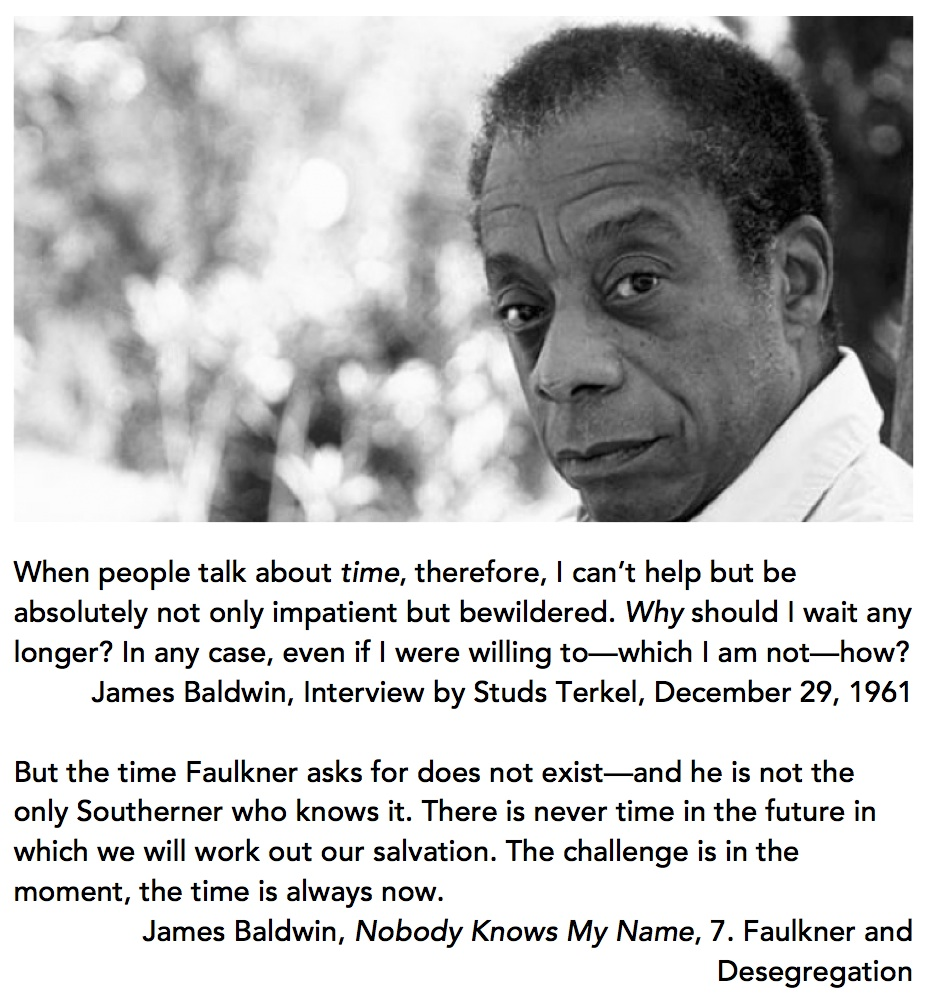
But the time Faulkner asks for does not exist—and he is not the only Southerner who knows is. There is never time in the future in which we will work out our salvation. The challenge is in the moment, the time is always now.

“Faulkner and Desegregation,” Nobody Knows My Name

On Southern Heritage and Pride

I’m Nobody! Who are you?

Emily Dickinson

For Skylar and Jessica

When writing about my redneck past—born, raised, and now having lived my entire life in the upstate of South Carolina—I reached back to my grandparents and parents as a way to give context to who I am and how I “got to be this way.”

In the waning days of June 2015, in the sort of near-100-degree heat we tend to suffer in July and August, SC has been exposed to the rest of the U.S. and world in a way that is hard for me as a Southerner to face: nine innocent souls slaughtered in a racist rage.

While the domestic terrorist responsible for this logical consequence of a people hopelessly clutching a culture of violence in the form of the right to bear arms and willfully blind to the lingering racism that stains our refrain of “life, liberty, and the pursuits of happiness” sought to start a race war, instead a state and national conversation has begun about the embarrassment that is Southern Heritage, raised like a petulant bully’s middle-finger on the grounds of SC’s Capitol.

I have never felt pride about being a South Carolinian, a Southerner, or an American—these are all mere coincidences of my birth.

It makes no real sense to me, this personalizing geography and then mangling history and ideology in order to create barriers among people.

As a high school teacher in SC for nearly two decades, my students often bristled at my confronting them about the flag fetish among many white students, mostly males.

As a life-long witness to Southern Heritage, I have come to recognize that we are not unique but representative in the South of the worst aspects of patriotism, nationalism, and jingoism—making a commitment to a false narrative to preserve an ideology that ultimately is self-defeating and dehumanizing.

Those most fervent about Southern Heritage and fundamentalist faith in the South have something important in common: an incomplete at best and missing at worst understanding of either the history of the South (and the Confederacy) or the Bible.

There is a selectivity to calling on history and scripture that exposes the real commitments of the fervent: holding onto a world that insures other people remain inferior.

“Heritage Not Hate” is propaganda, and as Aldous Huxley notes: The propagandist’s purpose is to make one set of people forget that certain other sets of people are human.”

It is the cruelest sort of irony that Southern Heritage advocates misrepresent history as many fundamentalists misrepresent Christianity because those false narratives seek to dehumanize and divide.

Yes, my family and community shaped who I am and how I “got to be this way.” And I am certain the South and SC have played roles in that story of me as well.

But I have no specific idea if any of my ancestors participated in any way in the Civil War or slavery; I must imagine that those ancestors in the South during those eras were like most people—in most ways directly or indirectly complicit in horrible human acts.

I must imagine that because we are directly and indirectly complicit now in horrible human acts—some so large and pervasive that most cannot see them (our consumer culture that includes the wealth of the few on the labor of the discardable many).

I have no desire to contort reality around my ancestors or the history of the region I happen to be born in as a act of somehow justifying my own value as a person.

Southern Heritage and Pride are abstractions that allow a callous disregard for the very real world around us—a world that is unnecessarily violent of our own making, a world that is horribly inequitable of our own making, and a world trapped in the labels of “heritage” and “Christian” but unwilling to learn from history or act on “Love your neighbor as yourself.”

I simply cannot embrace a past that reveals all the ways we have failed each other.

It seems instead that today and every “today” we are called to imagine how the world can be better and then do something to make that happen.

I am grateful in many ways for the life my grandparents and parents afforded me, but my life has also included making choices to set aside many things that redneck past inculcated in me, things that do not fill me with pride, but shame.

The enduring possibilities of human dignity have been my guideposts that I found in literature (not garbled and romanticized history or cherry-picked bible verses): William Faulkner and Flannery O’Connor, Ralph Ellison and Alice Walker, Langston Hughes and e.e. cummings, Margaret Atwood and Haruki Murakami, Milan Kundera and Adrienne Rich.

But the moral barometers who ultimately saved me remain the voices I hear daily: Kurt Vonnegut and James Baldwin.

Vonnegut writes through Eliot Rosewater from God Bless You, Mr. Rosewater:

“Go over to her shack, I guess. Sprinkles some water on the babies, say, ‘Hello, babies. Welcome to Earth. It’s hot in the summer and cold in the winter. It’s round and wet and crowded. At the outside, babies, you’ve got about a hundred years here. There’s only one rule that I know of, babies—:

“‘God damn it, you’ve got to be kind.’”

Baldwin confesses in “They Can’t Turn Back”:

It took many years of vomiting up all the filth I’d been taught about myself, and half-believed, before I was able to walk on the earth as though I had a right to be here.

I feel no pride in being a South Carolinian, a Southern or an American; I did not choose any of that geography.

But when I read Vonnegut and Baldwin, I am proud to be a fellow human and I feel a sudden rush of hope found in the pages of literature—as author Neil Gaiman recognizes:

You’re also finding out something as you read vitally important for making your way in the world. And it’s this:

The world doesn’t have to be like this. Things can be different.

And this is my confession: While white parents gave me life, black authors saved my life.

I have debts to pay, and I must pay them forward—things I cannot do clutching a past that has failed us all.

#BaltimoreUprising and the Politics of “Myths That Deform Us”

They know they would not like to be black here. If they know that, they know everything they need to know. And whatever else they say is a lie….The American idea of progress, when Americans talk about progress, they mean how fast I become white. And it’s a trick bag because they know perfectly well I can never become white….

James Baldwin, 15 January 1979

Politics in the U.S. is carefully and meticulously restrained, walled off as mere partisan politics, the manufactured and mostly illusion of choice (hence, of democracy) between Republicans and Democrats—both of which are in the service of capitalism, commercialism, and consumerism.

As such, Republicans and Democrats are different sides of the same economic coin, both depending on the false threat of socialism and both fostering the narrow and distorted gaze always on economics. The U.S. has no capacity for looking away from the coin and toward what the coin represents: Power.

Not to be too simplistic, but the system is irrelevant because the powerful few will always work that system to maintain power, and thus to keep the vast majority subservient. In that respect, the former USSR serves well to show that so-called communism works in many of the same ways as capitalism to serve the few.

Capitalism, communism, socialism, and even democracy, then, are not really economic or political systems as much as they are stories, mythologies—ways of framing the world to serve the needs of the powerful at the expense of the powerless.

Made popular by Bill Moyers, Joseph Campbell spent his career seeking ways to bring a better understanding of comparative religion studies and mythology into pop culture. Campbell explained that “[m]yth basically serve four functions”: mystical, cosmological, sociological, and pedagogical.

The third function, sociological, “[supports] and [validates] a certain social order”:

And here’s where the myths vary enormously from place to place. You can have a whole mythology for polygamy, a whole mythology for monogamy. Either one’s okay. It depends on where you are. It is this sociological function of myth that has taken over the world—and it is out of date. (p. 31)

As a powerful example, Moyers and Campbell discussed the representation of serpents/snakes in myths, starting with the Christian Garden of Eden myth, but also highlighting the parallel Bassari legend. “It’s very much the same story,” Campbell explained (p. 45).

And from this, Campbell noted where the sociological functions vary regarding serpents/snakes: “Now the snake in most cultures is given a positive interpretation,” he added (p. 47). However, the Christian framing is uniquely negative:

Moyers: In the Christian story the serpent is the seducer.

Campbell: That amounts to a refusal to affirm life. In the biblical tradition we have inherited, life is corrupt, and every natural impulse is sinful unless it has been circumcised or baptized. The serpent was the one who brought sin into the world. And the woman was the one who handed the apple to the man. The identification of the woman with sin, of the serpent with sin, and thus of life with sin, is the twist that has been given to the whole story in the biblical myth and doctrine of the Fall.

Moyers: Does the idea of woman as sinner appear in other mythologies?

Campbell: No, I don’t know of it elsewhere. (p. 47)

In its sociological function, the myth of the Fall serves men, the power and purity of men by imposing sin onto serpents/snakes and women.

Paulo Freire confronts the power of myth:

To the extent that I become clearer about my choices and my dreams, which are substantively political and attributively pedagogical, and to the extent that I recognize that though an educator I am also a political agent, I can better understand why I fear and realize how far we still have to go to improve our democracy. I also understand that as we put into practice an education that critically provokes the learner’s consciousness, we are necessarily working against the myths that deform us. As we confront such myths, we also face the dominant power because those myths are nothing but the expression of this power, of its ideology. (p. 41)

#BaltimoreUprising and the Politics of “Myths That Deform Us”

The abrupt shooting of Tamir Rice offered a horrifying moment to confront the “myths that deform us,” as Stacey Patton explained, placing Rice’s shooting within the historical context of Emmitt Till.

As well, Rice’s shooting has been informed by research showing that black children are mis-seen as being older, even by people in authority (such as police officers, teachers).

The relentless string of highly publicized shootings of black males has now exploded in Baltimore, a perverse real-world allegory of the consequences of the sociological function of “myths that deform us.”

Placing as we should all of the incidences from Trayvon Martin until today (since memory in the U.S. is brief, ahistorical), we must acknowledge that blacks live daily under the “myths that deform us,” often myths ascribed to the power of Church and God: biblical arguments for slavery, biblical arguments against inter-racial marriage, biblical arguments for beating children (and parallel marginalizing and dehumanizing women with the Word of God).

The Western/Christian iconography and symbolism preaches black is evil and white is pure: the corrupt that must be purified and the pristine that must be preserved.

These “myths that deform us” have also been given the veneer of science—IQ and decades of standardized tests that serve the interests of white, affluent males, keeping people of color, the poor, and women behind the wall of not measuring up.

Watching #BaltimoreUprising requires that we listen to and look at carefully in order to confront the Thug Myth being used to maintain with perpetual surveillance a culture of compliance shaped by and for white privilege.

Race itself is a myth, a human construction, not a biological fact. The associations (prejudices, stereotypes) with race (young black males are thugs, looters, rioters) are no more true than snakes are evil.

Those who control the myths (that deform us) have fashioned these stories in their honor, for their gain.

As Baltimore rises, those who deny racism continue to have an evidence problem, one that must serve to crumble their “myths that deform us.”

#BaltimoreUprising exposes that white privilege cares more about private property than human life—even as a black man sits in the White House.

We must tear down the wall.

In God We Trust?

Writing about her The Handmaid’s Tale, Margaret Atwood explains in “Writing Utopia”:

Dystopias are often more like dire warnings than satires, dark shadows cast by the present into the future. They are what will happen if we don’t pull up our socks.

Atwood’s now contemporary classic reads as a brilliant hybrid of George Orwell’s 1984 and Arthur Miller’s The Crucible—”dire warnings” about the allure and dangers of totalitarian theocracies.

Literature, in fact, comes back again and again to warnings about fanatical and fundamentalist religion, especially as that intersects government and politics.

Powerful in its concision and word play, e.e. cummings’ satire of pompous political patriotism begins, “‘next to of course god america i/ love you'”—weaving a stump speech both garbled with cliches and distinctly lucid in its pandering.

The last line (“He spoke. And drank rapidly a glass of water”), the only words not being spoken by the unnamed politician, comes after the dramatic rhetorical question: “‘then shall the voice of liberty be mute?'”

Like Atwood, Orwell, and Miller, cummings is offering his warning about draping ourselves in the flag while simultaneously thumping the Bible.

In God We Trust?

Having been born, raised, and then living and working my entire life in South Carolina, I have mostly existed in a default culture of Southern Baptist religiosity, a fundamentalist view of scripture.

I have witnessed and continue to witness religion used both as a rod and as a water torture: at once a blunt and instant tool of judgment and a relentless, although only a drop at a time, force for keeping everyone in line.

And that line is decreed by God, so they say.

However, this is not something exclusive to the South—although many continue to rely on scripture to justify corporal punishment and even misogyny in my homeland.

The history of the South, too, offers countless and disturbing “dire warnings”: justifying slavery with scripture and the historical roots of Southern Baptists as a result.

But fundamentalism in the South and the dramatic consequences may mask the thread of those same beliefs running throughout the nation. Consider “In God We Trust” on U.S. currency, “under God” in the Pledge of Allegiance, and the place of prayer in public schools.

The public is mostly misinformed about all of these, but easily swayed by the political implications of invoking “God.”

“God” on currency and in the Pledge (as a Cold War political ploy) represents a political manipulation of religion (using religion to score political points), as the history of how each occurred reveals. But prayer in public school may be the best example of the problem.

Formed under Ronald Reagan, the committee eventually drafting what is called A Nation at Risk included Gerald Holton, who has revealed Reagan’s “marching orders” for the report:

We met with President Reagan at the White House, who at first was jovial, charming, and full of funny stories, but then turned serious when he gave us our marching orders. He told us that our report should focus on five fundamental points that would bring excellence to education: Bring God back into the classroom [emphasis added]. Encourage tuition tax credits for families using private schools. Support vouchers. Leave the primary responsibility for education to parents. And please abolish that abomination, the Department of Education.

When the president of the U.S. misrepresents a fundamental issue, when virtually no one (media, etc.) holds the president accountable for the misrepresentation, and then when that inaccurate claim remains powerful for decades (until today), we would be careless to suggest that the danger of religion and politics is simply a vestige of the backward South.

Neither prayer nor God has ever been removed or banned from public schools. In 1962, forced prayer was ruled unconstitutional—which ironically seems to be the sort of law the Libertarian-leaning streak in the U.S. would embrace. Yet Reagan Democrats and Tea Partiers are the exact national demographics calling for “religious freedom” legislation, much like the redundant and unnecessary legislation guaranteeing students the right to pray in public schools.

“Freedom To and Freedom From”

“Religious freedom”?

“There is more than one kind of freedom, said Aunt Lydia,” Atwood’s narrator, Offred/June, recounts. “Freedom to and freedom from. In the days of anarchy, it was freedom to. Now you are being given freedom from. Don’t underrate it.”

Women training women, Atwood dramatizes, is about control—control of their bodies and control of their minds, which includes controlling language.

“We were a society dying, said Aunt Lydia, of too much choice,” Offred/June adds.

Again, I live in SC, a “right to work” state, so I am attuned to the Orwellian language gymnastics so wonderfully emphasized in Atwood’s novel, echoing Orwell’s “dire warnings”:

Winston kept his back turned to the telescreen. It was safer; though, as he well knew, even a back can be revealing. A kilometer away the Ministry of Truth, his place of work, towered vast and white above the grimy landscape….

The Ministry of Truth—Minitrue, in Newspeak—was startlingly different from any other object in sight….From where Winston stood is was just possible to read, picked out on its white face in elegant lettering, the three slogans of the Party:

WAR IS PEACE

FREEDOM IS SLAVERY

IGNORANCE IS STRENGTH. (p. 7)

Therefore, I am skeptical—if not cynical—about the proposed “religious freedom” law in Indiana. I am also disturbed that this is occurring in Kurt Vonnegut‘s Indiana, and as Garrett Epps discusses, there are important connections to Indiana’s law and SC:

Until the day he died, however, [Maurice] Bessinger insisted that he and God were right.  His last fight was to preserve the Confederate flag as a symbol of South Carolina. “I want to be known as a hard-working, Christian man that loves God and wants to further (God’s) work throughout the world as I have been doing throughout the last 25 years,” he told his hometown newspaper in 2000….

That’s a good background against which to measure the uproar about the Indiana Religious Freedom Restoration Act, which was signed into law by Governor Mike Pence last week. I don’t question the religious sincerity of anyone involved in drafting and passing this law. But sincere and faithful people, when they feel the imprimatur of both the law and the Lord, can do very ugly things.

Being reared in the fundamentalist South, I was given mostly a negative education in morality—all that I was determined not to do and be.

My moral compass has come from literature instead—Margaret Atwood, James Baldwin, and Kurt Vonnegut.

These calls, then, for “religious freedom” ring Orwellian, not about “freedom” at all but about the sorts of cancerous marriages between religion and politics already played out time and again in the U.S. to deny marginalized groups what those in power enjoy as if such is ordained by God.

#

“Do you know what a humanist is?” writes Vonnegut in A Man Without a Country:

My parents and grandparents were humanists, what used to be called Free Thinkers. So as a humanist I am honoring my ancestors, which the Bible says is a good thing to do. We humanists try to behave as decently, as fairly, and as honorably as we can without any expectation of rewards or punishments in an afterlife.

I am compelled to suggest that the question is not, In God we trust?

We must be very cautious about anyone who speaks in God’s stead; we must adopt Vonnegut’s stance toward our fellow humans.

Indiana should feel the consequences of humans’ inhumanity toward humans—a great irony is that this wrath appears to be the Invisible Hand of Capitalism—and like great literature, Indiana’s political hubris and indecency must fulfill Atwood’s recognition of the power of “dire warnings.”

Indiana, pull up your socks.

Recommended

Freethinkers: A History of American Secularism, Susan Jacoby

Ellison, Baldwin, Coates: #BlackLivesMatter, a Reader

Published in 1944, An American Dilemma: The Negro Problem and Modern Democracy by Gunnar Myrdal, prompted black novelist Ralph Ellison (March 1, 1913–April 16, 1994) to offer a review, one that is much more than a review, including:

This was a period, the 1870s, wherein scientific method, with its supposed objectivity and neutrality to values, was thought to be the answer to all problems. There is no better example of the confusion and opportunism springing from this false assumption than the relation of American social science to the Negro problem. And let us make no easy distinctions here between Northern and Southern social scientists; both groups used their graphs, charts and other paraphernalia to prove the Negro’s biological, psychological, intellectual and moral inferiority, one group to justify the South’s exploitation of Negroes, and the other to justify the North’s refusal to do anything basic about it. Here was a science whose role, beneath its illusionary non-concern with values, was to reconcile the practical morality of American capitalism with the ideal morality of the American Creed.

And:

The most striking example of this failure is to be seen in the New Deal administration’s perpetuation of a Jim Crow army, and the shamefaced support of it given by the Communists. It would be easy—on the basis of some of the slogans attributed to Negro people by the Communists from time to time, and the New Deal’s frequent retreats on Negro issues—to question the sincerity of these two groups. Or, in the case of the New Deal, to attribute its failure to its desire to hold power in a concrete political situation, while the failure of the Communists could be laid to “Red perfidy.” But this would be silly. Sincerity is not a quality that one expects of political parties, not even revolutionary ones. To question their sincerity makes room for the old idea of paternalism, and the corny notion that these groups have an obligation to “do something for the Negro.”

James Baldwin‘s A Report from Occupied Territory (1966)

Ta-Nehisi Coates’s The Case for Reparations (2014)

Ta-Nehisi Coates Completely Shuts Down Shelby Steele In Epic Fashion In This Reparations Debate (see video clip)

Michelle Alexander’s The New Jim Crow

Black Lives Matter: The Schott 50 State Report on Public Education and Black Males (2015)

“Black Girls Matter”: An Interview With Kimberle Crenshaw and Luke Harris

Bearing Witness: Hypocrisy, Not Ideology

Unless this is mangled memory (and in my advancing age, it may well be), when the sit-com Seinfeld interspersed Jerry Seinfeld doing stand-up with the main show, I was struck by one routine about sports fandom. Seinfeld noted that since the players on any team are constantly changing, fans are essentially pulling for the jerseys.

As observational humor goes, that joke is funny, but I also think it essentially nails what is wrong with partisan politics when anyone defends her/his party (team) regardless of behaviors while simultaneously illuminating every slip of the other party (team) as if the world is coming to an end.

For that reason mainly, I have removed myself entirely from partisan politics (inspired by the late and great George Carlin, who is the team to which I lend my loyalty).

Recently, I have noticed Democrats posting on social media a news story concerning Rudy Giuliani’s daughter being arrested for shoplifting. I ignored the posts at first, but since I certainly have found Giuliani in the past and recently to be beyond loathsome in his commentary (notably when paired with equally loathsome Bill O’Reilley), I happened to click the link once to discover the story is from 2010.

All of this puts me in an ethical/intellectual bind because in many respects the Giuliani-as-law-and-order-politician/daughter-as-criminal dynamic does highlight what I believe is how we must judge both leadership and privilege in the U.S. But the context in which I have found this story (and it being from 2010) still reeks of partisan sniping and pettiness (especially if we consider the recent ugliness surrounding comments about the Obama daughters).

In the U.S., political leadership, wealth and success, and privilege are nearly inseparable—despite the meritocracy myth perpetuated by the privileged to mask their greased paths to power and wealth.

And thus, the genuine differences between Democrats and Republicans remain mostly in word only—platforms, speeches, and published commentaries. War mongering, accountability-driven public education reform, economic policy, etc., remain significantly similar regardless of political party affiliation in the U.S., particularly is we assess the policy against the larger ideology justifying those policies (free market mechanisms, neoliberalism, etc.).

Participating in partisan politics, then, in the same ways we participate in team sport allows privileged leadership to continue serving the interests of the privileged at the expense of the great majority of people in the U.S.—notably the marginalized.

While I am not suggesting ideology doesn’t matter, I am calling for placing judgments of leaders and the privileged in the context of hypocrisy first. Let me offer some context.

Both Democrats and Republicans champion market forces for reforming public education, notably parental choice as a driving mechanism for reform.

However, when controlling for student demographics (and conditions such as selection exclusivity and attrition), among private, charter, and public schools, virtually no differences in major outcomes exist.

But let’s go further, many endorsing market forces (whether vouchers on the right or charter schools on the left) often claim issues such as class size do not matter—assertions that must be tested against not only those making the claims but also the evidence from the market itself.

Bill Gates, for example, has pushed for classes of 40 students with teachers paid bonuses for those large class sizes; however, Gates himself attended elite private schools with extremely low class sizes.

And therein lies the problem with hypocrisy.

While private schools do not in fact outperform public schools (both forms of schooling have a wide range of so-called quality), the market dynamics around private schools responding to parental choice clearly show that low class sizes are important—in fact, justifying larger financial investments by parents.

And I think now we can circle back to how Giuliani and his daughter can and should matter.

Privileged leadership in the U.S. represents word and deed designed for everyone else except the privileged class; in education, what privileged leaders are saying is that, for example, class size doesn’t matter for other people’s children (but it does for mine and my privileged friends).

Giuliani’s tone-deaf and offensive claims about law enforcement and black/brown people/families reveal the arrogance of leadership and privilege—and thus, he should be held accountable for his hypocrisy. But not as yet another partisan mask for letting those on the “other” political team slide (which is what I believe most of the posts I have seen are doing).

Kurt Vonnegut’s Cat’s Cradle, among many things, is about the puppet show that is partisan politics as team sport. Vonnegut’s dystopia, however, is playing out before us now whenever we fail to see past the veneer of ideological claims, whenever we continue to pull for the jerseys.

To judge leadership/privilege against hypocrisy is a moral imperative that is lost in ideological team sport.

“But to recommend thrift to the poor is both grotesque and insulting,” wrote Oscar Wilde. Why? Because the people demanding thrift among the poor are not themselves living under the same directive; if fact, the wealthy who demand thrift of the poor wallow in waste and excess.

Those demanding “no excuses,” as with those rejecting the importance of class size, for example, tend to live in abundance and slack—among the very riches of excuses.

And so I believe that a key part of our fight for public education and democracy is that we cannot have genuine ideological battles until we hold all ideologies responsible for the validity of their own investment in those ideologies.

Hypocrites have no moral authority. Without moral authority, a person deserves no political authority.

As long as we allow hypocrisy, however, in order to preserve our partisan politics as team sport, we are part of the problem.

In a 1961 interview by Studs Terkel, James Baldwin states: “People don’t live by the standards they say they live by, and the gap between their profession and the actuality is what creates this despair, and this uncertainty, which is very, very dangerous.”

Baldwin, then, as writer/artist describes himself—in a 1984 interview by Julius Lester—as a witness: “Witness to whence I came, where I am. Witness to see what I’ve seen and the possibilities that I think I see.”

Every people, every generation needs the artists-as-witnesses, but a democracy requires that each one of us serves as witness in the way Baldwin explains:

Lester: You have been politically engaged, but you have never succumbed to ideology, which has devoured some of the best black writers of my generation.

Baldwin: Perhaps I did not succumb to ideology, as you put it, because I have never seen myself as a spokesman. I am a witness. In the church in which I was raised you were supposed to bear witness to the truth. Now, later on, you wonder what in the world the truth is, but you do know what a lie is….

A spokesman assumes that he is speaking for others. I never assumed that—I never assumed that I could….No society can smash the social contract and be exempt from the consequences, and the consequences are chaos for everybody in the society.

Hypocrisy is that obvious lie we must bear witness to by rising above mere ideology.