“‘When Bokonon and McCabe took over this miserable country years ago,’ said Julian Castle, ‘they threw out the priests. And then Bokonon, cynically and playfully, invented a new religion'” (p.172)—opens Chapter 78 of Kurt Vonnegut’s Cat’s Cradle.
Readers soon learn that Bokonon creates a religion “‘to provide the people with better and better lies'” (p. 172), foma, and a central aspect of that strategy involves the fabricated war between the government of San Lorenzo and the religion, Bokononism. Readers discover that this plan fails:
“But people didn’t have to pay as much attention to the awful truth. As the living legend of the cruel tyrant in the city and the gentle holy man in the jungle grew, so, too, did the happiness of the people grow. They were all employed full time as actors in a play they understood, that any human being anywhere could understand and applaud.” (pp. 174-175)
The false choice between McCabe and Bokonon in the other world created by Vonnegut happens to represent well the delusion of choice that exists in the U.S. (not to be examined here, but McCabe/Bokonon reflect the false choice currently in the U.S. between Republican/Democrat; it’s a fake fight, and a false choice).
This delusion, in fact, doesn’t even require the existence of choice—the word itself is nearly magical. But the choice that is the soma of American Myth tends to be binary and constrained, actually no real choice at all.
Should I buy an Accord or a Camry (no real difference, by the way)? But never, Should I even own a car?
And that constraint tends to lie within making sure Americans have no choice other than to work, work, work and thus participate fully in the great Free Market. This choice isn’t really about choice, but about keeping everyone busy and focused on choosing so that no one will consider the alternatives.
This dynamic plays out in the education reform debate through the emphasis on parental choice: that parents must have choice and that parents must know how to choose what education is best for their child.
Just as choosing between car models fails the larger freedom to choose, the school choice truism fails to acknowledge the possibilities of creating conditions that are beyond choice—conditions that make parents choosing what school is best unnecessary.
Many people living in poverty in the U.S. must choose between eating low-quality but cheap food or spending limited funds on more expensive but healthy food (and thus sacrificing other expenses). When do we ever discuss creating a world in which that choice isn’t needed, a world in which only healthy food is available and all food is affordable regardless of social class?
Is that really beyond the scope of a free people and the richest country in the history of humanity?
Probably not.
A a simple example, the South (mostly) has chosen not to play the toll road game, one in which people must choose between spending more money or more time. Many areas of the South have a large number of publicly funded roads (as a cyclist I ride for miles and never see a car, never see a house, but there is a road, usually well maintained).
That attitude toward roads rises above choice; open and available roads render choices between spending time or money irrelevant. But also, that was a choice, a culturally and regionally bound choice.
Idealizing choice and failing to unmask false choice are, ironically, failures of choice, the myopia created by the belief that choice is sacred, that choice is the only key to human freedom.
But in our new research we found that three and a half years after finishing university, graduates who attended private schools earn an average of 7% more per year than graduates who went to state school.
This could easily be interpreted as the need for choice so the superior private option could motivate the inferior public model to do better—if the consumers choose and create such pressure.
But, as the researchers explain about the complexities of these findings, we often fail to acknowledge that education (including how much achieved and what type of school attended) is often a marker for privilege, and that privilege or race is a stronger predictor of success (such as income) than any equal achievement (such as graduating college); see for example (from HERE, Fig. 1, and HERE, Fig. 2), the influence of class and race against educational attainment:
Figure 1. “Even poor kids who do everything right don’t do much better than rich kids who do everything wrong. Advantages and disadvantages, in other words, tend to perpetuate themselves. You can see that in the above chart, based on a new paper from Richard Reeves and Isabel Sawhill, presented at the Federal Reserve Bank of Boston’s annual conference, which is underway.” Matt O’BrienFigure 2. “On average, black families at a given level of educational attainment receive incomes that are just 66% of what white families at the same level of educational attainment receive. For Hispanic families, that figure is 79%. Naturally, when education-controlled income disparities like this exist, education-controlled wealth disparities will exist.” Matt Bruenig
Thus, if we remain committed to choice—that parents and students must have choice in order to spur higher quality education, that in turn will overcome social inequity (classism, racism)—we are not directly addressing class and race inequities, and thus allowing them to continue: Within class and race, education makes a difference, but education does not erase class and race inequities.
Again, we are committed to a false and misleading choice, and not creating a world where that choice isn’t needed once we have eradicated (mostly) classism and racism.
The soma of choice in the U.S. keeps us addicted to competing so that some may win—while excluding the possibility of collaborating so that all may thrive.
As we seek ways to create better education, we should stop demanding that parents and students have choice, and start demanding that no parents or children should have to choose. This is the sort of real choice a free people can and should make.
Fig. 18. Bruenig: “Look at the red bar furthest to the right. That is the bar describing where kids born into the richest fifth who do not get a college degree wind up. Notice that 25% of those kids still wind up in the richest fifth. Now look at the blue bar furthest to the left. That is the bar describing where kids born into the poorest fifth who do get a college degree wind up. Notice that only 10% of those kids wind up in the richest fifth.”Fig 3. Matt Bruenig concludes, based on data from the Pew’s Economic Mobility Project: “So, you are 2.5x more likely to be a rich adult if you were born rich and never bothered to go to college than if you were born poor and, against all odds, went to college and graduated….Therefore, the answer to the question in the title is that you are better off being born rich regardless of whether you go to college than being born poor and getting a college degree.”
“Jesusland” by Ben Folds includes a powerful verse against the energetic piano and soaring harmonies:
Town to town
broadcast to each house, they drop your name
but no one knows your face
Billboards quoting things you’d never say
you hang your head and pray
While the music and rhythm sound uplifting, the message of the lyrics is a sharp criticism of the Bible Belt, where I grew up, where I live. Folds confronting the disconnect between the ideology found in the words of Jesus in the Bible and then how Christians have manipulated those words and ideals for justifications significantly not Christ-like sits in a long tradition including Thomas Jefferson stating that he believed everything said by Jesus but little said about him (and revising his own version of the Bible to reflect that stance):
I was born and then have lived all of my 53 years in the South, the upstate of South Carolina, a stark example of a Bible Belt state where fundamentalist Christianity is blended seamlessly and unselfconsciously with rabid state’s-rights commitments and fervent patriotism as a veneer for a solid faith in the free market.
I have labeled my home region of the U.S. the self-defeating South because these often contradictory ideologies not only have created scars on our history but also continue to leave us in a constant state of being battered and bruised, especially children, women, and people of color.
Like the angry white Christians shouting hate and their narrow faith at the Little Rock Nine, “Spare the rod, spoil the child” quickly follows the defenses of corporal punishment as the topics of domestic violence and child abuse have been spurred by controversies surrounding NFL players.
As Larry Morrison details about Biblical arguments for slavery—”The emphasis from proslavery defenders was always upon a literal reading of the Bible which represented the mind and will of God himself” (p. 16)—so too are Biblical arguments for spanking children.
•
Unlike me, Kurt Vonnegut was born and raised in the Midwest. In his collection Palm Sunday, Vonnegut confessed, “Toward the end of our marriage, it was mainly religion in a broad sense that Jane and I fought about” (p. 175).
And then Vonnegut—as he often did—shared his upbringing as a Free Thinker, leading to his casual references to himself as an atheist or agnostic. In a speech delivered at Hobart and William Smith College (May 26, 1974), Vonnegut explained:
So a modern, secular education is often painful. By its very nature, it invites us to question the wisdom of the ones we love….
I have said that one guess is as good as another, but that is only roughly so. Some guesses are crueler than others—which is to say, harder on human beings, and on other animals as well….
But it is reasonable to suppose that other bad guesses are poisoning our lives today. A good education in skepticism can help us to discover those bad guesses, and to destroy them with mockery and contempt. (pp. 178-179)
Vonnegut as Free Thinker recognized that “bad guesses” were often most corrosive when linked to the Word of God; therefore, he called for “a new religion” (p. 181)—necessary to combat “hypocrisy”:
I am willing to drop the word religion, and substitute for it these three words: heartfelt moral code….The trouble with so many of the moral codes we have inherited is that they are subject to so many interpretations….This is good news for hypocrites, who enjoy feeling pious, no matter what they do. (p. 184)
Vonnegut in this speech focused on the tragedies of continuous war and rampant consumerism to the expense of the survival of humans—concluding as only Vonnegut could about the need “to do whatever we need to do in order to have life on the planet go on for a long, long time”:
This is bad news for business, as we know it now. It should be thrilling news for persons who love to teach and lead. And thank God we have solid information in the place of superstition! Thank God we are beginning to dream of human communities which are designed to harmonize with what human beings really need and are.
And now you have just heard and atheist thank God not once, but twice. And listen to this:
God bless the class of 1974. (p. 191)
•
In 1974, I didn’t know about Vonnegut, but I was on the cusp of two important realizations of my life: the need “to question the wisdom of the ones we love” (my parents and community) and my own aversion to the hypocrisy of the Bible Belt I called home.
A decade later, 1984, I was teaching English in the high school I had attended, in the classroom where my favorite teacher, Lynn Harrill, had taught before moving on to administration. And then, about another decade later, my students—most of whom attended the Southern Baptist church that sat literally in the middle of the district’s four public schools—joined the national fad of wearing What Would Jesus Do (WWJD) bracelets and T-shirts.
Teaching public school in the Bible Belt throughout the 1980s and 1990s, I can attest that religion was never absent from school, including prayers still be announced each morning over the intercom.
The WWJD movement highlighted for me, however, how in the South superficial religiosity trumps any genuine heartfelt moral code, as Vonnegut called it. Students leading lives that were in fact not Christ-like were the most fervent about the WWJD paraphernalia, creating a great deal of tension with students who were acting Christ-like (in many ways) but not calling attention to it.
Two things remain with me about those years teaching, watching young people too often slip comfortably into the hypocrisy of the Bible Belt (something about which I blame the adults, and not those students).
First, and ironically, the WWJD merchandising was an accurate portrayal of commitments in the U.S. to the market, to consumerism over all else (especially ethics).
And second, what a wasted moment.
Like Vonnegut and Jefferson, I too am comfortable with embracing a world in which humans behave in ways that are Christ-like:
You have heard that it was said, “Eye for eye, and tooth for tooth.” But I tell you, do not resist an evil person. If anyone slaps you on the right cheek, turn to them the other cheek also. (Matthew 5: 38-39)
Jesus answered, “If you want to be perfect, go, sell your possessions and give to the poor, and you will have treasure in heaven. Then come, follow me.” (Matthew 19:21)
Again I tell you, it is easier for a camel to go through the eye of a needle than for someone who is rich to enter the kingdom of God. (Matthew 19:24)
I have a Who Would Jesus Bomb bumper sticker on a file cabinet in my office, and am certain that if this guided our policy in the U.S., we’d be a much better people.
•
It is 2014, 40 years since Vonnegut’s essentially optimistic speech.
I fear I cannot share his optimism, having slipped from the healthy skepticism Vonnegut endorsed into a solid cynicism.
As I have written about and raised in my classes my strong stance against all corporal punishment, based on decades of solid research, I have been bombarded with “My parents spanked me, and I turned out OK” as well as the expected refrain: “Spare the rod, spoil the child.”
All while I lie down each night still living in Jesusland, the Bible Belt where we endorse teaching children lessons with fear and pain.
I am left to muse as Vonnegut did four decades ago, but I think about Who Would Jesus Spank and simply cannot find a credible answer other than not a single child.
•
“Human dignity,” Vonnegut offered in a 1980 speech at the First Parish Church in Cambridge, Massachusetts, “must be given by people to people”:
If you stand before me, and I do not credit you with dignity, then you have none. If I stand before you, and you do not credit me with dignity, then I have none….
What could be more essential in a pluralistic society like ours than that every citizen see dignity in every other human being everywhere? (p. 194)
I can’t imagine anything different uttered by Jesus, and I can only add, including children.
As a lifelong fan of science fiction (SF), I want to start by invoking a SF convention that never gets old: time travel (but I’ll spare you the whirlwind prestidigitation mastered by Kurt Vonnegut, who married time travel and non-linear narrative in Slaughterhouse-Five).
Once upon a time (well, I must confess, I enjoy a bit of genre-splicing also), Bill Gates, billionaire and burgeoning education hobbyist, began tossing his considerable expertise (read: money) at small schools projects. Low and behold, Gates eventually looked at the research his own foundation gathered, declared the project a failure, and scuttled away—only to decide that the greatest scourge on the planet was the enormous number of “bad” teachers failing our children everyday!
Since we are now back in time (and you may notice a pattern here about history repeating itself, and such), let’s look at that Gates/small school dynamic as I blogged about this in April and May 2011:
And, Gates’s small schools experiment? While Gates himself declared the experiment a failure, Marshak explains that Gates’ small school experiment actually exposes Gates’ own inability to understand the education dynamics he claims to reform. But ample evidence reveals both that Gates is inexpert and remains unsuccessful as an education reformer. See here,here and here — including his failure to understand statistics and the charts he enjoys using to make his points here. (Accountability? Start at the Top, OpEdNews 11 April 2011)
Let’s do some truly basic math.
First, consider that Bill Gates, a billionaire whose wealth and success have been built on computer innovation and entrepreneurship, has been an education reformer for many years now–stretching back to a small schools focus:
“Bill Gates used to believe that one of the solutions to failing schools was to create smaller ones with 500 students or fewer. His foundation spent $1 billion toward this; seeing the opportunity to bring in private dollars, districts started shifting to smaller schools. Small schools became the big new trend. But then the foundation conducted a study that found that, by itself, school size had little if any effect on achievement. The foundation dropped the project and moved on to teacher reform, but by then some urban districts throughout the nation had changed to small–and more expensive to operate–schools.”
So the first formula is:
Gates initiative + Gates funding = abandoned schools in the wake of failure (with no consequences for Gates)
As the Los Angeles Times reports above, Gates is now focusing on teacher quality–including calls for teacher evaluations tied to test scores measuring student achievement against the common core standards.
This suggests a new formula:
Gates money + common core standards + testing industry = profit for Gates and testing industry at the expense of students, learning, and public education. (If There Remains Any Question, Daily Kos 1 May 2011)
Let’s return now to the present where the Gates machine has called for a moratorium on all that Common Core and VAM stuff because his own people’s research appears to refute what Gates has been pontificating about in the compliant media gaze that only Gates seems worthy of receiving (I hate to beat this to death, but do any of you see a pattern here?).
First, Gates/small schools, Gates/VAM, and Gates/Common Core are all the same flawed dynamic in which political leaders, the media, and the public confuse wealth with expertise. Remove Gates’s billions and he would have zero credibility in any of these ventures—and I still maintain that the small school debacle is the most telling part of this story [1] because Gates misread his own research, declared erroneously the commitment a failure, and simply walked away leaving others to hold the bag (roadbuilder he has always been, roadbuilder he will always be).
And this leads to the debate and discussion that has blossomed from the Gates moratorium announcement.
So our second lesson is somewhat positive: If we could ever set aside confusing wealth with expertise, we may come to recognize that among educators, scholars, and researchers we already have a wealth of expertise that could better serve our goals of education reform.
And thus, I maintain my stance that the Gates moratorium is a sham, but I want to highlight here that within the credible responses to that moratorium call, we see how education reform should be debated by those who know the field:
And while I enjoy coming back to and finding new SF again and again, in education reform I am eager to step off the “Déjà vu all over again” merry-go-round.
Bill Gates, about that moratorium? No thanks. And while we are at it, no thanks to all the rest either.
If you’d stopped building your roads we never asked for right through the middle of our villages, we would have time to take care of business here, instead of constantly staying one step behind underneath the rubble of the disasters you create.
Memorial Day should be a day for putting flowers on graves and planting trees. Also, for destroying the weapons of death that endanger us more than they protect us, that waste our resources and threaten our children and grandchildren….
Meanwhile, there is such a shortage of housing that millions live in dilapidated sections of our cities and millions more are forced to pay high rents or high interest rates on their mortgages. There’s 90 billion for the B1 bomber, but people don’t have money to pay hospital bills.
We must be practical, say those whose practicality has consisted of a war every generation. We mustn’t deplete our defenses. Say those who have depleted our youth, stolen our resources. In the end, it is living people, not corpses, creative energy, not destructive rage, which are our only real defense, not just against other governments trying to kill us, but against our own, also trying to kill us.
Let us not set out, this Memorial Day, on the same old drunken ride to death.
Thousands of black Charlestonians, most former slaves, remained in the city and conducted a series of commemorations to declare their sense of the meaning of the war. The largest of these events, and unknown until some extraordinary luck in my recent research, took place on May 1, 1865. During the final year of the war, the Confederates had converted the planters’ horse track, the Washington Race Course and Jockey Club, into an outdoor prison. Union soldiers were kept in horrible conditions in the interior of the track; at least 257 died of exposure and disease and were hastily buried in a mass grave behind the grandstand. Some twenty-eight black workmen went to the site, re-buried the Union dead properly, and built a high fence around the cemetery. They whitewashed the fence and built an archway over an entrance on which they inscribed the words, “Martyrs of the Race Course.”
Then, black Charlestonians in cooperation with white missionaries and teachers, staged an unforgettable parade of 10,000 people on the slaveholders’ race course. The symbolic power of the low-country planter aristocracy’s horse track (where they had displayed their wealth, leisure, and influence) was not lost on the freedpeople. A New York Tribune correspondent witnessed the event, describing “a procession of friends and mourners as South Carolina and the United States never saw before.”
Small and unexpected resurrections of a kind help lighten the weight of the inevitable consequence of aging, those losses of people and things that you know must happen but you regret nonetheless.
One such loss for me was when the group R.E.M. called it a day. So it is fitting that I sit writing these recommendations while listening to Unplugged 1991 2001, a beautiful and bittersweet resurrection of everything I love about R.E.M. and everything I miss, mostly that there will never be a new R.E.M. album.
When Kurt Vonnegut died 11 April 2007, I cried on and off for several days, unable to hold inside that I was filled with Vonnegut’s art. I found myself crying as I came to the end of the first official biography of Vonnegut as well, prompting a poem.
Since Vonnegut’s death, we have been gifted small and unexpected resurrections, including two new books.
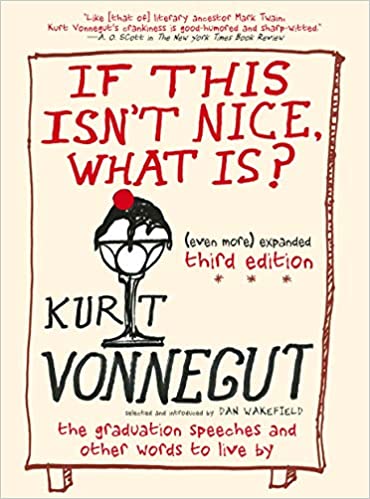
If This Isn’t Nice, What Is?: Advice to the Young is a collection of Vonnegut’s graduation speeches, a form that suited Vonnegut perfectly since he worked on a basic framework found among comedians: The Joke. And jokes are perfect for graduations where people invited to give speeches often take themselves and the ceremony far too seriously (see my own tongue-in-cheek graduation speech written mostly as a homage to Vonnegut).
If This Ian’t Nice, What Is?
If this collection isn’t perfect for a graduation gift, what is?
In “How I Learned from a Teacher What Artists Do,” Vonnegut employs his standard speech format, exhibiting his mainstay of seeming simplicity and dark bitterness masking crystal clear Truth and genuine kindness, or better phrased, a genuine call to kindness among all humans and for all things of this only world we know:
There are three things that I very much want to say in this brief hail and farewell. They are things which haven’t been said enough to you freshly minted graduates nor to your parents or guardians, nor to me, nor to your teachers. I will say these in the body of my speech, I’m just setting you up for this.
First, I will say thank you. Second, I will say I am truly sorry—now that is the striking novelty among the three. We live in a time when nobody ever seems to apologize for anything; they just weep and raise hell on the Oprah Winfrey Show. The third thing I want to say to you at some point— probably close to the end—is, “We love you.” Now if I fail to say any of those three things in the body of this great speech, hold up your hands, and I will remedy the deficiency.
I probably fell in love hard with the work of Vonnegut with Breakfast of Champions, although Vonnegut himself offered only an average grade for the work. Part of the attraction, I know, are the crude drawings, Vonnegut’s artwork that blends his calling to capture the world simply—I feel Thoreau in the background—and to remain true to his primary love, words.
I probably came to understand fully the work for Vonnegut with Cat’s Cradle, which Vonnegut graded highly also, and I return to it often to help me navigate the world too complex for a humankind unkind.
However, like his A Man without a Country, the collected graduation speeches are punctuated with his drawings, something that remains possibly the most endearing quality of published Vonnegut, which leads me to the other new Vonnegut resurrection—Kurt Vonnegut Drawings.
Kurt Vonnegut Drawings
There is an apt and warm touch to this collection of Vonnegut’s visual art, the “drawings” in the title. Vonnegut, if anything, is an artist that embodies childhood as well as a glorious faith in childhood. When he is most serious and most angry, he appears to be his most playful and childlike, but never childish (preview some of the pieces in this review).
In my most recent poem, Vonnegut’s Bluebeard came rushing back to me, unbidden. I preface the poem with a line from the novel and then include an allusion to the novel’s ending. Bluebeard is one of Vonnegut’s many faux autobiographies that exist in a netherworld between fiction and nonfiction that forces the reader to consider everything she/he knows about genre while also setting all of those assumptions aside.
There is a good deal of Vonnegut to find in Bluebeard and Rabo Karabekian (who confesses [for Vonnegut?], “I may have been a lousy painter, but what a collector I turned out to be!”); just as there is much in both that tells us almost nothing about Vonnegut.
But—despite Vonnegut being mostly a man of letters—I find his drawings help me come to terms with the complete Vonnegut, the human Vonnegut wanted to be, the humans Vonnegut wanted all of us to be.
Kurt Vonnegut’s Cat’s Cradle and Tennessee Williams’s Cat on a Hot Tin Roof may seem at first blush to share only the use of “cat” in their titles, but both works are masterful examinations of something central to the human condition: the lie.
Mendacity is the darkest of lies because it corrupts and ultimately destroys relationships and even lives. For Big Daddy, mendacity is inevitable, central to the human condition: “I’ve lived with mendacity!—Why can’t you live with it? Hell, you got to live with it, there’s nothing else to live with except mendacity, is there?”
While Vonnegut’s novel is also dark—and typically satirical—foma is offered as harmless lies, as Julian Castle explains to the narrator:
“Well, when it became evident that no governmental or economic reform was going to make the people much less miserable, the religion became the one real instrument of hope. Truth was the enemy of the people, because the truth was so terrible, so Bokonon made it his business to provide the people with better and better lies.” (p. 172)
Although different consequences result from the mendacity of Cat on a Hot Tin Roof and the foma of Cat’s Cradle, all lies share one important characteristic: They are almost impossible to confront, and once confronted, they create a great deal of pain.
As a parent, I came face to face with letting the cat out of the bag when my daughter first unmasked the foma of the Tooth Fairy, and then connected that realization with Santa Claus. After I confessed to the truth—trying as I did to make a case about “harmless lies”—my daughter cut right to the heart of the matter, asking, “Why did y’all lie to me?”
The thinnest margins between mendacity and foma, I think, are found in our cultural myths—the fatal flaw of confusing the ideals we aspire to as a people with conditions already achieved. Many of those aspirations have tipped into mendacity, poisoning the possibility of those ideals—especially in the foundational promises of public institutions.
Here, then, are those ideals that could have served us well as aspiration, but now work as mendacity and thus against our best intensions:
Capitalism and choice. The realization is now becoming hard to ignore, that capitalism (the free market) is incompatible with equity (see, for example, Thomas Piketty). As well, choice as a concept central to freedom is far more complicated than expressed in our public discourse. Both capitalism and choice have worked against cultural aspirations for equity, but those failures may be better explained by the reason they have failed: idealizing capitalism and choice while failing to commit fully to the power of the Commons to establish the context within which capitalism and choice could serve equity well.
Education as Key to Equity. As misleading as claims about the U.S. being a meritocracy (or that we are a post-racial country) are assertions that education is the one true way to overcome social ills and how any individual can lift her/himself out of poverty. However, education has not and does not, in fact, change society, rarely lifts people out of the circumstances of their births, and serves as a marker for privilege (thus creates the illusion that education is a force for change)—as Reardon explains:
Here’s a fact that may not surprise you: the children of the rich perform better in school, on average, than children from middle-class or poor families. Students growing up in richer families have better grades and higher standardized test scores, on average, than poorer students; they also have higher rates of participation in extracurricular activities and school leadership positions, higher graduation rates and higher rates of college enrollment and completion.
Whether you think it deeply unjust, lamentable but inevitable, or obvious and unproblematic, this is hardly news. It is true in most societies and has been true in the United States for at least as long as we have thought to ask the question and had sufficient data to verify the answer.
What is news is that in the United States over the last few decades these differences in educational success between high- and lower-income students have grown substantially….
Meanwhile, not only are the children of the rich doing better in school than even the children of the middle class, but the changing economy means that school success is increasingly necessary to future economic success, a worrisome mutual reinforcement of trends that is making our society more socially and economically immobile.
Education Must Be Reformed. One key to seeing the mendacity of cultural claims is recognizing how often those claims are contradictory. Many who champion the idealized and misleading belief that education is central to social and personal achievement also have historically and currently declared education a failure, concluding that education must be reformed. That reform is monolithic: Greater and greater accountability built on new standards and new testing. The concept of “having high standards,” however, proves to be as misleading as claims of the U.S. being a meritocracy because thirty years of standards-based education reform have revealed there is no correlation between the existence or quality of standards and student achievement. As well, throughout more than 60 years of lamenting international test score rankings of the U.S., we also have no evidence of a correlation between those international rankings and any country’s economic robustness or competitiveness.
When my daughter allowed the evidence to lead her to a conclusion that made her at least uncomfortable if not disillusioned, she had to begin to re-evaluating her perception of the world, a perception that included the nature of truth and the role of her parents in her navigating that world.
That may sound dramatic about a conversation including the Tooth Fairy, but for a child, the intentions of foma have the same stinging consequences as the cynicism of mendacity. For adults, it seems, burying ourselves in the opiate of foma (Aldous Huxley’s soma) allows us to ignore the bitter pill of mendacity.
As aspirations, the bulleted concepts above remain important for a free people, but as mendacity, they have and will continue to insure that inequity cannot be achieved.
Many readers miss the powerful theme of optimism that runs through Vonnegut’s works; he maintains a genuine and compelling hope among the ruins for the capacity of humans to be kind. The bitterness and fatalism of Big Daddy, however, seem for now a more accurate assessment of the human condition in 2014.
More difficult to confront than either mendacity or foma, it appears, is the hard truth that the human pursuit of equity must come before merit can matter and that in order to achieve that possibility, the human condition must commit to a spirit of community and collaboration, not competition.
Regretfully, most in power are apt to continue to not let that cat out of the bag.
—
[1] The film adaptation of the play has some shifts in the wording and transposing of character’s lines, but the film is iconic as pop culture so I include a clip from that although I use lines from the play in the quotes.
The rich and successful are rich and successful because of their work ethic.
The poor are poor because they fail to take advantage of the American Dream.
Women are paid less than men because they choose fields/careers that pay less and choose family over career.
Prisons are overwhelmingly populated by African Americans because they are trapped in the cycle of poverty.
Work hard and be nice.
Education, especially college, is the main path for rising above the conditions of any person’s home or community.
Before I examine the answer, consider this enduring claim:
In 1492, Columbus sailed the ocean blue, and thus, Columbus discovered America. [The original poem ends “The first American? No, not quite./ But Columbus was brave, and he was bright.”]
Gallup brought science to that process. Richard Smith tells how, by the time Landon challenged Roosevelt, the prestigious Literary Digestmagazine was America’s leading pollster. The Digest featured a regular poll called “America Speaks.” It drew samples from phone books and auto registrations. Gallup knew that such samples were biased toward people with means….
Then, in 1948, Gallup blew the Truman-Dewey prediction. How? His mistake was to quit polling two weeks before the election with fourteen percent of the electorate still undecided. After that humiliation, Gallup went back to analyze his error. He emerged with the maxim, “Undecided voters side with the incumbent.”
By 2012, then, you’d think polling would have reached some higher and clearer process for predicting presidential outcomes, but instead, we had the Nate Silver element, yet another case about how the science of polling has flaws, human flaws.
Even, it seems, as science inspects itself—acknowledging and addressing confirmation bias, for example—we are always “trapped in the amber of this moment,” since the human condition is itself necessarily a subjective experience.
And now, in order to answer my initial question, I want to turn to history; while history as a discipline is distinct from the hard sciences, both are dependent on evidence and then the conclusions drawn from that evidence—conclusions I call narratives (more on that below). Consider Howard Zinn on Christopher Columbus:
My viewpoint, in telling the history of the United States, is different: that we must not accept the memory of states as our own. Nations are not communities and never have been, The history of any country, presented as the history of a family, conceals fierce conflicts of interest (sometimes exploding, most often repressed) between conquerors and conquered, masters and slaves, capitalists and workers, dominators and dominated in race and sex. And in such a world of conflict, a world of victims and executioners, it is the job of thinking people, as Albert Camus suggested, not to be on the side of the executioners.
Thus, in that inevitable taking of sides which comes from selection and emphasis in history, I prefer to try to tell the story of the discovery of America from the viewpoint of the Arawaks, of the Constitution from the standpoint of the slaves, of Andrew Jackson as seen by the Cherokees, of the Civil War as seen by the New York Irish, of the Mexican war as seen by the deserting soldiers of Scott’s army, of the rise of industrialism as seen by the young women in the Lowell textile mills, of the Spanish-American war as seen by the Cubans, the conquest of the Philippines as seen by black soldiers on Luzon, the Gilded Age as seen by southern farmers, the First World War as seen by socialists, the Second World War as seen by pacifists, the New Deal as seen by blacks in Harlem, the postwar American empire as seen by peons in Latin America. And so on, to the limited extent that any one person, however he or she strains, can “see” history from the standpoint of others.
In other words, shaping narratives bound by evidence does not insure that those narratives are pure and certainly does not insure that those narratives are above bias or absent the urge to mold them in order to secure someone’s agenda (likely someone in power). [1]
Consider Billy Pilgrim in a telepathic conversation with a Tralfamadorian in Kurt Vonnegut’s Slaughterhouse Five:
“Welcome aboard, Mr. Pilgrim,” said the loudspeaker. “Any questions?”
Billy licked his lips, thought a while, inquired at last: “Why me?”
“That is a very Earthling question to ask, Mr. Pilgrim. Why you? Why us for that matter? Why anything? Because this moment simply is. Have you ever seen bugs trapped in amber?”
“Yes.” Billy, in fact, had a paperweight in his office which was a blob of polished amber with three ladybugs embedded in it.
“Well, here we are, Mr. Pilgrim, trapped in the amber of this moment. There is no why.”
And that brings me to the “grit” debate, one in which advocates point to scientific research and prestigious grants. From that evidence, we have three contexts of narratives: disciplinary narratives (Angela Duckworth, Carolyn Dweck), popular narratives (Paul Tough, Jay Mathews), political narratives (Arne Duncan, Michelle Rhee)—all of which are trapped like bugs in amber, or as I prefer to suggest, that “grit” narrative advocacy is snow blind.
If evidence and the narratives surrounding the evidence appear to support a privileged agenda, and since the privileged have a larger megaphone in a culture, then that evidence and narrative are disproportionately likely to gain momentum—regardless of how accurate they are in the context of the oppressed or marginalized (consider again history and the Zinn points above).
And that inability by the privileged to see beyond their privilege is, I think, a state of being snow blind.
Thus, my answer to the initial question at the beginning is that those claims as narratives built on evidence are ideological distortions of the evidence. The “grit” narrative is similar to the education = income argument that falls apart when analyzed: Education is a marker for privilege (since privilege leads to advanced education) just as “grit” qualities are markers for privilege.
Systemic Inequity v. Rugged Individualism
In Slaughterhouse Five, the work of Howard W. Campbell (previously the main character in Vonnegut’s Mother Night) is quoted:
America is the wealthiest nation on Earth, but its people are mainly poor, and poor Americans are urged to hate themselves….
Americans, like human beings everywhere, believe many things that are obviously untrue….The most destructive untruth is that it is very easy for any American to make money. They will not acknowledge how in fact hard money is to come by, and, therefore, those who have no money blame an blame and blame themselves. This inward blame has been a treasure for the rich and powerful, who have had to do less for their poor, publicly and privately, than any other ruling class since, say, Napoleonic times. (pp. 164, 165)
Snow blind and bugs trapped in amber, the privileged by their privilege and the impoverished by the blinding but misleading promise of the American Dream—the narratives become the product of those who shapethem and for whose benefit, regardless of the evidence, the artifacts, the data.
Let me end, then, with a couple of points to consider, one from the 1973 satire Sleeper [2] and the other from Vonnegut’s Cat’s Cradle.
First, a scene from the film:
And then, John and Mona in Cat’s Cradle discuss Boko-maru (a sacred foot ceremony) and their culturally-bound and conflicting perceptions of love:
“Mona?”
“Yes?”
“Is—is there anyone else in your life?”
She was puzzled. “Many,” she said at last.
“That you love?”
“I love everyone.”
“As—as much as me?”
“Yes.” She seemed to have no idea that this might bother me….
“I suppose you—you perform—you do what we just did—with other people?’
“Boko-maru?”
“Boko-maru.”
“Of course.”
“I don’t want you to do it with anybody but me from now on,” I declared.
Tears filled her eyes. She adored her promiscuity; was angered that I should try to make her feel shame. “I make people happy. Love is good, not bad.”
“As your husband, I’ll want all your love for myself.”
She stared at me with widening eyes. “A sin-wat!”
“What was that?
“A sin-wat!” she cried. “A man who wants all of somebody’s love. That’s very bad.” (pp. 207-208)
John is trapped in the amber of the moment, his patriarchal and possessive love leaves him snow blind to Mona’s perspective. He either cannot see, or refuses to see.
So I have made a decision—one shared by Zinn, expressed by Eugene V. Debbs, and reflected in the research of Sendhil Mullainathan and Eldar Shafir—that the perspectives of the marginalized must be honored in the context of systemic inequities.
This is a position of humility and a recognition that any human arrogance—whether it be scientific or not—is likely to lead to the sort of pettiness captured in the Sleeper clip: both the satire aimed at the foolish dietary beliefs of the past and the incredulity of the scientists in the film’s present (“You mean there was no deep fat…?” exposes that despite the scientists recognizing the misguided stances of the past, they remain trapped in their own certainty).
Both the “grit” narrative and the “grit” research fail that litmus test. They both speak from and to a cultural norm that privileges individual characteristics (rugged individualism) as if they are indistinguishable from the systemic context of privilege (again, a claim refuted by Mullainathan and Shafir, but that narrative doesn’t serve the privileged, and thus, isn’t embraced as the “grit” narrative is).
“Many novelties have come from America,” the cited monograph from Campbell notes, adding:
The most startling of these, a thing without precedent, is a mass of undignified poor. They do not love one another because they do not love themselves. (p. 165)
The human intellect is a wonderful thing, and thus, we must pursue our efforts to understand the world and the human condition—a thing we call science. But as humans, it is not ours to somehow remove our basic humanity from that process (the folly of objectivity), but to choose carefully just how we shape the narratives from the evidence we gather.
Your Honor, years ago I recognized my kinship with all living beings, and I made up my mind that I was not one bit better than the meanest on earth. I said then, and I say now, that while there is a lower class, I am in it, and while there is a criminal element I am of it, and while there is a soul in prison, I am not free.
[2] While citing a Woody Allen work is problematic, I am in no way endorsing Allen or any efforts to absolve him of guilt or responsibility in the ongoing controversy surrounding him.
Stephen King’s career reminds me of the career of Kurt Vonnegut in three ways: (1) they suffered the negative consequences of being associated with writing genre fiction, (2) they are often devalued as being too popular to be credible “literary” authors, and (3) as many popular writers are, they are often associated with one work—King with The Shining and Vonnegut with Slaughterhouse-Five. King, as well, has been further marginalized by the stigma that being prolific means a writer can’t possibly be high quality.
Doctor Sleep, Stephen King
With Doctor Sleep, then, King takes on some monumental challenges since this 2013 novel is a sequel of possibly his most treasured work, The Shining, from 1977. King confronts the task of writing a sequel, as well as the weight of the popular film adaptation, in a concluding Author’s Note:
Did I approach the book with trepidation? You better believe it. The Shining is one of those novels people always mention…when they talk about which of my books really scared the bejeezus out of them….
I like to think I’m still pretty good at what I do, but nothing can live up to the memory of a good scare, and I mean nothing, especially if administered to one who is young and impressionable….
And people change. The man who wrote Doctor Sleep is very different from the well meaning alcoholic who wrote The Shining, but both remain interested in the same thing: telling a kick-ass story. (pp. 529-530)
Like many people, I was first drawn to King’s The Shining after seeing the 1980 film adaptation made popular by Jack Nicholson’s role. While I am certain I read the novel, I also realize I tend to recall more vividly the film version (the culturally iconic “Here’s Johnny!” and “Redrum”), which King warns about in a parenthetical comment in his Author’s Note: “If you have seen the movie but not read the novel, you should note that Doctor Sleep follows the latter, which is, in my opinion, the True History of the Torrance Family.”
I should also add that I am no fan of King’s primary genres, such as horror, and have not been an avid reader of King over the years. During a couple summers in the early 2000s when I was an instructor in a regional National Writing Project institute, we assigned King’s On Writing, solidifying my argument that King remains a writing treasure as well as a writer’s writer, one who informs what we know and understand about the craft of narrative.
In 2013, I had bought several King novels, deciding once and for all to spend more time with his work because an avid reader I trust deeply is a devoted King fan, but had yet to find one that grabbed me. Then I came across Adam Roberts’s Best science fiction books of 2013, in which he praised Doctor Sleep along with Margaret Atwood’s MaddAddam.
Although not intended as a book review, I want to offer first that Doctor Sleep delivers on King’s stated goal, “telling a kick-ass story.”
Dan Torrance is a fully developed and compelling character as a haunted adult, and his new shining companion, Abra Stone, is equally engaging as a child character replicating but also expanding some of the power found in Danny as a child in The Shining. If you are looking for a novel worthy of your commitment as a “ling-distance reader,” this is more than worthy of your time and investment.
But there are two aspects of the work I want to highlight beyond a recommendation.
First, as a regular and enthusiastic beer drinker who knows the horrors of alcoholism among men on my mother’s side of the family, the most haunting aspect of the novel is the examination of alcoholism and the personal yet not idealistic dramatization of Alcoholics Anonymous. At over 500 pages in hardback, the book took several days to read and it bore into my thoughts deeply and pervasively, making me contemplative about even raising a pint of beer with a meal.
The weight and terror associated with the life of alcoholism are rendered far more frightening in this work than the vampire-like threat of the True Knot. For readers, the damage done by alcoholism is real, and the damage done to humans in its wake, including children, haunts Dan and the reader as powerfully as the apparitions expected in a King work of horror.
Many so-called types of genre fiction—such as science fiction, fantasy, and horror—incorporate social commentary through allegory. In Doctor Sleep, King does not hide his examination of alcoholism, however, beneath a metaphorical veneer; instead he pairs the twin demons of alcoholism and the supernatural—resulting in a work that may be more disturbing in the real rather than the imagined.
The second powerful aspect of the work involves the relationship between being a child and also being vulnerable because of that mere status as well as because of nearly debilitating fears that you are alone because you are different.
Much of Doctor Sleep for me is about childhood, itself a scary thing. When Dan as a struggling adult crosses paths with Abra, their shared shining creates a compelling look at how any child and all humans must come to terms with the Self, even or especially when that Self feels or is dramatically unlike social norms or what appears to be normal: “’I’m okay,’ [Abra] said. ‘Really. I’m just glad not to be alone with this inside my head’” (p. 236). You don’t have to have the shining to understand Abra’s relief.
Even as Abra finds solace in her connection with Dan—and their shared shining—she remains a victim of her own anxieties, especially as she feels compelled to hide her differences from her parents in order to protect them.
Abra also has a terrifying connection with a murdered boy—again speaking to both the fragility of being a child in a harsh adult world and the weight of isolation and bonds that are beyond any person’s control. This connection is stunning and, like the focus on alcoholism, haunts the reader:
They cut him up and licked his blood and then they did something even worse to him [emphasis in original]. In a world where something like that could happen, mooning over a boy band seemed worse than wrong. (p. 209)
Abra’s story is more than the narrative of a paranormal girl; it is the story of the collision between childhood and adulthood, and the potential of that childhood and even children being left in the wake. Again, this very real element is somehow much more terrifying than the supernatural.
King’s noting he is a different man than the one who wrote The Shining informs the big picture about Doctor Sleep since this novel of horror has a compassionate and soothing narration to it—the gift of a master storyteller—that keeps the reader somewhere between Abra’s anxiety and the eternal drift into slumber—both the daily ritual of sleep and the inevitable exit from this mortal coil.
Yes, Doctor Sleep is “a kick-ass story,” but it also much more; it will not soon leave you once you’ve returned to, or entered for the first time, the Torrance Family Album.
The Socialist objective is not a society where everything comes right in the end, because kind old gentlemen give away turkeys. What are we aiming at, if not a society in which ‘charity’ would be unnecessary? We want a world where Scrooge, with his dividends, and Tiny Tim, with his tuberculous leg, would both be unthinkable. But does that mean we are aiming at some painless, effortless Utopia? At the risk of saying something which the editors of Tribune may not endorse, I suggest that the real objective of Socialism is not happiness. Happiness hitherto has been a by-product, and for all we know it may always remain so. The real objective of Socialism is human brotherhood. This is widely felt to be the case, though it is not usually said, or not said loudly enough. Men use up their lives in heart-breaking political struggles, or get themselves killed in civil wars, or tortured in the secret prisons of the Gestapo, not in order to establish some central-heated, air-conditioned, strip-lighted Paradise, but because they want a world in which human beings love one another instead of swindling and murdering one another. And they want that world as a first step. Where they go from there is not so certain, and the attempt to foresee it in detail merely confuses the issue.
Go over to her shack, I guess. Sprinkles some water on the babies, say, “Hello, babies. Welcome to Earth. It’s hot in the summer and cold in the winter. It’s round and wet and crowded. At the outside, babies, you’ve got about a hundred years here. There’s only one rule that I know of, babies—:
Your Honor, years ago I recognized my kinship with all living beings, and I made up my mind that I was not one bit better than the meanest on earth. I said then, and I say now, that while there is a lower class, I am in it, and while there is a criminal element I am of it, and while there is a soul in prison, I am not free….
I believe, Your Honor, in common with all Socialists, that this nation ought to own and control its own industries. I believe, as all Socialists do, that all things that are jointly needed and used ought to be jointly owned—that industry, the basis of our social life, instead of being the private property of a few and operated for their enrichment, ought to be the common property of all, democratically administered in the interest of all…
I am opposing a social order in which it is possible for one man who does absolutely nothing that is useful to amass a fortune of hundreds of millions of dollars, while millions of men and women who work all the days of their lives secure barely enough for a wretched existence….
I can see the dawn of the better day for humanity. The people are awakening. In due time they will and must come to their own.
When the mariner, sailing over tropic seas, looks for relief from his weary watch, he turns his eyes toward the southern cross, burning luridly above the tempest-vexed ocean. As the midnight approaches, the southern cross begins to bend, the whirling worlds change their places, and with starry finger-points the Almighty marks the passage of time upon the dial of the universe, and though no bell may beat the glad tidings, the lookout knows that the midnight is passing and that relief and rest are close at hand. Let the people everywhere take heart of hope, for the cross is bending, the midnight is passing, and joy cometh with the morning.
I liked to read Kurt Vonnegut and Richard Brautigan while I was a college student. They had a sense of humor, and at the same time what they were writing about was serious. I like those kind of books. The first time I read Vonnegut and Brautigan I was shocked to find that there were such books! It was like discovering the New World.
Murakami identified something essential in Vonnegut, a tension created by blending humor with serious themes and topics as well as Vonnegut’s ability to shuffle non-fiction and fiction in his novels like a seasoned magician.
In fact, Gregory D. Sumner catalogues the gradual emergence of Vonnegut as a thinly fictionalized character in his own novels, notably by his most celebrated work, Slaughterhouse-Five: “The opening chapter of Slaughterhouse-Five annihilates the boundary between fiction and autobiography, inviting us into Vonnegut’s uncertainty about just what he has written. It is a dance, rather than an exercise in cold objectivity” (p. 126).
From this narrative ambiguity of genre, Vonnegut is often characterized as post-modern. And while there may be some waffling about details or accuracy, Vonnegut is quite certain—uncharacteristic for actual post-modern writers—about some foundational ideals, although even then he makes his most sacred pronouncements in the most challenging ways.
Vonnegut reveled in playing the free thinker and atheist as he also referenced Jesus—a common routine in his speeches—and his persona in his speeches and non-fiction was certainly as much fabrication as Vonnegut. But the novels and their blend of memoir and fiction create and sustain the most tension.
Slaughterhouse-Fivepresented Vonnegut a nearly insurmountable task of maintaining his joke-based writing pattern against the great human tragedy of World War II. This attempt to write a novel about being a POW during the fire bombing of Dresden, in fact, becomes the opening chapter of the novel that doesn’t genuinely start until Chapter 2. And in this first chapter while visiting a fellow veteran of WWII and his friend Bernard V. O’Hare, Vonnegut is confronted by O’Hare’s wife Mary, who is angry about Vonnegut’s considering writing a novel about his war experience:
“You were just babies then!” [Mary] said.
“What?” I said.
“You were just babies in the war—like the ones upstairs!”
I nodded that this was true. We had been foolish virgins in the war, right at the end of childhood….
So I held up my right hand and I made her a promise:…
“I tell you what,” I said, “I’ll call it ‘The Children’s Crusade.'”
She was my friend after that. (pp. 18-19)
Several years before his Dresden novel garnered him fame, Vonnegut had offered what I think is his central children’s crusade: a paean to kindness, God Bless You, Mr. Rosewater.
The titular character of the novel, Eliot Rosewater, implores:
“Go over to her shack, I guess. Sprinkles some water on the babies, say, ‘Hello, babies. Welcome to Earth. It’s hot in the summer and cold in the winter. It’s round and wet and crowded. At the outside, babies, you’ve got about a hundred years here. There’s only one rule that I know of, babies—:
“‘God damn it, you’ve got to be kind.’” (p. 129)
On November 11, 2013, the day of Vonnegut’s birth, while we who love his work raise our eyes to the heavens and hope he is in fact Resting In Peace, we might honor him by heeding those words, crafted in the glorious blasphemy that makes Vonnegut Vonnegut.