Category Archives: Langston Hughes

Free

although you’re older—and white—
and somewhat more free.

“Theme for English B,” Langston Hughes

The iconic aliens of Kurt Vonnegut’s Slaughterhouse-Five marvel at the idealistic delusion of the human race when challenged by Billy Pilgrim about free will:

“If I hadn’t spent so much time studying Earthlings,” said the Tralfamadorian, “I wouldn’t have any idea what was meant by ‘free will.’ I’ve visited thirty-one inhabited planets in the universe, and I have studied reports on one hundred more. Only on Earth is there any talk of free will.” [Vonnegut, Kurt. Slaughterhouse-Five (Kindle Locations 1008-1010). RosettaBooks. Kindle Edition.]

In the American character, “free” remains a powerful and corrupt term and concept.

It is uttered like an incantation, but in fact, the use of “free” has sullied both the role of government (socialism) and the so-called free market (capitalism).

Nothing of the government is free—not highways, public schooling, the military, the judicial system and police force, and certainly not the bare-bones social services so demonized.

All government structures and services are publicly funded, a powerful and important term that highlights that public funding provides a foundation on which a free people can remain free.

Despite the animosity among many Americans about the damn government (who is us), there would be no free market without essential and publicly funded structures and services; think about how any business could exist in the U.S. without the highway system.

But we sully capitalism as well with promises of “free”—free internet with our hotel room, buy one to get one free.

But, alas, there is nothing free in the free market. The truth is that all products and services are paid for by the customers.

Internet may be included with the price of a room, and two products may be included with the usual charge for one product—but nothing is free, including freedom.

*

Writing in 1946 specifically about bigotry, English educator Lou LaBrant asked: “Do the very words we use and our attitudes toward them affect our tendency to accept or reject other human beings?” (p. 323).

LaBrant was confronting the power of words and the need for teachers of language to stress the importance of using words with care; what we say, how we label and name—these human acts define, shape, and create the world.

But to name does not make truth, LaBrant warns:

A basic understanding which needs to be taught in school and home is that the existence of a word does not at all prove the existence of any thing. Children do not understand this; nor do all adults. (p. 324)

As with “free,” LaBrant would argue: “These abstractions tend to become vague and therefore misleading….Frequently the speaker uses them with apparent assurance that they have meaning, and yet could not for his[/her] life explain what he[/she] means” (p. 325).

This carelessness with language, with words, LaBrant calls “word magic”—and with our slipshod use of “free,” it is a black magic that sullies everything it touches.

*

Free will hangs before the human grasp like an apple forbidden by the Creator.

Tempting, yes, but is it delusion?

Nothing’s free, including freedom, and so, “free” can only be cherished if used with the care it deserves.

Feel free to take such care.
Listening to Langston Hughes about “Make America Great Again”

When an individual is protesting society’s refusal to acknowledge his dignity as a human being, his very act of protest confers dignity on him.

Bayard Rustin

It’s called the American Dream because you have to be asleep to believe it.

George Carlin

When I met with my first-year writing seminar, Reconsidering James Baldwin in the Era of #BlackLivesMatter, this Monday, I noted that the weekend had provided for us local and national examples of why the course matters: locally, one high school restricted students from having U.S. flags at a football game because of patterns of using that flag to taunt and harass rival students who are Latinx/Hispanic, and nationally, Colin Kaepernick was questioned about his sitting during the National Anthem at the beginning of NFL preseason games.

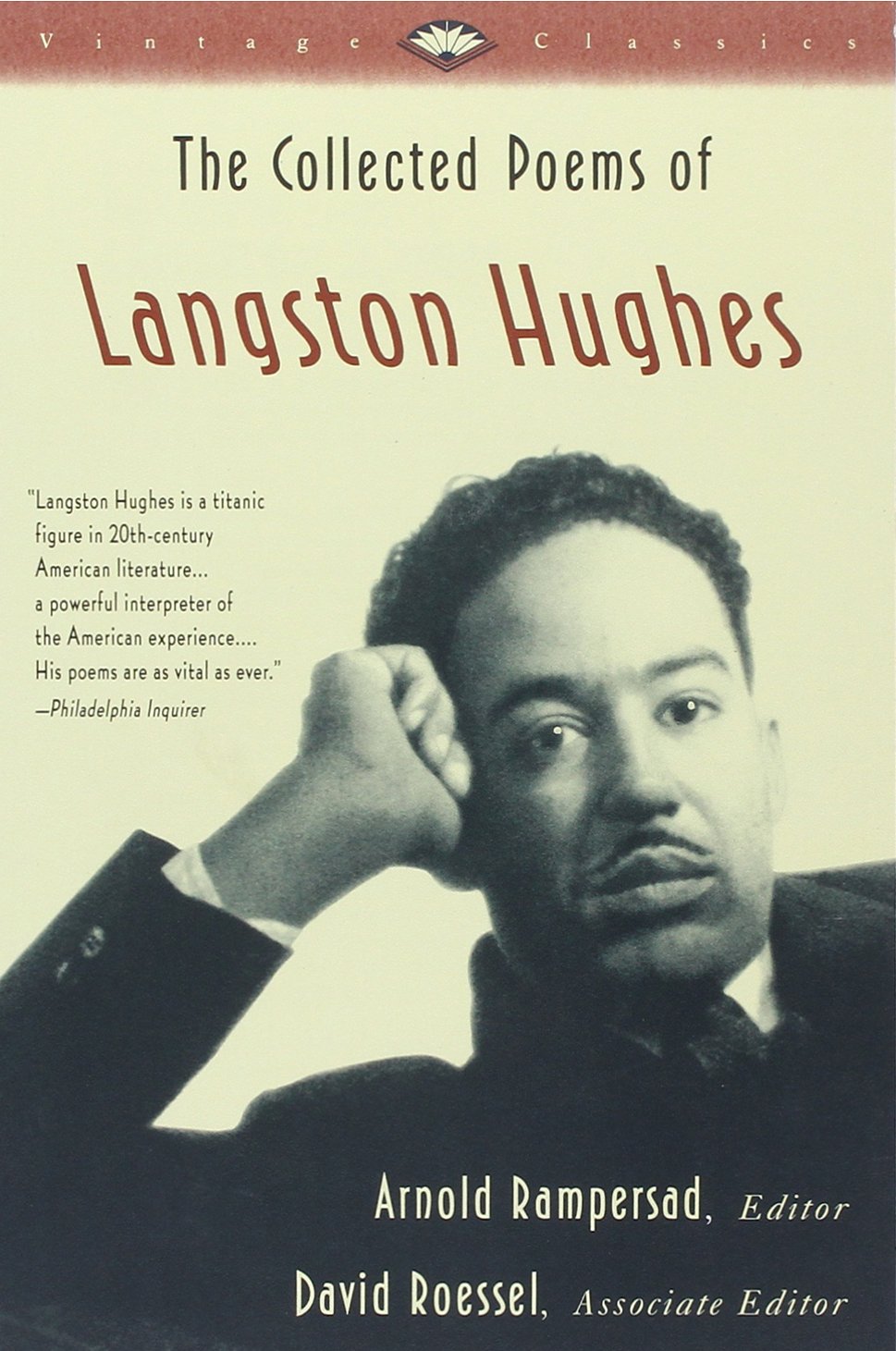
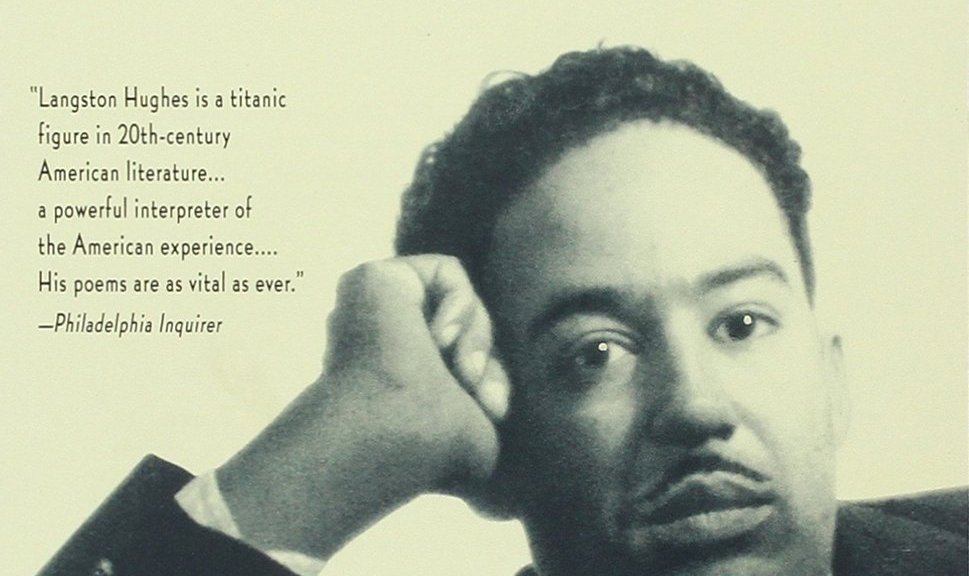
As entry points into the work of Baldwin as well as the long history of racism in the twentieth and twenty-first centuries, I read aloud and we discussed Langston Hughes‘s “Theme for English B” [1] and “Let America Be America Again.”

I stressed to these first-year college students that Hughes lived and wrote in the early to mid-1900s—nearly a century ago in terms of the college student personae in “Theme for English B.”

As we examined the professor/student and race-based aspects of power in “Theme,” students were quick to address the relevance of Hughes today—emphasizing as well part of my instructional purpose to expose these students to the lingering and historical racism in the U.S.

But the real meat of this class session revealed itself as we explored “Let America Be America Again.”

Hughes: “(America never was America to me.)”

Written and published about 80 years ago, “Let America Be America Again” represents a racialized dismantling of the American Dream myth—a poetic companion to the skepticism and cynicism of F. Scott Fitzgerald, Ernest Hemingway, and other writers/artists works throughout the early to mid-twentieth century.

Hughes begins with a celebratory stanza that easily lulls readers into an uncritical response to the American Dream, but then offers a brilliant device, the use of parentheses, to interject a minority voice (parenthetical, thus representing the muted voices of the marginalized in the U.S.) after several opening stanzas:

(America never was America to me.)…

(It never was America to me.)…

(There’s never been equality for me,
Nor freedom in this “homeland of the free.”)

And then the poem turns on two italicized lines followed by:

I am the poor white, fooled and pushed apart,
I am the Negro bearing slavery’s scars.
I am the red man driven from the land,
I am the immigrant clutching the hope I seek—
And finding only the same old stupid plan
Of dog eat dog, of mighty crush the weak.

My students soon recognized a disturbing paradox: Hughes and Donald Trump’s “Make America Great Again” campaign slogan share a foundational claim but for starkly different reasons.

Trump has built political capital on anti-immigrant and anti-Muslim (both as “Others”) sentiment that the media and pundits often mask behind what is being called legitimate white working-class angst.

Parallel racist anger has been sparked when Michelle Obama, for example, confronted that the White House was built in part with slave labor—raising the issue of just who did build this country. Upon whose backs? we must ask.

Eight volatile decades ago, Hughes named “the poor white, fooled and pushed apart” now courted by Trump’s coded and blatant racism and xenophobia.

However, Hughes’s poem celebrates the diverse workers who created the U.S. while reaping very little if any of the benefits. Hughes offers a different coded assault, his on capitalism and the ruling elites, but not the rainbow of U.S. workers “fooled,” it seems, by the hollow promise of the American Dream.

In Whitmanesque style, Hughes raises throughout the poem a collective voice of immigrants and slaves as the foundation of the U.S.:

I’m the man who sailed those early seas
In search of what I meant to be my home—
For I’m the one who left dark Ireland’s shore,
And Poland’s plain, and England’s grassy lea,
And torn from Black Africa’s strand I came
To build a “homeland of the free.”

But as he returns to the poem’s refrain, Hughes unmasks the promise and tempers the hope:

O, let America be America again—
The land that never has been yet—
And yet must be—the land where every man is free.

In the final stanza, there is hope, built on “We, the people, must redeem.”

In a time of Trump’s cartoonish stereotype of the empty politician, his “Built a Wall” and “Make America Great Again” sloganism, we must reach back almost a century to Hughes’s often ignored voice that merges races through our shared workers’ remorse.

Hughes calls out the robber baron tradition of U.S. capitalism—”those who live like leeches on the people’s lives”—as the “fooled and pushed apart” line up to support those very leeches.

“Let America Be America Again” is a warning long ignored, but truths nonetheless facing us. Silence and inaction are endorsements of these truths.

“To be afraid,” Bayard Rustin acknowledged, “is to behave as if the truth were not true.”

It remains to be seen if we are brave enough as a people to “Let America Be America Again.”


[1] See also Revisiting “Theme for English B” by Langston Hughes.

The Khan Moment: God, Family, Country

As I learn from you,
I guess you learn from me—
although you’re older—and white—
and somewhat more free.

“Theme for English B,” Langston Hughes

“‘[N]ext to of course god america/ i love you,'” opens e.e. cummings’s satirical sonnet about the hollowness of political pandering to love of God, family, country—a staple of stump speeches by both major political parties in the U.S.

The speaker turns to war toward the end:

why talk of beauty what could be more beaut-
iful than these heroic happy dead
who rushed like lions to the roaring slaughter
they did not stop to think they died instead

Late in the presidential election cycle of 2016, this poem resonates in a way that should leave every American resolute to defend the ideals we claim are at the core of a free people.

As summer creeps toward fall, we are not just about to elect a president, but are faced with a test; it is pass/fail and there are no re-takes.

The test is the Khan moment, when a grieving Muslim family spoke out at the Democratic National Convention to confront the rising and emboldened bigotry that is personified by Donald Trump but endemic of the Republican Party.

For decades, the Republican playbook has included a wink-wink-nod-nod approach to very thinly veiled courting of racists, sexists, bigots, and homophobes. Trump has now taken that playbook to a new level—with outright Islamophobia and xenophobia at the center.

Like Pat Tillman, Humayun Khan proudly embraced his service to his country, according to his mother, who was directly slandered by Trump:

My son Humayun Khan, an Army captain, died 12 years ago in Iraq. He loved America, where we moved when he was 2 years old. He had volunteered to help his country, signing up for the ROTC at the University of Virginia. This was before the attack of Sept. 11, 2001. He didn’t have to do this, but he wanted to.

Tillman’s and Khan’s service and deaths share being politicized for partisan purposes—adding additional layers of insult to injury.

But both also are about far more than partisan politics; they expose that cummings was right: Political pandering to God, family, and country as well as the public’s cheering for that pandering is ultimately hollow.

Both Republican and Democrat politicians are warmongers, elites willing to fight wars on the backs of the “heroic happy dead.”

The Khan moment, however, raises a blunt question: Which party, which candidate, Trump or Hillary, are racists, sexists, homophobes, Islamophobes, and/or xenophobes supporting?

And there is the damning truth because Trump and the Republican Party are the voices of bigotry.

Many, myself included, believe the war in which Humayun Khan died was yet another senseless war, a waste of human life and valuable national resources.

Many also recognize that the Khan family as well as others scarred by these wars have no political party unsullied by warmongering.

Yet, as a pacifist, I must acknowledge that many marginalized people choose to join, serve, fight, and die in the U.S. military.

Black, brown, gay, female, and Muslim—these soldiers may be guided by higher ideals than the calloused and hollow political leaders waging those wars.

What, then, would these marginalized people be fighting for?

The Khan moment stands before us a test about religious freedom.

A young Muslim man may have seen far more promise for religious freedom in the U.S. than in other countries—until after his sacrifice his parents had to sit by and listen to Trump call for religious intolerance, to watch as a major political party nominated this man in the wake of naked hatred.

Religious freedom for some, but not others, is not religious freedom.

“Injustice anywhere is a threat to justice everywhere.”

The Khan moment is not about limited government, taxation, crumbling infrastructures, or hundreds of legitimate but ultimately mundane issues about which people can have partisan political disagreements.

The Khan moment is about the Statue of Liberty, the Constitution, and the continuing inability of people in the U.S. to live the ideals instead of simply mouthing them.

Teaching Poetry with Fidelity: “Does it matter?”

My take on Sandra Cisneros’s “Eleven” has always focused on the callousness of her math teacher and the subsequent marginalizing of Rachel, who represents for me all students and especially vulnerable students.

Due to both historical and recent (the accountability movement) pressures, teachers fail when they see their work as teaching content instead of teaching students.

Students as well as their love of literature and language and poetry are often sacrificed at the alter of the literary technique hunt so that they can answer questions correctly on a standardized test.

Thus we teach Langston Hughes’s “Harlem” to identify the metaphors and similes; we assign Gwendolyn Brooks’s “We Real Cool” for a daring look at rhyme scheme.

What a bloody waste.

For those who teach, and teach poetry, and love poetry—and probably lose a piece of their soul each time they teach poetry—I recommend the brief poem “Forty-Seven Minutes” by Nick Flynn.

The beauty of the poem is that it sets up a classroom situation in which a student pushes back against the literary technique hunt with “Does it matter?

The persona of the poem is forced to conclude:

I smile—it is as if the universe balanced on those three words & we’ve landed in the unanswerable. I have to admit that no, it doesn’t, not really, matter, if rain is an image or rain is an idea or rain is a sound in our heads. But, I whisper, leaning in close, to get through the next forty-seven minutes we might have to pretend it does.

We must ask, then, when teaching poetry, what it is we are about.

Do we owe anything to our students, to our students’ love of language, literature, poetry? Do we owe anything to our fidelity to poetry itself?

If yes—and I think it is yes—it does not matter if we name the techniques; but otherwise, if poetry is simply one of many sacrifices to the standards and testing gods, then let us reduce all the beauty that is poetry to covering the curriculum, meeting the obligations of accountability.

And all else be damned.


MLK Day 2016: A Reader

In the US in 2016—and specifically for educators—the need to confront racism must remain central to all efforts to overcome inequity and injustice. Among the privileged—white-, male-, heterosexual-skewed—there is no room for “yes, but,” although there remains ample room for stepping back, being silent, and then listening as first steps to offering solidarity in the action needed to confront the false narratives of “meritocracy” and “rugged individualism,” and then to overcome the irrefutable inequities linked to race, class, gender, and sexuality.

One commitment is to resist the whitewashing of Martin Luther King Jr. as a passive radical. So here, I offer some readings, varied and important, but pathways to honoring the radical MLK and to resisting the lingering dream deferred.

Final Words of Advice/ “Where do we go from here?” (1967), Martin Luther King Jr.

MLK poverty

The Trumpet of Conscience, Martin Luther King Jr.

Leonard Pitts Jr.: Haley’s fairy tale ignores our history

haleyEnslaved Africans of George Washington Depicted as ‘Happy and Joyful’ in New Children’s Book

The Forgotten, Radical Martin Luther King Jr., Matt Berman

Martin Luther King, Jr.: Christian Radical—And Saint, Elizabeth Stoker Bruenig

Read This Before Co-Opting MLK Jr., Jose Vilson

The Revisionist’s Martin Luther King Jr., “I Have A Dream For Most Of Us,” Jose Vilson

Harlem, Langston Hughes

Let America Be America Again, Langston Hughes

The white man pathology: inside the fandom of Sanders and Trump, Stephen Marche

Schools, black children, and corporal punishment, Dick Startz

figure-1

“Please—a little less love, and a little more common decency.”

The Causal Effects of Cultural Relevance: Evidence from an Ethnic Studies CurriculumThomas Dee, Emily Penner

Questioning Payne | Teaching Tolerance

Toolkit for “Questioning Payne” | Teaching Tolerance

50 Years After Selma, White Lives Still Matter More, Stacey Patton

The Oscars’ Racist Refusal to Honor Modern Black Heroes, Stereo Williams

Should We Marvel at a Black Captain America?

The Martian: Allegory of Whose Lives Matter

Nicolas Sparks and the Allegory of Pretty White People Who Struggle until Everything Works Out

James Baldwin: “the time is always now”

the-time-is-always-now

Revisiting “Theme for English B” by Langston Hughes

Bookending my higher education experience is a common situation: finding myself in an intense dialogue with the professor and then realizing I was essentially the only student participating in that discussion.

As a first-year (actually first semester) student, Mr. Pruitt and I were enthusiastically exploring Henry David Thoreau, and maybe Ralph Waldo Emerson. During a doctoral course on educational theory, Dr. Holton and I were wrestling with Joseph Schwab.

My life as a student was mostly a good one, and I needed little prompting to enjoy learning or to appreciate and marvel at my teachers and professors—this the result of being a mama’s boy, she my first and a wonderful teacher.

During my junior and senior years as an undergraduate, Dr. Nancy Moore—short hair, button-down collar shirts, and slacks—was a recurring professor in my program. Nancy was incredibly kind to me, supportive and complimentary in a way that lifted me out of my essential low self-esteem.

Nancy’s courses, as well, were my first introductions to diverse literature—Ralph Ellison, Alice Walker, Toni Cade Bambara, Langston Hughes, Countee Cullen, Toni Morrison.

Although a nearly terminal redneck, I was a white, male student who had been gifted (both genetically and culturally) the socially valued verbal and mathematical skills considered “smart.” And thus, my venture into formal education was mostly unlike that of Langston Hughes.

Revisiting “Theme for English B” by Langston Hughes

The Harlem Renaissance and Langston Hughes’s life-/career-span (1902-1967) likely seems to be the distant past for many high school or undergraduate students. But one of the most powerful aspects of poetry by Hughes for me is how present his work is, every time I return to it.

As a reader and a poet, I am drawn to work that appears simple (as if anyone could have written it) and simultaneously reveals that only this poet could have shaped this verse, that the accessible words and phrasing disguise something rich, complex, and enduring.

“The instructor said,” opens “Theme for English B”—establishing one of the poem’s major themes, the imbalance of power.

“Theme for English B” is a narrative in poetic form that weaves race, place, and power in order to challenge the inequity inherent in all “[t]hat’s American.”

The writing prompt at the opening of the poem strikes me as surreal—far too open and inviting for what traditionally is a writing prompt in English courses, but Hughes immediately shakes the reader: “I wonder if it’s that simple?” because “I am the only colored student in my class.”

And now the poem runs.

The poem’s speaker details his race and his place (actually places) in order to confront truth:

It’s not easy to know what is true for you or me
at twenty-two, my age. But I guess I’m what
I feel and see and hear, Harlem, I hear you.

The poem has now complicated the speaker’s situation with both black/white and South/North dichotomies—the latter, I think, is wonderfully enriched by also reading Countee Cullen’s “Incident.”

For the speaker, despite the careful outlining of his humanity as beyond racial or regional stereotypes, the issue remains, “So will my page be colored that I write?/Being me, it will not be white.”

There is a tinge of defiance along with both youthful exuberance and wiseness beyond his 22 years, and then a heavy awareness by the end:

As I learn from you,
I guess you learn from me—
although you’re older—and white—
and somewhat more free.

As a writer/poet and teacher, I am then profoundly—and every time I re-read this poem—moved by the last line signifying that this student under the weight of race, place, and an unfair imbalance or power has submitted an essay that is true in the same simple language used to open the poem: “This is my page for English B.”

A poem that is a student’s college essay—this becomes an enduring lesson about race, place, and the imbalance of power.

https://youtu.be/4TYn844thuM

See Also

Culturally Responsive Teaching: The Harlem Renaissance in an Urban English Class, Andrea J. Stairs