Category Archives: literacy

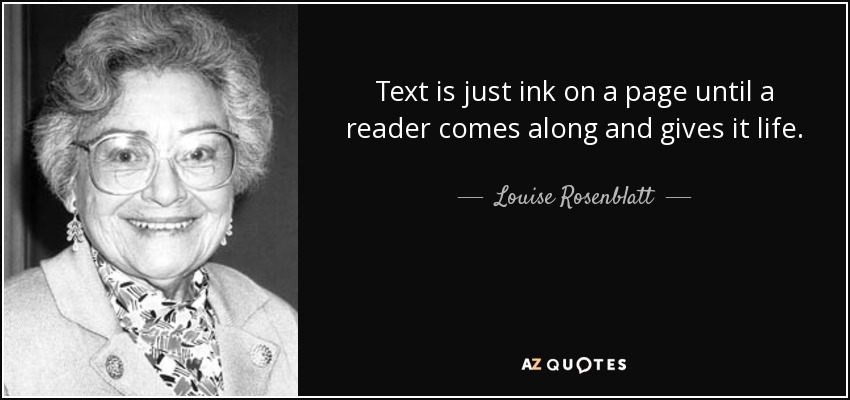
On New Criticism and Louise Rosenblatt: A Clarification and Dialogue

In an ambitious and contrarian essay, Reconciling Rosenblatt and the New Critics: The Quest for an “Experienced Understanding” of Literature, Andrew Rejan asserts:

Without diminishing the significance of Rosenblatt’s contributions, I wish to reexamine and reimagine the familiar history of Rosenblatt’s rebellion against New Criticism: I will propose that Rosenblatt and the New Critics, particularly Cleanth Brooks, might be viewed as pioneers of parallel, rather than opposing, pedagogical traditions, shaped by the shared influence of I. A. Richards.

As a former Council Historian of NCTE and the biographer of Lou LaBrant, whose career overlapped significantly with Rosenblatt’s, I was immediately drawn to Rejan’s unpacking of both New Criticism and Rosenblatt—but was also intrigued by his citing my “A Richer, Not a Narrower, Aesthetic”: The Rise of New Criticism in En­glish Journal.

Rejan incorporates my analysis of the historical relationship between EJ and New Criticism to offer an example of what he calls the “the folly of defining and critiquing the New Critics without directly citing any of the New Critics’ actual writing.” While I find much of Rejan’s analysis important and nuanced, here he rushes to support his thesis without taking into account the purpose of my piece and he fails to note key final points I raise that fit more closely with his thesis than providing evidence of “folly”:

On one level, we owe our field of English language arts pedagogy the opportunity to reexamine the unspoken power of New Criticism as well as the reduced ways in which New Criticism has been implemented in our classes. We must consider the role reader response has played as the most frequent challenge to New Criticism in our classrooms—including the misunderstanding and misuse of Rosenblatt’s perspective as well. But we must rise above the narrow tensions among critical perspectives.

Literary analysis, then, becomes about agency—the agency in the work/text itself and the agency of the reader reading and rereading the world (Freire). The call for critical literacy does not deny or silence the potential power of New Criticism or reader response or any critical stance. Instead it calls for confronting efficiency and objectivity as questionable stances:

“We can help students read the word and the world in deeper and more profound ways. We can help students investigate the ways in which they are manipulated. They can become critically literate consumers of the media. They can engage with and focus on current issues. We can help them problematize the world so they think about their role in it and what they can do to shape its future directions.” (Michell 45) 

Before highlighting how Rejan offers some very important contributions to both literary theory and how that manifests in traditional English and literature classrooms, I want to clarify a couple points about my own work cited.

First, my article is a historical overview of the relationship between teaching English in high school or college and New Criticism; and in that overview, I note that there is a gap between the pure theory in its founding and how teachers practice a reduced (and often bastardized) version best represented, I think, by the Advanced Placement English Literature and Composition [1] test.

In other words, while not as developed or explicit as Rejan’s thorough essay, I very much recognize that what passes as New Criticism in the teaching of English is not solidly grounded in the seminal work of the New Critics. In fact, I will address this more fully below, high school English teachers may have never read the New Critics and, like our students, often navigate within New Criticism without it being named or acknowledged in any way.

The commonly implemented (distorted) version of New Criticism is mostly a consequence of the goal of appearing to be objective that is driven by the primacy of assessment in teaching; in other words, literary interpretation grounded in analysis and “right/wrong” answers helped reduce New Criticism to a practical shadow of its original self—as I teased out when rejecting “close reading”:

Like the mechanistic and reductive ways in which New Criticism has been implemented in formal schooling in order to control and measure objectively how students respond to text, CC and the focus on close reading are poised to serve efficiency models of high-stakes testing while also failing students who need and deserve the complex and challenging tools afforded with critical literacy.

And to the “folly” Rejan sees my essay modeling, I would note that I spend a significant subsection of the essay, “New Criticism: Defined and Embraced, Narrowly,” arguing a similar point as Rejan’s, the reductive application of New Criticism, citing heavily from a major literary scholar, David Daiches.

Finally, as the passage from my essay highlighted above demonstrates, I was documenting the exact dynamic—the tension between New Criticism and Rosenblatt—Rejan teases out far more explicitly, and also suggesting that tension is too often reductive and fails ultimately to be sufficiently critical, in that students are rarely afforded agency in the process whether they are navigating text through New Criticism or reader response.

Setting aside that Rejan was a bit hasty in one paragraph citing my work, I want to note that Rejan offers some important take aways for how English teachers are prepared and then how we practice our crafts of literary analysis with our students.

One foundational commitment I have implemented as a college professor since my doctoral program in the mid 1990s is assigning seminal texts, not secondary texts, addressing the most prominent ideas in education and literacy. As one example, my undergraduate and graduate students read Rosenblatt’s Literature as Exploration.

And during our discussion, we address that Rosenblatt’s work is often mischaracterized and over-simplified; I typically add that a careful reading of Rosenblatt uncovers a thinker far more conservative and traditional that often acknowledged.

So, yes, Rejan’s call for reading the original work of the New Critics to understand New Criticism is a worthy call for all aspects of education, the teaching of English, and preparing teachers of English.

Rejan’s broad message about understanding literary theory also shows the importance of the “considerable gap” (LaBrant, 1947) between theory and practice too often common in English classrooms.

A former graduate student of mine and current doctoral student has been discussing by email with me Rejan’s piece as she investigates Rosenblatt. She has confessed, in fact, that she knows little about literary theory because that topic wasn’t covered well in her undergraduate English courses, leaving her with a “superficial” understanding—all of which reinforces Rejan’s central concerns.

When I have taught young adult literature, where I assign Rosenblatt, practicing teachers in the graduate section often share a similar lack of understanding when we practice literary theory with a picture book.

Ultimately, as I shared with Rejan, we are offering a similar message, although our pieces are distinct in purpose and thoroughness (EJ articles tend to be brief, and EE essays, dense and extended). I could not agree more with Rejan’s last paragraph and sentence: “I suspect that Brooks and Rosenblatt both would appreciate a closer reading of the past that might bring us closer together in the future.”

Although I must offer yet one more caveat, the central thrust of my essay—any literary theory lens is a way to investigate text, and if any becomes the way to investigate text, we have failed the ultimate goal of fostering critical literacy in our students.

That is a folly we cannot afford.


[1] I Taught AP Lit and Comp for most of my 18 years as a high school English teacher.

See Also

“A Respect for the Past, a Knowledge of the Present, and a Concern for the Future”: The Role of History in English Education, P.L. Thomas (English Education, January 2011)
Scholarship, “Lived Reality,” and “the Validity of a Thing”

In the beginning of my experiment as a public intellectual, I was a lowly high school English teacher who on occasion had a letter to the editor in the Herald-Journal (Spartanburg, SC).

These brief efforts at speaking to a general public as an informed voice taught me some valuable and enduring lessons—one of which included feedback from that general public.

My letters to the editor prompted long, rambling messages on my phone answering machine and incoherent typed letters mailed to my home and the high school where I taught.

Many of the phone messages were irate retired people who proved beyond a shadow of a doubt that they had no real understanding of Social Security or the workings of government and the free market. The typed letters (some on manual typewriters) were often single-spaced with almost no margins and punctuated with slurs and threats.

One frequent letter writer opened his diatribe with “Dear African American Homosexual”—all meant as slurs, and none accurately identifying me.

These early experiences with being misunderstood and ineffective were mostly interactions with anonymous and angry readers.

Eventually, mostly because I moved to higher education after earning my doctorate (although only a lowly EdD), I have been afforded a larger stage—Op-Eds in local, state, and national publications as well as a well-read personal blog, invited public and university-based talks, and a substantial collection of published work.

Responses to my public claims, now, are typically not as often public, but those responses continue to teach me valuable lessons—mostly how often and how easily words and claims can be misunderstood and even work in ways that are the opposite of my intent.

Here I want to examine two experiences, one from 2014 and another recent, that help shape who I seek to be as a person, a writer, a teacher, and a scholar.

First, some context.

As a redneck from rural South Carolina who had working-class parents, attended state universities, and has embraced critical pedagogy as my scholarly self, I am regularly marginalized in scholarly and academic contexts because of those identities; my writing is brushed aside as “polemics,” and my Southern drawl is noted with passive-aggressive disdain.

In personal spaces with family and friends as well as in my public writing and speaking, I am there marginalized as “just a scholar”—another pointed-headed intellectual with no real-world experience.

Let me stress here that as a white man with an advanced degree and a prestigious position at a universities, I am acknowledging these experiences but in no way suggesting they are nearly as consequential as simply being a woman, a person of color, or gay (for example). This is not a whine-fest, but I am trying to discuss the challenges of navigating public spaces as a perceived scholar.

Several years ago, I was invited to speak at the University of Arkansas by good friends who are professors there; I had written a book on poverty, and they were kind enough to ask me to speak at a week-long focus on poverty and education.

The University of Arkansas happens also to be home to a Walton-funded graduate department that is staffed by faculty who universally reject my scholarly perspective, and in some cases, me specifically.

Based on that talk, some of those antagonistic professors mentioned me in a piece for Education Next. In their defense of “no excuses” ideologies (specifically KIPP charter schools, both of which I reject), they openly mischaracterized me in order to discredit me:

Like all charter schools, KIPP schools are chosen by parents, but critics fear that disadvantaged parents do not know enough to choose wisely, or else do not have their children’s best interest at heart. Leaving aside whether the critics patronize the people of color KIPP schools serve, we propose that KIPP and similar schools are not nearly as militaristic as critics, who may have never been inside them, fear.

Recently, Andre Perry has confronted that charter advocates tend to smear critics of charter schools as “against parental choice,” something I have examined critically as well.

Even though I am skeptical of most charter and choice advocates, I learned an important lesson, and was confronted with a real dilemma: How do I challenge charter schools and “no excuses” ideologies in the context of black, brown, and poor families voluntarily choosing them?

Michelle Alexander offered me a solution in her confronting of The New Jim Crow:

This last point – that African Americans seem to support both the war on crime and “no excuses” charter schools – presents the most problematic aspect of charges that mass incarceration and education reform are ultimately racist, significant contributions to the New Jim Crow.

For example, Carr reports that African American parents not only choose “no excuses” charter schools in New Orleans, but also actively cheer and encourage the authoritarian policies voiced by the schools’ administrators. But Alexander states, “Given the dilemma facing poor black communities, it is inaccurate to say that black people ‘support’ mass incarceration or ‘get-tough’ policies” because “if the only choice that is offered blacks is rampant crime or more prisons, the predictable (and understandable) answer will be ‘more prisons.’ ” (p. 210)

New Orleans serves as a stark example of how this dynamic works in education reform: Given the choice between segregated, underfunded and deteriorating public schools and “no excuses” charters – and not the choice of the school environments and offerings found in many elite private schools – the predictable answer is “no excuses” charters. (Education Reform in the New Jim Crow Era)

As a result, I now try to frame my rejecting of charter schools and “no excuses” by clarifying that all parents regardless of social class or race deserve high-quality schools without need to choose or compete; I also confront directly how choice advocates tend to embrace a false choice (as exposed by Alexander).

My second example happened just yesterday on Twitter when Angela Dye and I interacted about the “word gap,” which I have often rejected.

I consider Dye a comrade, virtual colleague, and someone whose public voice informs my own; in those ways, this experience was not like the one above, but it forced me once again to confront how good intentions are not enough, especially when that intent is perceived as silencing or ignoring the exact people I seek to support.

Several of Dye’s comments are powerful checks on how I have examined the “word gap”:

You’re talking as a scholar. I respect that. I’m talking as a person living in a specific community with a specific lived reality. I’m hoping the respect can be mutual.

— Angela Dye, PhD (@ejuc8or) December 25, 2017

It pains me when we limit the validity of a thing to research–silencing or debating the voices of those living it.

— Angela Dye, PhD (@ejuc8or) December 25, 2017

So you have to excuse me if I am unwilling to invalidate an experience because “research” doesn’t prove it.

— Angela Dye, PhD (@ejuc8or) December 25, 2017

This Twitter moment also serves to prove John Warner’s point about the value of social media.

Dye’s challenges asked me to reconsider how my work perpetuated the voice of a scholar that uses research to “invalidate” “lived reality”—especially since I in no way sought to have that impact.

Just as I have afforded a fuller context to my rejecting charter schools and “no excuses,” I must seek ways to examine the “word gap” with Dye’s powerful concerns in mind.

Rejecting the “word gap,” I must clarify, is not rejecting the lived reality of significant and consequential differences among the social classes in terms of literacy. Yes, people living in poverty are denied access to and marginalized by privileged language.

Too often formal education works to perpetuate that equity gap resulting in the so-called “word gap” that works as a term and in reality similar to the “achievement gap.”

This lived reality in which some people due to race and social class are excluded from life, liberty, and the pursuit of happiness through formal gatekeeping of who has access to privileged language and who does not, I think, is what Dye is speaking for and through.

So as I navigate still how to express more clearly why I reject the “word gap” as a term and how it works against marginalized and vulnerable populations, I offer two contexts for what I am rejecting.

First, Virginia Eubanks confronts in The Digital Poorhouse:

The most marginalized in our society face higher levels of data collection when they access public benefits, walk through heavily policed neighborhoods, enter the health care system, or cross national borders. That data reinforces their marginality when it is used to target them for extra scrutiny. Groups seen as undeserving of social support and political inclusion are singled out for punitive public policy and more intense surveillance, and the cycle begins again. It is a feedback loop of injustice.

And, Annette Lareau unpacks in Unequal Childhoods: Class, Race, and Family Life (see online)

The differences are striking….

Neither the approach of concerted cultivation or the accomplishment of natural growth is without flaws. Both have strengths and weaknesses [emphasis added]. Middle-class children, for example, are often exhausted, have vicious fights with siblings, and do not have as much contact with their extended families as working-class and poor children. But when children enter institutions such as schools and health care settings, the strategy of middle-class child rearing of concerted cultivation is far more in compliance with the current standards of professionals than is the approach of the accomplishment of natural growth. There are signs that middle-class children gain advantages, including potentially in the world of work, from the experience of concerted cultivation. Working-class and poor children do not gain this benefit.

Therefore, I argue that the “word gap” fails for the following reasons:

  • Literacy is reduced and distorted to quantifying vocabulary (data collecting) as the sole proxy for literacy. Literacy is far more complex.
  • That use of data serves to frame poor children and their parents as having incomplete or inadequate literacy and idealizes middle-class and affluent literacy without acknowledging that this imbalance is an issue of power.
  • The “word gap” keeps the evaluative gaze on children and their parents (how to give the children more vocabulary and how to blame poor parents for literacy-deficient homes) and allows education and education reform to remain focused on “fixing” children and their parents and in-school reform only while ignoring the larger and more powerful social inequities reflected in schools and homes.
  • Research confirming the “word gap,” notably by Hart and Risley, is compelling not because of the quality of the research but because it confirms race and class biases in both conservative and liberal narratives. Media/journalists, pundits, and the public rush to cite Hart and Risley for reasons that must be unpacked—even as we acknowledge the inequities of literacy correlated with social class.

Because of an uncritical embracing of the “word gap” as a concept (not the acknowledging of the inequity of literacy among social classes), vulnerable populations of students have been mis-served through reductive vocabulary drill-and-kill, narrow high-stakes testing, and the lack of political will to address their access to rich literacy in their homes, communities, and schools (experiences afforded middle-class and affluent children that results in their identifiable vocabulary differences).

Because of an uncritical embracing of the “word gap” as a concept (not the acknowledging of the inequity of literacy among social classes), poor children and families are characterized primarily through deficit lenses that ignore their literacy strengths that simply do not match privileged literacy.

Because of an uncritical embracing of the “word gap” as a concept (not the acknowledging of the inequity of literacy among social classes), the barriers to literacy, academic, economic, and judicial equity remain mostly unexamined—out of sight, out of mind.

By confronting scholarly debates about the “word gap,” Dye has exposed the problematic relationship among scholarship, “lived reality,” and “the validity of a thing.”

I must do a better job with that dynamic if I want to be the sort of voice for social equity and justice that I seek to be.

UPDATE

Angela Dye has taken the exchange above and examined how our Twitter interaction confronts a tension around public discourse and elements of power and privilege; see Pissing on My Pee.


For Further Reading

What These Children Are Like, Ralph Ellison

If Black English Isn’t a Language, Then Tell Me, What Is?, James Baldwin

This Is Not My Opinion

“Many people call for an end to politics in the classroom, as this is seen as the source of the problem,” writes Nicole Truesdell, concluding: “Now is not the time to side with neutrality.”

Mainstream and rightwing pundits have long promoted the idea that K-12 and higher education in the US are rife with liberal indoctrination. One of my long-time colleagues often told the story of his own father periodically lamenting that he had allowed my colleague to go to college because the experience had turned him into a liberal.

Evidence, however, is another thing when framed against these standard railings against a Left in the US that simply does not exist.

As the country stumbles toward its first year in Trumplandia, a new but also misleading mantra is lamenting fake news in post-truth America. The misleading part is that these phenomena are somehow new or spawned by Trump and his serial lies as well as his ability to avoiding any consequences for his outlandish racism, sexism, and xenophobia.

The US has a long and disappointing history with choosing ideology over evidence, and public discourse has often been grounded in framing opinion in a cloak of false equivalence.

The term “opinion” itself has worked throughout modern history to suggest that no person has any more credibility than another since “both sides” are simply sharing their opinion. How often do we listen as debate is resolved with “Let’s just agree to disagree”?

So as 2017 comes to an end, and the Trumplandia nightmare of the unreasonable continues, I want to take this opportunity to state clearly: This is not my opinion.

While socializing with good friends just yesterday, I was reminded once again that to be informed places anyone in a stressful situation throughout our day-to-day life since the vast majority of people are uninformed about the many things they none the less feel compelled and justified to weigh in on.

I, on the other hand, have the annoying habit of reserving comments unless I am well informed and being disturbingly honest and blunt when I do weigh in myself.

Yes, I do hold my tongue often in social situations—but that is quite challenging since most people spend their lives in the actual realm of “opinion” as it is commonly used to suggest that no evidence exists to confirm if that “opinion” is valid or not.

Formal schooling traditionally reinforces this lazy approach to how we explore ideas by plodding students through overly simplistic “fact v. opinion” worksheets.

What we should be teaching instead is that all of us make claims (not that everyone has an opinion) and that we are all ethically responsible for making claims that are credible, supported by evidence or solid logic.

As two examples, I often contribute to public discussions about the so-called “word gap” and corporal punishment—both of which are illustrative of the problems inherent with seeing the world as awash in “opinion.”

The “word gap” represents an interesting phenomenon since those who appeal to the term and the idea that social class is strongly correlated to literacy (wealthy children are exposed to and know more words than poor children) do take the initiative to cite evidence, almost always one study by Hart and Risley.

This appeal to the “word gap,” however, has two critical flaws: it is driven by a social class and racist bias hiding beneath a flawed view of literacy (number of words in any person’s vocabulary is not a valid single proxy for literacy), and since the “word gap” appeals to a common-sense view of how to support better children in poverty, the average person and journalist have failed to investigate Hart and Risley, whose study has itself been discredited.

Understanding the complex relationship between social class/race and literacy and then how to educate better vulnerable populations of students are not served well by a culture of “opinions.” Here is an important context for why expertise (making claims grounded in evidence) is important—and how all discourse is political.

Journalists perpetuating the “word gap” without critically unpacking the concept or confronting Hart and Risley are themselves being political—even as they hide behind the veneer of “just reporting” and “both sides” journalism.

As a literacy professor, I cannot avoid being political—there is no neutral pose—when I teach literacy courses. But I have an ethical obligation to be well informed on the topics I teach. And thus, just as when I blog or weigh in on topics in public spaces, when I teach, this is not my opinion.

While the “word gap” continually is reanimated as a fact that isn’t true, the corporal punishment debate is a disturbing example of how “both sides” discourse and “just an opinion” have real and negative consequences—especially for the powerless (such as children).

As I have explained before, public debate about domestic violence is quite distinct from public debate about corporal punishment—the former is always examined as something no one can support or defend, but the latter is always framed as a “both sides” argument.

If we consider the rush to cite Hart and Risley when promoting the “word gap,” we must wonder how domestic violence is universally rejected in mainstream discussions (and with no need to cite research[1]) but corporal punishment remains a debate—despite decades of research and virtually all medical and psychological professional organizations clearly showing there is no acceptable amount of physical punishment.

This often ignored distinction between how we frame domestic violence and corporal punishment again highlights that all human discourse is political.

In her rejecting calls for classrooms that are somehow not political, Truedell offers the words of James Baldwin so here I want to make my case by merging their ideas myself:

While Truesdell argues, “Now is not the time to side with neutrality,” Baldwin admonished us: “The challenge is in the moment, the time is always now.”

A democracy cannot afford teachers, professors, journalists, or public intellectuals who choose the veneer of neutrality as long as inequity and injustice rule the day.

This is not my opinion.


[1] Note that discussions of domestic violence often do include statistics about who is involved and how many women suffer domestic violence, corporal punishment debates may note how may states allow it in schools, but rarely identify the number of actual children impacted; thus, domestic violence is more humanized than corporal punishment even in the numbers. This is political; this is about power.

God Bless You, Jacqueline Woodson

Moving to higher education from high school teaching has afforded me the annual joy of a national conference each November. This year’s conference is in St. Louis, MO, and I spent my Saturday morning listening to writer Jacqueline Woodson.

When an early-career teacher and I were making plans for the conference, she noted Woodson would be talking, and I pointed out that Woodson was about my age—surprising my former student.

Woodson herself made a passing comment about looking much younger than her age, being born in 1963 just two years younger than I.

In most ways that we identify people, Woodson and I are unalike—race and gender the most obvious.

Woodson’s talk was engaging, beautiful as expected of a writer, but also equal parts kind and confrontational. She weaved a talk with stories of who she is as well as reading from her works.

Literature and writing, I share with Woodson, but we also have some geography in common—Woodson having lived for a while in Greenville, SC, where I now teach and only a thirty-minute drive from my home town.

While I am deeply and permanently Southern, Woodson stressed that she is a New Yorker, joking about how fast she talks now.

However, Woodson and I shared formative years, highlighted by her cultural references in her works that she noted young readers should be researching to understand the context of her references.

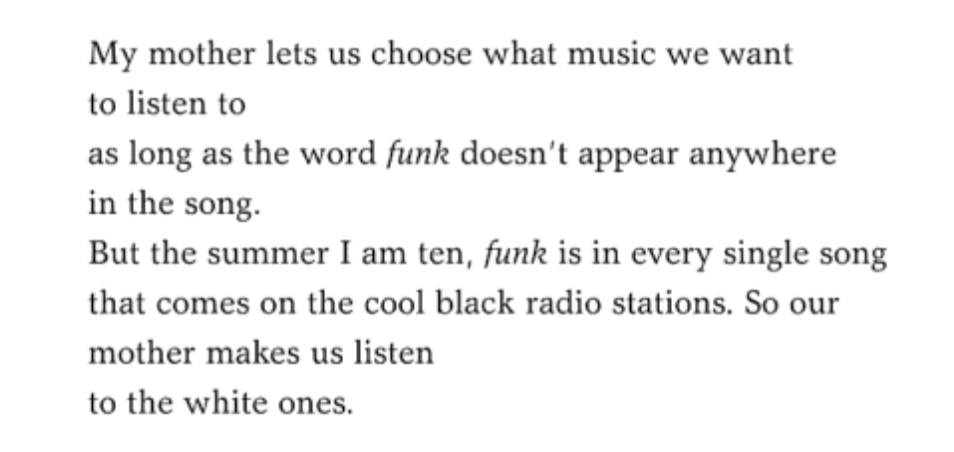
As Woodson read from Black Girl Dreaming, I was transported back to my youth. Woodson offers in “music”:

funk 1

funk

A skinny and deeply insecure white kid, I was enamored with The Ohio Players, and I can recall vividly being mesmerized by the word “funk” because it sounded so close to profanity and clearly was a powerful word that carries elements of sex and cool that were way beyond my realm of awareness, my lived experiences as a nerdy white boy.

During this period of my life, Wild Cherry’s “Play that Funky Music, White Boy” was a Top 40 hit, and I listened to raucous and theatrical groups such as Earth, Wind, and Fire, and Parliament-Funkadelic, fronted by flamboyant personalities like George Clinton and Bootsy Collins.

As I listened to Woodson quilting her talk with her published writing, I felt myself letting down my usual guard against all that defines me for other people; I felt community with her as well as the people laughing and nodding in the audience.

Unlike most of life these days in the U.S., that room felt safe and filled with peace—even as we were nested in St. Louis, a city now infamous for Ferguson and Michael Brown, the pervasive danger in the U.S. for those merely trying to live while being black.

Who are we? and What defines us? always sit just below the surface of my conscious self, a self ensconced in my whiteness, privilege, and being a man.

The first morning at the conference, as I was leaving a small coffee and breakfast shop, a woman asked where all the people outside were going. As I answered her, she interrupted me with “You are Southern”—an intense declaration that made me half expect her to back away as if redneck is contagious.

I thought about this encounter when Woodson took questions from students, one of which asked her if she were afraid of moving back to the South.

She replied that she wouldn’t move back South but “it ain’t cause I’m scared”—although, she added, she would be concerned for the safety of her family.

Like me, Woodson is projecting her fear around those she loves; unlike me, Woodson, simply due to all the ways she is unlike me, is aware that she does have much to fear, all that I am shielded from by my privileges.

Woodson’s talk catapulted me back to my teen years and the transformational power of “funk”—the word and the music—in my tentative white boy life.

As an aging (old?) white man, I am now more acutely aware of the alternative meaning of “funk”—to be in a funk, to be weighed down by the world, our fears, our fears in the name of the ones we love.

Joy and that funk reside together in my heart and bones as I think of my granddaughter—wild-haired, just a girl-child, innocent and fragile, bi-racial—and the delicate threads of my life linking me to all that is beautiful in this life despite all that is horrible.

“You have a right to be here fabulously,” Woodson told us at the beginning of her talk.

Yes we do, and I want so badly to hope that this is true.

God bless you, Jacqueline Woodson.


The Tyranny of Canonical Texts

I, too, dislike it: there are things that are important beyond
all this fiddle.

“Poetry,” Marianne Moore

As a sophomore in high school, I was a nerdy good student who had succeeded in schooling by transferring his mama’s-boy skills into teacher-pleasing dexterity. I was, however, enamored with math and science and just tolerated English and history.

My sophomore and junior years with the same English teacher, Lynn Harrill, were wonderful because of Lynn—not English, which to me was a mind-numbing series of vocabulary tests and a lot of reading I couldn’t have cared less about.

English in junior high had been torture, years and years of grammar book exercises and sentence diagramming.

Once while my tenth-grade peers were suffering through a week-long exploration of Charles Dickens’s A Tale of Two Cities, I was home on the couch, sick. That unit on Tale culminated in a long multiple-choice test, which my classmates scored very low on.

When I returned to class, I had never read that book—started it, of course being a good student, but found it insufferable (I still loath Dickens, much as I do Shakespeare, Austen, and a whole host of canonical authors). Before taking a make-up exam, I chose the Cliff’s Notes route, and scored a sweet 96 on the test—best by far in the class.

Over the next four or so years, a weird thing happened: I graduated high school planning to be a physics major, was enlisted by an English professor to tutor a survey course my first year of college, and then became an English education major at the beginning of my junior year—along the way discovering I was a writer and someone who loves literature as much or more than any other person I have ever met.

books
When my college students enter my office for the first time, they invariably pause at this view of my bookshelf, asking, “Have you read all these books?”

I also love English majors; they say things like “canonical” and “epistolary” without any hint that this is not the way humans communicate.

But I have to confront that the biggest obstacle to my life of words was English courses throughout my junior and senior high school years, and a key element of that negative influence was being assigned canonical texts, most of which I found then and continue to find to be dreadful reading.

Concurrent with those cloying experiences with texts, I was collecting and reading thousands of comic books (I had about 7000 Marvel comics when I graduated high school) as well as science fiction novels by Arthur C. Clarke and others.

As I have examined before, my very serious experiences with William Faulkner in high school set me up to be embarrassed when I rediscovered Faulkner in upper-level college English courses.

While teaching high school English for 18 years and then moving to teacher education for 16 years-and-counting now (primarily working with future teachers of English), I remain powerfully aware of the me who was alienated from the things I would come to love—the things that mostly define who I am as a human—by the very environment that should have been the place I discovered what I love.

That alienation I call the tyranny of the canonical text, and it hurts me to watch as many English teachers continue to be agents of that tyranny or co-victims of that tyranny with their students.

As chair of the English department while teaching high school, I worked for years to end or at least modify the required novel and play lists we used in our department. Those efforts were met with a great deal of resistance from my colleagues.

My argument then (and now) was grounded in the fact that between me and the most ardent advocate for canonical texts and required reading lists, we had vastly different reading backgrounds, and none the less were both highly literate, well-read people.

I have read every work by Milan Kundera, Haruki Murakami, Franz Kafka, William Faulkner, Margaret Atwood, Kurt Vonnegut, and many others—but only  a few pages of many of the books canon advocates would argue are essential. I have written and edited volumes on Barbara Kingsolver, Kurt Vonnegut, Ralph Ellison, Margaret Atwood, Haruki Murakami, and James Baldwin.

My literary life is an example of literacy triumphing over the tyranny of canonical texts. However, I wonder why anyone should have to fight through that tyranny to discover the joy and value of the written word.

Yes, I understand and appreciate the allure of teaching a valued text; I, too, have works that I love to teach, several of which were pure tyranny for my students.

Yes, I understand that reasonable people can agree that some works of literature are, in fact, superior to others; I, too, cringe at the Twilight and 50 Shades of Grey sorts of popular novels.

And, yes, I recognize that teaching English includes both an obligation to the discipline (composition and literature) and our students.

Ultimately, I have committed in my career to begin with (and to seek never to fail) my obligations to students and their literacy (both the so-called practical aspects of that literacy and the much more important role literacy plays in any person’s full humanity, agency, and joy for living)—some times necessarily sacrificing the finer points of covering canonical texts and authors.

An important element in that commitment is coming to see that when any student balks at a text, I first challenge the text selection, and resist assuming some problem lies in the student.

My deeply insecure self in junior and high school, mortified in the full body brace I wore for scoliosis, would have appreciated greatly someone offering me that opportunity then; instead, my life in literacy came later and only because I somehow fought through the tyranny of canonical texts.

The Universal Lie

Education and journalism often are similar windows into the power of bias in the U.S.

Consider first a somewhat innocuous media report about sports:

BREAKING: United States misses first World Cup since 1986.

— The Associated Press (@AP) October 11, 2017

Much more disturbing, also consider the media coverage of the Las Vegas mass shooting:

As the news broke, major outlets across the country wrote headlines that humanized [Stephen] Paddock…

Past mass shooters who were nonwhite or Muslim have been depicted quite differently ― and so have people of color who were victims of gun violence.

“There’s a clear difference in the way this kind of incident is treated and the way it would be treated if it were actually associated with Islam or Muslims,” Ibrahim Hooper, spokesperson at the Council on American-Islamic Relations, told HuffPost. “It would be instantly called an act of domestic or even international terrorism; it wouldn’t be individualized, but collectivized to the entire Muslim community or faith of Islam.”

The seemingly harmless report about U.S. soccer and the mainstream coverage of Paddock expose how the media works in ways that establish men and whiteness as the norms, the given, and thus somehow the most important (or only) statuses.

As many noted, U.S. soccer has had tremendous success in the women’s team—essentially rendered invisible by the coverage of the failure of the men’s squad this year. Paddock, as white man, floats above corrosive myths about Muslim terrorists and violent black men—both of which are statistically far more rare than violent and abusive white men, who constitute the largest percentage of mass shooters.

Now, let’s consider education.

Sarah Donovan, who blogs at Ethical ELA, posted a question on social media: “Teachers, scholars, authors, please weigh in. What is the value of the plot diagram in literature instruction? Is the language of rising action, etc. relevant, important?”

My first response to Donovan’s question was to point to Kurt Vonnegut’s mostly satirical but also illuminating “Shapes of Stories”[1]:

Vonnegut is an interesting and contradictory steward of both the modernist and post-modernist periods of so-called “Great Literature”:

Instead, the female characters [in his short fiction] are furniture or bouncing, pink operators. Of course you can’t blame Vonnegut for society’s sexism (in the 1950s, or now) but if these are indeed moral stories, it’s a male, white, affluent morality. Vonnegut himself, as Wakefield writes, puzzled over his inability to “do women well.”

Similarly, the dialects of some black waiters and soldiers and the poor will induce groans. As for the five stories from the archives, “City” has a lovely back-and-forth alternating point of view between a boy and a girl meeting on a bus, but the rest might have stayed lost.

As a white male, Vonnegut was afforded gender and race privileges that likely allowed him to be a somewhat rebellious writer who flaunted and broke the rules handed down by the New Criticism gods, blurring fiction and non-fiction as well as making himself a primary character of his genre-defying narratives.

Since I have examined before the power of mechanical evaluations of literature, often about New Criticism, and how the canon is mostly a white, male mythology, I next turned to a recent examination of the Nobel Prize in literature, awarded in 2017 to Kazuo Ishiguro:

The Nobel is the premier institution of elite literary prestige, conferring authority on what is already taken to be worthy of acclaim within the literary field….Conferring the Nobel also solidifies Euro-American cultural power (members of the adjudication committee often have American graduate degrees), as the Nobel institution positions itself as naturally authorizing and emboldening, in its own dispassionate assessment, what is inherently worthy of commendation. It’s a classic case: an institution of elite cultural power that hides its biases in claims to universality.

So if we consider plot diagrams as “dispassionate assessment,” we can begin to unpack how the concurrent concept of universality is, in fact, a lie—a sort of god creating “man” in “his” own image.

Like the flawed five-paragraph essay template that induces both bad writing and bad thinking in students, mechanical scripts for how fiction (or poetry, or any form) works are misleading but also perpetuate the inherent biases of the formulas.

The fathers of New Criticism were in many ways self-serving—arguing for prescriptions and structures that they themselves then followed in order to create the circular reasoning of “Great Literature.” Along the way, of course, mechanistic traditional education—mostly in English courses—provided a powerful ally in that process.

From plot diagrams to the literary technique hunt, mechanical approaches to texts are reductive and thus fail the critical literacy test: How is this text positioning the reader and in whose interest is the text working?

Let me close by nudging a bit beyond the narrow question about plot diagrams for fiction (usually the short story), and ask that we consider how the universal functions to mask and distort through W.B. Yeats “Leda and the Swan” and Adrienne Rich’s “Rape.”

In most traditional English/literature courses, Yeats likely is taught far more often than Rich, and then, his poem retelling a classic myth carries the heft of being a praised structured form (sonnet) and by an oft-anthologized white male Great Poet.

Rich, however, tends to be swept aside as a free verse poet who is too political, often code for “just a woman” (see Anne Sexton).

Yeats’s poem uses rape as a plot element, seemingly “dispassionate,” while rape in Rich’s poem is a confrontation about the physical terror women face in a man’s world (is that not universal?) and the concurrent metaphorical assault women must suffer to seek justice for the actual rape.

Ultimately, there is something insidious about allowing the normalization of the powerful to sit beside the marginalization of the powerless—calling the experiences of one (white men) “universal” and the experiences of the other (women), “political.”

So what do we do with Donovan’s question?

Critical literacy guides us here as we must be diligent in making our students aware of traditional structures and approaches to literature and writing, but also we must go beyond that awareness and invite them to unpack critically why those structures exist—again, in whose interest do they work?


[1] See also Vonnegut’s essay included in Chapter 3 (“Here is a lesson in creative writing”) of A Man without a Country.

Florida Education Reform: “It’s a Trap”

In his stand-up comedy days, Steve Martin had a routine about a TV evangelist. This character had, he believed, stumbled across the perfect TV evangelist sale: He announced that he had spoken to God and God had assured him he was the only person God was speaking to—so viewers should not listen to any other TV evangelist who claimed to know the word of God.

Yes, this was a stinging satire of religion, but at its core, Martin is unmasking the scam grounded in claims too good to be true—the “miracle” claim.

Writing in support of South Carolina’s Read to Succeed legislation, Oran P. Smith makes this claim:

Read to Succeed was indeed a success in Florida. Since the year before the retention policy came into effect, the percentage of Florida students scoring low enough to qualify for retention has fallen by 40 percent. More Florida children are learning how to read during the developmentally critical period. The students at the bottom proved the biggest winners from Florida’s no-nonsense reforms.

Setting aside that the Florida policy is actually Just Read, Florida! (Read to Succeed is SC’s version), reading policies based on standards, high-stakes testing, and grade retention (very much a Florida model) are a subset of the Florida “miracle” scam driven by Jeb Bush—a set of policies grounded in rhetoric and ideology but regularly refuted by careful analysis.

Between leaving office as governor of Florida and running for president, in fact, Jeb Bush shuttled around the U.S. selling his education reform—not unlike Martin’s TV evangelist: “These reforms include assigning letter grades to schools, high-stakes testing, promotion and graduation requirements, bonus pay, a wide variety of alternative teacher credentialing policies, and various types of school choice mechanisms.”

Many Republican governors simply adopted the rhetoric and pushed these policies while entirely disregarding substantial evidence refuting the practices. As I have noted, SC has been on the Florida “miracle” bandwagon for some time.

Like all “miracle” claims, however, the Florida “miracle” must be confronted simply: “It’s a trap!”

The allure, now, reaches beyond the states and into the federal Department of Education headed by Betsy DeVos, who is a one-trick pony for school choice.

Yet, as Valerie Strauss at the Washington Post reports Florida’s education system — the one Betsy DeVos cites as a model — is in chaos.

Public schools now have been besieged by this scam for decades—the Texas “miracle,” the Chicago “miracle,” the Harlem “miracle,” and the Florida “miracle.”

Political careers and horrible education policy have been driven by the power of showmanship and snake-oil sales pitches.

For well over a decade, education “miracles” have nearly all been fully debunked. The need to continually refute claims that are too good to be true is part of the strategy in fact since the media are a willing customer to these lies and then the careful analysis needed to show the claims to be false is simply lost in the shuffle of the next “miracle” story.

So just as I have pointed out about charter advocacy, those pushing the Florida model for education reform and reading policy are trafficking in mostly rhetoric in the absence of evidence.

Smith’s jumbled plea to give Read to Succeed a chance is yet another trap; these claims fail his argument, and ultimately, students and teachers in SC:

  • Florida education reform and reading policy simply have not succeeded. And what is more troubling, key elements such as standards and high-stake testing, grade retention, school  choice, and charter schools have all been strongly discredited as effective reforms by dozens of studies over more than a decade. The big scam in promoting Florida reading policy is that grade retention based on high-stakes testing does bump test scores short term (which benefits politicians and their rhetoric), but that bump fades and the negative consequences of grade retention remain (see Jasper, 2016).
  • SC has no reading “crisis,” or education “crisis” for that matter. Crisis rhetoric is one of the most corrosive aspects of the education reform debate. First, low literacy test scores in SC are strongly correlated with high poverty rates; our state’s high poverty is not a crisis, but an on-going reality with deep historical roots nurtured by political cowardice and lingering racism. SC’s literacy struggles are cousins to our political failure to address race and social class inequity in our state. Shouting “reading crisis” is yet another distraction from the political will needed to address poverty. Simply put, education is not the great equalizer, and thus, education reform will not eradicate larger social problems.
  • Smith touts teacher buy-in for Read to Succeed—a dubious claim about legislation and policy that are imposed on teacher certification programs, schools, and teachers who have no option accept to comply. But the bigger issue about buy-in is worth a moment, again about Florida. In the early days of Florida reform, a school receiving multiple years of failing report card grades triggered parental school choice; however, only about 3% of parents took that choice, and then within a couple years, about half of those parents chose to return to the failing schools. So here is my challenge: Talk to current SC teachers when they are free to share their opinions and find some actual parents of school-aged children and teachers from Florida. The messages you receive about buy-in, I suspect, will cast a dark cloud on the claims by Smith.
  • The final, and maybe ugliest, trigger is framing reading policy as an either/or prospect—grade retention or “social promotion” (an outdated but powerful term that certainly spurs the All-American hatred of giving people anything—especially if we believe those “people” to be black or poor). Either/or thinking is always misleading since the research on grade retention also addresses what best serves students other than retention or simple promotion, and since grade retention based on test scores can and often retains students who have achieved passing grades for the academic year. Grade retention as the antithesis to “social promotion” has some really ugly roots in ignoring how grade retention has and will disproportionately impact negatively poor and black student.

While we may agree that Read to Succeed is “in its infancy,” as Smith concludes, we must also confront that it is a clone of policies and programs that have already failed; Read to Succeed is finding yourself in a hole and continuing to dig, while shouting platitudes you hope can be heard by those choosing to avoid falling into the same trap once again.

SC Fails Students Still: More on Grade Retention and Misreading Literacy

But their remedies do not cure the disease: they merely prolong it. Indeed, their remedies are part of the disease.

Oscar Wilde (1891), The Soul of Man under Socialism

Bells will certainly continue to signal class changes in public schools all across South Carolina this fall, but there is a much more serious (and unwarranted) bell of doom for many third-graders because of SC’s punitive Read to Succeed legislation.

Paul Hyde’s Furman professor: Read to Succeed retention policy ‘a disaster’ offers a primer on the politically and publicly popular move across the U.S. to retain students based in part or fully on third-grade high-stakes tests of reading.

Once again, literacy policy often fails to address valid literacy practices or to acknowledge that literacy proficiency is strongly correlated with systemic conditions beyond the walls of the school or the control of teachers.

Worksheets on literacy skills, test-prep for state assessments of reading and writing, linking teacher evaluations to students’ test scores, and retaining children are simply not only flawed literacy policies, but also negative influences on children’s literacy and academic achievement.

And decades of creating ever-new standards and then purchasing ever-new reading textbooks and programs have utterly failed children and literacy.

For about a century, in fact, we have known what is needed to help students develop literacy—but the political will remains lacking.

A robust literacy strategy for schools must include instead the following:

  • Addressing access to books in all children’s homes.
  • Insuring access to books in all children’s schools.
  • Providing all students ample and extended time in class to read by choice.
  • Guaranteeing every student balanced literacy instruction based on each student’s demonstrated literacy needs (not the prescriptions of literacy programs).
  • Discontinuing the standards and testing disaster dominating schools and classrooms by providing teachers the materials, time, and professional autonomy to teach literacy in evidence-based ways.

Just as education policy ignores a rich research base, political leaders and the public refuse to address how public policy directly and indirectly impacts student achievement; the following would create higher student achievement and literacy:

  • Eradicating food deserts and insuring food security.
  • Providing universal healthcare to children and families with children.
  • Creating job security for families with children.

Finally, we must acknowledge that grade retention fulfills a cultural negative attitude about children and people in poverty among the U.S. public—one grounded in individual blame and punishment.

But decades of research has shown (yes, even with the failed Florida policy that serves as a template for many states such as SC) that grade retention may raise test scores short term, but that gain disappears in a few years and the many negative consequences of retention remain.

As the National Council of Teachers of English detail in their position statement on grade retention and high-stakes testing, grade retention fails in the following ways:

  • retaining students who have not met proficiency levels with the intent of repeating instruction is punitive, socially inappropriate, and educationally ineffective;
  • basing retention on high-stakes tests will disproportionately and negatively impact children of color, impoverished children, English Language Learners, and special needs students; and
  • retaining students is strongly correlated with behavior problems and increased drop-out rates.

Of course all children need and deserve rich and rewarding literacy experiences and growth, but third grade literacy is both a manufactured metric (by textbook and testing companies) and a misleading emergency.

Grade retention and skills- and standards-based literacy instruction and testing have failed and continue to fail horribly the students who need authentic literacy instruction the most—black and brown children, English language learners (who may need a decade to acquire a second language), students in poverty, special needs students.

These populations are a significant portion of the students served in SC public schools; our hateful and misguided policies are created and tolerated by a more white and affluent political leadership and public who have racist and classist biases against “other people’s children.”

In fact, failed literacy policy in SC can be linked directly to how the U.S. demonizes and fails the impoverished:

It all starts with the psychology concept known as the “fundamental attribution error”. This is a natural tendency to see the behavior of others as being determined by their character – while excusing our own behavior based on circumstances.

For example, if an unexpected medical emergency bankrupts you, you view yourself as a victim of bad fortune – while seeing other bankruptcy court clients as spendthrifts who carelessly had too many lattes. Or, if you’re unemployed, you recognize the hard effort you put into seeking work – but view others in the same situation as useless slackers. Their history and circumstances are invisible from your perspective.

Struggling students in SC are viewed as lacking or broken, in need of repair and/or punishment to correct.

If you think this is harsh, compare how mostly white and more affluent students learn literacy in advanced and gifted classes in public schools (a dirty little secret about how we have maintained segregation) and most private schools.

Like No Child Left Behind and Every Student Succeeds Act, Read to Succeed is an Orwellian name for a horrible way to view, treat, and teach children.

SC continues to be a morally bankrupt state, calloused and driven to punish instead of offering our citizens, especially our children, the compassion and opportunities all people deserve.

For Further Reading

At Duke, I realized how badly many South Carolina schools are failing students like me, Ehime Ohue

Grade Retention Research

Executive Summary: THE EFFECTS OF MANDATED THIRD GRADE RETENTION ON STANDARD DIPLOMA ACQUISITION AND STUDENT OUTCOMES OVER TIME: A POLICY ANALYSIS OF FLORIDA’S A+ PLAN (9 January 2017)

THE EFFECTS OF MANDATED THIRD GRADE RETENTION ON STANDARD DIPLOMA ACQUISITION AND STUDENT OUTCOMES: A POLICY ANALYSIS OF FLORIDA’S A+ PLAN, Kathleen M. Jasper (2016)

NCTE: Resolution on Mandatory Grade Retention and High-Stakes Testing

Retain to Impede: When Reading Legislation Fails (Again)

Confirmed: SC Implementing Retain to Impede

Beware Grade-Level Reading and the Cult of Proficiency

Teaching Reading and Children: Reading Programs as “Costume Parties”

Florida Retention Policy a Blight on Literacy, Children across US