Stories Grounded in Decades of Research: What We Truly Know about the Teaching of Reading – Compton‐Lilly – The Reading Teacher – Wiley Online Library


Stories Grounded in Decades of Research: What We Truly Know about the Teaching of Reading – Compton‐Lilly – The Reading Teacher – Wiley Online Library
Student knowledge and beliefs about literacy and literature are necessarily a reflection of their teachers’ knowledge and beliefs about literacy and literature.
I teach first-year writing at the university level; much of my work is helping students unlearn and reconsider that knowledge and those beliefs they brings from K-12 education.
Teacher posts on social media are often windows into the misconceptions those students bring to college. I recently fretted for a few days after seeing Advanced Placement teachers refer to book-length nonfiction as “novels,” which triggered a recurring situation when I ask students what novels they read in high school.
The answers often include The Crucible and Shakespeare as well as more recently Between the World and Me—prompting me to note that none of those are novels. Students have mis-learned to call any book assigned and studied in school a “novel,” the seeds of having weak or even flawed understanding of genre (see also here), medium, and mode in reading and writing.
Before I could spend any time on that social media post, however, I came across this:
I agree with both challenges here, but think Anger’s post is way more than a “bad take.” Here are a couple reasons why before a fuller discussion of how to center students in novel and play study.
First, I have little experience that assigning a single novel/play for all students to study under the guidance of the teacher is somehow mostly absent from high school literature classes.
Second, whole class study of novels and plays centers the teacher’s authority (the teacher guides the students through the work and then assesses students on that teacher’s framing of the work) and acquisition of knowledge about a singular work (essentially trivia).
Dropping the whole-class study of assigned novels/plays is not only a needed shift in literature study with students, but also a better approach to fostering student autonomy and healthier beliefs and deeper knowledge about literacy and literature.
One instructional and assessment shift is fostering students’ skills at text analysis instead of knowledge acquisition about a specific text. Traditionally, we assign The Scarlet Letter, walk students through the novel page-by-page, and then test students on knowledge they have retained about that novel.
Instead, we should be giving students multiple experiences interrogating texts and then putting them in new text situations to assess their ability to analyze texts. For example, we can do whole-class instruction on a short text by Hawthorne as preparation for having students analyze a text by Hawthorne students haven’t read before.
The key is not knowing facts about Hawthorne’s canonical novel, but fostering their ability to analyze a text better because they are familiar with that author and have context for anticipating those new texts.
The assigned whole-class novel/play is appealing, I think, because it allows greater control of instruction and, again, centers authority in the teacher and the work being studied. None of that, however, is fostering the sort of autonomy, knowledge, and beliefs students need, and deserve.
In the late 1990s when I was teaching high school AP Literature, I made the switch from assigning whole class novels and plays to complete student choice in the major works my students studied in preparation for the AP Literature exam.
I documented that first experience in English Journal because I learned some key lessons the hard way.
First, this shift requires purposeful and direct instruction that supports students’ ability to choose novels and plays. My students taught me that over a decade of being assigned what to read had failed them as skilled or even eager consumers of works.
Teachers disproportionately do way too much for students (see also the problem with rubrics and writing prompts) and inculcate compliance over agency and autonomy.
Finally, let’s consider how making the shift away from whole-class assigned novels and plays can be navigated by teachers despite the valid challenges that poses.
Novel/play knowledge and instructional strategies are often the two most pressing concerns for teachers accustomed to traditional novel/play study.
Yes, I have had students choose novels/plays I had not read (but often read eventually because students chose them) but that in no way hindered my ability to offer instruction or assess their work. In fact, when students are allowed to be the authority on a text, they often are more fully engaged in both reading and understanding the work.
Next, allowing students tethered choice in texts can fit into traditional practices.
The primary structure of novel/play study grounded in student choice and agency is that I designed thematic units within which students chose their works (tethered choice).
For example, one unit was Black writers and the lives of Black Americans. Students had to choose and justify a novel within that theme (we focused on works that helped prepare them for the AP exam, for example, but in any class the purpose must be established for studying the work—understanding American literature or preparation for college, etc.).
Next, for each work the student chooses, they had to build a resource folder on that work by doing searches in the library; these resource folders had literary analysis and author material that supported the student’s study but also gave me access to knowledge if I had not read the work.
Now, I think this is the key for teachers concerned about how to conduct instruction.
We still had whole-class discussions around the thematic element, but each student was invited to share their journey through their chosen text. All students, then, were encouraged to connect and contrast as the discussions unfolded.
For example, one student would note the use of flying motifs drawn from African mythology in Toni Morrison’s Song of Solomon, prompting other students to share the use of flying motifs in other works.
These organic connections were much more engaging than when I orchestrated page-by-page analysis of a shared novel or play.
These class discussions were embedded in reading workshop structures that allowed students time in class to read and research as well as conference with me and other students (especially when students chose the same work).
Using these approaches, students read more, were more deeply engaged, and gained much healthier beliefs and richer knowledge.
As teachers, we must constantly interrogate when our commitments are grounded in retaining power and authority versus fostering the autonomy and agency of our students as well as the integrity of our fields of literacy and literature.
Despite social media protestations, I doubt whole-class novel/play study has disappeared from high school literature classes, but I also certain that making the shift away from that and toward student agency would be one of the best developments for those students.
Below I will keep an updated listing of presentations and other public work for Fall 2023 through Spring 2024.
I am available for webinars, podcasts, presentations, white papers, blog posts, etc., on a number of education and literacy topics (browse my blog posts for topics):
Leadership Workshop: Making Sense of the Science of Reading
August 5, 2023, 12:45 – 1:45
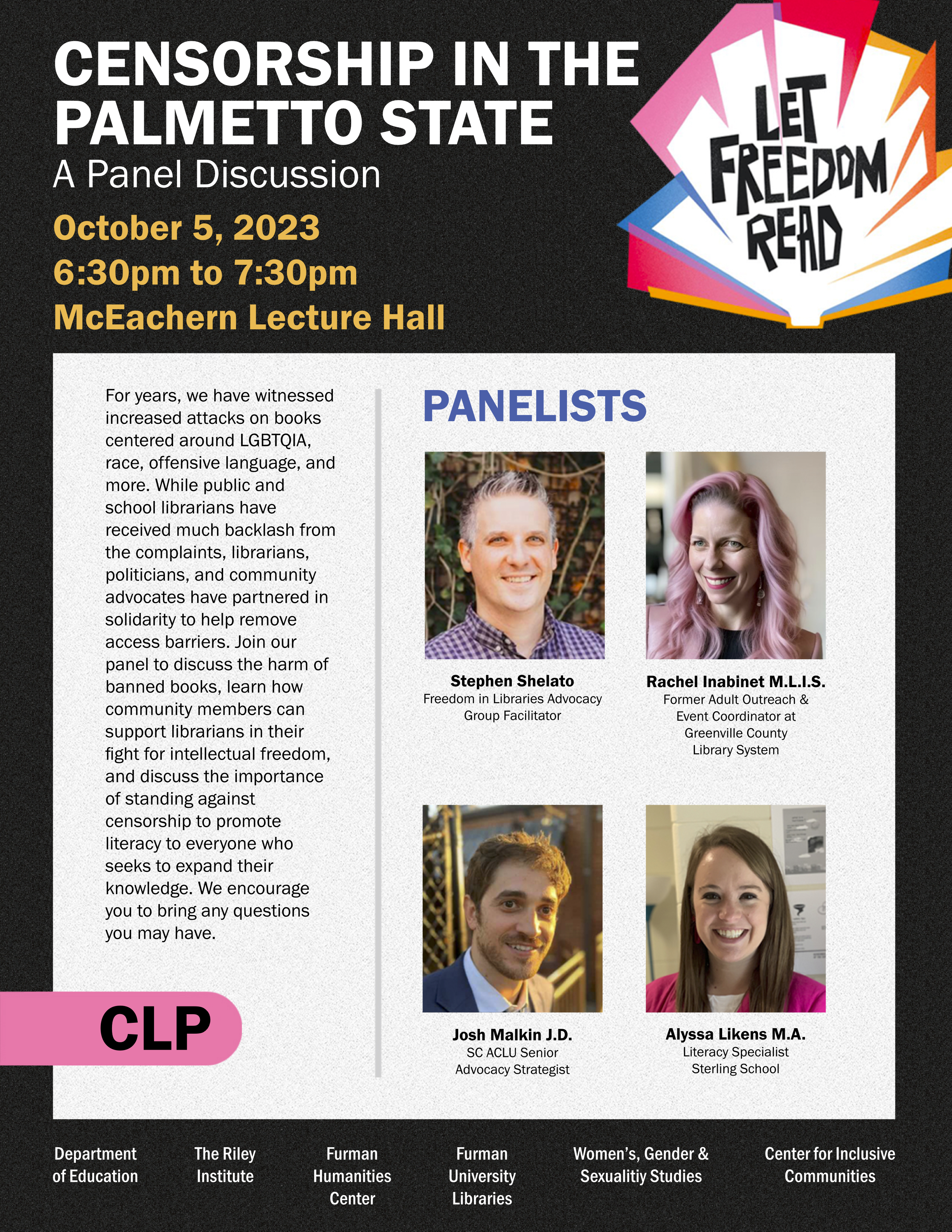
Title: Censorship in the Palmetto State: A Panel Discussion
Date: October 5
Time: 6:30 PM
Location: McEachern Lecture Hall – Furman Hall 214
Description: For years, we have witnessed increased attacks on books centered around LGBTQIA, race, offensive language, and more. While public and school librarians have received much backlash from the complaints, librarians, politicians, and community advocates have partnered in solidarity to help remove access barriers. Join our panel to discuss the harm of banned books, learn how community members can support librarians in their fight for intellectual freedom, and discuss the importance of standing against censorship to promote literacy to everyone who seeks to expand their knowledge. We encourage you to bring any questions you may have.
Title: Libraries are Worthwhile: Why We Need Them and How We Will Keep Them
Date: October 10
Time: 7:00 PM
Location: Hartness Pavilion
Description: Emily Drabinski, interim chief librarian at The Graduate Center, City University of New York and the 2023-2024 president of the American Library Association (ALA) will give a talk on the importance of libraries and librarians and how we can protect them in the face of ongoing censorship attempts.
Conexiones 2023
Columbus, OH – November 16-19, 2023
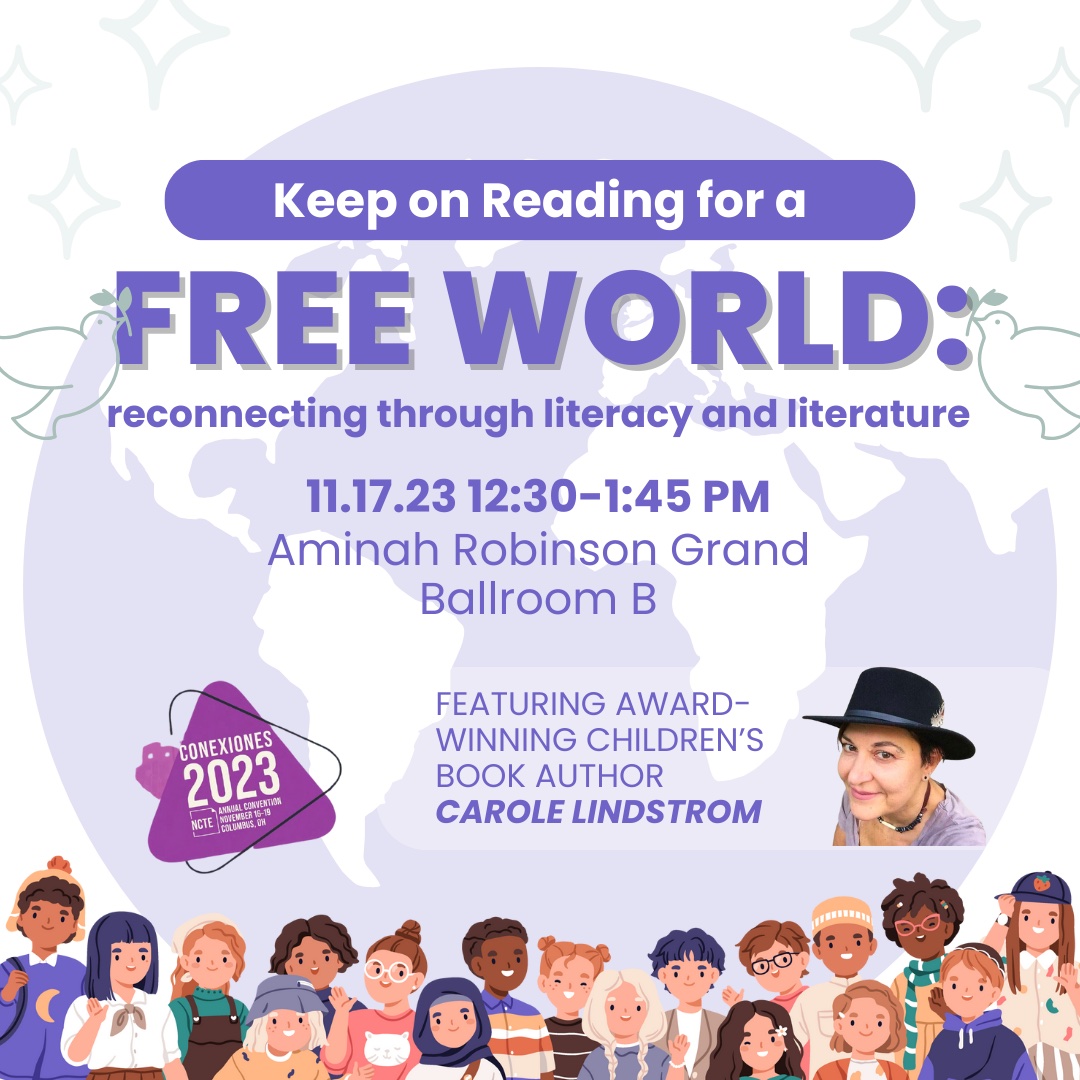
Keep on Reading for a Free World: Reconnecting through Literacy and Literature (Roundtable) – 11/17/2023 12:30 – 1:45; Aminah Robinson Grand Ballroom B [Reading Wars and Censorship: A Long and Shared History click for PDF]
Connecting Teachers with their Professional Autonomy in the “Science of Reading” Era click for PDF (Presentation) – 11/18/2023 – 11:00 – 12:15; A-214/215
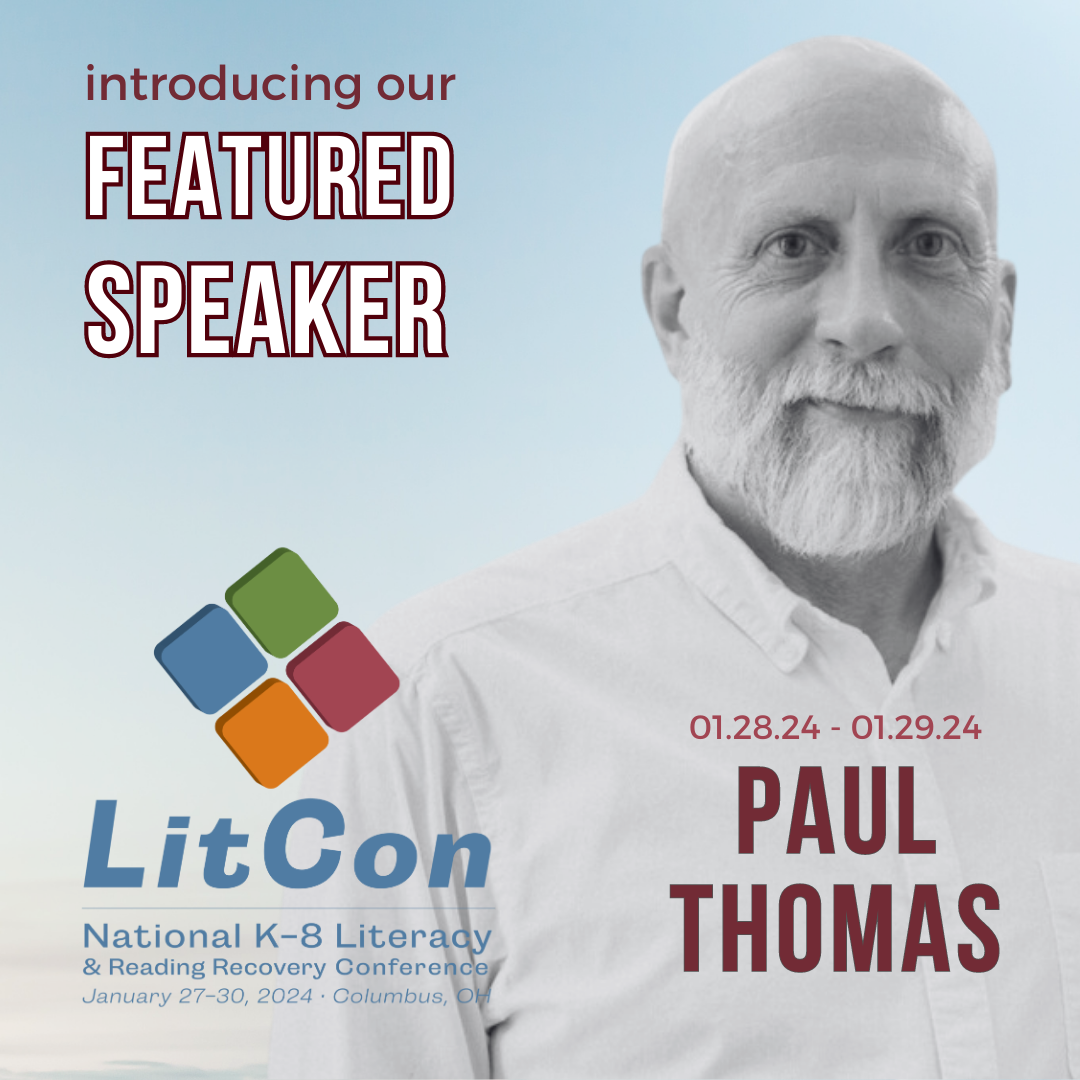
Columbus, OH – January 27-30, 2024
Download PP HERE
Over the last decade, states have passed new or revised reading legislation, often grounded in the “science of reading” (SOR) movement. The SOR movement has perpetuated many oversimplified and misleading stories that portray teachers negatively. This featured session will prioritize teacher autonomy by exploring the following topics: reading crisis, NAEP reading data, reading programs, teacher training and LETRS, dyslexia, and the complicated full body of reading research.
Sunday, January 28, 3:15 pm – 4:15 pm
Monday, January 29 4:15 – 5:45 pm
West Beach Conference Center at Kiawah Island Resort, Kiawah, SC from Friday-Saturday, February 2-3, 2024
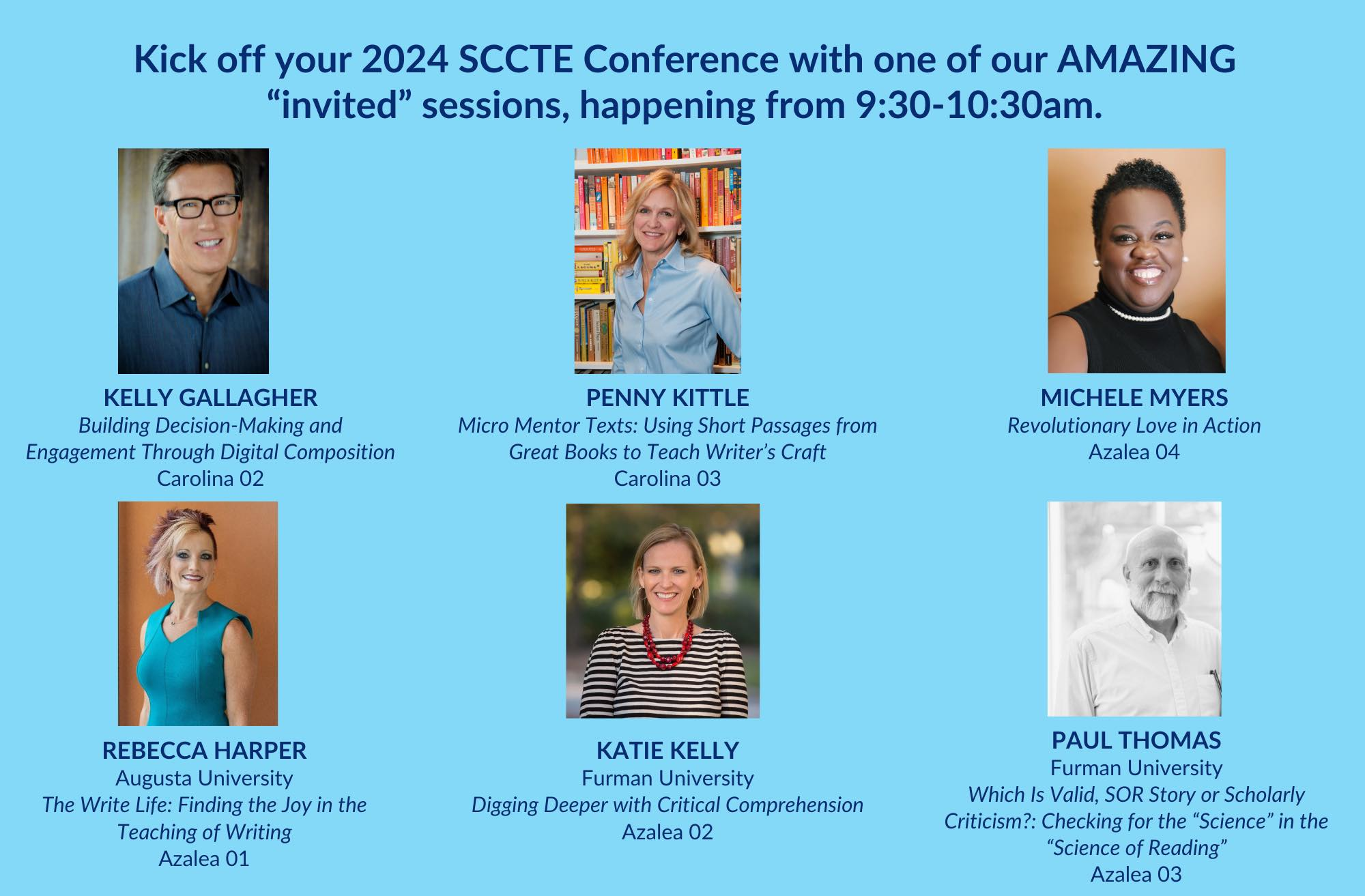
February 2, 2024, 9:30-10:30
P.L. Thomas, Professor of Education, Furman University
Download PP HERE
The “science of reading” (SOR) movement has shifted from media stories to state legislation and instructional policy. This workshop invites teachers to critically examine media claims about reading, teachers of reading, and teacher educators against the full body of reading science. The topics will include history of reading crises, the simple view of reading, NAEP, the Mississippi “miracle,” balanced literacy and reading programs, dyslexia, three cueing, brain science, and an overview of reading science.
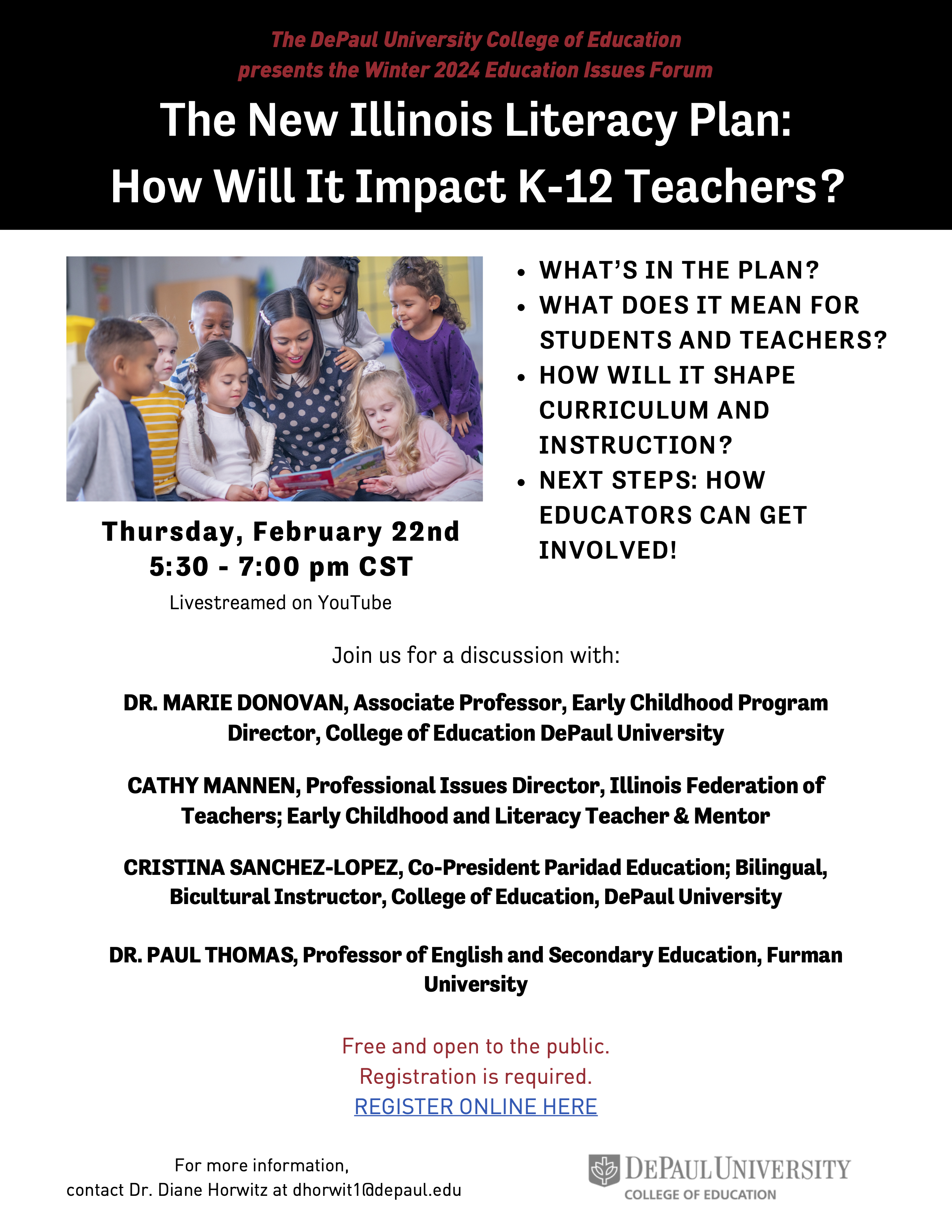
6:30 – 8:00 EST
Buyer Beware: Avoiding the Unintended (But Predictable) Consequences of SOR Legislation [access PDF here]
March 14-15, 2024 – Springfield, Illinois
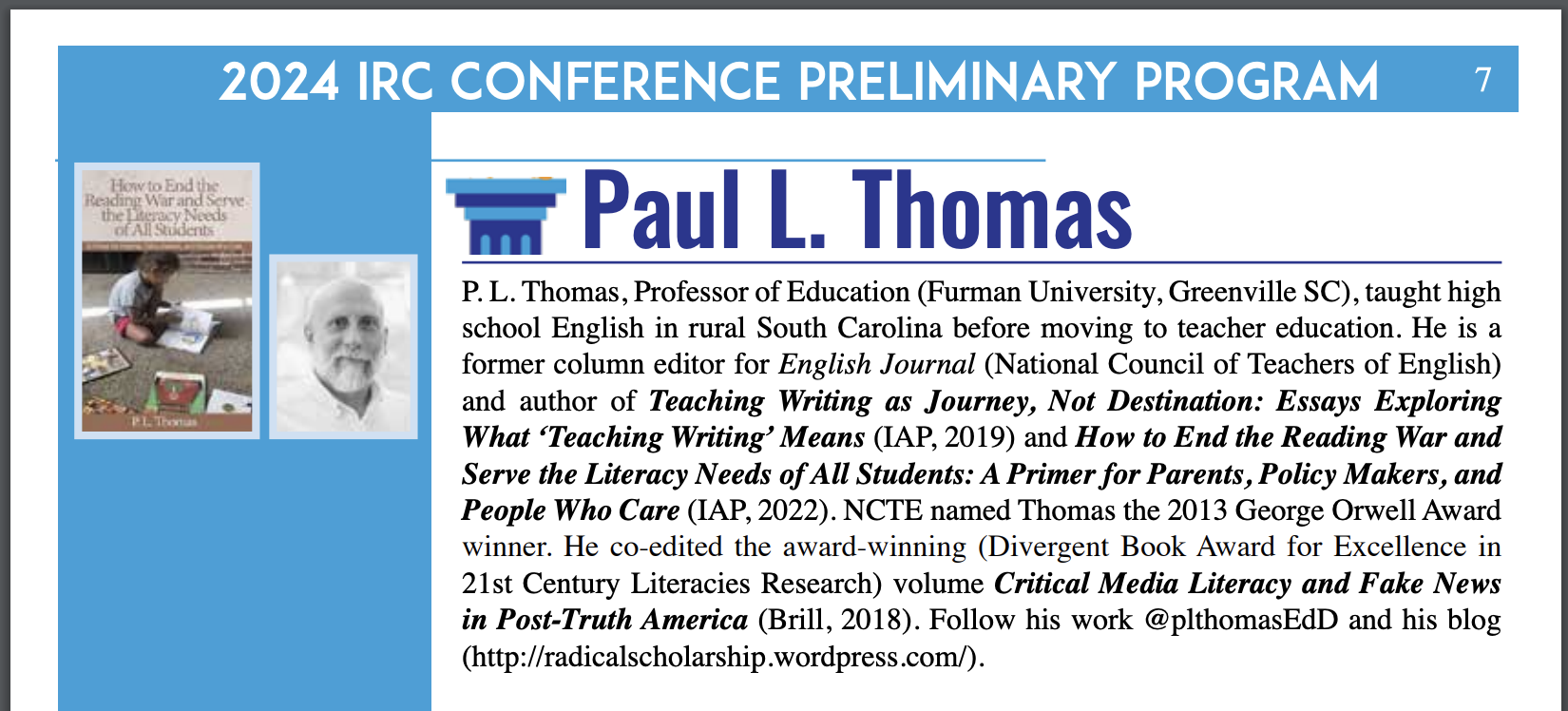
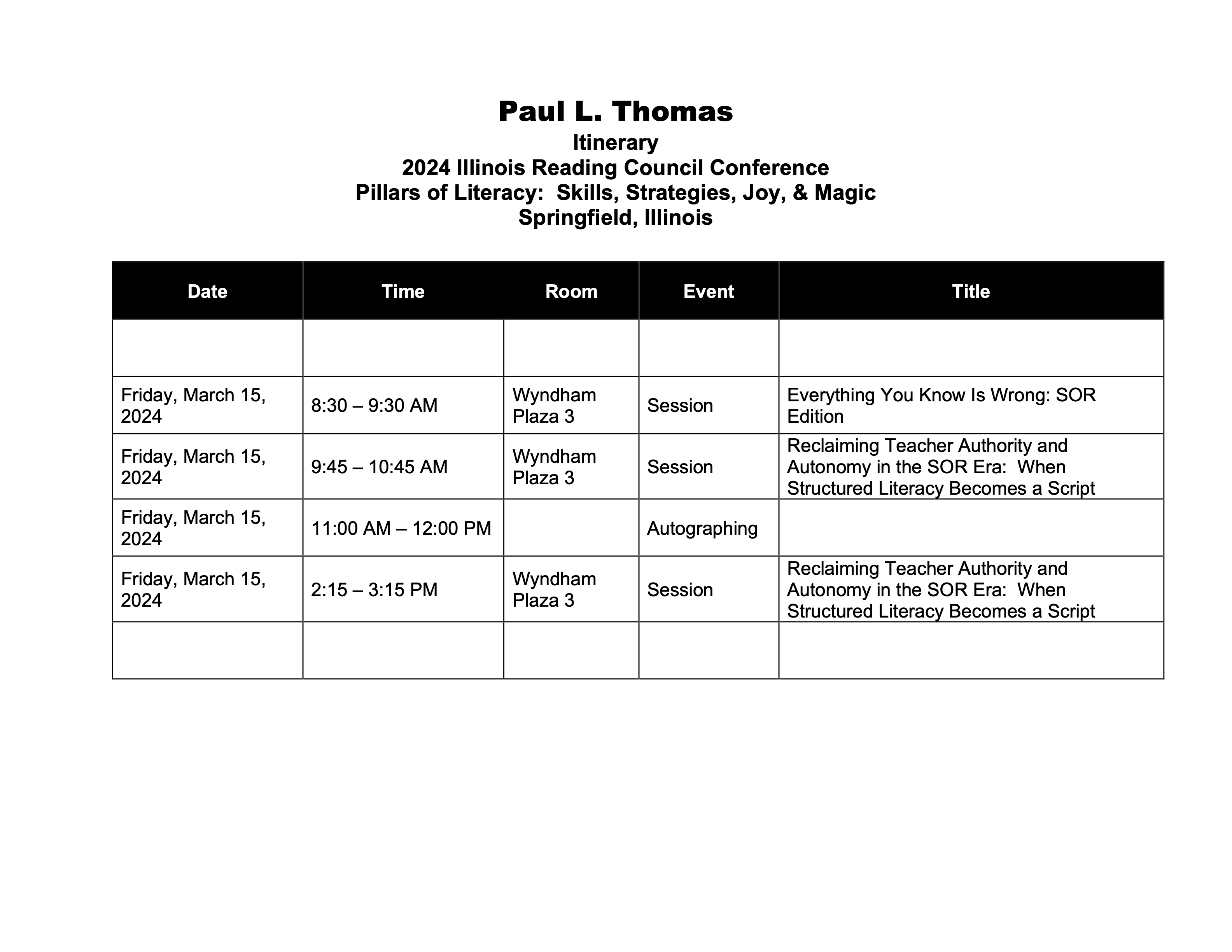
[Access PDF HERE]
Friday March 15 8:30-9:30
The “science of reading” movement has perpetuated several compelling and highly influential stories about reading; however, much of those claims are misleading or even completely false. This session will examine some of those stories and claims in the context of the full body of evidence. Topics include NAEP reading data, grade retention, the Mississippi “miracle,” phonics research, dyslexia, teacher education (NCTQ), multiple cueing, and reading programs and theories (balanced literacy).
[Access PDF HERE]
Friday March 15 9:45-10:45; 2:15-3:15
Increasingly since 2013, states have adopted reading legislation identified as the “science of reading.” Since curriculum and instruction should be driven by classroom teachers, not media narratives, parental advocacy, or political mandate, this session examines key reading topics framed with current research to support teacher authority and autonomy.
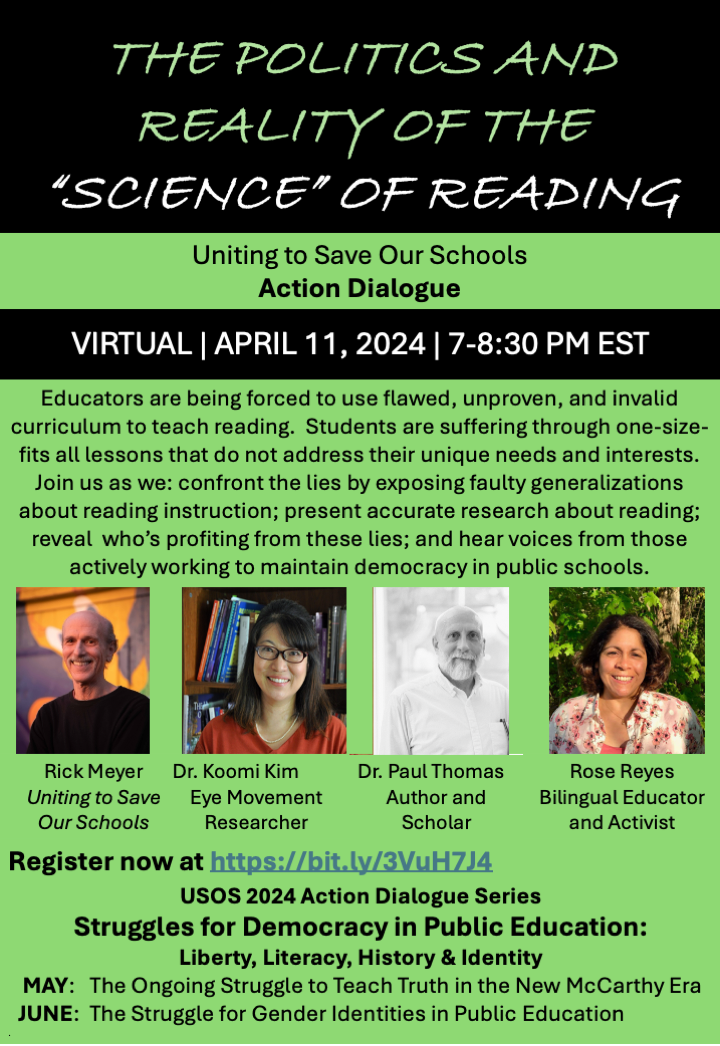
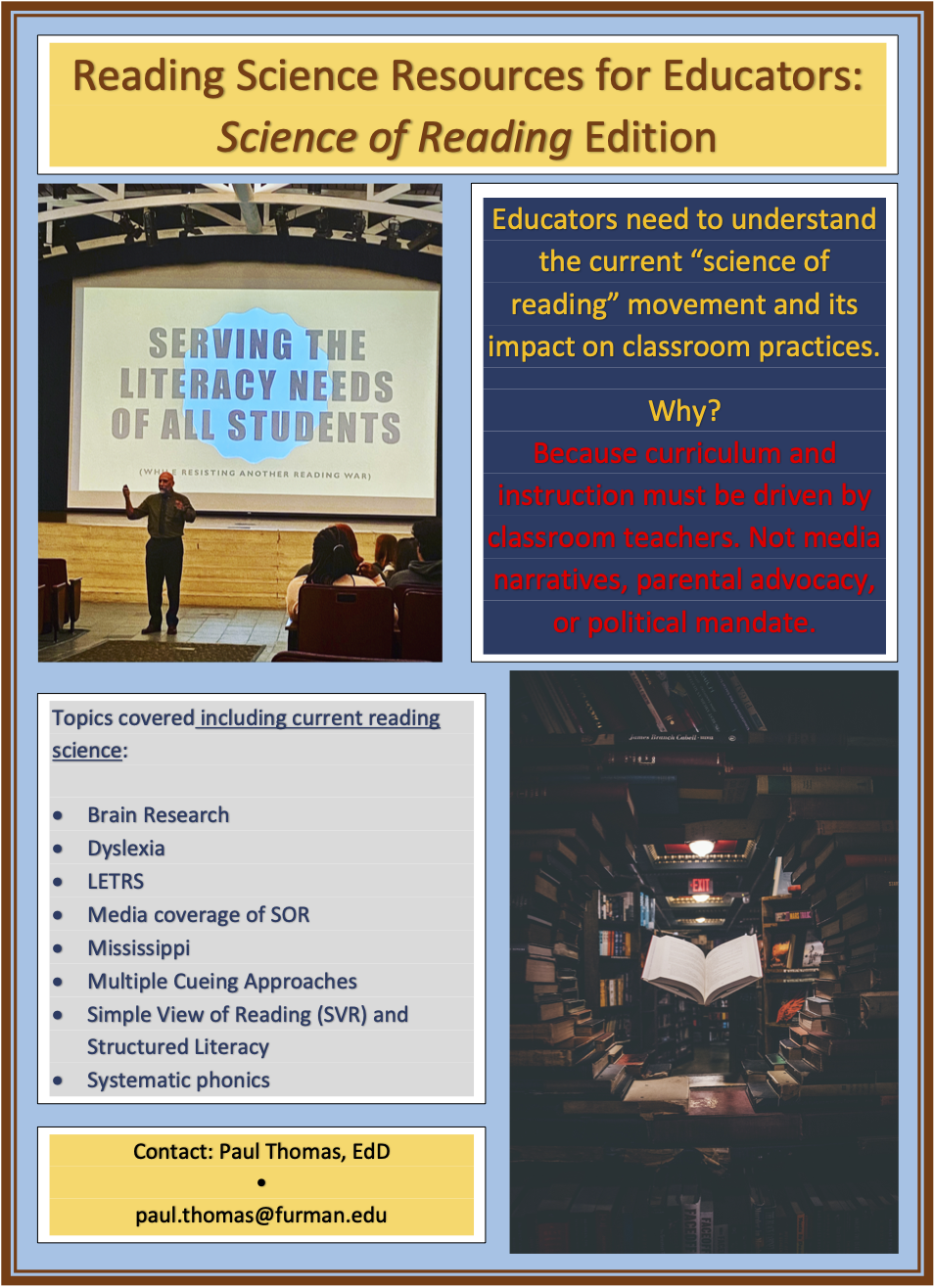
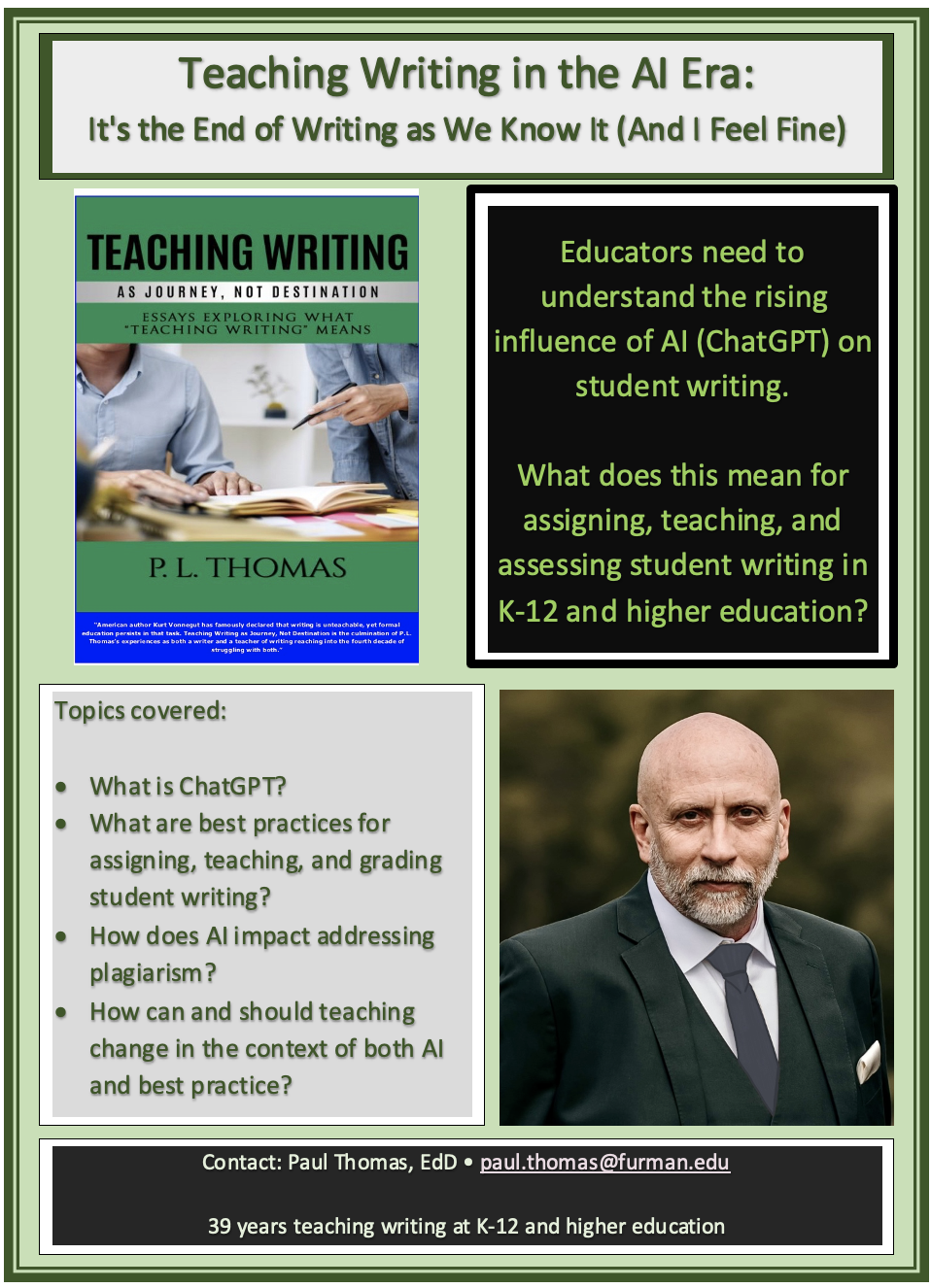
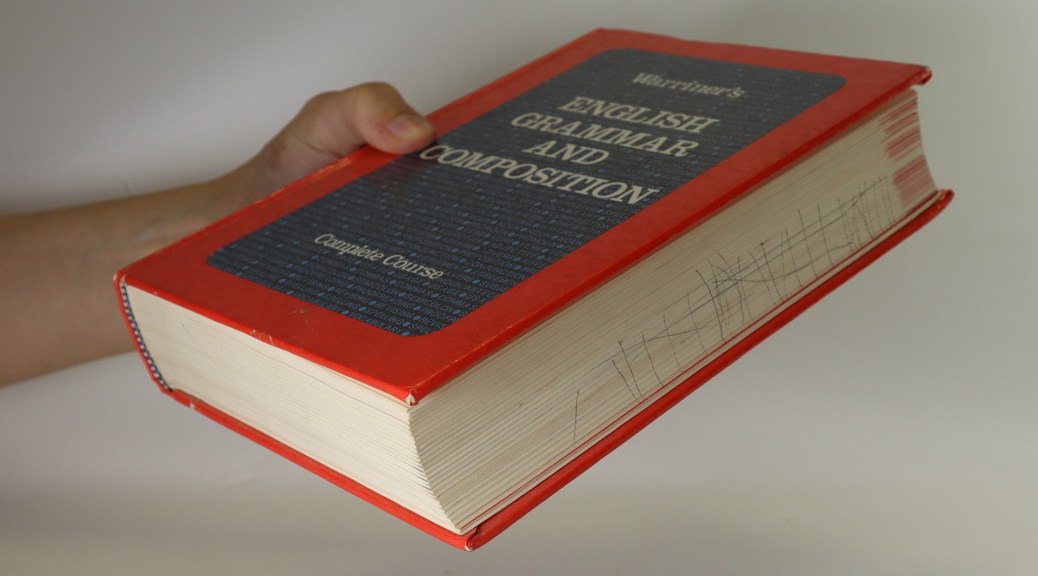
When I entered the classroom as an English teacher in 1984 at the high school where I had graduated just five years earlier, students lugged around two huge textbooks for their English courses, one of which was Warriner’s English grammar text.
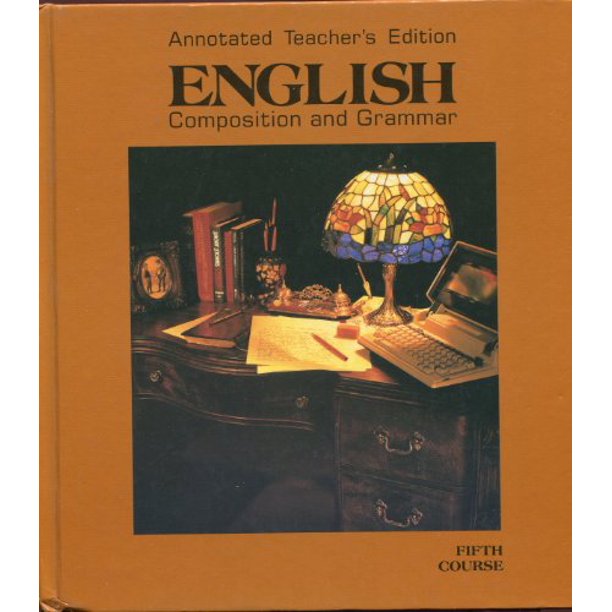
Students were conveniently color coded by these texts since the publishers provided different ability and grade levels of the literature and grammar texts. And universally students hated these textbooks, the carrying and their use in the classrooms.
Since I taught different ability levels (we used and A, B, C level system for each grade) and grades, I had about 15 textbooks across my five courses because students in English also were assigned vocabulary books (the publisher we used proudly printed in bright letters that these vocabulary books prepared students for the SAT!).
At least the vocabulary books were small paperbacks.
Two important facts stand out about those first couple years teaching in the traditional expectations for English teachers at that school (mostly the same teachers who taught me as a student): first, Warriner’s regardless of grade or ability level had essentially the exact same chapters for teachers to systematically and comprehensively teach every year, and second, teachers expressed repeatedly that students never learned those grammar lessons, noting that student writing failed to improve in terms of grammar, mechanics, and usage.
Another big picture point to make here is that when I was a student, grammar texts included lessons on “shall” and “will”; that my students had to cover an entire chapter and be tested on “who” and “whom”; and both my students and I had to “learn” about pronoun/antecedent agreement (specifically the use of “they” as plural only).
Today, we must acknowledge that all of these rules and the consequences of students “not learning them” have evaporated since “shall” and “whom” have graciously disappeared and “they” has been (finally) acknowledged as a resourceful pronoun.
As a beginning teacher, I had entered education to teach writing, although, of course, I loved literature also. Yet, the grammar- and skills-centric approach to teaching English, I recognized, was failing students miserably—I mean literally because students were miserable, learning to hate English, writing, and literature.
Of course, my stories here speak to a disturbing reality in education: Lou LaBrant, writing in 1946, noted: “We have some hundreds of studies now which demonstrate that there is little correlation (whatever that may cover) between exercises in punctuation and sentence structure and the tendency to use the principles illustrated in independent writing” (p. 127). And then in 1947: “A brief consideration will indicate reasons for the considerable gap between the research currently available and the utilization of that research in school programs and methods” (p. 87).
Yet, English teachers throughout the decades kept beating their heads against the grammar and skills wall, lamenting “kids today” for not being good writers—regardless of decade, regardless of the grammar programs implemented.
This raises a current issue about “scientific” or “evidence” as the basis for how teachers teach, notably in the current reading war.
Here, I think, is an excellent overview by Jal Mehta (Harvard University) about why calling for “scientific” or “evidence” to mandate teaching literacy is just as misguided as the evidence-free practices I witnessed as a beginning teacher almost 40 years ago:


What may have started out about a decade ago as a sincere plea similar to LaBrant’s—the teaching of reading in practice often failed to be effectively evidence-based (“scientific”)—has turned into the exact sort of one-size-fits-all ideological movement that Jal warns about: scientific as a “weapon.”
The SOR movement has refueled the myth of the bad teacher, continued to perpetuate false narratives of crisis and miracle schools, profited the education marketplace, and driven deeply problematic reading legislation and policy, including inequitable grade retention.
The mistake being made is also perfectly identified by Jal: “In my experience, the best educators and leaders see lots of complexity, consider context, and artfully weave together different approaches to solve particular problems.”
Ironically, this is the exact approach grounding both whole language and balanced literacy as philosophies of teaching reading and writing; however, as we have witnessed, both WL and BL also became convenient labels for practices not following those philosophies or simply slurs ideologues use to criticize.
Instead, the SOR movement has become ideological and weaponized to create simplistic and unfounded crisis rhetoric for politicians and skills-driven reading policy and practice.
For example, no one argues that phonics, vocabulary, and knowledge are not key elements in reading. But the SOR movement demands a linear and sequential skills-first approach; teach phonics, vocabulary, and knowledge systematically before students read.
The skills-first approach is essentially authoritarian (what phonics, vocabulary, and knowledge students “need” is determined and outlined for students and teachers) and necessarily erases diversity of language and experiences by students.
The counter approach, the complex approach to reading, acknowledges the importance of elements such as phonics, vocabulary, and knowledge, but also honors that the relationship between so-called skills and reading is reciprocal, not linear or sequential.
In other words, yes, students need some direct and purposeful instruction in phonics, vocabulary, and knowledge building as they become beginning readers; however, most of a person’s acquisition of phonics, vocabulary, and knowledge comes from reading—not direct or systematic instruction.
The problem with systematic and comprehensive teaching of any literacy skills is that the goal and accountability around teaching and learning become the acquisition of the skills (phonics tests, vocabulary tests, knowledge tests) instead of the authentic goal of fostering eager, independent, and critical students who read.
Ultimately, if we genuinely want evidence-based reading instruction for children in the US, we must recognize that the most important sources of evidence are the children themselves and the most valuable person to understand what children need to read are their teachers.
However, beyond shifting to what evidence counts, we must also recognize that students and teachers cannot be successful unless we address learning and teaching conditions (the one move politicians refuse to make).
Regretfully, as Jal recognizes, students and teachers are again simply pawns in another fruitless war won by the SOR advocates “who are loudest about ‘evidence-based practices,’ [and] ironically tend to be more ideologues who have a few preferred solutions that they think can address every problem.”

[Header Photo by Seema Miah on Unsplash]
For me, the pandemic era (and semi-post-pandemic era) of teaching has included some of the longest periods in my 39-year career as an educator when I have not been teaching.
The first half of my career as a high school English teacher for 18 years included also teaching adjunct at local colleges during the academic year along with always teaching summer courses (even while in my doctoral program).
Currently in my twenty-first year as a college professor, in addition to my required teaching load, I have always taught overloads during the main academic year, our optional MayX session, and (again) summer courses.
Teaching has been a major part of who I am as a professional and person since my first day at Woodruff High (South Carolina) in August of 1984.
However, during pandemic teaching, I have experienced several different disruptions to that teaching routine—shifting to remote, courses being canceled or not making (especially in MayX and summer), and then coincidentally, my first ever sabbatical during this fall of 2022 (in year 21 at my university).
One aspect of sabbatical often includes the opportunity to reset yourself as a scholar and of course as a teacher. As I was preparing my Moodle courses for Spring 2023, I certainly felt an unusually heightened awareness around rethinking my courses—an introductory education course, a first-year writing seminar, and our department upper-level writing and research course.
Here is an important caveat: I always rethink my courses both during the course and before starting new courses. Yes, the extended time and space afforded by sabbatical makes that reflection deeper, I think, but rethinking what and how I teach is simply an integral part of what it means for me to be a teacher.
For two decades now, I have simultaneously been both a teacher and teacher educator; in that latter role, I have been dedicated to practicing what I preach to teacher candidates.
I am adamant that teacher practice must always reflect the philosophies and theories that the teacher espouses, but I am often dismayed that instructional practices in education courses contradict the lessons being taught on best practice in instruction.
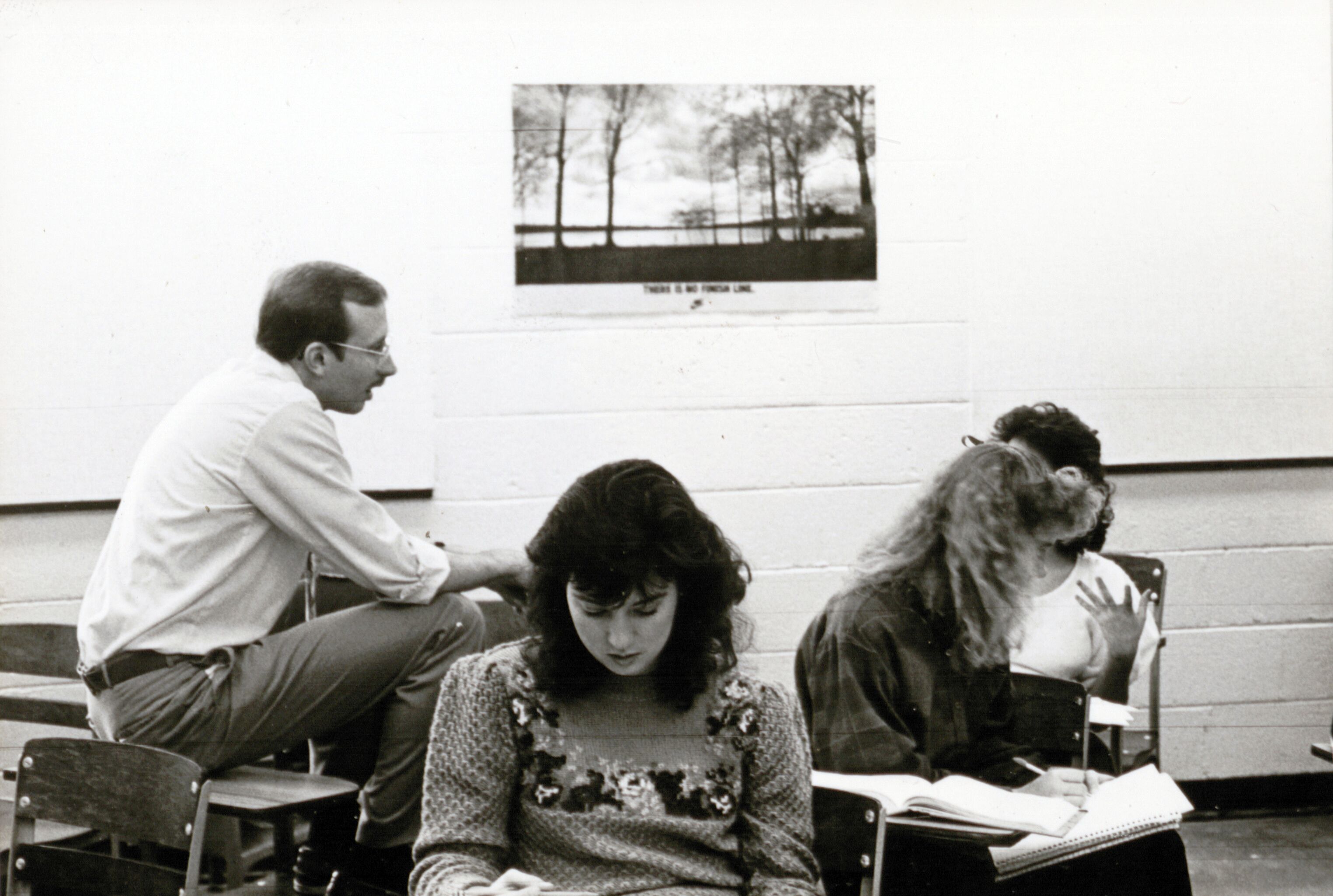
In both my K-12 and higher education positions, for example, I have practiced de-grading and de-testing the classroom because I teach pre-service teachers about the inherent counter-educational problems with traditional grades and tests.
Now, here is the paradox: As both a teacher and teacher educator my answer to “Does instruction matter?” is complicated because I genuinely believe (1) teacher instructional practices are not reflected in measures of student achievement as strongly (or singularly) as people believe and therefore, (2) yes and no.
The two dominant education reform movements over the past five decades I have experienced are the accountability movement (standards and high-stakes testing) and the current “science of reading” movement.
The essential fatal flaw of both movements has been a hyper-focus on in-school education reform only, primarily addressing what is being taught (curriculum and standards) and how (instruction).
I was nudged once again to the question about instruction because of this Tweet:
I am deeply skeptical of “The research is clear: PBL works” because it is a clear example of hyper-focusing on instructional practices and, more importantly, it is easily misinterpreted by lay people (media, parents, and politicians) to mean that PBL is universally effective (which is not true of any instructional practice).
Project-based learning (PBL) is a perfect example of the problem with hyper-focusing on instruction; see for example Lou LaBrant confronting that in 1931:
The cause for my wrath is not new or single. It is of slow growth and has many characteristics. It is known to many as a variation of the project method; to me, as the soap performance. With the project, neatly defined by theorizing educators as “a purposeful activity carried to a successful conclusion,” I know better than to be at war. With what passes for purposeful activity and is unfortunately carried to a conclusion because it will kill time, I have much to complain. To be, for a moment, coherent: I am disturbed by the practice, much more common than our publications would indicate, of using the carving of little toy boats and castles, the dressing of quaint dolls, the pasting of advertising pictures, and the manipulation of clay and soap as the teaching of English literature. (p. 245)
LaBrant, L. (1931, March). Masquerading. The English Journal, 20(3), 244-246. http://www.jstor.org/stable/803664
LaBrant and I both are deeply influenced by John Dewey’s progressive philosophy of teaching (noted as the source for PBL), but we are also both concerned with how the complexities of progressivism are often reduced to simplistic templates and framed as silver-bullet solutions to enormous and complex problems.
As LaBrant notes, the problem with PBL is not the concept of teaching through projects (which I do endorse as one major instructional approach), but failing to align the project in authentic ways with instructional goals. You see, reading a text or writing an essay is itself a project that can be authentic and then can be very effective for instruction.
My classrooms are driven, for example, by two instructional approaches—class discussions and workshop formats.
However, I practice dozens of instructional approaches, many planned but also many spontaneously implemented when the class session warrants (see Dewey’s often ignored concept of “warranted assertion”).
This is why Deweyan progressivism is considered “scientific”—not because we must use settled science to mandate scripted instructional practices but because teaching is an ongoing experiment in terms of monitoring the evidence (student artifacts of learning) and implementing instruction that is warranted to address that situation and those students.
So this leads to a very odd conclusion about whether or not instruction matters.
There are unlikely any instructional practices that are universally “good” or universally “bad” (note that I as a critical educator have explained the value of direct instruction even as I ground my teaching in workshop formats).
The accountability era wandered through several different cycles of blame and proposed solutions, eventually putting all its marbles in teacher quality and practice (the value-added methods era under Obama). This eventually crashed and burned because as I have noted here, measurable impact of teaching practice in student achievement data is very small—only about 10-15% with out-of-school factors contributing about 60-80+%.
The “science of reading” movement is making the exact same mistake—damning “balanced literacy” (BL) as an instructional failure by misrepresenting BL and demonizing “three cueing” (see the second consequence HERE, bias error 3 HERE, and error 2 HERE).
Here is a point of logic and history to understand why blaming poor reading achievement on BL and three cueing: Over the past 80 years, reading achievement has never been sufficient despite dozens of different dominant instructional practices (and we must acknowledge also that at no period in history or today is instructional practice monolithic or that teachers in their classrooms are practicing what is officially designated as their practice).
In short, no instructional practice is the cause of low student achievement and no instructional practice is a silver-bullet solution.
Therefore, does instruction matter? No, if that means hyper-focusing on singular instructional templates for blame or solutions.
But of course, yes, if we mean what Dewey and LaBrant argued—which is an ongoing and complicated matrix of practices that have cumulative impact over long periods of time and in chaotic and unpredictable ways.
From PBL to three cueing—no instructional practice is inherently right or wrong; the key is whether or not teachers base instructional practices on demonstrated student need and whether or not teachers have the background, resources, teaching and learning conditions, and autonomy to make the right instructional decisions.
Finally, hyper-focusing on instruction also contributes to the corrosive impact of marketing in education, an unproductive cycle of fadism and boondoggles.
In the end, we are trapped in a reform paradigm that is never going to work because hyper-focusing on instruction while ignoring larger and more impactful elements in the teaching/learning dynamic (out-of-school factors, teaching and learning conditions, etc.) creates a situation in which all instruction will appear to be failing.
Reforming, banning, and mandating instruction, then, is fool’s gold unless we first address societal/community and school inequities.

The 2010s into the 2020s has been another decade of high-intensity concern for reading achievement by students, resulting in several rounds of reading policy reform.
Maren Aukerman (University of Calgary) has recently joined a growing number of literacy scholars [1] who are documenting how that high-intensity concern for reading is significantly misleading and misguided.
In her third and final post, Aukerman makes an important plea:
Kick the polarization monster to the curb whenever writers practice divisive reporting: refuse to accept flawed premises and call media outlets out on it, whether you are drawn more toward balanced literacy or more toward what gets called “the science of reading” – or if neither term adequately describes your approach.
My exhortation to education journalists is simpler still. Acknowledge that reading teaching and research are complex; follow best practices for journalism to avoid the aforementioned errors; read a range of high-quality research that takes different perspectives; don’t use the phrase “science of reading” unless you acknowledge it as multi-faceted, evolving, and the domain of all serious reading researchers; and remain curious and open-minded. And finally, stop feeding the polarization monster with what you write. Reading educators and other stakeholders all want children to read well, after all, and we need each other’s voices, perspectives, and research in conversation rather than in battle in order to best make that happen.
The Science of Reading and the Media: How Do Current Reporting Patterns Cause Damage?
I strongly agree with Aukerman not only in the analysis of media coverage of the “science of reading,” but also for this plea.
What we need is a new (and honest) reading story for 2023.
The essential problem is that the current reading story is driven by oversimplification and sensationalistic anecdotes that are being leveraged to attack and blame singular causes for another reading “crisis.”
Let’s start the new story by admitting the following:
We need, then, a new (and honest) reading story that “[k]ick[s] the polarization monster to the curb,” calls for a different approach to reading policy reform, and includes the following:
Out-of-School Policy
In-School Policy
A new (and honest) reading story is not as sexy as the tired reading war story that depends on crisis rhetoric and simplistic good v. bad characters.
A new (and honest) reading story also isn’t simple, and complexity as well as nuance can be frustrating and even counter-intuitive (see the OOS list above).
And a new (and honest) reading story is quite frankly hard to swallow: The reality is that human behavior (including student learning) will always fall along a spectrum at any identified point. We can never achieve “all third graders will be proficient readers.”
Yes, grade 3 is important, but we would all do better to acknowledge that grades 3 through 8 are key years over which we must be diligent about purposefully monitoring student progress and providing the instruction each student needs regardless of where that student falls on the spectrum of achievement.
We have a recent example of the inherent failure of 100% proficiency goals (NCLB), and students will be much better served if our new (and honest) reading story includes patience and realistic goals.
Frankly, I do not believe in compromise or taking a middle-of-the-road approach. I do believe that we need a community effort to address individual student needs that is grounded in honesty and accuracy, which is often messy and still in a state of becoming.
I strongly advocate for addressing OOS factors first or concurrently with establishing equity goals for in-school reform, but I also advocate for starting our reading reform with classroom teachers and literacy scholars—acknowledging that these key stakeholders will not universally agree.
“It is essential that translational research include, rather than blame and devalue, teachers and teacher educators,” as MacPhee, Handsfield, and Paugh conclude.
The current state of reading “science” and evidence is actually a powerful debate with strong elements of agreement and several key areas of evolving understanding rooted in disagreement.
Demanding lock-step adherence to “settled” science is a fatal flaw of the “science of reading” story.
A new (and honest) reading story admits that classroom practice is (and will always be) in a constant state of becoming, just as all science and research are.
Finally, we cannot persist in allowing mainstream media and social media to create the reading story that results in reading policy.
That’s an old and failed story.
We need and deserve instead a new (and honest) reading story in 2023.
[1] Media Coverage of SOR [access materials HERE]
Hoffman, J.V., Hikida, M., & Sailors, M. (2020). Contesting science that silences: Amplifying equity, agency, and design research in literacy teacher preparation. Reading Research Quarterly, 55(S1), S255–S266. Retrieved July 26, 2022, from https://doi.org/10.1002/rrq.353
MacPhee, D., Handsfield, L.J., & Paugh, P. (2021). Conflict or conversation? Media portrayals of the science of reading. Reading Research Quarterly, 55(S1), S145-S155. Retrieved July 26, 2022, from https://doi.org/10.1002/rrq.384
Cryonics Phonics: Inequality’s Little Helper – New Politics
[UPDATE]
The Science of Reading and the Media: Is Reporting Biased?, Maren Aukerman, The University of Calgary
The Science of Reading and the Media: Does the Media Draw on High-Quality Reading Research?, Maren Aukerman
The Science of Reading and the Media: How Do Current Reporting Patterns Cause Damage?, Maren Aukerman
[Aukerman three posts as PDF]
Making sense of reading’s forever wars, Leah Durán and Michiko Hikida
After about a decade blogging on other open sites and dabbling in social media as part of my public work, I committed to blogging at WordPress in 2013, and to date, had my highest traffic year in 2014.
Between my Twitter presence and blog, I always expected to have a greater reach at Twitter, but by 2022, I have just short of 8000 followers on Twitter and over 10,000 at this blog.
As part of my current fall sabbatical, I revised and redesigned this blog to make it more appealing and (I hope) to better present the work as professional (blogs continue to be discounted and marginalized despite the vast majority of my posts being heavily cited).
I am on track for 2022 to be the third or second best year:

And here are my top 10 posts of 2022 (eight original to this year):

Access these posts as follows:
While the “science of reading” dominated my work, I am quite proud of my comic book posts throughout 2022, notably my series on Black Widow and my frequent posts on my collecting Daredevil.
I also want to highlight two of my scholarly projects:
Why do I blog?
Primarily, I am a writer and writing is who I am so blogging is a wonderful way to write and draft, a way to think through important issues while also contributing to the public discourse that drives not only what people think but actual policy.
Also, blogs are accessible (essentially free to anyone who have internet access), and I feel far more valuable and effective than traditional scholarship that sits behind paywalls.
I have been an educator for almost 40 years, shouting the entire time that we mostly do this thing called education badly because we are thinking wrong or simply stuck in a rut of doing things only one way (for education, that way is “Crisis!> reform > Crisis! > reform, etc.).
Yet, I think we can do better, and I know we should.
Thank you for reading because that is the thing we writers are mostly seeking—those genuinely and sincerely engaged in the ideas we are drawn to interrogate and explore.
Let us hope for a better, more kind and peaceful 2023.
[Header Photo by Chi Xiang on Unsplash]
The word “theory” is a technical term in the sciences that doesn’t mean “guessing.” “Theory” is not “hypothesis,” even as “hypothesis” isn’t really guessing either (maybe it is an educated guess).
Yet, average people tend to use “theory” as just a guess. That tension between laypeople and scientists is central to many problem with attempting to create evidence-based (“scientific”) policy in the context of media, public, and political debate that is mostly among laypeople.
Reading theory is rarely labeled “theory” in those debates among laypeople. Popular labels, such as “whole language,” often lose their theory origin and become teacher practice.
About a decade into teaching high school English, I taught a group of tenth graders with whom I immediately bonded (and was fortunate to teach again as seniors). Many of these students, now well into their 40s, remain friends of mine.
This class was very bright and genuinely eager to learn, but they were also driven to be “pleasers.” I worked hard to help them become more independent thinkers (instead of being incredibly compliant).
The worst way that urge to do the right thing hindered these students is reading. Early in the course, they pleaded with me that they could not read the assigned texts as fast as I wanted. This seemed odd because no class had ever complained about that, and the amount was quite manageable.
We set aside a class period to discuss how they read and such. What I learned was that these students in the early 1990s had been taught (or learned) that reading is done letter-by-letter to create words and word-by-word to create complete thoughts.
And there was their problem with reading speed.
I shared with them an epiphany I had in my MEd program during a course on early literacy. In that class we discusses how proficient and fast readers actually read. The process is much closer to what many would call skimming (“reading” large chunks at a time) and includes skipping as well as continually reading faster until the reader senses a loss of meaning before circling back.
My epiphany was that this described me perfectly as a reader, but I had always thought I was doing something wrong for not sticking to letter-by-letter and then word-by-word.
The discussion freed many of these students from a perception of reading that simply wasn’t accurate.
That explanation of highly proficient readers is also a story about reading as guessing and why reading theory remains a debate and not settled science.
The current “science of reading” movement depends heavily on melodramatic anecdotes to drive a narrative about reading and teaching reading that is overly simplistic and often simply wrong (see Media Coverage of SOR HERE).
One of those anecdotes portrays a teacher prompting a student struggling to read simply to guess at the words instead of using any sort of decoding strategy (what most people would call “sounding it out”).
So a key issue in the current reading debate is “guessing.”
To understand how “guessing” is part of the debate, we have to return to “theory.”
Whole language is a reading theory that is strongly associated with scholar Ken Goodman (see Whole Language HERE). In the 1960s, Goodman published Reading: A Psycholinguistic Guessing Game.
Goodman’s stated purpose in the piece is as follows:
Simply stated, the common sense notion I seek here to refute is this:
“Reading is a precise process. It involves exact, detailed, sequential perception and identification of letters, words, spelling patterns and large language units.”
In phonic centered approaches to reading, the preoccupation is with precise letter identification. In word centered approaches, the focus is on word identifications. Known words are sight words, precisely named in any setting.
Reading: A Psycholinguistic Guessing Game
And his alternative, where the issue with “guessing” has its roots:
In place of this misconception, I offer this: Reading is a selective process. It involves partial use of available minimal language cues selected from perceptual input on the basis of the reader’s expectation. As this partial information is processed, tentative decisions are made to be confirmed, rejected, or refined as reading progresses.
More simply stated, reading is a psycholinguistic guessing game. It involves an interaction between thought and language. Efficient reading does not result from precise perception and identification of all elements, but from skill in selecting the fewest, most productive cues necessary to produce guesses which are right the first time. The ability to anticipate that which has not been seen, of course, is vital in reading, just as the ability to anticipate what has not yet been heard is vital in listening.
Reading: A Psycholinguistic Guessing Game
While Goodman noted later that “guessing” may have not been the best choice, whole language proposed a theory of reading that valued meaning over accurately reading every word. And while the pervasiveness of whole language in K-12 education, I think, is greatly overstated, elements of holistic and workshop approaches certainly impacted practice and informed what would later be called “balanced literacy.”
The problem with “guessing” is the same as the problem with “theory”; both have very specific meanings in science and quite different (and often negative) meanings in day-to-day use.
And when theory is translated into practice, it is entirely possible, even likely, that some practitioners misunderstand and misuse “guessing.”
But it is quite a huge leap, as the “science of reading” movement has done, to announce that we have a unique reading crisis now that can be traced to teacher education teaching “guessing” and a couple reading programs that rely exclusively on “guessing.”
That “guessing” is also being identified (and even banned by some states) as “three cueing.”
So there are a few things to note about Goodman’s “guessing.”
First, that essay and idea is well over forty years ago; Goodman himself noted that he would later in his career have written a much different piece.
Next, the line between Goodman’s theorizing and the use of “guessing” or “three cueing” is complicated and extremely long.
Finally, it is much better to have a debate about reading theory and practice if we all agree to use important terms accurately. Here is a great and well cited overview of “multiple cueing”:
In some cases, proponents of structured literacy approaches have denigrated instructional practices that attend to multidimensional aspects of reading. For example, Spear-Swerling (2019) argued against encouraging students to attend to multiple-cueing systems when reading. Arguing that explicit teaching of decoding/phonics skills should dominate reading instruction, she warned against coaching students to use “meaning in conjunction with print cues and having students ‘problem-solve’ with teacher guidance (e.g., Burkins & Croft, 2010)” (p. 205). Spear- Swerling cited two reports (Foorman et al., 2016; National Institute of Child Health and Human Development, 2000) to argue that “research on students’ reading development… has conclusively disproven the multiple-cuing-systems model” (p. 206), although neither of these reports directly addressed or tested that model.
This rally against multiple-cueing systems models has been reiterated by scholars (Paige, 2020) and journalists (Hanford, 2018, 2019, 2020). Although it may be true that as readers become more proficient, they attend less to illustrations, this does not negate the role that illustrations play in helping young students learn to attend to meaning while reading. In short, drawing students’ attention to illustrations is one means of helping them attend to the stories and information presented in texts. Learning to attend to meanings that emerge while reading is essential for understanding both the simple and increasingly complicated texts that students encounter as they become skilled readers. Describing multiple-cueing systems models as having students draw on “partial visual cues to guess at words (Adams, 1998; Rayner & Pollatsek, 1989; Solman & Stanovich, 1992; Stanovich, 1986)” (Paige, 2020, p. 13) misrepresents these models and ignores the important role of illustrations as tools for learning to access and monitor meaning construction.
Compton-Lilly, C.F., Mitra, A., Guay, M., & Spence, L.K. (2020). A confluence of complexity: Intersections among reading theory, neuroscience, and observations of young readers. Reading Research Quarterly, 55(S1), S185-S195. Retrieved July 26, 2022, from https://doi.org/10.1002/rrq.348
In 2022, scholars of literacy have moved beyond Goodman’s initial theories of whole language, but they have also moved on from the “simple” view of reading (yet, SOR continues to blame whole language and balanced literacy while endorsing the “simple” view).
And the current state of reading theory remains a debate, not settled science. And that debate has those who focus on letters, sounds, words, and meaning versus those who envision proficient readers who scan text and create meaning through dozens of strategies, many of which aren’t grounded in letters and words.
This is more of a theory than a guess, but our only hope of not continuing the cycle of reading crisis, reform, reading crisis, reform, etc., we must begin to understand the complexities of reading and teaching reading instead of declaring winners and losers in order to play the blame game.
[Header Photo by Greg Rosenke on Unsplash]
While Paulo Freire is strongly associated with critical pedagogy, I often remind myself that Freire came to his philosophy of teaching and learning through his commitment to teaching adults to read and write.
The U.S. finds itself repeatedly in a state of crisis-paralysis because people periodically discover illiteracy and aliteracy among our students and even adults.
The irony of the nearly nonstop and melodramatic cries of “reading crisis” is that the need for literacy always remains vital for human autonomy, human dignity, and human freedom, but the crisis approach always fails that need.
The problem is that public fears around illiteracy and aliteracy are often overly simplistic, and then calls for solving the “reading crisis” are equally simplistic.
The current Reading War driven by the “science of reading” movement is once again repeating that failed dynamic, notably by claiming that the simple view of reading (SVR) is the current and settled reading science (it isn’t; see here).
And concurrent with this Reading War is a dramatic rise in censorship and book banning—yet another layer of misunderstanding reading and teaching/learning.
Since we seem destined to remain stuck in misreading reading, I want to share Freire’s The Importance of the Act of Reading as an ideal text to reconsider what reading is and why literacy is central to the human condition.
First and vital to understanding literacy, Freire begins by asserting “the practice of teaching—which is political practice as well.”
In other words, teaching reading and any reading done by students (or anyone) are inherently political acts—behaviors that necessarily place humans in situations of power imbalances.
Freire’s meditation on reading was originally presented as a talk in Brazil in 1981. Then, Freire challenged the mechanical and reductive view of reading:
Reading is not exhausted merely by decoding the written word or written language, but rather anticipated by and extending into knowledge of the world. Reading the world precedes reading the word, and the subsequent reading of the word cannot dispense with continually reading the world. Language and reality are dynamically intertwined. The understanding attained by critical reading of a text implies perceiving the relationship between text and context.
The Importance of the Act of Reading, Paulo Freire
One side of the reading debate often focuses on isolated text-only approaches that argue for phonics-first and/or systematic phonics instruction for all before addressing comprehension (or critical comprehension, which is often only approached for some students deemed “advanced”).
Freire, however, grounds reading in the context of reading the world before beginning to decode text for meaning.
In short, context matters, and lived experiences form the basis of anyone acquiring reading and writing. This is key to understanding the problem with focusing exclusively or primarily on in-school reading and writing instruction.
If we in the U.S. value reading for all students and adults, we must acknowledge that addressing the lived experiences of all people—eliminating poverty, food insecurity, job insecurity, etc.—is an essential aspect of needed reading policy.
Simply changing how we teach reading will never achieve the goals we claim to have.
And in this talk, Freire used his own experiences to think aloud and complexly about reading:
I put objective distance between myself and the different moments in which the act of reading occurred in my existential experience: first, reading the world, the tiny world in which I moved; afterwards, reading the word, not always the word-world in the course of my schooling.
The Importance of the Act of Reading, Paulo Freire
Yes, young students must make the transition from reading their world to reading the word, but those acts of reading cannot (and should not) be separated (think of the reductive practice of having students pronounce nonsense words).
Freire speaks not only to acquiring reading, but also to why we read—and this is a powerful refuting of the rise in censorship and book bans being imposed by some parents onto all parents and students:
As I became familiar with my world, however, as I perceived and understood it better by reading it, my terrors diminished.
It is important to add that reading my world, always basic to me, did not make me grow up prematurely, a rationalist in boy’s clothing. Exercising my boy’s curiosity did not distort it, nor did understanding my world cause me to scorn the enchanting mystery of that world. In this I was aided rather than discouraged by my parents.
It was precisely my parents who introduced me to reading the word at a certain moment in this rich experience of understanding my immediate world.
The Importance of the Act of Reading, Paulo Freire
Like Freire, my journey to literacy was enthusiastically driven by my parents and their commitment to me having free access to essentially anything I wanted to read. And like Freire, I had that freedom significantly reinforced by teachers when I was in high school:
I would like to go back to a time when I was a secondary-school student. There I gained experience in the critical interpretation of texts I read in class with the Portuguese teacher’s help, which I remember to this day. Those moments did not consist of mere exercises, aimed at our simply becoming aware of the existence of the page in front of us, to be scanned, mechanically and monotonously spelled out, instead of truly read. Those moments were not reading lessons in the traditional sense, but rather moments in which texts were offered to our restless searching, including that of the young teacher, Jose Pessoa.
The Importance of the Act of Reading, Paulo Freire
Reading and all literacy as well as formal and informal education are human ways of coming to understand the world—including the dark and light—so that we gain agency in our living, so that we are not paralyzed by fear and ignorance.
The why and how of reading, then, are not mere mechanics, but a complex process of critical comprehension:
Mechanically memorizing the description of an object does not constitute knowing the object. That is why reading a text taken as pure description of an object (like a syntactical rule), and undertaken to memorize the description, is neither real reading, nor does it result in knowledge of the object to which the text refers.
The Importance of the Act of Reading, Paulo Freire
And regardless of the simplistic calls by Republicans and conservatives to “just teach” and to not be political, we must recognize that all teaching, learning, and literacy are political acts. As he did throughout his career, Freire denounced the banking concept of teaching that erases human agency and views students as empty piggy banks into which teachers deposit value:
First, I would like to reaffirm that I always saw teaching adults to read and write as a political act, an act of knowledge, and therefore as a creative act. I would find it impossible to be engaged in a work of mechanically memorizing vowel sounds, like in the exercises ba-be-bi-bo-bu, la-le-li-lo-lu. Nor could I reduce learning to read and write merely to learning words, syllables, or letters, a process of teaching in which the teacher fills the supposedly empty heads of the learners with his or her words. On the contrary, the student is the subject of the process of learning to read and write as an act of knowing and a creative act. The fact that he or she needs the teacher’s help, as in the pedagogical situation, does not mean that the teacher’s help annuls the student’s creativity and responsibility for constructing his or her own written language and reading this language.
The Importance of the Act of Reading, Paulo Freire
Freire builds to this: “Reading the world always precedes reading the word, and reading the word implies continually reading the world.”
Reading is not simply decoding text or recognizing whole words. Reading is context, and reading requires context—a context that is far more than letters, sounds, words, sentences, and paragraphs.
Reading is a very human and individual act because “reading always involves critical perception, interpretation, and re-wrìting what is read,” which is how Freire wrote his talk before sharing it aloud as yet another act of re-reading in order to re-write.
Freire’s essay anchors this award-winning volume: The SAGE handbook of critical pedagogies.






 dr. p.l. (paul) thomas