Category Archives: literacy

What Should Students Do with Text?: From Interpretation to Interrogation

Over the first week or so of my first-year writing seminars, I carefully explain to students that the course is not an English class, but a composition class.

Most students have experienced writing assignments primarily in English classes and often anchored to literary analysis (interpreting fiction and poetry grounded in New Criticism or “close reading” assumptions about analysis).

In our composition class, we explore many texts, but are mostly examining non-fiction and the essay form. A guiding structure I used with high school students (including those preparing to take Advanced Placement exams in literature) and continue to use in first-year writing is to ask the following questions when engaging with text:

  • What is the author saying or arguing?
  • How is the author making that case?
  • Why does it matter to the reader?

The transition I am addressing for composition courses is away from literary analysis, interpreting text, and toward reading like a writer, interrogating text (something my students encounter in John Warner’s The Writer’s Practice).

However that same transition should also occur in literary analysis since traditional interpretation tends to focus on a static and misguided view of meaning—such as the “close reading” argument that meaning exists only in the four corners of that text.

Texts in a composition course that focuses on students as essay writers tend to serve as models for the writer’s craft as well as how to create and maintain the writer’s authority (specially in scholarly writing). I often tell students to mine those models of the essay for the “how” in the the three questions above—rhetorical strategies, literary techniques, organizational structure, etc.

Too often, I have noticed that traditional interpretation of fiction and poetry does not serve students well who are likely to navigate college in ways that never ask them to interpret fiction and poetry but that do require them to construct original essays that investigate and interrogate complex ideas, disciplinary knowledge across many disciplines, and non-fiction texts.

As just one example of the high school/college disconnect I have highlighted often, students tend to leave high school believing they should have MLA citation memorized only to discover a vast array of citation styles and the expectation that they know how to use the style guide assigned (and not memorize formatting).

One way to bridge the disconnect between high school English and first-year writing as well as writing expectations in college is implementing interrogation instead of interpretation at all level.

Reading like a writer in a composition course (see here and here) matches well experiences interrogating literature (fiction and poetry) since the larger concept is not identifying a fixed meaning, but considering and contesting many aspects of the text—such as writer intent, writer craft, and the role of the reader in creating meaning.

For example, consider Lavina Jadhwani’s approach to Shakespeare: Dismantling Anti-Black Linguistic Racism in Shakespeare.

In an interview, Jadhwani explains:

I spent a long time thinking Shakespeare’s plays were inaccessible to me: Either I didn’t have the “right” training or I wasn’t in the “right” circle. I wasn’t getting invited to direct them. I spent a long time feeling like I wasn’t worthy, and I think a lot of people feel that way.

This experience, I think, comes from how Shakespeare is taught, the focus on so-called objective interpretation of text that ignores the role of the reader as well as the many historical contexts of any text.

More specifically, Jadhwani explains how to approach Shakespeare through an anti-blackness lens (interrogating):

The document I created started with the word that starts with an “n” and means miserly. I don’t use that word, and I don’t see a reason for it. If you are a Black artist who has a different relationship to that word and feel like you want to reclaim it or use it in a certain way, I say, “Go for it.” As a non-Black artist, I only know the harm that word does, and “miserly” is just as good. It’s clearer. It scans. There’s no reason not to use it.

If there’s an instance where the word “slave” does harm and the word “knave” doesn’t, I think you can change it. I don’t know if that word did harm to Shakespeare’s audiences, but it can to ours. In an instance like that, I believe that making a substitution is actually closer to honoring Shakespeare’s original intention.

Further, this approach moves away from seeing any text as the ends, the goal, of instruction, and moves the text to a means to a much richer range of goals.

For example, Jadhwani’s anti-blackness guide invites students to consider and reconsider “cancel culture,” the historical context of Shakespeare’s language and Elizabethan culture, and their contemporary association with language, race, and racism.

To interrogate Shakespeare is to ask far more of teachers and students than the traditional interpretation process that restricts students to the text and evaluates the student against a singular and authoritarian meaning.

Even as high school English remains primarily courses in literature (with an emphasis on fiction and poetry), students need a much better foundation for writing in college or in the workplace. I am not rejecting the value of fiction and poetry or writing literacy analysis.

Literature and composition goals are different, and both valid. But we should find ways that those goals are symbiotic and not in conflict.

To achieve that, students should be invited to interrogate and not simply interpret text with their own reading and writing goals in mind.

Critical Literacy, Not Nonsense Literacy

At 59 with almost 40 years experience as an educator (focusing on literacy) and writer, I remain someone who struggles with spelling.

And when I come across an unfamiliar word, I ask around until I find someone who can pronounce it aloud for me; I have never really tried to “sound it out”—even though I have intuited a huge amount of letter/sound patterns in the English language.

Also, as a Southerner, my common pronunciation of many words doesn’t quite align with the so-called “proper” pronunciation of many words; I can make one-syllable words two syllables, and choke two-syllable words into one.

“Hell” is one of my better versions of the former.

More like “hey-uhl.”

None the less, I am a highly literate person with a reading and writing background that outpaces most people in sheer volume significantly. I also love language and the history of the English language.

After fumbling my way earnestly through a decade or more of teaching high school English and honing my craft as a writer, I discovered critical pedagogy and critical literacy in my 30s during my doctoral program. That “discovery” was simply a recognition of an ideology and practice I had already been attempting to grasp daily as a teacher, but finding this philosophy already existed was deeply liberating—and crucial for my own practice as an educator of literacy.

I have a very firm appreciation for and understanding of the holistic nature of literacy, but I also am an ardent advocate for critical literacy as the ultimate goal of reading and writing instruction.

My commitments to holistic and critical literacy have resulted in a career-long battle with advocates of isolated and intensive grammar and phonics instruction (what I frame as grammar/phonics as the goal of instruction, not as authentic components of broader literacy goals such as critical literacy).

For a couple years now, I have been confronting the most recent Reading War, often labeled as the “science of reading,” which is another veneer for advocates of systematic intensive phonics for all students.

The general public, likely, isn’t aware that “phonics” isn’t a monolithic instructional practice or concept; within the field of phonics, there is debate (such as synthetic approach versus analytic phonics).

The systematic intensive phonics being advocated for all students by proponents of the “science of reading” includes a focus on teaching students to decode nonsense words (such as the assessment DIBELS).

The embracing of teaching and assessing nonsense words is a central concern for me as a holistic and critical literacy teacher.

Consider this from Nicola Yelland:

Advocates of the phonics screening tests claim that they are fun. In fact, for fluent readers, it can destroy their recognition as competent readers. In one school example, a boy who came to school reading, and who continued to flourish as a fluent reader, scored 2/40! Since the test includes nonsense words in the quest to focus on decoding (he read “elt” as “let,” “sarps” as “rasp,” and “chab” as “cab,” to foreground a few). What he seemed to be doing was re-arranging the letters or sounds and reconstructing them into recognizable words that he knew made sense. Meanwhile, another child whom the teacher regarded as not being a fluent reader was able to sound out the nonsense words as well as regular words and achieve a score of 16/40, all without knowing their meaning. Thus, the raw scores from the test of each child give us no information about them as readers and how they can make meaning from text; they simply show how they decode words out of context.

Adoniou (2018) has pointed out that while the phonics screening test scores are increasing in the United Kingdom where it was introduced in 2011, with children improving in their ability to read words like “kigh” and “queep,” reading comprehension scores have not improved. So, the claims of success of teaching with the phonics approach would seem to be premature. She also notes that the assertion that the test has given teachers more data with which to support children struggling with reading is false. There is no evidence that test results data was any better than the teachers’ professional judgements. Some of the synthetic phonics “kits” include 80 hours of lessons for 20 weeks in small groups of no more than four children. This requires high-level resourcing for systems, and while research revealed improved skills in phonemic awareness and letter sound knowledge, as that is what the 80 hours was designed for, there were “no better outcomes on reading whole passages of text” (Quach et al., 2019, p. 8).

Here is the crux of the ultimate failure of the “science of reading” movement; it embraces nonsense literacy, claiming it is a necessary step on the journey toward comprehension for all students.

That is, at best, a tenuous claim, but it does expose the anaemic view of literacy and incomplete goals of the “science of reading” movement, which fails to reach for (or even acknowledge) critical literacy for all students and seeks to justify spending precious time on nonsense with children—time that could and should be better spent in rich and authentic literacy experiences.

As Yelland’s example above shows, nonsense is a distraction from sense-making in reading; however, nonsense makes for very manageable (and profitable) “phonics instruction.”

It shouldn’t have to be stated, but let me be clear, for children learning to read, we must choose critical literacy over nonsense literacy.

Fact Checking the “Science of Reading”: A Quick Guide for Teachers

Fact Checking the “Science of Reading”: A Quick Guide for Teachers

Download a PDF here

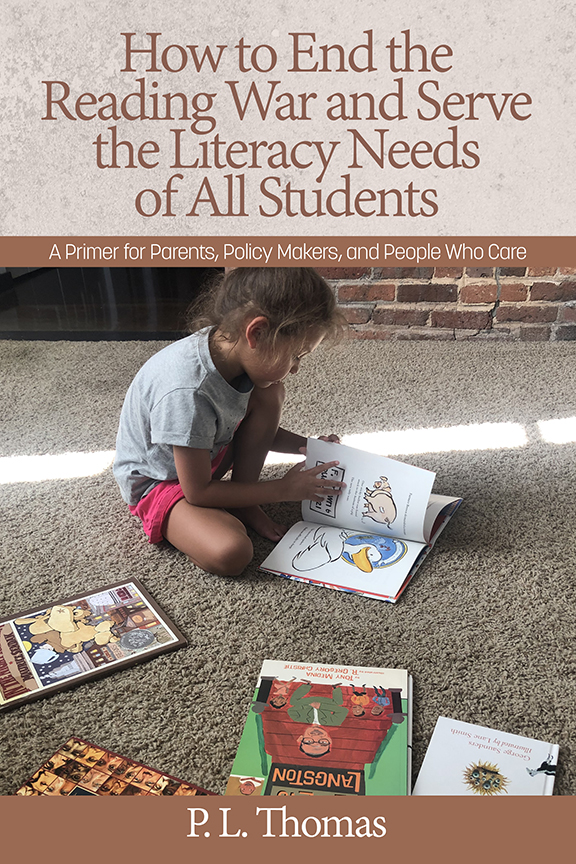
Thomas, P.L. (2020). How to end the Reading War and serve the literacy needs of all students: A primer for parents, policy makers, and people who careCharlotte, NC: Information Age Publishing.


Recent Research Refuting “Science of Reading” Claims

Dyslexia

Johnston, P., & Scanlon, D. (2021). An examination of dyslexia research and instruction with policy implications. Literacy Research: Theory, Method, and Practice70(1), 107–128. https://doi.org/10.1177/23813377211024625

Science

Yaden, D.B., Reinking, D., & Smagorinsky, P. (2021). The trouble with binaries: A perspective on the science of reading. Reading Research Quarterly, 56(S1), S119– S129. https://doi.org/10.1002/rrq.402

Balanced Literacy and Whole Language

Semingson, P., & Kerns, W. (2021). Where is the evidence? Looking back to Jeanne Chall and enduring debates about the science of reading. Reading Research Quarterly, 56(S1), S157– S169. https://doi.org/10.1002/rrq.405

 “Simple” View of Reading

Duke, N.K., & Cartwright, K.B. (2021). The science of reading progresses: Communicating advances beyond the simple view of reading. Reading Research Quarterly, 56(S1), S25– S44. https://doi.org/10.1002/rrq.411

Filderman, M. J., Austin, C. R., Boucher, A. N., O’Donnell, K., & Swanson, E. A. (2022). A meta-analysis of the effects of reading comprehension interventions on the reading comprehension outcomes of struggling readers in third through 12th grades. Exceptional Children88(2), 163–184. https://doi.org/10.1177/00144029211050860

State-Level Reading Policy

Cummings, A. (2021). Making early literacy policy work in Kentucky: Three considerations for policymakers on the “Read to Succeed” act. Boulder, CO: National Education Policy Center. https://nepc.colorado.edu/publication/literacy

Collet, V.S., Penaflorida, J., French, S., Allred, J., Greiner, A., & Chen, J. (2021). Red flags, red herrings, and common ground: An expert study in response to state reading policy. Educational Considerations, 47(1). https://doi.org/10.4148/0146-9282.2241

National Education Policy Center & Education Deans for Justice and Equity (2020). Policy statement on the “science of reading.” Boulder, CO: National Education Policy Center. http://nepc.colorado.edu/publication/fyi-reading-wars

Intensive Systematic Phonics

Wyse, D., & Bradbury, A. (2022). Reading wars or reading reconciliation? A critical examination of robust research evidence, curriculum policy and teachers’ practices for teaching phonics and reading. Review of Education, 10, e3314. https://doi.org/10.1002/rev3.3314

Bowers, J.S. (2020).Reconsidering the evidence that systematic phonics is more effective than alternative methods of reading instruction. Educational Psychology Review, 32(2020), 681–705. https://link.springer.com/article/10.1007%2Fs10648-019-09515-y

“Science of Reading” Advocacy Stumbles, Falls

First, the stumble.

Yet another education journalist (also identified as a novelist and historian), Natalie Wexler, has weighed in on the “science of reading” (SoR). Wexler isn’t an educator, and she seems to suffer from the Columbus Syndrome far too common among journalists covering education.

I am not linking to the article, but it has already been updated since Wexler has received strong challenges to her tactics in this over-stated and misleading article

Accompanying the standard misrepresentations about teaching reading in the U.S., Wexler attempts to cast an accusatory shadow—invoking racism—over teaching reading by joining the “science of reading” propaganda movement.

However, Zaretta Hammond set the record straight on Twitter. In brief, Hammond challenges Wexler’s jumbled attempts at calling out racism and misguided references to recent racist police violence as well as implicating Hammond’s work in Wexler’s claims.

As Hammond notes, Wexler’s failure exposes the problems with fanning a Reading War that, once again, keeps our gaze on so-called failed students and failing teachers instead of systemic inequity and racism.

Wexler is wrong about reading and racism, but the criticism her article prompted has only nudged her to retract the racism stumbles, whitewashing her mistakes by apologizing on Twitter and revising her article.

Now, the fall.

One of the most damaging aspects of the “science of reading” movement has been how swiftly advocates of SoR and dyslexia have translated their movement into state-level reading legislation.

While I have been helping literacy educators and activists resist these efforts to change state education laws, some of us saw at least a pause in the SoR momentum with the Covid-19 pandemic, an unfortunate consequence that now seems to have had unintended positive outcomes for education (flawed reading legislation not passing for financial stress prompted by the pandemic).

For example, “A bid to improve Louisiana’s dismal reading skills for its youngest students died near the legislative finish line, leaving backers baffled on just what happened,” writes Will Sentell.

The surprise at this defeat comes, as Sentell explains, because “[t]he proposal, House Bill 559, had led something of a charmed life until it wilted at the end.”

However, as with other state-level reading legislation agendas across the U.S., this bill was grounded in misinformation about reading achievement as well as claims about the “science” they claim is missing in reading instruction.

Advocacy for the SoR has a fatal flaw found in both Wexler’s article and the “charmed” but failed bill in Louisiana—a “rigid refusal” to address first and fully the systemic inequity that is at the root of all educational measurements, including reading achievement.

SoR advocacy is grounded in a deficit lens that sees only individuals (students, teachers) and measures them against very reduced and narrow ideas of what counts as “normal.”

This advocacy also falls victim to silver-bullet solutions, reducing teaching to “all students must” and suggesting that this program is better than that program (without recognizing that the problem is reducing reading instruction to any program).

SoR advocacy is a misuse of “science” and a misunderstanding of human nature and the teaching/learning dynamic.

There is a powerful relationship among measurable reading achievement by students, reading instruction provided students in formal schooling, and the corrosive persistence of racism and systemic inequity in U.S. society and schools—systemic racism and inequity.

Since the SoR playbook is wrong on all of that, as Hammond ends her Twitter thread, “Know the difference.”

See Also

NEW: How to End the Reading War and Serve the Literacy Needs of All Students: A Primer for Parents, Policy Makers, and People Who Care (IAP)

Policy Statement on the “Science of Reading”


NEW: How to End the Reading War and Serve the Literacy Needs of All Students: A Primer for Parents, Policy Makers, and People Who Care (IAP)

How to End the Reading War and Serve the Literacy Needs of All Students: A Primer for Parents, Policy Makers, and People Who Care (IAP)

amazon

Barnes and Noble

ThomasCase2

[excerpt from Introduction]

How to End the Reading War and Serve the Literacy Needs of All Students: An Overview

The chapters that follow are not intended to document how we should or can teach reading. In fact, there is abundant work that has existed since the early twentieth century to document the many and varied ways we know we should help foster students as readers from the first days of school to the last. As well, this entire book is working well outside being a how-to on teaching reading or a storehouse of research—even as I am advocating that test-driven reading policy and instruction are asking way too little of students and their teachers.

Instead, this is an informative work, focusing on the historical and current Reading War, that builds to a framework for moving beyond that war, and as the subtitle states, serving the literacy needs of all students.

Chapter 1 (A Historical Perspective of the Reading War: 1940s and 1990s Editions) offers a historical overview of crisis responses to reading, focusing on the 1940s (WWII literacy rates of soldiers) and a 1990s report spurred by NAEP. This historical perspective is often missing from media coverage of reading and reading policy debates and decisions made at the federal and state levels.

In Chapter 2 (The Twenty-First Century Reading War: “The Science of Reading,” Dyslexia, and Misguided Reading Policy), I examine the current “science of reading” phenomenon in mainstream media driven by mainstream media, Emily Hanford and Education Week as key examples, but also fueled by dyslexia advocacy, all of which has manifested themselves in education policy such as adopting grade retention based on 3rd-grade test scores and training teachers in the “science of reading.”

Chapter 3 (Misreading Reading: The Good, the Bad, and the Ugly) addresses key concepts and topics that are misunderstood but central to the media coverage of the recent Reading War, such as the following: The National Reading Panel (NRP), reading programs, balanced literacy (BL), whole language (WL), phonics, scientific research, grade retention, teacher education, and teacher autonomy.

Finally, in Chapter 4 (How to End the Reading War and Serve the Literacy Needs of All Students: Shifting Our Deficit Gaze, Asking Different Questions about Literacy), the following reforms needed to end the Reading war will be explored:

  • Social policy must be implemented to address inequity and the homes, communities, and lives of children; these socioeconomic reforms must be viewed as central to reading policy.
  • The mainstream media must abandon Christopher Columbus and both-sides journalism that addresses education/reading.
  • Reading policy must abandon ineffective and hurtful commitments that include standards, high-stakes testing, grade retention, etc.
  • Classroom and school practices must abandon reading programs and silver-bullet approaches to literacy; and teaching must be far more individualized and patient.
  • Evidence-based teaching of reading must expand the meaning of “scientific” and evidence.

In the Conclusion (The Science of Literacy: A 36-Year Journey and Counting), I challenge a narrow view of “science,” especially in terms of education and literacy.

As you read the following chapters, I want you to keep some big-picture concerns in mind: What do we ultimately mean when we talk about teaching children to read? And what does it mean for a student to be able to read?

I want you to consider this story from a high school ELA class discussion on capital punishment. As the teacher led a discussion on the death penalty, a student interjected that Texas currently uses decapitation for the death penalty. The teacher paused, and then suggested that this wasn’t true. The student hurriedly explained it was true, and that he had proof.

The student took out his smartphone, pulling up an article to show the teacher. The article was from The Onion.

Patiently, the teacher informed the student that The Onion is satire, to which the student replied, “No, it isn’t.” Keep in mind that this high school student can pronounce the words in the article; he had read the entire piece.

Are our reading standards, sacred high-stakes tests, and reading programs fostering the sort of students who are critical readers, capable of navigating a complex world better than the student above? Is this Reading War in any way addressing that problem?

Recommended

Policy Statement on the “Science of Reading”

Open Letter: Education Week’s Coverage of the Life, Career, and Death of Ken Goodman

The May 21, 2020 article in Education Week by Stephen Sawchuk fails to honor the remarkable life and career of Ken Goodman on the occasion of his death. Instead, the publication has used this significant loss to the field of literacy as well as the Goodman family and friends for yet another opportunity to perpetuate the misleading narrative about the “science of reading.”

While Ken Goodman spent his life and career dedicated to reading and literacy, leaving behind a legacy of wide-reaching influence through his scholarship and embodying an ethic of kindness and inquiry, the selective use of interviews and incomplete references to research in the EdWeek article construct a distorted and tarnished image of a powerful voice in the field of education.

There is ample room for scholarly debate and disagreement in the complex and still evolving understanding of how children learn to read; however, EdWeek has chosen a solemn moment to continue a single-minded and misguided refrain about the “science of reading”—at the expense of the dignity and respect many know Ken and his family deserve.

Those signed below find the EdWeek coverage both insensitive to Ken and his family, and harmful to the field of literacy and reading.

This is a new low in EdWeek’s role as a high-profile voice in education. By mis-serving Ken and the field of literacy and reading, EdWeek has further eroded the publication’s credibility.

Signed,

Shira Adler
MFA, Founder & CEO Synergy

Richard Allington
Professor Emeritus
University of Tennessee

Marcia Baxter
Literacy Coach Columbia, SC

Laurey Brevig Almirall, EdD
Third grade teacher, Port Washington School District

Delisa Alsup Ed.S
Reading and Literacy Leadership
Instructional Coach

Bess Altwerger
Professor Emerita
Towson University
Former School Board Member, Howard County, MD

Nancy Bailey, Ph.D.
Education Blogger

Kylene Beers, Ed.D.
Literacy specialist and educational consultant
Past-president National Council of Teachers of English;
Recipient of the CEL Leadership Award

Carrie Birmingham
Associate Professor of Education
Pepperdine University

Susi Bostock, Ed.D.
Elementary Education
Half Hollow Hills School District, NY

Dorey Brandt-Finell, Family Advocate and Educational Specialist
David Finell, Principal (retired)

Lois Bridges Ph.D.
VP/Publisher

C. Garth Brooks,
British Columbia Literacy Council of the ILA
Executive Director, LEADER Special Interest Group of the ILA

Sally Brown, Ph.D.
Professor of Literacy Education
Reading Program Director
Department of Curriculum, Foundations, and Reading
Georgia Southern University

Charlotte A. Butler, MAELT
P-20 Literacy Coordinator (retired)

Lucy Calkins
Richard Robinson Professor of Children’s Literature at Teachers College, Columbia University
Founding Director of the Teachers College Reading and Writing Project

Professor Brian Cambourne, B.A. Litt.B (Hons), Ph.D A.M
Principal Fellow University of Wollongong, NSW, Australia

Cecilia Candreva, Ed.D.
Retired Elementary Principal
Franklin Square School District, NY

Rose Anne Casement
Professor Emerita
University of Michigan-Flint

Erika Strauss Chavarria
Spanish Teacher, Howard County MD

Linda Christensen
Director, Oregon Writing Project
Lewis & Clark College
Editor, Rethinking Schools
Editor Rethinking School

Ruby Clayton, Teacher
Indianapolis Public Schools

Gerald Coles,
Education Researcher
Reading the Naked Truth: Literacy Legislation & Lies (Heinemann)

Nancy Creech, Ed.D.
Elementary Teacher & Reading Specialist, Retired

Caryl Crowell, M.Ed, Ed.S.
Retired, Tucson Unified School District

Paul Crowley, PhD
Professor Emeritus
Sonoma State University
Rohnert Park, CA

Joan Czapalay,
Teacher, Educator (Nova Scotia, MSVU)
Parent and Grandparent

Diane DeFord
Professor Emerita and Endowed Professor
University of South Carolina

Benjamin Doxtdator
English Teacher, Education Writer

Corydon Doyle, Ph.D.
English Teacher Mount Sinai UFSD
Adjunct Professor Long Island University

Amy J. Dray
Program Officer
Spencer Foundation

Katie Dredger
Associate Professor
James Madison University

Peter Duckett, PhD
Bahrain Bayan
Kingdom of Bahrain

Carole Edelsky, Ph.D.
Professor Emerita
Arizona State University

Eric W. Eye, M.A.
HS ELA teacher

Amy Seely Flint
Professor
University of Louisville

Barbara Flores, Ph.D.
Professor Emerita
CSU, San Bernardino

Jennifer Flores
Tucson TAWL

Susan Florio-Ruane Ed.D.
Professor Emerita
College of Education
Michigan State University

Alan Flurkey
Professor, Literacy Studies
Department Chair, Specialized Programs in Education
Hofstra University

Salli Forbes, Ph.D.
Professor Emerita and Reading Recovery Trainer
The University of Northern Iowa

David E. Freeman, Ph.D.
Professor Emeritus
The University of Texas Río Grande Valley

Yvonne S. Freeman, Ph.D.
Professor Emerita
The University of Texas Río Grande Valley

Peter H. Fries
Professor emeritus
Central Michigan University

Stefanie Fuhr, MEd

Janet S. Gaffney
Professor, University of Auckland
Professor Emerita, University of Illinois

Andrea Garcia, Ph.D.
Literacy Educator, Mexico

Suzanne Gespass

Carol Gilles, Associate Professor of Reading/Language Arts, Emerita
University of Missouri, Columbia

Debra Goodman
Professor, Hofstra University
President, Center for Expansion of Language and Thinking

Wendy J Trachtman Goodman, MA ED
36 year veteran classroom teacher

Vera Goodman
Teacher and Reading Expert
Creator of The Making Sense Approach to Reading
Calgary, Alberta

Yetta Goodman, Regents Professor Emerita
University of Arizona, College of Education

Helmuth Leal Guatemalan
professional in tourism and activist in improving the techniques of teaching in Guatemala

Kris Gutierrez, University of California, Berkeley

Xenia Hadjioannou, Ph.D.
Associate Professor of Language and Literacy Education
Penn State Harrisburg

Sue Haynes, M.S. ed, M.ed, Literacy Specialist
Author of Creative Mavericks: Beacons of Authentic Learning

Dr. Roxanne Henkin
Professor Emeritus
The University of Texas at San Antonio
Past President
Literacies & Languages for All
Director Emeritus
San Antonio Writing Project

Kathleen A. Hinchman, Professor
School of Education
Syracuse University

Jim Horn, PhD
Professor, Cambridge College

Dr. Mary Howard
Literacy Consultant and Author

Liz Hynes-Musnisky, Ph.D.,
Associate Professor, Department of Critical Reading
Nassau Community College

Ana Christina da Silva Iddings
Professor, Vanderbilt University

Lori Jackson,
Reading Interventionist and Coach

Debra Jacobson

Rosemarie A. Jensen, M.Ed.
UF ProTeach Grad

Bobbi Jentes-Mason, Ph.D.
Professor Emerita
Teacher Education

Nancy J. Johnson, Ph.D.
Professor Emeritus
Western Washington University
Bellingham, WA

Katie Kelly, Ph.D.
Associate Professor of Education
Coordinator of Literacy Graduate Program Furman University

Gary Kilarr
Center for the Expansion of Language and Thinking

Dorothy F. King

Brian Kissel, Ph.D.

Dr. Dick Koblitz
Adjunct Professor at Webster University in St. Louis, Missouri and Saint Louis University
Literacy Consultant

Alfie Kohn
author and lecturer / Belmont, MA

Stephen Krashen
Professor Emeritus
University of Southern California

Lorraine Krause
Retired teacher
Peter Krause
Retired Superintendent of Schools

Tasha Laman

Lester Laminack
Children’s Author
Professor Emeritus Western Carolina University

Christine Leland​
Professor Emerita, Indiana University, Indianapolis

Mitzi Lewison
School of Education
Indiana University

Georgia Leyden, MA in Education, Reading and Language
Retired first grade teacher
Retired lecturer, School of Education, Sonoma State University

Calvin A. Luker
Respect ABILITY Law Center
Co-founder, Our Children Left Behind

Elizabeth Lynch, Ed.D.,
retired elementary school teacher, Brentwood UFSD, NY,
former Adjunct Associate Professor, Dowling College, NY,
Adjunct Assistant Professor, Hofstra University

Gina Margiotta, NBCT
LAUSD

Prisca Martens
Ray Martens

Carmen M. Martínez-Roldán
Associate Professor & Program Director Bilingual Bicultural Education,
Teachers College, Columbia University

Stephanie L. McAndrews

Becky McCraw
Goucher Elementary
Cherokee County Schools

J. Cynthia McDermott

Dr. Theresa McGinnis
Associate Professor, Literacy Studies
Hofstra University

Jeff McQuillan
Independent Researcher

Rick Meyer
Regents’ Professor Emeritus
University of New Mexico

Alexandra Miletta
Ed Blogger

Heidi Mills
Distinguished Professor Emerita
University of South Carolina

Kathryn Mitchell Pierce
Saint Louis University

Luis Moll
Emeritus Professor, University of Arizona
Reading Hall of Fame

Maureen Arnold Morrissey, M.ED.
37 year veteran teacher

Liz Murray, Ed D.

Michele Myers
Clinical Associate Professor
University of South Carolina

Jennifer Ochoa
8th grade English Teacher

Susan Ohanian
Fellow, National Education Policy Center

Mike Oliver, principal
Zaharis Elementary, Mesa Public Schools
“Zaharis Elementary School is standing on the shoulders of Ken Goodman.”

Richard C. Owen, Publisher
Richard C. Owen Publishers, Inc.

Celia Oyler
Professor, Teachers College, Columbia University

Glennellen Pace, PhD, Associate Professor Emerita
Lewis & Clark College Graduate School of Professional Studies
Portland, OR

Karen V. Packard, Ed.D
Retired teacher educator, Title 1 director, reading/language arts specialist and classroom teacher

Johnna Paraiso, EdD
Rutherford County Schools, ESL/ Adult Literacy Educator
Education Professor, Tennessee State University

Nancy Paterson, PhD
Associate Professor (Retired) Literacy Studies
College of Education, Grand Valley State University
Former Chair Middle Section, NCTE

Patricia Paugh
Associate Professor
University of Massachusetts Boston

P. David Pearson
Evelyn Lois Corey Emeritus Professor of Instructional Science
Graduate School of Education
University of California, Berkeley

Erica Ann Pecorale

Ann Peluso
Assistant Superintendent of Curriculum & Instruction (Retired)
West Hempstead School District, NY

Kathleen O’Brien Ramirez, PhD
Universal Multilingual Literacy

Patricia Reed-Meehan, Ed.D.
Literacy Teacher, NYC Department of Education
Adjunct Professor, EECE Queens College

Louann Reid, PhD
Professor of English Education
Chair Department of English
Colorado State University

Lynne Hebert Remson, PhD, CCC-SLP, BCS-F
Speech-Language Pathologist
Small Talk Speech and Language Specialists

Victoria J. Risko
Professor Emerita
Vanderbilt University

Laura Roop, Director
Western Pennsylvania Writing Project
University of Pittsburgh

Elisabeth Costa Saliani, Ph.D.
William Floyd UFSD
20 year teacher of Elementary ENL

Lenny Sánchez
Faculty, Language and Literacy Education
co-Director, Bilingualism Matters @ UofSC
co-Editor, Literacy Research: Theory, Method, and Practice

Sherry Sanden, Ph.D., NBCT alum
Interim Associate Director
Associate Professor, Early Childhood Literacy

Ronda Schlumbohm, M.Ed Reading
Grade 2, Salcha Elementary

Renita Schmidt
Associate Professor Emeritus
University of Iowa

Jean Schroeder

David Schultz, EdD, Retired
Long Island University Riverhead
Mattituck-Cutchogue School District

Sara H. Somerall

Louise Sweeney Shaw, Ed.D.
Associate Professor, Curriculum and Learning
Southern Connecticut State University

Nancy Rankie Shelton, PhD
Professor, UMBC, Literacy Education

Ira Shor
Professor Emeritus
City University of NY Graduate Center

Marjorie Siegel,
Professor, Teachers College, Columbia University

Flory Simon U of A Retired
Co-Director Southern Arizona Writing Project

Yvonne Siu-Runyan, Ph.D.
Professor Emerita, The University of Northern Colorado
Past President, National Council Teachers of English
Boulder, CO

Tracy L. Smiles, Ph.D.
Professor Emerita, Western Oregon University

Melinda Smith, MAEd
Elementary Teacher
Manhasset UFSD, NY

Patricia G Smith Ph.D.,retired
Federation University
Victoria, Australia

Ellen Spitler, PhD
Associate Professor
Metropolitan State University of Denver

Diane Stephens
Professor Emerita
University of South Carolina

Charlotte H. Stocek, Ph.D.

Steven L. Strauss, MD, PhD
Neurologist
Baltimore, Md

Denny Taylor
Distinguished Alumni, Columbia University
Distinguished Scholar, NCRLL
Inducted (2004) Reading Hall of Fame
Founder of Garn Press

Monica Taylor, PhD
Professor, Department of Educational Foundations
Montclair State University

P.L. Thomas, EdD
Professor of Education
Furman University
NCTE’s 2013 George Orwell Award winner

Serena Troiani Ph.D.
Elementary school teacher Port Washington UFSD, NY
Adjunct Assistant Professor Queens College, NY

Dr Jan Turbill FACE
University of Wollongong
Australia

Dr. Jesse P. Turner
Central Connecticut State University

Ruth J. Sáez Vega
Universidad de Puerto Rico
San Juan, Puerto Rico

Meghan Valerio, M.Ed.
Doctoral Student & Graduate Assistant
Curriculum and Instruction, Emphasis in Literacy
Kent State University

Elisa Waingort
Classroom Teacher
Calgary, Alberta
Canada

Judy M. Wallis, Ed.D.
Literacy Author and Consultant
Former Director of Language Arts

Russ Walsh
Adjunct Instructor, Graduate Education
Rider University

Yang Wang
Assistant Professor in Language and Literacy
University of South Carolina

Lois Weiner, Ed.D.
Professor Emerita, NJCU

Steve Wellinski
Associate Professor of Reading Education
Eastern Michigan University

Darlene Westfall, M.ED.
Special Education Teacher

Kathryn F Whitmore, PhD
Professor and Department Chair
Metropolitan State University of Denver
And PROUD student of Dr Kenneth S Goodman

Carolynn E. Wilcox, English Teacher,
Early College of Arvada and Affiliate Professor,
Department of English,
Metropolitan State University of Denver

Jeffery L Williams
Past-President of Reading Recovery Council of North America
K-12 Literacy Coach and Teacher Leader

Joan Wink, Professor Emerita
California State University, Stanislaus

Thomas DeVere Wolsey, EdD
Graduate School of Education
The American University in Cairo

Recommended

Policy Statement on the “Science of Reading”

What Every Parent Should Know about Kenneth S. Goodman

Misreading the Main Idea about Reading

About a decade ago, I accepted an invitation from the ACT to review a set of new test questions for their reading section. As a career-long anti-standardized test advocate, after talking with several colleagues, I accepted that an inside view of the process would help me better confront the problems with tests such as the ACT and the SAT.

The process included receiving the test section, taking the test myself (and taking notes), and then being flown to Iowa City to attend a workshop where we walked through each question to help the test designers revise and edit so this section could be added to the implementation of the test.

Some important take aways included discovering that the test designers were almost exclusively experts in test design (not reading or literacy) and confirming that “good test questions” were mostly about if the question creates “spread” (a range of correct and incorrect) in the data and not if the question is a valid assessment of reading ability (whatever that is).

This experience came to mind when I ran across this on Twitter:

A well-educated adult struggling with a kindergartner’s worksheet also reminds me of “Sara Holbrook, the writer who couldn’t answer test questions about her own work,” covered by Peter Greene.

While I think we may need to extend some grace to the teacher who sent this work home during a pandemic, I also think we should confront that this is a quite common way to approach reading and teaching reading—common ways that are deeply flawed.

Both the kindergarten homework and the author puzzled by standardized test questions reflect reading instruction and assessment that are skills-driven—framing the holistic act of reading as a collection of identifiable reading skills such as “main idea.”

A skills approach to teaching and testing reading tends to focus on decoding (phonics), vocabulary, prior knowledge (content), and an array of reading strategies (identifying main idea, predicting, context clues, etc.).

While literacy teachers and scholars tend to agree that these all are valid elements of reading, the debate lies in whether or not teaching and testing them in isolation are valid reflections of the whole act of reading.

The skills approach has some practical advantages in whole-class formal schooling, especially when classes include 25-35 students and when thousands of students are being tested.

In other words, a skills approach is efficient (easy to manage as instruction, and quick and cost-effective as assessment) and it also lends itself to a teacher-centered, authoritative mode of teaching (someone in authority determines the answers, and by their authority, those answers are “correct”).

The skills approach during early literacy development also feeds well into the New Criticism norm of text analysis that is common in middle and high school (re-branded under the Common Core as “close reading”). Reading assessment in standardized testing requires that “right” answers exist neatly in any text and that a systematic form of analysis lends itself to identifying that “right” answer.

But, as the kindergarten and published author examples above demonstrate, the skills approach and the “right” answer view of texts are deeply flawed, and likely work against fostering students as eager, independent, and critical readers.

No sophisticated adult readers sit down to answer a set of multiple-choice questions about a text they have read once they are finished. Those of us who pleasure read are likely to do almost nothing once we have read, or we eagerly find other people who have read the text so we can discuss the experience.

And those conversations are rarely punctuated with “main idea” or “theme,” but mostly about how we felt about the text and all the connections we noticed with our lives or other experiences we have had with all sorts of art—other texts, movies, music, etc.

Here, then, are a few ways we should change how we teach and assess reading, especially with young students.

First, in kindergarten, our focus should be far less on skills and mostly on fostering eager readers. Frankly, there is no urgent need for children this young to correctly interpret any text.

Reading to beginning readers and inviting them to have a wide range of emotional and text-based responses (mostly free of evaluating them for being right or wrong) should replace a skills approach in kindergarten (and likely through the first three or four years of school).

Gradually, we should move toward helping students navigate text in ways that improve their ability to gain valid conclusions from that text, keeping in mind that “meaning” isn’t necessarily fixed and in many cases may be more about contested meaning, not one right answer.

Skills approaches to reading can mostly be justified as efficient, but seeing reading as a set of discrete skills and strategies is, none the less, not reading since it is a holistic act.

As I have noted before, for example, people have large vocabularies from reading extensively, but learning a bunch of isolated vocabulary doesn’t necessarily make a person highly literate. We too often flip the value and consequences of the whole act of reading and identifiable reading skills and strategies.

Next, we must be careful not to teach or test skills for the sake of those skills, but to always keep our focus on the whole text and the reader’s reading experience while acknowledging that skills and strategies are working together in the process of making meaning and reaching critical conclusions about the text.

For example, the kindergarten worksheet is having children find “main idea” as if that is a reasonable or authentic goal (it isn’t) instead of helping students come to understand that text has large meaning (such as main idea and theme) that can be justified through smaller elements in the text (supporting ideas, literary and rhetorical techniques).

Asking students “What do you think is important about this text?” (Or “What did you enjoy in this text?”) is a much better approach that can be followed by “Why do you think that?” (moving them to offer textual support). Here, we are starting with the student (not some skill or predetermined “right” answer) and still fostering careful and purposeful approaches to text.

Finally, the big picture problem with these examples, and why a skills approach is common in the teaching and testing of reading, is that we have created teaching and learning conditions that are counter-educational for literacy growth.

We have chosen efficiency over authentic literacy in the U.S. because we refuse to invest in teaching and learning conditions (low student/teacher ratios, fully funded classrooms and materials) that would support effective teaching and rich learning by our students.

Skills approaches to reading are efficient and manageable, but as the kindergarten example above shows, they simply are not reasonable or authentic.

While I question the periodic cries that the U.S. has a reading crisis, I can attest from 36 years of teaching that we do far too often make young people hate to read—and there are tragic consequences to misreading the main idea about reading in schools.


See Also

Negotiating Meaning from Text: “readers are welcome to it if they wish”

LaBrant, L. (1937, February 17). The content of a free reading programEducational Research Bulletin, 16(2), 29–34.


The More Things Change …

As I have previously recommended Jeff McQuillan’s work on reading from the 1990s, I want to highlight briefly another example of the more things change, the more they stay the same.

In 2007, the Thomas B. Fordham Institute released Whole-Language High Jinks: How to Tell When “Scientifically-Based Reading Instruction” Isn’t by Louisa Moats. This report includes on the cover a despondent looking Black girl with her head down near a book, reminding me of the manipulative imaging used in the documentary Corridor of Shame.

Fordham cover

Moates is touted as a “renowned reading expert” and “author of the American Federation of Teachers’ Teaching Reading Is Rocket Science and an earlier Thomas B. Fordham Foundation report, Whole Language Lives On: The Illusion of “Balanced” Reading Instruction.”

The Executive Summary makes a case that may sound familiar to anyone paying attention to media coverage of the “science of reading” since 2018:

While the field of reading has made enormous strides in recent years—especially with the publication of the National Reading Panel’s landmark report and enactment of the federal Reading First program—discredited and ineffectual practices continue in many schools. Although the term “whole language” is rarely used today, programs based on its premises, such as Reading Recovery, Four Blocks, Guided Reading, and especially “balanced literacy,” are as popular as ever. These approaches may pay lip service to reading science, but they fail to incorporate the content and instructional methods proven to work best with students learning to read.

And guess where the failures lie?

Moats exposes popular but scientifically untenable practices in reading instruction, including

  • use of memorization, picture cues, and contextual guessing for teaching word recognition, justified by the faulty “three cueing systems” theoretical model, instead of direct, systematic teaching of decoding and comprehension skills;
  • substitution of “teacher modeling” and reading aloud for explicit, organized instruction;
  • rejection of systematic and explicit phonics, spelling, or grammar instruction;
  • confusion of phonemic awareness with phonics;
  • reliance on “leveled” books and trade books to organize instruction; and
  • use of whole-language approaches for English language learners.

However, a review of this report exposed several key problems that, again, may sound familiar:

In Whole language high jinks: How to tell when ‘scientifically-based reading instruction’ isn’t, Louisa Moats contends that she provides “the necessary tools to distinguish those [programs] that truly are scientifically based… from those that merely pay lip service to science” (p. 10). This review finds that Moats exaggerates the findings of the National Reading Panel (NRP), especially the effects of systematic phonics on reading achievement. She also ignores research completed since the NRP report was issued seven years ago. Perhaps most disturbingly, she touts primarily commercial curriculum products distributed by her employer — products that have far fewer published studies of effectiveness than the products and methods she disparages.

These flaws pervade the report’s subsequent discussion of what “scientifically based reading instruction” should look like. In the end, the Fordham report works more effectively as promotional material for products and services offered by Moats’ employer, SoprisWest, than as a reliable guide to effective reading instruction.

The report and review spurred a few exchanges among Moats, Allington (also here), and NEPC that also capture well the reading debate that will not die.

And here is a fun fact: During the time since NCLB and the NRP that Moats criticizes schools for failing to implement “scientific” reading instruction, Mississippi had an 8-point jump in 4th-grade NAEP reading scores from 2002 to 2009:

MS grade 4 reading 1992 2019.png

Was unscientific whole language/balanced literacy the cause of that jump [1], or is it possible that making any sort of direct causal claim about classroom instructional practices and NAEP score trends is misleading (especially without research to investigate the many causes of test scores)?

Alas! The more things change, the more they stay the same.


[1] According to advocates of the “science of reading,” Mississippi did not adopt the “science of reading” until 2013.

Recommended: Literacy Crises: False Claims and Real Solutions, Jeff McQuillan [Update 2 February 2023]

[UPDATE]

After posting this in 2019 while working on the first edition of How to End the Reading War and Serve the Literacy Needs of All Students: A Primer for Parents, Policy Makers, and People Who Care, I have published the second edition and continued to work on the “science of reading” movement.

Regretfully, McQuillan’s work is even more relevant in 2023 because the media and political response to the SOR movement has gained momentum despite the evidence that it is mostly misinformation and another round of the exact reading war McQuillan debunked in the 1990s.

I highly recommend accessing this (which I will cite/quote below in the update of the original post):

McQuillan, Jeff (1998) “Seven Myths about Literacy in the United States,” Practical Assessment, Research, and Evaluation: Vol. 6 , Article 1.
DOI: https://doi.org/10.7275/em9c-0h59
Available at: https://scholarworks.umass.edu/pare/vol6/iss1/1 [1]


Recently, I have been (frantically but carefully) drafting a new book for IAP about the current “science of reading” version of the Reading War: How to End the Reading War and Serve the Literacy Needs of All Students: A Primer for Parents, Policy Makers, and People Who Care.

Those familiar with this blog and my scholarly work should be aware that I often ground my examinations of education in a historical context, drawing heavily on the subject of my dissertation, Lou LaBrant. The book I am writing begins in earnest, in fact, with “Chapter 1: A Historical Perspective of the Reading War: 1940s and 1990s Editions.”

As I have posted here, the “science of reading” over-reaction to reading and dyslexia across mainstream media as well as in state-level reading legislation has a number of disturbing parallels with the claims of a reading crisis in the 1980s and 1990s. Few people, I explained, are aware of the 1997 report authored by Linda Darling-Hammond on NAEP, reading achievement in the U.S., and the positive correlations with whole language (WL) practices and test scores.

I imagine even fewer  education journalists and political leaders have read a powerful and important work about that literacy crisis in the 1990s, Literacy Crises: False Claims and Real Solutions by Jeff McQuillan.

In his Chapter 1, “What Isn’t Wrong with Reading: Seven Myths about Literacy in the United States,” McQuillan admits, “Serious problems exist with reading achievement in many United States schools,” adding, “Yet in the midst of media coverage of our (latest) ‘literary crisis,’ we should be very clear about what is and is not failing in our schools” (p. 1).

This leads to his list of myths ([1] updated with material from McQuillan’s article noted above), which are again being recycled in the “science of reading” version of the Reading War:

Myth 1: Reading Achievement in the United States Has Declined in the Past Twenty-Five Years.

Myth 2: Forty Percent of United States Children Can’t Read at a Basic Level.

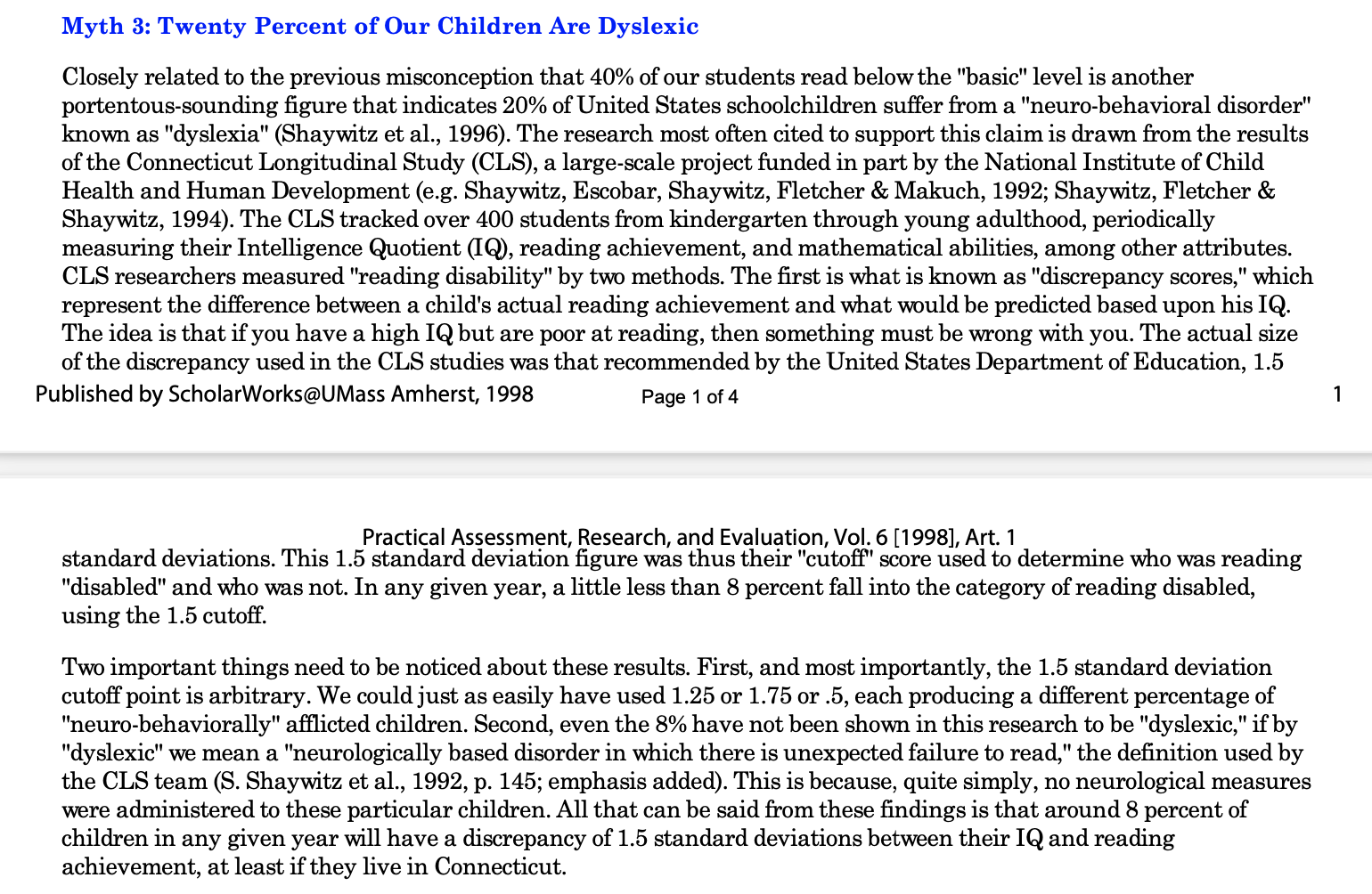
Myth 3: Twenty Percent of Our Children Are Dyslexic.

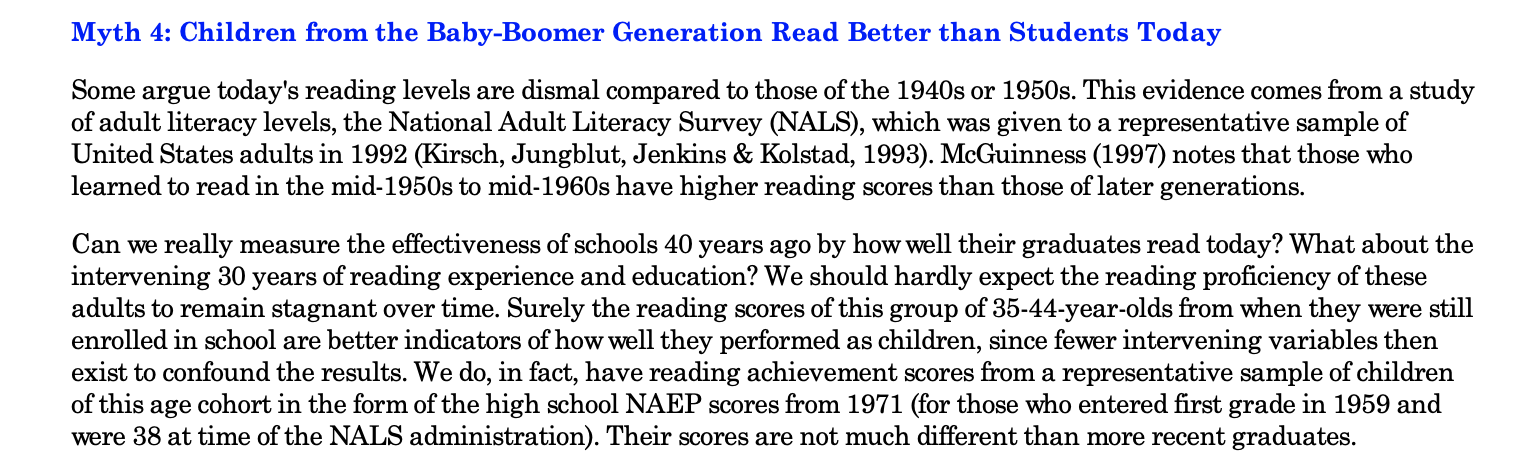
Myth 4: Children from the Baby Boomer Generation Read Better than Students Today.

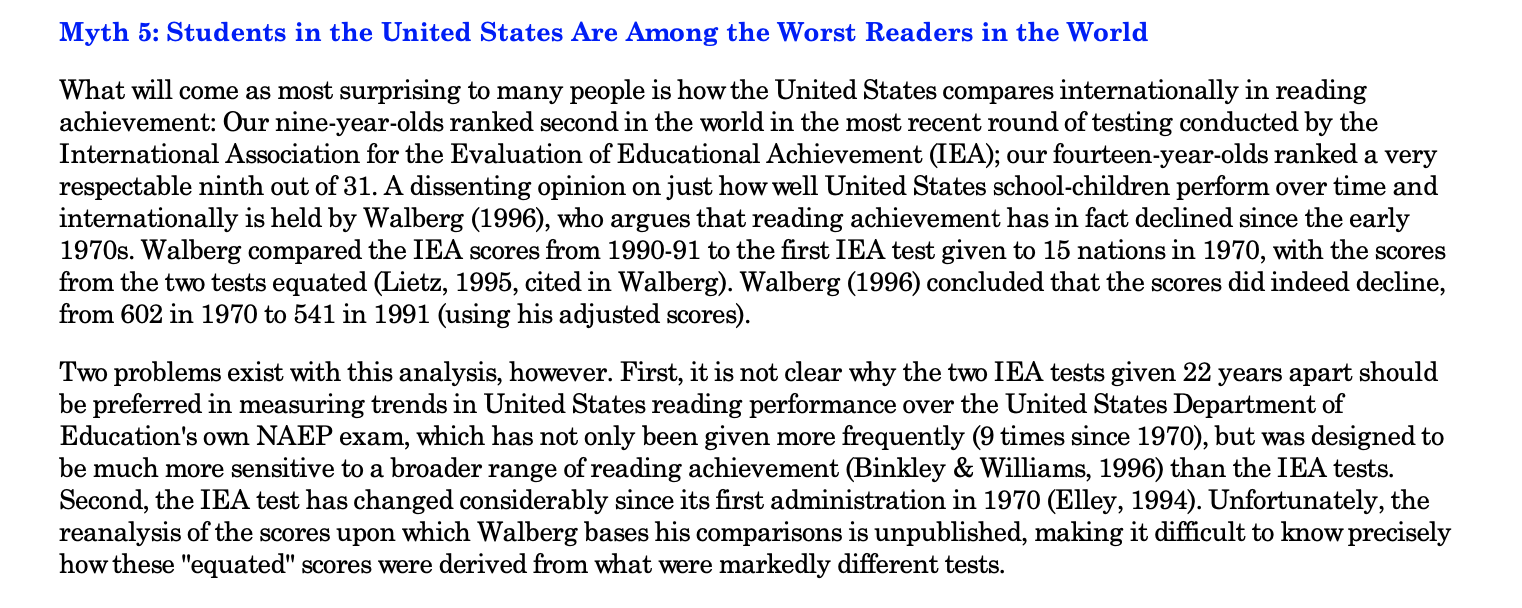
Myth 5: Students in the United States Are Among the Worst Readers in the World.

Myth 6: The Number of Good Readers Has Been Declining, While the Number of Poor Readers Has been Increasing.

Myth 7: California’s Test Scores Declined Dramatically Due to Whole Language Instruction.

DOI: https://doi.org/10.7275/em9c-0h59

McQuillan carefully dismantles each of these, with evidence, but many today continue to make the same misguided and unsupported claims.

In 2019 (and 2023), McQuillan’s work remains important, and relevant, both for understanding how we should teach better our students to read and how the current version of the Reading War is wandering once again down very worn dead-end roads.