Category Archives: literacy

The Science of Writing: A 36-Year Journey and Counting

[Header Photo by Ron Otsu on Unsplash]

Science is not a hammer.

Science is an old-growth forest, each tree an organic thing. Think of a tree as a theory. At any moment that tree (theory) is fully a tree but not the tree it will be.

As a tree grows, it becomes more robust, a stronger trunk, deeper roots. If we inspect that trunk, we find rings detailing the history of how that tree became stronger with age. Theories too are not simply the result of fixed evidence, but an accumulation of evidence, an accumulation that evolves over time.

Science, like that old-growth forest, is never settled, but it is always at any moment the best that it can be in terms of being a forest and in terms of the trees being the tress of that moment. You see, science is also organic, not yet the forest or trees it can and will be.

Old-growth forests are also characterized by being untouched by humans, and while science is the product of humans, science often seeks ways to limit the flaws of that human contact (a lofty and unattainable goal, but one that helps science aspire toward truth and Truth).

Science ultimately is aspirational; it can never be settled, fixed, and anyone using science as a hammer is, in fact, not being scientific.

Science is not a hammer.

Science is an old-growth forest, each tree an organic thing.

#

Viewing science as a hammer is the fatal flaw of the “science of reading” (SoR) movement that has gained momentum in 2019. Advocates of SoR begin by claiming that this science is settled:

In spite of the current discussions, the science on this instructional issue is settled. Castles, Rastle, & Nation (2018) lay out that there is a clear progression to effective literacy instruction. First and foremost, children need to understand the principles of spelling-sound correspondences and to solidify a store of high-frequency words to read words and phrases fluently. Most children need explicit teaching to build this knowledge. After decoding and high-frequency words are established, more attention can be devoted to comprehension with a focus on making meaning. Castles et al. (2018) offer a logical and research-based model. In spite of this research, educators remain without consensus about what is most important—phonics instruction or a focus on comprehension.

Science is not a hammer, neither is it to be used to bludgeon nor is it a singular tool.

In fact, especially for education as well as teaching literacy, science is a much broader spectrum of evidence than SoR advocates are arguing, steeped as they are in the neurosciences.

The science needed to guide real-world teaching of literacy is an old-growth forest of many types of trees at different stages of growth.

For example, I primarily have been a teacher of writing for 36 years and counting. I have taught students from 9th grade through graduate courses.

As a scholar of teaching writing, I am well versed in the experimental/quasi-experimental research base on teaching writing as well as a huge and complex body of qualitative research.

I also have 36 years of experience with thousands of students.

All of that is at my disposal as I teach any student to write, an act that for me is highly individualized—even when I taught 100-125 high school students five days a week.

The generalizations and controls that result from and govern experimental/quasi-experimental research (which is dominant in neuroscience) are informative (not prescriptive) for me as a teacher, but my work tends to be with many different outliers—humans, that is—who may thrive with practices outside the constraints of narrow types of science.

I don’t use science as a hammer because students are fragile things, and instruction that treats them all as ten-penny nails is unwarranted.

#

You may be thinking about climate change, evolutionary science, or vaccinations—all of which many people would argue are settled science.

“Settled,” I think, remains a problematic word even in those contexts.

All science based in experimental/quasi-experimental research when properly vetted is compelling, compelling to the point that it feels settled, compelling to the point that we must act in ways that confirm it is settled even as we are aware this tree may grow.

Since all sciences remain in the replication loop, we are best off calling even the largest tree with the most powerful trunk and deepest roots “compelling,” not settled.

In qualitative research, “compelling” is the best we can hope for, but much of that research is compelling, although with caveats about the evidence not reaching standards of generalizability and the conditions of the evidence not bound by controls.

#

Let me end with an anecdote, what some would call not scientific. It is the story of having taught writing for 36 years and counting, and still being very cautious about my practice and very nervous about the fate of my field of teaching writing.

Actually this is an anecdote about gathering anecdotal evidence, the sort of scientific teaching that John Dewey envisioned for progressive educators.

I always spend the last class of my first-year writing seminars by discussing with students what has worked and what I should do differently in the future.

I also use this class to re-emphasize that my overarching goals for these classes are about fostering in them greater authority and autonomy as students and writers about to run the gauntlet of three-and-a-half additional years (or more) of college.

This fall, students argued for having Essay 1 turned in earlier, allowing more time and class sessions for Essay 3 (the academically cited essay), and moving Essay 4 earlier to leave more time for the revised submission.

We fleshed out these requests against the goals of the course, and ultimately, I found their anecdotal feedback compelling. My schedule for fall 2020 will be revised.

As the professor, as well, I have reflected on how to better encourage students to revise their essays and not simply address what I have marked for them. I discussed this problem with another teacher, and am considering a new policy on how students should resubmit their essays.

In the past, I have required students to resubmit essays in clean Word files, track changes, comments, and highlighting all removed. Part of that requirement was aimed at helping students better use Word as a tool, but I also have trouble with Word files that are busy.

However, as I discussed student revision with a friend who teaches writing, I thought about how students having the track changes visible for their revisions would show them how much, or how little, they actually revised. Visible track changes can be a very effective teaching tool.

So my new policy may be that students submit two Word files, one clean and one with only the track changes of their revisions (with the file including “TC”).

This, then, is a brief anecdote about how I teach scientifically as a professional educator, a writer, and an expert in literacy. I teach with caution, I resist teaching with a hammer.

This means that when some students demonstrate a need for a type of instruction not supported by a narrow type of research, I still provide the student with that instruction. We may even experiment with a range of strategies until the student feels capable on their own.

I am always cautious, but I am also nervous because while the “science of reading” mania is in full stride, I see on the horizon a similar fate for the teaching of writing: Scientific evidence on how to teach writing is slim.

I suspect the mainstream media will discover a field that already exists, has for a century or more. I suspect the allure of “science” will blind that media and those who also feel passionate about the dismal state of student writing.

So somewhat preemptively, I want to offer about the teaching of writing:

Science is not a hammer.

Science is an old-growth forest, each tree an organic thing.


Research, the Media, and the Market: A Cautionary Tale

Reporting in The New York Times, Gina Kolata offers a compelling lede:

The findings of a large federal study on bypass surgeries and stents call into question the medical care provided to tens of thousands of heart disease patients with blocked coronary arteries, scientists reported at the annual meeting of the American Heart Association on Saturday.

The new study found that patients who received drug therapy alone did not experience more heart attacks or die more often than those who also received bypass surgery or stents, tiny wire cages used to open narrowed arteries.

And Julie Steenhuysen adds an interesting detail to this new major study: “At least two prior studies determined that artery-clearing and stenting or bypass surgery in addition to medical treatment does not significantly lower the risk of heart attacks or death compared with non-invasive medical approaches alone.”

But these details may prove to be the most important ones of all: “Over $8 billion worth of coronary stents will be sold annually by 2025, according to a new research report by Global Market Insights, Inc. The increase over the years will be created by an increase in artery diseases coupled with a growing demand for minimally invasive surgeries,” explains Stephen Mraz.

So now let’s do the math. If heart doctors shift to what the new research shows, “The nation could save more than $775 million a year by not giving stents to the 31,000 patients who get the devices even though they have no chest pain, Dr. Hochman said,” reports Kolata.

Better and less intrusive patient care, lower overall medical costs for a U.S. healthcare system already overburdened—what is there to keep the medical profession from embracing compelling scientific research?

Well, the market of course.

Lower costs come from fewer heart surgeries, meaning heart surgeons lose income—and possibly patients.

Keep in mind that while the medical profession decades ago emphasized best practice in prescribing antibiotics (only when bacterial infections are detected), many doctors found that following best practice led to dissatisfied patients, who flexed their consumer muscles by finding doctors who would usurp best practice and prescribe the requested antibiotics even when they weren’t warranted.

The new research on stents and heart disease treatment is a cautionary tale involving research, the media, and the market—a cautionary tale that should inform the current call for the “science of reading,” especially as that impacts children with dyslexia.

That several studies now show the use of stents should be reduced or at least delayed, but that doctors have resisted that evidence calls out for us to ask an important question about scientific research: In whose interest is the research being applied?

At the International Literacy Association 2019 conference, P. David Pearson, University of California, Berkeley, lays out in about 11 minutes a compelling unpacking of What Research Really Says About Teaching Reading–and Why That Still Matters.

In this framing talk before a panel discussion, Pearson confronts the role of media in misinforming the public about research, challenges advocates of “scientific research” who fluctuate between endorsing research and following “common sense,” and calls for not ignoring “scientific research” but expanding the types of research relied upon to make teaching and learning decisions (recognizing a broad spectrum of evidence-based research that trumps ideology or assumptions).

One of the most compelling examples offered by Pearson is how the media framed research on reading after the report from controversial National Reading Panel (NRP), at the center of No Child Left Behind’s mandate for scientific research. The headline Pearson highlights is “Systematic, explicit, synthetic phonics improves reading achievement.”

Yet, the specific study being cited actually was far more complicated, and less endorsing of systematic phonics; along with “many other elements…, a small but robust effect for a subset of the population is found on a measure that requires kids to read a lists of pseudowords.”

Pearson adds that even if we accept the larger NRP report as valid (and several scholars do not), the report calls for systematic phonics for K-1 students, not older struggling readers. Yet, as Pearson explains, many calling for the “science of reading” push for systematic phonics programs throughout grades well beyond grade 1.

So there exists several traps in calling for scientific research in education, and more narrowly, in the teaching of reading.

As another example, consider Timothy Shanahan’s response to the effectiveness of dyslexia fonts:

Over the past decade or so, three new fonts have appeared (Open Dyslexia, Dyslexie, and Read Regular), all claiming—without any empirical evidence—to somehow aid dyslexic readers.

Since then there have been 8 studies into the value of these fonts.

Most of the studies found no improvement in reading rate, accuracy, or eye fixations (Duranovic, et al., 2018; Kuster, et al., 2018; Rello & Baeza-Yates, 2013; Wery & Diliberto, 2017). The studies even found that dyslexics—children and adults—preferred reading standard fonts to the special ones (Harley, et al., 2016; Kuster, et al., 2018; Wery & Diliberto, 2017).

Only one study reported a benefit of any kind—the dyslexic students in this study read faster (Marinus, et al., 2016). This benefit apparently came, not from the font design, but from the spacing within and between words. The researchers increased the spacings in the standard fonts and the same effect was seen. Masulli (2018) likewise found that larger spacings improved the reading speed of dyslexics—but that effect was apparent with non-dyslexic readers, as well.

Reading faster is a good thing, of course, as long as reading comprehension is maintained. Unfortunately, these studies didn’t look at that.

The use of dyslexia fonts, then, are driven by the market—consumer demand being met by businesses—but not supported by evidence; neither the claims of the businesses nor the outcomes from implementing the fonts are justified by “scientific evidence.”

Just as Hooked on Phonics flourished in two different iterations (the first felled by court rulings that exposed the lack of research backing market claims), many reading and phonics programs in education are buoyed by ideology and the market but not by research.

But the traps around programs and “scientific” are extremely complex from two different angles.

First, as noted in several examples above, teaching and learning are likely not served well within a market dynamic whereby parents and students are the consumers and teachers and the schools serve the inexpert demands of those consumers.

Yes, parents and students have a right to express their need, but they most often lack the expertise to demand how that need should be met.

Parents of children with reading problems or dyslexia should be demanding that their children be served better and appropriately. But calling for specific policy and practice is outside the purview of those “consumers.” (This is the same dynamic in patients seeking doctors who prescribe antibiotics when they are not needed, creating a health hazard for themselves and others when medical best practice is usurped by market demand.)

The second trap, however, is “scientific” itself. As I have detailed, experimental and quasi-experimental research (what we mean by “scientific,” as Pearson discusses) draws causal relationships that can be generalized. By definition, then, generalizable research doesn’t address outliers or real-world situations where several factors impact the effectiveness of teaching and learning.

The “scientific” trap positions a parent of a child struggling to read, diagnosed with dyslexia, into a problematic corner if that child finds success with dyslexia fonts, a practice not supported by research.

Teaching and teachers must be guided by evidence, both the evidence of a wide range of research and the evidence drawn from the individual students in any classroom.

To teach is to quilt together what a teacher knows about the field, reading for example, and then to match instruction to where any student is and where any student wishes to go.

This, ironically, is the philosophy behind balanced literacy, the approach demonized (usually with false claims and without evidence) by those calling for the “science of reading.”

Each time advocacy for systematic intensive phonics for all students gains momentum, I ask the key question: In whose interest is the research being applied?

Go back to the new research on stents, a true life-and-death matter, and think about that question when you read the media demand the “science of reading.”


For Further Consideration

Flu Outbreak Reduces Class Sizes To Level Appropriate For Learning

On Poetry and Prose: Defining the Undefinable

As a professor of first-year writing, I spend a good deal of time helping students unpack what they have learned about the essay as a form and about writing in order to set much of that aside and embrace more nuanced and authentic awareness about both.

Teaching writing is also necessarily entangled with teaching reading. In my young adult literature course, then, I often ask students, undergraduate and graduate (many practicing teachers), to do similar unpacking about their assumptions concerning writing and reading.

I have noted before that my first-year students often mangle what I would consider to be very basic labels for writing forms and genres—calling a short prose piece a poem and identifying a play as a novel because they read both in book form.

Because of the ways students have been taught writing to comply with accountability and high-stakes testing of writing, they also confuse modes (narration, description, exposition, and persuasion) for genres or types of essays.

These overly simplistic or misguided ideas extend to distinguishing between fiction and non-fiction as well as prose and poetry.

I am always adding to my toolkit, then, lessons that ask students to investigate and interrogate genre, form, and mode, instilling a sense that literacy remains something undefinable that we none the less try to define so that we feel we have greater control over it.

This post details a lesson about recognizing all literacy as a journey, and embracing defining the undefinable.

The seeds of the lesson, in fact, start with my own stumbling through my journey with literacy. The first time I read Gate A-4 by Naomi Shihab Nye, I assumed the piece was a personal essay.

I think I may have shared with students and even referred to the passage as such. At some point after that, I ran across the piece being referred to as fiction, a very brief short story.

This week, as I was planning a lesson on how we distinguish poetry from short fiction, I considered using “Gate A-4” along with four poems by women poets—Adrienne Rich’s “Aunt Jennifer’s Tigers,” Maggie Smith’s “Good Bones,” Emily Dickinson’s “Wild night – Wild nights!,”  and Margaret Atwood’s “Siren Song.”

As I searched online for “Gate A-4,” I noticed that the piece was routinely identified as a poem. However, when I did a “Look Inside” search of Naomi Shihab Nye’s Honeybee: Poems & Short Prose, I discovered that the piece is clearly prose, one of what the book description identifies as “eighty-two poems and paragraphs.”

I also discovered a wonderful video of Nye reading the passage:

This became the opening for the lesson, which began with asking students to watch the read aloud without a text in front of them. After viewing, I asked them to identify the text form—what is this thing she is reading?

The students were cautious, even hesitant to answer, exposing, I think, the many elements of a text that advanced readers use to make a significant number of decisions in a very brief moment. We know poetry from prose simply from seeing the text, even before reading.

As we struggled, I handed out a copy of “Gate A-4” and explained it is prose (although some guessed poem). I also pulled up the amazon link and showed them the piece in the original book.

Next I placed them in small groups with the four poems noted above, asking them to use one or as many of them as they wanted to create a quick lesson on what makes a poem, a poem.

The first group decided to use all four poems, and began by noting students would identify what most people associated with poetry in “Aunt Jennifer’s Tigers”—rhyme and stanzas.

They also recognized that turning to “Good Bones,” those assumptions were challenged, as they explained, since this poem didn’t rhyme and has no stanzas (which we later clarified to note it is simply one stanza, constructed of lines).

Since “Aunt Jennifer’s Tigers” and “Wild night – Wild nights!” tend to conform to narrow and traditional characteristics associated with poetry and “Good Bones” and “Siren Song” look poetic but sit outside those characteristics, we began to brainstorm how to have broader concepts; for example, we explored that all the poems have repetition (noting that rhyme is sound repetition) and concluded that poetry is often driven by purposeful line form and stanzas.

Possibly the key moment of this discussion was when the second group added that the best we can say is that a poem is a poem because the writer identifies it as such. We have come to a similar conclusion about the genre of young adult literature.

Another important part of this exploration came from a student who explained that he had always been bothered by trying to write poetry in high school, specifically the concept of line breaks. The how of breaking lines eluded him.

Here is something I always emphasize when teaching someone to write poetry—the art and craft of line breaks.

Broadly, we can help students better understand form and genre by keeping them focused on prose as a work driven by purposeful sentence and paragraph formation and poetry as a work driven by purposeful line and stanza formation (recognizing that even poetry sometimes is prose poetry).

To help answer this student’s concern about line breaks, I pulled up my newest poem about my father’s death, “quotidian,” and walked the class through my first draft (typed in Notes on my iPhone and emailed to myself) as well as how I came to choose and then work within the stanza pattern.

The big-picture lessons from this activity include the following:

  • Helping students understand that writing forms, genres, and modes are driven (not constrained) by some conventions, but also fluid.
  • Exploring that writers of all types of genres and forms work from a very similar toolbox—writers of poetry and prose care about sound, for example.
  • Emphasizing form and meaning are related in writing, but as soon as anyone finds a firm definition, a piece challenges that.
  • Identifying how writers and readers navigate form, genre, and mode with purposefulness as well as awareness. As I explained about line breaks and stanzas when writing poetry, there is no magical formula, but most poets do seek some guiding pattern or patterns and then shape poetry within or against those patterns.

Many years ago as a high school English teacher, I gradually shifted away from defining poetry during our poetry unit, and choosing instead to ask throughout, “What makes poetry, poetry?” We simply came to understand poetry better by asking a question instead of finding a clear definition.

I remain convinced that seeking greater awareness about text is a long journey, best guided by always seeking a definition rather than imposing one.

Regardless of the definition we discover, or fail to uncover, I hope that students remain in awe as I am each time I read “Gate A-4” even as I also remain conflicted about just what the thing is she is reading aloud on the video.

On Normal, ADHD, and Dyslexia: Neither Pathologizing, Nor Rendering Invisible

[Header Photo by Artem Beliaikin on Unsplash]

In 1973, Elliott Kozuch explains, “the American Psychiatric Association (APA) — the largest psychiatric organization in the world — made history by issuing a resolution stating that homosexuality was not a mental illness or sickness. This declaration helped shift public opinion, marking a major milestone for LGBTQ equality.”

Homosexuality in many eras and across many cultures has been rendered either invisible (thus, the “closet” metaphor) or pathologized as an illness (thus, the horror that is conversion therapy).

This troubling history of responses to homosexuality confronts the inexcusable negative consequences of shame and misdiagnosis/mistreatment against the more humane and dignified recognition that “normal” in human behaviors is a much broader spectrum than either invisibility or pathologizing allows.

How we determine “normal” in formal education is profoundly important, and the current rise of dyslexia advocacy as that impacts and drives reading legislation and practice for all students parallels the dangers identified above with rendering invisible or pathologizing children who struggle with reading.

woman sitting on bed while holding book
Photo by David Lezcano on Unsplash

Further, this more recent focus on dyslexia looks incredibly similar to the increased diagnosis of ADHD, which was initially left invisible and then pathologized (probably over-diagnosed and heavily medicated).

Let’s focus first, then, on ADHD, and how the dynamic of “normal,” “invisible,” and “pathologized” impacts children.

In 2013 Maggie Koerth-Baker reported:

The number of diagnoses of Attention Deficit Hyperactivity Disorder has ballooned over the past few decades. Before the early 1990s, fewer than 5 percent of school-age kids were thought to have A.D.H.D. Earlier this year, data from the Centers for Disease Control and Prevention showed that 11 percent of children ages 4 to 17 had at some point received the diagnosis — and that doesn’t even include first-time diagnoses in adults.

But here is the problem:

That amounts to millions of extra people receiving regular doses of stimulant drugs to keep neurological symptoms in check. For a lot of us, the diagnosis and subsequent treatments — both behavioral and pharmaceutical — have proved helpful. But still: Where did we all come from? Were that many Americans always pathologically hyperactive and unable to focus, and only now are getting the treatment they need?

Probably not. Of the 6.4 million kids who have been given diagnoses of A.D.H.D., a large percentage are unlikely to have any kind of physiological difference that would make them more distractible than the average non-A.D.H.D. kid. It’s also doubtful that biological or environmental changes are making physiological differences more prevalent. Instead, the rapid increase in people with A.D.H.D. probably has more to do with sociological factors — changes in the way we school our children, in the way we interact with doctors and in what we expect from our kids.

For context, when I was exploring the ADHD phenomenon in 2013, I ran across a provocative piece from 2012 about ADHD in France, Why French Kids Don’t Have ADHD, published in Psychology Today. Immediately, this spoke to my concern about both pathologizing human behavior that may be within a broader understanding of normal and my skepticism about immediately medicating, instead of addressing diet, environment, etc.

However, the situation in France is far more complicated as noted in a piece also published by Psychology Today in 2015 , French Kids DO Have ADHD, this time acknowledging:

In other words, it’s not that French kids, or Europeans, don’t have ADHD, says French child psychiatrist Michel Lecendreux, but that they’re clinically invisible. “It’s just not very well understood, nor is it very well-diagnosed, nor well-treated.” Lecendreux, a researcher at the Robert Debre Hospital in Paris who also heads the scientific commission for the French ADHD support group HyperSupers, told me that his research suggests that fewer than one-third of French children who have ADHD are being diagnosed.

The circumstances around ADHD in France reveal the power of narratives and cultural responses to human behavior, any people’s perception of “normal.” A study by Sébastien Ponnou and François Gonon from 2017, in fact, details the pervasiveness of different narratives about ADHD in French media:

Two models of attention deficit hyperactivity disorder (ADHD) coexist: the biomedical and the psychosocial. We identified in nine French newspapers 159 articles giving facts and opinions about ADHD from 1995 to 2015. We classified them according to the model they mainly supported and on the basis of what argument. Two thirds (104/159) mainly supported the biomedical model. The others either defended the psychodynamic understanding of ADHD or voiced both models. Neurological dysfunctions and genetic risk factors were mentioned in support of the biomedical model in only 26 and eight articles, respectively. These biological arguments were less frequent in the most recent years. There were fewer articles mentioning medication other than asserting that medication must be combined with psychosocial interventions (14 versus 57 articles). Only 11/159 articles claimed that medication protects from school failure. These results were compared to those of our two previous studies. Thus, both French newspapers and the specialized press read by social workers mainly defended either the psychodynamic understanding of ADHD or a nuanced version of the biomedical model. In contrast, most French TV programmes described ADHD as an inherited neurological disease whose consequences on school failure can be counteracted by a very effective medication. (abstract)

Back in the US, in Room for Debate from 2016, several experts challenged overpathologizing children with ADHD labels, the racial disparity in that pathologizing, and the dangers of medicating for ADHD as an avenue to controlling children.

Thus, the interaction among the fields of medicine and psychology, media representations of clinical conditions, and the spectrum along “normal,” “invisible,” and “pathologized” has profound consequences for children/teens and formal education.

Currently, we are witnessing mainstream media build a compelling narrative about the “science of reading” and the needs of children with dyslexia; this is a narrative about children with dyslexia being rendered invisible and there existing a “science of reading” that is the medicine necessary to cure that pathology.

However, as the examinations of homosexuality and ADHD above demonstrate, when it comes to the humanity and dignity of children being served by the institution of public education, we cannot tolerate either rendering them and their behaviors invisible or over-pathologizing, and thus misdiagnosing/mistreating, them.

This leads to the current rush to assess and identify dyslexia as a foundational part of teaching all children to read, policies about which the International Literacy Association (2016) offer several concern:

Errors in reading and spelling made by children classified as dyslexic are not reliably different from those of younger children who are not classified as dyslexic. Rather, evidence suggests that readers with similar levels of competence make similar kinds of errors. This does not suggest a greater incidence of dyslexia, but instead that some difficulties in learning to work with sounds are normal.

International Literacy Association (2016)

Yet, the rise in advocacy for identifying dyslexia has gained significant momentum in state policy even as ILA warns:

Some have advocated for an assessment process that determines who should and should not be classified as dyslexic, but this process has been shown to be highly variable across states and districts in the United States, of questionable validity, and too often resulting in empirically unsupported, one-size-fits-all program recommendations [emphasis added].

International Literacy Association (2016)

No child struggling to read should have that struggle rendered invisible, but pathologizing behavior that does not conform to a narrow definition of normal also carries significant and negative consequences. As ILA notes above, a more reasonable approach is simply to expand the spectrum of normal while building a supportive environment tempered with patience.

I teach a graduate student whose child is now in a school for dyslexic children. That child was floundering personally and academically in traditional school, and now flourishes, something everyone would applaud.

The parent, however, made a really powerful observation, noting that the child’s recent success comes in a school that champions Orton-Gillingham-based reading programs [1] (often OG for short).

Advocates for universal screening for dyslexia also advocate for systematic intensive phonics for all students, specifically OG. Yet, this child is now in a school with a 1-8 teacher-student ratio and a guaranteed 1.5 hours a day with 1-2 teacher-student ratio instruction.

The parent stated flatly that almost any child would flourish in those conditions and the different way the child is being taught to read is not necessarily the real cause of the new success. I must add, we absolutely have no research exploring these dynamics and controlling for variables that would help us understand the importance of reading programs versus learning/teaching conditions (see, for example, unfounded and overstated responses to 2019 NAEP reading scores).

Struggling to read is, in fact, quite normal, and a long, chaotic process. Teaching reading is very complex, unique to each child, and as ILA clarifies, “there is no certifiably best method for teaching children who experience reading difficulty.”

Demands that all children attain some prescribed proficiency in reading by third grade are artificial and themselves unnatural, abnormal.

No child should be invisible in schools, but pathologizing childhood behavior that is quite normal because some adults have irresponsible deadlines and expectations for those children is inexcusable.

Teaching children to read needs a new normal, one that acknowledges the power of learning and living conditions while avoiding the dangers of finding fault in any child that we can simply cure with some magical quick fix.


[1] From ILA:

[R]esearch does not support the common belief that Orton-Gillingham–based approaches are necessary for students classified as dyslexic (Ritchey & Goeke, 2007; Turner, 2008; Vaughn & Linan-Thompson, 2003). Reviews of research focusing solely on decoding interventions have shown either small to moderate or variable effects that rarely persist over time, and little to no effects on more global reading skills. Rather, students classified as dyslexic have varying strengths and challenges, and teaching them is too complex a task for a scripted, one-size-fits-all program (Coyne et al., 2013; Phillips & Smith, 1997; Simmons, 2015). Optimal instruction calls for teachers’ professional expertise and responsiveness, and for the freedom to act on the basis of that professionalism.

International Literacy Association (2016)

Resisting the Silver Bullet in Literacy Instruction (and Dyslexia): “there is no certifiably best method for teaching children who experience reading difficulty”

The Mind, Explained episode 1, Memory, introduces readers to some disorienting facts about human memory, transported in the soothing and authoritative voice-over by Emma Stone.

The episode shares a 9-11 memory from a young woman, recalling sitting as a child in her classroom and watching the smoke from the Twin Tower collapse billowing past the window as she worried about her mother working in the city.

Her memory is vivid and compelling, but it also factually wrong—both the detail of the billowing smoke (the window didn’t face that direction and the proximity of the school would not have allowed that event to occur) and her mother was not in the city that day.

Memory, the episode reveals, is often deeply flawed, as much a construction by the person as any sort of accurate recall.

Watching this, I thought about one of the most misinterpreted poems commonly taught in schools, Robert Frost’s “The Road Not Taken.”

This poem, and how people almost universally misread it, is parallel to the problems with memory in that people tend to impose onto text what we predict or want that text to say; and the verbatim elements of a text, the raw decoding of words, also depends heavily on schema, what the reader knows and the correlations that reader makes with words and phrases.

Frost’s poem, by the way, is about the significance of choosing, in that when we choose we determine our path. But the poem literally states multiple times that the paths are the same; therefore, the poem is not some inspirational poster about making the right choice—although this is the sort of simplistic message many people want to read.

Since I have been wrestling with the recent rise of dyslexia advocates calling for intensive systematic phonics instruction and dyslexia screening for all students as well as the over-reaction to the 2019 reading data from NAEP, I believe the memory and poem interpretation phenomena help explain how and why the “science of reading” narrative is so effective while simultaneously being deeply misguided (and misleading).

The media and most people find a single explanation for reading problems compelling; the argument that more students have dyslexia than are being identified and that one program type (intensive systematic phonics, usually Orton-Gillingham–based) will cure the low reading achievement crisis matches what people want to hear.

The disturbing irony is that those oversimplifying reading challenges and solutions as “the science of reading” are themselves not being very scientific even as they idealize “scientific research.”

I have argued against this in education for many years, and have identified this broadly as technocratic, an over-reliance on narrow types of measurement in order to control the teaching/learning process in ways that are not realistic in real-world classrooms.

The call for reading instruction driven by the “science of reading,” then, comes against several problems. First, literacy acquisition and instruction are both inherently messy and chaotic. Despite our seeking efficient and effective methods, mandating that all students develop the same ways and at the same rates is futile, and harmful. Concurrent with that reality, highly structured teaching of literacy is something that is manageable but likely ineffective, and again, harmful.

Narrow expectations for “scientific” tend to include controlling for external factors and reaching generalizable conclusions—both of which can be inappropriate for guiding teaching real students in an actual classroom.

Should reading policy and practice be informed by scientific studies? Of course, but any teacher must frame that against the needs of each student, needs that may dictate practices outside the parameters of narrow research. And every teacher has another type of evidence—their practice.

We must also, recognize, however, that the science of reading, and the science around dyslexia, are both not as clearcut as some advocates seem to suggest.

When we ask the questions being posed now—Is there a reading crisis (distinct from the historical trends of reading test scores)? Is there a dyslexia crisis? Should all students be screened for dyslexia? Should all students receive intensive systematic phonics instruction?—the answers do not match the current media and advocacy frenzy.

The 2016 International Literacy Associations Reading Advisory on Dyslexia offers a much different framing of “scientific,” in fact:

Both informal and professional discussions about dyslexia often reflect emotional, conceptual, and economic commitments, and they are often not well informed by research.

First, some children, both boys and girls, have more difficulty than others in learning to read and write regardless of their levels of intelligence or creativity. When beginning literacy instruction is engaging and responsive to children’s needs, however, the percentage of school children having continuing difficulty is small (Vellutino et al., 1996; Vellutino, Scanlon, & Lyon, 2000).

Second, the nature and causes of dyslexia, and even the utility of the concept, are still under investigation [emphasis added]….

Third, dyslexia, or severe reading difficulties, do not result from visual problems producing letter and word reversals (Vellutino, 1979)….

Errors in reading and spelling made by children classified as dyslexic are not reliably different from those of younger children who are not classified as dyslexic. Rather, evidence suggests that readers with similar levels of competence make similar kinds of errors. This does not suggest a greater incidence of dyslexia, but instead that some difficulties in learning to work with sounds are normal [emphasis added]….

[I]nterventions that are appropriately responsive to individual needs have been shown to reduce the number of children with continuing difficulties in reading to below 2% of the population [emphasis added] (Vellutino et al., 2000).

As yet, there is no certifiably best method for teaching children who experience reading difficulty [emphasis added] (Mathes et al., 2005). For instance, research does not support the common belief that Orton-Gillingham–based approaches are necessary for students classified as dyslexic [emphasis added] (Ritchey & Goeke, 2007; Turner, 2008; Vaughn & Linan-Thompson, 2003)….

Some have advocated for an assessment process that determines who should and should not be classified as dyslexic, but this process has been shown to be highly variable across states and districts in the United States, of questionable validity, and too often resulting in empirically unsupported, one-sizefits-all program recommendations [emphasis added].

The science of reading actually suggests we should not see a reading crisis in our test data, and not conflate low test scores in reading with special needs such dyslexia.

And we must reject calls to adopt singular evaluation processes and reading programs that claim to address the natural development and challenges of 98% of students.

All general population students and students with special needs need rich and robust literacy instruction that helps teachers recognize their needs in order to foster their natural development over many years (resisting as well the false notion that 3rd grade is a magical moment for all students to attain the same mastery of literacy).

While there are certainly good intentions behind calls for identifying and serving students with dyslexia, the over-reaction to reading test scores and oversimplification of “scientific” are pathologizing and stigmatizing students, and eroding effective teaching and authentic learning.

Like memory and poems by Frost, teaching reading and becoming a reader are complicated. Many find that so unpleasant, they have retreated into a mantra that isn’t itself very well grounded in evidence, the hallmark of “scientific.”

The evidence we use on reading, test scores, has for at least a century shown us that there really is no normal development of reading at predictable benchmarks and that measurable reading achievement has always been and continues to be a powerful marker for the socio-economic status of the students tested.

Technocrats do not want evidence that is historical and sociological, however, preferring instead to impose a problem and a solution onto the data in ways that are as comforting as a detailed, though significantly flawed, memory.

See Also

Scientific evidence on how to teach writing is slim

Proof Points (Writing Instruction)

The Problem with Balanced Literacy

My summer graduate course, Foundations and Current Trends in Literacy Research and Practice, never fails at being an invigorating course for me and my students because it combines foundational topics in literacy with a never-ending series of current debates and controversies surrounding those enduring elements of teaching and learning literacy.

For several years recently, my home state of South Carolina has provided ample content because of the current reading legislation, Read to Succeed, heavily drawn from Florida’s reading policy and commitment to grade retention as a punitive key element in teaching reading.

This summer, however, even with Read to Succeed firmly entrenched and resulting in grade retention for students, a new wave of controversy has invigorated this course’s topics—the media focus on the “science of reading” driven by advocates for students with dyslexia and the (tired) resurgence of calls for systematic phonics for all students.

The scapegoats in this “science of reading” frenzy are teacher education and balanced literacy (the younger cousin of the similarly maligned whole language).

At the end of class preceding the next day’s focus on balanced literacy, a graduate student asked for a quick definition because since she was new to education and had recently experienced many interviews that asked her to define balanced literacy, she felt quite disoriented and uninformed about what it means.

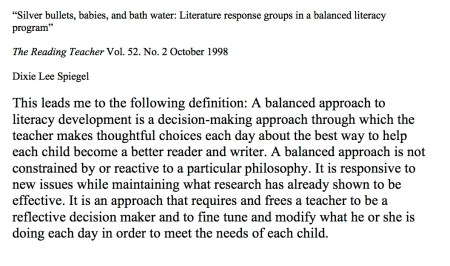
I pulled up my standard paragraph from Dixie Lee Spiegel and immediately heard several other students note this isn’t how they have had the term defined in their schools.

As I read the daily reflections on the readings for balanced literacy, this response, I think, is an important way to address the problem with balanced literacy (edited for some minor formatting):

My school places a huge emphasis on balanced literacy. However, it is presented more in terms of how much time and in what context various components of literacy should be implemented in class daily (we even have it in a pie chart) [emphasis added]. We used to have a great deal of autonomy in the curriculum we chose in reading and writing, but our district recently adopted Lucy Calkins’ Units of Study. Although Calkins desires for teachers to use her units as a framework, it has become a way to make sure all teachers are doing the same thing [emphasis added]. In practice we have a balanced literacy program in terms of we give students choice (although in the early grades very restricted choices), allow time for free reading, a lot of experience with literacy, small, guided reading group instruction, and explicit phonics instruction; we are doing all of this in a systematic, controlled way. I read the article about effective balanced literacy instruction and felt it did a great job in summarizing the qualities that make a teacher highly effective in the implementation of balanced literacy. But the point is…it takes a highly effective teacher, period.

Having only been consistently teaching for five years, I also understand how incredibly challenging it is to be a masterful teacher. I feel I could have seemed that I was implementing balanced literacy proficiently in a class I had two years ago. Most of my class came from literacy rich environments and could discuss books in meaningful ways. The ones that did struggle, were inspired by their peers to take risks in reading (they made me look good). This past year, I did not have a class as a whole that loved reading. For a lot of them, it was a challenge to get them to listen to stories much less engage in meaningful conversations. The majority of them would say they hated to read. Calkins (and my reading coach) would have me go to a first grade unit of study and implement more basic literacy skills to scaffold, but there was no way I would be able to do this alone. The lessons are very in depth and it would have cost me more time than I had available. Also, those mini-lessons would not have appealed to the 6 or 8 students who were ready to have more comprehensive, richer discussions. Reading and literacy implementation was a struggle all year.

I also realize that it is easier within systems to quantify and package things, but you simply cannot do this with teachers and students [emphasis added]. It is easy to show learning in a quantitative way. Although my students achieved higher reading levels this year, which looks great on an SLO [Student Learning Objectives], as a teacher I know that I missed it with them. I also realize that I can say I am doing balanced literacy, but I know it isn’t truly what balanced literacy is intended to be [emphasis added].

To open the discussion, after reading this an other reflections with similar descriptions, I explained to the class that both whole language and balanced literacy are philosophies of teaching and acquiring literacy; they provide evidence-based broad concepts to guide practice, but neither was originally intended to be programs or templates for how teachers teacher or how students learn.

As the response above demonstrates, however, education in practice is often over-reliant on programs and less diligent about addressing philosophy or theory. In short, the problem with balanced literacy is not that teacher education teaches balanced literacy and not the science of reading (note because balanced literacy as a philosophy of literacy embraces that full and complex science of reading) and not that teachers do not know the science of reading but are teaching balanced literacy, but that almost all schools have adopted programs, many of which claim the label of “balanced literacy” while also breaking the foundational elements of that philosophy (see the last sentence of the response above).

And just as the media, dyslexia advocates, and phonics proponents have endorsed, these reading programs (labeled “balanced literacy” or not) are primarily about addressing standards, preparing students for high-stakes tests, and imposing a one-size-fits-all approach to teaching and learning reading; and therein is the essential flaw.

All teachers and all students doing the same things at the same time and being held accountable for doing the mandated program—this is literacy instruction in the U.S., and this is the grand failure no one in the media or in political leadership is willing to address.

All the bluster around calling out “balanced literacy” is nothing more than distraction because it doesn’t really matter what label we assign to how teachers teach reading or how students learn reading; what matters are the expertise of teachers, the needs of students, and the teaching/learning conditions that support or inhibit (see complying with reading programs) effective teaching and learning.

The real problem with balanced literacy is too few people know what it is and as a result are failing it along with the students and teachers caught in that misguided vortex.

Educational Accountability and the Science of Scapegoating the Powerless

Several years ago when I submitted an Op-Ed to the largest newspaper in my home state of South Carolina, the editor rejected the historical timeline I was using for state standards and testing, specifically arguing that accountability had begun in the late 1990s and not in the early 1980s as I noted.

Here’s the interesting part.

I began teaching in South Carolina in the fall of 1984, the first year of major education reform under then-governor Richard Riley. That reform included a significant teacher pay raise, extended days of working for teachers, and the standards-testing regime that would become normal for all public education across the U.S.

In fact, SC’s accountability legislation dates back to the late 1970s (I sent her links to all this).

As a beginning teacher, the only public schooling I ever knew was teaching to standards and high-stakes tests by identifying standards on my lesson plans and implementing benchmark assessments throughout the academic year to document I was teaching what was mandated as a bulwark against low student tests scores. State testing, including punitive exit exams, pervaded everything about being an English teacher.

Yet, an editor, herself a career journalist, was quick to assume my expertise as a classroom practitioner and then college professor of education was mistaken.

This is a snapshot of how mainstream media interact with education as a topic and educators as professionals.

I am reminded of that experience over and over in fact as I read media coverage of education. Take for example this from Education Week, Want Teachers to Motivate Their Students? Teach Them How, which has the thesis:

Most teachers intrinsically understand the need to motivate their students, experts say, but teaching on intuition alone can lead to missteps in student engagement.

A study released in May by the Mindset Scholars Network, a collaborative of researchers who study student motivation, found most teacher education programs nationwide do not include explicit training for teachers on the science of how to motivate students.

Want Teachers to Motivate Their Students? Teach Them How

Two key elements of this article stand out: The new scapegoat in proclaiming education a failure is teacher education and the go-to failure is always about a lack of “science” in teacher education.

This article on motivation is following a media template well worn recently about students in the U.S. can’t read because teachers are not taught the “science of reading,” you guessed it, in their teacher education programs.

As I detailed in a Twitter thread, scapegoating teacher education has many flaws, and my experience and expertise as a teacher educator for almost two decades, following almost two decades as a classroom teacher, inform my understanding of how finding scapegoats for educational failure during the accountability era is fool’s gold.

How has the accountability era gone in terms of where the accountability and locus of power lie, then?

In the 1980s and 1990s, the accountability mechanisms focused on holding students accountable (think exit exams) and schools accountable (student test scores often translated into school rankings or grades, designating schools as “failing,” for example).

Keep in mind that students had no power in that process, and that schools were merely agents of the standards being implemented, again outside the power dynamics of those mandates being determined.

With No Child Left Behind spawned by the false claims of the Texas Miracle, the accountability era was greatly accelerated, including a creeping sense that the process wasn’t improving education but it was punishing students (lower graduation rates due to exit exams) and demonizing schools (most high-poverty and high-racial minority schools were labeled as “failing”).

By the administration of Barak Obama, with education policy under another false narrative (the Chicago Miracle) and false ambassador with no background in education other than appointments (Arne Duncan), the scapegoating took a turn—the problem, went the new message, was “bad” teachers and the solution was not holding students or schools accountable for test scores but those teachers (the era of value-added methods [VAM]).

As some have noted and documented, teacher bashing increased and then prompted a backlash (see magazine covers from Time for a great series of artifacts on this); it seems that VAM proved to be a false metric for accountability and that maybe teachers were not the problem after all.

With the scapegoat role now vacant, the media have discovered a new candidate, teacher education.

Let’s here recognize that once again the power context is way off in who is determining the accountability and who is being held accountable. For the most part, teachers and teacher educators are relatively powerless agents who are mandated to implement standards and assessments that they do not create and often do not endorse as valid.

Now consider another really important reason accountability in education is deeply flawed: The constant misguided scapegoating of powerless agents in formal teaching and learning is a distraction from the actual causal sources for educational challenges.

Fun fact: Decades of research from educators and education scholars have detailed that out-of-school factors overwhelmingly determine measurable student outcomes, some estimates as high as 80+% and most scholars agreeing on 60%. Teacher quality’s impact on measurable student achievement has been identified repeatedly as only about 10-15%.

Yet, the entire accountability era since the early 1980s has focused on in-school reforms only (scapegoating along the way), while tossing up hands and embracing harsh ideologies such as “no excuses” practices that argue teachers fail students with the “soft bigotry of low expectations” and students fail because they lack “grit” or a growth mindset.

Many of us have doggedly argued for social context reform, addressing socio-economic reform first and then reforming education along equity (not accountability) lines next, or concurrently. Many of us have also demonstrated that “grit” and growth mindset have racist and classist groundings that are harmful.

For those positions, we have been demonized and marginalized for decades.

So imagine my surprise when, first, the tide shifted on teacher bashing (I have 34 posts on my blog discrediting VAM and dozens on misunderstanding teacher quality) and then these articles: Better Schools Won’t Fix America (The Atlantic), The Harsh Discipline of No-Excuses Charter Schools: Is It Worth the Promise? (Education Week), and Unchartered territory: 2020 Democrats back away from charter schools (MSN).

My blog posts, however, on social context reform and poverty (157), “no excuses” reform (70), and the mirage of charter schools (80) have either mostly been ignored or are harshly (even angrily) rejected. Like my interaction with the editor discussed in the opening, my experience and expertise as an educator and education scholar have held almost no weight with those in power pr the media.

The media and journalists as generalists seem deeply resistant to learning a lesson they create over and over.

Take for a current example Karin Wulf’s examination of Naomi Wolff and Cokie Roberts; Wulf herself is a historian:

It’s been a tough few weeks for amateur history. First, journalist Naomi Wolf discovered on live radio that she had misinterpreted key historical terms in her new book, “Outrage,” leading her to draw the wrong conclusions. A week later, journalist Cokie Roberts, too, got a quick smackdown when she claimed on NPR that she couldn’t find any incidence of abortion advertised in 19th century newspapers, a claim quickly disproved by historians.

Wolf and Roberts fell victim to a myth widely shared with the American public: that anyone can do history. Whether it’s diving into genealogy or digging thorough the vast troves of digital archives now online, the public has an easy way into the world of the past. And why would they imagine it takes any special training? After all, the best-selling history books are almost always written by non-historians, from conservative commentators like Bill O’Reilly to journalists like Wolf and Roberts.

What Naomi Wolf and Cokie Roberts teach us about the need for historians

Wulf’s confronting “that anyone can do history” immediately prompted in me my experience when I first moved from teaching high school English (and adjuncting at several colleges, including being a lead instructor in a university-based summer institute of the National Writing Project) to higher education. My university was debating a curriculum change that included dropping traditional composition courses (popularly known as English 101 and English 102) for first-year seminars.

One of those first-year seminars was to be writing-intensive, and the argument being posed was that any professor could teach writing.

This change passed, and the English department and professors were relieved of sole responsibility for teaching writing.

Over the next eight years or so, the university learned a really disturbing lesson (one I could have shared in the beginning): “Any professor can teach writing” is false.

As Wulf argues about history, with writing and education, experience and expertise matter.

So here I sit again, writing over and over that the media are getting reading wrong, that scapegoating teacher education is missing the real problem.

How many years will it take until I see articles “discovering” these facts as if no one with experience and expertise ever raised the issue?

Checklist: Media Coverage of the “Science of Reading”

Several years ago while preparing the first edition (2013) of De-testing and De-grading Schools: Authentic Alternatives to Accountability and Standardization, I came to know Peter DeWitt as a highly praised principal who wrote in that volume about no testing week at his school.

His work and career have shifted since then, but I have remained in contact through his public writing. Coinciding with a mostly fruitless Twitter debate about how the media continues to misrepresent the challenges and realities of teaching reading, then, I was strongly drawn to DeWitt’s 3 Reasons I Do Not Engage In Twitter Debates.

Much of his examination of the paradox that is social media is extremely compelling to me; his three reasons, in fact, resonate powerfully: They’re rarely about common understanding, they make you look really crazy to onlookers, and he’s not good at them.

When I find myself crossing (foolishly) DeWitt’s pointed line, I try to justify the effort by this (mostly idealistic and probably misguided) justification: Making a nuanced and detailed case, even through the limitations of Twitter, will likely not persuade the Twitter thread members, but can provide a platform for learning to those observing the discussion.

However, I find DeWitt’s conclusions hold fast, and thus, offering here the details and the nuance has a better, although also limited, potential for changing the dialogue and reaching more understanding.

Instead of providing yet another discrediting of yet another media misrepresentation of the “science of reading” (see some of that work listed below), I want to offer here a checklist for those who want to navigate the media coverage in an informed and critical way.

Mainstream media education journalism is routinely bad because of some broad problems inherent in journalism: journalists tend to be generalists and media assume a journalist can and should cover specialized fields, journalism remains bound to a “both sides” coverage of topics that misrepresents the actual balance of evidence in those specialized fields, and as I outline below, mainstream media tend to be trapped in a sort of presentism that lacks historical context.

Below with additional sources to support and illuminate the problems is a checklist for navigating mainstream media’s coverage of the “science of reading”:

Mainstream media’s errors in science of reading include the following:

[ ] Misrepresenting balanced literacy (BL), whole language (WL) to discredit them. To evaluate media coverage of reading instruction, know that reading ideologies such as balanced literacy and whole language suffer very complex realities. First, as links below detail, even when teachers or schools claim to be implementing BL or WL, there is ample evidence that traditional and more isolated practices are actually in place. Second, and extremely important to the current and historical versions of the reading wars, both BL and WL recognize and endorse a significant place for phonics instruction in early literacy; as Stephen Krashen explains pointedly: “Zero Phonics. This view claims that direct teaching is not necessary or even helpful. I am unaware of any professional who holds this position.”

Resources:

Defending Whole Language: The Limits of Phonics Instruction and the Efficacy of Whole Language Instruction, Stephen Krashen

Whole Language and the Great Plummet of 1987-92, Stephen Krashen

Literacy at the Crossroads: Crucial Talk About Reading, Writing, and Other Teaching Dilemmas, Regie Routman

Facts: On the nature of whole language education

Attack on “Balanced Literacy” Is Attack on Professional Teachers, Research

Silver Bullets, Babies, and Bath Water: Literature Response Groups in a Balanced Literacy Program, Dixie Lee Spiegel

[ ] Misrepresenting the complex role of phonics in reading in order to advocate for phonics programs. Related to the first point above, phonics advocacy tends to suggest falsely that some literacy experts support no phonics instruction and that all children must receive systematic intensive phonics instruction; these extreme polarities distort, ironically, what the broad and complex research base does show about how children learn to read as well as the role of phonics in that process.

Resources:

To read or not to read: decoding Synthetic Phonics, Andrew Davis

Stephen Krashen: Literacy: Phonemic Awareness and Phonics

The Literacy Crisis False Claims Real Solutions, Jeff McQuillan

[ ] Lacking historical context about the recurring “reading wars” and the false narratives of failing to teach children to read. The media, the public, and political leaders have chosen a crisis narrative for teaching reading throughout the twentieth and into the twenty-first century. That framing as crisis has mostly obscured both the problems that do stunt effective reading instruction and the complex nature of teaching reading as well as the current research base on teaching and literacy development.

Resources:

What Shall We Do About Reading Today?: Looking Back to See Now More Clearly

What Shall We Do About Reading Today?: A Symposium

Research in Language (1947), Lou LaBrant

Hooked on Phonics Redux

[ ] Overemphasizing/ misrepresenting National Reading Panel (NRP) value, ignoring it as a narrow and politically skewed report. A central component of No Child Behind was the NRP; however, as a key member of the panel has detailed, that report was neither a comprehensive and valid overview of the then-current state of research on teaching reading nor a foundational tool for guiding reading practices or policy. Yet, media coverage routinely references the NRP as gold-standard research and laments its lack of impact (although the NRP report did spawn a disturbing scandal concerning federal funding and textbook adoptions).

Resources:

Babes in the Woods: The Wanderings of the National Reading Panel, Joanne Yatvin

Did Reading First Work?, Stephen Krashen

My Experiences in Teaching Reading and Being a Member of the National Reading Panel, Joanne Yatvin

I Told You So! The Misinterpretation and Misuse of The National Reading Panel Report, Joanne Yatvin

The Enduring Influence of the National Reading Panel (and the “D” Word)

[ ] Citing bogus reports from discredited think tanks such as NCTQ. Well over a decade ago, Gerald Bracey warned about the growing influence of agenda-driven think tanks aggressively promoting reports before they are peer reviewed; since the mainstream media and most journalists are under-funded and overworked, press-release journalism has become more and more common, especially regarding education and often in terms of how so-called research is framed for the public. With the recent focus on the “science of reading,” the scapegoat of the day is teacher education; the narrative goes that teachers today do not know the science of reading because teacher education programs do not teach the science of reading. Often as proof, the mainstream media resorts to anecdote (they talk to a teacher or two who claims not to have been taught the science of reading) and citing bogus reports masquerading as research—notably the work of NCTQ, a think-tank that has aggressively and falsely attacked teacher education in report after report using slip-shod methods and devious processes to gather the data claim to analyze.

Resources:

NEPC Review: 2018 Teacher Prep Review (National Council on Teacher Quality, April 2018)

Review of Learning about Learning: What Every New Teacher Needs to Know

GUEST POST by Peter Smagorinsky: Response to the new NCTQ Teacher Prep Review

[ ] Scapegoating teacher education while ignoring two greatest influences on reading: poverty and reading programs adopted to comply with standards and high-stakes testing. There is ample room to criticize teacher education, particularly focusing on the problems with credentialing and the flaws inherent in the accreditation process, but the current media urge to blame teacher education for either how reading is taught or the errors in how reading is taught distracts from some hard facts about measurable reading achievement: first, standardized testing of all kinds are more strongly correlated with socio-economic and out-of-school factors than either teacher, teaching, or school quality; and this blame-teacher-education narrative glosses over that almost all reading instruction in U.S. public schools is mandated by standards, high-stakes testing, and adopted reading programs regardless of what teachers learned in their certification program.

Resources:

In Schools, Teacher Quality Matters Most

Teachers Matter, But So Do Words | Shanker Institute

Teaching Reading and Children: Reading Programs as “Costume Parties”

Masquerading (1931), Lou LaBrant

[ ] Conflating needs of students with special needs and needs of general population of students. The genesis of the most recent version of the reading wars that focuses on the “science of reading” appears to be grounded in a growing advocacy for children either not diagnosed or misdiagnosed for issues related to dyslexia. Parents of those children have been very politically active, and while their concerns for children with special needs are valid, the media and politicians have overreacted to that narrow issue and over-generalized the needs of those students to all students. This advocacy has also run roughshod over the actual and more nuanced research base on dyslexia itself. In short, parents advocating for their children should be honored and heard, but parents should not be driving reading instruction or reading policy.

Resource:

Parent Advocacy and the New (But Still Misguided) Phonics Assault on Reading

[ ] Emphasizing voices of cognitive scientists over literacy professionals. Two common patterns in media coverage of education and specifically reading are that journalists perpetuate both a gender and a discipline bias in whose voices are highlighted; notably, mostly men who are cognitive scientists are used to drive the agenda while women who are literacy practitioners and scholars are either ignored, marginalized as “critics,” or scapegoated as misguided advocates of BL or WL.

Resources:

NPR Fails Journalism and Education (Again)

What’s Wrong with Education as a Discipline?: Unpacking the Reading Wars (Again)

[ ] Trusting silver-bullet, one-size-fits-all claims about teaching and learning. Fundamentally, the historical and current flaw in the reading wars, even one framed as the “science of reading,” is that phonics advocacy reaches for “all students must have systematic intensive phonics programs,” buoyed recently by “but intensive phonics programs won’t hurt any students.” However, all teaching and learning proves to be far more complex that these claims. If we return to BL as a reading philosophy, we can emphasize that each child (not all children) should receive the type and amount of direct phonics instruction they need to begin and then grow as readers; that type and amount is difficult to prescribe, and often children are mis-served when systematic phonics programs are adopted because fidelity to the program typically trumps the actual goal of reading instruction, eager and autonomous readers. When a child is mandated to complete a phonics program, regardless of that child’s needs, that time would have been much better spent with the child reading by choice; therefore, systematic phonics do in fact harm students when they are implemented as “all students must.”

Resources:

Navigating the Scylla and Charybdis of Research in Education

Teaching Students, Not Standards or Programs

[ ] Feeding a false narrative blaming teachers and teacher educators both of whom are deprofessionalized /powerless in accountability structures. There are some dirty little secrets about education that discredit much of how media cover teaching and learning: as noted above, measurable teacher impact on student learning is quite small; teachers are mostly complying with mandates, and not making instructional or assessment decisions; and teacher educators have very little impact on how teachers implement teaching once they are in the classroom and required to conform to the mandates linked to standards and high-stakes testing.

Resources:

Pre-Service Teacher Education vs. the World

Verboden!: Autonomy and Critical Thinking in Education

Autonomy Must Precede Accountability

See Also


Hooked on Phonics Redux

The commercial reading program Hooked on Phonics, with iconic over-the-top commercials for those of us of a certain generation, had to abandon those ads in 1994:

Under an agreement disclosed this week between the makers of the reading program Hooked on Phonics and the Federal Trade Commission, the manufacturer must abandon its advertising campaign or conduct far more research into the program’s effectiveness–and disclose any evidence of failure.

Anyone paying even slight attention to current media fascination with the “science of reading” and dyslexia may benefit from revisiting the problem with Hooked on Phonics and their outlandish claims:

Orange County-based Gateway Educational Products, maker of Hooked on Phonics, agreed to a settlement that bars the parent company from making unsubstantiated claims about the program’s ability to teach people to read. The settlement, which was signed Aug. 29, was made public Wednesday by the commission.

The FTC had charged that Gateway was making sweeping, unproven promises that the program could teach anyone to read, regardless of their limitations. Gateway admitted no wrongdoing in the settlement, and will pay no penalty, said Christian S. White, acting director of the commission’s bureau of consumer protection.

“They offered a one-size-fits-all solution–you have reading problems, this is the product,” White said. “Gateway’s evidence just doesn’t back up these broad, sweeping claims.”

The claims, according to the commission, included statements that Hooked on Phonics can teach even those with reading problems, such as dyslexia; that the product improves users’ reading levels and classroom grades significantly; that it can teach reading at home, without a tutor; that it teaches comprehension of the meaning of words, and that it has helped almost 1 million people learn to read at home.

The commission also said that testimonials by people who have taken the program are used misleadingly in commercials and do not prove that their experiences were typical of the average user, which is a violation of federal law.

Although this happened 25 years ago, currently driven by overzealous dyslexia advocacy, the mainstream media is promoting essentially the same misguided and overstated arguments about teaching reading.

For the full and complicated story about teaching reading that the mainstream media refuses to acknowledge, see this reader below:

Found in Translation

Charlotte: I just don’t know what I’m supposed to be.

Lost in Translation (2003)

Trans 2
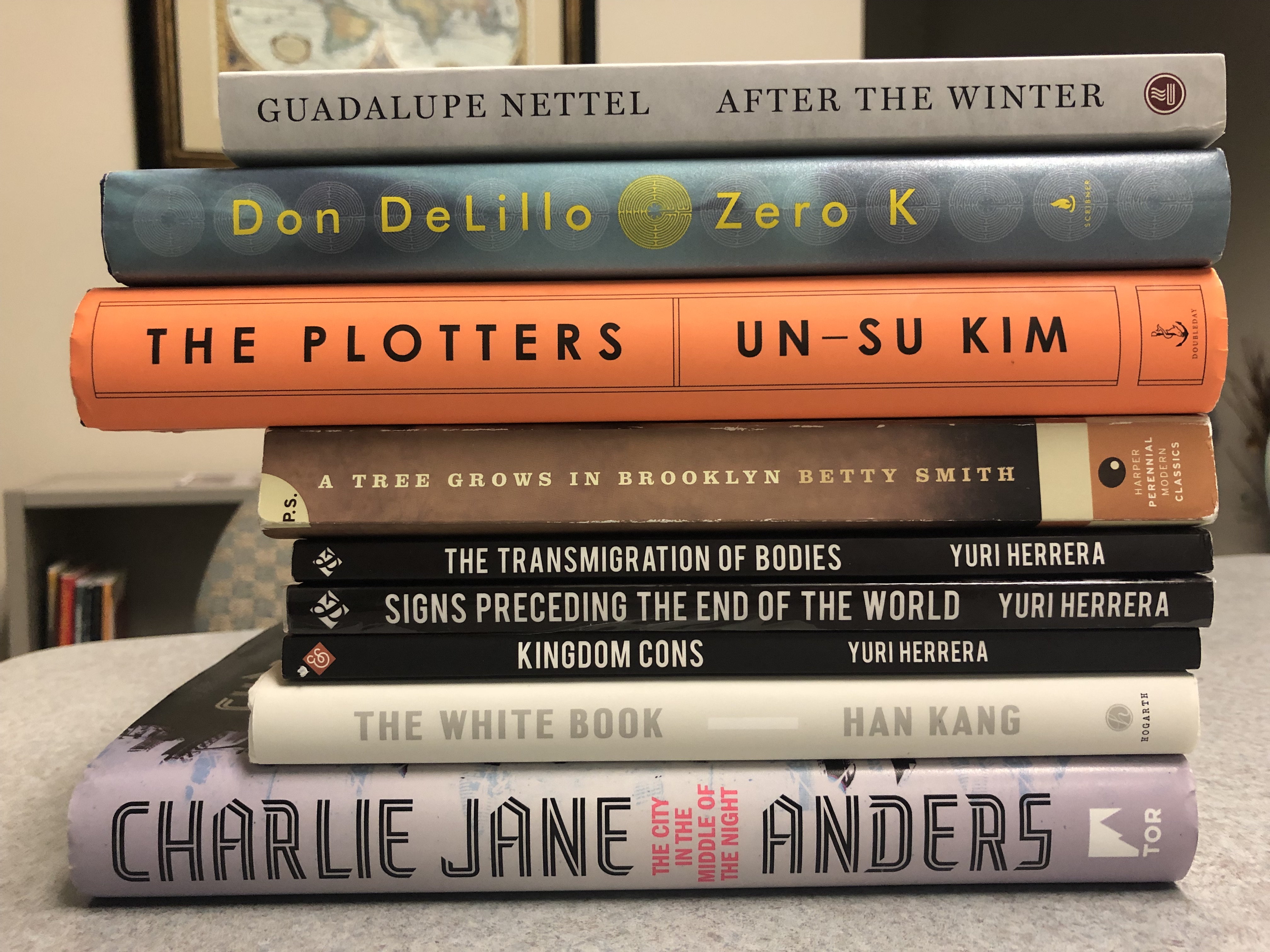
Recent reading heavily skewed by translation as well as works by women.

So what do Charlotte (Scarlett Johansson) and Bob Harris (Bill Murray) have in common as the central characters in Sophia Coppola’s Lost in Translation (2003)?

Quite a great deal despite the significant age difference—disillusionment about marriage (Charlotte young and newly married while Bob is much older and married 25 years), being American as well as white and privileged, and possibly most importantly, feeling deeply out of kilter with their own separate lives.

Viewers watch as these two develop both an occasionally predictable and often unpredictable relationship while visiting Japan—and thus, the title’s play on the location and these two being lost and also possibly finding themselves while visiting a land foreign to them.

As a many-decades voracious reader, I can attest to the power of literature for offering the same sort of different context that being in Japan provides Charlotte and Bob. In fact, I have experienced deep and powerful affection for authors from countries outside the U.S.—from Milan Kundera to Haruki Murakami—and am drawn to the literary qualities but also their distinctly different world views and cultural experiences from my own.

Kundera and Murakami, for example, have forced me often to step away from my assumptions and re-see the world and many of the ideals I hold precious. From Kundera’s philosophical musings on sex and relationships along with his narrative unpacking of history and geography in the shaping of society and individuals to Murakami’s confrontations of reality and the awkwardness that is self-awareness as human sexuality—these works I have experienced in translation with an affection beyond most other writers I also love and cherish.

By comparison, I love the work of Margaret Atwood and value the Canadian and gendered elements of her writing, but she composes in my shared language of English.

While I have long been fascinated by writing in translation—reaching back to my high school English teaching days when we wrestled with literary analysis of non-English language authors such as Franz Kafka, Albert Camus, and Henrik Ibsen—I have recently slipped into a trend of reading several new non-English language authors (see recent reading below).

The love of fiction often includes both an affection for the narrative (characters, plot, tension, etc.) as well as how that narrative is told, the weaving together of words and sentences. It is about both the what and how.

With traditional works in the canon of English-language fiction, and the dominance of New Criticism’s emphasis on textual analysis (echoed in the Common Core’s arguments about the four corners of the page), readers have been conditioned to consider rhetorical devices and literary technique as purposeful and singular tools of the author.

Here is where translation poses a problem of language—especially in translations of works by Murakami, Kim, and Kang, for example—and who makes those choices of language.

Zero K by Don DeLillo represents the most traditional sort of white male writing among the works I have read recently; this work overtly makes a case for language and words, represented by the narrator’s obsession with language:

Once, when they were still married, my father called by mother a fishwife. This may have been a joke but it sent me to the dictionary to look up the word. Coarse woman, a shrew. I had to look up shrew. A scold, a nag, from Old English for shrewmouse. The book sent me back to shrew, sense 1. A small insectivorous mammal. I had to look up insectivorous. The book said it meant feeding on insects, from Latin insectus, for insect, plus Latin vora, for vorous. I had to look up vorous. (p. 25)

With works in translation, however, the translator becomes another factor in the meaning as well as the compelling nature of the narrative. In Signs Preceding the End of the World by Yuri Herrera, the Translator’s Note offers a window into that process.

Lisa Dillman, translator, explains that “Herrera’s prose…exhibits…non-standard language,” for example, posing challenges for her work. Dillman adds “[t]o prepare for the project, as many translators do, I first read widely. I read for theme; I read for tone; I read for style” (pp. 109, 110).

Interestingly, Dillman focused on the prose of Cormac McCarthy as a guide for this novel’s translation. Also compelling is her decisions with word choice, notably “the novel’s most talked-about neologism: jachar” (p. 112). Dillman eventually chose “to verse” as the translation, capturing the word’s meaning (“essentially, ‘to leave'”) and carrying an odd, quirky sense found in the original.

Herrera’s fiction offers beyond concerns about language, and translation, insight into how culture and even geography impact genre, as investigated by Marcelo Rioseco:

Two subjects seem inescapable for a Mexican author who works with the space of the border: immigration, drug trafficking, and, consequently, the violence associated with these two phenomena. Nonetheless, this swift and simplifying identification can be deceiving in the effort to create a taxonomy of border literature, especially in the case of a writer like Yuri Herrera, born in Actopan in the Mexican state of Hidalgo.

Herrera’s case appears more problematic, precisely because, since his first novel, Kingdom Cons (2005), Herrera has been seen by critics as a border writer and, indirectly, as a natural representative of a subgenre of border literature: the narconovela.

Reading the three novels listed below by Hererra were genre bending and genre expanding; these works in translation, then, are about narrative and language but in ways for me as someone with a different first language than the author that I cannot experience with DeLillo—or Kurt Vonnegut and Atwood.

Just as Charlotte and Bob find something between them while out of context, for them, in Japan, I have found myself anew in these translations often because of disorientation and lack of context that forces me to think and rethink the world.


Recent Reading

After the Winter, Guadalupe Nettel*

Zero K, Don DeLillo

The Plotters, Un-su Kim*

A Tree Grows in Brooklyn, Betty Smith

The Transmigration of Bodies, Yuri Herrera*

Signs Preceding the End of the World, Yuri Herrera*

Kingdom Cons, Yuri Herrera*

The White Book, Han Kang*

The City in the Middle of the Night, Charlie Jane Anders

* In translation