Category Archives: Lou LaBrant

Persistent Straw Man Claims about Literacy Skills: Grammar Edition

[Header Photo by Anthony on Unsplash]

Since the “science of reading” (SOR) has now expanded into a “science of learning” (SOL) movement, the same problems among SOR advocates have appeared among SOL advocates—misinformation and misunderstanding about teaching and learning combined with a bait-and-switch approach that offers anecdotes as if they prove the so-called “science,” for example:
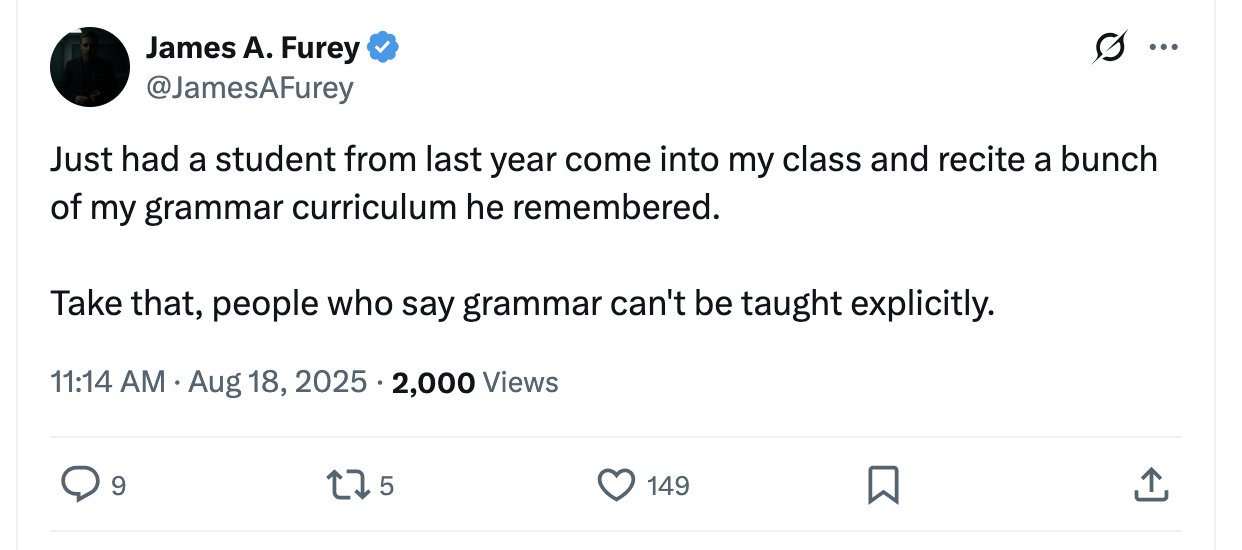
There is so much wrong with this that it is mind boggling, but let’s focus on, first, this is merely an anecdote, which proves nothing except that it happened.

Second, that direct instruction can be effective for students demonstrating simple recall is not very shocking; in fact, many would recognize that direct instruction/recall is asking far too little of students, especially in literacy instruction.

At one point in my education, I could name all the presidents in order as well as all the state capitals. It would have been better if I had developed a more sophisticated understanding of the presidency and the political realities of the US.

Through direct instruction over a brief amount of time, I can say one word, “inside,” and my poodle will happily trot into our apartment. I didn’t let her discover that; direct instruction produced pretty reliable recall in that sweet dog.

But she isn’t smarter; she is well trained.

Here, then, I am going to expand some on a third point: Furey clearly does not understand the issue he seems to be attacking, grammar instruction (with the implied agents being woke progressives who worship at the alter of discovery learning).

Let’s start by acknowledging Stephen Krashen’s explanation of “three different views of phonics”:

Intensive Phonics. This position claims that we learn to read by first learning the rules of phonics, and that we read by sounding out what is on the page, either out-loud or to ourselves (decoding to sound). It also asserts that all rules of phonics must be deliberately taught and consciously learned.

Basic Phonics. According to Basic Phonics, we learn to read by actually reading, by understanding what is on the page. Most of our knowledge of phonics is subconsciously acquired from reading (Smith, 2004: 152)….

Zero Phonics. This view claims that direct teaching is not necessary or even helpful. I am unaware of any professional who holds this position.

Furey seems to be posting a Gotcha! aimed at what he believes is a Zero Grammar view so let me follow Krashen’s lead and clarify: “I am unaware of any professional who holds this position.”

The Big Irony of a “science of” advocate attacking a straw man position on grammar is that there is pretty solid body of research/science on grammar instruction (note that many people use “grammar” to encompass grammar, mechanics, and usage).

To understand the research on direct (and isolated) grammar instruction, we first must clarify our instructional goal. If a course is a grammar course, and the goal is for student to acquire grammar knowledge, then some or even a significant amount of direct instruction can be justified and effective.

Even in the context of teaching students to acquire distinct grammar knowledge, however, many would caution against viewing grammar as “rules” and instead would encourage seeing grammar as a set of contextualized conventions that also carry some degree of power coding.

For example, subject/verb usages are a feature of so-called standard English, and some dialects can be identified by varying from those standards. It is important to acknowledge that one is not “right” or “better” linguistically, although the so-called standard forms tend to carry some cultural or social capital. And there may be cultural/social negative consequences for using dialects considered not standard.

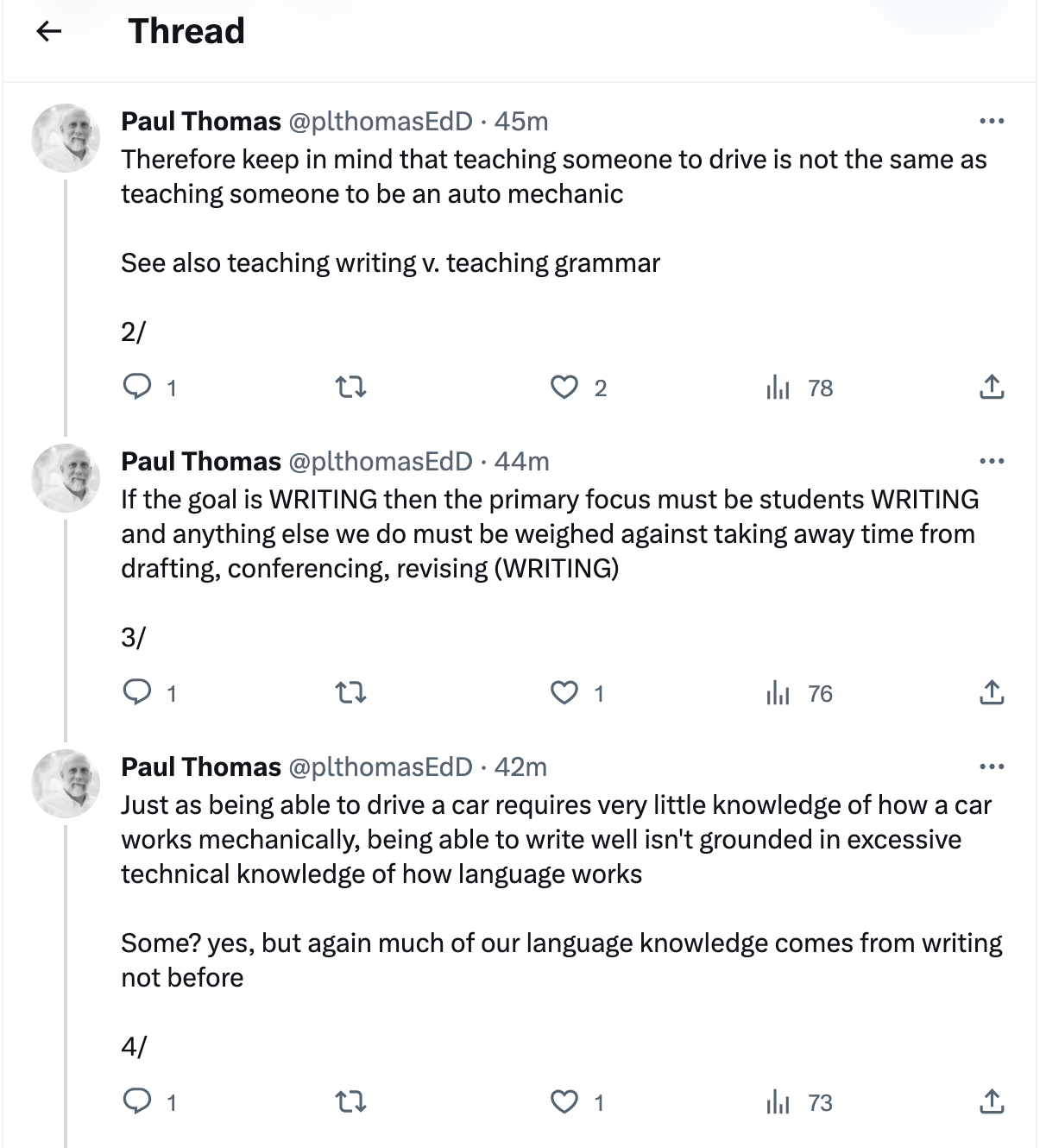
As an analogy, direct (isolated) grammar instruction can be effective for teaching students grammar knowledge just as having students diagram sentences can be effective for teaching students how to diagram sentences.

The problem is when we make our instructional goal teaching students to write with purpose and with awareness of language conventions (grammar, mechanics, usage).

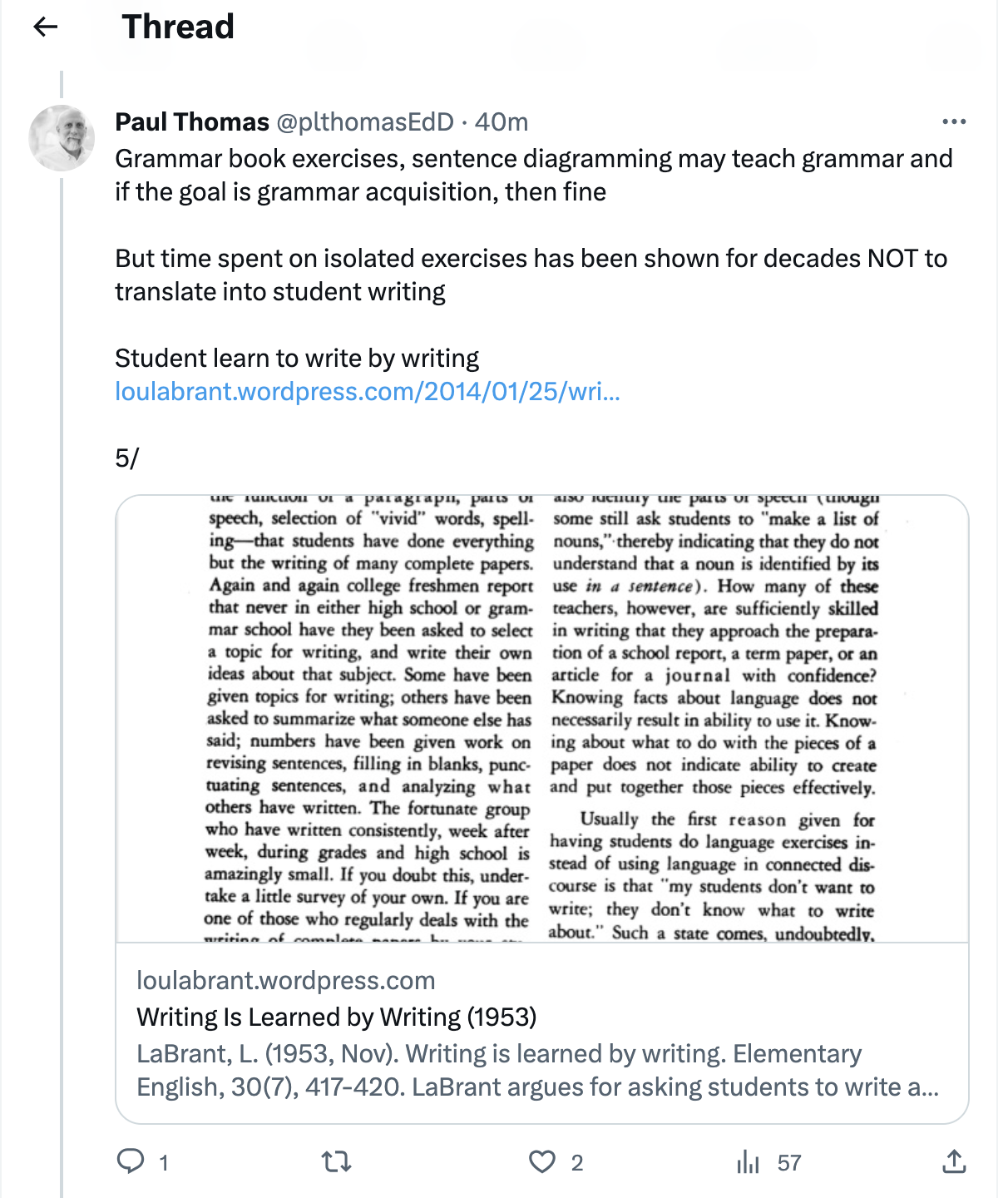
There is a long and deep research base reaching back into the early 1900s showing that direct (isolated) grammar instruction fails to transfer into student writing and can even have negative outcomes for the quality and amount of student writing.

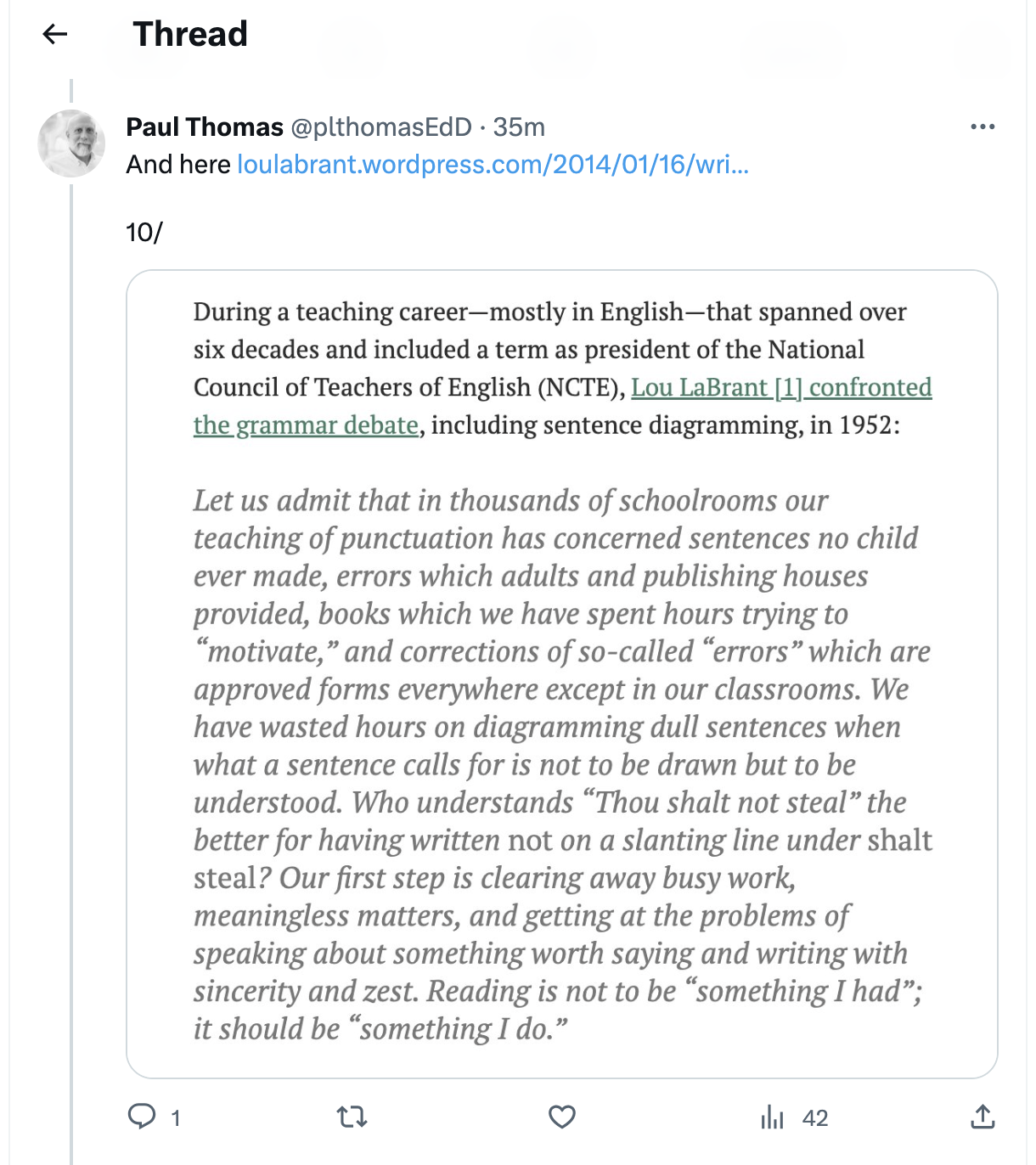
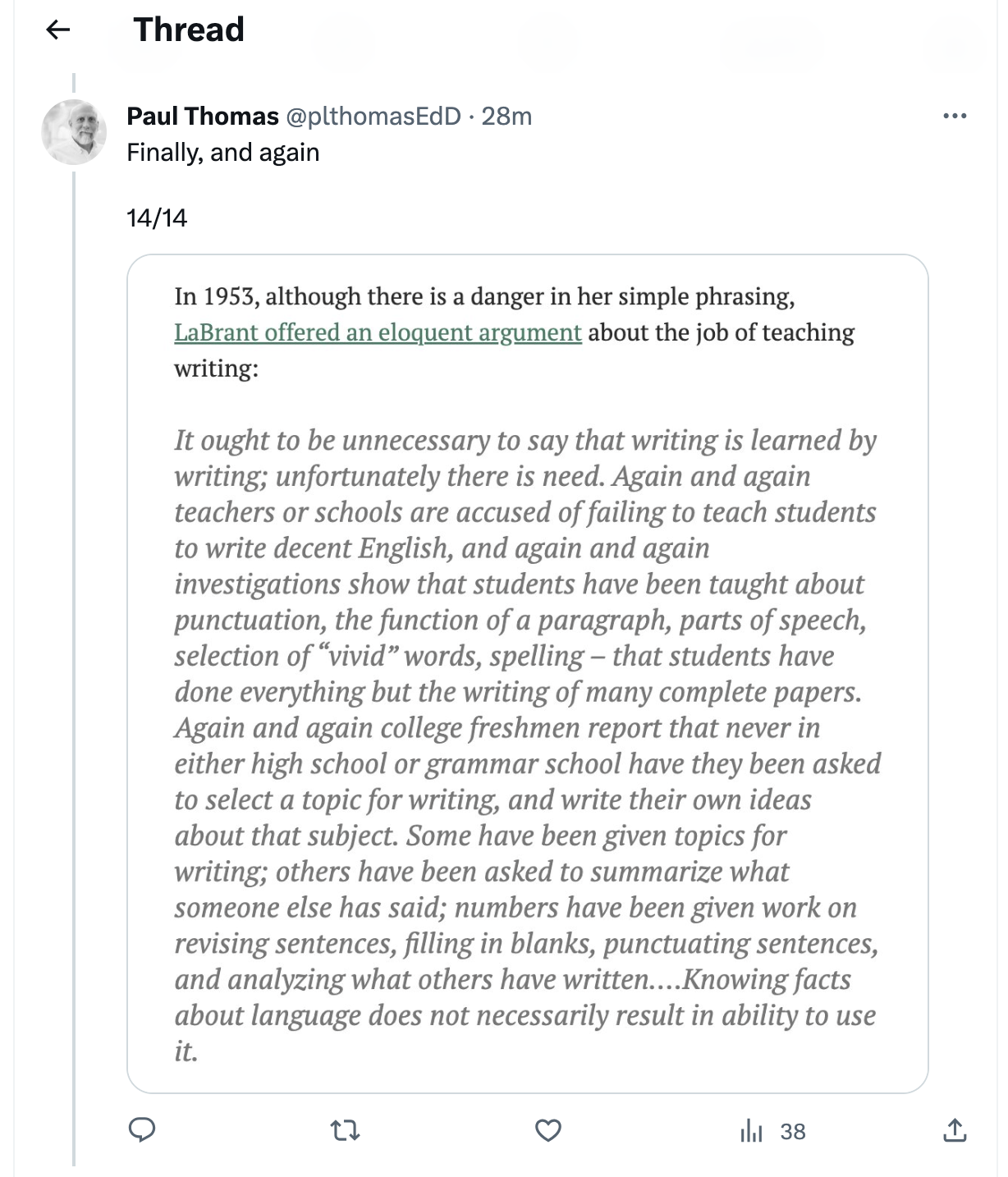
For example, LaBrant (1946) noted: “We have some hundreds of studies now which demonstrate that there is little correlation (whatever that may cover) between exercises in punctuation and sentence structure and the tendency to use the principles illustrated in independent writing” (p. 127).

This does not mean “do not teach grammar,” but does mean that direct grammar instruction needs to in the context of student writing.

Students who are writing by choice and with purpose are much more likely to engage with and understand (and thus apply) language conventions (grammar, mechanics, usage) than when we directly teach those in isolation.

So let me be clear: Teaching students to write without direct instruction would be inexcusable, but teaching grammar through direct and isolated instruction is malpractice when our goal is teaching writing.

Here, then, are some ways to insure direct grammar instruction in the context of student writing is effective:

  • Establish direct instruction of grammar in context based on student writing and demonstration of need. This can be effective for both individual student writing conferences and whole-class instruction (if most student demonstrate the same needs).
  • Recognize that some language conventions are abstractions that may be difficult to grasp for students at early stages of brain development; holding students accountable for usage should be tempered by their development (see Weaver below).
  • Avoid the “error hunt” (see Weaver below) and do not frame language conventions as “right/wrong” or revising and editing as “correcting.” The goal is language convention awareness and purposeful writing by students.
  • Avoid traditional grammar textbook and exercises. Prefer instead research-based direct instruction that transfers to writing such as sentence combining and lessons on the history of the English language (see Style below).
  • Adopt either a workshop approach to writing or integrate workshop elements (choice, time, and feedback) into the course.
  • Forefront and help students understand that revising writing is their primary responsibility as writers in order to communicate as well as possible; however, editing (addressing language conventions) is a part of that process, although it may be delayed until a piece is worthy of editing and before publishing or submitting. As LaBrant (1946) cautioned: “I am not willing to teach the polishing and adornment of irresponsible, unimportant writing” (p. 123).
  • The surface features of student writing need not be perfect when writing is part of a course. Seeking perfect surface features can and often is a goal for published writing.

As this discussion shows, another failure of the “science of” movement is the urge to attack caricatures and to oversimplify.

Teaching grammar is not a simple thing to address, and, again, I will note using Krashen, there simply is no credible professional saying teachers should not teach grammar. In fact, no credible educator would reject direct instruction of grammar as long as that instruction is in the context of student writing.

LaBrant (1947) made an assertion about teaching almost 80 years ago that may sound familiar: “A brief consideration will indicate reasons for the considerable gap between the research currently available and the utilization of that research in school programs and methods” (p. 87).

I have always regarded this as accurate, and have repeated the claim myself for decades.

Straw man fallacies, caricature, and anecdotes, I fear, are not the path to making this less true.

The “science of” movement is failing here, and the consequences are to the detriment of students and teachers who deserve better.


Recommended

Teaching Writing as Journey, Not Destination

Teaching High-School Students to Write (1946), Lou LaBrant

Research in Language (1947), Lou LaBrant

The Individual and His Writing (1950), Lou LaBrant

Writing Is Learned by Writing (1953), Lou LaBrant

Inducing Students to Write (1955), Lou LaBrant

Writing Is More than Structure (1957), Lou LaBrant

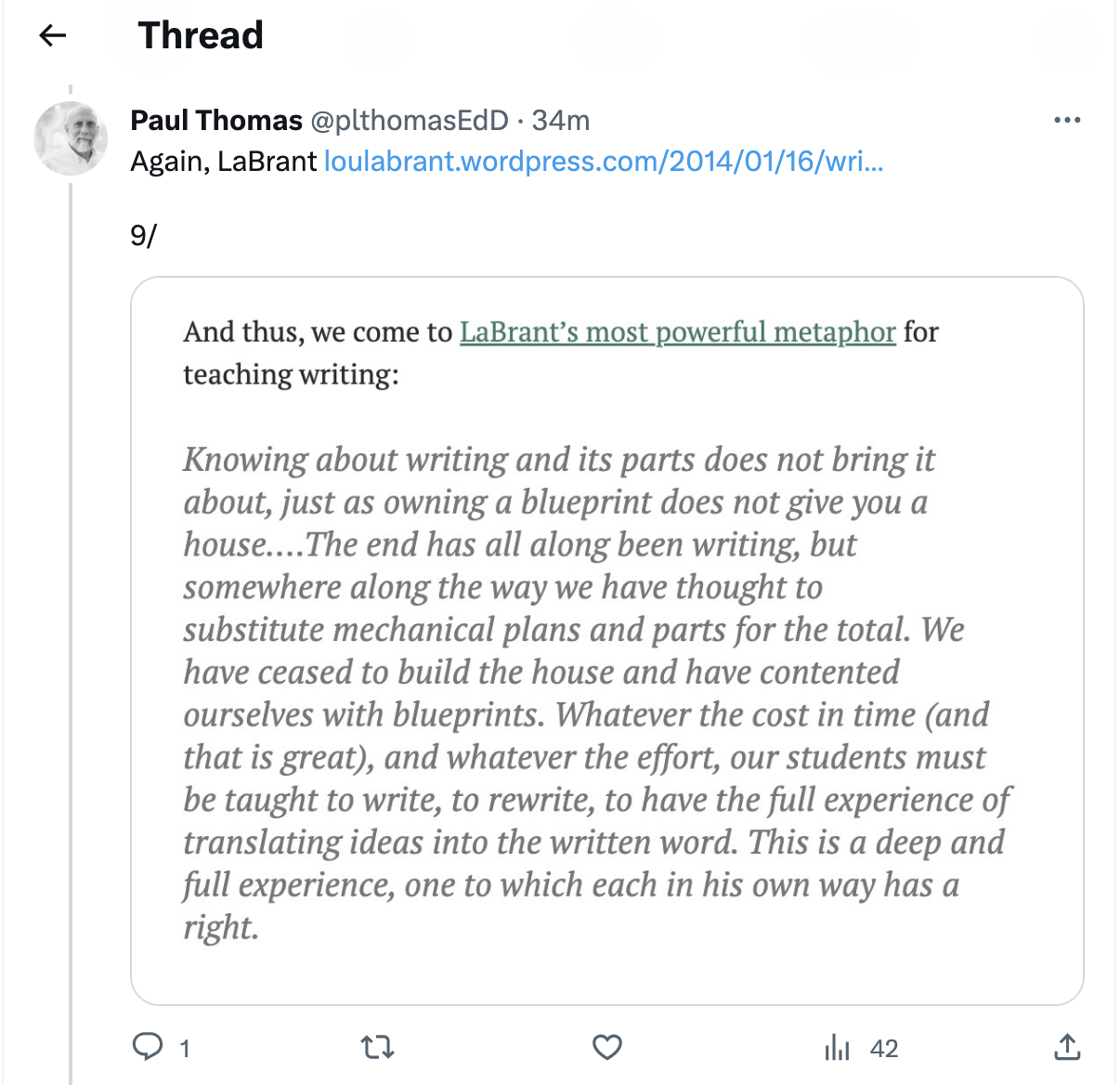
Blueprints or Houses? Lou LaBrant and the Writing Debate, P.L. Thomas [access HERE]

Revisiting LaBrant’s “Writing Is More than Structure” (English Journal, May 1957), P.L. Thomas

Teaching Grammar in Context, Connie Weaver

Style: Lessons in Clarity and Grace, 12th Edition, Joseph M. Williams, Joseph Bizup

The Writer’s Practice: Building Confidence in Your Nonfiction Writing, John Warner

This Ain’t Another Statement! This is a DEMAND for Black Linguistic Justice! (CCCC)
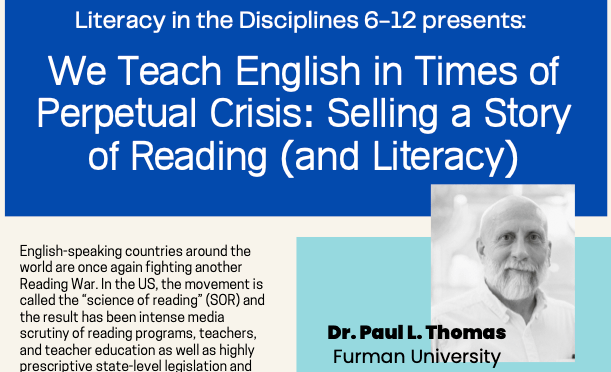
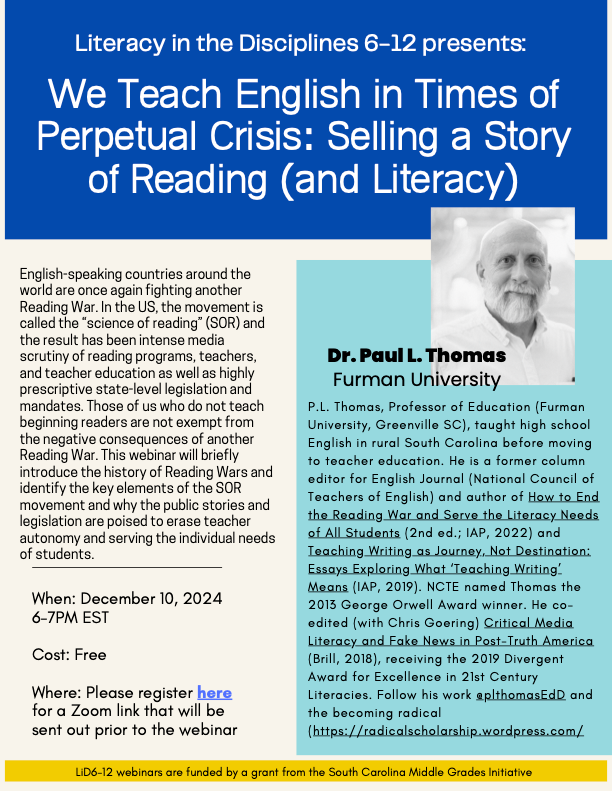
We Teach English in Times of Perpetual Crisis: Selling a Story of Reading (and Literacy) [Webinar Companion Post]

Click here to register: https://forms.gle/mvvs7etQAg7RESxs8

See the webinar presentation HERE.

Webinar recording:


In 1947, writing in NCTE’s Elementary English (which became Language Arts), Lou LaBrant announced, “This is not the time for the teacher of any language to follow the line of least resistance, to teach without the fullest possible knowledge of the implications of his medium” (p. 94).

The 2020s have made this call even more important for teachers of language K-12 in the US because of the rise of censorship and curriculum gag orders along with legislative mandates including scripted curriculum as part of the “science of reading” (SOR) movement.

Here, I want to focus on the SOR movement as another cycle of the Reading War, one that threatens the professionalism and autonomy of all teachers at every level.

Those Reading War cycles have included:

Teachers must recognize that Reading War cycles tend to be about ideology, market concerns (reading programs), and political agendas, but not grounded in credible evidence or well focused on the needs of students or the professionalism of teachers.

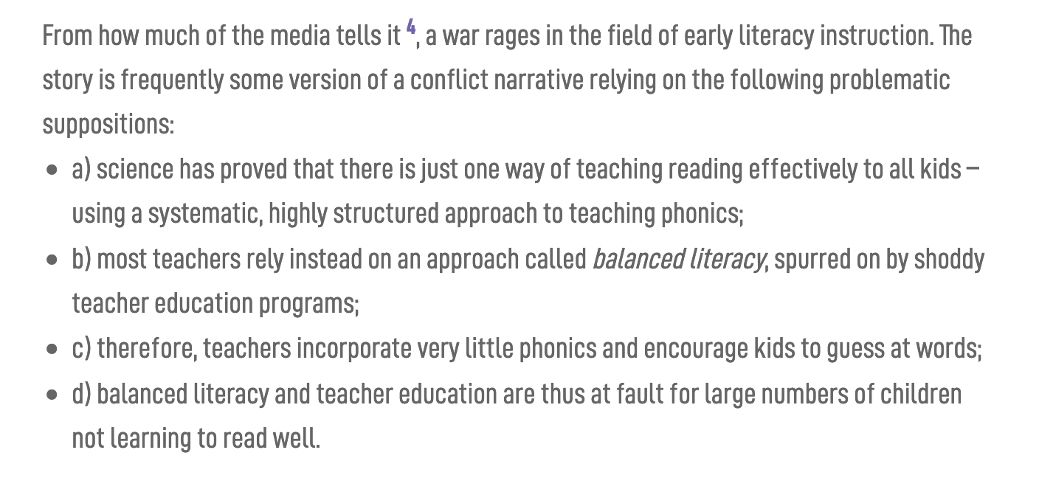
Also when I address the SOR movement, I am not contesting reading science or valid concerns about reading instruction or reading proficiency by students. I am challenging the media story being sold:

Aukerman, M. (2022, November 23). The science of reading and the media: Is reporting biased? Literacy Research Association. https://literacyresearchassociation.org/stories/the-science-of- reading-and-the-media-is-reporting-biased/ 

Further, teachers at all levels must be familiar with the key issues for misleading and even inaccurate claims within the SOR movement (again distinct from reading science and a broad base of research over a century):

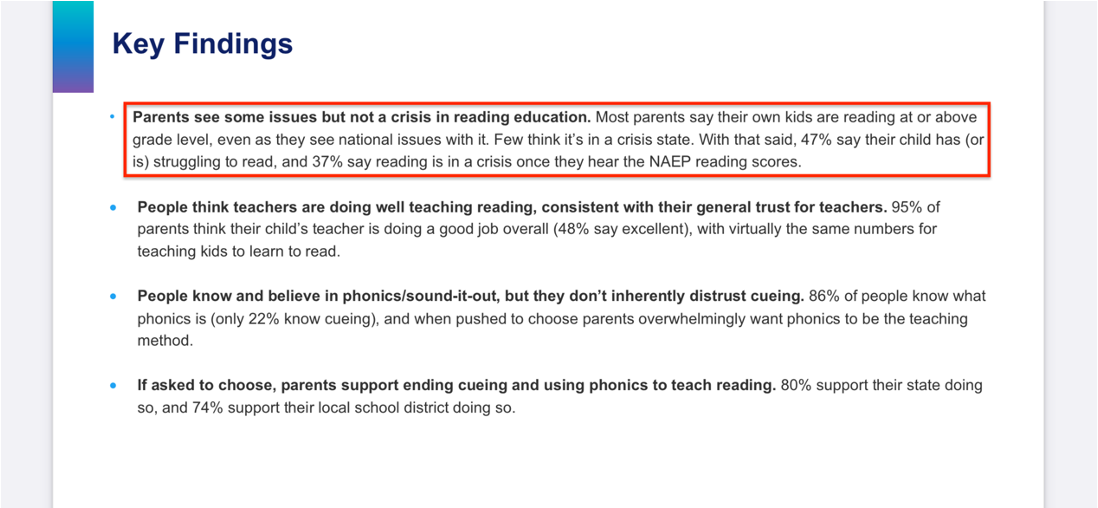
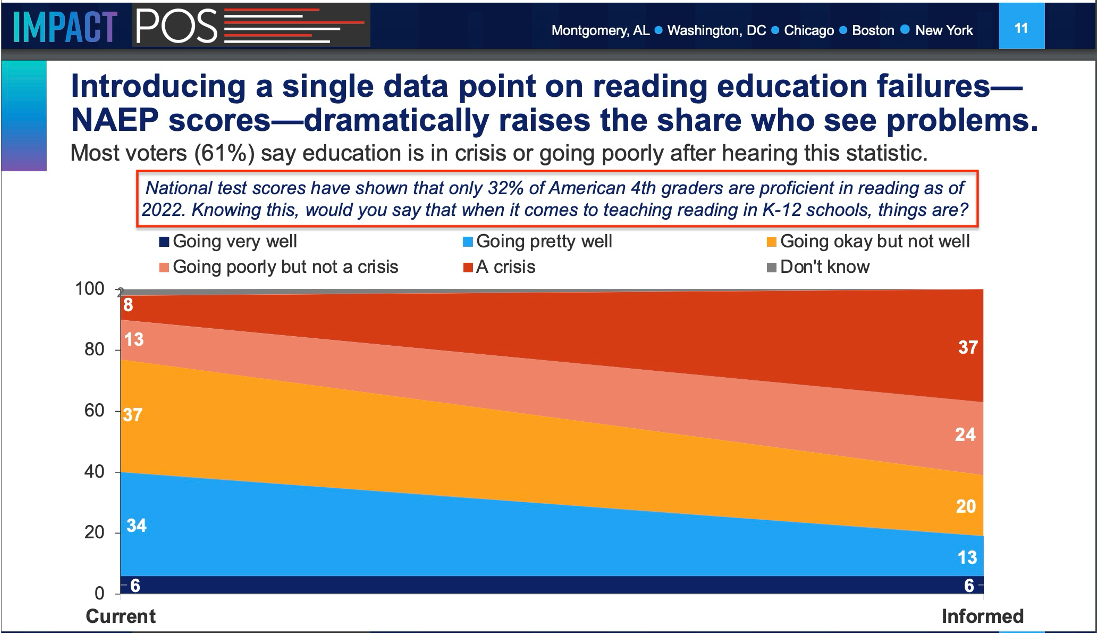
Despite many of the claims made in this media story being misleading or false, the story is very compelling for the public, especially parents. For example, a poll, Reading Education Messaging: Findings and Recommendations from an Online Poll of K-5 Parents in America, shows a disturbing pattern:

The media claim about reading proficiency (which is false because of the confusing categories in NAEP testing) actually changes parental opinion from positive to negative.

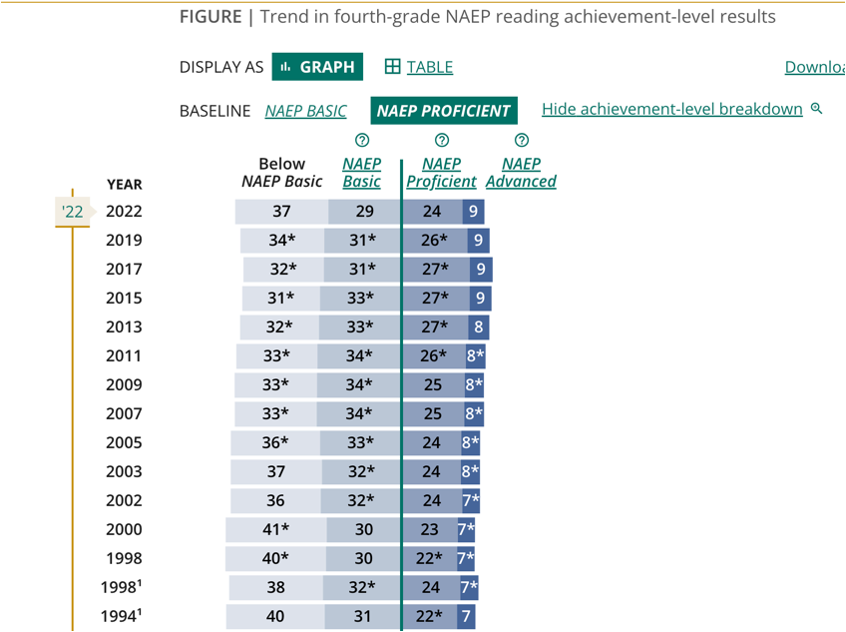
“Basic,” not “proficient,” in NAEP is at grade level; therefore, instead of about 2/3 of students struggling to read, the closer statistic is about 1/3 (and this has been a flat data point for 30+ years, which suggests a norm of reading proficiency and not some recent crisis):

More broadly, the phonics agenda in the Reading War is driven by the same conservative ideology as book bans.

One example is the advocacy of the Gablers in the 1980s, featured in a article in Texas Monthly:

But the Gablers also feel that even those students who learn to read through intensive phonics, memorize their ‘times tables,’ diagram sentences perfectly, and win spelling bees and math contests must still cope with an educational system that is geared to undermining their morals, their individuality, their pride in America, and their faith in God and the free enterprise system. Much of this corrosive work is accomplished through textbooks in history, social sciences, health, and homemaking.

The Gablers also targeted textbooks in their crusade similar to the book bans and misguided attacks on some reading programs:

Norma and Mel Gabler entered the field of textbook reform twenty years ago, after their son Jim came home from school disturbed at discrepancies between the 1954 American history text his eleventh-grade class was using and what his parents had taught him. The Gablers compared his text to history books printed in 1885 and 1921 and discovered differences. “Where can you go to get the truth?” Jim asked.

Since states have been moving toward reading legislation and programs labeled as SOR since around 2012, the evidence is mounting that these misleading and ideological claims of a reading crisis have not (and cannot) deliver on their promises. [1]

But possibly more troubling than the failure to improve student reading proficiency is that these legislative commitments are wasting taxpayers’ money on another baseless Reading War that serves the interests of the education marketplace: “In the first year of implementation, $100 million was allocated for the reform, with $60 million coming from CO VID-19 relief funds. Most of these resources, however, went toward covering the products and services provided by nonprofit and private-sector organizations” (Aydarova, 2023, p. 570).

The market motives behind SOR, in fact, were openly expressed a decade ago in a post by IDA, Structured Literacy: A New Term to Unify Us and Sell What We Do:

At its July 1st meeting, the IDA Board of Directors made a landmark decision designed to help market our approach to reading instruction.  The board chose a name that would encompass all approaches to reading instruction that conform to IDA’s Knowledge and Practice Standards. That name is ‘Structured Literacy.’…

If we want school districts to adopt our approach, we need a name that brings together our successes. We need one name that refers to the many programs that teach reading in the same way. A name is the first and essential step to building a brand….

The term “Structured Literacy” is not designed to replace Orton Gillingham, Multi-Sensory, or other terms in common use. It is an umbrella term designed to describe all of the programs that teach reading in essentially the same way. In our marketing, this term will help us simplify our message and connect our successes. “Structured Literacy” will help us sell what we do so well.

Structured literacy is more a marketing term than a proven way to address the manufactured reading crisis; further, structured literacy accomplishes two outcomes that are counter-educational—de-professionalizing teachers and whitewashing the reading curriculum. [2]

The SOR movement grounded in structured literacy driven by efforts to curb teacher autonomy is being admitted also by the Evidence Advocacy Center, as reported in New Initiative Is Creating Evidence-Based Guidelines for Educators:

In the EAC’s plan for the transformation of the profession into an evidence-based system, educators will relinquish certain freedoms — notably the leeway to employ ineffective practices — but will gain guidance that empowers them to fulfill their original purpose by profoundly impacting the future of students, families and communities. The alternative is to continue rearranging the deck chairs under the guise of education reform.

Since over 75% of public school teachers are women (Report on the Condition of Education 2024), all educators, regardless of content area or grade level, must recognize the threat of “relinquish certain freedoms,” eeriely similar to arguments posed to Handmaid’s in Atwood’s The Handmaid’s Tale:

There is more than one kind of freedom, said Aunt Lydia. Freedom to and freedom from. in the days of anarchy, it was freedom to. Now you are being given freedom from. Don’t underrate it….

We were a society dying, said Aunt Lydia, of too much choice. (pp. 24, 25)

While these efforts are about power and control, the SOR movement includes a harmful pattern of journalists taking on the role of “watchdogs,” as Hanford claims for the Education Writers Association.

Finally, then, the SOR movement is not just another Reading War, and the SOR movement is far more than an immediate concern for beginning reading teachers and teacher educators.

This movement is another threat to teaching as a profession, an organized agenda that seeks ways to de-professionalize teachers while serving market and political goals at the expense of teaching and learning.

Recommended

Betts, E. A., Dolch, E. W., Gates, A. I., Gray, W. S., Horn, E., LaBrant, L., Roberts, H., Smith, D. V., Smith, N. B., & Witty, P. (1942). What shall we do about reading today? A symposium. The Elementary English Review, 19(7), 225–­ 256. https://www.jstor.org/stable/41382636

Thomas, P.L. (2024, March). We teach English in times of perpetual crisis: The long (and tedious) history of reading crisis. English Journal, 113(4), 21-26. https://publicationsncte.org/content/journals/10.58680/ej2024113421

Thomas, P.L. (2024, May). Teaching English in the “science of reading” era: We teach English in times of perpetual crisis: Selling a story of reading. English Journal, 113(5), 16-22. https://publicationsncte.org/content/journals/10.58680/ej2024113516 [Access HERE until open access at EJ]

Thomas, P.L. (2024, September). We teach English in times of perpetual crisis: The media continue to misread teaching reading and literacy. English Journal, 114(1), 14-19. https://publicationsncte.org/content/journals/10.58680/ej2024114114 [Access HERE until open access at EJ]

Thomas, P.L. (2024, November). We teach English in times of perpetual crisis: For all ELA teachers, “the time is always now.” English Journal, 114(2), 21-26. TBD

Thomas, P.L. (2022). The Science of Reading movement: The never-ending debate and the need for a different approach to reading instruction. Boulder, CO: National Education Policy Center. Retrieved [date] from http://nepc.colorado.edu/publication/science-of-reading

Thomas, P.L. (2016). Miracle schools or political scam? In W.J. Mathis & T.M. Trujillo, Learning from the Federal Market-Based Reforms: Lessons for ESSA. Charlotte, NC: IAP.

Lou LaBrant: An Annotated Bibliography

Tomorrow’s Illiterates: The State of Reading Instruction Today, by Walcutt, Charles Child


Notes

[1] See for example:

  • Aydarova, E. (2023). ‘Whatever you want to call it”: Science of reading mythologies in the education reform movement. Harvard Educational Review, 93(4), 556–581, https://doi.org10.17763/1943-5045-93.4.556
  • Chaffin, M., Riesco, H.S., Hacket-Hill, K., Collet, V., Grizzle, M.Y., Y Warren, J. (2023). “Phonics monkeys” and “real life reading”: Heteroglossic views of a state reading initiative. Literacy Research and Instruction, 1–22. https://doi.org10.1080/19388071.2023.2271085
  • Reinking, D., Hruby, G.G., & Risko, V.J. (2023). Legislating phonics: Settle science of political polemic? Teachers College Record. https://doi.org/10.1177/01614681231155688
  • Thomas, P.L. (2022). The Science of Reading movement: The never-ending debate and the need for a different approach to reading instruction. Boulder, CO: National Education Policy Center. http://nepc.colorado.edu/publication/science-of-reading 

[2] See for example:

Writing Is Learned by Writing: 2023

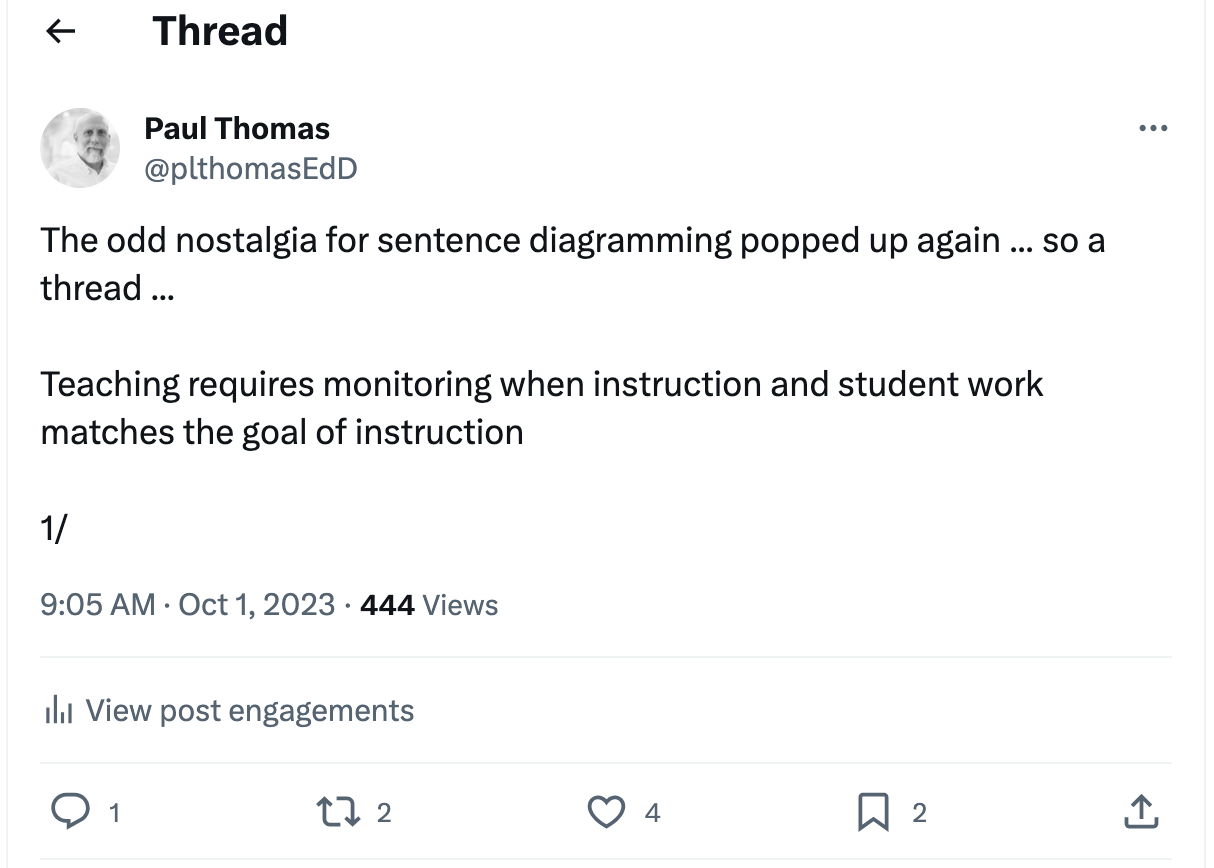
The odd nostalgia for sentence diagramming popped up again so a thread that builds on an older post of mine—Diagramming Sentences and the Art of Misguided Nostalgia:

Links from Thread

Writing Is Learned by Writing (1953)

Writing topics by LaBrant

Writing Is More than Structure (1957)

grammar Nazis (post-apostrophe literature)

Thomas, P.L. (2019). Teaching writing as journey, not destination: Essays exploring what “teaching writing” means. Charlotte, NC: Information Age Publishing.

Deja Vu All Over Again: The Never Ending Pursuit of “Scientific” Instruction

Writing in NCTE’s Elementary English (known as Language Arts since 1975), Lou LaBrant offered a bold proclamation that resonates still today: “This is not the time for the teacher of any language to follow the line of least resistance, to teach without the fullest possible knowledge of the implications of his medium” (1947, p. 94).

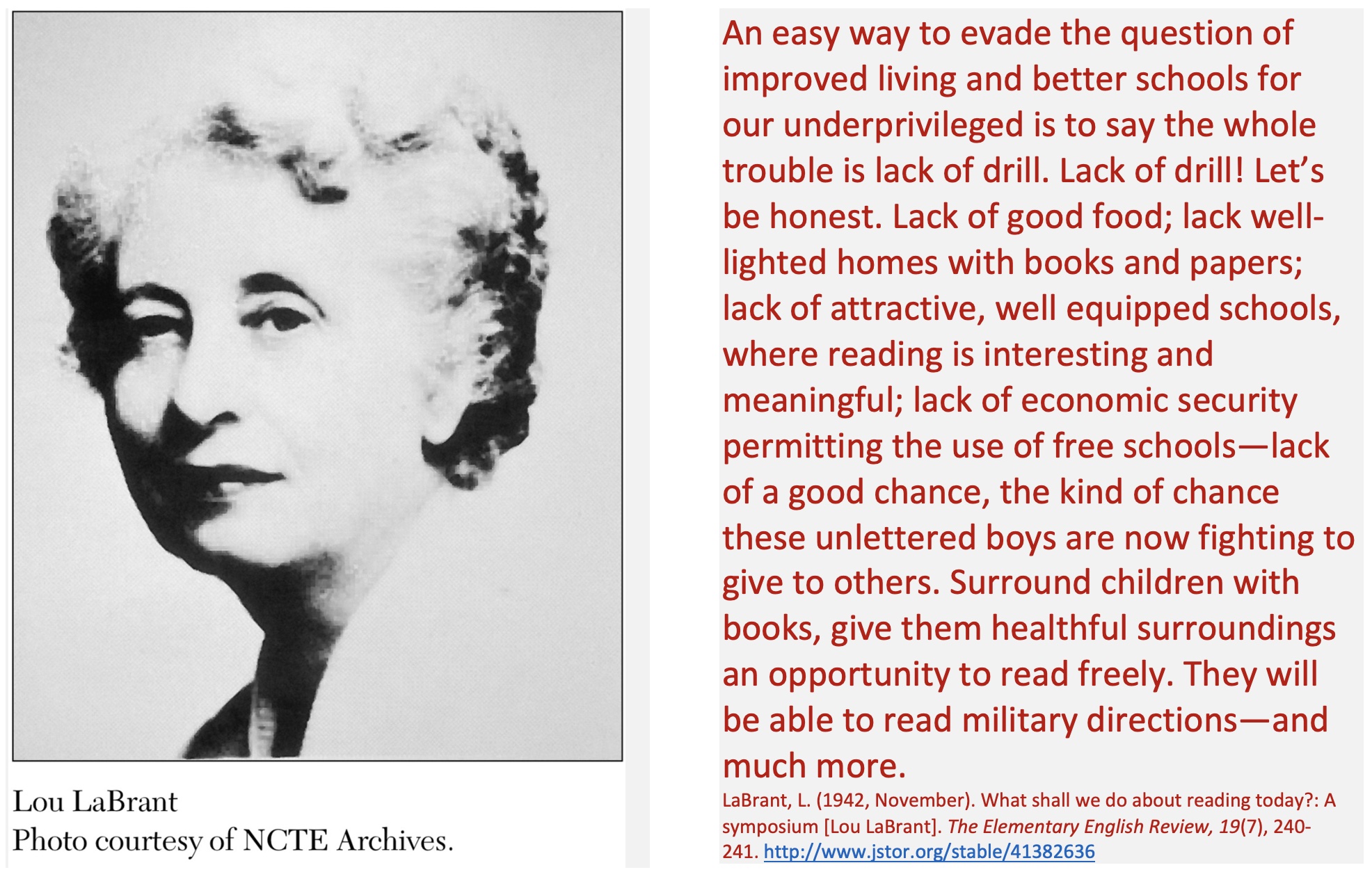
LaBrant entered the classroom in 1906, and after experiencing forced retirement in her 60s, she found ways to remain in the field at historically Black colleges, finally retiring fully in 1971 from Dillard University. This impressively long career sits at the center of an impressively long life, living until she was 102 after writing her memoir at 100.

The embodiment of Deweyian Progressivism, LaBrant was equally demanding of herself as she was of others—particularly educators. Her high standards and blunt speaking and writing style make her appealing and often intimidating.

Her piece from 1947 also includes other statements I have repeated in my public and scholarly work:

A brief consideration will indicate reasons for the considerable gap between the research currently available and the utilization of that research in school programs and methods…. (p. 87)

It is not strange, in view of the extensive literature on language, that the teacher tends to fall back upon the textbook as authority, unmindful of the fact that the writer of the text may himself be ignorant of the basis for his study. (pp. 88-89)

LaBrant, L. (1947, January). Research in languageElementary English, 24(1), 86-94. http://www.jstor.org/stable/41383425

Seventy-six years later, LaBrant could just as easily be speaking into the current “science of reading” (SOR) debate that centers research (“science”) and the imbalance of authority often conceded to reading programs.

Some, in fact, may be compelled to assume LaBrant would be an outspoken advocate for SOR. However, LaBrant’s scholarship and practice offer a window into why the SOR movement is misguided and misleading, specifically about the central role of pursuing “scientific” instruction.

To understand that the current SOR is a misuse of the term “scientific” we should reach back a bit farther in LaBrant’s career to 1931:

The cause for my wrath is not new or single. It is of slow growth and has many characteristics. It is known to many as a variation of the project method; to me, as the soap performance. With the project, neatly defined by theorizing educators as “a purposeful activity carried to a successful conclusion,” I know better than to be at war. With what passes for purposeful activity and is unfortunately carried to a conclusion because it will kill time, I have much to complain. To be, for a moment, coherent: I am disturbed by the practice, much more common than our publications would indicate, of using the carving of little toy boats and castles, the dressing of quaint dolls, the pasting of advertising pictures, and the manipulation of clay and soap as the teaching of English literature. (p. 245)

LaBrant, L. (1931, March). MasqueradingThe English Journal, 20(3), 244-246. http://www.jstor.org/stable/803664

In the first couple decades of the 1900s, John Dewey practiced and developed a progressive approach to teaching and learning that was grounded in his call for scientific instruction and holistic approaches to education. Many associate Dewey with “learning by doing,” a relatively fair summary but one that is ripe for misapplication.

Similar to what has been repeated in educational practice for at least a century, William Heard Kilpatrick seized onto Dewey’s concept but packaged it as the Project Method, the source of LaBrant’s “wrath” in 1931.

Dewey’s progressive education philosophy has a very odd history that includes progressivism routinely being blamed for educational failure even though public education in the US being historically and currently deeply traditional and conservative (read Kohn on this paradox).

Two dynamics are at play.

First, formal public education in the US has mostly grounded practice in efficiency since the 1920s—packing as many students per teacher into the classroom as possible and structuring curriculum and instruction around commercial programs and standardized testing.

Second, progressive “scientific” is much more complex and nuanced than current and narrow uses of “scientific” in the SOR movement.

Dewey and LaBrant were advocates for teacher autonomy and authority, which rested on the expectation that teachers know the current evidence base (the “science”) of their filed of literacy but in the context of their day-to-day classroom practice. Both, for example, would strongly reject teaching reading through a commercial reading program of any kind.

Dewey’s progressivism, then, is tethered to the real world in front of the teacher—student behaviors and classroom dynamics.

Philosophy and theory (based on evidence, some of which is generated by the scientific process) provide the teacher with a place to start instruction; however, the evidence in front of the teacher during the act of teaching perpetually shapes practice.

Dewey advocated for “scientific” teaching as an ongoing experiment, not teaching grounded to a template derived from a narrow body of experimental and quasi-experimental research.

If LaBrant were alive today, she would be writing pieces very similar to her 1931 diatribe about the project method, but targeting the SOR movement and the deeply unscientific legislation and practices that movement has spawned: testing students with nonsense words, grade retention, scripted reading programs, one-size-fits-all systematic phonics, LETRS training, NAEP data, “miracle” claims, and more.

Yes, as LaBrant lamented in 1947, public education has a long history of a “considerable gap” between research (“science”) and classroom practice, but another problem sitting between better instruction and greater learning by students is the never ending pursuit of “scientific” instruction that weaponizes “science” and fails to acknowledge the most powerful messages of Dewey’s progressivism—teaching and learning must be focused on the real students sitting in front of teachers daily.

Those unique and diverse students are best served by teachers who teach as scientists perform science—starting with informed hypotheses, implementing instructional practices, developing temporal and unique theories for each student, and adjusting practice based on that evidence for the benefit of each student.

Progressive ideas of “science” are ways to navigate the world in informed and practical ways; conversely, the SOR movement has once again reduced “scientific” to an ideological and political baseball bat used to batter anyone not conforming to their misinformation.

Although LaBrant left us over three decades ago, I can feel her wrath for the SOR movement growing somewhere in the universe, and regret we do not have her voice still to guide us—but we do have her words: “This is not the time for the teacher of any language to follow the line of least resistance, to teach without the fullest possible knowledge of the implications of his medium” (1947, p. 94).

Beyond Reading Skills: Phonics, Vocabulary, and Knowledge

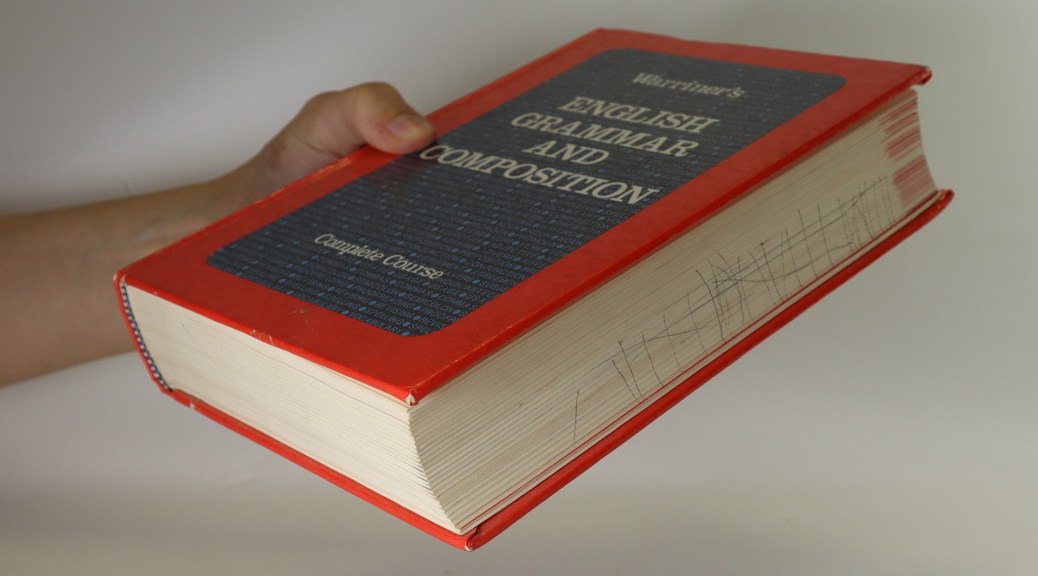
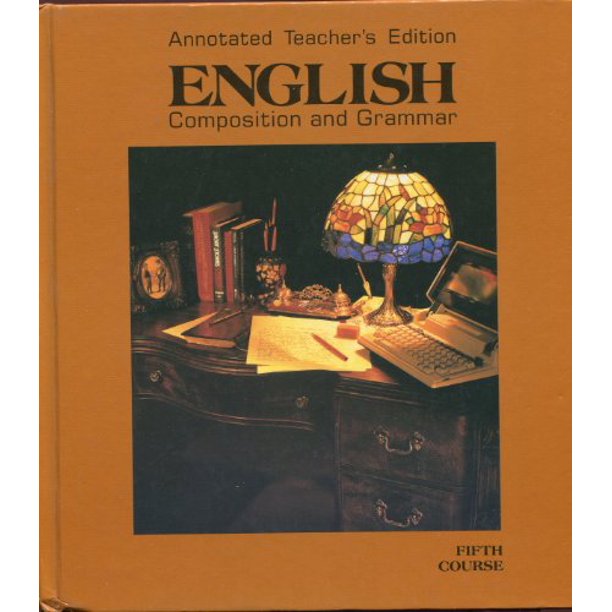
When I entered the classroom as an English teacher in 1984 at the high school where I had graduated just five years earlier, students lugged around two huge textbooks for their English courses, one of which was Warriner’s English grammar text.

Students were conveniently color coded by these texts since the publishers provided different ability and grade levels of the literature and grammar texts. And universally students hated these textbooks, the carrying and their use in the classrooms.

Since I taught different ability levels (we used and A, B, C level system for each grade) and grades, I had about 15 textbooks across my five courses because students in English also were assigned vocabulary books (the publisher we used proudly printed in bright letters that these vocabulary books prepared students for the SAT!).

At least the vocabulary books were small paperbacks.

Two important facts stand out about those first couple years teaching in the traditional expectations for English teachers at that school (mostly the same teachers who taught me as a student): first, Warriner’s regardless of grade or ability level had essentially the exact same chapters for teachers to systematically and comprehensively teach every year, and second, teachers expressed repeatedly that students never learned those grammar lessons, noting that student writing failed to improve in terms of grammar, mechanics, and usage.

Another big picture point to make here is that when I was a student, grammar texts included lessons on “shall” and “will”; that my students had to cover an entire chapter and be tested on “who” and “whom”; and both my students and I had to “learn” about pronoun/antecedent agreement (specifically the use of “they” as plural only).

Today, we must acknowledge that all of these rules and the consequences of students “not learning them” have evaporated since “shall” and “whom” have graciously disappeared and “they” has been (finally) acknowledged as a resourceful pronoun.

As a beginning teacher, I had entered education to teach writing, although, of course, I loved literature also. Yet, the grammar- and skills-centric approach to teaching English, I recognized, was failing students miserably—I mean literally because students were miserable, learning to hate English, writing, and literature.

Of course, my stories here speak to a disturbing reality in education: Lou LaBrant, writing in 1946, noted: “We have some hundreds of studies now which demonstrate that there is little correlation (whatever that may cover) between exercises in punctuation and sentence structure and the tendency to use the principles illustrated in independent writing” (p. 127). And then in 1947: “A brief consideration will indicate reasons for the considerable gap between the research currently available and the utilization of that research in school programs and methods” (p. 87).

Yet, English teachers throughout the decades kept beating their heads against the grammar and skills wall, lamenting “kids today” for not being good writers—regardless of decade, regardless of the grammar programs implemented.

This raises a current issue about “scientific” or “evidence” as the basis for how teachers teach, notably in the current reading war.

Here, I think, is an excellent overview by Jal Mehta (Harvard University) about why calling for “scientific” or “evidence” to mandate teaching literacy is just as misguided as the evidence-free practices I witnessed as a beginning teacher almost 40 years ago:

What may have started out about a decade ago as a sincere plea similar to LaBrant’s—the teaching of reading in practice often failed to be effectively evidence-based (“scientific”)—has turned into the exact sort of one-size-fits-all ideological movement that Jal warns about: scientific as a “weapon.”

The SOR movement has refueled the myth of the bad teacher, continued to perpetuate false narratives of crisis and miracle schools, profited the education marketplace, and driven deeply problematic reading legislation and policy, including inequitable grade retention.

The mistake being made is also perfectly identified by Jal: “In my experience, the best educators and leaders see lots of complexity, consider context, and artfully weave together different approaches to solve particular problems.”

Ironically, this is the exact approach grounding both whole language and balanced literacy as philosophies of teaching reading and writing; however, as we have witnessed, both WL and BL also became convenient labels for practices not following those philosophies or simply slurs ideologues use to criticize.

Instead, the SOR movement has become ideological and weaponized to create simplistic and unfounded crisis rhetoric for politicians and skills-driven reading policy and practice.

For example, no one argues that phonics, vocabulary, and knowledge are not key elements in reading. But the SOR movement demands a linear and sequential skills-first approach; teach phonics, vocabulary, and knowledge systematically before students read.

The skills-first approach is essentially authoritarian (what phonics, vocabulary, and knowledge students “need” is determined and outlined for students and teachers) and necessarily erases diversity of language and experiences by students.

The counter approach, the complex approach to reading, acknowledges the importance of elements such as phonics, vocabulary, and knowledge, but also honors that the relationship between so-called skills and reading is reciprocal, not linear or sequential.

In other words, yes, students need some direct and purposeful instruction in phonics, vocabulary, and knowledge building as they become beginning readers; however, most of a person’s acquisition of phonics, vocabulary, and knowledge comes from reading—not direct or systematic instruction.

The problem with systematic and comprehensive teaching of any literacy skills is that the goal and accountability around teaching and learning become the acquisition of the skills (phonics tests, vocabulary tests, knowledge tests) instead of the authentic goal of fostering eager, independent, and critical students who read.

Ultimately, if we genuinely want evidence-based reading instruction for children in the US, we must recognize that the most important sources of evidence are the children themselves and the most valuable person to understand what children need to read are their teachers.

However, beyond shifting to what evidence counts, we must also recognize that students and teachers cannot be successful unless we address learning and teaching conditions (the one move politicians refuse to make).

Regretfully, as Jal recognizes, students and teachers are again simply pawns in another fruitless war won by the SOR advocates “who are loudest about ‘evidence-based practices,’ [and] ironically tend to be more ideologues who have a few preferred solutions that they think can address every problem.”

Looking Back to Understand “Science of Reading” and Censorship: Lou LaBrant 1936-1949 [Updated]

One of the most important aspects of understanding any issue or field of knowledge, I think, is to have nuanced historical perspective. That is vividly true about education and especially reading.

The current reading crisis, often referred to as the “science of reading” movement, and the incredibly chilling impact of curriculum bans, book censorship, and attacks on teaching and learning are not, I regret to emphasize, all that new (except the degree of the bans are in many ways unprecedented).

I am currently working on completing my online annotated bibliography of Lou LaBrant, and offer below some historical perspective on teaching reading and why censorship is always wrong for education and democracy.

Access my blog post on each work by clicking the hyperlink in the essay titles; many of her publications can also be accessed through JSTOR (links at end of bibliographies when available). I am including memes of key passages from LaBrant with the recommended works below.


Witty, P.A., & LaBrant, L.L. (1936, June). Aims and methods in reading instructionEducational Trends, 5-9, 18.

LaBrant, L. (1939). The relations of language and speech acquisitions to personality development. In P.A. Witty & C.E. Skinner (Eds.), Mental hygiene in modern education (pp. 324-352). Farrar and Rinehart, Inc.

LaBrant, L. (1940, February). Library teacher or classroom teacher? The Phi Delta Kappan, 22(6), 289-291. https://www.jstor.org/stable/20330759

LaBrant, L. (1942, November). What shall we do about reading today?: A symposium [Lou LaBrant]. The Elementary English Review, 19(7), 240-241. http://www.jstor.org/stable/41382636

LaBrant, L. (1943, March). Our changing program in languageJournal of Educational Method, 21(6), 268-272.

Witty, P., & LaBrant, L. (1946). Teaching the people’s language. Hinds, Hayden, & Eldredge, Inc.

LaBrant, L. (1947, January). Research in language. Elementary English, 24(1), 86-94. http://www.jstor.org/stable/41383425

LaBrant, L. (1949, January). A little list. English Journal, 38(1), 37–40. https://www.jstor.org/stable/808110

Provincialism, Ways of Being, and the Failure of Democracy

I had dinner and a few beers with a former student recently. Although he is about two decades younger than me, we share a hometown and grew up in the same neighborhood. And after I had moved out during young adulthood, as a child, he often spent time at my parents’ house, just playing and hanging out.

He’s worked all over the world and has been living in Europe for more than 15 years. Our conversation drifted to our hometown and his perception of living in Europe instead of near where he grew up. Eventually, he asked how some people “get out” of small hometowns, escape the trap of narrow-mindedness—what I referred to as provincialism.

We share a strong discomfort with conservative and fundamentalist thinking even though we were raised in that environment, which continues to this days in our hometown. His question reminded me of one of my favorite lyrics from The National: “How can anybody know/ How they got to be this way?”

Especially as a teacher, I have found teaching siblings complicates any solid answer to his question since two people raised in the same home and town can turn out to be very different people. We catalogued several people also from our community who, like us, no longer conform to the mold of our upbringing, trying to understand why some people change and others remain frozen in the provincialism of their upbringing.

My former student is very clear that the key for him was being an exchange student in Europe during his junior year of high school; his worldview changed once he had lived a different view of the world. I credit my education, especially literature, but it is the same dynamic—being exposed to different views of the world.


“The English class does not differ from other classes in responsibility for social situations which militate against prejudice and intolerance,” begins “The Words of My Mouth” in a June issue of English Journal. “Classifications which result in racial or cultural segregation, encouragement of small cliques, avoidance of crucial issues—all of these may be evils in the English classes as others.”

That opening builds to this key question: “Do the very words we use and our attitudes toward them affect our tendency to accept or reject other human beings?”

This essay is by Lou LaBrant and was published in 1946. LaBrant was vividly aware of the threats to freedom in the context of WWII and Nazi Germany, but her essay resonates today because of the threats from within the US, the Republican assaults on academic freedom, books, and individual choice by weaponizing “pornography,” “grooming,” “Critical Race Theory,” and any word or phrase to impose a narrow view of the world onto all of us.

“Not one facet of human experience will serve to insure the kind of society we need so desperately, and all aspects of living affect all others,” LaBrant warns.

The role of education, she emphasizes, must include: “A basic understanding which needs to be taught in school and home is that the existence of a word does not at all prove the existence of anything.” At the core of racism, sexism, and all types of bigotry and hate, LaBrant recognized the need to challenge the power of “word magic,” the belief that uttering something makes it so, gives it power.

In 1950, LaBrant returned to this topic, focusing on students as writers:

[Students] should discover the danger in word-magic, that calling a man by a name does not necessarily make him what they say; that describing the postal system as socialist does not transfer our mail to Moscow, nor brand either the writer or postman as disciples of Stalin. We must teach our students that words are symbols which they use, and that there is stupidity in word-magic. (p. 264)

LaBrant, L. (1950, April). The individual and his writing. Elementary English27(4), 261-265. http://www.jstor.org/stable/41383735

Over the past few years, I have made long trips from South Carolina into the Midwest, specifically Ohio and Wisconsin. Each time, I find the persistence of what is stereotypically “Southern” into the region that we in the South would classify as the “North” (which is everything outside of the Deep South, including Virginia and Texas). Fundamentalist billboards condemning homosexuality and abortion as well as huge signs quoting scripture line highways all through rural America.

These 8-10 hour drives left me certain I was not making just the specific trip I was on (conference presentations) but was destined for the flaming pits of Hell. Although I am a white straight man, I strongly believe in the rights of all people regardless of racial identification, gender, sexuality, religion (or not), etc., because I very much believe I deserve the same sort of freedom to fully be the human I have come to know that I am.

I also know that for women to be fully human, body autonomy is essential and that includes abortion rights.

Like Kurt Vonnegut, I am a humanist:

My parents and grandparents were humanists, what used to be called Free Thinkers. So as a humanist I am honoring my ancestors, which the Bible says is a good thing to do. We humanists try to behave as decently, as fairly, and as honorably as we can without any expectation of rewards or punishments in an afterlife [emphasis added]. My brother and sister didn’t think there was one, my parents and grandparents didn’t think there was one. It was enough that they were alive. We humanists serve as best we can the only abstraction with which we have any real familiarity, which is our community.

A Man without a Country, Kurt Vonnegut

To me, this is a foundational commitment to the country’s claim of life, liberty, and the pursuit of happiness. How can any of us be happy if we are required to conform to a narrow mandate of ways of being determined by a few in power based on a provincial view of the world?

My gender identity and sexuality are who I am, and right for me, but that means nothing for anyone else. I want my ways of being to be honored; therefore, I believe I am obligated to honor that for everyone else.


As my former student can attest by experience, people have even more freedom in countries other than the US; Americans do not have a monopoly on individual freedom and certainly not communal support for those freedoms (universal healthcare contributes to individual freedom, for example):

[I]t seems to me that the myth, the illusion, that this is a free country, for example, is disastrous….

There is an illusion about America, a myth about America to which we are clinging which has nothing to do with the lives we lead and I don’t believe that anybody in this country who has really thought about it or really almost anybody who has been brought up against it—and almost all of us have one way or another—this collision between one’s image of oneself and what one actually is is always very painful and there are two things you can do about it, you can meet the collision head-on and try and become what you really are or you can retreat and try to remain what you thought you were, which is a fantasy, in which you will certainly perish.

“Notes for a Hypothetical Novel,” James Baldwin

The hostile environment in the US today fostered by conservatives is also eroding those freedoms day by day; people are less free in the US than 6 months ago, and we are very likely on the precipice of the erasing of even greater freedoms in the coming months.

The Republican agenda of rolling back freedoms and rights as well as increasing bans and censorship is an agenda grounded in provincialism, which, as I have observed, seems to be rooted in rurality, the isolation of people creating an isolation of worldview.

We know rural America is red and urban American is blue, but I think we fail to examine fully why this is the case. For me, my former student’s experience illustrates the dangers of narrow thinking when you have limited experiences and why a cosmopolitan worldview is a doorway to expanding how you think and your ability to have empathy for people who appear to be unlike you.

I use “appear” because, for example, a gay person and a straight person have different sexualities but share the need for having that sexuality honored. That is our commonality.

Yet, democracy is failing us in the US because those who want to use their political power to control have the same rights to vote as those who want to use their political power to insure everyone’s freedoms and ways of being.

And in 2022, those voting to control seem to the have the upper-hand, not because there are more of them but because the system has been gamed to favor them and they often have the greatest passion for asserting their control. Sadly, “The best lack all conviction, while the worst/Are full of passionate intensity” (William Butler Yeats).

Some see their ideologies and beliefs as baseball bats; others see them as safety nets. In a democracy, those votes are equal—and the humanity of individuals hangs in the balance.

I am not concerned, however, that I am in fact going to hell for wanting individual freedom for everyone regardless of their ways of being, regardless of how their gender, sexuality, or whatever appears the same or different from mine.

The irony is that Republicans are creating hell on earth for all of us right here in the US; they are proving Sartre right: “Hell is other people.”

And because of the failure of democracy, there is no exit.

The “Science of Reading” Multiverse

Published in 1947 in The Elementary English Review, a flagship journal of the National Council of Teachers of English (NCTE) that later became Language Arts, “Research in Language” is one of the most cited pieces by Lou LaBrant in my scholarship and public writing about education and literacy.

LaBrant served as president of NCTE in the 1950s, and along with being an active and influential literacy scholar, LaBrant was a practitioner over a staggering 65 years of teaching.

LaBrant made two incisive claims in this article:

A brief consideration will indicate reasons for the considerable gap between the research currently available and the utilization of that research in school programs and methods. (p. 87)

It is not strange, in view of the extensive literature on language, that the teacher tends to fall back upon the textbook as authority, unmindful of the fact that the writer of the text may himself be ignorant of the basis for his study. (pp. 88-89)

LaBrant, L. (1947, January). Research in language. Elementary English, 24(1), 86-94. http://www.jstor.org/stable/41383425

Having written an educational biography of LaBrant for my doctoral dissertation, I am vividly aware that LaBrant taught and wrote as a complex progressive who used the term “research” in broad Deweyan terms that included everything from gold-standard experimental research to the daily observations made by classroom teachers.

I cite her because as a practitioner and scholar I also embrace a very complicated understanding of “research,” “evidence,” and the word of the moment, “science.” I am also deeply skeptical of textbooks and programs.

Since early 2018, the phrase “science of reading” has entered and often dominated media, public/parental, and political discourse around the teaching and learning of reading in the U.S.

Almost for as long—I discovered the movement a few months after it began—I have been waving a red flag, advocating for skepticism and extreme caution about that discourse, the media, public/parental, and political rhetoric. For that reason, I persist in placing the phrase in quote marks since I am specifically criticizing the discourse.

If anything, my criticism is having far too little impact on the consequences of the “science of reading” discourse that is driving many states to adopt new reading legislation. And on social media, I am routinely attacked, often quite aggressively, as a science denier and someone intent on hurting children (although I have been a life-long educator across five decades as both a K-12 classroom teacher and a college professor).

I am also often discredited and told that journalists, parents, and politicians understand my own field better than I do.

Part of the problem with debating the “science of reading” movement is the term itself, one that has at least three different meanings, a multiverse if you will (although absent, darn it, Doctor Strange or Wanda).

Before anyone can, or should, answer “Do you support/reject the ‘science of reading’?” we must first clarify exactly what the term means; therefore, here, then, I want to detail the three ways the phrase currently exists since it entered mainstream use in the media during 2018.

“Science of Reading” as Media, Public/Parental, and Political Discourse. Beginning with Emily Hanford and then perpetuated by mainstream media (Education Week and the New York Times, notably), the “science of reading” is a narrative that claims teachers are not teaching students to read using the “science of reading” because teacher educators have failed to teach the “science of reading” in teacher prep programs. Concurrently, this discourse also blames low student reading achievement on the dominance of balanced literacy reading programs (often erroneously) since, as advocates claim, balance literacy is not grounded in the “science of reading.” This version of the “science of reading” maintains that primarily (or even only) cognitive science research is the “science” that counts and that the “simple view” of reading is the one valid theory of reading supported by the “science of reading.” [Note: This is the version of the “science of reading” that most of my scholarly and public writing challenges as misguided and harmful; see here, here, and here.]

“Science of Reading” as Marketing and Branding. Since the “science of reading” advocacy identified above has been extremely effective, states are adopting new reading legislation, some of which directly bans popular reading programs and then narrowly mandates the use of materials and programs that meet the narrow characterization above. This means education companies, especially ones focusing on literacy, have begun to brand and rebrand their materials as programs with the “science of reading.” For example:

As a market response to legislation, as well, some popular reading programs have responded to this version of the phrase. This marketing dynamic is very common in education. Many years ago, I attended a state-level literacy conference where Smokey Daniels spoke. Daniels is one of the top literacy scholars associated with the term “best practice”; however, he warned then that the term had been quickly co-opted by textbook publishers and that there was no mechanism for insuring that something labeled “best practice” was, in fact, demonstrating those concepts (the same problem exists for “whole language” and “balanced literacy”).

“Science of Reading” as Shorthand for the Research Base for Teaching Reading. This is what LaBrant referred to as the “research currently available” in 1947. The irony in this use of the phrase is that many people have been using some form of this phrase for a century—”research,” “science,” “evidence.” And of course, scholars and practitioners are often aware of and practicing many aspects of that “science”—even though science, research, and evidence are all necessarily in a state of flux (and thus, LaBrant’s nod to “currently available”). To be blunt, no reasonable or informed person would reject this use of the “science of reading.” However, I must note that this use is almost entirely absent in public discourse; it remains used almost exclusively among researchers and some practitioners. Another irony, in fact, is that the first use of the phrase above is itself a gross mischaracterization of this complex and broad use.

Because of these different and often conflicting uses of the “science of reading,” we are experiencing incredibly jumbled and even nonsensical outcomes such as teachers being required to attend training in programs that are not supported by research (LETRS) and states adopting reading legislation that implement practices that are not supported by research (grade retention).

So, if you return to LaBrant’s claims above, you may notice an eerie similarity between her valid assertions and the current “science of reading” discourse that is not credible even as it is highly effective.

The problem is that teaching, learning, and literacy are extremely complex human behaviors that resist simple labels or explanations—and also defy efforts to prescribe templates that will magically fulfill the urge for “all students must.”

Alas, in this multiverse there is no magic.


Recommended

Dr. Paul Thomas on the Multiverse that is the Science of Teaching Reading

Paul Thomas How to End the Reading War and Serve the Literacy Needs of All Students

Transitioning from High School to College: (Re)considering Citation Edition

My first really challenging experience with citation as a student/scholar occurred fairly late in life, during my mid- to late 30s while I was in my doctoral program.

Although I had undergraduate and graduate degrees in secondary English education, I had functioned, essentially, as an English major in my academic as well as personal writing. That means I had done mostly textual analysis and worked my way over the years through the many versions of MLA—from footnotes to endnotes to parenthetical citation.

Before entering my doctoral program, I had been teaching high school English for a decade while also actively pursuing a career as a writer (submitting literary analysis, original fiction, and original poetry for publication). Frankly, my approach to citation as a teacher and writer had been uncritical and rigidly practical.

Even my dissertation—where I certainly learned how to navigate APA since I produced a final manuscript of over 300 pages with about 10 pages of references—was nothing more than a glimpse of the social science scholar and writer I would become; writing a biography allowed me to remain primarily focused on textual analysis, often more like a humanities (history, English) scholar than a social science scholar (writing educational biography). I culled a life of Lou LaBrant out of her memoir, her published scholarship, and her personal letters, augmented with a few interviews and a couple pieces of scholarship on her published before I took on my project.

Two pivotal experiences in my doctoral program changed me profoundly—being introduced to Joseph William’s Style (and later Jacques Barzun) and transitioning to APA citation and style after many decades using only MLA.

For about 15 years now, I have been fortunate to teach first-year writing at the college level, where I have dramatically changed how I approach citation and the teaching of writing. Much of my focus for undergraduates is fostering genre awareness and disciplinary conventions (including citation).

My approaches have pulled back considerably to the wide view so that students are invited to see and navigate at the conceptual level regardless of the writing or disciplinary circumstance they find themselves in.

I see in my eager and very bright students how paralyzing a reduced high school writing experience can be. These students have written almost entirely in English, primarily doing literary analysis (especially if they took Advanced Placement Literature and Language) and, as one student announced angrily, “memorizing MLA.”

When I explain to them that many (if not most) of them will navigate college and never use MLA again, that all of them will be expected to write at a high level across all the disciplines, and that each discipline has different style sheets and conventional ways of writing, they look deflated, if not outright angry.

At the broadest level, I think students and future scholars need to understand why academia incorporates sources and uses formal citation. There are two reasons, I think. First, students and scholars serve knowledge best by having intellectual humility—starting all writing and research projects by assuming other people have examined a topic already, likely many people with a great deal more expertise and experience that the student or scholar.

If a scholar is fortunate, they can eventually find themselves as one of the or the dominant voice on a topic, but this is rare (I am likely the Lou LaBrant scholar in the world, for example).

And second, related to that first foundational concept, students and scholars establish and gain credibility by “standing on the shoulders of giants”—those scholars, thinkers, and writers who have come before and already spent many years thinking and studying a topic.

Thus, most writing by students and scholars must begin with primary and secondary sources.

Next, students and developing scholars must understand the essential concepts that constitute citation.

In the positive sense, citation is clear and adequate attribution given to other people’s words, ideas, research conclusions, original creations (writing, photography, artwork, performances, etc.), and so forth.

In the negative sense (often how formal education approaches the topic), citation is avoiding plagiarism, which falls along a spectrum from purposefully to carelessly/accidentally presenting someone else’s words, ideas, etc., as your original work.

Finally, the most tedious aspect of citation—especially for students—is navigating the various standards for proper attribution in a variety of writing contexts.

For example, print journalism has a fairly simple (compared to academia) bar for attribution; for example, see this from an article in the New York Times by Anahad O’Connor:

“Sweetened beverages are a common purchase in all households across America,” Kevin Concannon, the U.S.D.A. under secretary for food, nutrition and consumer services, said in an interview. “This report raises a question for all households: Are we consuming too many sweetened beverages, period?”

In the Shopping Cart of a Food Stamp Household: Lots of Soda

Print journalists often use direct attribution in the writing (no complex citation or bibliographies provided). However, online journalism and publications have added another level of citation, the hyperlink; see this from Joe Soss in Jacobin:

In a New York Times story over the weekend, Anahad O’Connor massages and misreports a USDA study to reinforce some of the worst stereotypes about food stamps. For his trouble, the editors placed it on the front page. Readers of the newspaper of record learn that the end result of tax dollars spent on food assistance is a grocery cart full of soda. No exaggeration. The inside headline for the story is “What’s in the Shopping Cart of a Food Stamp Household? Lots of Sugary Soda,” and the front-page illustration shows a shopping cart containing almost nothing but two-liter pop bottles.

O’Connor tells us that “the No. 1 purchases by SNAP households are soft drinks, which account for about 10 percent of the dollars they spend on food.” Milk is number one among non-SNAP households, we are told, not soft drinks.

Food Stamp Fables

I have students write in these contexts (journalism and using hyperlinks) to practice clear and adequate attribution (citation) and finding credible sources, but most students and scholars eventually must navigate formal citation such as MLA, APA, and Chicago Manual of Style.

For many students who recently graduated high school and now must write and cite in college, they must shift to disciplinary writing and recognize that each writing situation has different conventions depending on the field of study.

Academic and scholarly writing (as noted above) require evidence for all claims, often incorporating sources as that evidence. Many students enter college confusing “evidence” with “quoting” because they have written a great deal of literary analysis.

While literature and history scholars often incorporate direct quotes from primary and secondary sources and forefront the authors and titles of those sources (conventions of MLA), most disciplines prefer paraphrasing and synthesis (citing multiple sources with the same content supporting your point) as well as forefronting the content from the sources, and not the sources themselves, as in this sample of synthesis:

From the 1980s (a hot decade for rebooting origins, highlighted by Frank Miller’s Batman) and into the early 2000s, Captain America’s origin continued to be reshaped. Notable for a consideration of race is Truth: Red, White and Black from 2003, which details a remarkable alternate origin as a medical experiment on black men (echoing Tuskegee), resulting in Isaiah Bradley ascension as the actual first Captain America (Connors, 2013; Hack, 2009; McWilliams, 2009; Nama, 2011).

Thomas, P.L. (2017). Can superhero comics defeat racism?: Black superheroes “torn between sci-fi fantasy and cultural reality.” In C.A. Hill (ed.), Teaching comics through multiple lenses: Critical perspectives (pp. 132-146). New York, NY: Routledge.

Quoting, then, is simply one way to support claims and build credibility, and quoting should be confined in academic writing to textual analysis or highlighting passages from a source that demonstrates a uniquely powerful way of expressing the content.

Just as most students can navigate college without using MLA, they will incorporate many other types of evidence that are not quoting (and students will discover that some disciplines see quoting as weak stylistic choices of immature students and scholars).

Ultimately, academic and formal citation is about following a prescribed system while also understanding why each system exists. APA includes publication dates in-text because in the social sciences when research has been conducted matters; for literary scholars, when scholarship was published matters less than the credibility and stature of the critic (so all dates in MLA reside in the bibliographies, not the parenthetical citation in the text).

The mechanics of each citation system require students and scholars to pay attention to details and to copyedit carefully. Students must recognize that their credibility and authority are in part built on following those (often arcane) mechanics.

Of course, the quality of students’ original writing and the sources they depend on matter more, but citation systems exist in part to support what constitutes citation—clear and adequate attribution given to other people’s words, ideas, research conclusions, original creations (writing, photography, artwork, performances, etc.), and so forth.

On their journey to being writers and scholars, students are best served with these broad approaches to why academics depend on sources and how proper attribution/citation varies across writing situations and different disciplines.

Drama and the Struggling High School Reader

In my current trends in literacy course for our MAT program, I have 7 students across several content areas. Our discussion yesterday confronted how too often teachers (notably ELA teachers) assign texts and reading that discourage students as readers.

One candidate in ELA shared a story of a teacher who declared that most of their students “can’t read Shakespeare” so that teacher has the class listen to an audio recording of the play Macbeth.

I noted that required reading lists often do more harm than good for students as readers and added if I had to choose between required texts that students don’t read or choice texts that students actually read, I always want the latter.

Further, this example triggered a pet peeve of mine about how we teach different forms and genres of writing.

I asked the class what type of text Macbeth is, and they all identified it as a play. I followed up with asking how plays/drama are intended to be experienced, and again, they all noted that plays are written to be viewed, preferably as live performances.

Next, I shared with them recurring experiences I have with my first-year writing students (high-achieving students—disproportionately white and affluent—admitted to a selective liberals arts college).

Often on the first day of class, I ask students what novels they read in high school English, and several students will say A Raisin in the Sun, Hamlet, and such. I then point out that these are plays, and not novels. But the students have mostly read these plays in bound books that look identical to the novels they were assigned.

Also in the first few days, I have students do a writing exercise where they write a mimic passage from a chapter in Sandra Cisneros’s The House on Mango Street, “A House of My Own.” Students are told to mimic the grammar and style of the chapter exactly while changing the content.

The assignment is designed as a first transition to reading like a writer [1] (as opposed to reading text for literary analysis) so that students develop the skills needed to compose and revise with attention to not just what they express but also how they express their messages.

Invariably, several students email me their piece and identify it as their “poem,” despite my noting in class that they are mimicking a prose chapter from a novel.

In other words, very bright and often “A” students demonstrate over and over that they have garbled and often inaccurate knowledge about genre and form—and they learn these flawed lessons in school, typically in English, because of careless approaches to text like the one above concerning Macbeth.

I want to focus here on two aspects, interconnected, about how we teach text to students, particularly in high school.

First, concerning having students listen to or read plays, I always see lessons involving text as essentially lessons in genre awareness, a concept endorsed by Ann Johns instead of genre acquisition (her discussion forefronts composition, but this applies to reading as well):

Russell [and] Fisher (in press) distinguish between two approaches to genre pedagogy, two basic goals for a course or tutorial. The first is GENRE ACQUISITION, a goal that focuses upon the students’ ability to reproduce a text type, often from a template, that is organized, or ‘staged’ in a predictable way. The Five Paragraph Essay pedagogies, so common in North America, present a highly structured version of this genre acquisition approach. …

A quite different goal is GENRE AWARENESS, which is realized in a course designed to assist students in developing the rhetorical flexibility necessary for adapting their socio-cognitive genre knowledge to ever-evolving contexts. …I have concluded that raising genre awareness and encouraging the abilities to research and negotiate texts in academic classrooms should be the principal goals for a novice literacy curriculum (Johns 1997).

This juxtaposition of two quite different goals, genre acquisition and genre awareness, is reminiscent of another pedagogical contrast mentioned by Henry Widdowson years ago (1984) and, later, by Flowerdew (1993): that pedagogies are designed to either TRAIN for specific tasks (i.e., text types) or EDUCATE, to cope with an almost unpredictable future. It is my argument here that education should, in the end, be our goal for novice academic literacy courses, for a genre awareness education will prepare students for the academic challenges
that lie ahead. (pp. 238-239)

Johns, A.M. (2008). Genre awareness for the novice academic student: An on-going quest. Language Teaching, 41(2), 237-252.

Therefore, when I teach a genre or form, I typically invite students to ask questions and develop or refine their internalized rubric for what constitutes that genre or form (or medium): What makes a poem, a poem? What makes a comic book, a comic book? What makes a film, a film? What makes an essay, an essay? etc.

Reading and critical literacy require that the reader come to a text with some awareness of form and genre, and that awareness helps the reader navigate the text for meaning.

Sitting down to read Naomi Shihab Nye’s “Gate A-4,” for example, often challenges people since I have seen it identified and heard students refer to the work as a poem, a story, and a non-fiction essay (it is a prose passage, fictional, in Nye’s Honeybee: Poems & Short Prose).

Finally, we must confront why Macbeth was taught to these students through an audio recording—the conclusion that high school students couldn’t read Shakespeare.

I am deeply skeptical of the rush to identify high school students as struggling readers for several reasons:

  • Many high school students are non-readers and it is too easy to conflate non-readers with struggling readers.
  • Often, even in ELA courses, lessons and assessments are designed in ways that allow students to pass or even excel in a course without having to read [2] (students can access information on novels and plays or simply depend on the teacher to cover everything to be assessed in class, which most teachers do).
  • Students who are non-readers are not necessarily demonstrating they have decoding, vocabulary, or comprehension problems, but that they lack motivation to read texts assigned to them and to perform in ways that are not authentic. Many non-readers in the classroom go home and perform complex and advanced literacy that teachers do not see and traditional schooling does not acknowledge (video and board gaming, binge-watching TV, reading and collecting comic books, reading novels they choose such as YA lit or science fiction and fantasy).
  • Students who “struggle” with assigned texts and performing in ways that are often required in school (narrow analysis and multiple choice testing) may be struggling due to those expectations as well as lacking adequate experience reading (since they have passed courses without reading). I think “struggling” is a misnomer for that phenomenon.

Lou LaBrant warned in 1949, “We should not, under the guise of developing literary standards, merely pass along adult weariness” (p. 276).

And LaBrant (1937) held that belief because “the adolescent has much greater power to read and to think intelligently about reading than the results of our conventional program have led us to believe” (p. 34).

We ask too little of students when we fail to honor the fidelity of genre, form, and medium, but we ultimately fail students when we assume their lack of reading lies in a fault with them (“struggling”) instead of interrogating what we require them to read (or not read) and our reductive approaches to text and literacy.


[1] See here and here.

[2] I saw a former students several years after he was a marginal and combative AP Literature student of mine. He smiled and announced that he expected I would be surprised to know he earn a degree in English in college. Then, he added that he did so without ever reading a book assigned to him.

Sources

LaBrant, L. (1949, May). Analysis of clichés and abstractions. English Journal, 38(5), 275-278. Stable URL: http://www.jstor.org/stable/807545

LaBrant, L. (1937, February 17). The content of a free reading program. Educational Research Bulletin, 16(2), 29–34. Stable URL: http://www.jstor.org/stable/1471836