Published in The High School Journal (May 1951) by Dorothy McCuskey, a review of Lou LaBrant‘s most comprehensive work on teaching English, We Teach English, concluded: “In short, this is no ‘how to teach’ book. Rather, it is a book which will cause the reader to re-examine the bases of his [sic] teaching methods and the content of his [sic] courses.”
LaBrant was a demanding teacher and scholar with a career as a teacher of English from 1906 until 1971. And one of the defining features of that career was her persistent challenges to how teachers taught the field labeled, then, as “English.”
The field traditionally called “English” has evolved over the years, often at the K-12 level being envisioned as English/Language Arts (ELA) or simply Language Arts.
Schools often teaches courses called Language Arts. Yet, little actual art happens in most of these classrooms. Instead, language is often treated as a static set of prescriptivist rules that children are expected to master and mimic back to their teacher. This is not an exploration of the art of language. This is linguistic oppression.
Concurrent with this post from Flores, I argued that students must unlearn to write in order to write well at the college level and shared on Twitter the baggage students bring to college, what they must unlearn:
* "Research paper" is a real thing * Huge paragraphs are good * Big (obscure) words are good * Editing is revision * Don't use "I" is a real thing
Having been a high school English teacher for almost two decades and then a teacher educator focusing on ELA and a first-year composition professor for an additional two decades, I carry on LaBrant’s tradition of mostly swimming against the tide of tradition in terms of what counts as “teaching English.”
Students majoring in the humanities, specifically English, has declined significantly—”History is down about 45 percent from its 2007 peak, while the number of English majors has fallen by nearly half since the late 1990s”—prompting many colleges and universities to reconsider and even cut those majors and departments.
We are well past time, I think, the need to reimagine the teaching and fields of English/ELA for K-16.
At one level, English/ELA includes a complex challenge since teachers and professors in that singular field/discipline are often tasked with addressing a wide range of content included in literature and literacy (reading/writing). Bluntly put, teaching English/ELA is a herculean, nearly impossible task.
If we teachers of English/ELA are to be successful in covering literature and literacy K-16, any success found in our students is necessarily cumulative over many, many years. This is no trivial point, and not mere metaphor, but when teaching or learning literature and literacy, there is no finish line.
While I firmly believe we must distinguish between the teaching of literature and literacy, specifically between teaching literature and composition/writing, I also recognize that the myriad aspects of literacy are inherently recursive, symbiotic: learning to read is learning to write; learning to write is learning to read.
For people learning to teach, for example, high school English/ELA (courses that are designed to address both literature and literacy [reading/writing]), majoring in English often proves to be inadequate since English as a discipline at the university level tends to be literature based, often very narrow in course content (an entire semester on William Butler Yeats, for example).
Yes, English majors tends to write a great deal, but writing literary analysis or even so-called creative writing does not prepare a person to teach writing. In higher education, English (literature) and composition are distinct and separate fields.
To emphasize my point, when I was teaching American literature for high school students and as I teach first-year writing at my university, bringing texts into class has completely different purposes; it isn’t that both sets of students aren’t learning reading and writing in the courses, but that we are interrogating texts for significantly distinct purposes.
Literary analysis and reading like a writer are complex but different behaviors for students with different purposes and outcomes.
In fact, literary analysis is a discipline-based type of writing that demands unique moves and conventions than other discipline-based writing, such as in history, psychology, or the sciences.
I spent 18 years teaching high school English and have spent a bit longer now preparing candidates to teach high school English/ELA. I can attest without hesitation that expectations for K-12 English/ELA are excessive, inherently impossible.
While I don’t want to linger on the problems with teaching math, I do want to note that math tends to acknowledge the unique aspects within the field since students take sequences and more clearly delineated courses (geometry, Algebra I, Algebra II, calculus, etc.) that have mathematical principles in common throughout while maintaining the distinct features of each course.
With math (and the sciences), we recognize that a geometry teacher may be ill equipped to teach algebra (or a chemistry teacher, ill equipped to teach biology), but we tend to see English/ELA teachers as a monolithic monstrosity.
Somehow, with only a bachelors degree and at the tender age of 22, I was deemed capable of teaching American and British literature as well as writing to my high school students, but college professors several years older than that and armed with doctoral degrees are hired in English departments to teach Elizabethan drama (and such candidates often wave off requests that they take on first-year composition as well since, well, they aren’t trained to do that).
Sure, professors at the college level teach outside their specialities, but this is seen as a stretch, and not the norm or ideal. And when professors are tasked to work outside their areas of specialization, outcomes are often disappointing (my university decided years ago any professor could teach first-year writing—until it became abundantly clear that that is certainly not true).
Since a significant percentage of my college teaching load is now first-year and upper-level writing, I witness the harm done to students at the K-12 level and the inadequacies at the university level for writing instruction, historically a shunned cousin of the field of English since, I think, composition is viewed as mere teaching (and we all know the status of the field of education in academia).
Students need and deserve in K-16 schooling courses and teachers/professors properly equipped to teach both literature and literacy (specifically writing), but not simultaneously.
English/ELA must be reimagined as a complex field with symbiotic but distinct elements that require time and patience for both teaching and learning—and a much greater respect for the complexity and difficulty involved in teaching any of those different areas.
Writing in 1939 about the experimental program at the Ohio State University High School, LaBrant posed a similar argument:
That not all teachers are, however, equally skilled in assisting with all phases of language experiences, as, for example with personal or creative writing or with leisure reading; and consequently that students need a so-called “English” teacher who will assume certain specialized responsibilities and who will, in addition, study the general language growth of individual students and classes, and see that, as far as possible, adequate and balanced growth takes place. (p. 269)
At OSU, the University School recognized that a team of teachers with unique training and strengths needed to work together in order to address that “language growth and study are to be expected in all phases of school experience”—not simply laid at the feet of the English teacher.
It’s 2021, and “we teach English” needs to mean something more complex than it does currently, something similar to a nearly forgotten experiment in the early twentieth century where LaBrant practiced what she preached.
For 36 years now, I have been teaching people to write; that journey is a large subset of my own being and becoming a writer, an experience that is captured well in an old Nike poster I used to hang on the wall of my high school classroom, proclaiming “There is no finish line.”
For the last decade-plus, I have taught first-year college students to write. While I am teaching writing, however, I also am teaching young people how to do college, how to make the important transition from being a student to being a scholar.
Part of that work is unlearning bad habits from high school embedded in traditional approaches to writing essays.
Here is one of the worst: Many students come to college having followed a narrow writing process in which teachers require students to submit a one-paragraph introduction with a direct thesis statement. Once approved, the student is then released to write an essay that fulfills that approved essay thesis.
This instills in students two incredibly misguided practices. One is writing with a level of certainty that an 18-year-old has yet to reach (particularly on topics about which they have only second-hand knowledge); and another is failing to see drafting and writing as an act of discovery, as a journey to understanding ideas better.
Neither of these lessons from high school serve young people well in their quest of becoming more educated, being a scholar. Scholarship and deep understanding of a field or discipline comes mostly from interrogating ideas, not from grand pronouncements.
Knowledge is living forest; dogma is a rigid stone slowly wearing away to nothing in its resistance to the elements.
This also comes into play when anyone is trying to understand a situation outside their own areas of expertise. As Ballantyne explains about epistemic trespassing:
First, the intellectual characters of trespassers often look unsavoury. Out of their league but highly confident nonetheless, trespassers appear to be immodest, dogmatic, or arrogant [emphasis added]. Trespassers easily fail to manifest the trait of intellectual humility and demonstrate one or another epistemic vice (Whitcomb et al. 2017, Cassam 2016). Second, it’s useful to distinguish between trespassers holding confident opinions and investigating questions in another field [emphasis in original]. I assume it can be epistemically appropriate for people to look into questions beyond their competence, even when it would be inappropriate for them to hold confident opinions.
This is a key distinction (arrogance v. modesty) for an enduring question in the U.S., one that has remained at the forefront of public and political debate since at least the 1940s: Why are students not learning to read?
If we are going to focus on asking questions and not making grand pronouncements, we probably should first interrogate the question, and confirm whether or not students are learning to read in reasonable ways and when they genuinely need to read independently.
Here we have a serious problem because at no period in the U.S. has anyone pronounced reading achievement to be satisfactory; thus, the somewhat bell-shaped curve of reading achievement among school-age students could very likely simply be normal.
Yet, most of us view education as a 100% attainable venture—all students can and should learn to read by X age. This is a valuable ideal, but it certainly isn’t a reasonable measure for any sort of accountability (see the disaster that was No Child Left Behind).
We are left then with an enduring question that I think is valid and worth considering: Why do some students not become eager and critical readers at the same rate as most of their biological peers?
Data for many decades have shown that all sorts of achievement gaps, reading included, are strongly correlated with the socioeconomic status of any student’s parents, home, and community as well as the educational attainment of the parents (notably the mother). [Every administration of the SAT reflects those patterns, for example.]
Especially over the past forty or so years, however, emphasizing the correlation between inequity and academic achievement has been discounted with making “excuses.” Public and political concern for any problem seeks to find individual causes to blame, but Americans tend to balk at systemic explanations for negative outcomes.
When the U.S. declared a reading crisis in the 1940s during WWII, many immediately blamed progressive education, then strongly associated with John Dewey. But there were three practical problems with that blame.
First, as Alfie Kohn has explained, Dewey’s progressive education has never been implemented on any wide scale in the U.S. Despite mainstream arguments to the contrary, formal education in the U.S. has almost always been primarily conservative and traditional.
1. Not many men in the army now have been taught by these newer methods [emphasis in original]. Those few come for the most part from private or highly privileged schools, are among those who have completed high school or college, and have no difficulty with reading.
2. While so-called “progressive” schools may have their limitations, and certainly do allow their pupils to progress at varied rates, above the second grade their pupils consistently show superior ability in reading. Indeed, the most eager critics have complained that these children read everything they can find, and consequently do not concentrate on a few facts. Abundant data now testify to the superior results of purposeful, individualized reading programs [emphasis in original].
3. The reading skills required by the military leaders are relatively simple, and cause no problem for normal persons who have remained in school until they are fourteen or fifteen. Unfortunately the large group of non-readers are drop-outs, who have not completed elementary school, come from poorly taught and poorly equipped schools, and actually represent the most conservative and backward teaching in the United States [emphasis in original]. (pp. 240-241)
Third, and this is possibly the most important point for understanding our current reading crisis, many students were unsuccessful in situations where educators claimed to be practicing progressive education, but in fact, were not.
First, Dewey tended to offer philosophical and theoretical parameters for teaching, but refused to offer models and never templates or programs. This made, ironically, a practitioner of pragmatism (Dewey’s philosophical roots shared with William James) quite impractical for day-to-day teaching and the running of schools.
William Heard Kilpatrick, however, seized the moment and packaged the project method, which did find its way into schools, often ones that claimed to be progressive.
Here comes the real but complicated problem.
In 1931, LaBrant (the subject of my dissertation and a devout Deweyan progressive) launched into the use of the project method in classes where students are supposed to be learning reading and writing:
The cause for my wrath is not new or single. It is of slow growth and has many characteristics. It is known to many as a variation of the project method; to me, as the soap performance. With the project, neatly defined by theorizing educators as “a purposeful activity carried to a successful conclusion,” I know better than to be at war. With what passes for purposeful activity and is unfortunately carried to a conclusion because it will kill time, I have much to complain. To be, for a moment, coherent: I am disturbed by the practice, much more common than our publications would indicate, of using the carving of little toy boats and castles, the dressing of quaint dolls, the pasting of advertising pictures, and the manipulation of clay and soap as the teaching of English literature. (p. 245)
Let’s imagine that some students did not grow as readers or writers if they were crafting, and not reading or writing (as LaBrant argued for over six decades), and let’s also imagine that if there was poor reading growth in these classrooms, people certainly associated that with progressive practices since it was explicitly using the project method.
To untangle this, we need to recognize that as LaBrant admonished, using the project method to craft instead of having students read and write was a misuse and misunderstanding of progressive philosophy.
Neither the project method nor progressivism failed these students, but the misuse of both certainly did.
This pattern has repeated itself at both small and large levels for decades.
The 1980s-1990s reading crisis was blamed on whole language, but almost no one was implementing whole language and the drop in test scores were easily connected to systemic factors such as reduced funding and an influx of English language learners (Emergent Bilinguals).
It is also interesting to investigate the many misuses of the term “best practice” and the instructional strategy literature circles, both important aspects of Harvey “Smokey” Daniels educational work and regrets he has explained in detail about too many people misunderstanding and misapplying the terms and practices.
At a state-level ELA teacher conference many years ago, I listened to Daniels explain that he wishes he could distance himself from the term “best practice” because nothing stopped publishers from slapping the term on any book because publishers knew the concept was in vogue. In short, like Dewey, Daniels was aware that he had no control over whether or not anything labeled “best practice” was in fact best practice (supported by evidence and research).
So this all leads to the blog post’s title: Did balance literacy fail to teach your child to read?
I suspect if you have made it this far and if you have fully interrogated the information I have provided, you can expect that the answer is very unlikely.
Are too many students not acquiring reading at rates we would prefer in the U.S.? Absolutely.
Are identifiable subgroups particularly mis-served in reading in our public schools—students with dyslexia, poor students, students of color, English language learners (Emergent Bilinguals)? Absolutely and inexcusably so.
Have these students who have experienced educational inequity sat in classrooms and schools that have adopted and implement reading programs labeled “balanced literacy”? There is no question this has happened, and continues to happen.
The paradox about blaming balanced literacy is that as a guiding reading philosophy and theory, balanced literacy supports that every student should receive whatever reading instruction the student needs (systematic intensive phonics, reading authentic texts, read alouds, special needs intervention, etc.); therefore, if a student isn’t receiving what they need, then the fault doesn’t lie with balanced literacy—just as Kilpatrick’s project method was being misused in the 1930s.
This may seem like a trivial distinction, but I think it is important because the current “science of reading” movement is laser-focused on blaming balanced literacy and offering a silver-bullet solution, systematic intensive phonics for all students.
This bodes poorly for students because with a false diagnosis, you are likely endorsing a flawed cure.
It is compelling to identify one thing to blame and to embrace a structured single solution, but that is a historically failed strategy.
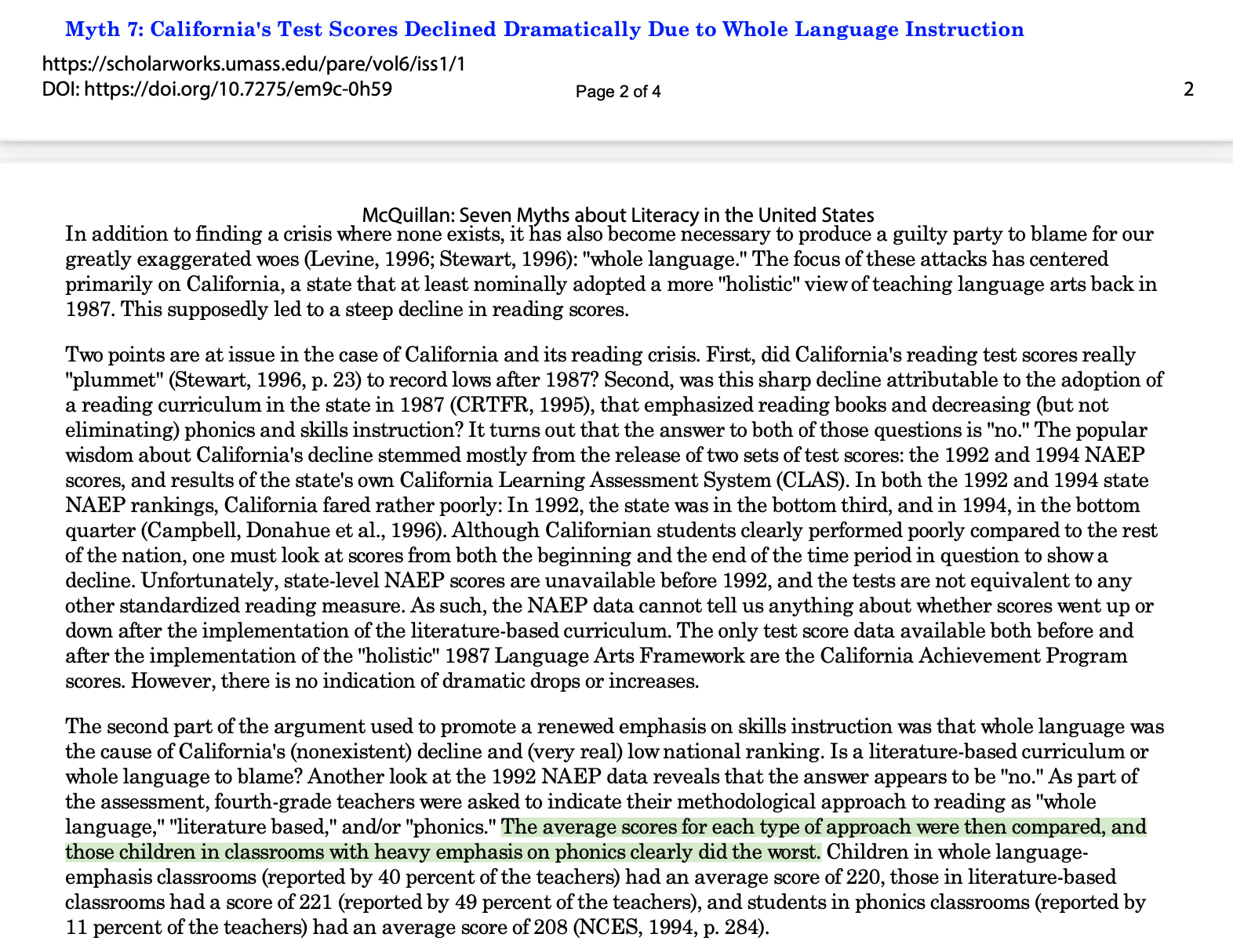
Over the last few decades, we have no evidence that reading has ever been taught in any sort of uniform way, even in the same school (although analyses from the 1990s showed a positive correlation between whole language classes and higher NAEP reading scores). The causes for low reading achievement are incredibly complex, linked to out-of-school factors as well as teaching and learning conditions in schools.
We should focus more directly on out-of-school factors, but if we insist on in-school only reform to increase reading achievement, we would do better to start with teaching and learning conditions (low student/teacher ratios for struggling students, better funding) and then to abandon lock-step implementation of any reading program (not ones labeled “balance literacy” or ones prescribing systematic intensive phonics for all students).
And the one real reform we refuse to acknowledge or address is making sure every child and young person in the U.S. has access to reading in their homes, communities, and schools. When people wield “science of reading” like a hammer, they fail to acknowledge the enormous research base showing access to texts as the strongest indicator of students acquiring literacy.
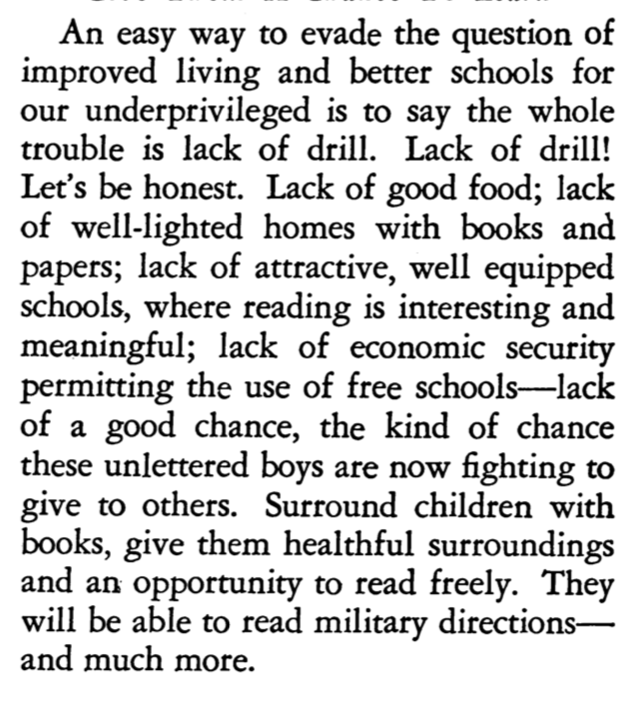
In fact, the more things change, the more they stay the same. We are about 80 years late on listening to LaBrant:
An easy way to evade the question of improved living and better schools for our underprivileged is to say the whole trouble is lack of drill. Lack of drill! Let’s be honest. Lack of good food; lack of well-lighted homes with books and papers; lack of attractive, well equipped schools, where reading is interesting and meaningful; lack of economic security permitting the use of free schools—lack of a good chance, the kind of chance these unlettered boys are now fighting to give to others. Surround children with books, give them healthful surroundings and an opportunity to read freely. They will be able to read military directions—and much more. (p. 241)
After posting this in 2019 while working on the first edition of How to End the Reading War and Serve the Literacy Needs of All Students: A Primer for Parents, Policy Makers, and People Who Care, I have published the second edition and continued to work on the “science of reading” movement.
Regretfully, McQuillan’s work is even more relevant in 2023 because the media and political response to the SOR movement has gained momentum despite the evidence that it is mostly misinformation and another round of the exact reading war McQuillan debunked in the 1990s.
I highly recommend accessing this (which I will cite/quote below in the update of the original post):
Recently, I have been (frantically but carefully) drafting a new book for IAP about the current “science of reading” version of the Reading War: How to End the Reading War and Serve the Literacy Needs of All Students: A Primer for Parents, Policy Makers, and People Who Care.
Those familiar with this blog and my scholarly work should be aware that I often ground my examinations of education in a historical context, drawing heavily on the subject of my dissertation, Lou LaBrant. The book I am writing begins in earnest, in fact, with “Chapter 1: A Historical Perspective of the Reading War: 1940s and 1990s Editions.”
As I have posted here, the “science of reading” over-reaction to reading and dyslexia across mainstream media as well as in state-level reading legislation has a number of disturbing parallels with the claims of a reading crisis in the 1980s and 1990s. Few people, I explained, are aware of the 1997 report authored by Linda Darling-Hammond on NAEP, reading achievement in the U.S., and the positive correlations with whole language (WL) practices and test scores.
I imagine even fewer education journalists and political leaders have read a powerful and important work about that literacy crisis in the 1990s, Literacy Crises: False Claims and Real Solutions by Jeff McQuillan.
In his Chapter 1, “What Isn’t Wrong with Reading: Seven Myths about Literacy in the United States,” McQuillan admits, “Serious problems exist with reading achievement in many United States schools,” adding, “Yet in the midst of media coverage of our (latest) ‘literary crisis,’ we should be very clear about what is and is not failing in our schools” (p. 1).
This leads to his list of myths ([1] updated with material from McQuillan’s article noted above), which are again being recycled in the “science of reading” version of the Reading War:
Myth 1: Reading Achievement in the United States Has Declined in the Past Twenty-Five Years.
Myth 2: Forty Percent of United States Children Can’t Read at a Basic Level.
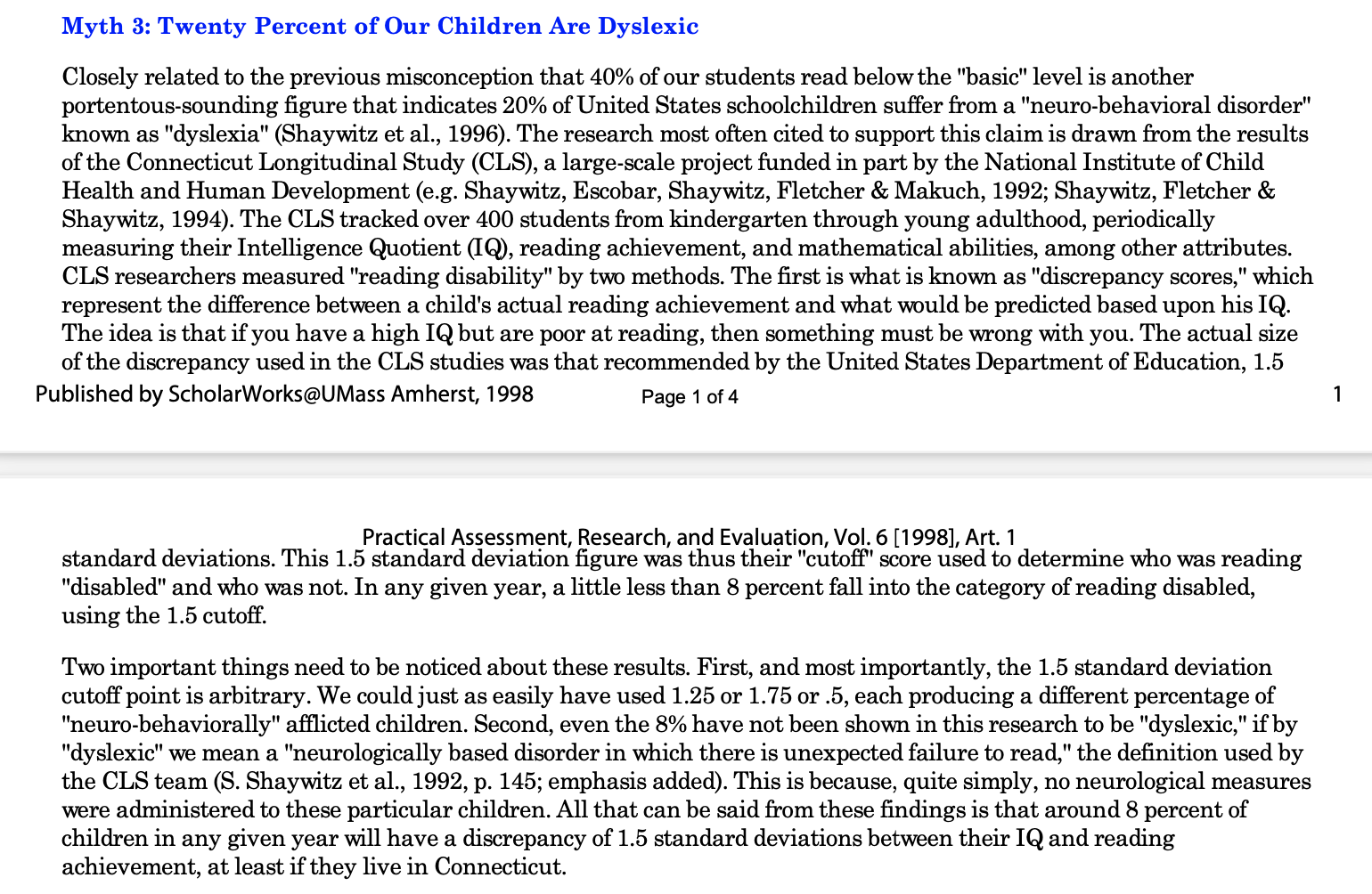
Myth 3: Twenty Percent of Our Children Are Dyslexic.
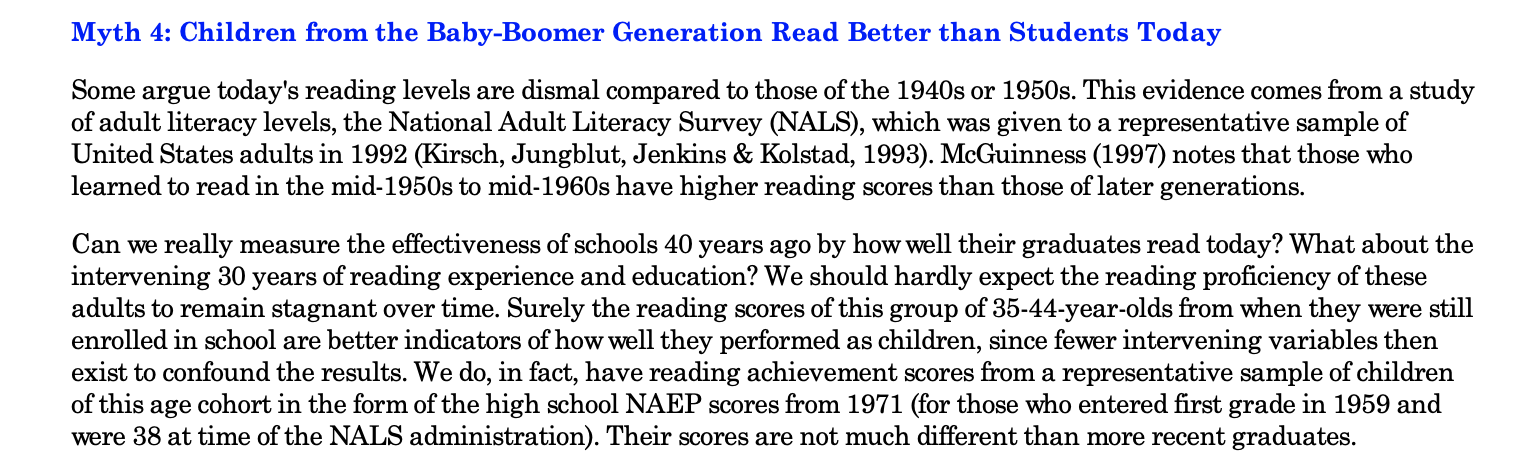
Myth 4: Children from the Baby Boomer Generation Read Better than Students Today.
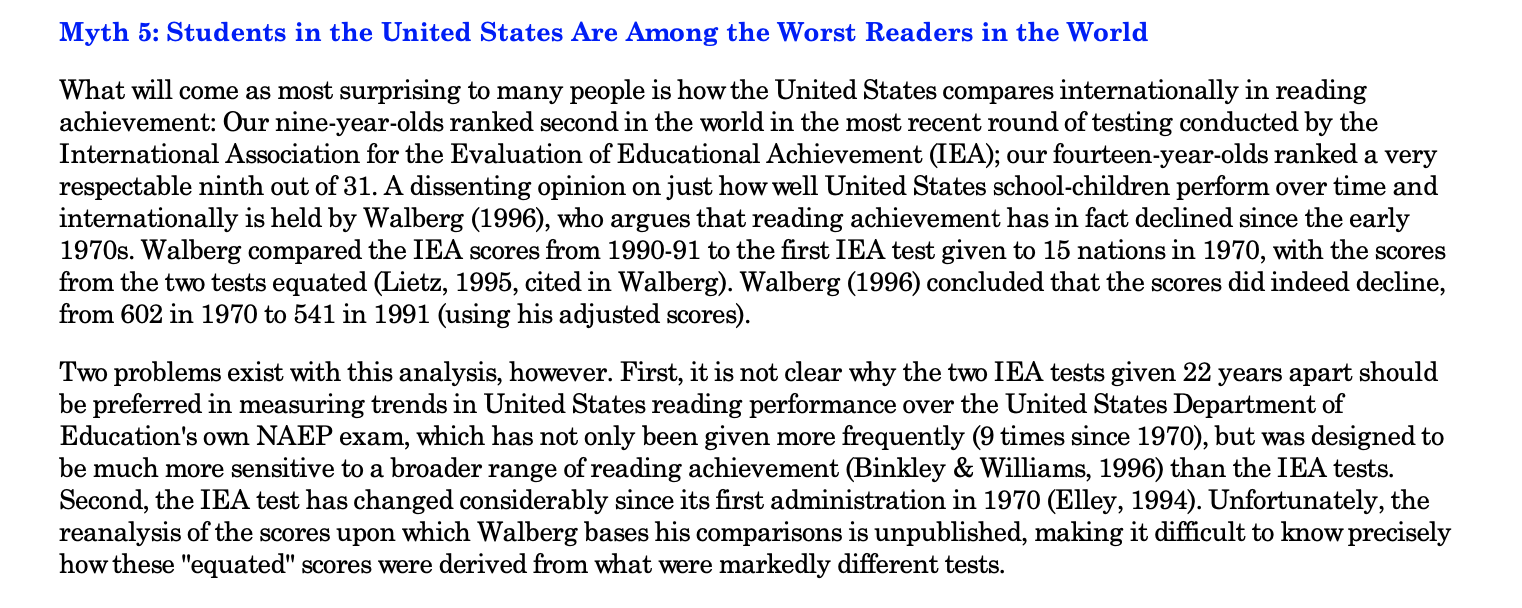
Myth 5: Students in the United States Are Among the Worst Readers in the World.
Myth 6: The Number of Good Readers Has Been Declining, While the Number of Poor Readers Has been Increasing.
Myth 7: California’s Test Scores Declined Dramatically Due to Whole Language Instruction.
McQuillan carefully dismantles each of these, with evidence, but many today continue to make the same misguided and unsupported claims.
In 2019 (and 2023), McQuillan’s work remains important, and relevant, both for understanding how we should teach better our students to read and how the current version of the Reading War is wandering once again down very worn dead-end roads.
While the media and the public seem historically and currently convinced by the rhetoric of “scientific,” there is a significant irony to the lack of scientific evidence backing claims about the causes of NAEP scores; for example, some have rushed to argue that intensive phonics instruction and grade retention legislation have caused Mississippi’s NAEP reading gains while many have used 2019 NAEP scores to declare the entire accountability era a failure.
Yet, none of these claims have the necessary scientific evidence to make any of these arguments. There simply has not been the time or the efforts to construct scientific studies (experimental or quasi-experimental) to identify causal factors in NAEP score changes.
Another problem with the rhetoric of “scientific” is that coinciding with that advocacy is some very disturbing contradictory realities:
And let’s not forget that for at least two decades, “scientific” has been central to No Child Left Behind and the Common Core—both of which were championed as mechanisms for finally bringing education into a new era of evidence-based practices.
We must wonder: If “scientific” is the answer to our educational failures, what has happened over the past twenty years of “scientific” being legislated into education, resulting in everyone shouting that the sky is falling because 2019 NAEP scores are down from 2017 as well as relatively flat since the early 1990s (30 of the 40 years spanning accountability)?
First, there is the problem of definition. “Scientific” is short-hand for a very narrow type of quantitative research, experimental and quasi-experimental research that is the gold standard of pharmaceutical and medical research.
To meet the standard of “scientific,” then, research in education would have to include random-sample populations of students and a control group in order to draw causal relationships and make generalizations. This process is incredibly expensive in terms of funding and time.
As I noted above, no one has had the time to conduct “scientific” research on 2019 NAEP data so making causal claims of any kind for why NAEP scores dropped is necessarily not “scientific.”
But there is a second, and larger, problem with calling for “scientific” research in education. This narrow form of “scientific” is simply wrong for education.
Experimental and quasi-experimental research seeks to identify causal generalizations. In other words, if we divide all students into a bell-shaped curve with five segments, the meaty center segment would be where the generalization from a study has the greatest effectiveness. The adjacent two outer segments would show some decreasing degrees of effectiveness, leaving the two extreme segments at the far ends of the curve likely showing little or no effectiveness (these students, however, could have learned under instruction not shown as generally effective).
Yet, in a real classroom, teachers are not serving a random sampling of students, and there are no controls to assure that some factors are not causing different outcomes for students even when the instructional practice has been shown by scientific research to be effective.
No matter the science behind instruction, sick, hungry, or bullied students will not be able to learn.
The truth is, in education, scientific studies are nearly impossible to conduct, are often overly burdensome in terms of expense and time, and are ultimately not adequate for the needs of real teachers and students in real classrooms—where teaching and learning are messy, idiosyncratic, and impacted by dozens of factors beyond the control of teachers or students.
Frankly, nothing works for all students, and a generalization can be of no use to a particular student with an outlier need.
While we are over-reacting to 2019 NAEP reading scores, we have failed to recognize that there has never been a period in the U.S. when reading achievement was adequate; over that history teachers have implemented hundreds of different instructional strategies, reading programs, standards, and high-stakes tests—and we always find the outcomes unsatisfying.
If there is any causal relationship between how we teach and how students learn, it is a cumbersome matrix of factors that has been mostly unexamined, especially by “scientific” methods.
And often, history is a better avenue than science.
The twenty-first century has not been the only era calling for “scientific” in educational practice.
The John Dewey progressivism of the early twentieth century was also characterized by a call for scientific practice. Lou LaBrant, who taught from 1906 until 1971 and rose to president of the National Council of Teachers of English in the 1950s, was a lifelong practitioner of Deweyan progressivism.
While progressive education and Dewey are often demonized and blamed for educational failure by mid-twentieth century, the truth is that progressivism has never been widely embraced in the U.S.
Today, however, we should be skeptical of the narrow and flawed call for “scientific” and embrace instead the progressive view of “scientific.”
For Dewey, the teacher must simultaneously teach and conduct research—what eventually would be called action research.
To teach, for progressives, is to constantly gather evidence of learning from students in order to drive instruction; in this context, science means that each student receives the instruction they demonstrate a need for and that produces some outcomes of effectiveness.
In an elementary reading class, some students may be working in read aloud groups while others are receiving direct phonics instruction, and even others are sitting in book clubs reading picture books by choice. None of them, however, would be doing test-prep worksheets or computer-based programs.
The current urge toward “scientific” seems to embrace the false assumption that with the right body of research we can identify the single approach for all students to succeed.
Human learning, however, is as varied as there are humans.
This brings us to the current “science of reading” narrative that calls for all students to receive intensive systematic phonics, purportedly because scientific research calls for such. The “science of reading” narrative also rejects and demonizes “balanced literacy” as not “scientific.”
We arrive then back at the problem of definition.
The “science of reading” advocacy is trapped in too narrow a definition of “scientific” that is fundamentally wrong for educating every student. Ironically, again, balanced literacy is a philosophy of literacy (not a program) that implements Deweyan progressive “scientific”; each student receives the reading instruction they need based on the evidence of learning the teacher gathers from previous instruction, evidence used to guide future instruction.
Intensive phonics for all begins with a fixed mandate regardless of student ability or need; balanced literacy starts with the evidence of the student.
If we are going to argue for “scientific” education in the U.S., we would be wise to change the definition, expand the evidence, and tailor our instruction to the needs of our students and not the propagandizing of a few zealots.
For two decades at least, the U.S. has been chasing the wrong “scientific” as a distraction from the real guiding principle, efficiency. Reducing math and reading to discrete skills and testing those skills as evidence for complex human behaviors are as misleading as arguing that “scientific” research will save education.
Teachers as daily, patient researchers charged with teaching each student as that student needs—that is the better “scientific” even as it is much messier and less predictable.
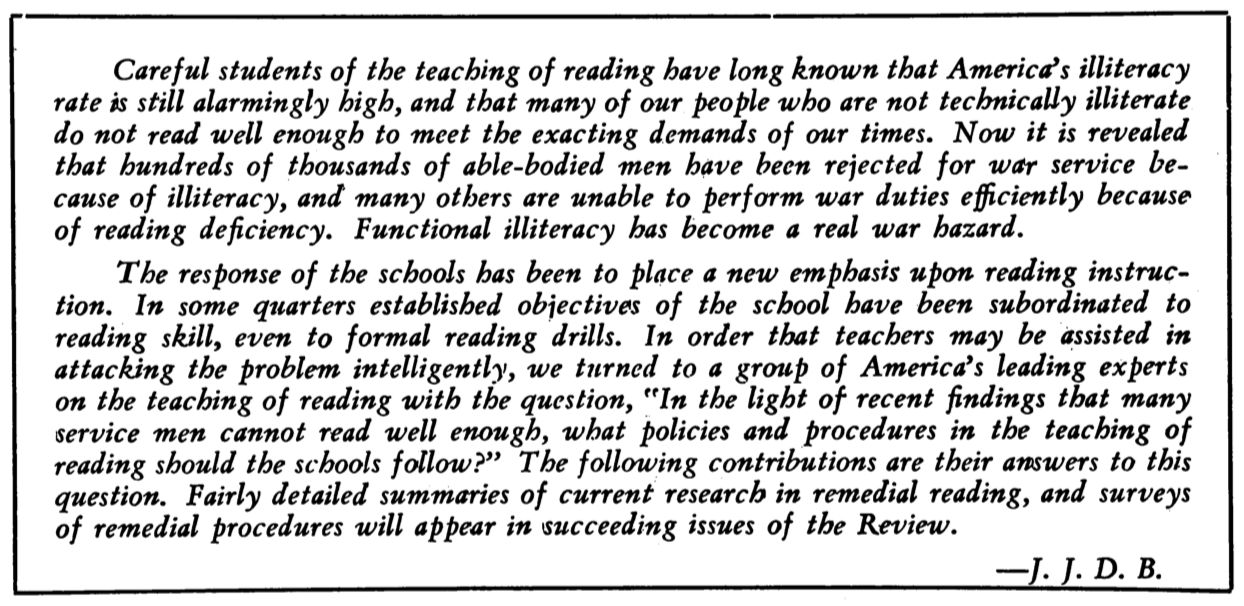
Unlike most cries of educational “crisis,” this national focus on reading was nested in World War II—a genuine crisis. But, according to the assembled experts on literacy, this 1942 version of the Reading Wars was a harbinger of how these debates are mostly misinformed, misguided, and driven by ideology instead of evidence.
Betts, in the opening piece, notes an important fact drawn from a report by First Lady Eleanor Roosevelt: “One of the students had only four months of schooling, another was foreign born, some came from sections of the country where educational opportunities were meager, and so on. In short, the First Lady’s report emphasized the lack of educational opportunity [emphasis added] rather than the questionable quality of instruction” (p. 225).
Before detailing the problems and the possible solutions—including recognizing shortages and shifts in teacher availability—Betts makes a powerful claim: “In a democracy, the people get the kind of schools they want….In a democracy, the quantity and quality of educational opportunity is a product of what people want, and what they want is to no small degree conditioned by the educational leadership they have elected to follow” (pp. 225-226).
While I recommend reading the symposium responses in full, I focus below on two key answers from Gray and LaBrant.
Gray offers a solid framing of the debate spurred by claims of illiteracy among those called to serve, including this:
Along with refuting these standard false charges, Gray builds to a powerful closing argument:
A common error on the part of those who modify their reading programs is to adopt one or more reforms, such as the provision of much free reading, and neglect other aspects of reading that are in need of specific attention…
If the discussion thus far has achieved its purpose, it should be clear that current deficiencies in reading are not the product of “pseudo-scientific fumbling” or the use of progressive reforms, as some would have us believe. They are due in large measure either to the continued use of traditional patterns of teaching or to failure to provide a well-balanced [emphasis in original] program of reading activities that harmonize with progressive trends. (pp. 236-237)
LaBrant, in her typical style, takes a much more direct approach:
Within the past ten years we have made great strides in the teaching of purposeful reading, reading for understanding (the kind of reading, incidentally, which the army and navy want). Nevertheless, we hear many persons saying that the present group of near-illiterates are results of “new methods,” “progressive schools,” or any deviation from the old mechanical procedures. They say we must return to drill and formal reciting from a text book. (p. 240)
However, LaBrant completely discredits that blame:
1. Not many men in the army now have been taught by these newer methods [emphasis in original]. Those few come for the most part from private or highly privileged schools, are among those who have completed high school or college, and have no difficulty with reading.
2. While so-called “progressive” schools may have their limitations, and certainly do allow their pupils to progress at varied rates, above the second grade their pupils consistently show superior ability in reading. Indeed, the most eager critics have complained that these children read everything they can find, and consequently do not concentrate on a few facts. Abundant data now testify to the superior results of purposeful, individualized reading programs [emphasis in original].
3. The reading skills required by the military leaders are relatively simple, and cause no problem for normal persons who have remained in school until they are fourteen or fifteen. Unfortunately the large group of non-readers are drop-outs, who have not completed elementary school, come from poorly taught and poorly equipped schools, and actually represent the most conservative and backward teaching in the United States [emphasis in original]. (pp. 240-241)
In her conclusion, LaBrant is passionate and unyielding:
Within five years, LaBrant penned what would become a refrain of her six-plus decades as an educator: “A brief consideration will indicate reasons for the considerable gap between the research currently available and the utilization of that research in school programs and methods” (p. 87).
The question about reading raised in the 1940s suffered from the same failures to recognize the problem in order to shape effective and credible answers that we are confronting in 2019.
The fumbling today of the Reading Wars is yet another snapshot of a tired truism: “Those who cannot remember the past are condemned to repeat it” (George Santayana).
Most teachers charged with writing instruction at all levels from K-12 through graduate education have far too little time and almost impossible learning conditions in order to teach writing well, much less completely.
After decades of teaching writing, I have far more questions, and goals, than I have answers.
But I do have two guiding principles that I believe help my writing instruction to be more effective, if still lacking: (1) no writing-intensive course is an inoculation (writing and students are not diseased things to be cured), and (2) to invoke Thoreau, it is not any writing teacher’s duty to do everything, but to do something well.
With those in mind, this Twitter exchange provides an excellent entry point to how we should navigate the trivial in our very challenging work teaching writing:
I would be questioning why I’m focusing on something so relatively trivial or thinking that grading by degrees of harshness may have anything to do with helping students learn. https://t.co/71KCTzjjef
Drezner’s original Tweet and Warner’s reply provide an important tension that all writing teachers face, the tension between the trivial (elements such as format, grammar, mechanics, and usage) and the substantive (expression, credibility of claims and evidence, audience awareness, purposefulness, etc.).
Broadly, this debate sits within the prescriptivist versus descriptivist approaches to language. For teachers of writing, I think we must acknowledge that prescriptivism remains the norm in both formal education and social norms. In other words, many people are prone to see (or hear) “errors” and then to draw some evaluative conclusions from those “errors” regardless of the credibility or effectiveness of the whole text or expression.
Drezner is typical of those who cannot look past the trivial (confusing “it’s” and “its”) in order to recognize the ultimate whole of the text.
Like Warner, I rest in the camp that rejects prescriptivism and seek ways to focus my instruction, and student drafting, on the substance of their writing as well as their journey to being writers and scholars.
But this is no new tension, as Lou LaBrant (1946) expresses, many decades before Warner’s retort: “As a teacher of English, I am not willing to teach the polishing and adornment of irresponsible, unimportant writing.”
With limited time and reduced teaching and learning conditions, teachers of writing must focus on priorities—fostering purposeful, thoughtful, and risk-taking young writers who have an awareness of prescriptivism and the consequences of so-called “errors” in their writing.
As a first-year writing teacher, I can attest that most of my students enter my writing-intensive classes mostly viewing their work as students to be about correctness and then when prompted to revise or rewrite, to be about correcting.
Their priorities learned in formal schooling about writing are the inverse of LaBrant’s mantra above; students believe correctness trumps content because they have often submitted “irresponsible, unimportant writing,” driven by the teacher’s prompts, and received high grades simply for having conventional surface features.
One example of how I try to navigate the trivial in writing instruction is the current debates about “they” as a singular gender neutral pronoun.
I offer students a mini-lesson on how language changes, a short overview of the history of the English language with some examples (grain/corn, the demonizing of “ain’t” and the tortured construction “Aren’t I?” that grew out of that), and then I introduce them to the “they” debate.
We examine pronoun/antecedent agreement and concerns about sexist language (the use of “he” as gender neutral, for example) before I detail for them that they are living in a time of language flux; many formal publications and organizations now have standardized “they” as a singular gender neutral pronoun (see especially NCTE).
However, I also address with them that many people remain trapped in the fading prescriptive view of pronoun/antecedent agreement. I caution students that they may (likely will) encounter professors and others who will, as Drezner’s Tweet in the opening shows, make conscious or unconscious decisions about their credibility as writers based on the developing convention of “they” as a singular gender neutral pronoun.
I often follow this with a discussion of my own experiences as a student in the 1970s and 1980s that included drills and workbook exercises on “shall” and “will”—noting that poor “shall” is now deceased. This leads me to the certain impending demise of “whom” coming, I think, in my students’ lifetime.
As their writing teacher, I am committed to fostering purposefulness in my students, and to help them rise above the paralysis of correctness. I want them to have healthy attitudes about language and writing, much as linguists and writers do.
Yet, this effort to raise their awareness about the specter of the language police while prioritizing their content, organization, style, and such as purposeful writers is no easy task.
It is nearly impossible to break them from habits formed over years—viewing their job as being correct or correcting their drafts—and my own practice, I fear still seems to them to prioritize the trivial.
One of my strategies embedded in my requirement that students draft and conference with me during each essay is that I use highlighting in Word to draw their eyes to the trivial (issues of grammar, mechanics, usage, and format) and reserve comments and the conferences for what I consider to be substance.
I will still highlight, for example, a singular gender neutral use of “they,” and may add a comment asking if they have used this with purpose and with awareness, but I have no policy about their grades based on that use (I do not grade writing at all in fact).
Since many of the elements I highlight are what most teachers would call “errors,” students tend to ask me why I highlight, leading to a mini-lesson. Occasionally, the highlighting works, and students self-edit, if needed.
My work as a teacher of writing, then, is defined in many ways by the tension in the Tweet exchange above. I feel mostly compelled to foster my students as purposeful writers and scholars with healthy attitudes about language and writing.
But I also feel an ethical obligation to make my students aware that language use is political, that language use (often the trivial) has real consequences for them as students and in their lives beyond formal schooling.
I do invite them to join me is changing the norm of prescriptivism, to challenge the language police, but I also am deeply aware that is a tall task to ask of any of us.
LaBrant (1952) lamented that “thousands of teachers seem to resent or refuse to recognize change.” This, I think, is a grand failure when we are teaching writing and ultimately thinking.
Language is in constant flux, and our students are both agents and victims of that change.
Navigating the trivial in writing instruction is ultimately about honoring the human dignity of our students because language is an essential part of that humanity.
In my upper-level writing and research course, Scholarly Reading and Writing in Education, students have been practicing critical discourse analysis of how media cover selected issues in education in order to compare that coverage to the research base on that topic.
They have recently submitted initial drafts of the major scholarly essay and are now drafting a public commentary drawn from the same analysis. One student in last evening’s seminar approached me with a question.
She was very concerned that her topic seemed to show a distinct disconnect between education policy and the research base, wondering if that was unique to her topic, and why that failure existed.
Her question came during the workshop time after we had read and discussed a recent public commentary of mine on school safety and the threat of gun violence as a model for their commentaries. I noted that her observation was accurate, and that it was not simply her topic, but common across all of public education—as I noted in my commentary that challenges popular school safety measures not supported by research
Coincidentally, I came across the next morning a Twitter thread about the broader failure in education to embrace progressivism:
Agree. I’d bet few could pass a basic history test…
Yet, there were decisive turning points where progressive theory was intentionally marginalized, which is why we now forget
While progressivism in education (often linked directly to John Dewey) has been routinely blamed for causing educational failure, as Alfie Kohn has addressed, the reality is that education has failed progressivism:
The rarity of this approach, while discouraging to some of us, is also rather significant with respect to the larger debate about education. If progressive schooling is actually quite uncommon, then it’s hard to blame our problems (real or alleged) on this model. Indeed, the facts have the effect of turning the argument on its head: If students aren’t learning effectively, it may be because of the persistence of traditional beliefs and practices in our nation’s schools.
Kohn’s analysis is a mere decade old, and if anything, his observations have intensified as the U.S. continues to double-down on traditional and technocratic practices such as standards and high-stakes testing.
However, if we look back to 1942, Lou LaBrant exposed the exact same dynamic grounded in a public outcry over low literacy among men enlisted in the military:
Within the past ten years we have made great strides in the teaching of purposeful reading, reading for understanding (the kind of reading, incidentally, which the army and navy want). Nevertheless, we hear many persons saying that the present group of near-illiterates are results of “new methods,” “progressive schools,” or any deviation from the old mechanical procedures. They say we must return to drill and formal reciting from a text book. (p. 240)
However, LaBrant completely discredits the blame:
1. Not many men in the army now have been taught by these newer methods. Those few come for the most part from private or highly privileged schools, are among those who have completed high school or college, and have no difficulty with reading.
2. While so-called “progressive” schools may have their limitations, and certainly do allow their pupils to progress at varied rates, above the second grade their pupils consistently show superior ability in reading. Indeed, the most eager critics have complained that these children read everything they can find, and consequently do not concentrate on a few facts. Abundant data now testify to the superior results of purposeful, individualized reading programs.
3. The reading skills required by the military leaders are relatively simple, and cause no problem for normal persons who have remained in school until they are fourteen or fifteen. Unfortunately the large group of non-readers are drop-outs, who have not completed elementary school, come from poorly taught and poorly equipped schools, and actually represent the most conservative and backward teaching in the United States. (pp. 240-241)
Just 5 years later, LaBrant penned what would become a refrain of her six-plus decades as an educator: “A brief consideration will indicate reasons for the considerable gap between the research currently available and the utilization of that research in school programs and methods” (p. 87).
“[T]he considerable gap” between policy/ practice and research has, then, defined public education throughout the twentieth and into the twenty-first centuries.
Again, as I confront about fortifying schools against gun violence and the research base on those so-called safety measures, practices such as grade retention and even corporal punishment [1] remain policy all across the U.S. despite decades of evidence overwhelmingly rejecting their use. Grade retention, for example, has been formally refuted by the National Council of Teachers of English (NCTE), yet states continue to adopt grade retention based on high-stakes tests for third graders.
As LaBrant challenged decades ago, literacy today is failing students because policy remains anchored to discredited practices and ideologies such as the “word gap,” reading programs, leveled texts, isolated phonics and grammar instruction, and test-prep.
Possibly one of the most troubling examples of this phenomenon is the relentless and bi-partisan obsession with charter schools, especially the abusive practices found in so-called “no excuses” charters. As this review details,
A report, Charter Schools and the Achievement Gap, finds that, though charter schools on average perform no better than traditional public schools, urban “no-excuses” charter schools—which often use intensive discipline to enforce order—demonstrate promising results. It recommends that these schools and their practices be widely replicated within and outside of the charter school sector. We find three major flaws with this conclusion.
This endorsement of “no excuses” charter schools, again, simply ignores the broader research base that cautions against charter schools broadly and “no excuses” practices more specifically.
So, as I answered my student’s insightful question, I noted a few important ways to understand “the considerable gap” between policy/practice and research.
First, educators—unlike doctors and lawyers, for example—have never controlled the field of education. Public education has always been hostage to partisan politics and mind-numbing bureaucracy.
Let me caution here that I am not making a narrow Libertarian swipe at “government” schooling—since we are government—but acknowledging that just as education has failed progressive and critical theory and practice, public institutions have mostly failed the promise of democratic government because of partisan politics and bureaucracy.
Next, and related, the evidence vacuum that exists in the dynamic between political leaders and the public, again, can be witnessed in the school safety debate. Politicians both speak to and perpetuate public misconceptions about fortifying school—the public’s irrational trust in armed police on campuses, surveillance cameras, and metal detectors (all of which have been shown to make schools more dangerous, not safer).
But that same evidence vacuum occurs throughout the adoption and implementation of education policy.
LaBrant’s 1947 unmasking of “the considerable gap” ends with her imploring English teachers and NCTE:
This is not the time for the teacher of any language to follow the line of least resistance, to teach without the fullest possible knowledge of the implications of his medium. Before we, either as individuals or as a Council, experiment with methods of doing specific things or block out a curriculum, let us spend some time with the best scholars in the various fields of language study to discover what they know, what they believe uncertain and in need of study. Let us go to the best sources, and study the answers thoughtfully. (p. 94)
As teachers strike across the U.S. in 2018, let’s us carry LaBrant’s message forward because the only hope that exists for our schools and the students they serve is to close the gap by allowing teachers as professionals to practice our field guided by the evidence too long ignored by the political bureaucracy that has defined public education for more than a century.
[1] The list of ideologies and practices that represent “the considerable gap” is far too long to include in the discussion above, but here are many of the key ones worth recognizing: “grit,” growth mindset, merit pay, VAM, standards, and high-stakes testing. Please refer to the Categories in the right menu for posts related to each of these.
Without diminishing the significance of Rosenblatt’s contributions, I wish to reexamine and reimagine the familiar history of Rosenblatt’s rebellion against New Criticism: I will propose that Rosenblatt and the New Critics, particularly Cleanth Brooks, might be viewed as pioneers of parallel, rather than opposing, pedagogical traditions, shaped by the shared influence of I. A. Richards.
Rejan incorporates my analysis of the historical relationship between EJ and New Criticism to offer an example of what he calls the “the folly of defining and critiquing the New Critics without directly citing any of the New Critics’ actual writing.” While I find much of Rejan’s analysis important and nuanced, here he rushes to support his thesis without taking into account the purpose of my piece and he fails to note key final points I raise that fit more closely with his thesis than providing evidence of “folly”:
On one level, we owe our field of English language arts pedagogy the opportunity to reexamine the unspoken power of New Criticism as well as the reduced ways in which New Criticism has been implemented in our classes. We must consider the role reader response has played as the most frequent challenge to New Criticism in our classrooms—including the misunderstanding and misuse of Rosenblatt’s perspective as well. But we must rise above the narrow tensions among critical perspectives.
Literary analysis, then, becomes about agency—the agency in the work/text itself and the agency of the reader reading and rereading the world (Freire). The call for critical literacy does not deny or silence the potential power of New Criticism or reader response or any critical stance. Instead it calls for confronting efficiency and objectivity as questionable stances:
“We can help students read the word and the world in deeper and more profound ways. We can help students investigate the ways in which they are manipulated. They can become critically literate consumers of the media. They can engage with and focus on current issues. We can help them problematize the world so they think about their role in it and what they can do to shape its future directions.” (Michell 45)
Before highlighting how Rejan offers some very important contributions to both literary theory and how that manifests in traditional English and literature classrooms, I want to clarify a couple points about my own work cited.
First, my article is a historical overview of the relationship between teaching English in high school or college and New Criticism; and in that overview, I note that there is a gap between the pure theory in its founding and how teachers practice a reduced (and often bastardized) version best represented, I think, by the Advanced Placement English Literature and Composition [1] test.
In other words, while not as developed or explicit as Rejan’s thorough essay, I very much recognize that what passes as New Criticism in the teaching of English is not solidly grounded in the seminal work of the New Critics. In fact, I will address this more fully below, high school English teachers may have never read the New Critics and, like our students, often navigate within New Criticism without it being named or acknowledged in any way.
The commonly implemented (distorted) version of New Criticism is mostly a consequence of the goal of appearing to be objective that is driven by the primacy of assessment in teaching; in other words, literary interpretation grounded in analysis and “right/wrong” answers helped reduce New Criticism to a practical shadow of its original self—as I teased out when rejecting “close reading”:
Like the mechanistic and reductive ways in which New Criticism has been implemented in formal schooling in order to control and measure objectively how students respond to text, CC and the focus on close reading are poised to serve efficiency models of high-stakes testing while also failing students who need and deserve the complex and challenging tools afforded with critical literacy.
And to the “folly” Rejan sees my essay modeling, I would note that I spend a significant subsection of the essay, “New Criticism: Defined and Embraced, Narrowly,” arguing a similar point as Rejan’s, the reductive application of New Criticism, citing heavily from a major literary scholar, David Daiches.
Finally, as the passage from my essay highlighted above demonstrates, I was documenting the exact dynamic—the tension between New Criticism and Rosenblatt—Rejan teases out far more explicitly, and also suggesting that tension is too often reductive and fails ultimately to be sufficiently critical, in that students are rarely afforded agency in the process whether they are navigating text through New Criticism or reader response.
Setting aside that Rejan was a bit hasty in one paragraph citing my work, I want to note that Rejan offers some important take aways for how English teachers are prepared and then how we practice our crafts of literary analysis with our students.
One foundational commitment I have implemented as a college professor since my doctoral program in the mid 1990s is assigning seminal texts, not secondary texts, addressing the most prominent ideas in education and literacy. As one example, my undergraduate and graduate students read Rosenblatt’s Literature as Exploration.
And during our discussion, we address that Rosenblatt’s work is often mischaracterized and over-simplified; I typically add that a careful reading of Rosenblatt uncovers a thinker far more conservative and traditional that often acknowledged.
So, yes, Rejan’s call for reading the original work of the New Critics to understand New Criticism is a worthy call for all aspects of education, the teaching of English, and preparing teachers of English.
Rejan’s broad message about understanding literary theory also shows the importance of the “considerable gap” (LaBrant, 1947) between theory and practice too often common in English classrooms.
A former graduate student of mine and current doctoral student has been discussing by email with me Rejan’s piece as she investigates Rosenblatt. She has confessed, in fact, that she knows little about literary theory because that topic wasn’t covered well in her undergraduate English courses, leaving her with a “superficial” understanding—all of which reinforces Rejan’s central concerns.
When I have taught young adult literature, where I assign Rosenblatt, practicing teachers in the graduate section often share a similar lack of understanding when we practice literary theory with a picture book.
Ultimately, as I shared with Rejan, we are offering a similar message, although our pieces are distinct in purpose and thoroughness (EJ articles tend to be brief, and EE essays, dense and extended). I could not agree more with Rejan’s last paragraph and sentence: “I suspect that Brooks and Rosenblatt both would appreciate a closer reading of the past that might bring us closer together in the future.”
Although I must offer yet one more caveat, the central thrust of my essay—any literary theory lens is a way to investigate text, and if any becomes the way to investigate text, we have failed the ultimate goal of fostering critical literacy in our students.
That is a folly we cannot afford.
[1] I Taught AP Lit and Comp for most of my 18 years as a high school English teacher.
In 1971, after years of scrounging and clawing, my parents were able to build their dream home on the largest lot at the new golf course in my home town. This was a redneck working-class vision of what it meant to achieve the American Dream.
As a consequence, I lived on and worked at this golf course (called a “country club” without a speck of irony) throughout my adolescence. Some of my formative moments, then, occurred on the golf course while I was working—including discovering that when a teen has been covertly drinking mini-bottles of liquor for hours virtually every adult can see that in about 2 seconds.
The grass on the course itself was over-seeded a couple times a year, and this required the work of all the employees and many of the club members simply volunteering, including my father.
One fall, I believe, I was told to drive around the old pickup truck used exclusively on the course. I was likely a year or so away from driving legally.
The truck was a 3-speed manual shift on the column and a transmission that worked about as well as you’d imagine for a work truck that never left the fairways of a redneck golf course.
My father hopped in the passenger seat and told me what to do, throwing around terms such as “clutch” as well as all the intricacies of column shifting. I was overwhelmed and terrified.
Within moments, he had me start the truck, and lurch forward, coaching me along the way about using the three pedals and finding the sweat spot for engaging and releasing the clutch (I would drive manual transmission cars with glee well into my late twenties when a broken ankle proved to me the practicality of automatic transmissions).
Soon I was left alone with this beast of a truck to shuttle whatever was needed all over the golf course. Within hours, I was pretty damn proficient despite the rolling berms of the fairways, the steep hills, and the idiosyncratic transmission in this truck well past its prime.
Once again on NCTE’s Connected Community’s Teaching and Learning Forum questions about teaching grammar surfaced, and as I often do, I thought about how we learn to drive cars.
Driving a car and composing are quite similar since they are holistic behaviors that require many seemingly simultaneous decisions performed in some type of “rules” environment (driving within laws and writing within conventions, what people commonly call “grammar” to encompass grammar, mechanics, and usage).
As well, I am convinced that both are best learned by actually doing the whole thing, preferably with an experienced mentor guiding the learning process.
And thus we come to a recurring and powerful question whenever the grammar debate claws its way zombie-like out of the dirt: Do teachers and students need common terminology for the teaching of writing to be effective?
This is a very practical retort to those who caution about isolated direct grammar instruction and a rules-based approach to how language works. It is a very common complaint I hear from teachers of second languages as well.
Let me return for a moment to my adventure in a 3-speed pickup truck. My hearing the term “clutch” did me no good at all in terms of engaging and releasing the clutch and actually maneuvering the truck around the golf course.
In fact, my dad immediately added “the pedal on the left.”
So my first response to the question about the importance of common (grammar) terminology in teaching writing is that we must all step back and critically examine if this is really essential.
My sense gained from teaching writing for over 30 years is that students do not need the technical language that teachers must have and that the terms students should acquire are incredibly few.
None the less, my professional concern as a teacher and a writer is not if students will acquire common terminology (they will and they should), but how and to what extent.
The grammar debate has one aspect in common with the phonics debate: too many see the argument as a yes/no dichotomy (and it isn’t).
So a foundational guiding principle for the role of grammar and common terminology in the teaching of writing is to provide students with the least direct instruction and acquisition of terminology needed for the students to be fully engaged in the whole behavior. And then during that whole behavior, students continue to build their grammatical awareness and technical terminology storehouse.
And that begins to address the how.
I learned to drive the 3-speed truck by driving the truck very badly for an extended amount of time and among a group of experienced drivers who were also incredibly patient and encouraging.
There was no pass/fail, and I never took a test on the parts of the truck or how to drive a 3-speed manual transmission.
Our students need low-stakes and extended opportunities to write by choice while receiving ample feedback from their teacher, who models the writing process and the technical terminology that helps those students learn and improve.
Ultimately, then, when our goal is to foster students as writers, let’s critically interrogate our own assumptions about what students must have to learn to write, and then let’s be vigilant about protecting that goal; in other words, prioritize the time students have to practice the full writing process in low-stakes and supportive environments over time spent on isolated and direct instruction that detracts from that foundational commitment.
I will set aside driving a truck for a final example from my teaching writing. In a first-year writing seminar, I use a text that frames effective writing in broad concepts such as cohesion and clarity.
I assign the text; students read weekly and submit response journals on key points and questions. In class and during writing conferences, I use these terms—cohesion, clarity—but we have no test and I never explicitly say they need these terms that I typically use along with some concept or analogy building on their existing schema (my father adding “pedal on the left” after “clutch”).
Regularly and often throughout the semester, students begin to say “I was trying to work on cohesion like Williams says in our book.”
Teaching writing is not well served by either/or debates, especially when warranted practice is about not if but how.
My students throughout my 18 years teaching high school (in the same redneck town when I grew up) and then at the college level have almost all acquired common terminology in context of what they do without a doubt learn—my writing classroom is about composing, and everything we do is in service to that one essential goal.
Just as the recalcitrant grammar debate spurs in me nostalgia for my formative years gaining the All-American rite of passage, driving, it also pulls me once again to my (abrasive) muse, former NCTE president Lou LaBrant, who confronted in 1953: “It ought to be unnecessary to say that writing is learned by writing; unfortunately there is need.”
In 2017, we stand on the same worn path, and I conclude here by urging us all who teach writing to keep our bearings: “writing is learned by writing,” and anything else we do must not detract from that truism.









 dr. p.l. (paul) thomas