Category Archives: Lou LaBrant

Lou LaBrant and Teacher Education’s Enduring Legacy

A colleague of Louise Rosenblatt at New York University, Lou LaBrant faced mandatory retirement when she turned 65 in 1953. Reflecting on her work at NYU as a teacher educator from 1942-1953, LaBrant wrote in 1988 “Public School 65, Down on the Lower East Side” as she turned 100.

LaBrant noted “that [New York City] requirements seemed to me inadequate for those who already spoke the language clearly but needed a richer background” (p. 6). Candidates for teaching English, LaBrant argued, needed greater linguistic understanding and experiences grounded in the complex Germanic and Latinate roots of English.

But other regulations also impeding LaBrant’s goals, including restrictions on the number of student teachers placed in each school. Circumventing that restriction, however, LaBrant placed 6 teacher candidates at “P.S. 65, a junior high school on the Lower East Side, known as one of the worst slum areas in the city” (p. 7). LaBrant then explained her choice (p. 7):

two years below

Next, LaBrant built her program and the experience for the student teachers on the characteristics of the students being taught—a progressive and student-centered approach to scientific education. The students at P.S. 65, they found, had very limited experiences with the wider city, lived in cramped and poorly lit housing, had no books or reading materials in the home, had life experience unlike the national research on student reading interests, and attended a school in which “[t]eachers did not welcome an assignment to the area and within ten minutes after the final gong were on their way to the subway to avoid the five o’clock rush” (p. 8).

In that context, LaBrant’s program included taking students on bus trips to explore the city, having librarians provide students time and opportunities to examine and choose books that matched their interests, committing to not requiring book reports, and creating an overarching goal that “[s]chool was to become a pleasant place” for students and their teachers.

Key, as well, was LaBrant’s rejecting deficit views of race, literacy, and poverty that pervaded popular practices: “This simple program did not depend on the theories about word count, word recognition, left-handedness, or any of the educational fads then popular” (p. 9). This “simple” approach to teaching reading was a hallmark of LaBrant’s work, including her rejecting reading programs as “costume parties” (LaBrant, 1949).

And while LaBrant admitted she did not know the long-term results of her work, she did note that this year, this “simple” experiment with teaching a vulnerable population of students (impoverished, racial minorities and English language learners) resulted in reading levels that “[rose] from two years below to two years above” in the city testing.

Today, we can see LaBrant’s legacy endures: public education policy that impedes teacher education, reading programs and “fads” that overcomplicate and distort literacy education, and the lingering challenge of teaching vulnerable populations of students who have strengths and unique needs that cannot be addressed through deficit ideologies or “silver bullet” approaches to schooling.

In 1940, LaBrant implored: “Language is a most important factor in general education because it is a vital, intimate way of behaving. It is not a textbook, a set of rules, or a list of books” (p. 364).

Again, teacher education and teaching children to read are, in fact, “simple”—if we allow them to be.

References

LaBrant, L. (1988). Public School 65, down on the lower east side. Teaching Education, 2(1), 6-9.

LaBrant, L. (1949). A genetic approach to language. Unpublished manuscript, Institute of General Semantics, Lakeville, CT.

LaBrant, L. (1940, May). The place of English in general education. The English Journal, 29(5), 356-365.

Dismantling an Unstable Discipline: Education without Foundation

“Whether we are willing to admit the role or not,” Lou LaBrant wrote in 1943, “schools cannot escape responsibility for some share in determining whether the peace which comes will last” (p. 225).

As the U.S. approached the mid-twentieth century—after decades of vibrant debate about the purposes of schools, the promise of universal public education—LaBrant and many progressive educators remained optimistic, if not idealistic, about the power of formal education to create broad social change.

LaBrant mused about the teacher as scholar, demanding from herself and other educators very high expectations for content knowledge and pedagogy among teachers. And she also “advocate[d]…that we attempt to develop the kind of students who can themselves make a world of peace even though we do not give them the pattern” (p. 228).

Over seven decades ago, LaBrant called for embracing authentic critical thinking over basic transmission of knowledge:

What I started to say was that we must not depend upon presenting a body of facts, useful as facts are, but that we must in our classrooms constantly remember that it is thinking about facts which is the important thing, and that this is as true in science and English and mathematics as it is in history or economics or the arts….(p. 229)

But she added:

Thinking is not sufficient. We must also have people who are accustomed to work with others (not against them), and who know that regardless of color, religion, clothing, occupation, or skills, people can work together….Teachers who are themselves striving to find answers will lead children toward those answers. (p. 229)

My career as an educator has spanned from the early 1980s until today, but my classroom practice and educational scholarship have much deeper roots, ones richly grounded in the history of U.S. education that was made real to me by the life and career of LaBrant.

Having taught from 1906 until 1971, LaBrant wrote her memoir as she approached 100 years of age, brushing aside the back-to-basics movement under Ronald Reagan as something she had witnessed herself twice before throughout her career as an English teacher and university scholar.

LaBrant’s last decade was spent in the first decade of the current accountability era, but even as her eyesight faded, LaBrant saw through the facile political and bureaucratic rhetoric and policies that now define the field of education, a discipline that was never very robust but which is now nearly completely dismantled.

Education, A Discipline Denied

During a video-taped interview of LaBrant for Missing Chapters, LaBrant claimed that despite having been born in the 1880s she had never experienced any sexism.

Of course, she was an exceptional woman in many ways, and had achieved many accomplishments that during the early twentieth century were stereotypically male endeavors. But primarily, LaBrant was always a teacher, and being a teacher has been historically and continues to be a profession and discipline of women.

Currently, as John Warner writes, education remains plagued by sexism—as demonstrated in the low pay and dependency on adjuncts to teach composition, about which Warner highlights while attending a composition conference: “The attendees were also overwhelmingly female.”

There was no Golden Age of education as a profession or discipline, by the way; once again, something the study of the history of education reveals. But since the progressive era of the early to mid-1900s, when LaBrant published frequently, the steady bureaucratization of education has eroded any chance that education as a discipline could rise above teacher training and sit among the core disciplines in the academy.

Published years after Joe Kincheloe’s death by co-editor with Randy Hewitt, Regenerating the Philosophy of Education examines the disappearance of educational philosophy in education degrees and certification programs.

Standards, standards everywhere—it seems—but not a spot to think.

And now, Stephen Sawchuck in Education Week reports:

Once an ubiquitous course requirement that nearly all aspiring teachers took, the history of education seems to be going the way of land-line phones, floppy disks, and shorthand.

Crowded out by an ever-expanding teacher-preparation curriculum in the latter half of the 20th century, such courses are now almost exclusively electives reserved for graduate education students, according to scholars who have documented the decline.

To put it simply: Is the history of education, well, history? And more to the point, does that matter?

Increasingly, then, education practitioners and scholars are watching our profession and our field being bled of all the essential elements of either a profession or a field.

Education without philosophy is education without a mind.

Education without history is education without a past.

While there is much hand wringing (and little action) about the so-called corporatization of public education, there is little being done to save education as a discipline. And soon it will be too late.

Absent philosophy and history, education will in fact be mere technocracy and will be easily managed by temp workers (TFA, adjuncts) and technology (on-line education).

Absent philosophy and history, no one will be asking if that should happen, no one will be demanding the big demands that LaBrant and other progressives yearned for in the quickly dimming 1930s and 1940s.

Yes, I am here to fight to create the sort of universal public schools we have so far failed to produce, but I also am here to fight for education as the discipline it has never become.

“Throughout our country today we have great pressure to improve our schools,” LaBrant wrote in 1961, but could write the same today, continuing:

By far too much of that pressure tends toward a uniformity, a conformity, a lock-step which precludes the very excellence we claim to desire. Many are talking as though teachers with sufficient training would become good teachers. There is little consideration of the teacher as a catalyst, a changing, growing personality. Only a teacher who thinks about his work can think in class; only a thinking teacher can stimulate as they should be stimulated the minds with which he works. Freedom of any sort is a precious thing; but freedom to be our best, in the sense of our highest, is not only our right but our moral responsibility. (p. 390)

Finally, LaBrant built to—and speaks to us now:

“They”—the public, the administrators, the critics—have no right to take freedom from us, the teachers; but freedom is not something one wins and then possesses; freedom is something we rewin every day, as much a quality of ourselves as it is a concession from others. (p. 291)

Power of Common Core to Reshape Vocabulary Instruction Reaches Back to 1944!

According to Liana Heitin at Education Week [1]:

[S]ome reading experts, including those who helped write the Common Core State Standards [emphasis added], are saying what’s critical about vocabulary instruction is how the words are introduced—and that context is key.

“We’ve known for a long, long time from research that giving students a list of words and asking them to look them up in the dictionary and write a sentence is not an effective way to teach vocabulary,” said Nell K. Duke, a professor of literacy, language, and culture at the University of Michigan in Ann Arbor.

A better approach, some say, is to have students focus on a topic—anything from the musculatory system to the Great Depression to Greek myths.

“It turns out that learning about the world is a great way to build your vocabulary and knowledge,” said David Liben, a senior content specialist for the literacy team at the New York City-based Student Achievement Partners, a nonprofit professional-development group founded by the lead writers of the common-core standards [emphasis added].

But this amazing revolution in vocabulary instruction created by the Common Core is not the much more dramatic story.

It appears the power of Common Core to reshape vocabulary instruction reaches back to 1944, when English educator and former National Council of Teachers of English (NCTE) president Lou LaBrant wrote in “The Words They Know”:

There are many causes for our concern. For one, we hear that vocabulary correlates with intelligence; hence, we decide, we should increase vocabulary. At the time of our most trusting interest in objective measurement—the 1920’s—much discussion followed the discovery that on group intelligence tests the single item most highly correlated with the total score, and consequently the best single prediction of intelligence rating, was the vocabulary score. As has been frequent in the history of human thinking, we inferred a causal relation, over-looking the fact that, since both tests were basically language, the results would naturally be similar. We were really only discovering that what we measured as “intelligence” was in large measure the ability to use school vocabulary. Nevertheless the idea persevered, and today many teachers base arguments for teaching vocabulary on the relation it bears to intelligence, although if vocabulary were causal, we should expect to move our low I.Q. pupils into a gifted group by vocabulary drills. (p. 475)

Apparently from consideration of the varied forms which “vocabulary” may take, and the amazing extent of the vocabulary which even the dullest student has, we have a more complicated problem than our exercises and assignments suggest….It is not, however, the number of words alone which is important. It is the depth of meaning. This also comes from experience. (p. 477)

Vocabulary range for a class of English-speaking pupils is therefore so wide as to make futile our selection of any particular list of words for teaching except for specific situations; and the full meaning of a word is so complicated that to teach even a small number thoroughly is a long-term task. (p. 478)

The following suggestions seem to be implied by the findings and observations stated.

1. We can extend vocabulary by providing a wealth of rich experiences: trips, hand work, discussion, reading. The teacher can make sure that words are related to things seen….

2. We can bring into the classroom more personal writing, and more talk about personal experiences, introducing thereby the vocabulary which eludes us, but which needs better understanding and use. So-called “free” writing is excellent for this. …

3. We can take time to expand meanings….

4. We can teach students to learn meanings from context [emphasis added]. This is the natural way. Children learn to talk through hearing words in context, deriving meaning from the situation (other words used, speaker’s tone, objects present, actions which accompany the words)….

5. We can help students judge meanings of words by those previously known….

6. We can undoubtedly teach our students something about the nature of symbols….(pp. 478-479)

…[W]e can teach pupils that words have more than a literal or defined meaning: they carry feeling overtones which make them rich and beautiful as in poetry but often also dangerous and misleading in arguments….We cannot foresee all these needs. There are 750,000 words in English. We can encourage the use of what the student knows, deepen his understanding of the possibilities in a word (poetry is ideal for this), open his eyes to the simple ways for learning new words (context, and, this failing, the dictionary, encyclopedia, history, science book, or other reference), and teach him to respect the word he speaks and writes. The drive to lift his vocabulary will then be his own. (p. 480)

Or Do We Witness Yet More Hokum?

Well, yes, the pose taken in the EdWeek piece above is yet more hokum.

As I have noted, the miracle of “close reading” offered by the marvel that is Common Core is just repackaged New Criticism, and now, the miracle of Common Core and vocabulary instruction is little more than even more evidence that enormous amounts of money, manipulative politicians seeking their own aggrandizement, and an uncritical media are a powerful and dangerous combination (and I made that calculation without the benefit of Common Core math).

If anyone actually cares about effective literacy instruction, and not pandering to fruitless but incessant obsessions with accountability, standards, and high-stakes testing, the published works of Lou LaBrant spanning the 1920s into the 1960s offer a wealth of the many ways we have known to foster literacy in students, well before the Common Core architects and advocates were born.

In 1944, after almost four decades as a teacher herself, with almost three decades ahead of her as a teacher as well, LaBrant recognized about deciding what vocabulary to teach students: “We cannot foresee all these needs.”

Her conclusions (in the sexist language of her time) remain a powerful frame today, one that is obscured by the lingering failure of seeking better standards:

There are 750,000 words in English. We can encourage the use of what the student knows, deepen his understanding of the possibilities in a word (poetry [2] is ideal for this), open his eyes to the simple ways for learning new words (context, and, this failing, the dictionary, encyclopedia, history, science book, or other reference), and teach him to respect the word he speaks and writes. The drive to lift his vocabulary will then be his own. (p. 480)

My ongoing coverage of low quality education journalism is not supported in any way by the Bill & Melinda Gates Foundation.

[1] Noted at the end of this piece: “Coverage of the implementation of college- and career-ready standards is supported in part by a grant from the Bill & Melinda Gates Foundation*. Education Week retains sole editorial control over the content of this coverage.”

Bill Gates Spent More Than $200 Million to Promote Common Core. Here’s Where it Went.

Source: Gates Foundation Photograph: Win McNamee

[2] See In Defense of Poetry: “Oh My Heart” for the likely impact of Common Core on teaching poetry.

Beyond Caricatures: On Dewey, Freire, and Direct Instruction (Again)

A former colleague while we both taught high school in rural South Carolina, Ed Welchel, and I addressed [1] the continuing importance of both John Dewey and Paulo Freire, despite the decrease in requirements for education philosophy in certification and degree programs, in “The Practitioner Has No Clothes: Resisting Practice Divorced from Philosophy in Teacher Education and the Classroom” for Kincheloe and Hewitt’s Regenerating the Philosophy of Education.

While Dewey (Progressivism) and Freire (Critical Pedagogy) share significance for how we should implement universal public education, they also share a pattern of being discounted and discredited through caricature more often than through valid criticisms of their faults.

I have noted several times the work of Lou LaBrant, who I would identify as a “true” progressive, specifically her own efforts to unmask misguided and mislabeled progressive practices (see “Masquerading”). LaBrant’s work and career help expose (i) that progressive claims have often been misrepresentative of progressivism and Dewey and (ii) that some progressives (LaBrant) offer more accurate representations of just what being a progressive educator looks like in the real-world classroom.

Complicating the matter is the century-plus struggle to reform education, which I have represented as four competing arenas (also well teased out by Jack Hassard):

Education reform camps fall into two broad categories—Mainstream and Radical—with two divisions within each broad category: Mainstream Reform includes bureaucratic reformers and technocratic reformers; Radical Reform includes libertarian reformers and critical reformers.

Whether debates are addressing Dewey/progressives or Freire/critical educators, the issues tend to focus on the role of the student, the role of the teacher, the nature of curriculum, and the nature of instruction.

As a thirty-plus year educator who has worked through my progressive stage and settled solidly into critical pedagogy, I want to highlight the central misrepresentations of Freire with the following excerpt from the co-authored chapter noted above:

“My theoretical explanation of such practice ought to be also a concrete and practical demonstration of what I am saying,” Freire (1998) explains, thus connecting the philosophical with the practical (p. 49). Without a careful consideration of what we believe about teaching and learning, we are ill equipped to measure what we do with any precision, a precision unlike the traditional view of the term (not mechanistic quantification, but holding the real against the ideal as an act of qualitative validity). Teaching and our classrooms, then, must be “something witnessed, lived” (Freire, p. 49).

The progressive challenge that pushed against the traditional and mechanistic assumptions of teaching and learning offers practitioners a consideration of alternative views of education, but without a critical perspective, practitioners are left vulnerable to a dualistic and thus incomplete understanding of a classroom that creates the conditions necessary for the pursuit of democracy and freedom. Here, we find the necessity for the critical perspective that becomes a way of being, one that is “ethical” as teaching and learning are acts of empowerment—“to ‘spiritualize’ the world, to make it either beautiful or ugly” (Freire, 1998, p. 53).

The most damning result of either/or thinking is believing, falsely, that classrooms must be either authoritarian or chaotic. Freire (1998) explains the critical alternative:

“It is in this sense that both the authoritarian teacher who suffocates the natural curiosity and freedom on the student as well as the teacher who imposes no standards at all are equally disrespectful of an essential characteristic of our humanness, namely, our radical (and assumed) unfinishedness, out of which emerges the possibility of being ethical.” (p. 59)

The empowering classroom is far more complex than any either/or dynamic as such dynamics oversimplify and necessarily distort human endeavors (Kohn, 1993). But it is Freire’s recognition “of being ethical” that poses the greatest argument for the need to explore philosophy fully and rigorously.

A wrestling with the ethical implications of teaching and learning exposes “the dilemma arising from the tension between authority and freedom. And we invariably confuse authority and authoritarianism, freedom and license” (Freire, 1998, p. 60). And this, I believe, is the crux of why practitioners balk at any pursuits they deem impractical. They are trapped by the false dichotomy of what a classroom can be, primarily because they themselves have experienced and excelled in those exact settings that critical pedagogy challenges for being mechanistic and oppressive. When practitioners call for “practical” over “philosophical,” that call is masking a fear of deconstructing the exact assumptions that housed their own success as students—and often their own physical and psychological safety as professionals.

The practical becomes in effect a perpetuation of the status quo, a fixed thing. A philosophical perspective, one augmented with a critical lens, however, is an embracing of a state of flux: “This permanent movement of searching creates a capacity for learning not only in order to adapt to the world but especially to intervene, to re-create, and to transform it” (Freire, 1998, p. 66). With the practical, we have a sense of security; with the theoretical, a sense of risk. The classroom that seeks and embraces risk is a classroom that confronts authority; thus, the practitioner trapped by dualistic assumptions believes confronting authority can only lead to chaos. Without a critical perspective, the practitioner is left without the possibility of authoritative (instead of authoritarian), without the possibility of freedom (without slipping into license).

Classrooms guided by practitioners who have ignored a careful consideration of philosophy—of progressivism and critical pedagogy—slip into an authoritarian, and thus oppressive, dynamic that contradicts democratic ideals by silencing students. The mechanistic assumptions of these classrooms embrace a traditional view of objectivity as both attainable and preferable to the contextual arguments made by critical pedagogy: Freire (1998) maintains “that the school. . .cannot abstract itself from the sociocultural and economic conditions of its students, their families, and their communities” (p. 62). Education without a rich philosophical understanding embraces a clinical view of humanity—oppressive in its narrow view of “scientific.” [2]

And thus we come to some clarifications:

  • Progressive educators and critical educators—while embracing many overlapping concerns, beliefs, and practices—are not the same as unschoolers, exsitential educators, and “naturalist” educators.
  • For critical educators, a teacher seeks to serve as teacher/student while a student serves as student/teacher. Key here is where authority lies (not that it is absent). Authority for a teacher should grow from that teacher’s expertise, and not primarily or solely from that teacher’s status as “teacher.” Critical educators are skeptical of authoritarianism, but embrace their authoritative status.
  • Progressive and critical educators do not reject direct instruction, but are skeptical of direct instruction that is isolated and determined for students without any evidence of student need/interest or input. Again, the problem is isolated direct instruction, and the question is not if we use direct instruction, but when, how, and why. (Read carefully again the quote from Freire [1998], p. 59.)

So rejecting Dewey/progressivism or Freire/critical pedagogy with caricatures ignores the need to criticize both on substantive grounds (bell hooks has taken Freire to task well, and Lisa Delpit has dismantled failed progressivism, for example) while also perpetuating a reality that I find most troubling: Neither progressivism nor critical pedagogy has ever had any real and substantial place in U.S. public education.

The irony of this is that those who are most apt to criticize both progressivism and critical pedagogy by relentlessly calling U.S. public education a failure are in fact criticizing the policies and ideologies they claim will “reform” schools because those classrooms have been dominated by transmissional practices, content- and teacher-centered commitments, and technocratic policies driven by prescriptive standards/curriculum and high-stakes testing.

I end, then, with the final paragraphs in the essay excerpted above:

The empowered student necessarily requires the classroom offered by the empowered teacher. Any who teaches must first work through the philosophical evolution that Dewey and Freire represent—as well as continuing beyond the possibilities offered by Dewey’s progressivism and Freire’s critical pedagogy. The pursuit of an educational philosophy, then, is a journey that inseparable from being a practitioner—not something we “finish” in undergraduate courses and then mindlessly build upon.

Choosing between the status quo (norms and traditions) and progressive as well as critical possibilities is a choice between the moribund and the fecund. Norms and traditions are moribund—but the mind requires the fecund classroom that works against norms and traditions (thus progressive and critical) instead of bowing mindlessly to them. Philosophy is not something merely academic, something that wastes a teacher’s time better spent on the practical. Again, as Freire (1998) argues, “Critical reflection on practice is a requirement of the relationship between theory and practice. Otherwise theory becomes simply ‘blah, bah, blah,’ and practice, pure activism” (p. 30). The soul of teaching, then, is an act of the mind and the heart that rises above the limitations falsely separating theory from practice.


[1] Co-authored with Welchel, E. (2011). The practitioner has no clothes: Resisting practice divorced from philosophy in teacher education and the classroom. In Eds. J. Kincheloe & R. Hewitt, Regenerating the philosophy of education: Whatever happened to soul (pp. 43-54). New York: Peter Lang USA.

[2] See Freire, P. (1998). Pedagogy of freedom: Ethics, democracy, and civic courage. (Trans.) P. Clarke. New York: Rowman & Littlefield;

Kohn, A. (1993, September). Choices for children: Why and how to let students decide. Phi Delta Kappan. Retrieved from http://www.alfiekohn.org/teaching/cfc.htm

“Students Today…”: On Writing, Plagiarism, and Teaching

Posted at Maureen Downey’s Get Schooled, college instructor Rick Diguette offers a grim picture of first year college writing:

Once upon a time I taught college English at a local community college, but not any more.  Don’t get me wrong, I’m still on faculty and scheduled to cover three sections of freshman composition this fall.  But it has become obvious to me that I am no longer teaching “college” English.

Every semester many students in my freshman English classes submit work that is inadequate in almost every respect. Their sentences are thickets of misplaced modifiers, vague pronoun references, conflicting tenses, and subjects and verbs that don’t agree―when they remember, that is, that sentences need subjects.  If that were not bad enough, the only mark of punctuation they seem capable of using with any consistency is the period.

I read this just after I had been mulling Jessica Lahey’s What a 12 Year Old Has in Common With a Plagiarizing U.S. Senator, and I recognize in both pieces several overlapping concerns that deserve greater consideration as well as some warranted push back.

“Students Today…”

Let me first frame my response by noting that I taught high school English for 18 years in rural upstate South Carolina—where I focused heavily on student writing—and now have been in teacher education for an additional 13 years. My primary role is to prepare future English teachers, but I also serve as the university Faculty Director for First Year Seminars, and thus support the teaching of writing at my university.

In both Diguette’s and Lahey’s pieces, we must confront a problematic although enduring sense that “students today” are somehow fundamentally different than students in the past, and that difference is always that “students today” are worse. Students today can’t even write a complete sentence (Diguette), and students today are cheating like there is no tomorrow (Lahey).

This sort of “students today” crisis discourse fails us, I believe, because it is fundamentally skewed by our tendency to be nostalgic about the past as well as by shifting far too much focus on lamenting conditions instead of addressing them.

I offer, then, a broad response to both Diguette’s and Lahey’s central points: Let’s not address student writing and plagiarism/cheating as if these are unique or fundamentally worse concerns for teachers and education in 2014 than at any other point in modern U.S. education.

And for context, especially regarding students as writers, I offer the work of Lou LaBrant on teaching writing (see sources below) and my own examination of teaching writing built on LaBrant’s work; in short:

In “Writing Is More than Structure,” LaBrant (1957) says that “an inherent quality in writing is responsibility for what is said. There is therefore a moral quality in the composition of any piece” (p. 256). For LaBrant, the integrity of the content of a student’s writing outweighs considerably any surface features. In that same article, she offers a metaphor that captures precisely her view of the debate surrounding the teaching of writing—a debate that has persisted in the English field throughout this century: “Knowing about writing and its parts does not bring it about, just as owning a blueprint does not give you a house” (p. 256)….

…LaBrant sought ultimately through writing instruction the self-actualized literate adult, the sophisticated thinker. She never wavered in her demand that writing instruction was primarily concerned with making sincere and valuable meaning—not as a means to inculcate a set of arbitrary and misleading rules, rules that were static yet being imposed on a language in flux.

Lou LaBrant remained paradoxically rigid in her stance: The writing curriculum had to be open-ended and child-centered; the content of writing came first, followed by conforming to the conventions; and English teachers had to be master writers, master descriptive grammarians, and historians of the language. It all seemed quite obvious to her, since she personified those qualities that she demanded. LaBrant was one of many who embodied the debates that surround the field of teaching English, and she left writing teachers with one lingering question: Do we want our students drawing blueprints or building houses? The answer is obvious. (pp. 85, 89)

Instead of framing student writing and plagiarism, then, within crisis discourse, we must view the teaching of writing and the need to instill scholarly ethics in our students as fundamental and enduring aspects of teaching at every level of formal schooling. In other words, the problems in student work we encounter as teachers—such as garbled claims; shoddy grammar, mechanics, and usage; improperly cited sources; plagiarism—are simply the foundations upon which we teach.

Along with the essential flaw of viewing “students today” as inferior to students of the past, the urge to lament that students come to any of us poorly prepared by those who taught them before is also misleading and more distraction.

We certainly could and should do a better job moving students along through formal education (see my discussion of common experiences versus standards), but the simple fact is that each teacher must take every student where she/he is and then move that student forward as well as possible. Formal standards and implied expectations about where all students should be mean little in the real world where our job as teachers is bound to each student’s background, proclivities, and all the contexts that support or impede that student’s ability to grow and learn.

Now, before moving on, let me introduce another point about our perceptions of how and when students “learn” literacy. Consider the common view of children learning to read by third grade, for example. As reported at NPR, this widespread assumption that students acquire reading by third (or any) grade is flawed because children and adults continue to evolve as readers (and writers) in ways that defy neat linear categories.

As educator professor and scholar Peter Smagorinsky notes in his response to Diguette, “Education is very complex, and it’s rare that one problem has a single cause.”

On Writing, Plagiarism, and Teaching

None of what I have offered so far relieves teachers of this truth: All students need (deserve) writing instruction and that must include serious considerations of proper citations as well as focusing on the ethical implications of being a scholar and a writer (and citizen, of course).

And while I disagree with claims that “students today” are fundamentally worse writers or more prone to plagiarism than students in the past, I do recognize that we can expose why students perform as they do as writers and why students plagiarize and settle for shoddy citation.

Whether we are concerned about the claims or organization in a student writing sample, the surface features (grammar, mechanics, and usage), faulty attribution of citations, or outright plagiarism, a central root cause of those issues can be traced to the current thirty-years cycle of public school accountability built on standards and high-stakes testing.

As Smagorinsky does, I want to urge anyone concerned about student writing to consider the conclusions drawn by Applebee and Langer regarding the teaching of writing in middle and high school (see my review at Teachers College Record).

Applebee and Langer present a truly disheartening examination of the consequences related to the accountability era as they impact student writing: Although teachers are more aware than ever of best practices in the teaching of writing (due in no small part to the rise of the National Writing Project in the 1970s and 1980s), throughout middle and high school, students are not writing in ways that foster their abilities to generate original ideas; establish, support, and elaborate on credible claims; and polish writing that conforms to traditional conventions for language.

The primary reasons behind this failure are not “bad” teachers or lazy/stupid students, but the demands linked to high-stakes accountability. Just as one example, please consider Thomas Newkirk’s challenge to the unintended and corrosive consequences of writing being added to the SAT in 2005.

The writing section of the SAT has negatively impacted the teaching of writing in the following ways, all of which can be found in contexts related to preparing students for other high-stakes testing situations related to state-based accountability (although NCTE warned about these consequences from the beginning):

  • Writing (composition) is reduced to what can be tested in multiple-choice format. In other words, students are being taught and assessed for writing in ways that are not composing. Here we have the central failure of allowing testing formats to correlate with holistic performances, and thus, students are not invited or allowed to spend the needed time for developing those holistic performances (composing). See LaBrant (1953) “Writing Is Learned by Writing.”
  • Students write primarily or exclusively from detailed prompts and rubrics assigned by teachers or formulated by test designers. Ultimately, by college, few students have extended experiences with confronting the wide range of decisions that writers make in order to form credible and coherent ideas into a final written form. If many college students cannot write as well as professors would like, the reason is likely that many of those students have never had the opportunity to write in ways that we expect for college students. Students have been drilled in writing for the Advanced Placement tests, the SAT, and state accountability tests, but those are not the types of thinking and writing needed by young scholars.
  • Students have not experienced extended opportunities to draft original essays over a long period of time while receiving feedback from their teachers and peers; in other words, students have rarely experienced workshop opportunities because teachers do not have the time for such practices in a high-stakes environment that is complicated by budget cut-backs resulting in enormous class sizes that are not conducive to effective writing instruction.

The more productive and credible approach to considering why students write poorly or drift into plagiarism, then, is to confront the commitments we have made to education broadly. The accountability era put a halt to best practice in writing for our teachers and students so we should not be shocked about what college professors see when first year students enter their classes.

But another source of shoddy student writing must not be ignored.

Within that larger context of accountability, student writing that is prompted tends to have much weaker characteristics (content as well as surface features including proper citation) than writing for which students have genuine engagement (see the work of George Hillocks, for example). In other words, while students are not composing nearly enough in their K-12 experiences (and not receiving adequate direct instruction of writing at any formal level), when students do write, the assignments tend to foster the worst sorts of weaknesses highlighted by Diguette and Lahey.

Shoddy ideas and careless editing as well as plagiarism are often the consequences of assigned writing about which students do not care and often do not understand. (Higher quality writing and reducing plagiarism [Thomas, 2007] can be accomplished by student choice and drafting original essays over extended time with close monitoring by the teacher, by the way.)

And this leads back to my main argument about how to respond to both Diguette and Lahey: As teachers in K-12 and higher education, we have a moral obligation to teach students to be writers and to be ethical. Period.

To be blunt, it doesn’t matter why students struggle with writing or plagiarism at any level of formal education because we must address those issues when students enter our rooms, and we must set aside the expectation that students come to us “fixed.”

In other words, like most of education, learning to write and polishing ones sense of proper citation as well as the ethical demands of expression are life-long journeys, not goals anyone ever finishes.

However, in the current high-stakes accountability era of K-12 education—and the likelihood this is spreading to higher education—I must concur with Smagorinsky:

If you want kids to learn how to write, then put your money to work to provide teachers the kinds of conditions that enable the time to plan effective instruction, guide students through the process, and assess their work thoughtfully and considerately.

Otherwise, you may as well add yourself to the list of reasons that kids these days can’t write.

And I will add that if college professors want students who write well and ethically, they (we) must commit to continuing to teach writing throughout any students formal education—instead of lamenting when those students don’t come to us already “fixed.”

Writing and ethical expression have never been addressed in formal schooling in the ways they deserve; both have been mostly about technical details and domains of punishment. The current accountability era has reinforced those traditional failures.

I find Diguette’s and Lahey’s pieces both very important and seriously dangerous because they are likely to result in more misguided “blaming the victims” in that too many of the conclusions drawn about why students write poorly and often plagiarize remain focused on labeling teachers and students as flawed.

That students write poorly and often plagiarize is evidence of systemic failures, first and foremost. In order for the outcomes—effective and ethical student writers—to occur, then, we all must change the conditions and expectations of formal education, including understanding that all teachers are obligated to identify our students strengths and needs in order to start there and see how far we can go.

Final Thoughts: Adult Hypocrisy

Many of you may want to stop now. The above is my sanitized response, but it isn’t what I really want to say so here goes.

If you wonder why students write poorly and too often plagiarize, I suggest you stroll into whatever room has the biggest mirror and look for a moment.

As someone who is a writer and editor, I work daily with scholars and other writers who submit work far more shoddy than my students submit.

And as an increasingly old man, I witness the adult world that is nothing like the idealized and ridiculous expectations we level moment by moment on children.

Plagiarism? You too can become vice president of the U.S.!

Lazy student? You can become president of the U.S.!

Now, I absolutely believe we must have high expectations for our students, including a nuanced and powerful expectation for ethical behavior, but many of the reasons that children fail at their pursuit of ethical lives must be placed at our feet. The adults in the U.S. (especially if you are white, if you are wealthy, if you are a man) play a much different ethical game than what we tell children.

Children see through such bunkum and that teaches a much different lesson that doesn’t do any of us any good.

For Further Reading

The New Writing Assessments: Where Are They Leading Us?, Thomas Newkirk

On Children and Childhood

Advice to Students and Authors: Submitting Your Work

High and Reasonable Expectations for Student Writing

What do College Professors Want from Incoming High School Graduates?

References

LaBrant, L. (1949, May). Analysis of clichés and abstractions. English Journal, 38(5), 275-278.

LaBrant, L.L. (1934, March). The changing sentence structure of children. The Elementary English Review, 11(3),  59-65, 86

LaBrant, L. (1945, November). [Comment]. Our Readers Think: About IntegrationThe English Journal, 34(9), 497-502.

LaBrant, L. (1950, April). The individual and his writingElementary English27(4), 261-265.

LaBrant, L. (1955). Inducing students to write. English Journal, 44(2), 70-74, 116.

LaBrant, L. (1943). Language teaching in a changing world. The Elementary English Review, 20(3), 93–97.

LaBrant, L. (1936, April). The psychological basis for creative writingThe English Journal, 25(4), 292-301.

LaBrant, L. (1946). Teaching high-school students to write. English Journal, 35(3), 123–128.

LaBrant, L. (1953). Writing is learned by writing. Elementary English, 30(7), 417-420.

LaBrant, L. (1957). Writing is more than structure. English Journal, 46(5), 252–256, 293.

Thomas, P. L. (2000, January). Blueprints or houses?—Looking back at Lou LaBrant and the writing debate. English Journal, 89(3), pp. 85-89.

Thomas, P. L. (2007, May). Of flattery and thievery: Reconsidering plagiarism in a time of virtual information. English Journal, 96(5), 81-84.

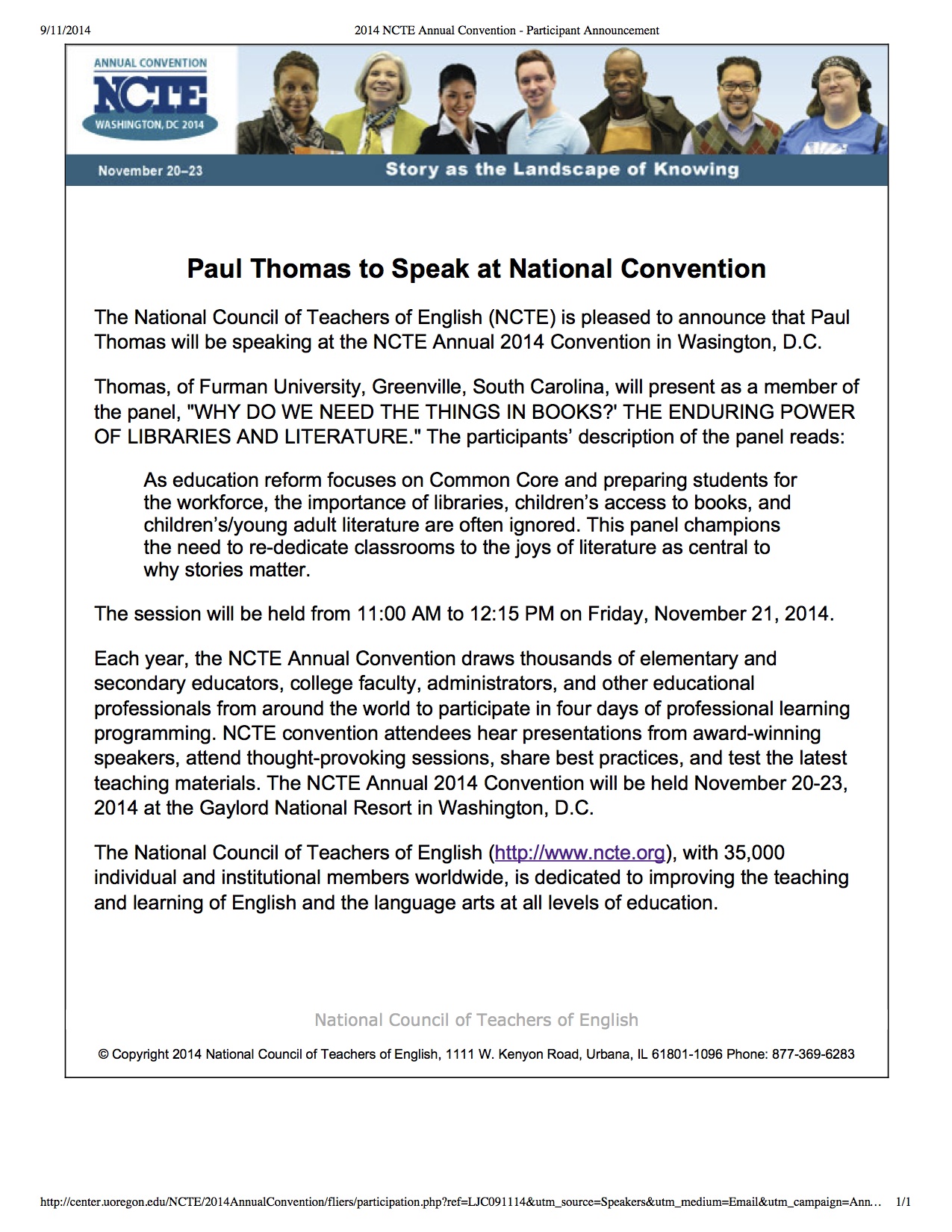
NCTE 2014: “Why do we need the things in books?”: The Enduring Power of Libraries and Literature

[At the 2014 National Council of Teachers of English Annual convention—themed Story As the Landscape of Knowing and held November 20-23, 2014, in Washington DC—Renita Schmidt (University of Iowa), Sean Connors (University of Arkansas), and I will be presenting as detailed below; I offer our proposal as a preview and hope you can join us as we need to raise our voices for both libraries and literature.]

“Why do we need the things in books?”: The Enduring Power of Libraries and Literature

Panel presentation, 75 mins

2014 NCTE Annual Convention - Participant Announcement copy

Teaching Reading and Children: Reading Programs as “Costume Parties”*

P. L. Thomas, Furman University

“[L]anguage behavior can not be reduced to formula,” Lou LaBrant (1947) argued (p. 20)—emphasizing that literacy growth was complicated but flourished when it was child-centered and practical (for example, in the ways many privileged children experience in their homes because one or more of the parents are afforded the conditions within which to foster their children’s literacy). Also, LaBrant (1949) identified the central failure of teaching reading: “Our language programs have been set up as costume parties and not anything more basic than that” (p. 16). This opening talk of the panel will focus on the importance of access to books and libraries as an antidote to “costume parties”—highlighting the work of LaBrant and Stephen Krashen as well as the speeches and writings of Neil Gaiman and Ray Bradbury as life-long proponents of libraries.

The More Books the Better!: Library Books as Boundary Objects To Build Strong Girls

Nita Schmidt, University of Iowa

Libraries provide stories for helping us understand who we are and who we might become. Sometimes, those stories take us to places we cannot imagine and we need more stories to resolve the tension. Libraries provide the books that become boundary objects or, as Akkerman and Baker (2011) describe, artifacts that work as mediators during times of discontinuity. Drawing on sociocultural theories of learning (Gee, 1996; Wenger, 1998; Vygotsky, 1978), this paper will discuss the ways an after school book club works with 4th – 6th grade girls to consider new perspectives. Book club members visit the library every month, read books with strong female protagonists, discuss topics in the books that relate to the real lives of the girls, and help the girls start their own personal libraries to encourage girls to begin to see themselves as successful young women in a complex global world. A bibliography will be provided.

Speaking Back to Power: Teaching YA Literature in an Age of CCSS

Sean Connors, University of Arkansas

If, as the narrator of John Green’s (2009) Paper Towns suggests, imagination is the machine that kills fascists, then literature, as English teachers and librarians know, is the engine that drives it. Despite the current education reform movement’s insistence on reducing the study of literature to a set of narrowly defined, measurable skills, and arguments which associate “close reading” and “textual complexity” with canonical literature, educators who value Young Adult fiction know that, like literature for adults, it is capable of creating a space for readers to examine complex issues related to race, class, gender, etc. This presentation calls on educators to recast arguments for teaching YA fiction in an age of CCSS by foregrounding its ability to encourage critical thinking. The presenter will share examples of (and guidelines for producing) student created digital book trailers that, rather than promoting books, instead “speak back” to oppressive ideologies featured in them.

*Portions adapted from the following blog posts:

Teaching Reading and Children: Reading Programs as “Costume Parties”

Common Core in the Real World: Destroying Literacy through Standardization (Again)

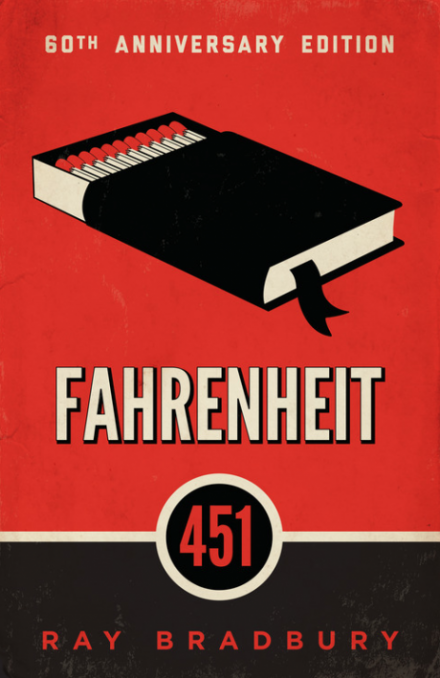
“Fahrenheit 451” 60 Years Later: “Why do we need the things in books?”

Neil Gaiman Should Be U.S. Secretary of Education: “Things can be different”

References

Akkerman, S.F. & Baker, A. (2011). Boundary crossing and boundary objects. Review of Educational Research, 81(2), 132-169.

Bradbury, R.  Fahrenheit 451, 60th anniversary edition.

Fahrenheit 451: 60th Anniversary Edition

Neil Gaiman lecture in full: Reading and obligation — http://readingagency.org.uk/news/blog/neil-gaiman-lecture-in-full.html

Gee, J.P. (1996). Social linguistics and literacies: Ideology in discourse. New York: Routledge.

Green, J. (2009). Paper towns. New York: Speak.

Krashen, S. (2014, January 4). The Spectacular Role of Libraries in Protecting Students from the Effects of Poverty. http://skrashen.blogspot.com/2014/01/the-spectacular-role-of-libraries-in.html?m=1

LaBrant, L. (1949). A genetic approach to language. Unpublished manuscript, Institute of General Semantics, Lakeville, CT.

LaBrant, L. (1947). Um-brel-la has syllables three. The Packet, 2(1), 20-25.

LaBrant, L. (1944, November). The words they know. The English Journal, 33(9), 475-480.

LaBrant, L. (1940, February). Library teacher or classroom teacher? The Phi Delta Kappan, 22(6), pp. 289-291.

LaBrant, L. (1931, March). Masquerading. The English Journal, 20(3), pp. 244-246.

Wenger, E. (1998). Communities of practice, learning, meaning and identity. Cambridge: Cambridge University Press.

Vygotsky, L. (1978). Mind and Society: The development of higher psychological processes. Cambridge, MA: President and Fellows of Harvard College.

Free Reading Redux

A book must be the axe for the frozen sea within us.

Franz Kafka, Letter to Oskar Pollak 1904

Paul Horton at Anthony Cody’s blog has offered a third installment of his defense of reading, recommending:

David Mikics, a Professor of English at the University of Houston, has recently written a very good book on this issue, Slow Reading in a Hurried Age (2013).

As reading and English teachers grapple with teaching literacy to prepare students for PARCC tests across the country, they should read this book very slowly to attempt to maintain a semblance of sanity: Slow Reading in a Hurried Age describes what you know you should be doing and want to do in your classes: reading to open minds rather than prescribed literacy drills that closes them.

Horton’s defense speaks to two important points I want to add here.

First, over 31 years as a teacher primarily concerned with literacy, I can attest that one of the most powerful forces that stands between students and a life-long love of reading is formal schooling.

For example, virtually all children (who are healthy, safe, and well fed) are eager and excited about both learning to read and reading. By 9th or 10th grade, however, a solid majority of students respond to reading somewhere between ambivalence and dread.

What do all those students have in common? Years of formal schooling in which their reading has overwhelmingly been assigned and then the purpose of text has almost exclusively been reduced to mining those assigned texts for the information teachers or test creators want those students to identify (up next, the hell that will be “close reading”—or “how to destroy the love of reading in one easy step”).

Teaching at the university level and working closely with English majors have presented me with another powerful phenomenon: College students who lament that their formal education keeps them from pleasure reading and who feel relief and excitement at the possibility of returning to reading by choice once they graduate.

Second, Horton’s series on reading speaks to the work of Lou LaBrant, who spent most of her 65 years as a formal educator calling for free reading—including her foundational “The Content of a Free Reading Program” (1937).

And thus, to the term “free reading.”

Directly, advocacy for free reading is an evidence-based argument that reading is essential for human agency and empowerment, but the quest for reading among the young must be couched in recognizing the tension between the ability to read (so-called reading skills such as decoding, comprehension, etc.) and the proclivity to read (appreciating the value of reading as well as simply wanting to read).

If teaching children to read makes them non-readers, what’s is the point?

That leads to the secondary implication of the term “free reading”—we must find ways in which to free reading from the historical and current policies and practices that destroy the love of reading all children need and deserve.

And here is what we know (from the earliest years of LaBrant’s work to the continued scholarship and advocacy of Stephen Krashen):

  • Choice is one of the most powerful conditions for all literacy growth, especially when students are allowed choice in the context of the guidance of expert readers and writers (including but not exclusively teachers).
  • Access to books and texts is central to literacy development, especially abundant access to texts in the home and in schools (such as well-funded libraries with professional librarians).

The ways in which many of us come to love reading have been identified and confirmed again and again by teachers and researchers, but also among writers. Read Neil Gaiman on libraries and books, or Ray Bradbury, or Walter Dean Myers.

That list, in fact, is nearly endless, but we fail to listen to teachers, researchers, writers, and worst of all, students.

There is a wonderful and powerfully subtle remembrance in Lousie DeSalvo’s Vertigo in which she shares a moment from her high school experience. DeSalvo’s physics teacher confronts the young Louise about her ignoring his lectures by reading novels not-so-covertly in the back of room (otherwise, Louise notes that she is a good student in that class).

Mr. Horton, the teacher, does not respond in the way we expect. He takes her book, Fyodor Dostoevsky’s The Possessed, in his hand and then offers her a deal: He wants her to stop ignoring his lectures, but he offers to read the books she is reading and then talking with her about them (pp. 168-169).

For me, this teacher asks that DeSalvo respect the course by acknowledging his respect for those things that matter to her. It is an elegant and gracious compromise found all too rarely in schools.

If we are to take seriously the value in reading, as Horton does, we must come to terms with the paradox: Free reading is the path to free reading from the failures of demanding and teaching reading in our schools.

In 1937, LaBrant reached a conclusion that holds true today:

The theory that in a free or extensive reading program designed to utilize interest and to serve individual needs there will be fruitless reading of light fiction gains no evidence from this study. The report does, however, point to the possibility that the adolescent has much greater power to read and to think intelligently about reading than the results of our conventional program have led us to believe. (p. 34)

DeSalvo’s physics teacher ends his deal offer by noting that Louise has the key quality needed for a teacher: “‘A passionate interest in your subject'” (p. 169).

Moments such as this must become the norm of schooling, not the rare recollection found in a memoir—a memoir, by the way, that is a beautiful and incisive read, an “axe for the frozen sea within us.”

For Further Reading

How an economics professor taught me a life-changing lesson — in literature

Revisiting “Cliches and Abstractions” in the Context of Race, 2014

Writing in 1949 in the wake of World War II, Lou LaBrant opens a consideration of cliche and abstractions by focusing on a student essay, in which the student discussed her assumptions instead of the text she was examining:

Only after inch-by-inch progress was she able to see that from “orphan,” for which the novelist was undoubtedly responsible, my student had jumped to the whole cliche “poor, defenseless orphan” and consequent accusations against at least three other characters in the story.

…But of serious account is her tendency or that of any reader to accept a cliche and so permit it to stand between himself and a fact or understanding. (p. 275)

In 1987, the College Board included Sylvia Plath’s “Sow” on the Advanced Placement Literature exam; the prompt read:

1987 Poem: “Sow” (Sylvia Plath)
Prompt: Read the poem. Then write an essay in which you analyze the presentation of the sow. Consider particularly how the language of the poem reflects both the neighbor’s and the narrator’s perceptions of the sow and how the language determines the reader’s perceptions. Be certain to discuss how the portrayal of the sow is enhanced by such features as diction, devices of sound, images, and allusions.

Typical of A.P. literature prompts, the focus of the response is on three sets of perceptions. Scores for that written section in 1987 were notoriously low. Students, it seemed, experienced something very similar to what LaBrant identified in her students: “to accept a cliche and so permit it to stand between himself and a fact or understanding.”

I used that prompt for students to practice for the exam when I taught A.P. Lit, and we always discussed how students struggled against their own perceptions of “sow,” or pigs.

Let me offer, now, three further points in the context above.

First, consider our assumptions about language. When I teach ELA methods, I often raise the issue of how people respond to the so-called non-standard use of “aks” (instead of the standard “ask”)—highlighting that the non-standard “aks” is immediately and almost universally associated with African Americans, and then if not simultaneously, consequentially, with being uneducated or unintelligent.

However, when placed in historical and cultural context, those simplistic assumptions fall apart. And, “aks” is but one of many words in the English language that demonstrates “metathesis”:

Wasp used to be wapsbird used to be brid and horse used to be hros. Remember this when the next time you hear someone complaining about aks for ask or nucular for nuclear, or even perscription. It’s called metathesis, and it’s a very common, perfectly natural process.

And while “aks” carries both racial and intelligence baggage, President George W. Bush experienced the brunt of intelligence jokes because of “nucular.”

Second, consider the assumptions bound in not the words we hear or use, but what we see:

Asked to identify the age of a young boy that committed a felony, participants in a study routinely overestimated the age of black children far more than they did white kids. Worse: Cops did it, too.

The study, published in the Journal of Personality and Social Psychology, aimed at figuring out the extent to which black children were likely to be treated differently than their white peers solely based on race. More specifically, the authors wanted to figure out the extent to which black kids were dehumanized. “Children in most societies are considered to be in a distinct group with characteristics such as innocence and the need for protection,” author Phillip Atiba Goff of UCLA told the American Psychological Association. “Our research found that black boys can be seen as responsible for their actions at an age when white boys still benefit from the assumption that children are essentially innocent.”

Third, consider Glenn Ford:

A Louisiana man who has spent nearly three decades on death row walked free on Tuesday, after prosecutors asked a judge to set aside his first-degree murder conviction and death sentence, citing new evidence in the case that exonerated him.

Glenn Ford, 64, a black man, was convicted by an all-white jury in the 1983 robbery and murder of Isadore Rozeman, a 56-year-old Shreveport watchmaker, who was found shot to death behind the counter of his jewelry shop.

Acting on new information that exonerated Ford, a judge in Shreveport ordered him released from Louisiana State Penitentiary in Angola, where he has been held on death row since March 1985.

As I have stated before, denying racism has an evidence problemone that is recurring and recurring.

As LaBrant warns in her examination of cliches and abstractions, humans are predisposed to read texts and the world in ways that are shaded, and thus distorted, by their assumptions, the codes they have embraced uncritically.

The line between cliches and abstractions in careless student writing, and prejudices and bigotry in the way people live their lives is razor thin, and possibly the only things between a young person and crossing that line are the sorts of experiences in their formal schooling that ask students to reconsider assumptions, reconsider abstractions and generalizations.

Teaching English, teaching reading and writing, is about more than the 1987 prompt on the A.P. exam above—a prompt grounded in New Criticism and little different than what students will be bound to do under the new regime of “close reading” in the Common Core (a strategy designed to ask students not to consider context beyond the text itself).

How students read and re-read the world, how students write and re-write the world, then, must be framed differently. Students require context and they require some basis in their own realm of understanding in order to move beyond their provincialism:

It should be noted that such analysis is made much more easily when the writer is dealing with a problem in which he has some stake and for which he has assumed the initiative in writing. If the statement comes from a workbook or from the teacher’s assignment, it is impossible to hold the writer to an understanding of meaning. Sometimes we ourselves deliver definitions (generalizations) meaningless to children.

…We assign topics for writing, well knowing that they are beyond the real understanding of our pupils and that consequently these young writers must fall back on vague and meaningless generalizations. (p. 277)

It is not just about the words and people we see around us; it is about what we assume we see in the words and people around us—often despite evidence to the contrary.

That fact of the power of bias, assumption, prejudice, and bigotry has powerful consequences:

The less the black kids were seen as human, the less they were granted “the assumption that children are essentially innocent.” And those officers who were more likely to dehumanize black suspects overlapped with those who used more force against them.

In 2014, systemic racism in the discipline systems of our schools feed and then are magnified in the systemic racism in our era of mass incarceration.

What cliches-as-prejudice persist that keep political leaders, the media, and the public from reading that reality?

“Hunting Scapegoats”: WWII Literacy Crisis and Current Education Reform

[Header Photo by Christian Chomiak on Unsplash]

“Historians often mention World War II as a time when expectations for schooling and literacy really took off,” explains Deborah Brandt [1], “when what was considered an adequate level of education moved from fourth grade to twelfth grade in a matter of a few years” (p. 485).

National concerns about literacy can be traced to literacy tests for soldiers in WWI, when 25% of recruits were deemed illiterate. While this data appear to have prompted a greater focus on literacy in U.S. public schools, WWII data on literacy again suggested far too many people in the U.S. struggled with basic literacy. As Brandt notes:

Even more profoundly, though, World War II changed the rationale for mass literacy. Literacy was irrevocably transformed from a nineteenth-century moral imperative into a twentieth-century production imperative—transformed from an attribute of a “good” individual into an individual “good,” a resource or raw material vital to national security and global competition. In the process, literacy was turned into something extractable, something measurable, some-thing rentable, and thereby something worthy of rational investment. (p. 485)

From the early to mid-twentieth century, then, a powerful dynamic was created among racial integration, military-based measurement of IQ and literacy, and changing expectations for public education.

Brandt sees those relationships in current education reform ideologies and claims:

We can find eerie parallels between the selective service system of the mid-twentieth century and the public educational system of the early twenty-first century. There is the atmosphere of high anxiety around literacy, rapidly changing standards, an imposition of those standards onto more and more people, a search (largely futile) for reliable testing, a context of quick technological development, a heightened concern for world dominance, and a linking of literacy with national security, productivity, and total quality control. This is what happens when literacy links up with competition, with the need to win the war. It is this competition that justifies the strip mining of literacy, the ranking of skill, the expendability of human potential, and the production of just-in-time literacy. It is the blueprint for the Knowledge Economy. (p. 499)

Calls of a literacy crisis during WWII are roots of similar cries of education crisis spanning from the early 1980s until today. And throughout either era, the complexities of the problems are ignored in order to force agendas that have less to do with education than with serving larger social and political goals—often ones benefitting the privileged at the expense of the impoverished and marginalized.

In 1942, Lou LaBrant confronted the misleading conclusions drawn about low literacy rates among WWII draftees:

The induction of American youth into the armed forces, and the attendant examinations and classifications have called attention to a matter long of concern to those who teach reading or who are devoted to the cause of democracy: the fact that in a land which purports to offer universal education we have a considerable number of youth who cannot read intelligently. We are disturbed now because we want these men to be able to read military directions, and they cannot. A greater tragedy is that they are and have been unable to read with sufficient understanding to be constructive peace-time citizens.

As is to be expected, immediate explanations have been forthcoming, and immediate pointing-of-fingers has begun. Most of the explanations and pointing have come from those who have had least to do with teaching reading, and who are least conversant with the real problem. Moreover, as is again to be expected, the diagnosis is frequently in terms of prejudice or pet complaint, and could be used in other situations as logically. Many are hunting scapegoats; there are scores of “I-told-you-so’s.” It is best to look at the situation critically. (p. 240)

LaBrant recognized, as a teacher and scholar of literacy, that public blame for the low literacy rates suffered from both a lack of expertise about literacy and a number of complicating factors. For example, the standard for literacy changed from generation to generation, and WWII experienced an expanded pool of recruits due to integration, which of course included African Americans and impoverished men who had been systematically denied educational opportunities.

The political and public response to low literacy rates among the military in WWII included blaming progressive education and calling for a back-to-basics focus, as LaBrant addressed:

Within the past ten years we have made great strides in the teaching of purposeful reading, reading for understanding (the kind of reading, incidentally, which the army and navy want) . Nevertheless, we hear many persons saying that the present group of near-illiterates are results of “new methods,” “progressive schools,” or any deviation from the old mechanical procedures. They say we must return to drill and formal reciting from a text book. (p. 240)

The pattern identified by LaBrant foreshadows the rise of high-quality writing instruction in the 1970s-1980s that was blunted by the accountability era’s focus on standards and high-stakes testing.

But, as LaBrant outlined, public and political blame placed on progressivism was misguided, and ultimately misleading:

Before we jump to such an absurd conclusion, let’s take a minute to think of a few things:

1. Not many men in the army now have been taught by these newer methods. Those few come for the most part from private or highly privileged schools, are among those who have completed high school or college, and have no difficulty with reading.

2. While so-called “progressive” schools may have their limitations, and certainly do allow their pupils to progress at varied rates, above the second grade their pupils consistently show superior ability in reading. Indeed, the most eager critics have complained that these children read everything they can find, and consequently do not concentrate on a few facts. Abundant data now testify to the superior results of purposeful, individualized reading programs.

3. The reading skills required by the military leaders are relatively simple, and cause no problem for normal persons who have remained in school until they are fourteen or fifteen. Unfortunately the large group of non-readers are drop-outs, who have not completed elementary school, come from poorly taught and poorly equipped schools, and actually represent the most conservative and back- ward teaching in the United States. (pp. 240-241)

Again, consider the pattern: Implement new and developing tests (literacy tests during WWII), identify a problem related to education, create a scapegoat, and then call for a return to traditional drill-based education. Does this sound familiar?

Now add what was not being addressed in 1942, as detailed by LaBrant:

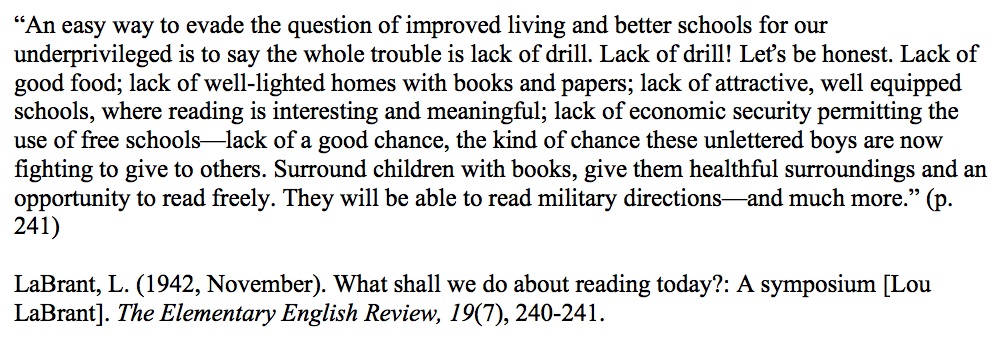
An easy way to evade the question of improved living and better schools for our underprivileged is to say the whole trouble is lack of drill. Lack of drill! Leťs be honest. Lack of good food; lack of well-lighted homes with books and papers; lack of attractive, well equipped schools, where reading is interesting and meaningful; lack of economic security permitting the use of free schools—lack of a good chance, the kind of chance these unlettered boys are now fighting to give to others. Surround children with books, give them healthful surroundings and an opportunity to read freely. They will be able to read military directions—and much more. (p. 241)

Seven-plus decades ago, public and political outrage was willing to attack a straw man, a scapegoat—progressive education—but was unwilling to confront inequity, poverty, and the linger scar of racial segregation.

Again, sound familiar?

Note

[1] Brandt, D. (2004). Drafting U.S. Literacy. College English, 66(5), 485–502. https://doi.org/10.2307/4140731 [https://www.jstor.org/stable/4140731]

Lack 1942

Teaching Reading and Children: Reading Programs as “Costume Parties”

Well into my 30s and during my doctoral program, I was finally afforded the opportunity to read carefully the work of John Dewey. This late scholarship on my part is an indictment of teacher certification, but it is also a window into the historical and current misinformation about the state of reading and the teaching of reading in U.S. schools.

Dewey, the Father of Progressive Education, I discovered, believed that we do not need to teach reading; Dewey noted that reading just happened, basing this claim on his own inability to recall having been taught to read.

The first time I came across this—considering I was then and remain primarily a teacher of English—I was puzzled that Dewey could be so wrong about reading and so compelling* about education in general.

With time, however, I realized that my initial rejection of Dewey’s belief about reading sprang from my perspective as a teacher: Teachers are predisposed to seeing themselves as change agents, as causational in the learning of others.

As an avid reader and writer, if I am honest, my perspective on reading isn’t all that different from Dewey’s. It is likely that Dewey and I experienced similar conditions of privilege that allowed something like a natural learning of reading, and literacy in general.

And it is here that we must confront a foundational question: Why have we declared a perpetual reading crisis in the U.S. throughout the last century?**

Lou LaBrant: A Progressive Voice

Lou LaBrant began teaching in 1906—in a one-room school, nonetheless. LaBrant’s career spanned most of the 20th century, ending in 1971.

Throughout the 1920s, 1930s, and 1940s, LaBrant built a substantial publishing record that focused on a few powerful commitments: (1) Endorsing progressive education, (2) calling for free reading, and (3) highlighting the importance of libraries and the role of librarians as teachers (LaBrant, 1940).

Progressive education and Dewey became and often remain targets of traditional claims that U.S. public education is a failure. But, as Alfie Kohn has detailed:

Despite the fact that all schools can be located on a continuum stretching between the poles of totally progressive and totally traditional — or, actually, on a series of continuums reflecting the various components of those models — it’s usually possible to visit a school and come away with a pretty clear sense of whether it can be classified as predominantly progressive. It’s also possible to reach a conclusion about how many schools — or even individual classrooms — in America merit that label: damned few. The higher the grade level, the rarer such teaching tends to be, and it’s not even all that prevalent at the lower grades. (Also, while it’s probably true that most progressive schools are independent, most independent schools are not progressive.)

The rarity of this approach, while discouraging to some of us, is also rather significant with respect to the larger debate about education. If progressive schooling is actually quite uncommon, then it’s hard to blame our problems (real or alleged) on this model. Indeed, the facts have the effect of turning the argument on its head: If students aren’t learning effectively, it may be because of the persistence of traditional beliefs and practices in our nation’s schools.

LaBrant’s career and her scholarship, then, represent both an accurate case for progressive approaches to teaching reading and a record of how U.S public schools have failed the promise those practices offered.

More so than Dewey, LaBrant’s scholarship and practice represent a practical progressive pedagogy that rises above “natural” and includes “critical”:

Two adults speak of “progressive education.” One means a school where responsibility, critical thinking, and honest expression are emphasized; the other thinks of license, lack of plans, irresponsibility. They argue fruitlessly about being “for” or “against” progressive education. (LaBrant, 1944, pp. 477-478)

Dewey’s claim of “natural” learning has led critics to demonizing the latter, while LaBrant’s practices are grounded in the former. In reality, again as Kohn shows, neither the misapplication of a laissez-faire progressivism nor holistic, child-centered progressivism has ever characterized the learning experiences of most U.S. students.

And thus, LaBrant’s arguments throughout the first half of the twentieth century remain relevant.

“[L]anguage behavior can not be reduced to formula,” LaBrant (1947) argued (p. 20)—emphasizing that literacy growth was complicated but flourished when it was child-centered and practical (for example, in the ways many privileged children experience in their homes because one or more of the parents are afforded the conditions within which to foster their children’s literacy).

By mid-twentieth century, LaBrant (1949) had identified the central failure of teaching reading: “Our language programs have been set up as costume parties and not anything more basic than that” (p. 16).

In fact, many years before this observation, LaBrant (1936) confronted the failure of implementing progressive philosophy in the real-world classroom:

An Experience Curriculum in English [A Report of a Commission of the National Council of Teachers of English. W. Wilbur Hatfield, Chairman. D. Appleton- Century Company, 1935], published only a the year ago, is already influencing the course of study in many schools. There is always danger in popular revision that the change may be confined to stated objectives and superficial devices, and that basic understandings may not be involved at all. A teacher eager to join the ranks of progressives recently asked the question: “How can I put the teaching of The Lady of the Lake on an experience basis in my ninth grade class?” The question is but little less absurd than the procedures of many curriculum revisers who re-arrange old materials, add a little in- formality to class discussions and present the result as a mark of progress. We must consequently beware lest many so-called “experience curriculums” be set up without recognition of opportunity for normal, strong and complex experiences, within which language development in reading, writing, talking and listening is an integral factor. (p. 295)

Despite LaBrant’s optimism above about the impact of NCTE’s report, the history of reading programs in the U.S. remains a disappointing trail of costume parties. In fact, the history of reading instruction as little more than a masquerade was tackled by LaBrant (1936) just five years before:

The cause for my wrath is not new or single. It is of slow growth and has many characteristics. It is known to many as a variation of the project method; to me, as the soap performance. With the project, neatly defined by theorizing educators as “a purposeful activity carried to a successful conclusion,” I know better than to be at war. With what passes for purposeful activity and is unfortunately carried to a conclusion because it will kill time, I have much to complain. To be, for a moment, coherent: I am disturbed by the practice, much more common than our publications would indicate, of using the carving of little toy boats and castles, the dressing of quaint dolls, the pasting of advertising pictures, and the manipulation of clay and soap as the teaching of English literature. At almost any meeting of teachers of English one may find, somewhere near the main entrance, a room full of exhibition work. This will include models of the castle from Ivanhoe, miniatures of the lake with Ellen’s isle, weaving ma-chines like those at Raveloe, and soap reproductions of Camelot. Recently a teacher attempted to protest against such an exhibition. The reply was that such materials always drew attention from teachers, more attention than lectures probably, and that pupils also found them interesting. …

That the making of concrete models will keep interested many pupils who would otherwise find much of the English course dull may be granted. The remedy would seem to be in changing the reading material rather than in turning the literature course into a class in handcraft. Good work in handcraft would best be accomplished by a teacher trained in that field. The sand table, the soap for carving, the tiny mirrors for lakes, and the rest of the paraphernalia belong, certainly, outside the literature class. (pp. 245, 246)

The misapplication of the project method as arts and crafts (instead of reading) is a close cousin to what passes for reading instruction today: Test-prep for reading tests (instead of reading).

Reading Programs as “Costume Parties”

If LaBrant were alive today, I suspect she would express the same wrath for Common Core and the high-stakes testing that are the source of the materials bonanza now sweeping across the U.S.: This is once again allowing reading programs to masquerade as reading instruction—except these costume parties are incredibly costly in terms of time and public funding and detrimental to the exact students who need genuine progressive learning environments the most.

Why, then, are we failing reading once again?

There is no market incentive for doing what is right in terms of reading.

New standards and new tests feed our consumer culture, but genuine reading reform would not.

In short, the sort of reading practices we have known to be effective since LaBrant’s career (and echoed by leading literacy experts decade after decade) simply don’t sell:

  • Alleviate poverty and inequity so that all children live in homes that foster early reading development.
  • Choice reading, not prescriptive reading programs, is essential to reading development.
  • Access to books, such as libraries as well as books in the home, is also central to reading growth.

Thus, if genuine social and school reform focused on the above, instead of new standards, new tests, and new materials, consider the consequences:

If all children entered schools as literate as most affluent children, the reading program industry would be destroyed.

Just as the market economy of the U.S. depends on poverty to thrive (and thus market forces will never overcome poverty), the reading program industry depends on struggling readers and thus will never seek ways to foster reading among all children.

The choice before us is to continue the masquerade that is Common Core—one that lines the pockets of curriculum consultants, textbook and testing companies, and government bureaucrats—or to make a truly progressive commitment to both the lives and schools of all children, lives and schools that allow learning that seems natural.

References

LaBrant, L. (1949). A genetic approach to language. Unpublished manuscript, Institute of General Semantics, Lakeville, CT.

LaBrant, L. (1947). Um-brel-la has syllables three. The Packet, 2(1), 20-25.

LaBrant, L. (1944, November). The words they know. The English Journal, 33(9), 475-480.

LaBrant, L. (1940, February). Library teacher or classroom teacher? The Phi Delta Kappan, 22(6), pp. 289-291.

LaBrant, L.L. (1936). The library and “An experience curriculum in English.” The Elementary English Review, 13(8), pp. 295-297, 305.

LaBrant, L. (1931, March). MasqueradingThe English Journal, 20(3), pp. 244-246.

Thomas, P. (2001). Lou LaBrant—A woman’s life, a teacher’s life. Huntington, NY: Nova Science Publishers, Inc.

* For the record, I am not a progressive, and I remain about equally disappointed in traditionalists and progressives in terms of educational practices. When I must acknowledge a label, I am most comfortable with “critical.”

** Without a historical perspective of education, the public may be unaware that at any moment throughout the 20th and into the 21st century, the public and professional claim about reading always includes: (a) children today aren’t reading as much as they used to, (b) our literacy rate is in crisis, and (c) we must make sure that all children can read [insert grade level here; in 2013, 3rd grade is the emergency year].