If trending matters on social media, a consensus is building that Bari Weiss has ushered in the death of CBS, a nail in the coffin of mainstream media:
Farewell to CBS News and "60 Minutes." It just went the way of the Washington Post's editorial page
Once you begin surrendering to Trump, he always wants more. You can’t appease a tyrant. Some thoughts… pic.twitter.com/g8JBxfkCHk
Many things can be true at once even when they seem to be somewhat contradictory, and here is such a case.
First, Weiss being hired by and then allowed to shape one of the original major networks in the US—associated with Walter Cronkite and Dan Rather—does deserve the criticism being leveled at both Weiss and CBS.
However, lurking beneath this hand wringing about the death of the mainstream media are interrelated realities—media and journalists have a long tradition of seeking to remain unbiased and nonpartisan, but they are both perceived by the public as liberal.
Over my 40+-year career, I have worked in two professions that share reputations for being liberal (education and journalism) even though both professions demand that teachers and journalists remain unbiased and nonpartisan, essentially not political.
Here is what many people miss about the Weiss/CBS controversy: Journalists/media represent a body of workers who are often disproportionately progressives or moderates but who have historically in the US (mostly because of standards around remaining unbiased and not political) perpetuated conservative and traditional values, often to the exclusion of pursuing truth and accuracy.
Yes, Weiss pulling (or delaying) the 60 Minutes episode is a grossly extreme example, but this action isn’t substantially different than how mainstream media has always worked. And that includes the nostalgia often associated with Cronkite and the Golden Era of broadcast television.
Journalists and media performing their work in unbiased and objective ways is not possible (all human endeavors are biased) but that standard also works as a veneer for maintaining social and political norms—which is a conservative bias.
Mainstream media has never really disrupted the political and economic status quo of the US; media has mostly served that status quo and those profiting from it.
My work as a public scholar keeps me in constant contact with mainstream media. This past summer, I had a commentary in The Washington Post, and while I found the journalists and experience very professional and supportive, the very long process tended toward softening my analysis of the reading crisis and shifting the discourse toward normative beliefs instead of critical evidence.
But I also had an experience with 60 Minutes in the spring of 2024.
A producer at 60 Minutes had read some of my public work on the current reading crisis movement, the “science of reading,” and he found my perspective unique, surprising. He emailed, and we set up a phone conversation.
We talked for over an hour and a half, and while the producer was engaged and interested, the discussion was mostly punctuated with him asking me to repeat key points that contradicted the norms of what people believe about reading and teaching reading.
He seemed most disoriented by my explaining what NAEP reading scores and achievement levels mean and how that tends to distort how reading proficiency and reading at grade level are understood.
By the end of the conversation, the producer concluded that everything I shared was important and even fascinating, but as he explained, there was no story there for a 60 Minutes segment.
Not long after this, however, 60 Minutes ran a segment on Moms for Liberty, an extremist right-wing group that also happens to perpetuate the exact reading misinformation that does provide the sort of story that media loves (compelling even though it is misleading or even false).
Frustrated and angry, I emailed the producer who responded by stating he had not been aware of the M4L segment, but that producers didn’t interfere in each other’s projects. You see, a compelling story trumps an accurate story.
Again, the Weiss/CBS controversy is a valid concern, but David Brooks—often considered not just a credibly journalist but an elite one—was a lower-key version of Weiss’s nonsense well before anyone knew her name. And Brooks enjoys a mostly uncritical acceptance and even celebration of his conservative ideology thinly wrapped in astute public commentary.
And The New York Times as well as Education Week have long been viewed as high-quality journalism that the public believes to be liberal while routinely producing conservative journalism and traditional stories.
Yes, many journalists (and educators, especially in higher ed) self-identify as progressives and moderates. But mainstream media is ultimately a business, and as the Trump era has shown, the public can be self-defeating in its retreat from anything critical, accurate, or counter to what most people believe.
Before Weiss, CBS was not liberal mainstream media or a Gold Standard of journalism; it was corporate media, often negligent while maintaining a veneer of being unbiased.
After Weiss, who has completely perverted the already problematic both-sides approach to journalism, CBS seems to believe that dropping the mask of objectivity will be the sort of story that sells—even when brazenly eradicating truth and accuracy.
You see, Weiss didn’t murder a robust and mature media; she just nudged it into the grave from Hospice.
Having just re-watched 28 Days Later last night, I am prone to suggest that while we mourn the death of CBS, let’s not rush to raise the dead.
In corporate America, there has never been either a liberal or unbiased mainstream media.
The Weiss dumpster fire is razing the garbage that most Americans pretended not to smell rotting right under their noses.
This “Southern surge” narrative tends to center Mississippi but also includes Florida, Alabama, and Louisiana (the most recent “miracle” state based on an incomplete or misleading use of NAEP scores).
Like many media manufactured narratives, the “Southern surge” in reading falls apart when the data are carefully examined.
While I give the Chalkbeat article some credit for admitting that the so-called “surge” is not fully understood, Barnum—as Hanford did when christening Mississippi a “miracle” in 2019 (“What’s up in Mississippi? There’s no way to know for sure what causes increases in test scores”)—gives the “surge” narrative nearly complete credibility even with the headline hedge and a couple points made then glossed over (“Eighth grade results have been less impressive for these Southern exemplars, though”).
Here are the (likely fatal) flaws in the “surge” narrative:
Although Barnum cites an important and comprehensive analysis of reading reform, he fails to acknowledge its most important findings: States adopting reading reform (often popularly associated with Mississippi’s model even when states explicitly do not mimic those reform policies, such as California) has seen short-term test score gains in reading (note that score gains are not necessarily higher reading proficiency); however, while Barnum lists several reading policy components (“third grade retention, phonics-based curriculum, and statewide teacher training”), this study directly states that only retention is associated with higher scores (with the researchers noting their study did not identify why).
Barnum notes the drop by Southern states’ grade 8 reading scores, but fails to acknowledge that this data point may suggest that retention is inflating scores, not increasing reading proficiency. Notably states such as Florida and Mississippi have had these reform for over one to two decades without the “surge” appearing in grade 8 data.
The retention component also is troubling since these states continue to retain students as high rates. If the other policies were working, we should expect retention numbers to decrease significantly, but they have not.
Possibly the most damning ignored data from NAEP, however: Across all states, but including the so-called “surge” states, the race and poverty gaps remain persistent, typically the same as in 1998.
There are statistical realities also being ignored in the “surge” narrative.
Test scores for the lowest performing students are easier to improve that top-scoring students, for example.
But likely more significant is that early literacy test scores are strongly correlated with student biological age (England has almost twenty years of data on phonics checks that show this); therefore, when grade retention removes the lowest scoring students from the testing population (grade 3 retention laws impact grade 4 NAEP testing) and reintroduces them when they are biologically older, the possibility is that scores are being artificially inflated.
Reading “crisis/miracle” narratives and the phonics gambit should be dead horses; these unfounded claims have existed in the US well back into the 1940s, recurring decade after decade.
At best, “we don’t fully understand it yet,” and at worst, too many people profit off this zombie narrative, and children, teachers, and schools will continue to be sacrificed instead of putting these stories in the ground where they belong.
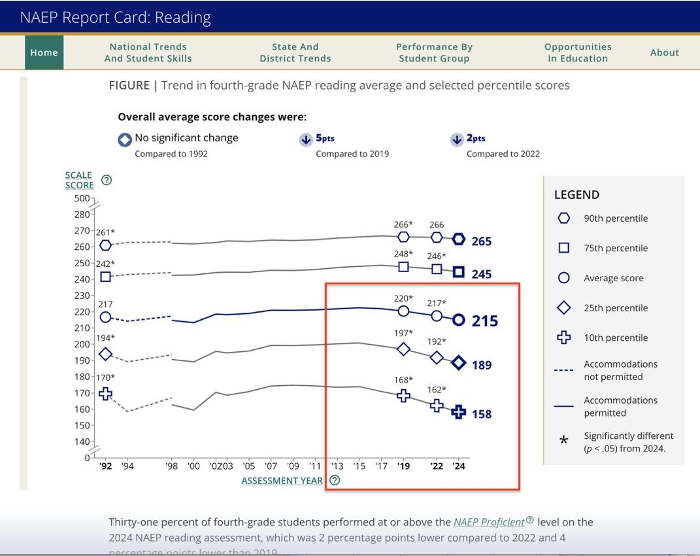
Every two years reading scores make headlines. And this year, as has been the case since COVID, the news is not good. Scores are down (again), and the causes being pointed to for the drop are also wrong (again).
National Assessment of Educational Progress (NAEP) is the national program mandated with tracking student achievement. The 2024 results reveal that reading scores have hit their lowest point in 32 years. This decline is notable because in recent years many states have passed aggressive reading legislation, often labeled as the “science of reading” (SOR).
The SOR movement makes a few key claims: the US has a reading crisis, teachers fail to use “scientific” evidence for instruction, and educators and policymakers are making excuses by acknowledging poverty when addressing low reading proficiency.
However, the Mississippi “miracle” story was an incomplete misreading of reading proficiency and policy.
With the average 2024 NAEP reading scores in further decline, the SOR era in reading reform appears to be failing. This is especially true for vulnerable students whose scores have dropped the most. Interpreting these scores correctly is key to forging a better path forward.
Thus, we must seek a more credible story about 2024 NAEP reading scores.
Let’s consider three sets of data from the Department of Defense schools (DoDEA), Florida, and Mississippi. These student populations include significant racial and socioeconomic diversity as well as multilingual learners and other vulnerable populations of students.
Florida and Mississippi have long been applauded for aggressive education and reading reform, and in 2024, their grade 4 reading scores remained in the top 25% of states, seemingly defying the odds. But Florida and Mississippi scored again well below top-scoring DoDEA schools.
Although many rush to ascribe this success to SOR policies, we should really be looking at a different (ultimately harmful) policy: third-grade retention based on state testing.
As education analysts John Westall and Amy Cummings concluded in a report on reading policy: “[S]tates whose policies mandate third-grade retention see significant and persistent increases in high-stakes reading scores in all cohorts…. [T]here is no consistent evidence that high-stakes reading scores increase in states without a retention component.”
Inflated scores are not learning; by eighth grade NAEP reading scores for Florida and Mississippi drop into the bottom 25% of states. The widely applauded “gains” in grade 4 are, in fact, a mirage.
Here is a different story: DoDEA schools are the top-scoring schools on NAEP tests and tell a story we’ve resisted admitting in the US. Maroun and Tieken found in 2024, replicating decades of similar research, that 60+% of student test scores are not linked to teacher quality, instruction, or programs but to out-of-school factors like socioeconomic background, home environment, and parental involvement to name a few.
While DoDEA schools have significant populations from poor and working-class backgrounds and serve diverse as well as vulnerable populations of children, these students have healthcare, food security, stable housing, and parents with stable work—and consistently high reading scores.
NAEP reading scores, again, are not a story about teacher and reading program failure or even student reading proficiency. These scores tell a complex story about a long history in the US of negligence, the lack of political will to address not only the education of all our children, but also their lives outside of school.
Regardless of your level of optimism, there simply is no other conclusion to draw from over forty years of educational crisis and reform: Education reform has almost nothing to do with improving education for students, but education reform has become an industry.
And one of the most powerful engines driving the crisis/reform industry in education is education journalism.
Interesting is that both are provable false narratives.
Yet, these stories endure because “[v]iewing education as being in more or less permanent crisis” (Edling, 2015) creates market and political profit for media, private education corporations, and politicians.
As a simple fact of logic, consider that for at least the last century, on every standardized test in every content area, students in poverty as a group have scored significantly lower than more affluent students.
Over that century, the teachers, instructional practices, programs, and curriculums/standards have changed dozens of times and have never been coherent at any one point across the US.
The only constant, of course, has been the economic inequity of the populations of students being taught and tested.
Yet, what have the media and political leaders focused on almost exclusively in the forty-plus-years of intense accountability reform (over what can be called at least half a dozen cycles in those decades)?
Instruction, curriculum/standards, and programs.
Why?
Teacher training churn, standardized test churn, and program churn are industries, and there is profit in constant churn.
Never has it been more clear that education reform is industry: “The administrations in charge,” writes Gilles Deleuze in Postscript on the Societies of Control, “never cease announcing supposedly necessary reforms: to reform schools, to reform industries, hospitals, the armed forces, prisons” (p. 4).
And never has it been more clear that education journalism is deeply invested in that churn, in manufacturing perpetual crisis:
Just within the past twenty years, Gates+ money has incubated several new education-only media outlets, such as Chalkbeat, EdReports, EdSurge, Education Next, Ed Post, FutureEd, and The 74. Gates+ money has also substantially boosted the efforts of preexisting education-only media organizations, such as EdSource, Education Week, the Education Writers Association, the Thomas B. Fordham Institute, and the Hechinger Report. All told, this accounts for almost all large-audience, US, K–12-education-only print media outlets, other than those tied to the traditional public education establishment.
I suspect no one embodies education reform as industry as well as Bill Gates, education reform hobbyist.
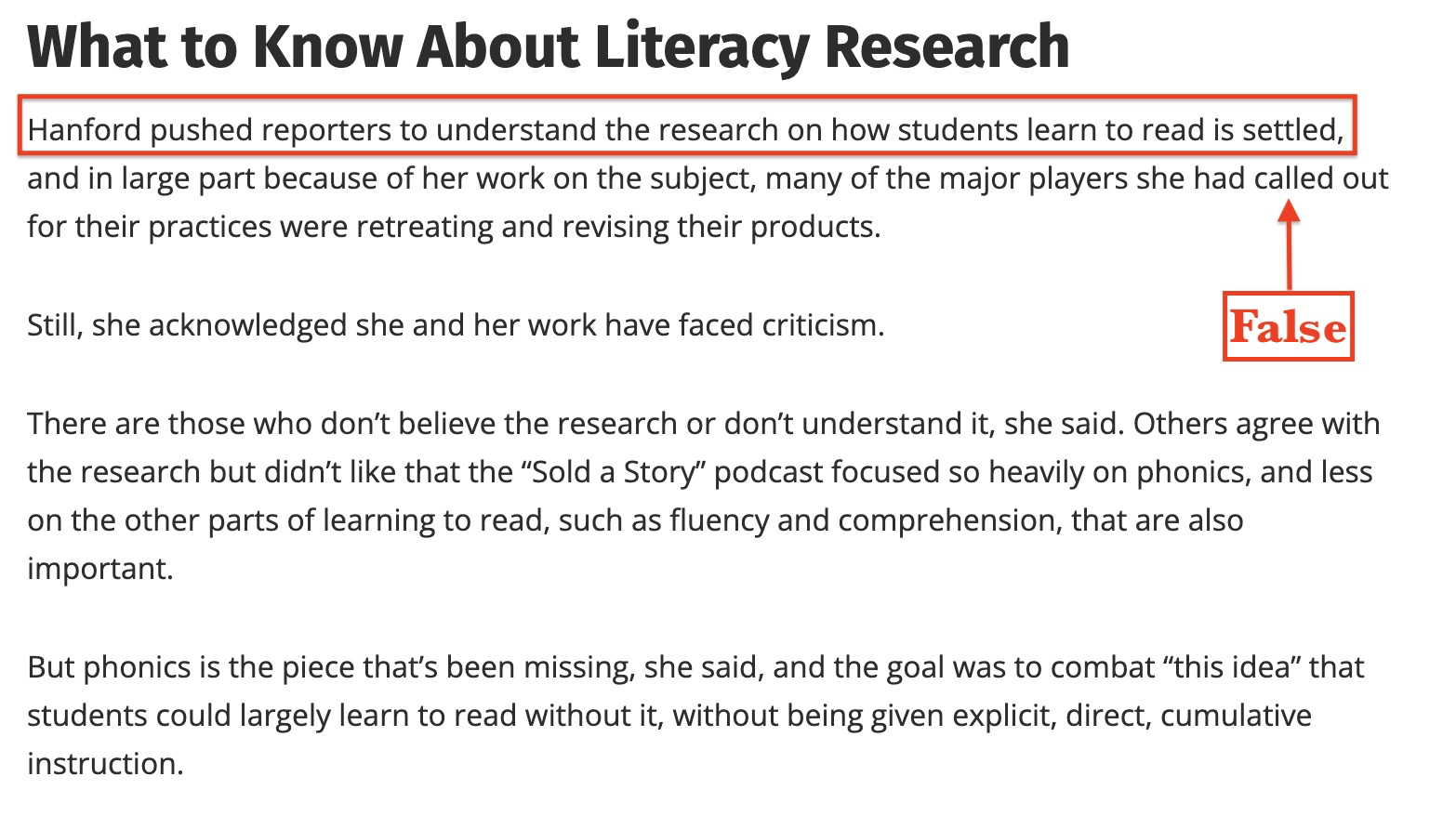
And, for example, nothing better exemplify what the true commitment in education journalism is better than the Education Writers Association and the current darling of education misinformation, Emily Hanford:
Manufacture a crisis with a melodramatic story, and then steel the troops for the inevitable outcome so that everyone can circle back to yet another crisis and more reform.
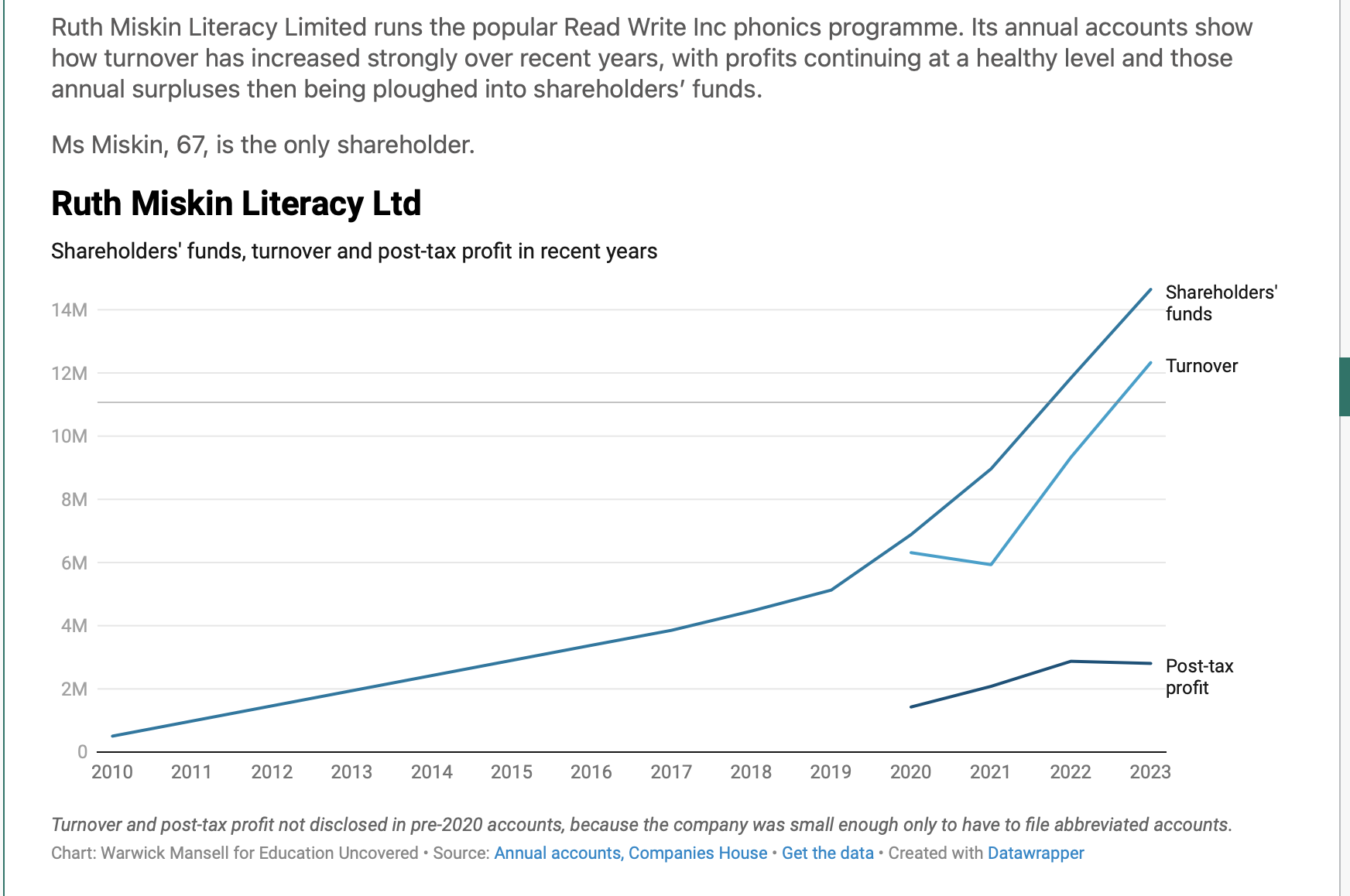
There is the sound of profit in the background as journalists as “watchdogs” announce more and more failure and crisis among school, teachers, and students.
The real literacy crisis is that too many people cannot read the writing on the wall. Or more likely, too many people are blinded by the profit of education reform as industry to even see the writing on the wall.
Thought Experiment 1
If you wonder if or how money matters, consider that the Department of Education Reform at the University of Arkansas is funded by Walton money. The Walton’s are significant school choice and charter school proponents. The “research” coming out of the DER is overwhelming positive about school choice and charter schools.
Coincidence?
Thought Experiment 2
England passed reading reform mandating systematic phonics for all students in 2006 (although their media and political leaders persist in crying “reading crisis”).
Before the close reading below, let me offer several examples for context concerning how media have weaponized “science” resulting in misguided and even harmful reading legislation.
First, here is an example of a journalist posting an article by a journalist praising a journalist. What is missing? Actual research, evidence, or science.
Gottlieb’s article, oddly, repeats three times at the end that he is a journalist, but in the piece, he seems most concerned about advocating for Hanford:
As brilliantly illuminated by education journalist Emily Hanford’s articles over the past several years, and her 2023 “Sold a Story” podcast, the education establishment in this country — which includes textbook and curriculum publishers, schools of education and school districts — has been guilty of educational malpractice for decades, using now-discredited Whole Language methods for teaching reading.
Gottlieb refers to a report and data, but offers no links to any science or research to support any of his claims, again primarily supported by Hanford’s “brilliant” podcast.
Note that the subhead, written by editors, not the journalist (“The state’s reliance on cognitive science explains why”) is directly contradicted by Hanford, although the article itself implies the opposite of what she acknowledges:
What’s up in Mississippi? There’s no way to know for sure what causes increases in test scores, but Mississippi has been doing something notable: making sure all of its teachers understand the science of reading.
When Hanford makes huge claims about teachers being unprepared to teach reading (“But a lot of teachers don’t know this science“), the link provided circles back to her own journalism, not research, not science.
The consequences of this media cycle of using “science” to give stories credibility while omitting the actual science is reading policy grounded in misinformation, but also given the veneer of “science”:
Legislation that would require Michigan schools to use a reading curriculum and interventions for students with dyslexia that are backed by science has taken a different shape to satisfy school administrators who questioned the timeline in the bills.
I focus in this essay on the way that policymakers in education may promote policy through the use of words and terms used by academics and by the public about education topics – words and terms such as “evidence”, “what works”, “evidence-based policy” and “gold standard”. In particular, I examine ways in which vernacular and specialist meanings of “evidence” and “evidence-based” may become hybridised; ways in which technical terms may be appropriated by politicians and their advisers for public consumption, and, in the process, become degraded and corrupted in the service of their own policy agendas.
One issue with the use of “evidence” (and synonyms) is that policymakers are apt to resort to “’cherry-picking, obfuscation or manipulation.’”
Terms such as “evidence” (and “science”) are designed to create “the ‘almost magical power’ that certain words acquire to ‘… make people see and believe.'”
Thomas’s analysis found:
In not one of the 100 uses was “evidence” used prefatory to an actual itemisation of data in support of a proposition, and in all cases in the non-specific category, “evidence” was used with verbs – e.g. “there is evidence”, “England possesses evidence” – which simultaneously conferred authority via the supposed status of “evidence” at the same time as acting as a proxy for detailed enumeration of specific data. The authority of the non-specific “evidence” was amplified with many qualifications of the word, which, without detail of the data for which “evidence” was a proxy, appeared merely to add rhetorical weight rather than empirical support. These qualifiers included words/terms such as incriminating, overwhelming, strong, weak, little, hard, fresh, preliminary, sufficient, inadmissible, no, verifiable, hearsay, prima facie, disturbing, concrete.
As Thomas walks the reader through a few examples, he highlights: “’Evidence’ is here prefaced with ‘scientific’, seemingly to elevate its status in the absence of specificity – a strategy frequently employed in general discourse, as the analysis of the corpora revealed.”
“Evidence” (like “science” and “research”) is commonly used in place of citing actual evidence throughout media and political discourse. [As my examples above show, US media often link to other media when terms such as “science” and “research” are used.]
“Evidence” is weaponized, then, as Thomas explains:
All the examples given here reveal the fashioning of semiotics, the creation of meaning, and the dissemination of messages to non-specialist audiences in an outlet that, while widely read, offers no obvious route for scholarly interrogation or critique – at least, within a timeframe that might allow meaningful challenge. The putative “evidenced reality” proves on examination not to exist and the attempt is – in the world of retail politics – to craft an illusion of “evidence” in support of particular political agendas, employing devices such as the “negative other-representation” to attempt to augment the writer’s position.
And thus:
“Evidence”, in the pieces examined here, is used often with only a superficial allusion to any kind of research, and the research “evidence”, where any is cited, is often highly selectively sampled, with unconcealed deprecation of alternative interpretations.
Thomas then addresses the need for scholars to correct the misleading stories of media and political leaders instead of jumping on the bandwagon of reform for financial gain or prestige:
Academics must take a share of responsibility in the way that this process proceeds unimpeded. Such is the pressure inside universities for staff to be winning research grants and earning research income that there is inevitably willing involvement in con- tract research involving the kind of steering groups I have just mentioned.
Yet, Thomas ends by acknowledging that the weaponizing of “evidence” (and “science” along with other synonyms) immediately frames anyone challenging the stories negatively [1]:
In realising this, astute politicians can kill two birds with one stone. The knack is to enlist conspicuously with “science”, ostensibly adhering firmly to principles of reason and empiricism, while simultaneously projecting silliness, unreason and disengagement from research findings onto one’s interlocutor – as did Gibb in the phrase cited in illustrative case study 2: “The evidence is clear – however much it may shock the pre-conceived expectations of some education experts”, or as did Cummings in declaring that the “education world” handles scientific developments “badly”. Utter the phrase “the evidence is clear” and one straightaway affiliates oneself with reason, wisdom and unequivocal allegiance to empirical inquiry. One’s interlocutors, by contrast, are immediately forced onto the back foot, compelled to defend themselves against charges of not engaging with evidence – of subjectivity, sloppiness, credulity and narrow-mindedness borne of ideology.
Therefore, as Thomas concludes about “evidence,” here in the US we too must accept about “science” in media rhetoric and political policy”
On the basis of the analysis here, “evidence-based” is next to meaningless, given that the evidence in question is habitually unspecified and given that any evidence that is actually specified is carefully selected and/or offered as if it were superior to other evidence which suggests conclusions at variance to those being proffered. Protean and manoeuvrable, terms such as “evidence-based” are powerful rhetorically. They drop easily into conversation, speeches and documents to add weight to an assertion. Filling any gap, taking any shape, as instruments of retail politics they serve politicians’ purpose perfectly, but in any discourse with pretensions to scholarly independence and disinterestedness, their mutability ought to be troubling. Our responsibility as an academy is surely consistently to question these terms, to call for specification of evidence, to be ready to provide alternative evidence, to engage energetically with a broad range of media and social media (i.e. not just peer review and academic publications) and to question the validity of concepts such as “impact”.
[1] Compare this framing with how the Education Writers Association and Hanford frame the role of journalists and the expectation that implementing the “science of reading” may fail:
“The 2022 NAEP results show that the average reading score for fourth graders is lower than it has been in over 20 years. For eighth and twelfth graders, average scores are at about a 30-year low,” states Senator Bill Cassidy (R-LA) in his new literacy report, adding, “The 2022 NAEP LongTerm Trend assessment for nine-year-old students showed average reading scores not seen since 1999.”
Cassidy’s alert about a reading crisis fits into dozens and dozens of media articles announcing crises and failures among students, teachers, and public schools all across the US. Typical of that journalism was Nicholas Kristof in the New York Times about a year ago:
One of the most bearish statistics for the future of the United States is this: Two-thirds of fourth graders in the United States are not proficient in reading.
Reading may be the most important skill we can give children. It’s the pilot light of that fire.
Yet we fail to ignite that pilot light, so today some one in five adults in the United States struggles with basic literacy, and after more than 25 years of campaigns and fads, American children are still struggling to read. Eighth graders today are actually a hair worse at reading than their counterparts were in 1998.
One explanation gaining ground is that, with the best of intentions, we grown-ups have bungled the task of teaching kids to read. There is growing evidence from neuroscience and careful experiments that the United States has adopted reading strategies that just don’t work very well and that we haven’t relied enough on a simple starting point — helping kids learn to sound out words with phonics.
As I have noted, education and reading crises have simply been a fact of US narratives since A Nation at Risk. But as I have also been detailing, these claims are misleading and manufactured.
Based on NAEP data—similar to Cassidy’s report—Shakeel and Peterson offer a much different view of student achievement in the US, notably about reading achievement:
This analysis demonstrates that the current reading crisis is manufactured, exclusively rhetorical and ideological, generating profit for media, politicians, and commercial publishers.
In short, the manufactured crises are distractions from the other contrarian truth about education as highlighted in the analysis from NPE:
This educational grading from NPE is unique because it doesn’t grade students, teachers, or public school, but holds political leadership accountable for supporting universal public education and democracy. The standards for these grades include the following:
Privatization Laws: the guardrails and limits on charter and voucher programs to ensure that taxpayers and students are protected from discrimination, corruption, and fraud.
Homeschooling Laws: laws to ensure that instruction is provided safely and responsibly.
Financial Support for Public Schools: sufficient and equitable funding of public schools.
Freedom to Teach and Learn: whether state laws allow all students to feel safe and thrive at school and receive honest instruction free of political intrusion.
These two examples come from contrasting ideologies, yet they offer contrarian truths about public schools and student achievement that would better serve how we talk about schools and student achievement as well as how we seek ways in which to reform those schools in order to better serve those students and our democracy.
Thomas, P.L. (2022). The Science of Reading movement: The never-ending debate and the need for a different approach to reading instruction. Boulder, CO: National Education Policy Center. http://nepc.colorado.edu/publication/science-of-reading
Accordingly, when policymakers explore new guidelines, they would be wise to do the following:
• Be wary of overstatements and oversimplifications within media and public advocacy, acknowledging concerns raised but remaining skeptical of simplistic claims about causes and solutions.
• Attend to known influences on measurable student reading achievement, including the socioeconomics of communities, schools, and homes; teacher expertise and autonomy; and teaching and learning conditions.
• Recognize student-centered as an important research-supported guiding principle but also acknowledge the reality that translating such research-based principles into classroom practice is always challenging.
• Shift new reading policies away from prescription and mandates (“one-size-fits-all” approaches) and toward support for individual student needs and ongoing teacher-informed reform.
In rethinking past efforts and undertaking new reforms, policymakers should additionally move beyond the ineffective cycles demonstrated during earlier debates and reforms, avoid ing specific mandates and instead providing teachers the flexibility and support necessary to adapt their teaching strategies to specific students’ needs. Therefore, state policymakers should do the following:
• End narrowly prescriptive non-research-based policies and programs such as:
o Grade retention based on reading performance. o High-stakes reading testing at Grade 3. o Mandates and bans that require or prohibit specific instructional practices, such as systematic phonics and the three-cueing approach. o A “one-size-fits-all” approach to dyslexia and struggling readers.
• Form state reading panels, consisting of classroom teachers, researchers, and other literacy experts. Panels would support teachers by serving in an advisory role for teacher education, teacher professional development, and classroom practice. They would develop and maintain resources in best practice and up-to-date reading and literacy research.
On a more local level, school- and district-level policymakers should do the following:
• Develop teacher-informed reading programs based on the population of students served and the expertise of faculty serving those students, avoiding lockstep implementation of commercial reading programs and ensuring that instructional materials support—rather than dictate—teacher practice.
• Provide students struggling to read and other at-risk students with certified, experienced teachers and low student-teacher ratios to support individualized and differentiated instruction.
Entering the sixth year of detailing how the “science of reading” (SOR) movement uses “science” as a cover for claims that are primarily rhetorical and ideological, I once again must highlight that this misinformation campaign continues to be “holy text” in mainstream media.
What remains stunning about the relentless misleading and factually wrong series of articles in mainstream media is the sheer absence of understanding about the topic of reading by those promoting SOR with missionary zeal.
SOR advocates lack scientific evidence for their claims and seem mostly driven by market/commercial or political/ideological agendas.
Durig’s misinformation is not only the exact same series of false claims you can find weekly since about 2018, but also a disturbingly careless recycling of Emily Hanford’s copycat misinformation articles initiated by “Hard Words” and then recycled into the melodramatic and misleading Sold a Story podcast.
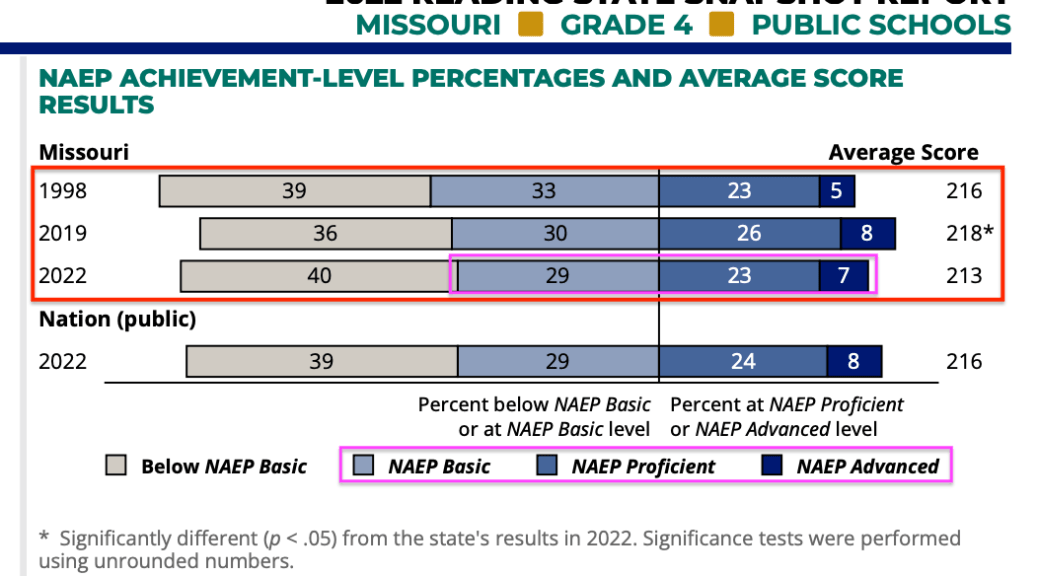
If you follow that link, you find a reference to MO’s NAEP grade 4 reading scores:
Using the exact same misinformation tactic as Hanford in 2018 and Nicholas Kristof in the NYT, Durig either doesn’t understand NAEP achievement levels or is being purposefully misleading; in either case, readers would be better served by not reading further since her argument is built on a lie.
NAEP “basic” is approximately grade level reading, and thus, 60% of MO students are reading at grade level or above, not 30%. [1]
One must ask, if you have to lie to make your case, do you have a case?
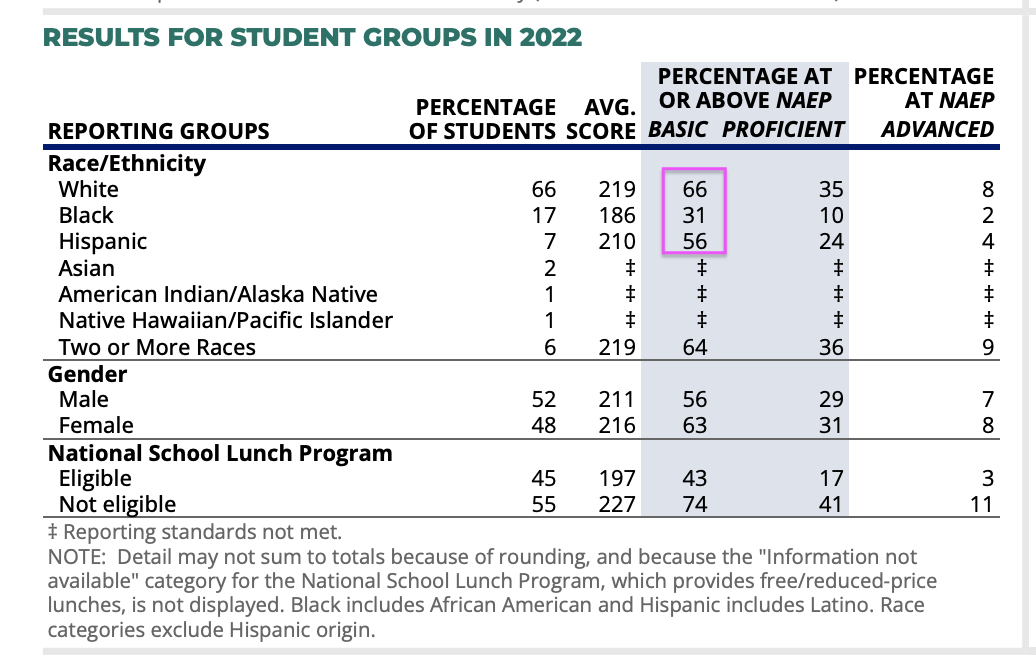
The follow-up claims—”The numbers are even more alarming for Black and Hispanic students in the state. They drop to 17% and 7%, respectively”—do not seem corroborated by the NAEP link, showing 31% of Black students at grade level or above and 56% of Hispanic students at grade level or above:
In the US, achievement inequity along racial lines is a historical failure of all achievement, not just reading. But again, if this is a serious issue, misinformation isn’t needed.
But it gets worse, if that is possible, because, Durig claims, “We are in the midst of a reading revolution. The way kids are taught to read in Missouri — and across the country — needs to be overhauled. And any rebuild should be based on the science of reading, including phonics.”
What is most disturbing is the lack of “science” in what follows, notably these well-worn but false series of claims and the links to anything except “science”:
Unfortunately, a lot of early reading teachers in the United States still practice what’s known as balanced literacy. That approach relies heavily on teacher choice and professional judgment. Teachers are taught to have many tools in their toolbox, and to use the methods that they think are most appropriate for their students.
One common practice in balanced literacy is guided reading, in which teachers coach students in a variety of comprehension strategies as they read a book matched to their level. Teachers encourage students who struggle over individual words to use pictures and context, in addition to looking at the letters, to guess at what the word could be.
But should kids be guessing at words when learning to read? There’s a ton of research that says no.
Note that these claims include two hyperlinks—the first to NCTQ (which links to a blog post to prove the 90% claim), and the second to Education Week, more misinformation journalism, not science.
As many have demonstrated by conducting external peer-review, NCTQ is an ideologically conservative think tank founded by The Thomas B. Fordham Institute. NCTQ releases non-scientific reports that are not peer-reviewed. In other words, no NCTQ report meets even the minimum standards of “science,” and in fact, the reports have been shown to use shoddy methods to draw predetermined conclusions about teacher education. [2]
Durig also depends on the Balanced Literacy Big Lie, reducing BL to a caricature of guessing using pictures instead of decoding. Notably as well, Durig offers no links for the “ton of research” claim (because there is none).
The accurate claim about BL is that we have no scientific research to support claims of a reading crisis, no scientific research proving BL has failed, and no data proving any universal application of BL or reading programs. The media and political attacks on BL and reading programs are entirely rhetorical and ideological.
With this careless and misleading article, we find ourselves trapped in the sixth year of the Hanford SOR lie, and it seems too few people are willing to tell the real story of reading, the one that students deserve instead of using “science” to promote the same baseless reading war we have been waging since at least the 1940s.
Fuller, E. J. (2014). Shaky methods, shaky motives: A critique of the National Council of Teacher Quality’s review of teacher preparation programs. Journal of Teacher Education, 65(1), 63-77. https://journals.sagepub.com/doi/10.1177/0022487113503872
Cochran-Smith, M., Stern, R., Sánchez, J.G., Miller, A., Keefe, E.S., Fernández, M.B., Chang, W., Carney, M.C., Burton, S., & Baker, M. (2016). Holding teacher preparation accountable: A review of claims and evidence. Boulder, CO: National Education Policy Center. http://nepc.colorado.edu/publication/teacher-prep










 dr. p.l. (paul) thomas