Category Archives: memoir

Oat Milk: The Further Adventures of a Redneck Academic

A thread I posted on the Social Media Site Formerly Known as Twitter seems to have resonated so I am posting here along with a bit more redneck content after the thread.

If this resonates with you, bless you (and I mean that sincerely, not the Southern “Well, bless your heart,” which means something entirely different).


More Redneck Content

My Redneck Past: A Brief Memoir of Two’s

Rednecks, Hillbillies, and Crackers

What We Don’t Talk about When We Talk about Teacher Education

How can anybody know
How they got to be this way?

Daughters of the Soho Riots, The National

I graduated high school 8th out of 150 students and took with me a great deal of affection and respect for two life-changing teachers—Harold Scipio (chemistry/physics) and Lynn Harrill (English).

My academic success was bolstered by making mostly As in math and science courses, but I puttered along with Bs in English (resisting the drudgery of vocabulary tests and assigned novels). Therefore, I left high school intending to major in physics.

School had taught me I was good with numbers, and I learned that the field of English was grammar book exercises and diagramming sentences (junior high school) or vocabulary tests and assigned novels I had no interest in reading (high school).

Those experiences with English in school were in stark contrast to my ignored and marginalized literary life at home—collecting and reading comic books as well as reading voraciously science fiction and thriller novels.

In fact, that closeted life of reading was teaching me that genre literature was wonderful while English courses and teachers indirectly and directly told me genre writing was trash, that I should read real literature.

I entered a junior college less than thirty minutes from my home with those perceptions of school and myself as well as a youthfully distorted view of my abilities as a golfer and a want-to-be comic book artist.

There a few interesting things happened, notably linked again to teachers for whom I developed affection and respect—Steve Brannon (speech) and Dean Carter (British literature).

Mr. Brannon re-introduced me to e.e. cummings (in a speech course of all places) and sparked my first-year realization that I am a poet and writer; it was during the spring of that first year of college that I began writing seriously.

The other pivotal moment was when Dean Carter (who regularly berated me for my shoes and clothing in front of the class) approached me, asking if I’d like to start tutoring for the course. I clarified for him that I was a math and science person, not an English person.

After Dean Carter explained to me that I was the strongest student in that British literature survey class, however, I began tutoring and soon discovered that I was good at helping other students and I also enjoyed it.

Somehow I didn’t quite get it yet, and I was still mulling options for when I transferred to a four-year university, toying with architecture and pre-law.

A friend with whom I had gone to all 12 years of public school and then junior college and I were set to transfer to the main campus of the state university, but he had a paralyzing accident that summer. I panicked and chose to attend the satellite state university near my home instead of venturing to the main campus.

Having spent over 20 years now in higher education, this next part is something we rarely talk about—how people really chose their majors and how coincidental and haphazard that life-shifting decision can be.

With my friend’s accident and my late change of universities, I was rushed through registration where I was asked (as a rising junior) my major so courses could be chosen for that fall.

At that point I had no real idea but my thinking had shifted to majoring in English (still possibly as a path to law school). Coming from a working class family where neither parent had attended a four-year college, I was hyper-practical, however.

So on the spot I decided I would major in education because that would prepare me for a job and a career. When I said “education,” the advisor nudged me by asking what kind.

Having no idea what that meant, I shrugged and then was prompted with elementary or high school. I immediately said high school only to be asked what kind of high school teacher.

It was at that moment I chose secondary English education as a major; three years later, I entered as a high school English teacher the same classroom that Lynn Harrill had taught me in.

That full circle, I eventually recognized, helped me reconsider what I believed when I left high school, notably that Mr. Scipio and Mr. Harrill had set me on course to be a teacher.

Now here is what we don’t talk about when we talk about teacher education.

Once again, over the last 2.5 years of undergraduate education, I had some really influential professors.

Dr. Tom Hawkins was my secondary English advisor and teacher, and he planted the seeds of how I would eventually think about teaching and learning, specifically about grading (and he introduced me to triathlons, which set me on course to be a life-long serious cyclist).

But I was also an eager English student, taking extra English courses beyond what was required by my education certification; English professors Dr. Richard Predmore and Dr. Nancy Moore profoundly shaped me as a writer and as a potential scholar.

My student teaching was divided between two schools and two teachers, one middle school and one high school.

Here is the really complicated part.

I was greatly motivated to become a teacher so that I could create English classes unlike what most English classes were (no grammar book exercises and tests, no diagramming sentences, no vocabulary tests). And student teaching mostly proved to me all the ways in which I did not want to teach.

Once I was firmly in schooling from the teacher side, I also realized that virtually all the literature I had studied in college would never be works I could teach. In fact, I had to scramble to be prepared to teach the texts assigned and in textbooks during student teaching.

My teaching career began the fall of 1984, right at the beginning of the current 40-year accountability era sparked by the manufactured crisis of Reagan’s A Nation at Risk.

I was handed over a dozen textbooks (grammar, literature, and vocabulary texts) and the journalism course (school newspaper and literary magazine).

Now this is what people really do not want to talk about: I was almost entirely unprepared to teach that fall.

I had no background in journalism (I was a writer, sure, but I had been on the annual staff in high school and dabbled in college newspapers very slightly), and, as I noted above, I was not familiar with almost all of the required literature across four different English courses (mostly British literature) in the textbooks and the required novels/plays.

Most significantly, although my central goal for being an English teacher was to teach my students to write, I soon realized I had almost no composition pedagogy—other than I was myself an accomplished writer in school and college as well as a practicing professional writer (submitting a great deal of writing for publication without success).

Much of that first decade of teaching was spent teaching myself to teach; that journey was supported by also working through my MEd during those years.

But one of the most significant moments was entering the Spartanburg Writing Project (SWP) housed where I had received my undergraduate degree.

I had been teaching (frantically) for several years when I took the SWP summer institute, and it is there, once again, that a teacher changed my life.

The director, Brenda Davenport, essentially took me aside and set me straight, metaphorically kicked my butt.

I had been teaching myself to teach writing with a missionary zeal that had driven me down the wrong road; certainty and arrogance were quickly replaced with humility and patience.

Brenda helped me learn the one thing that we almost never talk about when talking about teacher education and teaching: teaching is learning to teach, and there is no finish line.

I spent much of my first decade of teaching trying to perfect The Way to teach. But each different Way I designed fell just as flat as the Way before.

After SWP, I embraced a true Deweyan approach, recognizing that each new class is a new experiment, informed by all the experiments before but its own different set of humans and requiring different ways of teaching and learning.

You see, there is no One Right Way to prepare people to teach (just as there is no One Right Way to teach reading, for example) because nothing can prepare a person to start teaching.

This fall I start year 40 as a teacher. It will not be like that fall in 1984 when I was first called a teacher.

But it is entirely new, and like that first fall, this is another experiment where I learn how to teach by teaching.

Sincerity, Not Sadness, and the Beautiful Music of The National

On the day The National released their newest album, First Two Pages of Frankenstein, I was in New Orleans to present at the University of New Orleans.

I imagine it is quite rare to have your favorite band release an album with your name featured on the cover.

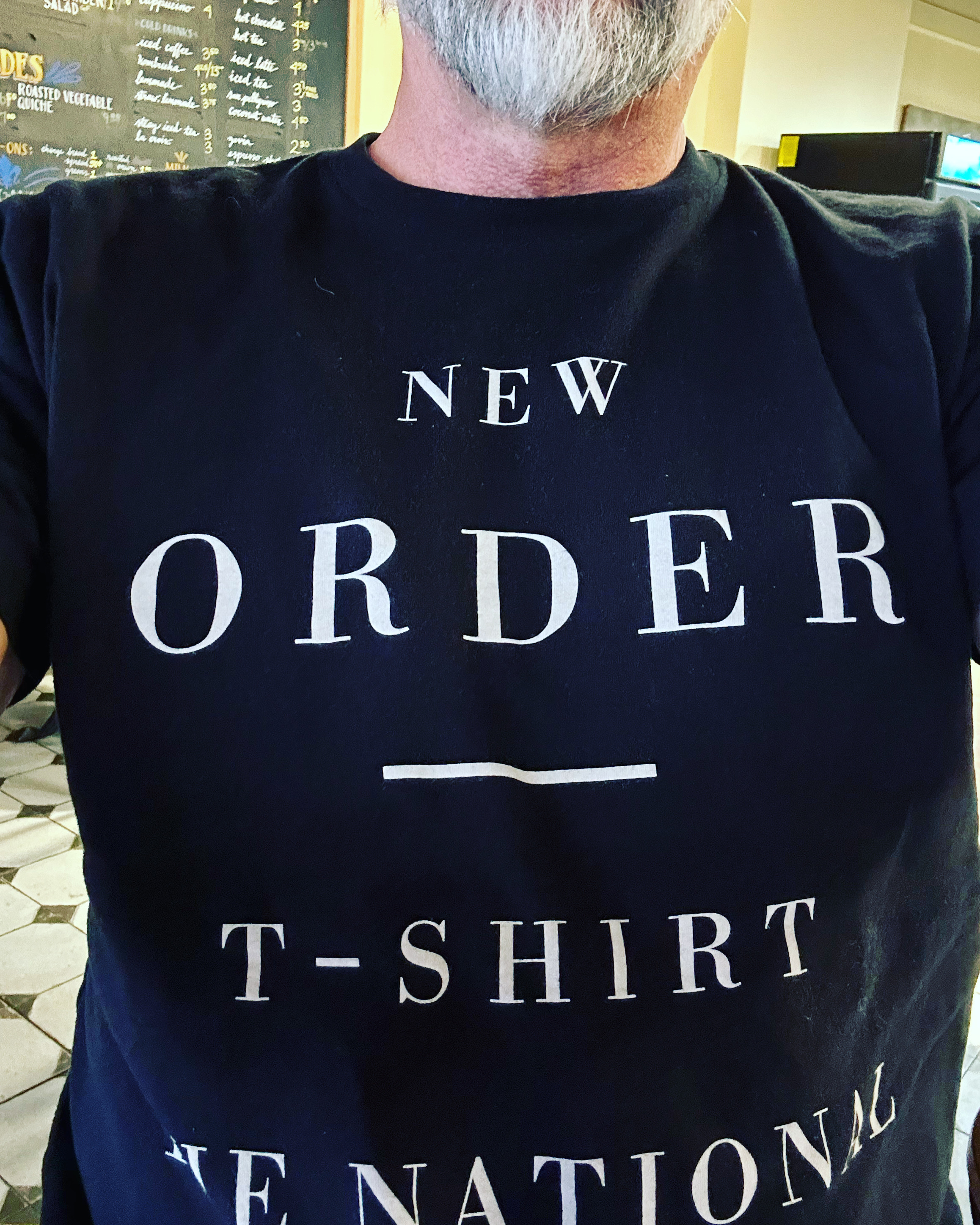
The day the album was released, I wore my New Order t-shirt released by The National along with New Order, related to one of the albums songs, “New Order T-Shirt.”

While standing in line on release day at Second Line Brewing, I turned around and the guy behind me had on the original New Order t-shirt mine was based on. He was a casual fan of The National but had seen them in concert.

A bit later, another guy in line spoke to me, surprised the band had been around since 1999 (noted on the back of the t-shirt).

I was introduced to The National sometime in the early to mid-2000s through R.E.M. I immediately fell in love with the group and was frantically catching up as anticipation built for the release of Boxer.

This has been a central body of music for me as I aged through my 40s into my 60s and has included seeing them in concert across the U.S.—Asheville, NC; Atlanta, GA; Pittsburg, PA; Red Rocks, CO.

At first, I recognized The National was a niche alternative band with a dedicated following but most people had never heard of them. The National t-shirt would attract the occasional fan, but mostly people had no idea.

My “I Am Easy to Find” t-shirt elicits laughs, but people are oblivious that it is a song/album title.

With First Two Pages of Frankenstein, however, The National has attained an oddly higher profile, in some ways because of their critical success, but mostly because the band has begun working with Taylor Swift, who is also featured on one song from the new album, “The Alcott.”

With that heightened fame, The National has also been branded “Sad Dad” music, and for me, this is somewhat funny and mostly missing the whole point of what the band does and why their work resonates.

The lyrics are primarily written by Matt Berninger, often with his wife, Carin Besser. Swift and other guest musicians contribute also with the music written by the rest of the band, often driven by the Dessner twins.

Here, recognizing that groups’ music is never singularly created, I want to focus on why Berninger’s lyrics aren’t actually “sad,” and why his lyrical development is much more important than that sort of reductive label.

First, let me acknowledge why I think many people do view The National’s music as sad.

Upon my first listen of the new album, I cried very hard during the final song, “Send for Me,” one of the best songs of the band’s career for me (a bit more on that below).

And on the second run through, “Once Upon a Poolside,” brought tears as well.

I suspect that song is more than a passing reference to their first album and the tenuous state of the band post-Covid as they struggled to produce this album.

The National does evoke deeply emotional responses; for me, crying is often about being emotionally overwhelmed, not sad.

When thinking about discussing why The National isn’t “sad” music, I immediately thought of how people misunderstand existentialism—specifically Albert Camus’s “The Myth of Sisyphus”: “The struggle itself toward the heights is enough to fill a man’s heart. One must imagine Sisyphus happy.”

Berninger’s lyrics, I think, reflect the existential reality that our passions are our suffering, and we should never wish away our suffering because that would eliminate our passions as well.

Feeling deeply is being fully human, not sad. And what resonates with me about Berninger’s lyrics is their sincerity about feeling deeply in our human experience.

I have also seen people describe The National’s lyrics as too male-centric, which I also reject because Berninger is expressing human experiences as they, of course, exist in his body and mind (even when creating is not directly autobiographical).

Another element here that I find simplistic is that many of the lyrics are acknowledging clinical depression, anxiety, and introversion; it is discounting and careless to brush that aside as “sad.”

Berninger’s fascination with Tennessee Williams and self-medicating, along with acknowledging being on medication, are the core of what makes the lyrics sincere, not sad, and is wonderfully demonstrated here:

I get a little punchy with the vodka
Just like my great uncle Valentine Jester did
When he had to deal with those people like you
Who made no goddamn common sense
I’d rather walk all the way home right now
Than to spend one more second in this place
I’m exactly like you, Valentine, just
Come outside and leave with me

“The Day I Die”

While I am not claiming some sort of traditional argument that Berninger’s lyrics are universal themes, I am arguing that his lyrics capture the frailty and tenderness of being fully human and that his growth as a lyricist includes a level of sincerity that fill a person’s heart.

So why did I cry upon first hearing “Send for Me”?

On one level, the sincerity for me is in the use of specific details, which lifts a song that could be cheesy or lazy to a sincere sweetness:

If you’re ever in a psychiatric greenhouse
With slip-on shoes
Wipe a smile on the shatterproof windows
I’ll know what to do
If you’re ever in a gift shop dying inside
Filling up with tears
‘Cause you thought of somebody you loved
You haven’t seen in years

“Send for Me”

Often, Berninger’s narratives are like verbal collages and speakers are prone to crying themselves.

Another powerful aspect of the lyric writing is that Berninger has increased his use of rhetorical structures to give song cohesion and structure in the way that most pop music depends on heavy rhyme; the use of “if” clauses in “Send for Me” is a craft element found all throughout the album.

As a writer, poet, and teacher of writing, I appreciate how difficult it is to make writing sound natural, even easy, while also not being cliche, lazy, or writing beneath your topic.

The National, for me, isn’t a collection of Sad Dads, but a group of sincere people who have a high level of craft in the art they produce.

That fills my heart, and I feel lucky to have the songs surrounding me like the soundtrack we all imagine for ourselves.

Trash Talk

When I checked Twitter and noticed Larry Bird trending, I immediately assumed that it was connected to the Angel Reese/ Caitlin Clark debate surrounding trash talk.

I was right, and the discussions around Bird, a legendary trash talker, echoes the same racial tension that responses to Reese and Clark are exposing.

My basketball life was grounded in the 1970s and 1980s when I played a great deal of basketball—on school and rec teams throughout junior and high school as well as almost daily pick-up games in the late 70s and early 80s—and was an avid college and NBA fan.

That basketball life included being a rabid fan of Pete Maravich and Bird, and since I was a scrawny white redneck from a working class family, there were many aspects of race and social class entrenched in my basketball life.

Despite my compulsive practicing—much of that focusing on dunking and spinning a basketball on my finger—I was mostly a bench warmer on school teams; I was routinely humiliated by my teammates who were overwhelmingly Black.

In fact, on a 13-person roster as a sophomore, I was the only white guy on the team.

But probably the most important part of my basketball life, and ultimately my life in general, was playing pick-up basketball almost exclusively with Black guys throughout high school and into college (where I also played intramural basketball).

Despite my limited skills as a basketball player, I was pretty athletic, I knew how to play ball well, I was a physical player, and I talked trash. On the court and off, I was known for my gifted use of profanity.

Concurrent with my basketball life, I listened for hours to George Carlin and Richard Pryor comedy albums. Carlin and Pryor taught me the power of language while also disrupting much of my redneck upbringing that was often narrow-minded and bigoted.

I learned from Carlin and Pryor that being smart and gifted knew no race, but I also learned that individual power and autonomy was grounded in my mind and my verbal abilities.

On the basketball court, I had a great to deal to make up for since I was often the weakest pure player on the court. So I had to play hard, and I used one skill I trusted—running my mouth.

One year that stands out to me is playing intramural basketball in my first couple years of college when I was playing pick-up basketball nearly daily with members of the college team and local elite high school players. Again, pick-up gains were overwhelmingly with Black guys and a couple of my closest white friends who, like me, were very Black-guy-adjacent in their basketball and personal lives.

Looking back on these experiences, especially in the context of the reductive and racist debates raging over Reese/ Clark and including references to Bird, I am now vividly aware of the moral codes I was taught through the Black culture elements of basketball.

One of my white friends used to say to me often, “Paul, you’re going to get your ass beat,” referring to my trash talk. Notably, these moments were always about my antagonistic interactions with other white guys.

I could have, and should have, gotten my ass beat, by the way. I was more mouth than ass, and I really never monitored when the other guy didn’t understand the moral code I had acquired.

The mostly Black-guy pick-up games were intense with a great deal of mouthing. But we usually smiled, we often slapped hands or shook hands to compliment good play, and I really never expected anyone to come to blows.

Unlike white guys, as well, Black guys called their own fouls when they committed them. If you fouled guys and let it slide, you caught extra hell so there was a not-so-subtle message to do the right thing.

White guys cried and moaned about being fouled, and trash talking often teetered in the edge of starting a fight.

I am certain I learned to respect the game from Black guys, and part of that code had to do with respecting each other even as we talked trash. White guys were often petty, what I called back then “punks,” calling touch fouls, complaining, being soft.

Talking trash was as much of the game as dribbling, passing, rebounding, and shooting. But talking trash was also a sign of respect and a level of expectations.

If you talk trash, you are going to pay for it at some point.

Bird often used trash talking to gain an advantage, but Bird lost games and match ups many times over his career. I am sure many people let him know that.

Bird was very open about his respect for Black athletes, and even said aloud he took it as a sign of disrespect when coaches had a white player guard him.

There is a very complex and even uncomfortable set of lessons in the racial dynamics of the basketball world of the 1970s and 1980s, often represented by Bird and Magic Johnson but also involving Michael Jordan and the Detroit Pistons.

Basketball was much more physical and even violent then, but basketball in many ways (along with professional sports) represented a way for Black men to gain status in US society in ways mostly denied them.

We want to think sports is a meritocracy, and maybe it is more so than in other contexts, but the basketball world I grew up in pushed racial tensions, racism and stereotypes, and cultural norms into a stronger spotlight for me.

In 2023, I shake my head, I sigh, and I regret that white people remain trapped in the sort of pettiness I witnessed growing up—thin skinned and absent a moral code that respects all humanity.

The Reese/ Clark controversy is much bigger than these athletes, and it exposes how public discourse remains white-centered, shaping a much different narrative of Reese than Clark.

An unfairly different narrative grounded in race and racism but also extending a faux respectability politics onto Reese but excused in Clark.

There was an important camaraderie  in the trash talking of my teen and young adult years that I cherish and miss (my basketball life was quite different than my all-white golf life that had a false decorum I never felt comfortable in). Dozens and dozens of Black guys made me a better athlete and person.

Clark like Bird likely understands that trash talk has its rewards but you will pay for it.

Millions of moments like the Reese/ Clark clash happened and do happen on basketball courts around the world, daily. But theirs was on one of the brightest stages and televised.

While too many people want to make claims about the character of Reese or Clark, the truth is that the debate itself is a window into the character of everyone choosing to debate their trash talking.

Too many people, mostly white, never learned the moral codes I did, never learned the lessons of race that were gifted me in the 1970s on vinyl records and on sweaty basketball courts.

If you are inclined to chastise Reese and praise Clark, you need to take a long moment in the mirror and consider holding yourself accountable before worrying about two young women playing college basketball at the highest level.

Granny’s Ironing Service

A former student of mine from my 18 years as a high school English teacher in my home town, Woodruff, SC, lived in the house across the street from my home, where my parents lived from 1971 until they died in 2017.

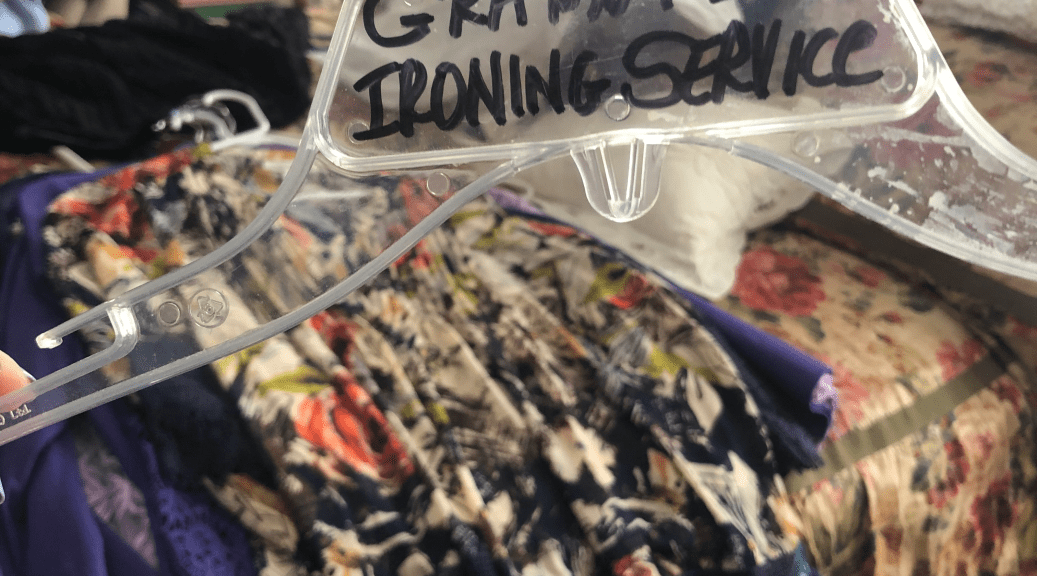
The former student was visiting her mother and helping clean out closets. She texted me that she had found this in her mother’s closet:

Those houses sat on the golf course just north of my hometown, and I had spent my childhood in an even smaller town, Enoree, just south of Woodruff. Both very small town were mill towns, although most of the mills in the area are now abandoned or converted into apartments (I live in one of those mill-to-apartment complexes now in the larger city of Spartanburg only about 20 minutes north of my golf course home).

I immediately felt myself about to cry when she sent the picture of the hanger, an artifact of my mom’s small washing and ironing service.

I have romanticized my childhood, lived and doted upon with my mother often an at-home mom until she started working as an office assistant at the elementary school I attended for third grade (my sister was there in the second grade also).

My mother’s earliest work, that I recall, was as a cashier in the Winn-Dixie grocery store just across the street from where my dad was born in the kitchen of the house where his grandmother lived after his parents moved into the house just down the slope behind there.

The job at the elementary school was more about my parents’ racism than about needing to make money; this school was in the Black neighborhood, Pine Ridge, that sat across the railroad tracks.

She took the job to watch over us, continuing to closely mother us through life. Mom wasn’t a helicopter parent; she was a tether parent, always keeping us in her eyesight.

By the time I was a preteen and we had moved to the golf course, Three Pines, my mother became the bookkeeper for the country club. I also started working at the golf course—as an club house helper, as a life guard at the pool, and as an assistant pro throughout my teens into my early 20s.

My parents were never empty-nesters since they helped raised three of my nephews over all the years after I moved out until they passed away. At their deaths just 4 months apart, my youngest nephew was still living most of the time with my parents.

Over the course of about three decades, then, my mother shifted to what seems almost normal now, working from home.

She ran an elaborate yard sale, for a while at my great uncles defunct store between Woodruff and Enoree, but then in the front yard of their home.

That cobbled together job resulted in an emotionally and physically taxing experience after they died; my nephews and I had to clean out their house, incredibly cluttered from years of my other buying out yard sales and storing other people’s junk to sell herself.

But she had other at-home jobs too.

For a long time, my mother ran a daycare in her house; dozens of people recall her fondly since they spent years of their childhood in her care. This job was the essence of my mother, a natural mother of sorts beginning with her helping raise her brother and sisters as the oldest sibling.

My mother as daycare provider is bittersweet because her inclination to mother was also an inclination to self-sacrifice, martyrdom.

And then there was the washing and ironing service, what proved to be her last job as my father’s health quickly deteriorated and then she suffered a stroke just two weeks before my father passed away at her side in a care facility.

When my former student sent me the picture of the hanger, I recognized the handwriting, but I also immediately sent it to my oldest nephew.

He recognized the hanger much as I did, sharing associations that both warm and break our hearts. Then he texted that he still irons his clothes with an iron my mother gave him.

So I cried twice.

My parents shuffled off this mortal coil with hearts kept beating by medical wizardry—pace makers, defibrillators.

And they leave us who were often in their care with heavy hearts, hearts often so full that tears run down our faces.

Of all the things and people my mother rushed to care for, the one person she always ignored was herself.

That left her some parts doting and loving but other parts disillusioned and bitter.

A clothes hanger, some handwriting—we are left with everyday artifacts that rekindle the memories we must navigate with our heavy hearts.


Poems

the philosophy of gerunds (my mother is dying)

my mother has returned to where she began

wisteria (like a photograph)

Lemmings

My nephew realized during our texting the other day that he had failed to tell me about a sudden memory.

While eating gummy bears, he wasn’t paying attention as he popped one after the other into his mouth until he really liked one. He stopped chewing and checked the half-eaten gummy, a clear one.

That triggered the memory of my mother (his grandmother who mostly raised him) telling him that those were my favorite gummies.

We then texted a while about how and why we have such vivid memories as humans as well as how we know things.

In short, our memories and bodies of knowledge are swirling with many elements of our experiences. I mentioned to my nephew that I usually ask classes of students if they recall the first time visiting a friend’s house and thinking it smelled weird (or even bad).

Virtually everyone immediately perks up because this experience is so vivid in our memories.

My goal in that brief exercise is to help students confront how we associate “different” with “bad,” and as critical educators, we must move past that judgmental state.

But this texting was also a trigger for me.

Photo by Philip Myrtorp on Unsplash

I am resistant to and very rarely fly—not because I am afraid of flying (yes, I am rational enough to know flying is far safer than driving), but because almost all of the experiences around flying trigger my anxiety.

Flying is a series of first experiences (a nightmare for me), racing to meet schedules beyond your control (including sudden gate changes and flight delays, etc.), and worst of all, a toxic soup of cramped spaces and loud noises.

Last week, I attended and presented at two conferences requiring me to fly from Upstate SC to Detroit (Troy, MI) and then to LA (Anaheim) before returning to the Greenville/Spartanburg SC area. That trip involved 6 plane flights and three hotels over just five days.

The very worst part of the trip was finally arriving at LAX from Detroit, a segment of the journey that began just after lunch EST and involved me walk-running through the Houston airport and having no food from noon EST until midnight PST.

As noted above, I struggle with my anxiety in any new situations and securing an Uber at LAX was my very first Uber experience—which nearly drained me as finding a way to secure a ride through the App wasn’t working in the airport and then took 1.5 hours to complete after reaching the pick up area outside the airport.

I found myself standing at my hotel around midnight being told that they were completely full, and despite my having a reservation, they were moving me to another hotel.

That other hotel was just on the opposite side of the convention center from the hotel where I stood, but the manager gave me the wrong directions leaving me wandering around Anaheim near Disney, again, after midnight.

Sweating, exhausted, and starving, I opened my Google App and discovered I should have turned left instead of the right I was told.

I dropped into bed, still no food, completely exhausted about 1 PM PST, where I stayed only about 4 hours before being up to (finally) eat some food, make my move to the original hotel, and make my major roundtable by 12:30.

Most of this trip felt like standing in line or being packed into seats far too small for humans and everything—every thing—costing far too much—with human choice cast to the ditch all along the way.

It’s a small world after all.

As we stood packed together for one of the flights home, I had a sudden memory like my nephew.

I thought “lemmings.”

My adolescence was spent in the 1970s. I recall vividly discovering the new music of The Police when waking up one morning in my childhood bedroom. The song was “Roxanne,” and The Police would become one of those foundational parts of my music-crush history.

In those formative years, a starting metamorphosis occurred.

Concurrent with my introduction to reading and collecting comic books along with being a closeted science fiction novel fan, I was increasingly drawn to popular music lyrics.

Pink Floyd, The Police, Eagles, Billy Joel, and others provided for me some of the first places that I recognized purposeful writing—of course this genesis of my own love for reading and writing poetry.

Standing in line, mindlessly herded, I thought “lemming,” and also that I learned the word from “Synchonicity II” on The Police’s Synchronicity. That album and song title also led me to explore the word “synchronicity.”

My earliest memory of learning words from popular music is “Bohemian Rhapsody” by Queen, a song that drove me to both the dictionary and the Bible.

Toward the end of my year 61, I am also fascinated by my experience with the word “lemming” because like “coyote,” it provides a wonderful example of how idiosyncratic reading, learning to read, and knowledge are for us humans.

The Police were using “lemming” to evoke the song’s message about the dehumanizing aspects of modern life:

Another working day has ended
Only the rush hour hell to face
Packed like lemmings
Into shiny metal boxes
Contestants in a suicidal race.

“Synchonicity II,” The Police


When I heard this song 40 years ago, I had no real access or inclination to check the association being made with lemmings, what turns out to be a fabricated story of animals who are suicidal:

So why is the myth of mass lemming suicide so widely believed? For one, it provides an irresistible metaphor for human behavior. Someone who blindly follows a crowd—maybe even toward catastrophe—is called a lemming. Over the past century, the myth has been invoked to express modern anxieties about how individuality could be submerged and destroyed by mass phenomena, such as political movements or consumer culture.

But the biggest reason the myth endures? Deliberate fraud. For the 1958 Disney nature film White Wilderness, filmmakers eager for dramatic footage staged a lemming death plunge, pushing dozens of lemmings off a cliff while cameras were rolling. The images—shocking at the time for what they seemed to show about the cruelty of nature and shocking now for what they actually show about the cruelty of humans—convinced several generations of moviegoers that these little rodents do, in fact, possess a bizarre instinct to destroy themselves.

Do Lemmings Really Commit Mass Suicide?

So here is the complicated reality about “lemmings” and how I came to know the word.

First, I hear Sting’s British pronunciation any time I think of the word. My Southern version is quite different, but I know the word in a layer of subtle ways to say the word aloud.

Next, I now know not only the flawed but enduring meaning of “lemming” (the metaphor for mindless human obedience that is self-defeating), but also the fascinating and disturbing back story to how an Urban Legend and cultural myth come to be.

To read with comprehension, we humans certainly need a complex toolbox of decoding, word recognition, and knowledge; however, how that toolbox is formed remains mostly idiosyncratic and very difficult to prescribe.

I imagine many of my teachers were given credit by proximity for my developing (and often) advanced literacy throughout my junior high and high school years.

Yet, my word recognition and knowledge base were overwhelmingly fostered out of school—reading comics and science fiction, listening for hours while staring at liner notes in pop music.

Also in my seventh decade on this planet, I watch my grandchildren blossom with literacy that is grounded in video games, YouTube, and cartoons. Their knowledge base, like mine, comes disproportionately from their hobbies, the things they love.

Our literacy, if allowed, is inextricable from our passions.

This is Freire’s writing and reading the world, using our language to make sense of the world we are given and to create the world we want and need.

Here is the great and sad irony: Formal schooling and the teaching of reading are all too often the perfect context for evoking the enduring by inaccurate association we all have with lemmings.

We have a faction of people who persist in “all students must” approaches to very small children coming to know the world and the enchanting beauty of language.

Like the commuters packed like lemmings/sardines in their cars, like all the travelers with me marched through boarding and then packed into those planes, children pre-K through grade 12 are marched through schooling and taught that reading is not in fact beautiful but a way to create the sort of workers The Police recognized: “He doesn’t think to wonder why.”

We are marching together to the end of 2022, a year when literacy and literature are under assault, and thus, our children and our freedom are under assault.

We will goose step into 2023 with “lemmings” being the perfect mascot for who were are, thoughtlessly on a suicide march that was manufactured in a Disney studio.


Provincialism, Ways of Being, and the Failure of Democracy

I had dinner and a few beers with a former student recently. Although he is about two decades younger than me, we share a hometown and grew up in the same neighborhood. And after I had moved out during young adulthood, as a child, he often spent time at my parents’ house, just playing and hanging out.

He’s worked all over the world and has been living in Europe for more than 15 years. Our conversation drifted to our hometown and his perception of living in Europe instead of near where he grew up. Eventually, he asked how some people “get out” of small hometowns, escape the trap of narrow-mindedness—what I referred to as provincialism.

We share a strong discomfort with conservative and fundamentalist thinking even though we were raised in that environment, which continues to this days in our hometown. His question reminded me of one of my favorite lyrics from The National: “How can anybody know/ How they got to be this way?”

Especially as a teacher, I have found teaching siblings complicates any solid answer to his question since two people raised in the same home and town can turn out to be very different people. We catalogued several people also from our community who, like us, no longer conform to the mold of our upbringing, trying to understand why some people change and others remain frozen in the provincialism of their upbringing.

My former student is very clear that the key for him was being an exchange student in Europe during his junior year of high school; his worldview changed once he had lived a different view of the world. I credit my education, especially literature, but it is the same dynamic—being exposed to different views of the world.


“The English class does not differ from other classes in responsibility for social situations which militate against prejudice and intolerance,” begins “The Words of My Mouth” in a June issue of English Journal. “Classifications which result in racial or cultural segregation, encouragement of small cliques, avoidance of crucial issues—all of these may be evils in the English classes as others.”

That opening builds to this key question: “Do the very words we use and our attitudes toward them affect our tendency to accept or reject other human beings?”

This essay is by Lou LaBrant and was published in 1946. LaBrant was vividly aware of the threats to freedom in the context of WWII and Nazi Germany, but her essay resonates today because of the threats from within the US, the Republican assaults on academic freedom, books, and individual choice by weaponizing “pornography,” “grooming,” “Critical Race Theory,” and any word or phrase to impose a narrow view of the world onto all of us.

“Not one facet of human experience will serve to insure the kind of society we need so desperately, and all aspects of living affect all others,” LaBrant warns.

The role of education, she emphasizes, must include: “A basic understanding which needs to be taught in school and home is that the existence of a word does not at all prove the existence of anything.” At the core of racism, sexism, and all types of bigotry and hate, LaBrant recognized the need to challenge the power of “word magic,” the belief that uttering something makes it so, gives it power.

In 1950, LaBrant returned to this topic, focusing on students as writers:

[Students] should discover the danger in word-magic, that calling a man by a name does not necessarily make him what they say; that describing the postal system as socialist does not transfer our mail to Moscow, nor brand either the writer or postman as disciples of Stalin. We must teach our students that words are symbols which they use, and that there is stupidity in word-magic. (p. 264)

LaBrant, L. (1950, April). The individual and his writing. Elementary English27(4), 261-265. http://www.jstor.org/stable/41383735

Over the past few years, I have made long trips from South Carolina into the Midwest, specifically Ohio and Wisconsin. Each time, I find the persistence of what is stereotypically “Southern” into the region that we in the South would classify as the “North” (which is everything outside of the Deep South, including Virginia and Texas). Fundamentalist billboards condemning homosexuality and abortion as well as huge signs quoting scripture line highways all through rural America.

These 8-10 hour drives left me certain I was not making just the specific trip I was on (conference presentations) but was destined for the flaming pits of Hell. Although I am a white straight man, I strongly believe in the rights of all people regardless of racial identification, gender, sexuality, religion (or not), etc., because I very much believe I deserve the same sort of freedom to fully be the human I have come to know that I am.

I also know that for women to be fully human, body autonomy is essential and that includes abortion rights.

Like Kurt Vonnegut, I am a humanist:

My parents and grandparents were humanists, what used to be called Free Thinkers. So as a humanist I am honoring my ancestors, which the Bible says is a good thing to do. We humanists try to behave as decently, as fairly, and as honorably as we can without any expectation of rewards or punishments in an afterlife [emphasis added]. My brother and sister didn’t think there was one, my parents and grandparents didn’t think there was one. It was enough that they were alive. We humanists serve as best we can the only abstraction with which we have any real familiarity, which is our community.

A Man without a Country, Kurt Vonnegut

To me, this is a foundational commitment to the country’s claim of life, liberty, and the pursuit of happiness. How can any of us be happy if we are required to conform to a narrow mandate of ways of being determined by a few in power based on a provincial view of the world?

My gender identity and sexuality are who I am, and right for me, but that means nothing for anyone else. I want my ways of being to be honored; therefore, I believe I am obligated to honor that for everyone else.


As my former student can attest by experience, people have even more freedom in countries other than the US; Americans do not have a monopoly on individual freedom and certainly not communal support for those freedoms (universal healthcare contributes to individual freedom, for example):

[I]t seems to me that the myth, the illusion, that this is a free country, for example, is disastrous….

There is an illusion about America, a myth about America to which we are clinging which has nothing to do with the lives we lead and I don’t believe that anybody in this country who has really thought about it or really almost anybody who has been brought up against it—and almost all of us have one way or another—this collision between one’s image of oneself and what one actually is is always very painful and there are two things you can do about it, you can meet the collision head-on and try and become what you really are or you can retreat and try to remain what you thought you were, which is a fantasy, in which you will certainly perish.

“Notes for a Hypothetical Novel,” James Baldwin

The hostile environment in the US today fostered by conservatives is also eroding those freedoms day by day; people are less free in the US than 6 months ago, and we are very likely on the precipice of the erasing of even greater freedoms in the coming months.

The Republican agenda of rolling back freedoms and rights as well as increasing bans and censorship is an agenda grounded in provincialism, which, as I have observed, seems to be rooted in rurality, the isolation of people creating an isolation of worldview.

We know rural America is red and urban American is blue, but I think we fail to examine fully why this is the case. For me, my former student’s experience illustrates the dangers of narrow thinking when you have limited experiences and why a cosmopolitan worldview is a doorway to expanding how you think and your ability to have empathy for people who appear to be unlike you.

I use “appear” because, for example, a gay person and a straight person have different sexualities but share the need for having that sexuality honored. That is our commonality.

Yet, democracy is failing us in the US because those who want to use their political power to control have the same rights to vote as those who want to use their political power to insure everyone’s freedoms and ways of being.

And in 2022, those voting to control seem to the have the upper-hand, not because there are more of them but because the system has been gamed to favor them and they often have the greatest passion for asserting their control. Sadly, “The best lack all conviction, while the worst/Are full of passionate intensity” (William Butler Yeats).

Some see their ideologies and beliefs as baseball bats; others see them as safety nets. In a democracy, those votes are equal—and the humanity of individuals hangs in the balance.

I am not concerned, however, that I am in fact going to hell for wanting individual freedom for everyone regardless of their ways of being, regardless of how their gender, sexuality, or whatever appears the same or different from mine.

The irony is that Republicans are creating hell on earth for all of us right here in the US; they are proving Sartre right: “Hell is other people.”

And because of the failure of democracy, there is no exit.

Mother’s Day 2022

There are sayings about power that seem true.

Power corrupts.

Absolute power corrupts absolutely.

But, I think, these are mere shiny rhetoric because the truth is much uglier.

Power reveals who a person truly is.

Most power in the U.S. remains in the hands of men, white men. And we routinely hear male politicians invoke the “I have a mother” or “I have a daughter” to justify the truly horrible things they do to the detriment of women and girls.

Yes, we have mothers. But that doesn’t guarantee anything, any more than having power guarantees that having that privilege means the power will be used in the service of those without power.

For all her very human flaws, my mother was wonderful to me. Far from perfect, often wonderful, formative, of course, and ever-present in my being, even (or maybe especially since) after she died.

I am not stooping to the petty and dishonest “since I have a mother” argument, but I cannot in good conscience do anything other than advocate for complete body autonomy, complete human dignity and freedom for all women and girls in part because of the life my mother lived—especially her early life in the 1940s, 1950s, and 1960s.

And then my life with her in the 1960s and 1970s as I grew up—watching her daily live the reduced life of women, even as she enjoyed the privileges of being white and having the advantages that came with being working class in the South.

As elected officials—often white men and then occasionally joined by white women working anti-woman adjacent—continue to dismantle the autonomy and freedom of women in a country that shamelessly claims to be the “land of the free and the home of the brave,” I am emboldened by the weight of my own mother sitting there in the knots of my being that I daily try to ease.

She did give me life and she also passed on our shared anxieties—the racing mind, the never-ending “what if” thinking, the erosion of our bodies because our minds simply will not leave us be.

Motherhood is not the defining feature of womanhood.

Motherhood is the defining feature of motherhood.

Dishonoring womanhood is spitting in the face of all that defines womanhood, including motherhood.

Power reveals who people truly are.

In the U.S. in 2022, that truth should shame us all.


the philosophy of gerunds (my mother is dying)

my mother has returned to where she began

wisteria (like a photograph)

Clothespin Bucket

Cleaning the Kitchen the Last Time

2022: On Fear and Anxiety

“This one’s like your mother’s arms when she was young and sunburned in the ’80s/ It lasts forever”

“I’ll Still Destroy You,” The National

The Friends We Never Had

While I am more than deeply skeptical about the supernatural world, I had a few weeks ago what I can call only a premonition.

My partner and I were sitting at a local brewery, and I had this sudden and random thought: A former more-than-friend contacting me more than a decade after ghosting me to tell me a mutual friend had died.

Both people in that thought are people I have had no contact with for many years, although I once considered one of them (the one I imagined finding out had died) my best friend.

In no more than thirty minutes from that thought, I had a chilling real experience: I put down a book I was reading, glanced through Facebook on my phone, and saw a post that the person I had once considered my best friend had just died.

I was quite disoriented, and shared the whole event—premonition—with my partner, who asked how I was feeling.

To be honest, it took several days for me to work through and confront how I felt, both about the premonition event itself and of course the death of a person I had once considered my best friend.

There is more, of course, to why this entire situation bothered me, disoriented me.

The person who ghosted me made a statement to me that would prove to be about the last thing they ever told me; they said about the person who I once considered my best friend: “He is not your friend.”

Among the many parts of our parting that were messy and painful, even though that was over ten years ago, I remain haunted by the sincerity of that message despite the layers of doubt about that relationship I had to navigate.

Being ghosted means being left without full closure, but this ghosting also left me with a puzzle I never was able to piece together.

Without any real evidence, I believe that warning—that he wasn’t my friend. However, I can’t shake the need to understand that even as I have made complete peace with both the ghosting and the reality that someone I considered my best friend was in fact a friend I never had.


I am not religious and I have a very strong aversion to tradition and formality (anxiety reflexes, I think); therefore, death always puts me in awkward public corners.

My parents died within 6 months of each other only a few years ago. Being the dutiful son in the way people expected, the normal way, added to the weight of their deaths for me. Their deaths overlapped my mother’s sudden stroke and debilitation so by the time they died, I was drained in ways that were far beyond simply having to live through the sudden health decline and deaths of your parents.

I was completely at peace with what I wanted and could do during those months with and for my parents in terms of I know that my parents were and would have been the very first people to understand and not judge my abnormal responses and behavior.

I don’t play expected roles well. I am deeply attracted to people who do not expect or want me to play roles as a result.


That brings me back to friendship.

My partner has noticed that I am prone to referring to several people as “someone I used to consider my best friend.” In fact, my life’s highway seems to be littered with those folk.

That phrase is not one of bitterness but one of an awareness that comes with having lived into my sixth decade.

Today, I still stumble a bit when I refer to someone and tag that with “my best friend”—even though I have come to a place where I have created a space for embracing that designation in a way that resists idealizing and seeks to honor how someone has demonstrated to me their degree of friendship.

The path to resenting someone you once called your best friend is paved with your own projections, your own hope or want for that person to be your “best friend.”

The best kind of best friend is one that you realize after “best friend” has already just happened naturally over time.

I think I am in a place where I can enjoy someone else for who they are, without expectations of them being anything other than who they are. Some of that, again, comes with age and can only occur when we are as comfortable with ourselves as is humanly possible.

I suspect no one can ever be entirely comfortable with themselves, but we can come close if we are willing to look hard at who we are in our bones and still like/love ourselves.

Idealism is a delusion. Blunt recognition of Self and others is a gift, a liberation, an opportunity to recognize someone as your “best friend” without the traps of either word—”best” need not be exclusionary and “friend” must not be an obligation.

I have again and again over the years found a sort of solace in the work of Kurt Vonnegut, someone who too seemed out of kilter with this world but gleefully willing to look hard at himself and that world. Vonnegut always felt like he was able to provide some soothing but dark words of wisdom, almost as if he were an old soul all his life.

“And I urge you to please notice when you are happy, and exclaim or murmur or think at some point, ‘If this isn’t nice, I don’t know what is,’” he wrote in A Man Without a Country, quoting his Uncle Alex.

The more I think about friendship, the more I believe this is the key to happy friendships—enjoying all the nice in the moment regardless of anything else.


I sit here left with a quandary about whether I did, in fact, have a premonition. Could the person who I once considered my best friend cast himself into the universe in such a way that something like my soul sensed it?

Is there something beyond our traditional awareness that keeps some of us forever intertwined?

Once ghosted, are we forever haunted?

And just what in the hell do we do with those friends we never had?

12-22-21: Nerdvana

What does it mean to be a nerd?

Not as vividly as today, slipping toward my last month at the age of 60, but in high school I was aware that I existed in different worlds, worlds that really did not overlap.

Those worlds, in fact, were documented in two films of my youth, Animal House and Revenge of the Nerds. And the worlds, of course, are the tensions between nerds and jocks in formal schooling.

From about 1975 into the early 1980s, I was a compulsive comic book collector, and throughout junior and senior high school, I was on the schools’ basketball teams; I also was a serious golfer and ran track my senior year.

Wearing my father’s number 3, I spent much of my adolescence trying to be the athlete I believed he wanted me to be.

With 7000+ comic books safely ensconced in my comic book room at my home, where I could control who knew about my mostly closeted life, I graduated 8th in my class and more distraught that I had failed to secure a letterman’s jacket than proud of my academic achievements.

My school had arcane rules for lettering, the jacket only awarded to those who lettered in their junior year, the only year I failed to letter in basketball after lettering my sophomore year and in two sports my senior year. I wore my father’s letterman’s jacket occasionally—him a four-sport letterman and co-captain of the school’s first state championship football team.

I clung to the jock life desperately in high school, but the nerd life was who I was, who I am.

Although I became a serious cyclist a few years after high school, and continue today as a fairly accomplished recreational cyclist, I learned quite quickly that the embarrassment of being an outcast that came with being a nerd in school, suddenly flipped throughout college and into adulthood.

Oddly, to be honest, much of my nerd impulses are satisfied by my adult sports obsession, cycling. The two worlds seamlessly merged, and with little conflict—unlike the satirical clashes in the films of my youth.

From the science fiction obsession I adopted from my mother to the comic book collecting and compulsive efforts to be a comic book artist, I slowly throughout college morphed into being a writer and a teacher, followed by graduate school and the life of a scholar, which pulls everything into one neat and stable nerd pile.

In my 40s, I moved to higher education and found the space to merge all of my nerd life into my career, including doing comic book scholarship and blogging. Over the next two decades, with age, I returned to my nerd center, beginning again to collect comics just as the world has embraced all that nerdom in the form of comic books being adapted to film and series on streaming services.

I grew up with campy Batman (a wonderful work around to shift comic books to live-action), The Green Hornet, The Incredible Hulk, and The Amazing Spider-Man, the latter two a hint of the possibility of comic books as TV series that were far ahead of their time in terms of the technology needed to make that work.

Most of that pop culture/comic book/super hero world was simply only stuff that nerds could appreciate, love. While there was some momentum to these as well as popular success, this was still mostly the nerd world.

Young adulthood, career, graduate school, marriage, and fatherhood pushed my nerd life aside while pop culture continued to tip-toe toward today’s nonstop nerdvana seen in Marvel and Disney+.

I sit here writing on 12-22-21, recognizing that the Pop Culture Gods have blessed us with the last episode of season 1 of Hawkeye, the release of The Matrix Resurrections, and new comic book day (including the release of Moon Knight (v9) 6 amidst the buzz around Moon Knight coming to Disney+)—maybe the peak ever nerdvana.

My 15-year-old rendition of Marvel Spotlight on The Moon Knight 28 (1976)

In 2012, despite being a lifelong SF nerd, I came to the original The Matrix trilogy 13 years late; I found all three films on my cable package, and immediately consumed them with nerd-glee, baffled why and how I had allowed life to distract me from them when they were commanding pop culture.

I soon wrote a poem about this experience, alluding the Revenge of the Nerds and beginning then to think seriously about what it means to be a nerd.

The value and consequences for being a nerd shift throughout childhood and adolescence into adulthood because at its core being a nerd is about being fully human, passionately and nakedly fully human. While we are children, and especially teens, to being transparent is terrifying, and the result is many simply hide their passions, who they are, and resort to shaming and bullying those few among us willing to live the nerd life even as we know it costs during those delicate years of growing up.

Of course, we have always found each other, sought refuge in small gatherings, but I grew up before comic book stores and Dungeons and Dragons, well before gaming really took hold.

Nerdom was isolating for me—until it simply was my life, my passions finding their way into my careers.

I will find ways to bask in 12-22-21, this nerdvana. After I complete this blog post, I can head to my local comic book store, opening at 11 am. I will go cycling this afternoon, and we have committed to watching The Matrix Resurrections tonight. I am fretting over how to fit in Hawkeye, as I also fret over how and when Daredevil comes to the MCU (hints and leaks swirling around me).

Being a nerd is an attempt at being fully human, allowing our souls and our minds to care deeply, to love and embrace these other worlds imagined and brought into our real lives.

12-22-21 is also the first day after the Winter Solstice, daylight once again promising to expand and bring us another spring, hope and sunshine and warmth.

Nerdom is the human heart joining with the human mind and pretending we have souls, souls that can and will occasionally join hands, all creatures good and one.