Category Archives: memoir

A Collector’s Dilemma: Navigating Comic Book Universes over the Decades

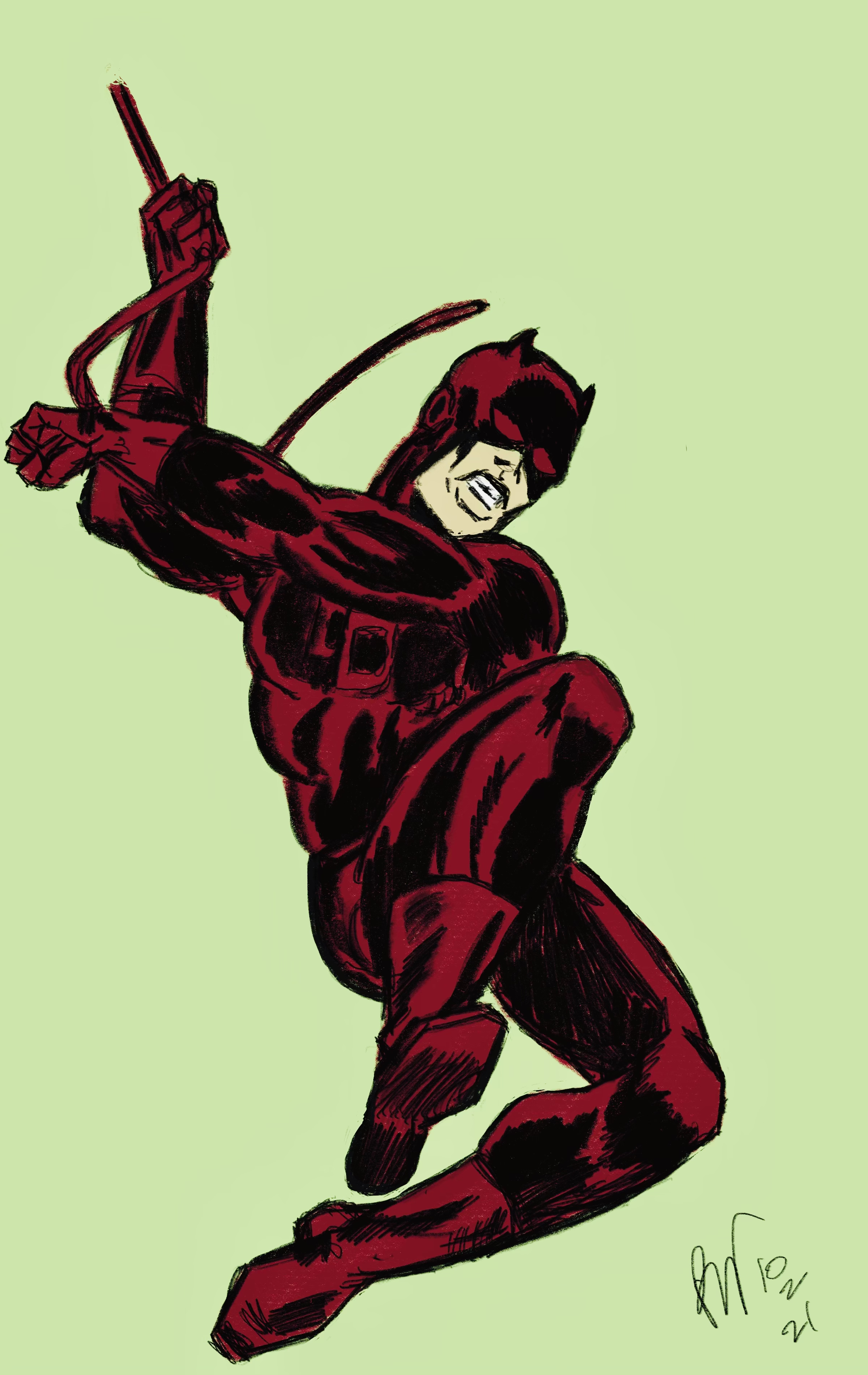
Recently, my partner began doing artwork on an iPad, and one afternoon, I returned to one of my passions as a teenager, drawing super heroes:

After Gil Kane’s cover of Daredevil and Black Widow v1 issue 97

Over the past year, facing as I am creeping into my 60s, I have also returned to collecting comic books, focusing on Daredevil and now Black Widow. Collecting, reading, and drawing from comic books were central to my teenage life from about 1975 through the early 1980s.

Diagnosed with scoliosis in the summer of 1975, just before entering ninth grade, I took solace in those comic books as I struggled against not only the usual terrors of adolescence but also the specter of living life in a clunky body brace throughout high school.

The brace was incredibly uncomfortable, and standing at the long bar separating our kitchen and living room was an ideal place for me to draw from the growing number of Marvel comics I was buying each week.

Collecting comics in the 1970s was a real nerd-life, but it looked much different than now. I visited two pharmacies and one convenience store on comic book release day, carefully sorting through spinner racks. Eventually I had paper catalogues of the books I owned in a 3-ring binder.

Back issues were also a real challenge, but I scoured the for-sale section of the print newspaper and found comic book sellers in the ads of the Marvel comics I collected. Once, my father even took me to a comic book convention in Atlanta.

But in many ways, the 1970s were a very naive time, much simpler and incredibly problematic.

Even then, as I note in my full-length examination of comic books, Marvel seemed overly focused on new readers; comic book publishers know where their money is made—the foundational and enduring characters—and cannot resist returning over and over to their origin stories.

Adulthood interfered with my collecting, and in one of the worst decisions of my life, I sold my 7000-book Marvel collection to help make a downpayment on a townhouse. I squirreled away my full run of Howard the Duck (volume 1), but all the other magical runs—Conan, Spider-Man, Daredevil, X-Men, etc.—were handed over to a comic book store in Charlotte, NC, so that I could properly adult.

After the Frank Miller reboot of Batman and the first Batman films with Michael Keaton, I dipped my toes back into collecting briefly because several of my high school students were collectors. However, since the early 1980s, I really had mostly abandoned the comic book world.

One of the great pleasures of my career shift in 2002—from high school English teacher for 18 years to college professor, 20 years and counting—was starting to write and publish comic book scholarship, and later, often blogging about comic books.

A couple summers ago, I made a huge change in my life, and with turning 60, I decided to allow myself my pleasures, even if they seemed childlike, childish. With the encouragement of my partner, then, I returned to actively collecting comics, and moved my collection into our apartment (from my office).

Even though I have much more disposable income at 60 than I (or my working-class parents) did as a teen, I recommitted to collecting with parameters of spending less than a few dollars per book (maybe $10 or $12 from time to time) even though I was targeting the 620+ issue run of Daredevil—to which I have added the much smaller run for Black Widow (after noticing a recent issue had a legacy numbering of 50).

From the naive and simpler 1970s until the 2020s, huge changes have occurred in comic books—the multiple reboots, the rise of the film adaptations, and the nearly fatal collapse of over-saturation in the 1990s.

But for me, a comic book lover and collector reconnecting with the super hero world, I find the constant renumbering and rebooting maddening.

The quest for complete runs is a nightmare of Dante’s Inferno proportion.

It took some tedious work, but Wikipedia and the Marvel database at Fandom allowed me to map out on my Notes app the 6 volumes of Daredevil and the (ridiculous) 8 volumes of Black Widow.

As I flip through back issues at the 2 or 3 local comic book stores, I have the Notes app open and typically have to click a Fandom link to make sure I am buying a book I need since Marvel provides precious little information for collectors on the covers (currently, however, most do have legacy numbering).

I find the reboots and renumbering some of the worst decisions made by comic book publishers, notably DC and Marvel. Again, these behaviors prioritize new readers, and leave life-long fans and collectors behind. Yes, I am well aware that comic books are a business and the market drives a great deal of what happens in the pages of my favorite titles.

It is maddening none the less.

A perfect example is Black Widow. I jumped into volume 8 of Black Widow, a wonderful run written by Kelly Thompson and drawn beautifully by Elena Casagrande and Rafael De Latorre (and others).

When I noticed that issue 10 of volume 8 was legacy number 50, I was motivated to collect the entire run of Black Widow, a seemingly doable project.

I turned again to Wikipedia and Fandom, constructing another outline on my Notes App. However, I soon noticed that if I collected every issues of the identified 8 volumes, I would own far more than 50 issues.

What gives?

I reached out on Twitter and searched frantically on Google—but finding a clarification for how Marvel determined legacy numbering, and why Black Widow has 8 volumes with conflicting total issue numbering, was nearly impossible.

It seems, according to Fandom, that Marvel counts only volumes 3, 4, 5, 6, and 8 in the legacy numbering—another maddening layer to collecting in 2021.

And this is just Black Widow, a relatively fringe character in print comics (although her status appeared to be much greater in the MCU); when I grabbed some recent Spider-Man issues (prompted by noticing Thompson writing there also), I am even more frustrated by the layers and layers of reboots and alternate universes.

Where, o where, is Spider-Man of my teen years?

I don’t want to be the old man shouting for kids to get off my lawn; I do want to stay reconnected with Daredevil and Black Widow, along with other loved characters such as Wolverine and X-Men.

But I must admit, Marvel isn’t making it easy, and I am not even sure they care.

The Inevitable, Exponential Decline

Do not go gentle into that good night,/ Old age should burn and rave at close of day;/ Rage, rage against the dying of the light.

Do not go gentle into that good night, Dylan Thomas

In the consumer society called “America,” we humans are often nothing more or less than the objects we accumulate.

Or as comedian George Carlin explained, we are ultimately our “stuff”:

Nine months into being 60, I recognize that my life—in the throes of the inevitable, exponential decline—is reflected in some of my most prized stuff, my collection of bicycles that numbers 4 (two Ridley road bicycles, a Santa Cruz MTB, and a Santa Cruz gravel bicycle).

Part of that reflection involves my more than 30 years as a so-called serious cyclist living by The Rules, including Rule #12: The correct number of bikes to own is n+1. Because of major life changes, I now live in a 900-square-foot apartment instead of a house more than twice that size.

Bicycles occupy far too much space, and I have them hanging on the wall, forcing me to climb a ladder just to be able to ride.

As I have been fearing, while alone, I fell off the ladder recently while storing bicycle parts in the only storage space available in the HVAC area above the bathroom. I imagined myself lying broken on the concrete floor while I was falling—feelings I included in a recent poem, blue&black.

The reason I was on that ladder circles back to my bicycles since I was replacing the saddle on my Ridley Excalibur (Flandrien edition).

A few Saturdays ago, I joined the early morning ride from the local Trek store. I took several extended pulls during the ride, and gradually realized my saddle was incredibly uncomfortable, causing numbness and pain.

For cyclists, especially those of us who ride long and intense distances, the saddle is one of the most important components. I rode with Fizik Arione saddles for many years, a flat, long saddle with a faux-suede strip that keeps you from sliding around.

However, I briefly retired from road cycling throughout 2017—after being struck by a car on Christmas Eve 2016—but when I returned to road cycling in early 2018, I had to acknowledge that my body no longer found my road bicycle as comfortable as before.

Much to my chagrin, and embarrassment, I had to raise my stem and change my saddle, then to the Fizik Aliante, a curved saddle designed for people who are less flexible.

I also had to abandon my preferred thin, faux-leather handlebar tape, and returned to wearing padded gloves since I was struggling with hand stiffness and pain.

Those changes made riding more comfortable, even as I strayed from The Rules and the enormous cultural pressure among so-called serious cyclists.

After I stood up from the fall off the ladder, momentarily stunned and shaken, I cursed what had led to having to change my saddle again (this time to the same MTB-style saddle I have on my MTB and gravel bicycle). It took a few minutes to realize I was essentially fine, until I noticed blood marks on the carpet from a small cut on my foot.

Each time I climb the ladder to ride my Flandrien road bicycle, which I have switched to from my Helium SL because the Flandrien is far more comfortable, I see the inevitable, exponential decline of me reflected in the gradual replacement of parts on that bicycle—the raised stem, the padded handlebar tape, the bulkier saddle.

Much of this is depressing because it reflects a life-long war for me between me and my body—a body that never seemed to be able to attain the demands I have made of it, a body often disappointing and flawed.

But there is also more, a recognition that my being drawn to a sport grounded in Rule #5 (harden the fuck up, or HTFU) has a great deal of disfunction that I should walk away from, instead of gradually and reluctantly relinquishing piece by piece.

Some of that disfunction can be traced to my father, a hard-ass product of mid-twentieth century bullshit about working hard and suffering. Any of the success I have achieved as a cyclist resulted from my ability to suffer, just as my father taught me directly and indirectly.

My father suffered himself into an early grave.

And there are days now, especially after mountain biking and some gravel riding, when my shoulders ache just like my father’s failed him for the last couple decades of his life.

The machine is wearing down.

I have been sharing stories about the inevitable, exponential decline with my students, including telling stories about my life as a cyclist for about 35 years.

I now confess that the HTFU lifestyle was a really bad way to live and ride, and that I am paying for it. I usually share the story of the day I quit the Assault on Mt. Mitchell—a 102-mile ride that concludes with about 30 miles of climbing—just as I was starting the climb.

I didn’t just quit that day; I quit ever doing the ride again (after about 20 starts and 16 or so finishes of the grueling event since 1988).

My story of coming to reject a life of suffering, a hobby of suffering, seems to resonate with many of my students, notably my athletes (especially the football players) and students in ROTC.

Those students deeply inside cultures of suffering appreciate a different perspective than what they are being told within those cultures; those students are often up very early in the mornings doing grueling physical activity before starting their day as students.

They are bone tired, often fighting the urge to fall asleep in class.

I tell them that it doesn’t have to be that way, that life can be filled with joy and pleasure.

As I write this, I have recently ridden my bicycles 6 days in a row, and found myself in a hole. Tired. Sore.

As I write this, it is day 2 of rain with several more days of rain forecast.

I am anxious about not being able to ride. I am also slipping into the depression that comes with the contracting daylight of October.

I am a good existentialist who recognizes our passions are our sufferings, but I am far too inadequate at being a human who can resist the allure of HTFU.

Yes, I know—and believe—that we are supposed to imagine Sisyphus happy as he turns again and again to descend the hill in order to roll his rock, his Thing, back up the hill.

But at 60, I am newly aware Sisyphus would be happier if he were simply to quit, no longer to be defined by his stuff.


See Also

Cleaning the Kitchen the Last Time

Death Takes a Lifetime, and then a Year

60 (Last Time)

This coming Thanksgiving of 2021 will be the ten-year anniversary of me being ghosted.

The person was an important part of my life, but our connection made both our lives complicated. And we were never able (willing?) to address the problems in ways that would protect the relationship.

The ghosting was a dark cloud over my life for many years—although I never discussed it in any real way with anyone else. And if I am entirely honest with myself, the ghosting may have been about the only option for the other person.

Over the last few years, that dark cloud has vanished, and in its place, the ghosting simply remains as an example of one of my deepest existential fears—realizing I have experienced the last time after the fact.

I think many of us believe that if we have forewarning, we could better prepare for and work through a last-time situation—such as the loss of a loved one or the end of a serious relationship, whether lover or friend.

Not knowing, I admit, triggers my anxiety, but I lost both of my parents about 4 years ago, my father in late June 2017 and my mother that December.

My father had been in poor and declining health for years, to the point that I think many of us had become far too complacent with that reality. He literally died right after telling me he needed to “poop,” likely as three nurses moved him into the bathroom or certainly by the time they had him on the toilet.

Nothing about being aware of his poor health and imminent death or being right there as he passed really made that last time any less overwhelming or less shocking. Once the last time has passed, there are many what-ifs to worry your mind.

My mother’s death was much different. By comparison she seemed healthier than my father (she wasn’t), and then, her death was precipitated by a stroke.

Nearly every day after her stroke in early June until her death in early December, I visited her, unable to speak and often suffering an assortment of ailments that left her miserable. The end for my mother was a many-months nightmare.

Just weeks before she died, the doctors discovered she had stage 4 lung cancer; he last days were spent in hospice where I sat beside her a few hours a day.

She died late at night when I wasn’t there, and I slept through the call from hospice since my cell phone was on silent. The what-ifs about the last time with my mother have weighed on me and my nephews.


On July 9, the day after my granddaughter turned 7, I was just starting a 16-hour drive to Kansas before then driving to Colorado for two weeks before a week in Arkansas to visit friends at the University of Arkansas. While driving, I noticed an email from my dean about a position I had applied for, director of my university’s writing program.

I have been at my university almost twenty years and have invested a great deal of time into our first-year writing program, effectively lobbying for and helping develop the job that I applied for.

Since I was driving, my partner read the email, which explained that I would not be interviewed at all for the position. My dean acknowledged that he knew I would be disappointed.

I am 60, and this was my dream position for my career.

Yes, I was deeply disappointed, driving much of that day very depressed and slightly numb from the realization.

But the larger issue was coming to recognize that this was very likely the last time I would apply for any position other than the one I now have. I certainly will never be the director of writing at my university.

I am white, a man, well paid, and very privileged. I am also 60. People now routinely ask me when I plan to retire.

This is the end of my career, although I genuinely do not think about retiring since writing and teaching are careers I can continue to do for many more years.

And yet, my experience is quite insignificant and pales against the racial and gender awareness among Black people and women (for example) who navigate the workplace with the moment-by-moment awareness that they are being ignored, passed over, paid less, and marginalized simply for being who they are, regardless of their qualifications or potential.

This is not intended as a pity party, but a way to acknowledge and navigate something almost all humans must endure, the fear of and experiencing the last time.


I taught Thornton Wilder’s Our Town many years as a high school English teacher. I have always been drawn to the character Emily who dies young but is allowed to relive a day of her life.

By the final act, Emily views her life in replay from beyond and exclaims: “I can’t look at everything hard enough.”

She then turns to the Stage Manager and asks, distraught: “Do any human beings ever realize life while they live it—every, every minute?” And the Stage Manager replies, “No—Saints and poets maybe—they do some.”

Living is a series of last times, and we are damned as humans to rush through our lives simply not looking hard enough because we are so pre-occupied with our lives.

I am 60.

When I get down on the floor to play with my grandchildren, I inevitably have to stand up. It is a challenge these days, standing up, and I think maybe, just maybe, part of the struggle is carry around all the last times I have accumulated.

Last times I will continue to accumulate.

Until the last time.

Clothespin Bucket

I had a dream last night, the kind of dream that jumbles your past and present in ways that make sense only in the dream.

The jumble in this dream was riding my recently purchased gravel bike from my former home (where I lived when I was about 10 until my early 20s) to the nearby club house of the rural golf course where that house sat, Three Pines Country Club.

In this dream, my mother, now deceased, met me at the club house after I pedaled up the long hill from that house to the club house, weaving between cars much more carelessly than I would in real life. I also rode the bicycle over steps and furniture into the club house, weaving there through people as if my behavior was perfectly normal.

The kicker of that dream was not the mixing of past and present as well as the living and the deceased but that I eventually realized although I had ridden to the club house to hit range balls, I didn’t have my golf clubs or shoes—as I had ridden a bicycle of course.

In real life, both my mother and I worked at that golf course for many years, and I spent a great deal of my life at the club house and hitting range balls, spanning essentially my entire adolescence.

None the less, the dream was so vivid that I was unnerved when I woke, and continued to think about it all morning.

Eventually, I texted my oldest nephew, over twenty years my junior, who lived much of his life growing up in the same house, raised primarily my my parents, his grandparents.

Our shared home and parenting have resulted in our feeling in many ways more like brothers than uncle/nephew, I think.

Since my nephew had been very close to my parents in their declining years, he was the executor of their will; and since their deaths a couple years ago, we have continued to reach out to each other as we work through the complicated loss of my parents.

When I thought more about this dream, I wanted to share it with him, and his immediate response was to wonder why the dream had included the associations that it did.

Almost immediately, I realized that the odd combination of my current cycling hobby and my childhood and adolescent life on a golf course made perfect sense, especially including my mother.

And what holds all that together is clothespins, or more accurately my mother’s clothespin bucket.

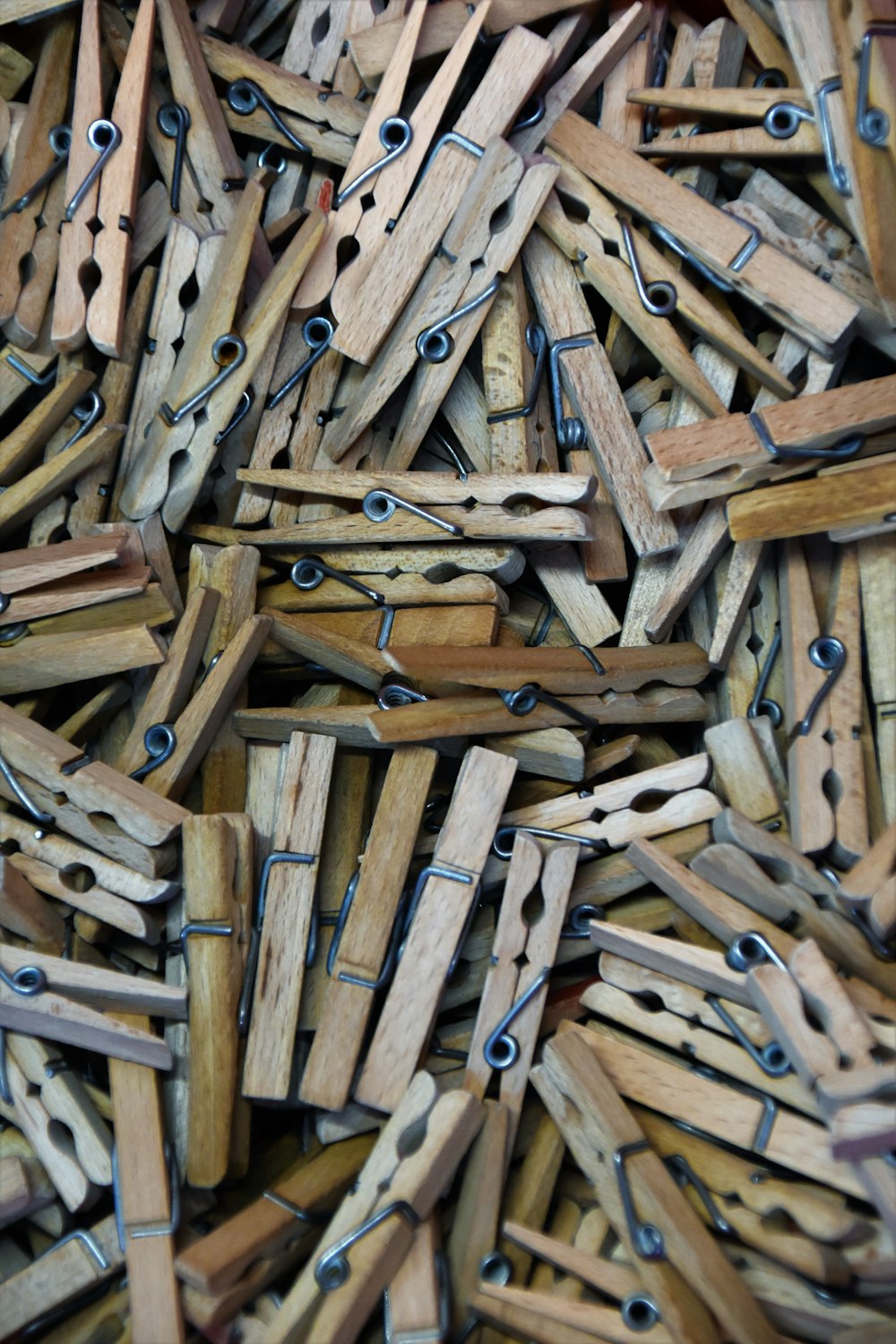
brown wooden cloth pin lot display
Photo by Waldemar Brandt on Unsplash

Our first family home was a rental house in Enoree, SC, several miles south of my home town, Woodruff, where my parents next rented a house before building their own home—the one of my dream—at Three Pines. The house on the golf course was a few miles north of Woodruff. I lived in these homes in the 1960s and 1970s.

My mother always washed clothes and then dried them on a clothes line outside, the clothes held in place by dozens of wooden clothespins she kept in a plastic bucket.

At some point, by the time we lived at Three Pines, my parents did own a dryer, but she still would hang clothes outside and that bucket never budged from the laundry room. I want to say the bucket was blue, in fact.

I started college at a junior college in nearby Spartanburg, and then finished my undergraduate degree at the satellite campus of the University of South Carolina—then USC-Spartanburg but now named USC Upstate.

For my final 2.5 years there, my advisor was an avid triathlete, a sport I had never encountered before, being relatively new in the early 1980s. It is because of this advisor that I became fascinated with serious cycling.

As a college student from working class parents, I was not hurting for money—I always had jobs, often at nearby golf courses—but buying a serious bicycle in the early 1980s seemed too expensive once I started shopping around.

One day I was telling my mother about the advisor, triathlons, and my budding interest in cycling, adding that I thought buying a bicycle was more than I could afford.

Without hesitating, she told me to go to the laundry room and bring her the clothespin basket; that turn in the conversation struck me as odd, but I dutifully fetched the bucket and started to walk to my room.

Digging through the clothes pins, my mother said, “Here,” and I turned to see her holding a wad of bills she had pulled from under the clothespins. “Don’t tell your father,” she added.

It turned out to be a couple hundred dollars, but we never talked about why she was squirreling away money or why she was so willing just to hand over about $200 to me on the spot.

The money was still well below a bicycle shop quality bicycle, but I went to Sears and bought what now counts as my first serious bicycle because I did start riding in a way then that led over the next three years to buying that first bicycle shop bicycle from the now defunct Great Escape, then in downtown Spartanburg.

I know enough pop culture psychology and the works of Freud, Jung, and Frazier to be able to navigate my own dreams for some glints of meaning. So I feel comfortable with what I see in the dream merging my now and my past, blurring my current 30-plus year hobby of cycling with my childhood and adolescent hobby of golfing.

It is of course my mother this dream is about.

My mother’s willingness to create her own secret place, a stash of cash, in a clothes pin bucket—this domestic woman, this life-long mother, this person who was immediately self-sacrificing.

Especially for her son.

Especially for me.

My parents not only would have done almost anything for me. My parents essentially did do anything for me.

They did that for my nephew as well.

It is something we share, something we can understand with a heavy melancholy and love, something we have to take out every once in a while and try to work through, untangle, confront.

I had a dream last night, the kind that leaves you disoriented and nearly unable to draw a clean line between that dream and your own lived life—because the fabric of the dream is weaved out of strands from many different years as if the finished garment is a perfectly ordinary shirt.

A shirt when washed would flutter a bit on a clothes line, fastened securely by decade’s old clothespins used occasionally to hide a few dollars you may need someday.

At War with Myself

There is a refrain I say to myself, something I likely have never admitted to anyone: “I hate my body.”

I say this to myself quite often and without the gravity the word “hate” should imply because this simply is a fact of my existence.

A good friend texted recently, sharing very dark morning thoughts and ending with #upliftingthoughts. I wasn’t being flippant but empathetic when I replied: “Well … uh … yep … done that, do that … it is called existentialism.”

Discovering and working through existential philosophy and literature throughout my undergraduate years and into the first decade or so of my career as a teacher was incredibly important for me.

Liberating.

As I followed up with my friend, I explained that existentialism, in my opinion, gets a bad rap as a negative philosophy—confused with nihilism (in the same way “communism” is conflated with “totalitarianism” in the U.S.). My reading of existentialism, I explained, was that humans had to acknowledge that our passions are our sufferings in order to move past that fact of human existence so that we were free to live, even enjoy the fatalism of human existence (we live, we die, and everything else continues—or as Kurt Vonnegut put it, “So it goes”).

Human pain and suffering, and nearly daily angst experienced by being human (aware), are not things to be dreaded or to be overcome, avoided; those are fruitless folly.

I was drawn, in fact, to Albert Camus’s existentialism (mostly the literary strand). Not to be too simplistic, but Camus suggested humans must contemplate their ability to take their own lives, suicide, in order to reject that power, and live.

Camus also matter-of-factly said that Sisyphus’s rock was his Thing and we must imagine Sisyphus happy.

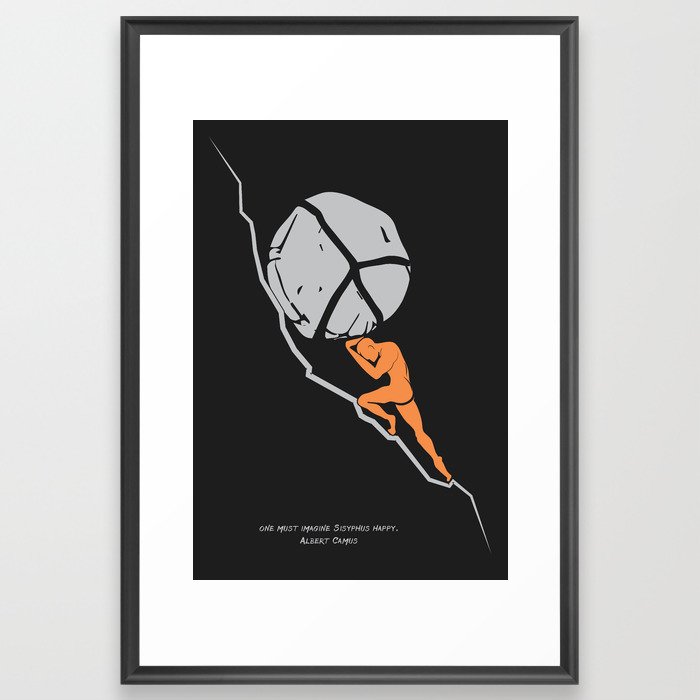
One Must Imagine Sisyphus Happy - Illustration - Albert Camus Quote Framed Art Print

I must confess that my daily refrain of “I hate my body” is grounded in a very simple fact: I cannot recall a single day of my life absent some sort of physical pain and discomfort.

In brief moments of painlessness, in fact, maybe brought on by medication for example, I am nearly unable to recognize painlessness as anything other than the absence of pain (the norm) and then am gripped by the realization that the pain will return—almost to the point of my feeling relief when the pain does return.

In my high school soccer-coach days, I had a ninth grader sit out of practice because he was in pain from practice “starting back all of a sudden” (he seemed to have no concept of off-season training); his older brother turned to him and said, “If I didn’t practice or play when I was in pain, I would never practice or play.”

I didn’t have to say anything, but nodded at the older brother.

It is no accident or surprise that I adopted as my lifelong athletic hobby recreational and competitive cycling, a sport that is grounded in pain and suffering.

To be a cyclist is to hurt; to be an elite cyclist is to hurt more than other cyclists.

I have more than once noted that a very hard cycling event was just pain.

And that is part of what my refrain to myself is all about; “I hate my body” is no complaint to myself or the Universe, but a statement of fact like “It’s just pain.”

I do imagine there are people without chronic pain, people who enjoy their physical selves, basking in pleasure as the default experience with their corporeal manifestation.

How I envy those people, maybe even loathe them.

I was quite old, nearly forty, before I discovered that I am a clinically anxious person, probably also on the autism spectrum; regardless, I am hyperaware of everything.

Every. Thing.

My senses are on high alert 24 hours a days, 7 days a week, 52 weeks a year.

I may have normal experiences with pain (I doubt that) but I certainly am deeply and continually aware of those aches. Anxiety and pain are also symbiotic; regardless of which came first, they are cyclic and perpetuate each other relentlessly.

While some people dream of becoming wealthy or famous, I fantasize about relaxing and being painless in a way that doesn’t include anticipating the return of pain.

Pleasure as a default instead of the occasional “absence of pain.”

At 59, I am in a real dilemma because growing older is somewhat naturally a descent into chronic pain. Ironically, my cycling avocation has guaranteed as much since I spent many years cycling 8,000-10,000 miles a year, many of those miles exceeding efforts that I should not have been forcing my (hated) body to accomplish.

That is my war with myself. My body’s chronic pain in combat with my brain that will not pause, that wallows in endless “what if” thinking (resulting in my lifelong hypochondria as well).

When my friend and I were commiserating about dark thoughts, and I was being too academic and explaining existentialism, I also noted that existentialism allowed me to recognize that I am not drawn to some promise of a peaceful afterlife (the carrot of most organized religions) that can come if I deny the flesh during the one life before me.

Pain is exhausting and demoralizing, but it is the only thing I really know.

When I am prompted to say to myself “I hate my body,” I actually smile a little to myself, take a deep breath, do the best with whatever is before me, and just carry on.

It is my Thing, you must imagine me happy.

Neil Young v. Lynyrd Skynyrd 2020: “Southern Man” Redux

What happens to a dream deferred?

“Harlem,” Langston Hughes

My empty-headed adolescence spanned the 1970s—I turned 18 and graduated high school in 1979—in rural upstate South Carolina, only about 25 minutes away from where I live now.

Lynyrd Skynyrd’s “Sweet Home Alabama” and “Free Bird” were persistent background music on the radio and in dance clubs well into my college life. I never owned a Lynyrd Skynyrd album, but I knew every word to both songs and gleefully (and mindlessly) sang along to them in my car or holding a long-neck Budweiser on 25-cent beer night at O’Sullivan’s.

I was a very conflicted, insecure, and anxious-to-near-paralysis teenager, and my musical tastes reflected the jumble of the mindlessness (Tom Petty, Eagles) with my late-to-develop serious interest in music that I didn’t just know the lyrics, but began to think about their implications (Parliament, Pink Floyd).

My deep and careful affection for Neil Young did not develop until the 1980s. But like most people, I was always aware of the so-called feud between Young and Lynyrd Skynyrd.

The songs that are permanently intertwined are Young’s “Southern Man” and “Alabama” (which Young has distanced himself from in moments of self-criticism) that spurred Lynyrd Skynyrd’s “Sweet Home Alabama” with the infamous lines:

Well I heard Mr. Young sing about her (Southern man)
Well, I heard ol’ Neil put her down
Well, I hope Neil Young will remember
A Southern man don’t need him around, anyhow

And that band’s iconic single cover art also sent a pretty strong symbolic message:

While the band’s relationship with the Confederate Flag is complicated, Lynyrd Skynyrd as a band and MCA Records were certainly intentional about fostering a strong relationship with some of the worst realities about Southern pride.

Young’s “Southern Man” and “Alabama,” of course, took square aim at those Southern sins, prompting (as some have tried to clarify) Lynyrd Skynyrd to write “Sweet Home Alabama” as a rebuttal anthem along the lines of “Not all Southerners.”

Young has noted that his songs may have painted with too broad a brush, but Lynyrd Skynyrd’s revisionist explanations stretch credulity.

Both the tension and controversy surrounding Young and Lynyrd Skynyrd were grounded in a sort of regionalized ideological divide that remains today—Young as the liberal Canadian and Lynyrd Skynyrd as the conservative Southerners.

I was born and raised in the racist, redneck Southern culture that embraced and celebrated Lynyrd Skynyrd and the Confederate Flag. Both are steeped in a sort of jumbled logic about tradition and pride that refuses to acknowledge the harsh realities of racism that created the South but also lingers in the South and its traditions (such as the Confederate Flag and idealized mythologies about Dixie and the Lost Cause whitewashing of the Civil War).

It took a great deal of critical introspection for me to slay that past, deconstruct and then reject it, and it took too much time for that process, a transition occurring while I was an undergraduate (a racial awakening overlapping with many nights at O’Sullivan’s singing along to “Free Bird” and holding a long-neck Budweiser).

In Young, the Self I constructed out of the shell that chose to walk away from my racist upbringing found the music and lyrics that resonated with the person I wanted to become.

Recently, I saw a post on social media asking people to choose between Neil Young or Lynyrd Skynyrd. At first, it seemed out of place in 2020.

Like others who replied, my first thought was there is no choice here; it is Young because of the many problems surrounding Lynyrd Skynyrd, including “Sweet Home Alabama” and their embracing the Confederate Flag.

Over five decades, however, there really is nothing simple about that choice because it is 2020.

The Southern-apologist strategy is alive and well in 2020 even as states have taken more aggressive approaches to renaming buildings and removing statues honoring Civil War figures who unequivocally were racists and slavery enablers.

The jumbled history of Lynyrd Skynyrd and the band’s relationship with both the Old South and the New South are an aging quilt, but the threads of that quilt are being disturbingly re-spun in support for Trump by reinvigorated white nationalists in the U.S.

And while conservatives have long clung to “Sweet Home Alabama” and “Free Bird” as right-wing anthems, Republicans have also co-opted Young’s “Rockin’ in the Free World,” and Bruce Springsteen’s “Born in the U.S.A.”—seemingly (mis)understood with the same sort of empty-headedness I practiced as a redneck singing along to “Sweet Home Alabama” in the 1970s.

History has been far more kind to Young’s efforts at social consciousness through his music than to Lynyrd Skynyrd regardless of to what degree you backward (re)construct their messages about the South and its iconography (people claim, for example, the “Boo! Boo! Boo!” following “In Birmingham they love the governor” as both rejecting and endorsing infamous racist George Wallace).

There is an irony to asking people to choose between Young and Lynyrd Skynyrd—the former a flawed but earnest choice and the latter a tarnished if not irreparably stained choice.

There was never room for the Confederate Flag, and “Not all Southerners” is a coward’s plea against the historical and lingering systemic racism that plagues not just the South but the entire U.S.A.

But 2020 has proven James Baldwin’s edict: “the time is always now.”

Lynyrd Skynyrd, the original band, and the reconstructed Lynyrd Skynyrd as well as their fans are real-life examples of the great failure of the South, clinging to the old ways simply because they are the old ways.

So much of literature has warned about the folly of pride that it feels cliche, but “Proud to be a Southerner” and “Proud to be an American” both fall flat against the “rigid refusal” to acknowledge our sins past and current.

Now, Young recognizes his warning “Southern change gonna come at last” ( applies to the entire country, not just the region he targeted:

Young posted a 2019 performance of the song on his Archives Wednesday, writing: “Here’s me as an old guy singin’ his 50-year-old song that was written after countless years of racism in the USA. And look at us today! This has been going on for way too long. It’s not just ‘Southern Man’ now. It’s everywhere across the USA. It’s time for real change, new laws, new rules for policing.”

It’s 2020 and there is no credible way to justify Lynyrd Skynyrd, just as there is no credible way to justify Trump.

It’s 2020 and there really is no choice, but it certainly is time to make the choice in ways other than mere words or simply clinging to something that should have never been held dear to begin with.


Social Media and the Marketplace of Ideas

When I was first married, we lived in the room of my parents’ house that had been converted from a garage. My sister and her husband also lived with my parents, them in her old bedroom inside the main house.

One night, we were awakened by my sister pulling the screened door to the room free of the flimsy latch, yelling that my father needed help.

That was a terrible and important night for me as a young man. My mother had found my father collapsed in the bathroom, blood everywhere. He had been hiding a bleeding ulcer from everyone, waking that night in pain and passing out while vomiting blood.

My mother was running around frantically as my sister tried to calm her. While they called the ambulance, I cleaned up my father as best I could and helped rouse him.

They sent me with my father in the ambulance; the first hour or so at the hospital was terrifying as I watched the doctors try to stabilize my father.

He survived this, but in my early 20s I had to face a fact that I had been avoiding for many years—the inevitable and very real physical frailty of my father.

It is no easy thing for any of us to confront our parents’ weaknesses, to admit that our parents are wrong, even when the evidence is right there in front of us.

We humans want to believe what we want to believe. And we aren’t very well equipped for changing our minds, especially if we have to admit those beliefs were wrong all along.

No parent is superhuman, no parent is immortal.

Even in my early 20s, I was quite different than just a few years before, but I was still quite a ways from who I would become, who I am becoming. My journey was always moving away from my parents, my hometown, and what many people would consider mainstream.

Over nearly 60 years in this planet, I have watched as people struggle with unfounded beliefs, stubbornly clinging to and even promoting those unfounded beliefs.

In our era of social media, in fact, people spend a tremendous amount of time sharing provably false information because they are fatally committed to the beliefs at the expense of truth.

While this has been a common attribute in the U.S. for many years, maybe all of the country’s existence, the combination of the Trump administration and social media has certainly amplified the problem.

Technology has created a sort of bastardized marketplace of ideas on social media sites such as Facebook and Twitter, but it has also allowed almost anyone to communicate, create memes and manipulated images, and perpetuate any and everything as if all information has the same value or credibility.

Posting it makes it so.

Trump’s incessant (pathological) lying has invigorated the fact-checking business exponentially, but the free market has also allowed a partisan fact-checking backlash that uses the label of “fact check” to legitimize fake news and outright lies.

The result is that many people simply silo themselves with “their” evidence and languish in a perversely post-modern Frankenstein world of no facts matter—unless they are mine.

Two of the worst ways people communicate on social media are memes and images. I regularly warn people not to share any memes, but at least fact-check before posting.

As is becoming more common, however, doctored images are spreading faster than people can refute them.

Regardless of the ideology or partisan politics, that false information is being shared can never be justified. I spend far too much time posting links refuting memes, images, and social media posts.

What is frustrating here is that all I ever have to do is switch tabs to Google; in minutes, or even seconds, I have several examples of the meme or image being false.

And this poses a real problem for blaming technology. In fact, the problem is us, and our beliefs that resist evidence.

Social media also poses a real problem for our idealizing the marketplace and democracy. The market often rewards dishonesty and even abuse, and all voices are not, in fact, equal when some level of expertise is involved.

The entire world right now is witnessing that not everyone should be holding forth about Covid-19; epidemiologists and others in the medical profession are rightly the voices that should be elevated while some, as hard as this is to admit, should be silenced.

One of those beliefs is that things today are worse than ever, that the U.S. is more divided than ever (let’s not forget slavery and the Jim Crow era, just for some context about a divided country).

But we do have many calling for ways we can get along, come together.

My modest proposal is that we do not return to some naive belief in objectivity, but that we can agree to navigate social media and our IRL experiences with the same verifiable facts.

When we have video and audio that Trump said X, we must begin with that he did in fact say X.

Being the loudest or the most persistent doesn’t make you right. Posting provably false memes, images, and comments online does make you the problem, and proves that we shouldn’t value anything you believe.

My father was always merely a human before that night I saw him lying in the bathroom floor, bloody and unconscious. I was naive until than night, but to deny his mortality after seeing him right there in front of me would have been worse than delusional, a discredit to us both.


See Also

11 Warning Signs of Gaslighting | Psychology Today

Do as I Say, Not as I Do: Lessons My Father Didn’t Know He Taught Me

My childhood home, the place of my single-digit life, sat just outside Enoree, South Carolina, a very small crossroads of a town near where I typically call my hometown, Woodruff.

This house my parents rented throughout the early to mid-1960s had a large barn beside it, apparently intended as a garage, and a redneck beer joint across the street, Lefty’s.

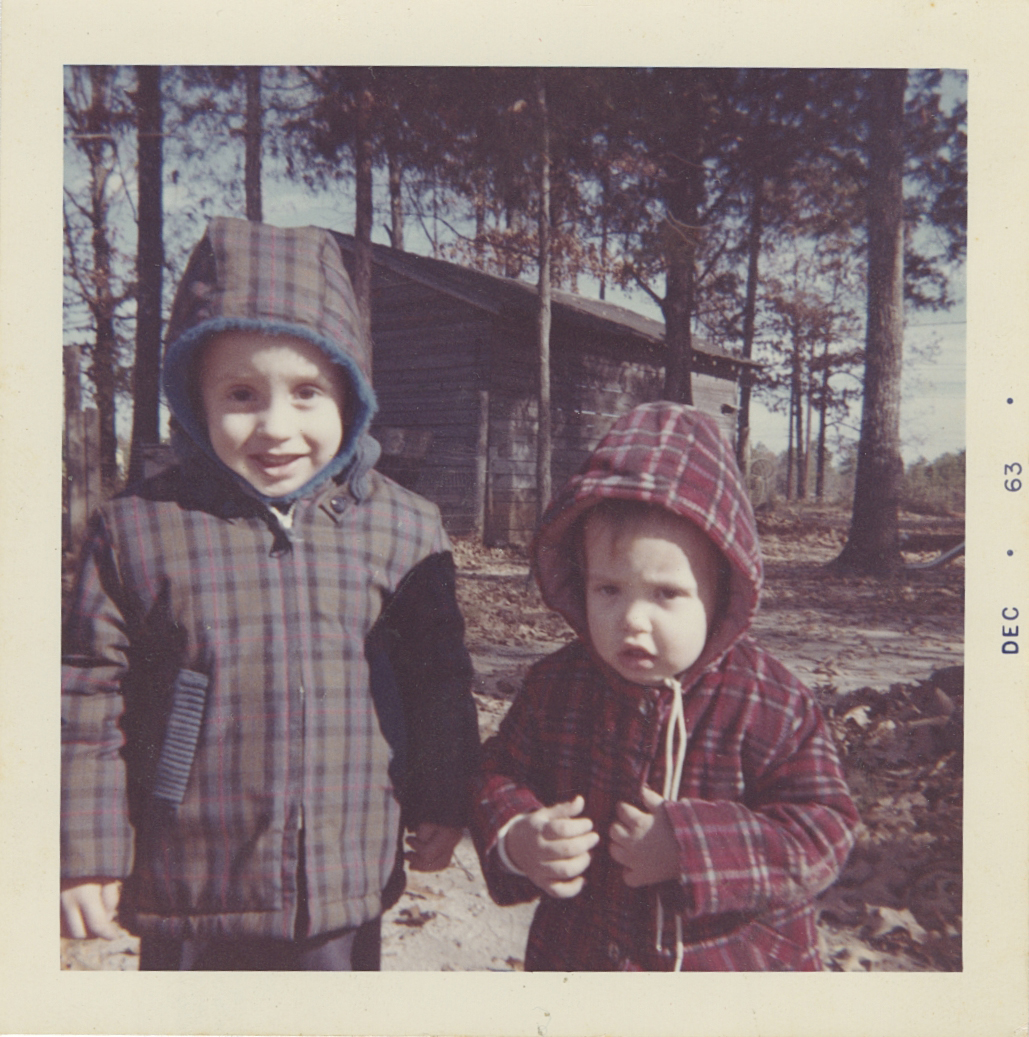
Paul and Eydie DEC 63 Enoree
My sister, Eydie, and me in the yard of the Enoree house.

This is the house where our family dog was killed, hit by a car in that street and buried by my father before he walked over to Lefty’s for a beer or two.

While our memories are not as credible as we would like, I have some of the most vivid recollections of my life from those years and that house. Part of that vividness is likely from my father’s habit of telling and retelling stories of his life and ours, but a significant contribution to my being able to see those years quite vividly in my mind is that my parents took 8 mm movies throughout that time as a young family.

There was the snowstorm video with the giant, frozen snowball that we watched over and over.

But I also recall playing outside in the leaves with my parents, and our own family version of ollie ollie oxen free that positioned one child and one parent together on each side of the house as we threw balls over for the other pair to catch. The greatest chaos, however, were the tea and water fights that often began at the table during lunch or dinner and then carried over into the yard before circling back into the house.

My father was apt, even after they built their own house and moved to the other side of Woodruff in 1971, to sneak around the house and spray my mother with the garden house through the window screen as she sat on the toilet.

I think my parents were well aware of these lessons about play and joy as a family. I often think my parents had children to insure they could continue playing their entire lives; we were card and board game players throughout my life at home as well.

And my parents raised three grandsons with the same sort of playful gusto well into their old age.

gramps outside 3 pines house
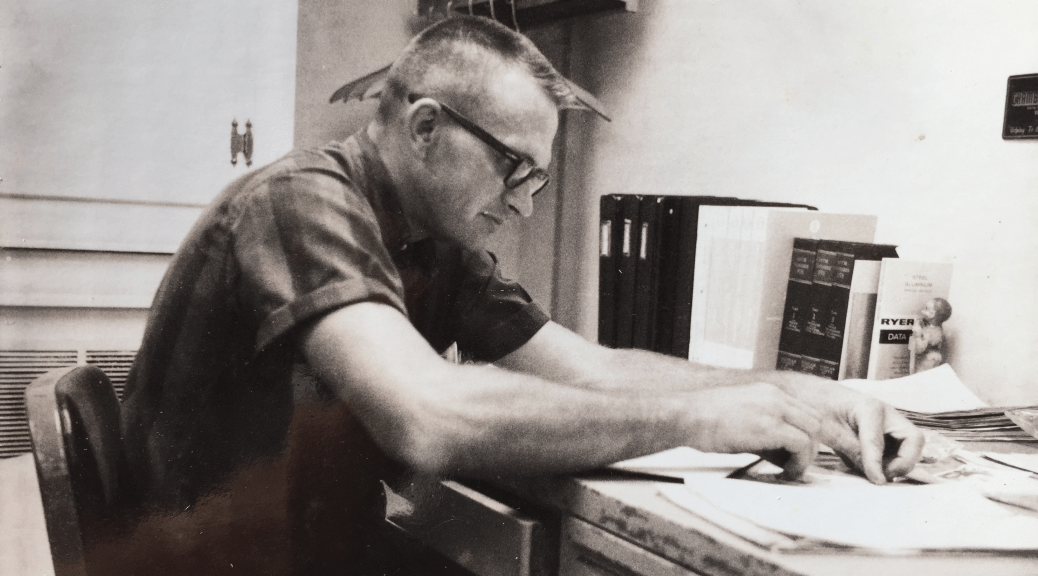
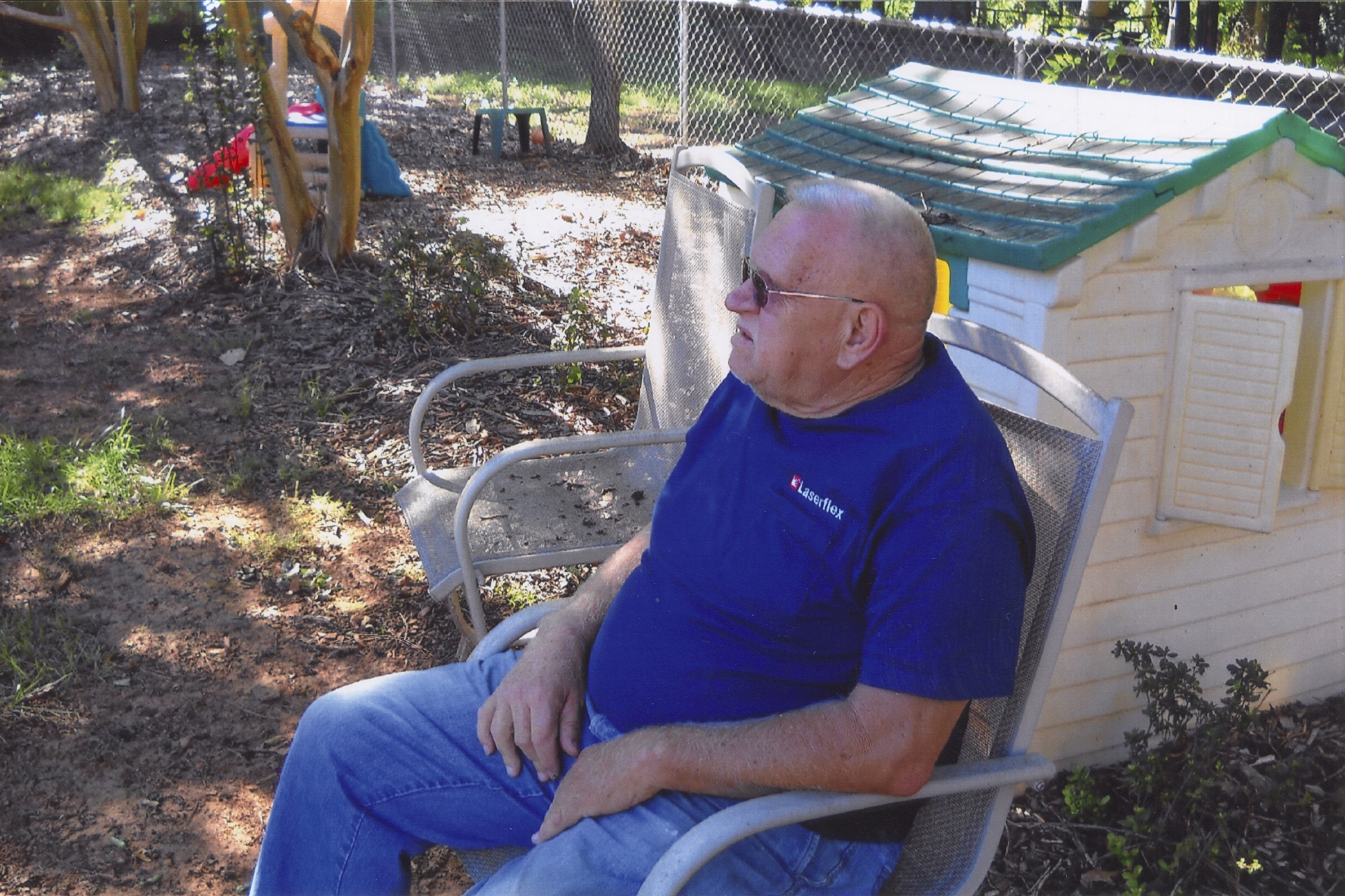
My father, Keith, was known as Gramps and sits here near the play area at the only house they owned.

I have another vivid memory, a standard refrain of my father’s as well as what very well may be a reconstructed memory of him lecturing from the living room of the Enoree house while smoking and drinking bourbon: “Do as I say, not as I do.”

This parent philosophy and authoritarian pose by my father planted early seeds of our discord as father and son. As a child, I couldn’t explain why but I hated this mandate, often while sitting in my room alone as punishment for talking back.

I would maintain a strict policy of my own, my philosophy of being a son, well into adolescence—talk back because that is the one thing he will not tolerate and ultimately something he could not stop.

As a teen, I also recall (again maybe more reconstruction) my father holding me hard against the floor, all his weight on me and his massive arms and hands rendering me immobile, and saying, “Don’t say another word.”

To which I would say, “Word.”

My mother was crying nearby because these events had to look pretty violent, although they were more clashes of will since my father never went much further than restraining me.

While my father and his mantra were intended to teach me about the proper place of authority and doing what you are told, my father taught me quite different and unintended lessons.

I learned to appreciate the sacrifices my father and mother made for me, the very limited but deep ways that they were able to love. And I have to hold onto that as I came to understand my father’s flaws, including the hypocrisy of his mantra.

As an adult, a high school teacher, I experienced the same anger I felt toward my father when I watched the principal treat teachers as my father treated me. The principal had his own private restroom in his office, but relentless policed the faculty for not doing hall and door duty during every class exchange—disregarding the basic human needs he took for granted in his position of authority.

And this morning, my father’s “Do as I say, not as I do” rushed back over me as I watched a video of several white families being told to leave a park closed because of the Covid-19 pandemic.

Police officers were gently informing these families the park was closed—tape clearly marking off that fact—and that they were simply doing their jobs. But one white woman was relentless, asking for officers’ names and badge numbers and explaining to the that the park is public, paid for by tax payers.

You see, the big lesson my father taught me was what white privilege looks like, his version a healthy dose of male privilege also.

And my father taught me almost everything I need to know to understand this.

White male privilege is not a message of law and order, or of the rightful place of authority.

White male privilege is about demanding other people comply with “my” authority, uncritically.

White male privilege is a concession that the law and rules are for those “other” people.

While not my father’s intent, his lesson here has made me a better person, or at least given me the opportunity to be a better person in my roles of authority. My anger at his hypocrisy returns to me often and pushes me to have higher standards for myself than for others.

Don’t trust what I say until you see what I do.

Worker’s Dilemma

A former first-year student of mine, about to graduate during the Covid-19 pandemic, emailed me recently since we will miss the chance to talk face-to-face before graduation. This student was incredibly kind about the role I played in their undergraduate journey, offering this as well: “I came to you with concerns over a major sophomore year, and instead of lecturing me you asked me what my dream job was.”

This student made some dramatic changes to their life and college career then, and now, I think is on a path that will be far more fulfilling. But this situation plays out over and over, and quite differently, at my selective, small liberal arts university.

The students at my university are often socially and economically conservative, or at least come from homes that are socially and economically conservative. These students are keenly aware of viewing a college education in terms of return on investment.

In other words, is there major going to lead to a career that justifies the price tag of those four years (and often the additional years of graduate school that follow)?

More often than not, I interact with students who want to follow their bliss, but their parents want them to respect their investment—by preparing for a high-paying career.

My journey to and through college was quite different in most ways than the students I teach. I grew up in a white Southern working-class home, where my parents’ generation was just beginning to tip-toe into college but had firmly accepted that college was an essential goal for their children.

My mother completed only one year of junior college, where my father finished both years. But four-year college was rare throughout both sides of their families, although college was part of the aspirational narrative that all of my family voiced and instilled in me.

I had no knowledge of concepts such as return on investment, but my academic journey was a given that included going to college and turning that degree into a stable career.

Although I fumbled with deciding on a major throughout my first two years (also attending the junior college my parents had)—from physics to pre-law to architecture—by the time I transferred to a satellite campus of the state university, I was staring at needing to commit fully to the sort of major and career that justified my parents paying for my college experience.

I am not entirely sure why, but I always felt deeply obligated to my parents and their funding my college (although I did earn several academic scholarships along the way and also tutored for additional income). I had grown up in a home where school was first, athletics second, and as long as I attended to these commitments, then I was not asked to work or “pay my way” in much of anything (although I did hold jobs throughout the summers and into college).

As I entered my junior year, although I wanted to major in English, I was acutely aware that this sort of major wasn’t practical (no one expressed that to me, not even my parents) so I chose to be a secondary (English) education major to become a high school teacher.

This meant that I sat in English courses (taking far more than was required to certify) where the professors routinely identified me as education, not a real English major. Because I graduated in December, I immediately entered an MEd program (more practicality since that insured a pay raise) that spring before becoming a full-time high school English teacher that coming fall.

A bit over a decade later, I continued that trend by entering an EdD program, earning my doctorate in 1998. That entire journey consisted of academic choices made at the margins of bliss, grounded always solidly in being practical.

You see, I had not lived the comment that I made years ago to my student.

I am very fortunate and happy to have had a career as a teacher; it has been a fulfilling dream career. But I consider myself a teacher and a writer, with the latter always lurking in shadows and being tended only secondarily and gradually as my life became more and more conducive to that dream deferred (moving to higher education was a huge boost to being a writer, but greater and greater financial stability has been significant as well).

My student I reference above has been on my mind as I have witnessed the disturbing reality of being a worker in the U.S.—emphasized by the pandemic that has stressed our medical system, exposed the failures of private work-based health insurance, and tossed people out of their jobs and careers.

In the U.S. (to the bafflement of much of the rest of the world), most people have their health insurance and retirement anchored to their jobs—being a worker is a necessity to have what many would consider essential elements of being fully human in 2020.

The pandemic has not only unmasked how inhumane these practices are, but even when stimulus legislation was passed, much of the money to help people remained grounded in the people who were (or had been) workers.

Even as the stimulus money is dripping out to individuals through the lump-sum check and funds added to unemployment, many conservatives on social media are lamenting that these “handouts” are proving that government money just makes people lazy. The mainstream media are playing right along by posting several stories in which small business owners are complaining that their workers are making more unemployed than when they were working.

Here is something I think many are missing about the $600 per week addition to unemployment: Political leaders of both parties were so eager not to send large lump payments to all citizens ($2400 stimulus checks not linked to unemployment, doubling the current stimulus amount) that they chose a process that has had unintended and negative consequences.

The bad policy and bad politics coming out of the Covid-19 crisis is not driven by good economic policy or even concern for the common good; the bad policy and bad politics are the consequence of a bad and paradoxical mythology.

The first part of that mythology is that to be fully human in the U.S., you must be a worker. The big lie in that myth being debunked during the pandemic is that we are witnessing that the lowest paid, hardest working, and most exposed working conditions—hourly workers and the service industry, for example—are genuinely essential and the workers who are building and maintaining the U.S.—not the CEOs, billionaires, or political leaders.

Along with service workers, health care providers and teachers now sit far more prominently in the minds of people about what sort of workers matter, what sort of workers have the kinds of work conditions and obligations that many people would prefer to avoid.

The second part of the mythology is a paradox, a cruel and ugly paradox: Workers’ lives don’t matter, actually, but being a worker is dangled before the public as a possible way to become what does really matter—being rich and powerful.

The cruel and ugly part is almost no one will ascend to rich and powerful because almost everyone who is rich and powerful had most of that gifted, not earned.

The rugged individual who built his empire completely on his own is a bald-faced lie, a saccharine libertarian fantasy.

We should not be rushing to get back to normal once we find some handle on the Covid-19 crisis because normal in the U.S. means that everyone must be a worker to even have a shot at being fully human.

Our normal democracy has been held hostage by a false truth we hold as self-evident. We deserve a new normal in which basic human dignity is the given and our lives as workers are a part of that but a part that is properly supported by our government and our economic system.

It should not be normal that wait staff must depend on tips.

It should not be normal that you have to work to have health care and retirement.

It should not be normal that minimum wage means that you cannot afford housing, food, and essentials.

It should not be normal that you have to choose between your health and keeping your job.

It should not be normal that a billionaire class continues to feed on the labor of the masses who are systematically being denied their humanity.

I am happy that my former student feels connected to a life and career in part because we talked and he thought differently about who he was and who he wants to be.

I am nervous about the possibility that after Covid-19 we will in fact return to normal where workers’ lives don’t matter.

Honey Bee: “Honey helps an open wound”

“Gradually, Toby stopped thinking she should leave the Gardeners,” begins Chapter 19 of Margaret Atwood’s book 2 of her Maddaddam Trilogy, The Year of the Flood.

The “flood” is the apocalyptic “Waterless Flood,” predicted by God’s Gardeners, a vegetarian sect, and created by Crake (Oryx and Crake, book 1 of the trilogy).

Oryx and Crake (MaddAddam Trilogy, Book 1) by [Margaret Atwood]

“One day, old walnut-faced Pilar—Eve Six—asked Toby if she wanted to learn about bees,” and Toby does. The scene includes Pilar’s “bee lore”—such as “Honey helps an open wound”—and highlights the fragility of those bees under the weight of human negligence: “It was the pesticides, or the hot weather, or a disease, or maybe all of these—nobody knew exactly.”

Atwood’s trilogy, and this novel specifically, is quite chilling—for me a reread—in the time of Covid-19; our 2020 pandemic at least forces humans to confront our fragility, but it should also provoke some humility for our role in the entire ecosystem, Nature, or as Emily Dickinson envisions, “Landscape.”

What human behavior costs bees also costs humanity—bees as harbingers of our own inflicted doom.

That God’s Gardners are vegetarian, not vegan, is a distinction captured by their devotion and tending to honey bees. For several years now, I have been learning about veganism, and one of the most surprising elements was discovering that for vegans, honey remains a point of debate.

The standard “eat nothing with a face” framing of veganism is a bit fair, and a bit careless. Vegans also shun eggs and milk, produced by creatures with faces, driven by a concern for sentient life that is central to the Gardner’s in Atwood’s novel.

Some of veganism can be grounded in consent—creatures other than humans being given the same grace of consent for their lives and that which they produce—while some is certainly anchored in the sanctity of life, a rejection of reading “dominion” in Genesis as nature and all living creatures subject to the folly of humans.

While bees producing honey seems the same as chickens producing eggs and cows producing milk, the gathering of and using honey continues to be allowed among some vegans and rejected by others.

Once unpacked, in fact, veganism becomes a nearly inextricable ethical spider’s web of contradictions. Fruits and vegetables are not above the workings of nature and living creatures, pollination for example.

How arbitrary is the line between pollination and honey/egg/milk production?

One morning, a little over three years ago, seemingly in a different universe than the world we live in during April of 2020, I was opening a small packet of honey to put in my coffee at Starbucks.

This may have been around the time that I learned some vegans rejected the use of honey (vegans do not, however, shun sugar). So I found myself overwhelmed in that moment with recognizing the arrogance of being human, the work of bees so neatly and cavalierly packaged for human consumption.

For many years, I had avoided processed granular sugar by using honey in my coffee. In recent years, along with the ethical dilemma, I have had to admit that sugar is sugar in the human body so the commitment to honey has always been fairly arbitrary and pointless.

After some health concerns highlighted by blood work last fall, I have renewed my quest to be sugar free, and have even abandoned my dear honey, drinking coffee with creamer only.

That morning at Starbucks began a poem, we rape the bees (because we can), because I stood there thinking about bees as workers, and the stark reality in the U.S. that workers are seen as autonomous beings even as our capitalistic consumer culture compels us to work or find ourselves less than human.

Health care and retirement along with our wages are directly tied to our status as workers. As the Covid-19 crisis is showing us, without the security of health care and wages, we are all dehumanized.

Our Waterless Flood has been a sort of reverse baptism that should wash us clean of the sin of the inhumanities of capitalism. This pandemic may as well call us to reconsider not only our basic humanity but our oversized role in all of nature.

For us in the South, we fear the invisible threat of Covid-19 as pollen covers over everything during an April that has brought us temperatures in the 80s, a swarm of tornadoes, and a frost and freeze warning.

Is making honey and serving the queen simply the beeness of being a bee, an existential fact like Sisyphus and his rock? Is working in the service of the U.S. economy simply the basic humanity of being human as well, a fate shared with the bees?

I included lyrics from “Bloodbuzz Ohio” (The National)—“I was carried to Ohio in a swarm of bees”—in my poem, and am often drawn to lyrics and poetry about bees.

So as I approach the end of book 2 of Atwood’s trilogy while I also live a new life guided more than normal by simply surviving our Waterless Flood, I venture outside everyday for some relief, some peace—everything yellow-dusted in pollen—and eventually I cough and sneeze, tempered then by the new paranoia we all feel from the basic human reactions that may signal the Waterless Flood is right there before us.

One of my favorite spots to sit outside my apartment, a converted cotton mill in the quickly gentrifying South, is among an assortment of bees and wasps in the rafters of the deck overhang. So far, we share the space in harmony, although I have to calm my own knee-jerk fears.

Now, I am tempered by Atwood’s speculative novels that seem all too real, but also Matthew Olzmann’s “Letter to Someone Living Fifty Years from Now,” published the same year I wrote my bee poem, ending: “And then all the bees were dead.”


Recommended

Honeybee: Poems & Short Prose, Naomi Shihab Nye

[The murmuring of bees has ceased], Emily Dickinson