Category Archives: miracle schools

Science of Reading or Science of Retention?: Why Miracles Fail Reading Reform

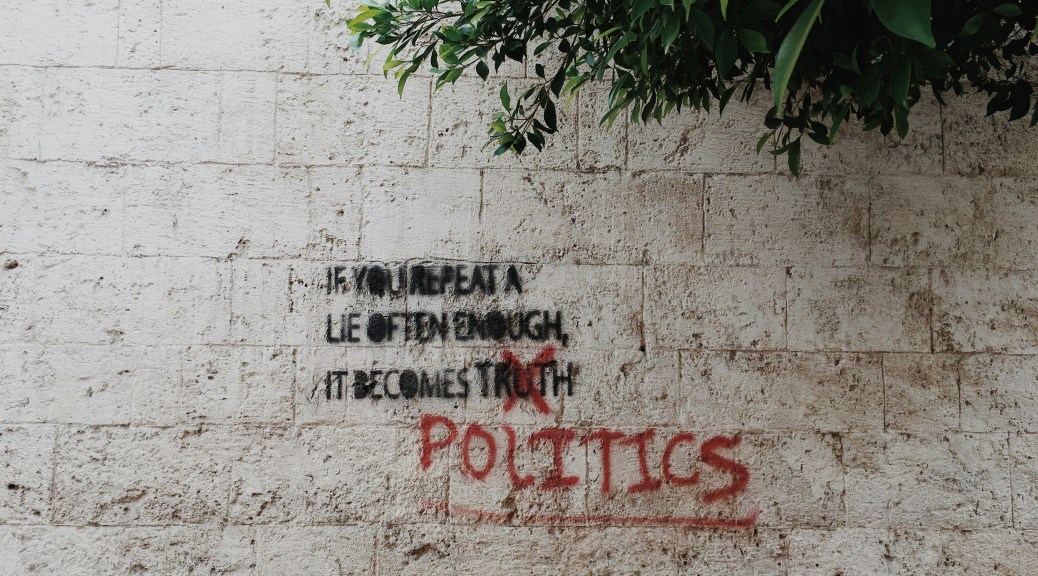
[Header Photo by Ava Sol on Unsplash]

My entire career in education, begun in the fall of 1984, has been during the accountability era of education that is primarily characterized by one reality—perpetual reform.

The template has been mind-numbingly predictable, a non-stop cycle of crisis>reform>crisis>reform, etc.

Another constant of that cycle is that the crisis-of-the-moment has almost always been overblown or nonexistent, leading to reforms that fall short of the promised outcomes. Reforms, ironically, just lead to another crisis.

But one of the most powerful and damning elements in the crisis/reform cycle has been the education miracle. [1]

Two problems exist with basing education reform on education miracles. First, and overwhelmingly, education miracles are almost always debunked as misinformation, misunderstanding of data, or outright fraud. Research has shown that statistically education miracles are so incredibly rare that they essentially do not exist.

Second, even when an education miracle is valid, it is by definition an outlier, and thus, the policies and practices of how the miracle occurred are likely not scalable and certainly should not be used as a template for universal reform.

Those core problems with education miracles have prompted the attention of Howard Wainer, Irina Grabovsky and Daniel H. Robinson, who have analyzed the reading reform miracle claims linked to Mississippi:

In 1748, famed Scot David Hume defined nature. He elaborated such a law as “a regularity of past experience projected by the mind to future cases”. He argued that the evidence for a miracle is rarely sufficient to suspend rational belief because a closer look has always revealed that what was reported as a miracle was more likely false, resulting from misperception, mistransmission, or deception….

A careful examination confirms that enthusiasm to emulate Mississippi should be tempered with scepticism….

In short, the authors followed a key point of logic: If something seems too good to be true, then it is likely not true.

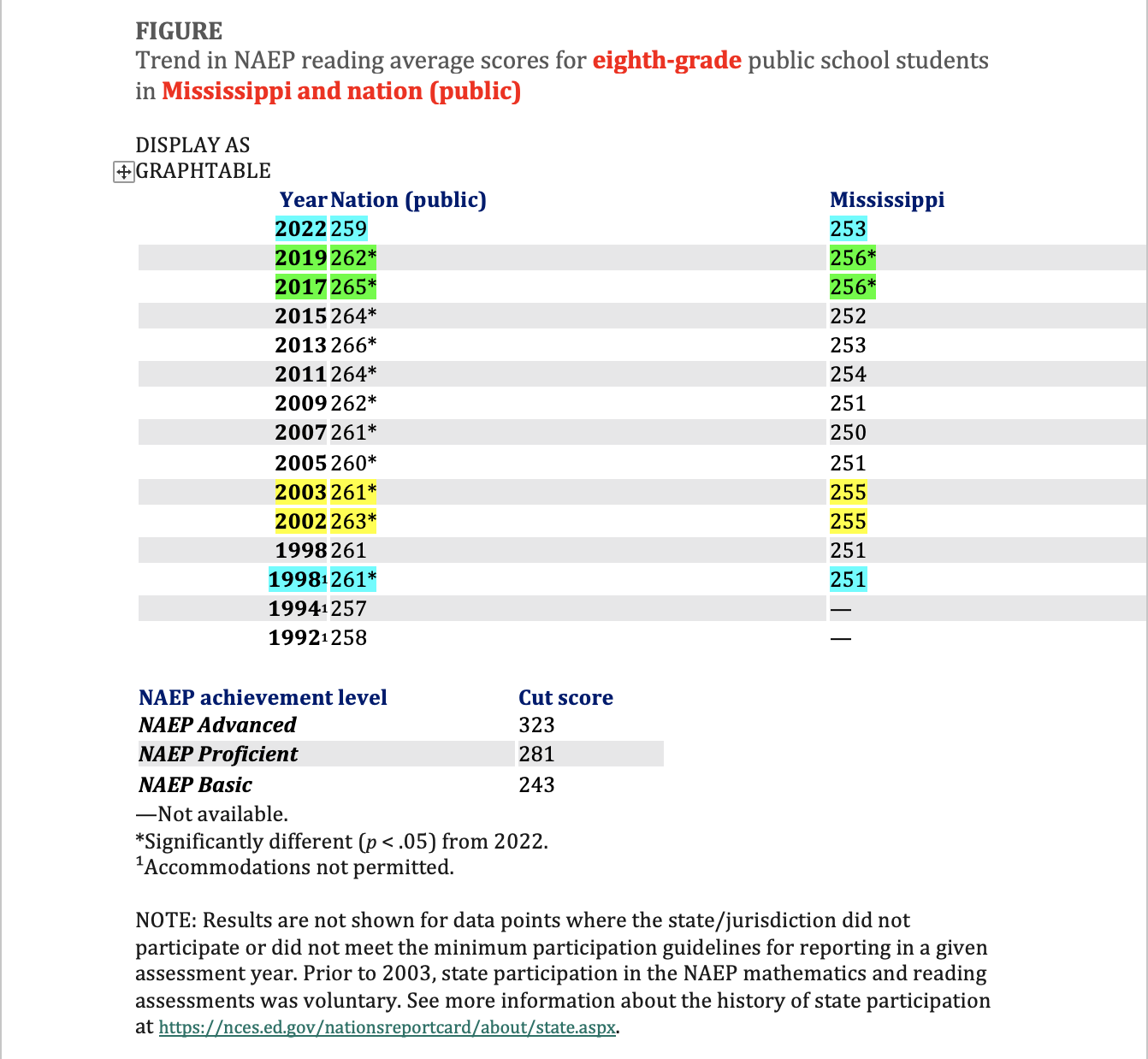
In their analysis, On education miracles in general (and those in Mississippi in particular), they focused on two of the key problems with the story about Mississippi’s outlier grade 4 reading scores (in the top quartile of state scores) on NAEP: What is the cause of the score increases? And, why are Mississippi’s grade 8 reading scores remaining in the bottom quartile of state scores?

They found, notably, that Mississippi’s instructional reform, teacher retraining, additional funding, and reading program changes were not the cause of the score increases, concluding:

But it was the second component of the Mississippi Miracle, a new retention policy, perhaps inspired by New Orleans’ Katrina disaster a decade earlier, that is likely to be the key to their success….

Prior to 2013, a higher percentage of third-graders moved on to the fourth grade and took the NAEP fourth-grade reading test. After 2013, only those students who did well enough in reading moved on to the fourth grade and took the test.

It is a fact of arithmetic that the mean score of any data set always increases if you delete some of the lowest scores (what is technically called “left truncation of the score distribution”)….

In short, Mississippi has inflated grade 4 NAEP scores, but that is unlikely evidence that student reading proficiency has improved. This is not a story about reading reform, but about “gaming the system”:

It is disappointing, but not surprising, that the lion’s share of the effects of the “Mississippi miracle” are yet another case of gaming the system. There is no miracle to behold. There is nothing special in Mississippi’s literacy reform model that should be replicated globally. It just emphasises the obvious advice that, if you want your students to get high scores, don’t allow those students who are likely to get low scores to take the test. This message is not a secret….

Wainer, Grabovsky and Robinson’s analysis also needs to be put in context of two other studies.

First, their analysis puts a finer point on the findings by Westall and Cummings, whose comprehensive review of contemporary reading reform found the following: Third grade retention (required by 22 states) is the determining factor for increased test scores (states such as Florida and Mississippi, who both have scores plummet in grade 8), but those score increases are short-term.

Next is a recent study on grade retention. Jiee Zhong concluded:

[T]hird-grade retention significantly reduces annual earnings at age 26 by $3,477 (19%). While temporarily improving test scores, retention increases absenteeism, violent behavior, and juvenile crime, and reduces the likelihood of high school graduation. Moreover, retained students exhibit higher community college enrollment but lower public university attendance, though neither estimate is statistically significant.

Grade retention masquerading as reading reform, then, is fool’s gold for inflating test scores, but it is also harming the very students the reform purports to be helping.

The evidence now suggests that reading reform should not be guided by miracle claims; that no states should be looking to a miracle state for reading reform templates; that the so-called “science of reading” movement is mostly smoke and mirrors, and should be recognized as the “science of retention”; and that grade retention policies are distorting test scores at the expense of our most vulnerable students in life changing ways.


[1] Thomas, P.L. (2016). Miracle schools or political scam? In W.J. Mathis & T.M. Trujillo, Learning from the Federal Market-Based Reforms: Lessons for ESSA. Charlotte, NC: IAP.

Big Lies of Education: Series

Here I will collect a series dedicated to the Big Lies of Education. The initial list of topics include :

  • A Nation at Risk and education “crisis”
  • Poverty is an excuse in educational achievement
  • 2/3 students not proficient/grade level readers; NAEP
  • Elementary teachers don’t know how to teach reading
  • NRP = settled science
  • Teacher education is not preparing teachers based on science/research
  • Education “miracles”
  • Reading program X has failed
  • Whole language/balanced literacy has failed
  • Systematic phonics necessary for all students learning to read
  • Nonsense word assessments measure reading achievement
  • Reading in US is being taught by guessing and 3 cueing
  • Balanced literacy = guessing and 3 cueing
  • K-3 students can’t comprehend
  • 40% of students are dyslexic/ universal screening for dyslexia needed
  • Grade retention
  • Grit/ growth mindset
  • Parental choice
  • Education is the great equalizer
  • Teacher quality is most important factor in student achievement (VAM)

Series:

Big Lies of Education: A Nation at Risk and Education “Crisis”

Big Lies of Education: Reading Proficiency and NAEP

Big Lies of Education: National Reading Panel (NRP)

Big Lies of Education: Poverty Is an Excuse

Big Lies of Education: International Test Rankings and Economic Competitiveness

Big Lies of Education: “Science of” Era Edition [Access PP PDF Here]

Big Lies of Education: Grade Retention

Big Lies of Education: Growth Mindset and Grit

Big Lies of Education: Word Gap


Moving Beyond the Cult of Pedagogy in Education Reform

As a teacher for forty years and a teacher educator for more than half of that career, I have always struggled with the tendency to oversell teacher quality and instructional practice.

Does teacher quality matter? Of course.

Does instructional practice matter? Again, of course.

But both teacher quality and instruction (pedagogy) are dwarfed by teaching and learning conditions within schools and more significantly by the conditions of any child’s life.

As I have noted recently, the peak era of focusing on teacher quality, the value-added movement (VAM) occurring mostly under the Obama administration, instead of identifying high-quality teachers as a driver for improving student achievement found out something much different than intended:

VAMs should be viewed within the context of quality improvement, which distinguishes aspects of quality that can be attributed to the system from those that can be attributed to individual teachers, teacher preparation programs, or schools. Most VAM studies find that teachers account for about 1% to 14% of the variability in test scores, and that the majority of opportunities for quality improvement are found in the system-level conditions. Ranking teachers by their VAM scores can have unintended consequences that reduce quality.

ASA Statement on Using Value-Added Models for Educational Assessment (2014)

Teacher quality necessarily includes two types of knowledge by a teacher—content knowledge and pedagogical knowledge.

Yet the VAM experiment revealed something we have known for decades—standardized tests of student learning mostly reflect the student’s relative privilege or inequity outside of school.

Despite the refrain of Secretary Duncan under Obama, schools have never in fact been “game changers.”

While neoliberal/conservative education reforms leveraged the “soft bigotry of low expectations” and unsubstantiated claims that the Left uses poverty as an excuse, people all along the ideological spectrum are over-focused on instructional practices. And that overemphasis is used to keep everyone looking at teachers, students, and instruction instead of those more impactful out-of-school (OOS) influences on student learning.

A companion to the cult of pedagogy in education reform is the “miracle” school claim, but “miracle” schools rarely (almost never) exist once the claim is interrogated, and even if a “miracle” school exists, it is by definition an outlier and essentially offers no guidance for scaling outward or upward.

The paradox of the cult of pedagogy in education reform is that until will directly address OOS factor we will never have the context for better teasing out the importance of teacher quality and instructional practices.

The current education reform trapped in the cult of pedagogy is the “science of reading” (SOR) movement which oversells the blame for student reading achievement as well as oversells the solutions in the form of different reading programs, reading instructional practice, and teacher preparation and professional development.

The “miracle” of the day in the SOR propaganda is Mississippi, which is very likely a mirage based on manipulating the age of students being tested at grade level and not on teacher quality and instructional practices.

Not a single education reform promise since the 1980s has succeeded, and the US remains in a constant cycle of crisis and reform promises.

Yet, the evidence is overwhelming that many OOS factors impact negatively student learning and that social reform would pay huge dividends in educational outcomes if we simply would move beyond the cult of pedagogy in education reform.

For example, see the following:

My entire career has existed within the neoliberal accountability era of education reform that oversells education as a “game changer” and oversells teacher quality and instructional practices.

Like time-share frauds, we are being duped, and teachers and students need us to move beyond the cult of pedagogy in education reform and focus on the much larger influences on students being able to learn and teachers being able to show that their quality and instruction can matter.

Test Scores Reflect Media, Political Agendas, Not Student or Educational Achievement [UPDATED]

In the US, the crisis/miracle obsession with reading mostly focuses on NAEP scores. For the UK, the same crisis/miracle rhetoric around reading is grounded in PIRLS.

The media and political stories around the current reading crisis cycle have interested and overlapping dynamics in these two English-dominant countries, specifically a hyper-focus on phonics.

Here are some recent media examples for context:

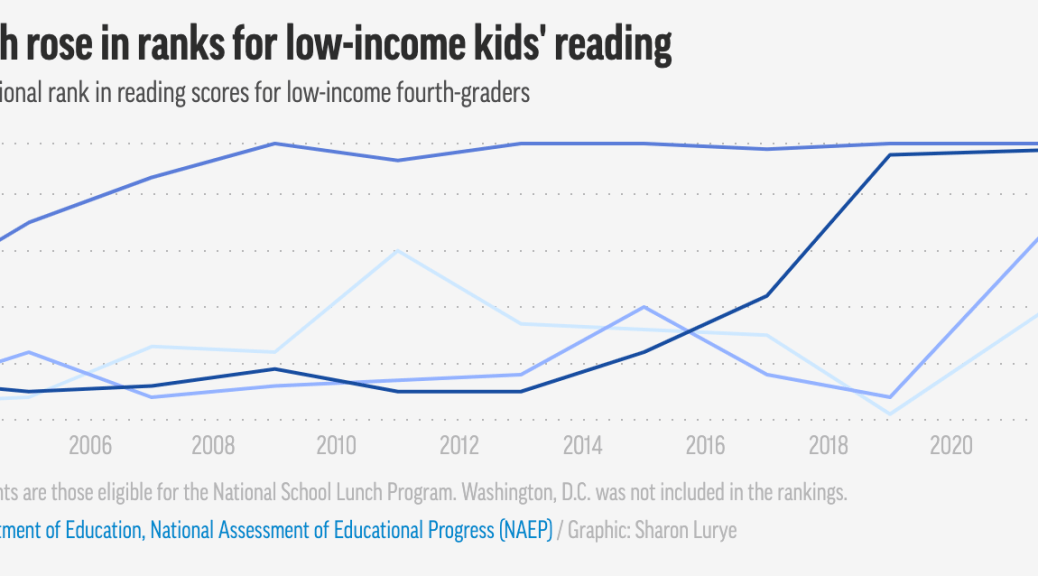
Let’s start with the “soar[ing]” NAEP reading scores in MS, LA, and AL as represented by AP:

‘Mississippi miracle’: Kids’ reading scores have soared in Deep South states

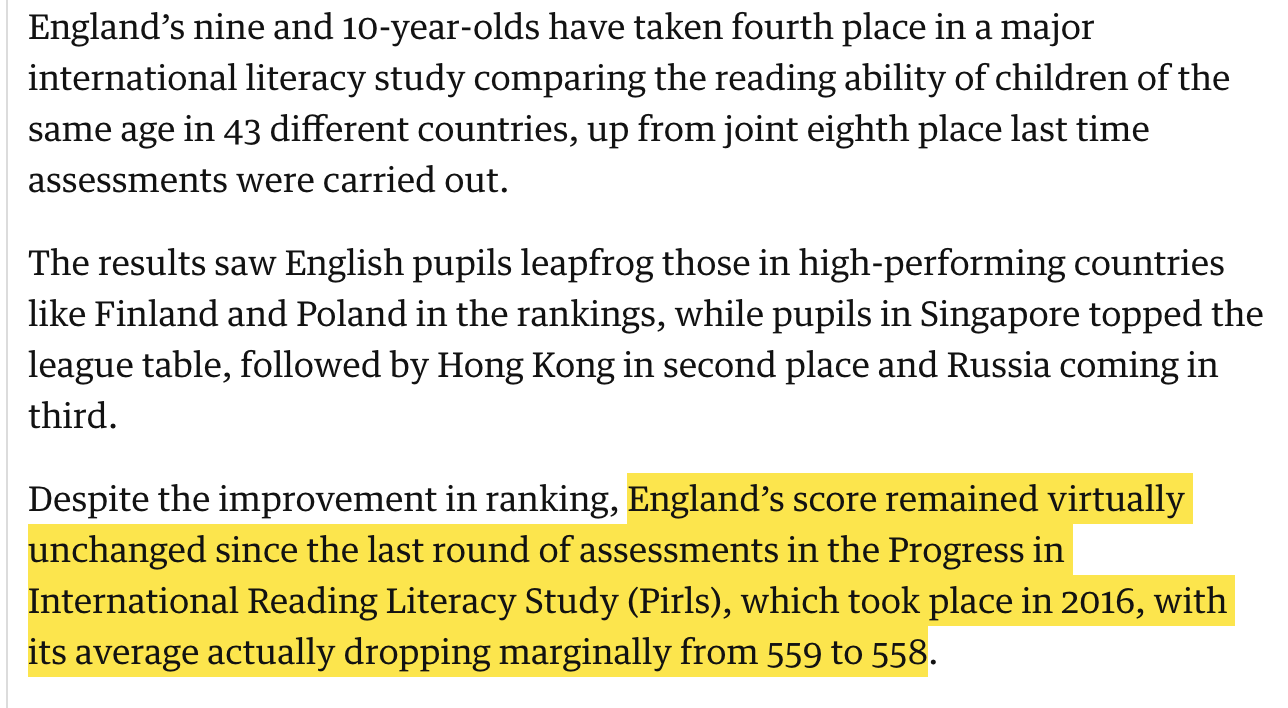
Now, let’s add the media response to PIRLS data in the UK:

Reading ability of children in England scores well in global survey

Now I will share data on NAEP and PIRLS that shows media and political responses to test scores are fodder for their predetermined messaging, not real reflections of student achievement or educational quality.

A key point is that the media coverage above represents a bait-and-switch approach to analyzing test scores. The claims in both the US and UK are focusing on rank among states/countries and not trends of data within states/countries.

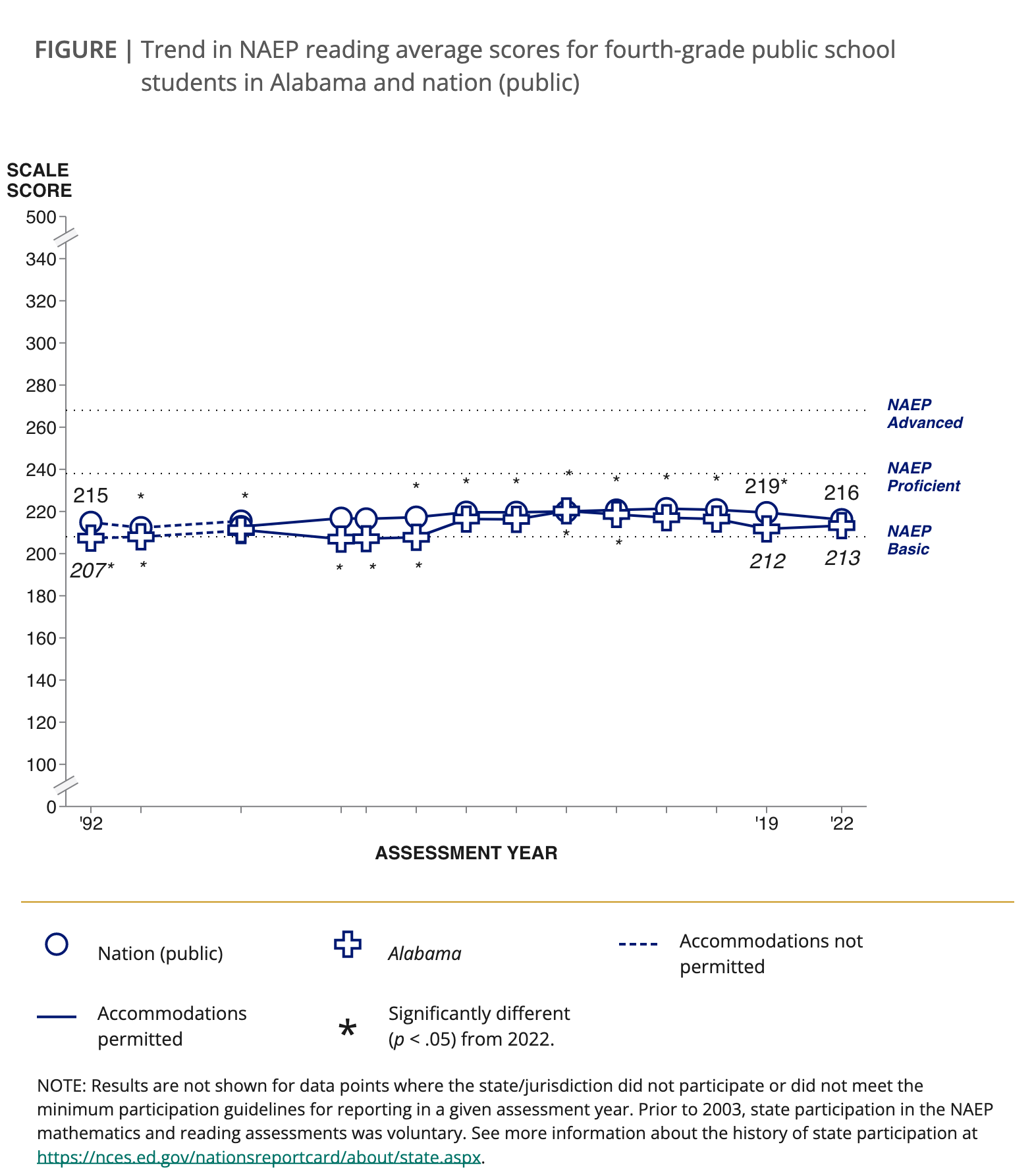
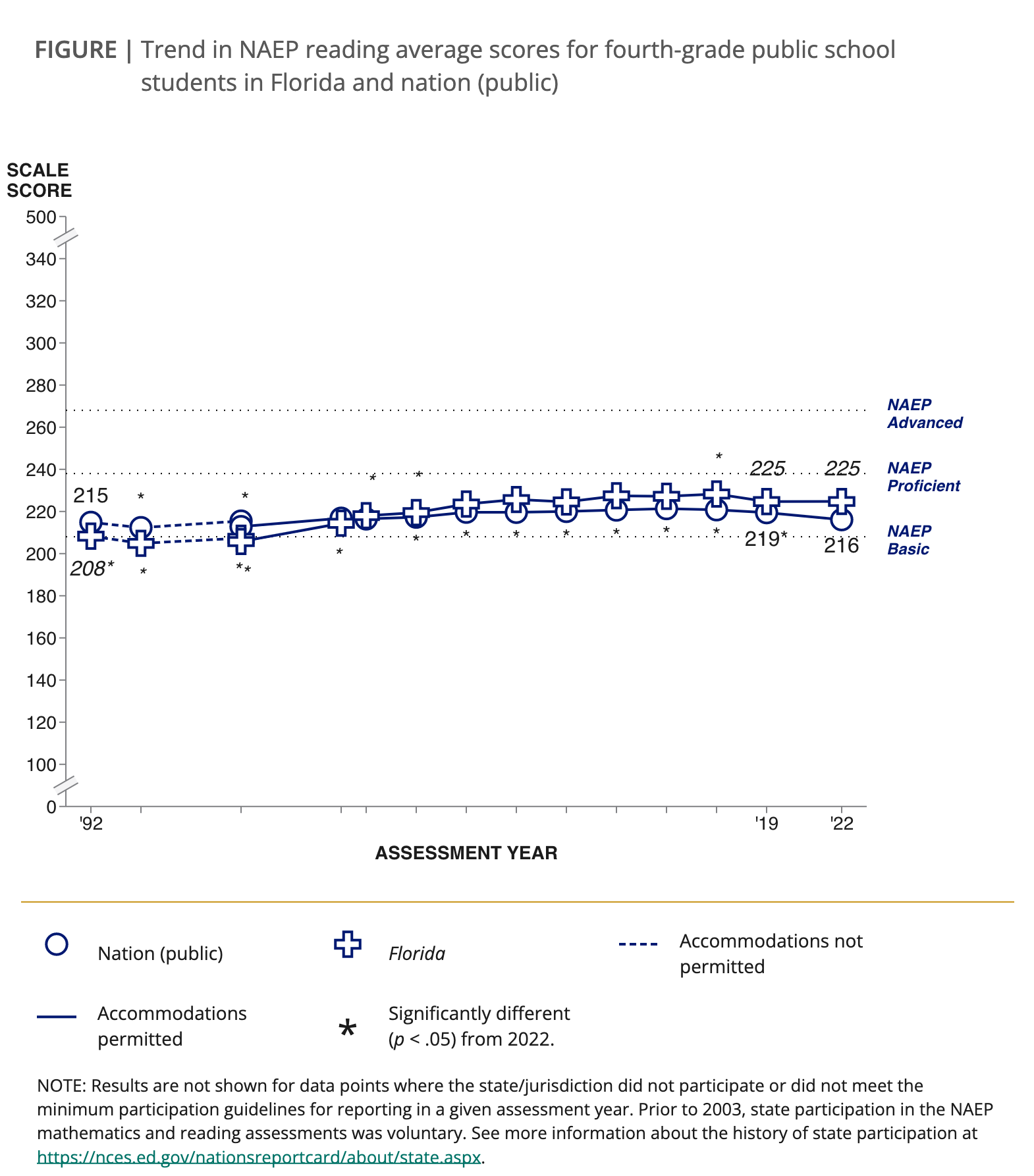
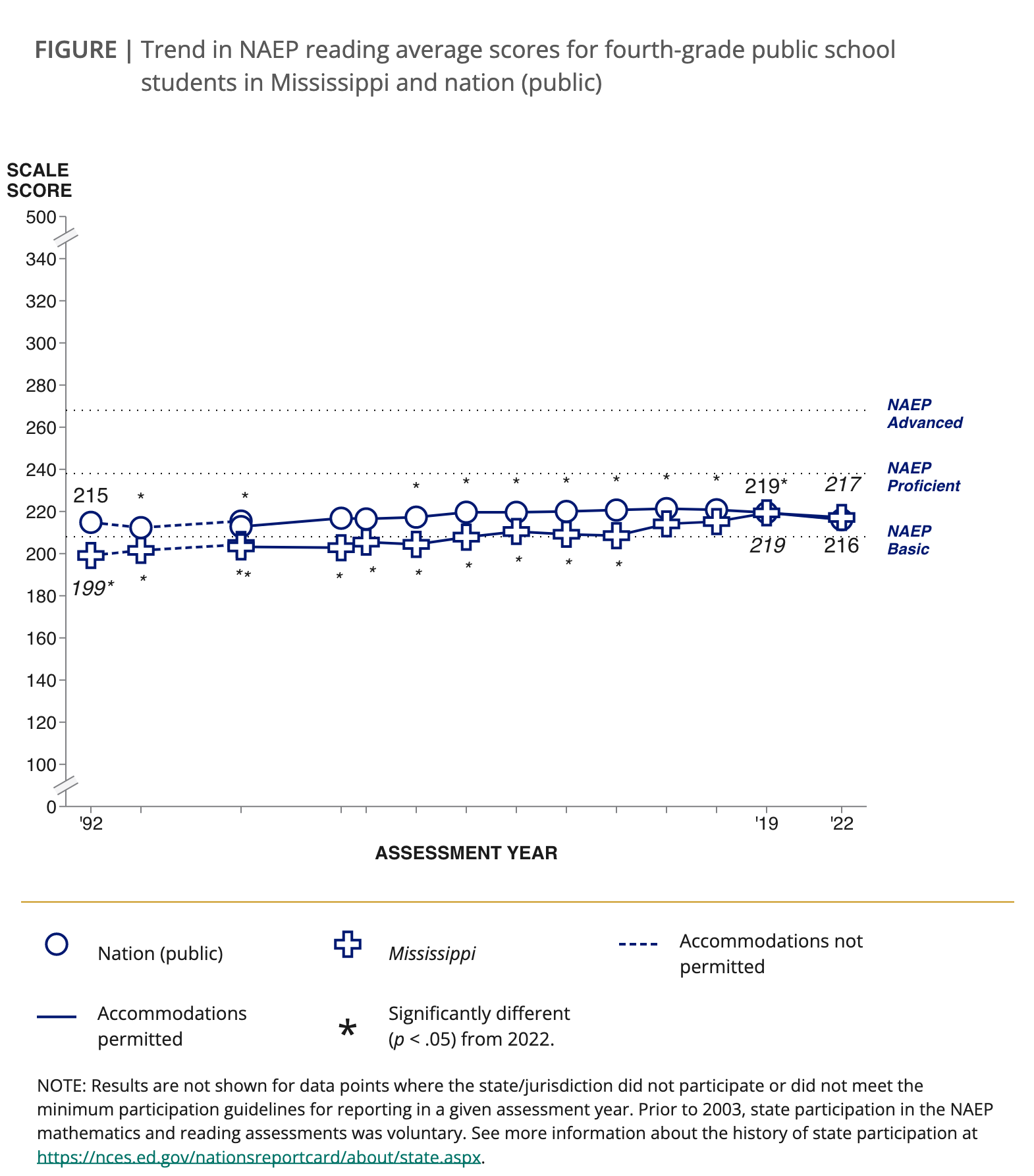
Do any of these state trend lines from FL, MS, AL, or LA appear to be “soar[ing]” data?

The fair description of the “miracle” states identified by AP is that test scores are mostly flat, and AL, for example, appears to have peaked more than a decade ago and is trending down.

The foundational “miracle” state, MS, has had two significant increases, one before their SOR commitment and one after; but there remains no research on why the increases:

Scroll up and notice that in the UK, PIRLS scores have tracked flat and slightly down as well.

The problematic elements in all of this is that many journalists and politicians have used flat NAEP scores to shout “crisis” and “miracle,” while in the UK, the current flat and slightly down scores are reason to shout “Success!” (although research on the phonics-centered reform in England since 2006 has not delivered as promised [1]).

Many problems exist with relying on standardized tests scores to evaluate and reform education. Standardized testing remains heavily race, gender, and class biased.

But the greatest issue with tests data is that inexpert and ideologically motivated journalists and politicians persistently conform the data to their desired stories—some times crisis, some times miracle.

Once again, the stories being sold—don’t buy them.


Recommended

Three Twitter threads on reading, language and a response to an article in the Sunday Times today by Nick Gibb, Michael Rosen

[1] Wyse, D., & Bradbury, A. (2022). Reading wars or reading reconciliation? A critical examination of robust research evidence, curriculum policy and teachers’ practices for teaching phonics and reading. Review of Education10(1), e3314. https://doi.org/10.1002/rev3.3314

UPDATE

Mainstream media continues to push a false story about MS as a model for the nation. Note that MS, TN, AL, and LA demonstrate that political manipulation of early test data is a mirage, not a miracle.

All four states remain at the bottom of NAEP reading scores for both proficient and basic a full decade into the era of SOR reading legislation:

No Crisis, No Miracles: The False Narratives of Education Journalism

With a sort of humility rarely found when someone of prominence speaks to or about education in the US, celebrated author Ralph Ellison (Invisible Man) found himself speaking at a teachers conference in 1963 “to discuss ‘these children,’ the difficult thirty percent,” the identified population making up the drop-out crisis of the time [1].

One of the most impressive aspects of Ellison’s talk is his emphasis on systemic influences on children and their language acquisition: “The American scene is a diversified one, and the society which gives it its character is a pluralistic society-or at least it is supposed to be,” explaining:

The education which goes on outside the classroom, which goes on as they walk within the mixed environment of Alabama, teaches children that they should not reach out for certain things. Much of the education that I received at Tuskegee (this isn’t quite true of Oklahoma City) was an education away from the uses of the imagination, away from the attitudes of aggression and courage. This is not an attack. This is descriptive, this is autobiographic. You did not do certain things because you might be destroyed. You didn’t do certain things because you were going to be frustrated. There were things you didn’t do because the world outside was not about to accommodate you….

It does me no good to be told that I’m down on the bottom of the pile and that I have nothing with which to get out. I know better. It does me no good to be told that I have no heroes, that I have no respect for the father principle because my father is a drunk. I would simply say to you that there are good drunks and bad drunks. The Eskimos have sixteen or more words to describe snow because they live with snow. I have about twenty-five different words to describe Negroes because I live principally with Negroes. “Language is equipment for living,” to quote Kenneth ’Burke. One uses the language which helps to preserve one’s life, which helps to make one feel at peace in the world, and which screens out the greatest amount of chaos. All human beings do this.

What These Children Are Like

And then Ellison goes right to the core issue about language in marginalized and minoritized populations:

Some of us look at the Negro community in the South and say that these kids have no capacity to manipulate language. Well, these are not the Negroes I know. Because I know that the wordplay of Negro kids in the South would make the experimental poets, the modern poets, green with envy. I don’t mean that these kids possess broad dictionary knowledge, but within the bounds of their familiar environment and within the bounds of their rich oral culture, they possess a great virtuosity with the music and poetry of words. The question is how can you get this skill into the mainstream of the language, because it is without doubt there. And much of it finds its way into the broader language. Now I know this just as William Faulkner knew it. This does not require a lot of testing; all you have to do is to walk into a Negro church….

Thus we must recognize that the children in question are not so much “culturally deprived” as products of a different cultural complex. I’m talking about how people deal with their environment, about what they make of what is abiding in it, about what helps them to find their way, and about that which helps them to be at home in the world. All this seems to me to constitute a culture. If you can abstract their manners, their codes, their customs and attitudes into forms of expression, if you can convert them into forms of art, if you can stylize them and give them many and subtle ranges of reference, then you are dealing with a culture. People have learned this culture; it has been transferred to them from generation to generation, and in its forms they have projected their most transcendent images of themselves and of the world.

What These Children Are Like

On social media, I had a cognitive scientist SOR-splain to me literacy in my home state of South Carolina, recommending I look at narrow assessments of reading (a popular program) to admit that SC has a reading crisis. Like Ellison, I pointed out I don’t need a test to know the truth about reading and literacy in SC, all across the South, and even in the US.

In my 39th year as a literacy educator in SC, where I was born in 1961 and attended formal education from 1967 through 1998, I have lived and witnessed firsthand a fact that the media narratives never capture, but let me ask you to help me before I explain the real story.

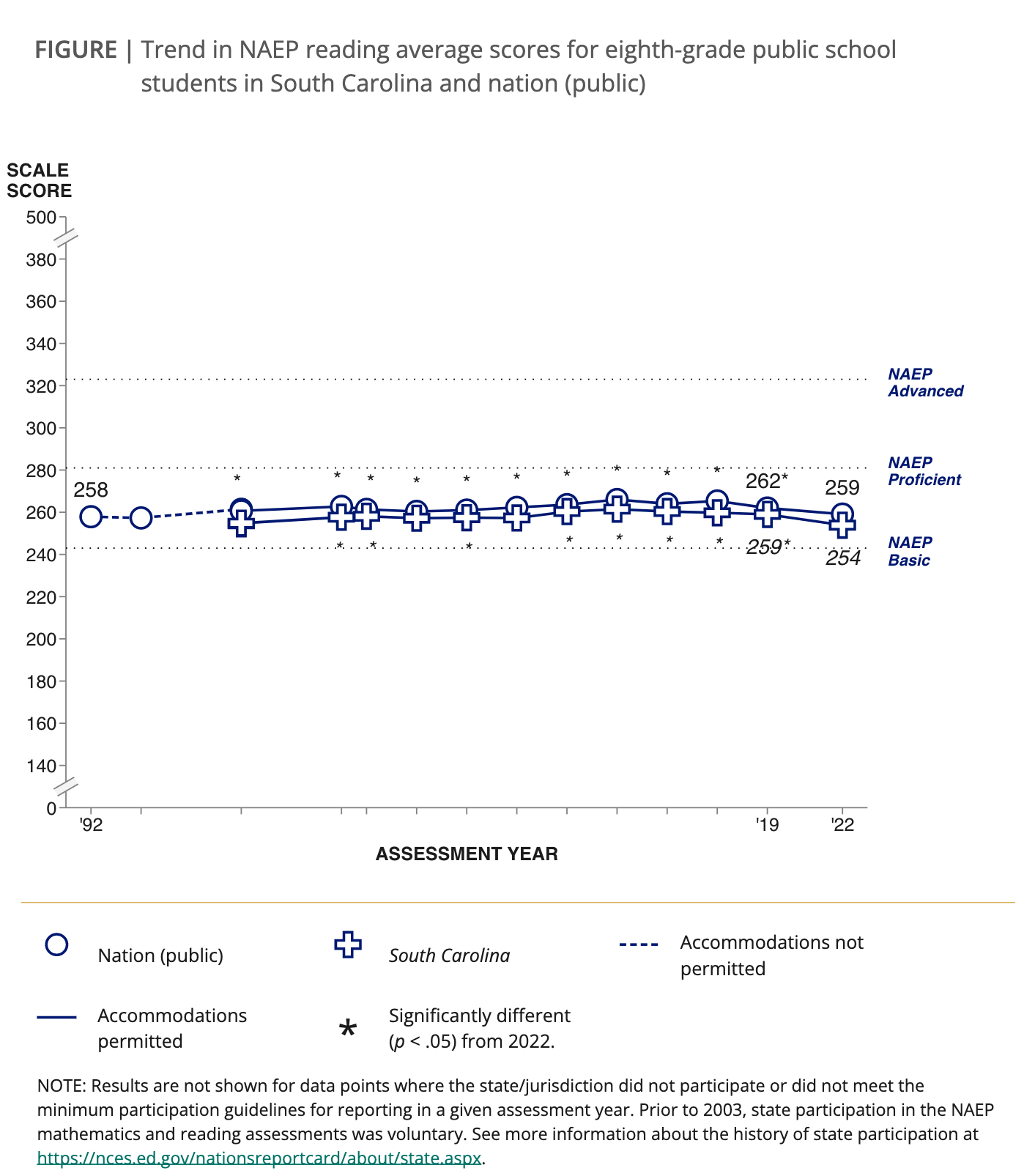
Here are longitudinal data for SC NAEP reading scores in grades 4 and 8 from 1992 to 2022; could you please identify where the “crisis” is?:

I lived, learned, and taught in the three decades before these three decades, and I can only conclude that reading achievement (whatever that is) as measured in formal testing has been about the same forever.

In my home state and across the nation, this is the real story: We have become content with a historical and current negligence about the reading acquisition of some populations (Black and brown students, poor students, special needs students, multi-lingual learners), and we lack the political will to address the systemic forces of inequity in the lives and schooling of these students to do anything about it.

Historical negligence is not a crisis; it simply is how things are, what we have come to accept as “normal.”

As I have examined in my scholarship [2], journalism in the US has only two false stories about education—crisis and miracle.

The problem is that neither narrative is true; they are anecdotal and melodramatic so they are compelling to the public, politically useful, and likely to drive reader/viewership for the media.

The US remains in a false crisis cycle begun by A Nation at Risk, and then powerfully expanded under the Obama/Duncan era of shouting education crisis while propping up the false charter school miracle machine (for example, the Harlem “miracle” celebrated by David Brooks citing the Obamas).

The crisis/miracle narrative approach from the Obama era has recently been replicated by the media obsession with SOR; Hanford’s seminal story planted both seeds by falsely claiming the US has a reading crisis and promoting a miracle school that wasn’t.

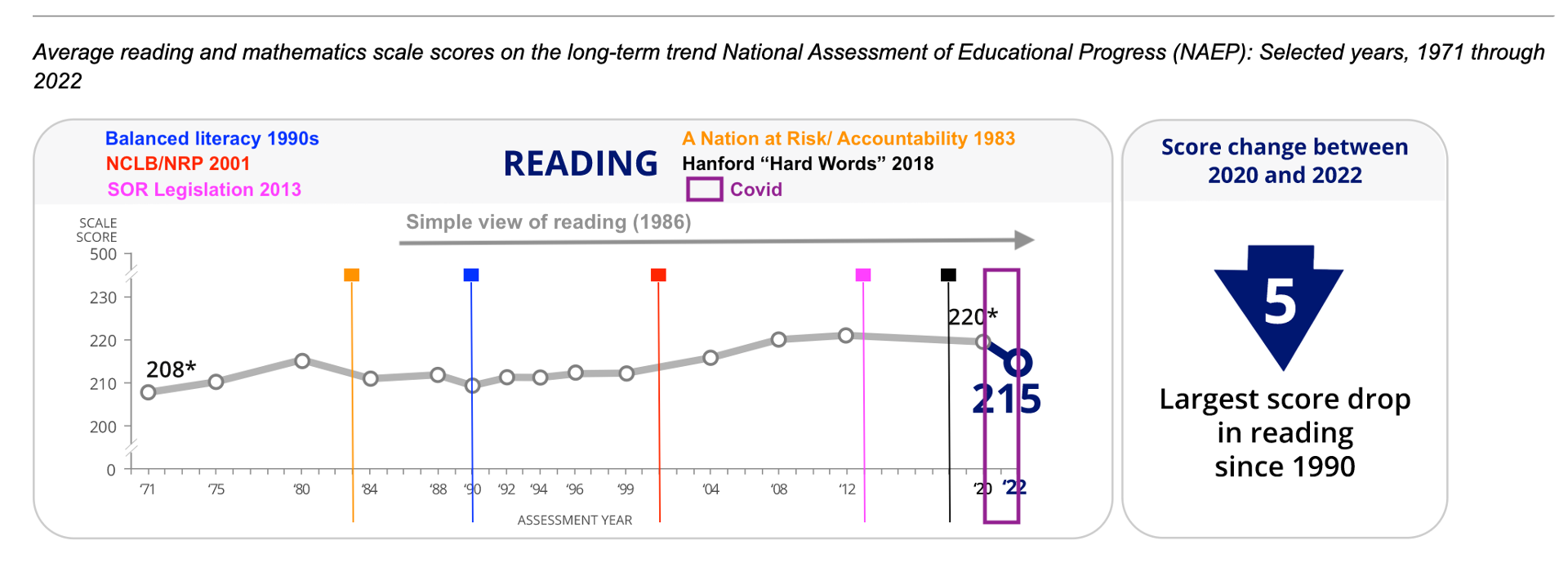
Again, please point out the crisis here:

And as I have explained, the miracle of the moment, Mississippi, like all the other educational miracles, simply doesn’t exist; MS has had steady growth and some jumps, often well before any SOR reading legislation:

And MS remains below NAEP proficient and continues to have drops between grade 4 and 8:

For many years, I have had to help my students navigate the media obsession with the melodramatic—crisis! miracle!—often found in films such as Waiting for Superman (false union crisis v. charter miracles) and the compelling documentary about education in SC, Corridor of Shame (an emotionally manipulative film about the powerful connection between poverty and educational negligence in the state).

The media, public, and politicians love and benefit from the crisis/miracle rhetoric about education. But those stories do not serve the needs of children, teachers, or schools.

Ellison ends his talk powerfully:

I don’t know what intelligence is. But this I do know, both from life and from literature: whenever you reduce human life to two plus two equals four, the human element within the human animal says, “I don’t give a damn.” You can work on that basis, but the kids cannot. If you can show me how I can cling to that which is real to me, while teaching me a way into the larger society, then I will not only drop my defenses and my hostility, but I will sing your praises and help you to make the desert bear fruit.

What These Children Are Like

Education journalism has reduced education to crisis or miracle, and like the reductive formula Ellison rejects for children, I must reject this false pair of stories.

There is no reading or education crisis, and there are no miracle schools.

There is historical and current political negligence for addressing inequity in the lives and schooling of “other people’s children” in the US.

But that reality doesn’t sell or garner votes.


[1] Toward end, Ellison is scathing:

The great body of Negro slang–that unorthodox language–exists precisely because Negroes need words which will communicate, which will designate the objects, processes, manners and subtleties of their urban experience with the least amount of distortion from the outside. So the problem is, once again, what do we choose and what do we reject of that which the greater society makes available? These kids with whom we’re concerned, these dropouts, are living critics of their environment, of our society and our educational system, and they are quite savage critics of some of their teachers.

What These Children Are Like

[2] Thomas, P.L. (2016). Miracle school myth. In W.J. Mathis & T.M. Trujillo, Learning from the Federal Market-Based Reforms: Lessons for ESSA. Charlotte, NC: IAP.

Thomas, P.L. (2015). Ignored under Obama: Word magic, crisis discourse, and utopian expectations. In P. R. Carr & B. J. Porfilio (Eds.), The phenomenon of Obama and the agenda for education: Can hope (still) audaciously trump neoliberalism? (pp. 45-68). Charlotte, NC: Information Age Publishing.

The “Manufactured Crisis” and the Repeated Failure of Education Journalism [UPDATED]

[Header Photo by Nik on Unsplash]

For people not in the field of education, A Nation at Risk is either a hazy (or nonexistent) footnote of history or a pedestrian (and obvious) claim that didn’t need a government committee to announce—US public education is a failure.

However, for all its fanfare and eager media coverage, the real significance of the politically driven report is that it set in motion a pattern still vibrant in 2023; mainstream media is constantly fanning the flames of “manufactured crisis.”

A Nation at Risk was a media, public, and political hit, but scholars were quick to note that the claims in the report were overstated, oversimplified, and lacking any credible evidence [1].

In short, manufactured.

From the early 1980s and into the 2020s, mainstream education journalism has hopped feverishly from crisis to crisis and endorsed boondoggle after boondoggle—never once stopping to say “My bad!” or to pause, step back, and reconsider their template.

David Labaree concludes:

When the state takes the quantified depiction of schooling that educational researchers provide and uses it to devise a plan for school reform, the best we can hope for is that the reform effort will fail.  As the history of school reform makes clear, this is indeed most often the outcome.  One reform after another has bounced off the classroom door without having much effect in shaping what goes on inside, simply because the understanding of schooling that is embodied in the reform is so inaccurate that the reform effort cannot survive in the classroom ecology.  At worst, however, the reform actually succeeds in imposing change on the process of teaching and learning in classrooms.  Scott provides a series of horror stories about the results of such an imposition in noneducational contexts, from the devastating impact of the collectivization of agriculture in the Soviet Union to the parallel effect of imposing monoculture on German forests.  The problem in all these cases is that the effort to impose an abstract technical ideal ends up destroying a complex distinctive ecology that depends on local practical knowledge.  The current efforts by states across the globe to impose abstract technical standards on the educational village bear the signs of another ecological disaster.

The Lure of Statistics for Educational Researchers

As a result, a stunningly harmful pattern has emerged:

  • Amanda Ripley was wrong about Michelle Rhee.
  • Jay Matthews and Paul Tough were wrong about “no excuses” charter schools and Teach For America.
  • David Brooks was wrong about “miracle” charter schools (and everything else).
  • [Insert journalist] was wrong about Common Core and VAM.

And now, rest assured it will come to pass, Emily Hanford and Natalie Wexler are wrong about the “science of reading.”

Remember Waiting for Superman?

Sold a Story and The Truth about Reading are the same melodramatic misinformation campaign depending on an uninformed public to sell yet another educational crisis.

There will be no reckoning; there never is.

But some day (soon?) the “science of reading” histrionics will be a faint memory while everyone scrambles to the next education manufactured crisis.

The only things not to be addressed, of course, are the actual needs of students, teachers, and universal public education.


[1] See Gerald Bracey, Gerald Holton, and David Berliner and Bruce Biddle (who coined “manufactured myth”).

The Return of Missionary Zeal in Education Reform: “Science of Reading” Edition

Increasingly, I am contacted by email or spoken to in person by teachers with a similar and disturbing series of experiences.

These teachers ask to remain anonymous out of fear of retaliation because they have already been reprimanded or dismissed for simply asking questions about their school/district’s implementing the “science of reading.”

One recent communication I received represents well that pattern (I am paraphrasing and reducing specifics to protect anyone trying to identify the specific teacher, and this is representative of dozens and dozens of similar communications).

The teacher has been a literacy educator well over a decade and also has earned a doctorate. A few years ago, this teacher had a first experience with LETRS training being required for university faculty where they were on one-year contracts.

After asking about why LETRS was being required and noting that the research base doesn’t support that training as effective, the teacher was shunned by their administrator and then their contract wasn’t renewed.

Before leaving that school, they noticed some faculty had simply stopped attending the training, but the administrator sought other faculty to log in to complete that training. The teacher grew concerned that there seemed to be some incentive for simply having many faculty trained.

At a new school, that teacher was immediately required to go through LETRS training. They described the training as a “cult” experience in which professional educators were handed pipe cleaners and asked to make models of the “simple view” of reading (Scarborough’s rope).

While I have repeatedly documented (along with several other scholars; access materials HERE) that the “science of reading” movement is primarily over-simplified narratives and misinformation, I want here to address that the central flaw in the movement is one we have seen in recent history regarding education reform: missionary zeal.

It is important to emphasize that I am aware of no one who rejects that a body of reading science/research exists and that should be a significant part of what drives classroom practice.

However, the media-driven SOR movement and the political consequences of that advocacy that has resulted in SOR-labeled policy are oversimplified and misguided versions of that research base.

And that new policy is often unscientific and harmful such as the pervasive implementation of grade retention.

Further the SOR movement fails to ground the narrative in the history of the field of reading and education reform.

For example, during the “miracle” school/teacher era spanning from George W. Bush through Barack Obama, missionary zeal drove Teach For America, charter schools, “miracle” school claims, and value-added methods for evaluating teachers.

At the core of these connected elements of education reform is a missionary zeal that ultimately failed to produce what was guaranteed, primarily because the reformers misidentified the problems and offered misguided solutions. In the case of the SOR movement, the same mistake is being made by claiming that reading science is simple and settled.

Currently, the “science of reading” movement has fallen into the missionary zeal trap as represented by The Reading League:

The similarities in these two recent movements are important and damning:

The criticisms I have raised are directly targeting the missionary zeal and misinformation found in the media story [1] and the political reaction [2] to that false narrative.

Reading proficiency in the US is about the same now as well before anyone implemented balanced literacy or current popular (and demonized) reading programs. And persistently over the last 80 years, scholars have lamented the “considerable gap” between research and practice in all aspects of K-12 education.

Throughout those 80-plus years, no one has ever been satisfied with student reading achievement regardless of the reading theory being implemented or the reading programs being adopted.

And teacher preparation has been significantly hampered for the past 40 years by top-down accountability mandates that have reduced most teacher certification to more bureaucracy than preparation. A dirty little secret that SOR advocates ignore is that how teachers are prepared to teach reading matters little because most teachers are bound to reading programs and reading standards once they enter the classroom. A huge gap exists between how teachers are prepared and how they are allowed to teach.

But manufacturing a crisis, perpetuating melodramatic stories, and casting simplistic blame are doing the same things we have done in education reform for decades without ever truly supporting teachers or better serving all students.

Just like the TFA and charter/”miracle” school era immediately behind us, the SOR movement is anti-teacher and anti-schools. The public and political leaders have been well primed since the 1980s to believe that schools are horrible and that teachers are incompetent. Regardless of what SOR advocates intend, that is what most people hear.

SOR advocates have falsely attacked teacher expertise, both that of K-12 teachers and that of teacher educators (many of whom had long careers as K-12 teachers); these attacks are often grounded in agendas and reports that are not themselves scientific (such as reports from NCTQ), and solutions offered (LETRS) lack scientific grounding as well.

Just as there is a robust and deep body of reading science, there are sincere educators who are engaged with that research base but also recognize that the SOR movement and SOR policy are not aligned with the complex and still developing reading science.

The SOR movement and much of SOR implementation are corrupted by missionary zeal that creates a veneer for the essentially anti-teacher elements—scripted curriculum (structured literacy), mandated retraining (LETRS), and caricatures of teacher educators, teacher education, balanced literacy, three cueing, and reading programs

An authentic embracing of reading science would acknowledge that current research is complex and evolving, that the causes of students struggling to read are also complex and include influences beyond and in the classroom (not just teacher practice but teaching/learning conditions such as class size and funding), that professionals engaging with research should raise questions and challenge conventional wisdom and traditional assumptions in order to serve the individual needs of students, that one-size-fits-all solutions for students and teachers don’t exist, and that educational practices should be grounded in teacher expertise—not journalists, parents, and politicians.

Missionary zeal is problematic in the same way as people who claim to know the mind of god (I unpack that in the newest arc of Daredevil), creating tunnel vision and arrogance while casting blame and judgment toward anyone or anything that dare raise a valid question or concern.

Just as TFA lured thousands into the program and thousands more to champion the idealistic (and unrealistic) blame-game as well as promises of miracles only to collapse under the weight of its own propaganda, SOR is following the same guaranteed-to-fail strategy.

And, yes, many good people jump on bandwagons with good intentions (I have several people I greatly admire who came through TFA), but eventually, we must all come to terms with the deeply flawed elements of this SOR movement. We must remain committed to individual student needs and teacher autonomy—not movements, slogans, and market boondoggles.

The reasons students have struggled for decades to acquire reading as well or as soon as we’d like are multi-faceted and mostly grounded outside of schools; therefore, the solutions are also complex and quite large.

From the TFA/”miracle” school era to today’s SOR movement, these false narratives are compelling because they are simple (simplistic), but they are destined to cause far more harm than good to students, teachers, and schools.

Beware missionary zeal—especially when dealing with why our schools and students struggle and what solutions advocates offer with passionate certainty.


Recommended

Trainwreck For America

[1] Media Coverage of SOR [access materials HERE]

Hoffman, J.V., Hikida, M., & Sailors, M. (2020). Contesting science that silences: Amplifying equity, agency, and design research in literacy teacher preparation. Reading Research Quarterly, 55(S1), S255–S266. Retrieved July 26, 2022, from https://doi.org/10.1002/rrq.353

MacPhee, D., Handsfield, L.J., & Paugh, P. (2021). Conflict or conversation? Media portrayals of the science of reading. Reading Research Quarterly, 55(S1), S145-S155. Retrieved July 26, 2022, from https://doi.org/10.1002/rrq.384

Cryonics Phonics: Inequality’s Little Helper – New Politics

[UPDATE]

The Science of Reading and the Media: Is Reporting Biased?, Maren Aukerman, The University of Calgary

The Science of Reading and the Media: Does the Media Draw on High-Quality Reading Research?, Maren Aukerman

The Science of Reading and the Media: How Do Current Reporting Patterns Cause Damage?, Maren Aukerman

Making sense of reading’s forever wars, Leah Durán and Michiko Hikida

[2] Thomas, P.L. (2022). The Science of Reading movement: The never-ending debate and the need for a different approach to reading instruction. Boulder, CO: National Education Policy Center. http://nepc.colorado.edu/publication/science-of-reading

The Crumbling Facade of “No Excuses” and Educational Racism

Sarah Karp offers a long overdue and somewhat surprising opening lede for WBEZ Chicago, home to a number of charter school chains:

Chicago’s largest charter school network sent a letter to alumni this week admitting that its past discipline and promotion policies were racist and apologizing for them. The apology is notable not just as an acknowledgment of misguided policies, but as a repudiation of the “no-excuses” philosophy adopted by many charter schools during the 2000s.

Top Chicago Charter School Network Admits A Racist Past

“No excuses” ideologies and practices have been a foundational staple of charter schools disproportionately serving Black students, Hispanic students, and poor students well back into the 1990s but blossoming in the 2000s since both political parties jumped on the charter school bandwagon. By the late 2000s, mainstream media and the Obama administration were all-in on charter schools as “miracles.”

There were always two problems with the charter school mania and propaganda—data never supported the “miracle” claims (see my “Miracle School Myth” chapter), and worse of all, “no excuses” ideology has always been racist, shifting the blame and gaze onto students and teachers in order to ignore systemic inequity and racism.

“No excuses” schools always began with the assumption that Black, Hispanic, and poor students are fundamentally “broken” and must be “fixed”—an ugly and racist version of deficit thinking.

Almost a decade ago, I spoke at the University of Arkansas after the publication of my book on poverty and education; in that work and talk, I directly challenged “no excuses” ideologies and charter chains as harmful and, yes, racist.

In the wake of that talk, I was discounted and mis-characterized in Education Next, along with an equally unfair swipe at another KIPP critic, Jim Horn: “critics fear that disadvantaged parents do not know enough to choose wisely, or else do not have their children’s best interest at heart.”

Neither Horn nor I hold those views, and our criticisms were firmly and clearly grounded in arguing that “no excuses” is essentially racist and classist.

As I have documented, when I contacted the article authors about the false narrative they created around Horn and me, Maranto both admitted the framing was unfair and claimed the article would be updated; it never was.

The Noble charter chain mea culpa is likely too little, too late, but it is a serious crack in the facade perpetuated by “no excuses” advocates over the last two decades, included so-called “scholars” at the Department of Educational Reform (University of Arkansas) where Maranto works.

Many years ago, in fact, after dozens of blog posts and talks, I co-edited a volume refuting “no excuses” and proposing social context reform instead.

Jim Horn has an excellent volume confronting and dismantling the many problems with KIPP charter schools, Work Hard, Be Hard: Journeys Through “No Excuses” Teaching.

Our work, along with many other scholars and educators committed to equity and anti-racism, has been ignored and often directly attacked, primarily because we dare to name racism as “racism.”

While I am not suggesting that Noble’s confession trumps our scholarship and work that has spanned multiple decades, I do want anyone concerned about education, education reform, and educational equity to step away from assumptions and see clearly how harmful “no excuses” ideologies and practices have been for students and their teachers.

“No excuses” ultimately fails for many reasons—being trapped in “blame the victim” approaches that normalize an unspoken white and affluent standard against which marginalized populations of students are judged, and harmed.

“No excuses” has been compelling because in the U.S. we are prone to seeing all problems as individual and not systemic. But it has also been compelling because education reform has always been tragically drawn to silver-bullet solutions and the shiny mirages seen as “miracles.”

Let me stress here that currently “no excuses” has quite a number of equally racist and flawed practices entrenched all across K-12 schooling: “grit,” growth mindset, word gap, Teach for America, grade retention, and the poverty workshops of Ruby Payne.

K-12 education in the U.S. is mostly a reflection of the communities schools serve; our schools tend to house and perpetuate our social inequities, but schools do very little to overcome racism, sexism, classism, etc.

Education reform has for nearly four decades refused to acknowledge systemic inequity, choosing instead to punish students, teachers, and schools. The many policies and fads of education reform over those decades have been themselves racist and classist, ultimately doing more harm than good to students, teachers, and education.

Karp includes an important realization by Jennifer Reid Davis, chief equity officer for Noble:

“It’s important to own it,” she said. “I think you have to say it, I think you have to be honest. Part of what it truly means to be anti-racist is to be honest about the circumstances in which you are in and or created.”

Top Chicago Charter School Network Admits A Racist Past

The list is quite long still of those who need “to own it” and allow confronting racism to be the first step to ending racism in our schools and our society.

Educational Accountability and the Science of Scapegoating the Powerless

Several years ago when I submitted an Op-Ed to the largest newspaper in my home state of South Carolina, the editor rejected the historical timeline I was using for state standards and testing, specifically arguing that accountability had begun in the late 1990s and not in the early 1980s as I noted.

Here’s the interesting part.

I began teaching in South Carolina in the fall of 1984, the first year of major education reform under then-governor Richard Riley. That reform included a significant teacher pay raise, extended days of working for teachers, and the standards-testing regime that would become normal for all public education across the U.S.

In fact, SC’s accountability legislation dates back to the late 1970s (I sent her links to all this).

As a beginning teacher, the only public schooling I ever knew was teaching to standards and high-stakes tests by identifying standards on my lesson plans and implementing benchmark assessments throughout the academic year to document I was teaching what was mandated as a bulwark against low student tests scores. State testing, including punitive exit exams, pervaded everything about being an English teacher.

Yet, an editor, herself a career journalist, was quick to assume my expertise as a classroom practitioner and then college professor of education was mistaken.

This is a snapshot of how mainstream media interact with education as a topic and educators as professionals.

I am reminded of that experience over and over in fact as I read media coverage of education. Take for example this from Education Week, Want Teachers to Motivate Their Students? Teach Them How, which has the thesis:

Most teachers intrinsically understand the need to motivate their students, experts say, but teaching on intuition alone can lead to missteps in student engagement.

A study released in May by the Mindset Scholars Network, a collaborative of researchers who study student motivation, found most teacher education programs nationwide do not include explicit training for teachers on the science of how to motivate students.

Want Teachers to Motivate Their Students? Teach Them How

Two key elements of this article stand out: The new scapegoat in proclaiming education a failure is teacher education and the go-to failure is always about a lack of “science” in teacher education.

This article on motivation is following a media template well worn recently about students in the U.S. can’t read because teachers are not taught the “science of reading,” you guessed it, in their teacher education programs.

As I detailed in a Twitter thread, scapegoating teacher education has many flaws, and my experience and expertise as a teacher educator for almost two decades, following almost two decades as a classroom teacher, inform my understanding of how finding scapegoats for educational failure during the accountability era is fool’s gold.

How has the accountability era gone in terms of where the accountability and locus of power lie, then?

In the 1980s and 1990s, the accountability mechanisms focused on holding students accountable (think exit exams) and schools accountable (student test scores often translated into school rankings or grades, designating schools as “failing,” for example).

Keep in mind that students had no power in that process, and that schools were merely agents of the standards being implemented, again outside the power dynamics of those mandates being determined.

With No Child Left Behind spawned by the false claims of the Texas Miracle, the accountability era was greatly accelerated, including a creeping sense that the process wasn’t improving education but it was punishing students (lower graduation rates due to exit exams) and demonizing schools (most high-poverty and high-racial minority schools were labeled as “failing”).

By the administration of Barak Obama, with education policy under another false narrative (the Chicago Miracle) and false ambassador with no background in education other than appointments (Arne Duncan), the scapegoating took a turn—the problem, went the new message, was “bad” teachers and the solution was not holding students or schools accountable for test scores but those teachers (the era of value-added methods [VAM]).

As some have noted and documented, teacher bashing increased and then prompted a backlash (see magazine covers from Time for a great series of artifacts on this); it seems that VAM proved to be a false metric for accountability and that maybe teachers were not the problem after all.

With the scapegoat role now vacant, the media have discovered a new candidate, teacher education.

Let’s here recognize that once again the power context is way off in who is determining the accountability and who is being held accountable. For the most part, teachers and teacher educators are relatively powerless agents who are mandated to implement standards and assessments that they do not create and often do not endorse as valid.

Now consider another really important reason accountability in education is deeply flawed: The constant misguided scapegoating of powerless agents in formal teaching and learning is a distraction from the actual causal sources for educational challenges.

Fun fact: Decades of research from educators and education scholars have detailed that out-of-school factors overwhelmingly determine measurable student outcomes, some estimates as high as 80+% and most scholars agreeing on 60%. Teacher quality’s impact on measurable student achievement has been identified repeatedly as only about 10-15%.

Yet, the entire accountability era since the early 1980s has focused on in-school reforms only (scapegoating along the way), while tossing up hands and embracing harsh ideologies such as “no excuses” practices that argue teachers fail students with the “soft bigotry of low expectations” and students fail because they lack “grit” or a growth mindset.

Many of us have doggedly argued for social context reform, addressing socio-economic reform first and then reforming education along equity (not accountability) lines next, or concurrently. Many of us have also demonstrated that “grit” and growth mindset have racist and classist groundings that are harmful.

For those positions, we have been demonized and marginalized for decades.

So imagine my surprise when, first, the tide shifted on teacher bashing (I have 34 posts on my blog discrediting VAM and dozens on misunderstanding teacher quality) and then these articles: Better Schools Won’t Fix America (The Atlantic), The Harsh Discipline of No-Excuses Charter Schools: Is It Worth the Promise? (Education Week), and Unchartered territory: 2020 Democrats back away from charter schools (MSN).

My blog posts, however, on social context reform and poverty (157), “no excuses” reform (70), and the mirage of charter schools (80) have either mostly been ignored or are harshly (even angrily) rejected. Like my interaction with the editor discussed in the opening, my experience and expertise as an educator and education scholar have held almost no weight with those in power pr the media.

The media and journalists as generalists seem deeply resistant to learning a lesson they create over and over.

Take for a current example Karin Wulf’s examination of Naomi Wolff and Cokie Roberts; Wulf herself is a historian:

It’s been a tough few weeks for amateur history. First, journalist Naomi Wolf discovered on live radio that she had misinterpreted key historical terms in her new book, “Outrage,” leading her to draw the wrong conclusions. A week later, journalist Cokie Roberts, too, got a quick smackdown when she claimed on NPR that she couldn’t find any incidence of abortion advertised in 19th century newspapers, a claim quickly disproved by historians.

Wolf and Roberts fell victim to a myth widely shared with the American public: that anyone can do history. Whether it’s diving into genealogy or digging thorough the vast troves of digital archives now online, the public has an easy way into the world of the past. And why would they imagine it takes any special training? After all, the best-selling history books are almost always written by non-historians, from conservative commentators like Bill O’Reilly to journalists like Wolf and Roberts.

What Naomi Wolf and Cokie Roberts teach us about the need for historians

Wulf’s confronting “that anyone can do history” immediately prompted in me my experience when I first moved from teaching high school English (and adjuncting at several colleges, including being a lead instructor in a university-based summer institute of the National Writing Project) to higher education. My university was debating a curriculum change that included dropping traditional composition courses (popularly known as English 101 and English 102) for first-year seminars.

One of those first-year seminars was to be writing-intensive, and the argument being posed was that any professor could teach writing.

This change passed, and the English department and professors were relieved of sole responsibility for teaching writing.

Over the next eight years or so, the university learned a really disturbing lesson (one I could have shared in the beginning): “Any professor can teach writing” is false.

As Wulf argues about history, with writing and education, experience and expertise matter.

So here I sit again, writing over and over that the media are getting reading wrong, that scapegoating teacher education is missing the real problem.


How many years will it take until I see articles “discovering” these facts as if no one with experience and expertise ever raised the issue?

New Orleans RSD Mirage, Not Miracle: A Reader

The political/bureaucratic education reform machine that began with the bogus A Nation at Risk report under Ronald Reagan has been aided and abetted for almost 40 years now by the feckless mainstream media (MSM).

That education reform agenda has been a recurring pattern of overstated and unmerited polices grounded in ideology, but education reformers are powerful advocates, bolstering their reforms with more public relations than expertise; the MSM repeatedly falls for the hucksterism hook, line, and sinker.

In the ugly and harmful lineage of education reform “miracles”—Texas, Chicago, Washington DC, Tennessee, etc.—comes the new darling of education reform mirages, New Orleans:

Not surprising, but always disappointing, is that education-related media remain deeply misleading, and thus, complicit in an education reform movement more dedicated to dismantling than reforming universal public education in the name of equity and democracy.

Since I have been refuting these “miracle” claims for many years, I offer here a reader to discredit the two claims above, and the lingering political, public, and media fascination with charter schools and take-over approaches to education reform: