Category Archives: No Excuses Reform

Are Racially Inequitable Outcomes Racist?

Among what may seem to be marginally related policies and conditions, these all have one startling thing in common—grade retention, school discipline, NCAA athletics, incarceration, “grit,” “no excuses,” zero-tolerance, high-stakes testing (such as the SAT and ACT), charter schools and school choice—and that commonality is observable racially inequitable outcomes that are significantly negative for blacks.

My own experiences with exploring and confronting race and racism through my public writing has shown that many people vigorously resist acknowledging racism and will contort themselves in unbelievable ways to avoid accepting facts and data that show racism exists.

Common responses include “I am not a racist,” “I am sure the people who started X didn’t intend to be racist,” “White people experience racism too,” and “Everyone has the same opportunities in this country.”

And while I continue to compile a stunning list of ways in which racial inequity and racism profoundly impact negatively black people, resistance to terms such as “white privilege” and “racism” remain robust.

In the wake of the NCAA Final Four, Patrick Hruby has attempted a similar tactic I have used in order to unmask the racial inequity in college athletics by carefully working readers through the evidence in order to come to an uncomfortable conclusion about the financial exploitation of college athletes (money-making sports being disproportionately black) by the NCAA and colleges/universities (leadership and those profiting being overwhelmingly white) along racial lines:

Understand this: there’s nothing inherently racist about amateurism itself. And there’s no reason to believe that its defenders and proponents—including current NCAA president Mark Emmert—are motivated by racial animus….

And yet, while the NCAA’s intent is color-blind, the impact of amateurism is anything but. In American law, there is a concept called adverse impact, in which, essentially, some facially neutral rules that have an unjustified adverse impact on a particular group can be challenged as discriminatory….Similarly, sociologists speak of structural racism when analyzing public policies that have a disproportionately negative impact on minority individuals, families, and communities. State lottery systems that essentially move money from predominantly lower-class African-American ticket buyers to predominantly middle-and-upper-class white school districts fit the bill; so does a War on Drugs that disproportionately incarcerates young black men; so does a recent decision by officials in Maricopa County, Arizona, to drastically cut the number of presidential primary polling stations in and around Phoenix, which unnecessarily made voting far more difficult for the residents of a non-white majority city.

Big-time college sports fall under the same conceptual umbrella. Amateurism rules restrain campus athletes—and only campus athletes, not campus musicians or campus writers—from earning a free-market income, accepting whatever money, goods, or services someone else wants to give them. And guess what? In the revenue sports of Division I football and men’s basketball, where most of the fan interest and television dollars are, the athletes are disproportionately black.

And herein lies the problem with refusing to equate racially inequitable outcomes with racism.

Hruby’s detailed unmasking of the NCAA comes also during the troubling rise of Trump in presidential politics—another marker for how many scramble to find any cause other than racism.

Trump’s rise is not exclusively the result of overt and unexamined racism, but a significant amount of his success is easily traced to a wide spectrum of racism.

However, from the rise of Trump to the so-called popularity of charter schools to the school-to-prison pipeline and to the spread of third-grade retention policies, all of these and more are fueled by racism because racism, we must acknowledge, is most insidious when it isn’t overt, when the racist person or the racist act is unconscious, unacknowledged.

The impact of racism in NCAA sports, as Hruby details, is the elegant racism Ta-Nahisi Coates unpacked when Donald Sterling became the NBA’s face for oafish racism (along with Clive Bundy in popular culture).

What has occurred in the U.S. since the mid-1960s is an end to placard racism, the end of “White Only” signs on bathroom and restaurant doors.

What has not occurred in the U.S. yet is an end to seeing black boys as significantly older than their biological ages, an end to tracking black children into segregated schools and reductive courses, an end to incarcerating black men—and this is a list that could go on for several pages.

Racial (and class) equity will never occur in the U.S. until the white power structure admits that racially inequitable outcomes are in fact racist.

White privilege is a powerful narcotic that numbs white elites to the harm that privilege causes black and brown people, but it is also a powerful narcotic that pits poor whites against black and brown people because poor whites believe their whiteness gives them the chance at great wealth held by only a few.

That the NCAA maintains a structure within which black athletes produce wealth enjoyed almost exclusively by white elites is an undeniable fact and a startling example of the elegant racism eroding the soul of a free people—an elegant racism eating at the roots of public education, the judicial system, the economic system, and nearly ever aspect of the country.

Racially inequitable outcomes are racist, and this must be admitted in order to be confronted and then to be eliminated.

Mainstream “Both Sides” Journalism Continues to Ignore Critical Third Way

In Beyond the viral video: Inside educators’ emotional debate about ‘no excuses’ discipline, Elizabeth Green asserts about the controversy around a viral Success Academy video: “It’s complicated, more so than you might think,” adding:

Coming to any personal conclusion requires understanding a deep and very active debate about discipline, race, and the conditions that brought Charlotte Dial, the teacher in the video, to the moment that was caught on camera. Chief among those conditions: an educational philosophy known as “no excuses” that advocates for strict discipline as a critical foundation for learning.

What follows is a long and detailed examination of “no excuses” approaches to education reform, but Green’s analysis is also yet another example of how mainstream “both sides” journalism continues to ignore a critical third way.

Before examining Green’s challenge to “no excuses,” let me offer some context.

Because of high-profile incidences connected with NFL players, public debates about domestic violence toward women and corporal punishment have played out in the mainstream media.

While both topics are important, here I want to stress how mainstream media covered the two topics.

Domestic violence toward women was universally condemned without creating panels or “both sides” debates—although some in the U.S. and throughout the world still hold to men using physical force against women, often citing religious texts to justify their behaviors.

However, corporal punishment received the “both sides treatment”; those advocating for corporal punishment were treated as credible and allowed to argue, again often on religious grounds, for spanking children.

What is key about these differences is that the medical profession is solid in its rejecting corporal punishment. In short, advocating for corporal punishment is not in any way a credible stance—yet the mainstream press treated it as such.

The media took an informed stance against domestic violence, but deferred to “both sides” journalism for corporal punishment. We need far more of the former, and far less of the latter.

I have participated in a similar situation with mainstream media coverage of education policy concerning grade retention. Even though the research is strongly against grade retention, the media tends to lead with advocates of grade retention, directly and indirectly making that stance credible, and then giving a slight nod to “critics” of grade retention—marginalizing the only warranted position.

So let me return here to Green’s very well developed and ambitious work on “no excuses.” And let me emphasize once again—without any snark here—that Green’s work is high-quality mainstream journalism, and she is a very good journalist with good intentions—but that is the problem.

First, what constitutes “complicated” in mainstream journalism?

Green reduces the controversy over discipline and “no excuses” practices to two sides (which really isn’t even complicated as it is the standard approach to nearly all topics in journalism [see corporal punishment]), and then builds to three reasons to abandon and three reasons not to abandon “no excuses.”

This template and her premise about “complicated” highlight why mainstream journalism is doomed to reinforcing social inequity because of the practices that are embraced for the pursuit of objectivity and balance.

The great irony is that the “both sides” approach is a veneer of objectivity, but isn’t objective or informed at all.

Green follows a similar pattern I have examined about NPR’s coverage of “grit”: start with a perspective that is not credible, but by opening with it, making it the default “right” position; and then framing the more credible position as the “critics.”

Even as a confrontation of many of the problems with “no excuses,” Green maintains “no excuses” approaches can be reformed, and then by grounding her polar three reasons to abandon/not to abandon in “no excuses,” she effectively builds to an endorsement of “no excuses.”

This “both sides” tactic of very professional journalism always fails a third critical way; in this case, what is ignored is that both traditional public schools (TPS) and “no excuses” charter schools (NECS) mistreat and shortchange high-poverty children of color—TPS have done this historically and NECS have simply intensified the very worst of those TPS failures.

In short, “no excuses” practices are essentially inexcusable, and cannot be reformed. But that doesn’t mean tossing up our hands and simply ignoring the failures of traditional public schools.

“No excuses” practices and narratives must be entirely rejected for the following reasons:

  • The slogan itself is nasty and misleading since it implies anyone who highlights the impact of poverty on school/teacher quality and measurable student achievement is making an “excuse.” While those people may exist, the vast majority of education activists concerned with poverty are calling for alleviating the impact of poverty on the lives of children so that education reform can work.
  • “No excuses” focuses all the “blame” for learning on the child—directly stating that children must simply set aside their lives when they walk in the doors of schools and suck it up. This is a calloused and ugly thing to say to a child—and something that most adults themselves do not do. Many who advocate for “grit” in children are living in privilege and casting their privilege as “grit.” “No excuses” speaks to and reinforces the rugged individualism ideology in the U.S. that refuses to acknowledge or address systemic inequity (an ideology voiced by the privileged and one that benefits mostly those in privilege).
  • “No excuses” practices all are grounded in deficit views of children and education: The children from poverty or so-called minority races and the teachers/schools dealing with those children are deficient and must be “fixed.” However, a strong body of research suggests that individual behavior is often a reflection of the context; people living in scarcity behave differently than people living in slack. Affluent children have high test scores as a result of their lives in slack; impoverished children have low test scores as a result of their lives in scarcity. The problem is how to insure all children the slack they deserve—not how to harden children doomed to scarcity. TPS and NECS are both complicit in failing that directive.
  • “No excuses” feeds and builds on racism and classism—the exact racism and classism that have plagued traditional public schools and the U.S. for decades. Segregated schools, tracked class assignments, inequitable teacher assignments, inequitable and harsh discipline policies, and a misguided emphasis on high-stakes testing (itself race/class/gender biased)—these are the failures of both traditional public schools and “no excuses” charter schools.

The critical third way is about admitting social inequity in the U.S.—inequity grounded in racism, classism, sexism, homophobia, etc.—and admitting as well that our institutions mostly reflect that inequity, including out public schools and the so-called reform approaches such as “no excuses” charters.

“No excuses” practices cannot be reformed because they are essentially exaggerated versions of the greatest failures of the public school system they are designed to reform.

The critical third way is about social and educational equity, seeking schools that serve the most vulnerable students first with the opportunities that affluent children have (small classes, experienced teachers, challenging curriculum, supportive discipline, safe and well funded facilities).

The critical third way is about admitting we have broken systems, not broken children.

Let Us Not in Righteous Indignation Fail to See

Why do you look at the speck of sawdust in your brother’s eye and pay no attention to the plank in your own eye?

Matthew 7:3

I resist as least weekly, it seems, to name directly yet another disturbing example of how “no excuses” approaches to teaching mostly black/ brown and poor children are inexcusable, abusive, and disgusting.

But a recent video prompted two responses that are important to highlight and need no further explanation—from Jose Vilson and Shree Chauhan:

this is nothing new

daily


“Please—a little less love, and a little more common decency.”

I wish that people who are conventionally supposed to love each other would say to each other, when they fight, “Please—a little less love, and a little more common decency.”

Slapstick or Lonesome No More!, Kurt Vonnegut

I was a public high school English teacher for almost two decades in the rural upstate of South Carolina.

My first years were nearly overwhelming—as they are for most beginning teachers. And I would concede that much of that struggling could easily be categorized as classroom management challenges (although having five different preps, 15 different textbooks, and classes as large as 35 students certainly didn’t help).

Yet, then and now, as I approach the middle of my third decade teaching, I tend to reject the terms “discipline” and “classroom management” because they carry connotations I cannot endorse.

First, framing classroom management as something separate from pedagogy, I believe, is a mistake. In other words, effective and engaging pedagogy creates the environment that renders so-called (and generic) classroom management strategies unnecessary.

Next, most claims about “discipline” and “classroom management” remain trapped in reductive behavioristic ideology as well as authoritarian views of the teacher (in which authority is linked by default to the position).

As a critical educator, I seek to be authoritative, not authoritarian (see Paulo Freire). In other words, I forefront the human dignity and agency of my students, I seek always to model the person and learner I feel my students should emulate, and I work diligently to earn the respect of my students, in part, because of my expertise and credibility in terms of what content I am teaching.

But having taught public school, I know the real world is messy: students become confrontational with their peers and even teachers. School can be (and in some places often is) a physically and psychologically dangerous and uncomfortable place, rendering learning less important.

And I also recognize that each teacher is legally and morally the central figure of authority in any classroom. Yes, as a teacher, I must assert that authority any time the safety, health, or opportunity to learn of any students is threatened.

So when I am teaching pre-service teacher candidates, I urge them to take certain steps in their day-to-day interactions with students as well as in confrontational events.

I urge them always to speak to students with “please” and “thank you.” I stress that whenever students become loud, belligerent, or threatening, the teacher must lower her/his voice, mediate her/his language, increase her/his patience, and seek ways to give the student space and time in order to protect all innocent students and the upset student.

I say “yes, sir” and “no ma’am” to students because my father raised me that way. However, my father’s own authoritarian style (“do as I say, not as I do”) also imprinted on me my fear of hypocrisy; therefore, I seek always to have higher standards for my own behavior than for the behavior of my students.

All of that—and more—is to say that when I read A ‘No-Nonsense’ Classroom Where Teachers Don’t Say ‘Please’ I was horrified because of both the abusive treatment of children and the (not surprising) cavalier endorsement by NPR.

The problems are almost too numerous to list, but I’ll try.

First, the so-called “unique teaching method”—”no-nonsense nurturing”—is a program (from “Center for Transformative Teacher Training, an education consulting company based in San Francisco”), and thus, NPR’s reporting proves to be little more than a PR campaign for that company.

Next, these harsh and dehumanizing methods are yet more of the larger “no excuses” ideology that targets primarily children in poverty and black/brown children. In other words, there is a general willingness to endorse authoritarian methods as long as the children are “other people’s children”—code for the poor and racial minorities.

And then, related, the direct justification for that authoritarianism is that parents choose this for their children.

Here, I want to stress again what I have examined before (see here and here):

  • Be skeptical of idealizing parental choice. Parents can and do make horrible choices for their children, and children should not be condemned only to the coincidences of their births.
  • Many scholars have addressed the self-defeating choices within racial minority communities that stem from unhealthy dynamics related to being a marginalized and oppressed people; see Michelle Alexander on black neighborhoods calling for greater police presence and Stacy Patton (here and here) on blacks disproportionately embracing corporal punishment. I have applied that same dynamic to blacks choosing “no excuses” charter schools.

While the NPR article notes that these practices “[make] some education specialists uncomfortable,” I must note this is not about being “uncomfortable.”

These practices are not providing “structure,” but are dehumanizing.

As well, these practices are racist and classist, and ultimately abusive. Period.

Our vulnerable populations of students already have unfair and harsh lives outside of school. Doubling down on indignity during the school day is not the answer.

If we cannot change the world (and I suspect we can’t), we can provide all children the sorts of environments all children deserve in their school day—environments of kindness, compassion, safety, and challenges.

To paraphrase Vonnegut, then, Please—a little less “no nonsense,” and a little more common decency.

See Also

If you’re a teacher, say “please” and “thank you,” Ray Salazar

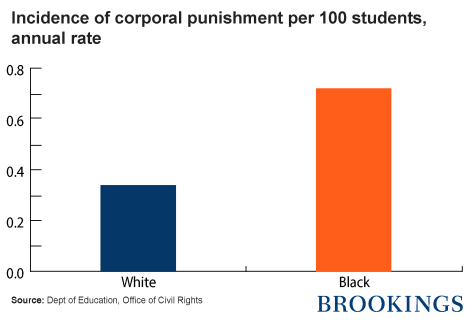
Schools, black children, and corporal punishment

figure-1

Why Do the Privileged View Equity as “Hard Work”?

Let’s start with this: Privileged people in the U.S. embrace what amounts to a lie—that success is mostly the result of effort, notably that education is the key to success.

However, the evidence is overwhelming that being born wealthy trumps effort (including educational attainment) by people born into poverty and especially by black and brown people regardless of socioeconomic status.

White, wealth, and male privilege remains the most powerful combination in the U.S.

Let’s also note that formal education, instead of eradicating inequity, often works to reflect and even expand the equity gap for impoverished, black, and brown children [1]. And “other people’s children” experience much harsher disciplinary policies in those schools, such as zero tolerance, that reflect and perpetuate race and class inequity as well.

And it may be that the root of this disturbing gap between what the privileged claim and the reality of being born and living in the U.S. is that those in power argue that taking action for equity is “hard work,” and thus themselves lack the grit or growth mindset (qualities being used—projected onto as deficits—to further demonize poor, black, and brown children) to actually do what is necessary to close the equity gap.

For example, although mind-numbingly late, some are beginning to recognize the racially inequitable discriminatory practices among many so-called “no excuses” charter schools, such as Success Academy. Yet, when those practices are confronted, we read these caveats:

The challenge posed to Success Academy and similar charter schools by the U.S. Department of Justice and U.S. Department of Education’s guidance on student discipline is serious. To be in conformance with civil rights law, these schools will need to make radical reforms to their “no excuses” school culture and practices. Now that Moskowitz has laid down the gauntlet on this issue, many eyes will be on the Obama administration for its response. Changing policies, practices and cultures to make schools into safe and welcoming places that do not resort to the excessive and discriminatory use of suspensions and expulsions is hard, challenging work.

Ending discriminatory practices that disproportionately impact black and brown children living in poverty is “hard, challenging work”? Really?

In my home state of South Carolina, we discover, that despite decades of gross negligence of high-poverty, majority-black public schools in pockets mostly throughout the lower part of the state, the response is much the same:

It is difficult to know how to do that — although it would be much less difficult if we stopped worrying about turf protection and job protections and making sure the right people get lucrative contracts and pursuing our ideological goals.

It is difficult to get our legislators and our governor to ignore those distractions. But it is their job to do that….

The sad thing is that as difficult as it will be for our leaders to develop a plan and our teachers to implement it, the hardest part could be convincing ourselves that it’s worth doing.

In case we missed it, educational equity for all children in SC (read “poor,” read “black”) is “difficult.” Again, really?

The racist and classist stereotyping at the end of privileged finger-pointing is disgusting—calls for some children simply to work harder, blaming impoverished parents for not caring about education or their children, and making cavalier and rash arguments about either the great failure of schools and teachers or idealistic promises about schools and teachers.

No, it is neither hard nor difficult to do the right thing. It is simply that those with privilege in the U.S. do not care about equity, do not care about marginalized people or children. While the words say “hard” and “difficult,” the actions speak much louder: We do not care.

“There is never time in the future in which we will work out our salvation,” James Baldwin warned at mid-twentieth century. “The challenge is in the moment, the time is always now.”

Let’s end with this: The challenge is not for the poor, not for black and brown people; the challenge is for those who have the power to change things but remain impotent because that challenge is “hard,” that challenge is “difficult.”

[1] Poor, black, and brown children disproportionately are subjected to larger class sizes, un-/under-certified teachers, underfunded schools, and reduced curriculums (test prep).

On Public Debate, Naming the Enemy, and White Privilege: “a most disagreeable mirror”

Let’s start with one of the most heated public and political issues in the U.S. for at least four decades since Roe v. Wade: the abortion debate.

How does that debate resonate differently if framed as Pro-Life v. Pro-Abortion when compared to Anti-Abortion v. Pro-Choice? Or how does that debate resonate differently if framed as the rights of the unborn child versus women’s rights?

But the abortion debate reveals more than just the power of naming the enemy in that contest of ideologies because the abortion debate has often devolved into mostly a struggle for power, one that leaves in its wake both the claimed concern for the unborn child and women. In other words, too often the abortion debate is about scoring public points or making political hay—and not about the welfare of marginalized human beings, especially in the context of race and racism (without the intervention of the courts, affluent white women had access to reproductive rights that poor black women were denied).

And then if we dig deeper, the abortion debate in its most extreme and insensitive forms also becomes a battle between privileged agents, ones who ignore the race and class issues that significantly overlap the more narrow debate about access to abortion or reproductive rights.

For several years now, I have watched and participated in an increasingly hostile education reform debate that has many of the same characteristics I have identified above.

Early in my public (and evolving) role writing about that reform (in the more recent of thirty-plus years advocating for reform as part of my daily practice as a classroom teacher at both the high school and higher education levels), I found the need to define the debate as a struggle between No Excuses Reformers (NER)—who focus on in-school only reform as accountability—and Social Context Reformers (SCR)—who call for both social and educational reform as equity—aligning myself with the latter.

Also early in that public effort, I confronted directly and even interacted with some of the prominent agents of NER, something I gradually stopped doing. However, those contentious exchanges inevitably spurred my being framed as anti-reform.

Coming from advocates of NER, that label offended me greatly—again because I entered education and then committed my work as a teacher for decades to very unpopular reforms such as expanding the canon to include black and female writers, ending tracking, and erasing the masked racial bigotry of my small home town that was reflected in the high school’s disciplinary and curricular practices.

However, recently Andre Perry and Angela Dye have also used the label “anti-reform” and then I came across this Tweet:

Here I had to step back from my entrenched knee-jerk response to the “anti-reform” label because for Perry, Dye, and Thinnes, the use of “anti-reform” is in the context of many people I have framed as SCR advocates becoming so committed to fighting NER, Perry has noted “that overwhelmingly white movements pursuing change for black and brown communities are inherently paternalistic.” In other words, the two dominant voices debating education reform are often indistinguishable in their missionary zeal and their tendency to ignore the very communities, families, and children historically and currently mis-served by both reform agendas and traditional public schooling.

Thinnes has also commented further (here and here), reaching a powerful and important conclusion:

Exploring these [nuanced] questions [about TFA] this last year have helped start to move me from my own simplistic “us and them” camp mentality; to recognize the richness of the social justice commitments that many individuals are bringing to many sectors and orgs; to wonder what kind of systemic transformation ‘we’ actually envision; and to question who it is, exactly, that ‘we’ are really fighting for.

For me, then, I must stress that when NER advocates toss out the label “anti-reform,” I am skeptical, even cynical, about the intention, but “anti-reform” works for Perry, Dye, and Thinnes in a much different and significant way: This is a warning flag, a vital warning flag, that all along the so-called education reform spectrum, as Thinnes notes, the “us v. them” mentality allows “reform” to be yet another insensitive and blunt baseball bat swung in self-righteousness, battering indiscriminately.

Thirty-plus years into intensive state and federal education reform have not resulted in the sorts of educational or social outcomes politicians have promised and the public has expected. In fact, the reforms themselves have increasingly become secondary to the war and those poised to benefit from that reform debate.

Perry, Dye, and Thinnes—among others—require us to step back from that debate and recognize that white privilege/white denial remain the poisons infecting the so-called “both sides,” whether we label those sides NER v. SCR or reformers v. anti-reformers.

Social and educational justice advocacy that forefronts race and racism must unite everyone dedicated to education reform, and in doing so, this must stop being a war of privilege, one that is deaf and blind to the voices and interests of black, brown, and poor people.

In the August 1965 Ebony, James Baldwin began “The White Man’s Guilt”: “I have often wondered, and it is not a pleasant wonder, just what what white Americans talk about with one another,” adding:

I wonder this because they do not, after all, seem to find very much to say to me, and I concluded long ago that they found the color of my skin inhibitory. This color seems to operate as a most disagreeable mirror, and a great deal of one’s energy is expended in reassuring white Americans that they do not see what they see.

It is 50 years later, and Baldwin’s incisive confrontation of white-as-blind, white-as-deaf to the black condition, of the “most disagreeable mirror” is now being replicated in an education war too often being fought as if the greatest historical and current failure of education doesn’t involve black, brown, and poor people.

Baldwin’s refrain—”White man, hear me!”—in the context of the education reform movement being too white to matter, in the context of #BlackLivesMatter, demands an end to white privilege and white denial that maintain the burden of the accusatory gaze on black, brown, and poor communities, families, and students.

“[P]eople who imagine that history flatters them (as it does, indeed, since they wrote it),” Baldwin argued, “are impaled on their history like a butterfly on a pin and become incapable of seeing or changing themselves, or the world.”

This is the education reform movement challenged by Perry, Dye, and Thinnes—a battle between mostly white advocates, impaled on their own missionary zeal and demanding that other people do what they themselves are incapable of doing.

Before us we have an enemy we seem to refuse to name, the white privilege at the root of the historical failure of universal public education and the remaining white privilege derailing both sides of the reform debate.

From New Orleans to #BlackLivesMatter, the echo of Baldwin’s “White man, hear me!” remains drowned out beneath the white noise of reform debate.

The responsibility lies with that privilege to see ourselves, to change ourselves, and thus to change the world we have created and maintained.

See Also

Why Liberals Separate Race from Class

On Public Versus Charter: “The Dispute Has Actually Nothing to Do with Education”

I.

Published 54 years ago, Nobody Knows My Name continues to shake any reader willing to listen as James Baldwin bore witness to the region currently—and again, shamefully—in the national spotlight, “the South, which was now undergoing a new convulsion over whether black children had the same rights, or capacities, for education as did the children of white people.”

Baldwin continued—and we could too easily substitute for his “this” as we now witness debates long past their time for resolution:

This is a criminally frivolous dispute, absolutely unworthy of this nation; and it is being carried on, in complete bad faith, by completely uneducated people. (We do not trust educated people and rarely, alas, produce them, for we do not trust the independence of mind which alone makes a genuine education possible.) Educated people, of any color, are so extremely rare that it is unquestionably one of the first tasks of a nation to open all of its schools to all of its citizens. But the dispute has actually nothing to do with education, as some among the eminently uneducated know. It has to do with political power and it has to do with sex. And this is a nation which, most unluckily, knows very little about either. [Baldwin, James (2013-09-17). Nobody Knows My Name (Vintage International) (Kindle Locations 1102-1108). Knopf Doubleday Publishing Group. Kindle Edition.]

The “frivolous” comes not from the great questions that have always and will always confront humanity—how do we educate?—but from the “bad faith” among “uneducated people” who have undeserved privilege and power.

To believe the current education reform debate is not nearly indistinguishable from what Baldwin contested as the U.S. resisted desegregation is to live among the deaf and blind.

For more than three decades now, public education has been held hostage by the most frivolous of frivolous debates: how to design and implement accountability built on standards and high-stakes testing. This adolescent game of “my accountability can beat your accountability” has left public education and the children it should serve battered and bloodied.

From the seemingly endless cycle of new standards and new high-stakes tests (and ways to punish even more groups within our public schools) to the increasingly snarky divisiveness and personal politics of social media, the often cited reasons for all this sound and fury—public schools, the children—are being mis-served; just as a couple terrible examples, public education has re-segregated during the accountability era, and the mislabeled achievement gap among racial groups has remained robust.

II.

“I often find myself scratching my head,” writes Andre Perry, “wondering why so many black folk extol the virtues of public education.”

Perry, 54 years after Baldwin’s challenge to “frivolous dispute,” wades into not only the public versus charter schools debate but also the race and social class biases at the root of whose voices matter and whose voices do not.

Most of the U.S. sits idly by—like audiences watching the newest Avengers movie—while the arrogant and mighty battle, rarely acknowledging the collateral damage (will there ever be a superhero blockbuster film in which all those superheroes use their superpowers to rebuild the infrastructure they destroy?).

Since Marvel’s Civil War is set for film soon, we may be watching the equivalent in fiction of the public versus charter debate, and I think Perry is offering a rare but important plea, as Baldwin did: “the dispute has actually nothing to do with education.”

Perry recognizes “[i]n the education wars,”

black and brown educators who criticize the current wave of reform often find themselves rallying with those who can say that public education in this country works. But let’s be clear, blacks aren’t in a position to root for or celebrate the status quo. Likewise, there has never been a time in which blacks shouldn’t have considered themselves reformers. Yet many have incidentally joined an education “party of no.”

Although eventually (as late as the early 1970s in the South Baldwin examined) public schools were forced to open their doors to all children, Perry stresses “many of us fight for that unfulfilled promise at the expense of student learning”:

Public education should advance society and its individual members simultaneously. But black communities can’t afford to wait for whites to gentrify schools in the name of democracy to get a good education.

And thus, Perry challenges the false dichotomy that has been created by the “education reform [debate that] is too white to do any good“: public schools versus charter schools. In fact, Perry asserts, guided by Frederick Douglass’s “What To The Slave Is The 4th of July?”:

Charter schools make sense for black communities. Charter schools are independent public institutions that are freed from administrative controls of a centralized, area board, but must still meet broad guidelines or requirements of public schools. Through a charter, parents, teachers, and administrative staff primarily can gain freedom from an elected local board that’s incongruent with their values.

To fight the public versus charter war at a pitch that drowns out the voices of those whom “public institutions” should be serving, must be serving is disturbingly frivolous, Perry recognizes.

Of all the education reform debates, this tension has given me the most pause: How can we rectify rejecting “no excuses” charter schools for being racist/classist while many black families choose those very schools?

I am compelled to look again to Baldwin in order to remove the misleading labels (“public,” “charter”) and to hear, as Perry explains:

I like many see a promise that charter schools can deliver, but I also see inequities waving in the faces of black and brown students every day in public schools. Inadequate funding, harsh suspension and expulsion policies, lack of services for students with special needs and culturally irrelevant curricula are durable, standing problems in most takeover districts. I see waste, fraud, and unsavory practices that led cities to decentralize.

“Charter” for Perry represents a new promise, one responsive to the needs of children too long ignored.

So to save this debate from the “frivolous” we must guard against simplistic labels. Regardless of whether the school is “public” or “charter,” the educator’s commitment must be, as Paul Gorski explains, to “take a stand when one of our students is being shortchanged—not standing in front of or standing in place of, but standing next to, standing with low-income[, black and brown] students and families.”

Being for public education or either for or against charter schools proves to be as callous and hollow as superheroes destroying a city to win a war between Good and Evil when we lose sight of foundational promises to achieve race and class equity.

III.

In the years between Baldwin’s and Perry’s commentaries, the promise of public institutions has remained unfulfilled because the question of race in the U.S. has never been fully confronted.

In 2015, presidential candidates expressing racist trash are viable while elected officials, although now in a minority, in South Carolina continue to cling to the Confederate battle flag as they spew whitewashed history and empty slogans as thin veils for racism that works as political capital. In 2015, because a privileged minority controls what counts as civil debate, we haven’t the capacity to denounce the morally reprehensible position that “both sides” deserve equal credibility.

So we are people trapped by trivializing debate and democracy in a moral vacuum.

And again, Baldwin’s “debate” allows us to insert his voice in our moment now:

And yet, it became clear as the debate wore on, that there was something which all black men held in common, something which cut across opposing points of view, and placed in the same context their widely dissimiliar experience. What they held in common was their precarious, their unutterably painful relation to the white world. What they held in common was the necessity to remake the world in their own image, to impose this image on the world, and no longer be controlled by the vision of the world, and of themselves, held by other people. What, in sum, black men held in common was their ache to come into the world as men. And this ache united people who might otherwise have been divided as to what a man should be. [Baldwin, James (2013-09-17). Nobody Knows My Name (Vintage International) (Kindle Locations 346-351). Knopf Doubleday Publishing Group. Kindle Edition.]

From Baldwin’s world of overt racial segregation to Perry’s world of covert racial segregation, then, whether the debate be who we educate or how we educate, the tarnished promise is the consequence of the white illusion:

This illusion owes everything to the great American illusion that our state is a state to be envied by other people: we are powerful, and we are rich. But our power makes us uncomfortable and we handle it very ineptly. The principal effect of our material well-being has been to set the children’s teeth on edge. If we ourselves were not so fond of this illusion, we might understand ourselves and other peoples better than we do, and be enabled to help them understand us. I am very often tempted to believe that this illusion is all that is left of the great dream that was to have become America; whether this is so or not, this illusion certainly prevents us from making America what we say we want it to be. [Baldwin, James (2013-09-17). Nobody Knows My Name (Vintage International) (Kindle Locations 1080-1085). Knopf Doubleday Publishing Group. Kindle Edition.]

IV.

We need “educated people,” as Baldwin explained—not the credentialism of formal schooling, but the education that comes from Freire’s reading and re-reading the world, writing and re-writing the world unmasked of race and class privilege.

Educated people who can state clearly that no black child should have to sit in Robert E. Lee Elementary.

That no black young adult should have to sit in Tillman Hall.

Yes, names matter.

But then, the indignity of honoring “men with wicked histories” must not be compounded by what happens inside those institutions.

No black, brown, or poor child should be walking through the doors of any school only to be treated as criminals, failures, or data.

We need educated people who can admit public, charter, and private schools remain too often institutions of inequity reflecting a country in which a child’s race and social class at birth have a greater bearing on her/his life than the content of her/his character.

We need educated people who can admit symbolism and practices both matter—that two Americas will not be tolerated or obscured by “frivolous dispute[s … that have] nothing to do with education.”

On this there must no longer be debate.

We Can, and We Must

I remembered it had been one of Mother’s pet ideas—she was always voicing it—that in the long run one gets used to anything.

The Stranger, Albert Camus (Trans. Stuart Gilbert)

Pamela Cantor offers her medical perspective to the education reform debate that tends to focus on high-poverty schools disproportionately serving  black and brown children:

The argument that says we can’t fix education until we fix poverty is a false one [1]. We can’t fix poverty or the other adverse events of children’s lives, but we can “fix” the impact of stress on the developing brain. In fact, we have to. We can and must teach schools and teachers how to do this now.

Lurking beneath the good intentions of this charge, however, is the false dichotomy of fatalism that is common among a wide range of education reformers.

For children living in poverty—a stressful and toxic life of unjust scarcity—this “we” has chosen simultaneously to concede that “we” can do nothing about poverty, racism, and inequity, but those impoverished children have been sentenced to both their lives of poverty and then formal education that replicates the stress of the lives (which “we” demand they set aside somehow just by walking through the doors of schools) through mantras of “no excuses,” manufactured lessons in “grit,” and race- and class-biased high-stakes testing that doubles down on stress and anxiety.

The false dichotomy of fatalism has built a world in which privileged adults with the power to tolerate this world or to change this world are afforded excuses (“We can’t fix poverty or the other adverse events of children’s lives”), but powerless and impoverished children are dehumanized with the demand of “no excuses.”

“I have always rejected fatalism,” writes Paulo Freire:

I prefer rebelliousness because it affirms my status as a person who has never given in to the manipulations and strategies designed to reduce the human person to nothing. The recently proclaimed death of history, which symbolizes the death of utopia, of our right to dream, reinforces without doubt the claims that imprison our freedom. This makes the struggle for the restoration of utopia all the more necessary. Educational practice itself, as an experience in humanization, must be impregnated with this ideal.

Meursault in Albert Camus’s The Stranger confesses and embraces human resignation, the fatalism that the world happens to us, that a world in which we are alive or dead is no different, that a world of freedom or prison is simply something “we” get used to.

Margaret Atwood offers a more detailed and darkly disturbing vision in The Handmaid’s Tale and Offred/June, who has been shaped a different woman in her lives before and after the fall of the world “we” know and the brave new world of Gilead.

The world “we” have created is neither existential fiction nor speculative dystopian fiction; the world “we” have created is far more terrible.

“Why exactly was I sad?” asks Ta-Nehisi Coates in Letter to My Son, as he confronts a “failed” guest appearance on a news show:

I came out of the studio and walked for a while. It was a calm December day. Families, believing themselves white, were out on the streets. Infants, raised to be white, were bundled in strollers. And I was sad for these people, much as I was sad for the host and sad for all the people out there watching and reveling in a specious hope. I realized then why I was sad. When the journalist asked me about my body, it was like she was asking me to awaken her from the most gorgeous dream. I have seen that dream all my life. It is perfect houses with nice lawns. It is Memorial Day cookouts, block associations, and driveways. The Dream is tree-houses and the Cub Scouts. And for so long I have wanted to escape into the Dream, to fold my country over my head like a blanket. But this has never been an option because the Dream rests on our backs, the bedding made from our bodies. And knowing this, knowing that the Dream persists by warring with the known world, I was sad for the host, I was sad for all those families, I was sad for my country, but above all, in that moment, I was sad for you.

July 5, 2015, is in too many ways ample evidence not of celebration but disappointment, one grounded in the exact document of declaration that prompts annual flag waving each July in the United States of America.

As “we” rebelled from the British crown, “we” pronounced to “hold these truths to be self-evident, that all men are created equal, that they are endowed by their Creator with certain unalienable Rights, that among these are Life, Liberty and the pursuit of Happiness”—excluding black humans shackled by slavery and those second-class humans, women.

Thomas Jefferson had faced slavery in the original draft of this declaration, but due to the pressure of Southern heritage and the Invisible Hand of the all-mighty market, “we” included only some men, despite the rhetoric otherwise.

More than 100 years passed before the rhetoric of law approached the apparent original intent of declaring independence, but the clock continues to tick as “we” throw up our hands when “we” don’t have them covering our eyes.

Coates above quotes James Baldwin because Coates recognizes in his own life as well as the life of his son that as Baldwin declared:

To be a Negro in this country and to be relatively conscious, is to be in a rage almost all the time. So the first part of the problem is how to control the rage so that it won’t destroy you. Part of the rage is this: it isn’t only what is happening to you, but it’s what’s happening around you all of the time, in the face of the most extraordinary and criminal indifference, the indifference and ignorance of most white people in this country.

“Indifference and ignorance of most white people in this country” is the fatalism “we” embody each time “we” claim nothing can be done about poverty, racism, or inequity—each time “we” ask more of children, the poor, the marginalized and dehumanized than of ourselves.

“We,” I regret, have chosen a resignation and paralysis that benefits the “we” “who believe that they are white,” as Coates channels Baldwin.

Freire believed, however, “we” can transform into we by “reject[ing] fatalism.”

We can, and we must.

[1] While I believe this first comment is a straw man argument (since many are calling for both equity-based reform of society and schools, and this smacks of implying some are using poverty as an excuse), Cantor should consider that Martin Luther King Jr. asserted: “We are likely to find that the problems of housing and education, instead of preceding the elimination of poverty, will themselves be affected if poverty is first abolished.”

From “Remediation” to “No Excuses”: The Indignity of Deficit Thinking

Speaking in Savannah, Georgia, March 21, 1861, in his “Corner Stone” Speech, Alexander H. Stephens, Vice President of the Confederate States of America, carefully enumerated the justification for secession among Southern states.

At length, Stephens addressed slavery: “The new [Confederate] constitution has put at rest, forever, all the agitating questions relating to our peculiar institution African slavery as it exists amongst us the proper status of the negro in our form of civilization.”

That “proper status”—according to Stephens and the declarations of secession by Georgia, Mississippi, South Carolina, Texas, Virginia— was misrepresented in the U.S. Constitution, that “rested upon the assumption of the equality of races. This was an error.”

The Confederacy, instead, embraced “the great truth that the negro is not equal to the white man; that slavery subordination to the superior race is his natural and normal condition.” Stephens chastised the North because “[t]hey assume that the negro is equal, and hence conclude that he is entitled to equal privileges and rights with the white man.”

Stephens called on the triple bedrocks of authority in his statement of the inequality of the races—science, law, and religion:

This, our new government, is the first, in the history of the world, based upon this great physical, philosophical, and moral truth. This truth has been slow in the process of its development, like all other truths in the various departments of science….

With us, all of the white race, however high or low, rich or poor, are equal in the eye of the law. Not so with the negro. Subordination is his place. He, by nature, or by the curse against Canaan, is fitted for that condition which he occupies in our system.

=

While apologists for Southern heritage remain unable or unwilling to confront the blatant racism of the Confederacy, many today remain nearly universal in our inability or unwillingness to recognize and then confront racism, classism, and sexism in the form of deficit thinking.

Deficit thinking, as Stephens represented, is imposing onto groups or individuals deficits as the primary characteristics of their humanity. In education, deficit thinking is pervasive and the foundational mechanism for formal schooling as an institution that reflects and perpetuates bigotry, inequity, and marginalization of people based on status instead of merit.

Some deficit thinking appears nearly harmless because of its common-place use—for example, the term and concept of “remediation.”

Remediation as a normalized deficit concept is at the heart of the third-grade retention movement masquerading as reading policy.

Remediation is built on several flawed assumptions: (i) learning is predictably linear and sequential, (ii) so-called skills such as reading can be accurately quantified (as in “grade level”), and (iii) some “types” of learning (associated with rates and/or biological ages of the students) are lesser than others (basic skills versus higher-order thinking skills, for example).

Remediation also fails a basic point of logic: If remediation is teaching a student something that student doesn’t know, isn’t all teaching remediation?

Remediation, then, is deficit thinking because we must first establish “third grade reading” and then test children in order to label them deficient—and thus the ultimate flaw of grade retention is allowing that seemingly scientific but biased quantifying to represent the entirety of any student.

=

Many key ideologies and practices in the education reform movement, as well, are masks for deficit thinking: culture of poverty, “grit,” the “word gap,” and “no excuses.”

As deficit thinking, all of these are driven by and contribute to unacknowledged racism and classism (often among those claiming to be fighting bias and inequity).

To say “poverty is not an excuse” or that student success depends on “grit” is to “blame the victim” since the focus of these slogans and the educational practices built on them highlight the students as deficient and thus needing to be “fixed.”

The lineage from the bald-faced racism of Stephens to the paternalistic and coded racism/classism of “grit,” “no excuses,” and the “word gap” is deficit thinking.

The racism of the Confederacy did not hide behind code, but more than 150 years later, we are faced with finding the will to decode and debunk the deficit thinking that is just as corrosive to individuals and society as corner-stone speeches.

Remediation, grade retention, lessons in “grit,” “no excuses” charter schools, strategies to end the “word gap”—these all disproportionately target black, brown, and poor children.

Those ideologies and practices, however, do not validate claims of deficient children, but expose a deficit of basic humanity among those in positions to honor the dignity of all children, but instead continue to choose otherwise.

=

About 100 years after Stephens’s racist declaration of secession, author Ralph Ellison concluded in “What These Children Are Like”: “I’m fascinated by this whole question of language.”

“The great body of Negro slang–that unorthodox language–exists,” Ellison explained:

precisely because Negroes need words which will communicate, which will designate the objects, processes, manners and subtleties of their urban experience with the least amount of distortion from the outside. So the problem is, once again, what do we choose and what do we reject of that which the greater society makes available? These kids with whom we’re concerned, these dropouts, are living critics of their environment, of our society and our educational system, and they are quite savage critics of some of their teachers.

Ellison’s lecture to teachers was an extended confrontation of deficit thinking, a powerful refuting of seeing black children and anyone’s language as deficient. His talk ended with a stirring plea:

I don’t know what intelligence is. But this I do know, both from life and from literature: whenever you reduce human life to two plus two equals four, the human element within the human animal says, “I don’t give a damn.” You can work on that basis, but the kids cannot. If you can show me how I can cling to that which is real to me, while teaching me a way into the larger society, then I will not only drop my defenses and my hostility, but I will sing your praises and help you to make the desert bear fruit.

Deficit thinking in its many forms is fruitless for its indignity.

For Further Reading

The Moynihan Report at Fifty, Stephen Steinberg

Letter to the Editor: The Moynihan Report at Fifty, Daniel Geary

The Moynihan Report Is Turning 50. Its Ideas on Black Poverty Were Wrong Then and Are Wrong Now, Daniel Geary

Educators (Still) Have No Political Party

NOTE: Below is a repost from 23 August 2012 with small edits. With great regret, I see no reason to write something new since the Chicago mayoral election and the announcement of Hillary Clinton entering the presidential election have offered clear proof educators still have no political party. I do, however, offer some important additions after the repost from W.E.B. Du Bois and George Carlin. I recommend them highly.

$$$

Educators (Still) Have No Political Party

For about thirty years now, public education as well as its teachers and students have been the focus of an accountability era driven by recurring calls for and the implementation of so-called higher standards and incessant (and now “next generation”) testing. At two points during this era, educators could blame Ronald Reagan’s administration for feeding the media frenzy around the misleading A Nation at Risk and George W. Bush’s administration for federalizing the accountability era with No Child Left Behind (NCLB)—both under Republican administrations.

For those who argued that Republicans and Democrats were different sides of the same political coin beholden to corporate interests, education advocates could point to Republicans with an accusatory finger and claim the GOP was anti-public education while also endorsing Democrats as unwavering supporters of public education. To claim Republicans and Democrats were essentially the same was left to extremists and radicals, it seemed.

As we approach the fall of 2015 and the next presidential election, however, educators and advocates for public education have found that the position of the extremists—Republicans and Democrats are the same—has come true under the Barack Obama administration.

Educators have no political party to support because no political party supports educators, public education, or teachers unions.

Democrats and Republicans: Our Orwellian Future Is Now

“If you want a picture of the future, imagine a boot stamping on a human face—forever.”

1984, George Orwell

Behind the historical mask that Democrats support strongly public education and even teachers specifically and workers broadly, the Obama administration has presented a powerful and misleading education campaign that is driven by Obama as the good cop and Secretary of Education Arne Duncan as the bad cop. Obama Good Cop handles the discourse that appeals to educators by denouncing the rising test culture in 2011:

What is true, though, is, is that we have piled on a lot of standardized tests on our kids. Now, there’s nothing wrong with a standardized test being given occasionally just to give a baseline of where kids are at. Malia and Sasha, my two daughters, they just recently took a standardized test. But it wasn’t a high-stakes test. It wasn’t a test where they had to panic.

Yet, simultaneously, Secretary Duncan Bad Cop was endorsing and the USDOE was implementing Race to the Top, creating provisions for states to opt out of NCLB, and endorsing Common Core—each of which increases both the amount of standardized testing and the high-stakes associated with those tests by expanding the accountability from schools and students to teachers.

Under Obama, Democratic education policy and agendas, embodied by Duncan, have created a consistently inconsistent message. During his campaign mode for a second term, Obama once again offered conflicting claims about education—endorsing a focus on reducing class size (despite huge cuts for years in state budgets that have eliminated teachers and increased class size, which many education reformers endorse) and making a pitch to support teachers unions and even increasing spending on education, leading Diane Ravitch to ponder:

Well, it is good to hear the rhetoric. That’s a change. We can always hope that he means it. But that, of course, would mean ditching Race to the Top and all that absurd rightwing rhetoric about how schools can fix poverty, all by themselves.

Throughout his presidency, Obama’s discourse has been almost directly contradicted by Duncan’s discourse and the USDOE’s policies. Obama tended to state that teachers were the most important in-school influence on student learning while Duncan tends to continue omitting the “in-school” qualifier, but these nuances of language are of little value since the USDOE under Obama has an agenda nearly indistinguishable from Republican agendas:

  • Incentivizing all states to adopt CC and the necessary increase in testing and textbook support (and thus, profit) to follow.
  • Endorsing market dynamics and school choice by embracing the charter school movement, specifically charters such as Knowledge Is Power Program (KIPP) that practice “no excuses” ideologies for school reform and school cultures.
  • Criticizing directly and indirectly public school teachers and perpetuating the “bad” teacher myth by calling for changes in teacher evaluations and compensation, disproportionately based on student test scores.
  • Funding and endorsing the spread of test-based accountability to departments and colleges of education involved in teacher certification.
  • Funding and endorsing the de-professionalization of teaching through support for Teach for America.
  • Appealing to the populist message about choice by failing to confront the rise of “parent trigger” laws driven by corporate interests posing as concerned parents.

If my claim that Republicans and Democrats are different sides of the same misguided education reform coin still appears to be the claim of an extremist, the last point above should be examined carefully.

Note, for example, the connection between the issues endorsed by Democrats for Education Reform (DFER) and the anti-union sentiment joined with endorsing the next misleading Waiting for “Superman”Won’t Back Down.

The Democratic National Convention was home to DFER, Parent Revolution, and Students First to promote Won’t Back Down as if this garbled film is a documentary—including a platform for Michelle Rhee.

There is nothing progressive about the education reform agenda under the Obama administration, nothing progressive about the realities behind Obama’s or Duncan’s discourse, nothing progressive about Rhee, Gates, or the growing legions of celebrity education reformers.

If the Democratic Party were committed to a progressive education platform, we would hear and see policy seeking ways to fund fully public schools, rejecting market solutions to social problems, supporting the professionalization of teachers, embracing the power and necessity of collective bargaining and tenure, protecting students from the negative impact of testing and textbook corporations, distancing themselves from Rhee-like conservatives in progressive clothing, and championing above everything else democratic ideals.

Instead, the merging of the education agenda between Democrats and Republicans is Orwellian, but it real, as Ravitch warned early in Obama’s administration:

This rhetoric represented a remarkable turn of events. It showed how the politics of education had been transformed. . . .Slogans long advocated by policy wonks on the right had migrated to and been embraced by policy wonks on the left. When Democrat think tanks say their party should support accountability and school choice, while rebuffing the teachers’ unions, you can bet that something has fundamentally changed in the political scene. (p. 22)

Still today in 2015, educators have no political party to support because no political party supports educators—and this is but one symptom of a larger disease killing the hope and promise of democracy in the U.S.

This tragic fact is the inevitable result of the historical call for teachers not to be political. Now that educators have no major party to support, the failure of that call is more palpable than ever.

Both the faux “not political” pose and playing the partisan political game fail educators, public education, and the democratic hope of the U.S.

Why I Won’t Vote, W.E.B. Dubois, The Nation, 20 October 1956