Category Archives: Paulo Freire

Confronting DiAngelo’s “White Fragility” in the Time of #BlackLivesMatter

For a book on racism written by an academic, Robin DiAngelo’s White Fragility has experienced a level of popularity over the last two years that is interesting, if not surprising.

With the #BlackLivesMatter movement re-ignited after the killing of George Floyd by a police officer, DiAngelo’s book has also experienced another significant boost in readership, primarily by white Americans seemingly having a long-overdue come-to-Jesus moment with their whiteness and complicity in systemic racism.

On social media, however, blog posts and Twitter threads have warned “don’t read White Fragility” and “don’t worship DiAngelo.” These warnings come from Black scholars and advocates for anti-racism activism, creating a powerful and important tension in that fight to eradicate white privilege and racism in the U.S.

There is also an insidious challenge to DiAngelo and White Fragility that comes from and speaks to white denial and white nationalism; this denial is grounded in a dishonest use of “science” calling into question DiAngelo’s statistics, methods, and scholarship.

This rebuttal is ironic proof of the existence and resilience of white denial and racism. It has no credibility and is a distraction.

Black voices, however, challenging the centering of DiAngelo in the conversation about race and racism must be acknowledged by anyone—especially white people—claiming to be anti-racism.

Having been raised in a racist home (with parents who embraced white celebrities such as Elvis Presley whose celebrity erased Black entertainers) and community throughout the 1960s and 1970s, I have documented that my journey to awareness about white privilege, white denial/fragility, and systemic racism has been grounded in Black writers and scholars.

When I first read DiAngelo’s essay, I found nothing new or surprising, except that a book existed and that people seemed to be reading it.

If anyone had wanted to understand white America or white fragility, James Baldwin unpacked all that often, for example in 1962’s “Letter from a Region in My Mind”:

quote 8
quote 9

My reading and scholarship on race, whiteness, and racism began in the late 1970s and early 1980s, including Malcolm X, James Baldwin, Alice Walker, Audre Lorde, Ralph Ellison, Richard Wright, Langston Hughes, Carter Godwin Woodson, bell hooks, Paulo Freire, Martin Luther King Jr., Nikki Giovanni, Frederick Douglass, Nina Simone, Claude McKay, Zora Neale Hurston, W.E.B. Du Bois, Bayard Rustin, and others.

I cannot emphasize enough the essential role social media has played in my evolving racial awareness through my being able to connect to an invaluable wealth of Black and multi-racial scholars, academics, writers, and creators whose voices drive my own commitments to anti-racism: Natalie Hopkinson, Jose Vilson, Chris Emdin, Trina Shanks, Camika Royal, Theresa Runstedtler, Nikki Jones, Mariame Kaba, Robert Jones Jr., Mychal Denzel Smith, Andre Perry, Ernest Morrell, Seneca Vaught, Michah Ali, Nikole Hannah-Jones, Rhondda R. Thomas, Jay Smooth, Greg Carr, Imani Gandy, Lou Moore, Simone Sebastian, Yvette Carnell, Asadah Kirkland, Venus Evans-Winter, Roxane Gay, John Ira Jennings, Jacqueline Woodson, Cornelius Minor, Stacey Patton, Jessica Moulite, Chenjerai Kumanyika, Brittney Cooper, Lisa Stringfellow, Angela Dye, Sherri Spelic, Bree Newsome Bass, Zoe Samudzi, Eddie S. Glaude Jr., Jonathan W. Gray, A.D. Carson, Terrenda White, Clint Smith, David E. Kirkland, Dereca Blackmon, Alondra Nelson, Teju Cole, Colin Kaepernick, Morgan Parker, Tressie McMillan Cottom, Crystal Fleming, Eve L. Ewing, Johnny E. Williams, DeMisty Bellinger, Imani Perry, Josie Duffy Rice, Kareem Abdul-Jabbar, Etan Thomas, Ijeoma Oluo, Natalie Auzenne, Ja’han Jones, Howard Bryant, The Root, Jemele Hill, Ibram X. Kendi, Nnedi Okorafor, Jason Reynolds, Jamil Smith, Valerie Kinloch, Michael Harriot, Bomani Jones, Rashawn Ray, Walter D. Greason, Hanif Abdurraqib, Sarah Thomas, Joshua Bennett, Marc Lamont Hill, Sarah J. Jackson, Clarkisha Kent, Robert Randolph Jr., Peter Darker, Tanji Reed Marshall, Sil Lai Abrams, Sami Schalk, Bianca Nightengale-Lee, Jessica Owens-Young, Andre M. Carrington, Christena Cleveland, Christopher Cameron, Val Brown, Kim Pearson, Kim Parker, Nicole Sealey, Margaret Kimberley, Malaika Jabali, Lisa Sharon Harper, Benjamin Dixon, Tade Thompson, Maria Taylor, Terri N. Watson, Zaretta Hammond, Shea Martin, and Kim Gallon.

There simply is an enormous wealth of Black voices historical and contemporary that white people should read and listen to, often easily accessible online, in fact.

DiAngelo is finding a place in mainstream and fragile America in a similar way that Ta-nehisi Coates and Michelle Alexander have, the latter two Black writers having also received criticism from Black scholars and public intellectuals for appeasing whiteness even as they confront racism.

I have included DiAngelo’s book as a choice reading in my courses as I have introduced students to Coates and Alexander—with caveats and in the context of required reading from critical Black writers, thinkers, and scholars.

White privileged students have admitted openly in class sessions that they finally listened to DiAngelo, even though they have heard and resisted claims of white privilege and systemic racism before.

DiAngelo’s White Fragility and her celebrity from that work fit into what I have called the paradox of centering whiteness to de-center whiteness (a paradox of which I am a part).

DiAngelo represents centering whiteness, acknowledging racism and Black suffering only in proximity to whiteness, and Black voices given space because of white approval; these all work against anti-racism and are in fact racism.

Simultaneously, and paradoxically, DiAngelo represents the importance of and power in white-to-white confronting of and naming racism as well as white denial and fragility.

Yes, we should all feel skeptical about celebrity status and capitalizing from racism, just as we should resist monetizing and career-boosting that surrounds poverty studies as well as poverty workshops and simulations.

White people must not worship DiAngelo or her book, and no one should be recommending that white people read only White Fragility or read it instead of Black voices.

My students who have been introduced to DiAngelo know that dozens of Black writers, thinkers, and scholars made the case against whiteness and racism over decades starting at least a century ago (in terms of the works I offer as required reading).

I take the warnings of “don’t read DiAngelo” from Black scholars very seriously, and find compelling without qualifications the alternative offered—read Black voices, listen to Black voices, and believe Black voices on their own merit.

I also think there remains a place for DiAngelo’s work—even as it has one foot solidly in centering whiteness—as long as it is an element of de-centering whiteness and eradicating white privilege and racism.

My critical commitments make me concerned this caveat is a mistake, yet another concession to that white fragility which DiAngelo is naming.

Is a contextualized place for DiAngelo necessary as white people continue to wrestle with racism? I think that is likely true.

“Don’t rely on only white voices about whiteness and racism” is the goal, the ideal.

Since we find ourselves in the midst of the paradox of centering whiteness to de-center whiteness, at the very least white people committed to anti-racism must reject calls for reading only DiAngelo or reading DiAngelo instead of Black voices.

White celebrity and white authority can no longer be allowed to rise on the backs and instead of Black labor and experiences, as that whiteness occupies spaces that erase or bar Black voices.

There simply is no place left for approaching the work of anti-racism while tip-toeing around the delicacy of white people.

Ultimately that is the sort of white fragility we must recognize, name, and check.


Recommended

You Want a Confederate Monument? My Body Is a Confederate Monument, Caroline Randall Williams
What Does This Poem Mean?: On the Politics of Core Knowledge and Reading Instruction

While I am skeptical of nostalgia, the mostly vapid good-old-days approach to anything, I want to return to my high school teaching years, mostly pre-Internet and smart phone years throughout the 1980s and 1990s.

One of the best parts of teaching English was forming bonds with students over popular music. Gradually, in fact, my entire poetry unit was grounded in the music of R.E.M., the alternative group based in Athens, GA.

R.E.M. achieved immediate critical success with their first album, Murmur, and then were college rock stars throughout the 1980s, with popular stardom coming more than a decade after they formed.

What made R.E.M. particularly fascinating for my students and me was that they typically did not release the lyrics for their earliest albums, and thus, we would spend hours listening and trying to figure out just what Michael Stipe was saying. In fact, some early jabs at R.E.M. referred to Murmur as Mumbles since Stipe had a signature way of being terribly unclear.

I can still recall wrestling with “You Are the Everything”—students puzzled by “eviscerate” and all of us thrown by “With your teeth in your mouth.”

The beauty of all this for me as a teacher of poetry was that we had to work diligently first on the what, the literal, of the lyrics before we could begin trying to tackle meaning.

Too often, I found, students felt compelled (a really flawed lesson learning in school) to jump immediately to “this song/poem means” without taking any care to read the poem literally first.

Ultimately, investigating poetry was yet more efforts at learning to read, a behavior that is always in a state of emerging (despite the technocratic view that we can reach proficiency).

These memories came to me when I read Carol Black’s excellent Twitter thread:

Black carefully and powerfully unpacks and discredits the E.D. Hirsch Core Knowledge argument about reading that is compelling to those so-called experts outside of literacy and especially to the media, politicians, and textbook publishers.

As Black details, the argument that some core or essential knowledge exists in an objective apolitical way falls apart once you unpack how facts are presented and, more importantly, who determines what knowledge matters.

A disturbing example of Black’s critique immediately surfaced, also on Twitter:

This example of whitewashing slavery further exposes that no knowledge is value neutral and that the details of knowledge are far less important than confronting the authority behind what knowledge counts as fact or true.

So let me return to my students and me trying to decipher Stipe’s mumbling so that we could start to imagine what those wonderful songs meant.

The essential flaw of Core Knowledge arguments is that it promotes the passive acquisition of knowledge (what Paulo Freire criticized as the “banking concept” of teaching and learning) instead of the interrogation of knowledge, the domain of critical literacy.

Yes, we listened to the songs over and over so that we could as a community create the text, and we also scoured the music press for any and everything we could find from the band members about those lyrics, especially anything Stipe might reveal.

And we also built knowledge about the band and Stipe himself to provide context for those interpretations. Once Peter Buck said his favorite line from Monster was “Oh, my kiss breath turpentine,” explaining that it didn’t mean anything, but sounded great.

In other words, lyrics, as Stipe also explained at some point, were a way for Stipe’s voice to be another instrument in the song, not necessarily always about coherent meaning in the traditional use of text.

We were not acquiring knowledge, but interrogating an audio text in an effort to discover and uncover meaning, even as that meaning was tentative.

Recently, Bertis Downs, long-time lawyer for R.E.M., posted “Photograph” to social media, where I listened again and read along to the lyrics:

Always a favorite song of mine, including the beautiful accompaniment of Natalie Merchant, I was struck this time by the lines: “Was she willing when she sat/And posed a pretty photograph.” The “willing” speaks to the #MeToo era in a way I had not noticed many years ago.

As well, this song reminded me of Margaret Atwood’s “This Is a Photograph of Me,” which I taught for many years in A.P. Literature.

As an entry point to think deeply about consent, the song has new meaning, a meaning that works beyond the text and resonates because of a changing time and new social awareness.

All text meaning is political, communal, and tentative—not a fixed or objective truth.

And then, Atwood’s poem always posed tremendous challenges for students. In short, the ambiguity of the poem was an ideal way to help students learn to ask questions as a pursuit of meaning, instead of looking for the meaning.

Other than being in lines and stanzas, the poem achieves its poetic form without many of the traditional elements students expect (rhyme, for example). Further, the poem’s second section in parenthesis asks readers to consider the implications of punctuation as that contributes to meaning.

“(The photograph was taken/ the day after I drowned” opens that section and immediately challenges the reader with the literal problem since the photograph appears to be of the lake: “I am in the lake, in the center/ of the picture, just under the surface.”

Moving from R.E.M.’s song to Atwood’s poem and then, for example, adding Stevie Smith’s “Not Waving but Drowning” builds for students a body of problematic texts that warrants investigation, and not simple knowledge acquisition.

These three texts certainly are better read when the reader is more knowledgeable, but let’s not misread “knowledgeable.”

To be well read, in fact, is having had many experiences interrogating text and knowledge which is also the process of acquiring knowledge.

The more R.E.M. I listened to, the better I read those songs. The more Atwood I read, the more I understood Atwood (her word play, her misdirection).

What does this poem mean?—this becomes a journey and not a destination, an interrogation, not a proclamation.

Black’s dismantling the Core Knowledge propaganda about learning to read, then, pulls back the curtain on how Core Knowledge advocates are themselves serving an unspoken politics by taking on a faux veneer of apolitical essential knowledge.

Unintended I am sure, Atwood’s poem itself speaks to this as well:

the effect of water
on light is a distortion

but if you look long enough,
eventually
you will be able to see me.)

Let us invite our students to “look long enough,” beyond the “distortion,” so that they will “be able to see.”

The Politics of Education Policy: Even More Beware the Technocrats

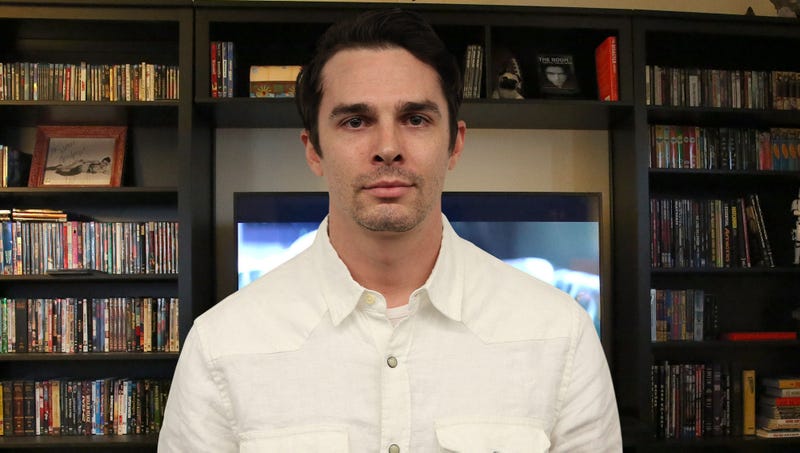
Man Prefers Comic Books That Don’t Insert Politics Into Stories About Government-Engineered Agents Of War (The Onion) includes a simple picture of a 31-year-old white male with the hint of a soon-to-be Van Dyke:

The fictional “man,” Jeremy Land, explains:

“I’m tired of simply trying to enjoy escapist stories in which people are tortured and experimented upon at black sites run by authoritarian governments, only to have the creators cram political messages down my throat,” said Land, 31, who added that Marvel’s recent additions of female, LGBTQ, and racially diverse characters to long-running story arcs about tyrannical regimes turning social outsiders into powerful killing machines felt like PC propaganda run amok. “Look, I get that politics is some people’s thing, but I just want to read good stories about people whose position outside society makes them easy prey for tests run by amoral government scientists—without a heavy-handed allegory for the Tuskegee Study thrown in. Why can’t comics be like they used to and just present worlds where superheroes and villains, who were clearly avatars for the values of capitalism, communism, or fascism, battle each other in narratives that explicitly mirrored the complex geopolitical dynamics of the Cold War?”

The satire here is the whitesplaining/mansplaining inherent in the politics of calling for no politics.

It strains the imagination only slightly to understand how this commentary on comic book fanboys also parallels the persistent combination in education of calling for no politics while using policy and a narrow definition of data and evidence to mask the racial and gender politics of formal schooling.

Let’s imagine, then, instead of the fictional Land an image of David Coleman (who parlayed his Common Core boondoggle into a cushy tenure as the head of the College Board) or John Hattie (he of the “poverty and class size do not matter” cults that provide Hattie with a gravy train as guru-consultant).

A close reading of David Coleman’s mug shot reveals a whole lot of smug.

In his “visible learning” hustle, John Hattie likely prefers to keep his enormous profits invisible.

Coleman and Hattie as technocrats feed the systemic racism, classism, and sexism in formal education policy and practice by striking and perpetuating an objective pose that serves as a veneer for the normalized politics of political and economic elites in the U.S.

As Daniel E. Ferguson examines, Coleman’s Common Core propaganda, the rebranded traditional mis-use of New Criticism into “close reading,” argues:

Close reading, as it appears in the Common Core, requires readers to emphasize “what lies within the four corners of the text” and de-emphasize their own perspective, background, and biases in order to uncover the author’s meaning in the text.

However, Ferguson adds,

Critical reading, in contrast, concerns itself with those very differences between what does and does not appear in the text. Critical reading includes close reading; critical reading is close reading of both what lies within and outside of the text. For Paulo Freire, critical reading means that “reading the world always precedes reading the word, and reading the word implies continually reading the world.”

And thus, close reading serves the cult of efficiency found in the high-stakes standardized testing industry that depends on the allure of believing all texts have singular meanings that can be assessed in multiple-choice formats—a dymanic Ferguson unmasks: “The story beyond the four corners of Coleman’s video is one of a man whose agenda is served by teachers following a curriculum that requires students to read in a way assessable through standardized tests he oversees and profits from.”

Simultaneously, of course, keeping students and teachers laser-focused on text only detracts them from the richer context of Martin Luther King Jr. and the broader implications of racism and classism informed by and informing King’s radical agenda.

Simply stated, close reading is a political agenda embedded in the discourse of objectivity that whitewashes King and denies voice and agency to King, teachers, and students.

Concurrently, Hattie’s catch phrase, “visible learning,” serves the same political agenda: Nothing matters unless we can observe and quantify it (of course, conveniently omitting that this act itself determines what is allowed to be seen—not the impact of poverty or the consequences of inequity, of course).

Hattie’s garbled research and data [1] match the recent efforts in education reform to isolate student learning as the value added (VAM) by individual teachers, yet another off-spring of the cult of efficiency manifested in high-stakes standardized testing.

Just as many have debunked the soundness of Hattie’s data and statistics, the VAM experiment has almost entirely failed to produce the outcomes it promised (see the school choice movement, the charter school movement, the standards movement, etc.).

Coleman and Hattie work to control what counts and what matters—the ultimate in politics—and thus are welcomed resources for those benefitting from inequity and wishing to keep everyone’s gaze on anything except that inequity.

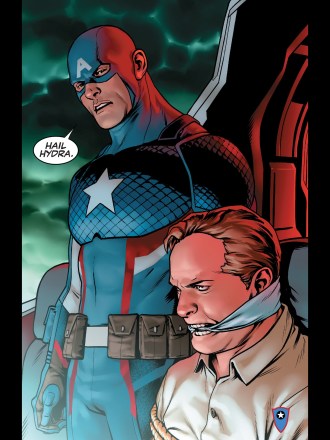
The misogyny and racism among comic book fanboys allows the sort of political ignorance reflected in The Onion‘s satire.  If we remain “within the four corners of the text” of Marvel’s Captain America, for example, we are ignoring that, as I have examined, “Captain America has always been a fascist. … But … Captain America has always been our fascist, and that is all that matters.”

3e281
Captain America: Steve Rogers #1 (c) Marvel

The politics of education policy seeks to point the accusatory finger at other people’s politics, and that politics of policy is served by the technocrats, such as Coleman and Hattie, who feed and are fed by the lie of objectivity, the lie of no politics.


[1] See the following reviews and critiques of Hattie’s work:

Fatalism Ate Our Democracy: “Today. Tomorrow. Always”

Forget it, nothing I change changes anything

“Walk It Back,” The National

On social media and in real life (IRL), I am experiencing a pattern.

For more than three decades now, mainstream education reformers have told me that there is nothing we can do about childhood poverty, racism, sexism, etc., so we must “fix” our schools and those students struggling because of all those inequities we simply cannot change.

Every time a mass shooting happens, people wave their arms and tell me that gun laws won’t stop violence; there simply is nothing we can do.

Over the last several months as I have witnessed my mother suffering in the wake of a stroke exponentially worsened by the U.S. healthcare and medical insurance monstrosities, even healthcare professionals respond to arguments for single-payer universal healthcare with “Good luck with that!” Never going to happen.

Fatalism appears more pervasive that the new national hobby of staring at a smart phone—joined only by the long-standing practice of most people existing as a heaping mound of contradiction.

The “nothing we can do about guns” crowd tends to be the same people who do want to regulate a woman’s ability to choose her reproduction options, do want demand that people show proper types of uniform patriotism, do staunchly advocate for the death penalty, mass incarceration, and militarized policing—but there is *sigh* just nothing we can do about gun violence because of that darn Second Amendment and, you know, people would still kill each other with knives and baseball bats.

Fatalism, then, is a convenient cover for those seeking ways to impose their political will on others; and thus, Paul Freire asserts: “I have always rejected fatalism. I prefer rebelliousness because it affirms my status as a person who has never given in to the manipulations and strategies designed to reduce the human person to nothing.”

Fatalism’s mantra—”Don’t bother!”—”reduce[s] the human person to nothing”—it de-democratizes, dehumanizes.

Like Freire, James Baldwin, then, expresses the antithesis to fatalism, hope: “I love America more than any other country in this world, and, exactly for this reason, I insist on the right to criticize her perpetually” (Notes of a Native Son, 1955).

“[T]o criticize…perpetually” is to cast off “Don’t bother,” to recognize that our ideals have merit but that we have failed to reach those ideals—and then we still have the capacity to do so.

And so I come back to the U.S. as a disturbing outlier in gun violence. These gruesome realities are not about the enormity of how a people can at least decrease the senseless loss of life that comes with our gun-lust; but this debate is about political and cultural will.

For a people seemingly obsessed with choice, we are far too willing to choose fatalism when it suits us, to become passive and “o, well” when the consequences somehow seem to be in someone else’s interest.

And for a people so eager to shout “American exceptionalism!” I wonder how we can ignore that many other countries insure all their citizens, have reduced their gun violence, and have created a culture that genuinely seeks to honor the meek and weak and vulnerable.

Freire recognized that the “freedom that moves us, that makes us take risks”—risks for a better world—is in fact a threat to those who believe the status quo is worth maintaining. Those beholden to the status quo—good for some, unfair to many—call for “conformity in the face of situations considered to be irreversible because of destiny”—thus, gun laws won’t change anything, or we’ll never have universal healthcare.

And a cousin to our fostered fatalism is our ahistorical mind, one that clings to traditional history but somehow rejects “revisionist” history:

To the degree that the historical part if not “problematized” so as to be critically understood, tomorrow becomes simply the perpetuation of today. Something that will be because it will be, inevitably. To that degree, there is no room for choice. There is only room for well-behaved submission to fate. Today. Tomorrow. Always.

Our fatalism has eroded our souls as a people, consumed our democracy.

We are a people more offended by black athletes kneeling during the national anthem than free people slaughtered while attending a music concert, children slaughtered while attending school.

Today. Tomorrow. Always?

Verboden!: Autonomy and Critical Thinking in Education

We don’t need no education
We don’t need no thought control
No dark sarcasm in the classroom
Teachers leave them kids alone

“Another Brick in the Wall – Part 2,” Pink Floyd (Roger Waters)

Those of us who stand outside the circle of this society’s definition of acceptable women; those of us who have been forged in the crucibles of difference — those of us who are poor, who are lesbians, who are Black, who are older — know that survival is not an academic skill. It is learning how to take our differences and make them strengths. For the master’s tools will never dismantle the master’s house. They may allow us temporarily to beat him at his own game, but they will never enable us to bring about genuine change. And this fact is only threatening to those women who still define the master’s house as their only source of support.

“The Master’s Tools Will Never Dismantle the Master’s House,” Audre Lorde

During my 18 years as a public high school English teacher, I taught as an outsider—but for many of those years, I found solace in a colleague, Ed Welchel, who taught history.

Among students, parents, faculty, and administration, Ed and I were considered good, even very good teachers, but we also were viewed with skepticism, particularly the farther up the authority chain you went (parents and administrators, especially).

The high school where we taught, although a rural public school, felt in many ways like a strict private school—very harsh discipline and dress codes, palpable conservative values.

Ed and I were as unlike that environment as two people could be.

After a particularly brutal faculty meeting that stressed the need to control our students, Ed and I began a chant we would share quietly as we passed in the hall: “Beat ’em down, beat ’em down.”

After I completed my doctorate in 1998, Ed soon finished the same program, and then left for another high school before moving on to higher education before I did.

That was fifteen-plus years ago, but it stands as relevant today since many are beginning to fret in earnest about why so many K-12 teachers leave the field.

It’s pretty damn obvious, I hate to say, but many teachers leave the profession because formal schooling is incredibly dehumanizing for students and teachers; in short, in schools, autonomy and critical thinking are verboden.

sample_pic209_14

Dark Sarcasms in the Classroom

Former career music educator and blogger at Education Week/Teacher, Nancy Flanagan asks: “Who is truly afraid of genuine leadership emerging from practitioners?”

Flanagan also confronts a key distinction about what “leadership” means by examining if teacher leaders are, as Audre Lourde would say, using the Master’s tools (implementing policy as required by administration as agents of accountability mandates) or being autonomous professionals.

More optimistically than I would conclude, Flanagan suggests, “Teachers may have lost a vision of reform led by authentic, unvarnished teacher thinking, instead of teacher compliance–but we haven’t relinquished the ideas of autonomy, mastery and self-determined purpose yet.

Educator and activist, Andre Perry turns a similar focus on how school climate impacts students, particularly marginalized populations of students. Perry stresses:

As researchers on positive school climate note, the “personality” of a school is an expression of how teachers, students, family members and community perceive the milieu.

In other words, a school doesn’t have to be mean to be good. Treating students with care and respect increases academic performance among students from low socioeconomic backgrounds, higher than if a school placed a singular single focus on academics.

This rejects, for example, the racist undertones driving the popularity of “no excuses” ideology, notably among charter schools serving poor, black, and brown students. But Perry also speaks to the wider norm of formal schooling.

Historically and especially over the past thirty years of high-stakes accountability, formal education is an Orwellian institution in which “critical thinking” is about completing a worksheet so you can score well on multiple-choice questions assessing critical thinking.

But don’t actually think or act critically if you are a student or a teacher.

Teacher Education and All that Is Wrong

Ed and I left K-12 education because of the harsh environment in schools toward students and because K-12 schools are no places for autonomous professionals.

I literally left after being docked pay for presenting at a professional conference.

However, much to our chagrin, teacher education in higher education is not oasis of professional autonomy, but the most embarrassing desert in higher education.

While colleagues in English often handed out 1-2 page syllabi, mine were 15-20 pages of standards, correlating assignments to those standards, and rubrics—despite my own published stance rejecting rubrics.

The professional life of a teacher educator is mostly about complying with accreditation and certification mandates in order to make sure teacher candidates comply with accreditation and certification mandates.

Again, autonomy and critical thinking are verboden!

For example, in the same foundations course I teach where we confront slut shaming and the inherent sexism of dress codes, within one week of my students being placed in a nearby elementary school to tutor, the principal asked me to remind the female students to dress appropriately.

As well, I always begin that course, and come back to this in most of my classes, with Sandra Cisneros’s “Eleven”—highlighting the dehumanizing norm of schooling that the story captures in the eleven-year-old Rachel’s lament: “Because she’s older and the teacher, she’s right and I’m not.”

But my foundations students are left with observing that reality in their field placements while also being denied the autonomy to do anything to change it.

And while I will not bore you with more examples, the situation above is no outlier; that is what teacher education is—a perpetual state of compliance to bureaucracy that is devoid of opportunities for professional autonomy and critical thinking.

When our candidates do reach the field, they invariably come to use with these observations:

  • “I can’t do anything you taught us in methods.”
  • “This is why people leave the field.”
  • “The administration treats teachers like students.”

All aspects of the field of education, then, are about compliance to the “bureaucratizing of the mind” about which Paulo Freire warned.

#

Formal education remains a desert, and we—teachers and students—wander dutifully forward, toward the wavering mirage that somehow teaching and learning are powerful instruments for change.

2671845245_9ebfd6be7c_b

Education as change remains just that, however—a mirage.

In the halls of schools at every level, student and teacher autonomy and critical thinking are verboden.


Teacher Education and A Call to Activism

If such a thing existed, education as a profession and discipline would easily take Gold, Silver, and Bronze in the Low Self-Esteem Olympics.

Historically viewed as a woman’s profession—and thus a “second” salary—and as merely a professional discipline, education has labored under a secondary status in both the professional and academic worlds.

As a result, education chose early to be a scientific profession and discipline to counter the perception of softness—and thus, as Kliebard details, the heart and soul of education (child-centered commitments and social activism) were marginalized for the more conservative and “hard” elements (efficiency and core curriculum).

In the early decades of the twentieth century, then, a paradox developed: while many who demonized and championed education associated U.S. public schools with John Dewey, the reality was that very little progressivism was practiced but that standardized testing was established as the engine driving the education machine.

Throughout the twentieth century, IQ testing and then the SAT and similar gate-keeping standardized tests (such as the Iowa Test of Basic Skills) significantly influenced how students were labeled and then what courses students were assigned—and even if they had real access to higher education. By the early 1980s, a new era of hyper-accountability was established within which the locus of power shifted entirely to standards and high-stakes tests.

In short, teachers have been reduced to implementing the standards prescribed for them and to conducting test-prep—while the discipline of education has been almost entirely bureaucratized since education courses serve as vehicles for fulfilling certification and accreditation mandates.

In the Preface to Regenerating the Philosophy of Education (edited by Kincheloe and Hewitt, Peter Lang USA, 2011), Hewitt confesses:

Seriously. I never thought I would ever have to justify the moral importance of social foundations courses—particularly philosophy of education courses—in Ph.D. and Ed.D. programs to a committee of colleagues, all holding Ph.Ds. (p. ix)

What Hewitt and the volume are addressing, however, is the new reality about teacher education: education philosophy and foundations courses are disappearing (are gone) because more and more course work in education degrees has to fulfill demands of certification and accreditation.

No more Dewey, Greene, and Freire. But a relentless drumbeat of validity, reliability, teacher impact, and rubrics (my God, the rubrics).

Teacher educators, teacher candidates, and practitioners—all are now not in the business of investigating and building/re-building the profession and discipline of education, but are soldiers taking marching orders from bureaucrats and technocrats.

No more “What is the purpose of universal public education in a free society?” but instead “How do we raise test scores among poor and black/brown students?”

And as I have pointed out before, among those of us in teacher education—who work in higher education where many of us have tenure and are full professors“we have met the enemy and he is us.”

Teacher education has continued the most self-defeating aspects of being a low self-esteem profession and discipline by trying way too hard to prove we are like “hard” disciplines—scrambling to be like psychology while sacrificing our sociological roots, battering our majors and candidates with statistics and measurement while reducing educational philosophy to surveys at best and eliminating it entirely at worst.

And to drift a bit into irony, philosophy is extremely illustrative of the problem facing education. Gilles Deleuze explains:

We are in a generalized crisis in relation to all the environments of enclosure—prison, hospital, factory, school, family. The family is an “interior,” in crisis like all other interiors—scholarly, professional, etc. The administrations in charge never cease announcing supposedly necessary reforms [emphasis added]: to reform schools, to reform industries, hospitals, the armed forces, prisons….

In the disciplinary societies one was always starting again [emphasis added] (from school to the barracks, from the barracks to the factory), while in the societies of control one is never finished with anything—the corporation, the educational system, the armed services being metastable states coexisting in one and the same modulation, like a universal system of deformation. (pp. 3-4, 5)

Education, then, as bureaucratic and technocratic has characteristics of both societies of control and disciplinary societies—”always starting again” and “never finished with anything” as characteristics of the accountability paradigm driven by ever-new standards and ever-new high-stakes tests.

But for all the bluster about being “scientific” and the relentless mantra of “crisis,” bureaucratic and technocratic education has failed to examine the data and re-evaluate the process: after nearly a century of standardized testing and over three decades of accountability, most “problems” all of that has been fashioned to address remain the same: poverty and inequity, racism, sexism, and homophobia still plague society and the schools designed to serve and even change that society.

The short version is that bureaucratic and technocratic education has not worked—except to destroy the heart and soul of education as a profession and discipline.

At both the K-12 and higher education levels, the school year is beginning all across the U.S. We in teacher education are spending much if not most of our time as soldiers in the certification and accreditation wars—recalibrating syllabi to standards and rewriting our rubrics to meet those new standards as well.

We in teacher education are so busy complying to bureaucratic and technocratic mandates, and so-long beaten down by the demand that we avoid being political (and thus remain compliant and silent), that we are embodying the very caricature of what educators and education professors are, paradoxically, as we rush to prove our profession and discipline are “hard,” scientific: rarely scholarly, superficial, and simplistic. 

K-12 teachers are increasingly even less powerful than the profession has been forever; therefore, teacher education—where we are tenured and full professors—is the last best hope for reclaiming the heart and soul of universal public education from the bureaucrats and technocrats.

We must reclaim the coursework and the discipline—ripping off our low self-esteem and standing proudly with our philosophy, theory, history, and methodology.

As a profession, education is a human endeavor, guided by our hearts and anchored by our souls. Teaching daily is messy, unpredictable, and chaotic.

None of that is “soft,” or hedging accountability.

As a discipline, education is rich and still in a constant state of becoming.

I cannot stress enough that over a thirty-plus-year career as first a public school English teacher and now a teacher educator, I don’t need standards, I don’t need tests, and I damn well don’t need rubrics to teach.

I do need students, and I do need courses to teach.

But these are trivial matters, irrelevant, as long as teacher educators remain dedicated soldiers in the bureaucratic and technocratic education war.

Now, we do need defectors, conscientious objectors—teacher educators willing to resist, to speak up, and act out.

Especially those of us with tenure and who are full professors, we need not be the enemy—we can and should do better.


Imagining a Society where All Lives Matter

The law is meant to be my servant and not my master, still less my torturer and my murderer.

James Baldwin, “A Report from Occupied Territory,” The Nation, July 11, 1966.

The U.S. suffers from “myths that deform” [1].

As George Carlin quipped, “It’s called the American Dream because you have to be asleep to believe it.”

At the core of that deforming American Dream is a cultural clinging to individual responsibility and its negative—a rejection of both community/collaboration and systemic forces.

In the U.S., so the story goes, you are successful or a failure because of your own individual traits, regardless of the power of inequities (racism, classism, sexism) to shape your life.

Also necessary for the American Dream and bootstrap narratives to endure, the U.S. has a love affair with outlier antidotes: One black man’s success proves no racism exists.

Idealism in the U.S. sustains offensive slogans such as All Lives Matter, but also feeds whitewashing of the ugliest parts of our history (know-nothing pundit Bill O’Reilly, for example, arguing that slaves building the White House were well fed).

This belief in individual responsibility has created a culture in the U.S. that allows and embraces a militarized police force, one that defaults to an excessive use of force.

Just as our idealism blinds us, we in the U.S. are simplistic thinkers. Instead of questioning why in the U.S. police kill hundreds of citizens each year (2014: 630 killed) while in German police routinely kill fewer than 10 citizens a year (2014: 7 killed), the urge to whitewash shouts that police kill more whites than black—disregarding that black and brown U.S. citizens are killed at much higher rates than whites.

Let’s then imagine what a society would be like where all lives do matter—even though we really don’t have to imagine.

If all lives mattered, we would expect that no citizens be killed by the police each year, and that no police officer would die in the line of duty.

Our default would be zero in each case, and instead of rushing to justify either, we would see both as failures of our free people. “We are better than this,” we would say, “and we shall do better.”

In this imaginary society, most of us would have never known Trayvon Martin or Tamir Rice—now perversely immortalized as victims of a people who do not value some people’s lives as much as we rush to justify our violent culture, our militarized police, and our sacred guns.

In this imaginary world where all lives matter, there is “nothing to kill or die for”—but this is a type of idealism we refuse to pursue in the U.S.


[1] Paulo Freire’s Teachers as Cultural Workers.

Teaching, Writing as Activism?

To the extent that I become clearer about my choices and my dreams, which are substantively political and attributively pedagogical, and to the extent that I recognize that though an educator I am also a political agent, I can better understand why I fear and realize how far we still have to go to improve our democracy. I also understand that as we put into practice an education that critically provokes the learner’s consciousness, we are necessarily working against the myths that deform us. As we confront such myths, we also face the dominant power because those myths are nothing but the expression of this power, of its ideology.

Paulo Freire, Teachers as Cultural Workers

Thus, proponents of critical pedagogy understand that every dimension of schooling and every form of educational practice are politically contested spaces. Shaped by history and challenged by a wide range of interest groups, educational practice is a fuzzy concept as it takes place in numerous settings, is shaped by a plethora of often-invisible forces, and can operate even in the name of democracy and justice to be totalitarian and oppressive.

Joe Kincheloe, Critical Pedagogy Primer

Low self-esteem and doubt are evil, tiny demons, and both have plagued me lately with a question: Are teaching and writing activism?

In the past several months, from Ferguson to Bree Newsome’s removing the Confederate battle flag from statehouse grounds in South Carolina, the public in the U.S. has had to confront the power and tensions with activism.

The activism connected with race and racism across the nation also prompted for me a question about what exactly counts as activism as well as what are our moral obligations when faced with bigotry, racism, sexism, homophobia, and all forms of oppression.

To do nothing, to strike the “I’m not political” pose, we must admit, is itself a political act, one that tacitly reinforces the status quo of oppression and inequity.

To proclaim “I don’t see race” is to be complicit in the very racism those who claim not to see race pretend to be above.

Activism broadly is taking action for change, and despite the cultural pressure that teachers somehow stand above activism and politics, despite the perception that writing is not action, both teaching and writing are types of activism—although each of us who are teachers and writers has decisions about how that looks in our own careers and lives.

For me, the urge to teach and write is grounded in confronting a world that is incomplete, inadequate, and then calling for a world that could be.

More than a decade after I began teaching high school English, I discovered critical pedagogy and social reconstructionism during my doctoral program—and was able to place my muddled and naive efforts at teaching-as-activism into a purposeful context.

As a K-12 teacher, I always held tight to the autonomy of my classroom to do what was right by my students—usually against the grain of the school and the community, and often in ways that were threatening to my career.

The curriculum we offer our students and the pedagogy we practice are activism if we embrace that call.

Instead of the prescribed textbook and reading list, I augmented what my students read and pushed each year to change, to expand the required reading lists to include women and writers of color.

My first quarter of American literature began with Howard Zinn’s reconsideration of the Columbus discovering America myth and then built on adding Margaret Fuller to the traditional examination of Ralph Waldo Emerson and Henry David Thoreau.

The second half of that first quarter focused on Gandhi’s non-violent non-cooperation as well as an expanded sub-unit of black thought—including Marcus Garvey, Booker T. Washington, W.E.B. Du Bois, Malcolm X, and Martin Luther King Jr. We considered whose voice matters, and why, along with complicating the often oversimplified presentation of MLK as the only black voice in U.S. history.

In the 1980s and 1990s of rural upstate SC, these texts and conversations were rare and hard for my students, resisted and rejected by the community (my birth town), and challenging for me as a becoming-teacher. And much of this I did badly despite my best intentions.

Beyond my classroom, as department chair, I worked to de-track our English classes as much as possible (reducing the levels from 4 to 3), but also ended the practice of multiple texts per grade level that in effect labeled our students walking down the hallways. I also had the department stop issuing grammar and vocabulary texts to all students, moving those texts to resources for teachers who wished to use them.

Then, I did not think of that teaching as activism, however.

So I share all this not to pat myself on the back, but to acknowledge now how our teaching can—and I would argue must—be activism. To detail what teaching-as-activism looks like in the day to day.

I share also to note that when working within the system as it is handed to us, we are being political in that we are complicit when we passively work as agents of practices that are a disservice to our students, and ourselves.

Activism is teaching for that which we want to be and thus against that which we witness as wrong.

None of this is easy or comfortable, and I recognize in hindsight, to work against the system has real costs, even if we do not lose our jobs, which of course serves no one well.

My journey to embrace writing as activism was much slower developing, but along the way I have shifted much of my energy toward public work because I believe that also to be activism—raising a voice in the pursuit of change, putting ones name behind words that challenge.

But it is the writing as activism that gives me greater pause because writing is a solitary and often isolated thing (although teaching is often a profession in which we are isolated from each other, and fail in teaching in solidarity because of that dynamic).

My dual vocations as teacher/writer are significantly impacted by my privilege as well as the perceptions that teaching is not/should not be political and that writing is not really putting one bodily into the fray.

Thus, my vigilance lies in setting aside paternalistic urges, working beside and not for, and seeking ways in which my unearned privilege can be used in the service of others who are burdened by inequity.

As teachers and writers, are we activists, then?

I say that we can be, that we must be.

But how that looks is ours to decide; grand and small, our impact on the world is in our daily actions, our daily words.

And I am always, always anchored in my high school classroom, where my efforts to open the world to my students, to foster in them a belief that the world can be different, the world can be better were often subtly taped to my wall—the words of Henry David Thoreau:

Any fool can make a rule, and any fool will mind it.

A man has not everything to do, but something; and because he cannot do everything, it is not necessary that he should do something wrong.

I think to be a teacher is to confront our doubts, to break through the stigma we may feel about our desire to make a difference, to change the world, to be activists.

These doubts and these callings are shared by writers as well, I believe.

Yes, teaching and writing are activism, activism we should be proud to own.

We Can, and We Must

I remembered it had been one of Mother’s pet ideas—she was always voicing it—that in the long run one gets used to anything.

The Stranger, Albert Camus (Trans. Stuart Gilbert)

Pamela Cantor offers her medical perspective to the education reform debate that tends to focus on high-poverty schools disproportionately serving  black and brown children:

The argument that says we can’t fix education until we fix poverty is a false one [1]. We can’t fix poverty or the other adverse events of children’s lives, but we can “fix” the impact of stress on the developing brain. In fact, we have to. We can and must teach schools and teachers how to do this now.

Lurking beneath the good intentions of this charge, however, is the false dichotomy of fatalism that is common among a wide range of education reformers.

For children living in poverty—a stressful and toxic life of unjust scarcity—this “we” has chosen simultaneously to concede that “we” can do nothing about poverty, racism, and inequity, but those impoverished children have been sentenced to both their lives of poverty and then formal education that replicates the stress of the lives (which “we” demand they set aside somehow just by walking through the doors of schools) through mantras of “no excuses,” manufactured lessons in “grit,” and race- and class-biased high-stakes testing that doubles down on stress and anxiety.

The false dichotomy of fatalism has built a world in which privileged adults with the power to tolerate this world or to change this world are afforded excuses (“We can’t fix poverty or the other adverse events of children’s lives”), but powerless and impoverished children are dehumanized with the demand of “no excuses.”

“I have always rejected fatalism,” writes Paulo Freire:

I prefer rebelliousness because it affirms my status as a person who has never given in to the manipulations and strategies designed to reduce the human person to nothing. The recently proclaimed death of history, which symbolizes the death of utopia, of our right to dream, reinforces without doubt the claims that imprison our freedom. This makes the struggle for the restoration of utopia all the more necessary. Educational practice itself, as an experience in humanization, must be impregnated with this ideal.

Meursault in Albert Camus’s The Stranger confesses and embraces human resignation, the fatalism that the world happens to us, that a world in which we are alive or dead is no different, that a world of freedom or prison is simply something “we” get used to.

Margaret Atwood offers a more detailed and darkly disturbing vision in The Handmaid’s Tale and Offred/June, who has been shaped a different woman in her lives before and after the fall of the world “we” know and the brave new world of Gilead.

The world “we” have created is neither existential fiction nor speculative dystopian fiction; the world “we” have created is far more terrible.

“Why exactly was I sad?” asks Ta-Nehisi Coates in Letter to My Son, as he confronts a “failed” guest appearance on a news show:

I came out of the studio and walked for a while. It was a calm December day. Families, believing themselves white, were out on the streets. Infants, raised to be white, were bundled in strollers. And I was sad for these people, much as I was sad for the host and sad for all the people out there watching and reveling in a specious hope. I realized then why I was sad. When the journalist asked me about my body, it was like she was asking me to awaken her from the most gorgeous dream. I have seen that dream all my life. It is perfect houses with nice lawns. It is Memorial Day cookouts, block associations, and driveways. The Dream is tree-houses and the Cub Scouts. And for so long I have wanted to escape into the Dream, to fold my country over my head like a blanket. But this has never been an option because the Dream rests on our backs, the bedding made from our bodies. And knowing this, knowing that the Dream persists by warring with the known world, I was sad for the host, I was sad for all those families, I was sad for my country, but above all, in that moment, I was sad for you.

July 5, 2015, is in too many ways ample evidence not of celebration but disappointment, one grounded in the exact document of declaration that prompts annual flag waving each July in the United States of America.

As “we” rebelled from the British crown, “we” pronounced to “hold these truths to be self-evident, that all men are created equal, that they are endowed by their Creator with certain unalienable Rights, that among these are Life, Liberty and the pursuit of Happiness”—excluding black humans shackled by slavery and those second-class humans, women.

Thomas Jefferson had faced slavery in the original draft of this declaration, but due to the pressure of Southern heritage and the Invisible Hand of the all-mighty market, “we” included only some men, despite the rhetoric otherwise.

More than 100 years passed before the rhetoric of law approached the apparent original intent of declaring independence, but the clock continues to tick as “we” throw up our hands when “we” don’t have them covering our eyes.

Coates above quotes James Baldwin because Coates recognizes in his own life as well as the life of his son that as Baldwin declared:

To be a Negro in this country and to be relatively conscious, is to be in a rage almost all the time. So the first part of the problem is how to control the rage so that it won’t destroy you. Part of the rage is this: it isn’t only what is happening to you, but it’s what’s happening around you all of the time, in the face of the most extraordinary and criminal indifference, the indifference and ignorance of most white people in this country.

“Indifference and ignorance of most white people in this country” is the fatalism “we” embody each time “we” claim nothing can be done about poverty, racism, or inequity—each time “we” ask more of children, the poor, the marginalized and dehumanized than of ourselves.

“We,” I regret, have chosen a resignation and paralysis that benefits the “we” “who believe that they are white,” as Coates channels Baldwin.

Freire believed, however, “we” can transform into we by “reject[ing] fatalism.”

We can, and we must.

[1] While I believe this first comment is a straw man argument (since many are calling for both equity-based reform of society and schools, and this smacks of implying some are using poverty as an excuse), Cantor should consider that Martin Luther King Jr. asserted: “We are likely to find that the problems of housing and education, instead of preceding the elimination of poverty, will themselves be affected if poverty is first abolished.”

Our Practice, Our Selves

In my undergraduate introductory education course, I read aloud the first or second class Sandra Cisneros’s “Eleven.”

The central character is Rachel, and the setting is her school day on her eleventh birthday. School that day strips all the shine from what should be a day of celebration and joy for this child because her math teacher, Mrs. Price, demands that Rachel not only claim but also wear a red sweater the teacher is certain belongs to Rachel (although, as the readers, the teacher, and students discover, it doesn’t). A key moment in the story highlights the power dynamic between Mrs. Price and Rachel: “Because she’s older and the teacher, she’s right and I’m not.”

Even for college students (and especially for my sophomores when I taught high school in rural South Carolina), I am hard to take those first days, and even weeks. My teacher persona and my class ask a great deal of students, who often feel overwhelmed, disoriented, and even angry.

So this semester I have just had “the talk” with that introductory class (and I also teach two first years seminars that are writing intensive); it includes acknowledging that I recognize how disorienting my class and I are for them as well as reminding them of “Eleven” and Rachel.

I very consciously want my students to be intellectually and ideologically rattled, but I also am committed to a much more important and foundational imperative: Students must always feel and be physically, emotionally, and psychologically safe in their learning spaces that I orchestrate.

Rachel in Cisneros’s story cannot learn on that day when she feels tiny, powerless, dehumanized. And the agent of those feelings are Mrs. Price, her callous attitude toward her students (children), and ultimately her practice.

Our Practice, Our Selves

Those of us who teach are now likely beginning new academic years, whether at the K-12 or higher education levels. As a result, I have read many posts and conversations on social media about our practices.

For my first year students, for example, I shared John Warner’s really fine piece, New Cell Phone/Computer Policy Draft Version. The transition from high school (significantly rule-based) to college is often difficult for students for reasons beyond the greater academic expectations. I have found that the transition to making decisions and being self-sufficient is far more disorienting for our students than even the challenges of college academics.

I have also come across online debates about handling late work from students and even a Tweet about a professor banning students from emailing except for emergencies.

After 31 years of teaching, then, I have been thinking again about how our practice teaches our students who we are and sends lessons that may not be in either our or our students’ best interests. I want here to outline a few of these in order to highlight what has always driven me as a teacher, coach, and parent: Seeking ways in which to avoid practicing what I believe is the greatest failure among adults, hypocrisy—holding children to standards that we ourselves never meet:

  • Let me start with Warner’s topic: cell phones and computers in class. Over my three decades as an educator, I have never attended a meeting with teachers or professors in which all of those attending paid full attention. In recent years, computers and cell phones are always out, and a significant number of teachers and professors are either multi-tasking or simply not paying attention. Thus, instead of imposing rules because I can, I discuss with students how and why their cell phones and laptops can be either productive or distracting in class—and how that is their decision, one that impacts everyone else in the room. I had similar talks with my high school students about needing to leave class to use the bathroom (automatic demerits where I taught, by the way). While teachers and schools are prone to embrace hard-line black-and-white rules, justifying them by invoking the real world, that approach to “rules” is in fact nothing like the real world.
  • The professor banning email from students struck me hard because I not only encourage students to email me, but also give them my cell number and mention texting. In fact, I want communication from my students—and I expect that a significant amount of it will be frustrating (asking me information they should know) and even so-called “disrespectful” (emails with “BTW” and other such text-ese). But I encourage these communications because I seek as many opportunities to teach students as I can, and I also am committed to doing so with patience and affording them the dignity they deserve. I often say in class that they should feel free to say what they want in class, in part so I can warn them never to utter such again, especially in a college classroom.
  • Both of the above, I think, are informed by my greatest pet peeve about (possibly) the most repeated commandment we make to teachers: Don’t be friends with your students. This always baffles and infuriates me because I cannot fathom what there is about friendship that isn’t appropriate for the teacher/student relationship. Kindness? Compassion? Attentiveness? I suspect that this dictum confuses a rightful restriction to the level of intimacy between teacher and student, but I also notice many teachers work so hard to maintain some artificial pose of professional distance between them and their students that all the humanity is drained out of teaching and learning. My students are my friends by default, and I love them. Again, I cannot comprehend how any of that should be avoided.
  • And just to address one practice linked more directly to instruction: How do we treat late work? [1] First, I have already examined high and reasonable expectations for student work—in which I made an important point related to the first bullet above: While editing several scholarly volumes, I have yet to have all work submitted complete and on time by college professors and scholars. In fact, in each situation, a number of the pieces were late (not just one or two) and many had significant citation problems (including not using the requested style sheet) as well as most needing heavy copyediting and feedback. So once again, while meeting deadlines and high-quality work are obviously important to instill in students, both are not as pervasive in the adult world as many teachers model in their classes: “I don’t accept late work,” “Late work starts at a B (or C),” and such. I no longer grade work, but if I did, I would never put a grade on an artifact of learning that didn’t represent the quality of the artifact (and not outside aspects unrelated to that quality). I did include considerations of habitually late work in quarter grades when teaching high school, but the key there was “habitually late,” and the need to address that habit.

Basic human kindness and dignity—these are the lessons I want my students to learn. And I don’t see those lessons in rules, and certainly not embedded in adult hypocrisy. I feel compelled as a teacher to work against both extremes confronted by Paulo Freire:

It is in this sense that both the authoritarian teacher who suffocates the natural curiosity and freedom on the student as well as the teacher who imposes no standards at all are equally disrespectful of an essential characteristic of our humanness, namely, our radical (and assumed) unfinishedness, out of which emerges the possibility of being ethical. (p. 59)

How often under the considerable weight of being a teacher do we bend to the callousness of Mrs. Price (“the authoritarian teacher”) and her ultimate failure—”Because she’s older and the teacher, she’s right and I’m not”—at the expense of a child’s or young adult’s respect or dignity?

How often do we fall victim to what LaBrant confronted: “On the other hand, we should not, under the guise of developing literary standards, merely pass along adult weariness” (p. 276)?

Let us be vigilant in recognizing that our practice is our Selves. Let us seek always to avoid any of our students feeling as Rachel does on her eleventh birthday, a victim of “adult weariness”:

Today I’m eleven. There’s a cake Mama’s making for tonight and when Papa comes home from work we’ll eat it. There’ll be candles and presents and everybody will sing Happy birthday, happy birthday to you, Rachel, only it’s too late.

[1] See Late Work: A Constructive Response, Rick Wormeli