
the universe reminds me of you
or do i simply see you in everything
that is how my mind works
working always back to you
•
sometimes i don’t know what to do
with my hands when we are apart
fingers stiff with age and overuse
reaching for you under covers
•
there scrawled in concrete your initials
sending my mind working and reaching
i clench my hands feeling the tightness
of knuckles and the loneliness of fingertips
•
you do not have to lie there
your arm extended across my chest
but when you turn to me under covers
i am there waiting and longing to be
•
the universe reminds me of you
or do i simply see you in everything
that is how my mind works
working always back to you
—P.L. Thomas
Category Archives: poetry

Fostering Purposefulness (and Not Correctness) in Students as Writers: The National Edition
A confluence of language has washed over me lately, completely an accident of living. I have been reading and finished Cormac McCarthy’s The Passenger just as The National has begun releasing singles from their upcoming album, First Two Pages of Frankenstein.
Currently my favorite band, The National’s music is characterized by their lead singer’s (Matt Berninger) literary elements, augmented by co-writing with his wife, Carin Besser. The new album leans heavily into the literary with the odd title, grounded in Berninger’s struggles with writer’s block when starting to compose this album.
The first three releases—“Tropic Morning News,” “New Order T-Shirt,” and “Eucalyptus”—sound like they have 1960s and 1980s pop influences and offer what appears to be an evolution in Berninger as a lyricist.
These three songs seem grounded in “Not in Kansas” from I am Easy to Find, a rambling sort of song that achieves its lyrical/poetic elements in many rhetorical and syntactical ways while also depending on specific details (such as references to other musical groups).
Having been a serious writer since my first year of college, I am often drawn to words and language in my hobbies, and lyrics fascinate me in the same way that poetry does.
I spent almost two decades teaching poetry to high school students through the songs of R.E.M. And among the many things I miss about teaching high school English is that I don’t have the space as I did then to engage students with lyrics as models for writing with purpose (a much more foundational writing skill than correctness).
As a poet and a teacher, I am not arguing that all students should love poetry (although I suspect that student resistance to poetry is mostly instilled in them by formal schooling ruining poetry), but I do maintain that studying how poetry/lyrics are written is an excellent context for fostering purposeful students as writers.
Lyrics are poetry adjacent; lyrics absent the music are not necessarily poetry, but a form of composing that embraces an essential quality of poetry—economy of language.
Poetry as a form relies on a purposeful structure—lines and stanzas—and a heightened form of expression through language. Poems tends to be brief and most pop songs hover around 3 minutes so these forms of text share that urgency to make the most out of the fewest words possible.
Yes, there are prose poems and book-length poems, but even then, these poetic forms are formed in tension with expectations of lines/stanzas and brevity.
What has struck me with the first 3 songs off The National’s upcoming album is Berninger’s (and when co-writing with Besser) use of specific details as well as rhetorical and syntactical patterns that raise the lyrics to poetry beyond the expected use of rhyme.
I want to focus here on two of the songs, “New Order T-Shirt” and “Eucalyptus,” as models for fostering purposefulness in students as writers.
A writing challenge in poetry and lyrics is achieving a coherent text within a very short space while also attending to more than creating meaning; to that last point, poetry and lyrics often depend heavily on exact word choice and rhetorical/syntactical elements in a compressed and layered way that isn’t necessarily in prose (although my recent McCarthy reading drifts far closer to poetry than standard prose).
So how do the lyrics of these two songs demonstrate qualities students as writers should aspire to?
First, I want to highlight how rhetorical and syntactical elements of raise the language of two songs to “poetic” (in the same way we associate rhyme and meter with “poetic”).
Consider the following:
When you rescued me from the customs cops in Hawaii
“New Order T-Shirt”
When I shut down the place with my Japanese novelty bomb
And your dad came along
How you had me lay down for a temperature check
With the cool of your hand on the back of my neck
When I said, “I think I’m finally going crazy for real”
What about the glass dandelions?
“Eucalyptus”
What about the TV screen?
What about the undeveloped cameras?
Maybe we should bury these
What about the last of the good ones?
What about the ceiling fans?
What if we moved back to New York?
What about the moondrop light?
Both songs’ opening stanzas are compelling and coherent structurally, relying on rhetorical patterns—the “when” and “how” clauses drive “New Order T-Shirt” and the “what” questions anchor “Eucalyptus.”
In typical Berninger fashion, these two examples also highlight how the specific details give writing weight and richness; both songs are heavily concrete, including a dependence on proper nouns and details.
Focusing on how the songs open also contributes to helping students interrogate how meaning is built by the writer and for the reader. The writer must have a coherent plan and purpose, but also present a text in a way that allows the reader to construct meaning.
Although cliche and a bit simplistic, poetry and lyrics when done well capture the truism “show, don’t tell” since the meaning comes from the whole text as a result of its parts.
Like poetry, as well, lyrics depend heavily on sound and patterns.
We expect rhyme in lyrics and poetry, so the near rhyme of “screen” and “these” in “Eucalyptus” both draws in and disorients the listener, reinforcing the complex topic of the song dealing with what appears to be a break up.
In those lyrics also, Berninger plays with meaning in the chorus:
You should take it ’cause I’m not gonna take it
“Eucalyptus”
You should take it, I’m only gonna break it
You should take it ’cause I’m not gonna take it
You should take it, you should take it
The listener must navigate the tension in the layers of the chorus: “take it” as in physically possessing an object and then “take it” as in putting up with a situation.
Rhetoric, syntax, and diction are the tools of the poet/lyricist who has chosen to work within the limiting constraints of poetry or a pop song; that’s where the economy of language and the need to express merge, creating poetic language.
There are many more things students could be asked to do with these lyrics, but I wanted here to start and continue a consideration of how lyrics and poetry can serve as powerful models for being an effective writer through acknowledging purposefulness and control by the writer.
There are no temples, and simplistic rules for writing often fall flat (like “show, don’t tell”), but there are enduring concepts emerging writers need to examine and adopt.
Concrete and specific details, rhetorical patterns applied with purpose, and paying attention to the sounds and emotional impact of words and syntax—this is the stuff of writing well, and these are the elements found throughout the songs I have identified here.
Some aspects of becoming a writer are ignored or simply bulldozed over, yet are as essential as the things we have traditionally taught (five-paragraph essays, rubrics, correctness, etc.)—such as engaging the reader and balancing the content of writing with the aesthetics of language.
Lyrics and poetry are ideal for highlighting those ignored elements because they are brief, rich, and engaging.
For a while now, this has been playing over and over in my head:
How you had me lay down for a temperature check
“New Order T-Shirt”
With the cool of your hand on the back of my neck
When I said, “I think I’m finally going crazy for real”
As a fan, this clearly resonates with me, but as a writer/teacher I want students to investigate how these lines are compelling—the rhetorical patterns (“how,” “when”) throughout the song creating meaning and the details shaping a very brief but compelling narrative.
Unlike (for me) McCarthy’s The Passenger, the three new songs from The National are satisfying and fulfilling, even when I find some of them fragmentary, possibly incomplete.
They also warrant re-listening because that element of fulfilling grows over time with the text and complete song.
Our students are unlikely to be poets, lyricists, or even writers beyond formal schooling, but there is a great deal to be gained from exploring purposeful things in order to foster purposefulness in what we do and why.
The speaker in “New Order T-Shirt” admits a few times, “I carry them with me like drugs in a pocket,” and for me, this is the thing about poems and songs I love. That line reminding me:
i carry your heart with me(i carry it in
[i carry your heart with me(i carry it in], e.e. cummings
my heart)i am never without it(anywhere
i go you go,my dear;and whatever is done
by only me is your doing,my darling)
Finally, I think, we often get lost trying to teach writing, mired in the technical, the rules and such. But language is more often about how we feel and about our need to communicate through language.
Poetry and lyrics are an ideal medium for not getting lost in the technical when inviting students to explore becoming writers.
Recent Poem
closer (turn inside out before washing)
closer (turn inside out before washing)
I keep feeling smaller and smaller
“I Need My Girl,” The National
i tripped and fell i think tumbling
or maybe i just leaned over too far?
i could have been pushed i think
lying at the end of this falling
that’s my problem always
trying to be closer and closer
until you are standing there cornered
your back firmly against the wall
•
i keep seeing my deceased father in my dreams
i keep seeing my deceased father in the mirror
we just moved all our clocks forward
to be closer to spring driving out the cold
so i’m thinking about clearing my head
turn inside out before washing
but i can no longer tell if i am
falling or simply fading away
•
in the darkness thinking of my father
i hear you softly telling me not to yell
you only need to turn around
you standing there behind me
i lean just a bit closer
as you lean just a bit closer
if it all falls apart you say softly again
in my ear we can rebuild it together
we have everything we need
—P.L. Thomas
Poem: when she appeared
I keep what I can of you
“New Order T-Shirt,” The National
when she appeared
happy
he worried that appeared
mattered more than happy
sitting with her in the odd warmth
of a south carolina february
pollen dusted
a coastal island breeze
and no-see-um flies
he worried that appeared
mattered more than happy
as he noticed her skin glistening
like sitting poolside in summer
when he loved her so much it hurt
like all the other times
she pulled his mind and eyes
from the cormac mccarthy novel
fanned open between his legs
a novel she really wanted to read
if he would just fucking finish reading it
(she often talked in her sleep
cussing like a sailor as she did awake
fucking choose your mission and go to sleep)
but
you cannot ask someone
he realized like the bags under his eyes
are you happy or do you seem happy
and you can never climb on the table
to shout your love without causing a scene
or say with a straight face and sigh
i am too old for this
so he said nothing at all aloud
that silence of loving deeply and sincere
like the bite of a tiny tiny fly
that you never see until you feel it
—P.L. Thomas
Poem: this is what we carry (heft)

Poem: i don’t love you
     i don’t love you
more than anything
     i love you
more than everything

spooning on a couch in arkansas
you said “we should do this
more often when we are home”
     we still sit with your feet in my lap

now driving away from you
at 5 am for only three days
i cannot wait for the weight of you
beside me in our bed or on our couch

“In my mind, I am in your arms” i sing to myself
     you should doubt
     that i doubt you
     the way you doubt you

     i don’t love you
more than anything
     i love you
more than everything

—P.L. Thomas
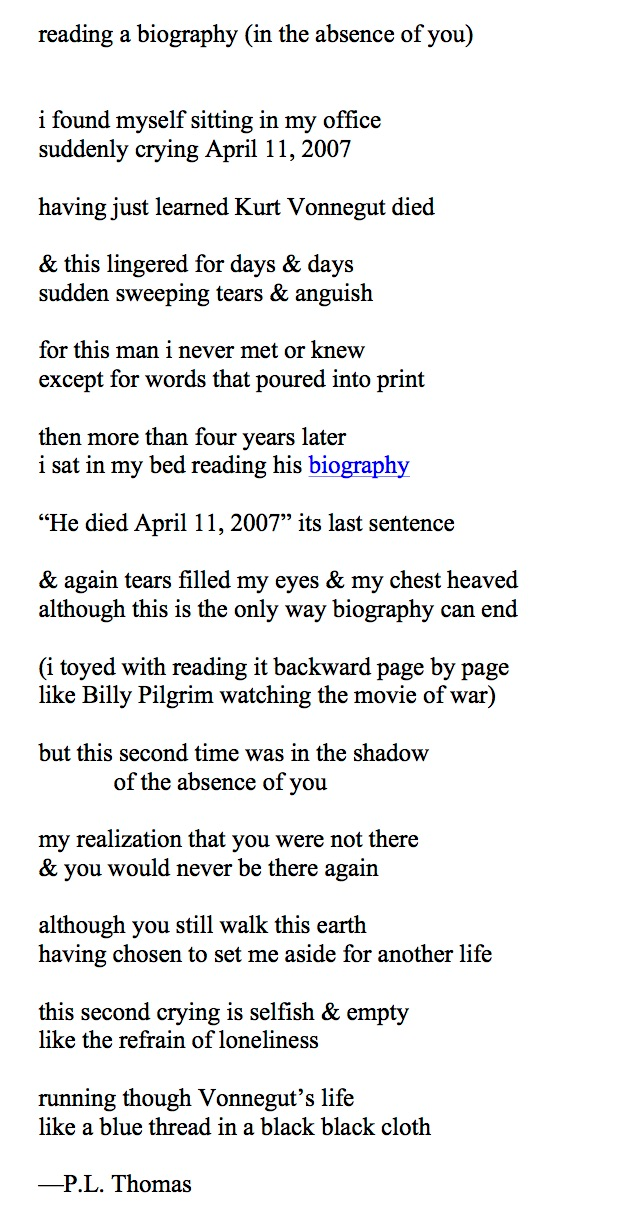
Poem: reading a biography (in the absence of you)
[NOTE: Reposting from 2015 to commemorate year 100 of Kurt Vonnegut’s birth 11 November 1922]

On Art, Imposter Syndrome, and Epistemic Trespassing
Ada Limón’s “The Raincoat” ripped through me as I read the poem; it begins:
When the doctor suggested surgery
and a brace for all my youngest years,
my parents scrambled to take me
to massage therapy, deep tissue work,
osteopathy, and soon my crooked spine
unspooled a bit, I could breathe again,
and move more in a body unclouded
by pain.
I was diagnosed with scoliosis in the summer of 1975 as I was about to enter ninth grade. My entire high school experience was shaped (literally) by wearing a full upper-torso brace.
This was deeply traumatizing for an anxious, skinny, and deeply self-conscious teenager, but it was also unimaginably moving—especially in hindsight—because my working-class parents never hesitated to seek out, pay for, and support anything I needed medically or emotionally to straighten my spine and live somewhat normally once it was removed.
My scoliosis years are also my introduction to reading, collecting, and drawing from Marvel comic books.
Recently, I have come back to creating art although I abandoned my aspirations to be a comic book artist somewhere in my early 20s.
I started out simply tracing from comic books in 1975, but soon began drawing freehand from my favorite artists working at Marvel. By my senior year and into early college, I was drawing more realistic pencil work usually from photographs.
I was entirely self-taught because my high school in the late 1970s had no art courses (until my senior year when the only art class offered was during a required class), just as it had no Advanced Placement courses.
Early in life, I was engaged in self-education in a way that seems logical as I remained in formal schooling until I was 37, when I finished my doctorate.
Yes, I have degrees in education, but my real expertise is learning.
I also spent decades learning to be a serious cyclist and my own bicycle mechanic. And my life as a creative writer, now mostly poetry, is very much self-taught (although I did enroll in one graduate creative writing course during my EdD).
However, all of this sparks a real tension for me that can be captured well in two concepts—imposter syndrome and epistemic trespassing.
While I have returned to art, prompted by my partner exploring art for the first time in her life through Procreate, I have had to revisit what it means to do any sort of work from a naive and inexperienced position while there are people doing that same work from a position of expertise and many years of purposeful pursuit of that work.
My nephew is a professional photographer, yet, much as my partner expressed, he recently worried over texting about his submitting an art display on school shootings. He and my partner are very aware of both imposter syndrome and epistemic trespassing (although the latter, more so as a concept and not necessarily the term).
The conversations with both of them while I have committed anew to being a visual artist myself (which has not progressed as I anticipated; see here and here) have allowed me to think carefully and deeply about how to justify being self-taught, how to navigate imposter syndrome, and how to avoid epistemic trespassing.
First, as I explained to my nephew, to do any creative work, art for public consumption, takes a degree of arrogance—the assumption that your expression matters in some way and that others should or need to experience it.
As a writer, I have the fortunate “gift” that despite my trepidations and insecurities, once I feel the urge to write something, I do it, I do it with zeal, and then I share it. (Yes, later I suffer the terror of having done all that, but the terror never impedes my doing it, fortunately.)
But as we in the literary world know, arrogance is a dangerous thing; arrogance is so dangerous, much of literature bangs the warning drum repeatedly: “My name is Ozymandias, King of Kings;/Look on my Works, ye Mighty, and despair!/Nothing beside remains” (“Ozymandias,” Percy Bysshe Shelley).
Next, then, since creative acts take at least a modicum of arrogance, the key is the most important lesson I learned over three decades as a dedicated student: The moment you have a “great idea” you must understand that there are many people who have already had that idea and spent years upon years purposefully exploring that idea (or behavior).
Your creative arrogance must be tempered by humility, a healthy alternative to both imposter syndrome and epistemic trespassing.
A doctorate (not exclusively of course) like any advanced formal schooling or training provides skills in that humility—such as first knowing there are experts that have come before you (and concurrent with you), researching who those people and their work are, and then assessing how to navigate their expertise in ways that inform your coming to know and to do.
My scrawny ass, fully braced, standing at the bar of my parents’ house knew that I deeply wanted to draw something as wonderful as Gil Kane, something as stunning as Jim Steranko, something as beautiful as Frank Frazetta.
During that same time I was falling in love with writers—reading, reading, and mimicking.
Being creative requires that balance between arrogance and humility; however, I also think one other reality is very important to confront.
American culture tends to suggest that many human behaviors are for gifted people only—especially visual arts and poetry, for example.
So, most of us pause when we have creative urges—”Who am I …?”—although, and I cannot emphasize this enough, to be human is to be creative.
Creativity is not for the gifted only. Or better yet, we are all potentially gifted, and thus, potentially creative.
My new life of visual art isn’t what I planned or expected. It involves the wonders of technology (iPad and Procreate) that allow me to blend my very naive attempts at photographs, my latent and self-taught abilities as a visual artist, and my many decades as a purposeful and serious writer.
For me, then, I move forward arrogantly with the humility of “Who am I …?” as my background music while I work.
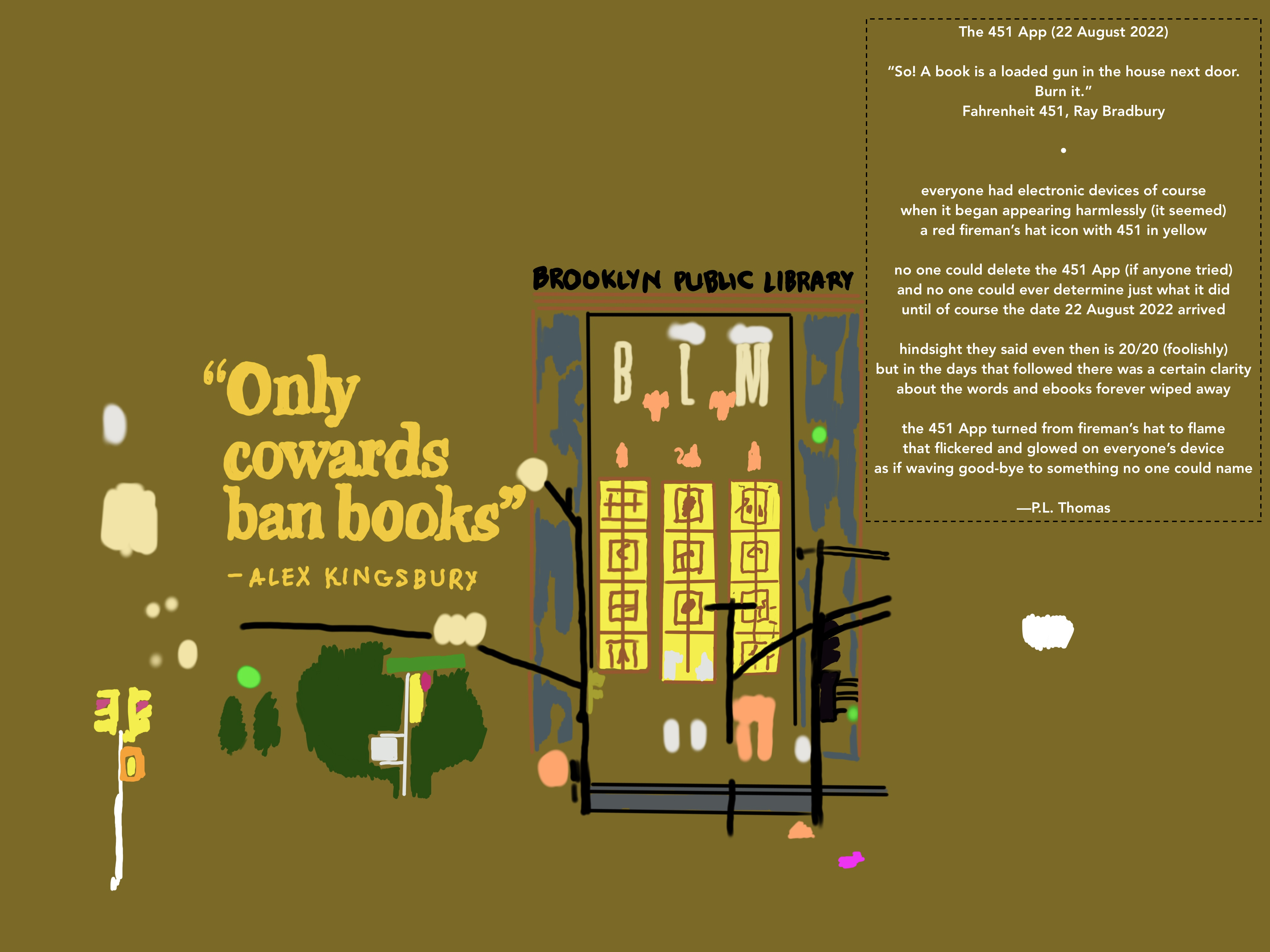
The 451 App (22 August 2022)
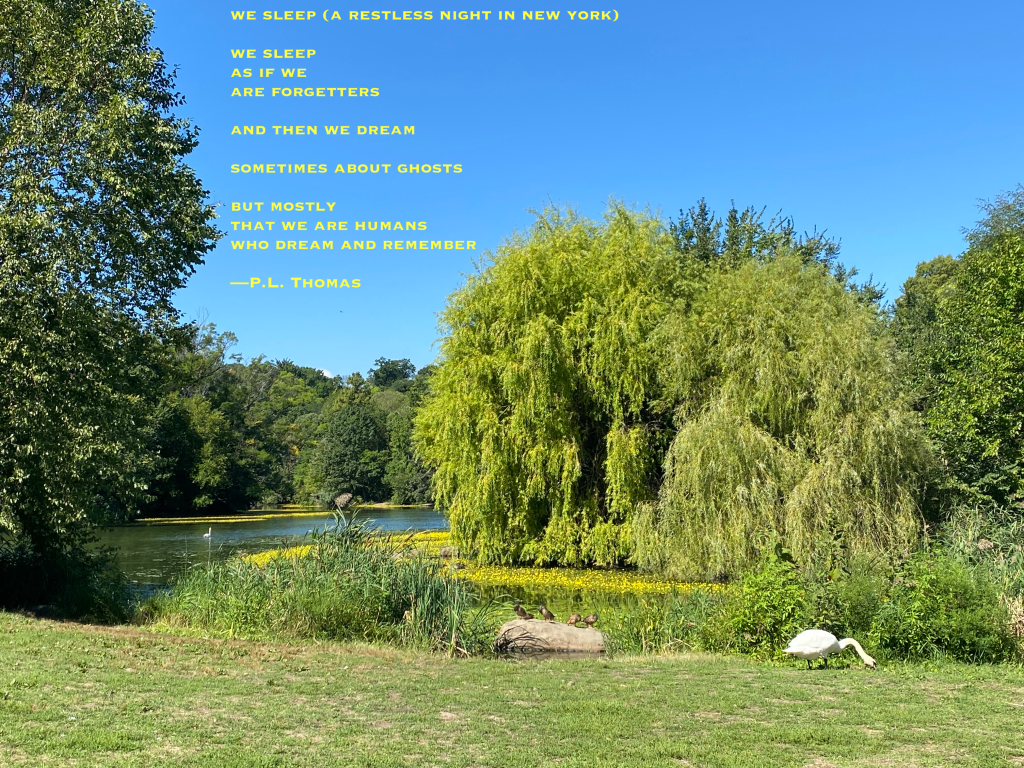
POEM: we sleep (a restless night in new york)
we sleep
as if we
are forgetters

and then we dream

sometimes about ghosts

but mostly
that we are humans
who dream and remember

—P.L. Thomas
NOTE: My original poetry will now be posted here, but please find my poetry-only blog here for older poems.
 dr. p.l. (paul) thomas