Category Archives: poetry

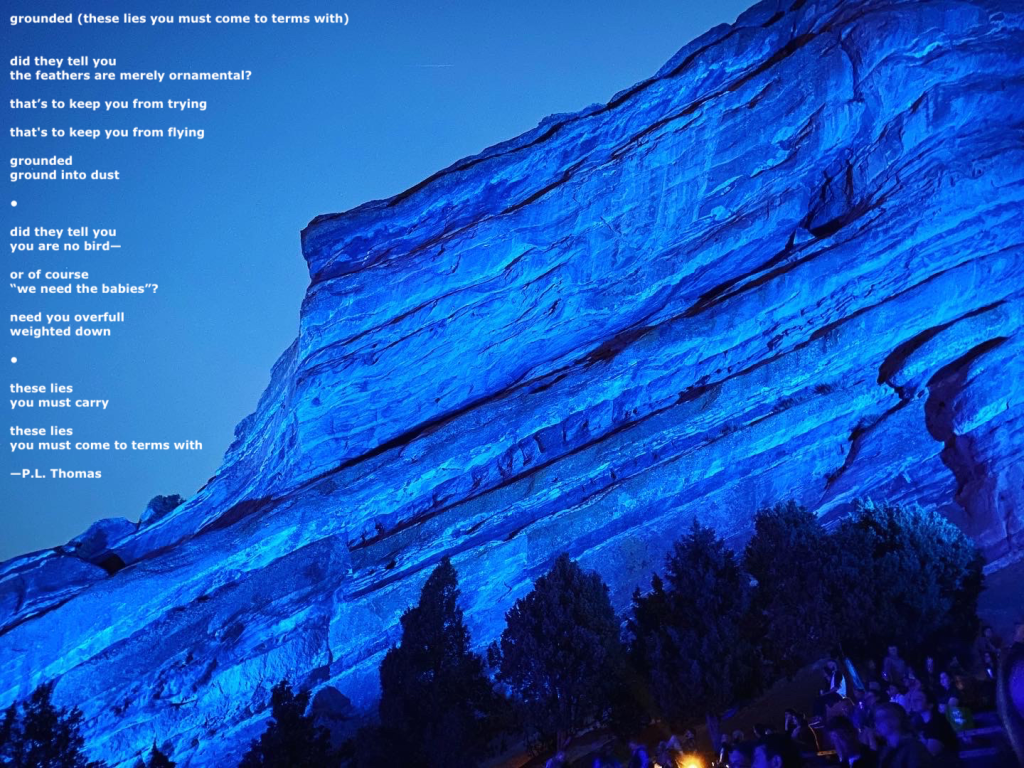
POEM: grounded (these lies you must come to terms with)

did they tell you
the feathers are merely ornamental?

that’s to keep you from trying

that's to keep you from flying

grounded
ground into dust

•

did they tell you
you are no bird—

or of course
we need the babies?

need you overfull
weighted down

•

these lies
you must carry

these lies
you must come to terms with

—P.L. Thomas

NOTE: My original poetry will now be posted here, but please find my poetry-only blog here for older poems.

POEM: the last rest area in Missouri (this trail of me)

I guess I’ve always been a delicate man

“Lemonworld,” The National
i tiptoe through your garden
but it is dark
so there will be carnage

i should have done this barefoot
and in the daylight
i realize stepping blindly

then i could feel and see
this trail of me
my silent destructions

(other people would just tapdance on your heart
or carelessly bloody your shins
ruthless and graceless)

in the morning you will find me surefooted
knees caked in mud
my head resting apologetically against your back door

—P.L. Thomas

NOTE: My original poetry will now be posted here, but please find my poetry-only blog here for older poems.

Teaching in a Time of Conservative Tyranny

My spring 2022 schedule includes three classes, two sections of upper-level writing/research and one first-year writing seminar. During my second class today, while students were completing individual work before a class discussion, I scrolled through Twitter and found this:

I quickly Googled the poem, and decided to interject an impromptu mini-lesson between students completing the individual assignment and the class discussion.

Although I have been a teacher educator (and first-year writing professor) for twenty years now, I quickly put on my high school English teacher hat and conducted a lesson on Dunbar’s poem, reading it aloud and asking students questions along the way.

I repeated the lesson (also not on the schedule) in my third class, where students offered similar responses to the discussion.

Overwhelmingly, students identified the mask motif as an exploration of putting on an emotional front, noting, for example, the juxtaposition of “smile” and “cry” in the line “We smile, but, O great Christ, our cries.” (Interestingly, one student immediately contextualized the mask motif in the current Covid era.)

When I directly asked students to identify the “we,” most immediately spoke about a universality of the poem being about “society” or anyone who identifies with the speaker in the poem.

After walking through the poem (and confirming that students were not familiar with the poem or Dunbar), I pulled up the Wikipedia page on the poem to highlight that it had been published in 1895 and that Dunbar was a Black poet who was born during U.S. Reconstruction and published in the Jim Crow Era.

I then noted the poem is about Black people masking for white people—the core of Chanea Bond‘s Tweet and the student’s awareness that at least 4 out of 10 students in the U.S. are now being taught in states with educational gag orders, a growing list of state-level legislation being proposed and passed by Republicans from Florida to Virginia to Texas to Oklahoma to Indiana and anywhere Republicans have unlimited power.

These educational gag orders include curriculum bans (often directly and indirectly invoking Critical Race Theory), book/text bans, and so-call parental rights bills that allow any parent to trigger censorship or reprimanding a teacher. While this legislation is devastating to public institutions (K-16), some bills include potential fines for private schools who take any public funds.

Attacks on books have spread beyond assigned reading, classroom libraries, and school libraries to include public libraries as well.

This wave of gag orders and censorship has included violence and threats as well as overwhelmingly impacting Black texts and topics along with any writers or works that deal with LGBTQ+ topics or experiences.

The mask being used to hide the racism and bigotry of these complaints and legislation is an insincere claim that student discomfort must be curtailed.

Some of the most extreme versions of gag order bills include requirements that teachers provide a year of lesson plans before the academic year in order for parents and others to review and approve them.

First, let me confront that last point; my impromptu lesson today was one of the best I have done in recent memory. Students were engaged, and I watched in real time as my students confronted ideas, as my students learned and became different people than when they walked into class today.

While lesson plans are important, they simply are not as valuable as being prepared to teach, and being prepared to engage with your students; a fundamental misunderstanding about teaching is that (as these gag orders and parental rights bills reveal) too many people think the job of the teacher is to transfer knowledge/content to students.

As most any teacher will tell you, we teach students—not lessons, not history or English or even The Great Gatsby.

As students and as future educators, my students today needed and deserved the lesson that came from a teacher’s Tweet. They also benefitted from a brief experience with how to read and engage with poetry along with the tyranny of partisan politics that is shutting the door on their lives as free individuals.

But my impromptu lesson today grounded in a text that may soon be banned from classrooms exposes the catastrophic misunderstanding of texts. Not a single student today recognized the powerful racial message intended by Dunbar because those students lacked historical and literacy context that is already missing from their formal education without the educational gag orders.

As I have stressed during this manufactured outrage from the Right, traditional education is already incredibly conservative.

Reading Dunbar’s poem, in fact, for its universal appeal strips it of its radical power—and cheats students from confronting the historical realities of Reconstruction and Jim Crow for Black Americans.

In 2022, students, teachers, teaching/learning, and academic freedom are under assault by conservative tyranny. There is nothing American or noble about censorship.

“A mind is a terrible thing to waste” is a seven-decades long slogan of the UNCF, and with the greatest of ironies, it now seems a central goal of Republicans to insure all minds are wasted.

Bond’s student is our canary in a coal mine, and soon, every classroom may be just as dangerous, literally, as a coal mine if we refuse to heed that student’s concern.

Poetry of Pain, Poetry of Hope

When I posted my newest poem yesterday, we weathered winter (silence & shouting), I realized this is my first poem of 2021. It is unusual since it is mostly a poem of hope, a poem uniquely set in the Covid-19 pandemic.

As I looked back, I also realized that the last poem of 2020 was about my aunt’s suicide, a human throat (ineffable), a poem of pain anchored to the frailties of being human—although this poem too cannot avoid the ghost of the pandemic lingering there.

My newest poem feels out of character for me, a person prone to cynicism and a general negative outlook on life paraded as a “realistic” view. The poem is also unusual because most of my poetry comes in bursts; first there are entire sections that come to me whole (often in sleep or near sleep) and then several hours of tinkering and shaping the poem that is calling to me to bring it forth.

I ended 2020 in the paradox of writing about the ineffable, a suicide of a family member who filled me with contradictory and confusing emotions. So starting 2021 with some hope feels both odd and perfect as I sit in South Carolina where spring is teasing us with warm weather and pollen.

we weathered winter (silence & shouting) is a spring poem, and I could have written something like it even before a pandemic. But the poem did not come in a burst; it came over many weeks and quite unexpectedly:

we weathered winter once again
the sun slipping away later & later
daylight & hope expanding

this winter like all winters
was unlike any winter before
unlike any winter ahead

The opening section above did come in a burst, which I typed out on a Word document many weeks ago. It sat on my screen since then, was eventually closed out, and then almost nearly forgotten.

A couple nights ago, I had what I consider sort of a poem vision that accompanies words, specifically “everything ascending into the trees.” In my slumber brain, I was writing a post-apocalyptic science fiction novel, and I was jumbling literally all people climbing into trees with some nondescript memory of watching a nature show about monkeys scurrying into the trees when avoiding predators. I also was thinking about the Crakers from Margaret Atwood’s MaddAddam trilogy.

When I woke up, I began playing with that kernel and eventually the second section appeared:

i imagine late at night
you do not understand
the silence & shouting

everything ascending
into the trees
completely quiet & afraid

But this could not have developed if I had not remembered the “winter” section abandoned weeks ago. I opened the file, thought about the need for section dividers, and plopped in the section section, drafting and playing with the original ascending idea as well as the “do not understand” part that also came to me during the night.

What developed was a poem with three-line stanzas, with two each per section. What I began to imagine, though, was how this ambiguous ascending scene matched the winter/end to the pandemic idea of the first section.

The silence/shouting contrast along with the sense of fear in ascending to escape something, to feel safe, needed something to combine the impressions. That is when I began to think about two beings huddled together, a conflating of two beings huddled together in a tree and two beings cuddling in sleep; and thus the third and last section:

how we huddle here
like lovers entwined asleep
hoping with spring

maybe there will be drums
maybe there will be horns
maybe there will be singing

One of the many things we have lost due to the pandemic is music concerts so my message of hope—imagining us all sitting in trees, afraid of Covid-19 and hoping for a return to something closer to normal (not a tree life)—about the possibility of returning to large crowds at a concert (drums, horns, singing).

The sound motif—silence, shouting, music—works, I think, to create the sort of tension that comes from the change of seasons. In the case of winter to spring, that tension is the feeling of hope resting against a nagging fear that spring somehow may not come after all.

My initial joy over the first section—the “W” alliteration of the first line I dearly love—were mostly affections of language, although I thought the idea of pandemic winter being more different, just as every winter is different, was clever enough and engaging. But there was no poem there.

The missing elements were about breathing a story into the “we” and also allowing those characters to develop even as I left much of the context ambiguous and even not directly spoken.

What is the job of poetry? I have been wondering. My poetry of pain next to my poetry of hope.

I understand that poetry is essentially concrete—images, characters, plot, setting; poetry is about the physical world doing stuff. But I also know that poetry is about what is not stated, what is not specifically identified.

My poem of pain ends with a sort of brutal specificity that attached itself to my own experience of discovering the cold details of the suicide. My poem of hope is suggestive, elusive, and in the most basic sense, hopeful.

Hope became symbolized by attending a concert, The National. Something I have done before so something I can reconstruct and imagine. During the writing of the poem, I had “I’ll Still Destroy You” on replay in my brain, although mostly different lines than what I chose to preface the poem: “Put your heels against the wall/I swear you got a little bit taller since I saw you” cycling over and over in my mind’s ear.

2021 is now racing by, and with spring, many of us in the U.S. are overwhelmed with hope for more than the usual joy associated with longer daylight and warmer weather.

What if the vaccinations allow us to return to something we have missed—gathering close together to sing along and sway to the drums, the horns, and the singing?

I am hopeful because it is too painful not to hope.

The Writing Models Dilemma: On Authentic Writing and Avoiding the Tyranny of Rubrics

While my journey to the fields of English and teaching started with science fiction and comic books, a love of reading that was steered to so-called “literature” by my high school English teacher, Lynn Harrill, I walked into my first high school classroom as a teacher of English primarily committed to teaching young people to write.

My goal was not simply to have my students write well, but to write authentically, to write in ways that existed outside traditional classroom essay writing.

Teacher preparation for teaching high school English was for me (and remains mostly so) grounded significantly in teaching literature. As a result, I spent the first 5-10 years as a teacher teaching myself how to be a writing instructor.

Far too many of my practices were quite bad, even harmful. However, one thing kept my writing curriculum afloat—volume. I somehow recognized very early that people learn to write by writing (see LaBrant, 1953).

But I also began my career as a teacher of writing by embracing two contradictory commitments: (1) I was always anti-five-paragraph essay; however, (2) I tended to remain grounded in a (ridiculous) commitment to using an authentic-template approach.

It took me several years to recognize that teaching writing wasn’t about finding the right template, but about rejecting the tyranny of the rubric/template approach.

Without rubrics/templates, however, teaching writing to a relatively large number of students, most of whom are not genuinely motivated to become writers, is incredibly challenging. None the less, rubrics/templates are conducive to managing the teaching of writing, but they are essentially the enemy of authentic writing.

A watershed moment for me in teaching writing came with helping writers who wanted to write poetry. Writing poetry and teaching people to write poetry are very similar to writing and teaching students to write essays in that both can be accomplished in some superficial way with rubrics/templates, but that those outcomes are only pale imitations of the forms being attempted.

Most of us have participated in the clunky 5-7-5 approach to writing a haiku poem for class just as most of us have performed the five-paragraph essay.

The watershed moment in understanding how to approach the teaching of poetry included a direct move away from templates and mechanical structures (haiku, sonnets, etc.) and toward the conceptual elements that define a form or genre.

While prose is driven by the formation of sentences and paragraphs (both concepts that are not as easily defined as many think), poetry is most often characterized by lines and stanzas (even prose poetry is anchored to the norms it resists).

Without using syllable count, then, line formation and line breaks are something many poets intuit or feel—stanza formation as well.

When I work one-on-one with an emerging poet, I attack lination (line formation and breaks) and stanzas by asking the poet to be aware of the “why” in those formations and whether or not there is any pattern guiding that “why.”

It is about having a purpose, not that one purpose is correct.

This work is very complex, but it is at a conceptual level, not the mechanical framing of rubrics/templates.

Teaching writing at the conceptual level, however, can seem abstract to students (who lack the rich experiences with text as writers for those concepts to be concrete); therefore, I soon began seeking ways to merge concepts to the concrete.

Here I also began to blend more intentionally my responsibility for literature and reading instruction with my writing curriculum by presenting our text readings as models for our journey as writers.

To be authentic in our pursuit as writers, I eventually realized, ours was not to reject rubrics but to reimagine our paths to rubrics. I knew that handing students stilted rubrics/templates was mostly about compliance and did not foster the sort of conceptual understanding my students needed.

The teacher-created rubric makes most of the writer decisions for students that they need experiences with in order to be authentic and autonomous writers.

However, I needed to help students develop their own toolbox of rubrics drawn from a wide and rich reading of texts that model the many ways that writers produce any form or genre.

Poets create poetry always in conversation with forming lines and stanzas just as essayists are aware of beginnings, middles, and ends as they navigate sentences and paragraphs.

For at least thirty years, then, I have been providing my students compelling models of the sorts of essays they are invited to write and walking them through reading-like-a-writer activities (see here and here).

And for the past two decades, where I teach undergraduate and graduate students, I have worked diligently to provide my students detailed models with my comments embedded to walk them through some of the more mundane elements of writing in formal situations (college essays, scholarly writing, public commentary)—citation, document formatting, etc.

Two of those models (linked above) are for cited scholarly essays using APA and public commentaries. Periodically, I create new models and revise my embedded comments, seeking always to refine the effectiveness of using models for teaching writing.

Now here is the dilemma.

Many years ago I had to accept the sobering fact that research shows that teaching writing by models is only modestly effective, far less so than something as clunky and inauthentic as sentence combining (sigh).

But I also live the reality that models often fall short of why I use them and how they should support students writing authentically.

This spring, in fact, I have implemented two new models with embedded notes, and I have been increasingly frustrated by the jumbled efforts at public commentary in my upper-level writing/research course.

That frustration, however, has led to a new understanding, coming 36+ years into teaching writing.

My models with notes are primarily generic examples to walk students through some of the structures and formatting expected in formal cited essays or when submitting a public work for publication. While I am frustrated always with students failing to format as required with these models right there in front of them, I have resolved myself to this process taking several rounds for students to “get” these (trivial) elements of submitting original writing.

My ah-ha! moment this semester has been to recognize that students have repeatedly ignored the public commentary assignment and have clung instead too directly to the model by creating a backward rubric/template for their public commentary submissions.

I soon realized that many of the students simply mimicked exactly my number of and types of paragraphs provided in the model (much of which wasn’t appropriate for this specific assignment).

Of the two major writing assignments, of course, writing a public commentary is the one more foreign to my students, the one about which they have the least expertise. In desperation, they have reverted to the inauthentic process most of them have experienced as writing instruction—prescriptive prompts and conforming to rubrics.

I have been long aware that my writing instruction is mostly unlike what students have experienced. What I ask students to do is extremely hard, often frustrating, but something they genuinely can just suffer through briefly and return to the normal ways of writing essays in college.

There is little I can do about this outlier aspect of my classes and practices, but I am now better equipped to have the rubric/template urge conversation earlier and more directly with students.

Using models and models with embedded notes can be more effective with greater intentionality and my diligence in responding to students who resist working toward conceptual levels of understanding by defaulting to rubric/template mode.

The dilemma with using models to teach writing is a subset of the larger problem with nudging students away from performing as students and toward performing as writers (or whatever role we are trying to achieve—pianist, scientist, historian, etc,).

This newest round of better understanding how to teach writing is yet another adventure in teacher humility—confirming that I must always be diligent about what I am doing and how they guides (or misleads) my students in pursuits we share.

Teaching and learning are different sides of the same complicated coin.

Honey Bee: “Honey helps an open wound”

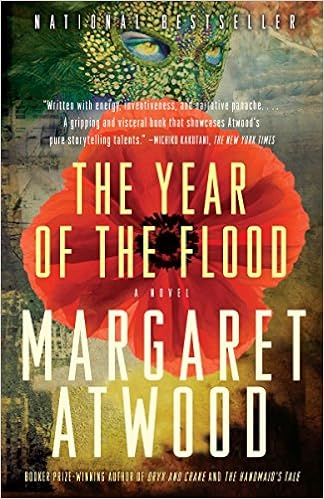
“Gradually, Toby stopped thinking she should leave the Gardeners,” begins Chapter 19 of Margaret Atwood’s book 2 of her Maddaddam Trilogy, The Year of the Flood.

The “flood” is the apocalyptic “Waterless Flood,” predicted by God’s Gardeners, a vegetarian sect, and created by Crake (Oryx and Crake, book 1 of the trilogy).

Oryx and Crake (MaddAddam Trilogy, Book 1) by [Margaret Atwood]

“One day, old walnut-faced Pilar—Eve Six—asked Toby if she wanted to learn about bees,” and Toby does. The scene includes Pilar’s “bee lore”—such as “Honey helps an open wound”—and highlights the fragility of those bees under the weight of human negligence: “It was the pesticides, or the hot weather, or a disease, or maybe all of these—nobody knew exactly.”

Atwood’s trilogy, and this novel specifically, is quite chilling—for me a reread—in the time of Covid-19; our 2020 pandemic at least forces humans to confront our fragility, but it should also provoke some humility for our role in the entire ecosystem, Nature, or as Emily Dickinson envisions, “Landscape.”

What human behavior costs bees also costs humanity—bees as harbingers of our own inflicted doom.

That God’s Gardners are vegetarian, not vegan, is a distinction captured by their devotion and tending to honey bees. For several years now, I have been learning about veganism, and one of the most surprising elements was discovering that for vegans, honey remains a point of debate.

The standard “eat nothing with a face” framing of veganism is a bit fair, and a bit careless. Vegans also shun eggs and milk, produced by creatures with faces, driven by a concern for sentient life that is central to the Gardner’s in Atwood’s novel.

Some of veganism can be grounded in consent—creatures other than humans being given the same grace of consent for their lives and that which they produce—while some is certainly anchored in the sanctity of life, a rejection of reading “dominion” in Genesis as nature and all living creatures subject to the folly of humans.

While bees producing honey seems the same as chickens producing eggs and cows producing milk, the gathering of and using honey continues to be allowed among some vegans and rejected by others.

Once unpacked, in fact, veganism becomes a nearly inextricable ethical spider’s web of contradictions. Fruits and vegetables are not above the workings of nature and living creatures, pollination for example.

How arbitrary is the line between pollination and honey/egg/milk production?

One morning, a little over three years ago, seemingly in a different universe than the world we live in during April of 2020, I was opening a small packet of honey to put in my coffee at Starbucks.

This may have been around the time that I learned some vegans rejected the use of honey (vegans do not, however, shun sugar). So I found myself overwhelmed in that moment with recognizing the arrogance of being human, the work of bees so neatly and cavalierly packaged for human consumption.

For many years, I had avoided processed granular sugar by using honey in my coffee. In recent years, along with the ethical dilemma, I have had to admit that sugar is sugar in the human body so the commitment to honey has always been fairly arbitrary and pointless.

After some health concerns highlighted by blood work last fall, I have renewed my quest to be sugar free, and have even abandoned my dear honey, drinking coffee with creamer only.

That morning at Starbucks began a poem, we rape the bees (because we can), because I stood there thinking about bees as workers, and the stark reality in the U.S. that workers are seen as autonomous beings even as our capitalistic consumer culture compels us to work or find ourselves less than human.

Health care and retirement along with our wages are directly tied to our status as workers. As the Covid-19 crisis is showing us, without the security of health care and wages, we are all dehumanized.

Our Waterless Flood has been a sort of reverse baptism that should wash us clean of the sin of the inhumanities of capitalism. This pandemic may as well call us to reconsider not only our basic humanity but our oversized role in all of nature.

For us in the South, we fear the invisible threat of Covid-19 as pollen covers over everything during an April that has brought us temperatures in the 80s, a swarm of tornadoes, and a frost and freeze warning.

Is making honey and serving the queen simply the beeness of being a bee, an existential fact like Sisyphus and his rock? Is working in the service of the U.S. economy simply the basic humanity of being human as well, a fate shared with the bees?

I included lyrics from “Bloodbuzz Ohio” (The National)—“I was carried to Ohio in a swarm of bees”—in my poem, and am often drawn to lyrics and poetry about bees.

So as I approach the end of book 2 of Atwood’s trilogy while I also live a new life guided more than normal by simply surviving our Waterless Flood, I venture outside everyday for some relief, some peace—everything yellow-dusted in pollen—and eventually I cough and sneeze, tempered then by the new paranoia we all feel from the basic human reactions that may signal the Waterless Flood is right there before us.

One of my favorite spots to sit outside my apartment, a converted cotton mill in the quickly gentrifying South, is among an assortment of bees and wasps in the rafters of the deck overhang. So far, we share the space in harmony, although I have to calm my own knee-jerk fears.

Now, I am tempered by Atwood’s speculative novels that seem all too real, but also Matthew Olzmann’s “Letter to Someone Living Fifty Years from Now,” published the same year I wrote my bee poem, ending: “And then all the bees were dead.”


Recommended

Honeybee: Poems & Short Prose, Naomi Shihab Nye

[The murmuring of bees has ceased], Emily Dickinson

The Things Schools Ruin: Poetry Edition

[Header Photo by Kristin O Karlsen on Unsplash]

When I posted two of my favorite lines of poetry to highlight our human failures, I received a poetic reply:

funny, I posted the Wasteland today.
You know, ‘April is the cruelest month’ and all that.

— oTTo & Nairb (@NairbOtto) April 2, 2020

While this poetry exchange remains anchored to the dead-white-man problem with the canon many of us have experienced in formal schooling, I think it also speaks to, when allowed, that poetry is a genuinely powerful and relevant human form of expression that is more often than not harmed by traditional teaching.

National Poetry Month, April 2020, falls in the midst of a world-wide pandemic that has disrupted almost all formal schooling across the U.S. and much of the world, but social media suggests that poetry not only persists, it thrives.

Poet Tara Skurtu, for example, launched the International Poetry Circle through her Twitter account, and the response from poets video recording poetry readings has accelerated beyond her capacity to manage them.

When given the opportunity, poetry is its own best teacher, and when readers are allowed, poetry matters.

Even though I came to recognize my own calling and journey as a poet during my first year of college, I was during that same period having a terrible experience with Emily Dickinson, who I loathed because of formal schooling but came to love many years later as a teacher while exploring her life and work on my own.

By my junior year of college, I had made the transition from considering a major in physics or architecture to committing to English education. It was a hard and long journey for me to find my life in words because schooling was often in my way.

I entered teaching high school English determined to teach well, but also determined to open the door to literature and writing for my students in ways that weren’t often allowed for me (except for the occasional teacher who was working against the traditions of schooling).

The two seemingly endless challenges I faced, however, were that my own early efforts at teaching well proved to be as counter-productive to fostering a love of reading and writing as so-called traditional methods and that students hated, for example, writing and poetry so deeply because of their experiences over nine or ten years I was facing the most uphill of uphill battles.

I taught Albert Camus’s “The Myth of Sisyphus” for many years in conjunction with his The Stranger; I also had a poster of Sisyphus hanging on my classroom wall.

Like Sisyphus I taught poetry each year with good intentions and great care, only to have the students remain stoically anti-poetry.

Teaching poetry was my rock, but I was not happy.

Then on Twitter this morning, I was reminded of when my teaching poetry turned a corner:

— Paul Thomas (@plthomasEdD) April 2, 2020

Eventually, I shifted my entire poetry unit, spanning a quarter of the academic year, to a series of lessons grounded in the lyrics and music of the Athens, Georgia based alternative band R.E.M. And I discovered that my students were drawn to the poetry of James Dickey, who at the time taught at the University of South Carolina.

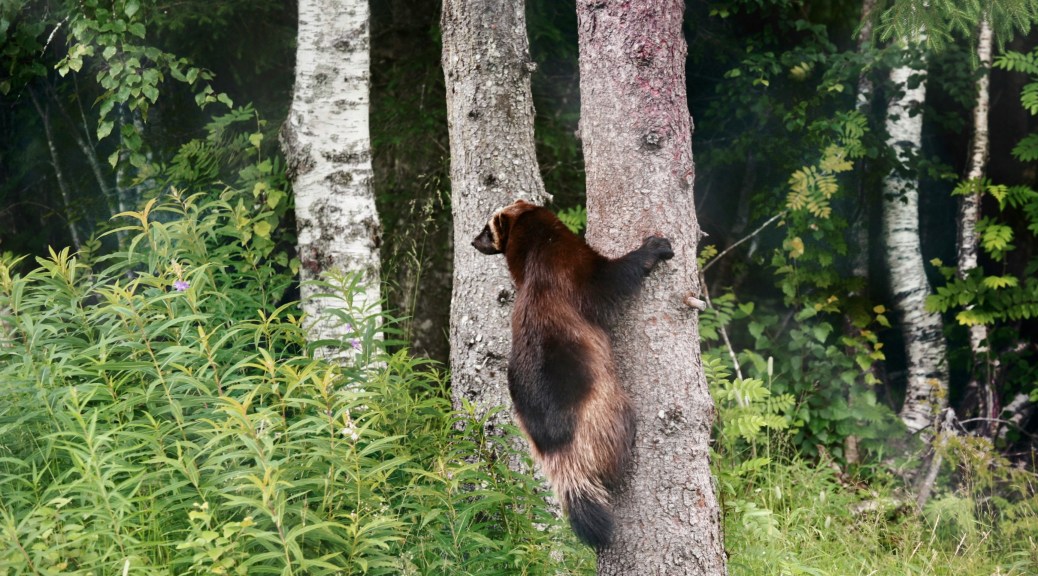
In the late 1980s, our high school was destroyed by arson, and once the school was rebuilt, we made a large print of Dickey’s “For the Last Wolverine,” had Dickey sign it, and hung it prominently in the entrance of our new library.

Dickey himself was from Georgia, and I think students found his rural poetry set in nature and dealing with animals concrete and accessible. He was very readable and students tended to feel a sense of comfort with their understanding of these poems.

Although Dickey, like many white men of the twentieth century, poses problems as a flawed man, I will always have a warm place in my teacher heart for how my students embraced these poems; we had many good days reading and discussing these poems by Dickey (along with “Deer among Cattle” and “For the Last Wolverine”):

There is a complicated paradox to formal schooling since the structure is an ideal way to bring young people into the beauty and wonder of language, but the demands of mass education for structured outcomes tend to ruin those experiences with beauty and wonder.

Poetry worked with my students when we allowed ourselves to experience poetry for poetry’s sake, when we set aside the insidious urge to analyze and reduce any poem to a neat theme.

And despite having similar problems as the dead-white-man tradition of schooling, social media shows us that poetry links us, poetry can stabilize and soothe us when the world is too much with us.

If and when we return to some brave new world on the other side of the Covid-19 pandemic, something we will then call “normal,” I hope those of us who are charged with teaching language and poetry will be able to hold onto the beauty and wonder of poetry in ways that guide us as we invite students to join in.

No literary technique hunt. No multiple-choice questions.

I think that when I read Dickey’s poems aloud—”I wave, like a man catching fire”—just as when I read Faulkner aloud, there was something about my deeply Southern voice and Dickey’s very Southern poetry that resonated with my Southern students.

Poetry as us, us as poetry.

I miss those days, and regret it took me several years to allow those times that now sit in my heart fondly.