If trending matters on social media, a consensus is building that Bari Weiss has ushered in the death of CBS, a nail in the coffin of mainstream media:
Farewell to CBS News and "60 Minutes." It just went the way of the Washington Post's editorial page
Once you begin surrendering to Trump, he always wants more. You can’t appease a tyrant. Some thoughts… pic.twitter.com/g8JBxfkCHk
Many things can be true at once even when they seem to be somewhat contradictory, and here is such a case.
First, Weiss being hired by and then allowed to shape one of the original major networks in the US—associated with Walter Cronkite and Dan Rather—does deserve the criticism being leveled at both Weiss and CBS.
However, lurking beneath this hand wringing about the death of the mainstream media are interrelated realities—media and journalists have a long tradition of seeking to remain unbiased and nonpartisan, but they are both perceived by the public as liberal.
Over my 40+-year career, I have worked in two professions that share reputations for being liberal (education and journalism) even though both professions demand that teachers and journalists remain unbiased and nonpartisan, essentially not political.
Here is what many people miss about the Weiss/CBS controversy: Journalists/media represent a body of workers who are often disproportionately progressives or moderates but who have historically in the US (mostly because of standards around remaining unbiased and not political) perpetuated conservative and traditional values, often to the exclusion of pursuing truth and accuracy.
Yes, Weiss pulling (or delaying) the 60 Minutes episode is a grossly extreme example, but this action isn’t substantially different than how mainstream media has always worked. And that includes the nostalgia often associated with Cronkite and the Golden Era of broadcast television.
Journalists and media performing their work in unbiased and objective ways is not possible (all human endeavors are biased) but that standard also works as a veneer for maintaining social and political norms—which is a conservative bias.
Mainstream media has never really disrupted the political and economic status quo of the US; media has mostly served that status quo and those profiting from it.
My work as a public scholar keeps me in constant contact with mainstream media. This past summer, I had a commentary in The Washington Post, and while I found the journalists and experience very professional and supportive, the very long process tended toward softening my analysis of the reading crisis and shifting the discourse toward normative beliefs instead of critical evidence.
But I also had an experience with 60 Minutes in the spring of 2024.
A producer at 60 Minutes had read some of my public work on the current reading crisis movement, the “science of reading,” and he found my perspective unique, surprising. He emailed, and we set up a phone conversation.
We talked for over an hour and a half, and while the producer was engaged and interested, the discussion was mostly punctuated with him asking me to repeat key points that contradicted the norms of what people believe about reading and teaching reading.
He seemed most disoriented by my explaining what NAEP reading scores and achievement levels mean and how that tends to distort how reading proficiency and reading at grade level are understood.
By the end of the conversation, the producer concluded that everything I shared was important and even fascinating, but as he explained, there was no story there for a 60 Minutes segment.
Not long after this, however, 60 Minutes ran a segment on Moms for Liberty, an extremist right-wing group that also happens to perpetuate the exact reading misinformation that does provide the sort of story that media loves (compelling even though it is misleading or even false).
Frustrated and angry, I emailed the producer who responded by stating he had not been aware of the M4L segment, but that producers didn’t interfere in each other’s projects. You see, a compelling story trumps an accurate story.
Again, the Weiss/CBS controversy is a valid concern, but David Brooks—often considered not just a credibly journalist but an elite one—was a lower-key version of Weiss’s nonsense well before anyone knew her name. And Brooks enjoys a mostly uncritical acceptance and even celebration of his conservative ideology thinly wrapped in astute public commentary.
And The New York Times as well as Education Week have long been viewed as high-quality journalism that the public believes to be liberal while routinely producing conservative journalism and traditional stories.
Yes, many journalists (and educators, especially in higher ed) self-identify as progressives and moderates. But mainstream media is ultimately a business, and as the Trump era has shown, the public can be self-defeating in its retreat from anything critical, accurate, or counter to what most people believe.
Before Weiss, CBS was not liberal mainstream media or a Gold Standard of journalism; it was corporate media, often negligent while maintaining a veneer of being unbiased.
After Weiss, who has completely perverted the already problematic both-sides approach to journalism, CBS seems to believe that dropping the mask of objectivity will be the sort of story that sells—even when brazenly eradicating truth and accuracy.
You see, Weiss didn’t murder a robust and mature media; she just nudged it into the grave from Hospice.
Having just re-watched 28 Days Later last night, I am prone to suggest that while we mourn the death of CBS, let’s not rush to raise the dead.
In corporate America, there has never been either a liberal or unbiased mainstream media.
The Weiss dumpster fire is razing the garbage that most Americans pretended not to smell rotting right under their noses.
Responding to the symposium question “What Shall We Do about Reading Today?” Emmett A. Betts, professor of Education at Pennsylvania State College, opened the first article in a professional journal for elementary education with a broad claim:
In a democracy, the people get the kind of schools they want. One of the many functions of an educator is to point the way to ever better schools. If the people want many public and private institutions for the preparation of teachers regardless of the quality of the work or the teacher supply and demand, the people get them. If the people want better schools plants and instruction, they make their will known at the polls and they get what they want. In a democracy, the quantity and quality of educational opportunity is the product of what people want, and what they want is to no small degree conditioned by the educational leadership they have elected to follow. (p. 226)
This may read a bit idealistic or naive, but Betts, I think, offers an accurate characterization of the very complex public education system in the US—a system bound necessarily to the political system itself.
Betts then warns:
Very soon strong pressure will be felt by elementary school teachers to intensify instruction in certain areas, such as reading. This pressure will be brought to bear by non-educators who have found a deficiency but who may may offer no other solution than a “stronger prescription.” Years of fruitful research on learning many be cast aside in order to “do something about reading instruction….” To prevent this wastage, educators must be prepared to bring to bear a considerable accumulation of information that permits an adequate resolving of this problem. (p. 226)
Later in that issue, William S. Gray, University of Chicago, expands on Betts’s warning:
[R]ecent editorials…maintain that current deficiencies in reading are the product of “pseudo-scientific bungling and the innovation of so-called progressive methods of teaching. The solution advocated by one editor was the elimination of “impractical non-essentials,” which were not defined, and of “undisciplined dabbling with practical essentials. The implication of these vague criticisms is that recent innovations in teaching reading have been adopted without due consideration of essentials and of methods of achieving desired ends. Such assumptions are as unsound and merit no more consideration than a purely defensive attitude. (p. 235)
In forty-plus pages, eleven literacy scholars confront the same problems with a reading crisis that may sound familiar to people in 2025.
However, this is from 1942
And in a mere two decades, guess what the state of reading the US entailed?
“After half a century of [progressive reform and expanding public education],” wrote Jacques Barzun in Tomorrow’s Illiterates: The State of Reading Instruction Today (1961), “we who run businesses, carry on professions, work for the government, or engage in teaching itself are forced to admit that illiteracy is still with us” (xii-xiii).
Barzun adds, “the citizen who is interested (and who has managed to learn to read) [may have their] hair [stand] on end at hearing what folly has been condoned as educational theory during the past thirty years” (p. xiv).
Editor of this volume and author of chapters 1 and 7, Charles Child Walcutt argues: “One way to describe the reading problem is to say that it is a teacher problem and—even more—that it is a problem of the teaching of teachers” (p. 18).
And of course: “The assertion that the reading experts do not understand the theory of their system can be demonstrated if we point out the false assumptions, the faulty extrapolations from scientific research, and the absolute contradictions that appear in its central propositions and procedures” (pp. 19-20).
Over sixty years ago, a reading crisis was declared (twenty years after on just before it), teachers were blamed, and reading experts were accused of not understanding the science behind their own field.
Déjà vu all over again.
There is a recurring story—one that is profitable and easy to sell—that education in the US is a failure, notably reading and math education.
The problem with this story is that it has existed since the mid-1800s in some fashion; but as I share above, an intense era of education (reading and math) crisis is at least 80 years and running.
And then, the last 40 years has been characterized by perpetual education reform, several cycles of new standards, new tests, and constant high-stakes accountability.
At no point in the US has the public, the media, or political leaders declared education (reading or math) effective.
But since the 1980s, after the hyper-crisis panic of A Nation at Risk, the US has doubled and tripled down on in-school only reform—”pressure will be brought to bear by non-educators,” as Betts noted in 1942.
The story that isn’t compelling and is hard to sell is this: The history of education crisis and reform has been grounded in misdiagnosing educational problems, casting misguided blame, and mandating solutions that are destined to fail—and even cause harm.
However, here is a story told in research that the US will not accept:
Almost 63% of the variance in test performance was explained by social capital family income variables that influence the development of background knowledge. Background knowledge is a known predictor of standardized test results. Family income variables are immutable by schools. Only public policies, outside the control of school personnel, can influence family income….
Policy makers and education leaders should rethink the current reliance on standardized test results as the deciding factor to make decisions about student achievement, teacher quality, school effectiveness, and school leader quality. In effect, policies that use standardized test results to evaluate, reward, and sanction students and school personnel are doing nothing more than rewarding schools that serve advantaged students and punishing schools that serve disadvantaged students. (Maroun and Tienken, 2024)
In other words, the ways we measure school and teacher effectiveness as well as student achievement are in fact mostly measuring out-of-school factors.
So, what is really wrong with education?
Ideology/politics and market forces.
The disconnect between public, political, and media beliefs about education and decades of research reinforced by Maroun and Tienken is entirely ideological/political.
Many people in the US are bound to rugged individualism and the meritocracy myth, both of which feed into another belief that education transforms society.
So we are now at the story the US hates, refuses to acknowledges, and thus, does not sell: Schools reflect our society, but do not (cannot) transform it (reread the opening quote from Betts above).
There is a core libertarian belief in the US rejecting the dominance of systemic forces that drives crisis rhetoric about education as well as the politics and policy mandating how we implement our schools.
US public education has never been a singular process. There has never been one program or learning/teaching theory driving schools.
However, the ideological attacks on schools, teachers, and students have always reduced claims of crisis to simplistic problems and blame (reading the entire journal issue from 1942 or the book from 1961 is eerie and frustrating).
But possibly as powerful and problematic as ideology/politics is the impact of market forces on educational practices.
To be blunt, the education market benefits from perpetual education crisis, not from successful education reform. (See also: The healthcare market benefits from perpetual illness, not curing diseases and healthy people.)
Education crisis and reform, then, have been almost entirely ideological/political and market driven.
Ironically, perpetual crisis/reform benefits both ideology/politics and the market.
Regretfully, perpetual crisis/reform does not benefit schools, teachers, or students.
This also is a story that doesn’t sell: The current “science of” movement (science of reading, science of math, science of learning) is nothing new; in fact, this is simply the science of ideology (again).
Because of the outsized impact of ideology/politics and the market on how we talk about, judge, and implement schooling in the US, we do not have a crisis, but an entrench set of failures we lack the political will to address: perpetual opportunity and achievement gaps between affluent, white students and minoritized/marginalized students (Black and brown students, impoverished students, multilingual learners, and special needs students).
Yet those gaps have been about the same for many decades and across all areas of learning (there is no gap in reading, for example) that isn’t also in math or science, or even civics).
But as Maroun and Tienken show, those measured gaps are more about social inequity than education—even though those measures also show in-school inequity as well that magnifies systemic inequities.
The ideology/politics driving how we view and implement our schools is corrupted by a fatalism about needed social reform.
It isn’t that we cannot build a better society; it isn’t that we cannot build better schools.
It is that we simply have chosen that neither matters more than our sacred—and misguided—beliefs and market.
The overwhelming majority of American students are reaching “baseline proficiency,” in math, reading and science, according to PISA. That’s almost certainly because of our public school systems, where about 87 percent of students in grades K-12 get their education. U.S. politicians for a while were pushing the aspirational idea that most students should score proficient or above on the NAEP tests. That is a very high and probably unrealistic standard. Most of America’s students are reaching the NAEP “basic” level, mirroring the PISA results.
Join us for a timely and vital conversation on April 16 at 6:30 p.m. ET with Dr. P.L. Thomas, Professor of Education at Furman University. For decades, media and policymakers have pushed a narrative that America’s public schools are “failing.” But who benefits from this story, and who is harmed by it? Dr. Thomas will expose how the education reform industry has fueled a false crisis, undermining trust in public schools while advancing corporate-driven reforms. Drawing on his experience as a teacher, scholar, and national award-winning writer, Dr. Thomas will offer critical insights into how we can challenge disinformation and reclaim a narrative rooted in equity, democracy, and community empowerment.
My mother was extremely smart and had a remarkable sense of humor. Even at the worse moments in her life, she found humor and insight. One day, as my sisters and I were playing (and fighting) in the house because of rainy weather, she called out to none, some or all of her three children, “Hey, do you want to know a way to lose twenty pounds of ugly fat?” We stopped our bickering and turned to her, waiting for her to reply to her own question. “Cut off you’re your head,” she said and quietly continued making dinner. Her remark cut through the tension and led to some whole-hearted laughter.
I think of my mom today as I try to understand what it means for a country to work on becoming more efficient. My mom was right: your body would be twenty pounds lighter if you removed your head. That’s an efficient solution to a weight problem. The problem is the effect: you’d most certainly die. Indiscriminately removing something that’s weighty may not be good for the body of the whole.
In a country striving to be a democracy, the tension between efficiency and effect is crucial. Tom Paine said that in a democracy, law is king, and in a monarchy, the king is law. The latter is an efficient way to get laws made and enforced, with the king having power over both the laws and their implementation. The problem is the effect on the people living within the country in that they all work for the king, for the perpetuation of the monarchy, and suffer at the king’s whims, desires, moods, needs, and temperament. The effect on the people is that they are essentially enslaved.
In contrast, in a democracy, when the law is the king—meaning it’s the center of organization, structure, and power—things are much more complicated because the government is obligated to consider its impact on all the people. In a representative democracy, like the one in our country, those that represent us are morally, ethically, and legally bound to the good of all. A democracy is organic, meaning that it changes over time as our understandings of life, liberty, and the pursuit of happiness are informed by our deepening understanding of what it means to be a human being. We learned about, understood and acted upon slavery, putting Japanese people in internment camps, workers’ rights, women’s right, voting rights, civil rights, and so much more.
Our growing knowledge also causes tension as, for example, outlawing the owning of slaves affected the economy and led to war. But we adjust because of our deep-rooted belief in and commitment to a country that offers the potential for every human being to realize and act upon all that they can do. In other words, a democracy is not always efficient because the effects that efficiency has matter.
Cutting Medicaid is efficient: money is saved. The effect is that people without economic means lose access to medical care that keeps them alive.
Cutting social security is efficient: money is saved. The effect is that people lose their earned deferred income—money they were forced by law to set aside for their future and their quality of life deteriorates to the point of losing their homes, dignity, and peace in their later years.
Cutting the department of education is efficient: money is saved. The effect is that schools lose essential aid, programs that protect health and civil rights, support for reading instruction, research programs, and even statistical analyses of progress.
Cutting funding of scientific research is efficient: money is saved. The effect is that research that can save lives, improve our food and water, keep our air clean, make communities safer, improve mental health and so much more is lost.
Cutting funding for the arts is efficient: money is saved. The effect is that beauty does not matter, expression is marginalized, and the voices that push our thinking and being are silenced.
Cutting support for programs in other countries is efficient: money is saved. The effect is that more people die of AIDS and other diseases, more children die of starvation, countries are left unprotected against radicals, and oppressed people no longer hear voices of hope.
We should not fall prey to chaos, attacks on a free press that expose chaos and selfishness, and the push to simplify the complexity of our democracy. We need to demand that every member of our government safeguards our well-being, demands that programs for the good of all are replenished, and uncovers who is getting the money that is supposedly being saved. We need to make sure that our heads are not being cut off to reduce our weight.
Rick is an activist and retired literacy researcher.
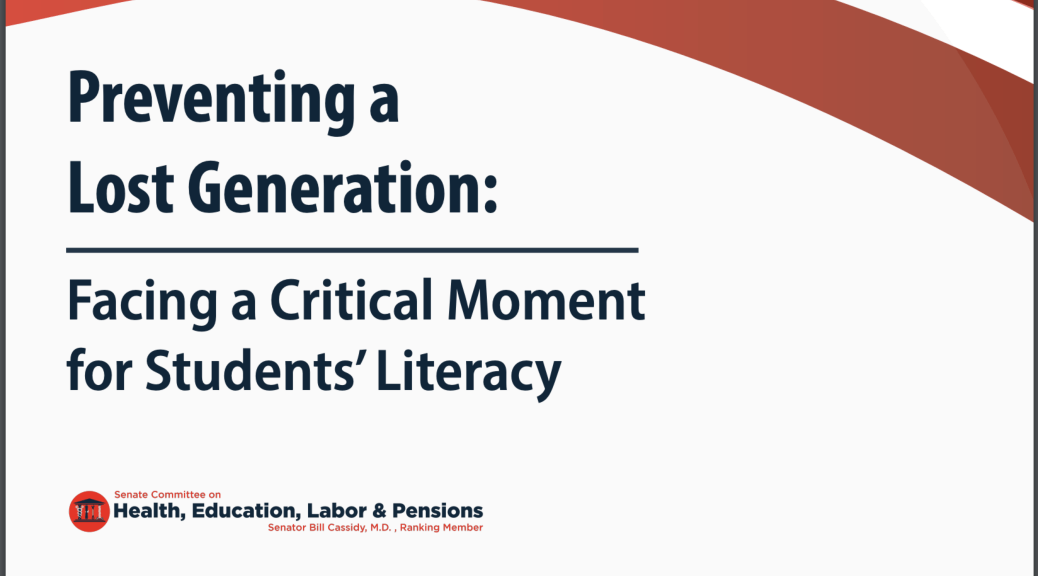
U.S. Senator Bill Cassidy, M.D. (R-LA) has released a report on literacy that opens with yet another example of misrepresenting NAEP reading scores to manufacture a reading crisis for political gain: “Two-thirds of America’s fourth and eighth graders are not proficient in reading.”
The report is an embarrassing recycling of the media misinformation campaign about reading in the US.
In fact, most of the footnotes cite news articles (including the Washington Times, a conservative outlet that lacks credibility) and conservative think tanks (ExcelinEd, Fordham). [1]
Notably missing are citations to scientific research on reading or credible analyses of NAEP data.
Responses are needed and can be sent to Literacy@help.senate.gov by April 5, 2024.
Good intentions are not enough and government policy on education has done more harm than good since A Nation at Risk. We can do better, and we should. But we must start with accurate claims and credible solutions.
A school for students with dyslexia continues to stay open despite two F grades from the BESE, Louisiana’s Board of Elementary and Secondary Education. The Louisiana Key Academy is run by Senator Bill Cassidy (R-LA) and his wife, Laura. Both are physicians. Neither are specialists in reading disorders, although they have a child with dyslexia.
When Anders Ericsson, an internationally renowned cognitive psychologist, died in 2020, a New York Times article included as a subhead: “His research helped inspire ‘Outliers,’ Malcolm Gladwell’s best-selling book on the keys to excelling.”
In short, the general public was more aware of Gladwell’s popularized version of Ericsson’s work than Ericsson, and likely, nearly no one in the general public had read Ericsson’s scholarship.
As a result, Ericsson penned a clarification that includes a key point:
Although I accept that the process of writing an engaging popular article requires considerable simplification, I think it is essential that the article does not contain incorrect statements and misinformation. My primary goal with this review is to describe several claims in Jaffe’s article that were simply false or clearly misleading and then discuss how APS might successfully develop successful methods for providing research summaries for non-specialists that are informative and accurately presents the major views of APS members and Fellows. At the very least they should not contain factually incorrect statements and avoid reinforcing existing misconceptions in the popular media.
Ericsson is confronting an essential problem when journalists and mainstream media seek ways to translate scholarship, research, and science into accessible and engaging media for the public. Journalists prioritize narratives, stories, as the primary mode to accomplish that translation.
Several months ago, I thought again about Ericsson’s valid concerns about Gladwell’s very popular but reductive Outliers:
[An article by Jaffe] goes on to state that “Ericsson and his colleagues found in a 1993 study that professional musicians had accumulated about 10,000 hours of deliberate practice over the course of a decade. The results became the basis of Ericsson’s deliberate practice theory of elite performance, also called the 10,000 hour rule” (Jaffe, 2012, p. 13). With these two sentences Jaffe reinforces misconceptions in some popularized books and internet blogs that incorrectly infer a close connection between deliberate practice and the “10,000 hour rule”. In fact, the 10,000 hour rule was invented by Malcolm Gladwell (2008, p. 40) who stated that “researchers have settled on what they believe is the magic number for true expertise: ten thousand hours.” Gladwell cited our research on expert musicians as a stimulus for his provocative generalization to a magical number.
Ericsson came to mind as I was having an extended phone conversation with a producer at 60 Minutes about the current “science of reading” (SOR) movement and the significant amount of misinformation being presented in mainstream media and then driving state-level reading legislation (now in about 47 states).
While the producer was thoughtful and receptive to my concerns about media misrepresenting NAEP data, student reading proficiency, and the so-called failure of popular reading programs and balanced literacy, he ultimately concluded after we talked almost two hours, that there is no story in the truth, thus he would not be able to produce a story about that truth.
As Ericsson’s career demonstrates, the public finds misinformation in the form of simplistic stories more compelling than nuanced and messy research; further, most people, including politicians, have read or viewed the journalism, but not the actual research (notably because too much research is behind a pay wall and/or nearly impossible for the average person to comprehend).
The Ericsson/Gladwell/”grit” dynamic is now being replicated with even greater consequence in the SOR movement that has been codified in legislation banning and mandating programs and practices primarily or even exclusively grounded in media misinformation, and not the full reading science.
For example, the recent controversy about a co-authored article in The Reading Teacher perfectly highlights the essential problem.
Let’s do a thought experiment for a moment: Which do you think the general public and political leaders are more familiar with (or familiar with at all), Emily Hanford’s Sold a Story or Nell Duke’s (with colleagues) work on the active view of reading?
And, importantly, which of those two do you think is a better representation of the current state of reading science (or full body of research on reading and teaching reading)?
Now let’s explore some artifacts to answer those questions.
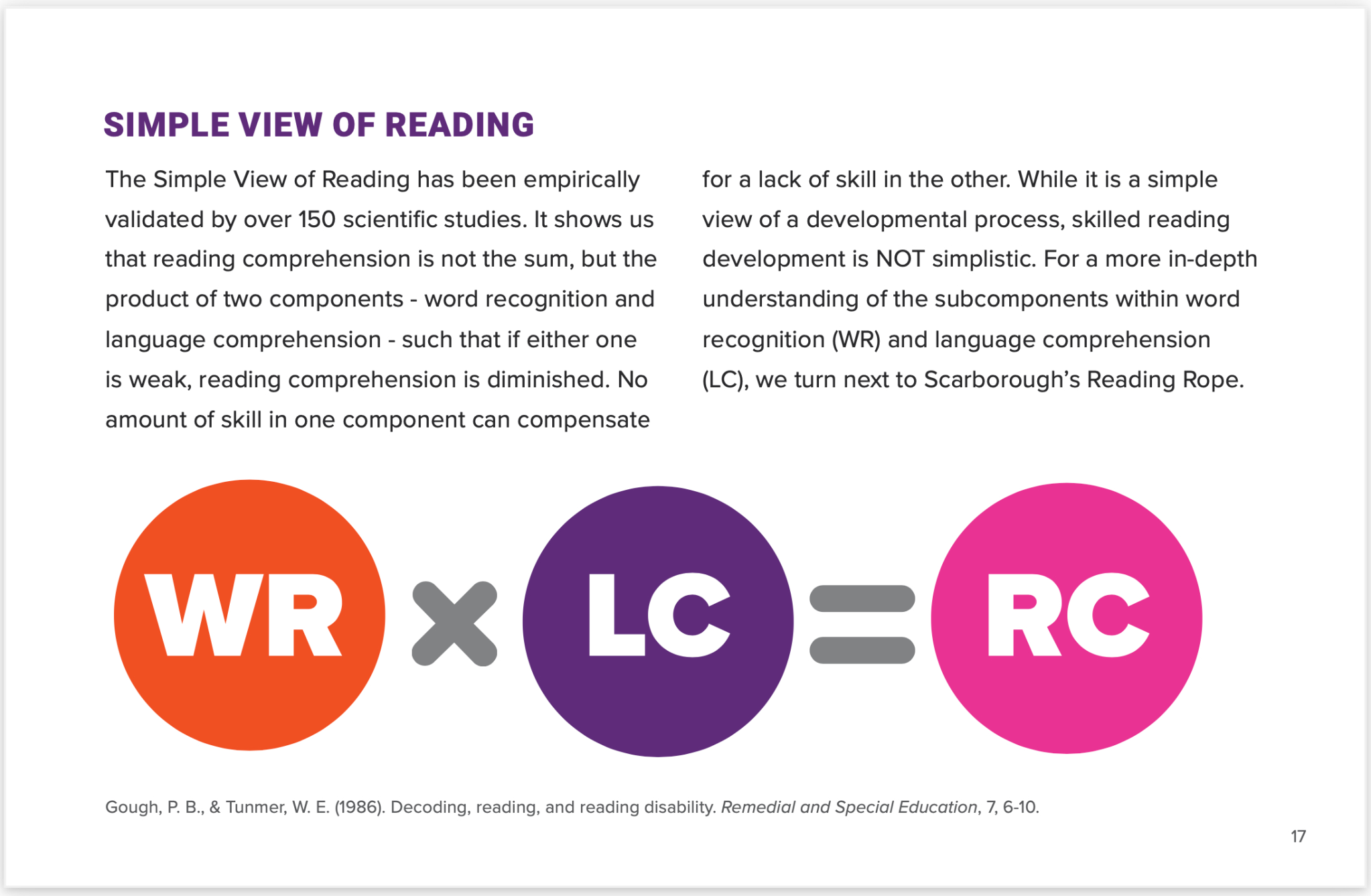
First, Hanford in her journalism has repeated that SOR is “settled science” called the simple view of reading (SVR):
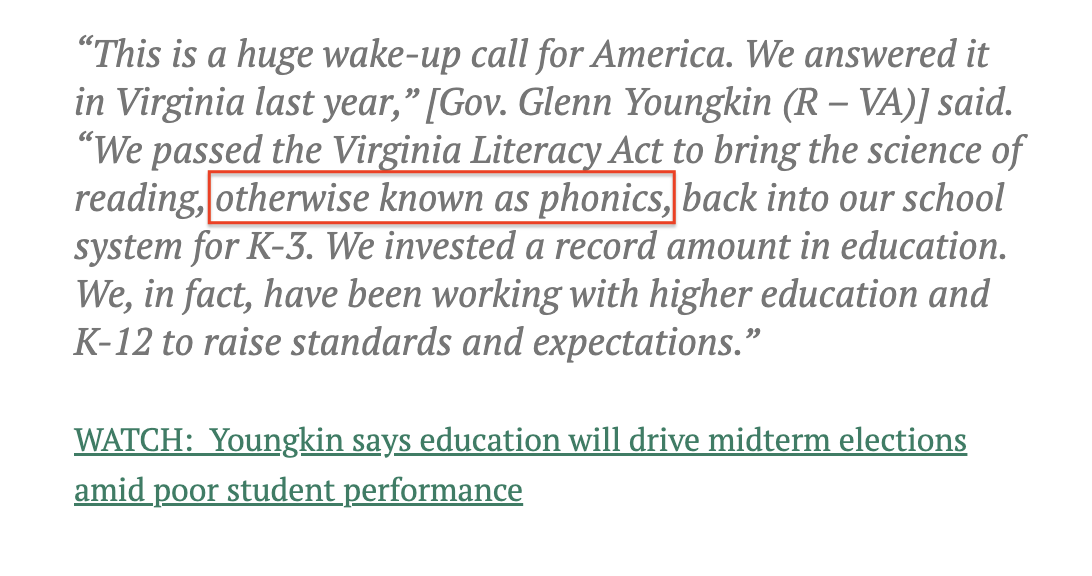
Now let’s note how these misleading and oversimplified claims about reading science have manifested themselves in political rhetoric and then state legislation:
While this is only one example [1] of the caution Ericsson raised, the misrepresentation of reading science as “simple and settled” has become holy text and then spurred misguided reading legislation and policy.
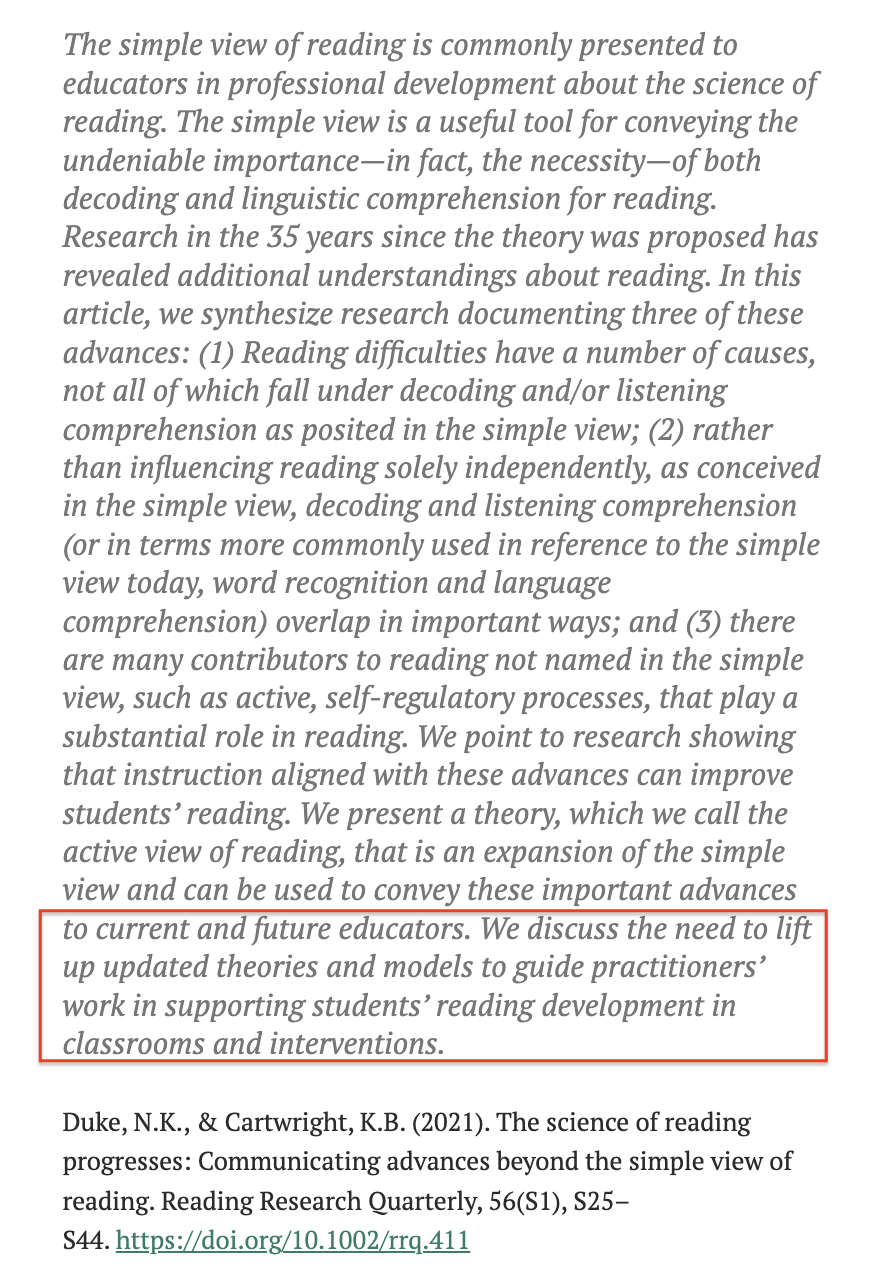
The more nuanced and on-going body of reading science is much better represented by the research from literacy scholars:
Duke, N.K., & Cartwright, K.B. (2021). The science of reading progresses: Communicating advances beyond the simple view of reading. Reading Research Quarterly, 56(S1), S25–S44. https://doi.org/10.1002/rrq.411
From Arkansas to New York City, political leaders have misrepresented dyslexia, reading proficiency, reading instruction, and reading programs in ways that parallel the stories found in mainstream media.
Like Gladwell, Hanford and dozens of mainstream journalists are reaping the rewards of compelling stories that misinform while also feeding commercial and political interests that are mis-serving students, teachers, and public education.
Once again, we find ourselves not only in the tired and false rhetoric of reading crisis but also lost in translation because a sensationalistic podcast tells a melodramatic story that runs roughshod over anything resembling a fair representation of student reading proficiency, teacher expertise, or our obsession with finding the next reading program.
Note
[1] For a more detailed examination of the misinformation in media, see the following:
Similar to ExcelinEd, Ohio Excels has entered the grade retention advocacy movement as part of the larger disaster reformreading policy movement occurring in the US for about a decade.
There is a pattern emerging in grade retention advocacy that contrasts with decades of research showing that grade retention, on balance, disproportionately impacts marginalized populations of students without improving academic achievement but correlating strongly with students dropping out of high school. [1]
The key aspects of the new advocacy reports include the following:
Funding and support by conservative think tanks.
An emphasis on early test score increases (grades 3 and 4) and claims of no negative impacts on students.
One problem is that these grade retention reports are often promoted in the media in incomplete and misleading ways, fitting into a similar pattern of education journalism.
The omissions, what is not reported, are the most important aspects of this advocacy, however.
Just as ExcelinEd uses one or two reports to endorse grade retention (again, see here for why that is misleading), this report connected to OSU has some key elements and one fatal flaw.
First, as is true about almost all grade retention, the reality of retention in OH is that it disproportionately impacts vulnerable populations of students:
The retained students were between 2.7% to 4.0% of all students subject to the retention policy. Numerically the largest group were retained in 2017 (4,590) and the smallest in 2016 (2,892).4 Overall, some 55% of retained students were male (versus 50% of not retained students), and 91% were economically disadvantaged (versus 50% of not retained students). Of the 20,870 retained some 17% had a disability (versus 10% of not retained students). In terms of race and ethnic characteristics, the largest fraction (48%) of students retained were African American (versus 14.3% of not retained students), 34% were White, Non-Hispanic (versus 72% of not retained students), 11% were Hispanic (versus 6% of not retained students), and 7% were Multiracial or Other Races (versus 5% of not retained students).
This report then concludes positive academic growth in math and reading for retained students. However, as with other recent grade retention advocacy reports, these positive academic gains remain linked to grade-level performance, and not age-level performance.
In short, retained students are always performing academically at an older age that non-retained students (note that this report carefully compares retained to nonretained students without controlling for age).
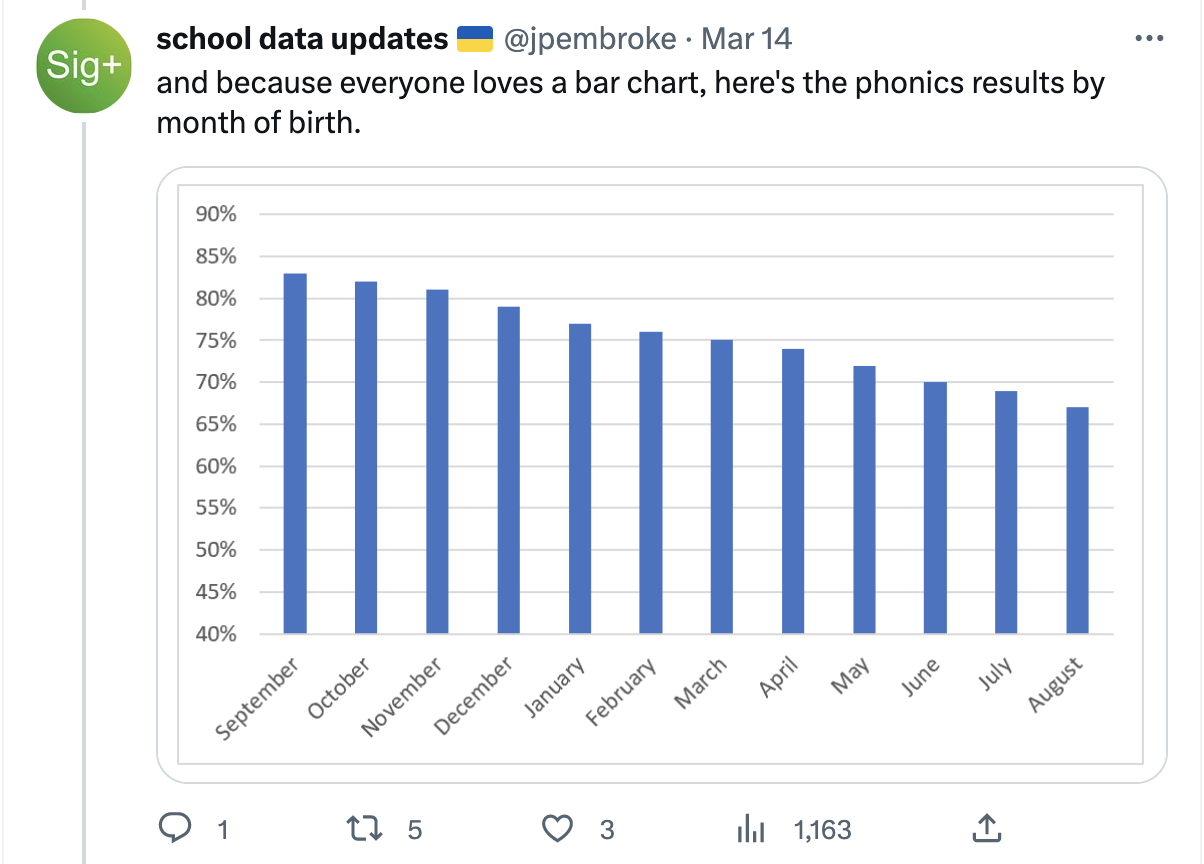
This is a key problem since even one month of age difference correlates strongly with phonics checks (and early literacy assessments tend to focus heavily on decoding and not comprehension):
Therefore, none of the recent grade retention advocacy reports show a causal relationship between retention and academic achievement. In fact, there is no evidence that the retained students’ gains are not simply being a year older.
These advocacy reports depend on the public confusing correlation and causation, and media fails to make that scientific distinction.
Decades of research as well have shown great emotional harm in grade retention; the grade retention advocacy reports simply ignore the personal and emotional consequences of grade retention by hyper-focusing on narrow measures of academic gain.
Grade retention is a punitive policy that disproportionately impacts Black and brown children, poor children, special needs children, and multi-lingual learners. [2]
Endorsing grade retention is ideological, neither scientific nor ethical.
The rise is grade retention advocacy reports are failing by omission and children are suffering the consequences of using reading legislation for political gain.
[Below is an OpEd submitted to newspapers in SC; no response yet.]
Writing in Teachers College Record, literacy scholars Reinking, Hruby, and Risko explain: “Since 2015, 47 state legislatures have enacted, or are currently considering, a remarkable total of 145 bills that address reading and reading instruction in public schools.”
A few days apart, an article in the New York Times again announced the US has a reading crisis, and in EdSource, a school’s exceptional success with multilingual learners was celebrated.
The problem with new reading legislation, another reading crisis, and highlighting education “miracles” is that they all are factually untrue.
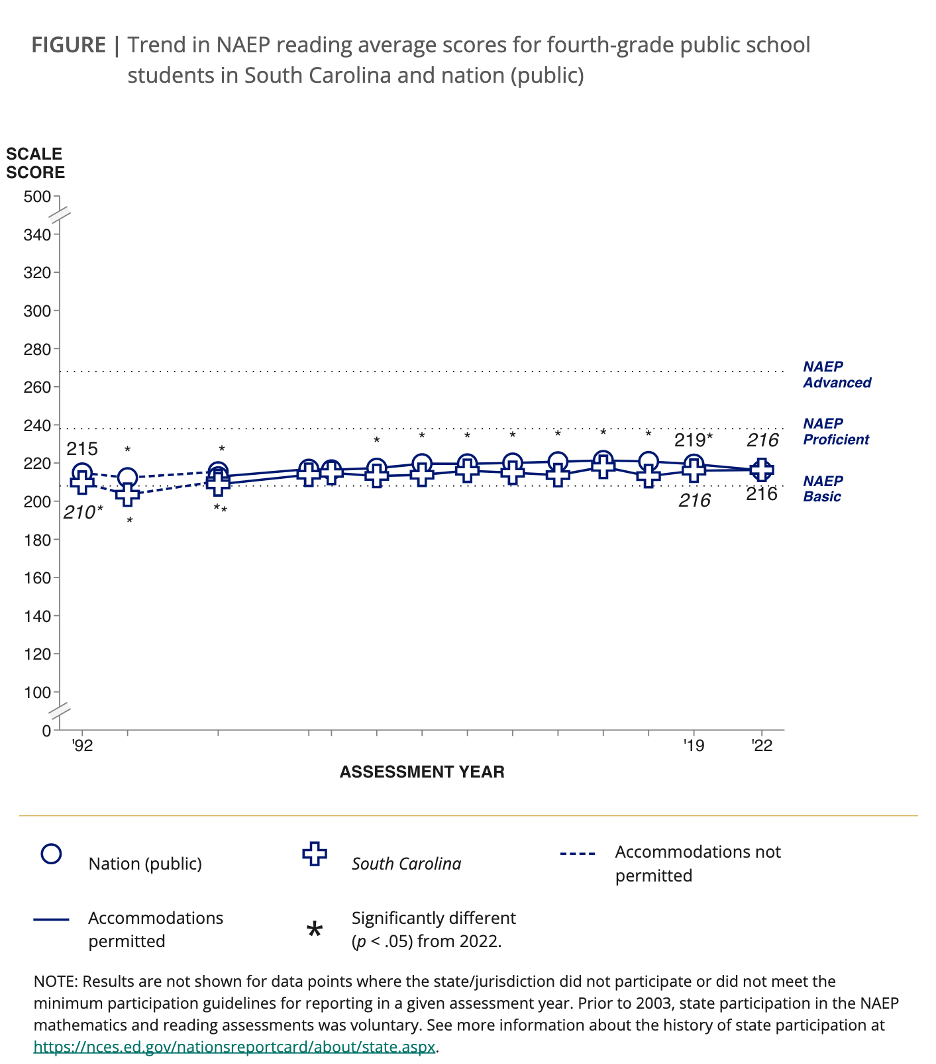
For example, Reinking, Hruby, and Risko demonstrate that reading achievement as measured by NAEP grade 4 reading scores have remained flat for many years in the US:
The same is true of South Carolina:
South Carolina has also been an early and eager adopted of standards, high-stakes testing, and embracing the current trend to legislate reading. However, these models of crisis and reform have never produced the sort of reading achievement that the media, the public, or political leaders have promised.
After multiple versions of different standards and tests as well as several rounds of reading wars, South Carolina like the rest of the US continues to lament low reading proficiency in students.
As a lifelong literacy educator in SC over five decades, I recommend that we first stop focusing on crisis and “miracle” stories about our schools, our teachers, and our students. These extreme stories almost always prove to be misleading or false.
Next, and most importantly, we need to do something different—at the school and classroom levels, but also at the political level of legislation, funding, and mandates.
South Carolina has a historical challenge of extreme pockets of poverty, and recent data from the value-added era of education reform under Obama confirmed that about 86 – 99% of measurable student achievement is linked to out-of-school factors, not teacher practice or quality.
The historical negligence of political leadership in SC highlighted in the documentary Corridor of Shame has simply never been addressed.
Further, what do students, teachers, and public schools needed from legislators in SC?
Political leaders must resist the current trend to ban teaching practices and reading programs while also mandating narrow approaches to reading and a new batch of preferred reading programs.
Simply put, there is no silver bullet for teaching reading, and neither the problem nor the solution is a magic reading program.
Students and teachers instead need political leaders to address learning and teaching conditions in our schools concurrent with addressing poverty and inequity in the homes and communities of our children.
Equitable learning and teaching conditions would include repealing grade retention, reducing significantly class sizes in the earliest grades and for the populations of students struggling to read, funding better all aspects of public education (teacher pay, school facilities, learning and teaching materials), and refusing to succumb to the current trends of legislating curriculum through bans and censorship.
The two most powerful commitments that a state can make in terms of supporting education and reading instruction is ensuring that the individual educational needs of all students are supported and that teacher professionalism is directly and fully supported.
For my entire career in SC as a literacy educator, political leaders have failed to address poverty and inequity, ignored the needs of our most vulnerable students, and eroded the profession of teaching in the state.
The stories we have told and the political responses to those stories have failed all of us for decades. We must do better and that means we must do something different.
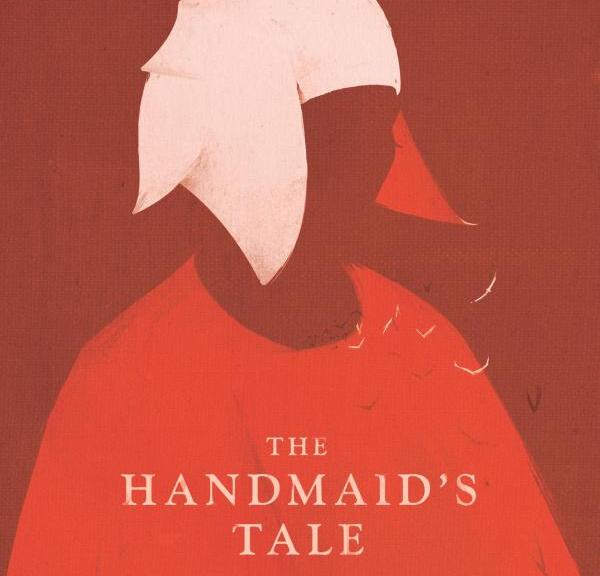
“But in The Handmaid’s Tale, nothing happens that the human race has not already done at some time in the past, or that it is not doing now, perhaps in other countries, or for which it has not yet developed technology,” explains Margaret Atwood in “Writing Utopia,” adding, “We’ve done it, or we’re doing it, or we could start doing it tomorrow.”
Or, we must admit, we are doing it right now.
Atwood’s most well know work is morphing itself into daily headlines, notably featuring a Republican governor from Florida:
As Atwood has warned, “freedom from” is the rhetoric of totalitarianism. In The Handmaid’s Tale, a few women are manipulated to control other women. The handmaid’s are trained by Aunts, who instill the propaganda:
There is more than one kind of freedom, said Aunt Lydia. Freedom to and freedom from. in the days of anarchy, it was freedom to. Now you are being given freedom from. Don’t underrate it….
We were a society dying, said Aunt Lydia, of too much choice. (pp. 24, 25)
Throughout the novel, readers must navigate how Offred (June) weaves the overlap of her own original ideas and vocabulary as that intersects with the propaganda of Gilead:
Will I ever be in a hotel room again? How I wasted them, those rooms, that freedom from being seen.
“Freedom” and “license” are exposed as bound words, the meanings contextual.
As Offred (June) continues to investigate rooms, she discovers a powerful but foreign phrase:
I knelt to examine the floor, and there it was, in tiny writing, quite fresh it seemed, scratched with a pin or maybe just a fingernail, in the corner where the darkest shadow fell: Nolite te bastardes carborundorum.
I didn’t know what it meant, or even what language it was in. I thought it might be Latin, but I didn’t know any Latin. Still it was a message, and it was in writing, forbidden by that very fact, and it hadn’t been discovered. Except by me, for whom it was intended. It was intended for whoever came next. (p. 52)
The power to control language includes defining words, often characterizing them incorrectly in the pursuit of political aims (such as “CRT” and “woke”), but also denying access to language—forbidding reading and writing, literacy, to those in bondage.
And then, Offred (June) explains about her life before Gilead:
We lived, as usual, by ignoring. Ignoring isn’t the same as ignorance, you have to work at it.
Nothing changes instantaneously: in a gradually heating bathtub you’d be boiled to death before you knew it….The newspaper stories were like dreams to us, bad dreams dreamt by others. How awful, we would say, and they were, but they were awful without being believable. They were too melodramatic, they had a dimension that was not the dimension of our lives.
We were the people who were not in the papers. We lived in the blank white spaces at the edges of the print. It gave us more freedom.
We lived in the gaps between the stories. (pp. 56-57)
And from that previous life of “ignoring” the other since it wasn’t about them, Offred (June) finds herself the procreation slave of a Commander, in “reduced circumstances” where she realizes: “There wasn’t a lot of choice but there was some, and this is what I chose” (p. 94).
It takes a special kind of “ignoring” to allow “freedom to” to be erased by the calloused allure of “freedom from” uttered with a smile by a totalitarian.
Better that we listen to a novelist: “We’ve done it, or we’re doing it, or we could start doing it tomorrow.”
Beware lest we all no longer have any of the words needed to be free at all.
educator, public scholar, poet&writer – academic freedom isn't free














 dr. p.l. (paul) thomas