Category Archives: politics

O NCTE, NCTE, Wherefore Art Thou NCTE? [Update]

[UPDATE: Please see and support this open letter to NCTE Executive Committee.]

[UPDATE 2: NCTE Statement on the Doublespeak Award and Anti-Censorship Efforts.]

[UPDATE 3: Public statement from NCSS 8 February 2021: “Saving” American History? Start by Teaching American History]

I have been a literacy educator for 38 years and counting; throughout the 1980s and 1990s, I taught high school English in rural South Carolina, and then I moved to higher education in 2002, where I am in teacher education and teach first-year and upper-level writing.

Along with being a career educator, I am a writer. I can identify the beginning of my real life as a writer and scholar with three publications: first, Oregon English (published by a state affiliate of the National Council of Teachers of English [NCTE]) in 1989, and then English Journal (a flagship journal of NCTE) in 1991 and 1998.

When I made my move to higher education, I also began a twenty-year and counting relationship with NCTE that has been among the most rewarding elements of my career as teacher and writer/scholar.

While my colleagues and friends discovered through NCTE are too many to list here, at NCTE San Francisco (2003), I attended a presentation and met Ken Lindblom; we began talking, and eventually our connection led to my editing/co-editing a column in English Journal for 10 years under several editors (also counted among my friends and colleagues), including Ken.

In 2013, NCTE named me recipient of their George Orwell Award—one of the proudest moments of my career—acknowledging not only my work that spoke truth to power but highlighting the significance of my public work (blogging, which is often marginalized in academia). Then, after my work on the committee preparing for NCTE’s Centennial at the Chicago annual convention (2011), I served as the Council Historian from 2013-2015.

Until the interruptions of Covid, one of the highlights of each year included attending and presenting at NCTE’s annual conventions.

I share all this not to aggrandize myself, but to establish a fact of my life and career: I love NCTE and the people who have enriched my life because NCTE brought us together.

And thus, I write here in the spirit of James Baldwin: “I love America more than any other country in this world, and, exactly for this reason, I insist on the right to criticize her perpetually” (Notes of a Native Son).

Since I do love NCTE, and since I am troubled at this moment of literary and educational crisis, I feel obligated to criticize NCTE, asking, Wherefore art thou, NCTE?

Novices to Shakespeare often misread “wherefore” as simply “where,” but, of course, Juliet is asking “why” Romeo exists, specifically why is she being confronted with the challenge of Romeo’s family name.

Why, I am asking, does NCTE exist? And more pointedly, why is NCTE choosing silence, why is NCTE choosing to take a false apolitical pose—at this moment of literary and educational crisis?

First, let me stress the context of my question.

Across the U.S., Pollock and Rogers, et al., have authored a report from UCLA that analyses the wildfire spreading across the U.S.—curriculum, instruction, and book/text bans:

We found that at least 894 school districts, enrolling 17,743,850 students, or 35% of all K–12 students in the United States, have been impacted by local anti “CRT” efforts. Our survey and interviews demonstrate how such restriction efforts have been experienced inside schools as well as districts. We found that both state action and local activity have left many educators afraid to do their work.

(Pollock, & Rogers, et al., 2022, p. vi)

As I have been cataloging, censorship and even calls for book burnings are nearly a daily event into 2022.

Notable, these attacks on what and how teachers teach, on what and how students learn, are grounded in dishonest claims and misrepresentations, as the UCLA report notes:

We put “CRT” in quotation marks throughout this report because so often the conflict campaign’s definition of “CRT” (like its description of actual K–12 practice) is a caricatured distortion by loud opponents as self-appointed “experts.” The conflict campaign thrives on caricature — on often distorting altogether both scholarship and K–12 educators’ efforts at accurate and inclusive education, deeming it (and particularly K–12 efforts to discuss the full scope of racism in our nation) wholly inappropriate for school.

(Pollock, & Rogers, et al., 2022, p. vi)

The news reports are chilling: A teacher fired in Tennessee for teaching Ta-Nehisi Coates (a featured speaker at an annual NCTE convention); a superintendent of education in North Carolina banning a book from one parent complaint, and without reading the book; and high-profile coverage by NBC and The Atlantic detailing the magnitude of the censorship movement, which has included bans of one of the most celebrated graphic novels ever, Maus.

With that context in mind, I want to add I am guided by two more commitments.

Martin Luther King Jr., in Strength to Love (1963), warned: “The ultimate measure of a man is not where he stands in moments of comfort and convenience, but where he stands at times of challenge and controversy. The true neighbor will risk his position, his prestige, and even his life for the welfare of others.”

And Howard Zinn [1], whose work has been prominent at NCTE’s annual convention, who titled his memoir, You Can’t Be Neutral on a Moving Train, argued:

This mixing of activism and teaching, this insistence that education cannot be neutral on the critical issues of our time, this movement back and forth from the classroom to the struggles outside by teachers who hope their students will do the same, has always frightened the guardians of traditional education. They prefer that education simply prepare the new generation to take its proper place in the old order, not to question that order.

You Can’t Be Neutral on a Moving Train

As of today, I am deeply concerned that NCTE, as the premiere national professional organization for literacy and literature in the U.S., has chosen the path of neutrality, of silence, to strike an apolitical pose in order to avoid risk.

In November before the 2021 annual convention, I reached out to some leaders of NCTE and implored that NCTE take a leadership role in speaking out against the creeping threat of state legislation banning curriculum and the rising number of books being banned across the country.

Although I was assured this would happen, there has only been silence.

And then, this: Members of NCTE’s Public Language Awards Committee posted on social media that NCTE has put the Doublespeak Award on hiatus indefinitely in order to avoid looking “political.”

Some members have resigned in protest.

The disappointment and irony of this move is that the Doublespeak Award, a companion of the Orwell Award, is designed to offer an “ironic tribute to public speakers who have perpetuated language that is grossly deceptive, evasive, euphemistic, confusing, or self-centered.”

If you return to the report from UCLA, it is obvious we are in the midst of an educational and literary/literature crisis that screams for the Doublespeak Award (“[t]he conflict campaign thrives on caricature”), that demands public-facing, risk-embracing leadership from NCTE.

Why does NCTE exist, if not for this moment?

The current anti-CRT/book banning movement is politically partisan only because Republicans have chosen to make it so. And as King and Zinn noted throughout their careers, taking a neutral pose, pretending to be apolitical, is a political concession to support the status quo.

Since curriculum bans, book censorship, and parental oversight legislation are occurring exclusively among Republican-controlled states, the teachers and students impacted are mostly in right-to-work (non-union) situations; therefore, they are the most vulnerable, and most in need of advocacy from organizations and people with power.

NCTE is the collective voice of literacy educators, scholars, and creators.

I want to remain hopeful, but I am deeply disappointed and increasingly skeptical of that hope.

NCTE’s leaders must look in the mirror, ask “why,” and then act.

Returning to Baldwin, I end with this: “There is never time in the future in which we will work out our salvation. The challenge is in the moment, the time is always now” (Nobody Knows My Name).


[1] Trying to confirm if/when Zinn spoke at an annual NCTE convention [edit].
The Zombie Allure of Ayn Rand’s Empty Literature and Philosophy

Social media didn’t create it, but social media are the perfect platforms for recording a disturbing fact about the zombie ideas that just will not die in the U.S. Case in point is that Ayn Rand is trending because NFL quarterback Aaron Rodgers pointed to her Atlas Shrugged on his book shelf.

Rand is a favorite of conservatives, especially among those embracing libertarianism, but Rand represents the consequences of the right’s anti-intellectualism that leaves Republicans and conservatives ignorant of the academics they shun and shame.

A snapshot of the problem occurred often on Rush Limbaugh’s radio program when he periodically praised “Ann” Rand—a grotesque moment that implied Limbaugh never read any of her work but felt compelled to use her as the dog whistle Rand has been reduced to (if her low-form literature and philosophy could be taken any lower).

Many people have noted that a large number of conservative thinkers and political leaders never attended or dropped out of college. Using Rand to signal a literary and ideological basis for yourself is actually a much different sort of signaling than conservatives realize since they have no or little experience with academia (note that there is plenty worth criticizing about academia and academics).

Citing Rand is the academic equivalent to citing Wikipedia or the dictionary in an essay for your first-year composition course: You just told your professor something you would have preferred to keep secret.

None the less, Ayn Rand has achieved a unique distinction; she is recognized as not being worthy of consideration in two major fields, literature and philosophy. Virtually no one in either field takes her work seriously even as both flourish among adolescent readers and limited political leaders.

That noted, she likely has another distinction also; her work’s enduring popularity prove that “popular” and “enduring” do not necessarily equal “good” or “credible.”

Rand’s enduring popularity in the U.S. among conservatives does highlight the internal lack of logic and self-defeating power of embracing uncritically a simplistic ideology. Rand’s rugged individualism seems to mask her militant atheism and sexual politics for Christian conservatives.

Rand’s popularity is a subset, of course, of the allure of the libertarian lie, the American Dream built on the argument that anyone can succeed with the right effort (and the inverse that failure is your own damn fault).

Let me recommend the Rand reader below, but I want to highlight a few points here.

First, I want to stress that while many of us on the left are quick to criticize Rand’s work, we are not advocating for legislation to ban her books in U.S. schools or libraries, and none of us are calling for Rand book burnings (except for a cheeky comment in a letter by Flannery O’Connor decades ago). Please note that Rodger’s glee over having Rand on his book shelf is occurring while Republicans are banning books they dislike, and some are calling for book burnings.

The Left believes in refuting and confronting bad ideas; the Right believes in censorship, using the government to control what people can read (not very Randian).

Finally, I want to emphasize just what people are endorsing when they point to Ayn Rand.

As noted by Skye C. Cleary, Rand endorses a caustic victim blaming:

It’s easy to criticise Rand’s ideas. They’re so extreme that to many they read as parody. For example, Rand victim-blames: if someone doesn’t have money or power, it’s her own fault. Howard Roark, the ‘hero’ of The Fountainhead, rapes the heroine Dominique Francon. A couple of awkward conversations about repairing a fireplace is, according to Rand, tantamount to Francon issuing Roark ‘an engraved invitation’ to rape her. The encounter is clearly nonconsensual – Francon genuinely resists and Roark unmistakably forces himself upon her – and yet Rand implies that rape survivors, not the rapists, are responsible. Might makes right and, as Roark states earlier in the novel, the point isn’t who is going to let him do whatever he wants: ‘The point is, who will stop me?’ Rand’s championing of selfishness, and her callousness to the unfortunate, finds echoes in contemporary politics. It would not be stretching a point to say that her philosophy has encouraged some politicians to ignore and blame the poor and powerless for their condition.

Philosophy shrugged: ignoring Ayn Rand won’t make her go away

Ultimately, the problem is not the zombie allure of Rand, but the people to whom she speaks; Masha Gessen concludes:

And, of course, the spirit of Ayn Rand haunts the White House. Many of Donald Trump’s associates, including the Secretary of State, Mike Pompeo, and his predecessor, Rex Tillerson, have paid homage to her ideas, and the President himself has praised her novel “The Fountainhead.” (Trump apparently identifies with its architect hero, Howard Roark, who blows up a housing project he has designed for being insufficiently perfect.) Their version of Randism is stripped of all the elements that might account for my inability to throw out those books: the pretense of intellectualism, the militant atheism, and the explicit advocacy of sexual freedom. From all that Rand offered, these men have taken only the worst: the cruelty. They are not even optimistic. They are just plain mean.

The Persistent Ghost of Ayn Rand, the Forebear of Zombie Neoliberalism

A final irony of Rand is that below I offer a reader by thoughtful people writing about why you are likely wasting your time reading Rand—and risking your soul if you do read her novels as how-to manuals for your life.

Keep in mind that taking sides on Rand is simply this: Rand believes mean people rock, and those of us rejecting Rand know mean people suck.

Reader

‘Atlas Shrugged’ free books and essay contest, plus other inducements (A good overview of why Rand’s novels being popular and enduring is a problem)

Philosophy shrugged: ignoring Ayn Rand won’t make her go away

Adam Roberts & Lisa Duggan on Ayn Rand

How Bad Writing Destroyed the World

The Bad Idea That Keeps on Giving

Flannery O’Connor: Friends Don’t Let Friends Read Ayn Rand (1960)

The problem with Ayn Rand? She isn’t a philosopher

The Persistent Ghost of Ayn Rand, the Forebear of Zombie Neoliberalism

Ayn Rand is for children

Freedom and the Politics of Canceling Teachers and Curriculum

By mid-December of 2021, Matthew Hawn, a former teacher in Tennessee, will once again have his appeal heard after being fired for violating the state’s restrictions on curriculum:

The Tennessee General Assembly has banned the teaching of critical race theory, passing a law at the very end of the legislative session to withhold funding from public schools that teach about white privilege.

Republicans in the House made the legislation a last-minute priority, introducing provisions that ban schools from instructing students that one race bears responsibility for the past actions against another, that the United States is fundamentally racist or that a person is inherently privileged or oppressive due to their race.

Tennessee bans public schools from teaching critical race theory amid national debate, Natalie Allison

As Allison reported in May, several states across the U.S. have filed or passed copy-cat legislation aimed at banning the teaching of Critical Race Theory.

By October and November, the consequences of Tennessee’s law have moved from silencing and canceling teachers to attempts to cancel curriculum [1]:

The Tennessee Department of Education recently declined to investigate a complaint filed under a new state law prohibiting the teaching of certain topics regarding race and bias.

The complaint, the first directed to the state under the new law passed this spring, was filed by Robin Steenman, chair of the Moms for Liberty Williamson County chapter, a conservative parent group sweeping the nation. 

The 11-page complaint alleged that the literacy curriculum, Wit and Wisdom, used by Williamson County Schools and at least 30 other districts, has a “heavily biased agenda” that makes children “hate their country, each other and/or themselves.”

Tennessee Department of Education rejects complaint filed under anti-critical race theory law, Meghan Mangrum

Although the complaint was rejected, Mangrum noted, “The group detailed concerns with four specific books on subjects like the Rev. Martin Luther King Jr.’s March on Washington, the integration of California schools by advocate Sylvia Mendez and her family, and the autobiography of Ruby Bridges, adapted for younger learners.”

A teacher fired for teaching Ta-Nehisi Coates, parents calling for bans on MLK and teaching about Ruby Bridges—these events are not unique to Tennessee, but they reflect a pattern of efforts to control not only teachers, but what students are allowed to learn and read.

Notable in these examples is that many of the consequences of legislation are canceling Black writers and key aspects of Black history; additionally, legislation and calls for book banning are targeting LGBTQ+ writers and topics.

Teaching and curriculum in the U.S. are being systematically and politically whitewashed.

One aspect not being addressed often is that political dynamic. Parents, political activists, and politicians are impacting who teaches and what is being taught in the context of a historical and current demand that teachers themselves remain apolitical, both in their classrooms and their lives beyond school.

As I have discussed often, teaching is necessarily political, and teaching as well as writing are necessarily types of activism.

For teachers, then, we must recognize that calls for teachers to be objective, neutral, and apolitical are themselves political acts. Currently, laws being passed and parents/activists confronting school boards are exercising their political power at the expense of teachers and schools—both of which are required to remain somehow politically neutral.

From historian/activist Howard Zinn to critical scholars such as Joe Kincheloe and to poet Adrienne Rich, we have ample evidence that taking a neutral stance is a political act that passively endorses the status quo and that silencing words is an act of canceling thought, eradicating ideas.

Zinn’s commitment to transparency as a teacher and activist is hauntingly relevant to the current political attack on teachers and curriculum:

This mixing of activism and teaching, this insistence that education cannot be neutral on the critical issues of our time, this movement back and forth from the classroom to the struggles outside by teachers who hope their students will do the same, has always frightened the guardians of traditional education. They prefer that education simply prepare the new generation to take its proper place in the old order, not to question that order [emphasis added]….

From the start, my teaching was infused with my own history. I would try to be fair to other points of view, but I wanted more than “objectivity”; I wanted students to leave my classes not just better informed, but more prepared to relinquish the safety of silence, more prepared to speak up, to act against injustice wherever they saw it. This, of course, was a recipe for trouble.

You Can’t Be Neutral on a Moving Train: A Personal History of Our Times, Howard Zinn

And Kincheloe confronted not only who is actually indoctrinating students but the imperative that teachers recognize teaching as inherently political:

Thus, proponents of critical pedagogy understand that every dimension of schooling and every form of educational practice are politically contested spaces. Shaped by history and challenged by a wide range of interest groups, educational practice is a fuzzy concept as it takes place in numerous settings, is shaped by a plethora of often-invisible forces, and can operate even in the name of democracy and justice to be totalitarian and oppressive [emphasis added].

Critical Pedagogy Primer, Joe L. Kincheloe

The great irony is that critical educators (often smeared as “Marxists”) are committed, as Kincheloe asserts, to a foundational concern: “Critical pedagogy wants to know who’s indoctrinating whom.”

The Orwellian named “Moms for LIberty,” then, by calling for canceling curriculum are in fact being “totalitarian and oppressive,” calling for not education, but indoctrination. To ban words and ideas is to ban the possibility of thinking, of learning:

The study of silence has long engrossed me. The matrix of a poet’s work consists not only of what is there [emphasis in original] to be absorbed and worked on, but also of what is missing, desaparecido [emphasis in original], rendered unspeakable, thus unthinkable.

Arts of the Possible, Adrienne Rich

A final powerful point is that many of these political acts to silence teachers and cancel curriculum are occurring in right-to-work states controlled by Republicans. Teachers not only are expected to be neutral, objective, and apolitical, but also work with a distinct awareness they have almost no job security.

Hawn fired in Tennessee simply taught a text and now is fighting for his career; the text in most ways just a year ago was considered non-controversial and even celebrated as Coates had attained recognition as one of the country’s leading Black voices.

During this holiday season at the end of 2021, teachers honestly have no decision about whether or not to be political. We are faced with only two political choices: conform to the demand that we take a neutral pose, resulting in endorsing whatever status quo legislators and parents/activist impose on schools; or recognize and embrace the essential political nature of being a teacher by actively opposing efforts to cancel teachers and curriculum.


[1] Twitter thread:

The Politics of Art and Artist: Tom King’s Rorschach

Politicians and political pundits in the U.S. routinely debate whether or not the American public is center-right or center-left in their political and ideological grounding. However, a more important and ultimately consequential reality is that the American public is incredibly politically naive.

At the core of that lack of sophistication is the failure to distinguish between “political” and “partisan”—the former being an unavoidable reality of human interaction and the latter being the mechanical workings of the political system that is essentially the Republican/Democratic binary.

While not a new phenomenon, the Trump era has highlighted the jumbled ideological and political sensibilities of the American public, well portrayed in the fading debate around former NFL quarterback Colin Kaepernick kneeling during the National Anthem.

The media became enamored with the vocal segment of the public that demanded professional athletes “shut up and just play ball.” Of course, the outcry for no politics in sports came from the same people demanding that athletes conform to so-called proper behavior during the National Anthem, the playing of which at a sport event is a form of political speech and a political decision by the NFL.

In the U.S., the call for “no politics” actually means a demand for “my politics only” so “other people’s politics” is the only “politics” being condemned.

Trumpublicans of 2021, in fact, simultaneously criticize (and mischaracterize) “cancel culture” and demand that certain elements of thought be, well, canceled—such as Critical Race Theory and the right’s (again, mischaracterized) demonizing of “woke” culture.

In the fall of 2021, NFL fans are once again confronted with politics, this time in the person of Aaron Rodgers, quarterback of the Green Bay Packers. Rodgers sits in debates about the best quarterback ever, but he also has enjoyed a life of celebrity, dating famous actresses and briefly being touted as the next host of Jeopardy (based in part on his cultivating an image as “smart”).

A positive Covid test, however, has now tarnished Rodgers’s Golden-Boy whiteness, exposing him to be a Joe Rogan conspiracy theorist and all-around, self-absorbed know-nothing.

What is important here is that while Rodgers is the exact same person he was a year ago, many fans are now rejecting being a fan of his because his ideology, his politics, has been unmasked (literally and figuratively).

The literary world had a similar conflict about the same time with Margaret Atwood, who appears to have slipped over to the J.K. Rowling world of transphobia (or at least inexcusable ignorance about and insensitivity toward trans people).

At its core, these situations are an enduring problem: What do we do when as consumers of entertainment, the ideology and politics of the entertainer and/or the entertainment (sports, film, novels, etc.) conflict with our own?

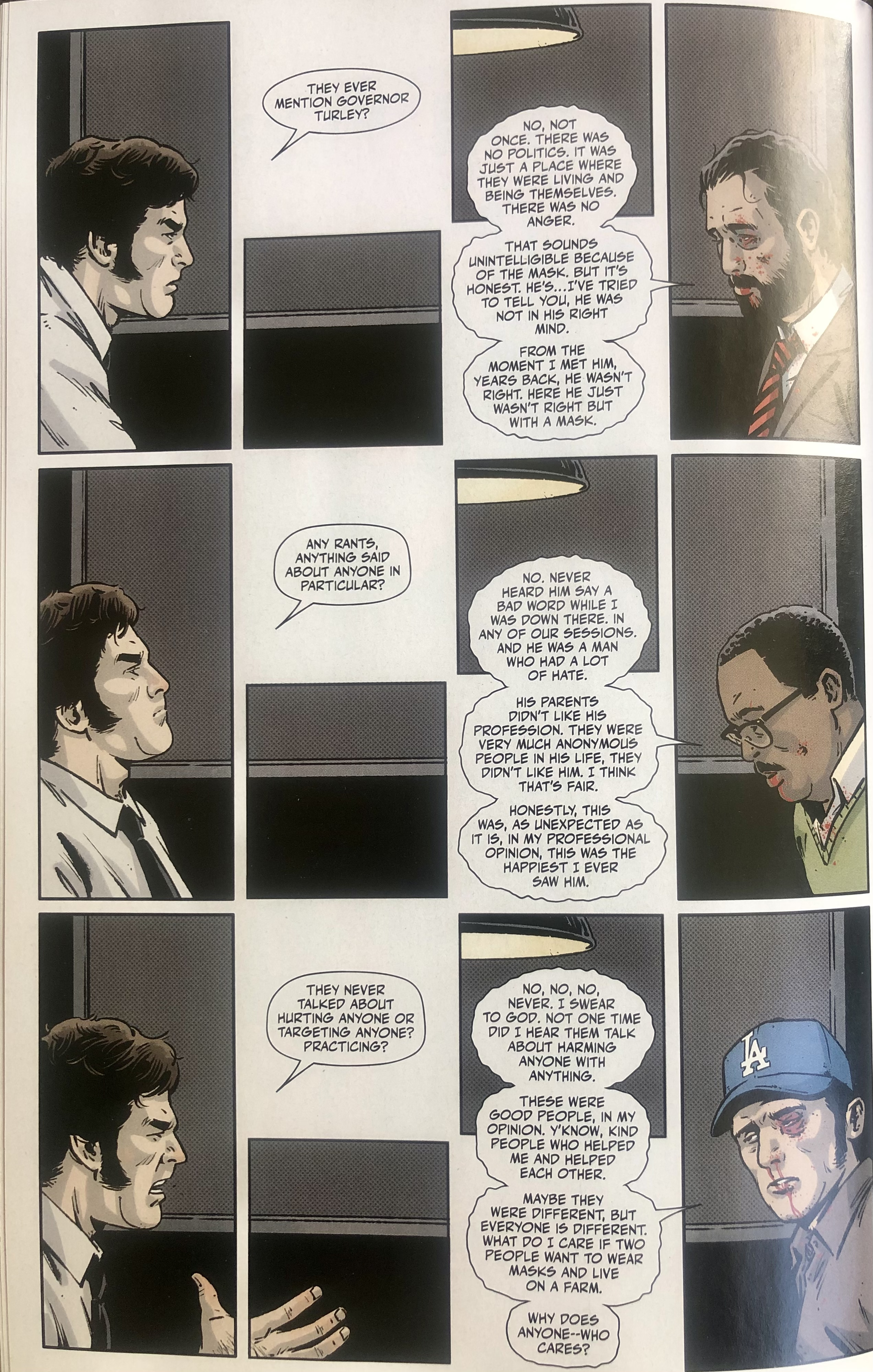
From Watchmen to Rorschach: “No, Not Once. There Was No Politics”

As a comic book reader and collector from the 1970s, I returned to collecting just before the series WandaVision stormed pop culture. I had been a fan of Vision in my teen years, and the series, I thought, was brilliant.

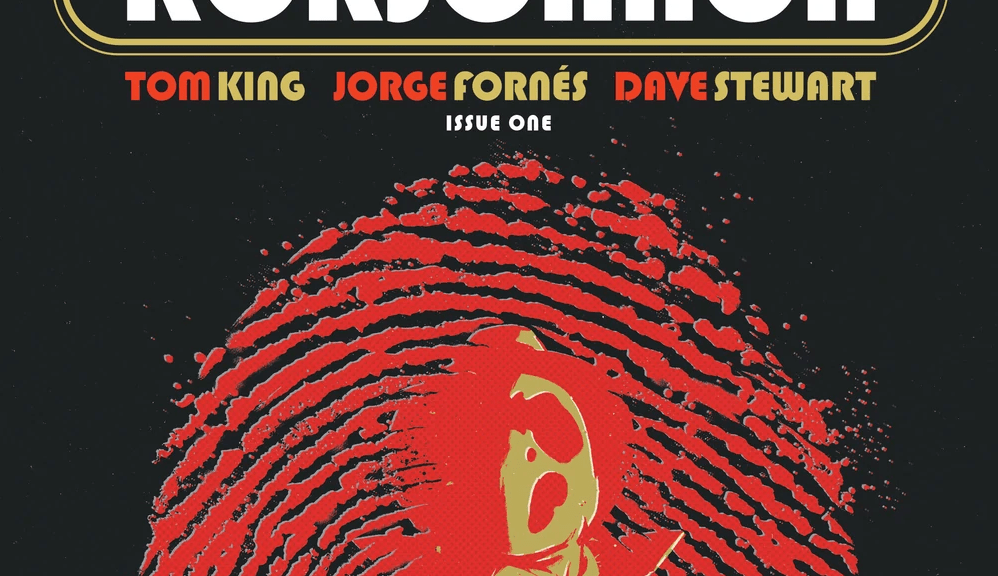
But it also led me to finding, late to the party, some of the wonderful work with the character Vision since I was away from comic books—notably Tom King’s Vision (2016, vol. 2). With King’s work, I now have a habit of missing the boat since, as a Marvel collector, I just bought and read King’s Rorschach (2020-2021), a continuation of the Watchmen universe created by Alan Moore and Dave Gibbons, and then reignited by the Watchmen series (HBO).

In a preview of the series, Matthew Jackson shares King’s recognition of the essence of the sequel to Moore’s Watchmen:

“[Moore] gave us the notes to talk about our current moment, and so I wanted to play in that sandbox to talk about this,” King said. “It’s a very political work. It tries to be revolutionary the way Watchmen tried to be revolutionary.”

TOM KING BREAKS DOWN HIS ‘VERY POLITICAL’ RORSCHACH BOOK’S PHILOSOPHICAL INFLUENCES

King also explains that he and artist Jorge Fornes maintain canon of Watchmen but frame this meta-narrative (like Watchmen, a super hero narrative about super hero narratives and the recurring question of vigilantism) as “film noir — to create a kind of hardboiled mystery story in the middle of the Watchmen universe.”

King’s re-envisioning of Rorschach, however, includes, like in Moore’s work, Steve Ditko (co-creator of Spider-Man), but shifts the ideological grounding from Ayn Rand (Ditko’s inspiration) to “‘Hannah Arendt, who is a different philosopher, Ayn Rand’s contemporary, another Jewish immigrant from Germany, but on the left, not on the right, who was obsessed with the concept of citizenship.'”

Both Moore and King offer “very political work,” work that is well crafted with other creators (artists, colorists, letterers), but it is a mistake to discount or reduce that work for attempting to promote a specific partisan politics; instead, I think King is asking readers to consider just what is political—or to understand that everything is political while also swimming in a partisan political reality that can be corrupt on both the left and the right:

The central detective, above on the left, is faced with a planned but foiled assassination during the presidential election between the liberal 4-time incumbent Redford and the conservative challenger Turley, calling for a conservative revolution and target of the assassination.

But as the first panel above shows, even those inside the workings of the plot seem to be unable to see politics at work: “No, not once. There was no politics.”

The Reader, the Writer, and the Text

The assassination plot belongs to “Wil Myerson, a stand-in for Steve Ditko that creates the Question-esque character, the Citizen, who expresses Arendt’s views rather than Rand’s,” explains Steve Baxi, and a young woman sharp-shooter called The Kid.

Despite the admitted political nature of this series, I agree with Baxi’s defense of the series:

[S]ome critics reject the series as a dangerous both-side-ism that creates a problem out of fake left-wing extremism in the context of a real life right wing insurgency.

This reaction, I think, has made it difficult to see the rich work being done by King, Fornés, Stewart and Cowles on this series which examines not only the origins of fascist thought, but the ups and downs of Arendt’s own work. This is not a series that feels like a sequel to Watchmen outside the setting, and instead tells a story that is influenced deeply by the current political climate, taking in the past in a manner akin to what Arendt called Pearl Diving

Watchmen Two-in-One: Hannah Arendt and Rorschach (2020) – Part One

Briefly, I want to conclude here by arguing that the problem is not whether or not a work or an artist is political, or even if that work or artist has a blunt political agenda, but the consequences of how readers respond—and why the politics of the reader is where the real problem lies.

Drawing on Baxi’s explication of the use of Arendt in Rorschach and Lousie Rosenblatt‘s view of how meaning is created from text (the interaction of the reader, the writer, and the text), I think we can confront how literalist conservatives and critical progressives respond differently (and predictably) to any text.

Baxi notes that Arendt’s work fits well into the Trump era, overlapping with Rorschach:

For Arendt, the foundational question of philosophy was “Is there a way of thinking that is not tyrannical?” Indeed everything from training with Heidegger and Jaspers, up to her rejection of Adorno and Critical Theory comes back to a philosophical thinking that richly interrogates our ability to understand and to imagine the world from the perspective of another.

…the problem with Eichmann, and fascists in general, is a failure to think….This capacity for thought is what Arendt’s work focused on, using concepts like storytelling to explain how our ability to think ties into our ability to have empathy, freedom, and sound political judgment.

Watchmen Two-in-One: Hannah Arendt and Rorschach (2020) – Part One

Like Moore, King likely has a political leaning that can be viewed on the left/right spectrum, but ultimately, King is making a narrative case for “[t]his capacity for thought” and “our ability to have empathy, freedom, and sound political judgment.”

In Moore’s original Watchmen, Baxi adds:

…Rorschach was a riff on the Question, and largely a joke Alan Moore was making about Steve Ditko qua Ayn Rand’s objectivism taken to its furthest possible extreme….Regardless of the reasons why, Moore’s presentation of the objectivist, moral absolutist became less a joke and more a serious position of its readers….

The critique of course is that such extreme devotion to an abstract good is ultimately self-contradictory and absurd, as Rorschach’s methods do not play by the same rules as his self-righteousness. While this nuance is clear in the text of the series, it’s also perfectly understandable that some might read Rorschach and find him aspirational. Correct or not, there is an ideology of Rorschach that does see him as good, as right, as the hero we might need.

Watchmen Two-in-One: Hannah Arendt and Rorschach (2020) – Part One

Ayn Rand fits into this perfectly since as a philosopher and a novelist, Rand is nearly universally rejected in the fields of philosophy and literature, but a favorite of naive readers, often adolescents and literalist conservatives/libertarians. In short, many fans of Rand’s novels read them as if they are “how to” manuals, and not texts to be interrogated.

Critical readers handed any text tend toward challenging the text and messages, and often fall closer to Arendt’s ideal (similar to Myerson’s The Citizen).

The legacy of Trump includes organized attacks on K-12 and higher education, focusing on controlling what students are exposed to. Those attacks represent the conservative misunderstanding about the political power of texts and knowledge.

In short, there is politics in any artist, in every text, and in every reader; that political dynamic is unavoidable.

King’s version of Rorschach clearly argues that partisan/ideological fanaticism, regardless of being from the left or right, is corrupt and dangerous; there are many bodies left on the ground in the series.

Neither Moore nor King offers a neat political or partisan solution as they remain in an enduring question at the heart of super hero narratives, as King explains:

“Instead of constructing Rorschach from a Randian point of view, if we construct him from an Arendt point of view, how does that change our conception of superheroes, and our conception of vigilantism? If we go from the idea of ‘it’s obviously bad to kill people without trials’ to ‘Is it bad to kill Nazis without trials?’ it makes a different moral universe and [asks] different moral questions, or at least the same questions but, you know, turning the ball on its side so you can see it from a different angle.”

TOM KING BREAKS DOWN HIS ‘VERY POLITICAL’ RORSCHACH BOOK’S PHILOSOPHICAL INFLUENCES

The politics of the audience confronts us, and the larger question, maybe the largest, is about the potential in that audience to be the sort of human Arendt (and likely Moore and King) envisioned.


See Also

Watchmen Two-In-One: Hannah Arendt and Rorschach (2020) – Part Two, Steve Baxi

The Politics of Childhood in an Era of Authoritarian Education

While on vacation, a friend and I were discussing the paradox of parenting.

A parent often feels a tension between fostering and supporting a child to be the person they want to be as that contrasts with dictating what is best for the child (knowing as adults do that children, teens, and young adults often make decisions necessarily without the context of experience that would certainly change many decisions).

That paradox, that tension has existed for me as a teacher/professor, parent, grandparent, and coach.

I am constantly checking myself in roles of authority to determine if I am imposing my authority onto children and young people (authoritarian) or if I am mentoring and fostering those humans in the cone of my authority in ways that support their own autonomy and development along lines they actively choose for themselves (authoritative).

This is a dichotomy examined by Paulo Freire [1], and a central concern for any critical educator.

The current misguided attacks on anything “critical” is particularly frustrating for critical educators since these attacks are designed to fulfill the demands of authoritarian systems, partisan politics and formal education.

It has occurred to me recently that I have been in roles of authority for a very long time, beginning with working as a lifeguard in my mid- to late teens. My role of authority literally began, then, with the expectations that I would guard human life—any human life that came into the sphere of the pool where I was charged with monitoring swimming and the safety of not only individual swimmers but all of the people in the pool.

I was a very good and capable swimmer, and for a teen, I was reasonably responsible (although I cringe thinking about being a head lifeguard when only 17 or so). But having the level of authority and responsibility that being a lifeguard entails was quite likely asking far more of me that I deserved.

Those days of lifeguarding set me on course for being the responsible person for the next 40-plus years, exacting a significant toll on me psychologically and emotionally.

Maintaining a critical authoritative pose when in positions of authority is extremely hard, much harder than being authoritarian.

Way back in the 1980s and 1990s, I was practicing in many ways the sort of critical teaching that is coming under attack in 2021, even resulting in a teacher in Tennessee being fired:

At issue was Hawn assigning the essay “The First White President” by Ta-Nehisi Coates to students in his Contemporary Issues class in February, and later in March, playing a video of “White Privilege,” a spoken word poem by Kyla Jenée Lacey to the same students.

A Tennessee teacher taught a Ta-Nehisi Coates essay and a poem about white privilege. He was fired for it

Many conservatives see the work of Coates, for example, as radical, while those of us on the left would argue Coates’s work is quite mainstream and accessible—but far from radical. This is the same dynamic around Barack Obama, for example; Obama is a moderate and an incrementalist, but certainly not a radical leftist or Marxist (as conservatives like to suggest).

While I taught high school English in the very conservative rural South, I was mostly allowed to teach texts with only occasional complaints from parents. What looks quite odd now is that I included Howard Zinn in my classes for many years without a peep from anyone (Zinn is a key target of the ant-CRT movement now).

But I also included Joseph Campbell’s comparative mythology in my classes in order to help students navigate metaphorical approaches to narratives (a key skill needed in the Advanced Placement course I taught and as preparation for college).

Including Campbell did cause problems since his work complicated the literalism many of students experienced in their religious lives. Fundamentalist Christianity was the background of nearly all my students, and Campbell’s casual claims that all religions and mythologies told similar archetypal stories stepped on the toes of arguments that accepting Jesus was the only way into heaven.

I aroused similar complaints by including Gandhi in my Emerson/Thoreau/MLK unit.

The parental challenges to Campbell and Gandhi were grounded in a type of insecurity that had never been examined critically by those parents, all of which was the result of having been raised in authoritarian environments.

I did have my students interrogate that Sunday school and preaching were not places where they were encouraged to ask questions or challenge any of the “lessons” they received.

So in 2021, I cannot stress too much that the Republican attack on critical race theory and how history is taught is simply a battle for the integrity of the mind of children, teens, and young adults.

Learning and knowledge—especially if we genuinely believe in human autonomy and democracy—are not simply about accumulating facts determined to be true or important by some authority, but are about learning how to know what we believe is true and why.

Human freedom is most threatened by unexamined beliefs, not by the act of questioning itself.

Authority doesn’t just resist questioning, but entirely rejects it as an act.

Republicans and the conservatives drawn to authoritarianism do not trust human agency, do not believe in the free exchange of ideas, and do not believe in the essential power of questioning, especially when the questions are aimed at their authority.

Nothing is as simple as “both sides,” and certainly we should never fall into traps of “only know this.”

There can never be free people, however, without free minds cultivated in the guarantee of academic freedom.

And the free exchange of ideas will never be spaces without discomfort, which now seems to be a smokescreen used by Republicans in their pursuit of securing authority.

Suddenly, Republicans are concerned about uncomfortable white students, but seem oblivious to the discomfort, for example, of thousands and thousands of Black students experience reading The Adventures of Huckleberry Finn or To Kill a Mockingbird.

Teachers must now tip-toe around the uncomfortable texts and conversations about race and racism because of the possibility of white discomfort (note that Black discomfort about Huck Finn has been repeatedly swept aside under the guise of “classic literature”)—a stance once again disregarding the daily discomfort of Black children experiencing racism.

Intellectual discomfort (what texts and discussions prompt in formal schooling) is often necessary for learning, but existential discomfort (what targets of racism and sexism experience) are not necessary and are essentially harmful.

Authoritarian education is willing to sacrifice the existential comfort of marginalized children in order to shield some children from intellectual discomfort.

Even more disturbing, however, is that what is really being protected is the frailty of those students’ parents and those people in authority who are not willing to risk being challenged or questioned in any way.


[1] Paulo Freire and Peace Education, Lesley Bartlett:

Freire’s early call for a “horizontal” relationship generated a staggering amount of debate over the teacher’s role in a democratic classroom. In his later writings, Freire refined his notion of directivity and the teacher-student relationship. In Pedagogy of Hope, he explained: “Dialogue between teachers and students does not place them on the same footing professionally; but it does mark the democratic position between them” (Freire, 1994, p. 116-117). In his “talking” books of the 1980s and 90s, Freire distinguished between authoritative and authoritarian teachers:

“I have never said that the educator is the same as the pupil. Quite the contrary, I have always said that whoever says that they are equal is being demagogic and false. The educator is different from the pupil. But this difference, from the point of view of the revolution, must not be antagonistic. The difference becomes antagonistic when the authority of the educator, different from the freedom of the pupil, is transformed into authoritarianism. This is the demand I make of the revolutionary educator. For me, it is absolutely contradictory when the educator, in the name of the revolution, takes power over the method and orders the pupil, in an authoritarian way, using this difference that exists. This is my position, and therefore it makes me surprised when it is said that I defend a nondirective position. How could I defend the fact that the nature of the educational process is always directive whether the education is given by the bourgeoisie or the working class” (Freire 1985, p. 76).

Dear Parents, Your Children’s K-12 Education Is Already Very Conservative

I entered public education in the fall of 1984, a naive and idealistic first-year English teacher vividly aware of the literary significance of that year.

Of course, I was not yet aware that I was completely wrong about the essential purposes of public education because I had been gifted parents who trusted not only my intellect but the foundational good of knowledge and academic freedom.

My parents were wrong about quite a lot, it turns out, but they were magnificent in the freedom they allowed my mind and the support they gave to my often wonderful teachers.

The first few years of my teaching career included a series of visits to the principal’s office to discuss complaints from parents. It was something akin to the hazing period people experience when joining fraternities.

One of the earliest clashes I had with parents—and I should note that my students were often deeply appreciative of my classes, supportive of the work I was doing—centered on complaints about my assigning John Gardner’s Grendel to my advanced tenth graders (students on track to take Advanced Placement their senior year).

Grendel is a retelling of the Beowulf epic poem in novel form, and it does include a few graphic scenes and some so-called adult language. But these were 15 and 16 year olds planning to go to college, and unbeknownst to their parents, many of these students were sexually active and used language that was far more profane that the few “offensive” words in the novel. (Treating young adults as intellectual children when they are asserting adult behavior in their lives outside of school is inexcusable, I think.)

Yet, a few (maybe only two) parents launched a campaign to teach this new teacher a lesson about what parents expected from their children’s teachers.

Of course, the short version of this is that the novel was removed from my required list (although I left copies on my shelf and many students continued to choose the novel along with many other commonly banned works).

This pattern continued for several years: I was challenging my students intellectually, often seeking ways to prepare them for college, and parents here and there asserted disproportionate influence on whether or not I was allowed to do my work as an educator.

A key moment in those first years was me sitting once again in the principal’s office listening to Mr. Simpkins (also the man who was principal when I attended this school and father of two of my childhood friends) chastise me about crossing lines parents created; these sessions were also punctuated with not-so-subtle threat that my teaching career could be ended at any moment (South Carolina is a right-to-work state, by the way).

One time, exasperated, I responded with, “Mr. Simpkins, I am simply trying to teach these students to think.”

With a half-smile and without hesitation, Mr. Simpkins replied, “Paul, some parents don’t want their children to think.”

It is important to emphasize here that his comment carried the implication “and thus, we have no right to make those students think.”

Fast forward almost 40 years, over which I have been in education in SC the entire time, and consider that those experiences I encountered in the mid-1980s are now how the entire nation is dealing with K-12 education in the U.S.

Republicans are creating a false narrative about public schools indoctrinating students in leftwing ideologies (often mislabeled as Critical Race Theory or Marxism) and whipping up parental anger at their local schools.

And the paradox, of course, is that Republicans are passing and signing legislation that is designed to indoctrinate:

Florida Gov. Ron DeSantis announced new state programs for students Tuesday that will require civics and patriotism education as well as CPR training.

“Once students graduate high school, some will go to college, some of them will do other things…whatever you do, this civics is gonna be relevant because you are going to be a citizen,” DeSantis said at an afternoon news briefing in Fort Myers.

It will also require high school students to learn about “the evils of communism and totalitarian ideologies.”

Florida will require schools to teach civics and ‘evils of communism’

Currently, about 25 states are doing something similar to Florida—mandating what and how schools teach about race, racism, and history.

Two points need to be made about these efforts.

First, K-12 public education in the U.S. has always been and remains very conservative.

Let me emphasize that my experience noted above is common for new teachers, who quickly learn to self-censor and avoid parental complaints and administrative reprimands.

As I have written about before, I taught with a wonderful young teacher, himself a well-known and well-loved active Christian in the church just across the street from the high school, who taught geography. He found himself “in trouble” because he taught Middle East geography, including how the countries were aligned with different religions.

One parent was outraged, and asked that his son be moved to another teacher because the parent didn’t want his son to know there were religions other than Christianity.

What did the principal do? Moved the student to a geography class taught by a coach (a very conservative man who taught in ways that would likely thrill Republicans).

This leads to a second point: Conservatives are deeply confused about indoctrination and education.

And a great example of that misconception comes from an unlikely place, a brilliant response from chairman of the Joint Chiefs of Staff, Gen. Mark Milley, about charges by Republicans that the military is “woke” (another misuse of a term designed by conservatives to be a criticism):

“I’ve read Mao Zedong. I’ve read Karl Marx. I’ve read Lenin. That doesn’t make me a communist. So what is wrong with understanding — having some situational understanding about the country for which we are here to defend?” Milley said.

He continued brusquely: “And I personally find it offensive that we are accusing the United States military, our general officers, our commissioned, noncommissioned officers of being, quote, ‘woke’ or something else, because we’re studying some theories that are out there.”…

“I want to understand white rage, and I’m white, and I want to understand it,” he said. “So what is it that caused thousands of people to assault this building and try to overturn the Constitution of the United States of America? What caused that? I want to find that out.”

Top General Defends Studying Critical Race Theory In The Military

Gen. Milley understands—like my parents—that knowledge, reading, and awareness are powerful, but that simply being exposed to an idea doesn’t mean anyone is immediately indoctrinated by those ideas.

Most of us have studied the Holocaust, and we know the ideology of Hitler and the Nazis. Yet, most people decide to reject those ideas and beliefs.

I also want to emphasize that Gen. Milley is defending academic freedom, the essential nature of an academic institution and the sacredness of the human mind.

These are concepts entirely lost on Republicans who seek ways to use schools to decide for students what they learn and what they believe.

I want to end by returning to the central point everyone should understand, especially parents: U.S. K-12 public education is extremely conservative.

A vivid example of that is the enduring ways that children are taught about Hellen Keller, through the play The Miracle Worker.

Keller has been and remains a tool of educational indoctrination aimed at inculcating into children a belief in rugged individualism; if a person such as Keller can overcome her many sensory challenges, the message goes, then anyone can pull themselves up by the bootstraps.

But just like the mis-teaching of Martin Luther King Jr. in public schools (the overemphasis on his “I Have a Dream” speech and the de-contextualizing of his “content of their character” assertion), Keller of The Miracle Worker is not the full and complicated (or even accurate) story of this woman.

Keller was a socialist and political activist—something I am certain most students never hear in a K-12 classroom.

The Miracle Worker is the sort of “safe” text that most teachers default to, like King’s “I Have a Dream,” in order to avoid the relentless interference of parents and administrators.

K-12 public education is mostly conservative because teachers learn to self-censor, to tip-toe around anything that the most extreme parents may complain about.

Critical Race Theory and liberal indoctrination simply do not exist in K-12 public schools in the U.S.

But there is a problem parents should be concerned about; your children are often being cheated out of knowledge and awareness because academic freedom died a long time ago when the first administrator defaulted to parental complaints at the expense of any student’s right to read and think widely and openly.

South Carolina Republicans Seek to Politicize History

[See here: MY TURN: S.C. Republican bill would corrupt teaching of history and here: Opinion: The battle over teaching history in SC]

For over 40 years, George Graham Vest served first as a Missouri state Representative, next as a state Senator in the Confederacy, and finally as a U.S. Senator for Missouri from 1879 to 1903.

In a speech from August 21, 1891, Vest included a claim about history that has been echoed by many: “In all revolutions the vanquished are the ones who are guilty of treason, even by the historians, for history is written by the victors and framed according to the prejudices and bias existing on their side.”

Considering Vest’s complicated relationship with the state and country that he served, we should keep in mind that his comment represents something many people misunderstand about history: All history is biased, and history is created by whoever is telling the story.

Often associated with Winston Churchill, the adage “history is written by the victors” seems to repeat itself in times of great upheaval.

One of our most recent moments of political conflict was the siege on the U.S. Capitol in early January 2021. Less dramatic but more significant, that was soon followed by the Trump administration releasing the 1776 Commission report, a rejection of the 1619 Project published in The New York Times.

“The 1619 Project is an ongoing initiative from The New York Times Magazine,” as noted in the Project’s opening, and Jake Silverstein explains,

The goal of The 1619 Project is to reframe American history by considering what it would mean to regard 1619 as our nation’s birth year. Doing so requires us to place the consequences of slavery and the contributions of black Americans at the very center of the story we tell ourselves about who we are as a country.

The 1776 Commission is a direct rebuttal of centering slavery in U.S. history, calling for a return to viewing the U.S. through the lens of the Founding Fathers as well as emphasizing a patriotic message about the country.

While there has been some tension among historians about the 1619 Project, most historians have rejected the 1776 Commission.

Although the Biden administration removed the 1776 Commission report, the National Council for the Social Studies (NCSS) issued a response to the political legacy of that report: The NCSS “strongly rejects the recent development of proposed bills in state legislatures which are designed to censor specific curricular resources from being used for instruction in K-12 schools.”

Now we can add to the list of misguided state legislation South Carolina, where a bill seeks, as reported in The Hill, the following:

Lawmakers in South Carolina are considering a bill that would use former President Trump’s 1776 report to help develop the U.S. history curriculum for public middle and high school students, WCSC reports.

The Restore America’s Foundation Act would require South Carolina’s State Superintendent of Education to “review and prescribe suitable texts and online materials aligned with the principles and concepts of the January 2021 report of the 1776 Commission.” 

South Carolina may implement Trump’s controversial ‘1776 Report’ in its schools

The essential problem with this bill is it contradicts its own goals. The 1619 Project is a source for teaching history, but it has no direct political power, and any influence it has on classroom teaching is entirely voluntary.

Yet, SC Republicans are claiming that the teaching of history and social studies is politically corrupt (the basic argument of the 1776 Commission), and then proposing a bill that politically corrupts the teaching of history and social studies.

Further, this bill is endorsing a report discredited by historians across the U.S. For example, the American Historical Association asserted: “The authors [of the 1776 Commission report] call for a form of government indoctrination of American students, and in the process elevate ignorance about the past to a civic virtue.”

That statement has nearly 50 signees, and this sort of critique from historians discredits the value of the report for teaching students in SC.

Additionally, the 1776 Commission report is not suitable for use in education since the report is plagiarized, further eroding its credibility in addition to its partisan use of historical facts.

The irony here is that this bill is politicizing SC social studies and history classrooms in the exact ways that Republicans have falsely criticized the 1619 Project for doing. The difference is that legislation does change how students are taught, but newspapers do not.

“If we really want to ‘save American history,’” NCSS concludes in their rebuking of misguided state legislation similar to the one being proposed in SC, “we should address the marginalization of social studies, and why instructional time for history and social studies learning has declined so rapidly in the 21st century—especially at the elementary level.”

Mandating debunked history is political theater, but it certainly isn’t serving the students of South Carolina.

Civility and the Steady Retreat from Truth

“I hope I live to see the day,” reads the subject line of an email I received a few days ago; the body continues: “That you are dead and rotting in hell along with your grandparents.”

This email arrived two days after another email posed two questions: “Did you really say those vile comments about Rush Limbaugh? Do you like civility or have you been misquoted?”

In the wake of Limbaugh’s death from cancer, conservatives and right-wing media have rushed to confront and chastise the incivility of anyone (especially professors) who expressed everything from glee to stating the facts around Limbaugh’s hate-mongering career, swamped with daily examples of mean-spiritedness, blatant racism, xenophobia, and misogyny.

In my own social media situation concerning Limbaugh, let me return to the two questions above. To whether or not I expressed “those vile comments” or if I have been misquoted, the answer is very complicated.

Of the handful-plus angry emails and voicemails I have received, a couple included my university president and other administrators (those annoying efforts at passive-aggressive intimidation); in one of those I can see the source of outrage at my claimed lack of civility since one email quoted from a right-wing media posting that in effect literally added words to my Tweet (including Limbaugh’s name, which I did not use, so yes to the misquoting) and distorted the purpose of my Tweet.

I did Tweet support for simply stating negative facts about Limbaugh despite his death and the universal tragedy that is cancer (my mother died horribly of stage 4 lung cancer just a few years ago). However, I did not celebrate his death in any way, and, in my view, I was not in the least uncivil; the full text of my offending Tweet reads: “Death and the tragedy of cancer in no way erase the facts of a person being a genuinely horrible entity that made a fortune at the expense of others. With almost no consequences. Death is no excuse for silence around evil.”

I do acknowledge the very worst of Limbaugh’s career (what I would argue is the bulk of that career and certainly not outlier examples), but I made the statement to emphasize that expressing the truth is not an act of incivility.

To be succinct, I do not support a moratorium on truth, and to answer part of one of the questions above, I actually do not “like civility”—or to be more clear, I reject calls for civility and all forms of respectability politics because they are disproportionately tools of those in power who seek silence and inaction against that inequity that supports their status.

When I read and hear the emails angry at me for breaking the rules of civility surrounding Limbaugh, I hear first: “The lady doth protest too much, methinks” (Hamlet).

Next, to be blunt, it is impossible to take seriously those who support Limbaugh as arbiters of civility. I find the finger-waving of Limbaugh’s supporters to be at best faux-outrage and at worst the most crass form of hypocrisy that has nothing to do with civility.

Several aspects of my situation—despite the insincerity of the complaints and the misleading framing taken on conservative media—raise important question about civility, truth, and the space (or not) between social media and anyone’s career (notably the careers of academics).

Currently and over the last half-year, a Biden nominee is facing serious challenges due to posts on Twitter (from Republicans who turned a blind eye to Trump’s Tweeting for four-plus years), and L. D. Burnett, a fellow academic, has experienced a very public challenge to that space between social media and our classrooms or roles as representatives of our institutions.

Just as there was never a civil day on any broadcast by Limbaugh or for four years of Trump as president, we must not allow calls for respectability politics to detract from the larger problem—the steady retreat from truth.

Throughout Trump’s administration, we witnessed a white backlash that framed calling out racism as more damning than racism itself. That no one dare call anyone a racist is very much the pinnacle of the problem with calls for civility; “racism” is being framed as uncivil so that the truth of racism cannot be uttered.

Daily, elected officials wearing expensive suits, having meticulous hair-dos, speaking with calming tones, and using words that do not offend even the most delicate ears express deeply offensive ideas and false claims; yet, they are never challenged as uncivil. And they are allowed the bully-pulpit of their status, which is cloaked in the protective shield of everyone being held to standards of civility.

In recent days, we witnessed during the confirmation hearings around Merrick Garland several elected officials, well coifed and suited, use racist tropes, feign ignorance about implicit bias, and utter provably false claims; yet, the proceedings were civil, apparently, by the standards of those who deem me the horrible person.

In many ways the Republican Party and conservatives across the country have devolved into the bully politics that resulted in Trump; bully politics depends on lies and gaslighting—as a sort of dysfunctional abusive relationship between elected officials and the electorate.

But bully politics and the erosion of truth also depend on the two divisions of power having an imbalanced standard of civility. The bully side, conservative America, wallows in hate and incivility while the passive side, progressive America, holds up civility as the ultimate goal (above accountability or equity, for example).

To be brief, bullies expect those being bullied to be passive and civil.

I will concede the value in civility once our moral and ethical standards of truth are established along with a clear assertion that the truth is never uncivil.

Civility, many will discover, is not the path to truth but the consequence of truth.

We must never sacrifice truth on the altar of civility, but on occasion, civility can and should be breached in order to honor truth.

Republicans Usher in the Land Free from the Truth: Free Speech v. Free Markets

We know of course there’s really no such thing as the “voiceless.” There are only the deliberately silenced, or the preferably unheard.

Arundhati Roy: The 2004 Sydney Peace Prize lecture

Labeled as “surreal” by Emilia Petrarca, Marjorie Taylor Greene (R – Georgia) wore as “censored” face mask while speaking from the floor on Congress.

First, we must recognize that statistically no one in the U.S. has the sort of access to a bully pulpit that a member of Congress has (535 out of 330 million people), and then, we must consider whether Greene is incredibly dishonest, spectacularly ignorant, or both.

After the insurrection at the Capitol by rightwing domestic terrorists supporting Trump—and emboldened by Trump and many Republicans in office—conservatives and Republicans across the U.S. have evoked “censorship,” “First Amendment,” and “freedom of speech” tirades in response to Trump being banned from several social media platforms as well as many Republicans losing followers on those platforms.

Here is the disturbing thing that Greene represents among conservatives and Republicans: There appears to be the same sort of dishonesty/ignorance running rampant because there is essentially no relationship between private businesses and free speech guaranteed in the Constitution since the First Amendment is about the role of government in protected speech.

Let’s not forget very recent history when Republicans and conservatives scrambled to support the right of companies not to serve or even hire LGBTQ+ individuals (recall the wedding cake).

Private companies banning anyone is not an issue of free speech grounded in the First Amendment since government plays no role in that, and (ironically), anyone losing Twitter followers is a consequence of market forces, how the free market works.

In the jumbled surreal-reality of Republicans, it seems they want some entity (the government?) to monitor the free market so that all voices are heard—regardless of truth and irrespective of inciting violence (seemingly now, conservatives support yelling “Fire!” in a crowded theater).

As a writer, I have been submitting letters to the editor and Op-Eds to local, state, and national media for decades; most of those submissions are rejected. Is that censorship? A denial of freedom of speech? A breech of my First Amendment rights?

Of course not.

It is the free market—as right-wingers would say, the marketplace of ideas.

There are some really important and likely disorienting elements to this jumbled message created by Republicans and conservatives.

One seems to be why does Greene (and Trump, et al.) lie and misrepresent to the American public as agents of the government with impunity? In other words, what is the role of truth in governing?

Free speech and the First Amendment have continued to be areas of debate in the U.S. in terms of inciting violence and pornography, and we must admit that free speech is not a clear-cut or absolute thing even when recognizing only the role of government.

The level of lies and disinformation under Trump, I think, now calls for a serious interrogation of what free speech allows in those contexts—especially in terms of elected and appointed members of the government.

It seems obvious that agents of government must not incite violence or promote false information.

When people with power (from the wealthy to police to elected officials, including the president) function above truth and the law, it is unlikely that free speech matters for anyone.

A second element that is being almost entirely ignored because of the lies and ignorance on the Right is the question of free speech and the free market; in other words, we are not confronting the role played by private companies in whose voice is amplified and whose voice is muted or ignored.

Twitter bans and people losing followers on Twitter are not the purview of government, and both exist in the mechanics of the free market—which many of us on the Left have warned are amoral dynamics.

Supply and demand left unchecked has nothing to do with ethical or moral concerns. There is a demand for child sex trafficking, for example, and without government intervention (a moral/ethical imperative), it would flourish within the parameters of those consumers.

Many aspects of the U.S. function this way without being so immediately disgusting and inhuman—and thus, remain unchecked.

Those of us on the Left, as well, recognize the amoral aspect of the market and therefore call for universal healthcare, for example, since market forces are inappropriate for determining who does and does not receive medical care.

Trump sycophants such as Greene are backing themselves into some complicated ideological and political corners since their outrage over social media is challenging the efficacy of the free market (misidentified as free speech because of their dishonesty/ignorance).

While I see no hope that Republicans have any interest in the truth—or freedom of speech—I think that this nonsense from the Right offers yet another opportunity for people in the U.S. to reconsider the relationship between government/democracy and capitalism.

Despite a related lie from the Right, we Leftists are rarely calling for full-blown socialism or communism; we are, however, arguing that far too much of human dignity and freedom is left to the free market—such as healthcare—and the whims of the states—such as women’s reproductive rights.

Should we be concerned that Twitter and Facebook banned Trump, and that Parler was de-platformed?

I suspect we should, but not because these events have violated the First Amendment.

The problem is us and the lack of political will in the U.S. to reconsider our overblown commitments to the free market at the expense of democracy and truth as well as life, liberty, and the pursuit of happiness.

The Politics of Calling for No Politics: 2021

As a part of the education community, I noticed two immediate responses to the insurrection of the U.S. Capitol by domestic terrorists seeking to disrupt the confirmation of the next President of the U.S.

One response anticipated that (once again) teachers would be on the front line of addressing trauma by suggesting ways that examining the riot in DC could be (should be) incorporated into the classroom—notably for those teachers dealing with history.

Another response, however, was the both-sides warning calling for no politics in the classroom.

Some educators received the identical email shared after the November elections, essentially telling teachers not to take political sides in the classroom.

We stand in the first weeks of 2021 once again needing to clarify language and confronting just what being “political” means.

First, to remain neutral or to use the “both sides” approach (or to remain silent) is a form of politics—often imposed by those with power onto those who fear for their jobs (notably teachers in non-union states).

“Politics” is simply the negotiation of power between and among humans; in other words, all human behavior is political.

Many demanding “no politics” are in fact confusing “political” with “partisan.”

2021 is providing a vivid and disturbing example of “partisan” though the behavior of Republicans who have for four years yielded all ethical ground to Trump in order to protect their partisan power in the White House and Senate.

With the insurrection at the Capitol, we have witnessed cowardly backpedaling (Lindsay Graham) and the most disturbing doubling-down on partisanship (Ted Crus et al.).

The politics of calling for no politics is both a paradox (since the ones in power demanding “no politics” are themselves being political) and the worst sort of ethical abdication.

The horrific four years of Trump has been fueled in part by calls for civility and by a simplistic belief that people can just get along if they have a difference of “politics.”

The last weeks of Trump have proven beyond a shadow of a doubt that rejecting Trump is not about his being a Republican. We are rejecting Trump on moral and ethical grounds; there is no compromise between white supremacy and human equity, no compromise between fascism and democracy, no compromise between lies and truth.

Trump’s minions storming the Capitol must not be read along partisan lines even though it is an easy thing to do.

For example, in 2016, Hillary Clinton gained 3+ million more popular votes than Trump, but lost in the Electoral College. Certainly we can all agree that most of Clinton’s supporters were at least as angry about Trump’s win as Trump supporters are of Biden’s win.

However, Clinton conceded, and the transition to Trump occurred without any disruption from Clinton’s majority of voters. Notable is that Trump won key states by even fewer votes than Biden won in 2020, yet no weeks and weeks of false claims of voter fraud.

The boundaries in 2020 and 2021 of democracy, however, have now been crossed, and Republicans have made that decision for the political party.

Regardless of our professions or stations in life, we cannot take the “both sides” or neutral approach to that line crossing without also being complicit in the insurrection.

Neutral is a political stance that endorses the status quo through silence and inaction.

Calling for no politics is always a political move of the powerful, who worship few things more than the status quo that allows their power.

Calling for no politics is always a political move of the powerful who depend on individual compliance and fear collective ethical resolve.

The worst and best examples of power in the U.S. is Trump and Mitch McConnell, both embodying the very worst of partisan and personal dishonesty and blatant loyalty only to their own fortunes; in other words, they have clung desperately to the status quo and their behavior has no ethical underpinning except to keep their own butts on their different thrones.

If the COVID-19 pandemic has taught us anything, we should now recognize that we are all in very tenuous circumstances; life has no guarantees.

But in our daily lives, we must eat, cloth ourselves, and sleep somewhere while we also have families and loved ones who need us so that they can live; calling for no politics where we work and because of our professions is the most insidious way to keep the status quo of inequity in place.

As adults, if we genuinely seek a country that honors life, liberty, and the pursuit of freedom for all people, we must take clear stands, especially in our work puts us in front of children and young people.

There is nothing partisan about calling fascism “fascism,” calling racism “racism,” and calling lies “lies.”

To name those wrongs is the very best of being political and remaining neutral and silent, then, is the very worst of being political.

We must not allow the latter.

See Also

The Politics of Calling for No Politics