Category Archives: politics

The Vulgar Academic Pose of President Trump

Criticism of Donald Trump as a presidential candidate and then president has been intense among university-based academics and scholars across the U.S.

However, the great irony of that fact lies in how President Trump’s “both sides” approach to addressing the Charlottesville, VA, violence is merely a vulgar version of the academic pose found among those academics and scholars—the traditional call for professors and researchers to be politically neutral and objective.
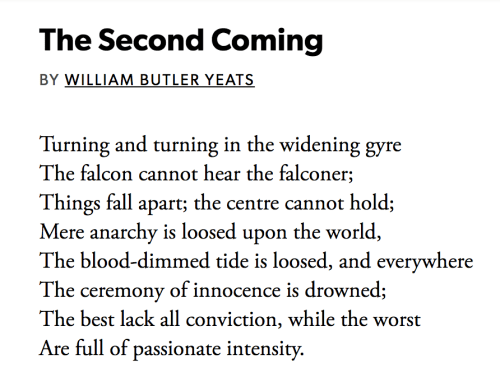

second coming yeats


Having been a public school teacher for almost two decades in the rural South and now a university professor for 15 years and counting, I have lived the tyranny daily of being chastised as “too political,” as tarnishing my credibility as a teacher and professor by my writing-as-activism.

I stumbled through a bit more than a decade of teaching before I discovered an organized body of thought that defined for me what I had been practicing, although quite badly—critical pedagogy.

Critical pedagogy acknowledges two powerful and seemingly contradictory realities: (1) all human behavior, including teaching, is inherently political, and thus, the neutral/objective pose is itself a political stance, and (2) indoctrination must be avoided and rejected.


crit ped kincheloe


K-12 public education and higher education remain resistant to these concepts, continuing to demand apolitical teaching (or, actually, the appearance of apolitical teaching) and to bristle at teachers and academics as activists.

In fact, teachers and professors take great risk to their careers when stepping beyond the neutral/objective pose, even outside the walls of the classrooms where they teach.

That the norm of formal education remains entrenched in the same sort of “both sides” mentality shared by mainstream journalism is made more disturbing by the dishonesty of that expectation because educators at all levels of schooling do in fact take stances.

For example, history taught through a patriotic lens is a political choice that is allowed to appear neutral, although it is clearly not.

And there are topics, such as the Holocaust and Nazi Germany, that are taught with a clear moral imperative—no “both sides” false equivalence afforded those who believed in exterminating the Jews.

No classes ever treating as equal “both sides” of pedophilia, child abuse, misogyny, rape.

None the less, activist-academics such as Howard Zinn have been and continue to be marginalized as merely activists.
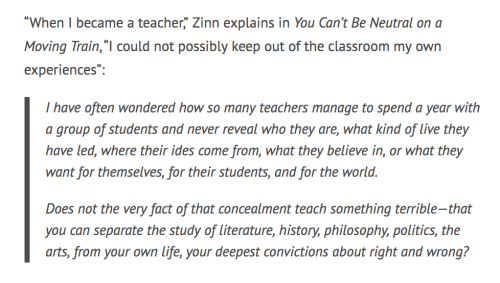

neutral zinn


Particularly in higher education, many go about their work as if the real world does not exist, and thus, the ivory tower myth and scathing phrases such as “merely academic.”

But to borrow Zinn’s metaphor, to remain in a neutral/objective pose in the classroom as an inequitable and unjust world charges on is to endorse that inequity and injustice.

President Trump’s “both sides” pose in the face of white nationalism and emboldened racism is inexcusable, but to pretend that Trump somehow sprang out of thin air is an ugly lie, a delusion.

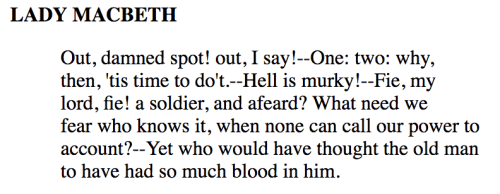
The rise of Trumplandia confirms there is blood on the hands of neutral academics and scholars, just as there is blood on the hands of “both sides” mainstream journalists.

lady macbeth


Trump is capitalizing on a vulgar academic pose that must be refuted, but it is equally inexcusable that traditional academic neutrality remains entrenched as if it has no consequences beyond the walls of schools and universities.

The U.S. needs Trump’s vapid logic repudiated: Good causes will always have some flawed and even bad people, as well as bad decisions, but causes dedicated to hatred and racism never include good people.

If educators, academics, and scholars are somehow excluded from taking ethical stands, we have little room to point fingers at Trump and his reign of white nationalism.


See Also
white folk (switchblade)

Thought Experiment: Racism and Republican Politics in the South

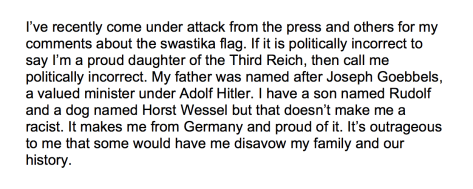
Consider this comment from a Republican candidate for governor in South Carolina, framed as “Telling insight as to what an R gov candidate thinks she need to say in a SC primary, circa 2017” by the NYT’s Jonathan Martin:

Now let’s place that in context with an imagined but parallel statement from another country:

Nazi pride

Feel free to discuss.


See Also

South Carolina governor candidate Catherine Templeton’s ‘proud of the Confederacy’ remarks stir controversy

Dismantling Monuments: History as a Living Document

Florida Education Reform: “It’s a Trap”

In his stand-up comedy days, Steve Martin had a routine about a TV evangelist. This character had, he believed, stumbled across the perfect TV evangelist sale: He announced that he had spoken to God and God had assured him he was the only person God was speaking to—so viewers should not listen to any other TV evangelist who claimed to know the word of God.

Yes, this was a stinging satire of religion, but at its core, Martin is unmasking the scam grounded in claims too good to be true—the “miracle” claim.

Writing in support of South Carolina’s Read to Succeed legislation, Oran P. Smith makes this claim:

Read to Succeed was indeed a success in Florida. Since the year before the retention policy came into effect, the percentage of Florida students scoring low enough to qualify for retention has fallen by 40 percent. More Florida children are learning how to read during the developmentally critical period. The students at the bottom proved the biggest winners from Florida’s no-nonsense reforms.

Setting aside that the Florida policy is actually Just Read, Florida! (Read to Succeed is SC’s version), reading policies based on standards, high-stakes testing, and grade retention (very much a Florida model) are a subset of the Florida “miracle” scam driven by Jeb Bush—a set of policies grounded in rhetoric and ideology but regularly refuted by careful analysis.

Between leaving office as governor of Florida and running for president, in fact, Jeb Bush shuttled around the U.S. selling his education reform—not unlike Martin’s TV evangelist: “These reforms include assigning letter grades to schools, high-stakes testing, promotion and graduation requirements, bonus pay, a wide variety of alternative teacher credentialing policies, and various types of school choice mechanisms.”

Many Republican governors simply adopted the rhetoric and pushed these policies while entirely disregarding substantial evidence refuting the practices. As I have noted, SC has been on the Florida “miracle” bandwagon for some time.

Like all “miracle” claims, however, the Florida “miracle” must be confronted simply: “It’s a trap!”

The allure, now, reaches beyond the states and into the federal Department of Education headed by Betsy DeVos, who is a one-trick pony for school choice.

Yet, as Valerie Strauss at the Washington Post reports Florida’s education system — the one Betsy DeVos cites as a model — is in chaos.

Public schools now have been besieged by this scam for decades—the Texas “miracle,” the Chicago “miracle,” the Harlem “miracle,” and the Florida “miracle.”

Political careers and horrible education policy have been driven by the power of showmanship and snake-oil sales pitches.

For well over a decade, education “miracles” have nearly all been fully debunked. The need to continually refute claims that are too good to be true is part of the strategy in fact since the media are a willing customer to these lies and then the careful analysis needed to show the claims to be false is simply lost in the shuffle of the next “miracle” story.

So just as I have pointed out about charter advocacy, those pushing the Florida model for education reform and reading policy are trafficking in mostly rhetoric in the absence of evidence.

Smith’s jumbled plea to give Read to Succeed a chance is yet another trap; these claims fail his argument, and ultimately, students and teachers in SC:

  • Florida education reform and reading policy simply have not succeeded. And what is more troubling, key elements such as standards and high-stake testing, grade retention, school  choice, and charter schools have all been strongly discredited as effective reforms by dozens of studies over more than a decade. The big scam in promoting Florida reading policy is that grade retention based on high-stakes testing does bump test scores short term (which benefits politicians and their rhetoric), but that bump fades and the negative consequences of grade retention remain (see Jasper, 2016).
  • SC has no reading “crisis,” or education “crisis” for that matter. Crisis rhetoric is one of the most corrosive aspects of the education reform debate. First, low literacy test scores in SC are strongly correlated with high poverty rates; our state’s high poverty is not a crisis, but an on-going reality with deep historical roots nurtured by political cowardice and lingering racism. SC’s literacy struggles are cousins to our political failure to address race and social class inequity in our state. Shouting “reading crisis” is yet another distraction from the political will needed to address poverty. Simply put, education is not the great equalizer, and thus, education reform will not eradicate larger social problems.
  • Smith touts teacher buy-in for Read to Succeed—a dubious claim about legislation and policy that are imposed on teacher certification programs, schools, and teachers who have no option accept to comply. But the bigger issue about buy-in is worth a moment, again about Florida. In the early days of Florida reform, a school receiving multiple years of failing report card grades triggered parental school choice; however, only about 3% of parents took that choice, and then within a couple years, about half of those parents chose to return to the failing schools. So here is my challenge: Talk to current SC teachers when they are free to share their opinions and find some actual parents of school-aged children and teachers from Florida. The messages you receive about buy-in, I suspect, will cast a dark cloud on the claims by Smith.
  • The final, and maybe ugliest, trigger is framing reading policy as an either/or prospect—grade retention or “social promotion” (an outdated but powerful term that certainly spurs the All-American hatred of giving people anything—especially if we believe those “people” to be black or poor). Either/or thinking is always misleading since the research on grade retention also addresses what best serves students other than retention or simple promotion, and since grade retention based on test scores can and often retains students who have achieved passing grades for the academic year. Grade retention as the antithesis to “social promotion” has some really ugly roots in ignoring how grade retention has and will disproportionately impact negatively poor and black student.

While we may agree that Read to Succeed is “in its infancy,” as Smith concludes, we must also confront that it is a clone of policies and programs that have already failed; Read to Succeed is finding yourself in a hole and continuing to dig, while shouting platitudes you hope can be heard by those choosing to avoid falling into the same trap once again.

What If?: Even the Best Republicans or Democrats

When news broke about John McCain’s cancer, political leaders from both major parties weighed in with words of praise and support—even former president Obama.

But here is my first thought: McCain will receive world-class medical care without any real fear of financial ruin because of his health crisis, but this fact is because he is extremely wealthy (much of that accumulated while being a career politician), not because he is a veteran, not because he is an American.

When Al Franken spoke about his middle-class roots and his wife’s struggle to rise out of poverty, Democrats began to post and praise Franken as the Great Hope of the party.

But here are my first thoughts: Franken’s white nostalgia for the good old days erases the very harsh realities for blacks, who did not have the same hope and promises Franken’s family and his wife’s family did (similar to McCain’s current fortune). While the good old days noted by Franken did include some identifiable opportunities gone today, Franken’s and his wife’s stories are significantly buoyed by their white privilege (conveniently omitted in his oratory).

McCain and Franken, I believe, represent both the best each major party has to offer and everything that is wrong with political leaders in the U.S.

McCain has worked his entire political life as a Republican to maintain the inequities of class and race that now benefit him in a very public and tragic way. McCain, in fact, was to be a major piece of Republican efforts to dump people off health insurance and to reduce the tattered safety nets needed by children, the poor, the elderly, and his fellow veterans.

Franken is the classic white progressive Martin Luther King Jr. warned about during the Civil Rights era. He speaks to rugged individualism and glosses past race because both strategies bolster his political capital.

The public in the U.S. is left victim to a vapid and soulless political sparring match between Republicans and Democrats, although neither party really cares about providing for all Americans the sorts of essential promises that every person deserves.

As one volatile example, we remain trapped in the abortion debate—as if that debate is about abortion, which it isn’t.

Throughout the history of the U.S. wealthy women have always had access to safe abortions; and regardless of the law, wealthy women will always maintain access to reproductive rights, safe and world-class healthcare for them and their children.

Roe v. Wade was narrowly about abortion, but broadly about expanding to all women in the U.S. the same rights already afforded the wealthy—just as we are witnessing in McCain’s cancer challenge.

I struggle to have the sort of compassion for McCain and praise for Franken that others are expressing because, in context, these men are—even as the best of their parties—the problems, not the solutions, to a more equitable country.

What if each of these men extended their own great fortune, much not even earned, to all Americans simply for being human? What if both of these men had worked and would now work to insure that especially the most vulnerable among are extended the promise that their human dignity will be preserved against poverty, disaster, and failing health?

What if they admitted the American Dream has never yet been achieved, even in their narratives about the good old days? What if they honestly sought ways to make that dream a reality soon?

What if enough Americans stopped playing petty and self-defeating political games so that our leaders had no choice but to do the right thing?

Yes, what if?

The Hollow Nation

Shape without form, shade without colour,
Paralysed force, gesture without motion…

“The Hollow Men,” T.S. Eliot

My name is Kathy H. I’m thirty-one years old, and I’ve been a carer now for eleven years….Carers aren’t machines.

Never Let Me Go, Kazuo Ishiguro

We are the hollow nation. We are the stuffed nation, “Leaning together/Headpiece filled with straw.”

It has been almost seven months since a motorist struck a pack of cyclists I was riding with on Christmas Eve 2016, injuring four of us—two seriously and permanently.

The motorist was deemed at fault on the scene, but received only a $76 ticket, less than the monthly payments I am making on my remaining medical bills since the insurance claim for the accident has yet to be settled.

My own insurance has paid much of the cost, but I am required to repay those payments once I have a settlement. The orthopedist, as well, overcharged me during my fracture treatment, refunding that amount more than six months later.

Nine or ten insurance companies and multiple lawyers have been wrestling with this accident, and the other injured cyclists and I have received a barrage of bills and notices from the ER, the hospital, the ambulance service, and numerous doctors. One cyclist was airlifted from the scene, and since the motorist had minimum coverage, his portion of that insurance likely was erased immediately in that urgent care.

This recent Monday morning, my mother was found unconscious by my youngest nephew, her grandson. She had a stroke, requiring an ambulance to transport her to our local hospital that then had her airlifted to a larger hospital nearby for emergency surgery on the clot discovered in her brain.

She has been in neurological ICU, and now a regular hospital room since Monday—but soon she will be transferred again to a rehabilitation facility for 2-3 weeks.

My father has been quite unwell recently; therefore, we are guiding him around in a wheelchair, circling our own wagons because my mother’s stroke creates a new and terrifying reality: she was his caretaker, and the family now must seek ways to provide both of my parents care.

Working-class children of the 1940s and 1950s, my parents have only Social Security and Medicare to sustain them.

Our next steps are swamped by if and how well their insurance and social services cover the medical care and rehabilitation my mother needs, if and how well my father can receive the daily care she has been providing.

My accident and my mother’s stroke are not nearly as extreme as the terrors of the healthcare system in the U.S. that countless people suffer daily. But these “terrors” are not really about the healthcare.

The treatment my mother has received, the seemingly miraculous surgery, has been the sort of kind and skilled medicine that leaves you mesmerized by the power of humans to make this world work in ways that are good and right and life-affirming.

But that care, I am afraid, is an isolated outlier in a calloused and awful system of administration, bureaucracy, and dehumanization caused by our lack of political courage as a people, as a country.

The power of universal healthcare and a single-payer system to provide humanity and dignity to the amazing medicine and brilliant healthcare providers already in the U.S. is left in the wake of our hollow nation.

A nation that is the wealthiest and most powerful in human history.

A nation that allows more than 1 in 5 children to live in poverty.

A nation of heartless and vicious partisan politics poised to dump an already inadequate system into the laps of caretakers, family members.

My accident exposes the hollowness of calls for individual responsibility; the system is designed to allow serial carelessness that leaves innocent victims responsible.

My mother’s stroke exposes that we as a nation genuinely do not care about a generation of people who may have bought the American Dream myth most sincerely—people such as my parents who were buoyed by white privilege they denied, who preached and practiced  the rigged rugged individualism scarred by racism with the faith it would pay off as they decline into their new reality of being dependent on the kindness of not only family, but the kindness of strangers.

Wealth and security are hoarded by a few, a vicious tribalism of a country that denies community, the power and dignity of everyone caring about everyone—not just the tunnel vision quest of “me getting mine,” the mean-spirited Social Darwinism that lurks beneath our national platitudes about working hard and fair play.

A hollow nation that denies the humanity of all sorts of “others” because of race and religion, but also culls away many at the edges of white privileged—white poor, white working-poor, white working class.

My parents represent that even the wink-wink-nod-nod promise of the American Dream (the white nationalism of “Make America Great Again”) is a lie, a calloused lie within the larger lie to the tired, the poor, the huddled massed—and especially a bald-faced lie about the so-called melting pot, a metaphor more accurate if named a witch’s cauldron.

With these realities before me, it is tempting to call for the removal of the Statue of Liberty, but at least, we must strip it of the poem inscribed at the base and post instead:

We are the hollow nation. We are the stuffed nation, “Leaning together/Headpiece filled with straw.”

NEW RELEASE NOW AVAILABLE: United We Stand Divided We Fall: Opposing Trump’s Agenda – Essays on Protest and Resistance

United We Stand Divided We Fall: Opposing Trump’s Agenda – Essays on Protest and Resistance

Full List of Contributing Authors

Yohuru Williams: Yohuru R. Williams is Professor of History and Author of Black Politics/White Power: Civil Rights Black Power and Black Panthers in New Haven

Denny Taylor: Denny Taylor is Professor Emeritus of Literacy Studies, Novelist, Children’s Author, and Founder of Garn Press

Jonathan Foley: Jonathan Foley is a World-Leading Environmental Scientist and Executive Director of the California Academy of Sciences

Charlene Smith: Charlene Smith is a Journalist, Documentary Film Maker, Author and Biographer of President Nelson Mandela

David Joseph Kolb: David Joseph Kolb is a Prize Winning Reporter, Editor and Columnist, and Author of Devil Knows: Tale of Murder and Madness in America’s First Century (Garn Press)

P.L. Thomas: P.L. Thomas is a Recipient of the NCTE George Orwell Award and Author of Beware the Roadbuilders and Trumplandia (Garn Press)

Jennifer C. Berkshire: Jennifer Berkshire is a Writer, Editor, and Author of the Have You Heard Blog and Co-Host of its Weekly Podcast on Education in the Time of Trump

Morna McDermott: Morna McDermott is Professor of Education and Co-Editor of Testing Our Courage: United Opt Out and the Testing Resistance Movement

Steven Singer: Steven Singer is a Public School Teacher, Education Advocate and Author of the Gadfly on the Wall Blog

Russ Walsh: Russ Walsh is a Public School Teacher, Literacy Specialist, Curriculum Supervisor and College Instructor, and Author of A Parent’s Guide to Public Education (Garn Press) and the Russ on Reading Blog

Katie Lapham: Katie Lapham is a NYC Public School Teacher and Author of the Critical Classrooms, Critical Kids Blog

Anne Haas Dyson: Anne Haas Dyson is Professor of Education, a Recipient of the NCTE Outstanding Educator of the Year Award, and Author of Negotiating a Permeable Curriculum (Garn Press)

Esther Sokolov Fine: Esther Sokolov Fine is Professor Emerita of Education, Former Elementary School Teacher in Downtown Public Housing Communities and Alternative Programs, and Author of Raising Peacemakers (Garn Press)

Vanessa Barnett: Vanessa Barnett is School District Arts Program Coordinator, University Arts Instructor, and Museum Arts Consultant

Carolyn Walker: Carolyn Walker is a journalist, memoirist, essayist, poet, and creative writing instructor nominated for a Pushcart Prize, and Author of Every Least Sparrow (Garn Press)

Steve Nelson: Steve Nelson, Head of Calhoun School 1998-2017 in NYC, one of America’s most notable progressive schools, and Author of First Do No Harm: Progressive Education in a Time of Existential Risk (Garn Press)

George Lakoff: George Lakoff, Professor Emeritus of Cognitive Science and Linguistics, is a World Renowned Linguist Integrating Studies of Social Issues and Politics from a Neural Linguistics Perspective

“Ignoreland” Realized: Trumplandia 2017

Bertis Downs, lawyer and everything-man for Athens-based group R.E.M., asked on social media what Automatic for the People song is most under-appreciated.

As this album approaches its 25-year anniversary—and in the weakening wake of the band calling it a day—we may be hard pressed to argue that any song on that collection is more relevant than “Ignoreland.”

The career of R.E.M. has some relatively clear eras—the independent phase spanning the 1980s, the popular phase associated with the Warner Brothers contract and the 1990s, and then the post-Bill Berry R.E.M.

It seems fair to argue that Automatic represents what makes R.E.M. an elite example of how a group can achieve significant popularity while maintaining artistic independence and credibility. In short, this is a beautiful album that may in fact have a collection of songs that are all under-appreciated.

Throughout their independent years as playing so-called college alternative rock, R.E.M. developed a reputation as a political band; Michael Stipe’s lyrics unpacked as such, even when they remained elliptical and more evocative than declarative, and then band mates themselves politically vocal and active beyond their music.

R.E.M. fandom seems to fall along the three eras above, with some clinging to the independent 1980s band but balking at popular R.E.M. and then abandoning post-Berry R.E.M. However, “Ignoreland” in many ways is a powerful link between the independent and popular phases.

From 1987, Document lays the groundwork for “Ignoreland” with “Exhuming McCarthy,” pop-song catchy and politically scathing. A compact distant cousin to Arthur Miller’s The Crucible, “Exhuming McCarthy” takes aim at the Reagan administration as a manifestation of all-that-is-wrong with U.S. corporate-capitalism as well as the need to keep the public afraid of creeping threats such as the 1950s Red Scare echoed in Reagan’s “Tear down this wall.”

It is damned hard to find better pop-culture political literature than “Look who bought the myth/ By Jingo, buy America.”

The U.S. did just that for twelve years—eight of Reagan and then four more with George H. W. Bush, who appears in “Ignoreland” with equally incisive lyrics: “How to walk in dignity with throw-up on your shoes.”

A great bittersweet reality of my life is that I no longer can anticipate a new R.E.M. album, no longer feel that rush of the first listen to unpack what I knew would be something that would make me a different person, a happier person.

I recall that first listen to Automatic and how I marveled at “Ignoreland”—what felt to me as a writer, a teacher, and a part of the political Left to be a perfect metaphor for the U.S.

The politics of ignoring reality—tremendous and grinding inequity—in the glare of rhetoric about the American Dream captured in e.e. cummings’s “‘next to of course american i.”

As in “Exhuming McCarthy,” cummings confronts U.S. jingoism—”by jingo by gee by gosh by gum”—linking the paradox of extremely inward-gazing nationalism and the simultaneous failure of the American character unmasked by James Baldwin: “This rigid refusal to look at ourselves may well destroy us.”

“Ignoreland” begins causticly and rings as if written in recent months: “These bastards stole their power from the victims of the Us v. Them years.”

The rise of Reagan/Bush is detailed twenty-five years ago by exposing divisive politics, sword rattling, and hollow promises of trickle-down economics. But “Ignoreland” also warns about the failure of media, predating significantly the recent hand wringing about fake news: “The information nation took their clues from all the sound-bite gluttons/ Nineteen eighty, eighty-four, eighty-eight, ninety-two too, too.”

The U.S. as a media-centric people who are paradoxically, again, un-/misinformed—Stipe’s catalogue also triggers George Orwell’s 1984, a work recently regaining popularity along with other works of dystopian science fiction because Orwell focused on how often those who control language control everything:

TV tells a million lies
The paper’s terrified to report
Anything that isn’t handed on a presidential spoon

If we truly want to know how we have arrived here, what I have christened Trumplandia, the bread crumbs of that decline can be followed through “Exhuming McCarthy” and “Ignoreland” to finding ourselves in the witch’s cauldron.

Trumplandia is a people willingly filing into what was sold as a Jacuzzi, only to find ourselves the meat of a meal to feed the 1%.

To ignore—this must not be ignored now. It is an act of will, a decision.

I argued during the presidential election of 2016 that voters had to compromise their morals to vote for Hillary Clinton, but to vote Trump was a complete abandoning of any moral grounding.

To vote Trump is the ultimate act of ignoring found in the majority of white women voting for a misogynist, in the religious Right voting for a serial adulterer, and in the media happily skipping along hand-in-hand with a pathological liar.

Twenty-five years ago, “Ignoreland” captured the toxic mix of political anger and political resignation:

If they weren’t there we would have created them
Maybe, it’s true
But I’m resentful all the same
Someone’s got to take the blame

Trump ascending and fabricating an administration of billionaires, “Ignoreland” realized because we chose the road of least resistance—we created them.


A Good Man Is (Still) Hard to Find

The jewel of an ending in Flannery O’Connor’s “A Good Man Is Hard to Find” is nearly as complex as the story itself: “‘Shut up, Bobby Lee,’ The Misfit said. ‘It’s no real pleasure in life.'”

O’Connor, although trapped in the sexist language of “man” meaning “human,” forces readers to consider just who is “good”: Red Sammy Butts must be since he is a veteran, but can The Misfit, murderous and philosophical, be good as well?

The essential question of human goodness interrogated and confronted in O’Connor’s dark and brilliant gem of a short story has been the moral dilemma of my life—a dilemma I have not unknotted in more than 56 years of trying.

The seminal person of that dilemma was my high school’s football coach and athletic director, with whom I would also work when I became a teacher and coach not many years after graduating from that school. He was and continues to be revered as a “good” man although I witnessed as a student and then a teacher that virtually everything afforded the label of “good” with him was veneer.

Like many coaches, he hid behind a suit and tie as well as platitudes about character and hard work; he also hid behind being a “family man” and a church-going Christian.

These are all powerful armor in the South for a certain segment of so-called professional white men.

Although I am skeptical, I hope we may have lost our innocence since the Joe Paterno/Jerry Sandusky abuse of such sacred trusts has been exposed.

But this isn’t just about the racism and hypocrisy that is rampant in big time scholastic and professional sports.

This is about the widespread evil that is white and affluent men in suits with nice hair cuts who hold positions of power all across the U.S.—notably, but not exclusively, in our government.

This is about many of them being Republicans who constantly hold up the God and family shields.

Conservative media pundits and the Ronald-Reagan Republicans have always bothered me in the same way that I have never been comfortable with the hypocrisy surrounding that high school coach.

With the rise of Trump, this discomfort has been intensified beyond expectations.

So as I have been mulling how friends and colleagues have been reaching out to our state’s Republican leaders, several people shared on social media Experts in the Field by Bonnie Nadzam—detailing the predatory patterns of older male writers and the women they’ve abused.

Nazdam’s expose has prompted many other women writers to speak out as well.

“A former teacher and I were discussing these things last week—how the hierarchies of power in the creative writing world resemble the hierarchies of power in Washington,” Nazdam admits.

And so I am nearly paralyzed with what to do with all this as we sit in the U.S. where Donald Trump was elected president, received a majority of votes from white women, despite his horrific and very public record of being the sort of sexual predator that disqualifies him from any position of power or any consideration for being a “good” man.

I am most disturbed, however, by something tangential to Trump, about whom there are calls not to normalize him: We continue to allow so-called mainstream Republicans—smiling, well coiffed, donning expensive suits and ties—to be afforded the mantle of “good,” to be treated with civility and deference, despite their bigoted comments and the inequitable policies they endorse and implement.

Having raised a daughter, an only child, and now regularly providing daycare for a granddaughter, my navigating the world as a man, a white man with considerable privilege, weighs considerably on my conscience.

I carry to this day the guilt I felt as a very young person when I learned about the male gaze—ultimately having to confront my being complicit in that culture and seeking ways to disentangle myself from both that gaze and the larger contexts of rape culture and objectifying women.

These formative years developed along with and after I was strongly immersed in superhero comic books and science fiction—both of which reflected and perpetuated the worst of these phenomena.

As a friend, companion, parent, grandparent, teacher, coach—I have always struggled with whether or not I have fulfilled my own obligations for being “good.” And that concern is often grounded in the sanctity and dignity of the females in my personal and professional lives.

I fear I have failed too often, recognizing good intentions are not enough.

Although I have not solved my essential moral dilemma about what it means to be “good,” I do know a really powerful way to investigate that question: How does someone treat those over whom he/she has power or prestige? How does someone use her/his power in the context of how it affects her/him and then other people?

Obamacare, while terribly inadequate, sought ways to expand healthcare while the proposed Trumpcare has been unmasked for potentially reducing who is covered and transferring tax breaks to the wealthy (and under either, of course, politicians making the rules and their families have the best of healthcare).

And thus, this is a test that Trump and his Republican minions fail—repeatedly.

“We each have a function and role in this culture, whether we acknowledge and are aware of and embrace it or not,” Nazdam argues, concluding: “Whatever your role or roles, at least be aware of your platform and responsibility….[I]n the current environment, it seems radical resistance may be as simple as noticing the truth.”

Therefore, I cannot and will not participate in or tolerate any more the charade that is treating Republican political leaders as if they are “good men” while saying and doing the awful and dehumanizing things they say and do every day.

A good man is (still) hard to find, and we certainly are wasting our time even trying in the Republican Party.

South Carolina Ranks First in Political Negligence

Based on a U.S. News & World Report ranking, The Post and Courier (Charleston, SC) announced South Carolina ranks last in education.

South Carolina also ranks first in women being murdered by men.

Rankings are popular in the U.S., but more often than not, terrible ways to understand what is being ranked as well as distracting fodder for both the media and politicians.

Ranking itself is problematic since the act itself requires finding data that supports that ranking, and then by ranking we are ascribing both a range of quality as well as some degree of blame for the relative status.

When saying SC is last in education and first in violence toward women, we must take greater care in clarifying what these rankings mean and where the accountability lies for both outcomes and the causes for those outcomes.

I suspect many would fault SC public schools for the education ranking, but almost no one would blame heterosexual domestic relationships for the inordinate rate of men’s violence toward women in the state.

But even more important here is that both of these rankings reveal something in common nearly entirely ignored: political negligence in SC.

The U.S. News ranking of education is far less about education, in fact, than about socio-economics.

Three of the six data categories to rank states by education are test scores (ACT and NAEP math and reading), and the other three are graduation rates as well as Pre-K quality and preschool enrollment.

At least 60% of test scores prove time and again to be correlated with out-of-school factors. In short, what we routinely label as “education” is in fact more significantly a reflection of poverty and wealth.

And thus, if we are compelled to say SC is last in education, we are actually saying that SC’s social and education policy are utter failures. The key here is that this ranking is about policy, a direct reflection of political will, political negligence.

And SC is easily in competition for elite status in political negligence of education as shown in the twenty years it took for the courts to address the Corridor of Shame, finally admitting that high-poverty schools serving high-poverty communities result in students being doubly disadvantaged by their lives and their school opportunities.

For comparison, consider SC’s violence toward women ranking and the state being one of 13 states that treat marital rape differently than rape of a non-spouse:

Men or women raped by a spouse have just 30 days to report the incident to authorities. For the rape to count, it must have involved “the use or the threat to use a weapon … or physical violence of a high and aggravated nature.” The offense is treated as a felony but has a maximum sentence of 10 years, whereas rape of a non-spouse has a maximum sentence of 30 years.

In both rankings, then, we must ask how policy creates the environments reflected in measurable outcomes—such as test scores and graduation rates or incidences of violence toward women.

There is a political advantage to keep media and public focus on schools with educational rankings; that focus, however, is akin to blaming hospitals for housing the sick.

Schools in SC and across the U.S. reflect the inequities of our communities, the failures of our policies, and as a result, they are ineffective as mechanisms of change.

While we have known for decades that poverty and inequity are the greatest hurdles for children learning, we have committed to decades of changing standards and testing students—and we appear poised to waste time and funding next on school choice scheme.

None of this addresses the root causes of the outcomes we continue to use to rank educational quality, a process that masks, misinforms, and guarantees to maintain the status quo.

Ranking invariably proves to be much ado about nothing because it tends to misrepresent and misinform, especially in terms of why conditions exist and what reforms would improve those conditions.

Policy is at the core of both any state’s educational outcomes and what threatens the safety of women.

Policy reflects what truly matters, and in SC, our rankings in terms of education and violence toward women are commentaries on who we are as a people, who we are willing to ignore and who we are willing to protect.

Ultimately, both of these rankings expose that SC ranks first in political negligence, negligence of equity in the lives and education of children, negligence in the safety of women.

Beware the Bastards: On Freedom and Choice

Your Honor, years ago I recognized my kinship with all living beings, and I made up my mind that I was not one bit better than the meanest on earth. I said then, and I say now, that while there is a lower class, I am in it, and while there is a criminal element I am of it, and while there is a soul in prison, I am not free.

Eugene V. Debs: Statement September 18, 1918


Based on “Eight O’Clock in the Morning” by Ray Nelson, the cult science fiction film They Live focuses on the main character, Nada (Roddy Piper), who discovers a pair of sunglasses that reveal to him that aliens are controlling the human race.

In the real world, the trick is not finding a pair of enlightening sunglasses to expose the alien overlords but to recognize the bastards we have chosen to rule over us—because the bastards controlling the U.S. are really easy to see.

Here’s one.

And here’s a whole room full.

The masking, you see, is not taking on human form to hide alien bodies, but the use of words that appear to say one thing while actually meaning something entirely different.

The trick in the real world is not visual, but verbal.

So we have Ryan on Twitter:

And Vice President Pence:

O, happy freedom! And glorious individual responsibility!

Let us, of course, step back and note that our federal political leaders are overwhelmingly white and wealthy men who have healthcare, retirement/pension, and daycare all provided for them at tax payers’ expense—although every one of them due to their wealth are free to take the individual responsibility to choose to pay for those luxuries that they are denying everyone else.

*

In Margaret Atwood’s The Handmaid’s Tale, Offred (June), the eponymous handmaid of the tale, reveals that “[t]he circumstances have been reduced” (p. 8) for the younger women of Gilead, a post-apocalyptic theocracy of sorts. These seemingly fertile women have become extremely precious for the survival of the white race and paradoxically the embodiment of a perverse slavery for procreation.

Atwood has written at length about being indebted to George Orwell—those who control language control everything and everyone—and that her speculative novel includes a quilting of human actions drawn directly from history, not fabricated by Atwood.

How have humans kept other humans in literal and economic bondage? Often by exploiting token members of the group being exploited.

Thus, in The Handmaid’s Tale, a few women are manipulated to control other women. The handmaid’s are trained by Aunts, who instill the propaganda:

There is more than one kind of freedom, said Aunt Lydia. Freedom to and freedom from. in the days of anarchy, it was freedom to. Now you are being given freedom from. Don’t underrate it….

We were a society dying, said Aunt Lydia, of too much choice. (pp. 24, 25)

Throughout the novel, readers must navigate how Offred (June) weaves the overlap of her own original ideas and vocabulary as that intersects with the propaganda of Gilead:

Will I ever be in a hotel room again? How I wasted them, those rooms, that freedom from being seen.

Rented license. (p. 50)

“Freedom” and “license” are exposed as bound words, the meanings contextual.

As Offred (June) continues to investigate rooms, she discovers a powerful but foreign phrase:

I knelt to examine the floor, and there it was, in tiny writing, quite fresh it seemed, scratched with a pin or maybe just a fingernail, in the corner where the darkest shadow fell: Nolite te bastardes carborundorum.

I didn’t know what it meant, or even what language it was in. I thought it might be Latin, but I didn’t know any Latin. Still it was a message, and it was in writing, forbidden by that very fact, and it hadn’t been discovered. Except by me, for whom it was intended. It was intended for whoever came next. (p. 52)

The power to control language includes defining words, but also denying access to language—forbidding reading and writing, literacy, to those in bondage.

And then, Offred (June) explains about her life before Gilead:

We lived, as usual, by ignoring. Ignoring isn’t the same as ignorance, you have to work at it.

Nothing changes instantaneously: in a gradually heating bathtub you’d be boiled to death before you knew it….The newspaper stories were like dreams to us, bad dreams dreamt by others. How awful, we would say, and they were, but they were awful without being believable. They were too melodramatic, they had a dimension that was not the dimension of our lives.

We were the people who were not in the papers. We lived in the blank white spaces at the edges of the print. It gave us more freedom.

We lived in the gaps between the stories. (pp. 56-57)

And from that previous life of “ignoring” the other since it wasn’t about them, Offred (June) finds herself the procreation slave of a Commander, in “reduced circumstances” where she realizes: “There wasn’t a lot of choice but there was some, and this is what I chose” (p. 94).

Her previous life of “ignoring” has been replaced by something seemingly more awful, but nearly exactly the same as she explains about the Ceremony: “One detaches oneself” (p. 95).

Even in Gilead, Offred (June) again becomes the other woman, lured into an infidelity characterized by playing Scrabble with the Commander, who reveals to her that Nolite te bastardes carborundorum is slang Latin for “Don’t let the bastards grind you down” (p. 187).

Adolescent language as rebellion has become a life-or-death slogan for Offred (June).

As her relationship with the Commander becomes increasingly trite and complex, Offred (June) declares, “Freedom, like everything else, is relative” (p. 231).

*

It is 2017, and many are living lives by ignoring because it just doesn’t seem to be about them.

Detached, unwilling to look or listen carefully—skipping along to the hollow mantras of “freedom,” “choice,” and “individual responsibility.”

As with Offred (June), this is no longer an adolescent joke; it is the only real option we have.

Nolite te bastardes carborundorum: Don’t let the bastards grind you down.