

Category Archives: politics
Education Reform in the Absence of Political Courage: Charleston (SC) Edition
Words matter, and thus, I must apologize by opening here with a mundane but essential clarification of terms.
As I have written over and over, everything involving humans is necessarily political, even and especially teaching and learning. Therefore, no teacher at any level can truly be apolitical, objective. Taking a neutral or objective pose is a political choice, and an endorsement of the status quo.
Key to that claim is recognizing the difference between political and partisan. Partisan politics involves allegiance to and advocacy for organized political parties, notably Republicans and Democrats.
A partisan feels compelled to place party loyalty above ideology or ethics. To be political can be and should be a moral imperative.
We can avoid being partisan, even as that is political. And when many people call for education and educators to avoid being political, what they really are seeking is that education and educators not be partisan—a position that is achievable and one I endorse.
This distinction matters in public education and public education reform because all public institutions in the U.S. are by their tax-supported status at the mercy of partisan politics.
From around 1980, in fact, politicians at the local, state, and national levels have discovered that public education is a powerful and effective political football. The standard politician’s refrain is “Schools are horrible, and I can make them better!”
The current rise of the inexpert ruling class at the presidential level has been foreshadowed for more than three decades by the partisan politics around education reform—politicians and political appointees with no experience or expertise in education imposing pet reform initiatives onto public schools because these policies appeal to an equally mis-informed public.
Even with large failed crucibles such as New Orleans post-Katrina, political leaders remain committed to finding themselves in a hole and continuing to dig.
In my home state of South Carolina, infamous for our Corridor of Shame, Charleston, on the east coast and part of that corridor, continues to represent the savage inequalities that result from a combination of an inexpert ruling class and an absence of political courage.
Charleston schools reflect the most stark facts about and problems with K-12 education across the U.S.: private and gate-keeping public schools (such as academies, magnet schools, and some charter schools) that provide outstanding opportunities for some students in contrast to grossly ignored high-poverty, majority-minority public schools that mis-serve “other people’s children.”
As a result of these inequities and dramatically different student outcomes exposed by the accountability era obsession with test scores, Charleston has played the education reform game, committing to provably failed policies over and over: school choice, school closures and takeovers, school turnaround scams, overstating charter schools as “miracles,” and investing in Teach For America.
Why do all these policies fail and what ultimately is wrong with inexpert leadership? The absence of political courage to address directly the blunt causes of inequitable student outcomes in both the lives and education of students.
Currently in Charleston, the closing of Lincoln High and transferring those students to Wando High (see here and here) highlight that the gap between commitments to failed edureform and political courage to do something different persists.
The debates and controversy over how former Lincoln students are now performing at Wando offer some important lessons, such as the following:
- The media and the public should be aware of partisan political code. A garbled reach for “the soft bigotry of low expectations” has been used to explain why Lincoln students’ grades have dropped while at Wando. The “soft bigotry” mantra is a conservative slur triggering the public’s belief in “bleeding heart liberals,” who coddle minorities. But the more damning part of the code is that it focuses blame on the administration and teachers in high-poverty, majority-minority schools and thus away from political leadership.
- And thus, the public needs to distinguish between blaming educators at Lincoln for low expectations (again, garbled as “low standards”) and the expected consequences of high-poverty, majority-minority schools suffering with high teacher turnover, annual under-staffing, and persistent teacher workforces that are new and/or un-/under-certified. Additionally, the accountability era has unrealistic demands of these schools when compared to low-poverty, low-minority schools that have much greater percentages of experienced and certified teachers.
- The apparent drop in student grades and test scores from Lincoln to Wando is extremely important data that deserve close scrutiny, but so far, that scrutiny has been reduced to partisan politics and deflecting blame. Dozens of reasons could explain the grade differences, including the transfer as well as the staffing differences between the two schools (neither of which is the simplistic “soft bigotry” argument used primarily to justify closing a community school).
The partisan political approaches to schools and education reform are tarnished by both willful ignorance and a confrontational blame game.
The willful ignorance of politicians and the public refuses to acknowledge huge social inequity driven by racism and white privilege; the blame game seeks ways to blame the victims of those inequities instead of confronting systemic forces.
What should political leaders be doing and what should the public be demanding that is different from the patterns identified above, than the policies already proven as failures?
- Recognize that in-school only reform creates two serious problems: (1) unrealistic demands with high-stakes consequences produce unethical behavior among otherwise good people (see the Atlanta cheating scandal), and (2) since out-of-school factors overwhelmingly influence measurable student achievement, even the right in-school only reform is unlikely to result in measurable improvement.
- Interrogate the proclaimed cause of low student achievement—”low expectations”—and instead seek to understand the complex reasons behind that low achievement by poor and black/brown students based on available evidence that includes carefully interviewing the administrators, teachers, and students involved.
- Advocate for public policy that addresses serious inequity in the lives of children—policy impacting access to health care, a stable workforce, access to safe and stable housing, and high-quality food security.
- Refuse to ignore needed in-school reform, but reject accountability-based reform for equity-based reform focusing on equitable teacher assignment for all students, articulated school funding that increases funding for schools serving struggling communities, guaranteeing the same high-quality facilities and materials for all children regardless of socioeconomic status of the communities served, and eliminating gate-keeping policies that track high-needs students into test-prep while advantaged students gain access to challenging courses such as Advanced Placement and International Baccalaureate.
Ultimately, the absence of political courage in SC and across the U.S. is where the real blame lies for inequitable student achievement along race and class lines.
Many students, the evidence shows, are doubly and triply disadvantaged by the consequences of their lives and their schools.
Trite and misleading political rhetoric, along with “soft bigotry of low expectations,” includes soaring claims that a child’s ZIP code is not destiny.
Well, in fact, ZIP code is destiny in SC and the U.S.; it shouldn’t be, but that fact will remain as long as political leadership chooses to ignore the expertise within the field of education and continues to lead without political courage.
Political courage requires direct action, even when it isn’t popular, and refuses to deflect blame, refuses to wait for what market forces might accomplish by taking the right action now.
Political courage, as James Baldwin expressed, embraces that “[t]he challenge is in the moment, the time is always now.”
For More on Political Courage
Support Betsy Devos Shoot Yourself In The Foot, Andre Perry
Black Activists Don’t Want White Allies’ Conditional Solidarity!, Stacey Patton
Dear New York Times
It is the end of the month, and as I click on what appear to be important articles in my social media feed, you, The New York Times, alert me that I have exhausted my free access to your news and commentary, including options for subscribing to your publication.
For a long time now, those messages have, frankly, irritated me because I have been blogging extensively as an educator about how your publication as a leader in mainstream media as well as other highly regarded outlets such as NPR and Education Week has been using my field of education as toilet paper.
Mainstream media consistently misrepresent the quality and problems with public education and teachers; routinely honor reform advocates, politicians, and organizations/think tanks with essentially no credibility; and remain trapped in vapid “both sides,” so-called objective, and press-release journalism.
Since I am just a blogger, only an 18-year veteran of public school teaching, and a current college professor and scholar of education, race, and poverty, I realize you really do not care about my informed positions, but since you are soliciting my money and my support, let me simply remind you here of some of my work highlighting your truly careless and harmful reporting:
- UPDATED: Mainstream Media in (Perpetual) Crisis: More Education Meat Grinder
- The New York Times in an Era of Kool-Aid Journalism
- Mainstream Media, Not Fake News, Spawned Trumplandia
However, I am not addressing this open letter to you, The New York Times, to rail yet again about your failures as a major aspect of the free press in the U.S.
For the first time, when you blocked access to an article and waved your subscription options before me, I paused because unlike NPR, you have done something that many are calling “bold,” but is actually what you should have always been doing: In a Swirl of ‘Untruths’ and ‘Falsehoods,’ Calling a Lie a Lie, Dan Barry.
If I may be so bold, let me counter your solicitation of my patronage with a request of my own.
The New York Times, as major voice in a fading field, could you please acknowledge the failure of mainstream media, a failure far more damaging than fake news, and along with your commitment to name lies as “lies,” could you please take a foundational stand for moving mainstream media in the U.S. toward rejecting “fair and balanced” and then embrace the tenets of being a critical free press?
Again, as a lowly blogger/educator/scholar, I know my voice really doesn’t matter, but I have laid out this problem often:
- When Fake Is Real and Real Is Fake: More on Crossing the Bigfoot Line
- Fair and Balanced Education and Journalism: On the Death of Democracy
- U.S. and Education Reform Need a Critical Free Press
- My Open Letter to Journalists: A Critical Free Press, pt. 2
- Invoking “Oliver Rule (Expanded)” for Education Reform Debate
- O, Free Press, Where Art Thou?
I am very cautiously willing to crack open the door I have long ago closed about the failures of mainstream media, beholden to our consumer society, because of your willingness to do something that any ethical person would do—confront lies, especially from the highest levels of our society.
But as I detail above in a recent blog, about the same time you made your stance about lies, you published a truly awful and harmful article about people living in poverty and depending on government assistance.
It was a hate piece that feeds the very lowest stereotypes (hint: lies) about poor people as well as triggering racism; others as I link in my piece have shown that the article was both filled with gross stereotypes and factually misrepresented the study it cited.
So, thank you for pointing out Trump’s lies, but as I was admonished as a child, when you point a finger at someone, three are pointing back at you.
Will you simultaneously clean your own house, become a leader for your field in the pursuit of a critical free press, as you challenge the current administration?
If yes, I will eagerly open the door, and subscribe with glee.
See Also
Sam Waterston: The danger of Trump’s constant lying
Fair and Balanced Education and Journalism: On the Death of Democracy
Once I posted a reader for Trumplandia, based on the increased sales of George Orwell’s 1984 as well as the related thought pieces on important texts from Orwell and other writers, I was not surprised by the expected response calling for teachers and classrooms to be somehow politically neutral.
I have rejected this idea often, focusing on Howard Zinn’s brilliant metaphor of being unable to remain neutral on a moving train. Both calling for no politics in any context and taking a neutral stance are, in fact, political themselves—the former is a political strategy to deny some Others their politics while imposing your own and the latter is the politics of passively endorsing the status quo (in a society where racism and sexism, for example, continue to thrive, being neutral is an indirect endorsement of both).
Education and journalism—universal free public education and the free press—share many important and disturbing qualities: they are essential to the creation and preservation of a free and equitable people, they remain mostly unachieved in the U.S. in practice because they are often the tools of powerful people and forces who distort their ideal contributions to democracy and equity, and at the heart of that failure (we have failed them; they have not failed us) is the shared traditional code of education/teachers and journalism/journalists assuming neutral poses, being forced into a state of objectively presenting both sides in a fair and balanced way.
Particularly in the post-truth times we now find ourselves—and I argue we are here because of our failures in education and journalism—demanding that educators and journalists remain neutral is not the right goal and not actually how either functions.
In fact, education and journalism are always political, and in most contexts, educators and journalists routinely break the rule of neutrality—and thus, when anyone wags a finger and exclaims “We must be fair and balanced! Show both sides!” the truth is not that educators or journalists are being ideological or biased, but that someone in power feels that his/her politics is being challenged.
Let me illustrate in both education and journalism, starting with the media.
As I have noted before, when we compare the Ray Rice inspired public debate about domestic abuse to the Adrian Peterson motivated public debate about corporal punishment, the unbiased press myth is completely unmasked because domestic abuse (men hitting and psychologically abusing women) was entirely examined throughout the media as wrong (no pro-abuse side aired) while that same media almost exclusively presented corporal punishment as a debate with a fair and balanced presentation of both sides to adults hitting children.
What is clear here is incredibly disturbing: The media, in fact, make decisions about when to honor credible positions, when to reject or even not cover invalidated and unethical positions, and when to shrink back into the “both sides” cover.
While decades of research and the same ethical concerns about power and abuse related to rejecting domestic abuse entirely refute corporal punishment, the media have chosen to remain neutral on a moving train aimed at the health and well being of powerless children.
In other words, when media shirks its role in creating and maintaining a free and equitable people behind its tin shield of objectivity—think about always framing evolution or climate change as debates, as if “both sides” are equally credible when they are not—this is a dishonest pose because the media routinely take sides.
Finally, I want to highlight that education represents this same dishonest dynamic—claiming to be apolitical, or aspiring to be apolitical, while often taking sides.
Unless I am misreading the current mood of the country, the rise of interest in 1984 and other works of literature similar to Orwell’s is along a spectrum of concern about to fear of the rise of fascism and totalitarianism. Concurrently, with the public discussions about fake news and post-truth, we are experiencing a renaissance in examining how power and language are inseparable.
So what does it mean when teachers call for presenting both side of this debate when we bring politically charged novels by Orwell or Margaret Atwood into high school and college classes?
Before answering, let me offer a few examples from typical lessons found in high schools for virtually every student.
Both the Holocaust and slavery in the U.S. are taught as foundational content in anyone’s education; these are disturbing topics, and hard issues.
When we teach the Holocaust, notably through Night by Elie Wiesel in an English course, do we rush to have students read Hitler’s Mein Kamft to fairly represent both sides, treating each position as morally equivalent, allowing our students to choose whichever position she/he wishes?
When we teach U.S. slavery, possibly having students read Frederick Douglass, do we also find eugenicists’ and racists’ declarations demonizing blacks to fairly represent both sides, treating each position as morally equivalent, allowing our students to choose whichever position she/he wishes?
As in the media, educators at all levels routinely take sides—the answer to the two questions above reveal.
And thus, returning to the push back to my Trumplandia reader, I am lost on how or why educators would find ways to present pro-fascist ideas to balance literature study about the threats of fascism and totalitarianism.
Using Orwell and all sorts of powerful literature to help students on the cusp of or early in their roles as active participants in a democracy to better read the world and better act on that world in informed and ethical ways is the very essence of politics, one not corrupted by simplistic partisan politics of endorsing Democrats [1] or Republicans (which is worth resisting in education and journalism).
In 2017, the U.S. and even the entire world are faced with whether or not we truly believe in freedom and equity, whether or not we are willing to invest in the institutions that can leverage both that freedom and equity—institutions such as formal education and the media. And we have been here before, in the same words and the same actions. [2]
If the answer is yes, then our resolve must be linked to demanding that our teachers and journalists are grounded in taking informed and ethical stands, not the dishonest and uncritical pose of objectivity.
As I have shown above, neither is really being neutral now, but instead, pulling out the objective card only when it serves the interest of the status quo.
Critical educators and critical journalists must not serve the whims of power and money, and must be transparent in their pursuit of credible evidence and ethical behavior.
To frame everything as a debate with equally credible antithetical sides is dishonest and insufficient for the promise of life, liberty, and the pursuit of happiness.
Teachers and journalists are always political agents; both professions must choose in whose interest they are willing to work.
The neutral pose by either is to take a seat on the train, to keep eyes down, and to allow the train to rumble along as if the tracks are not leading to a cliff.
Pretending that cliff isn’t now on our horizon will not stop the train from crashing on the rocks of the coming abyss.
[1] My political work is not partisan, for example, as I have been warning about the Orwellian failures of political parties for many years; see Orwellian Educational Change under Obama: Crisis Discourse, Utopian Expectations, and Accountability Failures by Paul Thomas.
[2]
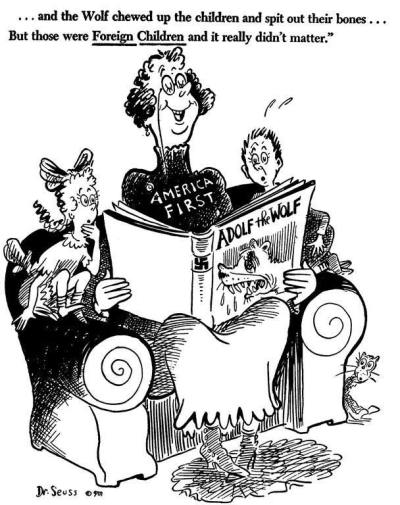
The Big Lie about the Left in the U.S.
The Big Lie about the Left in the U.S. is that the Left exists in some substantial and influential way in the country.
The Truth about the Left in the U.S. is that the Left does not exist in some substantial and influential way in the country. Period.
The little lies that feed into the Big Lie include that universities and professors, K-12 public schools, the mainstream media, and Hollywood are all powerful instruments of liberal propaganda.
These little lies have cousins in the annual shouting about the “war on Christmas” and hand wringing by Christians that they are somehow the oppressed peoples of the U.S.
These lies little and Big are a scale problem in that the U.S. is now and has always been a country whose center is well to the right, grounded as we are in capitalism more so than democracy.
The U.S. is a rightwing country that pays lip service to progressivism and democracy; we have a vibrant and powerful Right and an anemic, fawning Middle.
Wealth, corporatism, consumerism, and power are inseparable in the U.S.—pervading the entire culture including every aspect of government and popular culture.
The Left in the U.S. is a fabricated boogeyman, designed and perpetuated by the Right to keep the general public distracted. Written as dark satire, Kurt Vonnegut’s Cat’s Cradle now serves as a manual for understanding how power uses false enemies to maintain power and control.
Notably during the past 30-plus decades, conservative politics have dominated the country, creating for Republicans a huge problem in terms of bashing “big government.”
But dog-whistle politics grounded in race and racism benefitting the Right and Republicans have a long history.
In 1964, Martin Luther King Jr. confronted Barry Goldwater’s tactics foreshadowing Trump’s strategies and rise:
The Republican Party geared its appeal and program to racism, reaction, and extremism…On the urgent issue of civil rights, Senator Goldwater represents a philosophy that is morally indefensible and socially suicidal. While not himself a racist, Mr. Goldwater articulates a philosophy which gives aid and comfort to the racist. His candidacy and philosophy would serve as an umbrella under which extremists of all stripes would stand. In the light of these facts and because of my love for America, I have no alternative but to urge every Negro and white person of goodwill to vote against Mr. Goldwater and to withdraw support from any Republican candidate that does not publicly disassociate himself from Senator Goldwater and his philosophy.
Malcolm X held forth in more pointed fashion, but with the same focus:
“Well if Goldwater ever becomes president one thing his presence in the White House will do, it will make black people in America have to face up the facts probably for the first time in many many years,” Malcolm X said.
“This in itself is good in that Goldwater is a man who’s not capable of hiding his racist tendencies,” he added. “And at the same time he’s not even capable of pretending to Negroes that he’s their friend.”
The Civil Rights icon concluded that should Goldwater be elected, he would inspire black people to fully reckon with “whites who pose as liberals only for the purpose of getting the support of the Negro.”
“So in one sense Goldwater’s coming in will awaken the Negro and will probably awaken the entire world more so than the world has been awakened since Hitler,” he said.
Mentioned above, the annual panic over the “war on Christmas” is a distraction from the fact that Christmas serves consumerism, the Right, and not religion—keeping in mind that Jesus and his ideology rejected materialism and espoused moral and ethical codes in line with socialism and communism/Marxism.
What remains mostly unexamined is that all structures are essentially conservative—seeking to continue to exist. Power, then, is always resistant to change, what should be at the core of progressivism and leftwing ideology.
Marxism is about power and revolution (drastic change, and thus a grand threat to power), but suffers in the U.S. from the cartoonish mischaracterization from the Right that it is totalitarianism.
So as we drift toward the crowning of the greatest buffoon ever to sit at the throne of the U.S. as a consumerocracy posing as a democracy, Education Week has decided to launch into the hackneyed “academics are too liberal and higher education is unfair to conservatives” ploy.
At the center of this much-ado-about-nothing is Rick Hess playing his Bokonon and McCabe role:
I know, I know. To university-based education researchers, all this can seem innocuous, unobjectionable, and even inevitable. But this manner of thinking and talking reflects one shared worldview, to the exclusion of others. While education school scholars may almost uniformly regard a race-conscious focus on practice and policy as essential for addressing structural racism, a huge swath of the country sees instead a recipe for fostering grievance, animus, and division. What those in ed. schools see as laudable efforts to promote “equitable” school discipline or locker-room access strike millions of others as an ideological crusade to remake communities, excuse irresponsible behavior, and subject children to goofy social engineering. Many on the right experience university initiatives intended to promote “tolerance” and “diversity” as attempts to silence or delegitimize their views on immigration, criminal justice, morality, and social policy. For readers who find it hard to believe that a substantial chunk of the country sees things thusly, well, that’s kind of the issue.
Conversational and posing as a compassionate conservative, Hess sprinkles in scare quotes while completely misrepresenting everything about which he knows nothing.
This is all cartoon and theater.
The grand failure of claiming that the academy is all leftwing loonies is that is based almost entirely—see the EdWeek analysis—on noting that academics overwhelmingly identify as Democrats.
However, the Democratic Party is not in any way a substantial reflection of leftist ideology. At most, we can admit that Democrats tend to use progressive rhetoric (and this is a real characteristics of professors, scholars, and academics), but that Democratic policy remains centrist and right of center.
A powerful example of this fact is the Department of Education (DOE) and Secretary of Education (SOE) throughout George W. Bush’s and Barack Obama’s administrations.
For the past 16 years, education policy has been highly bureaucratic and grounded almost entirely in rightwing ideology—choice, competition, accountability, and high-stakes testing.
The only real difference between Bush’s SOE and Obama’s SOE has been rhetoric; yes, Duncan, for example, loved to chime in with civil rights lingo, but policy under Obama moved farther right than under Bush.
Now, let me end here by addressing the charge that college professors are a bunch of leftwing loonies.
I can do so because I am the sort of dangerous professor Hess wants everyone to believe runs our colleges and universities—poisoning the minds of young people across the U.S.
I can also add that I spent 18 years as a public school teacher before the past 15 years in higher education.
In both so-called liberal institutions—public education and higher education—as a real card-carrying Lefty, I have been in the minority, at best tolerated, but mostly ignored and even marginalized.
Public schools are extremely conservative, reflecting and perpetuating the communities they serve. In the South, my colleagues were almost all conservative in their world-views and religious practices.
My higher education experience has been somewhat different because the atmosphere has the veneer of progressivism (everyone know how to talk, what to say), but ultimately, we on the Left are powerless, unheard and often seen as a nuisance.
Colleges and universities are institutions built on and dependent on privilege and elitism. As I noted above, colleges and universities are not immune to the conservative nature of institutions; they seek ways to maintain, to conserve, to survive.
Colleges and universities are also not immune to business pressures, seeing students and their families as consumers.
Do professors push back on these tendencies and pressures? Sure.
But that dynamic remains mostly rhetorical.
The Truth is that colleges and universities are centrist organizations—not unlike the Democratic Party and their candidates, such as Obama and Hillary Clinton.
Some progressives in the U.S. play both sides to sniff at the power on the Right, and then the Right uses that rhetoric and those veneers to prove how the Left has taken over our colleges/universities, public schools, media, and Hollywood.
But that is a Big Lie about the Left in the U.S.
The Left does not exist in any substantial way, except as a boogeyman controlled by the Right in order to serve the interests of those in power.
“To be afraid is to behave as if the truth were not true,” Bayard Rustin warned.
Vonnegut’s Cat’s Cradle dramatizes this warning, and 50 years ago King and Malcolm X challenged us to see beyond the corrosive power of dog-whistle politics.
When the Right paints educational research as the product of corrupted leftwing scholars, you must look past the harmful foma and examine in whose interest it is that market-based education reform survives despite the evidence against it.
To paraphrase Gertrude from Hamlet, “The Right protests too much, methinks,” and we have much to fear from all these histrionics.
You Don’t Know Nothing: U.S. Has Always Shunned the Expert
Why did you listen to that man, that man’s a balloon
My redneck past includes a childhood steeped, like the family formula for making sweet tea, in a demand that children respect authority—authority-for-authority’s sake, the status of authority despite the credibility of the person in that status.
And is typical in the South, these lessons were punctuated with refrains such as the one my mother launched at us often: “He’s a know-it-all that don’t know nothing.”
But the best laid plans of parents often go awry, and they certainly did for me because this aspect of my redneck past backfired big time, resulting in a life-long skepticism of authority as well as my own pursuit of expertise trumping status.
Among my most irritating qualities, I suspect, is I work very hard not to hold forth until I am well informed, but when I do hold forth, I am passionate and that passion often comes off as arrogance.
I have little patience with debating when the other side lacks credibility, and I also balk at the silliest of all—”We will agree to disagree, then.”
Well, no, since your position has no credibility.
So I am particularly fascinated with what I consider a parallel interest currently with fake news and post-truth, what Tom Nichols calls The Death of Expertise.
Nichols and his argument, coming from his conservative perspective, represent, I think, why expertise currently and historically has been marginalized in the U.S.
Pop culture, in fact, has documented well how the so-called average American finds expertise and being educated mockable—think Fonzie on Happy Days and Ross on Friends.
Uneducated Fonzie is always smarter than the educated, and Ross is a laughing stock among his friends, notably often one-upped by the very anti-intellectual Phoebe and Joey (I discuss the latter more fully in Belief Culture).
Nichols and I share a concern about how little expertise matters in political and public discourse as well as policy, but while he and I share some elements of being experts, we are divided by our essential ideologies.
This presents a paradox: The U.S. rejects a cartoonish and monolithic “expert class,” but most fields/disciplines have a fairly wide spectrum of stances within them (in other words, the “expert class” rejected by the U.S. simply doesn’t exist).
But even that is oversimplified. Let me return to my redneck past.
In the South specifically, rejecting expertise is often about traditional views of respecting authority, best captured, I think, in how Huck Finn’s father shames Huck for his book learning. Huck even confesses: “I didn’t want to go to school much, before, but I reckoned I’d go now to spite papa.”
One of my former colleagues recounted often that his own father identified sending my friend to college was the worst mistake his father ever made.
Perversely, many see being informed, knowledgeable as rudeness, disrespectful.
A better recent confrontation of expertise than Nichols’s, I think, is Freddie deBoer’s What Is Aleppo?, focusing on Gary Johnson:
I would like to nominate Gary Johnson’s infamous “What is Aleppo?” gaffe as the moment which, for me, most typifies 2016, at least as far as our intellectual culture goes.
Predictably, and deservedly, Johnson was raked over the coals for this. A major presidential candidate — one who had far more electoral impact than Jill Stein, for instance — not knowing about this important foreign policy issue was disturbing. But it’s essential to recognize what he actually got in trouble for. Johnson’s great failure, what actually fed his public humiliation, was not a lack of knowledge. It was a lack of knowingness.
deBoer argues: “Ours is a culture of cleverness, not of knowledge, one that is far more comfortable in assessing wit than in assessing evidence.”
And here we may have a more accurate window into why someone who is not really an expert, such as Donald Trump, but is smug and cavalier about being smart, is more compelling in the U.S. than actual experts. Trump passes deBoer’s test:
That kind of thing: obviously smart but not, like, all tryhard about it. You are expected to work out relentlessly to train your body and to show everyone that effort, but your intelligence must be effortless, even accidental.
As I have argued, this is a very high-school popularity kind of dynamic in which bravado trumps credibility; again, think Fonzie’s allure in pop culture: “See, the drop-out is smarter than all those teachers!”
My own career as an educator has highlighted these exact patterns.
As a teacher of English, I am not credible in the field of English because I am just a teacher with an undergraduate, Master’s, and Doctorate in education (not English). However, to politicians and the public, I am routinely rejected in debates about education because my experience and expertise lie in education.
As a prelude to the rise of Trump, consider Arne Duncan, who has no degree in education and who has only experience in eduction as a political appointee.
Who do you think has more public and political influence on education—Duncan because of his statuses of authority or me with 33 years in education, an advanced degree, and a substantial publication history?
That question is nearly laughable in the U.S.
Let me end with a couple examples that are useful for a more nuanced consideration of the role of experts, grounded, I think, in deBoer’s discussion.
First, consider Joseph R. Teller’s Are We Teaching Composition All Wrong? and Doug Hesse’s We Know What Works in Teaching Composition, both published in The Chronicle of Higher Education.
I immediately blogged a rebuttal to Teller, and discovered through responses to my concerns that Teller has greater expertise in literature than composition (which I suspected).
Hesse’s rebuttal is grounded in his expertise in composition, his status of authority (president of NCTE), and his appeal to disciplinary authority (citing ample research that accurately reflects the field of composition).
None the less, Teller’s piece speaks to both an uniformed public and a click-bait culture, and it is likely, as John Warner mused, that Hesse’s better piece will not garner as many views or as much commentary as Teller’s.
This debate between experts serves to highlight, again, the failure of media in terms of honoring expertise, but it also demonstrates that expertise is often narrow and that disciplines are more often contentious than monolithic (although there are some things that are essentially settled and no longer debatable).
Bluntly, we must admit that simplistic resonates more than complex—and expertise is not only narrow but also complex.
Finally, to highlight that expertise is as much about wrestling with knowledge as having knowledge, I offer a debate in a guest co-edited volume of English Journal, centered on The Adventures of Huckleberry Finn:
-
Editors’ Introduction: Teaching Adventures of Huckleberry Finn: Essays in Conversation [FREE ACCESS], Julie Gorlewski and David Gorlewski
-
Huck and Kim: Would Teachers Feel the Same if the Language Were Misogynist? [FREE ACCESS], Peter Smagorinsky
-
The Irrationality of Antiracist Empathy [FREE ACCESS], Leigh Patel
-
Is Huck Finn Still Relevant? Revisiting “The Case for Conflict” [FREE ACCESS], Ebony Elizabeth Thomas
-
We Dare Not Teach What We Know We Must: The Importance of Difficult Conversations [FREE ACCESS], Jocelyn A. Chadwick
At one level, the experts included in this debate, in my informed opinion, are far more likely to have credible positions about the topic than people without degrees and experience in literature, the canon, race/racism, and teaching.
Yet, among these articles, you will find pointed disagreement—and as someone with expertise in these areas, I find myself siding with some, rejecting others, even as I respect the basic expertise among them all.
So in 2016, we are faced with a historical and immediate problem, one that could be solved if we reconsidered our cultural antagonism toward expertise and embraced a greater appreciation for informed stances, the realm of the expert.
As a critical pedagogue, I appease my skepticism about authority and quest for expertise by honoring being authoritative over authoritarian (see Paulo Freire).
It is ours to resist extremes, neither ignoring experts nor abdicating all authority to experts.
As cumbersome as it may seem, democracy that honors all voices works well only when we start with the most informed voices and then allow “all voices” to occur in an educated space.
Currently, we are prisoners to bravado drowning out expertise, and in that echo chamber, freedom cannot survive.
Rethinking “A monolithic and stereotypical understanding of rural identity” (Melissa Range, poet)
Separated by about a 2-3 hour drive on I-26 through South Carolina, North Carolina, and Tennessee, but also by about 10 years, Joe Kincheloe and I were born in the rural South, both destined to become aliens in our home land.
Joe proved to be a key person in my scholarly life quite by accident when a colleague at the university where I found myself after almost twenty years teaching high school English was working on a book for Joe and asked me to write a response for her to include.
From that, Joe offered me my first academic book contract, leading to co-authoring a volume with Joe as well as a now-long list of scholarly books and a career as a writer I was certain would never happen for me.
My relationship with Joe is bittersweet since we never crossed paths in person and had only a few phone calls, the first of which elicited from Joe when I spoke, “Why you are from the South, aren’t you!”
Laughing his words revealed a joy and kindness that were who Joe was in his soul, in his bones.
I recalled this phone call as I was reading On Poverty, Justice, and Writing Sonnets of the South, an interview with poet Melissa Range:
This sudden interest in so-called “rural identity” is amusing and frustrating to me, honestly, because I don’t think most of the country actually has much real interest in rural people. They just are horrified (as am I, as are more than a few rural people I know) about the election results. Had the election gone another way, would the non-rural parts of the country be seeking to know the “rural mind”—whatever that is? I don’t think so.
I say this as a card-carrying bleeding heart pacifist leftie socialist who comes from working class white rural people who didn’t have the opportunity to go to college, most of whom have always voted for Democrats, or not voted at all. Yes, my dad voted for Trump. He always votes Republican no matter how I try to convince him to do otherwise. My old aunts and my mom have been stumping for Clinton since 2008. My brother-in-law, another one of those “white males without a college degree,” is repulsed by Trump, is on disability, has PTSD from his time in Bosnia, is an accomplished cook, hunts and gardens, and reads the Qur’an in his free time. My sister, who is 41 years old, never went to college, and has lived in the same place her whole life, doesn’t understand what the big deal is about transgender bathrooms in North Carolina. We were driving around in Boone, NC, this past spring when I was visiting her, and I remember her exclaiming, “Why can’t those who make the law just let people do as they please? Who cares what bathroom anybody uses? They ought to be ashamed for passing that law.” You can find rural people with these beliefs, with sophisticated conspiracy theories about UFOs, with unexamined beliefs about race and gender, with a passionate commitment to union organizing and to environmental activism. You can find rural people who are passionately pro-life and just as passionately pro-choice, who love their guns and who don’t believe in guns. In other words, rural perspectives are diverse, like perspectives of people everywhere. There are so many kinds of rural people. And I would like to add that they’re not all white and not all poor and not all working-class and not all intolerant. Of course some are intolerant. Of course some are resistant to change—like people everywhere. There are a lot of rural spaces in America, and everyone who lives outside of cities isn’t the same. A monolithic and stereotypical understanding of rural identity is nothing new, but it’s as false now as it ever was.
I can’t and don’t want to speak for all rural people, but my people, at least, in East Tennessee, don’t expect the government to care about them and don’t expect the rest of the country to care about them, either. What they expect, and what they typically get, is either derision or dismissal. I’ve been hearing educated, liberal people throw around terms like “white trash” and “redneck” and “hillbilly” ever since I left East Tennessee. They say these words to my face as if they are not insulting my people and me. How can liberals and progressives forget that class exists? Maybe they just like having someone else to foist some blame on. I will say that my part of the country (I call it that even though I haven’t lived there in 25 years) has an inordinate number of people who are truly beaten down. In my hometown, there used to be textile factories that employed hundreds of people, and now there aren’t. One shut down in the 1970s, another in the 90s. Nothing much has come in to replace them except meth and other drugs, so there’s a lot of poverty and a lot of substance abuse and not much industry. Poverty and despair go hand in hand; it’s not hard to imagine this (and obviously this isn’t just a rural phenomenon). And when you see yourself on television and in movies being stereotyped and mocked, well, it doesn’t make you feel any better.
I can imagine Range joining in with Joe and me—aliens of academia and the literary world. Also reading Range’s comments, I thought about how often we Southerners are stereotyped as illiterate, in many ways because of how we sound (which is what tipped Joe off to my Southern roots).
The South is, from my lived experience, a heaping mess of social class, race, and god-awful mangling of the English language—all wrapped in the flag and lots of bible thumping.
But none of that is as simple as people want to believe, want to claim.
As Ralph Ellison confronted in 1963 when speaking to teachers:
Some of us look at the Negro community in the South and say that these kids have no capacity to manipulate language. Well, these are not the Negroes I know. Because I know that the wordplay of Negro kids in the South would make the experimental poets, the modern poets, green with envy. I don’t mean that these kids possess broad dictionary knowledge, but within the bounds of their familiar environment and within the bounds of their rich oral culture, they possess a great virtuosity with the music and poetry of words. The question is how can you get this skill into the mainstream of the language, because it is without doubt there. And much of it finds its way into the broader language. Now I know this just as William Faulkner knew it. This does not require a lot of testing; all you have to do is to walk into a Negro church.
But if you want to feel particularly out of place, out of kilter, academia can be that for you if you are working class or from the working poor. As Vitale and Hurst explain [1]:
Both academia and the DNC have a class problem. They don’t know anything about the working class because they have isolated themselves from working-class people. We have been struggling for years to change this within academia….
Discussion of social class has always been relegated to the margins of academia. In turn, public discourse about class is muted. By denying the opportunity for social class to be a valid academic subject in itself, or to be considered an authentic form of social identity, educated folks (academics, pundits, campaign managers, and journalists) didn’t just silence the voices of the poor and working-class, they also denied the possibility of critically engaging the problem of affluence.
Rurality, being working class or working poor—these have become another form of marginalization in many contexts, and with the rise of Trumplandia, the mischaracterization and fetishizing of working class/working poor whites have accelerated, as noted by Range and seen in the popularity of J.D. Vance’s Hillbilly Elegy.
However, the mainstream media’s misreading working class/working poor white angst is ironically reflected in Vance’s deeply flawed work, as noted by Sarah Jones:
Elegy is little more than a list of myths about welfare queens repackaged as a primer on the white working class. Vance’s central argument is that hillbillies themselves are to blame for their troubles. “Our religion has changed,” he laments, to a version “heavy on emotional rhetoric” and “light on the kind of social support” that he needed as a child. He also faults “a peculiar crisis of masculinity.” This brave new world, in sore need of that old time religion and manly men, is apparently to blame for everything from his mother’s drug addiction to the region’s economic crisis.
Vance’s thinly veiled conservatism and simplistic “aw shucks” cashing in on his background feels very similar to an experience I had years ago when my university chose Timothy B. Tyson’s Blood Done Sign My Name as the incoming first-year students’ common book, which faculty also read to discuss with those students.
From Tyson’s work to Vance’s and currently with all the bluster about working class whites across the rural U.S., I cringe at the ways in which many people treat any sort of Other as if they are visiting a zoo—oh-ing and ah-ing at the exotic, but keeping their distance all the while.
There is an insensitivity of distance that Henry Giroux, an academic from a working class background, has identified:
Being an academic from the working class is, of course, impacted by many registers, extending from ideology and cultural capital to politics….
My father had just died of a heart attack, and I had returned to the campus after attending his funeral. My Dean at the time was a guy named Bob Dentler, an Ivy-League educated scholar. I ran into him on the street shortly after my father’s death and he said to me, “I am sorry to hear about your father. It must have been difficult settling his estate?” Estate? My father left a hundred dollars in an envelope taped behind a mirror. That was his estate. I was immediately struck by how out of touch so many academics are with respect to those others who are not replicas of themselves. But as I began to understand how class was mapped onto academia, I was determined not to play the role of the subservient, aspiring-to-be-middle-class professional. I had no intention of letting myself morph into a golf-playing suburbanite living a politically irrelevant academic life. I viewed myself as being on the left, and my politics provided me with the tools to be not only self-reflective but also critical of the cultural capital that dominated the academy and passed itself off as entirely normalized. I had no interest in narrowly-defined, almost-choking specializations, stifling forms of professionalism, appeals to positivism or a politics that largely removed the university from the broader society.
But just as academia as well as mainstream media, politicians, and the public have garbled a romanticizing of working class whites, there are in these dynamics much uglier problems concerning stigmatizing and reducing any Other.
Political hand wringing about working class whites has, once again, ignored black and brown marginalization—including excluding working class black and brown people from that debate.
But the most corrosive aspect of the rush to appease working class whites is that the carelessness of this discussion has served only to further divide through race those among whom race is a commonality.
Recognizing that the poor, the working poor, and the working class have more interests in common than differences due to race is actively muted by those sharing class and race privilege.
We need ways to reject “monolithic and stereotypical understanding of rural identity,” as Range notes.
But that is a public and political conversation too often ignored in academia (increasingly as we seek ways not to upset students-as-customers) and possibly too complicated for the world beyond the walls of the Ivory Tower.
Yes, white working class and working poor angst is real, but those groups still benefit from white privilege—and many white working class/poor do not want to hear that while they are suffering.
And too often, among these groups of whites racism, sexism, and xenophobia remain too common, too powerful, and working class/poor whites certainly do not want to hear any of that.
Let us, then, not fetishize working class/poor whites, and not demonize black and brown people; let us not romanticize rurality or poverty, and not ignore the very real plight of rurality and poverty.
When Range writes about “our kind/of people,” I hear and see from my lived experience in an often self-defeating South.
It’s a complicated mix of love and embarrassment that Joe and I shared—one echoed in Range and Giroux.
I remain troubled, then, by how we can see and how we can listen, without the poisoned ways that have gotten us where we are now.
[1] See also A.L. Hurst & S.K. Nenga (Eds.), Working in class: recognizing how social class shapes our academic work.
On Kafka, Misreading Postmodernism, and Giving Up
In 2008, through a Republican connection with then-governor of South Carolina, Mark Sanford, a graduate of the university, President George W. Bush gave the primary commencement address at Furman University, sparking a faculty protest and a student push-back to that protest.
Once Bush being the speaker was announced, the days and weeks leading up to commencement were characterized by several media reports on the controversy, including some Op-Eds in the local paper by professors—one of which was by two neoliberal professors from one of the most conservative departments on campus chastising the protesting professors and characterizing them as postmodern.
Looking back through the rise of Trumplandia and the current focus on fake news and post-truth politics, this misreading of postmodernism is worth revisiting.
First, the protesting professors immediately balked at being labeled postmodern because most (if not all) were taking an ethical stand, counter to the postmodern questioning of objective or universal moral imperatives.
The neoliberal professors represented, even as elites, a cartoonish and dismissive lens for the public about nuanced and complex bodies of knowledge, ways of navigating the world.
By the twenty-first century, postmodernism was recognized as a moment in the twentieth century when modernism was unmasked, but that term and body of thought had mostly helped shape movements that many academics and scholars embraced (see this as one example of how complex postmodernism is as a term).
Postmodernism spurred many “post” ideologies, in fact—postcolonialism, poststructuralism, and others that, in fact, re-imagined how to reclaim the ethics and moral imperatives that postmodernism seemed to reject.
The key here is “seemed” since just as the neoliberal professors misrepresented the protesting professors as postmodern, they also grossly reduced postmodernism to something that may sound familiar today: there are no facts, no truths.
Once the province of liberatory academics—those seeking a dismantling of white/male privilege as the default norm, the universal—postmodernism as an argument about how controlling what counts as facts and truth is the province of who has power has today become a bastardized and politicized paradox in that partisan politics in the U.S. (and across Europe) has reached the logical evolution into nothing more than reality TV in the hands of the far Right—neoliberals, neoconservatives, white supremacists, misogynists, and neoNazis.
Toni Morrison’s Making America White Again details how this has come to fruition in the U.S.
First, she confronts how post-truth Trumplandia looks:
In order to limit the possibility of this untenable change, and restore whiteness to its former status as a marker of national identity, a number of white Americans are sacrificing themselves. They have begun to do things they clearly don’t really want to be doing, and, to do so, they are (1) abandoning their sense of human dignity and (2) risking the appearance of cowardice. Much as they may hate their behavior, and know full well how craven it is, they are willing to kill small children attending Sunday school and slaughter churchgoers who invite a white boy to pray. Embarrassing as the obvious display of cowardice must be, they are willing to set fire to churches, and to start firing in them while the members are at prayer. And, shameful as such demonstrations of weakness are, they are willing to shoot black children in the street.
To keep alive the perception of white superiority, these white Americans tuck their heads under cone-shaped hats and American flags and deny themselves the dignity of face-to-face confrontation, training their guns on the unarmed, the innocent, the scared, on subjects who are running away, exposing their unthreatening backs to bullets. Surely, shooting a fleeing man in the back hurts the presumption of white strength? The sad plight of grown white men, crouching beneath their (better) selves, to slaughter the innocent during traffic stops, to push black women’s faces into the dirt, to handcuff black children. Only the frightened would do that. Right?
The debasing of the current U.S. reflects, as Morrison notes, “the true horror of lost status” among whites. And thus:
The comfort of being “naturally better than,” of not having to struggle or demand civil treatment, is hard to give up. The confidence that you will not be watched in a department store, that you are the preferred customer in high-end restaurants—these social inflections, belonging to whiteness, are greedily relished.
So scary are the consequences of a collapse of white privilege that many Americans have flocked to a political platform that supports and translates violence against the defenseless as strength. These people are not so much angry as terrified, with the kind of terror that makes knees tremble.
Post-truth as a sort of mainstream faux-postmodernism and as fodder for political tyranny (fascism, authoritarianism, totalitarianism—real -isms to be feared) has already metastasized throughout Europe, as witnessed by Ece Temelkuran in Turkey:
This refashioning of a post-truth, post-fact Turkey has not happened overnight. The process has involved the skilful and wilful manipulation of narratives. We gave up asking the astonished questions “How can they say or do that?” some time ago. Truth is a lost game in my country. In Europe and America, you still have time to rescue it – but you must learn from Turkey how easily it can be lost.
It started 15 years ago, with a phenomenon that will now be familiar to you, when intellectuals and journalists reacted to a nascent populism with the self-critical question: “Are we out of touch?” To counter that possibility, they widened the parameters of public debate to include those who were said to be representatives of “real people”. We thought our own tool, the ability to question and establish truth, would be adequate to keep the discourse safe. It wasn’t. Soon we were paralysed by the lies of populism, which always sounded more attractive than our boring facts.
In the U.S., white authority barely batted an eye at a black child being shot dead by a policeman, Tamir Rice, but how much different is that callousness than what Temelkuran reveals about Turkey?:
What is the practical effect of this new truth on everyday life? Well, consider one example. In Turkey today, we are obliged to indulge a debate about whether minors should be married to their rapists. It is predicated on the “real people’s” truth that in rural areas girls get married even when they are just 13, and thus have sexual maturity. It is, we are told, a thoroughly elitist argument to insist that a minor cannot give consent.
The faux-postmodernism of post-truth normalcy erases ethical ways of being and enables a crass Social Darwinism and consumerism—about which Temelkuran warns:
An analogy came to mind: that this is like trying to play chess with a pigeon. Even if you win within the rules, the pigeon will clutter up the pieces, and finally it will shit on the chessboard, leaving you to deal with the mess. Farage, having told us to “cheer up”, and that this was “not a funeral”, did exactly that. Having dumbfounded the audience, he announced – as if fleeing a boring party – that he was off to meet Donald Trump in Washington.
Be warned. For 15 years we played chess with the pigeon in Turkey, but now we don’t even have the chessboard. Some of you still have time to shape your future. Use it.
As I read Temelkuran’s account of a people who appear to have willingly abandoned their moral core, I was haunted by his “We gave up,” reminding me of Franz Kafka’s Give It Up!:
It was very early in the morning, the streets clean and deserted, I was walking to the station. As I compared the tower clock with my watch I realized that it was already much later than I had thought, I had to hurry, the shock of this discovery made me unsure of the way, I did not yet know my way very well in this town; luckily, a policeman was nearby, I ran up to him and breathlessly asked him the way. He smiled and said: “From me you want to know the way?” “Yes,” I said, “since I cannot find it myself.” “Give it up! Give it up,” he said, and turned away with a sudden jerk, like people who want to be alone with their laughter.
Kafka’s dark surrealism, at once comic and tragic, presents the human condition through two clocks being out of kilter.
The existential angst of modernism has survived postmodern revolts as Kafka’s work from a century ago rings true today for those of us surviving capitalism—the relentless call to consume, the never-ending burden of debt, and the terror of being late imprinted on us by formal schooling.
From Kafka to Czech writers like Milan Kundera and Bohumil Hrabal and to Morrison, the message remains bleak about the power of authority to erase the humanity of the individual.
In Kafka’s sparse narrative, the tower clock and policeman as Authority combine to invoke anxiety and despair in the unnamed narrator, only “I.”
A century ago, Kafka imagined the state’s blunt indoctrination—”Give it up!”—and then today, Temelkuran admits that in Turkey, “We gave up.”
It seems that in these there are hard and undeniable truths.
Adichie’s “danger of a single story” and the Rise of Post-Truth Trumplandia
In an effort to understand post-truth Trumplandia, this is one explanation:
Why coverage is so off: Journalists literally have no framework or training with how to deal with a president who denies basic reality.
— Patrick Thornton (@pwthornton) November 28, 2016
However, this fails to confront that the rise of Trumplandia is but an extreme and logical extension of a mainstream media and political elite existing almost entirely on false narratives—the denial of basic reality.
The bootstrap and rising boat narratives, black-on-black crime, the pervasive threat of terrorism, the lazy poor, the welfare queen, and the relentless “kids today” mantra—these are all powerful as well as enduring claims but also provably false.
With Trump’s election, the post-truth reality now focuses on lamenting the plight of the white working class (also provably false) and masking racism and white supremacy as “alt-right.”
The media simply report that Source X makes Claim A—but never venture into the harder story that Source X is making a false Claim A—especially when false Claim A rings true within the Great American Myths that Chimamanda Ngozi Adichie powerfully warns about:
I’m a storyteller. And I would like to tell you a few personal stories about what I like to call “the danger of the single story.”…
I come from a conventional, middle-class Nigerian family. My father was a professor. My mother was an administrator. And so we had, as was the norm, live-in domestic help, who would often come from nearby rural villages. So, the year I turned eight, we got a new house boy. His name was Fide. The only thing my mother told us about him was that his family was very poor. My mother sent yams and rice, and our old clothes, to his family. And when I didn’t finish my dinner, my mother would say, “Finish your food! Don’t you know? People like Fide’s family have nothing.” So I felt enormous pity for Fide’s family.
Then one Saturday, we went to his village to visit, and his mother showed us a beautifully patterned basket made of dyed raffia that his brother had made. I was startled. It had not occurred to me that anybody in his family could actually make something. All I had heard about them was how poor they were, so that it had become impossible for me to see them as anything else but poor. Their poverty was my single story of them.
Adichie artfully shares more examples in her talk, but her message from 2009 rings much more horrifying today in post-truth Trumplandia, where the elected leader of the free world can say damn near anything one minute, deny it the next, and remain safely cloaked in the lies that endure as the “one story” many in the U.S. believe despite ample evidence to the contrary.
The one story of black men as criminals that allows police to disproportionately execute those black men in the streets.
The one story of the lazy poor that allows political leaders to avoid their moral obligations to provide social services, including health care even for children.
The one story of objectified women that allows rape culture and the democratically elected leader of the free world to boast about his own cavalier behavior as a sexual predator.
And so: “Stories matter. Many stories matter,” Adichie concludes:
Stories have been used to dispossess and to malign, but stories can also be used to empower and to humanize. Stories can break the dignity of a people, but stories can also repair that broken dignity.
For Adichie, “now is the time” to confront post-truth Trumplandia, and the media are on notice:
Yet a day after the election, people spoke of the vitriol between Barack Obama and Donald Trump. No, the vitriol was Trump’s. Now is the time to burn false equivalencies forever. Pretending that both sides of an issue are equal when they are not is not “balanced” journalism; it is a fairy tale—and, unlike most fairy tales, a disingenuous one.
Post-truth Trumplandia is creeping toward yet another of the very ugliest stories of a people claiming to embrace life and liberty but denying basic reality instead.
The question before us is whether or not we have the capacity for changing that arc of history toward, as Adichie expresses, the possibility to “regain a kind of paradise.”
See Also
Now Is the Time to Talk About What We Are Actually Talking About, Chimamanda Ngozi Adichie
Barbara Kingsolver: “everything we do becomes political: speaking up or not speaking up”
“So many of us have stood up for the marginalized,” explains writer Barbara Kingsolver in the wake of Trumplandia, “but never expected to be here ourselves,” adding:
It happened to us overnight, not for anything we did wrong but for what we know is right. Our first task is to stop shaming ourselves and claim our agenda. It may feel rude, unprofessional and risky to break the habit of respecting our government; we never wanted to be enemies of the state. But when that animosity mounts against us, everything we do becomes political: speaking up or not speaking up. Either one will have difficult consequences. That’s the choice we get.
She then calls for those of us with a social justice conscience to wear our hearts on our sleeves, including teachers:
If we’re teachers we explicitly help children of all kinds feel safe in our classrooms under a bullying season that’s already opened in my town and probably yours. Language used by a president may enter this conversation. We say wrong is wrong.
I have been using the writing of Kingsolver in both my high school English classes and a variety of college courses since the 1990s, and my first book-length examination of teaching a writer focused on Kingsolver.
The most enduring writing from Kingsolver for me as a teacher has been her essay writing. And while Kingsolver’s politics drives her fiction—such as Flight Behavior—and her poetry, there is a artistry to her essays that allows her politics to meander instead of immediately provoking.
For example, her collection Small Wonder grew out of 9/11, and the essays speak powerfully with a progressive voice that is unlike the American character and that challenges the flag-waving patriotism/nationalism the terrorism spurred across the U.S.
And while Kingsolver actually lives her convictions, her newest confrontation of what Trump means for the U.S. reads as an intensified Kingsolver-as-activist.
“We refuse to disappear,” she announces.
The American character has long misread and misrepresented the label “political,” and the rise of Trump may have, as Kingsolver argues, brought about inadvertently the change promised by Obama: “everything we do becomes political: speaking up or not speaking up. Either one will have difficult consequences.”
But only one—speaking up in the name of the good and the equitable—has the potential for the sort of consequences a free people should be seeking.
 dr. p.l. (paul) thomas