Category Archives: politics

“Out of Time” in Post-Truth Trumplandia

We’ve been through fake-a-breakdown
Self-hurt, plastics, collections
Self-help, self-pain
EST, psychics, fuck all

“Country Feedback,” R.E.M.

Maybe this is the stuff of Legend, or false memory—or that the Russians can hack even that—but it seems R.E.M. kept a running list of possible album titles as they recorded, a practice often including daring titles left to linger with the specter of a very unlike-R.E.M. outcome.

For the now 25-year-old Out of Time, that title, I recall, came from a final statement on that board—the band was out of time for submitting the recordings and title.
That the album most associated with R.E.M. and their delayed rise to pop culture fame, fueled as well by their becoming MTV darlings, has turned 25 in the year of electing Trump seems cruelly painful, and whether or not my recollection about how the album was named is factual has become irrelevant in post-truth Trumplandia.

Throughout the 1980s, R.E.M. was immediately loved by Rolling Stone and the so-called college radio crowd, and they were a touring alternative rock success—a reality that had much to do with fans and music critics recognizing that within the realm of popular music, R.E.M. took their craft seriously and were uniquely adept at that craft.

By the time the band angered those 1980s alternative fans by signing a huge record contract with Warner Brothers, and then (gasp) achieved fame with “Losing My Religion,” R.E.M. had become known as both a highly ethical band (making money but not selling out their artistic autonomy) and a political band; neither seemed to hurt the band in ways that other performers could not avoid (think many years later the fate of the Dixie Chicks).

Still now after the band has called it a day, after their fame dwindled into petty sniping at the albums produced after Bill Berry retired (Up, Reveal and Around the Sun unfairly slighted by critics and fans), after the inevitable rush to reconsider the enduring excellence once R.E.M. no longer was a practicing band—it is the politics of R.E.M. that fascinates me, from the more overtly political “Orange Crush” and “Ignoreland” to the ambiguously political “Fall on Me” or intimacy politics of “Tongue.”

Yes, Out of Time soared into the wider national and international consciousness with “Losing My Religion” as the least likely of hits (dare we say radio hit in the context of the album’s first song and the fact that this world is now a distant memory?) and an iconic tour-de-force in music videos.

But appreciating an album also requires taking the album as a whole:

Out of Time
01. Radio Song
02. Losing My Religion
03. Low
04. Near Wild Heaven
05. Endgame
06. Shiny Happy People
07. Belong
08. Half A World Away
09. Texarkana
10. Country Feedback
11. Me In Honey

The paradox of R.E.M., for me, is that the popularity of the band includes “Losing My Religion” and the odd controversy over the so-called too-poppy “Shiny Happy People”—and maybe that the album has guest vocals from KRS-One and Kate Pierson of the B-52s—but that many among those wider, late-to-the-party fans don’t understand: “I’m not sure all these people understand,” Stipe sings in the haunting and magnificent “Nightswimming.”

Maybe, just maybe, R.E.M. is about the politics of understanding, a call to the politics of intimacy.

Theirs is the art of the politics of the beautiful, of raising voices and instruments against all the unnecessary shit.

I fall in love hard with musical performers/groups and writers. And then I consume everything they create.

There is a direct line from my love affair with R.E.M. to The National, and especially with R.E.M. disbanding, my time and energy have been disproportionately committed to The National and CAKE.

So I have recently revisited Out of Time, and it has been lovely and tearful.

R.E.M. as the politics of the beautiful.

But the beautiful of Out of Time for me is “Low,” “Belong,” “Half a World Away,” and “Country Feedback.”

“I’ve had too much to drink/ I didn’t think, I didn’t think of you,” echoes into my bones—and then:

Oh, this lonely world is wasted
Pathetic eyes, high-alive
Blind eye that turns to see
The storm it came up strong
It shook the trees and blew away our fear

The politics of the beautiful, the politics of understanding, the politics of intimacy.

“That’s me in the corner,” I suppose, “Like a hurt lost and blinded fool, fool.”

And I miss R.E.M.


Harrison Bergeron 2016

Along with Slaughterhouse-Five, Kurt Vonnegut’s short story “Harrison Bergeron” is one of his most taught, and thus most read, works. Both narratives also represent Vonnegut’s characteristic genre bending and blending—notably dark satire with science fiction.

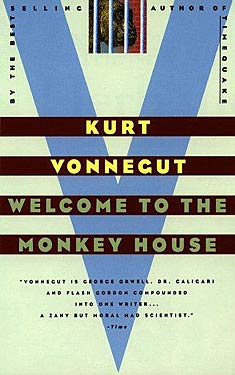
kv_welcomet
“Harrison Bergeron” is the second story in Kurt Vonnegut’s iconic Welcome to the Monkey House collection of short stories.

However, as I have examined, “Harrison Bergeron” is often misread and misinterpreted, reflected in the film adaptation 2081.

In 2016, just days before the presidential election, how and why the story is misread and misinterpreted—forcing on it American faith in the rugged individual and refusing to acknowledge Vonnegut’s principles grounded in socialism and free thinking—is a powerful commentary on U.S. politics broadly and Donald Trump specifically.

Misreading, Misinterpreting “Harrison Bergeron”

Vonnegut’s fiction and nonfiction are anything except simple—even though he practices a style that can be called “simple” because of his accessible vocabulary, mostly brief and simple sentence structure, and staccato paragraphing (which he claimed mimics the structure of jokes).

Yet, many impose onto “Harrison Bergeron” a simplistic theme (anti-communism) and a simplistic reading of Harrison as hero.

“If ‘Harrison Bergeron’ is a satire against the Left,” however, as Darryl Hattenhauer details, “then it is inconsistent with the rest of Vonnegut’s fiction.”

The misinterpretation stems from expecting narratives to have heroes and from careless reading of what the story says about equality; Hattenhauer clarifies:

But the object of Vonnegut’s satire is not all leveling—“any leveling process” that might arise. Rather, the object of his satire is the popular misunderstanding of what leveling and equality entail. More specifically, this text satirizes America’s Cold War misunderstanding of not just communism but also socialism.

Vonnegut’s enduring real-life hero was Eugene V. Debs, possibly the most well-known and influential socialist in U.S. history. Vonnegut was a lifelong advocate for socialism, and “Vonnegut’s concern for the working class eventually blossomed into a full-scale political outlook that was inspired by a combination of Midwestern populism and home-grown American socialism,” explains Matthew Gannon and Wilson Taylor.

Yet, the short film 2081 adapts “Harrison Bergeron” painstakingly true to Vonnegut—except for almost entirely missing that the story itself satirizes both the totalitarian state (embodied by Handicapper General Diana Moon Glampers) with its militaristic police force and Harrison Bergeron as megalomaniac would-be “Emperor!”

Again, as Hattenhauer emphasizes: “Like his fiction, Vonnegut’s non-fiction also satirizes the Right and endorses the Left. And the Left it endorses is not liberalism (America is one of the few nations where liberalism is not centrist).”

Therefore, “Harrison Bergeron” defies both being simple and America’s cartoonish hatred of communism as forced equality (a cultural failure to distinguish between brute equality and social equity). The story, Hattenhauer examines, has an unreliable narration, which describes a dystopian totalitarian state in which “anti-intellectual leveling” is satirized—not “income redistribution,” which Vonnegut as socialist endorsed.

Vonnegut attacks, then, the exact American myths that many who misread the story claim it endorses, as detailed by Hattenhauer:

According to the proponents of the ideology of America’s dominant culture, equal income redistribution would contradict the fact that some are smarter than others (the corollary: the rich are smart and the poor are dumb), and also contradict the fact that some are better looking or more athletic than others (the corollary: attractive and athletic people deserve wealth).

Nonetheless, “Harrison Bergeron,” understood as Vonnegut intended, proves to be a powerful commentary on the 2016 presidential election and the rise of Donald Trump.

Harrison Bergeron 2016

Vonnegut’s writing never fits neatly into clear genre categories, but like Margaret Atwood, he constantly plays with and within genre conventions both in loving devotion to the forms and in ways that defy those conventions.

As well, Vonnegut’s fiction resists traditional portrayals of the hero and main characters. Billy Pilgrim and Harrison Bergeron, for example, are not heroes—but they are not anti-heroes or everyman main characters.

In many ways, Vonnegut keeps an even focus on many characters throughout his works, and tends to include a mixture of positive and negative qualities in even the most static characters—mostly because nearly everything and everyone in Vonnegut is open to satire.

Charles Shields and Gregory Sumner suggest Vonnegut is nearly always the main character in his work, as authorial voice overseeing even identified narrators.

As a result, Harrison Bergeron is presented through an unreliable narrator as larger than life; at 14 years old, Harrison is seven feet tall and “a genius.” But the reader soon learns, as a fugitive, “Harrison’s appearance was Halloween and hardware.”

In short, Vonnegut’s dystopia and Harrison as a character are cartoonish.

“Clanking, clownish, and huge” as well as “wear[ing] at all times a red rubber ball for a nose,” Harrison bursts into the story with “‘I am the Emperor!'”

Misread as rugged individual hero, Harrison is, in fact, a megalomaniac—his bombast a sour joke.

Yet, as a genius and a renegade, he remains a threat to the totalitarian state; thus:

It was then that Diana Moon Glampers, the Handicapper General, came into the studio with a double-barreled ten-gauge shotgun. She fired twice, and the Emperor and the Empress were dead before they hit the floor.

Vonnegut’s dark, dark cartoon of a story ends with a joke worthy of a drumroll, but the story cannot be read with a smile in 2016 because Harrison Bergeron has been manifest in reality as Republican candidate for president, Donald Trump.

harrison-bergeron-2016

Trump as faux-billionaire, bombastic failed business man, and reality TV star stands before the U.S. as a threat as well—although to the promise (albeit tarnished) of democracy.

Enough Americans misread Trump as a hero to suggest why so many misread “Harrison Bergeron” as some sort of anti-communist propaganda: our rose-colored rugged individualism lenses are powerful, like the “spectacles with thick wavy lenses” worn by Harrison “to make him not only half blind, but to give him whanging headaches besides.”

The flaw in the American character that makes so many misread Trump is not simple either. Yes, there is racism and misogyny—but there is also a profound tension between a valid fear of totalitarianism and a simple-minded blurring of communism/socialism with totalitarianism.

When government actually is indistinguishable from the military (Diana Moon Glampers), a people have lost their precious freedom.

But Vonnegut’s cartoon dystopia omits entirely the utopian possibility of democratic socialism and free thinking that Vonnegut championed his entire life—and that many, if not most, in the U.S. remain unable to embrace.

“Harrison Bergeron” does speak to the center-right politics of the U.S., in which the so-called left is represented by a classic Republican (Hillary Clinton) and the so-called right has been reduced to a clown (Trump).

If this were a Vonnegut story or novel, it would be goddam funny.

As real life, the presidential campaign of 2016 is a metaphorical “double-barreled ten-gauge shotgun” aimed at our heads, and it is in our hands with our fingers on the trigger.

1 November 2016 Reader: “Matters of power, state violence, extreme poverty, institutional racism”

The rise of Trumpism and how to fight it, Dorian Bon

Even leaving aside the possibility of marauding, right-wing poll-watchers, other questions will have come up for readers of this website: Why is Donald Trump’s bigotry and aggressive chauvinism finding such a large audience? How can so many millions of people who don’t have millions in their bank accounts be planning to vote for him after everything we know?

More generally: Where is the momentum on the far right coming from? Where is it going? And what can be done to stop it?

Trump’s Inconvenient Racial Truth, Nikole Hannah-Jones

To be clear, I am not arguing that the man who called for the execution of the since-exonerated Central Park Five (and who still insists on their guilt) and who seeks nationwide implementation of the stop-and-frisk program ruled unconstitutional in New York City, and who warns that voting in heavily black cities is rigged, is a racial progressive who will enact policies that will help black communities. Nor am I saying black voters should buy what Trump is selling. (And they aren’t: A poll released last week by The New York Times Upshot/Siena College of likely voters in Pennsylvania found that “no black respondent from Philadelphia supported Mr. Trump in the survey.”)

What I am saying is that when Trump claims Democratic governance has failed black people, when he asks “the blacks” what they have to lose, he is asking a poorly stated version of a question that many black Americans have long asked themselves. What dividends, exactly, has their decades-long loyalty to the Democratic ticket paid them? By brushing Trump’s criticism off as merely cynical or clueless rantings, we are missing an opportunity to have a real discussion of the failures of progressivism and Democratic leadership when it comes to black Americans.

Dont Walk That Line! Why Schools Need To Create And Measure Positive Climates, Andre Perry

As researchers on positive school climate note, the “personality” of a school is an expression of how teachers, students, family members and community perceive the milieu.

In other words, a school doesn’t have to be mean to be good. Treating students with care and respect increases academic performance among students from low socioeconomic backgrounds, higher than if a school placed a singular single focus on academics.

Researchers for this study pulled evidence from multiple studies from around the world to understand the relationships between socioeconomic status, school climate, and academic achievement to help academics and practitioners alike understand what a positive climate is and why ultimately it can boost academic achievement.

Why I Have No Sympathy for Angry White Men, Stacey Patton

Why isn’t anyone suggesting that these beleaguered White men respond to their relatively new “hard times” by working hard and pulling themselves up by their bootstraps? Where are the people calling on these beleaguered Whites to develop empathy and compassion for those who have long been suffering, like African-Americans and other people of color? Why do we need to understand this community? Why is the opposite never suggested as a potential option? Is it because White men are simply not willing to emerge from their bubble and acknowledge the humanity of those they deem “other?” Or is it because they are unable to see beyond their own reality?

What we’re witnessing is racist populism all over again. Trump is following a historical pattern by stoking the racism, but especially as a rich White man pitting disenfranchised poor White people against Black people and especially Black people in low-income areas, telling them to intimidate and attack them at his rallies and at the polls, much in the same way poor Whites were pitted against poor Black people by elite White people to ensure there wouldn’t be a class uprising.

“Trump is emancipating unbridled hatred” – Interview: Rina Soloveitchik, Judith Butler

Butler: What Trump is emancipating is unbridled hatred and, as we see recently, forms of sexual action that don’t even care about anybody’s consent. Since when did we have to ask women whether they are okay with being touched, or why? He does not actually say that, but that is exactly what he is indicating. It liberates people, their rage, and their hatred. And these people may be wealthy, they may be poor, they may be in the middle; they feel themselves to have been repressed or censored by the left, by the feminists, by the movement for civil rights and equality, by Obama’s presidency, which allowed a black man to represent the nation.

Unthinkable Politics and the Dead Bodies of Children, Henry A. Giroux

Matters of power, state violence, extreme poverty, institutional racism, a broken criminal justice system, the school to prison pipeline and the existence of the mass incarceration state, among other important matters, rarely if ever enter her discourse and yet these are major issues negatively affecting the lives of millions of children in the United States. And her alleged regard for children falls apart in light of her hawkish policies on global regime change, drone attacks and cyber-warfare, and her unqualified support for the warfare state. Her alleged support for children abroad does not capture the larger reality they face from when their countries are invaded, attacked by drones and subject to contemporary forms of indiscriminate violence. Rather than critique the US as a powerful engine of violence, Clinton expands its imperialist role around the globe. This is a key point in light of her defense of the rights of children, because her warmongering ideology puts children in the path of lethal violence.

Republicans Have a Yuge Logic Problem

The new (and disgusting) face of the Republican Party, Donald Trump, has anchored his campaign on a foundational slogan he “inherited” from Ronald Reagan (like the millions he squandered from his father): Make America Great Again.

Setting aside that Trump is either a liar (well, is a liar) or is incredibly stupid since he claims he created that slogan, the concept itself creates a yuge logic problem for the Republican Party.

First, the slogan directly states America is now not great.

If this is true, it certainly reads next that whoever is running our state and federal governments must be at least significantly to blame for the lack of greatness, right?

Among Republicans, the anti-government roar has a long and loud history.

So here comes the logic problem: Republicans control the vast majority of state and federal power in the U.S.

That means that if America is now not great, and if government is to blame, then the Republican Party and its candidates are the source of all this not-greatness.

Thus, how in the hell is it logical to vote for Trump or any Republicans?

Hint: It isn’t.


Disclaimer: I am not now a Democrat, and I have never been a member of any political party. I do not support and will not vote for Hillary Clinton (nor for Green or Libertarian). I am very openly campaigning against anyone voting for Trump because he is uniquely a horrible human and candidate. A reasonable person can argue for Hillary or a third party candidate, but nothing can justify supporting Trump. His brand is so toxic, it likely has damaged any credibility the Republican Party was clinging to for years or decades to come.