Category Archives: Poverty

Howard Zinn: “education cannot be neutral on the critical issues of our time”

[Header Photo by Ankush Minda on Unsplash]

24 August 1922—Howard Zinn was born. His life and career spanned the twentieth century and into the first decade of the twenty-first. It is his memoir, You Can’t Be Neutral on a Moving Train: A Personal History of Our Times, for me, that speaks to the enduring power of Zinn’s metaphor, particularly for teachers.

Historically and currently, teacher remain under the demand that their teaching—and even their lives—remain neutral, not political. University professors—such as Zinn—also face disciplinary and public expectations of objectivity, dispassion—their work as public intellectuals either shunned or unrecognized.

In that context, K-12 education and university education suffer the same ultimate failure found in journalism, a flawed pursuit of objectivity, the faux-neutral pose of representing both sides.

So on the day of Zinn’s birth, it continues to be important not only to read and listen to Zinn, but also to act on Zinn, for it is action, after all, that Zinn lived and called for.

“When I became a teacher,” Zinn explains in You Can’t Be Neutral on a Moving Train, “I could not possibly keep out of the classroom my own experiences”:

I have often wondered how so many teachers manage to spend a year with a group of students and never reveal who they are, what kind of lives they have led, where their ideas come from, what they believe in, or what they want for themselves, for their students, and for the world.

Does not the very fact of that concealment teach something terrible—that you can separate the study of literature, history, philosophy, politics, the arts, from your own life, your deepest convictions about right and wrong?

Concealment is a political act, and in the face of the tragedy surrounding the police shooting of Michael Brown, the educational response has been exactly that, concealment. But as poet Adrienne Rich has confronted:

The study of silence has long engrossed me. The matrix of a poet’s work consists not only of what is there to be absorbed and worked on, but also of what is missing, desaparecido, rendered unspeakable, thus unthinkable.

Instead of striking the masked political poses of neutrality, objectivity, and dispassion, Zinn called for transparency:

In my teaching I never concealed my political views: my detestation of war and militarism, my anger at racial inequality, my belief in democratic socialism, in a rational and just distribution of the world’s wealth. I made clear my abhorrence of any kind of bullying, whether by powerful nations over weaker ones, governments over their citizens, employers over employees, or by anyone, on the Right or the Left, who thinks they have a monopoly on the truth.

Having taught in rural Southern public schools for 18 years and then 13 more years in higher education, I can attest that Zinn’s argument is challenged only because of the positions he holds and not because he took positions. You see, in K-12 classrooms, especially in history classes, textbooks, curriculum, and teachers always represented positions by framing as neutral the mainstream perspectives found among them all: a blind allegiance to capitalism, representing the U.S. as a righteous military victor, whitewashing every struggle in the country’s history, celebrating the wealthy and powerful while turning a blind eye to their many sins.

It has never been that our classrooms are neutral, as Zinn confronts, but that our classrooms have been passive passengers on the moving train of social and cultural indoctrination, the sort of indoctrination that benefits the few who have wealth and power built on their privilege at the expense of the many—workers, racial minorities, women, children, and the impoverished.

As Zinn recognized:

This mixing of activism and teaching, this insistence that education cannot be neutral on the critical issues of our time, this movement back and forth from the classroom to the struggles outside by teachers who hope their students will do the same, has always frightened the guardians of traditional education. They prefer that education simply prepare the new generation to take its proper place in the old order, not to question that order.

And although written well before the current education reform movement built on accountability, standards, and high-stakes testing, Zinn’s memoir has identified the Orwellian reality of that movement: Those decrying the status quo are those in service of the status quo. Education reform is the pursuit of maintaining, not reforming.

This call for teaching as activism was join by Zinn’s disciplinary challenge as well:

History can come in handy. If you were born yesterday, with no knowledge of the past, you might easily accept whatever the government tells you. But knowing a bit of history—while it would not absolutely prove the government was lying in a given instance—might make you skeptical, lead you to ask questions, make it more likely that you would find out the truth.

Here, Zinn recognizes both the power of disciplinary knowledge and the concurrent danger of codified disciplinary knowledge (prescriptive standards, curriculum). Zinn’s confrontation, then, speaks to the foundational principles expressed by critical scholar Kincheloe:

Thus, proponents of critical pedagogy understand that every dimension of schooling and every form of educational practice are politically contested spaces. Shaped by history and challenged by a wide range of interest groups, educational practice is a fuzzy concept as it takes place in numerous settings, is shaped by a plethora of often-invisible forces, and can operate even in the name of democracy and justice to be totalitarian and oppressive.

These critical principles replace the dissembling of neutrality in the classroom, as Kincheloe explains:

Recognition of these educational politics suggests that teachers take a position and make it understandable to their students. They do not, however, have the right to impose these positions on their students [emphasis in original]….

In this context it is not the advocates of critical pedagogy who are most often guilty of impositional teaching but many of the mainstream critics themselves. When mainstream opponents of critical pedagogy promote the notion that all language and political behavior that oppose the dominant ideology are forms of indoctrination, they forget how experience is shaped by unequal forms of power. To refuse to name the forces that produce human suffering and exploitation is to take a position that supports oppression and powers that perpetuate it. The argument that any position opposing the actions of dominant power wielders is problematic. It is tantamount to saying that one who admits her oppositional political sentiments and makes them known to students is guilty of indoctrination, while one who hides her consent to dominant power and the status quo it has produced from her students is operating in an objective and neutral manner.

“Critical pedagogy wants to know who’s indoctrinating whom,” Kincheloe concludes. Teaching and history as activism, for Zinn, were moral imperatives, and thus:

From that moment on, I was no longer a liberal, a believer in the self-correcting character of American democracy. I was a radical, believing that something fundamental was wrong in this country—not just the existence of poverty amidst great wealth, not just the horrible treatment of black people, but something rotten at the root. The situation required not just a new president or new laws, but an uprooting of the old order, the introduction of a new kind of society—cooperative, peaceful, egalitarian.

Zinn, activist, radical, speaks to us now, the “us” of any classroom, the “us” charged with the learning and lives of any child:

From the start, my teaching was infused with my own history. I would try to be fair to other points of view, but I wanted more than “objectivity”; I wanted students to leave my classes not just better informed, but more prepared to relinquish the safety of silence, more prepared to speak up, to act against injustice wherever they saw it. This, of course, was a recipe for trouble.

Today on the date of Zinn’s birth, I argue, it is a recipe we must follow.
Complicit: On Facing the Mirror Before Casting Stones

“Let me begin,” admits George J. Sefa Dei in “‘We Cannot Be Color-Blind’: Race, Antiracism, and the Subversion of Dominant Thinking,” “by making clear that I see myself as fully complicit in the discussion that I undertake in this chapter” (p. 25).

As we face large and powerful social forces such as poverty and racism—along with more narrow issues of education—I believe we all must address that first concern of who is complicit.

Let me begin with something that echoes in my mind almost continually, from Oscar Wilde: “But to recommend thrift to the poor is both grotesque and insulting.”

Consider taking that frame and using it many contexts: “But to recommend _____ to  _____ is both grotesque and insulting.”

Also consider who makes such recommendations. For the poor, the affluent and powerful—who do not live up to the same standards they impose—are the who.

Today—at this exact moment—we watch as a white authority structure recommends to a dominantly black community that which is “grotesque and insulting.” And then on a narrower scale, those with power and money recommend to educators that which is “grotesque and insulting.”

So whether we are confronting poverty and racism or education, we all must begin with who is complicit.

People in poverty and African Americans in the U.S. share one disturbing but distinct quality: disproportionately the impoverished and African Americans are excluded from the power structure.

Who, then, is complicit in the existence and tolerance of poverty and racism? It cannot be those without the power; therefore, it must be those with the power.

Inaction is being complicit. Silence is being complicit. There is no political option for being neutral as long as poverty and racism exist. None.

White high school drop-outs and African Americans with some college have the same economic opportunities.

Whites and African Americans use recreational drugs at the same rates, but African Americans are targeted, charged, and incarcerated at much higher rates.

Those born wealthy and not attending college have greater economic power than those born in poverty and completing college.

To be white, to be wealthy—in the U.S. is to be complicit.

Inaction is being complicit. Silence is being complicit. There is no political option for being neutral as long as poverty and racism exist. None.

While I think my field of education is of a magnitude smaller than issues of poverty and race, I must end there because the picture is hard to confront.

And because education is and always will be inextricable from the fight to end poverty and racism; as George J. Sefa Dei concludes, “Antiracism is about changing current processes of schooling and education delivery” (p. 39). We may say the same about poverty.

I have taught high school English for 18 years in rural South Carolina and then been in teacher education for another 13 years. Teachers and teacher educators persistently complain about the bureaucracy of education; it is a relentless refrain among educators.

Recently, I received an email about how to anticipate what may be demanded of us when political regimes, once again, change; the email included: “No other profession has to deal with such crap.”

My response: “No other discipline would put up with that crap.”

Educators are complicit in the crap that is education reform. Inaction is being complicit. Silence is being complicit.

All those scrambling to have a seat at the Common Core table, a table inextricable from the entire reform agenda—unions, administrators, teachers—all are complicit.

It is time to face the mirror, to examine who is complicit.

“Education as Great Equalizer” Deforming Myth, Not Reality

In the Seinfeld episode “The Hamptons,” viewers watch yet another clash between the essentially soulless main characters as they interact with the very white and privileged “real world” surrounding them in the sitcom. The crux of this episode revolves around one couple having a baby, and then what occurs when reality clashes with civility:

Jerry: Is it me or was that the ugliest baby you have ever seen?

Elaine: Uh, I couldn’t look. It was like the Pekinese.

Jerry: Boy, a little too much chlorine in that gene pool. (They sit) And, you know, the thing is, they’re never gonna know, no one’s ever gonna tell them. (See transcript here.)

Setting aside what this scene (again) reveals about Jerry and Elaine, an important message we can draw from this tension is that most people genuinely do not want to face the harsh truth, especially when that harsh truth contradicts their beliefs.

As I have examined before, the U.S. is overwhelmingly a belief culture, committed to our cultural myths even and especially when those myths have no basis in evidence.

When I have approached the overwhelming evidence that poverty is destiny, I receive angry challenges from people all along the spectrum of ideologies Right and Left, but I also have people who align themselves with me send pleas that I stop such nonsense: Rejecting hard truths has no ideological boundary.

However, in the U.S. both poverty and affluence are destiny, and those who shudder at that reality are confusing verbs: Yes, poverty should not be destiny, but false claims will never allow us to achieve that ideal.

So this leads me to a parallel harsh truth: Education is not the great equalizer (and, again, education should be the great equalizer, but making that claim when it isn’t a reality is inexcusable.)

As I have highlighted numerous times, Matt Bruenig, using “data from Pew’s Economic Mobility Project about social mobility (I,II),” presents a stark reality and draws a disturbing conclusion:

One convenient way to describe what’s going on is that rich kids are more likely to get a better education, which translates into being richer and wealthier as adults. It is certainly the case that richer kids are more likely to get a college degree, and it is certainly the case that getting a college degree leaves you much better off on average than not getting one. But this does not explain the full picture of social immobility. Take a look at this super-complicated chart, which I will describe below….

So, you are 2.5x more likely to be a rich adult if you were born rich and never bothered to go to college than if you were born poor and, against all odds, went to college and graduated. The disparity in the outcomes of rich and poor kids persists, not only when you control for college attainment, but even when you compare non-degreed rich kids to degreed poor kids!

Therefore, the answer to the question in the title is that you are better off being born rich regardless of whether you go to college than being born poor and getting a college degree.

In the U.S., powerful mythologies drive a faith in social mobility (connected to working hard, being well educated, and achievement coming to those who merit that success), but also foster counter-narratives that are essentially ugly and unwarranted: those who are poor or fail are lazy, underserving (read Scarcity for a powerful and evidence-based look at how poverty overwhelms people instead of poverty results from flawed individuals).

The evidence is overwhelming and growing, however, that education is not the great equalizer and that poverty/affluence remain essentially destiny, as reported by Juana Summers at NPR:

Education is historically considered to be the thing that levels the playing field, capable of lifting up the less advantaged and improving their chances for success.

“Play by the rules, work hard, apply yourself and do well in school, and that will open doors for you,” is how Karl Alexander, a Johns Hopkins University sociologist, puts it.

But a study published in June suggests that the things that really make the difference — between prison and college, success and failure, sometimes even life and death — are money and family.

In The Long Shadow, Alexander, Entwistle, and Olson “followed nearly 800 Baltimore schoolchildren for a quarter of a century, and discovered that their fates were substantially determined by the family they were born into,” Rosen explains, discovering:

  • Almost none of the children from low-income families made it through college. Of the children from low-income families, only 4 percent had a college degree at age 28, compared to 45 percent of the children from higher-income backgrounds. “That’s a shocking tenfold difference across social lines,” Alexander said.
  • Among those who did not attend college, white men from low-income backgrounds found the best-paying jobs. Although they had the lowest rate of college attendance and completion, white men from low-income backgrounds found high-paying jobs in what remained of Baltimore’s industrial economy. At age 28, 45 percent of them were working in construction trades and industrial crafts, compared with 15 percent of black men from similar backgrounds and virtually no women. In those trades, whites earned, on average, more than twice what blacks made. Those well-paying blue collar jobs are not as abundant as during the years after World War II, but they still exist, and a large issue today is who gets them: Among high school dropouts, at age 22, 89 percent of white dropouts were working compared with 40 percent of black dropouts.
  • White women from low-income backgrounds benefit financially from marriage and stable live-in partnerships. Though both white and black women who grew up in lower-income households earned less than white men, when you consider household income, white women reached parity with white men—because they were married to them. Black women not only had low earnings, they were less likely than whites to be in stable family unions and so were less likely to benefit from a spouse’s earnings. White and black women from low-income households also had similar teen birth rates, but white women more often had a spouse or partner, a relationship that helped mitigate the challenges. “It is access to good paying work that perpetuates the privilege of working class white men over working class black men,” Alexander said. “By partnering with these men, white working class women share in that privilege.”
  • Better-off white men were most likely to abuse drugs. Better-off white men had the highest self-reported rates of drug use, binge drinking, and chronic smoking, followed in each instance by white men of disadvantaged families; in addition, all these men reported high levels of arrest. At age 28, 41 percent of white men—and 49 percent of black men—from low-income backgrounds had a criminal conviction, but the white employment rate was much higher. The reason, Alexander says, is that blacks don’t have the social networks whites do to help them find jobs despite these roadblocks.

The realities of class and race in the U.S. are far removed from simplistic slogans.

In the U.S., African Americans with some college have the same economic power as white high school drop-outs.

And the relationship between education and opportunity proves to be again and again, misleading. The SAT remains a powerful gatekeeper for college, despite SAT scores being less effective than GPA (actual merit) for determining who attends college.

More disturbing, however, is that access to education provides cover for the what truly matters in the U.S.: as The Long Shadow and Bruenig document, the coincidences of birth—money and family (and not merit).

While I maintain that hollow slogans (“education is the great equalizer”) prove to be “myths that deform,” [1] and thus work against our ideals, I am not calling for some sort of callous fatalism.

The first step toward “poverty is not destiny” and “education is the great equalizer” is naming the current failures in order to establish actions and policies that would shift the existing, and ugly, realities: poverty and affluence are destiny and wealth/family trump merit (such as education)—all of which are magnified by lingering racism.

Next, we must confront our assumptions about who is wealthy and who is impoverished, coupled with ending cultural demands that the impoverished work twice as hard and that the disadvantaged conform to higher moral and ethical standards. As Oscar Wilde eloquently argued:

The majority of people spoil their lives by an unhealthy and exaggerated altruism – are forced, indeed, so to spoil them. They find themselves surrounded by hideous poverty, by hideous ugliness, by hideous starvation. It is inevitable that they should be strongly moved by all this….[I]t is much more easy to have sympathy with suffering than it is to have sympathy with thought. Accordingly, with admirable, though misdirected intentions, they very seriously and very sentimentally set themselves to the task of remedying the evils that they see. But their remedies do not cure the disease: they merely prolong it. Indeed, their remedies are part of the disease….

And in this recognition, Wilde rejects those “remedies”:

They try to solve the problem of poverty, for instance, by keeping the poor alive; or, in the case of a very advanced school, by amusing the poor….

It is immoral to use private property in order to alleviate the horrible evils that result from the institution of private property. It is both immoral and unfair….

Sometimes the poor are praised for being thrifty. But to recommend thrift to the poor is both grotesque and insulting. It is like advising a man who is starving to eat less. For a town or country labourer to practise thrift would be absolutely immoral. Man should not be ready to show that he can live like a badly-fed animal.

It is, then, ours to reject both “exaggerated altruism” and base fatalism; instead, we must commit to the following:

  • Name and recognize inequity without stooping to demonizing people. In our current commitments to meritocracy myths, we demonize the poor; but it does no one any good to simply shift who we demonize. Our enemy is inequity, and solutions to inequity rest in changing powerful social dynamics and not with “fixing” flawed (or promoting idealized and false portraits of “successful”) individuals.
  • Stop promoting false myths to children because as they grow up, they come to see the myth as a lie, and thus, the entire promise of the American Dream is tarnished.
  • Commit to social and education policy grounded in equity, and not in competition or market forces.

We need a new way to speak to our children. And we must begin here: “We have not yet created the country we want, and we must admit life continues to be too often unfair. But things can be better, and we are here to help because you can live in a world more fair than the one we have given you.”

Success in the U.S. is not the result of “grit,” not the consequence of some people being more determined (“better”) than others. Many people worker harder than others, but remain impoverished, have less access to opportunities. None of this should be true, but it is.

Ultimately, however, we must put our money and actions where our words take us. Otherwise, as John Gardner warned, equity, fairness, and justice become “cheap streamers in the rain.”

[1] “[A]s we put into practice an education that critically provokes the learner’s consciousness, we are necessarily working against myths that deform us. As we confront such myths, we also face the dominant power because those myths are nothing but the expression of this power, of its ideology.” (Freire, 2005, p. 75)

Freire, P. (2005). Teachers as cultural workers: Letters to those who dare to teach (D. Macedo, D. Koike, & A. Oliveira, Trans.). Boulder, CO: Westview Press.

Denying Impact of Poverty Has an Evidence Problem

As I have noted, denying racism has an evidence problem. But those who persist in denying the impact of poverty also have an evidence problem; thus, they have to manufacture evidence.

But manufacture evidence they will—as evidenced by Hanushek, Peterson and Woessmann (2014). However, David Berliner and Stephen Krashen have now unmasked that effort:

David Berliner Responds to Economists Who Discount Role of Child Poverty

Do American Rich Kids do Worse on International Tests than Rich Kids from Other Countries?

I also recommend this, related:

3 Facts that Poverty-Deniers Don’t Want to Hear

Evidence Must Trump Idealism: A Reader

Many of us are compelled by idealism, and I certainly entered education as a career over 30 years ago because of my faith in the power of learning (specifically literacy), especially as it has enriched my own life.

But evidence must trump idealism, or we are destined to remain trapped in the corrosive patterns of inequity that keep us from achieving the American Dream.

As disheartening as the facts are, poverty is destiny, education is not the great equalizer, and the U.S. is not a post-racial society.

I’m sorry, but these are the realities as we have them in the U.S. as of 2014.

Before you shoot the messenger, however, let me encourage you to spend some time with the following:

Once we face what the evidence shows, then we become equipped with the foundation upon which we can work to build toward those ideals that must matter among a free people.

U.S. and Education Reform Need a Critical Free Press

Few things are worse than mainstream media coverage of education.

Except for that sentence above, which stretches hyperbole beyond credibility.

But that is exactly where the mainstream media finds itself when covering education. Journalists, in their quest to maintain the traditional commitment to “fair and balanced” journalism [1], consistently endorse and perpetuate organizations without credibility (such as NCTQ) and baseless claims (such as cries of “bad” teacher, “bad” teacher certification, and “bad” unions).

With yet another report released by NCTQ, that failure of the mainstream media has been highlighted once again—notably at NPR [2] and Education Week: Study Delivers Failing Grades For Many Programs Training Teachers, Claudio Sanchez and Juana Summers; Alternative Certification Deemed Weak by NCTQ in New Teacher-Prep Report, Stephen Sawchuk; Most Teacher Preparation Falls Short on Strategies for ELLs, NCTQ Finds, Lesli A. Maxwell.

First, the mainstream coverage of NCTQ’s reports remains trapped inside assumed crises that have no basis in fact; NCTQ’s reports and then the media begin with the givens that education suffers under the burden of “bad” teachers, “bad” teacher certification, and “bad” unions. However, at the very least, these claims are disproportional, if not outright erroneous:

  • If we maintain the current context that student achievement is accurately reflected in test scores (and it isn’t), then we must acknowledge that teacher quality (10-15%) and school quality account for only about 20% of that measurement, but “60 percent of achievement outcomes is explained by student and family background characteristics (most are unobserved, but likely pertain to income/poverty),” as Di Carlo details.
  • If we accept that value-added methods (VAM) can accurately and consistently identify “good” and “bad” teachers (and the evidence is that it cannot) and if we accept the much repeated claim by Chetty et al. that teacher quality can add $50,000 to the lifetime earning potential of a student (and that also is a significantly contested claim, as well as another example of advocacy and media hyperbole since that lifetime earning figure equates to about 1.5-2 tanks of gas per month), the enormity of the claims about “bad” teachers and the urgency expressed about creating and implementing huge and expensive test-based systems to address teacher quality are at best overstated. No rational person would endorse the cost-benefit analysis of such schemes.
  • Finally, claims that teachers unions are primary or significant negative influences on educational quality are powerfully refuted by the historical and current fact that the states in the U.S. with the lowest standardized test scores tend to be those that are right-to-work (non-union) states. Unionization correlates positively with measurable student achievement, in fact, while poverty is the greatest correlation with low measurable student outcomes (for the record, union bashing is a straw man because U.S. public education has a poverty problem, not a union problem).

Next, NCTQ has established a sort of immediate appearance of credibility through three strategies: partnering itself with U.S. News & World Report, garnering significant and influential sources of funding, and bombarding the mainstream media with a series of reports without vetting those reports as is common in traditional scholarship (which slows down and greatly harnesses higher-quality research from reaching the public [3]. But scholars don’t issue press releases, and apparently, journalists respond primarily to press releases instead of conducting investigative journalism [4].)

Finally, once I engaged Sawchuck (EdWeek) and then Summers (NPR) on Twitter, several key aspects of this phenomenon were highlighted. Both journalists argued that their pieces on NCTQ were fair, and even critical—which I will examine below—but even more significant is a comment on Twitter from Summers:

@plthomasEdD I’m not sure it’s my place to say whether the study is credible, but we both note the significant criticism of the methods.

— Juana Summers (@jmsummers) June 18, 2014

My two reactions to Summers deferring from examining the credibility of NCTQ are, first, to strongly disagree, and second, note that no journalists need to do any real investigative journalism to uncover that NCTQ has no credibility because all of that work has been done already by a number of scholars (see those critiques catalogued here and here).

As disturbing, however, as that stance is, examining carefully the coverage of NCTQ reveals that the mainstream media does in fact endorse NCTQ implicitly (despite claims of impartiality) and also marginalizes the credible critiques of NCTQ.

All three articles (see above) have headlines that establish immediately for any reader that NCTQ’s report is worthy of major media coverage. Next, all three articles have ledes that also present NCTQ positively:

The nation’s teacher-preparation programs have plenty of room for improvement, according to a new report. (Sanchez and Summers)

Alternative-certification programs for preparing teachers suffer from many of the same problems that the National Council on Teacher Quality has identified in traditional, university-based programs, the Washington-based group concludes in a new pilot study. (Sawchuk)

More than 75 percent of elementary teacher-preparation programs are failing when it comes to readying future teachers to work effectively with English-language learners, a new report from the National Council on Teacher Quality contends. (Maxwell)

Sanchez and Summers (again, note that Summers argues it isn’t her job to assign credibility to the study) certainly imply that the study is credible by using this language: “The study is a dismal read, given that the U.S. spends more than $6 billion each year to prepare teachers for the classroom.”

The NCTQ study is only a “dismal read” if it is accurate (and it isn’t). NCTQ has been carefully discredited in scholarship (for example, see Fuller here and here) for serious conflicts of interest (Teach For America and KIPP leaders sit on the Advisory Board, for example), for a flawed study design, and for shoddy methodology [5].

So how are credible academic critiques of NCTQ characterized in the journalism that claims not to take evaluative positions?:

When NCTQ released a version of this report last year, it was met with some skepticism among educators and those responsible for preparing teachers. Critics said the advocacy group should have visited individual teacher-prep programs and talked to graduates and students, rather than relying on syllabi. (Sanchez and Summers)

Last year’s inaugural teacher-prep review was immediately rejected by most teacher colleges and, especially, by their main membership body, the American Association of Colleges for Teacher Education.

Criticism focused on the NCTQ’s tack of reviewing syllabi and other course materials rather than visiting institutions; its use of open-records requests and current students to obtain documents; the complaint that its standards weren’t agreed to by the profession; and the fact that its research products aren’t peer reviewed. Additionally, critics have claimed that the project is ideologically driven, given NCTQ’s role as incubator of an alternative-certification group, the American Board for Certification of Teacher Excellence (ABCTE), which received federal funding from the George W. Bush administration.

The latter complaint seems less viable now that the NCTQ has turned its green eyeshade toward alternative-certification programs. (Sawchuk)

“Some skepticism” and “critics” clearly position credible scholarship negatively while maintaining the implied endorsement of NCTQ as an organization and NCTQ’s reports. And while Sawchuk appears to address more directly NCTQ’s lack of credibility, he still marginalizes scholars as “critics” and then in the last paragraph above, simply discounts the criticism [6].

Further in Sawchuk’s piece, the contrast between lacking credibility (NCTQ) and credibility (scholarship discrediting NCTQ) is reduced to a simple misunderstanding and a matter of tone (not substance):

Notably, the report’s introduction this year contains a number of mea culpas regarding the bad blood between the NCTQ and teacher colleges. And Walsh agreed that her group bore some of the blame.

“At times we were a bit arrogant about what it is we think teacher education should be doing,” she said. “Even if we agree to disagree, we can be more respectful.”

Again, this trivializes criticism of NCTQ and further equates NCTQ (an advocacy think tank) with scholarship—while also painting NCTQ as apologetic (despite the organization maintaining its threat of ranking programs whether they cooperate or not; a powerful tool afforded NCTQ because of its media partnership with U.S. News & World Report).

One of my strongest criticisms of teachers is that we far too often allow ourselves to be trapped within traditional calls that we take neutral stances; however, the U.S. needs critical teachers (political teachers) if our public schools are to be a foundation for our democracy.

What I have detailed above is that journalists in the U.S. have bowed to the same call for neutrality, one that cannot be accomplished but can serve as a shield for maintaining the status quo.

The U.S. needs critical journalists, ones who see their job as maintaining a commitment to seeking out and identifying the credibility of things they report. Only those in power benefit when the free press is mostly free of taking to task those in power.

Nowhere is that more apparent than in how the mainstream media fails the education reform debate.

[1] Journalists and teachers share the burden of traditional expectations that they should never be “political,” but taking a neutral stance is, in fact, taking a passive stance endorsing the status quo. In other words, taking a dispassionate pose is a political stance (see The Politics of Calling for No Politics).

[2] See a similar example with NPR’s coverage of “grit.”

[3] See the following in terms of how the mainstream media disproportionately reports on think tank (non-peer reviewed) reports as compared to peer-reviewed and university-based research:

Molnar, A. (2001, April 11). The media and educational research: What we know vs. what the public hears. Milwaukee, WI: Center for Education Research, Analysis, and Innovation. Retrieved from http://epsl.asu.edu/epru/documents/cerai-01-14.htm

Yettick, H. (2009). The research that reaches the public: Who produces the educational research mentioned in the news media? Boulder, CO and Tempe, AZ: Education and the Public Interest Center & Education Policy Research Unit. Retrieved from http://epicpolicy.org/publication/research-that-reaches

[4] I make this claim not as a direct attack on any journalists, but teachers and journalists now experience very similar and negative influences on their ability to conduct their professions. While education reform tends to impeded good teaching, the contracting media market has tended to overburden journalists. As a result of newspapers and magazines disappearing and contracting their staffs, many journalists resort to press-release journalism as a survival technique, similar to teachers teaching to the tests. The conditions of both professions, teaching and journalism, are stark reasons why both teachers and journalists must exert their political selves in their professional work.

[5] As a brief glimpse into NCTQ’s accidental admission of their methodology, in an effort to twist criticism of their practices, this post adds at the end “As one teacher candidate who is working on our office this summer said,” highlighting that anecdote is enough for NCTQ, as long as it matches their advocacy.

[6] Sawchuk fails to recognize that NCTQ is working within a scorched-earth policy as part of the large disaster capitalism driving education reform in the U.S. For a vivid example of how this works, and why NCTQ, TFA, and KIPP benefit once the traditional education system is dismantled, see the events that have occurred since Katrina in New Orleans where the public school system has been replaced by charters schools, many KIPP and many staffed by TFA recruits.

“Click, Clack, Moo”: Why the 1% Always Wins

[Originally posted at Daily Kos and Truthout, “Click, Clack, Moo”: Why the 1% Always Wins is a powerful companion to George Saunders’s Allegory of Scarcity and Slack.]

As a high school English teacher for nearly two decades, I came to embrace a need to offer students a wide range of lenses for interacting with and learning from many different texts, but I also learned that coming to read and re-read, to write and re-write the world is both a powerful and disorienting experience for young people. So a strategy I now use and encourage other teachers to implement is reading and discussing children’s literature, picture books, while expanding the critical lenses readers have in their toolbox.

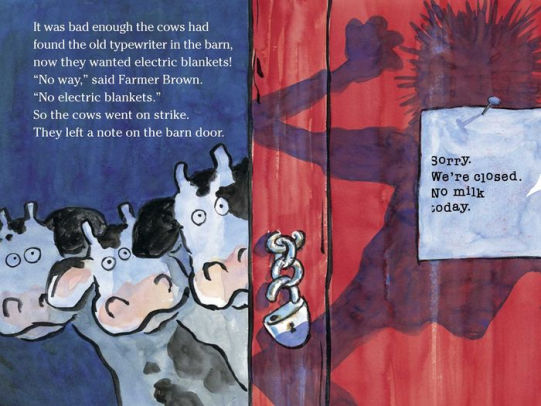
My favorite book for this activity is Click, Clack, Moo: Cows that Type. This work by Doreen Cronin with art by Betsy Lewin (view a read-aloud here) presents a clever and humorous narrative about Farmer Brown and his suddenly recalcitrant cows who, having acquired a rickety typewriter, establish a strike that inspires the chickens to join and ends with the neutral ducks aiding the revolt.

Click, Clack, Moo: Cows that Type

This story is ideal for asking teachers to consider the traditional approach to text in schools, New Criticism (a focus on text in isolation and on the craft in any story, such as characterization, plot, and theme), against Feminist and Marxist criticism, for example.

One fall, while doing the activity with a young adult literature class, I came against yet a new reading of Cronin and Lewin’s work: Why the 1% always wins.

The U.S. Public Likes Farmer Brown

As we explored Click, Clack, Moo recently, the adult members of the class told me they like Farmer Brown, with one student characterizing the striking farm animals as “mean.” And here is where I felt the need to consider how this children’s book helps us all confront the Occupy Wall Street movement or the rise in antagonism toward teachers, tenure, and unions as well as why the 1% continues to own the 99%.

One important element of the story is that the cows and chickens are female workers under the authority of the male Farmer Brown. These female workers produce for the farmer and remain compliant until the cows acquire the typewriter—both a powerful tool of literacy (the cows and chickens cannot effectively strike until they gain access to language) and a representation of access to technology (readers should note that the cows and chickens produce typewritten notes that show they find an old manual typewriter unlike the cleaner type produced by Farmer Brown on an electric typewriter, a representation of the inequity of access to technology among classes).

The cows and chickens, in effect, unionize and strike. Here, members of my classes often fail to notice the unionization, but tend to side with the farmer even when we acknowledge the protest as unionizing—particularly bristling at the duck, as a neutral party, using its access to the negotiation to acquire a diving board for the duck pond.

Like the 1%, Farmer Brown is incensed that the cows and chickens demand basic necessities for comfort, electric blankets, but he eventually secures a compromise, agreeing to give the barn animals the requested electric blankets for the return of the typewriter (the story ends with the obvious next step that the duck uses the typewriter to trade for the diving board).

What tends to be missed in this story is that Farmer Brown ultimately wins; in fact, the barn animals appear to be eager to abandon their one access to power, the typewriter, for mere material items—the electric blankets as comfort many would see as a basic right and the diving board as frivolous entertainment.

The 1% have the 99% right where Farmer Brown has the barn animals—mesmerized by the pursuit of materialism and entertainment. Consider the eager hordes of consumers lined up to buy the then-new iPhone 4S, released on the cusp of the passing of Steve Jobs, heralded as a genius for his contribution to our consumer culture.

Just give us our iPhones and we’ll be quiet, we’ll work longer and harder for the opportunity to buy what the 1% tells us we want.

And when the 1% and their compliant media inform us that the top 20% pays 64% of taxes, we slip back to our barns with our tails between our legs, shamed.

Instead, we should be noting that, yes, the top 20% income earners pay 64% of taxes because they make 59% of income.

We, the 99% who tend to remain silent and compliant, wait patiently for the next generation of technology to occupy our time, our lives reduced to work and amassing the ever-changing and out-dated things that become passe as the next-thing lures us further and further into our sheep lives.

Yes, if we remain eager to trade our voices for things, the 1% will always be the winners.

When we learn to treasure voice over things, however, the chickens may come home to roost.

George Saunders’s Allegory of Scarcity and Slack

The stories themselves, literally, are powerful and engaging or George Orwell’s 1984 and Arthur Miller’s The Crucible would not have endured as they have as literature people read again and again—and possibly should read again and again.

However, ultimately, 1984 is not about the future (especially since we have long since passed the future Orwell may have envisioned), and The Crucible is not about the past (although Miller built his play on the very real and troubling history of Puritan witchcraft hysteria). These works are about the complicated present of both authors’ worlds as that speaks to the enduring realities of the human condition.

All of that may seem weighty stuff to step into a look at what appears to be a children’s book, but the paragraphs above should be more than a hint that looks can be deceiving—and enlightening.

The Very Persistent Gappers of Frip, written by George Saunders and wonderfully illustrated by Lane Smith (whose It’s a Book I cannot recommend highly enough), is a fanciful and satirical tale that proves in the end to be an allegory of scarcity and slack—a perfect companion read to Ursula K. Le Guin’s allegory of privilege, “The One’s Who Walk Away from Omelas.”

The Very Persistent Gappers of Frip

Realizing that the Human Heart Is Capable

“Ever had a burr in your sock?” sets the story in motion—one sentence centered on the page over a giant question mark. It is an opening worthy of a child and all of us who cling to the wonder of childhood.

While Le Guin is often described as a science fiction writer, in her work I recognize the blurring of genres that joins science fiction, speculative fiction, and fantasy; it is that “other world” about which Le Guin and Margaret Atwood appear to argue, and it a stark but rich other world Saunders conjures and Lane pictures.

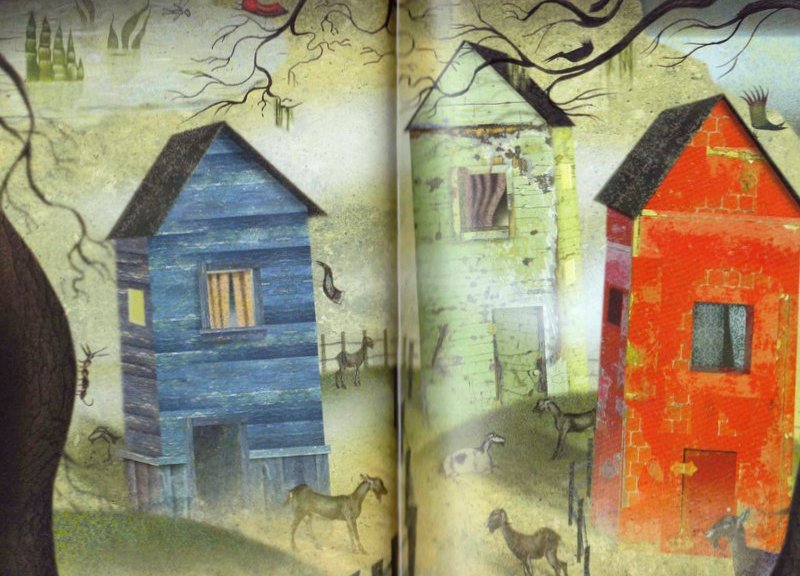
The story of Frip involves three houses for three families, all with children at the center. The houses are distinguished with primary colors—child-like blue, green, and red—but Lane’s artwork adds the ominous to Saunders’ seemingly simple narrative tinged with more than a bite of satire. The illustrations echo the haunting works about and for children found in Neil Gaiman and Tim Burton.

“Frip was three leaning shacks by the sea.” (p. 6) Artwork by Lane Smith

A child standing precariously close to the end of a slanted cliff over an angry ocean catches the eye on page 7 and then the crux of the story pulls you back to the text on page 6:

Frip was three leaning shacks by the sea. Frip was three tiny goat-yards into which eight times a day the children of the shacks would trudge with gapper-brushes and cloth gapper-sacks that tied at the top. After brushing the gappers off the goats, the children would walk to the cliff at the edge of town and empty their gapper-sacks into the sea. (p. 6)

Gappers, orange burr-like creatures with many eyes and the size of a baseball, come to represent throughout the story the power of the systemic inevitable: The presence of the gappers determines the lot of the families (and their goats), but most of the people in the tale remain unable to see beyond their own fixed and mostly misguided worldviews.

“A gapper’s like that, only bigger, about the size of a baseball, bright orange, with multiple eyes like the eyes of a potato.” (p. 2) Artwork by Lane Smith

When the gappers cling to the goats of all three families, there is an ironic appearance of equality among them. But when the fortune of one family shifts, the gappers fulfill their name by creating the gap:

So that night, instead of splitting into three groups, the gappers moved into one very large and impressive shrieking group directly into Capable’s yard. (p. 12)

Before this shift in how the gappers behave, of course, the three families are not equal because Capable is an only child living with her father and who has lost her mother. Capable works as all the children are expected to work (removing gappers in a daily Sisyphean nightmare of chores) and seeks to serve the needs of her grieving father, who along with his grief is a prisoner of nostalgia:

“I myself was once an exhausted child brushing off gappers. It was lovely! The best years of my life. The way they fell to the sea from our bags! And anyway, what would you do with your time if there were no gappers?” (p. 11)

This nostalgia masking an unnecessarily burdensome childhood, however, is but one ideology weighing on Capable because as soon as the other two families are relieved of gappers on their goats, those families reveal themselves to be very much like the people of Le Guin’s Omelas:

“It’s a miracle!” Mrs. Romo shouted next morning, when she came out and discovered that her yard was free of gappers. “This is wonderful! Capable, dear, you poor thing. The miracle didn’t happen to you, did it? I feel so sorry for you. God has been good to us, by taking our gappers away. Why? I can’t say. God knows what God is doing, I guess! I suppose we must somehow deserve it!” (p. 17)

Capable becomes the sacrificed child, and despite her misfortune, the relieved families read the events as their merit (and of course the ugly implication that Capable and her father deserve the burden of the gappers).

What follows from this shift in fate is the central story of Frip with Capable as our main character. The message becomes clear, and Saunders and Lane make the ride one you’ll want to visit again and again. If you are lucky, the book could become one of those read alouds requested by son or daughter, or by a classroom of children.

And while I will leave the rest of the story to you, I think it is necessary to note here that this allegory is both a cautionary tale about how we view children and childhood as well as a brilliant call to reconsider how we view education and education reform.

George Saunders’s Allegory of Scarcity and Slack

The U.S., like the characters (except for Capable) in Saunders’s story, is tragically blinded by a belief in cultural myths that have little basis in evidence: That we live and work in a meritocracy, that competition creates equity, that children need to be “taught a lesson” about the cold cruel world lest they become soft, and such.

As a result of these beliefs, schools often reflect and perpetuate rather harsh environments for children—or to be more accurate, schools often reflect and perpetuate rather harsh environments for other people’s children, as Capable personifies.

Here, then, I want to make the case that The Very Persistent Gappers of Frip is a powerful allegory of scarcity and slack as examined by Sendhil Mullainathan and Eldar Shafir in their Scarcity: Why Having Too Little Means So Much.

Mullainathan and Shafir detail that the conditions of poverty, scarcity, so overburden people psychologically, mentally, and physically that their behavior is often misread (poor people are lazy, poor people make bad decisions, etc.). In Saunders’s story, scarcity and its burden are portrayed by the gappers, and readers witness how the coincidence of the onslaught of the gappers changes the families involved. In other words, the behavior of people is determined by the environment, and not by the inherent goodness or deficiencies of any individual.

The Very Persistent Gappers of Frip goes further, however, by showing that one person’s scarcity (Capable) allows other person slack: privilege is built on the back of others, and those conditions are mostly arbitrary. While Mullainathan and Shafir argue that the slack enjoyed by those living in relative privilege provides the sort of cognitive space needed to excel, Saunders speaks to more than the slack enjoyed by the two families relieved of gappers and the compounding scarcity suffered by Capable (her lot in life and the addition of the gappers):

“And the men succeeded in lifting the house and moving it very very close to the third and final house in Frip, which belonged to Sid and Carol Ronsen, who stood in their yard with looks of dismay on their nearly identical frowning faces.” (p. 23) Artwork by Lane Smith
  • Capable represents a counter-narrative to claims that impoverished children lack “grit.” As her name suggests, this child is more than capable, but the world appears determined to defeat her.
  • Capable also embodies Lisa Delpit’s confrontation of “other people’s children”—that those with privilege (slack) are willing to allow one set of standards for other people’s children (often living and learning in scarcity), standards they will not tolerate for their own.

As I stated in the opening, allegory seeks to open our eyes by diversion, creating an other world that helps us see both the flaws with our now and the enduring failures of humans to embrace our basic humanity, a failure Capable teeters on the edge of making herself but cannot:

And [Capable] soon found that it was not all that much fun being the sort of person who eats a big dinner in a warm house while others shiver on their roofs in the dark.

That is, it was fun at first, but then got gradually less fun, until it was really no fun at all. (p. 70).

In the end, it is this sort of charity, this sort of recognition of the community of humanity, a call for the kindness found in Kurt Vonnegut’s similar mix of dark humor that Saunders appears to suggest we are all capable.

Companion Reads for The Very Persistent Gappers of Frip

Scarcity: Why Having Too Little Means So Much, Sendhil Mullainathan and Eldar Shafir

“The Ones Who Walk Away From Omelas,” Ursula K. Le Guin

“The Soul of Man under Socialism,” Oscar Wilde (1891)

“The Silenced Dialogue: Power and Pedagogy in Educating Other People’s Children,” Lisa Delpit

Other People’s Children: Cultural Conflict in the Classroom, Lisa Delpit

“NPR Whitewashes ‘Grit’ Narrative” 

Competition: A Multidisciplinary Analysis, Wade B. Worthen, A. Scott Henderson, Paul R. Rasmussen and T. Lloyd Benson, Eds.

Oscar Wilde on the Poor and Socialism

While I highly recommend a careful reading of Oscar Wilde’s The Soul of Man under Socialism, I also urge you to consider that this examination of the consequences of private property and how that perpetuates poverty is stunningly similar to the current education reform movement, notably: “But their remedies do not cure the disease: they merely prolong it. Indeed, their remedies are part of the disease.”

poor oscar wilde copy

Welcome to SC: A Heaping Stumbling-Bumbling Mess of Ineptitude

This is my 53rd year of living in South Carolina, the totality of my life.

This is my 31st year as an educator in SC—18 years as a high school English teacher and 13 years now in higher education.

My teaching career, coincidentally, began the exact year SC officially stepped into the accountability/standards/testing arms race that grew out of the early 1980s.

Over the past 30 years, SC has created, implemented, revised, and changed a nearly mind-boggling array of standards and tests:

  • SC Frameworks
  • SC state standards (revised multiple times)
  • BSAP and exit exams
  • PACT
  • PASS
  • HSAP and EOC (end-of-course) tests
  • Common Core and high-stakes tests TBD
  • Two concurrent and competing sets of school report cards (the long-standing state version and the federal letter-grade based version)

Before I move on, let me add that SC is a high-poverty state (in the bottom quartile of poverty in the U.S.) that is historically and increasingly racially diverse, a right-to-work state that picks fights with unions that have no power, and a challenging environment for children of color (in the bottom third of the U.S. for African American and Latino/a children).

So now let’s return to the Accountability Hunger Games: SC Edition:

SC Senate approves replacing Common Core in 1 year

That’s right, before SC schools, teachers, and students can actually make the transition from the repeatedly revised (and obviously failed) standards-and-tests Merry-Go-Round of state-based accountability to the all-mighty Common Core gravy train of world-class and college-ready standards and next-generation high-stakes tests [insert trumpet]:

The Senate on Thursday unanimously approved a bill that replaces Common Core education standards with those developed in South Carolina by the 2015-16 school year.

The bill, which passed 42-0, is a compromise of legislation that initially sought to repeal the math and reading standards that have been rolled out in classrooms statewide since their adoption by two state boards in 2010. Testing aligned to those standards must start next year, using new tests that assess college and career readiness, or the state will lose its waiver from the all-or-nothing provisions of the federal No Child Left Behind law.

But the state won’t be able to use tests South Carolina officials helped create with 21 other states. A bid must go out by September for their replacement.

[Insert wah-wah-wah]

As ridiculous and muddled as that all is (and I think “heaping stumbling-bumbling mess of ineptitude” may be understating the level of ridiculousness), Seanna Adcox’s coverage of this likely next-move for SC is chock-full of even more ineptitude so let me counts the ways:

  1.  “‘We’re back on track,’ said Sen. Mike Fair, R-Greenville.” Fair has built a political career on his yearly efforts to dismantle SC’s science standards by inserting an endless series of not-so-clever Creationism edits to the evolution elements of those standards. [HINT: He may not be the best authority on SC’s decisions about standards.]
  2. “Democrats say the bill forces the Legislature to spend money on technology in classrooms….” Ironically and sadly, SC is an equal-opportunity state in terms of political party ineptitude. SC is notorious for our Corridor of Shame, a swipe of high-poverty communities that roughly follows I-95 across the state. I will simply ask that you return to the Kids Count report on childhood opportunity and consider where tax dollars may be better spent than on technology investments for computer-based high-stakes testing that will further stigmatize the growing number of poor children of color in SC. [HINT: It ain’t on more technology that will fail and become obsolete.]
  3. “Computer testing allows for a better assessment of both students’ abilities and teachers’ effectiveness….” And nothing like baseless and inaccurate claims to help! [HINT: Nope.]
  4. “‘This is about maintaining control,’ said Campsen, R-Isle of Palms. ‘We shouldn’t cede our authority over children’s education to an outside process.'” See above and consider the smashing good job SC has done on its own for three decades. [HINT: That last sentence is sarcasm.]
  5. “Both the House and Senate budget proposals would spend about $30 million on technology next school year, focusing on rural districts.” $30 million on technology. [HINT: $30 million on technology.]

Unless that technology plan includes a provision for turning the iPads purchased into food trays once they are obsolete in a few months, I would posit that this entire farce is beyond ineptitude.

And I must add: SC is not some looney example of ineptitude in the world of education reform (although we do tend to be on the outer edges of looney in many things); in fact, the series of fits and starts that constitute SC’s heaping stumbling-bumbling mess of ineptitude are being replicated all across the U.S. as political manipulation of education collides with Tea Party lunacy.

If we may pause, then, and consider the real problems and the likely solutions: SC has an equity problem in our state and thus in our schools, and accountability/standards/testing do not address those essential equity problems.

SC must step off the accountability Merry-Go-Round, but this latest effort suggests we are enjoying the circus too much to make any reasonable decisions.