Category Archives: Poverty

Zombies, “Scarcity,” and Understanding Poverty

The original comic book series The Walking Dead opens with “This is not good” in the panel depicting police officers pinned behind their patrol car by gun fire. The page ends with officer Rick Grimes being shot, followed by a full-page panel on the next page of Rick waking with a gasp in the hospital. Zombies are soon to follow.

Preceding this first story is an introduction from creator Robert Kirkman, who explains:

I’m not trying to scare anybody….

With The Walking Dead, I want to explore how people deal with the extreme situations and how these events change [emphasis in original] them. I’m in this for the long haul.

While the AMC television series is an adaptation of the comic book (and not bound to Kirkman’s graphic narrative), this central premise tends to remain true in both the comic book and the TV series, notably in the “Isolation” episode (October 27, 2013):

AMC’s The Walking Dead picked up right where it left off, exploring the mental and emotional toll Karen’s and David’s deaths has had on the group and specifically Tyreese, who experienced the loss of someone close to him for the first time in this new world….

The biggest reveal of the hour, however, came in the final moments after Rick (Andrew Lincoln) uses his sheriff skills and pieces together that it was Carol (Melissa McBride) who was the one who killed Karen and David in a bid to contain the deadly illness threatening the group’s safe haven.

When asked by Rick and with a calm matter-of-fact detachment, Carol confesses to killing, dragging outside, and then setting on fire Karen and David. While there is certainly tension and shock created by this confession, the more powerful point may be that Carol has acted in a way that she feels is justified by the shared human condition: the pervasive threat of zombies surrounding the prison along with that anybody who dies, including those living in close quarters with Carol and the others, will reanimate as a zombie.

Two of the most compelling aspects of the AMC series are that zombies are omnipresent and that every human is a walking potential for becoming a zombie. Now that the main characters have positioned themselves in a prison behind two layers of fences, viewers watch as the characters go about their reduced lives (sometimes casually hoeing the garden) with zombies always moaning and clawing at the fence.

There is only one world for these characters—a world saturated with zombies. And a world defined by zombies is a world that has redefined the nature of human free will and choice.

On Rationality and Free Will (Choice)

Western culture honors rational behavior above emotional responses, and particularly in the U.S., choice is a nearly sacred value. That prejudice for rationality tends to normalize rational behavior creating the appearance that rationality is objective. Yet, in fact, rationality is always bound by context.

Consider the hiker, Aron Ralston, who would not have been rational for amputating a limb in his day-to-day life, but once Ralston was confronted with being trapped by a boulder while hiking, amputating a limb became not only rational, but also life-saving. The context changes and so does rationality.

In The Walking Dead TV series narrative, Carol’s murderous acts raise the same sort of debate about her behavior: Considering the threat of the newly spreading flu in the prison, is Carol’s behavior rational?

Certainly in a world without zombies, Carol has no justification for murder and burning the corpses, but in the realities of The Walking Dead, context dictates behaviors—and colors our judgment of those behaviors.

While rationality is contextual and subjective, choice as a sacred value in the U.S. is popularly idealized and misrepresented.

Choice is not a foundational aspect of being human. In fact, being human is about basic behaviors about which humans have no choice: breathing, eating, seeking shelter, attending to ones health. And broadly, survival (think Ralston).

Zombie narratives are speculative stories of humans reduced to a single basic human necessity, consumption. Zombies are perpetual and relentless consumers—to the extreme that renders them simultaneously campy and terrifying.

The Western fetish for choice is an exaggeration of a great human hope or quest: The human faith in free will, the human faith that our free will lifts us above the rest of the earth’s beasts.

“So it goes” is the now-iconic phrase that provides Kurt Vonnegut’s Slaughterhouse-Five the coherence of a refrain against the staccato of Vonnegut’s time-traveling narrative.

At its essence “So it goes” is an acknowledgement of the human condition, one in which humans cling to a belief in free will that doesn’t exist. When a Tralfamadorian explains to Billy Pilgrim that Pilgrim is on the planet Tralfamadore, the conversation turns to free will:

“Where am I?” said Billy Pilgrim.

“Trapped in another blob of amber, Mr. Pilgrim….”

“How—how did I get here?”

“It would take another Earthling to explain it to you. Earthlings are the great explainers, explaining why this event is structured as it is, telling how other events may be achieved or avoided. I am a Tralfamadorian, seeing all time as you might see a stretch of the Rocky Mountains. All time is all time. It does not change. It does not lend itself to warnings or explanations. It simply is. Take it moment by moment, and you will find that we are all, as I’ve said before, bugs in amber.”

“You sound to me as though you don’t believe in free will,” said Billy Pilgrim.

•••

“If I hadn’t spent so much time studying Earthlings,” said the Tralfamadorian, “I wouldn’t have any idea what was meant by ‘free will.’ I’ve visited thirty-one inhabited planets in the universe, and I have studied reports on one hundred more. Only on Earth is there any talk of free will.”

Do the characters in The Walking Dead have the choice to live as if zombies do not exist?

Do people living in poverty have the choice to live as if they are not in poverty?

Free will and choice—like rationality—are bound by context. But neither free will nor choice is basic to being human since our basic human nature consists of those thing about which we have no real choice.

Choice, in fact, is not an essential aspect of a free people. Choice is the result of a free people collectively insuring that all people have the essentials of life protected so that the human longing to choose becomes possible and even ethical.

Simply stated, choice and being free are luxuries that exist toward the top of the triangle representing Maslow’s hierarchy of needs: choosing between a Camry and an Accord is of little importance to a person starving. If nothing else, The Walking Dead highlights how trivial our choices about materialistic lives become once the human condition is reduced to survival within an ever-present threat.

Before Free Will: Zombies and Understanding Poverty

Sendhil Mullainathan and Eldar Shafir in Scarcity: Why Having Too Little Means So Much explain:

Poverty is surely the most widespread and important example of scarcity….

One cannot take a vacation from poverty [emphasis added]. Simply deciding not to be poor—even for a bit—is never an option….Our data suggest causality runs at least as strongly in the other direction: that poverty—the scarcity mindset—causes failure.

In other words, poverty is as omnipresent for the poor as the threat of zombies is for the characters in The Walking Dead. Just as the threat of zombies and reanimation into zombies weigh on the characters’ minds and drive their actions 24 hours a day and every day of their lives, poverty too dictates who poor people are and what they do.

Living in constant vigilance against the threat of zombies, ironically, reduces all living humans to their basic compulsions, rendering even living humans more zombie-like than they would want to admit: zombies are only consumers, and humans living under the threat of zombies are primarily survivors.

Living under the weight of poverty is a very real condition that zombie narratives represent in metaphor.

Human behavior, then, is likely a window into larger social contexts and less a reflection of individual strengths and weaknesses.

Because of cultural stereotypes that marginalize and even demonize people in poverty, Mullainathan and Shafir caution against drawing conclusions from observable behaviors by people living in poverty:

Given that we hold highly negative stereotypes about the poor, essentially defined by a failure (they are poor!), it is natural to attribute personal failure to them….Accidents of birth—such as what continent you are born on—have a large effect on your chance of being poor….The failures of the poor are part and parcel of the misfortune of being poor in the first place. Under these conditions, we all would have (and have!) failed.

In The Walking Dead, Carol-as-killer is a consequence of the existence of zombies in the same way people in poverty have their mental capacities drained by the state of poverty in which they are trapped. As well, poverty may be as unavoidable as zombies for people who find themselves born into impoverished homes (considering that in the U.S., affluence and poverty are highly “sticky”—most people remain in the social class into which they are born, especially at the extreme ends of the class spectrum).

The Walking Dead‘s central relevance as it speaks to the power of poverty is that becoming a zombie in this narrative is simply the result of dying; everyone is a potential zombie (unlike the traditional need to be bitten by a zombie). Zombies in The Walking Dead and poverty, then, are unavoidable and pervasive.

Depending on evidence instead of metaphor, with unintended zombie flair, Mullainathan and Shafir argue, “Scarcity captures the mind.”

For example, Carol’s entire existence now tunnels (Mullainathan and Shafir’s term for an intense form of focus) on surviving zombies. For example before she kills Karen and David, she offers the children in the prison covert lessons on killing zombies swiftly by using knives and weapons to execute effective blows to the brain.

In a world devoid of zombies, Carol’s behavior would be warped. In her previous life, in fact, Carol has been a different person.

Zombie narratives as well as Mullainathan and Shafir’s work on scarcity help highlight an understanding of poverty that rejects stereotypes as well as what people and children living and learning in poverty need: Their state of scarcity must be alleviated.

Until we alleviate poverty, however, we must be vigilant not to increase the consequences of scarcity (such as artificially ramping up stress for teachers and students) and we can no longer ask children and their teachers to work as if poverty doesn’t exist.

Social programs addressing poverty and education reform targeting the achievement gap must begin with embracing a closing claim from Mullainathan and Shafir: “We can go some way toward ‘scarcity proofing’ our environment.”

But that goal cannot be achieved within a deforming idealism that asks impoverished people to live as if poverty doesn’t exist, that asks children living in poverty to pretend they are not impoverished during the school day. It deserves repeating: “One cannot take a vacation from poverty.”
This Is the Problem

On Twitter, I posted the following:

2 guaranteed reforms reformers refuse to do: 1) give children books 2) give poor children’s parents money.

Both of these are supported by solid research—the need for access to books and choice reading by decades of research in literacy and the second point is powerfully supported by a recent study from the Joseph Rowntree Foundation:

The impact of increases in income on cognitive development appears roughly comparable with that of spending similar amounts on school [emphasis added] or early education programmes. Increasing household income could substantially reduce differences in schooling outcomes, while also improving wider aspects of children’s well-being.

Yet, here is a response I received:

I’m afraid some poor children’s parents do not spend money wisely.

And the person’s Twitter profile begins with “I love Jesus!”

This is the problem.

The default assumption in the U.S. about people in poverty is paralyzed by stereotypes and blind to the inverse of this person’s fear: In a world in which childhood poverty in the U.S. exceeds 20% and the new majority in public schools is students living in poverty, when the filthy rich buy gold-plated teeth, is that spending money wisely?

Mullainathan and Shafir, in Scarcity, caution against drawing conclusions from observable behaviors by people living in poverty:

Given that we hold highly negative stereotypes about the poor, essentially defined by a failure (they are poor!), it is natural to attribute personal failure to them….Accidents of birth—such as what continent you are born on—have a large effect on your chance of being poor….The failures of the poor are part and parcel of the misfortune of being poor in the first place. Under these conditions, we all would have (and have!) failed. (pp. 154, 155, 161)

To be clear, the overwhelming evidence detailed by Mullainathan and Shafir shows that the same people behave differently in situations of abundance and situations of scarcity.

People in abundance have enough slack to behave in ways that are productive while people in scarcity do not have that luxury.

Remove the scarcity, add slack, and people can and will behave differently.

But as long as we can love Jesus and hate poor people (or at least remain skeptical, if not cynical, about them), we will never address the systemic conditions that produce the evidence that we use unfairly against people in poverty.

The U.S. Formula for Children and the Choices We Refuse to Make

The formula for children in the U.S. can be summed up in one word, I think: “harsh.” And the response we should have to this formula is “inexcusable.”

Let’s consider the U.S. formula for children:

If children in the U.S. can survive the gauntlet that is the national formula for children, as young adults they can look forward to crushing debt to attend college so that they can enter a nearly non-existent workforce.

But there is a caveat to this formula: The U.S. formula for children above is for “other people’s children,” that new majority in U.S. public schools and those children living in homes of the working poor, the working class, and the dwindling middle class.

Children of the privileged are exempt.

And what are the choices we refuse to make?

The Joseph Rowntree Foundation (UK) has released “Does money affect children’s outcomes?”—based in part on “many studies…from the US.” The key points include:

  • This review identified 34 studies with strong evidence about whether money affects children’s outcomes. Children in lower-income families have worse cognitive, social-behavioural and health outcomes in part because they are poorer, not just because low income is correlated with other household and parental characteristics.
  • The evidence was strongest for cognitive development and school achievement, followed by social-behavioural development. Income also affects outcomes indirectly impacting on children, including maternal mental health, parenting and home environment.
  • The impact of increases in income on cognitive development appears roughly comparable with that of spending similar amounts on school or early education programmes. Increasing household income could substantially reduce differences in schooling outcomes, while also improving wider aspects of children’s well-being.
  • A given sum of money makes significantly more difference to children in low-income than better-off households (but still helps better-off children).
  • Money in early childhood makes most difference to cognitive outcomes, while in later childhood and adolescence it makes more difference to social and behavioural outcomes.
  • Longer-term poverty affects children’s outcomes more severely than short-term poverty. Although many studies were from the US, the mechanisms through which money appears to affect children’s outcomes, including parental stress, anxiety and material deprivation, are equally relevant in the UK.

The third bullet point should not be ignored: The key to eradicating poverty and the negative consequences of poverty for children is to address poverty directly in the lives of children—money—and to address inequity directly in the education of children.

There is no either/or, then, in the education reform debate. It is imperative that we do both.

Ultimately, the U.S. formula for children is based on flawed assumptions. Before we can change that formula, we must change our views of poverty as well as people and children trapped in poverty.

Scarcity and abundance are powerful forces; in the U.S., both are allowed to exist as an ugly game of chance.

The choice of abundance for all is there to be embraced, however, if compassion and community are genuinely a part of the American character.

Scarcity: A Few Thoughts While Reading

Scarcity: Why Having Too Little Means So Much, Sendhil Mullainathan and Eldar Shafir

Having bought Scarcity several weeks ago, I have finally begun reading, and while I anticipate using this work in my scholarship and blogging once I have finished, I feel compelled to offer some evolving thoughts as I read.

My interest in the book is grounded in my own work on the relationship between poverty/affluence and education, particularly in terms of how public and political perceptions of poverty/affluence impact public/political discourse and ultimately policy.

Thus, a few thoughts while reading:

  • Mullainathan and Shafir offer a compelling and readable Introduction. I trust the scholarship of the work, and appreciate that it begins as an engaging narrative.
  • “By scarcity, we mean having less than you feel you need” (p. 4). Here is a important point, I believe, related to the cultural assumptions about people living in poverty. In the U.S., poverty is associated with individual choices and weaknesses, ignoring, I think, the more powerful impact of social norms. In a consumer culture that shows citizens that their self-worth is directly related to the possessions, people living in poverty are profoundly impacted by “having less than you feel you need.” That sense, then, directly drives the behavior of people living in poverty. The privileged in the U.S. typically discount people living in poverty as lazy and/or careless based on people in poverty owning flat-screen TVs, iPhones, or new cars. I anticipate this book contributing powerfully to that misguided and hypocritical way of thinking about poverty and people in poverty.
  • “Scarcity captures the mind. Just as the starving subjects had food on their mind, when we experience scarcity of any kind, we become absorbed by it….Scarcity is more than just the displeasure of having very little. It changes how we think. It imposes itself on our minds” (p. 7). The consequences of thoughts and actions driven by scarcity, then, are important for understanding poverty. As Mullainathan and Shafir explain later, “So when the hungry recognize CAKE [in an experiment detailed in the Introduction] more quickly, it is not because they choose to focus more on this word. It happens faster than they could choose to do anything. This is why we use the word capture when describing how scarcity focuses the mind” (pp. 8-9). This discussion reminds me of Gladwell’s arguments posed in Blink related to racism (with the caveat that Gladwell poses some real problems related to his allegiances and work).
  • “But we suggest that while physical scarcity is ubiquitous, the feeling of scarcity is not” (p. 11). Attitudes about poverty in the U.S. tend to refuse to acknowledge the power of relative wealth—how the culture imposes views of poverty/affluence onto people. To pretend poverty and behavior related to poverty are somehow not socially constructed is at the center of why and how U.S. attitudes about poverty are deforming (see Freire).
  • “Being poor, for example, reduces a person’s cognitive capacity more than going one full night without sleep. It is not that the poor have less bandwidth [We can directly measure mental capacity or, as we call it, bandwidth] as individuals. Rather, it is that the experience of poverty reduces anyone’s bandwidth” (p. 13). This directly calls into question “no excuses” policies that suggest schools alone can overcome the impact of poverty.
  • “There is one particularly important consequence [of scarcity]: it further perpetuates scarcity….Scarcity creates its own traps” (p. 14). The so-called cycle of poverty may be a cycle of scarcity—beyond the power of individuals to create or change. According to Mullainathan and Shafir, “Scarcity forces all choices. Abstractions become concrete” (p. 20).
  • “In the real world, the poor and rich differ in so many ways” (p. 26).
  • “Focusing on on thing means neglecting other things….Instead of saying that scarcity ‘focuses,’ we could just as easily say that scarcity causes us to tunnel: to focus single-mindedly on managing the scarcity at hand….Tunneling is not [a positive]: scarcity leads us to tunnel and neglect other, possibly more important, things” (p. 29). There is a luxury of time and focus found in affluence, but not in poverty. The rules of life change within both affluence and poverty. To judge behavior of the impoverished by the rules of the affluent, then, is a fatal flaw of understanding poverty.

Ignoring the New Majority: Education Reform behind Blinders

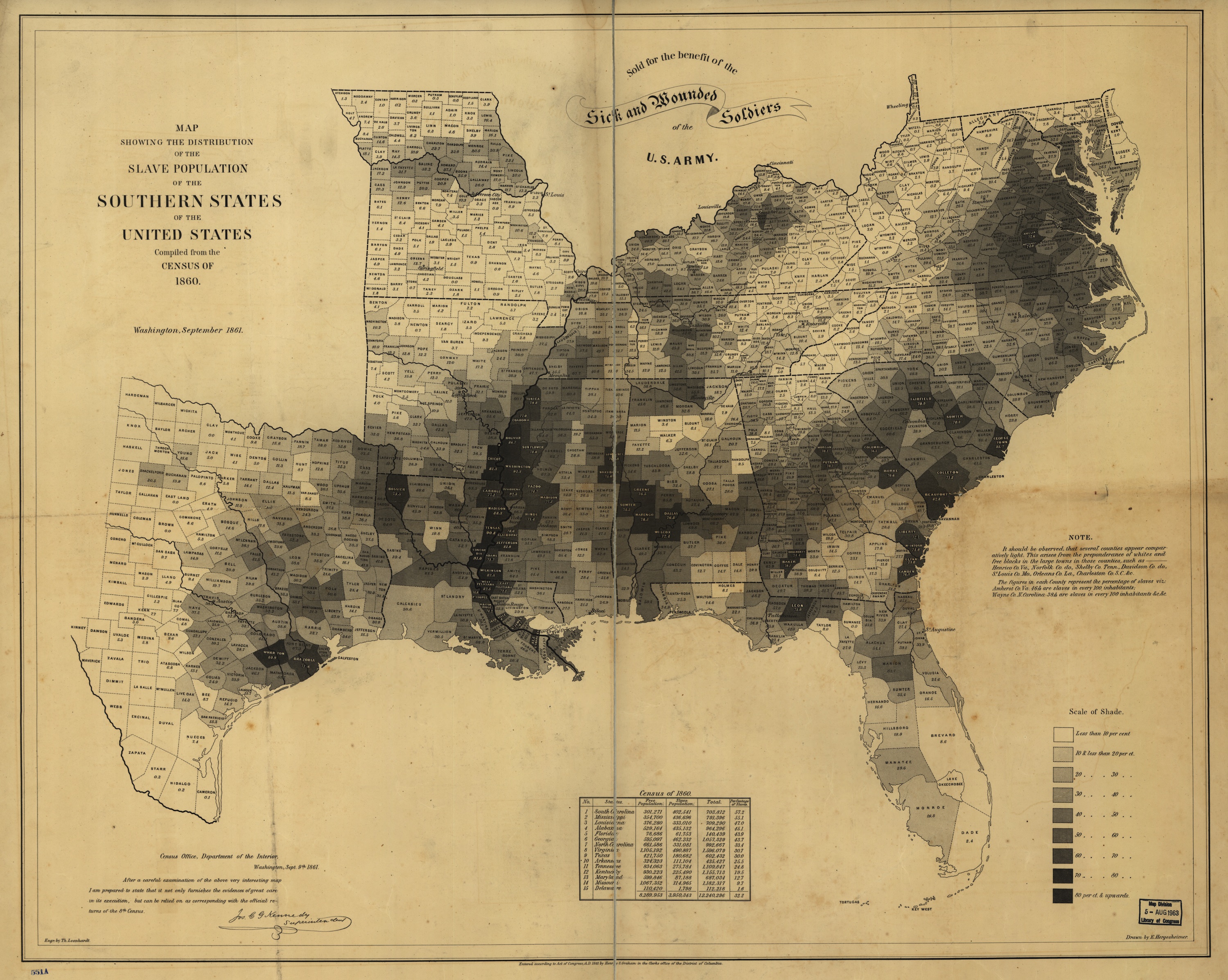
Consider three maps—one using data from the 1860 Census, one focusing on public schools in 2011, and one detailing the remaining states allowing corporal punishment in schools:

BigSlaveryMap

[1860; click to enlarge]

Perc of low income students public schools copy

[2011; click to enlarge]

[2005-2006; click to enlarge]

“A majority of students in public schools throughout the American South and West are low-income for the first time in at least four decades, according to a new study that details a demographic shift with broad implications for the country,” explains Lyndsey Layton, based on the report from the Southern Education Foundation (SEF).

The data in the SEF report parallel in many ways the documenting of in-school segregation lingering in the South as portrayed in the HBO film Little Rock Central: Fifty Years Later and reported by Felicia Lee:

On a recent visit to Central High, Ms. Trickey spoke to a self-segregated classroom: whites on one side, blacks on the other. An African-American student apparently dozed as she spoke. Students and teachers alike spoke blithely or painfully of the low educational aspirations and achievements of too many black students. Central, many said, is now two schools in one: a poor, demoralized black majority and a high achieving, affluent white minority.

And five years after the documentary, The Civil Rights Project detailed the extent of re-segregated schools across the South:

  • Since 1991, black students in the South have become increasingly concentrated in intensely segregated minority schools (defined as 90-100% minority students). This represents a significant setback. Though for decades Southern black students were more integrated than their peers in other parts of the country, by 2009-10 the share of Southern black students enrolled in intensely segregated minority schools (33.4%) was fast closing in on the national figure (38.1%).  By comparison, in 1980, just 23% of black students in the South attended intensely segregated schools.
  • For the last four decades, contact between black and white students has declined in virtually all Southern states.  In schools across the region, white students make up 30% or less of the enrollment in the school of the typical black student for the first time since racial statistics pertaining to schools were collected by the federal government.
  • Most of the largest Southern metro areas also report declining black-white exposure. The Raleigh, NC metro had the highest black-white contact although this too has fallen in recent years.  In 2009, the typical black student in the metro went to a school where whites accounted for about 45% of their peers, compared to about 54% in 2002).
  • In 2009, black-white exposure in the metropolitan area of Raleigh was relatively similar to the overall white percentage in the metro (54%)–indicating fairly stable levels of desegregation.  Future enrollment data for the Raleigh metro should be closely monitored to ascertain the impact of recent policy changes to the district’s voluntary integration policy.
  • Two metros, Memphis, TN and Miami, FL, had the lowest exposure of black students to white students in 2009, under 15%. (Siegel-Hawley & Frankenberg2012, September 19)

In Western states with high Latino/a populations, race and poverty patterns constitute double segregation:

  • The typical black or Latino today attends school with almost double the share of low-income students in their schools than the typical white or Asian student.
  • In the early 1990s, the average Latino and black student attended a school where roughly a third of students were low income (as measured by free and reduced price lunch eligibility), but now attend schools where low income students account for nearly two-thirds of their classmates.
  • There is a very strong relationship between the percent of Latino students in a school and the percent of low income students. On a scale in which 1.0 would be a perfect relationship, the correlation is a high .71.  The same figure is lower, but still high, for black students (.53).  Many minority-segregated schools serve both black and Latino students.  The correlation between the combined percentages of these underserved two groups and the percent of poor children is a dismaying .85. (Orfield, Kucsera, & Siegel-Hawley, 2012, September 19)

Combined with the growing trends in the U.S. related to increased inequity, rising child poverty, and re-segregating of schools by class and race, the 2013 SEF report on low-income students being the new majority in public schools should be a wake-up call to the current in-school only focus of education reform. While race and class segregation has proven to be entrenched in U.S. society, education reformers must admit that social institutions such as public schools do not lift children out of poverty but play two roles reformers prefer to ignore—they reflect social inequity and they tend to perpetuate that inequity:

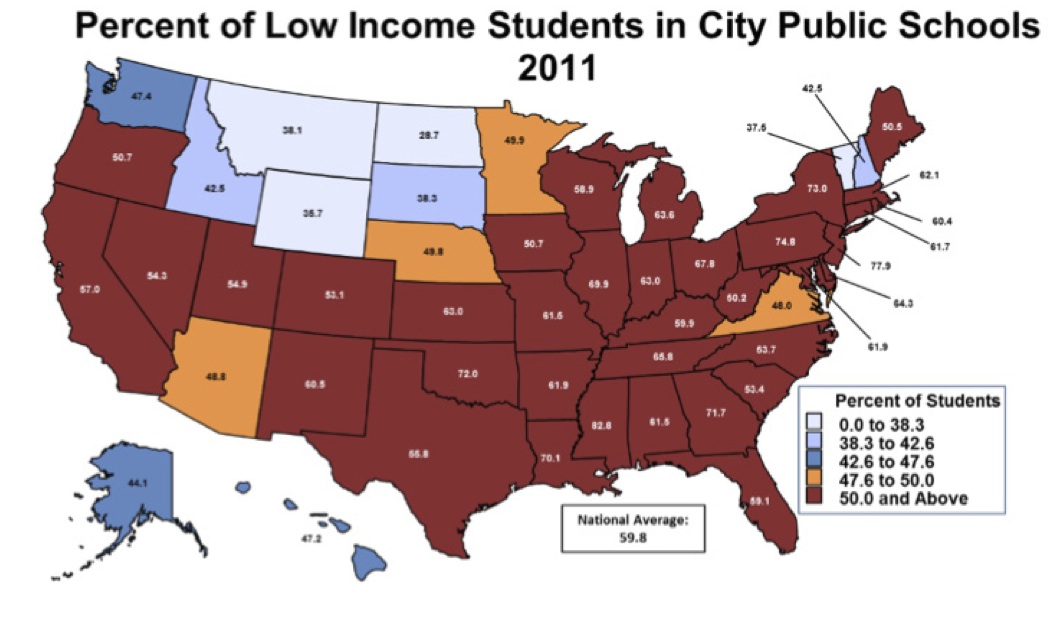
A majority of public school children in 17 states, one-third of the 50 states across the nation, were low income students – eligible for free or reduced lunches – in the school year that ended in 2011. Thirteen of the 17 states were in the South, and the remaining four were in the West. Since 2005, half or more of the South’s children in public schools have been from low income households. During the last two school years, 2010 and public schools. (SEF 2013)

Also hard hit by these social and academic realities are urban public schools:

city public schools

[click to enlarge]

In other words, while the South and West are crucibles for historical and current negative consequences associated with racial and class inequity and segregation, urban areas of the U.S. show that these same problems infect essentially the entire country:

In each of the nation’s four regions, a majority of students attending public schools in the cities were eligible for free or reduced lunch last year. The Northeast had the highest rates for low income school children in cities: 71 percent. The next highest rate, 62 percent, was found in Midwestern cities. The South had the third highest percentage of low income students in the cities – 59 percent.

The SEF report ends with the dilemma facing education reformers who promote a “no excuses” ideology grounded in market-based policies:

There is no real evidence that any scheme or policy of transferring large numbers of low income students from public schools to private schools will have a positive impact on this problem. The trends of the last decade strongly suggest that little or nothing will change for the better if schools and communities continue to postpone addressing the primary question of education in America today: what does it take and what will be done to provide low income students with a good chance to succeed in public schools? It is a question of how, not where, to improve the education of a new majority of students.

The lingering legacy of segregation as well as the rise of impoverished students constituting the new majority in public schools is evidence that ignoring poverty does not make it go away.

Arguing that in-school reform alone can eradicate the scars of slavery that remain vivid in the two maps included above is beyond idealism and approaches inexcusable irresponsibility of a type that is exposed by the data presented by SEF’s report.

With impoverished students now the new majority in public schools, a new era of education reform is unavoidable—one that begins with social reform addressing racial and class inequity and then continues by redesigning a public school system that itself is dedicated to equity of opportunity.

Aren’t All Children Equally Deserving?

A common practice for introducing students to the ethical foundation of philosophy is to pose moral dilemmas, possibly the most typical example being the life-boat dilemma that forces a person to choose who lives, and thus who dies.

Science fiction (SF) and speculative fiction often build entire other worlds in which the given circumstances create a series of moral dilemmas that are the basis of the tensions and actions of the novels and films. Writers such as Margaret Atwood (The Handmaid’s Tale, for example) and Kurt Vonnegut (Cat’s Cradle, for example) often build these worlds in the tradition of George Orwell and Aldous Huxley as a way to say, as Neil Gaiman explains about the power of fiction: “The world doesn’t have to be like this. Things can be different.”

In Cormac McCarthy’s The Road, the possible other world is one of scarcity, and by the end, the moral dilemma revolves around the fate of a child. The novel’s given, readers must accept, creates the narrow range of choices the characters face; that is part of the power of SF/speculative fiction.

Pulling back, however, from created other worlds, we are faced continually with moral dilemmas—often ones also involving children.

One such dilemma is how any society governs it schools. Confronting that dilemma in the UK, Polly Toynbee exposes dynamics that sound all too familiar in the U.S.:

Most people, right or left, would be alarmed at a trajectory of ever-worsening inequality. But few know the facts, wildly underestimating widening wealth gaps, still thinking Britain quite meritocratic. This ends the myth of modern classlessness, exposing shrinking mobility. The ladder up is so high and steep few can climb it – while those at the top exert all their power to stop their children falling down.

Citizens and institutions in both the UK and the U.S. are confronted by some troubling moral dilemmas: the rise of inequity in the wider society and the inability of public schools to overcome (as well as perpetuating) that inequity.

While debates often focus on the exact relationship between a meritocracy and its schools (a sort of “which comes first,” “chicken and egg” debate), an ethical decision about children seems to be ignored: To the question “Aren’t all children equally deserving?” the consensus in the U.S. appears to be “No.”

Education reform built on changing standards and high-stakes tests, weeding out “bad” teachers, funding the expansion of charter schools and Teach for America corp members, and retaining third graders based on their test scores is a concession to a fabricated moral dilemma. In other words, some children are more deserving (the standard among reformers is “grit,” by the way) because the reformers have conceded to a fatalistic scarcity that serves the advantages of the privileged, but leaves the middle class, the working class, the working poor, and the impoverished to fight among themselves for the scraps left behind.

Education reform in the U.S. is The Hunger Games.

Arthur H. Camins has identified the ugliest concession of them all in education reform as the Hunger Games, collateral damage:

“Whatever it takes,” is a dangerous philosophy because it tends to justify “collateral damage” in the guise of doing good things for children.  It excuses increased segregation wrought by school choice policies. It excuses flawed metrics in teacher evaluation.  It excuses the disruptions caused by open and closing of schools.  It excuses decreased instructional time for science, social studies and the arts.  It avoids exploration of meaningful debate about ideas and evidence.  It dismisses all of these consequences with the glib phrase, “Don’t let the perfect be the enemy of the good,” as if there were no alternative strategies available for improvement.  It is, I think, a calculated avoidance strategy that develops when leaders feel under siege and run out of ways to deflect valid criticism.  In the end it is a profoundly undemocratic stance.

And what given have the privileged leaders in the U.S. embraced to justify allowing all their children to remain deserving while “other people’s children” have to fight it out to show who among them are more deserving? Competition and concessions to scarcity.

However, competition and concessions to scarcity are choices, not inevitable conditions in the U.S.

As Michael B. Katz explains in The Undeserving Poor:

Poverty is deeply rooted [in the US]. Before the twentieth century, the nation lacked both the economic surplus and policy tools to eradicate it; all that could be hoped for was to ameliorate the condition of the poor by keeping them from perishing from starvation, wretched housing, and disease. The situation began to change in the twentieth century with what one historian has called the “discovery of abundance” and with increasingly sophisticated methods for transferring income, delivering services, and providing essentials of a decent life. For about a decade, this combination of abundance and method backed by popular support and political will worked spectacularly well. Since then, poverty has been allowed to grow once again, not, it must be emphasized, as the inevitable consequence of government impotence or economic scarcity, but of political will. (p. xi)

When political leaders and self-appointed education reformers point to U.S. public schools reduced to life-boats and demand that we continue to choose which children are deserving and which children are not, instead of playing the moral dilemma game they are handing us, we must begin to point back at the ship wreck they have created and concedes only this: all children are equally deserving.

U.S. Needs Moratorium on (Privileged) White Men Pontificating on Race, Class, Gender

Most  (privileged) white men are wrong about race, class, and gender—and while Mike Petrilli isn’t unique, he does represent how and why:

Second, the reason the overwhelming majority of children are born poor is that they are born to young single mothers without much education or many job prospects. These mothers will struggle mightily to provide the kind of home environment that is necessary to help children get off to a good start in life and in school. To put it bluntly, they tend to be bad parents. (Not “bad” in a moral sense but “bad” as in “ineffective”; with their brains literally maxed out with basic survival, it’s easy to understand why.)

While it is embarrassing enough that Petrilli thinks putting “bad” in quote marks and offering a parenthetical qualification are enough to counter the essential condescension and marginalization in his mischaracterization of people who happen to be trapped in poverty, the larger problem is that Petrilli represents, speaks for, and speaks to a cultural attitude toward the poor (and the affluent/privileged) that guarantees the U.S. remain inequitable, and likely will continue to grow more inequitable: people in poverty are lazy and deserve their poverty while the affluent are hard-working and deserve their achievements.

Before I continue, let me clarify that my calling for a moratorium on white men pontificating on race, class, and gender would include me. And if I am successful in this call, I am eager to comply.

The president/governor Bush clan in the U.S. has rightfully been accused of including several men born on third base who all believe they hit triples. If that characterization is accurate, and I think it is, then I am privileged by being white and male, but compared to the Bushes, my working-class background probably put me solidly at first.

Along with race and gender, I happen to have the sort of mathematical and verbal intelligence that schools and society honor—as well as a sort of Type-A work ethic that tends to be rewarded as well.

In fact, I have worked extremely hard at being a teacher and writer for about 30 years now, achieving a fairly high level of success.

I have earned that success, but let me be very clear that I do not deserve it.

I do not deserve the relative affluence and all the advantages of that while other people are being denied access that I was afforded through no effort on my part. Yes, I have worked hard, but the foundation of my success was pure and simply dumb luck.

Consider Shaquille O’Neal, LeBron James, George W. Bush, Bill Gates, and Mike Krzyzewski. What if these five men had lived in the early to mid 1800s? How would their lives have manifested themselves in that era?

It is without a doubt that two of these men would have had quite different lives—and not because of their talents, character, or determination.

Social norms are powerful and are primary when considering the individual talents of people.

And that leads us back to my call for a moratorium and my claim that most white men are typically wrong about race, class, and gender.

White men have built Western culture (often on the backs of others) and the exact privilege that appears transparent to them.

“Normal” to the privileged constitutes all the forces that assure their privilege and in turn create the poverty and disadvantage of others.

As a result, Petrilli can and does classify single, poor mothers as “bad parents”—and does so while believing himself and hearing from others that Mike is an essentially nice guy.

Yes, Petrilli is a nice guy—in the rarified air of privileged white men in the U.S.

His blogs appear civil and almost reasonable in fact.

But there is nothing civil or reasonable about a privileged class speaking about and for people in disadvantage, as long as that holding forth refuses to acknowledge privilege and the social dynamics that create poverty.

The powerful in the U.S. either create or tolerate whatever conditions exist in the U.S.

The powerless cannot and do not create or tolerate those conditions.

The U.S. is experiencing some of the highest child poverty rates and levels of inequity ever seen in contemporary times. White men still reap the benefits of those inequities while also being primarily the ones with the power and money to control this country.

It isn’t working—except for them.

I suspect the imbalances of inequity will remain for a while, but in the mean time, wouldn’t it be wonderful that where we currently have white-mansplaining, we could have for at least a while just silence that could be filled by those who have been spoken about and for?

Closing Gaps?: Addressing Privilege and Poverty

With the release of her Reign of Error, Diane Ravitch continues to identify the failures of education reform, exemplified by the charter school movement.

As the evidence mounts discrediting much of the movement, and more of the public discourse recognizes that evidence, we may be poised for rethinking education reform.

If current reform commitments are misguided, then what are our alternatives? Broadly, new ways of thinking about public education must occur before the U.S. can fulfill its obligation to the promise of universal public schools:

  1. We have failed public education; public education has not failed us.
  2. Education has never, cannot, and will never be a singular or primary mechanism for driving large social change.
  3. And, thus, public education holds up a mirror to the social dynamics defining the U.S. In other words, achievement gaps in our schools are metrics reflecting the equity and opportunity gaps that exist in society.

One aspect of these new ways of thinking about public education that is rarely discussed is that seeking laudable goals (such as closing the achievement gap in schools and the income and upward mobility gaps in society) requires that we address both privilege and poverty—the top and the bottom. Historically and currently, our gaze remains almost exclusively on the bottom.

Richard Reeves in the “The Glass-Floor Problem” poses a provocative and necessary admission about the polar ends of class in the U.S.:

When it comes to the economic malaise facing America, the biggest problem is not the widening gap between rich and poor, but the stagnation of social mobility. When the income gap of one generation becomes an opportunity gap for the next, inequality hardens into social stratification….

These solutions may sound easy, but they are not. While politicians discuss social mobility as a pain-free goal, the unspoken, uncomfortable truth is that relative mobility is a zero-sum game. Opening more doors to applicants from low-income backgrounds often means closing more doors to affluent applicants.

This is delicate territory. Nobody wants parents to stop trying hard for their children. But nor do we want a society in which the social market is rigged in favor of those born into affluence. If we want a competitive economy and an open society, we need the best and brightest to succeed. This means some of the children of the affluent must fail.

In other words, the declining social mobility in the U.S. includes not only that those at the bottom are victims of poverty being destiny, but also that those at the top are reaping the benefit of privilege being destiny. In both extremes, then, the ideal of a U.S. meritocracy is negated.

Beneath simplistic claims that higher educational attainment (effort) is rewarded with greater income potential lie the ugly truth that poverty blocks children from high-quality educational opportunities while privilege insures better schools, advanced degrees, and access to jobs linked to the networking of privilege.

The lives of adults in the U.S. are more often than not the consequences of large and powerful social dynamics driven by poverty and privilege—and not by the character or tenacity of any individual.

That fact is the basis for the needed new ways of thinking about education posed above.

One example of thinking differently about education is Ravitch, who explains that school-only reform over the past three decades is essentially a “mistake”; instead, social reform must come first so that school reform can work:

And income inequality in our nation is larger than at any point in the last century.

We should do what works to strengthen our schools: Provide universal early childhood education (the U.S. ranks 24th among 45 nations, according to the Economist); make sure poor women get good prenatal care so their babies are healthy (we are 131st among 185 nations surveyed, according to the March of Dimes and the United Nations); reduce class size (to fewer than 20 students) in schools where students are struggling; insist that all schools have an excellent curriculum that includes the arts and daily physical education, as well as history, civics, science, mathematics and foreign languages; ensure that the schools attended by poor children have guidance counselors, libraries and librarians, social workers, psychologists, after-school programs and summer programs.

Schools should abandon the use of annual standardized tests; we are the only nation that spends billions testing every child every year. We need high standards for those who enter teaching, and we need to trust them as professionals and let them teach and write their own tests to determine what their students have learned and what extra help they need.

Annie Murphy Paul also challenges the in-school only focus on seeking ways to close gaps, shifting away from schools and into the home:

When it comes to children’s learning, are we focusing too much on schools—and not enough on parents?

“There is, quite rightly, a cacophonous debate on how to reform schools, open up colleges, and widen access to pre-K learning,” notes a new article, “Parenting, Politics, and Social Mobility,” published by the Brookings Institution, a Washington think tank. “But too little attention is paid to another divide affecting social mobility—the parenting gap.”

Given all the roiling debates about how America’s children should be taught, it may come as a surprise to learn that students spend less than 15% of their time in school. While there’s no doubt that school is important, a clutch of recent studies reminds us that parents are even more so. A study by researchers at North Carolina State University, Brigham Young University and the University of California-Irvine, for example, finds that parental involvement—checking homework, attending school meetings and events, discussing school activities at home—has a more powerful influence on students’ academic performance than anything about the school the students attend.

Another study, published in the Review of Economics and Statistics, reports that the effort put forth by parents (reading stories aloud, meeting with teachers) has a bigger impact on their children’s educational achievement than the effort expended by either teachers or the students themselves. And a third study concludes that schools would have to increase their spending by more than $1,000 per pupil in order to achieve the same results that are gained with parental involvement (not likely in this stretched economic era).

So parents matter—a point made clear by decades of research showing that a major part of the academic advantage held by children from affluent families comes from the “concerted cultivation of children” as compared to the more laissez-faire style of parenting common in working-class families.

While Paul’s challenge pulls us one step back from school-only reform, this doesn’t go quite far enough (and stumbles if her argument is interpreted as “blame the parents”)—especially in the last comment quoted above. From Paul’s argument, we must ask ourselves why affluent parents and impoverished parents appear to parent differently.

“Laissez-faire” is a dangerous and potentially ugly word here.

Impoverished adults are not in poverty primarily due to laziness. Impoverished children do not score poorly on standardized tests because their parents do not care about school or are too lazy to parent properly (read: as affluent parents do).

Poverty is a social dynamic that does not allow people to behave in ways that we view as effective or productive. Privilege is a social dynamic that allows people to behave in ways that we mistakenly suggest is grounded in those people’s superior character.

Just as the achievement gap in schools is a marker for the equity gap in society, parenting style differences are reflections of the social dynamics experienced by those parents.

An affluent family with one parent staying home to support the children is allowed to behave in ways that an impoverished single parent working two part-time jobs (with no retirement or healthcare) cannot.

Privilege is a safety net, poverty is a prison.

Ultimately, we must acknowledge both privilege and poverty if we genuinely wish to close gaps in society and schools. Just as Reeves warns, however, recognizing that both privilege and poverty are unfair calls into question the advantages of children born into affluence.

It seems important that we ask as a culture some foundational questions:

  • Is ending the momentum of privilege “taking something away” from a child?
  • Is ending the momentum of poverty “giving something for free” to a child?
  • What are the foundational promises a country must make to insure the human dignity all people deserve, and expressed in that country’s foundational documents (in the U.S., life, liberty, and the pursuit of happiness)?

These questions can only be answered and then acted upon if we make one additional change to how we think—in the larger scale (not in the schools, not in the home, but in society), how we think about the relationship between the Commons (publicly-funded institutions) and the free market.

The free market, we must admit, is amoral; the free market is Social Darwinism: competition produces losers and winners, not equity.

The Commons are potentially the collective ethics of a people.

And finally, then, in order for a free market to work for the common good, the Commons must be primary in the commitment of any people.

The Commons are the foundation upon which the market can do good.

As long as the U.S. views the Commons and the Market as an either/or proposition, and as long as the U.S. prefers the Market, privilege and poverty will continue to be destiny for our children. And for us all.

Let’s go back now to the second new way of viewing public schools from the beginning—reframed within a primary commitment to the Commons:

  • Public education has never, cannot, and will never be a singular or primary mechanism for driving large social change as long as social inequity remains and as long as those public schools perpetuate those social inequities.

If we commit to social reform and education reform seeking equity and opportunity, then my first claim at the beginning will be proven wrong.

Here’s to my being wrong.

Why Poverty and Mass Incarceration Do Not Matter in the U.S.

Ever wonder why poverty and mass incarceration do not matter in the U.S.?

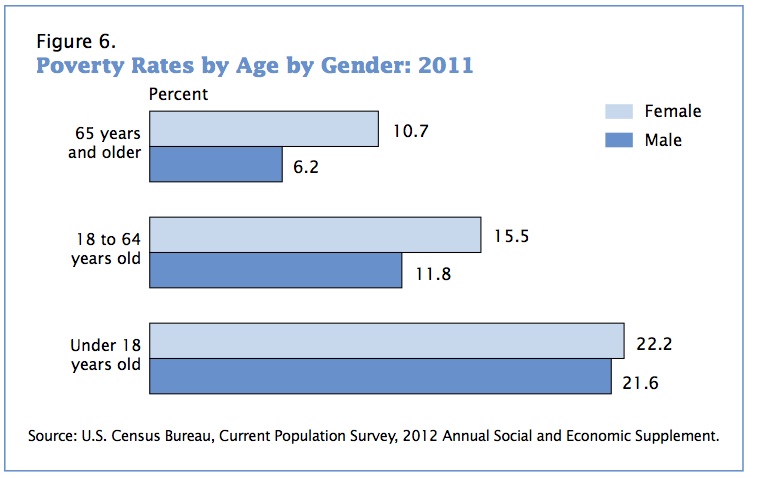
Poverty disproportionately impacts women and children (see p. 15):

Povertygenderage

[click image to enlarge]

Mass incarceration disproportionately impacts African American males. While white males outnumber AA males about 5 to 1 in society, AA males outnumber white makes about 6 to 1 in prison:

—–

Government and business in the U.S. remains dominated either by privileged white males or the norms associated with privileged white males.

Our leaders have no empathy.

Our leaders have wealth, privilege, child care, health care, food security, and job security—and they all believe they have earned it all. They also believe those who haven’t are lazy—also deserving their poverty.

Our leaders cannot and will not acknowledge their privilege.

Leadership without empathy is tyranny.

If poverty and mass incarceration were white male problems, we’d be working to end both.

Words and Deeds: The U.S. Is No Christian Nation

[Header Photo by Edward Cisneros on Unsplash]

In Chapter 1 (“The Foul Ball”) of John Irving’s A Prayer for Owen Meany, the narrator, John Wheelwright, declares on the first page, “I am a Christian because of Owen Meany.” Later in the chapter, John and Owen are in the car with John’s mother:

We were in Rye, passing the First Church, and the breeze from the ocean was already strong.  A man with a great stack of roofing shingles in a wheelbarrow was having difficulty keeping the shingles from blowing away; the ladder, leaning against the vestry roof, was also in danger of being blown over. The man seemed in need of a co-worker—or, at least, of another pair of hands.

“WE SHOULD STOP AND HELP THAT MAN,” Owen observed, but my mother was pursuing a theme, and therefore, she’d noticed nothing unusual out the window….

“WE MISSED DOING A GOOD DEED,” Owen said morosely. “THAT MAN SHINGLING THE CHURCH—HE NEEDED HELP.” (pp. 33-34, 35)

If you are looking for the U.S., there it is—John Wheelwright’s mother, who “noticed nothing unusual out the window.”

D.H. Lawrence’s “The Rocking-Horse Winner” presents the reader with a young boy, Paul, talking with his mother:

“Is luck money, mother?” he asked, rather timidly.

“No, Paul. Not quite. It’s what causes you to have money.”

“Oh!” said Paul vaguely. “I thought when Uncle Oscar said filthy lucker, it meant money.”

“Filthy lucre does mean money,” said the mother. “But it’s lucre, not luck.”

“Oh!” said the boy. “Then what is luck, mother?”

“It’s what causes you to have money. If you’re lucky you have money. That’s why it’s better to be born lucky than rich. If you’re rich, you may lose your money. But if you’re lucky, you will always get more money.”

“Oh! Will you? And is father not lucky?”

“Very unlucky, I should say,” she said bitterly.

If you are looking for the U.S., there it is—a working class fascination with luck and wealth, passed on to children, instead of the charity Owen calls for throughout Irving’s novel

From the grave, Addie Bundren reveals her philosophy of life in William Faulkner’s As I Lay Dying:

So I took Anse. And when I knew that I had Cash, I knew that living was terrible and that this was the answer to it. That was when I learned that words are no good; that words dont ever fit even what they are trying to say at. (p. 171)

If you are looking for the U.S., there it is—the failure of words against the possibility of deeds.

“With a clamor of bells that set the swallows soaring, the Festival of Summer came to the city Omelas, bright-towered by the sea,” opens Ursula Le Guin’s “The Ones Who Walk Away from Omelas.”

Later in the story, however, the narrator explains:

Do you believe? Do you accept the festival, the city, the joy? No? Then let me describe one more thing.

In a basement under one of the beautiful public buildings of Omelas, or perhaps in the cellar of one of its spacious private homes, there is a room. It has one locked door, and no window. A little light seeps in dustily between cracks in the boards, secondhand from a cobwebbed window somewhere across the cellar. In one corner of the little room a couple of mops, with stiff, clotted, foul-smelling heads stand near a rusty bucket. The floor is dirt, a little damp to the touch, as cellar dirt usually is. The room is about three paces long and two wide: a mere broom closet or disused tool room. In the room a child is sitting. It could be a boy or a girl. It looks about six, but actually is nearly ten. It is feeble-minded. Perhaps it was born defective, or perhaps it has become imbecile through fear, malnutrition, and neglect. It picks its nose and occasionally fumbles vaguely with its toes or genitals, as it sits hunched in the corner farthest from the bucket and the two mops. It is afraid of the mops. It finds them horrible. It shuts its eyes, but it knows the mops are still standing there; and the door is locked; and nobody will come. The door is always locked; and nobody ever comes, except that sometimes–the child has no understanding of time or interval–sometimes the door rattles terribly and opens, and a person, or several people, are there. One of them may come in and kick the child to make it stand up. The others never come close, but peer in at it with frightened, disgusted eyes. The food bowl and the water jug are hastily filled, the door is locked, the eyes disappear. The people at the door never say anything, but the child, who has not always lived in the tool room, and can remember sunlight and its mother’s voice, sometimes speaks. “I will be good,” it says. “Please let me out. I will be good!” They never answer. The child used to scream for help at night, and cry a good deal, but now it only makes a kind of whining, “eh-haa, eh-haa,” and it speaks less and less often. It is so thin there are no calves to its legs; its belly protrudes; it lives on a half-bowl of corn meal and grease a day. It is naked. Its buttocks and thighs are a mass of festered sores, as it sits in its own excrement continually.

They all know it is there, all the people of Omelas. Some of them have come to see it, others are content merely to know it is there. They all know that it has to be there. Some of them understand why, and some do not, but they all understand that their happiness, the beauty of their city, the tenderness of their friendships, the health of their children, the wisdom of their scholars, the skill of their makers, even the abundance of their harvest and the kindly weathers of their skies, depend wholly on this child’s abominable misery.

If you are looking for the U.S., there it is—the sacrificed child, the dull resignation toward inequity.

While Daisy and Tom Buchanan flee, essentially unscathed, to Europe, the images of Myrtle Wilson dead in the road and Jay Gatsby face-down in his swimming pool haunt Nick Carraway’s final lines of F. Scott Fitzgerald’s The Great Gatsby:

Gatsby believed in the green light, the orgiastic future that year by year recedes before us. It eluded us then, but that’s no matter—tomorrow we will run faster, stretch out our arms farther….And one fine morning—

So we beat on, boats against the current, borne back ceaselessly into the past. (p. 182)

If you are looking for the U.S., there it is—Myrtle’s corpse in the wake of Daisy driving a gold Rolls Royce, Gatsby and George Wilson both dead at George’s disillusioned hand.

The U.S. is no Christian nation—of that I am reminded, like Owen Meany witnesses again and again, each time I make a case that the U.S. is the wealthiest nation in the world, in human history, and that we tolerate and even loathe the growing number of poor, including poor children, who populate our country.

When I suggest we should end poverty directly, cries ring out for the interests of the wealthy: How dare I suggest that we take from the rich and give to the poor!

Certainly a sentiment that Jesus espoused often? No, in fact, Jesus speaks most about the least among us, the need to lay down our worldly possessions, and our moral obligation of charity.

The U.S. will have none of that, however.

A country will ultimately be measured by how the privileged treat the impoverished. About many things I am unsure, but about that, I am certain.

Many stood in line to buy the newest iPhone (which will be obsolete very soon so everyone yet again can line up for the new iPhone) while almost no one lined up to do something about 22% of children in the U.S. living in poverty.

If you are looking for the U.S., there it is—in line for the new iPhone.

Echoing the words of Jesus in many ways, Henry David Thoreau in Walden (Economy) recognized even in mid-nineteenth century:

Most of the luxuries, and many of the so-called comforts of life, are not only not indispensable, but positive hindrances to the elevation of mankind. With respect to luxuries and comforts, the wisest have ever lived a more simple and meagre life than the poor….

The life which men praise and regard as successful is but one kind….

No man ever stood the lower in my estimation for having a patch in his clothes; yet I am sure that there is greater anxiety, commonly, to have fashionable, or at least clean and unpatched clothes, than to have a sound conscience….We know but few men, a great many coats and breeches….

We worship not the Graces, nor the Parcæ, but Fashion.

I imagine most in the U.S. would scoff at Thoreau, much as they scoff at my suggesting that the privileged have more than they need, and that what they have earned isn’t earned at all—and that those people and children trapped in poverty are our obligations to charity, not people to be shunned or ignored.

The U.S. is no Christian nation.

Although humanist Kurt Vonnegut, may he rest in peace, seemed to understand:

How do humanists feel about Jesus? I say of Jesus, as all humanists do, “If what he said is good, and so much of it is absolutely beautiful, what does it matter if he was God or not?”

But if Christ hadn’t delivered the Sermon on the Mount, with its message of mercy and pity, I wouldn’t want to be a human being.

I’d just as soon be a rattlesnake. (pp. 80-81)

Amen.