Category Archives: Poverty

Kids Count on Public Education, Not Grit or “No Excuses”

Secretary of Education Arne Duncan has often stated that “education [is] the one true path out of poverty—the great equalizer that overcomes differences in background, culture and privilege. It’s the only way to secure our common future in a competitive global economy.” While this claim appears obvious, when Matt Bruenig asked “What’s more important: a college degree or being born rich?” and examined the data, he concluded:

So, you are 2.5x more likely to be a rich adult if you were born rich and never bothered to go to college than if you were born poor and, against all odds, went to college and graduated. The disparity in the outcomes of rich and poor kids persists, not only when you control for college attainment, but even when you compare non-degreed rich kids to degreed poor kids!

Therefore, the answer to the question in the title is that you are better off being born rich regardless of whether you go to college than being born poor and getting a college degree.

In South Carolina, for example, this sobering reality is made more troubling by the 2013 Kids Count report from the Annie E. Casey Foundation, which examines child well-being in the nation and each state.

Nationally, SC ranks 45th, down from 43rd in the foundation’s previous report. Only Louisiana, Arizona, Nevada, Mississippi, and New Mexico sit lower than SC in child well-being. The ranking consists of four broad categories that reflect significant social and educational challenges for SC:

  • Economic Well-Being (2011 data): SC children in poverty, 28% (worse than 2005, 23%); children whose parents lack secure employment, 35% (worse than 2008, 30%); children living in households with a high housing cost burden, 36% (worse than 2005, 32%); teens not in school and not working, 11% (worse than 2008, 8%).
  • Education: SC children not attending preschool (2009-11), 55% (better than 2005-2007, 59%); 4th graders not proficient in reading (2011), 72% (better than 2005, 74%); 8th graders not proficient in math (2011), 68% (better than 2005, 70%); high school students not graduating on time (2009/2010), 32%.
  • Health: SC low-birthweight babies (2010), 9.9% (better than 2005, 10.2%); children without health insurance (2011), 8% (better than 2008, 13%); child and teen deaths per 100,000 (2010), 32% (better than 2005, 41%); teens who abuse alcohol and drugs (2012-11), 7% (better than 2005-2006, 8%).
  • Family and Community: SC children in single-parent families (2011), 42% (worse than 2005, 38%); children in families where the household head lacks a high school diploma (2011), 13% (better than 2005, 15%); children living in high-poverty areas (2007-2011), 13% (worse than 2000, 6%); teen births per 1000 (2010), 43 (better than 2005, 51).

SC represents states that remain heavily burdened by the negative consequences of poverty and social inequity, complicated factors often reflected in the measurable outcomes of public schools. This report offers SC, the nation, and political leaders an opportunity to change the discourse about school reform and take bold action that addresses the wide range of social and economic challenges facing our state.

While the report data show that social and education reform should remain priorities for SC, that same data also suggest that social reform is far more pressing than expensive and historically ineffective commitments to new standards and tests being promoted for education reform.

Children in SC deserve better schools, and children in poverty remain the exact students most underserved in those schools. No one is suggesting that education reform be set aside or ignored. But many current school reform policies are simply wastes of taxpayers’ money and educators’ time that would be better spent on education reform that addresses the conditions of teaching and learning, and not just more of the same standards-and-testing mandates tried for thirty years now.

More pressing is social reform because without addressing childhood poverty, workforce stability and quality, the costs of living, single-parent homes, and concentrated high-poverty communities, most education reform measures are doomed to be fruitless.

As The Economic Mobility Project reveals, children in SC and across the US are likely to have bright futures if they are born into relative affluence, and those children, even without attending college, are apt to succeed over impoverished children who rise above the challenges of their homes and communities by graduating college. “Grit” and “no excuses” are simply slogans, hollow and cruel in the bright light of the evidence.

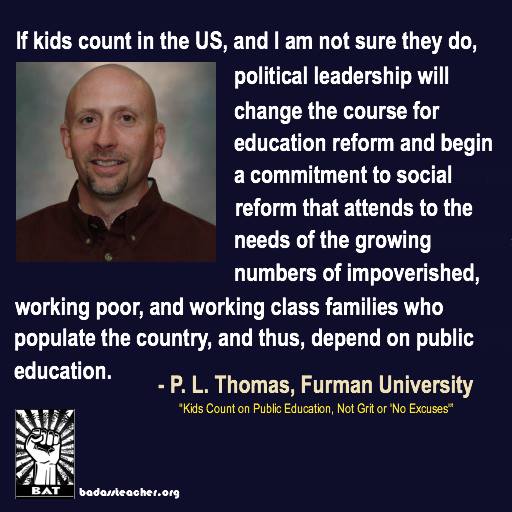
If kids count in the US, and I am not sure they do, political leadership will change the course for education reform and begin a commitment to social reform that attends to the needs of the growing numbers of impoverished, working poor, and working class families who populate the country, and thus, depend on public education.

meme

Blinded by the Stereotype Spotlight

Why are drug sweeps routinely conducted by police in high-poverty minority neighborhoods and not dorms on college campuses?

Why was shooting victim Trayvon Martin drug tested, and his shooter, George Zimmerman, not tested?

Why are Teach for America recruits, with no formal training as teachers, allowed to teach high-poverty minority students, often in “no excuses” charter schools such as Knowledge Is Power Program (KIPP), but affluent and white students tend to have certified and experienced teachers?

Why are charter schools, which often segregate students by race and class, expanding, while public schools also grow increasingly segregated—and why are both conditions essentially ignored?

The answers lie somewhere in the blinding power of the stereotype spotlight focused on people and children living and learning in poverty.

Consider Esther J. Cepeda’s “Overcoming generational poverty”:

Teachers in low-income school districts often get specialized training about the culture of poverty in order to better understand their students’ lives and take those challenges into account in the classroom. As a high school teacher, I was trained in Ruby K. Payne’s “A Framework for Understanding Poverty.”

Payne has a 20-item list of the characteristics of generational poverty, which includes constant high levels of background noise, the overvaluation of entertainment as a respite from the exertions of survival, a strong belief in destiny or fate because choices are in low supply, and polarized thinking in which options are hardly ever examined (again, because so few tend to be available).

Also pervasive in the culture of poverty is the sense that time isn’t for measuring, that it occurs only in the present, and that the future exists only as a word.

Cepeda, first, carelessly* honors the Payne “framework,” despite a significant and growing body of scholarship that has rejected Payne’s worksheets and workshops as the worst possible examples of deficit perspectives built on stereotypes, and not credible and nuanced evidence about class or race.

Payne, having no formal expertise in poverty, class, or race has admitted she based her work initially on her husband having grown up poor. In its genesis, Payne’s work is at best anecdotal.

But the “framework” also perpetuates and speaks to corrosive stereotypes about class and race. For example, Payne presents her clients (generating a tremendous amount of revenue for her through the self-published workbooks and workshops offered across the US) with what she claims are foundational conditions about people in poverty that explain why children living in poverty struggle in schools: According to Payne, people in poverty know how to bail someone out of jail, how to acquire handguns, and how to gather resources from trash and recycling bins.

Let’s imagine for a moment a similar “framework” for affluence**. You may be from wealth if:

  • You know how to hire an escort without being arrested.
  • You know people who can have charges dropped if you are arrested.
  • You know how to hide your income to avoid, legally, paying taxes.

Framed within the cultural fetish in the US for wealth and the wealthy, that “framework” likely seems unfair, but are those conditions and the implications in them any more unfair that Payne’s claims about people in poverty?

The blinding power of the stereotype spotlight fails even among advocates seeking, in earnest, to help people and children living in poverty. The failures include the following:

  • Stereotyping is gross overgeneralizing. The worst stereotyping is recognized as racism, sexism, or homophobia. Any category of humans (such as class, race, gender, or sexuality) is likely far more nuanced than monolithic. Payne’s stereotyping is classism, tinted by racism.
  • Focusing on claimed flaws inherent in people in poverty (and poverty itself) keeps the focus on personal failure, personal responsibility, but it ignores systemic inequity. As long as we continue to act as if people in poverty are deficient, and all we need to do is “fix” them, we continue to absolve ourselves of any social responsibility for inequity and injustice.
  • Creating stereotypes as deficits against social norms entrenches those norms as “right” and thus above being confronted or changed. The idealized middle class of the US has historically and currently constitutes, however, beliefs and practices that need to be challenged. Consider that separate but equal was a norm of the US, as was slavery. Social norms remain that speak to groups about “knowing their place” (women), as well.

As long as the stereotype spotlight remains focused on children in poverty, highlighting them as academic failures who need a culture of “no excuses” to force them to conform to the idealized middle-class norm (Payne’s “hidden rules”), the historical and current race and class biases remaining in standardized testing, the inequity of opportunity existing in US consumerism and capitalism, the inequity of opportunity expanding in access to high-quality schools and high-quality courses in schools, and the inequity of access to high-quality teachers all remain unacknowledged and thus never addressed.

The blinding power of the stereotype spotlight needs to be switched off and replaced by a mirror for middle-class and affluent America.

* Payne often expresses her “common sense” claims about people in poverty to large auditoriums filled with, disproportionately, middle-class, white, and female teachers. Those teachers often sit shaking their heads in agreement. Payne’s claims are compelling because they seem accurate within a cultural stereotyping. The result is many good people with wonderful intentions also find themselves trapped within stereotypes.

** Paul Gorski uses this method to discredit Payne’s simplistic claims.

Le Guin’s “The Ones Who Walk Away from Omelas”: Allegory of Privilege

“With a clamor of bells that set the swallows soaring, the Festival of Summer came to the city Omelas, bright-towered by the sea,” opens Ursula K. Le Guin ’s “The Ones Who Walk Away from Omelas.”*

The reader soon learns about a people and a land that leave the narrator filled with both a passion for telling a story and tension over the weight of that task:

How can I tell you about the people of Omelas? They were not naive and happy children—though their children were, in fact, happy. They were mature, intelligent, passionate adults whose lives were not wretched. O miracle! but I wish I could describe it better. I wish I could convince you. (p. 278)

The narrator offers an assortment of glimpses into these joyous people and their Festival of Summer, and then adds:

Do you believe? Do you accept the festival, the city, the joy? No? Then let me describe one more thing. (p. 280)

The “one more thing” is a child, imprisoned in a closet and its own filth—a fact of the people of Omelas “explained to children when they are between eight and twelve, whenever they seem capable of understanding”:

They all know it is there, all the people of Omelas. Some of them have come to see it, others are content merely to know it is there. They all know that it has to be there. Some of them understand why, and some do not, but they all understand that their happiness, the beauty of their city, the tenderness of their friendships, the health of their children, the wisdom of their scholars, the skill of their makers, even the abundance of their harvest and the kindly weathers of their skies, depend wholly on this child’s abominable misery. (p. 282)

And how do the people of Omelas respond to this fact of their privilege at the expense of the sacrificed child? Most come to live with it: “Their tears at the bitter injustice dry when they begin to perceive the terrible justice of reality, and to accept it” (p. 283)

But a few, a few:

They leave Omelas, they walk ahead into the darkness, and they do not come back. The place they go towards is a place even less imaginable to most of us than the city of happiness. I cannot describe it at all. It is possible that it does not exist. But they seem to know where they are going, the ones who walk away from Omelas. (p. 284)

Le Guin’s sparse and disturbing allegory has everything that science fiction/ speculative fiction/ dystopian fiction can offer in such a short space—a shocking other-world, a promise of Utopia tinted by Dystopia, the stab of brutality and callousness, and ultimately the penetrating mirror turned on all of us, now.

At its core, Le Guin’s story is about the narcotic privilege as well as the reality that privilege always exists at someone else’s expense. The horror of this allegory is that the sacrifice is a child, highlighting for the reader that privilege comes to some at the expense of others through no fault of the closeted lamb.

In the U.S., we cloak the reality of privilege with a meritocracy myth, and unlike the people of Omelas, we embrace both the myth and the cloaking—never even taking that painful step of opening the closet door to face ourselves.

What’s behind our door in the U.S.? Over 22% of our children living lives in poverty through no fault of their own.

While Le Guin’s story ends with some hope that a few have a soul and mind strong enough to walk away from happiness built on the oppression of the innocent, I feel compelled to long for a different ending, one where a few, a few rise up against the monstrosity of oppression and inequity, to speak and act against, not merely acquiesce or walk away.

Le Guin, U. (1975). The wind’s twelve quarters. New York, NY: Harper Perennial.

*Previously posted at The Daily Kos October 30, 2011, slightly revised here.

Kids [Still Don’t] Count

Some predictions aren’t that bold, and this is one of them:

I predict there will be much shouting and gnashing of teeth over the newest CREDO charter schools study and that the Kids Count 2013 report will dissipate into thin air like smoke from an abandoned camp fire.

Ultimately, the charter school debate continues to be much ado about nothing because charter schools produce about the same range of quality as public and private schools. Charter schools are school-choice-lite so they appease the beefy middle ground of conservatives and progressives who want to appear reasonable, but charter schools are not credible solutions to our pressing social and educational problems that remain primarily issues of equity and opportunity.

Schooling in the US continues to be a reflection and perpetuation of the inequities of our society; they don’t transform society, and they never have—primarily because education remains a tool of the political and economic elite who simply do not want social reform since that reform would challenge their perches atop the masses.

And the Kids Count report will remain ignored because it proves exactly that—social reform is needed in the US.

But most disturbing of all, beyond how debates about the CREDO study and charter schools will overshadow substantive examinations of social inequity, is that the CREDO study helps perpetuate the mindless and also distracting focus on data that ignores the ugly underbelly of many charter schools—segregating children by race and class, perpetuating “no excuses” and zero tolerance policies for African American and Latino/a children (but not white children), demonizing and de-professionalizing teachers and teaching, and reducing education for “other people’s children” to test-prep factories beholden to textbook publishers and high-stakes testing regimes (such as the ACT).

Count of this; my prediction will be proven true.

And we all lose in the process.

Addendum

And almost no one is paying attention to the Pew report on economic mobility—except for Matt Bruenig and The Atlantic. Why? Because just as the Kids Count data refute the big political lies, so does the Pew report in terms of the American Dream; for example:

Americans raised at the bottom and top of the family income ladder are likely to remain there as adults, a phenomenon known as “stickiness at the ends.”

  • While a majority of Americans exceed their parents’ family incomes, the extent of that increase is not always enough to move them to a different rung of the family income ladder.
  • Forty-three percent of Americans raised in the bottom quintile remain stuck in the bottom as adults, and 70 percent remain below the middle.
  • Forty percent raised in the top quintile remain at the top as adults, and 63 percent remain above the middle.
  • Only 4 percent of those raised in the bottom quintile make it all the way to the top as adults, confirming that the “rags-to-riches” story is more often found in Hollywood than in reality. Similarly, just 8 percent of those raised in the top quintile fall all the way to the bottom….

There is stickiness at the ends of the wealth ladder.

  • Sixty-six percent of those raised in the bottom of the wealth ladder remain on the bottom two rungs themselves, and 66 percent of those raised in the top of the wealth ladder remain on the top two rungs.

Blacks have a harder time exceeding the family income and wealth of their parents than do whites.

  • Sixty-six percent of blacks raised in the second quintile surpass their parents’ family income compared with 89 percent of whites.
  • Only 23 percent of blacks raised in the middle surpass their parents’ family wealth compared with over half (56 percent) of whites.

Blacks are more likely to be stuck in the bottom and fall from the middle than are whites.

  • Over half of blacks (53 percent) raised in the bottom of the family income ladder remain stuck in the bottom as adults, compared with only a third (33 percent) of whites. Half of blacks (56 percent) raised in the middle of the family income ladder fall to the bottom two rungs as adults compared with just under a third of whites (32 percent).
  • Half of blacks (50 percent) raised in the bottom of the family wealth ladder remain stuck in the bottom as adults, compared with only a third (33 percent) of whites. More than two-thirds of blacks (68 percent) raised in the middle fall to the bottom two rungs of the ladder as adults compared with just under a third of whites (30 percent).


Kids Count?

The Annie E. Casey Foundation has released their 2013 Kids Count report, cataloging child well-being in the U.S. and individual states.

Let’s place the Kids Count report first in the context of Matt Bruenig’s What’s more important: a college degree or being born rich?, and his conclusion:

So, you are 2.5x more likely to be a rich adult if you were born rich and never bothered to go to college than if you were born poor and, against all odds, went to college and graduated. The disparity in the outcomes of rich and poor kids persists, not only when you control for college attainment, but even when you compare non-degreed rich kids to degreed poor kids!

Therefore, the answer to the question in the title is that you are better off being born rich regardless of whether you go to college than if you are born poor and do go to college.

Next, I want to highlight my home state of SC:

  • 45th (down from 43rd) in national ranking of child well-being
  • From 2007-2011, childhood poverty rose steadily from 21% to 28%
  • Children in homes with parents lacking secure employment, 35%
  • Increases in children in single-parent homes, children living in high-poverty communities

A couple of quick thoughts.

Evidence is undeniable that social equity and opportunity are deeply connected with educational equity and opportunity. This report simply confirms that it is irresponsible to continue to suggest that schools alone are failing impoverished children and their families. Social and educational inequity of opportunity are cancers on a free people who claim to be just and kind.

Second, where are the “no excuses” advocates when it comes to social inequity? Why aren’t they peddling their “no excuses” mantra about childhood poverty, job insecurity, high-poverty neighborhoods, low birth weights, lack of health care, child and teen deaths?

The silence and inaction are inexcusable.

First Name and then Act

If we cannot even name the reality we claim we want to change, then we will never change that reality.

—–

There are two points that I make in my scholarship and public writing that are certain to prompt reactions from both friends and foes that suggest I may have just run down someone’s grandmother with a bus:

Let me try once again to clarify both that these claims are true and necessary to name in order to change.

“Poverty is destiny” is a normative [1] fact of the United States. For most children, the social class they are born into predicts the trajectory of their lives, independent of their self-worth, effort, and all sorts of other factors we are more likely to associate with the individual child.

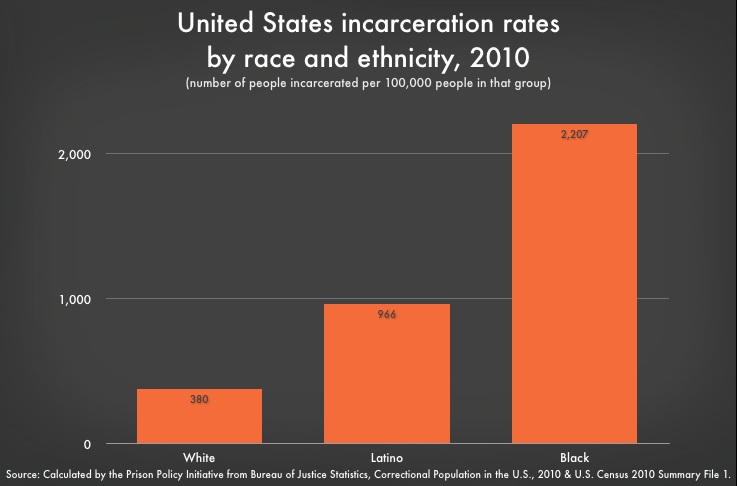
That this is a normative statement includes a concession that outliers exist (some people fall out of and rise above the social class of their births), but outliers do not discredit a normative statement just as we must caution against making an outlier status the rubric for normalized behavior. In other words, that African American men have scaled to the presidency and supreme court stands as outliers against the disproportionate number of AA men incarcerated in our country:

Michelle Alexander has embodied the need to name in order to change by confronting the normative facts of mass incarceration as well as the indisputable fact that mass incarceration is the New Jim Crow, thus racist.

And Sean Reardon has now offered a powerful case that “poverty and affluence are destiny”:

Here’s a fact that may not surprise you: the children of the rich perform better in school, on average, than children from middle-class or poor families. Students growing up in richer families have better grades and higher standardized test scores, on average, than poorer students; they also have higher rates of participation in extracurricular activities and school leadership positions, higher graduation rates and higher rates of college enrollment and completion….

In the 1980s, on an 800-point SAT-type test scale, the average difference in test scores between two such children would have been about 90 points; today it is 125 points. This is almost twice as large as the 70-point test score gap between white and black children. Family income is now a better predictor of children’s success in school than race….

We are still talking about this despite decades of clucking about the crisis in American education and wave after wave of school reform.Whatever we’ve been doing in our schools, it hasn’t reduced educational inequality between children from upper- and lower-income families….

The income gap in academic achievement is not growing because the test scores of poor students are dropping or because our schools are in decline….

It may seem counterintuitive, but schools don’t seem to produce much of the disparity in test scores between high- and low-income students. We know this because children from rich and poor families score very differently on school readiness tests when they enter kindergarten, and this gap grows by less than 10 percent between kindergarten and high school. There is some evidence that achievement gaps between high- and low-income students actually narrow during the nine-month school year, but they widen again in the summer months….

The more we do to ensure that all children have similar cognitively stimulating early childhood experiences, the less we will have to worry about failing schools. This in turn will enable us to let our schools focus on teaching the skills — how to solve complex problems, how to think critically and how to collaborate — essential to a growing economy and a lively democracy.

Alexander and Reardon are naming normative facts—ones that many all along the ideological spectrum not only refuse to do themselves, but rush to silence others who do name in order to change.

If the patterns of mass incarceration and “no excuses”/”zero tolerance” schools and policies even impacted privileged white males proportionately in the U.S., the outcry would be deafening.

The current and historical racially disproportionate and negative patterns of the U.S. penal and judicial systems and the rise of highly segregated “no excuses” charter schools and “zero tolerance” urban public schools must be named and then we must act t change that which is racist, that which is classist, that which is sexist.

Refusing to name, refusing to act guarantees poverty will remain destiny and the current education reform movement will continue to mirror the New Jim Crow of mass incarceration.

If you are uncertain about the messages our culture sends about race, view the video below:

This Is The Worst Thing I Have Ever Heard A Child Say

[1] “Normative” is being expressed as “typical,” that which can fairly be called “normal” in the sense of mode and/or more than half of a population exists in that condition.

Baldwin and Woodson: Lingering Legacy of Failing Education System

I am currently drafting a chapter on schools as prisons (a product of zero tolerance and “no excuses” ideologies and policies), and along with the words of James Baldwin being relevant today—

The truth is that the country does not know what to do with its black population now that the blacks are no longer a source of wealth, are no longer to be bought and sold and bred, like cattle; and they especially do not know what to do with young black men, who pose as devastating a threat to the economy as they do to the morals of young white cheerleaders. It is not at all accidental that the jails and the army and the needle claim so many, but there are still too many prancing around for the public comfort. Americans, of course, will deny, with horror, that they are dreaming of anything like “the final solution”—those Americans, that is, who are likely to be asked: what goes on in the vast, private hinterland of the American heart can only be guessed at, by observing the way the country goes these days. (Baldwin, 1998, pp. 432-433) [1]

—so are the words of Carter Godwin Woodson:

[T]he educational system as it has developed both in Europe and America [is] an antiquated process which does not hit the mark even in the case of the needs of the white man himself….The so-called modern education, with all its defects, however, does others so much more good than it does the Negro, because it has been worked out in conformity to the needs of those who have enslaved and oppressed weaker people….The same educational process which inspires and stimulates the oppressor with the thought that he is everything and has accomplished everything worth while, depresses and crushes at the same time the spark of genius in the Negro by making him feel that his race does not amount to much and never will measure up to the standards of other peoples. The Negro thus educated is a hopeless liability of the race. (pp. 4-5) [2]

[1] Baldwin, J. (1998). James Baldwin: Collected essays. New York, NY: The Library of America. Originally published in 1972, No Name in the Street.

[2] Woodson, C. G. (1933). The mis-education of the negro. New York, NY: Tribeca Books.

“We Are Entering the Age of Infinite Examination”

In 2011, Jim Taylor entered the poverty and education debate, asking U.S. Secretary of Education Arne Duncan and billionaire/education entrepreneur Bill Gates a direct question*:

I really don’t understand you two, the U.S. Secretary of Education and the world’s second richest man and noted philanthropist. How can you possibly say that public education can be reformed without eliminating poverty?

Taylor’s discussion comes to an important element in the debate when he addresses Gates: “Because without understanding the causes of problems, we can’t find solutions,” explains Taylor, adding. “You’re obviously trying to solve public education’s version of the classic ‘chicken or egg’ conundrum.”

Here, recognizing the education/poverty debate as a chick-or-egg problem is the crux of how this debate is missing the most important questions about poverty—and as a result, insuring that Duncan, Gates, Michelle Rhee, Paul Vallas, and other corporate reformers are winning the argument by perpetuating the argument.

The essential questions about poverty and education should not focus on whether we should address poverty to improve education (where I stand, based on the evidence and the words of Martin Luther King, Jr.) or whether we should reform education as the sole mechanism to alleviate poverty (the tenant of the “no excuses” ideology found at Knowledge Is Power Program [KIPP] charters); the essential question about poverty is: Who creates and allows poverty to exist in the wealthiest and most powerful country in recorded history?

The Conservative Nature of Power

As a basic point of logic, any organized entity—a society, a business, a school—has characteristics that are either created or tolerated by those in power controlling that organization. All entities are by their nature conservative—functioning to maintain the entity itself. In other words, institutions and their norms resist change, particularly radical change that threatens the hierarchy of power.

In the U.S., then, poverty exists in the wider society and performs a corrosive influence in the education system (among all of our social institutions, our Commons) because the ruling elite—political and corporate leaders—need poverty to maintain their elite status at the top of the hierarchy of power.

While the perpetual narratives promoted by the political and corporate elite through the media elite have allowed this point of logic to be masked and ignored in American society, we must face the reality that people with power drive the realities of those without power. Yes, the cultural narratives driven by the elite suggest that people trapped in poverty are somehow in control of that poverty—either creating it themselves due to their own sloth, that they somehow deserve their station in life, or failing to rise above that poverty (and this suggestion allows the source of poverty to be ignored) from their own failure to lift themselves up by their own bootstraps.

But that narrative has no basis in evidence—since those without power have control of that which creates the conditions benefiting the elite. The powerful allow those without power to have some token or artificial autonomy—as parents with children—in order to create the illusion of autonomy to keep revolt at bay; this is why the political and corporate elite use the word “choice” and perpetuate the myth that all classes in America have the same access to choice.

Poverty as Necessary for Current Hierarchies of Power

How does poverty benefit the powerful in the U.S.?

  • U.S. cultural narratives depend on the Utopian elements of democracy, meritocracy, and individual freedom. Those ideals form the basis for most of the cultural narratives expressed by the political and corporate elite in the U.S. Poverty works as the Other in those narratives—that which we must all reject, that which we must strive to avoid. If the Utopian goals, including eliminating poverty, is ever achieved, however, the tension between the working-/middle- class and those in poverty would be eliminated as well, exposing the artificial perch upon which the ruling elite sit. The necessity of poverty works both to keep us from attaining the Utopian goals and to make the Utopian goals attractive.
  • Poverty contributes to the crisis motif that keeps the majority of any society distracted from the minority elite benefiting disproportionately from the labor of the majority. Crises large and small—from Nazis, Communists, and Terrorists to the War on Drugs to teen pregnancy to the achievement gap and the drop-out crisis—create the perception that the average person cannot possibly keep these crises under control (crises that would plunge otherwise decent people into the abyss of poverty) and, thus, needs the leadership and protection of the elite. The majority of average people can only be carried to the promised land of Utopian peace and equality by the sheer force of personality held by only a few; these ruling elite are the only defense against the perpetual crises threatening the ideals we hold sacred (see below for how we identify those elite).
  • Along with Utopian promises and the refrain of crisis, the ruling elite need the pervasive atmosphere of fear—whether real or fabricated—in order to occupy the time and energy of the majority. [1] Poverty becomes not just a condition to be feared, but also those people to be feared. The cultural narratives—in contrast to the evidence—about poverty and people living in poverty connect poverty and crime, poverty and drug abuse, poverty and domestic violence, poverty and unattractiveness, and most of all, poverty and the failure of the individual to grasp the golden gift of personal freedom afforded by the United States.

Just as we rarely consider the sources of poverty—who controls the conditions of our society—we rarely examine the conditions we are conditioned to associate with poverty and people living in poverty. Are the wealthy without crime? Without drug abuse? Without deceptions of all kinds? Of course not, but the consequences for these behaviors by someone living in privilege are dramatically different than the consequences for those trapped in poverty.

The ruling elite have created a culture where we see the consequences of poverty, but mask the realities of privilege.

Winners always believe the rules of the game to be fair, and winners need losers in order to maintain the status of “winner.” The U.S., then, is a democracy only as a masking narrative that maintains the necessary tension among classes—the majority working-/middle-class ever fearful of slipping into poverty, and so consumed by that fear that they are too busy and fearful to consider who controls their lives: “those who are stuck at a machine and supervised for the rest of their lives.” [2]

In the narrow debate about poverty and education, we are being manipulated once again by the ruling elite, within which Duncan and Gates function, to focus on the chicken-and-egg problem of poverty/education so that we fail to examine the ruling elite creating and tolerating poverty for their own benefit. By creating the debate they want, they are winning once again.

And that success derives in large part from their successful propaganda campaign about the value of testing.

The Meritocracy Myth, Science, and the Rise of New Gods

Now that I have argued for shifting the discourse about poverty and education away from the chick-and-egg problem to the role of sustaining and tolerating poverty for the benefit of the ruing elite, let’s look at the central role testing plays in maintaining the status quo of power in the U.S. And let’s build that consideration on a couple pillars of evidence.

First, despite decades committed to the science of objective, valid, and reliable standardized testing, outcomes from standardized tests remain most strongly correlated with the socio-economic status of the students. As well, standardized tests also remain biased instruments.

Next, more recently during the thirty-year accountability era, the overwhelming evidence shows that standards, testing, and accountability do not produce the outcomes that political proponents have claimed.

Thus, just as the poverty/education question should address who creates and allows poverty and why, the current and historical testing obsession should be challenged in terms of who is benefiting from our faith in testing and why.

The history of power, who sits at the top and how power is achieved, is one of creating leverage for the few at the expense of the many. To achieve that, often those at the top have resorted to explicit and wide-scale violence as well as fostering the perception that those at the top have been chosen, often by the gods or God, to lead—power is taken and/or deserved.

“God chose me” and “God told me” remain powerful in many cultures, but in a secular culture with an ambiguous attitude toward violence (keep the streets of certain neighborhoods here crime-free, but war in other countries is freedom fighting) such as the U.S., the ruling elite needed a secular god—thus, the rise of science, objectivity, and testing:

[A] correlative history of the modern soul and of a new power to judge; a genealogy of the present scientifico-legal complex from which the power to punish derives its bases, justifications, and rules; from which it extends it effects and by which it masks its exorbitant singularity. [3]

As I noted above, testing remains a reflection of the inequity gap in society and the high-stakes testing movement has not reformed education or society, so the rising call for even more testing of students, testing based on nationalized standards and used to control teachers, must have a purpose other than the Utopian claims by the political and corporate elite who are most invested in the rising testing-culture in the U.S.

That purpose, as with the necessity of poverty, is to maintain the status quo of a hierarchy of power and to give that hierarchy the appearance of objectivity, of science.

Standards, testing, and accountability are the new gods of the political and corporate elite.

Schools in the U.S. are designed primarily to coerce children to be compliant, to be docile; much of what we say and consider about education is related to discipline—classroom management is often central to teacher preparation and much of what happens during any school day:

The exercise of discipline presupposes a mechanism that coerces by means of observation; an apparatus in which the techniques that make it possible to see induce effects of power in which, conversely, the means of coercion make those on whom they are applied clearly visible. [4]

In education reform, the surveillance of students, and now the surveillance of teachers, is not covert, but in plain view in the form of tests (and even Gates calling for cameras in all classrooms) allowing that surveillance to be disembodied from those students and teachers—and thus appearing to be impersonal—and examined as if objective and a reflection of merit.

Testing as surveillance in order to create compliance is central to maintaining hierarchies of power both within schools (where a premium is placed on docility of students and teachers) and society, where well-trained and compliant voters and workers sustain the positions of those in power:

[T]he art of punishing, in the regime of disciplinary power, is aimed neither at expiation, nor precisely at repression….It differentiates individuals from one another, in terms of the following overall rule: that the rule be made to function as a minimal threshold, as an average to be respected, or as an optimum toward which one must move. It measures in quantitative terms and hierarchizes in terms of value the abilities, the level, the “nature” of individuals….The perpetual penalty that traverses all points and supervises every instant in the disciplinary institution compares, differentiates, hierachizes, homogenizes, excludes. In short, it normalizes. [5]

The political and corporate elite in the U.S. have risen to their status of privilege within the “scientifico-legal complex” that both created that elite and is then perpetuated by that elite. As I noted above, the winners always believe the rules of the game to be fair and will work to maintain the rules that have produced their privilege.

The Expanded Test Culture—“The Age of Infinite Examination”

Foucault has recognized the central place for testing within the power dynamic that produces a hierarchy of authority:

The examination combines the techniques of an observing hierarchy and those of normalizing judgment. It is a normalizing gaze, a surveillance that makes possible to qualify, to classify, and to punish. [6]

Thus, as the rise of corporate paradigms to replace democratic paradigms has occurred in the U.S. over the last century, we can observe a rise in the prominence of testing along with how those tests are used. From the early decades of the twentieth century, testing in the U.S. has gradually increased and expanded in its role for labeling, sorting, and controlling students. In the twenty-first century, testing is now being wedged into a parallel use to control teachers.

Those in power persist in both cases—testing to control students and testing to control teachers—to claim that tests are a mechanism for achieving Utopian goals of democracy, meritocracy, and individual freedom, but in both cases, those claims are masks for implementing tests as the agent of powerful gods (science, objectivity, accountability) to justify the current hierarchy of power—not to change society or education: “[T]he age of the ‘examining’ school marked the beginnings of a pedagogy that functions as science.” [7]

Foucault, in fact, identifies three ways that testing works to reinforce power dynamics, as opposed to providing data for education reform driven by a pursuit of social justice.

First, testing of individual students and using test data to identify individual teacher quality create a focus on the individual that reinforces discipline:

In discipline, it is the subjects who have to be seen. Their visibility assures the hold of the power that is exercised over them. It is the fact of their being constantly seen…that maintains the disciplined individual in his subjection. And the examination is the technique by which power…holds them in a mechanism of objectification. [8]

This use of testing resonated in President Obama’s first term as Secretary Duncan simultaneously criticized the misuse of testing in No Child Left Behind and called for an expansion of testing (more years of a student’s education, more areas of content, and more directly tied to individual teachers), resulting in: “We are entering the age of infinite examination and of compulsory objectification.” [9]

As Giles Deleuze confirms in “Postscript on the Societies of Control”:

We are in a generalized crisis in relation to all the environments of enclosure—prison, hospital, factory, school, family….The administrations in charge never cease announcing supposedly necessary reforms: to reform schools, to reform industries, hospitals, the armed forces, prisons….In disciplinary societies one was always starting again (from school to the barracks, from the barracks to the factory), while in the societies of control one is never finished with anything—the corporation, the educational system, the armed services being metastable states coexisting in one and the same modulation, like a universal system of deformation. (pp. 3-4, 5)

Next, testing has provided a central goal of sustaining the hierarchy of power—“the calculation of gaps between individuals, their distribution in a given ‘population.’” [10] Testing, in effect, does not provide data for addressing the equity/achievement gap, testing has created those gaps, labeled those gaps, and marginalized those below the codified level of standard.

What tends to be ignored in the testing debate is that some people with authority determine what is taught, how that content is taught, what is tested, and how that testing is conducted. In short, all testing is biased and ultimately arbitrary in the context of who has authority.

And finally, once the gaps are created and labeled through the stratifying of students and teachers:

[I]t is the individual as he[/she] may be described, judged, measured, compared with others, in his[/her] very individuality; and it is also the individual who has to be trained or corrected, classified, normalized, excluded, etc. [11]

Poverty and Testing—Tools of the Privileged

Within the perpetual education and education reform debates, the topics of poverty and testing are central themes (poverty is no excuse, and better tests are always being promised), but we too often are missing the key elements that should be addressed in the dynamic that exists between poverty and testing.

Yes, standardized tests remain primarily reflections of social inequity that those tests make possible, labeled as “achievement gaps.”

But the central evidence we should acknowledge is that the increased focus on testing coming from the political and corporate elite is proof that those in privilege are dedicated to maintaining poverty as central to their hierarchy of authority.

Standards, testing, accountability, science, and objectivity are the new gods that the ruling class uses to keep the working-/middle-class in a state of “perpetual anxiety,” fearing the crisis of the moment and the specter of slipping into poverty—realities that insure the momentum of the status quo.

* Reposted and revised/updated from earlier publication at Truthout.

References

[1] Foucault, M. (1984). The Foucault reader. Ed. P. Rabinow. New York: Pantheon Books. See Foucault’s discussion of “perpetual anxiety” (p. 144) in “The Birth of the Asylum” from Madness and Civilization.

[2] Ibid., p. 177.

[3] Ibid., p. 170.

[4] Ibid., p. 189.

[5] Ibid., p. 195.

[6] Ibid., p. 197.

[7] Ibid., p. 198.

[8] Ibid., p. 199.

[9] Ibid., p. 200.

[10] Ibid., p. 202.

[11] Ibid., p. 203.

Open Letter to Political Leaders: Action, Not Tributes and Rhetoric

To All Elected Local, State, and National Political Leadership:

No American needs anymore to name specifically the tragedy or the media and political responses because all have become both commonplace and predictable.

I will name nonetheless, not because these are unique, but because they are sobering messages that must not be ignored.

In recent days, a bomb exploded at the finish line of the Boston Marathon, and during the subsequent news cycle as well as political tributes and rhetoric, the U.S. Senate failed to act on gun legislation that was prompted by the Sandy Hook Elementary shooting that also spurred 24-hours media coverage and political tributes and rhetoric.

I want first to note that as a scholar and poet, I understand the need to frame tragedy in words. I wrote commentaries—“‘They’re All Our Children,'” “Misreading the Right to Bear Arms”—and a poem, “calculating (the erased),” after the school shooting and was once again moved to poetry, “they ran (15 April 2013),” in the wake of the marathon bombing.

Also I concede that words matter, and for me, writing is a type of activism.

However, like Hamlet came to feel about marriage, I am compelled to say to politicians, We will have no more tributes and rhetoric.

Political tributes and rhetoric—as well as media discourse—fail in two ways: (1) They offer misleading distractions from authentic political action, and (2) they replace action.

From political perches of privilege, tributes and rhetoric are condescending since politicians read speeches others write for them and act only in ways that serve the moneyed interests who demand their policy.

Political tributes and rhetoric allow one existence for the power elites while preserving an entirely different existence for everyone else. In education reform, this is calling for and implementing policy for “other people’s children” that is unlike what those in power secure for their own children.

Dramatic tragedy such as mass shootings and bombings, then, becomes theater—stages upon which those in power can recite soliloquies about a certain kind of justice-as-revenge. But these hollow calls for justice-as-revenge mask that no action is taken for social justice.

And while each life lost or scarred by these tragedies-as-theater is precious and the acts of violence and terrorism can never be justified, Americans daily are subject to death and scarring from violences and terrorism that appear not to warrant political tributes and rhetoric or 24-hour media coverage.

Americans and America’s children are increasingly finding themselves victims of poverty. While some international rankings seem to preoccupy politicians and the media, hardly a word is spoken about U.S. international rankings in terms of the conditions of our children.

In terms of action related to the well-being of our children, the U.S. ranks near the bottom, and the ways in which the U.S. ranks at the top leave much to be desired, as detailed by Schwayder:

The United States is No. 1 on many other lists: It spends more on the military than the next 12 nations on the list combined; it’s the best in the world at imprisoning people; and it has the most obese people, the highest divorce rate, and the highest rate of both illicit and prescription drug use.

As children died at Sandy Hook Elementary and the Boston Marathon, as lives were scarred forever, children and adults die and have their lives scarred daily by poverty and violence that are as commonplace as the tragedy news-and-politics cycle.

America’s politicians and their tributes and rhetoric allow children to perish in poverty and a culture of violence—a culture of violence that is never genuinely addressed because that same political tribute and rhetoric have manufactured a New Jim Crow in which African American males are as disposable as our children in this era of mass incarceration that starts in schools-as-prisons and the rise of the working poor.

Racism, classism, and sexism corrode the lives of Americans while politicians pay tribute and make speeches.

The United States of America is the most powerful and wealthy society in human history. Every condition in our society is either created or tolerated by those with power.

To all elected local, state, and national political leadership, I say we will have no more tributes and rhetoric.

This is not, however, a call for politicians to be perfect. In fact, this is quite the opposite; it is a call for politicians to be fully human, not in words, but in deeds.

Where Is Our “Sense of Decency”?

Before teaching The Crucible in my American literature courses during my two decades as a high school English teacher in rural Upstate South Carolina, I played the students R.E.M.s “Exhuming McCarthy,” which “makes an explicit parallel between the red-baiting of Joe McCarthy‘s time and the strengthening of the sense of American exceptionalism during the Reagan era, especially the Iran-Contra affair” (Wikipedia).

The song includes an audio from the McCarthy hearings, including this soundbite of Joseph Welch confronting Joe McCarthy:  “Let us not assassinate this lad further, Senator….You’ve done enough. Have you no sense of decency, sir, at long last? Have you left no sense of decency?”

Part of The Crucible unit asked students to examine how societies continue to repeat the basic flaws of abusing power and oppressing powerless groups of people. Despite the lessons of the Witch Trials and the Red Scare/McCarthy Era (with the Japanese Internment in between), Americans seem hell-bent on doubling down on policies and practices that are authoritarian, hypocritical, and simply mean—especially if those policies can be implemented by people with power onto the powerless.

Current education reform needs a McCarthy hearing, and we need to confront those driving those reforms with “You’ve done enough. Have you no sense of decency, sir, at long last? Have you left no sense of decency?”

For example, consider the following:

History is replete with evidence that the ends do not justify the means.

While there remains great political and public support for grade retention, for example, a huge body of evidence shows that retention negatively impacts students retained, taxpayers, and peers not retained—all for mixed results of short-term test scores.

The only justification for grade retention is giving the appearance of being tough (raising a key question about how tough any adult is for lording him/herself over a child).

Americans’ puritanical roots are some of our worst qualities, and especially where children and other marginalized groups are concerned, Americans need to regain our sense of decency.

We would be well advised to begin with how we reform our schools.