Category Archives: Poverty

Outliers Never Evidence of Normal in Education

In Money, Race and Success: How Your School District Compares, the NYT, like most of mainstream media, is begrudgingly coming to admit that race and class inequity in the U.S. has a profound impact on the education of children—and that simply tinkering (badly) with school policy is not enough to change that reality:

We’ve long known of the persistent and troublesome academic gap between white students and their black and Hispanic peers in public schools.

We’ve long understood the primary reason, too: A higher proportion of black and Hispanic children come from poor families. A new analysis of reading and math test score data from across the country confirms just how much socioeconomic conditions matter.

Children in the school districts with the highest concentrations of poverty score an average of more than four grade levels below children in the richest districts.

But then there is this:

The data was [sic] not uniformly grim. A few poor districts — like Bremen City, Ga. and Union City, N.J. — posted higher-than-average scores. They suggest the possibility that strong schools could help children from low-income families succeed.

“There are some outliers, and trying to figure out what’s making them more successful is worth looking at,” said Mr. Reardon, a professor of education and lead author of the analysis.

Well, no, if we find outliers—and virtually all data have outliers in research—we should not waste our time trying to figure out how we can make outliers the norm.

The norm is where we should put our efforts in order to confront what is, in fact, not “puzzling” (used earlier in the article) at all; the data are very clear:

What emerges clearly in the data is the extent to which race and class are inextricably linked, and how that connection is exacerbated in school settings.

Not only are black and Hispanic children more likely to grow up in poor families, but middle-class black and Hispanic children are also much more likely than poor white children to live in neighborhoods and attend schools with high concentrations of poor students.

Our great education reform failure is one of failing to rethink our questions and our goals.

Let’s stop trying to find the “miracle” in a rare few schools where vulnerable students appear to succeed despite the odds against them. With time and careful consideration, we must admit, those appearances almost always are mirages.

Let’s instead put our energy in eradicating the poverty, racism, and sexism that disadvantages some students, vulnerable populations easily identified by race and social class, so that we can educate all students well.

And while we are making efforts at social policy, let’s end the in-school policies that we know “exacerbate” inequity: tracking, teacher assignments (and TFA), high-stakes testing, grade retention, discipline policies grounded in zero tolerance and “no excuses,” and segregation through school choice (including charter schools).

Education reform, as was highlighted in the original court case examined in the South Carolina documentary The Corridor of Shame, is obsessed with playing the hero by seeing who can pull the most babies out of the river.

And then examining the ones who survive the potential drowning in order to “make” all babies survive the trauma of being cast down stream.

But no one seems interested in walking upstream to stop babies being thrown in.

Life and learning do not need to be something children survive—and we must confront that we have decided that this is exactly what we are willing to accept for “other people’s children.”

It would not be so if we believed and acted upon that “they’re all our children.”


The Allegory of the River

How Good Is the Best Edujournalism?

A recurring theme running through my blog posts—one that could be addressed daily—is that education journalism is almost always significantly misleading and way too often completely inaccurate.

Mainstream media and journalists are trapped in false but compelling narratives about schools, learning and teaching, children, poverty, and race. Journalism itself fails education as a field because of a simplistic “both sides” to a rather cartoonish “objective” journalism.

As I have detailed too often, media coverage of education includes primarily voices and perspectives of people with no or very little experience or expertise in education, but when a few contrary perspectives are offered, those are typically framed as “some critics”—with no effort to establish which claims are credible or not.

Sadly, the best unmasking of the essential failure of the media has been by one of our faux-media comedians, John Oliver, who highlighted that even if there are two sides to an issue, one can be overwhelmingly credible while the other is mostly baseless; therefore, placing them as one-versus-one misleads the public on the weight of the arguments.

So when I received yet another email from the Education Writers Association (EWA)—who is extremely proud of itself—announcing their top award for education reporting, I wondered: How good is the best edujournalism?

The EWA Fred M. Hechinger Grand Prize for Distinguished Education Reporting was awarded for Failure Factories (The Tampa Bay Times), written by Cara Fitzpatrick, Lisa Gartner and Michael LaForgia. The series includes the following:

Without question, this series is comprehensive and it confronts some incredibly important issues about public schooling: the significant relationship between race/poverty and student achievement; the plague of segregation and resegregation in public institutions such as schools; and the huge inequities of education faced by racial minorities and impoverished students such as teacher assignments, school safety, funding, and discipline practices.

And while the series does a solid job of raising these issues, my first response is that these are all old news—I mean very old news.

That our public schools have failed poor and black/brown students is a recurring message over the last century—little different before or after the Civil Rights movement.

Therein lies a real problem with even the so-called best edujournalim—journalists without a historical lens afforded those with expertise in a field are ripe to fall prey to the lens of a novice.

One such failure of this series and then how the EWA praised the series can be found in the quoted judge’s comment:

Bravo to this team and the paper for taking an all-too-common story (low achievement in a high-poverty area) and digging past the excuses to reveal a shameful history of indifference and, most troubling, willful neglect. I was awed by the dogged reporting, the sheer volume of interviews and data-crunching, and the courageous analysis that put the blame exactly where it needed to be. But the true brilliance of this work is found in the stories of the children who were robbed of an education they deserved. How many other school districts in America might have the same story to tell?

The series title “Failure Factories” is but one of many triggers for the pervasive and ugly “no excuses” narrative that is all the rage in the U.S.

You see, once again, this series oversimplifies the story of educating vulnerable populations of students: racism and classism are merely excuses for the schools charged with high concentrations of vulnerable students.

And as the judge notes above, this is all about “blame”—and keeping the focus on those damn failing schools.

The shame is that without this corrosive and ugly framing, there is an incredible amount of work in this series that does deserve praise. We should be asking: Why do we need yet anther round of test scores to admit and confront race and class inequity—especially when high-stakes standardized testing itself is racist and classist?

The truth is that schools in the U.S. have never been, are not now, and never will be anything other than reflections of our society—unless we do things different in both our social and educational policy.

Yes, public schools almost entirely reflect and perpetuate the race, class, and gender inequities that remain powerful in our wider society, and much of that is embedded in the very reforms being championed in the media and among political leaders: accountability, standards, high-stakes testing, grade retention, zero tolerance policies, “no excuses” practices, charter schools, school choice, Teach For America, school report cards, value-added methods of teacher evaluation, and the worst of the worst—”grit.”

That is not simply a fact of the schools targeted by this series. That is a fact about public education across the entire country.

And many educators as well as education scholars have been yelling that for decades; that’s right—decades.

Possibly the most telling problem with the series is the end, where the condemnations of Arne Duncan and John King are treated as if they are somehow credible.

If this weren’t so tragic, it would be laughable—nearly rising to the level of an article in The Onion.

Therefore, here is a little message about the best of edujournalism.

Dear EWA:

Public schools have been reflecting and perpetuating the worst aspects of our society for over 100 years. People in power really don’t care, and politicians in the last three to four decades have learned that education policy is a powerful political football.

Since the Reagan administration, public schools have failed students even more significantly because of inane obsessions with accountability, standards, and tests.

Duncan and King are the personifications of all that is wrong with education policy: lots of soaring rhetoric masking policy cures that are part of the disease; thus, the accountability movement is intensifying race, class, and gender inequity—not overcoming it.

Racism, classism, sexism, and homophobia are never excuses, but facts, and these burdens are more than micromanaged and technocratic in-school only policies can address.

Yes, we need much more equitable school practices and polices—but none of what politicians are doing now meets those standards—and those alone will never accomplish what we seem to want without concurrent changes to public policy that also addresses equity.

Edujournalism, as well, is part of the problem because it remains trapped in false narratives, committed to simplistic “both sides” frames of issues, and unwilling to listen to the voices of the practitioners and scholars in the field of education.

Nearly everything addressed in “Failure Factories” was raised by novelist Ralph Ellison in a 1963 speech to teachers. Your best journalism is old news wrapped in a false frame and too often fumbled badly with good intentions.

I remain concerned that education-bashing journalism has become so lucrative for your flailing field that it is in fact as pressing that we address the journalism crisis as we do the need to significantly reform our public schools.

As agents of the public good, journalists and educators have a great deal in common that is being squandered; neither can afford as a field or in the name of that public good to remain the tools of those who have interests other than the public good.

We both can and should do better.

Recommended Reading Week of April 24

This list of suggested readings is eclectic, reflecting my interests, but I believe they are quite important—even though they range from issues of race and class to James Baldwin and Kurt Vonnegut.

Recommended reading week of April 24:

The Payne of Confronting Stereotypes about Poverty as Educators

Several years ago, I invited Randy Bomer to speak at my university and then at the annual South Carolina Council of Teachers of English (SCCTE) convention about the flawed but widely used framework of poverty by Ruby Payne.

After Bomer’s presentation at SCCTE, a woman energetically confronted Bomer, offering an impassioned story of her being from poverty and arguing that Payne’s work resonated with her own lived experiences.

I stood there and watched as Bomer patiently walked her through how her own beliefs about poverty were stereotypes that matched the false narratives sold by Payne. This was an uncomfortable and difficult exchange. But necessary, especially for educators.

This experience was brought back to mind when Nancy Flanagan posted Do Teachers Read Professionally?, which included:

In an earlier incarnation of the course, almost half the teachers (from a single state) mentioned Ruby Payne’s Framework for Understanding Poverty, a book whose ideas and scholarship have been roundly criticized by academics. What to say about that? Payne’s training model had been presented across the state, at conferences and in large districts, and teachers were given a copy of the book. They read it and found it useful.

When I shared Flanagan’s post, she responded with this and then my follow up:

I then added a brief comment about my experience above with Bomer, and added an @ for Paul Gorski to offer some advice.

Gorski’s comments include the following:

The powerful stereotypes, negative and deficit-laden, about people trapped in poverty that pervade the U.S. also infect teachers and even people trapped in poverty themselves.

However, the derogatory claims about people in poverty are false narratives, deforming myths that must be confronted and rejected by educators—as well as anyone seeking social justice, anyone who honors the basic human dignity of all people.

I recommend, then, that educators read the following:

Day on Diversity at the University of South Carolina

I am participating as a discussion leader and speaker for a day on diversity at the University of South Carolina 14 April 2016. Below are my notes which may be of value to some addressing race and class in both social and educational contexts.

University of South Carolina

April 14 1:30 pm

Svec. M., & Thomas, P.L. (2016). The classroom crucible: Preparing teachers from privilege for students of poverty. In A.L. Hurst & S.K. Nenga (Eds.), Working in class: recognizing how social class shapes our academic work. Landham, MD: Rowman & Littlefield Publishers.

http://www.heinemann.com/blog/wp-content/uploads/2015/12/Confronting-Privilege-to-Teach-About-Privilege.pdf

https://radicalscholarship.wordpress.com/2014/11/13/my-redneck-past-a-brief-memoir-of-twos/

https://radicalscholarship.wordpress.com/2015/12/20/i-dont-belong-heremy-otherness-my-privilege/

April 14 6 pm

“How do we look at systemic issues of equity in institutional settings?”

20 minutes

Scarcity: The New Science of Having Less and How It Defines Our Lives, Sendhil Mullainathan and Eldar Shafir

For White Folks Who Teach in the Hood… and the Rest of Y’all Too: Reality Pedagogy and Urban Education, Chris Emdin

Police in the Hallways: Discipline in an Urban High School, Kathleen Nolan

Hope Against Hope, Sarah Carr

Reaching and Teaching Students in Poverty: Strategies for Erasing the Opportunity Gap, Paul Gorski

No Caste Here? Toward a Structural Critique of American Education, Daniel Kiel

Abstract:

In his famous dissent in Plessy v. Ferguson, Justice John Marshall Harlan argued that in the United States, there was “no caste here.” Justice Harlan was rejecting the idea that American society operated to assign preordained outcomes to individuals based upon classifications, including racial classifications. This Article questions whether Justice Harlan’s aspirational assertion accurately reflects contemporary American education. Identifying: (1) multiple classification mechanisms, all of which have disproportionate racial effects, and (2) structural legal, political, and practical impediments to reform, the Article argues that the American education system does more to maintain the nation’s historical racial hierarchy than to disrupt it. This is so, the Article suggests, despite popular agreement with the casteless ideal and popular belief that education can provide the opportunity to transcend social class. By building the framework for a broad structural critique, the Article suggests that a failure to acknowledge and address structural flaws will preclude successful comprehensive reform with more equitable outcomes.

Privilege

Racism, classism

deficit perspectives (word gap, achievement gap, grit)

Paternalism

Accountability v. equity — academics and discipline policies

https://radicalscholarship.wordpress.com/2014/12/04/grit-education-narratives-veneer-for-white-wealth-privilege/

https://radicalscholarship.wordpress.com/2016/04/06/are-racially-inequitable-outcomes-racist/

https://radicalscholarship.wordpress.com/2016/03/29/race-and-education-a-reader/

https://radicalscholarship.wordpress.com/2014/02/11/what-these-children-are-like-rejecting-deficit-views-of-poverty-and-language/

https://radicalscholarship.wordpress.com/2014/05/01/revisiting-james-baldwins-black-english/

https://radicalscholarship.wordpress.com/2016/03/29/race-and-education-a-reader/

https://radicalscholarship.wordpress.com/2015/06/12/recommended-reaching-and-teaching-students-in-poverty-paul-c-gorski/

https://radicalscholarship.wordpress.com/2016/03/22/a-crack-in-the-dam-of-disaster-capitalism-education-reform/

https://radicalscholarship.wordpress.com/2016/01/23/understanding-poverty-racism-and-privilege-again-for-the-first-time/

https://radicalscholarship.wordpress.com/2014/12/30/bearing-witness-hypocrisy-not-ideology/

https://radicalscholarship.wordpress.com/2014/12/31/responsibilities-of-privilege-bearing-witness-pt-2/

http://www.heinemann.com/blog/wp-content/uploads/2015/12/Confronting-Privilege-to-Teach-About-Privilege.pdf

https://radicalscholarship.wordpress.com/2014/11/20/thomas-race-matters-in-school-discipline-and-incarceration-opinion-columns-the-state/

https://radicalscholarship.wordpress.com/2015/09/03/criminalizing-black-children-begins-in-our-schools/

https://radicalscholarship.wordpress.com/2014/11/30/creating-crime-criminals-to-justify-deadly-force/

http://cedar.wwu.edu/cgi/viewcontent.cgi?article=1184&context=jec

Are Racially Inequitable Outcomes Racist?

Among what may seem to be marginally related policies and conditions, these all have one startling thing in common—grade retention, school discipline, NCAA athletics, incarceration, “grit,” “no excuses,” zero-tolerance, high-stakes testing (such as the SAT and ACT), charter schools and school choice—and that commonality is observable racially inequitable outcomes that are significantly negative for blacks.

My own experiences with exploring and confronting race and racism through my public writing has shown that many people vigorously resist acknowledging racism and will contort themselves in unbelievable ways to avoid accepting facts and data that show racism exists.

Common responses include “I am not a racist,” “I am sure the people who started X didn’t intend to be racist,” “White people experience racism too,” and “Everyone has the same opportunities in this country.”

And while I continue to compile a stunning list of ways in which racial inequity and racism profoundly impact negatively black people, resistance to terms such as “white privilege” and “racism” remain robust.

In the wake of the NCAA Final Four, Patrick Hruby has attempted a similar tactic I have used in order to unmask the racial inequity in college athletics by carefully working readers through the evidence in order to come to an uncomfortable conclusion about the financial exploitation of college athletes (money-making sports being disproportionately black) by the NCAA and colleges/universities (leadership and those profiting being overwhelmingly white) along racial lines:

Understand this: there’s nothing inherently racist about amateurism itself. And there’s no reason to believe that its defenders and proponents—including current NCAA president Mark Emmert—are motivated by racial animus….

And yet, while the NCAA’s intent is color-blind, the impact of amateurism is anything but. In American law, there is a concept called adverse impact, in which, essentially, some facially neutral rules that have an unjustified adverse impact on a particular group can be challenged as discriminatory….Similarly, sociologists speak of structural racism when analyzing public policies that have a disproportionately negative impact on minority individuals, families, and communities. State lottery systems that essentially move money from predominantly lower-class African-American ticket buyers to predominantly middle-and-upper-class white school districts fit the bill; so does a War on Drugs that disproportionately incarcerates young black men; so does a recent decision by officials in Maricopa County, Arizona, to drastically cut the number of presidential primary polling stations in and around Phoenix, which unnecessarily made voting far more difficult for the residents of a non-white majority city.

Big-time college sports fall under the same conceptual umbrella. Amateurism rules restrain campus athletes—and only campus athletes, not campus musicians or campus writers—from earning a free-market income, accepting whatever money, goods, or services someone else wants to give them. And guess what? In the revenue sports of Division I football and men’s basketball, where most of the fan interest and television dollars are, the athletes are disproportionately black.

And herein lies the problem with refusing to equate racially inequitable outcomes with racism.

Hruby’s detailed unmasking of the NCAA comes also during the troubling rise of Trump in presidential politics—another marker for how many scramble to find any cause other than racism.

Trump’s rise is not exclusively the result of overt and unexamined racism, but a significant amount of his success is easily traced to a wide spectrum of racism.

However, from the rise of Trump to the so-called popularity of charter schools to the school-to-prison pipeline and to the spread of third-grade retention policies, all of these and more are fueled by racism because racism, we must acknowledge, is most insidious when it isn’t overt, when the racist person or the racist act is unconscious, unacknowledged.

The impact of racism in NCAA sports, as Hruby details, is the elegant racism Ta-Nahisi Coates unpacked when Donald Sterling became the NBA’s face for oafish racism (along with Clive Bundy in popular culture).

What has occurred in the U.S. since the mid-1960s is an end to placard racism, the end of “White Only” signs on bathroom and restaurant doors.

What has not occurred in the U.S. yet is an end to seeing black boys as significantly older than their biological ages, an end to tracking black children into segregated schools and reductive courses, an end to incarcerating black men—and this is a list that could go on for several pages.

Racial (and class) equity will never occur in the U.S. until the white power structure admits that racially inequitable outcomes are in fact racist.

White privilege is a powerful narcotic that numbs white elites to the harm that privilege causes black and brown people, but it is also a powerful narcotic that pits poor whites against black and brown people because poor whites believe their whiteness gives them the chance at great wealth held by only a few.

That the NCAA maintains a structure within which black athletes produce wealth enjoyed almost exclusively by white elites is an undeniable fact and a startling example of the elegant racism eroding the soul of a free people—an elegant racism eating at the roots of public education, the judicial system, the economic system, and nearly ever aspect of the country.

Racially inequitable outcomes are racist, and this must be admitted in order to be confronted and then to be eliminated.

Questioning the Questions Asked about Education

Considering all the things I like about Twitter, having discussions or debates by Tweeting is not one of them because I often get lost and the character count works against elaboration and nuance.

Yesterday, I was added to a debate that appears to be about the impact of poverty on student achievement—and a central question about why some high-poverty students excel although most do not. One person seems to be seeking research that focuses on comparing high-poverty students against each other to tease out the reasons for why some achieve higher than most.

First, let’s consider that when we talk about student achievement we are almost always defaulting to high-stakes test scores. In that context, we must frame all questions about success, excelling, and/or achievement within some solid facts about what standardized tests reveal (and what they don’t).

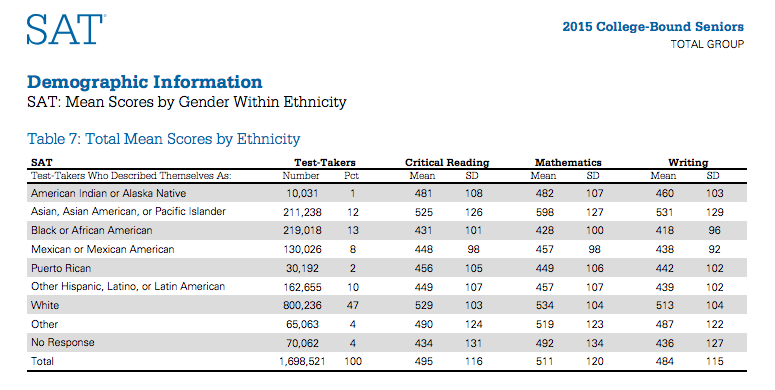
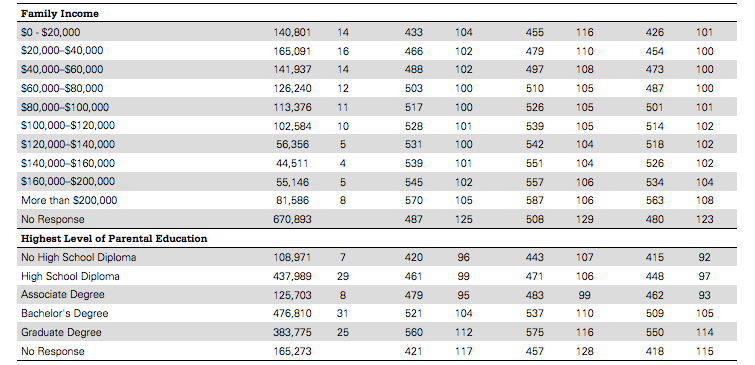
The SAT remains a fair representation of how all student scores on high-stakes standardized testing remain strongly correlated with race, social class, parental education levels, and gender. See for example from the 2015 SAT:

2015 SAT ethnicity

2015 SAT fam income lev edu

Therefore, in virtually all high-stakes standardized data sets, we find that being affluent, white, and male correlate strongly with high scores while being poor, of color, and female correlate with low scores.

Therefore, when we ask why do some (a few) high-poverty students excel while most do not, we could just as easily ask why do some (a few) wealthy students score low when most do not. And these are in fact the same question for a couple of reasons:

  • Poor students with high test scores and affluent students with low test scores are statistical outliers, and thus, provide little descriptive power for making decisions about the general populations of students. [As I cannot stress this enough, please reread that sentence until you get it.]
  • The question about why do some low-income students excel is a loaded question (and that we do not ask the parallel question about the few affluent students who score low is telling) because the real intent of that question is to suggest that student achievement is mostly controlled by the student, her/his teacher, and her/his school. Therefore, by isolating why some low-income students excel, we would be able to “fix” the majority of low income students, their teachers, and their schools.

This second point is huge, and complex, because it is deeply flawed in its essential implication. Student achievement remains in the U.S. a stronger indicator of social realities than student effort/ability, teacher quality, or school effectiveness.

That stated, could student achievement be positively impacted by addressing individual student qualities, teacher quality, or school effectiveness? Of course, and what education reform is attempting in these areas continues to be more harmful than helpful.

For example, charter schools and Teach For America are increasing educational inequity for the vulnerable populations of students (greater segregation and assigning low-income students of color beginning teachers without adequate training).

Now, if I return to the Twitter debate, yes, there are high-quality researchers looking at why low-income students struggle and achieve (see Sean Reardon here, here, and here), but the fundamental question about comparing success and failure within low-income student populations is an inherently flawed process that focuses our gaze almost exclusively on individuals while giving systemic forces a pass—the exact systemic forces that account for the greatest percentage of the scores we use to claim success or failure.

That social class, race, and gender are predictive of student scores on high-stakes standardized testing is not fatalism (using those characteristics as an excuse to do nothing), but a call to shift proportionately our questions to both systemic and individual sources for why some students excel and some struggle in formal schooling.

Race, class, and gender inequity in our society drive low test scores for many students—students who are then too often mis-served by inequitable school practices and policies such as tracking, teacher assignments, and discipline codes.

Why do some high-poverty students excel academically while most do not is one hell of a complicated question. But in most cases, it is the wrong question because of the misguided implications at its root (discussed above) and we remain unwilling to address social inequity and continue to use inequitable tools (high-stakes standardized tests) that create the very gaps we claim we want to close.

We need to prioritize questions about our broken systems before we can even begin to assess why individual students compare differently than their peers—and even then, outliers will never serve as valid gauges for all students.

Understanding Poverty, Racism, and Privilege Again for the First Time

Once again, predictably, when my South Carolina should focus on education opportunity, not accountability was published at The State, comments included convoluted arguments demonizing people who are poor while discounting racism because “I was poor but I worked hard and succeeded” (this last claim invariably comes from a white person who is oblivious to the example proving the power of white privilege even against the weight of poverty).

Recently, as well, Teaching Tolerance confronted Ruby Payne’s poverty industry that speaks to and perpetuates stereotypes about poverty, race, and privilege (see here for research discrediting Payne’s work).

My public work addressing poverty, race, and education consistently reinforces that political leaders, the media, and much of the public in the U.S. suffer corrosive and inaccurate views of poverty, race, and privilege—stereotypes that are incredibly powerful.

When I argue about the need to address poverty directly, many respond by claiming anyone can succeed if she/he simply works hard enough. When I argue about the need to address racism, many concede poverty is burdensome, but add that racism no longer exists—again, people of color simply fail to take advantage of the opportunities all people have in the U.S.

Despite the great potential of social media and online publications with commentary (a way to democratize whose voices matter), those open forums allow anyone to respond un-vetted and perpetuate one of the great failures of public debate—arguing a single example proves or disproves a generalization: One black person excelled means there is no racism; “I was poor but” proves everyone has an equal opportunity.

Evidence appears ineffective against stereotypes—the illogical and irrational—but I invite you to step away from your assumptions and understand poverty, racism, and privilege again for the first time.

Focusing on poverty, the most enduring myths include some of the following (see the reader below for ample evidence disproving each):

  • Adults and children living in poverty somehow deserve that condition because they do not work hard enough, lacking the “grit” that successful people have.
  • The impoverished struggle because of their inferior literacy skills, often referred to as the “word gap.”
  • The culture of poverty is the result of a number of qualities among the poor, and thus, it is up to the poor themselves to break that cycle.
  • Poverty is a sham because of a number of common sense observations: the impoverished often seem to be obese and many people in poverty still own things (TVs, cars, cell phones).
  • The poor are prone to criminal behavior and substance abuse.

Research, however, refutes and discredits all of these.

One of the most powerful ways to reject false narratives about the poor is to consider that in the U.S., the cheapest foods are high in fat and processed sugar; and thus, it is a matter of practicality that the poor tend toward obesity.

Good health and safety are more expensive—shopping at Whole Foods or purchasing a car with added safety features—and thus both are accessed more easily by privilege.

Yet, we are a people stuck in false narratives about meritocracy and rugged individualism.

To understand poverty, racism, and privilege, however, systemic dynamics such as slack and scarcity must be examined. Sendhil Mullainathan and Eldar Shafir in their Scarcity: Why Having Too Little Means So Much examine the research base that shows the same person behaves differently under slack and scarcity.

Privilege begets privilege because slack allows a great deal of room for failure, and poverty begets poverty because the margins are so tight that irrational behavior seems rational.

But, again, these dynamics are the result of the conditions and not inherent qualities in individuals.

Below I offer a reader because the facts about poverty, racism, and privilege are dramatically different than the false narratives we live with in the U.S. For even good people with good intentions, the myths are hard to set aside.

A Reader: Understanding Poverty, Racism, and Privilege Again for the First Time

Scarcity: Why Having Too Little Means So Much, Sendhil Mullainathan and Eldar Shafir

George Saunders’s Allegory of Scarcity and Slack

Miseducating Teachers about the Poor: A Critical Analysis of Ruby Payne’s Claims about Poverty, Bomer, et al.

Pathologizing the Language and Culture of Poor Children, Curt Dudley-Marling and Krista Lucas

Savage Unrealities, Paul C. Gorski

The Myth of the Culture of Poverty, Paul C. Gorski

Problematizing Payne and Understanding Poverty: An Analysis with Data from the 2000 Census, Jennifer C. Ng and John L. Rury [pdf]

The Culture of Poverty Reloaded

The State: South Carolina should focus on education opportunity, not accountability

The State: South Carolina should focus on education opportunity, not accountability

[original unedited submission below]

Former Governor and Secretary of Education Richard Riley established South Carolina as one of the first states to move education reform to the top of any state’s agenda. That journey for our state is now three decades-plus old, and political leaders, the media, and the public remain unsatisfied with our public schools.

With the No Child Left Behind (NCLB) era behind us and the newly passed Every Student Succeeds Act (ESSA) now returning a great deal of power to states for school reform, The State has called for SC to recommit to accountability, warning: “[R]emoving that oversight provides a tremendous temptation for states to lower the bar. We must not let that happen in South Carolina.”

My entire 34 years as an educator in SC has been during the accountability era in which the state has changed standards and high-stakes tests five or six times each. While I agree with The State’s editorial that the transition from NCLB to ESSA is a great opportunity, I caution about doubling down on accountability.

First, SC political leaders, the media, and the public must finally confront that our public schools are a reflection of the tremendous burden of poverty on children and families in our state. The schools along the Corridor of Shame (the I-95 corridor) as well as other pockets of high poverty across the state present us with a very disturbing lesson that school reform alone has never worked, and will likely never work.

Across the U.S., in fact, accountability based on standards and high-stakes testing has failed in both fifty different experiments and the more recent national effort with Common Core. The quality or even presence of standards and high-stakes tests has never produced higher student achievement or closed the so-called achievement gap between wealthy and poor students or racial minorities and whites.

The greatest education challenge, then, facing our state is addressing poverty and racism in our society so that education reform has a chance to succeed. Without adopting policy that deals directly with stable jobs with adequate pay and benefits, healthcare, childcare, and an equitable criminal justice system, our schools are destined to continue to struggle.

Next, we need to reconsider entirely education reform—not based on accountability but on equity of opportunity.

Labeling and ranking our schools—whether we use more than test scores or not—has been harmful, and it is past time to consider another process. As Bruce Baker, Professor in the Graduate School of Education at Rutgers, and researcher Gerald Bracey have argued often, educational rankings tend to reveal more about conditions outside of the school’s control than about the quality of education. Overwhelmingly in all types of educational rankings the greatest predictor of high or low rankings is wealth or poverty.

However, The State actually hits on a better alternative: “But the focus must remain on the core function of the schools: providing all children in this state the opportunity to receive a decent education, of the sort that will allow them to become self-supporting, productive, taxpaying citizens.”

Equity of opportunity must replace accountability in SC—although this doesn’t mean lowering expectations or absolving schools or teachers from their responsibilities to students and the state.

What I propose is transparency about the opportunities to learn that all students are receiving in the context of social programs that help every student enter the doors of those schools on much more equal footing than they have historically or currently.

Those equitable opportunities must include for all students access to experienced and certified teachers, open door policies for challenging courses and programs (such as Advanced Placement and International Baccalaureate), and equitably funded schools and facilities across the state. As well, we must end inequitable disciplinary policies and outcomes, tracking, and harmful current policies such as third-grade retention based on reading scores.

But grading and ranking schools must end as well.

A hard reality of teaching is that we can never guarantee outcomes; students ultimately, if given the conditions in their lives and schools to succeed, are responsible for learning. Schools and teachers are responsible for making that learning possible.

Accountability has not worked for thirty-plus years. The hard question now is: Have the adults learned that lesson and are they prepared to try something different?

See Also

Addressing Teacher Quality Post-NCLB

Now What?

Additionally many educators no longer feel a sense of responsibility for engaging difficult questions because educational institutions reward them for avoiding controversy and confirming the status quo.

The Answer is Not at the Back of the Book, Seneca Vaught

19 January 2016. It is the day after the official holiday commemorating Martin Luther King Jr. and MLK’s actual birthday—a span of days blanketed with tributes as well as every conceivable way one man’s words and legacy can be twisted to suit a need.

MLK Day 2016 passed in the wake of #ReclaimMLK, #BlackLivesMatter, and #OscarsSoWhite (just to note a few), and now we walk and talk through the days before Black History Month.

Now what?

MLK Day and Black History Month are mostly so much tokenism and appropriation—or better phrased misappropriation.

As the #ReclaimMLK movement has emphasized, MLK has become a whitewashed martyr, a passive radical serving the purposes of the privileged.

I began teaching the radical MLK over thirty years ago, along side Booker T. Washington, W.E.B. Du Bois, and Malcolm X as well as Gandhi. Eventually I added Howard Zinn’s People’s History.

This was in rural upstate South Carolina in the 1980s and 1990s. This was not a popular or easy thing to do. But it taught me some valuable lessons as a privileged white male.

Race, class, and gender are irrefutable markers for privilege and oppression, but those markers are not the roots of that privilege and oppression.

Privilege is about ideas, privileged ideas.

MLK the passive radical is allowed because sanitized ideas are safe for those in power. The real MLK, radical anti-war, radical anti-capitalism—these ideas are not allowed, remain purposefully muted.

As Arundhati Roy has explained, “We know of course there’s really no such thing as the ‘voiceless’. There are only the deliberately silenced, or the preferably unheard.”

Now what? is informed by the Bill Cosby problems—and yes, I mean plural.

The Cosby sexual predator problem has taken years to rise through the Cosby problem deliberately silenced, and preferably unheard: Cosby’s sit-com fame and popularity as a public black-shamer.

Cosby thrived and survived his own demons in part because despite his surface markers of disadvantage, he was embraced for his ideas, ones that conformed to the messages of the privileged class—boot straps and all that.

And it is no stretch to note that the silenced and unheard Cosby problem has been replayed when Hillary Clinton (against her burden of gender) received applauds for her “what if white people suffered as black people do” stump speech.

Yes, there is privilege in all its blindingly white light like the myopic #AllLivesMatter.

What if a free people refused to tolerate anyone’s indignity remains silenced, unheard.

Privilege is an idea, a series of ideas—ones that can be and are voiced by a wide variety of people who look like privilege and look like oppression.

If we want to embrace MLK as a martyr for a color-blind society, we must admit that privilege feeds on seeing, but wilts under the scrutiny of listening. It is not that we should not see race, class, and gender, but that we must listen to the messages behind what we see.

Privilege twists MLK into a cartoon and builds walls around anyone willing to tell the story.

Privilege does not want to hear that equal rights do not mean equal opportunity.

Privilege is threatened by critical education, critical media, critical citizens.

“The purpose of history is not to confirm the answers,” Seneca Vaught explains, “but to challenge the assumptions and raise new questions about the past that relate to the present.”

19 January 2016. A week and a half before Black History Month 2016.

Now what?