Category Archives: privilege

False Equivalence in Black and White

It is well documented that marriage has many benefits for any person, including economic, health, and longevity [1]. Divorce, then, should pose a question about the consequences to both parties.

Even in cases of 50/50 settlements of divorce, an important dynamic exists:

Ultimately, the overall economic quality of a man’s life, based on earnings and amount spent on living expenses, increases after his divorce. He continues to earn more but bears fewer family expenses. The overall economic quality of a woman’s life, post-divorce, decreases. (Rosen, 2009)

While the factors in this inequity are complicated, they are all under a clear difference in gender: after a divorce men retain male privilege and women continue to suffer the consequences of misogyny and sex discrimination (both of which may be mollified or masked while a woman is married).

This example allows us to wade into how people often assume equivalence between two situations or arguments that appear superficially equal; that assumption is a logical fallacy known as false equivalence.

Discussions of logical fallacies, I believe, often feel as if they are much ado about nothing, or merely academic—the stuff of college composition, rhetoric, and philosophy courses.

However, the careful naming of ways people think and communicate are witnessed daily in how we live; currently, the destructive power of false equivalence is on display in the wake of the violence spurred by a white nationalist rally in Charlottesville, VA.

One of the most bitter aspects of the U.S. as a current state of Trumplandia is the racial animosity emboldened by Trump, what has been characterized by the mainstream media as white pain or white angst (often oversimplified and whitewashed as working-class pain and angst).

Just as gender distinguishes the consequences of divorce, in the U.S., socially constructed race distinguishes pain and angst.

To be blunt, white pain simply is not equal to black pain since blacks carry daily the inequity of race through their lives while even struggling whites maintain some aspects of white privilege—just as men carry their male privilege even in challenging situations such as divorce.

The false equivalence, then, created with political and public speech about “all lives” or “both sides” or “many sides” fails to address the substantive differences, for example, in Black Lives Matter (BLM) protests (or Colin Kaepernick’s kneeling) from the white nationalists’ rally in Virginia over the removal of a Confederate monument.

BLM and Kaepernick are protest against inequity and calling for integrating all people into the same privileges that whites experience. White nationalists are railing against a false loss (symbolized by the removal of an offensive statue that represents oppression) and promoting racial inequity and segregation.

Again, simply put, two protests are not equal simply because they are protests, and one (BLM) has a moral imperative and a goal of expanding equity while the other (white nationalists) is clinging to an inequitable status quo and a romanticized oppressive past.

Just as expanding the marriage equities to gays never took anything away from advocates for so-called traditional straight marriage, expanding the promise of a just and equitable U.S. to everyone regardless of identity is not some assault on or removal of America but a long overdue path to fulfilling of America.

White nationalism in all its forms—from “Make America Great Again” to the most virulent Neo-Nazis and the KKK—is a plague on the U.S. It must not be equated to demands for equity in our justice system and liberty for all, which are the goals of BLM and counter-protests to white nationalism rallies.

The only thing whites are at risk of losing is their privilege, the false advantages of race that currently disadvantage people of color, the “peculiar benefits” Roxane Gay confronts that work invisibly to those who enjoy them:

We tend to believe that accusations of privilege imply we have it easy and because life is hard for nearly everyone, we resent hearing that. Of course we do. Look at white men when they are accused of having privilege. They tend to be immediately defensive (and, at times, understandably so). They say, “It’s not my fault I am a white man.” They say, “I’m working class,” or “I’m [insert other condition that discounts their privilege],” instead of simply accepting that, in this regard, yes, they benefit from certain privileges others do not. To have privilege in one or more areas does not mean you are wholly privileged. To acknowledge privilege is not a denial of the ways you are marginalized, the ways you have suffered. Surrendering to the acceptance of privilege is difficult but it is really all that is expected.

White nationalism is a denial of white privilege and a calloused clinging to the injustice and inequity that are represented by the monuments and flags white nationalists protect and flaunt.

Black Lives Matter and white nationalism are both bound by race, but they are in no way equal—the former is a call for equity and justice for all and the latter is the gross necrophilia clutching the ideologies that bred the Holocaust and American slavery.

False equivalency is a master’s tool, a rhetorical lie to distract a people from the hard but good work recognizing the unity of all humanity.


[1] Note that this may also be more about gender inequity, however.
Reaping What We Sow

Do not be deceived: God cannot be mocked. A man reaps what he sows.

Galatians 6:7

Today marks about a month spent navigating between two polar worlds of responsibility as I approach 60 in a few years.

My two grandchildren live with me and I often provide care for them. I also now visit my mother every day as she recovers from a stroke in a rehabilitation facility where my father died just over two weeks ago.

My three-year-old granddaughter and mother, in fact, are sharing a similar journey with language—uttering smalls bursts of distinguishable speech among strings of mostly gibberish.

Watching my father’s declining health and death along side my mother’s unexpected stroke and painstaking recovery, I have experienced more directly what I have known most of my adult life: medical insurance, Medicaid, Medicare, and Social Security are frail and inadequate sources for basic human dignity.

But these realities are shared daily by millions of people discarded in the U.S. where we simply have no interest in being a Christian nation or a charitable people. No, we prefer Social Darwinism and burying our heads in the sands of the free market and consumerism.

“Consumerism,” in fact, is the perfect and disturbing metaphor for our self-defeating beliefs and practices.

And that brings me to the ugly facts I have been confronting about my parents for nearly four decades.

My white working-class Southern parents are the poster children for the manufactured angry white working-class voters accused of electing Trump [1].

I grew up in a home aspiring to the American Dream of middle-class materialism, and my parents mostly worked themselves to death to cobble together that illusion.

Hand-in-hand with my parents being whitewashed model Americans was their unbridled racism, unquestioned self-loathing of their impoverished/working-class heritage, jumbled conservatism, and lifelong voting as Republicans.

As I watched my father die and patiently encourage my mother climbing out of the dark hole of her stroke, I have often thought that they certainly deserve so much better than what the end of their lives has brought.

But I also recognize that they were both willing and eager agents in their own misfortune—so damned inspired by racism and fear that some poor person might receive something without working that they cut off their own noses to spite their faces.

The acidic irony in all this is that my parents, especially my father, imprinted on me a manic work ethic grounded in the unspoken bromide “we reap what we sow.”

Work hard and you are rewarded, my parents believed, but half-ass and you will suffer.

The inverse message, the very ugly inverse message, of course, is the false conclusion that those who suffer and fail deserve the suffering and failure due to their sloth.

If we could somehow recreate Our Town so that my 20- or 30-something father could have watched his last days sitting beside my disabled mother, would he have reconsidered his life and what he believed?

But even that isn’t the solution, of course.

To know that what you do and believe has consequences for yourself ignores that we lack in the U.S. any sort of compassion for others, especially others we perceive as unlike us.

We don’t even believe in or practice a belief that all children are innocent, deserving safe and healthy lives that provide them opportunities at the promises the U.S. pretends to embrace—life, liberty, and the pursuit of happiness.

The paradox of my life is that my parents gave me incredible advantages and a loving idyllic childhood—a childhood abruptly marred as I worked through my teen years and entered college, resulting in my rejecting virtually everything my parents believed.

I certainly do not cling to some delusion that cosmic justice exists for the righteous and the careless.

I also know that social equity and justice are almost entirely rhetoric of the privileged to maintain their privilege.

None the less, I want to believe that my parents deserve better than what they have reaped, regardless of the seeds they planted.

That basic human dignity is not merely something we have to earn by being faithful workers or unquestioning patriots or cooperative citizens.

I want to believe that we should chose to extend compassion, kindness, and material comfort even to those who have spent their lives denying that to others.

Be the kindness and charity you want to find in others.

I sat with my mother yesterday as she rambled on—I eventually figured out—about her therapy, which is frustrating her. She is terrified and confused about having lost the ability to talk, convinced she will never regain the words.

My nephews and I have explained to her repeatedly that she had a stroke from a blood clot, but she keeps thinking she had a tumor.

The words that did come out as she waved her hands wildly gesturing through the therapy were “dumb, dumb, dumb.”

It sounded like my granddaughter’s misguided “I’m sorry” when she fears she has done something wrong, but hasn’t.

“Mom, you’re not dumb,” I said at her smiling and shaking her head. “You just have to relearn everything you have lost.”

What else, I wonder, is a son to do?


[1] A false claim masking that wealthy whites overwhelming drove Trump’s victory.

Freedom, Choice, and the Death of Us

“they did not stop to think they died instead”

“‘next to of course god america i,'” e.e. cummings

Over the course of a couple hours after my mother was discovered comatose, the ER doctor offered us a choice: airlift my mother to a larger hospital for surgery to remove the clot in her brain that caused her stroke or leave her comatose, each moment destroying more of her brain.

Just twelve days later, in front of my mother then in a rehabilitation facility after responding well to the high-risk surgery,  my father became unresponsive; the EMS team summoned by a 911 call were frantically trying to resuscitate my father, kept alive by his pacemaker/defibrillator. Since my father had resisted switching off the defibrillator and choosing a do-not-resuscitate (DNR) order, the lead EMS responder asked me where I wanted him to be transported.

Because of the proceeding days when we all scrambled against my parents’ health insurance, my first thought was how was I to know where his insurance would cover this event (ultimately the last moments of his life).

While cycling on the local rail trail near my university and where my mother now remains in a single room—the building in which she witnessed my father’s death—a friend and I pedaled up to a road crossing where a father sat on his bicycle with a trailer attached for children to ride along.

This intersection has decorative circles of brickwork on each side of the road. As this man crossed, he steered poorly around the brickwork—the cart left wheel rolling up onto the brick, tipping the cart and his two sons over onto the side of the trail and jerking the bicycle out from under the father.

These are all complicated and difficult stories about choice and freedom in the U.S.

The U.S. is a cruel and calloused culture that values a false narrative about freedom and choice, an idealized version of freedom and choice as concepts that trump all else.

Even human dignity.

Even life.

Especially in healthcare, education, and providing social support for the poor, the guiding principle is giving people choice, believing that individual responsibility is the root cause of poor health, failing students and schools, and finding oneself in poverty.

The meritocracy and rugged individualism myths are so powerful in the U.S. that winners and losers both cling to them even when the game is revealed to be fatally rigged. As Tim Maly explains:

So there are people who can be so wrapped up in a certain worldview that even in the face of serious evidence that they have been taken in, and despite many warnings from the rest of the world, they persist. Indeed, warnings from the rest of the world seem to serve only to entrench them in their position. With some of them, it’s as if they end up making bad choices specifically to spite the people warning them.

The U.S. has instilled a tremendous amount of self-loathing, in fact, among marginalized groups (blacks, English language learners, women) who feel compelled to embrace the bitter American Dream in order to be American—even as each of them could utter as Langston Hughes wrote:

Let America be America again.
Let it be the dream it used to be.
Let it be the pioneer on the plain
Seeking a home where he himself is free.

(America never was America to me.)

The parent cycling with his children in tow was free to choose placing those boys in the trailer, free to choose to pedal along the trail and then to send them tumbling.

And there we must admit, parental choice is not universally a good thing, and we must also confront that anyone’s choice necessarily encroaches on the freedom of others: children routinely suffer the consequences of their parents’ choices.

The children were fine, however, but my mother and father—along with our family—have been navigating a hellscape of healthcare dictated by patient choice and freedom, jumbled with a nightmare of bureaucracy in which mandated and bounded choices are not really choices at all.

In the U.S., we celebrate the choice between a Toyota Camry and Honda Accord (essentially the same car with the free market promise of competitive prices in your local market!), but few people are afforded the freedom of not buying a car at all—and no one is allowed the freedom from sales and property taxes or freedom from insurance and liability for all that driving.

Freedom and choice are in fact a nasty shell game used to keep the masses occupied so that they do not realize only the few have some sort of economic freedom and choice because of the labor of those masses, those people drawn to the myths like moths to a flame but never allowed to survive the allure.

It’s July 4th, a patriotic orgy in the U.S. that is as shallow and materialistic as the country we celebrate.

A people truly committed to equity and our moral obligations as humans would recognize that sometimes, maybe even often, choice and freedom are not as important as insuring that no one needs to choose because essentials are collectively provided for everyone to insure the dignity of simply being a human.

No child left to the lottery draw of their parents, no sick person tossed into the meat grinder of market-based healthcare, no elderly cast into the dark well of individual responsibility.

As we wave tiny plastic flags today, swill (mostly) cheap beer while overeating from our decadent grills, let us roast in the sun and the recognition that we actually have freedom and choice—and this heartless and selfish country is what we have chosen.

For Further Reading

Why poverty is not a personal choice, but a reflection of society, Shervin Assari

‘What to the Slave Is the Fourth of July?’ by Frederick Douglass

Resisting Cultural Appropriation: A Human Response to the Inhumanity of Privilege

When I posted K. Tempest Bradford’s argument “that cultural appropriation is indefensible,” the first comment I received (from a white man) suggested cultural appropriation is unavoidable, mostly discounting Bradford’s challenges.

Once I replied, the same person added: “The solution is to change the power relationships, not to erect artificial cultural walls.”

First, when so-called racial minorities speak against inequity, whites often fail to listen, shouting over or offering the condescending “yes, but”—in the same way men correct and marginalize when women confront sexism and misogyny.

In the situation above, the typical white male moderate or even self-proclaimed progressive response is at play, something like “Let’s work toward a color-blind society!”

This ploy fails on several layers.

As noted already, it fails because the response replaces a willingness to listen, to value the perspective, and then to act in alliance.

But more broadly, the premise is also flawed because the goal is not to be a color-blind society or to eradicate cultural (or racial, or gender) walls, but to make our identifiable differences worthy of equal celebration and to insure that those differences never stand as markers for injustice, inequity, and dehumanization.

As Bradford asserts, cultural appropriation must always be resisted because the U.S. is a capitalistic and materialistic society in which each person’s dignity and the humanity of that person are inextricably tied to any identifiable group with which they are connected.

Further, the U.S. remains incredibly inequitable and unjust along race, class, and gender lines (among others).

Entertainers such as Elvis or Pat Boone at mid-twentieth century, for example, were allowed to benefit and profit greatly on the musical styles of blacks who were directly excluded from the same financial and entertainment opportunities.

More recently Vanilla Ice and Eminem represent the lingering power of cultural appropriation despite the Civil Rights movement and greater access to wealth and fame by blacks.

And the entrenched negligence and insensitivity of sport mascots—such as the Washington Redskins or Florida State Seminoles—stand as bold symbols that white privilege continues to trump genuine appreciation of diversity and essential human dignity within capitalism.

One key point in this debate, however, is understanding the basic human response to cultural appropriation among marginalized and oppressed groups.

For those marginalized groups to cling to and defend their culture is a human response to the inhumanity of privilege.

Blacks, for example, are still daily told that they as humans do not matter as much, do not count as much as whites (lower pay even with equal experience and education, greater incarceration without greater criminality, disproportionately higher rates of being shot and killed by police, etc.), and then, elements of black culture routinely are appropriated by whites as long as whites benefit and profit.

Throwing Shade in 2017 as a TV show hosted by two whites?

If we dig deep enough, we may well have to face that beneath racism and cultural appropriation we will unearth that capitalism is the root of all evil—monetizing everything above human dignity.

As long as we allow our larger culture to be grounded in the amorality of capitalism and materialism (supply and demand trumps ethics or morality), then we are doomed to inequity and injustice, in the form of racism, sexism, classism, etc.; those individuals and groups suffering that inequity, then, must reach for their humanity and dignity by clinging to that which the dominant group deems valuable.

If tearing down “artificial cultural walls” is a valid goal (and I am skeptical it is), then the only truly progressive response by those with race and gender privilege is to listen to those who resist cultural appropriation (and all inequity), to accept that resistance, and then to offer their privilege in solidarity to end the injustice—not to shout over or offer yet another bitter “yes, but.”

Reader 22 May 2017 [UPDATED]: Connecting Dots

Why people are rich and poor: Republicans and Democrats have very different views

See: UPDATE 21 (20 May 2017): Grit, Education Narratives Veneer for White, Wealth Privilege

Minorities Who ‘Whiten’ Résumés More Likely to Get Interview, Michael Harriot

“Whitening” is an all-encompassing term for when prospective employees scrub their résumés of anything that might indicate their race. Applicants with cultural names will sometimes use their initials. Community or professional work with African-American fraternities, sororities or other organizations are deleted. One student omitted a prestigious scholarship he was awarded because he feared it might reveal his race.

Although the practice sounds demeaning and reductive in the year 2017, apparently it works. In one study, researchers sent out whitened résumés and nonwhitened résumés to 1,600 employers. Twenty-five percent of black applicants received callbacks when their résumés were whitened, compared with 10 percent of the job seekers who left their ethnic details on the same résumés.

The results were the same for employers who advertised themselves as “equal opportunity employers” or said that “minorities are strongly encouraged to apply.”

Whitened Résumés: Race and Self-Presentation in the Labor Market, Sonia Kang, Katy DeCelles, András Tilcsik, and Sora Jun

Abstract

Racial discrimination in labor markets is a critical process through which organizations produce economic inequality in society. Though scholars have extensively examined the discriminatory decisions and practices of employers, the question of how job seekers try to adapt to anticipated discrimination is often overlooked. Using interviews, a laboratory experiment, and a résumé audit study, we examine racial minorities’ attempts to avoid discrimination by concealing or downplaying racial cues in job applications, a practice known as “résumé whitening.” While some minority job seekers reject this practice, others view it as essential and use a variety of whitening techniques. When targeting an employer that presents itself as valuing diversity, however, minority job applicants engage in relatively little résumé whitening and thus submit more racially transparent résumés. Yet, our audit study shows that organizational diversity statements are not actually associated with reduced discrimination against unwhitened résumés. Taken together, these findings suggest a paradox: Minorities may be particularly likely to experience disadvantage when they apply to ostensibly pro-diversity employers. These findings illuminate the role of racial concealment and transparency in modern labor markets and point to an important interplay between the self-presentation of employers and the self-presentation of job seekers in shaping economic inequality.


Experts: Conflicts over Confederate names and symbols likely to continue, Paul Hyde

But Thomas said school administrators should encourage student debate over historical figures such as Wade Hampton — as an important lesson in democracy.

“If we really think that public education is to prepare people to live in a democracy, children need to have experiences with democratic processes,” Thomas said. “I think this specific protest should be seen as an opportunity for students to see what the democratic process looks like, with everybody’s voice mattering. Principals and superintendents of public schools — they have incredibly hard jobs — but they are the people who have to show students what moral courage is. If administrators and teachers can’t show moral courage, how do we expect our children to?”

See: Dismantling Monuments: History as a Living Document


When Standardized Tests Don’t Count | Just Visiting, John  Warner

And yet, when it comes to marginalized and vulnerable populations within Charleston County Schools, these standardized assessments provide a rational for top-down oversight and control.

This is entirely common and predictable. “Accountability” is often weaponized against those without the means to defend themselves.

I have no wish to upend the academic culture of the Citadel over their terrible CLA scores, but maybe some of those who are willing to give our elite storied places a pass can extend the same spirit to those who have no such protections.

See Are America’s top schools ‘elite’ or merely ‘selective?’

Why The New Sat Is Not The Answer, Akil Bello and James Murphy

If anything, the discord between them is likely to grow as the College Board pursues an equitable society using a test that is designed to mark and promote distinctions.

For all the positive changes the College Board has made, the new SAT shouldn’t be counted among them. It is a test, not a solution.

Every attempt to manage academia makes it worse, Mike Taylor

The problem is a well-known one, and indeed one we have discussed here before: as soon as you try to measure how well people are doing, they will switch to optimising for whatever you’re measuring, rather than putting their best efforts into actually doing good work.

In fact, this phenomenon is so very well known and understood that it’s been given at least three different names by different people:

  • Goodhart’s Law is most succinct: “When a measure becomes a target, it ceases to be a good measure.”
  • Campbell’s Law is the most explicit: “The more any quantitative social indicator is used for social decision-making, the more subject it will be to corruption pressures and the more apt it will be to distort and corrupt the social processes it is intended to monitor.”
  • The Cobra Effect refers to the way that measures taken to improve a situation can directly make it worse.

America has locked up so many black people it has warped our sense of reality, Jeff Guo

According to a Wonkblog analysis of government statistics, about 1.6 percent of prime-age white men (25 to 54 years old) are institutionalized. If all those 590,000 people were recognized as unemployed, the unemployment rate for prime-age white men would increase from about 5 percent to 6.4 percent.

For prime-age black men, though, the unemployment rate would jump from 11 percent to 19 percent. That’s because a far higher fraction of black men — 7.7 percent, or 580,000 people — are institutionalized.

UNEQUAL ENFORCEMENT: How policing of drug possession differs by neighborhood in Baton Rouge

BR inequity

Elite or Selective?: Reconsidering Who We Educate and How

Sharde Miller’s California teen describes his road from Compton to Harvard University offers a powerful subtext about the American Dream as well as the enduring belief in education as the “great equalizer,” embodied by Elijah Devaughn Jr.:

Devaughn grew up in a single-parent household in Compton, California, a city that has been plagued by gun violence and gang activity for decades….

“Getting accepted into a prestigious university like Harvard, I think it means the world,” Devaughn said. “It means God is able. It means that hard work pays off. It means that, you know, struggles end.”

What if we unpack the label of “prestigious” by making an important caveat: Is Harvard University elite or selective?

As a point of reference, over the past three decades of high-stakes accountability in public education, schools have been annually labeled as excelling and failing; however, once we look beneath the A-F rankings, a strong and consistent correlation persists between schools identified as excelling or failing and the socio-economic status of the students [1] (as well as the racial and language demographics).

Consider also that for every year of the SAT being administered, average scores have fallen perfectly in correlation with parental income and parental years of education [2].

My university has begun gathering data to analyze our impact on students. The university is selective, having high standards for the academic backgrounds and achievements of students.

Some initial data are telling. When students with high preparation are compared to students with low preparation, extrapolating over four years of college, high preparation students are more successful and the gap with low preparation students widens during years 2 and 3 and then never closes by year 4 (year 1 and year 4 gaps are about the same).

If we persist in suggesting that education is the great equalizer (despite ample evidence education does not, in fact, equalize) and a foundational mechanism of the American Dream, we must reconsider how and why we identify any schools as “prestigious.”

Alexander W. Astin’s Are You Smart Enough? seeks to examine if our prestigious and excelling schools are elite or merely selective. Astin exposes part of the problem with labeling colleges, for example, as “prestigious”:

The “quality” or “excellence” of a college or university is thus judged on the basis of the average test score of its entering students, rather than on how well it educates them once they enroll.

What is lost in the rush to ascribe success and failure to schools is, as Astin argues, the essential charge of any formal schooling:

On the contrary, the quality of our national talent pool depends heavily on how well colleges and university develops the students’ capacities during the college years. And this mean all students.

And thus, Astin asserts: “More parents need to be asking, ‘Why should an educational system invest the least in the students who may need the most in higher education?'”

Here, then, is the dirty little secret: “Prestigious school” (K-12 as well as colleges/universities) is a veneer for “selective,” not “elite” in terms of the educational impact but in terms of the conditions at those schools.

Public universities are less selective than private liberal arts colleges, and the former experience is distinct from the latter in, for example, faculty/student ratios, class size.

In other words, more academically successful students tend to be from more affluent and well educated parents, and then are afforded higher education experiences that are identifiably superior to relatively less successful students from lower levels of affluence and education.

Reconsidering how we label schools, the “selective” versus “elite” divide, is a first step in seeking ways to turn a tarnished myth (“education is the great equalizer”) into a reality.

Too often “prestigious” and “elite” are code for “selective,” praising a college/university for gatekeeping, and not educating; too often “excellent” and “failing” are code for student demographics, ranking K-12 schools for proximity, and not educating.

Testing, ranking, and accountability in the U.S. have entrenched social and educational inequity because, as Astin confronts, “there are two very different uses for educational assessment: (a) to rank, rate, compare, and judge the performance of different learners and (b) to enhance the learning process.”

We have chosen the former, pretending as well that those metrics reflect mostly merit although they are overwhelming markers of privilege.

Let’s return to Devaughn as a rags-to-riches story.

Late in the article we learn Devaughn attended private school before his acceptance to Harvard—again bringing us back to the issue of opportunity and what we are learning at my university about well prepared students versus less prepared students.

Devaughn’s story should not be trivialized, but carefully unpacked, it does not prove what I think it intended to show. The American Dream and claims education is the great equalizer are, in fact, deforming myths.

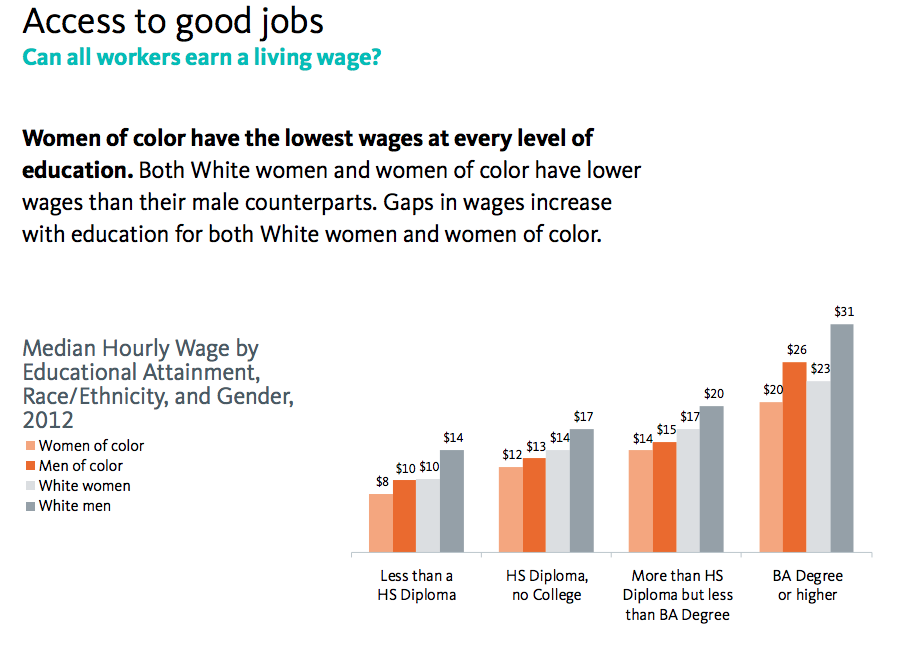
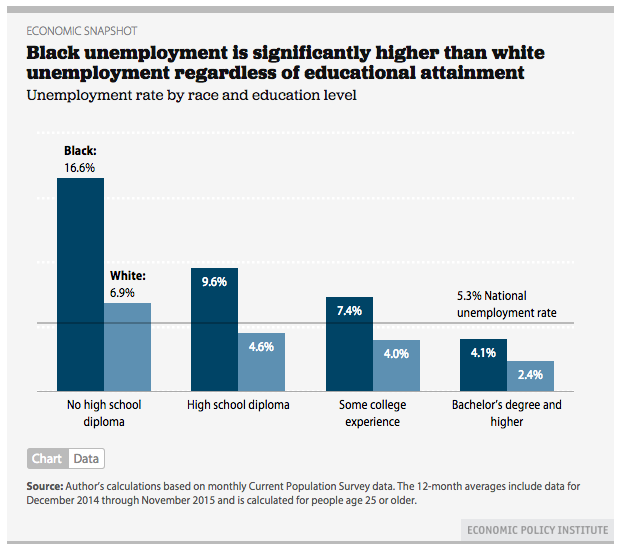
Race, gender, and the socioeconomic factors of homes and communities remain resilient causal factors in any person’s opportunities and success:

Access to good jobs

Black unemployment is significantly higher than white unemployment regardless of educational attainment | Economic Policy Institute

All schools at any level must re-evaluate who has access to the institution, and why, and then focus on what impact the educational experience has on those students. Therein must be the evidence for determining excellence and prestige.


[1] See here and here for examples in South Carolina.

[2] See The Conversation: Tests don’t improve learning. And PARCC will be no different.

Easter 2017 Reader: Grit, Poetry, Educational Rankings, Poverty

Grit

Forget Grit. Focus on Inequality, Christine Yeh (Education Week)

Grit is an easy concept to fall in love with because it represents hope and perseverance, and conjures up images of working-class individuals living the “American dream.” However, treating grit as an appealing and simple fix detracts attention from the larger structural inequities in schools, while simultaneously romanticizing notions of poverty….

Perhaps this idea of grit resonates with so many people who believe in the popular American adage that if you work hard and pull yourself up by your bootstraps, then you can achieve anything. This belief unfortunately, assumes that individuals have the power, privilege, and access to craft their own futures, regardless of circumstance and systemic barriers.

Statistics on educational access consistently reveal vast differences in resources in affluent versus poor neighborhoods. Predominantly white, middle- and upper-income school districts tend to spend significantly more money per student than the districts with the highest percentages of marginalized students. Our poorest schools also tend to have large class sizes, unsafe school transportation, damaged and outdated facilities, and high staff turnover. All of these conditions directly contribute to low educational outcomes and underscore the link between access to school resources and improvements in students’ success. Schools that focus on grit shouldn’t ignore structural inequities because they assume that regardless of your race, class, or social context you can still triumph.

Telling children ‘hard work gets you to the top’ is simply a lie, Hashi Mohamed (The Guardian)

What I have learned in this short period of time is that the pervasive narrative of “if you work hard you will get on” is a complete myth. It’s not true and we need stop saying it. This is because “working hard, and doing the right thing” barely gets you to the starting line. Furthermore, it means something completely different depending on to which context you’re applying this particular notion. So much more is required.

I have come to understand that the systems that underpin the top professions in Britain are set up to serve only a certain section of society: they’re readily identifiable by privileged backgrounds, particular schools and accents. To some this may seem obvious, so writing it may be superfluous. But it wasn’t obvious to me growing up, and it isn’t obvious to many others. The unwritten rules are rarely shared and “diversity” and “open recruitment” have tried but made little if any difference.

Those inside the system then naturally recruit in their own image. This then entrenches the lack of any potential for upward mobility and means that the vast majority are excluded.

Check out Neoliberalism: A Concept Every Sociologist Should Understand, Peter Kaufman (Everyday Sociology)

The end result of neoliberal ideology, Monbiot continues, is that we are led to believe in the myth of the self-made person:

“The rich persuade themselves that they acquired their wealth through merit, ignoring the advantages – such as education, inheritance and class – that may have helped to secure it. The poor begin to blame themselves for their failures, even when they can do little to change their circumstances. Never mind structural unemployment: if you don’t have a job it’s because you are unenterprising. Never mind the impossible costs of housing: if your credit card is maxed out, you’re feckless and improvident. Never mind that your children no longer have a school playing field: if they get fat, it’s your fault. In a world governed by competition, those who fall behind become defined and self-defined as losers.”

See Also

Failing Still to Address Poverty Directly: Growth Mindset as Deficit Ideology

SchoolED Podcast: Paul Thomas on Grit, Slack, and the Effects of Poverty on Learning

UPDATED (Again): Grit, Education Narratives Veneer for White, Wealth Privilege

“Grit” Takes another Hit (with Caveats)

Rejecting “Grit” While Embracing Effort, Engagement

Poetry/ National Poetry Month 2017

Perspective | Poet: Why I would never tell a student what a poem means, Sara Holbrook (The Answer Sheet/ Washington Post)

A few months ago I wrote an essay, “I Can’t Answer These Texas Standardized Test Questions About My Own Poems,” in which I questioned those of unknown academic distinction who anonymously compose proficiency test questions. Many teachers wrote to tell me that they too are unable to answer these vaguely written test questions being used to evaluate their students. One teacher reported that her kids had to endure 17 days of testing this year. Considering there are only about 20 days of school in a month and that every test requires preparation on the devices and manner of testing, that’s a lot of lost instructional time.

Parents wrote. I did a few television interviews and radio programs. It was my 15 minutes. Additionally, I took some heat from a (very) few academics who jumped to inform me that authors do not own the meaning of a poem, it is up to literary critics to make this determination. Good grief.

It was not my intent to kick off an argument on of the relative merit of learned literary analysis. I’ll leave that to those with letters after their names. But friends, parents, educators, learned folks, please remember, middle-schoolers are not just short college sophomores. They are not lit majors. These are kids like Paul. Kids who are often grappling with a world of unseen and sometimes unspeakable challenges.

See Also

Investigating Poetry Because We Love It (and Our Students)

In Defense of Poetry: “Oh My Heart”

“So We must meet apart”: #NationalPoetryMonth 2017 and My Journey with Emily Dickinson

Educational Rankings

Are South Carolina schools really the worst in the nation?, Cindy Landrum (Greenville Journal)

Furman University education professor Paul Thomas said the education ranking is far less about education than socioeconomics.

“This ranking is a direct reflection of political negligence,” he said. “Our schools don’t legislate. It’s not like our schools are without any fault, but how schools function is a reflection of political leadership. South Carolina is failing our children, not our children are failing school.”

U.S. News & World Report used 11 metrics to measure a state’s education ranking, including college and high school graduation rates and standardized test scores. Three of the six pre-kindergarten-12 categories are test scores (ACT and National Assessment of Educational Progress), while the others are high school graduation rates, pre-K quality, and preschool enrollment. South Carolina ranked high in quality of its public pre-kindergarten program, but ranked low in test scores and college readiness.

“Schools in South Carolina and the U.S. reflect the inequities of communities, the failure of our policies, and as a result, they are ineffective as mechanisms of change,” Thomas said.

At least 60 percent of test scores are correlated with out-of-school factors such as parental education levels, poverty, hunger, mobility, lack of health care, safety, and community resources, he said. Only 10 percent to 15 percent of test scores can be traced to teacher quality.

Thomas said it has been known for decades that poverty and inequity are the greatest hurdles for children learning. But instead of addressing the problems, instead grade-by-grade standards are changed and students tested.

“Our states have social and educational pockets of poverty,” Thomas said. “Food and home insecurity directly contribute to low academic output, and once they get into school, we make horrible decisions. High-poverty children are sitting in larger classes with early-career and uncertified teachers. We do the exact opposite of what we should be doing.”

See Also

South Carolina Ranks First in Political Negligence

Poverty

America’s Shameful Poverty Stats, Sasha Abramsky (The Nation)

But there’s a deeper significance to the numbers: how they compare with the figures from recent decades. The percentage of people in poverty is roughly the same as in 1983, in the middle of the Reagan presidency, as well as in 1993, at the end of twelve years of Reagan/Bush trickle-down economics. A far higher portion of the population lives in poverty than was the case in the mid-1970s, after a decade of investment stemming from Lyndon Johnson’s War on Poverty; and far more live in poverty today than did at the end of Bill Clinton’s eight years in office—years in which the earned-income tax credit was expanded, unemployment was kept to near-historic lows, and poverty rates fell significantly.

That our poverty numbers have risen to such a high level exposes the fact that as a society, we are choosing to ignore the needs of tens of millions of Americans—as we have done for much of the period since the War on Poverty went out of fashion and the harsher politics of Reaganism set in. These ignored Americans include kids like the ones I interviewed in Los Angeles, forced to choose between applying to college or dropping out of school and getting dead-end jobs to support parents who had lost not only their jobs but their homes, too. They include the elderly lady I met outside Dallas, who was too poor to retire but too sick to take the bus to her work at Walmart. Her solution? She paid her neighbors gas money to drive her to a job that paid so little she routinely ate either 88-cent TV dinners or went to bed hungry. They include, too, the residents of New Orleans’s Lower Ninth Ward I met in 2011, who, six years after Hurricane Katrina, were still living in appalling conditions in a largely obliterated community.

See Also

the world


Understanding Racism as Systemic and about Power

You are an hourly worker in a non-union (euphemistically called “right-work-work”) state. Your immediate boss is abusive and unfair often, but in ways that are nearly impossible to prove.

This is your first real job, and you develop a deep resentment for that boss—eventually coming to despise all bosses and people in authority.

That manager uses tactics that workers believe are abusive and unfair because the manager has decided all workers are lazy and unwilling to work without threats and constant authoritarian oversight.

The worker attitude about bosses and the boss attitude about workers are, however, not the same because of the imbalance of power.

In the beginning, I mention “non-union” because unionization grew out of a recognition that an imbalance of power (owners/bosses/managers versus individual workers) was often conducive to abusive working conditions (think Upton Sinclair’s The Jungle).

Now let’s transfer this workplace dynamic to how people (usually white people) misread racism.

Too often individuals with race or class privilege respond to charges of racism at the individual level: “What about black people who hate white people?” or “What about this white cop shot by a black man? Nobody’s making a fuss about this incident!” or “I am not a racist!”

Decades after his death—and much like the warped legacy of Martin Luther King Jr.—Malcolm X lingers in the white psyche as proof of black racism toward whites because of his “white devil” refrain.

And just as my hypothetical workplace scenario above shows, there exists, in fact, whites who reject all blacks simply for being black and blacks who reject whites for being white.

But, as with bosses and workers, several aspects of these facts expose how they are not the same.

The worker above develops antagonism for all bosses based on actually being mistreated by a boss; now this is possibly an unfair overgeneralization, but it is grounded in real evidence.

Black distrust, black anger—these are expressed in the context of real historical and current inequities that give whites privilege and negatively impact the lives of most if not all blacks.

Both white privilege (advantages not earned) and white animosity to all blacks simply for being black (what most people view as “racism”) are primarily grounded in inequitable systems and stereotypes (not credible evidence).

To make understanding racism even harder, we must try to untangle the recognition that race is not a biological fact (and thus, racial tags cannot be used as valid claims that whites are smarter or blacks are faster, etc.), but a social construct.

And here is where, despite that complexity, racism can be better understood.

Racism cannot be proven or disproven by an individual example. One white person refusing to hire one black person does not prove racism (even when it is clearly a racist act); one black man shooting a white police officer does not prove “reverse racism” or disprove racism.

This individual-gaze has made examining racism and admitting racism a persistent social problem in the U.S. Barack Obama being elected president was never proof of a post-racial society because one event cannot prove (or disprove) a systemic reality.

We are left then with some important elements to understanding—and thus, for many whites, resisting and denying—racism.

Racism is systemic, and while race is not a biological fact, it is a social construction that can be relatively easily managed (we can usually see race, or most people believe they can).

That “believe” is important because racism remains a reality because it, like privilege, works mostly in invisible ways.

Yes, some people remain overt in their oafish racism—the KKK, etc.—but most racism occurs along with privilege without people making conscious decisions to be racist (since virtually everyone is aware that “racism” is a negative behavior) or consciously benefitting from their privilege (a person inherits money or parents secure him a nice profession, after which that person genuinely works hard and is very successful; for that person, the initial privilege is invisible).

So let’s think of another parallel: While men certainly can be raped and physically abused just as women can, virtually all women walk around with a pervasive sense of threat to them physically and sexually because men tend to be physically bigger and stronger but also disproportionately have more power and wealth—while men rarely consider the threats of rape or violent attack.

And this is where understanding racism raises the central element of power.

Systemic racism in the U.S. is exclusively white power over black and brown people—just as sexism is exclusively men’s power over women. When black or brown people hate or demonize whites, this is racial, but not racism because black and brown people lack the systemic power to create the large scale consequences that whites can and do for black and brown people.

Despite being well educated, black women in the U.S. on average earn less than white males because of systemic and inequitable forces, racism and sexism.

Just as we can prove and should be able to see sexism in domestic violence data, rape culture, and inequitable workplace pay and promotion, we can prove and should be able to see racism in access to all sorts of opportunities in the U.S. (education, work), inequitable incarceration rates for blacks and shootings by police, and disproportionate underrepresentation in positions of authority.

Denying racism—as with proving racism—cannot be accomplished at the individual level and and cannot be treated as if race is the singular element in racism.

Racism is systemic and about imbalanced power dynamics that can be correlated with socially constructed racial categories.

Privilege and power are inequitably pooled among white straight men, and thus, a key to eradicating all types of inequity—racism, sexism, homophobia, etc.—is for anyone with privilege to resist denying inequity, especially by focusing on individual examples and by ignoring the central role of power in all types of inequity such as racism.

When confronted with claims of racism, then, “I am not a racist” fails, turning all of the gaze onto the self and thus failing to see—leaving racism both invisible and corrosive.

Dear People with Privilege: On Freeing the Pelican

The first men to deny sexism are sexists themselves; the first white people to deny racism are racists themselves.

One of the profound tensions of the U.S. is that the country founded on the ideals of individual liberty—life, liberty, and the pursuit of happiness—was in fact built by sexists and racists. This is no easy or comfortable contradiction.

We have settled into an ends justifying the means narcotic as a people to avoid that contradiction.

The great praise the U.S. does deserve (although not unique to the U.S.) is the concept of pursuit; a great many people have pursued and continue to pursue the elusive equity of our founding principles.

To identify, admit to, and then confront racism or sexism, we must reach to the people with the most power in the country—white men, who believe they have earned that power, their success.

Racism and sexism are not mere abstractions because some people must be complicit in the perpetuation of both.

Even among the victims of racism and sexism, we find people complicit, but the main people responsible for our failures in the pursuit of equity are the ones with the most power, power gained from privilege.

Most of us, then, when confronted with the ugliest truths of racism and sexism immediately tell our stories of struggle: “I cannot have privilege,” we proclaim, “because I have struggled!”

So consider the invisibility of privilege to those with privilege.

You buy a pair of Nike shoes, and if someone asks you if you are for child labor or slave wages for women forced to work in cramped factories as their homes, you are very likely to strongly reject being for those abstractions—while wearing the shoes made in horrifying conditions for women and children workers earning slave wages.

The problem of privilege is that most of us with privilege are complicit through negligence, not through conscious decisions to oppress.

Consequences, however, make those distinctions irrelevant.

As Roxane Gay navigates wonderfully in Peculiar Benefits, many people have contexts within which they have privilege, unearned advantages—even people for whom much of their life is spent as the victim of other people’s privileges.

And white heterosexual men can struggle mightily in life, even as we celebrate the apparent success of a black homosexual woman.

Outliers are some of the most powerful blinders for confronting privilege.

But I believe I can offer here a simple test.

First, to admit to having privilege is not opening yourself to scorn; the fact of having privilege is not justification for condemning anyone.

From there, then, we must move to the key question: What do you do with your privilege(s)? Perpetuate your own needs and desires? Or use your privilege(s) in the service of others who are oppressed, who are victims of other people’s privileges?

Some tests include whether or not you acknowledge your own and systemic privilege (racism and sexism, for example), and then if or not you develop an ability to feel compassion for anyone who is struggling, recognizing that human failure may often be the consequence of systemic forces and not individual flaws.

This last point is important. Racism, for example, persists because as a culture, people in the U.S. have made the default stance about human struggle and failure to be flawed individuals: People who succeed, we assume, worked hard, and people who struggle and fail, we assume, are lazy.

Each of us must come to acknowledge our privilege(s) and proceed with the understanding that systemic inequity is the root cause of individual struggle and failure.

To use your privilege in the service of others [1] even when that act creates risk for you and especially when that act works to dismantle the privilege that allows you to serve others.

A picture (or in this case, a video [2]) is worth a 1000 words, so let me end by suggesting, this is what it looks like to acknowledge your privilege, to identify those who suffer inequity, and then to act in the service of that other:


[1] To serve others, as well, must avoid paternalism. It is not substituting arrogance for your privilege in order to save those who are lesser than you; it is seeking out anyone without your privileges and then asking, How may I help you?

[2] Too often, when confronted with systemic inequity (racism, sexism, etc., represented by the fishing line on the pelican’s beak), people either refuse to acknowledge the fishing line, blame the pelican for being in the situation that caused the line tangle, or argue, “I didn’t put the fishing line around the beak.” Yet, we are complicit if we fish (even carefully), eat fish, or if we do nothing while aware of the dangers of fishing for pelicans and other animals—even if we believe we are compassionate to or hold no prejudice against pelicans.

See Also

Montclair SocioBlog: The Winds of Privilege

Toxic Masculinity, Predatory Men, and Male Paralysis

How can anybody know
How they got to be this way?

“Daughters of the Soho Riots,” The National

This is my sixth decade as a human, as a white, straight male.

Here I want to attempt confession, possibly seeking greater understanding, but fully aware of the huge complexities of making these claims, raising these personal struggles in the context of my many privileges.

I am treading lightly but committed to rise above the problematic satire of Ben Folds’ “Rockin’ the Suburbs”—which both speaks to me and makes me cringe:

Let me tell y’all what it’s like
Being male, middle-class, and white
It’s a bitch, if you don’t believe
Listen up to my new CD

My formative years over the 1960s and 1970s were spent in the redneck South. Just as I was reared to be a racist, I was taught very clearly to objectify women, even as that was tempered in my immediate family by direct and indirect messages about respecting and loving women/girls.

Growing up, I was a Mama’s boy, I was very close to my sister (my only sibling), and I had strong and warm relationships with aunts and my maternal grandmother.

As a so-called pre-sexual boy, then, I genuinely learned to feel deep and healthy affection for women/girls—to whom I have always been drawn more strongly than any male bonds.

As a teen, however, I was significantly enculturated into objectifying women, sowing the seeds for potentially behaving in ways that fed into and participated in predatory masculinity and even the various degrees of rape culture.

My classroom was, at first, superhero comic books and then soft-core pornography (such as Playboy and Penthouse)—but the wider popular culture was always reinforcing the worst possible models for how men treat women.

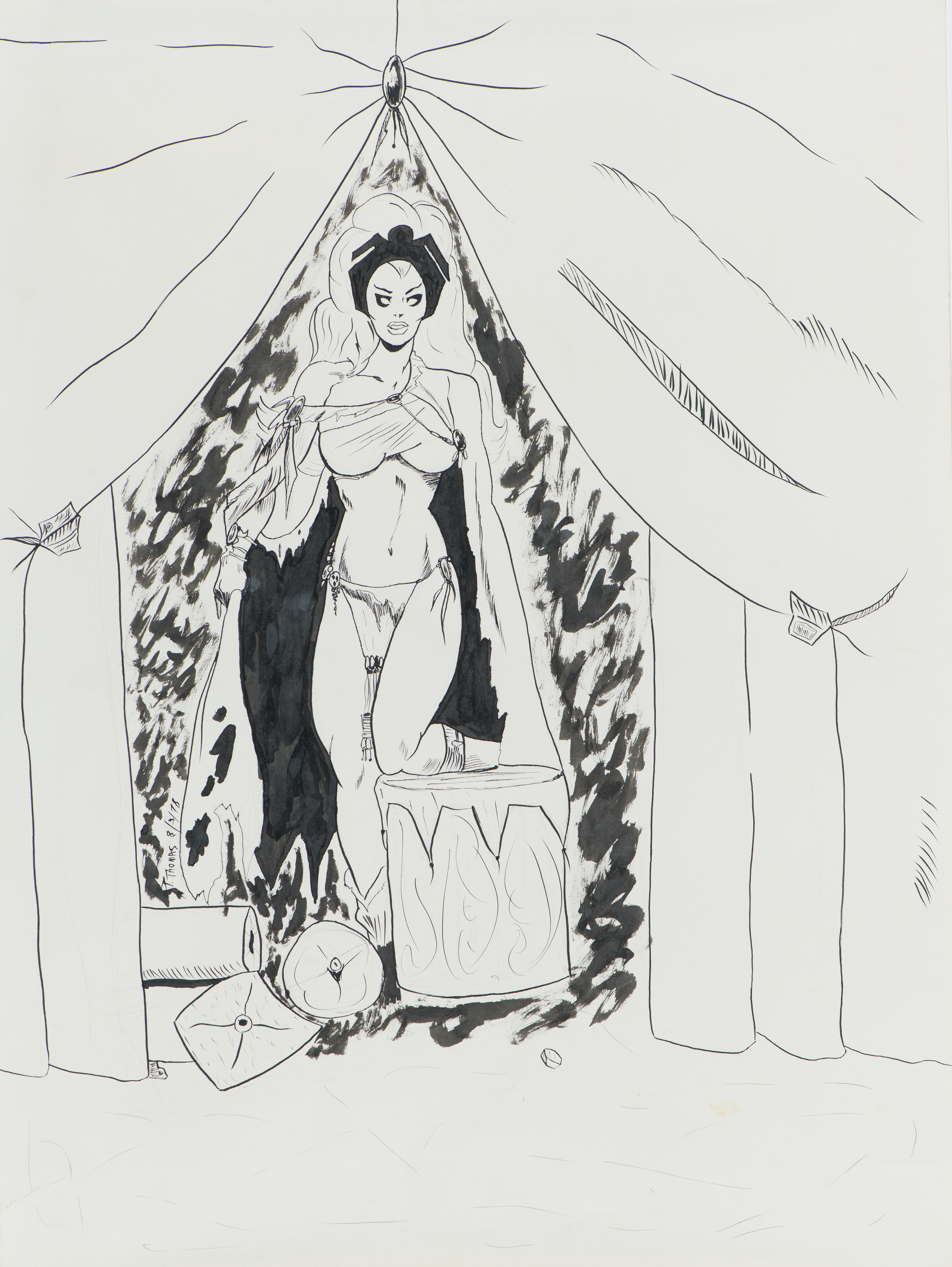
But as all this colored my attempts to be a sexual person, seeking out romantic relationships throughout high school and college, I was also being shaped in how I interacted with the world aesthetically, notably in that I was actively teaching myself visual art by drawing from both comic books and nude photography in the euphemistically named men’s magazines.

One can see a theme in my adolescent artwork:

Storm
Storm from the X-Men

Vargas
I shifted from comic books to men’s magazines and copying the objectifying artwork of Alberto Vargas, popularized in Playboy.

As a teen and young man, I was certainly trapped in very unhealthy but subtle patterns that could only be overcome by gaining critical awareness over my mid-20s into and my mid-30s (when I completed my doctoral program).

Some of that critical awareness was powerfully acquired through my commitment to learning from and teaching important literature such as Alice Walker’s The Color Purple and Margate Atwood’s The Handmaid’s Tale as well as poetry units I taught on Adrienne Rich, Anne Sexton, and Sylvia Plath.

Ultimately, writing an educational biography grounded in feminist theory stands in hindsight as the crowning experience as I approached 40 for a healthy awakening into fully appreciating toxic masculinity, predatory men, objectifying women, the male gaze, and rape culture.

Just as I would explain about my racial awareness, my sexual and gender awareness remains a journey, and as such, I find myself often paralyzed because, as a man, I represent still the potential for abuse through my status, the threat men pose for women in a society that continues to objectify and marginalize females—especially in terms of failing to listen to women who risk telling of their experiences with predatory men and rape culture.

My adult life has been spent as a partner, friend, parent, grandparent, teacher, and coach—all requiring me to monitor my status of power granted by being male and by my professional and familial positions in relationship with females.

As a coach and teacher, I have been (and continue) to be prone to call young women “darling” in casual moments—rightfully prompting some of my closest friends and colleagues who are women to call me on the language, the positioning.

I remain aesthetically drawn to photography and artwork of women nudes—entirely unsure if I can disentangle my toxic past from what I consider non-objectifying appreciation of art.

And so, as I noted above, I stumble toward 60, a man with good intentions who understands that is never enough; I am often reduced to paralysis in how to navigate the world in ways that are equitable and healthy for everyone regardless of race, gender, sexuality, or class.

I am genuinely terrified of ever making any woman/girl feel discomfort because of my masculine presence, my inadvertent gaze, my language, or the implicit threat of my status in relationship to her.

Often these days, I must confront these tensions as I snuggle with my granddaughter who I dearly want to grow up with healthy views of gender and sexuality, who I want to avoid any sort of predatory world.

My daughter was raised without corporal punishment, and now her children have been gifted that same dignity.

I work hard to practice what I preach and feel I make contributions small and even large to a kinder and more compassionate world—a world in which women and children need not ever fear men.

But even the best men walk in the wake of the worst men have given this world—the worst men continue to give to this world, and the women and children who must suffer for that.

Each man must moment by moment examine how he is culpable, where and how he stands in this world in relationship to women and children.

The dilemma of navigating the world as a man is couched in the unearned privilege, the potential for an abuse of unearned power that shouts out “First, do no harm.”

For a man committed to that, however, how does he live a full life without being paralyzed by the worst of being a man, behaviors that often go unpunished and even masked to protect some men from consequences.

How does any man avoid paralysis reading about the Stanford rape case or the stories of women as victims of predatory men?

This remains a rhetorical question for any man with an ethical imperative for his life—not a question for any woman or any child to offer their compassion.

For any man, for each man, this is ours to confront, to answer, and to act.

As long as men hold most of the power that shapes the world, it is ours to build a consensual environment in which human dignity supersedes the brute force of power.

Between acquiescing to the basest of male behaviors and paralysis is the true way, about which Franz Kafka wrote: “The true way is along a rope that is not spanned high in the air, but only just above the ground. It seems intended more to cause stumbling than to be walked upon.”

Pause. Listen. Look carefully before taking any step.


For Further Reading

Experts in the FieldBonnie Nadzam

Roxane Gay, Aimee Bender, and More on Assault and Harassment

The Predatory Men of Academic Creative Writing, John Warner

“He knows, or thinks he knows”: It’s Still a Man’s (Hostile) World

True Detective: It’s Still a Man’s (Hostile) World, pt. 2

Doubling Down (Again) on the White Man’s World

“Gravity”: The Unbearable Lightness of Being a Woman

In the U.S., Where the Female Nipple Is More Dangerous Than a Gun