Category Archives: privilege

Beware the Bastards: On Freedom and Choice

Your Honor, years ago I recognized my kinship with all living beings, and I made up my mind that I was not one bit better than the meanest on earth. I said then, and I say now, that while there is a lower class, I am in it, and while there is a criminal element I am of it, and while there is a soul in prison, I am not free.

Eugene V. Debs: Statement September 18, 1918


Based on “Eight O’Clock in the Morning” by Ray Nelson, the cult science fiction film They Live focuses on the main character, Nada (Roddy Piper), who discovers a pair of sunglasses that reveal to him that aliens are controlling the human race.

In the real world, the trick is not finding a pair of enlightening sunglasses to expose the alien overlords but to recognize the bastards we have chosen to rule over us—because the bastards controlling the U.S. are really easy to see.

Here’s one.

And here’s a whole room full.

The masking, you see, is not taking on human form to hide alien bodies, but the use of words that appear to say one thing while actually meaning something entirely different.

The trick in the real world is not visual, but verbal.

So we have Ryan on Twitter:

And Vice President Pence:

O, happy freedom! And glorious individual responsibility!

Let us, of course, step back and note that our federal political leaders are overwhelmingly white and wealthy men who have healthcare, retirement/pension, and daycare all provided for them at tax payers’ expense—although every one of them due to their wealth are free to take the individual responsibility to choose to pay for those luxuries that they are denying everyone else.

*

In Margaret Atwood’s The Handmaid’s Tale, Offred (June), the eponymous handmaid of the tale, reveals that “[t]he circumstances have been reduced” (p. 8) for the younger women of Gilead, a post-apocalyptic theocracy of sorts. These seemingly fertile women have become extremely precious for the survival of the white race and paradoxically the embodiment of a perverse slavery for procreation.

Atwood has written at length about being indebted to George Orwell—those who control language control everything and everyone—and that her speculative novel includes a quilting of human actions drawn directly from history, not fabricated by Atwood.

How have humans kept other humans in literal and economic bondage? Often by exploiting token members of the group being exploited.

Thus, in The Handmaid’s Tale, a few women are manipulated to control other women. The handmaid’s are trained by Aunts, who instill the propaganda:

There is more than one kind of freedom, said Aunt Lydia. Freedom to and freedom from. in the days of anarchy, it was freedom to. Now you are being given freedom from. Don’t underrate it….

We were a society dying, said Aunt Lydia, of too much choice. (pp. 24, 25)

Throughout the novel, readers must navigate how Offred (June) weaves the overlap of her own original ideas and vocabulary as that intersects with the propaganda of Gilead:

Will I ever be in a hotel room again? How I wasted them, those rooms, that freedom from being seen.

Rented license. (p. 50)

“Freedom” and “license” are exposed as bound words, the meanings contextual.

As Offred (June) continues to investigate rooms, she discovers a powerful but foreign phrase:

I knelt to examine the floor, and there it was, in tiny writing, quite fresh it seemed, scratched with a pin or maybe just a fingernail, in the corner where the darkest shadow fell: Nolite te bastardes carborundorum.

I didn’t know what it meant, or even what language it was in. I thought it might be Latin, but I didn’t know any Latin. Still it was a message, and it was in writing, forbidden by that very fact, and it hadn’t been discovered. Except by me, for whom it was intended. It was intended for whoever came next. (p. 52)

The power to control language includes defining words, but also denying access to language—forbidding reading and writing, literacy, to those in bondage.

And then, Offred (June) explains about her life before Gilead:

We lived, as usual, by ignoring. Ignoring isn’t the same as ignorance, you have to work at it.

Nothing changes instantaneously: in a gradually heating bathtub you’d be boiled to death before you knew it….The newspaper stories were like dreams to us, bad dreams dreamt by others. How awful, we would say, and they were, but they were awful without being believable. They were too melodramatic, they had a dimension that was not the dimension of our lives.

We were the people who were not in the papers. We lived in the blank white spaces at the edges of the print. It gave us more freedom.

We lived in the gaps between the stories. (pp. 56-57)

And from that previous life of “ignoring” the other since it wasn’t about them, Offred (June) finds herself the procreation slave of a Commander, in “reduced circumstances” where she realizes: “There wasn’t a lot of choice but there was some, and this is what I chose” (p. 94).

Her previous life of “ignoring” has been replaced by something seemingly more awful, but nearly exactly the same as she explains about the Ceremony: “One detaches oneself” (p. 95).

Even in Gilead, Offred (June) again becomes the other woman, lured into an infidelity characterized by playing Scrabble with the Commander, who reveals to her that Nolite te bastardes carborundorum is slang Latin for “Don’t let the bastards grind you down” (p. 187).

Adolescent language as rebellion has become a life-or-death slogan for Offred (June).

As her relationship with the Commander becomes increasingly trite and complex, Offred (June) declares, “Freedom, like everything else, is relative” (p. 231).

*

It is 2017, and many are living lives by ignoring because it just doesn’t seem to be about them.

Detached, unwilling to look or listen carefully—skipping along to the hollow mantras of “freedom,” “choice,” and “individual responsibility.”

As with Offred (June), this is no longer an adolescent joke; it is the only real option we have.

Nolite te bastardes carborundorum: Don’t let the bastards grind you down.
Education Reform in the Absence of Political Courage: Charleston (SC) Edition

Words matter, and thus, I must apologize by opening here with a mundane but essential clarification of terms.

As I have written over and over, everything involving humans is necessarily political, even and especially teaching and learning. Therefore, no teacher at any level can truly be apolitical, objective. Taking a neutral or objective pose is a political choice, and an endorsement of the status quo.

Key to that claim is recognizing the difference between political and partisan. Partisan politics involves allegiance to and advocacy for organized political parties, notably Republicans and Democrats.

A partisan feels compelled to place party loyalty above ideology or ethics. To be political can be and should be a moral imperative.

We can avoid being partisan, even as that is political. And when many people call for education and educators to avoid being political, what they really are seeking is that education and educators not be partisan—a position that is achievable and one I endorse.

This distinction matters in public education and public education reform because all public institutions in the U.S. are by their tax-supported status at the mercy of partisan politics.

From around 1980, in fact, politicians at the local, state, and national levels have discovered that public education is a powerful and effective political football. The standard politician’s refrain is “Schools are horrible, and I can make them better!”

The current rise of the inexpert ruling class at the presidential level has been foreshadowed for more than three decades by the partisan politics around education reform—politicians and political appointees with no experience or expertise in education imposing pet reform initiatives onto public schools because these policies appeal to an equally mis-informed public.

Even with large failed crucibles such as New Orleans post-Katrina, political leaders remain committed to finding themselves in a hole and continuing to dig.

In my home state of South Carolina, infamous for our Corridor of Shame, Charleston, on the east coast and part of that corridor, continues to represent the savage inequalities that result from a combination of an inexpert ruling class and an absence of political courage.

Charleston schools reflect the most stark facts about and problems with K-12 education across the U.S.: private and gate-keeping public schools (such as academies, magnet schools, and some charter schools) that provide outstanding opportunities for some students in contrast to grossly ignored high-poverty, majority-minority public schools that mis-serve “other people’s children.”

As a result of these inequities and dramatically different student outcomes exposed by the accountability era obsession with test scores, Charleston has played the education reform game, committing to provably failed policies over and over: school choice, school closures and takeovers, school turnaround scams, overstating charter schools as “miracles,” and investing in Teach For America.

Why do all these policies fail and what ultimately is wrong with inexpert leadership? The absence of political courage to address directly the blunt causes of inequitable student outcomes in both the lives and education of students.

Currently in Charleston, the closing of Lincoln High and transferring those students to Wando High (see here and here) highlight that the gap between commitments to failed edureform and political courage to do something different persists.

The debates and controversy over how former Lincoln students are now performing at Wando offer some important lessons, such as the following:

  • The media and the public should be aware of partisan political code. A garbled reach for “the soft bigotry of low expectations” has been used to explain why Lincoln students’ grades have dropped while at Wando. The “soft bigotry” mantra is a conservative slur triggering the public’s belief in “bleeding heart liberals,” who coddle minorities. But the more damning part of the code is that it focuses blame on the administration and teachers in high-poverty, majority-minority schools and thus away from political leadership.
  • And thus, the public needs to distinguish between blaming educators at Lincoln for low expectations (again, garbled as “low standards”) and the expected consequences of high-poverty, majority-minority schools suffering with high teacher turnover, annual under-staffing, and persistent teacher workforces that are new and/or un-/under-certified. Additionally, the accountability era has unrealistic demands of these schools when compared to low-poverty, low-minority schools that have much greater percentages of experienced and certified teachers.
  • The apparent drop in student grades and test scores from Lincoln to Wando is extremely important data that deserve close scrutiny, but so far, that scrutiny has been reduced to partisan politics and deflecting blame. Dozens of reasons could explain the grade differences, including the transfer as well as the staffing differences between the two schools (neither of which is the simplistic “soft bigotry” argument used primarily to justify closing a community school).

The partisan political approaches to schools and education reform are tarnished by both willful ignorance and a confrontational blame game.

The willful ignorance of politicians and the public refuses to acknowledge huge social inequity driven by racism and white privilege; the blame game seeks ways to blame the victims of those inequities instead of confronting systemic forces.

What should political leaders be doing and what should the public be demanding that is different from the patterns identified above, than the policies already proven as failures?

  • Recognize that in-school only reform creates two serious problems: (1) unrealistic demands with high-stakes consequences produce unethical behavior among otherwise good people (see the Atlanta cheating scandal), and (2) since out-of-school factors overwhelmingly influence measurable student achievement, even the right in-school only reform is unlikely to result in measurable improvement.
  • Interrogate the proclaimed cause of low student achievement—”low expectations”—and instead seek to understand the complex reasons behind that low achievement by poor and black/brown students based on available evidence that includes carefully interviewing the administrators, teachers, and students involved.
  • Advocate for public policy that addresses serious inequity in the lives of children—policy impacting access to health care, a stable workforce, access to safe and stable housing, and high-quality food security.
  • Refuse to ignore needed in-school reform, but reject accountability-based reform for equity-based reform focusing on equitable teacher assignment for all students, articulated school funding that increases funding for schools serving struggling communities, guaranteeing the same high-quality facilities and materials for all children regardless of socioeconomic status of the communities served, and eliminating gate-keeping policies that track high-needs students into test-prep while advantaged students gain access to challenging courses such as Advanced Placement and International Baccalaureate.

Ultimately, the absence of political courage in SC and across the U.S. is where the real blame lies for inequitable student achievement along race and class lines.

Many students, the evidence shows, are doubly and triply disadvantaged by the consequences of their lives and their schools.

Trite and misleading political rhetoric, along with “soft bigotry of low expectations,” includes soaring claims that a child’s ZIP code is not destiny.

Well, in fact, ZIP code is destiny in SC and the U.S.; it shouldn’t be, but that fact will remain as long as political leadership chooses to ignore the expertise within the field of education and continues to lead without political courage.

Political courage requires direct action, even when it isn’t popular, and refuses to deflect blame, refuses to wait for what market forces might accomplish by taking the right action now.

Political courage, as James Baldwin expressed, embraces that “[t]he challenge is in the moment, the time is always now.”


For More on Political Courage

Support Betsy Devos Shoot Yourself In The Foot, Andre Perry

Black Activists Don’t Want White Allies’ Conditional Solidarity!, Stacey Patton

The Big Lie about the Left in the U.S.

The Big Lie about the Left in the U.S. is that the Left exists in some substantial and influential way in the country.

The Truth about the Left in the U.S. is that the Left does not exist in some substantial and influential way in the country. Period.

The little lies that feed into the Big Lie include that universities and professors, K-12 public schools, the mainstream media, and Hollywood are all powerful instruments of liberal propaganda.

These little lies have cousins in the annual shouting about the “war on Christmas” and hand wringing by Christians that they are somehow the oppressed peoples of the U.S.

These lies little and Big are a scale problem in that the U.S. is now and has always been a country whose center is well to the right, grounded as we are in capitalism more so than democracy.

The U.S. is a rightwing country that pays lip service to progressivism and democracy; we have a vibrant and powerful Right and an anemic, fawning Middle.

Wealth, corporatism, consumerism, and power are inseparable in the U.S.—pervading the entire culture including every aspect of government and popular culture.

The Left in the U.S. is a fabricated boogeyman, designed and perpetuated by the Right to keep the general public distracted. Written as dark satire, Kurt Vonnegut’s Cat’s Cradle now serves as a manual for understanding how power uses false enemies to maintain power and control.

Notably during the past 30-plus decades, conservative politics have dominated the country, creating for Republicans a huge problem in terms of bashing “big government.”

But dog-whistle politics grounded in race and racism benefitting the Right and Republicans have a long history.

In 1964, Martin Luther King Jr. confronted Barry Goldwater’s tactics foreshadowing Trump’s strategies and rise:

The Republican Party geared its appeal and program to racism, reaction, and extremism…On the urgent issue of civil rights, Senator Goldwater represents a philosophy that is morally indefensible and socially suicidal. While not himself a racist, Mr. Goldwater articulates a philosophy which gives aid and comfort to the racist. His candidacy and philosophy would serve as an umbrella under which extremists of all stripes would stand. In the light of these facts and because of my love for America, I have no alternative but to urge every Negro and white person of goodwill to vote against Mr. Goldwater and to withdraw support from any Republican candidate that does not publicly disassociate himself from Senator Goldwater and his philosophy.

Malcolm X held forth in more pointed fashion, but with the same focus:

Well if Goldwater ever becomes president one thing his presence in the White House will do, it will make black people in America have to face up the facts probably for the first time in many many years,” Malcolm X said. 

“This in itself is good in that Goldwater is a man who’s not capable of hiding his racist tendencies,” he added. “And at the same time he’s not even capable of pretending to Negroes that he’s their friend.” 

The Civil Rights icon concluded that should Goldwater be elected, he would inspire black people to fully reckon with “whites who pose as liberals only for the purpose of getting the support of the Negro.”

“So in one sense Goldwater’s coming in will awaken the Negro and will probably awaken the entire world more so than the world has been awakened since Hitler,” he said.

Mentioned above, the annual panic over the “war on Christmas” is a distraction from the fact that Christmas serves consumerism, the Right, and not religion—keeping in mind that Jesus and his ideology rejected materialism and espoused moral and ethical codes in line with socialism and communism/Marxism.

What remains mostly unexamined is that all structures are essentially conservative—seeking to continue to exist. Power, then, is always resistant to change, what should be at the core of progressivism and leftwing ideology.

Marxism is about power and revolution (drastic change, and thus a grand threat to power), but suffers in the U.S. from the cartoonish mischaracterization from the Right that it is totalitarianism.

So as we drift toward the crowning of the greatest buffoon ever to sit at the throne of the U.S. as a consumerocracy posing as a democracy, Education Week has decided to launch into the hackneyed “academics are too liberal and higher education is unfair to conservatives” ploy.

At the center of this much-ado-about-nothing is Rick Hess playing his Bokonon and McCabe role:

I know, I know. To university-based education researchers, all this can seem innocuous, unobjectionable, and even inevitable. But this manner of thinking and talking reflects one shared worldview, to the exclusion of others. While education school scholars may almost uniformly regard a race-conscious focus on practice and policy as essential for addressing structural racism, a huge swath of the country sees instead a recipe for fostering grievance, animus, and division. What those in ed. schools see as laudable efforts to promote “equitable” school discipline or locker-room access strike millions of others as an ideological crusade to remake communities, excuse irresponsible behavior, and subject children to goofy social engineering. Many on the right experience university initiatives intended to promote “tolerance” and “diversity” as attempts to silence or delegitimize their views on immigration, criminal justice, morality, and social policy. For readers who find it hard to believe that a substantial chunk of the country sees things thusly, well, that’s kind of the issue.

Conversational and posing as a compassionate conservative, Hess sprinkles in scare quotes while completely misrepresenting everything about which he knows nothing.

This is all cartoon and theater.

The grand failure of claiming that the academy is all leftwing loonies is that is based almost entirely—see the EdWeek analysis—on noting that academics overwhelmingly identify as Democrats.

However, the Democratic Party is not in any way a substantial reflection of leftist ideology. At most, we can admit that Democrats tend to use progressive rhetoric (and this is a real characteristics of professors, scholars, and academics), but that Democratic policy remains centrist and right of center.

A powerful example of this fact is the Department of Education (DOE) and Secretary of Education (SOE) throughout George W. Bush’s and Barack Obama’s administrations.

For the past 16 years, education policy has been highly bureaucratic and grounded almost entirely in rightwing ideology—choice, competition, accountability, and high-stakes testing.

The only real difference between Bush’s SOE and Obama’s SOE has been rhetoric; yes, Duncan, for example, loved to chime in with civil rights lingo, but policy under Obama moved farther right than under Bush.

Now, let me end here by addressing the charge that college professors are a bunch of leftwing loonies.

I can do so because I am the sort of dangerous professor Hess wants everyone to believe runs our colleges and universities—poisoning the minds of young people across the U.S.

I can also add that I spent 18 years as a public school teacher before the past 15 years in higher education.

In both so-called liberal institutions—public education and higher education—as a real card-carrying Lefty, I have been in the minority, at best tolerated, but mostly ignored and even marginalized.

Public schools are extremely conservative, reflecting and perpetuating the communities they serve. In the South, my colleagues were almost all conservative in their world-views and religious practices.

My higher education experience has been somewhat different because the atmosphere has the veneer of progressivism (everyone know how to talk, what to say), but ultimately, we on the Left are powerless, unheard and often seen as a nuisance.

Colleges and universities are institutions built on and dependent on privilege and elitism. As I noted above, colleges and universities are not immune to the conservative nature of institutions; they seek ways to maintain, to conserve, to survive.

Colleges and universities are also not immune to business pressures, seeing students and their families as consumers.

Do professors push back on these tendencies and pressures? Sure.

But that dynamic remains mostly rhetorical.

The Truth is that colleges and universities are centrist organizations—not unlike the Democratic Party and their candidates, such as Obama and Hillary Clinton.

Some progressives in the U.S. play both sides to sniff at the power on the Right, and then the Right uses that rhetoric and those veneers to prove how the Left has taken over our colleges/universities, public schools, media, and Hollywood.

But that is a Big Lie about the Left in the U.S.

The Left does not exist in any substantial way, except as a boogeyman controlled by the Right in order to serve the interests of those in power.

“To be afraid is to behave as if the truth were not true,” Bayard Rustin warned.

Vonnegut’s Cat’s Cradle dramatizes this warning, and 50 years ago King and Malcolm X challenged us to see beyond the corrosive power of dog-whistle politics.

When the Right paints educational research as the product of corrupted leftwing scholars, you must look past the harmful foma and examine in whose interest it is that market-based education reform survives despite the evidence against it.

To paraphrase Gertrude from Hamlet, “The Right protests too much, methinks,” and we have much to fear from all these histrionics.

Rethinking “A monolithic and stereotypical understanding of rural identity” (Melissa Range, poet)

Separated by about a 2-3 hour drive on I-26 through South Carolina, North Carolina, and Tennessee, but also by about 10 years, Joe Kincheloe and I were born in the rural South, both destined to become aliens in our home land.

Joe proved to be a key person in my scholarly life quite by accident when a colleague at the university where I found myself after almost twenty years teaching high school English was working on a book for Joe and asked me to write a response for her to include.

From that, Joe offered me my first academic book contract, leading to co-authoring a volume with Joe as well as a now-long list of scholarly books and a career as a writer I was certain would never happen for me.

My relationship with Joe is bittersweet since we never crossed paths in person and had only a few phone calls, the first of which elicited from Joe when I spoke, “Why you are from the South, aren’t you!”

Laughing his words revealed a joy and kindness that were who Joe was in his soul, in his bones.

I recalled this phone call as I was reading On Poverty, Justice, and Writing Sonnets of the South, an interview with poet Melissa Range:

This sudden interest in so-called “rural identity” is amusing and frustrating to me, honestly, because I don’t think most of the country actually has much real interest in rural people. They just are horrified (as am I, as are more than a few rural people I know) about the election results. Had the election gone another way, would the non-rural parts of the country be seeking to know the “rural mind”—whatever that is? I don’t think so.

I say this as a card-carrying bleeding heart pacifist leftie socialist who comes from working class white rural people who didn’t have the opportunity to go to college, most of whom have always voted for Democrats, or not voted at all. Yes, my dad voted for Trump. He always votes Republican no matter how I try to convince him to do otherwise. My old aunts and my mom have been stumping for Clinton since 2008. My brother-in-law, another one of those “white males without a college degree,” is repulsed by Trump, is on disability, has PTSD from his time in Bosnia, is an accomplished cook, hunts and gardens, and reads the Qur’an in his free time. My sister, who is 41 years old, never went to college, and has lived in the same place her whole life, doesn’t understand what the big deal is about transgender bathrooms in North Carolina. We were driving around in Boone, NC, this past spring when I was visiting her, and I remember her exclaiming, “Why can’t those who make the law just let people do as they please? Who cares what bathroom anybody uses? They ought to be ashamed for passing that law.” You can find rural people with these beliefs, with sophisticated conspiracy theories about UFOs, with unexamined beliefs about race and gender, with a passionate commitment to union organizing and to environmental activism. You can find rural people who are passionately pro-life and just as passionately pro-choice, who love their guns and who don’t believe in guns. In other words, rural perspectives are diverse, like perspectives of people everywhere. There are so many kinds of rural people. And I would like to add that they’re not all white and not all poor and not all working-class and not all intolerant. Of course some are intolerant. Of course some are resistant to change—like people everywhere. There are a lot of rural spaces in America, and everyone who lives outside of cities isn’t the same. A monolithic and stereotypical understanding of rural identity is nothing new, but it’s as false now as it ever was.

I can’t and don’t want to speak for all rural people, but my people, at least, in East Tennessee, don’t expect the government to care about them and don’t expect the rest of the country to care about them, either. What they expect, and what they typically get, is either derision or dismissal. I’ve been hearing educated, liberal people throw around terms like “white trash” and “redneck” and “hillbilly” ever since I left East Tennessee. They say these words to my face as if they are not insulting my people and me. How can liberals and progressives forget that class exists? Maybe they just like having someone else to foist some blame on. I will say that my part of the country (I call it that even though I haven’t lived there in 25 years) has an inordinate number of people who are truly beaten down. In my hometown, there used to be textile factories that employed hundreds of people, and now there aren’t. One shut down in the 1970s, another in the 90s. Nothing much has come in to replace them except meth and other drugs, so there’s a lot of poverty and a lot of substance abuse and not much industry. Poverty and despair go hand in hand; it’s not hard to imagine this (and obviously this isn’t just a rural phenomenon). And when you see yourself on television and in movies being stereotyped and mocked, well, it doesn’t make you feel any better.

I can imagine Range joining in with Joe and me—aliens of academia and the literary world. Also reading Range’s comments, I thought about how often we Southerners are stereotyped as illiterate, in many ways because of how we sound (which is what tipped Joe off to my Southern roots).

The South is, from my lived experience, a heaping mess of social class, race, and god-awful mangling of the English language—all wrapped in the flag and lots of bible thumping.

But none of that is as simple as people want to believe, want to claim.

As Ralph Ellison confronted in 1963 when speaking to teachers:

Some of us look at the Negro community in the South and say that these kids have no capacity to manipulate language. Well, these are not the Negroes I know. Because I know that the wordplay of Negro kids in the South would make the experimental poets, the modern poets, green with envy. I don’t mean that these kids possess broad dictionary knowledge, but within the bounds of their familiar environment and within the bounds of their rich oral culture, they possess a great virtuosity with the music and poetry of words. The question is how can you get this skill into the mainstream of the language, because it is without doubt there. And much of it finds its way into the broader language. Now I know this just as William Faulkner knew it. This does not require a lot of testing; all you have to do is to walk into a Negro church.

But if you want to feel particularly out of place, out of kilter, academia can be that for you if you are working class or from the working poor. As Vitale and Hurst explain [1]:

Both academia and the DNC have a class problem. They don’t know anything about the working class because they have isolated themselves from working-class people. We have been struggling for years to change this within academia….

Discussion of social class has always been relegated to the margins of academia. In turn, public discourse about class is muted. By denying the opportunity for social class to be a valid academic subject in itself, or to be considered an authentic form of social identity, educated folks (academics, pundits, campaign managers, and journalists) didn’t just silence the voices of the poor and working-class, they also denied the possibility of critically engaging the problem of affluence.

Rurality, being working class or working poor—these have become another form of marginalization in many contexts, and with the rise of Trumplandia, the mischaracterization and fetishizing of working class/working poor whites have accelerated, as noted by Range and seen in the popularity of J.D. Vance’s Hillbilly Elegy.

However, the mainstream media’s misreading working class/working poor white angst is ironically reflected in Vance’s deeply flawed work, as noted by Sarah Jones:

Elegy is little more than a list of myths about welfare queens repackaged as a primer on the white working class. Vance’s central argument is that hillbillies themselves are to blame for their troubles. “Our religion has changed,” he laments, to a version “heavy on emotional rhetoric” and “light on the kind of social support” that he needed as a child. He also faults “a peculiar crisis of masculinity.” This brave new world, in sore need of that old time religion and manly men, is apparently to blame for everything from his mother’s drug addiction to the region’s economic crisis.

Vance’s thinly veiled conservatism and simplistic “aw shucks” cashing in on his background feels very similar to an experience I had years ago when my university chose Timothy B. Tyson’s Blood Done Sign My Name as the incoming first-year students’ common book, which faculty also read to discuss with those students.

From Tyson’s work to Vance’s and currently with all the bluster about working class whites across the rural U.S., I cringe at the ways in which many people treat any sort of Other as if they are visiting a zoo—oh-ing and ah-ing at the exotic, but keeping their distance all the while.

There is an insensitivity of distance that Henry Giroux, an academic from a working class background, has identified:

Being an academic from the working class is, of course, impacted by many registers, extending from ideology and cultural capital to politics….

My father had just died of a heart attack, and I had returned to the campus after attending his funeral. My Dean at the time was a guy named Bob Dentler, an Ivy-League educated scholar. I ran into him on the street shortly after my father’s death and he said to me, “I am sorry to hear about your father. It must have been difficult settling his estate?” Estate? My father left a hundred dollars in an envelope taped behind a mirror. That was his estate. I was immediately struck by how out of touch so many academics are with respect to those others who are not replicas of themselves. But as I began to understand how class was mapped onto academia, I was determined not to play the role of the subservient, aspiring-to-be-middle-class professional. I had no intention of letting myself morph into a golf-playing suburbanite living a politically irrelevant academic life. I viewed myself as being on the left, and my politics provided me with the tools to be not only self-reflective but also critical of the cultural capital that dominated the academy and passed itself off as entirely normalized. I had no interest in narrowly-defined, almost-choking specializations, stifling forms of professionalism, appeals to positivism or a politics that largely removed the university from the broader society.

But just as academia as well as mainstream media, politicians, and the public have garbled a romanticizing of working class whites, there are in these dynamics much uglier problems concerning stigmatizing and reducing any Other.

Political hand wringing about working class whites has, once again, ignored black and brown marginalization—including excluding working class black and brown people from that debate.

But the most corrosive aspect of the rush to appease working class whites is that the carelessness of this discussion has served only to further divide through race those among whom race is a commonality.

Recognizing that the poor, the working poor, and the working class have more interests in common than differences due to race is actively muted by those sharing class and race privilege.

We need ways to reject “monolithic and stereotypical understanding of rural identity,” as Range notes.

But that is a public and political conversation too often ignored in academia (increasingly as we seek ways not to upset students-as-customers) and possibly too complicated for the world beyond the walls of the Ivory Tower.

Yes, white working class and working poor angst is real, but those groups still benefit from white privilege—and many white working class/poor do not want to hear that while they are suffering.

And too often, among these groups of whites racism, sexism, and xenophobia remain too common, too powerful, and working class/poor whites certainly do not want to hear any of that.

Let us, then, not fetishize working class/poor whites, and not demonize black and brown people; let us not romanticize rurality or poverty, and not ignore the very real plight of rurality and poverty.

When Range writes about “our kind/of people,” I hear and see from my lived experience in an often self-defeating South.

It’s a complicated mix of love and embarrassment that Joe and I shared—one echoed in Range and Giroux.

I remain troubled, then, by how we can see and how we can listen, without the poisoned ways that have gotten us where we are now.


[1] See also A.L. Hurst & S.K. Nenga (Eds.), Working in class: recognizing how social class shapes our academic work.

On Kafka, Misreading Postmodernism, and Giving Up

In 2008, through a Republican connection with then-governor of South Carolina, Mark Sanford, a graduate of the university, President George W. Bush gave the primary commencement address at Furman University, sparking a faculty protest and a student push-back to that protest.

Once Bush being the speaker was announced, the days and weeks leading up to commencement were characterized by several media reports on the controversy, including some Op-Eds in the local paper by professors—one of which was by two neoliberal professors from one of the most conservative departments on campus chastising the protesting professors and characterizing them as postmodern.

Looking back through the rise of Trumplandia and the current focus on fake news and post-truth politics, this misreading of postmodernism is worth revisiting.

First, the protesting professors immediately balked at being labeled postmodern because most (if not all) were taking an ethical stand, counter to the postmodern questioning of objective or universal moral imperatives.

The neoliberal professors represented, even as elites, a cartoonish and dismissive lens for the public about nuanced and complex bodies of knowledge, ways of navigating the world.

By the twenty-first century, postmodernism was recognized as a moment in the twentieth century when modernism was unmasked, but that term and body of thought had mostly helped shape movements that many academics and scholars embraced (see this as one example of how complex postmodernism is as a term).

Postmodernism spurred many “post” ideologies, in fact—postcolonialism, poststructuralism, and others that, in fact, re-imagined how to reclaim the ethics and moral imperatives that postmodernism seemed to reject.

The key here is “seemed” since just as the neoliberal professors misrepresented the protesting professors as postmodern, they also grossly reduced postmodernism to something that may sound familiar today: there are no facts, no truths.

Once the province of liberatory academics—those seeking a dismantling of white/male privilege as the default norm, the universal—postmodernism as an argument about how controlling what counts as facts and truth is the province of who has power has today become a bastardized and politicized paradox in that partisan politics in the U.S. (and across Europe) has reached the logical evolution into nothing more than reality TV in the hands of the far Right—neoliberals, neoconservatives, white supremacists, misogynists, and neoNazis.

Toni Morrison’s Making America White Again details how this has come to fruition in the U.S.

First, she confronts how post-truth Trumplandia looks:

In order to limit the possibility of this untenable change, and restore whiteness to its former status as a marker of national identity, a number of white Americans are sacrificing themselves. They have begun to do things they clearly don’t really want to be doing, and, to do so, they are (1) abandoning their sense of human dignity and (2) risking the appearance of cowardice. Much as they may hate their behavior, and know full well how craven it is, they are willing to kill small children attending Sunday school and slaughter churchgoers who invite a white boy to pray. Embarrassing as the obvious display of cowardice must be, they are willing to set fire to churches, and to start firing in them while the members are at prayer. And, shameful as such demonstrations of weakness are, they are willing to shoot black children in the street.

To keep alive the perception of white superiority, these white Americans tuck their heads under cone-shaped hats and American flags and deny themselves the dignity of face-to-face confrontation, training their guns on the unarmed, the innocent, the scared, on subjects who are running away, exposing their unthreatening backs to bullets. Surely, shooting a fleeing man in the back hurts the presumption of white strength? The sad plight of grown white men, crouching beneath their (better) selves, to slaughter the innocent during traffic stops, to push black women’s faces into the dirt, to handcuff black children. Only the frightened would do that. Right?

The debasing of the current U.S. reflects, as Morrison notes, “the true horror of lost status” among whites. And thus:

The comfort of being “naturally better than,” of not having to struggle or demand civil treatment, is hard to give up. The confidence that you will not be watched in a department store, that you are the preferred customer in high-end restaurants—these social inflections, belonging to whiteness, are greedily relished.

So scary are the consequences of a collapse of white privilege that many Americans have flocked to a political platform that supports and translates violence against the defenseless as strength. These people are not so much angry as terrified, with the kind of terror that makes knees tremble.

Post-truth as a sort of mainstream faux-postmodernism and as fodder for political tyranny (fascism, authoritarianism, totalitarianism—real -isms to be feared) has already metastasized throughout Europe, as witnessed by Ece Temelkuran in Turkey:

This refashioning of a post-truth, post-fact Turkey has not happened overnight. The process has involved the skilful and wilful manipulation of narratives. We gave up asking the astonished questions “How can they say or do that?” some time ago. Truth is a lost game in my country. In Europe and America, you still have time to rescue it – but you must learn from Turkey how easily it can be lost.

It started 15 years ago, with a phenomenon that will now be familiar to you, when intellectuals and journalists reacted to a nascent populism with the self-critical question: “Are we out of touch?” To counter that possibility, they widened the parameters of public debate to include those who were said to be representatives of “real people”. We thought our own tool, the ability to question and establish truth, would be adequate to keep the discourse safe. It wasn’t. Soon we were paralysed by the lies of populism, which always sounded more attractive than our boring facts.

In the U.S., white authority barely batted an eye at a black child being shot dead by a policeman, Tamir Rice, but how much different is that callousness than what Temelkuran reveals about Turkey?:

What is the practical effect of this new truth on everyday life? Well, consider one example. In Turkey today, we are obliged to indulge a debate about whether minors should be married to their rapists. It is predicated on the “real people’s” truth that in rural areas girls get married even when they are just 13, and thus have sexual maturity. It is, we are told, a thoroughly elitist argument to insist that a minor cannot give consent.

The faux-postmodernism of post-truth normalcy erases ethical ways of being and enables a crass Social Darwinism and consumerism—about which Temelkuran warns:

An analogy came to mind: that this is like trying to play chess with a pigeon. Even if you win within the rules, the pigeon will clutter up the pieces, and finally it will shit on the chessboard, leaving you to deal with the mess. Farage, having told us to “cheer up”, and that this was “not a funeral”, did exactly that. Having dumbfounded the audience, he announced – as if fleeing a boring party – that he was off to meet Donald Trump in Washington.

Be warned. For 15 years we played chess with the pigeon in Turkey, but now we don’t even have the chessboard. Some of you still have time to shape your future. Use it.

As I read Temelkuran’s account of a people who appear to have willingly abandoned their moral core, I was haunted by his “We gave up,” reminding me of Franz Kafka’s Give It Up!:

It was very early in the morning, the streets clean and deserted, I was walking to the station. As I compared the tower clock with my watch I realized that it was already much later than I had thought, I had to hurry, the shock of this discovery made me unsure of the way, I did not yet know my way very well in this town; luckily, a policeman was nearby, I ran up to him and breathlessly asked him the way. He smiled and said: “From me you want to know the way?” “Yes,” I said, “since I cannot find it myself.” “Give it up! Give it up,” he said, and turned away with a sudden jerk, like people who want to be alone with their laughter.

Kafka’s dark surrealism, at once comic and tragic, presents the human condition through two clocks being out of kilter.

The existential angst of modernism has survived postmodern revolts as Kafka’s work from a century ago rings true today for those of us surviving capitalism—the relentless call to consume, the never-ending burden of debt, and the terror of being late imprinted on us by formal schooling.

From Kafka to Czech writers like Milan Kundera and Bohumil Hrabal and to Morrison, the message remains bleak about the power of authority to erase the humanity of the individual.

In Kafka’s sparse narrative, the tower clock and policeman as Authority combine to invoke anxiety and despair in the unnamed narrator, only “I.”

A century ago, Kafka imagined the state’s blunt indoctrination—”Give it up!”—and then today, Temelkuran admits that in Turkey, “We gave up.”

It seems that in these there are hard and undeniable truths.

Dark Mourning in America: “The world is at least/fifty percent terrible”

The best lack all conviction, while the worst
Are full of passionate intensity.

“The Second Coming,” William Butler Yeats

Although humans appear ultimately incapable of listening to and then acting upon our great capacity for art—which is an extension of our great capacity for compassion, love, and good—literature may offer some solace in a time when the US has announced itself still a racist, sexist, and xenophobic people, hiding behind the codes of “conservative,” “family values,” and “Christian nation.”

How low do people have to stoop before they have their Lady Macbeth moment:

Out, damned spot! out, I say!–One: two: why,
then, ’tis time to do’t.–Hell is murky!–Fie, my
lord, fie! a soldier, and afeard? What need we
fear who knows it, when none can call our power to
account?–Yet who would have thought the old man
to have had so much blood in him.

Shakespeare’s dramatization of guilt and being complicit is, let’s not ignore, an allusion to Pontius Pilat and the “assassination” of Jesus:

When Pilate saw that he was getting nowhere, but that instead an uproar was starting, he took water and washed his hands in front of the crowd. “I am innocent of this man’s blood,” he said. “It is your responsibility!” [Matthew 27:24, NIV]

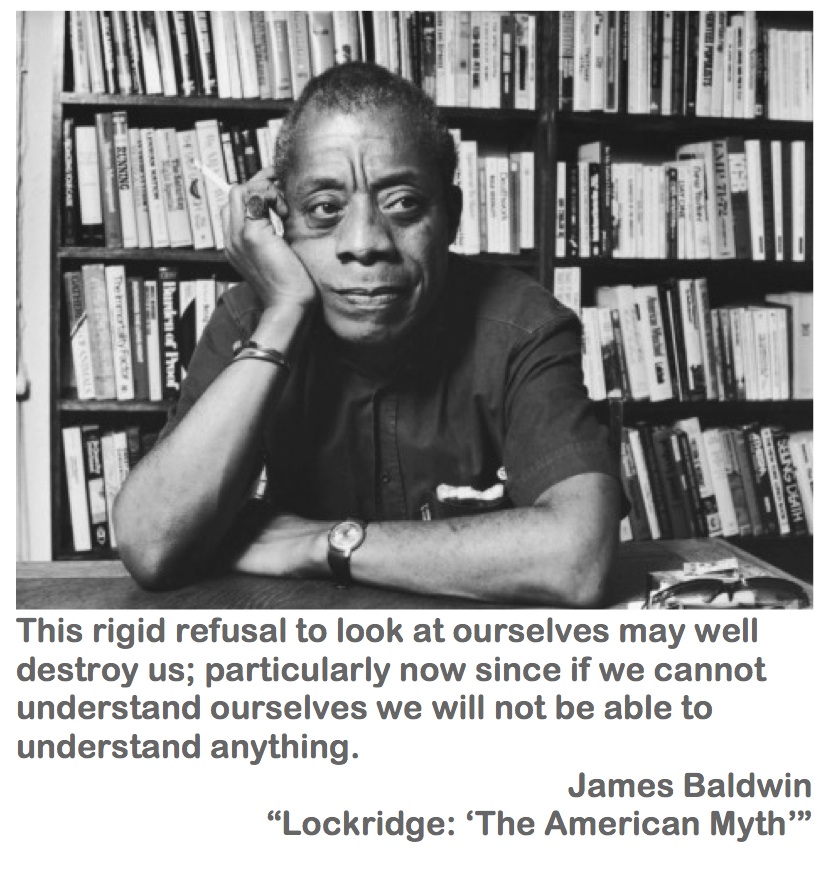
If we can have that moment in which we admit, confront, and atone for our responsibility in the evil that humans do, we must finally listen to James Baldwin:

rigid-refusal

And to Langston Hughes:

O, let America be America again—
The land that never has been yet—
And yet must be—the land where every man is free.
The land that’s mine—the poor man’s, Indian’s, Negro’s, ME—
Who made America,
Whose sweat and blood, whose faith and pain,
Whose hand at the foundry, whose plow in the rain,
Must bring back our mighty dream again.

And face our children with our failures, against which Maggie Smith struggles:

Life is short, though I keep this from my children….
The world is at least
fifty percent terrible, and that’s a conservative
estimate, though I keep this from my children….
Life is short and the world
is at least half terrible, and for every kind
stranger, there is one who would break you,
though I keep this from my children.

The US and its majority white population have the greatest opportunity before them, a free and powerful nation of riches, and daily, that opportunity is squandered because of our “rigid refusal to look at ourselves.”

The US is undeniably inequitable, and to balance among gender, race, etc., we have only two options: to take away or to give to—but in either case, white privilege is erased and white sensibilities are challenged.

There is no evidence the white majority has the ethical backbone to make changes for equity or even to tolerate them.

On a dark mourning in America, I recommend reading or rereading Margaret Atwood’s The Handmaid’s Tale—a sobering imagining of the worst of white responses to the rise of the Others they have created.

We are now on that path, and it is ours to make the decision to turn around or move forward into that oblivion.

1 November 2016 Reader: “Matters of power, state violence, extreme poverty, institutional racism”

The rise of Trumpism and how to fight it, Dorian Bon

Even leaving aside the possibility of marauding, right-wing poll-watchers, other questions will have come up for readers of this website: Why is Donald Trump’s bigotry and aggressive chauvinism finding such a large audience? How can so many millions of people who don’t have millions in their bank accounts be planning to vote for him after everything we know?

More generally: Where is the momentum on the far right coming from? Where is it going? And what can be done to stop it?

Trump’s Inconvenient Racial Truth, Nikole Hannah-Jones

To be clear, I am not arguing that the man who called for the execution of the since-exonerated Central Park Five (and who still insists on their guilt) and who seeks nationwide implementation of the stop-and-frisk program ruled unconstitutional in New York City, and who warns that voting in heavily black cities is rigged, is a racial progressive who will enact policies that will help black communities. Nor am I saying black voters should buy what Trump is selling. (And they aren’t: A poll released last week by The New York Times Upshot/Siena College of likely voters in Pennsylvania found that “no black respondent from Philadelphia supported Mr. Trump in the survey.”)

What I am saying is that when Trump claims Democratic governance has failed black people, when he asks “the blacks” what they have to lose, he is asking a poorly stated version of a question that many black Americans have long asked themselves. What dividends, exactly, has their decades-long loyalty to the Democratic ticket paid them? By brushing Trump’s criticism off as merely cynical or clueless rantings, we are missing an opportunity to have a real discussion of the failures of progressivism and Democratic leadership when it comes to black Americans.

Dont Walk That Line! Why Schools Need To Create And Measure Positive Climates, Andre Perry

As researchers on positive school climate note, the “personality” of a school is an expression of how teachers, students, family members and community perceive the milieu.

In other words, a school doesn’t have to be mean to be good. Treating students with care and respect increases academic performance among students from low socioeconomic backgrounds, higher than if a school placed a singular single focus on academics.

Researchers for this study pulled evidence from multiple studies from around the world to understand the relationships between socioeconomic status, school climate, and academic achievement to help academics and practitioners alike understand what a positive climate is and why ultimately it can boost academic achievement.

Why I Have No Sympathy for Angry White Men, Stacey Patton

Why isn’t anyone suggesting that these beleaguered White men respond to their relatively new “hard times” by working hard and pulling themselves up by their bootstraps? Where are the people calling on these beleaguered Whites to develop empathy and compassion for those who have long been suffering, like African-Americans and other people of color? Why do we need to understand this community? Why is the opposite never suggested as a potential option? Is it because White men are simply not willing to emerge from their bubble and acknowledge the humanity of those they deem “other?” Or is it because they are unable to see beyond their own reality?

What we’re witnessing is racist populism all over again. Trump is following a historical pattern by stoking the racism, but especially as a rich White man pitting disenfranchised poor White people against Black people and especially Black people in low-income areas, telling them to intimidate and attack them at his rallies and at the polls, much in the same way poor Whites were pitted against poor Black people by elite White people to ensure there wouldn’t be a class uprising.

“Trump is emancipating unbridled hatred” – Interview: Rina Soloveitchik, Judith Butler

Butler: What Trump is emancipating is unbridled hatred and, as we see recently, forms of sexual action that don’t even care about anybody’s consent. Since when did we have to ask women whether they are okay with being touched, or why? He does not actually say that, but that is exactly what he is indicating. It liberates people, their rage, and their hatred. And these people may be wealthy, they may be poor, they may be in the middle; they feel themselves to have been repressed or censored by the left, by the feminists, by the movement for civil rights and equality, by Obama’s presidency, which allowed a black man to represent the nation.

Unthinkable Politics and the Dead Bodies of Children, Henry A. Giroux

Matters of power, state violence, extreme poverty, institutional racism, a broken criminal justice system, the school to prison pipeline and the existence of the mass incarceration state, among other important matters, rarely if ever enter her discourse and yet these are major issues negatively affecting the lives of millions of children in the United States. And her alleged regard for children falls apart in light of her hawkish policies on global regime change, drone attacks and cyber-warfare, and her unqualified support for the warfare state. Her alleged support for children abroad does not capture the larger reality they face from when their countries are invaded, attacked by drones and subject to contemporary forms of indiscriminate violence. Rather than critique the US as a powerful engine of violence, Clinton expands its imperialist role around the globe. This is a key point in light of her defense of the rights of children, because her warmongering ideology puts children in the path of lethal violence.

Deplorables Unmasked

Something deplorable happened on the way to claiming the U.S. is a Christian nation of free people where everyone regardless of race, creed, religion, or gender has the same opportunities at life, liberty, and the pursuit of happiness.

And it wasn’t Donald Trump. Or better expressed, it wasn’t only Donald Trump.

Once Trump secured the nomination for president of the Republican Party, many scrambled to caution about condemning Trump’s supporters, not painting them with too broad and negative a brush.

Especially in the mainstream media, few, nearly none, would venture to utter words such as “racist,” “sexist,” “xenophobe,” or even “lie.”

Trump and his running mate have skated along literally piling lies on top of lies—including lies about not saying provable things, including Trump opening his most recent apology with lies.

But what is truly deplorable is Trump both represents and has unmasked the ugly truth about the U.S.: we are a nation of deplorables, not as outliers, but as a substantial population of our country.

As I was driving down I-85 in South Carolina on the morning after the suddenly shocking* recording of Trump being exactly who he has always been, I saw a large, black SUV in front of me with this bumper sticker:

deplorable

It has become conventional wisdom to brush off Trump’s obnoxious bravado as part of his reality show persona, while adding that his supporters are more nuanced in their support for his candidacy.

But the harsh truth is that Trump is deplorable and so are his supporters—and so are many so-called decent Americans.

Cliches become cliches often because they are true, and one truism seems quite important at this moment: when someone shows you who they really are, be sure to pay attention.

And people often reveal who they really are when they think they are in private, when they think they are among their own kind.

Men hanging out with other men often sound like the Trump comments being rebuked now as if this isn’t common language and attitudes.

Having been born, grown up, and now living in the South, I can assure you when whites are in seemingly safe environs, the racism rears its ugly head in subtle and blunt ways.

But it is even worse than that.

Now that we have yet more evidence of who Trump is, who his enablers are, the carefully prepared political backpedaling tells us just as much as any hot mic:

“I am sickened by what I heard today,” [Paul] Ryan said through a spokesman, about five hours after The Washington Post published a 2005 recording of Trump boasting of groping women and trying to have sex with a married woman. “Women are to be championed and revered, not objectified. I hope Mr. Trump treats this situation with the seriousness it deserves and works to demonstrate to the country that he has greater respect for women than this clip suggests.

Gross, pig sexist being chastised by his more well-groomed but equally clueless sexist—as part and parcel of who the Republican Party has always been, as part and parcel of who many in the U.S. remain to be:

When Trump vilified Mexicans and Muslims, when Trump repeatedly stirs racism and caters to openly racist groups, the mainstream political response remains trapped in respecting human dignity only by close association—currently the hot take in the mainstream press is to speak with reverence about mothers and daughters.

A people has no moral compass, no ethical grounding if the only way anyone can respect human dignity is by association.

If you have to know or be related to people with other statuses than yours to care about their human dignity, you are deplorable.

Some may now try to burn at the stake the Frankenstein’s monster, Donald Trump, but to do so without acknowledging Dr. Frankenstein is misguided and shallow political theater.

Trump as bogus billionaire entrepreneur, as con-man reality star is the white male prototype of what it means to be an American: America built this.

And, as much as we wish to deny it, we are America.

The America who tells Colin Kaepernick not to sully our sacred football with politics—while failing to see that opening every football game with the National Anthem is political.

The America who responds to #BlackLivesMatter with All Lives Matter—while refusing to admit that guns matter more than any lives.

The America that polices how some people raise their fists—while “land of the free and home of the brave” proves to be false on both counts.

Something deplorable happened on the way to claiming the U.S. is a Christian nation of free people where everyone regardless of race, creed, religion, or gender has the same opportunities at life, liberty, and the pursuit of happiness.

Something deplorable is right there in the mirror.


* One must ask, I think, why now? See More Than 150 Republican Leaders Don’t Support Donald Trump. Here’s When They Reached Their Breaking Point.

The Whitest Thing I Could Do

Let me tell y’all what it’s like
Being male, middle-class, and white
It’s a bitch, if you don’t believe
Listen up to my new CD

“Rockin’ the Suburbs,” Ben Folds

Sunday, I drove to Athens, GA, with friends to do the whitest thing I could do—attend a CAKE concert.

The most recent concert I attended was The National in Asheville, NC—very white—and before that, R.E.M. in Atlanta, GA—extremely white.

As a writer and a teacher, a significant amount of my time and energy is devoted to race, racism, white privilege, and inequity—particularly as those intersect education.

And while I have often outed myself as a redneck and confronted my own tremendous privilege that has contributed to my professional success, I have not ventured into my whiteness in any way other than to interrogate its mostly harmful contributions to a people’s claimed commitment to life, liberty, and the pursuit of happiness for all regardless of race or any status.

Sitting in The Classic Center in Athens as the lights were still up and the crowd gathered, I confirmed what I suspected: a crowd as far as I saw entirely white, many couples, and a wide array of ages clustering in their 30s and 40s.

The crowd and the concert were incredibly amiable; people were having fun, and the band in its typical way was casual, sardonic, and on form.

I don’t know by experience, but I suspect the mostly all-white crowds at, say, concerts for country music singers/bands are quite distinct from the chill, nerd-heavy fans of CAKE, a California band who records in a solar-powered studio, abandoned a lucrative major label, and flaunts their leftist politics through their eclectic musical style and smart-to-sarcastic lyrics from frontman John McCrea.

The concert was oddly low key and energetic with McCrea initiating a faux-battle between two halves of the crowd to highlight, as he invoked, that we all really have more in common than not.

CAKE began playing about 10-15 minutes after the scheduled start, with no opening act, but with a planned intermission and a tree give-away.

I am going to hazard a guess that the auditorium that night was filled with mostly good people—despite the goofy white-folk swaying and occasional unimpressive aisle dancing.

I will also hazard that most people attending and many who could have simply witnessed the crowd would be compelled to identify those attending as just a normal gathering of average folk.

And here where I cannot set aside my discomfort at my own inescapable whiteness.

“Privilege,” Roxane Gay examines, “is a right or immunity granted as a peculiar benefit, advantage, or favor,” continuing:

There is racial privilege, gender (and identity) privilege, heterosexual privilege, economic privilege, able-bodied privilege, educational privilege, religious privilege and the list goes on and on. At some point, you have to surrender to the kinds of privilege you hold because everyone has something someone else doesn’t….

One of the hardest things I’ve ever had to do is accept and acknowledge my privilege. This is something I am still working on. I’m a woman, a person of color, and the child of immigrants but I also grew up middle class and then upper middle class. My parents raised my siblings and I in a strict but loving environment. They were and are happily married so I didn’t have to deal with divorce or crappy intramarital dynamics. I attended elite schools. My master’s and doctoral degrees were funded. I got a tenure track position my first time out. My bills are paid. I have the time and resources for frivolity. I am reasonably well published. I have an agent so I have every reason to believe my novel will find a home. My life has been far from perfect but I have a whole lot of privilege. It’s somewhat embarrassing for me to accept just how much privilege I have.

Black and female, Gay speaks directly to the necessity of admitting privilege and then what I cannot avoid now, what I could not avoid while sitting at the concert: embarrassment.

It is a disturbing and distinct—but mostly ignored—fact that to pay for, drive to, and then attend a music concert is the consequence of a tremendous amount of time and financial privilege.

To utter “normal” or “average,” too, is a concession to the centeredness of “white” and to perpetuate the marginalizing of the Other (read as “not white”).

Despite my belief in the value and importance of art and pop culture, they are luxuries, they may be frivolous.

The people that could be fed, the suffering that could be comforted—while privileged white folk sing along to “Sheep Go to Heaven” and “Satan Is My Motor.”

The world, I know, is not a zero-sum game; it is possible for some to have without others going without.

But that is not the case in the U.S. White privilege has and continues to deny for some while catapulting others—and it is exponentially increased by gender, sexual orientation, and religious affiliation.

This sense of embarrassment has risen recently as well when I was being interviewed about my struggles with anxiety. While I am now eager to share, I paused during the interview and added that I hoped I didn’t sound as if I was whining—fearing I was echoing the persona in Ben Fold’s “Rockin’ the Suburbs” who groans, “All alone in my white-boy pain.”

My first concert was in Greenville, SC, during the late 1970s, and the acts were Mother’s Finest, Heat Wave, and Earth, Wind, and Fire. I drove a handful of my black teammates from the varsity basketball team to the event, and saw no other white people that night.

Yellow pot smoke filled the auditorium, and while I was a non-smoker, I occasionally and dutifully passed along a joint casually working its way down the row of seats.

In most ways, it is incredibly hard to fathom that night and that me as well as the journey from my conflicted racist and redneck past to sitting in the audience a couple nights ago truly happy and very much enjoying being at the CAKE concert.

That teenaged me has been replaced and is always here inside me.

And maybe it is because of that I remain quite uncertain about what to do with this embarrassment.

All of us walk around in the statuses given us—along with the privileges and disadvantages that they bring.

I am at peace with my own confrontations of my privilege, with my own commitments to dismantle those privileges and to guard against using them as weapons or to pretend they are what I have earned.

Yet, the embarrassment remains:

Narcotics cannot still the Tooth
That nibbles at the soul –

Dickinson, I think, offers a hint that this embarrassment from privilege is the unexplainable human quality too few experience—a conscience, a moral response to the “This World.”

And so I am left with my whiteness and an embarrassment of riches that afforded me the oasis of sitting in the audience and driven to happiness from the the trumpet of Vince DiFiore, a happiness about being alive and the possibilities of the human condition.

This, I think, is our greatest justification about art.

“Jesus wrote a blank check,” I sing in my mind:

One I haven’t cashed quite yet
I hope I got a little more time
I hope it’s not the end of the line.

Political Will: A Meditation

In my introductory foundations course in education, we have been watching Corridor of Shame and discussing the historical negligence of some schools, some students, and some communities in South Carolina for generations; in this case, “some” means “black” and “poor.”

The maudlin and melodramatic documentary is grounded in a court case that has taken the state two decades to settle—and then to proceed to do exactly nothing.

As we waded into a class discussion of this political negligence, I stressed a refrain I am moving toward more and more often: political will.

The godawful Truth of the matter is that public schools in high-poverty black communities—notably those along the I-95 corridor—are underfunded, marginalized, and essentially left to chance exactly because this is what we want in the state.

Nowhere in the U.S. at the state or federal level is there a lack of money, resources, or expertise to do anything we wish to do. What we choose to do and what we choose to ignore are exactly what we want.

In 2014, I wrote this poem:

It is a poem about political will, about the tyranny of the privileged and the consequences of that tyranny for marginalized groups; I highlight women and children, but this is also about black and brown people, people in poverty, religious minorities, foreign nationals, transgender people, gay people—anyone not of the centered community that is white, male, straight, and a certain kind of superficial Christian.

A former student of mine, Lucas Patterson, posted a Nikki Giovanni poem on Facebook, “Allowables,” and I felt my heart sink:

allowables

In fact, I felt sick physically and in my soul because of this:

Tulsa police officer Betty Shelby, identified as the officer who shot 40-year-old Terence Crutcher on Friday night, has offered her side of the story in the fatal encounter.

In dashcam and helicopter video released by police, Crutcher appears to have his hands up moments before he is shot by Shelby. Shelby’s attorney, Scott Wood, maintains that Crutcher refused to follow more than two dozen commands and that he reached into the open window of the car before Shelby perceived a threat and shot him….

Shelby believed that when Crutcher attempted to reach into the car, he was retrieving a weapon, Wood said. In her interview with homicide detectives, she said, “I was never so scared in my life as in that moment right then,” according to Wood.

Just as people who call themselves Christian and patriots will without a thought crush a spider under the soles of their shoes, those people will and have created this world and allow it to be exactly as they want it to be.

A world where black men’s names become hash tags as inconsequential as court cases being settled.

A world of unwarranted privilege at the expense of the Other.

The world was exactly as they expected, exactly as they knew it to be.

And mostly not as it could have been, or should have been.