Category Archives: privilege

Students, Not Standards: Calling for Solidarity in 2016

Many years ago, I was sitting in the last class session of the capstone secondary ELA methods course as part of my M.Ed. The guest speaker that day was my high school English teacher, the man responsible for my primary career path, Lynn Harrill.

Lynn was friends with the professor, who was then working at the state department of education, I believe.

Toward the end of the class, the professor asked what we wanted our students to know when they left our classes. That question was followed by lingering silence.

Ever the eager student, I said, “I want them to know themselves,” and I caught a glimpse of Lynn smiling widely.

Of course, that is what Lynn had taught me, although most people probably assumed it was reading and writing Lynn had so expertly given his students (which, by the way, was also true).

This moment—one of a very idealistic and naive young teacher, me—comes back to me often, and despite my many failures as a teacher, that grounding goal has always guided me. Not to be simplistic, but I teach students—that’s why I teach.

While reading Four Stories That Homework Tells Children About School, Learning, & Life, I was struck by “STORY #3: School Is More Important Than Other Pursuits/Interests/Activities.”

And now I have to investigate that memory again.

Yes, Lynn Harrill changed my life by being my sophomore and junior English teacher in high school. He was gracious, kind, and encouraging to a deeply insecure and anxious teen (me) who had decided he was a math and science person—because that is what school had told me.

Junior high English classes had been mostly draconian English teachers, grammar book exercises, and diagramming sentences. The “English” content of those classes was easy (I made As), but I loathed it all, even the texts we were assigned to read (much of which we did not read).

Now, before I launch into whining, let me be clear that my story is about how school failed me—but that because of my tremendous privilege (white, male and—according to traditional schooling and standardized tests—high verbal and mathematical intelligence), the consequences of those failures were miniscule. I attended college and continued to make As (easily), leading to an MEd and EdD.

I share this, then, not to bemoan poor pitiful me (or to brag), but to highlight that schools often fail students in ways we do not acknowledge and that the consequences for those students who need schooling most are monumental.

While I was begrudgingly playing school and succeeding, at home I was engaged in a rich array of hobbies and interests that school not only ignored, but also indirectly refuted (even Lynn told me as a 10th grader I needed to stop reading science fiction [SF] and start reading real literature such as Fitzgerald).

I was collecting, reading, and drawing from thousands of Marvel comic books. I was voraciously listening to popular music and studying the lyrics. And I was doing the same with comedy albums, mostly George Carlin and Richard Pryor.

My reading life, as I noted above, was Larry Niven and Jerry Pournelle, Arthur C. Clarke, and whatever works were prompted by my mother’s SF film fascination. I fell in love with The Andromeda Strain because of the film, and much of my formative life was driven by the five Planet of the Apes films and TV’s Star Trek.

My response to the real literature endorsed by Lynn was tepid (but always the mama’s boy, I did as teachers told me to do), but my life was irrevocably changed when he also recommended writers I would never be assigned in the rural South of the 1970s—notably D.H. Lawrence.

Well, damn, I thought. This is literature?

My journey from student to teacher began in my sophomore year of high school as I began to untangle the false narratives school had taught me and came to embrace the authentic narratives of my real life, my real Self, outside of school.

More than a decade into my teaching career (in the position Lynn left at my high school) and in the same doctoral program Lynn had completed, I finally discovered critical pedagogy as the complete vision of student-centered teaching and learning I had been haphazardly practicing.

Regretfully, my entire career as an educator (18 years as a high school ELA teacher and then 14 more years, and counting, as an English educator and first-year writing professor) has occurred under the antithesis of student-centered critical education—the high-stakes accountability movement.

All of which, ironically, I have been prepared for by the very reading material school marginalized, science fiction and dystopian fiction.

Standards, high-stakes tests, and accountability fail students, fail teachers. They conspire to do exactly what homework accomplishes in story #3 above.

I cannot step away form this: I must teach those students placed in my care, and that duty requires me to find out who they are, what they know, and what they want so that we can work together so that they find who they are and who they want to be.

So, I wonder with the new year, and the allure of resolutions—who is with me in 2016? Can we make this about students and not standards, not tests?

See Also

Doubling Down (Again) by Reverting, Not Changing: The Exponential Failures of Education Legislation

Teacher Quality, Wiggins and Hattie: More Doing the Wrong Things the Right Ways

More on Evidence-Based Practice: The Tyranny of Technocrats

Beware the Technocrats: More on the Reading Wars

I Don’t Need Standards To Teach, I Need Students

Are Common Core and Testing Debates “Two Different Matters”?
UPDATED: Mainstream Media in (Perpetual) Crisis: More Education Meat Grinder

UPDATE: Note Holly Yettick’s One Small Droplet: News Media Coverage of Peer-Reviewed and University-Based Education Research and Academic Expertise; see abstract:

Most members of the American public will never read this article. Instead, they will obtain much of their information about education from the news media. Yet little academic research has examined the type or quality of education research and expertise they will find there. Through the lens of gatekeeping theory, this mixed-methods study aims to address that gap by examining the prevalence of news media citations of evidence that has undergone the quality-control measure of peer review and expertise associated with academics generally required to have expertise in their fields. Results suggest that, unlike science or medical journalists, education writers virtually never cite peer-reviewed research. Nor do they use the American Educational Research Association as a resource. Academic experts are also underrepresented in news media coverage, especially when compared to government officials [bold aded]. Barriers between the news media and academia include structural differences between research on education and the medical or life sciences as well as journalists’ lack of knowledge of the definition and value of peer review and tendency to apply and misapply news values to social science research and expertise.

“‘Only four out of ten U.S. children finish high school, only one out of five who finish high school goes to college’”: This spells doom for the U.S. economy, or to be more accurate, this spelled doom for the U.S. economy.

Except it didn’t, of course, as it is a quote in a 1947 issue of Time from John Ward Studebaker, a former school superintendent who served as U.S. Commissioner of Education (analogous to today’s Secretary of Education) in the mid-1940s.

Jump forward to 26 December 2015 and The New York TimesAs Graduation Rates Rise, Experts Fear Diplomas Come Up Short. Motoko Rich, as in the Time article, builds her case on Secretary of Education Arne Duncan, as Susan Ohanian confronts:

Here’s a front page. above-the-fold New York Times non-story that’s a perfect depiction of damning schools every-which-way. Schools with low graduation rates are depicted as failures; improve graduation rates, and then the diplomas they’re handing out are judged to have no meaning. And the Times gives the departing Secretary of Education star billing on this issue.

Quotation of the Day
The goal is not just high school graduation. The goal is being truly college and career ready.

–ARNE DUNCAN, the departing secretary of
education, on the United States 82 percent graduation rate in 2013-14, the highest on record.–New York Times, Dec. 27, 2015

Along with the meat grinder of incessantly new high-stakes accountability standards and testing over the past thirty-plus years, U.S. public education has been demonized since the mid-1900s and relentlessly framed within crisis discourse by the mainstream media for a century.

Rich’s cover piece spends an inordinate amount of energy to twist public schools into that crisis image while making no effort to investigate or challenge Duncan (a life-long appointee with no expertise in education and no credibility as a leader in education) or to unpack the stale platitudes and unsubstantiated claims about education reaching back at least to the Time article.

Duncan and Rich share, in fact, no experience or education in teaching as well as the disproportionate power of their voices in the field despite that lack of expertise.

On the other hand, I taught public high school English in rural South Carolina (not far from the school Rich highlights), have been an educator in SC over 30 years total, have a doctorate in education that emphasized the history of the field, and now am a teacher educator at a university just a couple miles from the school in Rich’s piece (I know teachers there, and have had several teacher candidates placed there for field work). As well, I taught journalism and was the faculty sponsor of the school newspaper, and have been a professional writer for about the same amount of time as I have been teaching, including writing and publishing a good deal of journalism (mostly about education).

This is not, however, an attack on Duncan or Rich—because they are not unique but typical of the mismatch of high-level voice with a lack of expertise.

Mainstream media appear fatally wed to only one version of the U.S. public education story: crisis.

And thus, journalists reach out to the same know-nothings (political leaders, political appointees, think-tank talking heads) and reproduce the same stories over and over and over [1].

Here, then, let me offer a few keys to moving beyond the reductive crisis-meme-as-education-journalism:

  • Public education has never been and is not now in crisis. “Crisis” is the wrong metaphor for entrenched patterns that have existed over a century. A jet plane crash landing into the Hudson River is a crisis; public education suffers under forces far more complicated than a crisis.
  • Metrics such as highs-takes test scores and graduation rates have always and currently tell us more about the conditions of children’s lives than to what degree public schools are effective.
  • Short-hand terms such as “college and career ready” and “grade-level reading” are little more than hokum; they are the inadequate verbal versions of the metrics noted above.
  • The nebulous relationship between the quality of education in the U.S. and the fragility of the U.S. economy simply has never existed. Throughout the past century, no one has ever found any direct or clear positive correlation between measures of educational quality in the U.S. and the strength of the U.S. economy.
  • Yes, racial and class segregation is on the rise in the U.S., and so-called majority-minority schools as well as high-poverty schools are quickly becoming the norm of public education. While demographics of race and class remain strongly correlated with the metrics we use to label schools as failing, the problem lies in the data (high-stakes tests remain race, class, and gender biased), not necessarily the students, teachers, or administrators.
  • However, historically and currently, public education’s great failures are two-fold: (1) public schools reflect the staggering social inequities of the U.S. culture, and (2) public schools too often perpetuate those same inequities (for example, tracking and disciplinary policies).

The mainstream media’s meat grinder of crisis-only reporting on public education achieves some extremely powerful and corrosive consequences.

First, the public remains grossly misinformed about public schools as a foundational institution in a democracy.

Next, that misleading and inaccurate crisis narrative fuels the political myopia behind remaining within the same education policy paradigm that has never addressed the real problems and never achieved the promises attached to each new policy (see from NCLB to ESSA).

And finally, this fact remains: Political and public will in the U.S. has failed public education; it has not failed us.

Mainstream media remain trapped in the education crisis narrative, I think, because neither the media nor the collective political/public consciousness is willing to confront some really ugly truths beneath the cultural commitment to the powerful and flawed rugged individual mythology in the U.S.: America is a classist, racist, and sexist society.

We are committed to allowing privilege beget privilege and to pretending that fruits of privilege are the result of effort and merit.

There is no crisis in education, but our democracy is being held hostage by incompetent politicians and a compliant mainstream media—all of which, ironically, would be served well by the sort of universal public education envisioned by the tarnished founding fathers’ idealistic (and hypocritical) rhetoric [2].

[1] See Educational Expertise, Advocacy, and Media Influence, Joel R. Malin and Christopher Lubienski; The Research that Reaches the Public: Who Produces the Educational Research Mentioned in the News Media?, Holly Yettick; The Media and Educational Research: What We Know vs. What the Public Hears, Alex Molnar

[2] See Thomas Jefferson’s argument for a democracy embracing education:

The object [of my education bill was] to bring into action that mass of talents which lies buried in poverty in every country for want of the means of development, and thus give activity to a mass of mind which in proportion to our population shall be the double or treble of what it is in most countries. ([1817], pp. 275-276)

The less wealthy people, . .by the bill for a general education, would be qualified to understand their rights, to maintain them, and to exercise with intelligence their parts in self-government; and all this would be effected without the violation of a single natural right of any one individual citizen. (p. 50)

To all of which is added a selection from the elementary schools of subjects of the most promising genius, whose parents are too poor to give them further education, to be carried at the public expense through the colleges and university.  (p. 275)

By that part of our plan which prescribes the selection of the youths of genius from among the classes of the Poor, we hope to avail the State of those talents which nature has sown as liberally among the poor as the rich, but which perish without use, if not sought for and cultivated. But of all the views of this law none is more important none more legitimate, than that of rendering the people the safe, as they are the ultimate, guardians of their own liberty. (p. 276)

The tax which will be paid for this purpose is not more than the thousandth part of what will be paid to kings, priests and nobles who will rise up among us if we leave the people in ignorance. (p. 278)

Judging an Iceberg by the Tip Only: The Cumulative Effects of Opportunities for Students

“[M]ost of what poor people have in common has nothing to do with their culture or dispositions [laziness]. Instead, it has to do with what they experience, such as the bias and lack of access to basic needs” (p. 26).

Reaching and Teaching Students in Poverty: Strategies for Erasing the Opportunity Gap, Paul Gorski

Throughout the first several years as a high school English teacher in rural Upstate South Carolina (in my hometown high school, in fact), I believe I learned far more lessons than I taught.

In those first couple years, I had different ability levels of classes (yes, we tracked every grade with low, average, honors, and Advanced Placement) and multiple grade levels as well—resulting in my juggling as a beginning teacher 13 textbooks among my five courses. Several of the so-called “general” classes were at maximum capacity, 35 students, as well.

One of the most vivid and troubling lessons recurred year after year in my general senior English course: Students, in a burst of maturity accompanied by the realization that adulthood loomed, approached me about taking the SAT and applying to college.

General track students, typically, had been in courses for years specifically designed for students not applying for college; therefore, these students were destined to do poorly on the SAT (because of a combination of their inadequate coursework for many years and their socioeconomic status, mostly working-poor and working-class households) and have their belated motivation squashed.

Although not a popular response, I often replied with: “Well, first go back in time. And then, read, read, read.”

If possible, of course, that solution was and remains quite accurate, but my larger point was addressing the cumulative impact of life and educational experiences that students either have or miss—and that the quality and amount of those experiences are more strongly correlated with the coincidences of those students’ births than with the content of their character.

These students came rushing back to me this spring during my May Experience course on educational documentaries.

My university is a small selective liberal arts environment, and we have a relatively privileged and white student body—despite efforts shared by many universities to increase diversity. One of the unintended consequences of our May X program has been that athletes typically take these courses, and since our student-athletes are more racially diverse than our larger student body, my May X classes have usually been more racially and gender diverse than courses during the main semesters.

This May, my class was about 1/3 students of color and included more males than usual as well.

One day we were discussing Advanced Placement and International Baccalaureate courses in high schools, and when I asked students to raise their hands if they had taken A.P. or I.B., I immediately noticed on the one side of the room where several black student-athletes sat, the students had not raised their hands.

Possibly as a result of this discussion, one black male student-athlete wrote his public piece (they were asked to write a public piece addressing misconceptions about education) on his own background in high school, his recognition that students given access to A.P. had a significant advantage over students not allowed in or offered A.P. courses.

This young man noted that his college experience has highlighted for him his own disadvantage among students who had different backgrounds that he was afforded.

So when I saw Darryl Robinson’s I went to some of D.C.’s best schools. I was still unprepared for college, I immediately saw the faces of my high school students from decades ago blend with the students this May.

Despite his “work[ing] extremely hard to get [to college],” Robinson makes a powerful admission:

But after arriving on campus before the school year, with a full scholarship, I quickly felt unprepared and outmatched — and it’s taken an entire year of playing catch-up in the classroom to feel like I belong. I know that ultimately I’m responsible for my education, but I can’t help blaming the schools and teachers I had in my early years for my struggles today.

Robinson’s story is disturbing and important—and one that must be read carefully so that we turn our eyes away from Robinson himself and to the larger context he is ultimately condemning.

First, Robinson is the embodiment of the racial and class inequities suffered by students, but as he details very well, Robinson also is caught in the “good student trap”—as highlighted by his recognition of how his writing instruction failed him:

I first noticed the gap between me and my classmates after my first writing assignment at Georgetown. In an English class to help prepare incoming freshmen, we were asked to analyze the main character’s development in “Persepolis,” a graphic memoir about growing up in Tehran during the Iranian revolution. I thought it was an easy assignment. Everyone’s papers were distributed to the class, and it was immediately obvious how mine fell short: I merely summarized the plot of the book without making any real argument. I got a D-minus.

I did what I’d been taught growing up in school: memorize and regurgitate information. Other Georgetown freshmen from better schools had been trained to form original, concise thoughts within a breath, to focus less on remembering every piece of information, word for word, and more on forming independent ideas. I was not. I could memorize and recite facts and figures, but I didn’t know how to think for myself. Now, in an attempt to think deeper, I sometimes overthink myself into silence.

Without this first-person account from Robinson, many who claim that success in school and life in the U.S. is mostly a consequence of effort and resilience may continue to point the accusatory finger at the tip of the iceberg and draw their distorted conclusions about outcomes—without regard to the tremendous weight of the opportunities (and lack thereof) below the surface. As Robinson notes about his first experiences with A.P. classes:

It dawned on me that this was what college would be like. But with less than two years left in high school, would I be ready? Before that class, all the papers I had written were hardly analytical, simply retelling the plot of a book. I felt cheated.

Robinson’s story is possibly dangerous since he has somehow found himself at Georgetown University despite great odds against him and despite his realization that he remains behind his classmates for reasons not of his doing.

Robinson is an outlier in many respects, and it is alluring in the U.S. to read him as a model of the power of resilience without asking why some children are condemned to a real-life Hunger Games while some children are praised as smart and “gritty” without recognizing their privilege.

And then, stories, ironically, of the typical child of color growing up in poverty remains ignored—like the great majority of the iceberg below the surface.

Who is telling this story?:

As it turns out, the conditions that attend poverty—what a National Scientific Council report summarized as “overcrowding, noise, substandard housing, separation from parent(s), exposure to violence, family turmoil,” and other forms of extreme stress—can be toxic to the developing brain, just like drug or alcohol abuse. These conditions provoke the body to release hormones such as cortisol, which is produced in the adrenal cortex. Brief bursts of cortisol can help a person manage difficult situations, but high stress over the long term can be disastrous. In a pregnant woman, the hormone can “get through the placenta into the fetus,” Levitt told me, potentially influencing her baby’s brain and tampering with its circuitry. Later, as the same child grows up, cortisol from his own body may continue to sabotage the development of his brain.

Basing our demands of schools, teachers, and students on accountability for outcomes is judging an iceberg by the tip only.

That narrow and misguided view of teaching, learning, and humans is misreading success and failure (attributing them disproportionately to effort and resilience) while also ignoring the cumulative impact of access to rich and sustained opportunities (privilege) versus being denied those rich opportunities while also suffering inordinate and sustained stress (poverty and racism).

And the greatest failure of all in this call for accountability and education reform is that instead of trying to create for children in poverty the sorts of life and school experiences afforded the wealthy, children of color and impoverished children are being diagnosed as deficient (the word gap, lack “grit”) and then being subjected to the worst possible educational experiences: increased stressful environments (academic and disciplinary), reduced academic experiences (test-prep), narrowed curriculum (so-called core disciplines with no P.E. or fine arts), and an anemic teacher workforce (inexperienced, scripted, un-/under-qualified).

We do not need to raise our students test scores. We do not need to gather data on the “grit” of our students so we can teach them “grit.” We do not need slogans about “no excuses” that trivialize the realities of children’s lives as if they should walk through the doors of schools and magically ignore the weight of their lives—lives they did not create.

We do need to admit that outcomes and behaviors reflect an entire life, and that many we label “successful” have had the opportunities that those we label “failing” or “at risk” have been denied.

As a society, we are starving some children, weighing them, labeling them underweight, and then accusing them of not working as hard as their well-nourished peers.

So let me return to my current students at a selective university.

These students are in fact very bright and capable. I love them dearly. But they are not successful primarily because they have some qualities other students do not have.

My students represent the consequences of rich and diverse experiences over many years of mostly privileged lives.

This is how nearly all children could be if we genuinely had the resilience ourselves to make that happen.

The Real American Success Story

In the early 1990s after we had moved into our first stand-alone home (having lived in an owned townhouse a few years), my wife and I bought a Honda Accord—a typically American milestone of having finally risen above our station as Honda Civic owners.

As I was dong the paperwork for this car, I realized that the sale price was the same as what my parents had paid for their house in 1971 (a house, by the way, that still is more square footage than any house I have ever owned): $22,500.

I am one generation removed from the white working-class idealists who are my parents, both having been raised in the South during the 1950s—my mother the daughter of a mill worker and my father the son of a gas station owner.

Buying that Honda Accord, however, did not at that moment fill me with pride or a sense accomplishment. It made me feel extremely uncomfortable. I even called my father and told him about the coincidence of the prices of a car for me and the house my parents had worked themselves nearly to death to own.

My parents’ house sits on the largest lot of a local golf course, their having bought it as the course was being built and then scraped and clawed until they had the $1000 downpayment. Their monthly mortgage payment was also less than many of my car payments.

And while most people—especially my parents—would hold me up as proof of all that is Right with the U.S., I have to raise a hand of caution.

Yes, I have worked hard, but most of my success has come in academic settings—being a top student, and then working my way through undergraduate and graduate degrees while also having two careers, first as a high school teacher and now as a professor. To be perfectly blunt and honest, my success has been built on tremendous privilege—being white and male—and what appears to be hard work to many has in fact not been that hard for me at all.

Success in education depends a great deal on reading and writing—two behaviors that are for me both a joy and mostly easy to do.

#

In his Reaching and Teaching Students in Poverty, Paul C. Gorski notes “that many of us were raised to believe that the United States and its schools represent a meritocracy, wherein people achieve what they achieve based solely on their merit, so that all achievement is deserved rather than rendered” (pp. 14-15).

Historically, this American success story has been “tied to the Horatio Alger myth (Pascale, 2005) and the notions of rugged individualism and an ethic of self-sacrifice,” Gorski explains—what we often reduce to as “pulling ones self up by the bootstraps.”

However, this myth is nothing more than a twisted fairy tale—one that normalizes outliers and depends on a very ugly and false characterization of people in poverty: The impoverished, the subtext goes, create their poverty through their laziness.

The mostly false American success story keeps the accusatory gaze always on people in poverty so that little attention is paid to the larger forces of inequity in the U.S.

Gorski warns, “[M]ost of what poor people have in common has nothing to do with their culture or dispositions [ie., charges of laziness]. Instead, it has to do with what they experience, such as the bias and lack of access to basic needs” (p. 26).

#

Social forces—many of which are created and then perpetuated by privilege—drive conditions of scarcity (poverty) and slack (privilege) that are then reflected in the conditions surrounding and behaviors by individual people (see Sendhil Mullainathan and Eldar Shafir’s Scarcity: Why Having Too Little Means So Much).

Therefore, we must confront the real American success story, the one that is typical of life in the U.S. and not one that misrepresents outliers as the expectations for everyone.

In the U.S., the floors of the penthouse of the wealthy are incredibly secure and stable, the few cracks are nearly as tight as they are rare. The best road to success in the U.S. is to be born wealthy.

As well, the ceilings on the basement of poverty are incredibly secure, allowing only a rare fortunate few through by superhuman efforts.

Instead of Horatio Alger, then, we must look to our own former president George W. Bush, who regularly joked about his C-student status, and whose SAT score both reflected a score higher than his GPA and fell below most of his peers accepted in Ivy League educations (an ironic two-fer that exposes the SAT as mostly a measure of wealth and privilege as well as showing how connectedness, being a legacy, is a privileged version of affirmative action).

George W. Bush has been very open as well about his struggle with alcoholism and his relatively unimpressive efforts at adulthood until he was nearly 40. Despite those hurdles and signs of laziness, he acquired part-ownership of the Texas Rangers and then became governor of Texas and president of the U.S.

I must, then, conclude that in the U.S., we have two Americas, and the one George W. Bush represents is the real American success story that exposes the key to achievement—not the content of ones character, but the coincidence of ones birth.

#

Writing in the New York Times, Susan Dynarski reports:

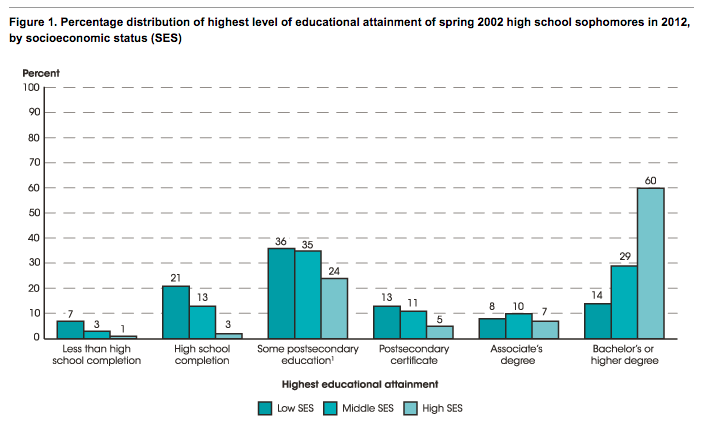
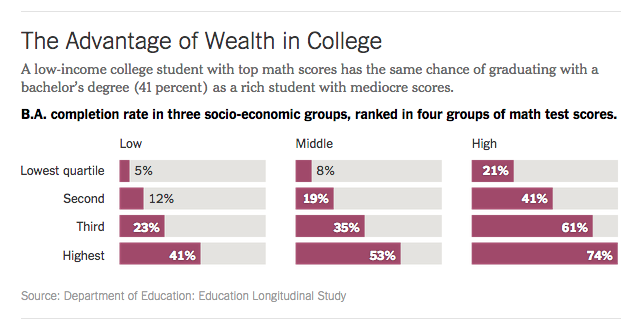
Rich and poor students don’t merely enroll in college at different rates; they also complete it at different rates. The graduation gap is even wider than the enrollment gap.

These sobering facts come from a longitudinal study and a connected report. And the data are stunning, but clear:

vantage of wealth in college
Source: Department of Education: Education Longitudinal Study
edu attainment distribution SES
SOURCE: U.S. Department of Education, National Center for Education Statistics, Education Longitudinal Study of 2002 (ELS:2002), Base Year and Third Follow-up. See Digest of Education Statistics 2014, table 104.91.

Further, Dynarski continues, and then concludes:

Academic skills in high school, at least as measured by a standardized math test, explain only a small part of the socioeconomic gap in educational attainment.

Here’s another startling comparison: A poor teenager with top scores and a rich teenager with mediocre scores are equally likely to graduate with a bachelor’s degree. In both groups, 41 percent receive a degree by their late 20s.

And even among the affluent students with the lowest scores, 21 percent managed to receive a bachelor’s degree, compared with just 5 percent of the poorest students. Put bluntly, class trumps ability when it comes to college graduation.

Poor students are increasingly falling behind well-off children in their test scores, as recent research by Sean Reardon at Stanford University shows.

That is, any poor children who manage to score at the top of the class are increasingly beating the odds. Yet even when they beat the odds in high school, they still must fight a new set of tough odds when it comes to completing college.

#

Steph Curry has gained a well-deserved high level of recognition as the NBA League MYV in the 2014-2015 season. Like Grant Hill, Curry is the black son of a successful and wealthy professional athlete.

Curry is recognized as a hard worker—practicing at rates and amounts that most people cannot comprehend.

An ideal role model for black males in the U.S.?

Not according to high school English teacher Matt Amaral, who recently posted Dear Steph Curry, Now That You Are MVP Please Don’t Come Visit My High School and asked of Curry: “But I have to ask you to do me a solid and make sure you don’t ever come visit my high school.”

Amaral is making a concession I have argued above.

Curry is an outlier, and the personification of a potentially corrosive promise: You can be anything if you just work hard enough.

Well, no, that isn’t true.

So those of us who are parents and educators are put in a truly ugly position.

I love to inspire and encourage young people. I dearly and deeply love young people.

But I also cringe at the adult proclivity to lie in order not to face themselves the ugly truths they create and perpetuate—often by refusing to face them.

There is tremendous value in hard work and effort for the sake of hard work and effort.

And, yes, the world should be a meritocracy, the world should be fair.

Pretending it is while it isn’t, wrapping our young in shallow feel-good slogans and stories—these are sure ways never to achieve the equity we say we love in the U.S.

If we do not want to tell students the real American success story—the one about winning the birth lottery—we damn well better do something to create a better story instead of continuing to lie to children and ourselves.

Because, as you know, it is entirely within your power to make things different, right?

See Also

UPDATED (Again): Grit, Education Narratives Veneer for White, Wealth Privilege

Telling Poor, Smart Kids That All It Takes Is Hard Work to Be as Successful as Their Wealthy Peers Is a Blatant Lie, Taylor Gordon