Category Archives: race

Changing the Odds So No Child Has to Overcome Them

[Header Photo by Library of Congress on Unsplash]

There are several challenging, and therefore uncomfortable, scenes in Little Rock Central: 50 Years Later (2007); however, when I show this documentary in my courses, few students recognize those scenes as either challenging or uncomfortable.

At one point, several black men from the Little Rock, Arkansas community are gathered outside the school, and they speak directly about the need for blacks to take care of their own, clean up their own communities. These men directly mention the damage of black-on-black crime (which is about the same as white-on-white crime, although the latter is almost never mentioned).

Throughout the documentary, as well, a number of black students confront how hard they work and how some of their fellow black students simply do not try—echoing a rugged individualism and personal responsibility narrative that a white teacher/coach and her white golf team members express.

I use these scenes as teachable moments about the negative impact of respectability politics on marginalized groups:

What started as a philosophy promulgated by black elites to “uplift the race” by correcting the “bad” traits of the black poor has now evolved into one of the hallmarks of black politics in the age of Obama, a governing philosophy that centers on managing the behavior of black people left behind in a society touted as being full of opportunity. In an era marked by rising inequality and declining economic mobility for most Americans—but particularly for black Americans—the twenty-first-century version of the politics of respectability works to accommodate neoliberalism. The virtues of self-care and self-correction are framed as strategies to lift the black poor out of their condition by preparing them for the market economy.

…Today’s politics of respectability, however, commands blacks left behind in post–civil rights America to “lift up thyself.” Moreover, the ideology of respectability, like most other strategies for black progress articulated within the spaces where blacks discussed the best courses of action for black freedom, once lurked for the most part beneath the gaze of white America. But now that black elites are part of the mainstream elite in media, entertainment, politics, and the academy, respectability talk operates within the official sphere, shaping the opinions, debates, and policy perspectives on what should—and should not—be done on the behalf of the black poor.

Respectability politics works in conjunction with seemingly innocuous narratives (rugged individualism, lifting yourself by your bootstraps, personal responsibility) to keep the accusatory gaze on individuals and away from systemic inequity. In other words, political and economic elites are more secure if the majority of people believe all success and failure are primarily determined by individual traits and not by privilege and disadvantage beyond most people’s control.

This semester that discussion has coincided with Laura Ingraham attempting to publicly shame LeBron James to “shut up and dribble,” a not-so-clever self-promotion for one of Ingraham’s vapid books.

Along with Kevin Durant’s heated response, James (see video in the link above) stressed, “We will definitely not shut up and dribble.”

Watching James, however, and listening carefully present us with the dangers of his “defeating the odds” motivation (listen to about minutes 1:50-2:15), his own powerful and impressive rise to being King James.

I am not criticizing James, however, and fully support his response, refusing to shut up and dribble.

But a message that suggests anyone can or should be able to achieve what an outlier, James, has achieved is ultimately harmful, speaking through and to the most corrosive aspects of respectability politics.

This call to teach children to beat the odds, in fact, is shared all along the political spectrum from right to left.

The ultimate flaw in a beat-the-odds mentality is, again, that it suggests success and failure lie mostly or solely in the individual, a matter of choice and effort—like having “grit,” a growth mindset, or a positive attitude (all ways to fix inadequate children).

This is a terrible message for children especially since success and failure are mostly determined by systemic forces—except for rare outliers—and the message allows those with the power to change the odds to escape accountability.

LeBron James, I believe, is right about his importance as a role model, as a stellar example of what black success looks like despite the odds being unfairly against him in the form of racism and economic inequity.

And as long as we as a society choose to ignore the odds, choose to allow racism, sexism, and classism to exist, I suppose we should find humane and supportive ways to encourage children to work so that a few of them may hit the life lottery and beat the odds.

But to be blunt, that’s a pretty shitty cop-out for the adults who could, in fact, change the odds so that no child has to overcome them.

It is ultimately a heartless and ugly thing to see children as lacking the drive to beat odds that shouldn’t exist in the first place.

It is political cowardice and public negligence to remain fatalistic about the odds as we watch those odds destroy the hopes and dreams of our children.

If anyone should shut up, that would be Ingraham and her entire cadre of right-wing know-nothings who shovel the very worst narratives that help guarantee those odds will remain in their favor.

And as we listen to James instead, let’s resist demanding that he or any so-called racial minorities somehow erase racism and then begin to demand that those who benefit the most from the odds use those privileges to dismantle those odds.

That, I know, is a powerful ask, but it is one that certainly holds more credence than asking children to be superhuman because we have James dribbling across our flatscreen TVs.

The Politics of Education Policy: Even More Beware the Technocrats

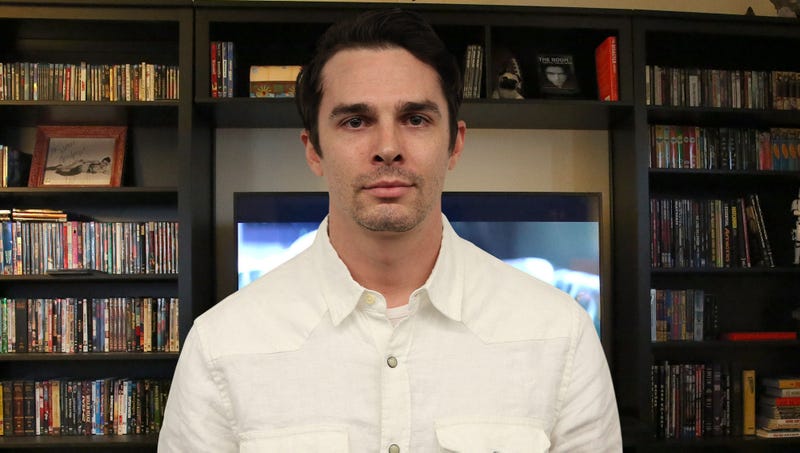
Man Prefers Comic Books That Don’t Insert Politics Into Stories About Government-Engineered Agents Of War (The Onion) includes a simple picture of a 31-year-old white male with the hint of a soon-to-be Van Dyke:

The fictional “man,” Jeremy Land, explains:

“I’m tired of simply trying to enjoy escapist stories in which people are tortured and experimented upon at black sites run by authoritarian governments, only to have the creators cram political messages down my throat,” said Land, 31, who added that Marvel’s recent additions of female, LGBTQ, and racially diverse characters to long-running story arcs about tyrannical regimes turning social outsiders into powerful killing machines felt like PC propaganda run amok. “Look, I get that politics is some people’s thing, but I just want to read good stories about people whose position outside society makes them easy prey for tests run by amoral government scientists—without a heavy-handed allegory for the Tuskegee Study thrown in. Why can’t comics be like they used to and just present worlds where superheroes and villains, who were clearly avatars for the values of capitalism, communism, or fascism, battle each other in narratives that explicitly mirrored the complex geopolitical dynamics of the Cold War?”

The satire here is the whitesplaining/mansplaining inherent in the politics of calling for no politics.

It strains the imagination only slightly to understand how this commentary on comic book fanboys also parallels the persistent combination in education of calling for no politics while using policy and a narrow definition of data and evidence to mask the racial and gender politics of formal schooling.

Let’s imagine, then, instead of the fictional Land an image of David Coleman (who parlayed his Common Core boondoggle into a cushy tenure as the head of the College Board) or John Hattie (he of the “poverty and class size do not matter” cults that provide Hattie with a gravy train as guru-consultant).

A close reading of David Coleman’s mug shot reveals a whole lot of smug.

In his “visible learning” hustle, John Hattie likely prefers to keep his enormous profits invisible.

Coleman and Hattie as technocrats feed the systemic racism, classism, and sexism in formal education policy and practice by striking and perpetuating an objective pose that serves as a veneer for the normalized politics of political and economic elites in the U.S.

As Daniel E. Ferguson examines, Coleman’s Common Core propaganda, the rebranded traditional mis-use of New Criticism into “close reading,” argues:

Close reading, as it appears in the Common Core, requires readers to emphasize “what lies within the four corners of the text” and de-emphasize their own perspective, background, and biases in order to uncover the author’s meaning in the text.

However, Ferguson adds,

Critical reading, in contrast, concerns itself with those very differences between what does and does not appear in the text. Critical reading includes close reading; critical reading is close reading of both what lies within and outside of the text. For Paulo Freire, critical reading means that “reading the world always precedes reading the word, and reading the word implies continually reading the world.”

And thus, close reading serves the cult of efficiency found in the high-stakes standardized testing industry that depends on the allure of believing all texts have singular meanings that can be assessed in multiple-choice formats—a dymanic Ferguson unmasks: “The story beyond the four corners of Coleman’s video is one of a man whose agenda is served by teachers following a curriculum that requires students to read in a way assessable through standardized tests he oversees and profits from.”

Simultaneously, of course, keeping students and teachers laser-focused on text only detracts them from the richer context of Martin Luther King Jr. and the broader implications of racism and classism informed by and informing King’s radical agenda.

Simply stated, close reading is a political agenda embedded in the discourse of objectivity that whitewashes King and denies voice and agency to King, teachers, and students.

Concurrently, Hattie’s catch phrase, “visible learning,” serves the same political agenda: Nothing matters unless we can observe and quantify it (of course, conveniently omitting that this act itself determines what is allowed to be seen—not the impact of poverty or the consequences of inequity, of course).

Hattie’s garbled research and data [1] match the recent efforts in education reform to isolate student learning as the value added (VAM) by individual teachers, yet another off-spring of the cult of efficiency manifested in high-stakes standardized testing.

Just as many have debunked the soundness of Hattie’s data and statistics, the VAM experiment has almost entirely failed to produce the outcomes it promised (see the school choice movement, the charter school movement, the standards movement, etc.).

Coleman and Hattie work to control what counts and what matters—the ultimate in politics—and thus are welcomed resources for those benefitting from inequity and wishing to keep everyone’s gaze on anything except that inequity.

The misogyny and racism among comic book fanboys allows the sort of political ignorance reflected in The Onion‘s satire.  If we remain “within the four corners of the text” of Marvel’s Captain America, for example, we are ignoring that, as I have examined, “Captain America has always been a fascist. … But … Captain America has always been our fascist, and that is all that matters.”

3e281
Captain America: Steve Rogers #1 (c) Marvel

The politics of education policy seeks to point the accusatory finger at other people’s politics, and that politics of policy is served by the technocrats, such as Coleman and Hattie, who feed and are fed by the lie of objectivity, the lie of no politics.


[1] See the following reviews and critiques of Hattie’s work:

The Oprah Problem (Nothing New)

As is common in the U.S., there has been much ado about Oprah and all the black-clothed solidarity at the Golden Globes.

Many are all atwitter at celebrity finger wagging at long-entrenched sexism and racism among, well, celebrities. You see, that’s all we have anymore in the U.S. since we have formally elected a reality-hack as president (trace this back to an entire country acting as if Ronald Reagan, hack actor, was a credible political leader, some sort of conservative messiah).

This sort of nonsense is not anything new, and I would note the fawning over Princess Diana as at least a typical example of how we canonize the glamorous in hollow and misguided ways.

Oprah Winfrey’s award and speech have fueled the smoldering notion that she should run for president.

In the context of who has dominated political leadership in the U.S. throughout history (almost entirely constituted by average but privileged white men who have avoided being held accountable for their moral and ethical flaws as well as outright horrible behavior as human beings), let’s note upfront that Oprah as a highly successful black woman exceeds the ridiculously low standards for who can be a political leader—even president—in the U.S.

On a very basic level, the U.S. has elected to high and even the highest political offices Reagan, Al Franken, Jesse Ventura, Donald Trump, and Arnold Schwarzenegger; therefore, anyone who wants to make a sweeping claim that Oprah somehow falls below that line cannot stand on anything other than the thinnest (and possibly racist and/or sexist) ice.

Period.

Oprah could be the Democrats’ Reagan, and to be honest, in terms of being president, would likely do a better job than Reagan.

But a related issue is the claim that Oprah is somehow a progressive savior, and that is also different but incredibly thin ice.

In the tradition of Barack Obama (but not Clarence Thomas, for example), Oprah has benefitted from and then perpetuated some really corrosive ideologies in the U.S. that ultimately hurt our pursuit (let’s call it a progressive pursuit for lack of a better word) of equity for women and racial (so-called) minorities.

Oprah has also used her celebrity to create and bolster some truly awful spin-off celebrities—Dr. Oz and Dr. Phil. I mean truly awful hucksters.

In short, while as I note above, Oprah is qualified for all political offices in the U.S. in terms of who we have routinely elected, the Oprah problem is then not about her qualifications but how progressives embrace, or not, her.

Again, although some very credible progressive gains were made under Obama, he is not “leftist,” and is only marginally progressive (using the deeply skewed parameters of the significantly right-leaning U.S. scale for ideology), and Oprah also fits that description.

I have no doubt she would be a powerful symbolic candidate for women and people of color, and she would, like Obama, very possibly drive some progressive policies and offer an occasional bully pulpit for progressive and equitable public discourse.

But Oprah as progressive? Oprah as radical? Those are not her selling points.

Let me offer a few counter-arguments along those lines:

The Oprah problem is a subset of the exact issues the rich and famous were wagging their fingers at during the Golden Globes—in other words, what are progressives and the authentic left to do in a country that has historically and continually elevated the average white man to excessive wealth, celebrity, and power even as those average white men have behaved as abusive and rapacious cowards and monsters?

My thoughts for now are that we on the left must temper our rush to discredit Oprah while making our case for genuine progressive policies (and progressive leaders who practice) and promote equity and justice for all.

If the arc of the moral universe does in fact bend toward justice, as Martin Luther King Jr. implored, at the very least, Oprah as president would provide a recalibration needed after the Trump-led assault on the tepid Obama progressive agenda, and gains.

I see no hope that mainstream politics in the U.S. has the capacity for anything truly revolutionary (I mean we actually touted Bernie Sanders as a socialist) so we must be careful about how we respond to Oprah as presidential candidate—careful that we all on the left do not become as shallow and hypocritical as the celebrities peacocking at the Golden Globes, in fact.

Research and Miscellaneous Roundup

Selective Exposure to Misinformation: Evidence from the consumption of fake news during the 2016 U.S. presidential campaign, Andrew Guess, Brendan Nyhan, and Jason Reifler

Abstract

Though some warnings about online “echo chambers” have been hyperbolic, tendencies toward selective exposure to politically congenial content are likely to extend to misinformation and to be exacerbated by social media platforms. We test this prediction using data on the factually dubious articles known as “fake news.” Using unique data combining survey responses with individual-level web traffic histories, we estimate that approximately 1 in 4 Americans visited a fake news website from October 7-November 14, 2016. Trump supporters visited the most fake news websites, which were overwhelmingly pro-Trump. However, fake news consumption was heavily concentrated among a small group — almost 6 in 10 visits to fake news websites came from the 10% of people with the most conservative online information diets. We also find that Facebook was a key vector of exposure to fake news and that fact-checks of fake news almost never reached its consumers.

Educational opportunity in early and middle childhood: Variation by place and age, Sean F. Reardon

Abstract

I use standardized test scores from roughly 45 million students to describe the temporal structure of educational opportunity in over 11,000 school districts—almost every district in the US. For each school district, I construct two measures: the average academic performance of students in grade 3 and the within-cohort growth in test scores from grade 3 to 8. I argue that third grade average test scores can be thought of as measures of the average extent of educational opportunities available to students in a community prior to age 9. Growth rates in average scores from grade 3 to 8 can be thought of as reflecting educational opportunities available to children in a school district between the ages of 9 and 14.

I document considerable variation among school districts in both average third grade scores and test score growth rates. Importantly, the two measures are uncorrelated, indicating that the characteristics of communities that provide high levels of early childhood educational opportunity are not the same as those that provide high opportunities for growth from third to eighth grade. This suggests that the role of schools in shaping educational opportunity varies across school districts. Moreover, the variation among districts in the two temporal opportunity dimensions implies that strategies to improve educational opportunity may need to target different age groups in different places. One additional implication of the low correlation between growth rates and average third grade scores is that measures of average test scores are likely very poor measures of school effectiveness. The growth measure I construct does not isolate the contribution of schools to children’s academic skills, but is likely closer to a measure of school effectiveness than are measures of average test scores.

Tax Bill Would Increase Abuse of Charitable Giving Deduction, with Private K-12 Schools as the Biggest Winners, Carl Davis

From Executive Summary

In its rush to pass a major rewrite of the tax code before year’s end, Congress appears likely to enact a “tax reform” that creates, or expands, a significant number of tax loopholes. One such loophole would reward some of the nation’s wealthiest individuals with a strategy for padding their own bank accounts by “donating” to support private K-12 schools. While a similar loophole exists under current law, its size and scope would be dramatically expanded by the legislation working its way through Congress.2 This report details how, as an indirect result of capping the deduction for state income taxes paid, the bill expected to emerge from the House-Senate Conference Committee would enlarge a loophole being abused by taxpayers who steer money into private K-12 school voucher funds. This loophole is available in 10 states: Alabama, Arizona, Georgia, Kansas, Montana, Oklahoma, Pennsylvania, Rhode Island, South Carolina, and Virginia.

The Sound of White Silence, @michaelharriot

White is a blank space.

It is the unwritten adjective that filled the infinite and simultaneously minuscule void between “all” and “men” when our founding fathers so eloquently declared their independence. The word “white” is not included in the Constitution, but it is understood by all to be the unmentioned modifier in “we the people.” It is our national equivalent to the aphonic letter “e.” We could always see it, but as a country we agreed to adhere to the first rule of American phonetics:

The “white” is silent.

The Nature and Aim of Fiction, Flannery O’Connor

People have a habit of saying, “What is the theme of your story?” and they expect you to give them a statement: “The theme of my story is the economic pressure of the machine on the middle class”—or some such absurdity. And when they’ve got a statement like that, they go off happy and feel it is no longer necessary to read the story.

Some people have the notion that you read the story and then climb out of it into the meaning, but for the fiction writer himself the whole story is the meaning, because it is an experience, not an abstraction.


Scholarship, “Lived Reality,” and “the Validity of a Thing”

In the beginning of my experiment as a public intellectual, I was a lowly high school English teacher who on occasion had a letter to the editor in the Herald-Journal (Spartanburg, SC).

These brief efforts at speaking to a general public as an informed voice taught me some valuable and enduring lessons—one of which included feedback from that general public.

My letters to the editor prompted long, rambling messages on my phone answering machine and incoherent typed letters mailed to my home and the high school where I taught.

Many of the phone messages were irate retired people who proved beyond a shadow of a doubt that they had no real understanding of Social Security or the workings of government and the free market. The typed letters (some on manual typewriters) were often single-spaced with almost no margins and punctuated with slurs and threats.

One frequent letter writer opened his diatribe with “Dear African American Homosexual”—all meant as slurs, and none accurately identifying me.

These early experiences with being misunderstood and ineffective were mostly interactions with anonymous and angry readers.

Eventually, mostly because I moved to higher education after earning my doctorate (although only a lowly EdD), I have been afforded a larger stage—Op-Eds in local, state, and national publications as well as a well-read personal blog, invited public and university-based talks, and a substantial collection of published work.

Responses to my public claims, now, are typically not as often public, but those responses continue to teach me valuable lessons—mostly how often and how easily words and claims can be misunderstood and even work in ways that are the opposite of my intent.

Here I want to examine two experiences, one from 2014 and another recent, that help shape who I seek to be as a person, a writer, a teacher, and a scholar.

First, some context.

As a redneck from rural South Carolina who had working-class parents, attended state universities, and has embraced critical pedagogy as my scholarly self, I am regularly marginalized in scholarly and academic contexts because of those identities; my writing is brushed aside as “polemics,” and my Southern drawl is noted with passive-aggressive disdain.

In personal spaces with family and friends as well as in my public writing and speaking, I am there marginalized as “just a scholar”—another pointed-headed intellectual with no real-world experience.

Let me stress here that as a white man with an advanced degree and a prestigious position at a universities, I am acknowledging these experiences but in no way suggesting they are nearly as consequential as simply being a woman, a person of color, or gay (for example). This is not a whine-fest, but I am trying to discuss the challenges of navigating public spaces as a perceived scholar.

Several years ago, I was invited to speak at the University of Arkansas by good friends who are professors there; I had written a book on poverty, and they were kind enough to ask me to speak at a week-long focus on poverty and education.

The University of Arkansas happens also to be home to a Walton-funded graduate department that is staffed by faculty who universally reject my scholarly perspective, and in some cases, me specifically.

Based on that talk, some of those antagonistic professors mentioned me in a piece for Education Next. In their defense of “no excuses” ideologies (specifically KIPP charter schools, both of which I reject), they openly mischaracterized me in order to discredit me:

Like all charter schools, KIPP schools are chosen by parents, but critics fear that disadvantaged parents do not know enough to choose wisely, or else do not have their children’s best interest at heart. Leaving aside whether the critics patronize the people of color KIPP schools serve, we propose that KIPP and similar schools are not nearly as militaristic as critics, who may have never been inside them, fear.

Recently, Andre Perry has confronted that charter advocates tend to smear critics of charter schools as “against parental choice,” something I have examined critically as well.

Even though I am skeptical of most charter and choice advocates, I learned an important lesson, and was confronted with a real dilemma: How do I challenge charter schools and “no excuses” ideologies in the context of black, brown, and poor families voluntarily choosing them?

Michelle Alexander offered me a solution in her confronting of The New Jim Crow:

This last point – that African Americans seem to support both the war on crime and “no excuses” charter schools – presents the most problematic aspect of charges that mass incarceration and education reform are ultimately racist, significant contributions to the New Jim Crow.

For example, Carr reports that African American parents not only choose “no excuses” charter schools in New Orleans, but also actively cheer and encourage the authoritarian policies voiced by the schools’ administrators. But Alexander states, “Given the dilemma facing poor black communities, it is inaccurate to say that black people ‘support’ mass incarceration or ‘get-tough’ policies” because “if the only choice that is offered blacks is rampant crime or more prisons, the predictable (and understandable) answer will be ‘more prisons.’ ” (p. 210)

New Orleans serves as a stark example of how this dynamic works in education reform: Given the choice between segregated, underfunded and deteriorating public schools and “no excuses” charters – and not the choice of the school environments and offerings found in many elite private schools – the predictable answer is “no excuses” charters. (Education Reform in the New Jim Crow Era)

As a result, I now try to frame my rejecting of charter schools and “no excuses” by clarifying that all parents regardless of social class or race deserve high-quality schools without need to choose or compete; I also confront directly how choice advocates tend to embrace a false choice (as exposed by Alexander).

My second example happened just yesterday on Twitter when Angela Dye and I interacted about the “word gap,” which I have often rejected.

I consider Dye a comrade, virtual colleague, and someone whose public voice informs my own; in those ways, this experience was not like the one above, but it forced me once again to confront how good intentions are not enough, especially when that intent is perceived as silencing or ignoring the exact people I seek to support.

Several of Dye’s comments are powerful checks on how I have examined the “word gap”:

You’re talking as a scholar. I respect that. I’m talking as a person living in a specific community with a specific lived reality. I’m hoping the respect can be mutual.

— Angela Dye, PhD (@ejuc8or) December 25, 2017

It pains me when we limit the validity of a thing to research–silencing or debating the voices of those living it.

— Angela Dye, PhD (@ejuc8or) December 25, 2017

So you have to excuse me if I am unwilling to invalidate an experience because “research” doesn’t prove it.

— Angela Dye, PhD (@ejuc8or) December 25, 2017

This Twitter moment also serves to prove John Warner’s point about the value of social media.

Dye’s challenges asked me to reconsider how my work perpetuated the voice of a scholar that uses research to “invalidate” “lived reality”—especially since I in no way sought to have that impact.

Just as I have afforded a fuller context to my rejecting charter schools and “no excuses,” I must seek ways to examine the “word gap” with Dye’s powerful concerns in mind.

Rejecting the “word gap,” I must clarify, is not rejecting the lived reality of significant and consequential differences among the social classes in terms of literacy. Yes, people living in poverty are denied access to and marginalized by privileged language.

Too often formal education works to perpetuate that equity gap resulting in the so-called “word gap” that works as a term and in reality similar to the “achievement gap.”

This lived reality in which some people due to race and social class are excluded from life, liberty, and the pursuit of happiness through formal gatekeeping of who has access to privileged language and who does not, I think, is what Dye is speaking for and through.

So as I navigate still how to express more clearly why I reject the “word gap” as a term and how it works against marginalized and vulnerable populations, I offer two contexts for what I am rejecting.

First, Virginia Eubanks confronts in The Digital Poorhouse:

The most marginalized in our society face higher levels of data collection when they access public benefits, walk through heavily policed neighborhoods, enter the health care system, or cross national borders. That data reinforces their marginality when it is used to target them for extra scrutiny. Groups seen as undeserving of social support and political inclusion are singled out for punitive public policy and more intense surveillance, and the cycle begins again. It is a feedback loop of injustice.

And, Annette Lareau unpacks in Unequal Childhoods: Class, Race, and Family Life (see online)

The differences are striking….

Neither the approach of concerted cultivation or the accomplishment of natural growth is without flaws. Both have strengths and weaknesses [emphasis added]. Middle-class children, for example, are often exhausted, have vicious fights with siblings, and do not have as much contact with their extended families as working-class and poor children. But when children enter institutions such as schools and health care settings, the strategy of middle-class child rearing of concerted cultivation is far more in compliance with the current standards of professionals than is the approach of the accomplishment of natural growth. There are signs that middle-class children gain advantages, including potentially in the world of work, from the experience of concerted cultivation. Working-class and poor children do not gain this benefit.

Therefore, I argue that the “word gap” fails for the following reasons:

  • Literacy is reduced and distorted to quantifying vocabulary (data collecting) as the sole proxy for literacy. Literacy is far more complex.
  • That use of data serves to frame poor children and their parents as having incomplete or inadequate literacy and idealizes middle-class and affluent literacy without acknowledging that this imbalance is an issue of power.
  • The “word gap” keeps the evaluative gaze on children and their parents (how to give the children more vocabulary and how to blame poor parents for literacy-deficient homes) and allows education and education reform to remain focused on “fixing” children and their parents and in-school reform only while ignoring the larger and more powerful social inequities reflected in schools and homes.
  • Research confirming the “word gap,” notably by Hart and Risley, is compelling not because of the quality of the research but because it confirms race and class biases in both conservative and liberal narratives. Media/journalists, pundits, and the public rush to cite Hart and Risley for reasons that must be unpacked—even as we acknowledge the inequities of literacy correlated with social class.

Because of an uncritical embracing of the “word gap” as a concept (not the acknowledging of the inequity of literacy among social classes), vulnerable populations of students have been mis-served through reductive vocabulary drill-and-kill, narrow high-stakes testing, and the lack of political will to address their access to rich literacy in their homes, communities, and schools (experiences afforded middle-class and affluent children that results in their identifiable vocabulary differences).

Because of an uncritical embracing of the “word gap” as a concept (not the acknowledging of the inequity of literacy among social classes), poor children and families are characterized primarily through deficit lenses that ignore their literacy strengths that simply do not match privileged literacy.

Because of an uncritical embracing of the “word gap” as a concept (not the acknowledging of the inequity of literacy among social classes), the barriers to literacy, academic, economic, and judicial equity remain mostly unexamined—out of sight, out of mind.

By confronting scholarly debates about the “word gap,” Dye has exposed the problematic relationship among scholarship, “lived reality,” and “the validity of a thing.”

I must do a better job with that dynamic if I want to be the sort of voice for social equity and justice that I seek to be.

UPDATE

Angela Dye has taken the exchange above and examined how our Twitter interaction confronts a tension around public discourse and elements of power and privilege; see Pissing on My Pee.


For Further Reading

What These Children Are Like, Ralph Ellison

If Black English Isn’t a Language, Then Tell Me, What Is?, James Baldwin

Beware the Average White Man

Looking back on my youth, I lived through and enjoyed in pop culture both the Average White Band and The White Shadow—as a teen, without an ounce of critical awareness, and as an average white boy, without a clue of my own blinding privilege.

As I entered college, the Reagan revolution occurred, and I recall vividly being drawn to the allure of reverse racism, the vapid claim that white men were somehow then the victims of a multicultural and gender revolution.

Rapidly approaching 60, I am both ashamed and more fully aware of who I was in my youth—a person I reject entirely but witness daily in teenaged and early adult white guys that I teach. One first-year student just wrote an essay—one I could have written myself at his age—passionately arguing he is not privileged even though every single example he offered (white, male, affluent parents) confirmed his privilege. His argument also bemoaned the “new” definition of privilege, a garbled argument at best, and railed against his belief that those with privilege today are being “criminalized.”

Juxtaposing my youthful ignorance in the cocoon of privilege with this student’s same delusion more than three decades later while the US watches as a parade of powerful and famous (often white) men are exposed for truly inexcusable behavior toward women and girls speaks to a disturbing warning: beware average white men.

Next, I’d like to juxtapose Garrison Keillor to a truism that almost every black person has been told repeatedly in their youth:

For decades, black parents have told their children that in order to succeed despite racial discrimination, they need to be “twice as good”: twice as smart, twice as dependable, twice as talented. (Gillian B. White)

There’s one mantra many black parents drill into their children’s heads throughout their life: be twice as good. It goes that as black folks in America, we’ve got to work twice as hard to get half as far as our white counterparts. (Britni Danielle)

Work twice as hard to attain half as much—what a horrible way to navigate the world, so pervasive that entire communities teach this to their children.

Keillor is among the newly fallen—though his sin tempered as “improper behavior”—and like Al Franken, Richard Dreyfuss, and Matt Lauer, Keillor’s response is itself a hedge: “The story of his alleged misdeeds is ‘more interesting and more complicated than the version MPR heard,’ Keillor wrote.”

Among this new normal, these partial admissions among the Left stand in stark contrast to a Republican president elected in the wake of his own profane bragging about being a sexual predator and a Republican senate candidate receiving a standing ovation while visiting a church after being exposed for his own open secret—his predatory habits including girls as young as 14.

Myself white, male, and affluent/privileged in many ways grounded in those first two accidents of my birth—I am deeply burdened by the question that lies before us about the essential nature of men, of whiteness: Can these revelations about how many powerful men are monsters be traced to predispositions of being born a male, to some code engrained in whiteness (even as we know race is a social, not a biological, construct)?

I am afraid of the truth about being male, about the flawed consequences of being a creature driven by testosterone even with the capacity for reason, compassion, and ethical awareness.

I am terrified about the inability to determine cause and effect among the dynamics of being male, white, and powerful—that white men have disproportionate power may allow being white and male to be absolved, may allow us all to decry the corrosive impact of power.

It is that terror that brings me back to Keillor as much more illustrative of the converse of how blacks raise their children—twice as good, half as much: the average white man is allowed to be half as good to attain twice as much.

“I am disappointed in both reviews of Garrison Keillor’s anthology Good Poems (April 2004)—nearly as much as in the anthology itself,” wrote poet Rita Dove in 2005, explaining:

Keillor dedicates his compilation to “all the English Teachers (especially the great ones),” and yet he neglects one of the cardinal guidelines for today’s English curricula—to select material that reflects the multi-faceted fabric of our society. Lake Wobegon’s Norwegian bachelor farmers may have in their youth been deprived of the smorgasbord American culture has become, but I would hope that nowadays even kids from the tiniest hamlets in rural Minnesota are a bit more informed about Walt Whitman’s multitudes than Mr. Keillor’s selection would have us believe. Young minds—hell, all minds—are impressionable, and an anthology overwhelmingly populated by white poets is likely to send the message that only white folks deserve and/or are capable of writing “good poems.”

Dove’s last charge reminds me of religious traditions that suggest God created man in His own image— the sexist language and the arrogance.

Dove’s last charge reminds me of the much smaller scale but none the less arrogant self-aggrandizing of the New Criticism movement—white men with literary power who manufactured standards of great literature both to match the sort of work they created but also to keep the evaluative gaze on the text (and thus, not on the white-male-only club they were creating, and that Keillor shamelessly perpetuated).

Could anyone be more mediocre than Matt Lauer, who earned $25,000,000 a year? Maybe Keillor, the grand patron of mediocrity.

And how does a country elect Barack Obama (twice as hard, half as much) and then Donald Trump—a man who can only aspire to Lauer’s and Keillor’s mediocrity, a man buoyed by his father’s ill-gotten wealth and a culture that allows wealthy white men to excel despite their mediocrity and moral decadence.

Keillor may too easily be swept aside as a mostly harmless minor celebrity, a victim himself of his era when men’s behavior toward women was seen as part of a normal “consensual seduction ritual,” Dreyfuss’s own effort to excuse himself as simply being “the kind of performative masculine man my father had modeled for me to be.”

Sin’s of the father and all that.

But Keillor represents more than the existential fear all women and girls must fear from all men as potential physical and sexual threats; Keillor is the quintessential average white man who is half as much but reaps twice the benefits on the wave of his privileges.

And yet as the veneer is being peeled back from men as predatory monsters, average white men themselves are desperately asking what if things are going too far, what if all the men guilty of sexual assault and intimidation are held accountable.

Yes, what if? Reckoning is a frightening thing for the guilty, and each time I read about another man hedging for the accused and punished, I am reminded, with some due gender irony, “The lady protests too much, methinks.”

Today the white male student who wrote the ham-fisted essay about privilege conferenced with me about his essay, and I was struck by how even though he is identified as privileged, he is confronted with a different world than I was. In another first-year class, a black young woman came into class upset about Lauer; she immediately said she was disappointed.

Both of those students share a naive view of the world, one shaped by the very average white men afraid of an overdue purging.

Both of those students, I worry, are not really being offered the promises they deserve, and thus, what if all the average white men face their reckoning?

We can hope, I think, and we should.

“But this is the way the world has always worked for me”

In his recurring role as White Man Who Doesn’t (Can’t?) Get It, Mike Golic held forth on ESPN’s Mike & Mike the morning after the Texans NFL team nearly unanimously knelt in protest of their owner comparing NFL players to prisoners.

Golic became impassioned about today’s political correctness and gushed that he just didn’t take the “inmates” comment as offensive.

What Golic doesn’t (can’t?) see, of course, is that the NFL is about 70% black professional athletes, and the mass incarceration system of the U.S.—the exact one initially protested by Colin Kaepernick—reflects a disturbing parallel: “Nearly three-quarters of federal inmates, 71.4%, are either of African American or Latino descent. That’s 37.6% and 33.8% respectively. The problem with this is that these two groups collectively only make up 21.3% of the entire population.”

What Golic doesn’t (can’t?) hear is that billionaire owner McNair’s analogy is just a thin veil for “can’t let the slaves run the plantation.”

This is the consequence of white male privilege that blinds and deafens.

During an otherwise casual afternoon, Mary* told a few friends about her experience as a babysitter when she was a few years away from 18. She travelled with a couple for whom she was their regular sitter to watch their child on their vacation.

Mary noted that the husband had been somewhat flirtatious, but she was mostly around the couple together. On this trip, however, Mary experienced her first time being drunk, but the husband’s flirtations in front of his wife while Mary was inebriated sparked a harsh reaction from the wife—while making Mary feel even more vulnerable than usual.

She added that because of the husband’s behavior, she was fired from the babysitting position.

“Huh,” Mary punctuated her story, “sexual assault”—thinking, it seemed, for the first time about the gravity of the incident.

A few years later, Mary found herself with a boyfriend who was physically violent, and she stayed in the relationship for a while after the abuse.

Despite her privileges of race and socioeconomic status, Mary suffered the consequences of being a woman; this story parallels the one by NFL player Michael Bennett, who personifies how race inequity trumps his financial privilege and celebrity.

In response to her experiences, Mary explained: “But this is the way the world has always worked for me. For most women.”

At 18, Joyce Maynard made a decision:

At [J.D.]Salinger’s urging, I left college — left the world, more or less — to be with him. I will state plainly: This was a choice I made, of my own volition, with as much understanding of the world as an 18-year-old may possess.

However, as she detailed in a confessional memoir, that relationship with a celebrity reclusive author 35 years older than her turned abusive:

I name two experiences of damage here — damage, and abuse. Equally painful as what happened when I was 18 is what took place when I was 44 — when, after maintaining silence about my time with Salinger for 25 years, I published a book that told what happened.

As dramatized in Adrienne Rich’s “Rape,” Maynard has experienced the double-abuse of being abused directly by a powerful man and then suffering under the weight of how the world responds to confessing that abuse.

After being vilified for her 1998 memoir, Maynard acknowledges:

Cut to the present. I am 63 years old — the author of 16 books and perhaps a thousand essays. I would like to say things are different now. But 20 years after I published the story of that young experience, my chief identity remains, in the eyes of many, as that of the woman who slept with Salinger 45 years ago.

“But this is the way the world has always worked for me. For most women,” Mary’s matter-of-fact response.

Maynard’s experiences, as well, speak to the opening story:

Many of those same arbiters of culture and political correctness who eviscerated me for telling the story of what happened when I was young, with a man of great power, now express outrage at the years in which Hollywood turned a blind eye to the routine behavior of Harvey Weinstein towards young women in whom he took an interest.

From Maynard’s critics, to Bennett being called a liar by the Las Vegas police department, to Mary losing her babysitting job, to Golic’s bluster about overreacting to the “inmates” comparison—the wider silencing of marginalized and abused people recurs daily at the hands of men, often powerful, often white.

Men who otherwise may appear to be relatively harmless or normal—because, of course, these powerful men have created all the rules about what counts as harm, what is normal, and whose voice matters.

Moment by moment, Arundhati Roy‘s “We know of course there’s really no such thing as the ‘voiceless’. There are only the deliberately silenced, or the preferably unheard” is played out with men as arbiters.

If race and gender equity are genuinely our goals, men who silence and who refuse to hear must themselves be silent and must begin to listen so that they can take action.

The Texans are not overreacting and Maynard has not overshared—as she details:

Let’s consider that term, and what it implies. In my case, it would appear, “oversharing” refers to telling the truth about what happened to us, refusing adherence to a set of unwritten but longstanding rules suggesting that (for a woman, at least; these charges are seldom leveled at men) there is something not simply unseemly but reprehensible about speaking honestly about one’s sexual history, one’s body, the examination of one’s own imperfect self.

To tell the truth, then, must be afforded women who remain victims to men just as it must be afforded to blacks who remain victims to racial discrimination.

“But our voices matter,” argues Breana Stewart, sharing her own #metoo story that resonates with Mary’s “But this is the way the world has always worked for me. For most women.”

With each #metoo story that seems endless, I am haunted by the “worked for me”—words of survival.


* Name and some details have been changed to honor the privacy of the person, but the story is in essence accurate. The person also gave permission to blog about this and was shown a draft for full consent.

More Delusional, White People or Charter Advocates?

Since I often share satirical articles from McSweeney’s and The Onion, and some regularly respond oblivious to the satire, I try to buffer my own knee-jerk reaction to headlines; and thus, at first, I suspected this to be yet another scathing parody: Majority Of White Americans Say They Believe Whites Face Discrimination.

Alas, however, this is serious journalism from NPR about an apparently credible poll— leaving me to consider how delusional white people truly are in the U.S.

White people’s beliefs about whites being discriminated against disappear like tears in the rain when placed against the enormous evidence that whites, in fact, benefit from tremendous benefits for that whiteness in the U.S.

Let’s just catalogue a few significant contradictions in these white beliefs.

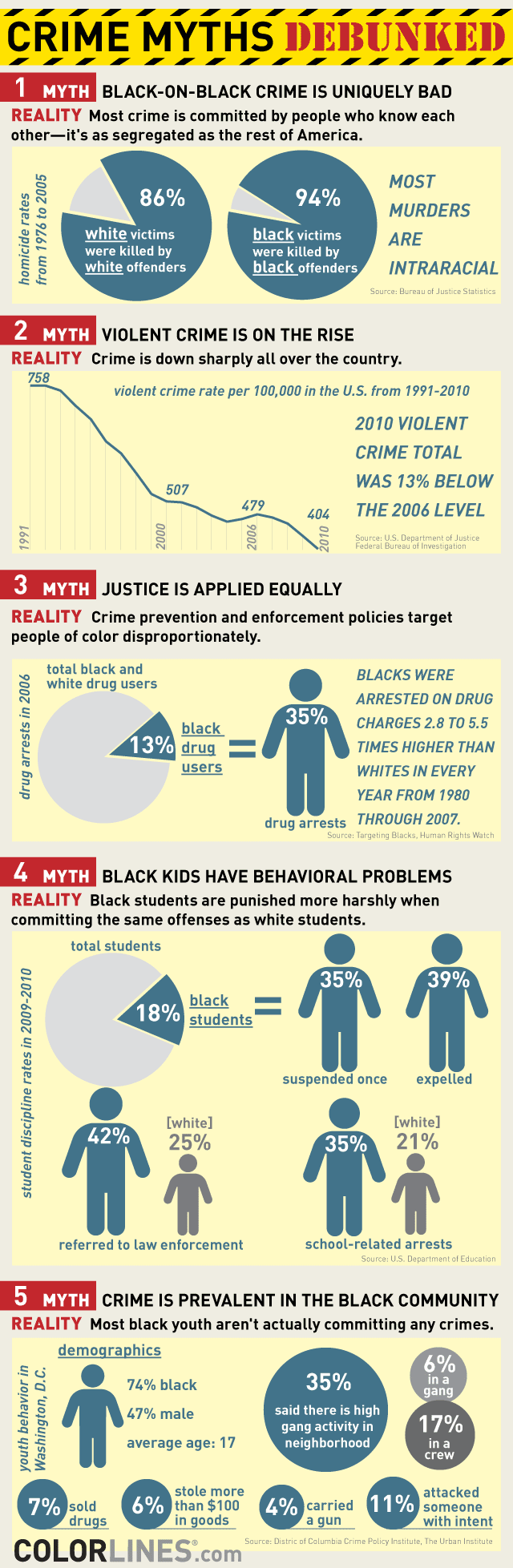
First, whites are likely strongly swayed by the mainstream media’s obsession with black-on-black crime, which sits beside the failure of mainstream media to cover with the same intensity white-on-white crime and this one basic fact: Crime in the U.S. is mostly within race and black-on-black crime rates (94%) are nearly statistically equal to white-on-white crime rates (86%):

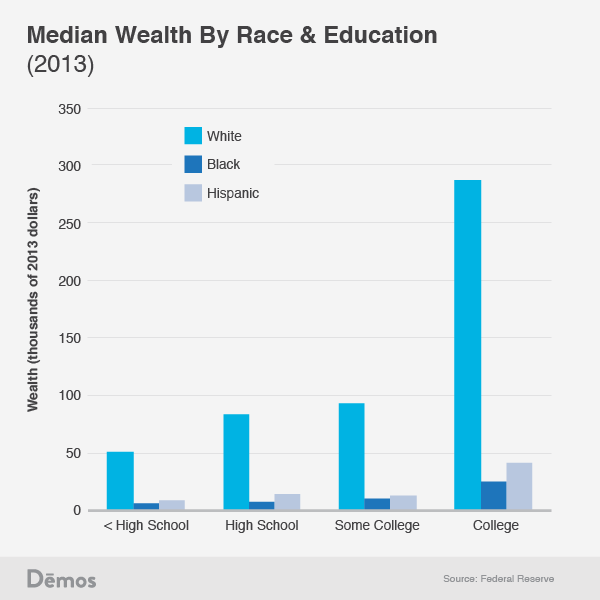
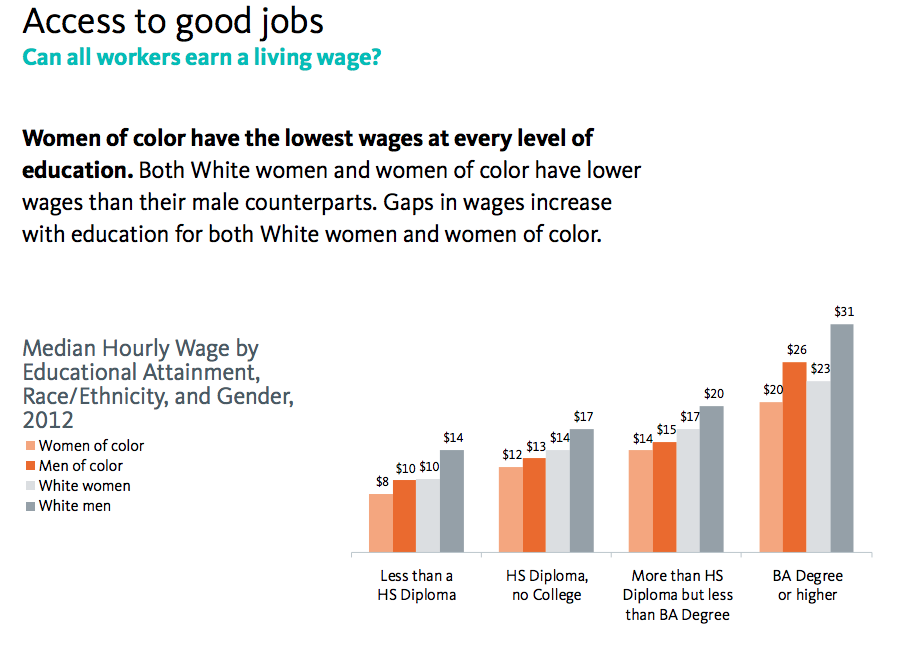
Next, whites reap huge economic benefits compared to black and brown people, even when comparing by race and level of education:

Bruenig, 24 October 2014

median
Matt Bruenig from 24 September 2014

Access to good jobs

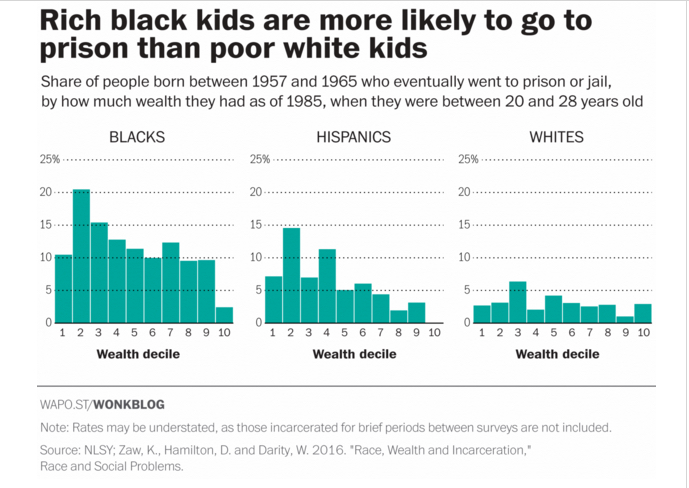
Additionally, whites fair much better than blacks in the judicial system, even when comparing among the same behaviors and despite the claimed advantages of more education:

Poor white kids are less likely to go to prison than rich black kids

And possibly most damning of all, the positive impact of affirmative action—the bane of whites—has mostly fallen to white women:

While people of color, individually and as groups, have been helped by affirmative action in the subsequent years, data and studies suggest women — white women in particular — have benefited disproportionately. According to one study, in 1995, 6 million women, the majority of whom were white, had jobs they wouldn’t have otherwise held but for affirmative action.

Another study shows that women made greater gains in employment at companies that do business with the federal government, which are therefore subject to federal affirmative-action requirements, than in other companies — with female employment rising 15.2% at federal contractors but only 2.2% elsewhere. And the women working for federal-contractor companies also held higher positions and were paid better.

Even in the private sector, the advancements of white women eclipse those of people of color. After IBM established its own affirmative-action program, the numbers of women in management positions more than tripled in less than 10 years. Data from subsequent years show that the number of executives of color at IBM also grew, but not nearly at the same rate.

Racism, willful ignorance, delusion—these are our only explanations for whites holding beliefs dramatically contradicted by an abundance of evidence that in the U.S. white privilege is powerful and the oppression of blacks is pervasive even when blacks attain more education.

One case that rivals white delusion is charter school delusion.

When I published an Op-Ed countering two local news stories on SAT scores—both of which misled readers by ranking schools and suggesting charter schools are somehow superior to traditional public schools—the predictable response appeared, from the state’s superintendent of charter schools no less:

Three levels of delusion in one Tweet.

First, my university is test-optional

We believe that your potential for success cannot be determined solely by standardized test scores. As a result, our admission process is test optional, meaning you are not required to submit SAT or ACT scores.

—as are a growing number of colleges and universities. And thus, the “gotcha” aspect of this Tweet falls flat due to a complete failure to look for the evidence.

Next, high-stakes testing—which remains biased by race, social class, and gender—does in fact cause inequity since these tests often are gatekeepers for scholarships and admissions.

And finally, the greatest delusion of all among charter advocates is pure ideology: “Our expectations of kids cause inequity.”

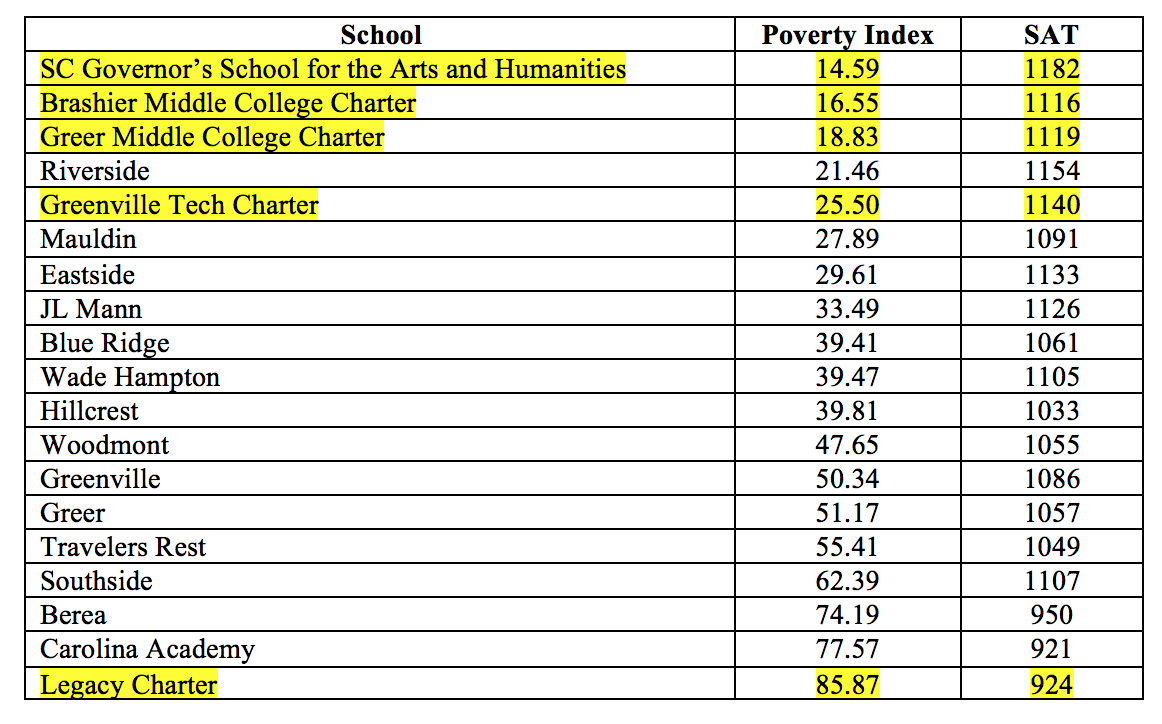
Simply examine the SAT scores along with the Poverty Index (PI) in the chart below (traditional schools, no highlight, and charter schools, highlighted):

SAT comp w charter HL

Both traditional and charter schools fall along a predictable pattern of SAT scores correlating strongly to PI, and thus, charter advocates have a real evidence problem with claims that SAT scores are the result, mostly or only, of expectations.

If there is an expectations problem in the charter school movement, it is that we must have higher expectations for honesty and awareness of evidence among charter school advocates, administrators, and teachers.

Delusion that denies white privilege or misrepresents educational policy is harmful on many levels since it detracts from real problems—such as the cancers that are racism and inequity as well as the tremendous failures of universal public education in the U.S.

In my first-year writing seminar, my constant refrain is urging young people to step back from what they believe is true, to be skeptical of those quick and easy beliefs, and to seek credible and compelling evidence that either confirms or corrects those beliefs.

Just saying something, I warn, doesn’t make it true.

White people and charter advocates, it seems, could use a refresher course in the foundations of composition.


black & white

My parents were 1950s plain-white-people pretty throughout my childhood in the 60s.

My dad wore a crewcut and Buddy Holly glasses. My mom with Mary Tyler Moore hair like they were always playing dress-up for a Weezer song.

I remember them and then in black and white.

The only 1960s hippies for me were my mother’s much younger sisters and brother. All of them animated in my mind on faded 8 mm color film, and they were always a little dirty.

And they all smoked—although my aunts and uncle probably indulged also in something illegal, pot—but old black and white photographs and the shaky 8 mm films my parents took allowed all that offensive smoke to look cool, harmless, romantic.

It has been five decades since then.

A few days ago, I bought my mother a new pair of shoes. She has two pairs in assisted living—one too small and the other too narrow.

And then just yesterday, I took her the new shoes before I drove her to a doctor’s appointment.

After her stroke, my mother is no longer her full self, having lost most of her language abilities and sounding more like my 3-year-old granddaughter than the very bright woman my mother was before.

She fretted to tears on the drive about needing to go by her house—I had no idea why—and about how to pay for the doctor’s visit—I explained as I have hundreds of time since the stroke that I have money. The trip was not unlike “Are we there yet?” round trips that most parents must suffer through, except in this case I was the parent to my mother as child.

My mother has seen the same doctors for many years, Indians who served my small rural hometown before moving their practice to the larger town hear-by. The nurses and staff have also known my parents for many years.

After a nurse conducted an ultrasound on my mother to check on the clots found in her leg after the stroke, they appeared out of the examination room. The nurse asked what happened to my father.

I hesitated as I often do now when people appear eager to discuss my father’s death with my infirm mother right there. I know she knows, but the act of discussing my father’s death, my father dead with her listening makes me want to say, “You do know my mother is right here?”

In the gap of my pause, the nurse added, “Rosie said he was killed?”

And I realized the nurse and my mom had already had a conversation, and my mother’s much reduced communication had likely caused more confusion for the nurse.

“No, he passed away,” I uttered euphemistically. “His heart.”

The nurse offered a cavalier “Oh” signaling that his death made perfect sense—more so than his being killed.

Although the visit with the nurse practitioner went well, my mother refused adamantly any further medication, even though it could help with her regaining the ability to talk. She has had a lifelong struggle with worrying about her health but refusing prescription medications.

I did run by her home on the way back to assisted living, but that simply sparked even more crying and incoherent ramblings, building on her struggling all day with simply going to the doctor.

Once in the house, she was unable to look through a closet because my nephews had been cleaning out and packing away much of my parents’ belongings. Eventually, exhausted and frantic, she gave up and demanded a couple pillows off a bed in that room, finally urging that we leave.

After my mother was once again in her recliner at assisted living, near tears and rambling further, I suggested she sit back and rest before dinner—and I left nearly as wrenched to exhaustion as she was.

For more than forty years, interacting with my parents had been mostly tension, a moral, intellectual, and emotional battle between my obligations as a son and my true self. Nothing was as simple as black and white.

Later that evening, my nephew texted that my mother was complaining to him about her neck hurting. I replied that we had just sat at the doctor’s office, and when the nurse practitioner asked my mother if she had any pain, my mother had responded with an assertive “no.”

I felt myself responding beyond the limits of patience or love.

Like many people enamored with image-based social media such as Instagram, I often choose to post pictures in black and white, usually of my granddaughter, alone and with me.

I also have an affinity for black and white movies made intentionally in black and white well into the era of color film.

As I psychoanalyze myself, I wonder if this romanticizing of black and white—few images move me more now that black and white versions of my granddaughter—is nested in pictures of my parents, 1950s plain-white-people pretty.

My dad with a crewcut and Buddy Holly glasses. My mom with Mary Tyler Moore hair like they were always playing dress-up for a Weezer song.

Some times with cigarettes gently between two fingers and the smoke static and odorless.

They often look happy and harmless, especially in staged family portraits.

Them there in black and white—I can pretend nothing existed in either of them or our future lives that would make their being alive, dead, or infirm almost unbearable.

Nothing is as simple as black and white.

Not being parent or child, not being in some important way fully human.