Category Archives: race

Brave: No Matter Where You Go, There You Are

If memory serves me well—and it is failing in that regard as I tumble toward 60—this is my fifth summer in a row to take a week-long or so vacation grounded in cycling.

For a couple summers, we went to Colorado, Boulder and Ft. Collins, but now we drive the brief hour just north of where I live to Asheville, NC.

But for all the proximity of geography, I might as well be slipping through a worm hole or walking into some sort of science fiction portal involving much more than time.

This summer of 2017 has come at significant costs to someone with incredible privilege and a life of mostly leisure—a traumatizing car and bicycle accident at the end of 2016 and then June brought my father’s death just days after my mother’s stroke.

More physically and psychologically tired than I can ever remember being, I walk around Asheville now as the U.S. spirals further and further into proving ourselves to be a truly awful people—primarily because of what we refuse to do.

The majority political party, Republicans, maintain a relentless drumbeat toward repealing the Affordable Care Act (ACA), pronounced Obamacare, as political theater and a not-so-thinly veiled next step in the renewed racist energy embodied by President Trump.

While the virulent racists in the U.S. may be few, the “best lack all conviction,” more than willing to remain neutral on this moving train of inequity.

A sizable majority of comfortable people (what we enjoy calling “the middle class”), mostly white but all financially stable enough, may think things are bad here and there, but doing something about pain and suffering for the struggling among us (children, the elderly, carers, the disabled) could disrupt what they have, and they’ll risk none of that.

Just last night a few senators (all of whom are enormously wealthy) stalled (derailed?) yet again the repeal of the ACA—some offering rhetorical flurries about their own medical struggles and eliciting praise for their bravery in the face of political pressure.

Also last night, I had a conversation about the fractures among feminists, specifically involving someone such as Emily Ratajkowski who shares a sort of capitalist feminism once championed by Madonna—the right for a woman to control and market herself as men are free to do even when that crosses a line viewed as objectification or sexualizing.

Not to be too simplistic, but Ratajkowski is the sort of brave witnessed in the senators—brave within a system but unwilling to overthrow a system that benefits them.

And I watch and feel this as I walk around Asheville where a bohemian way of life looks brave to me but is really not that brave at all in Asheville, where this has become normalized by being monetized. Part of the tourist schtick of Asheville is dreadlocks, tattoos, tie-die, and quirky eateries along with lots of breweries.

I mean lots of breweries, including the mega-craft brewery New Belgium, which boasts a powerful ownership model and much-praised corporate values.

NB Asheville
The view from the back deck of New Belgium Asheville is scenic and a picture of revitalization of long-ignored areas of cities. But how often do we ask for whom and why?

So on vacation for daily mountain biking and several rounds of breweries each afternoon, I am mired in thoughts of bravery—or to be honest, the lack of bravery in me and those around me whether I am where I live or here in Asheville.

No matter where you go, there you are, and mostly everyone is cowardly and selfish.

And as I often do, I think about the reduced circumstances of Margaret Atwood’s The Handmaid’s Tale. The rarely discussed consequence of the sacred Invisible Hand is that it keeps us often frantic so that behavior that falls short of any sort of human decency looks brave—senators barely keeping a healthcare system afloat that is criminally inadequate but even so better than the alternatives being promised.

To be brave, then, wherever you live, wherever you are, comes with great personal costs. As Ratik Asokan writes: “Most middle-class Indians hate Arundhati Roy—or, rather, they hate the political activist she has apparently become.”

Roy, it seems, has committed the sin of bravery, a sin most offensive to the so-called middle class—and this is about India, a country of tremendous poverty.

“Fiction is the only thing that can connect all of this together,” Roy explains about returning to the novel as a writer after decades writing essays as a political activist. “Fiction is truth. You turn to fiction when you can’t express reality with footnotes and evidence and reportage.”

Normal, it seems, becomes powerful and evil, ultimately. No matter where you go, there you are with your normal against the normal around you.

I feel both at home and entirely out of place in Asheville, but I am merely visiting and spreading my disposable income around town, often at breweries and restaurants where I am just wasting time and hoping to come out the other side—if not brave at least a bit less of a coward.

See Also

The Low Road, Marge Piercy
Please Support #FixInjusticeNotKids

Paul Gorski, currently preparing a revised edition of Reaching and Teaching Students in Poverty: Strategies for Erasing the Opportunity Gap, has initiated #FixInjusticeNotKids on social media, a hashtag that captures perfectly the primary fracture between mainstream education reformers and social justice education reformers.

As some examples, here are Tweets of mine addressing this powerful message:

Many elements of mainstream reform embrace a deficit view of children and students, specifically black and brown students as well as students living in poverty. This ideology blames the victims of social inequity, racism, classism, and sexism; it creates a laser focus on the individual and blinds us to systemic injustice.

Support #FixInjusticeNotKids in word and action to seek ways to reject deficit ideology and to end inequity and injustice so that the potential of all children can be achieved among a people who genuinely believe all children matter,

What If?: Even the Best Republicans or Democrats

When news broke about John McCain’s cancer, political leaders from both major parties weighed in with words of praise and support—even former president Obama.

But here is my first thought: McCain will receive world-class medical care without any real fear of financial ruin because of his health crisis, but this fact is because he is extremely wealthy (much of that accumulated while being a career politician), not because he is a veteran, not because he is an American.

When Al Franken spoke about his middle-class roots and his wife’s struggle to rise out of poverty, Democrats began to post and praise Franken as the Great Hope of the party.

But here are my first thoughts: Franken’s white nostalgia for the good old days erases the very harsh realities for blacks, who did not have the same hope and promises Franken’s family and his wife’s family did (similar to McCain’s current fortune). While the good old days noted by Franken did include some identifiable opportunities gone today, Franken’s and his wife’s stories are significantly buoyed by their white privilege (conveniently omitted in his oratory).

McCain and Franken, I believe, represent both the best each major party has to offer and everything that is wrong with political leaders in the U.S.

McCain has worked his entire political life as a Republican to maintain the inequities of class and race that now benefit him in a very public and tragic way. McCain, in fact, was to be a major piece of Republican efforts to dump people off health insurance and to reduce the tattered safety nets needed by children, the poor, the elderly, and his fellow veterans.

Franken is the classic white progressive Martin Luther King Jr. warned about during the Civil Rights era. He speaks to rugged individualism and glosses past race because both strategies bolster his political capital.

The public in the U.S. is left victim to a vapid and soulless political sparring match between Republicans and Democrats, although neither party really cares about providing for all Americans the sorts of essential promises that every person deserves.

As one volatile example, we remain trapped in the abortion debate—as if that debate is about abortion, which it isn’t.

Throughout the history of the U.S. wealthy women have always had access to safe abortions; and regardless of the law, wealthy women will always maintain access to reproductive rights, safe and world-class healthcare for them and their children.

Roe v. Wade was narrowly about abortion, but broadly about expanding to all women in the U.S. the same rights already afforded the wealthy—just as we are witnessing in McCain’s cancer challenge.

I struggle to have the sort of compassion for McCain and praise for Franken that others are expressing because, in context, these men are—even as the best of their parties—the problems, not the solutions, to a more equitable country.

What if each of these men extended their own great fortune, much not even earned, to all Americans simply for being human? What if both of these men had worked and would now work to insure that especially the most vulnerable among are extended the promise that their human dignity will be preserved against poverty, disaster, and failing health?

What if they admitted the American Dream has never yet been achieved, even in their narratives about the good old days? What if they honestly sought ways to make that dream a reality soon?

What if enough Americans stopped playing petty and self-defeating political games so that our leaders had no choice but to do the right thing?

Yes, what if?

Reaping What We Sow

Do not be deceived: God cannot be mocked. A man reaps what he sows.

Galatians 6:7

Today marks about a month spent navigating between two polar worlds of responsibility as I approach 60 in a few years.

My two grandchildren live with me and I often provide care for them. I also now visit my mother every day as she recovers from a stroke in a rehabilitation facility where my father died just over two weeks ago.

My three-year-old granddaughter and mother, in fact, are sharing a similar journey with language—uttering smalls bursts of distinguishable speech among strings of mostly gibberish.

Watching my father’s declining health and death along side my mother’s unexpected stroke and painstaking recovery, I have experienced more directly what I have known most of my adult life: medical insurance, Medicaid, Medicare, and Social Security are frail and inadequate sources for basic human dignity.

But these realities are shared daily by millions of people discarded in the U.S. where we simply have no interest in being a Christian nation or a charitable people. No, we prefer Social Darwinism and burying our heads in the sands of the free market and consumerism.

“Consumerism,” in fact, is the perfect and disturbing metaphor for our self-defeating beliefs and practices.

And that brings me to the ugly facts I have been confronting about my parents for nearly four decades.

My white working-class Southern parents are the poster children for the manufactured angry white working-class voters accused of electing Trump [1].

I grew up in a home aspiring to the American Dream of middle-class materialism, and my parents mostly worked themselves to death to cobble together that illusion.

Hand-in-hand with my parents being whitewashed model Americans was their unbridled racism, unquestioned self-loathing of their impoverished/working-class heritage, jumbled conservatism, and lifelong voting as Republicans.

As I watched my father die and patiently encourage my mother climbing out of the dark hole of her stroke, I have often thought that they certainly deserve so much better than what the end of their lives has brought.

But I also recognize that they were both willing and eager agents in their own misfortune—so damned inspired by racism and fear that some poor person might receive something without working that they cut off their own noses to spite their faces.

The acidic irony in all this is that my parents, especially my father, imprinted on me a manic work ethic grounded in the unspoken bromide “we reap what we sow.”

Work hard and you are rewarded, my parents believed, but half-ass and you will suffer.

The inverse message, the very ugly inverse message, of course, is the false conclusion that those who suffer and fail deserve the suffering and failure due to their sloth.

If we could somehow recreate Our Town so that my 20- or 30-something father could have watched his last days sitting beside my disabled mother, would he have reconsidered his life and what he believed?

But even that isn’t the solution, of course.

To know that what you do and believe has consequences for yourself ignores that we lack in the U.S. any sort of compassion for others, especially others we perceive as unlike us.

We don’t even believe in or practice a belief that all children are innocent, deserving safe and healthy lives that provide them opportunities at the promises the U.S. pretends to embrace—life, liberty, and the pursuit of happiness.

The paradox of my life is that my parents gave me incredible advantages and a loving idyllic childhood—a childhood abruptly marred as I worked through my teen years and entered college, resulting in my rejecting virtually everything my parents believed.

I certainly do not cling to some delusion that cosmic justice exists for the righteous and the careless.

I also know that social equity and justice are almost entirely rhetoric of the privileged to maintain their privilege.

None the less, I want to believe that my parents deserve better than what they have reaped, regardless of the seeds they planted.

That basic human dignity is not merely something we have to earn by being faithful workers or unquestioning patriots or cooperative citizens.

I want to believe that we should chose to extend compassion, kindness, and material comfort even to those who have spent their lives denying that to others.

Be the kindness and charity you want to find in others.

I sat with my mother yesterday as she rambled on—I eventually figured out—about her therapy, which is frustrating her. She is terrified and confused about having lost the ability to talk, convinced she will never regain the words.

My nephews and I have explained to her repeatedly that she had a stroke from a blood clot, but she keeps thinking she had a tumor.

The words that did come out as she waved her hands wildly gesturing through the therapy were “dumb, dumb, dumb.”

It sounded like my granddaughter’s misguided “I’m sorry” when she fears she has done something wrong, but hasn’t.

“Mom, you’re not dumb,” I said at her smiling and shaking her head. “You just have to relearn everything you have lost.”

What else, I wonder, is a son to do?


[1] A false claim masking that wealthy whites overwhelming drove Trump’s victory.

Hiding Behind Rhetoric in the Absence of Evidence

Having been extensively cited in recent news articles on education, I have received the typical responses, both by email and an Op-Ed (High expectations lead to achievement).

What is notable about these disgruntled responses can be seen directly in the headline above—a dependence on soaring and idealistic rhetoric to mask a complete failure to either discount my evidence or to provide any credible evidence for the counter arguments.

A recent email argued that I was causing more harm than good for emphasizing the impact of racism on literacy education and achievement by students; the rebuttal, however, was peppered with “I believe” and not a single effort to rebut the dozens of research studies I provided on both grade retention and racism/sexism.

While I pressed that point in a few replies, the offended person only ever produced as some sort of evidence a TED Talk, an unintended confession that his world-view depends on whiz-bang showmanship and seeing in any outlier example a confirmation of his biases—what Maia Szalavitz identifies as “’fundamental attribution error’. This is a natural tendency to see the behavior of others as being determined by their character – while excusing our own behavior based on circumstances.”

The emails were almost entirely rhetorical, like a TED Talk, and then divorced from any sort of empirical evidence.

The Op-Ed reflects in a more public way this same disturbing pattern. William W. Brown, founder and chairman of the board of Legacy Early College, holds forth in defense of the charter school’s “no excuses” approach to educating poor and mostly black/brown students, an ideology and set of policies that I have rejected for many years as inherently racist and classist.

While Brown quotes a few of my comments from a news article and then suggests he aims to rebut them, he merely slips each time into restating the ideology of the charter school, the rhetoric of high expectations.

Early in the commentary, Brown notes: “However, Thomas does not acknowledge that a college education is the single most reliable way to lessen the effect of systemic racism and end poverty.”

Here is the exact strategy employed by Arne Duncan throughout his tenure as Secretary of Education: make a grand rhetorical claim that most people in the U.S. believe (education is the “great equalizer”), and then offer no evidence it is true while hoping no one calls you on it.

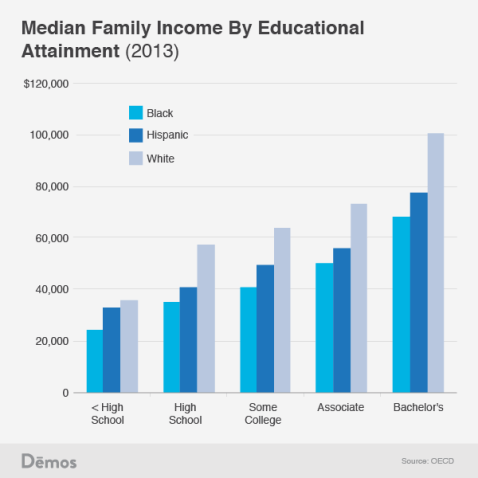
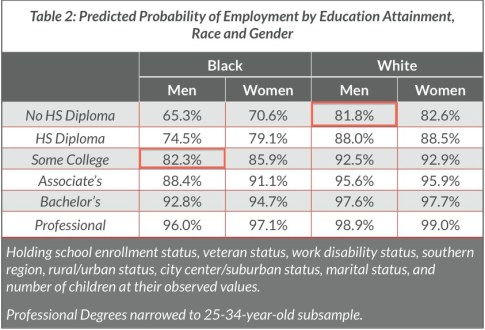
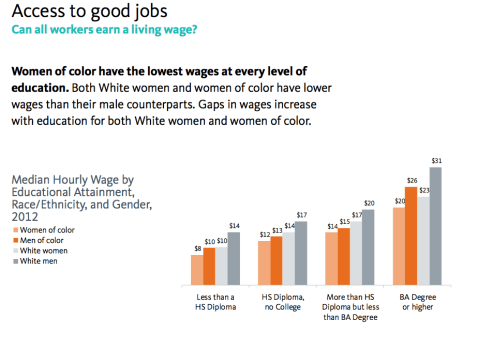
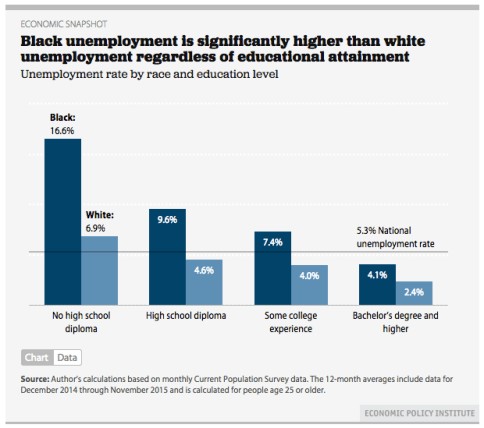
The truth is hard to swallow, however, because education can be shown through ample evidence to have very little impact on erasing inequity driven by racism and sexism. For just a few of many examples, please consider the following:

Whites with only high school completion earn more than Blacks/Hispanics having completed 2 years of college. (Bruenig, 24 October 2014)
White men with no high school diploma have the same employment opportunities as black men with some college completion. (Closing the Race Gap)
Race and gender remain powerful sources of inequity despite educational attainment. (Access to good jobs)

Brown also cites this: “He goes on to say, ‘Successful people in the United States tend to be white and come from privilege and they’re not necessarily working harder than anybody else but they have incredible advantages.'”

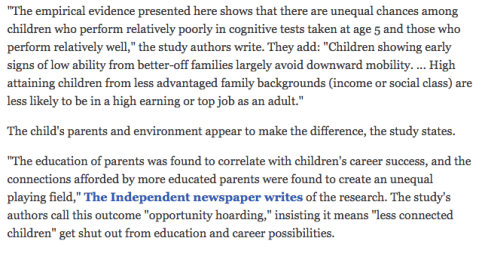
And then makes no effort to address why he believes my comment is “problematic.” Perhaps he could consider the following:

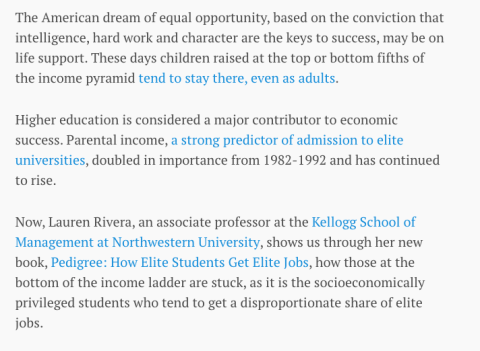
The best way to nab your dream job out of college? Be born rich
Why rich kids do better than smarter, less advantaged kids: ‘opportunity hoarding’
 Black unemployment is significantly higher than white unemployment regardless of educational attainment | Economic Policy Institute

Abstract

Racial discrimination in labor markets is a critical process through which organizations produce economic inequality in society. Though scholars have extensively examined the discriminatory decisions and practices of employers, the question of how job seekers try to adapt to anticipated discrimination is often overlooked. Using interviews, a laboratory experiment, and a résumé audit study, we examine racial minorities’ attempts to avoid discrimination by concealing or downplaying racial cues in job applications, a practice known as “résumé whitening.” While some minority job seekers reject this practice, others view it as essential and use a variety of whitening techniques. When targeting an employer that presents itself as valuing diversity, however, minority job applicants engage in relatively little résumé whitening and thus submit more racially transparent résumés. Yet, our audit study shows that organizational diversity statements are not actually associated with reduced discrimination against unwhitened résumés. Taken together, these findings suggest a paradox: Minorities may be particularly likely to experience disadvantage when they apply to ostensibly pro-diversity employers. These findings illuminate the role of racial concealment and transparency in modern labor markets and point to an important interplay between the self-presentation of employers and the self-presentation of job seekers in shaping economic inequality. (Whitened Résumés: Race and Self-Presentation in the Labor Market, Sonia Kang, Katy DeCelles, András Tilcsik, and Sora Jun)

One other tactic I experience is the subtle and not-so-subtle effort by the “no excuses” crowd to turn charges of racism toward those of us calling out the racism of “no excuses” practices: “If you believe the zip code where you were born should determine your educational outcome, you basically believe that some people aren’t built for success, which is — to put it bluntly — racist.”

Two aspects of this strategy are important to highlight. First, Brown here and others must misrepresent my claims (I have never and would never embrace or suggest that we ask less of any child or that some group of people have less ability than others because of inherent deficiencies; in fact, my scholarship and public work directly reject deficit ideologies).

Second, this rhetorical slight of hand is designed to point anywhere other than the person making the claim.

This second part of the move is important for charter advocates and the “no excuses” crowd because evidence is not on their side.

The Legacy Charter school endorsed by Brown has three consecutive years of “below average” state report cards (2012-2014, the most recent since report card assessments have been suspended in SC until this coming fall).

And my analysis of two years of data on SC charter schools has shown:

  • Using 2011 SC state repost cards and the metric “Schools with Students Like Ours,” charter schools performed as follows: 3/53 ABOVE Typical, 17/53 Typical, and 33/53 BELOW Typical.
  • Using 2013 SC state repost cards and the metric “Schools with Students Like Ours,” charter schools performed as follows: 2/52 ABOVE Typical, 20/52 Typical, 22/52 BELOW Typical.

The “high expectations” movement, again mostly aimed at black/brown and poor children, has some serious flaws because the rhetoric is discredited by the evidence.

In short, education is not the “great equalizer” in the U.S. And committing to “high expectations” for children living inequitable and overburdened lives suggests their struggles are mostly their fault because they simply are not working hard enough.

That is a calloused and racist/classist lie.

As I detailed above, success in the U.S. is mostly about advantages, not working hard.

Brown concludes with a flurry of rhetoric: “You could burn the world down as it is because it’s too hard to fix systemic injustices, or you could build it up to the sky because you know in your heart that’s where we belong. Keep your matches. I’m grabbing a hammer and a ladder.”

What should disturb us is how easily the winners (even those claiming good intentions) in the U.S. are willing to throw up their hands when challenged to address systemic racism, classism, and sexism.

In fact, this admission is awash in excuses and absent the exact resilience needed to address inequity that these adults demand of children, who must somehow set aside their lives each day they walk through the doors of school and behave in ways the adults refuse to do.

SC Fails Students Still: More on Grade Retention and Misreading Literacy

But their remedies do not cure the disease: they merely prolong it. Indeed, their remedies are part of the disease.

Oscar Wilde (1891), The Soul of Man under Socialism

Bells will certainly continue to signal class changes in public schools all across South Carolina this fall, but there is a much more serious (and unwarranted) bell of doom for many third-graders because of SC’s punitive Read to Succeed legislation.

Paul Hyde’s Furman professor: Read to Succeed retention policy ‘a disaster’ offers a primer on the politically and publicly popular move across the U.S. to retain students based in part or fully on third-grade high-stakes tests of reading.

Once again, literacy policy often fails to address valid literacy practices or to acknowledge that literacy proficiency is strongly correlated with systemic conditions beyond the walls of the school or the control of teachers.

Worksheets on literacy skills, test-prep for state assessments of reading and writing, linking teacher evaluations to students’ test scores, and retaining children are simply not only flawed literacy policies, but also negative influences on children’s literacy and academic achievement.

And decades of creating ever-new standards and then purchasing ever-new reading textbooks and programs have utterly failed children and literacy.

For about a century, in fact, we have known what is needed to help students develop literacy—but the political will remains lacking.

A robust literacy strategy for schools must include instead the following:

  • Addressing access to books in all children’s homes.
  • Insuring access to books in all children’s schools.
  • Providing all students ample and extended time in class to read by choice.
  • Guaranteeing every student balanced literacy instruction based on each student’s demonstrated literacy needs (not the prescriptions of literacy programs).
  • Discontinuing the standards and testing disaster dominating schools and classrooms by providing teachers the materials, time, and professional autonomy to teach literacy in evidence-based ways.

Just as education policy ignores a rich research base, political leaders and the public refuse to address how public policy directly and indirectly impacts student achievement; the following would create higher student achievement and literacy:

  • Eradicating food deserts and insuring food security.
  • Providing universal healthcare to children and families with children.
  • Creating job security for families with children.

Finally, we must acknowledge that grade retention fulfills a cultural negative attitude about children and people in poverty among the U.S. public—one grounded in individual blame and punishment.

But decades of research has shown (yes, even with the failed Florida policy that serves as a template for many states such as SC) that grade retention may raise test scores short term, but that gain disappears in a few years and the many negative consequences of retention remain.

As the National Council of Teachers of English detail in their position statement on grade retention and high-stakes testing, grade retention fails in the following ways:

  • retaining students who have not met proficiency levels with the intent of repeating instruction is punitive, socially inappropriate, and educationally ineffective;
  • basing retention on high-stakes tests will disproportionately and negatively impact children of color, impoverished children, English Language Learners, and special needs students; and
  • retaining students is strongly correlated with behavior problems and increased drop-out rates.

Of course all children need and deserve rich and rewarding literacy experiences and growth, but third grade literacy is both a manufactured metric (by textbook and testing companies) and a misleading emergency.

Grade retention and skills- and standards-based literacy instruction and testing have failed and continue to fail horribly the students who need authentic literacy instruction the most—black and brown children, English language learners (who may need a decade to acquire a second language), students in poverty, special needs students.

These populations are a significant portion of the students served in SC public schools; our hateful and misguided policies are created and tolerated by a more white and affluent political leadership and public who have racist and classist biases against “other people’s children.”

In fact, failed literacy policy in SC can be linked directly to how the U.S. demonizes and fails the impoverished:

It all starts with the psychology concept known as the “fundamental attribution error”. This is a natural tendency to see the behavior of others as being determined by their character – while excusing our own behavior based on circumstances.

For example, if an unexpected medical emergency bankrupts you, you view yourself as a victim of bad fortune – while seeing other bankruptcy court clients as spendthrifts who carelessly had too many lattes. Or, if you’re unemployed, you recognize the hard effort you put into seeking work – but view others in the same situation as useless slackers. Their history and circumstances are invisible from your perspective.

Struggling students in SC are viewed as lacking or broken, in need of repair and/or punishment to correct.

If you think this is harsh, compare how mostly white and more affluent students learn literacy in advanced and gifted classes in public schools (a dirty little secret about how we have maintained segregation) and most private schools.

Like No Child Left Behind and Every Student Succeeds Act, Read to Succeed is an Orwellian name for a horrible way to view, treat, and teach children.

SC continues to be a morally bankrupt state, calloused and driven to punish instead of offering our citizens, especially our children, the compassion and opportunities all people deserve.

For Further Reading

At Duke, I realized how badly many South Carolina schools are failing students like me, Ehime Ohue

Grade Retention Research

Executive Summary: THE EFFECTS OF MANDATED THIRD GRADE RETENTION ON STANDARD DIPLOMA ACQUISITION AND STUDENT OUTCOMES OVER TIME: A POLICY ANALYSIS OF FLORIDA’S A+ PLAN (9 January 2017)

THE EFFECTS OF MANDATED THIRD GRADE RETENTION ON STANDARD DIPLOMA ACQUISITION AND STUDENT OUTCOMES: A POLICY ANALYSIS OF FLORIDA’S A+ PLAN, Kathleen M. Jasper (2016)

NCTE: Resolution on Mandatory Grade Retention and High-Stakes Testing

Retain to Impede: When Reading Legislation Fails (Again)

Confirmed: SC Implementing Retain to Impede

Beware Grade-Level Reading and the Cult of Proficiency

Teaching Reading and Children: Reading Programs as “Costume Parties”

Florida Retention Policy a Blight on Literacy, Children across US


Freedom, Choice, and the Death of Us

“they did not stop to think they died instead”

“‘next to of course god america i,'” e.e. cummings

Over the course of a couple hours after my mother was discovered comatose, the ER doctor offered us a choice: airlift my mother to a larger hospital for surgery to remove the clot in her brain that caused her stroke or leave her comatose, each moment destroying more of her brain.

Just twelve days later, in front of my mother then in a rehabilitation facility after responding well to the high-risk surgery,  my father became unresponsive; the EMS team summoned by a 911 call were frantically trying to resuscitate my father, kept alive by his pacemaker/defibrillator. Since my father had resisted switching off the defibrillator and choosing a do-not-resuscitate (DNR) order, the lead EMS responder asked me where I wanted him to be transported.

Because of the proceeding days when we all scrambled against my parents’ health insurance, my first thought was how was I to know where his insurance would cover this event (ultimately the last moments of his life).

While cycling on the local rail trail near my university and where my mother now remains in a single room—the building in which she witnessed my father’s death—a friend and I pedaled up to a road crossing where a father sat on his bicycle with a trailer attached for children to ride along.

This intersection has decorative circles of brickwork on each side of the road. As this man crossed, he steered poorly around the brickwork—the cart left wheel rolling up onto the brick, tipping the cart and his two sons over onto the side of the trail and jerking the bicycle out from under the father.

These are all complicated and difficult stories about choice and freedom in the U.S.

The U.S. is a cruel and calloused culture that values a false narrative about freedom and choice, an idealized version of freedom and choice as concepts that trump all else.

Even human dignity.

Even life.

Especially in healthcare, education, and providing social support for the poor, the guiding principle is giving people choice, believing that individual responsibility is the root cause of poor health, failing students and schools, and finding oneself in poverty.

The meritocracy and rugged individualism myths are so powerful in the U.S. that winners and losers both cling to them even when the game is revealed to be fatally rigged. As Tim Maly explains:

So there are people who can be so wrapped up in a certain worldview that even in the face of serious evidence that they have been taken in, and despite many warnings from the rest of the world, they persist. Indeed, warnings from the rest of the world seem to serve only to entrench them in their position. With some of them, it’s as if they end up making bad choices specifically to spite the people warning them.

The U.S. has instilled a tremendous amount of self-loathing, in fact, among marginalized groups (blacks, English language learners, women) who feel compelled to embrace the bitter American Dream in order to be American—even as each of them could utter as Langston Hughes wrote:

Let America be America again.
Let it be the dream it used to be.
Let it be the pioneer on the plain
Seeking a home where he himself is free.

(America never was America to me.)

The parent cycling with his children in tow was free to choose placing those boys in the trailer, free to choose to pedal along the trail and then to send them tumbling.

And there we must admit, parental choice is not universally a good thing, and we must also confront that anyone’s choice necessarily encroaches on the freedom of others: children routinely suffer the consequences of their parents’ choices.

The children were fine, however, but my mother and father—along with our family—have been navigating a hellscape of healthcare dictated by patient choice and freedom, jumbled with a nightmare of bureaucracy in which mandated and bounded choices are not really choices at all.

In the U.S., we celebrate the choice between a Toyota Camry and Honda Accord (essentially the same car with the free market promise of competitive prices in your local market!), but few people are afforded the freedom of not buying a car at all—and no one is allowed the freedom from sales and property taxes or freedom from insurance and liability for all that driving.

Freedom and choice are in fact a nasty shell game used to keep the masses occupied so that they do not realize only the few have some sort of economic freedom and choice because of the labor of those masses, those people drawn to the myths like moths to a flame but never allowed to survive the allure.

It’s July 4th, a patriotic orgy in the U.S. that is as shallow and materialistic as the country we celebrate.

A people truly committed to equity and our moral obligations as humans would recognize that sometimes, maybe even often, choice and freedom are not as important as insuring that no one needs to choose because essentials are collectively provided for everyone to insure the dignity of simply being a human.

No child left to the lottery draw of their parents, no sick person tossed into the meat grinder of market-based healthcare, no elderly cast into the dark well of individual responsibility.

As we wave tiny plastic flags today, swill (mostly) cheap beer while overeating from our decadent grills, let us roast in the sun and the recognition that we actually have freedom and choice—and this heartless and selfish country is what we have chosen.

For Further Reading

Why poverty is not a personal choice, but a reflection of society, Shervin Assari

‘What to the Slave Is the Fourth of July?’ by Frederick Douglass

Resisting Cultural Appropriation: A Human Response to the Inhumanity of Privilege

When I posted K. Tempest Bradford’s argument “that cultural appropriation is indefensible,” the first comment I received (from a white man) suggested cultural appropriation is unavoidable, mostly discounting Bradford’s challenges.

Once I replied, the same person added: “The solution is to change the power relationships, not to erect artificial cultural walls.”

First, when so-called racial minorities speak against inequity, whites often fail to listen, shouting over or offering the condescending “yes, but”—in the same way men correct and marginalize when women confront sexism and misogyny.

In the situation above, the typical white male moderate or even self-proclaimed progressive response is at play, something like “Let’s work toward a color-blind society!”

This ploy fails on several layers.

As noted already, it fails because the response replaces a willingness to listen, to value the perspective, and then to act in alliance.

But more broadly, the premise is also flawed because the goal is not to be a color-blind society or to eradicate cultural (or racial, or gender) walls, but to make our identifiable differences worthy of equal celebration and to insure that those differences never stand as markers for injustice, inequity, and dehumanization.

As Bradford asserts, cultural appropriation must always be resisted because the U.S. is a capitalistic and materialistic society in which each person’s dignity and the humanity of that person are inextricably tied to any identifiable group with which they are connected.

Further, the U.S. remains incredibly inequitable and unjust along race, class, and gender lines (among others).

Entertainers such as Elvis or Pat Boone at mid-twentieth century, for example, were allowed to benefit and profit greatly on the musical styles of blacks who were directly excluded from the same financial and entertainment opportunities.

More recently Vanilla Ice and Eminem represent the lingering power of cultural appropriation despite the Civil Rights movement and greater access to wealth and fame by blacks.

And the entrenched negligence and insensitivity of sport mascots—such as the Washington Redskins or Florida State Seminoles—stand as bold symbols that white privilege continues to trump genuine appreciation of diversity and essential human dignity within capitalism.

One key point in this debate, however, is understanding the basic human response to cultural appropriation among marginalized and oppressed groups.

For those marginalized groups to cling to and defend their culture is a human response to the inhumanity of privilege.

Blacks, for example, are still daily told that they as humans do not matter as much, do not count as much as whites (lower pay even with equal experience and education, greater incarceration without greater criminality, disproportionately higher rates of being shot and killed by police, etc.), and then, elements of black culture routinely are appropriated by whites as long as whites benefit and profit.

Throwing Shade in 2017 as a TV show hosted by two whites?

If we dig deep enough, we may well have to face that beneath racism and cultural appropriation we will unearth that capitalism is the root of all evil—monetizing everything above human dignity.

As long as we allow our larger culture to be grounded in the amorality of capitalism and materialism (supply and demand trumps ethics or morality), then we are doomed to inequity and injustice, in the form of racism, sexism, classism, etc.; those individuals and groups suffering that inequity, then, must reach for their humanity and dignity by clinging to that which the dominant group deems valuable.

If tearing down “artificial cultural walls” is a valid goal (and I am skeptical it is), then the only truly progressive response by those with race and gender privilege is to listen to those who resist cultural appropriation (and all inequity), to accept that resistance, and then to offer their privilege in solidarity to end the injustice—not to shout over or offer yet another bitter “yes, but.”

Our Gladiator Culture: On “Grit,” Competition, and Saving Future Generations

my father moved through griefs of joy;…
his shoulders marched against the dark

“my father moved through dooms of love,” e.e. cummings

This place could be beautiful,
right? You could make this place beautiful.

“Good Bones,” Maggie Smith

While sitting in the ER with my father a few nights ago before he was admitted into the hospitals’ heart center—a few days after my mother’s stroke sending her to another, larger hospital 40-minutes away—I was reminded of Alice Walker’s The Color Purple, a novel, among other things, about the abusive power imbalance between men and women.

Late in the novel, Celie explains to her sister Nettie: “Take off they pants, I say, and men look like frogs to me. No matter how you kiss ’em, as far as I’m concern, frogs is what they stay.”

The most powerful and imposing man in my life, my father, sat in the ER—stooped, shrunken, pot-bellied, tongue hanging out of his mouth and bowed head like an aged human-sized toad somehow in a wheelchair. My father has always been my physical and athletic superior, despite my being in my mid-50s and quite successful in my career and my athletic hobby; he has always cast a shadow, darkening my lingering insecurities and anxieties.

This morning, Father’s Day 2017, I visited my father still in the heart center after spending almost all my time at my mother’s side as the number of family members able to help has dwindled as the day-count grows. Although improved, frog-like and frail, my father declared to me: “Nothing is wrong with me. I need to go home.”

For some time now, his heart has been working at only about 33%, wearing him and his pacemaker out at an accelerated rate.

In times of great medical stress, when families are brought together, stories spring forth to stabilize the chaos and restore our delusion that we have some sort of control.

One of the many myths of my father: In high school, because of fights and sports (my father was a four-sport letterman and captain of his high school’s first state championship football team in the 1950s), by age 18, my father had a full set of false teeth. So many teeth had been knocked out, his dentist eventually pulled the remaining 10 or 12 one day.

After the procedure, my father played in a baseball game, prompting his father to track him down, trying to make him come home to rest.

Like him, my mother is a gendered twin of the fanatic 1950s template for self-sacrifice, rugged individualism, and blind faith in the whitewashed American Dream—the racialized lie about hard work paying off and good guys winning.

I believe I am not being hyperbolic to recognize that my parents lie now in hospitals, broken and frail, because they bought the hokum, the hard-work hokum that makes people define their dignity in how fervently they sacrifice themselves, in how they work moment by moment to prove they are not lazy, soft, or in any way dependent on others.

My parents passed onto me a neurotic work ethic; my father instilled in me an incredibly unhealthy obsession with being athletic as proof of my manhood.

Although I have been trying to ween myself off sports fandom, I remain often connected to the sports fanaticism of the U.S.—one most solidly grounded in college and pro football, the perfect metaphor for the gladiator culture that defines us.

Dragged kicking and screaming, college football and the NFL have begun paying lip-service to acknowledging that [gasp!] the sport is cruelly violent, that football players are turning their brains into mush because of the relentless concussions that are simply part of the game.

The stories linked to the concussion debate in football are powerful and disturbing because they reveal a subtext that also came to mind as I sat with each of my parents: pro football players, many retired, admit that they have and would continue to lie about concussion symptoms to remain on the field.

The gladiator culture of the U.S. is replicated exponentially in the NFL [1]—toxic and hyper-masculinity, anything necessary including sacrificing health and even life.

And while the NFL and football mania of the U.S. are disturbing, the most troubling reality is that our neo-work-ethic of the twenty-first century targets children, specifically black and brown children from impoverished backgrounds.

The “grit” and growth mindset movements have become (mainstream) socially acceptable ways to wink-wink-nod-nod that black, brown, and poor people are simply too lazy, unwilling to work themselves, like my dad and mom, into decrepitude for the 1%.

Frantic—we are a nation with a ruling class snowblinded by their own privilege and terrified they won’t have a servant class—the whitewashed American Dream for black, brown, and poor children.

The U.S. has devolved into a perverse and inverted gladiator culture with the 1% in the stands and the rest of us reduced to a dog-eat-dog existence, an artificial and unnecessary dog-eat-dog existence.

Visit the elderly of this country, worn down by the demands that they work hard and depend on no one.

Look into their faces and if you can their eyes.

This is the future we are demanding of “other people’s children.”

But it is also a future we can reject, choosing instead an ethic of community and compassion.

As I look at my parents—discardable white working class Americans—I think that they deserved better, despite their own culpability in our whitewashed American Dream.

On this awful Father’s Day 2017, I would prefer above all else to be on the couch with my granddaughter, who yesterday kept imploring me “Wake up, Papa!” as I tried to doze between sessions with my mother, as she snuggled against me, her futon.

I know she deserves better—as does every single child having come to this planet and country by no choice of their own.

“This place could be beautiful,/right? You could make this place beautiful”—a haunting image of everything that I wish for this world in a poem by Maggie Smith that confesses:

The world is at least
fifty percent terrible, and that’s a conservative
estimate, though I keep this from my children.

On this awful Father’s Day 2017, I have kept much from my father and my mother in ways substantial and indirect.

But there is no way to justify the lies we tell children—that they fail to work hard enough, that they are somehow not good enough unless they act as if they do not matter, that they should shut up and suck it up.

Few things are worth fighting for, but one is to keep every child from the gladiator’s ring, to promise every child if not a beautiful world, at least the possibility of one.


[1] In the same way the NFL promotes the great lie that the U.S. is a meritocracy:

Despite this, NFL Commissioner Roger Goodell rejected on Friday the idea that any kind of blackballing was taking place. He called the NFL “a meritocracy,” saying, “If they see an opportunity to get better as a football team, they’re going to do it. They’re going to do whatever it takes to make their football team better. So, those are football decisions. They’re made all the time. I believe that if a football team feels that Colin Kaepernick, or any other player, is going to improve that team, they’re going to do it.”

The Hollow Nation

Shape without form, shade without colour,
Paralysed force, gesture without motion…

“The Hollow Men,” T.S. Eliot

My name is Kathy H. I’m thirty-one years old, and I’ve been a carer now for eleven years….Carers aren’t machines.

Never Let Me Go, Kazuo Ishiguro

We are the hollow nation. We are the stuffed nation, “Leaning together/Headpiece filled with straw.”

It has been almost seven months since a motorist struck a pack of cyclists I was riding with on Christmas Eve 2016, injuring four of us—two seriously and permanently.

The motorist was deemed at fault on the scene, but received only a $76 ticket, less than the monthly payments I am making on my remaining medical bills since the insurance claim for the accident has yet to be settled.

My own insurance has paid much of the cost, but I am required to repay those payments once I have a settlement. The orthopedist, as well, overcharged me during my fracture treatment, refunding that amount more than six months later.

Nine or ten insurance companies and multiple lawyers have been wrestling with this accident, and the other injured cyclists and I have received a barrage of bills and notices from the ER, the hospital, the ambulance service, and numerous doctors. One cyclist was airlifted from the scene, and since the motorist had minimum coverage, his portion of that insurance likely was erased immediately in that urgent care.

This recent Monday morning, my mother was found unconscious by my youngest nephew, her grandson. She had a stroke, requiring an ambulance to transport her to our local hospital that then had her airlifted to a larger hospital nearby for emergency surgery on the clot discovered in her brain.

She has been in neurological ICU, and now a regular hospital room since Monday—but soon she will be transferred again to a rehabilitation facility for 2-3 weeks.

My father has been quite unwell recently; therefore, we are guiding him around in a wheelchair, circling our own wagons because my mother’s stroke creates a new and terrifying reality: she was his caretaker, and the family now must seek ways to provide both of my parents care.

Working-class children of the 1940s and 1950s, my parents have only Social Security and Medicare to sustain them.

Our next steps are swamped by if and how well their insurance and social services cover the medical care and rehabilitation my mother needs, if and how well my father can receive the daily care she has been providing.

My accident and my mother’s stroke are not nearly as extreme as the terrors of the healthcare system in the U.S. that countless people suffer daily. But these “terrors” are not really about the healthcare.

The treatment my mother has received, the seemingly miraculous surgery, has been the sort of kind and skilled medicine that leaves you mesmerized by the power of humans to make this world work in ways that are good and right and life-affirming.

But that care, I am afraid, is an isolated outlier in a calloused and awful system of administration, bureaucracy, and dehumanization caused by our lack of political courage as a people, as a country.

The power of universal healthcare and a single-payer system to provide humanity and dignity to the amazing medicine and brilliant healthcare providers already in the U.S. is left in the wake of our hollow nation.

A nation that is the wealthiest and most powerful in human history.

A nation that allows more than 1 in 5 children to live in poverty.

A nation of heartless and vicious partisan politics poised to dump an already inadequate system into the laps of caretakers, family members.

My accident exposes the hollowness of calls for individual responsibility; the system is designed to allow serial carelessness that leaves innocent victims responsible.

My mother’s stroke exposes that we as a nation genuinely do not care about a generation of people who may have bought the American Dream myth most sincerely—people such as my parents who were buoyed by white privilege they denied, who preached and practiced  the rigged rugged individualism scarred by racism with the faith it would pay off as they decline into their new reality of being dependent on the kindness of not only family, but the kindness of strangers.

Wealth and security are hoarded by a few, a vicious tribalism of a country that denies community, the power and dignity of everyone caring about everyone—not just the tunnel vision quest of “me getting mine,” the mean-spirited Social Darwinism that lurks beneath our national platitudes about working hard and fair play.

A hollow nation that denies the humanity of all sorts of “others” because of race and religion, but also culls away many at the edges of white privileged—white poor, white working-poor, white working class.

My parents represent that even the wink-wink-nod-nod promise of the American Dream (the white nationalism of “Make America Great Again”) is a lie, a calloused lie within the larger lie to the tired, the poor, the huddled massed—and especially a bald-faced lie about the so-called melting pot, a metaphor more accurate if named a witch’s cauldron.

With these realities before me, it is tempting to call for the removal of the Statue of Liberty, but at least, we must strip it of the poem inscribed at the base and post instead:

We are the hollow nation. We are the stuffed nation, “Leaning together/Headpiece filled with straw.”