Category Archives: race

14 June 2017 Reader

How to Call B.S. on Big Data: A Practical Guide, Michelle Nijhuis

Mind the Bullshit Asymmetry Principle, articulated by the Italian software developer Alberto Brandolini in 2013: the amount of energy needed to refute bullshit is an order of magnitude bigger than that needed to produce it. Or, as Jonathan Swift put it in 1710, “Falsehood flies, and truth comes limping after it.”Plus ça change.

Who Is Dangerous, and Who Dies?

ERROL MORRIS: I found an innocent man who came very close to being executed. [Adams’s execution was scheduled for May 8, 1979, but Supreme Court Justice Lewis F. Powell Jr. ordered a stay only three days before he was to be strapped into the lethal-injection gurney. Ultimately, the court overturned his death sentence, but not his conviction.] I uncovered all of these appalling details 30 years ago and then opened up a newspaper recently and read about Buck. It’s as if nothing ever happened. That’s both depressing and infuriating. Mitt Romney, when he was governor of Massachusetts, was told that the death penalty is problematic because it’s fallible. You could execute an innocent person, and given our current state of knowledge, there is really no way to bring them back. Once executed, they stay executed.

CHRISTINA SWARNS: And so what was Romney’s reply?

ERROL MORRIS: He said: Oh, that’s simple. We’ll just make it infallible. We’ll make it foolproof. You said it’s fallible. We’ll just fix that.

Stop Pretending You’re Not Rich, Richard V. Reeves

So imagine my horror at discovering that the United States is more calcified by class than Britain, especially toward the top. The big difference is that most of the people on the highest rung in America are in denial about their privilege. The American myth of meritocracy allows them to attribute their position to their brilliance and diligence, rather than to luck or a rigged system. At least posh people in England have the decency to feel guilty.

In Britain, it is politically impossible to be prime minister and send your children to the equivalent of a private high school. Even Old Etonian David Cameron couldn’t do it. In the United States, the most liberal politician can pay for a lavish education in the private sector. Some of my most progressive friends send their children to $30,000-a-year high schools. The surprise is not that they do it. It is that they do it without so much as a murmur of moral disquiet.

Beneath a veneer of classlessness, the American class reproduction machine operates with ruthless efficiency. In particular, the upper middle class is solidifying. This favored fifth at the top of the income distribution, with an average annual household income of $200,000, has been separating from the 80 percent below. Collectively, this top fifth has seen a $4 trillion-plus increase in pretax income since 1979, compared to just over $3 trillion for everyone else. Some of those gains went to the top 1 percent. But most went to the 19 percent just beneath them.

50 years after the Loving verdict, a photo essay looks back on their love, Priscilla Frank

Monday, June 12, marks the 50th anniversary of the landmark United States Supreme Court decision Loving v. Virginia, which quashed anti-miscegenation laws in 16 states around the nation, ushering restrictions against interracial marriage to the wrong side of history.

The date is now remembered as Loving Day in honor of Richard and Mildred Loving, the couple who defied the state’s ability to dictate the terms of their love based on their skin color. Mildred, who was of African American and Native American descent, and Richard, who was white, wed in 1958 in Washington D.C., because interracial marriage was illegal in their native rural Virginia, as well as 15 other Southern U.S. states.

When the Lovings returned to Virginia, however, local police raided their home one early morning after being tipped off by another resident. They declared the Lovings’ marriage license invalid within the scope of the state, placing the couple under arrest.

What counts as language education policy?: Developing a materialist Anti-racist approach to language activismNelson Flores and Sofia Chaparro

Abstract: Language activism has been at the core of language education policy since its emergence as a scholarly field in the 1960s under the leadership of Joshua Fishman. In this article, we seek to build on this tradition to envision a new approach to language activism for the twenty-first century. In particular, we advocate a materialist anti-racist approach to language activism that broadens what counts as language education policy to include a focus on the broader racial and economic policies that impact the lives of language-minoritized communities. In order to illustrate the need for a materialist anti-racist framing of language education policy we provide portraits of four schools in the School District of Philadelphia that offer dual language bilingual education programs. We demonstrate the ways that larger societal inequities hinder these programs from serving the socially transformative function that advocates for these programs aspire toward. We end by calling for a new paradigm of language education policy that connects language activism with other movements that seek to address societal inequities caused by a myriad of factors including poverty, racism, and xenophobia.

The difficulties scholars have writing for a broad audience, Christopher Schaberg and Ian Bogost

Scholars have insights, experience and research that can help the public navigate the contemporary world, but scholarly work all too often goes unseen. Sometimes it gets sequestered behind exorbitant paywalls or prohibitively steep book prices. Other times it gets lost in the pages of esoteric journals. Other times yet, it’s easy to access but hard to understand due to jargon and doublespeak. And often it doesn’t reach a substantial audience, dooming its aspirations to impact public life.

How can scholars write for wider audiences without compromising their lives as disciplinary researchers?

The Confederate flag largely disappeared after the Civil War. The fight against civil rights brought it back, Logan Strother, Thomas Ogorzalek, and Spencer Piston

But what is less well-known is the actual history of these symbols after the Civil War — and this history sheds important light on the debate. Confederate symbols have not always been a part of American or Southern life. They largely disappeared after the Civil War. And when they reappeared, it was not because of a newfound appreciation of Southern history.

Instead, as we argue in a newly published article, white Southerners reintroduced these symbols as a means of resisting the Civil Rights movement. The desire to maintain whites’ dominant position in the racial hierarchy of the United States was at the root of the rediscovery of Confederate symbols.

Pride or Prejudice: Racial Prejudice, Southern Heritage, and White Support for the Confederate Battle Flag, Logan Strother, Spencer Piston, and Thomas Ogorzalek

Abstract: Debates about the meaning of Southern symbols such as the Confederate battle emblem are sweeping the nation. These debates typically revolve around the question of whether such symbols represent “heritage or hatred:” racially innocuous Southern pride or White prejudice against B lacks. In order to assess these competing claims, we first examine the historical reintroduction of the Confederate flag in the Deep South in the 1950s and 1960s; next, we analyze three survey datasets, including one nationally representative dataset and two probability samples of White Georgians and White South Carolinians, in order to build and assess a stronger theoretical account of the racial motivations underlying such symbols than currently exists. While our findings yield strong support for the hypothesis that prejudice against Blacks bolsters White support for Southern symbols, support for the Southern heritage hypothesis is decidedly mixed. Despite widespread denials that Southern symbols reflect racism, racial prejudice is strongly associated with support for such symbols.

More on White Men of Academia: Student and Self Evaluation Follies [Updated September 2019]

“Higher education too can make a fetish out of ‘objectivity’ and ‘rationality,'” observes John Warner, confronting specifically The Pitfalls of “Objectivity” in teaching composition.

Warner’s argument is a subset, however, of the larger problem with the white men of academia, as I have examined recently: Concepts and terms such as “objectivity,” “scientific,” “valid,” “reliable,” and “rationality” prove to be extremely powerful in academia and scholarship, yet the great irony of that power is that these concepts and terms are veneer for maintaining white male power—inequity grounded in the racism and sexism that academics are prone to refute in their rhetoric while maintaining in their practices.

“Objectivity,” for example, frames a white male subjectivity as the norm (thus “objective”), rendering racialized (non-white) and genderized (non-male) subjectivity as the “other,” as lacking credibility.

Explore the history of what research paradigms count, and you confront the bias in favor of quantitative (experimental and quasi-experimental) research (paradigms created by and maintained by men) over qualitative research (paradigms championed by women and racial minorities)—the former is “hard,” “scientific,” and “objective” while the latter is “soft,” “personal,” and “(merely) anecdotal.”

In an institution created by white men, academia, where their claim is that everything is based on empirical evidence filtered through the rarified lens of objectivity, we run into a real conflict when unpacking the evidence—for example, the annual/bi-annual self-evaluation process linked to promotion, tenure, and merit as well as the embedded key element of student evaluations of faculty.

As a tenured full professor, I am currently drafting my bi-annual self-evaluation, a process I have been using as a political document to confront the inherent inequity in both the faculty evaluation process and the traditional use of student opinion surveys.

The self-evaluation is flush with traditional norms about what counts as excellence—peer-reviewed publications, for example, but not public intellectual work. And as is the case at many colleges and universities, student evaluations are central evidence in the entire faculty evaluation process.

We are directed in our self-evaluations to “include numerical results from student opinion survey forms”—the double whammy of quantitative and the ubiquitous student evaluations. The narrative at my small selective liberal arts university is that of the three areas of evaluation—teaching, scholarship, and service—teaching remains primary; therefore, I make my strongest advocacy case (nearly equaled by my argument for valuing my public intellectual writing) about how we determine faculty teaching quality.

My opening to my teaching effectiveness self-evaluation begins, then:

My teaching effectiveness has exceeded [our] high standards for teaching over the past two academic years. As evidence below, I will not refer to student opinion surveys because they have been shown to be biased (against women and faculty of color) and poor indicators of student learning [1]. Since I strongly support concerns raised in our Gender Equity study and FU’s Diversity and Inclusion initiative, I believe use of the student opinion surveys are contradictory to those goals.

If, I argue, our university has gender equity and diversity/inclusion initiatives, then using student opinion surveys contradicts those goals because the evidence is overwhelming that these student surveys are gender and race biased; they serve the interests of white male academics.

Here, then, are some key readings and research to support rejecting and resisting student evaluations of faculty:

As a white man in academia, if my claimed scholarly focus and agenda are grounded in equity, social justice, and not only naming but also dismantling racism, sexism, and white privilege, then I am beholden to both word and action in those pursuits.

In the ideal, yes, academia has the potential to be a model for equity and justice; in reality, academia is more often than not a white man’s world with garnishes of elevated rhetoric.

As Warner concludes in his interrogation of “objectivity,” students deserve a commitment to their “agency that allows them to make space for their ideas in the world,” adding what we can and must extrapolate to all of academia:

In this context, “objectivity” is not a value, but a pose, and one that’s usually sussed out by students as phony. They easily recognize it as a confidence game because it’s a game they’d previously been trying to practice, and during that practice they knew it was a pose.

Too often this pose in higher education is that of a gatekeeper, a position garnered through privilege but flaunted as merit.

If it were only phony, maybe we could brush it aside, but this pose of white male academics is determinant—it shapes, defines, and controls the careers and lives of everyone.

Changing academia in the pursuit of equity must be the work of white men, and two ways to begin that shift is to reimagine faculty evaluations and to end the use of student evaluations of faculty in that process.

See Also

Gendered Language in Teacher Reviews


[1] The footnote I provide includes the bulleted research and links above.

The Tribalism that Divides: “the victims of the Us v. Them years/Wrecking all things virtuous and true”

Jonna Ivin’s long-form effort to understand the rise of TrumplandiaI Know Why Poor Whites Chant Trump, Trump, Trump—investigates an important question about political allegiances in the U.S.:

There is an unavoidable question about places like Benton County, a question many liberals have tried to answer for years now: Why do poor whites vote along the same party lines as their wealthy neighbors across the road? Isn’t that against their best interests?

The election of Trump has spurred a seemingly endless debate about -isms: racism and nationalism prominent, but rarely evoked but enveloping of both, tribalism.

Of these three -isms, discussions of racism remain taboo, sparking often white denial; nationalism draws both support and criticism; yet, as I noted, tribalism tends to be unspoken in the context of the U.S.

As a life-long U.S. citizen old enough to have witnessed the irrational national hatred of the USSR and Russia morph into a right-wing embracing of Russia based significantly on race, I am struck now by the tribalism central to Chimamanda Ngozi Adichie’s Half of a Yellow Sun, a fictional examination of the Nigeria-Biafra War of 1967-70.

“In 1967, Colonel Ojukwu declared that Eastern Nigeria would be known as the Independent Republic of Biafra. The main intentions of Colonel Ojukwu were to break away from the dictatorship of the Northern Nigeria Military who were immensely discriminating the people of Southern and Eastern Nigeria.” Cole Kirkpatrick

Adichie dramatizes the power of language, education, and tribes to drive power distributions. However, the U.S. version of tribalism is segregation—both de jure and de facto—that tends to fall along racial and economic lines.

Trump and his administration has fueled a growing genre of which Ivin’s essay is among the more powerful, although ultimately inadequate—the best trying to deconstruct white voters (often narrowed to working class and/or poor white voters), but the worst masking apologist journalism uncritically blinded by its own whitewashing.

Like J.D. Vance’s deeply flawed Hillbilly Elegy, Ivin’s piece is a sympathetic read of whites in the U.S., although much more blunt than Vance about the fact of racism running through angry poor whites, captured in her refrain: “I’m just a poor white trash motherfucker. No one cares about me.

As someone with white working-class roots nurtured in racist soil who eventually focused a great deal of scholarship and professional work on the intersections of inequity (poverty and racism) and education, I recognize that while poverty can and should unite, individual and systemic racism trumps common economic interests among impoverished whites in the U.S.

Yes, Ivin asks the right question, noted above, but her piece ultimately fails because it balks at holding poor whites accountable for being coerced into racism by the power elites; Ivin seems to see only two options: sympathy for poor whites or demonizing poor whites.

And, Ivin’s essay devolves into a Bernie Sanders plea, Sanders and his campaign a model of the ultimate failures of whitewashed socialism.

Partisan politics, like religion, is trapped in tribalism, subsets of the larger urges toward creating us versus them* in everything humans touch. Ivin and others seeking to understand angry white voters simply fail to address that ultimately those committed to tribalism (as nationalism and racism) above all else must be confronted, and held accountable.

Yes, the power elites who speak to and prime tribalism are the core problem, one that must be dismantled. Yet, to continue to sympathize with angry poor whites as if they remain more important than racial minorities is to whitewash that poor whites benefit from white racism (in the judicial system, for example), and that even though poor whites are pawns of political elites, they have the potential to assert their autonomy in order to acknowledge systemic racism and then reject racism in order to form economic solidarity.

So allow me to end with the sort of distinctions we need instead of clamoring to understand the angry poor white character.

Recently, I was confronted by a fellow academic who argued that whites voting in majorities (both men and women) for Trump cannot be called racist unless we also label as racist overwhelming majorities of blacks voting for Barack Obama.

This proves to be a false analogy if we step back from simple race to inspect the intent behind the votes. One of the most powerful aspects of Ivin’s essay is that she unpacks the racial and then racist motivations historically of many whites, again even as they are being baited by people with power.

There is much to suggest that Trump support is grounded in white fear of losing the exact privilege they deny ( a fear masked as “traditional values” and other nationalistic/tribal language); conversely, black support of Obama or other so-called progressives is a quest for equity.

“Conservative” (a tribal urge) is to keep things as the are; “progressive” is to seek change, ideally change for the benefit of all.

While demographics of  partisan political support are racial, we must confront that racial can be racist (white support of Trump) or about equity (black support of Obama).

Trump support among whites is a contemporary example of the historical pattern Ivin exposes, notably instilling fear of black men in poor whites during reconstruction: “Religious and political leaders began using a combination of fear, sex, and God to paint a chilling picture of freed angry Black men ravaging the South.”

The Lost Cause Worse Than Slavery
Thomas Nast
October 24, 1874
Reproduced from Harper’s Weekly

Trump’s dog whistles about Mexicans and terrorists, and getting tough on crime (code for policing blacks) are warmed over racism from the late nineteenth century—tactics that have worked for more than a century for political and economic elites.

Trumplandia is nothing new, and white angst need not be examined in order for us to understand it. These are all old hat for the U.S.

What would be new is an honest confrontation of tribalism in the U.S. and an honest effort to dismantle systemic racism in the name of social and economic justice.


* “Ignoreland,” R.E.M.: “These bastards stole their power from the victims of the Us v. Them years/Wrecking all things virtuous and true.”

Reader 22 May 2017 [UPDATED]: Connecting Dots

Why people are rich and poor: Republicans and Democrats have very different views

See: UPDATE 21 (20 May 2017): Grit, Education Narratives Veneer for White, Wealth Privilege

Minorities Who ‘Whiten’ Résumés More Likely to Get Interview, Michael Harriot

“Whitening” is an all-encompassing term for when prospective employees scrub their résumés of anything that might indicate their race. Applicants with cultural names will sometimes use their initials. Community or professional work with African-American fraternities, sororities or other organizations are deleted. One student omitted a prestigious scholarship he was awarded because he feared it might reveal his race.

Although the practice sounds demeaning and reductive in the year 2017, apparently it works. In one study, researchers sent out whitened résumés and nonwhitened résumés to 1,600 employers. Twenty-five percent of black applicants received callbacks when their résumés were whitened, compared with 10 percent of the job seekers who left their ethnic details on the same résumés.

The results were the same for employers who advertised themselves as “equal opportunity employers” or said that “minorities are strongly encouraged to apply.”

Whitened Résumés: Race and Self-Presentation in the Labor Market, Sonia Kang, Katy DeCelles, András Tilcsik, and Sora Jun

Abstract

Racial discrimination in labor markets is a critical process through which organizations produce economic inequality in society. Though scholars have extensively examined the discriminatory decisions and practices of employers, the question of how job seekers try to adapt to anticipated discrimination is often overlooked. Using interviews, a laboratory experiment, and a résumé audit study, we examine racial minorities’ attempts to avoid discrimination by concealing or downplaying racial cues in job applications, a practice known as “résumé whitening.” While some minority job seekers reject this practice, others view it as essential and use a variety of whitening techniques. When targeting an employer that presents itself as valuing diversity, however, minority job applicants engage in relatively little résumé whitening and thus submit more racially transparent résumés. Yet, our audit study shows that organizational diversity statements are not actually associated with reduced discrimination against unwhitened résumés. Taken together, these findings suggest a paradox: Minorities may be particularly likely to experience disadvantage when they apply to ostensibly pro-diversity employers. These findings illuminate the role of racial concealment and transparency in modern labor markets and point to an important interplay between the self-presentation of employers and the self-presentation of job seekers in shaping economic inequality.


Experts: Conflicts over Confederate names and symbols likely to continue, Paul Hyde

But Thomas said school administrators should encourage student debate over historical figures such as Wade Hampton — as an important lesson in democracy.

“If we really think that public education is to prepare people to live in a democracy, children need to have experiences with democratic processes,” Thomas said. “I think this specific protest should be seen as an opportunity for students to see what the democratic process looks like, with everybody’s voice mattering. Principals and superintendents of public schools — they have incredibly hard jobs — but they are the people who have to show students what moral courage is. If administrators and teachers can’t show moral courage, how do we expect our children to?”

See: Dismantling Monuments: History as a Living Document


When Standardized Tests Don’t Count | Just Visiting, John  Warner

And yet, when it comes to marginalized and vulnerable populations within Charleston County Schools, these standardized assessments provide a rational for top-down oversight and control.

This is entirely common and predictable. “Accountability” is often weaponized against those without the means to defend themselves.

I have no wish to upend the academic culture of the Citadel over their terrible CLA scores, but maybe some of those who are willing to give our elite storied places a pass can extend the same spirit to those who have no such protections.

See Are America’s top schools ‘elite’ or merely ‘selective?’

Why The New Sat Is Not The Answer, Akil Bello and James Murphy

If anything, the discord between them is likely to grow as the College Board pursues an equitable society using a test that is designed to mark and promote distinctions.

For all the positive changes the College Board has made, the new SAT shouldn’t be counted among them. It is a test, not a solution.

Every attempt to manage academia makes it worse, Mike Taylor

The problem is a well-known one, and indeed one we have discussed here before: as soon as you try to measure how well people are doing, they will switch to optimising for whatever you’re measuring, rather than putting their best efforts into actually doing good work.

In fact, this phenomenon is so very well known and understood that it’s been given at least three different names by different people:

  • Goodhart’s Law is most succinct: “When a measure becomes a target, it ceases to be a good measure.”
  • Campbell’s Law is the most explicit: “The more any quantitative social indicator is used for social decision-making, the more subject it will be to corruption pressures and the more apt it will be to distort and corrupt the social processes it is intended to monitor.”
  • The Cobra Effect refers to the way that measures taken to improve a situation can directly make it worse.

America has locked up so many black people it has warped our sense of reality, Jeff Guo

According to a Wonkblog analysis of government statistics, about 1.6 percent of prime-age white men (25 to 54 years old) are institutionalized. If all those 590,000 people were recognized as unemployed, the unemployment rate for prime-age white men would increase from about 5 percent to 6.4 percent.

For prime-age black men, though, the unemployment rate would jump from 11 percent to 19 percent. That’s because a far higher fraction of black men — 7.7 percent, or 580,000 people — are institutionalized.

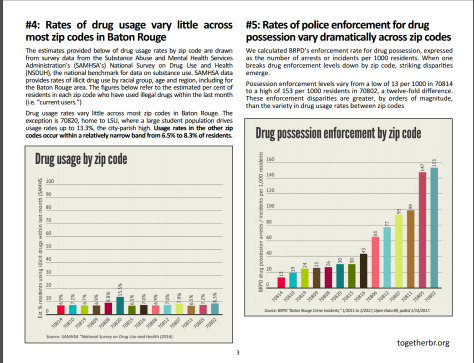
UNEQUAL ENFORCEMENT: How policing of drug possession differs by neighborhood in Baton Rouge

BR inequity

Dismantling Monuments: History as a Living Document

Disturbance at the Heron House
A stampede at the monument
To liberty and honor under the honor roll

“Disturbance At The Heron House,” R.E.M.

“And on the pedestal, these words appear:
My name is Ozymandias, King of Kings;
Look on my Works, ye Mighty, and despair!”

“Ozymandias,” Percy Bysshe Shelley

Possibly one of the greatest failures of formal K-12 schooling has been not only what students are taught in history and social studies, but how history as a discipline has been misrepresented (paralleled, I think, by a similar message about science) as fixed and objective.

History is never fixed or objective, but always a living document—one written by those who have power, access to the telling.

A powerful and vivid example of this fact is how Howard Zinn has been marginalized as more an activist than a historian because his work was committed to changing the perspective of history from the power elites to the people. Zinn was both heralded and demonized, for example, when his work asked everyone to rethink Christopher Columbus and the concept of “discovering” lands already occupied.

Traditionalists remain trapped in the belief that history has been and can be objective, can avoid being political, and once anyone seeks to better understand a person or the narratives of the past, those traditionalists shout “revisionism,” as if that new understanding is something to be shunned.

That any human expression can be objective, apolitical, is a naive position. In response to those arguing Ivanka Trump’s new book is not a political work, Ani Kokobobo reveals:

She claims she wrote it before her father’s election, “from the perspective of an executive and an entrepreneur.” And though they criticize her for being trite, derivative, out of touch and racially tone-deaf, most readers have accepted the premise that this is a largely apolitical book.

Yet as every scholar of literature knows, each book contains what theorist Fredric Jameson has dubbed a “political unconscious.” In other words, through the sheer act of narrating, a book reinforces one particular point of view while policing others.

This last point perfectly captures the reality of all history. And thus, the great irony of slurring history with “revisionism” is that history as a living document should be a constant act of revisionism as a retelling history in an effort to make the story clearer, more accurate—not an erasing of history.

Teaching that Washington never told a lie or that Columbus discovered America was in the moment an act of revisionism since they both are distortions in the name of some agenda. To seek ways that better portray Washington and how Europe reaching the West began what is now the U.S. and other countries is the great promise history and historical thought can offer a free people.

In a time now characterized by the rise of Trump (as a marker for nationalism masking racism) against the #BlackLivesMatter movement (as a confrontation of the racial inequities in policing and the justice system), we become witnesses to the power of monuments to maintain racism: calls for renaming Tillman Hall at Clemson University, New Orleans removing Civil War statues, and near my university, black students petitioning to rename a high school.

These efforts to revise history, bending it toward a greater clarity, a more credible Truth, cannot be divorced from how political, media, and public responses frame calls for dismantling monuments to the flawed and often awful past.

As a recent example, local coverage of students’ petitioning to rename a high school has a revealing title, Petition calls for dropping ‘racist’ name of Wade Hampton, and lede paragraph:

Wade Hampton III was a Confederate lieutenant general, one of the largest slaveholders in the Southeast and, by today’s standards, a blatant “racist,” according to historians.

When I raised concern about the word racist being placed in quote marks in the article, the journalist noted that it was to identify “charged language” and to avoid bias.

Couched within the lingering racism driven by denying and tip-toeing about confronting racism is the pervasive failure of both-sides journalism that refuses to acknowledge that some perspectives are credible while others are not.

The article itself quotes a historian acknowledging the fact of racism that the article treats as “charged language,” and thus, possibly lacking credibility.

A revised view of history allows us to acknowledge what is not debatable—many with power in the past, mostly white men, were racists—and is essential for helping us resolve what is debatable—whether or not we rename buildings/institutions and dismantle monuments.

If we believe in an optimistic view of human history, associated with Martin Luther King Jr. (“How long? Not long, because the arc of the moral universe is long, but it bends toward justice”), that we can somehow shape the world for the good of all, there is much to dismantle—the monuments grounded in human actions devoid of a more refined moral view as well as a tentative discourse that refuses to name and steps around the very facts that allow us to engage in robust debate.

It is an anemic approach to wait for monuments to crumble under their own baselessness, and thus, it is our duty to hasten the process on the path to justice, even when that duty is hard and seemingly unpopular.

We make history with each step we take, and we reshape history necessarily in that procession.

See Also

Opinion: Leave Wade Hampton in the history books, Asha Marie

The Young Black Activists Targeting New Orleans’s Confederate Monuments, Clint Smith

Elite or Selective?: Reconsidering Who We Educate and How

Sharde Miller’s California teen describes his road from Compton to Harvard University offers a powerful subtext about the American Dream as well as the enduring belief in education as the “great equalizer,” embodied by Elijah Devaughn Jr.:

Devaughn grew up in a single-parent household in Compton, California, a city that has been plagued by gun violence and gang activity for decades….

“Getting accepted into a prestigious university like Harvard, I think it means the world,” Devaughn said. “It means God is able. It means that hard work pays off. It means that, you know, struggles end.”

What if we unpack the label of “prestigious” by making an important caveat: Is Harvard University elite or selective?

As a point of reference, over the past three decades of high-stakes accountability in public education, schools have been annually labeled as excelling and failing; however, once we look beneath the A-F rankings, a strong and consistent correlation persists between schools identified as excelling or failing and the socio-economic status of the students [1] (as well as the racial and language demographics).

Consider also that for every year of the SAT being administered, average scores have fallen perfectly in correlation with parental income and parental years of education [2].

My university has begun gathering data to analyze our impact on students. The university is selective, having high standards for the academic backgrounds and achievements of students.

Some initial data are telling. When students with high preparation are compared to students with low preparation, extrapolating over four years of college, high preparation students are more successful and the gap with low preparation students widens during years 2 and 3 and then never closes by year 4 (year 1 and year 4 gaps are about the same).

If we persist in suggesting that education is the great equalizer (despite ample evidence education does not, in fact, equalize) and a foundational mechanism of the American Dream, we must reconsider how and why we identify any schools as “prestigious.”

Alexander W. Astin’s Are You Smart Enough? seeks to examine if our prestigious and excelling schools are elite or merely selective. Astin exposes part of the problem with labeling colleges, for example, as “prestigious”:

The “quality” or “excellence” of a college or university is thus judged on the basis of the average test score of its entering students, rather than on how well it educates them once they enroll.

What is lost in the rush to ascribe success and failure to schools is, as Astin argues, the essential charge of any formal schooling:

On the contrary, the quality of our national talent pool depends heavily on how well colleges and university develops the students’ capacities during the college years. And this mean all students.

And thus, Astin asserts: “More parents need to be asking, ‘Why should an educational system invest the least in the students who may need the most in higher education?'”

Here, then, is the dirty little secret: “Prestigious school” (K-12 as well as colleges/universities) is a veneer for “selective,” not “elite” in terms of the educational impact but in terms of the conditions at those schools.

Public universities are less selective than private liberal arts colleges, and the former experience is distinct from the latter in, for example, faculty/student ratios, class size.

In other words, more academically successful students tend to be from more affluent and well educated parents, and then are afforded higher education experiences that are identifiably superior to relatively less successful students from lower levels of affluence and education.

Reconsidering how we label schools, the “selective” versus “elite” divide, is a first step in seeking ways to turn a tarnished myth (“education is the great equalizer”) into a reality.

Too often “prestigious” and “elite” are code for “selective,” praising a college/university for gatekeeping, and not educating; too often “excellent” and “failing” are code for student demographics, ranking K-12 schools for proximity, and not educating.

Testing, ranking, and accountability in the U.S. have entrenched social and educational inequity because, as Astin confronts, “there are two very different uses for educational assessment: (a) to rank, rate, compare, and judge the performance of different learners and (b) to enhance the learning process.”

We have chosen the former, pretending as well that those metrics reflect mostly merit although they are overwhelming markers of privilege.

Let’s return to Devaughn as a rags-to-riches story.

Late in the article we learn Devaughn attended private school before his acceptance to Harvard—again bringing us back to the issue of opportunity and what we are learning at my university about well prepared students versus less prepared students.

Devaughn’s story should not be trivialized, but carefully unpacked, it does not prove what I think it intended to show. The American Dream and claims education is the great equalizer are, in fact, deforming myths.

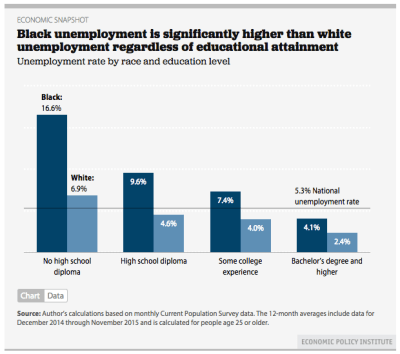
Race, gender, and the socioeconomic factors of homes and communities remain resilient causal factors in any person’s opportunities and success:

Access to good jobs
Black unemployment is significantly higher than white unemployment regardless of educational attainment | Economic Policy Institute

All schools at any level must re-evaluate who has access to the institution, and why, and then focus on what impact the educational experience has on those students. Therein must be the evidence for determining excellence and prestige.


[1] See here and here for examples in South Carolina.

[2] See The Conversation: Tests don’t improve learning. And PARCC will be no different.

UPDATED: Black Power and the Rise of Trumplandia

During my formative years of the 1960s and 1970s, the political unrest driven by race and racism churned somewhat innocuously for me in the dim background. Several aunts and an uncle lived in Asheville, North Carolina, and their school lives were punctuated with protests, my mother receiving frequent updates by phone as we lived about an hour and a half south of there in South Carolina.

The working class white racism of my family and being a son of the recalcitrant South significantly skewed the ongoing version of history occurring around me—the othering of black people (protests in Asheville were always “riots”) and the discrediting of the Civil Rights movement and its black leaders.

Then, “black power” existed for me in two forms—pop culture versions of blaxploitation media, including Luke Cage, Hero for Hire and Shaft, and real-world protest such black gloves and fists raised, John Carlos and Tommy Smith at the 1968 Olympics.

After the election of Donald Trump as president, many have continued to scramble to explain the rise of Trumplandia, often falling into two opposing camps—one arguing Trump’s support is because more people were hurting under Obama than the pundits ever admitted and the other demanding that we admit Trump’s rise was fueled by racism, now neatly cloaked in terms such as “nationalism” and “alt-right.”

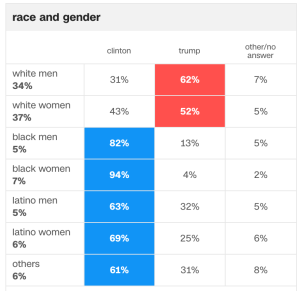
I am of the second camp because the data are overwhelmingly compelling about how white men and women voted for Trump in large percentages:

trump race gender
CNN Politics

We stand in 2017 continuing a corrosive tradition confronted by James Baldwin—”this rigid refusal to look at ourselves.”

“White” remains unspoken as the normal, as the given, and then any excuse is embraced in order to ignore the lingering weight of racism in the U.S.

As might be expected, “black power” in 2017 is before us in the form of economic power, a rising economic autonomy by blacks that likely played a major role in motivating Trump’s supporters who seek to keep the U.S. white.

Two recent controversies may serve as evidence of this: LaVar Ball creating a a sports brand around his soon-to-be-drafted son, Lonzo, and former president Barack Obama’s speaking engagements and fees.

The backlash against both Ball and Obama are interesting and telling since the critics are often those who elected Trump—a bravado and hollowness that dwarf anything Ball has said or done—and who worship Ronald Reagan—who earned millions speaking in Japan after leaving office.

The problems are not bravado, self-promotion, or capitalizing on political careers; the problems are when blacks seek the same avenues as whites to fortune and power.

Moments of this racial anger occurred under George W. Bush as well when his administration sought to dismantle affirmative action, racial preferential treatment for college admission; although Bush himself had benefitted from legacy admission to college.

Trump’s wealth and political success began with an inheritance, one that he has squandered and continued to grow on the backs of others, at the expense of others. Trump now right in front of the entire world works daily to pass on that unearned privilege to his family.

But we are somehow offended by Ball and Obama’s speaking fees—somehow offended that these black men are doing exactly what the capitalistic American Dream says we are supposed to do.

And swirling around all this are black superheroes returning to pop culture prominence—Luke Cage on Netflix and The Falcon as well as the Black Panther in the Marvel film universe.

And just as it did when I was growing up, as long as these black heroes generate money for the right people (“right” means “white”), all is good.

But those same people paying to watch black superheroes, as my family did about Carlos and Smith, turn their scorn on #BlackLivesMatter, rigidly refusing to look at themselves.

Twenty-first century black power is LeBron James, who demands not only the wealth he earns but the power to control that wealth.

Trumplandia is a self-defeating racist response to black power, one that is a real-world dystopia not far removed from another message of pop culture begging for our viewing dollars, The Handmaid’s Tale on Hulu.

We must admit black power spawned Trumplandia, a white fright, and we can only hope, in part, black power will be able to dismantle it.


Recommended

Status threat, not economic hardship, explains the 2016 presidential vote

More Evidence That Racism and Sexism Were Key to Trump’s Victory

Understanding White Polarization in the 2016 Vote for President: The Sobering Role of Racism and Sexism – Schaffner – 2018 – Political Science Quarterly – Wiley Online Library

Does White America Fear Black Equality? The Economic Forces Behind Trump’s Win

Top Democrats are wrong: Trump supporters were more motivated by racism than economic issues, Mehdi Hasan

Race, Religion, and Immigration in 2016 | Democracy Fund Voter Study Group, John Sides

Ultimately, the 2016 campaign helped make attitudes related to immigration, religion, and race more salient to voter decision making in a way that many other attitudes were not. This was particularly consequential for Clinton because a substantial number of white Obama voters had less favorable views of immigrants, Muslims, and black people. Of course, these attitudes were not the only thing associated with how people voted in 2016. Moreover, the findings I have presented here characterize the entire sample of white voters; they are not an account of how any single voter, or every voter, made his or her choice. Nevertheless, these findings suggest that, compared to the 2012 election, the 2016 election was distinctively about attitudes related to racial, ethnic, and religious minorities.

Economic Anxiety Didn’t Make People Vote Trump, Racism DidSean McElwee and Jason McDaniel

Analysis | Racism motivated Trump voters more than authoritarianism, Thomas Wood

Trumpism: It’s Coming From the Suburbs, Jesse A. Myerson

UPDATED: Beware the “Miracle” School Claim: “Why not tell the whole story?”

UPDATE 19 February 2019

With Seanna Adcox’s Bill seeks to expand successes of Charleston’s Meeting Street Schools (Post and Courier) and the release of SC state report cards, it is time to completely unmask how Meeting Street (and other charter schemes) float on claims absent evidence.

Just consider a few report card comparisons among elementary schools with similar poverty indexes (PI) in Charleston:

If Meeting Street is a miracle school (it isn’t) then so are these schools, but the cold hard truth is charter schools are mostly advocacy absent evidence.

The media and politicians must stop promoting the propaganda at the expense of students and the public.

UPDATE 19 April 2017

Since my post below, Benjamin Navarro, founder of Meeting Street Schools, submitted a Lady Macbeth-esque protest about the article linked below.

Navarro, I believe unintentionally, poses a very important question while challenging how the Post and Courier reported the excessive suspensions at Meeting Street Elementary @Brentwood: “Why not tell the whole story?”

While Navarro bristles at the suspension data, he is quick to offer a partial story about data he prefers, test scores:

And most important of all [emphasis added], why not talk about the enormous impact that Brentwood’s higher test scores have on the likely outcomes for these children? Why not report the fact that our students scored in the 71st percentile in reading and 73rd percentile in math (almost eliminating the bottom quartile), while other North Charleston Title One schools scored on average in the 42nd and 39th percentile respectively in 2016?

So let’s have a shot at the whole story because that is the problem with Meeting Street Elementary @Brentwood, with all so-called alternative approaches to public schools such as charter schools.

Currently, South Carolina is not holding schools accountable by the usual school report card until fall 2018. But the media, in fact, has been reporting glowing depictions of Brentwood, depending almost entirely on the school’s founder and leaders who are incentivized to paint the best picture possible of their experiment while concurrently (and dishonestly) falsely trashing Charleston public schools (see Navarro’s letter).

Navarro’s reference to test scores looks impressive; yet, he fails to provide the whole story about that data—and as I detail below, virtually every time the whole story comes out about miracle schools, that whole story proves there are no miracles.

Here, then, is what we need to know:

  • What test data are being cited? It is likely he is citing practice test data (such as MAP and ACT testing). We must confront if we truly believe that intensive test-prep and test scores are what any child deserves from formal schooling, if these claimed higher scores are from test prep, and why we allow this reduced form of education for poor and black/brown students while affluent and white students receive advanced courses, gifted programs, and all sorts of enrichment.
  • What is the attrition rate for Brentwood—the number of students originally enrolled compared to the number of students tested? Are suspension/expulsions and counseling out creating skewed test score data?
  • What percentage of English language learners (ELLs) and students with special needs are being tested, and then, are data from Brentwood being compared to other schools with similar demographics (and not just all Title One schools)?
  • Has Brentwood controlled for the extended school day/year to account for these claimed higher test scores, or are we being asked to compare student data under different conditions of learning? More teaching and learning time should produce higher scores; thus, Brentwood may have higher scores while not being able to claim that anything other than more time created that difference.
  • If, as advocates and Navarro claim, some unique practices by Meeting Street are causing greater student achievement, how can they prove those practices are causal and then that they are scalable? For example, what is the per-pupil expenditure, what are class sizes and student/teacher ratios, and what can Brentwood do that traditional public schools cannot (such as refuse to serve ELLs or special needs students)?
  • What race and social class biases are driving our willingness to create schools for high poverty and black/brown students that are committed to “no excuses” and zero tolerance discipline practices?

Advocates for Brentwood, including Navarro, are trafficking in partial stories by failing to be transparent about their claims of miracles while refusing to accept data that tarnishes those claims.

Until all of the questions above are answered by making that data transparent to independent analysis (not by those invested in the success of Brentwood), we are forced to suffer under partial stories that serve no one well.


Original Post: Beware the “Miracle” School Claim

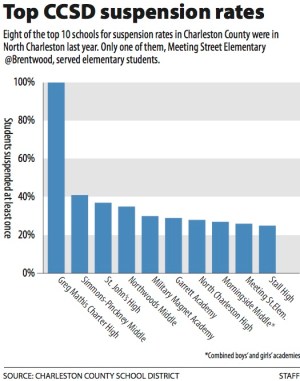
Published on Easter Sunday 2017 in the Post and Courier, Paul Bowers offered what I suspect will be a slow and painful series of unfortunate evidence that will discredit claims of educational miracles at Meeting Street Elementary @Brentwood; in this case, the public/private partnership elementary school has a unique and extreme suspension problem:

Meeting St suspensions copy

As a public/private venture, as a school choice and reform mechanism, Meeting Street Elementary @Brentwood is trapped in the need to advocate, sell its process. And since South Carolina has not held this experiment to the traditional school report card transparency, we are left only with the claims of school leaders.

However, we have well over a decade of “miracle” school bluster, all of which has been dismantled—suggesting that, I am sorry to say during this holiday season, there are no miracles.

While the school report card based mostly on high-stakes testing data is a significant failure of education reform, South Carolina’s report card system has included a key way to know if schools are in fact outperforming other schools, using the “Schools with Students Like Ours” metric (which I have detailed multiple times exposes that charter schools are no different, and possibly less effective, than traditional public schools in our state):

However, analyses from two years of report cards for charter schools in SC reveal the clear picture that more investment is not justified (see below for complete analysis of both years’ comparisons):

  • Using 2011 SC state repost cards and the metric “Schools with Students Like Ours,” charter schools performed as follows: 3/53 ABOVE Typical, 17/53 Typical, and 33/53 BELOW Typical.
  • Using 2013 SC state repost cards and the metric “Schools with Students Like Ours,” charter schools performed as follows: 2/52 ABOVE Typical, 20/52 Typical, 22/52 BELOW Typical.

And thus, this disturbing suspension data about an elementary school are just the beginning of what I can predict will happen as the evidence grows against the claims of this school somehow is accomplishing what other schools have not, cannot accomplish.

First, the evidence is very clear that “high-flying schools” are extreme outliers, constituting about 1.1% of high-poverty schools. This means two things: (1) if Meeting Street does achieve some sort of high-flying status, it will be in extremely rare company, and thus, (2) outliers prove virtually nothing about what most schools can and should accomplish (outliers often include key elements that cannot be scaled to all schools).

Next, the huge caution about any claims of miracle success on test scores at Meeting Street must be couched in their extended day and academic year. This technique has driven the false but powerful propaganda from KIPP charter schools that conveniently leave out that when you identify learning as months or years of growth, and you extend the learning time, the raw data growth is actually the same growth rate as other schools.

Comparing students with more teaching and learning time to other students with less is just one way advocates of charters and miracle schools mislead the public.

Remaining questions—some linked to suspension and expulsion patterns—include how any school’s test scores are impacted by student attrition (counseling out, expulsion, etc.), the percentage of special needs and English language learners served (when compared to traditional public schools), and the impact of self-selection (which can skew even claims that a school is serving a high-poverty population of students).

Meeting Street Elementary @Brentwood will prove, once again, to be evidence of the inherent problems with education form, and no miracle at all.

Our most vulnerable students—impoverished, black and brown students, English language learners, and special needs students—are disproportionately the targets of educational reform/experiments grounded in test-mania and harsh discipline policies and outcomes (see here, here, and here).

To be blunt, good intentions of administrators and teachers in our traditional public schools have not been enough, and now, those same good intentions among reformers cannot be justification for false claims and failed policies and practices.

Practices and fads such as exit exams, “no excuses” mantras, “grit” and  growth mindset, zero-tolerance discipline, and the larger accountability movement churning through standards and high-stakes testing—these have all increased the existing problems with inequity in our schools and society, and have miserably failed the students who need nurturing and effective schooling the most.

Miracle school claims are that human-sized Easter bunny; but that is just some stranger in a suit pretending to be a bunny, and it isn’t really appealing so much as something we should be very leery of approaching, especially with children.

bunny3

Easter 2017 Reader: Grit, Poetry, Educational Rankings, Poverty

Grit

Forget Grit. Focus on Inequality, Christine Yeh (Education Week)

Grit is an easy concept to fall in love with because it represents hope and perseverance, and conjures up images of working-class individuals living the “American dream.” However, treating grit as an appealing and simple fix detracts attention from the larger structural inequities in schools, while simultaneously romanticizing notions of poverty….

Perhaps this idea of grit resonates with so many people who believe in the popular American adage that if you work hard and pull yourself up by your bootstraps, then you can achieve anything. This belief unfortunately, assumes that individuals have the power, privilege, and access to craft their own futures, regardless of circumstance and systemic barriers.

Statistics on educational access consistently reveal vast differences in resources in affluent versus poor neighborhoods. Predominantly white, middle- and upper-income school districts tend to spend significantly more money per student than the districts with the highest percentages of marginalized students. Our poorest schools also tend to have large class sizes, unsafe school transportation, damaged and outdated facilities, and high staff turnover. All of these conditions directly contribute to low educational outcomes and underscore the link between access to school resources and improvements in students’ success. Schools that focus on grit shouldn’t ignore structural inequities because they assume that regardless of your race, class, or social context you can still triumph.

Telling children ‘hard work gets you to the top’ is simply a lie, Hashi Mohamed (The Guardian)

What I have learned in this short period of time is that the pervasive narrative of “if you work hard you will get on” is a complete myth. It’s not true and we need stop saying it. This is because “working hard, and doing the right thing” barely gets you to the starting line. Furthermore, it means something completely different depending on to which context you’re applying this particular notion. So much more is required.

I have come to understand that the systems that underpin the top professions in Britain are set up to serve only a certain section of society: they’re readily identifiable by privileged backgrounds, particular schools and accents. To some this may seem obvious, so writing it may be superfluous. But it wasn’t obvious to me growing up, and it isn’t obvious to many others. The unwritten rules are rarely shared and “diversity” and “open recruitment” have tried but made little if any difference.

Those inside the system then naturally recruit in their own image. This then entrenches the lack of any potential for upward mobility and means that the vast majority are excluded.

Check out Neoliberalism: A Concept Every Sociologist Should Understand, Peter Kaufman (Everyday Sociology)

The end result of neoliberal ideology, Monbiot continues, is that we are led to believe in the myth of the self-made person:

“The rich persuade themselves that they acquired their wealth through merit, ignoring the advantages – such as education, inheritance and class – that may have helped to secure it. The poor begin to blame themselves for their failures, even when they can do little to change their circumstances. Never mind structural unemployment: if you don’t have a job it’s because you are unenterprising. Never mind the impossible costs of housing: if your credit card is maxed out, you’re feckless and improvident. Never mind that your children no longer have a school playing field: if they get fat, it’s your fault. In a world governed by competition, those who fall behind become defined and self-defined as losers.”

See Also

Failing Still to Address Poverty Directly: Growth Mindset as Deficit Ideology

SchoolED Podcast: Paul Thomas on Grit, Slack, and the Effects of Poverty on Learning

UPDATED (Again): Grit, Education Narratives Veneer for White, Wealth Privilege

“Grit” Takes another Hit (with Caveats)

Rejecting “Grit” While Embracing Effort, Engagement

Poetry/ National Poetry Month 2017

Perspective | Poet: Why I would never tell a student what a poem means, Sara Holbrook (The Answer Sheet/ Washington Post)

A few months ago I wrote an essay, “I Can’t Answer These Texas Standardized Test Questions About My Own Poems,” in which I questioned those of unknown academic distinction who anonymously compose proficiency test questions. Many teachers wrote to tell me that they too are unable to answer these vaguely written test questions being used to evaluate their students. One teacher reported that her kids had to endure 17 days of testing this year. Considering there are only about 20 days of school in a month and that every test requires preparation on the devices and manner of testing, that’s a lot of lost instructional time.

Parents wrote. I did a few television interviews and radio programs. It was my 15 minutes. Additionally, I took some heat from a (very) few academics who jumped to inform me that authors do not own the meaning of a poem, it is up to literary critics to make this determination. Good grief.

It was not my intent to kick off an argument on of the relative merit of learned literary analysis. I’ll leave that to those with letters after their names. But friends, parents, educators, learned folks, please remember, middle-schoolers are not just short college sophomores. They are not lit majors. These are kids like Paul. Kids who are often grappling with a world of unseen and sometimes unspeakable challenges.

See Also

Investigating Poetry Because We Love It (and Our Students)

In Defense of Poetry: “Oh My Heart”

“So We must meet apart”: #NationalPoetryMonth 2017 and My Journey with Emily Dickinson

Educational Rankings

Are South Carolina schools really the worst in the nation?, Cindy Landrum (Greenville Journal)

Furman University education professor Paul Thomas said the education ranking is far less about education than socioeconomics.

“This ranking is a direct reflection of political negligence,” he said. “Our schools don’t legislate. It’s not like our schools are without any fault, but how schools function is a reflection of political leadership. South Carolina is failing our children, not our children are failing school.”

U.S. News & World Report used 11 metrics to measure a state’s education ranking, including college and high school graduation rates and standardized test scores. Three of the six pre-kindergarten-12 categories are test scores (ACT and National Assessment of Educational Progress), while the others are high school graduation rates, pre-K quality, and preschool enrollment. South Carolina ranked high in quality of its public pre-kindergarten program, but ranked low in test scores and college readiness.

“Schools in South Carolina and the U.S. reflect the inequities of communities, the failure of our policies, and as a result, they are ineffective as mechanisms of change,” Thomas said.

At least 60 percent of test scores are correlated with out-of-school factors such as parental education levels, poverty, hunger, mobility, lack of health care, safety, and community resources, he said. Only 10 percent to 15 percent of test scores can be traced to teacher quality.

Thomas said it has been known for decades that poverty and inequity are the greatest hurdles for children learning. But instead of addressing the problems, instead grade-by-grade standards are changed and students tested.

“Our states have social and educational pockets of poverty,” Thomas said. “Food and home insecurity directly contribute to low academic output, and once they get into school, we make horrible decisions. High-poverty children are sitting in larger classes with early-career and uncertified teachers. We do the exact opposite of what we should be doing.”

See Also

South Carolina Ranks First in Political Negligence

Poverty

America’s Shameful Poverty Stats, Sasha Abramsky (The Nation)

But there’s a deeper significance to the numbers: how they compare with the figures from recent decades. The percentage of people in poverty is roughly the same as in 1983, in the middle of the Reagan presidency, as well as in 1993, at the end of twelve years of Reagan/Bush trickle-down economics. A far higher portion of the population lives in poverty than was the case in the mid-1970s, after a decade of investment stemming from Lyndon Johnson’s War on Poverty; and far more live in poverty today than did at the end of Bill Clinton’s eight years in office—years in which the earned-income tax credit was expanded, unemployment was kept to near-historic lows, and poverty rates fell significantly.

That our poverty numbers have risen to such a high level exposes the fact that as a society, we are choosing to ignore the needs of tens of millions of Americans—as we have done for much of the period since the War on Poverty went out of fashion and the harsher politics of Reaganism set in. These ignored Americans include kids like the ones I interviewed in Los Angeles, forced to choose between applying to college or dropping out of school and getting dead-end jobs to support parents who had lost not only their jobs but their homes, too. They include the elderly lady I met outside Dallas, who was too poor to retire but too sick to take the bus to her work at Walmart. Her solution? She paid her neighbors gas money to drive her to a job that paid so little she routinely ate either 88-cent TV dinners or went to bed hungry. They include, too, the residents of New Orleans’s Lower Ninth Ward I met in 2011, who, six years after Hurricane Katrina, were still living in appalling conditions in a largely obliterated community.

See Also

the world


The Tone-Deaf Politics of Denying Racism, Excusing Segregation

Let’s connect the dots, which is challenging because, if those with power had their way, it would be white dots on a field of white.

Rick Hess, whose tagline is “Education policy maven Rick Hess of the American Enterprise Institute [AEI] think tank offers straight talk on matters of policy, politics, research, and reform,” blogging at Education Week makes this claim:

Some deem this a healthy and long-overdue development, believing that social justice demands that education be understood through the prism of race and inequality. They believe that tackling deep racial inequities is the measure of one’s commitment to educational improvement, and view measures like the DREAM Act and affirmative action as inseparable from elements of that work. Thus, they tend to see an inevitable overlap between school reform and the pursuit of progressive policies regarding housing, immigration, policing, health care, and much more.

Others of us think that viewing education primarily through the lens of race is unhealthy and divisive, fueling a destructive hypersensitivity and race-based grievance. We’re concerned that it undermines the unifying possibilities of democratic schooling, especially when foundational virtues like personal responsibility and patriotism get dismissed as culturally oppressive remnants from yesteryear. We fear that it turns schooling, potentially one of our great common endeavors, into something very different, political, and partisan.

Keep in mind the dichotomy of “some” and “we.”

Next, a review of an AEI report on charter schools reveals:

The reviewers find that the report presents charter school de facto segregation as a benign byproduct of parental choice. In fact, the review finds that the original report actually acknowledged that this type of stratification was part and partial of a “properly” functioning charter sector – one in which parents get to choose the type of school their children attend.

“Some” who “[believe] that social justice demands that education be understood through the prism of race and inequality” are being, according to Hess, “political” and “partisan.”

And AEI finds segregation “benign” because it is just what parents choose.

With those dots detected and connected, consider this Tweet from Charles Blow:

What is at play here, and linked by AEI, includes an ends-justify-the-means ideology paired with Social Darwinism (masked as “parental choice”)—all of which is bereft of any sort of ethical grounding, any acknowledgement that “some” (the ellipsis of race, and thus, people of color) are making pleas for being heard to create a more just and equitable education system and country.

The ends justify the means for the winners because they have no personal experience with the devastating impact of the means—think the pyramids of Egypt to the economy of the South and the entire nation during U.S. slavery.

The Masters must keep pointing at the outcomes and must find ways to silence the enslaved, the oppressed.

The Masters must control what is normal, objective, and non-partisan/non-political (their way) while casting everyone else as the “other”—biased, partisan, political, radical.

Hess and AEI are peddling the inexcusable in a time now dominated by the deplorables.

None the less, these are calloused claims, and nothing can justify denying racism or embracing segregation.