Category Archives: race

The “R” Word as Taboo in Twenty-First Century U.S.A.

Margaret Atwood’s The Handmaid’s Tale offers a not-too-distant dystopia in which Atwood explores the rise of a theocracy as a sanctuary for the declining white race; the work is a tour-de-force confrontation of sexism and misogyny as well as dramatization of the relationship between power and language, including the power inherent in what humans name* and what humans taboo.

The central handmaid of the tale, June/Offred, narrates her own journey through hell that includes being assigned to a Commander who monthly is charged with attempting to impregnate his handmaid in what this new nation of Gilead calls the Ceremony, infusing the act with religious and official overtones.

However, June/Offred characterizes the Ceremony with a disturbing and clinical precision:

My red skirt is hitched up to my waist, though no higher. Below it the Commander is fucking. What he is fucking is the lower part of my body. I do not say making love, because this is not what he’s doing. Copulating too would be inaccurate, because it would imply two people and only one is involved. Nor does rape cover it: nothing is going on here that I haven’t signed up for. There wasn’t a lot of choice but there was some, and this is what I chose. (p. 94)

Many aspects of this passage are worth emphasizing, but let’s focus on the importance and value in June/Offred naming accurately this awful thing happening—and not ignore the weight of taboo language (such as the word “fucking”).

“I have guarded my name as people/ in other times kept their own clipped hair,” opens Barbara Kingsolver’s poem, “Naming Myself,” “believing the soul could be scattered/ if they were careless.”

Here too are the intersections of naming, gender, and power: why must women abandon their names in the legal/religious act of marriage while men retain theirs?

Kingsolver’s speaker, like Atwood’s narrator, both uses and values language as power—guarding a name and naming.

#

The election of Donald Trump as the president of the U.S. comes in the wake of Trump making inflammatory comments about Mexicans, Muslims, and women. Nonpartisan and measured assessments of Trump’s words rightly label them as racist, xenophobic, and sexist/misogynistic.

The rise of Trump as a political leader has exposed the lingering taboo in the U.S. for naming racism, even when there is direct evidence of racist language and behavior and especially when that racism is coded (getting tough on crime, building a wall, evoking the specter of terrorism).

Serious public debate has parsed making the distinction between Trump being a racist and Trump courting and/or attracting racists, such as being endorsed by the KKK, neo-Nazi organizations, and the white nationalist movement.

A perverse shift has occurred, in fact, from the mislabeling of Barack Obama’s being elected president as proof that the U.S. is a post-racial society to Trump’s rise asking the U.S. to reconsider what counts as racism.

Trump personifies the triple-Teflon of being white, male, and affluent, most notably in the power of those attributes to deflect the label “racist.” As Trump himself asserted defiantly:

I can never apologize for the truth. I don’t mind apologizing for things. But I can’t apologize for the truth. I said tremendous crime is coming across. Everybody knows that’s true. And it’s happening all the time. So, why, when I mention, all of a sudden I’m a racist. I’m not a racist. I don’t have a racist bone in my body.

Trump’s own strategy frames his words and behavior as “truth,” therefore not “racist.”

The election of Trump grounded significantly on white voter support, including a majority of white women, adds another layer of tension in that if Trump has voiced racism and/or practiced racism, how complicit are voters as racists themselves?

In short, are the approximately 25% of eligible voters who supported Trump racists? And if so, who can name that racism?

#

A valued colleague who is a rhetorician posted on social media his argument that white liberal elites, especially, should stop naming people as racists—pointing to the overwhelming evidence that the approach is ineffective.

Faced with evidence of racism, whites tend to emphasize their own personal struggles, and many whites now believe racism toward whites trumps racism toward blacks.

Systemic racism (distinct from individual racists) tends to be much harder for many in the U.S. to name or confront. For example, the political and media perpetuation of black-on-black crime is enduring despite the fact that all crime is mostly intra-racial—the white-on-white crime rate is nearly identical to the black-on-black crime rate.

To approach this in Trump-logic: black-on-black crime rates are true; therefore, referring to them cannot be racist.

But even the racism that can be named in the U.S. is reduced to the most extreme and even cartoonish version that Ta-Nehisi Coates calls the “oafish racist”:

Cliven Bundy is old, white, and male. He likes to wave an American flag while spurning the American government and pals around with the militia movement. He does not so much use the word “Negro”—which would be bad enough—but “nigra,” in the manner of villain from Mississippi Burning or A Time to Kill. In short, Cliven Bundy looks, and sounds, much like what white people take racism to be.

The problem with Cliven Bundy isn’t that he is a racist but that he is an oafish racist. He invokes the crudest stereotypes, like cotton picking. This makes white people feel bad.

What Trump represents, however, is more insidious:

The elegant racist knows how to injure non-white people while never summoning the specter of white guilt. Elegant racism requires plausible deniability, as when Reagan just happened to stumble into the Neshoba County fair and mention state’s rights. Oafish racism leaves no escape hatch, as when Trent Lott praised Strom Thurmond’s singularly segregationist candidacy.

Elegant racism is invisible, supple, and enduring. It disguises itself in the national vocabulary, avoids epithets and didacticism. Grace is the singular marker of elegant racism. One should never underestimate the touch needed to, say, injure the voting rights of black people without ever saying their names. Elegant racism lives at the border of white shame. Elegant racism was the poll tax. Elegant racism is voter-ID laws.

The racism of Trump and emboldened by Trump sullies the “elegant,” but it certainly meets Coates’s recognition of “plausible deniability.”

#

Finally, let’s return to June/Offred, being fucked, but not raped because “[t]here wasn’t a lot of choice but there was some.”

In a free society, black and brown people find themselves in a parallel circumstance to June/Offred, the victims of racism even though “[t]here wasn’t a lot of choice but there was some.”

And as my colleague noted, victims of racism certainly find value in naming racism and racists.

The problem my colleague raises, however, is among white allies to those victims of racism; if it is ineffective for white allies to name racism, to name racists, what is our obligation as allies against racism and inequity?

To suggest that racism and racists do not exist until acknowledged by whites is a nasty dose of paternalistic racism. To tip-toe around racists for fear of offending them and entrenching racism further also seems like a slap in the face of black and brown people living the very real consequences of racism and the “rigid refusal to look at ourselves.”

As a very privileged ally to everyone marginalized by racism (as well as sexism/misogyny, xenophobia, and all sorts of bigotry), I believe I must listen to black and brown voices, but I also must use my privilege to amplify (not confirm) those voices—to stand beside and behind, but never to speak for.

There was a time in the not-so-distant past when even the oafish racist was not called to account; therefore, I am convinced that a key step to erasing elegant racism, systemic racism, is to have the courage to call racists “racists” regardless of the evidence that those rightly labeled “racists” will not change.

I am taking this stand because I am not sure our goal is to change individual racists, but to change the greater capacity of the larger population who have yet to confront their culpability in elegant/systemic racism, and thus to create a critical mass in the name of equity that will eradicate racism over time.

In the most profound and bitter sort of appropriateness, the U.S. has elected the very worst and most perfect leader of, as Trump would say, the truth about the U.S.—which is that we are a racist, sexist/misogynist, and xenophobic people, drunk on consumerism and negligent in our humanity for each other.

With that before us and named, let us hope we can confess our sins, do our penance, and create a more perfect union.


* Dare we call fascism “fascism”? No, this isn’t the 1930s – but yes, this is fascism, James McDougall
What Trumplandia Confirms about Republican Party, Christian Right, and White America

I just want to ask a question:
Who really cares, to save a world in despair?
Who really cares?

“Save the Children,” Marvin Gaye

I was born and have lived my entire life in the cesspool of hypocrisy that is the Bible Belt—where conservative Republicanism and Christian values are thin veneer for hatred, bigotry, sexism, gun-lust, and enduring racism.

That hypocrisy failed me and then as a young adult and throughout my life I have been taught critical love and kindness by great writers and thinkers: Kurt Vonnegut, Eugene V. Debs, Alice Walker, Toni Morrison, Langston Hughes, and the greatest witness of all, James Baldwin.

With the election of Donald Trump as the U.S. president, the entire nation has before it this reality: Trumplandia confirms that the Republican Party, Christian Right, and white America have abdicated all rights to any moral authority.

First, despite efforts by mainstream media and pundits to argue otherwise, Trump and his rhetoric are continuations of central efforts by the Republican Party reaching back at least to Reagan: “tough on crime” as code for racist beliefs about blacks and Latinx, “build a wall” as just more xenophobia, and anti-government ranting as code for denying “free” offerings to the “lazy” people of color and “illegal immigrants.”

Trump’s Republicanism is directly in line with Reagan Republicanism. The only real difference is Trump’s outlandish and brash admissions aloud of the very worst of the Republican Party, such as calling Mexicans rapists and murderers. Traditional Republicans only hint at such.

Even more important is that the overwhelming support for Trump by the Christian Right is stunningly damning:

For eight years, Barack Obama and his family—despite a history of being practicing Christians, despite Obama himself offering several eloquent and Christian speeches and hymns in times of tragedy, and despite Obama and his family living essentially good (read: Christian) lives—the Christian Right, and Trump, have refuted Obama’s Christianity and used accusations of his being a Muslim as a slur.

Yet, Trump’s hedonism, adultery, sexual assault, profane discourse, hate speech, sexism, and rapacious behavior as a business man and pseudo-billionaire [1], for the Christian Right, prove to be just fine.

Trumplandia has exposed there is nothing “Christian” or “right” about the Christian Right.

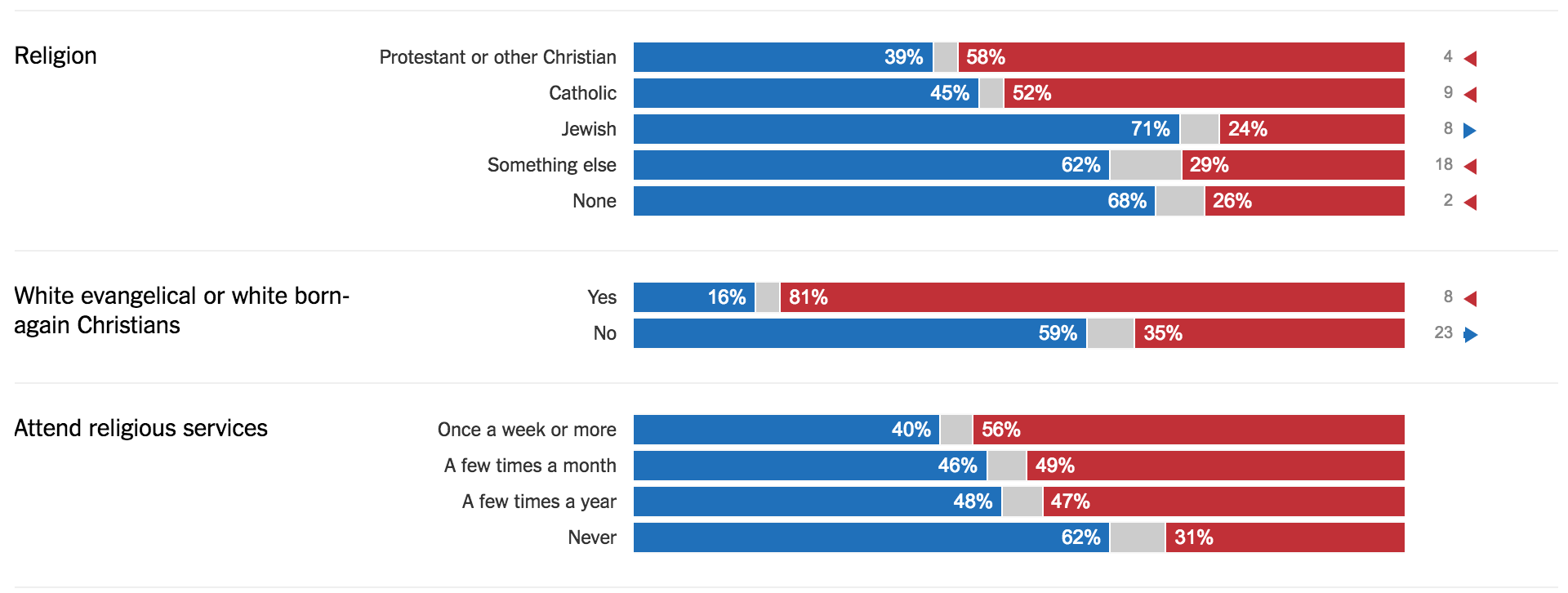
Finally, however, the most damning and least addressed consequence of Trumplandia is what it has exposed about white America, who overwhelmingly supported Trump:

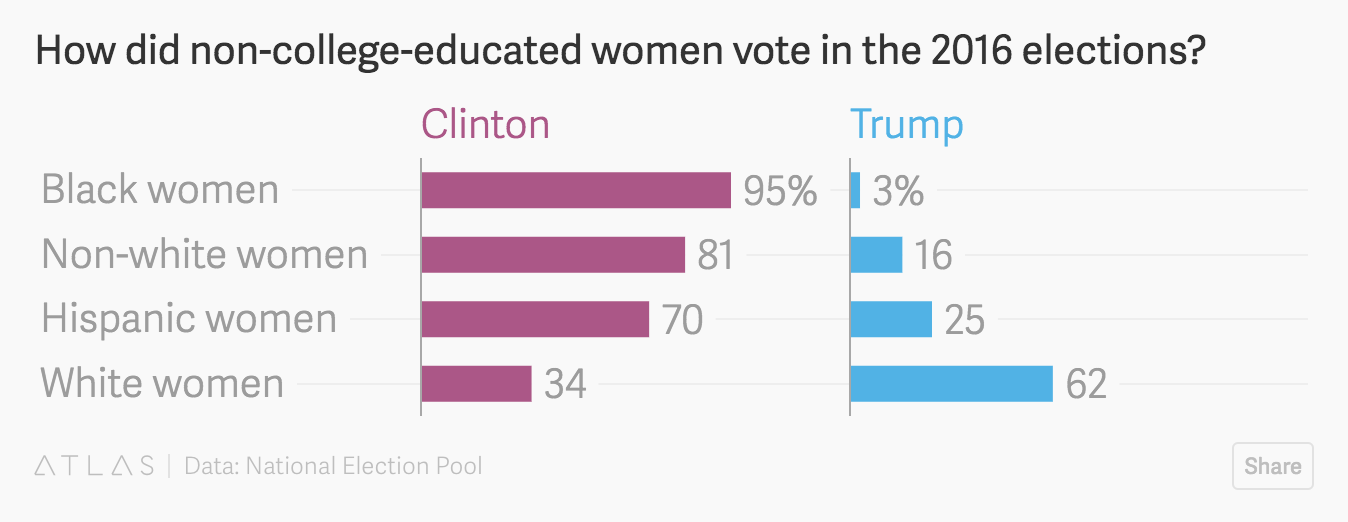
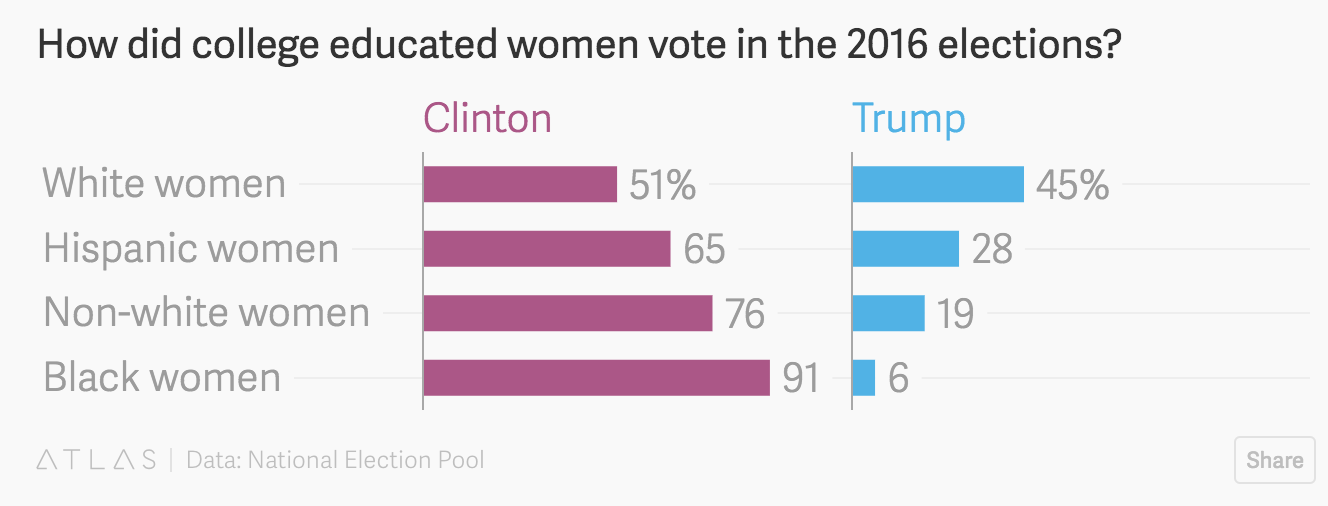
As expected, Trump did best among white voters without a college degree, beating Clinton by the enormous margin of 72 percent to 23 percent. Trump also won among white, non-college women 62 to 34 percent and white college-educated men, 54 to 39 percent. Among white voters, Clinton only won among women with a college degree by a 51 to 45 percent margin. Interestingly, among white voters, there is no evidence in the exit poll that income affected the likelihood that they supported Trump.

The conventional wisdom being promoted by whitewashed mainstream media is that the working and middle class have been abandoned by Democrats and the U.S. government; yet, exit polls show that the two lowest income categories chose Clinton by a slim majority (certainly skewed, however, by people of color over-represented in these groups, revealing how the media is mostly worried about “working class” and “middle class” only as that relates to whites):

Both sets of exit data from CBS and NYT, then, suggest that Trump’s support has more to do with race than disgruntled working class whites being ignored and disenfranchised.

Actually, mainstream media has its argument backward because Trumplandia confirms that white America has abandoned commitments to equity for all—not that any political party or the U.S. government has abandoned white America.

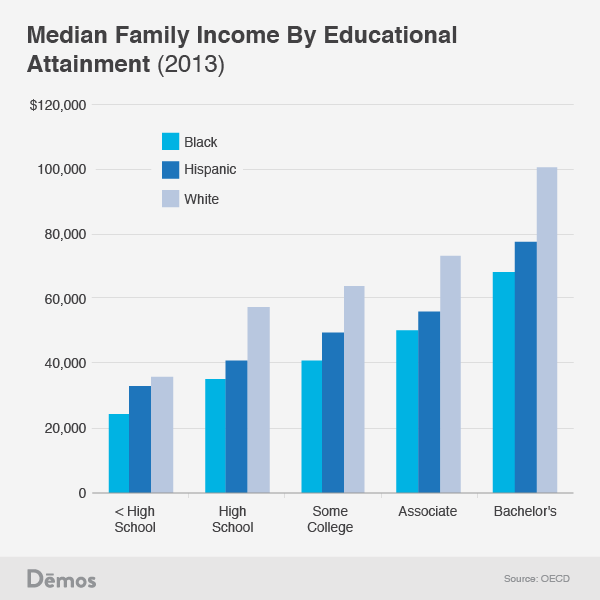
The problem with the hurting working/middle class white argument is that this is racially inequitable America:

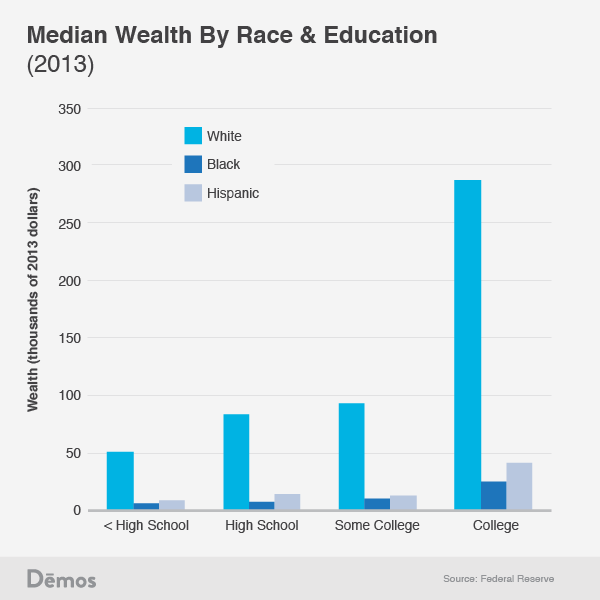
And this is racially inequitable America:

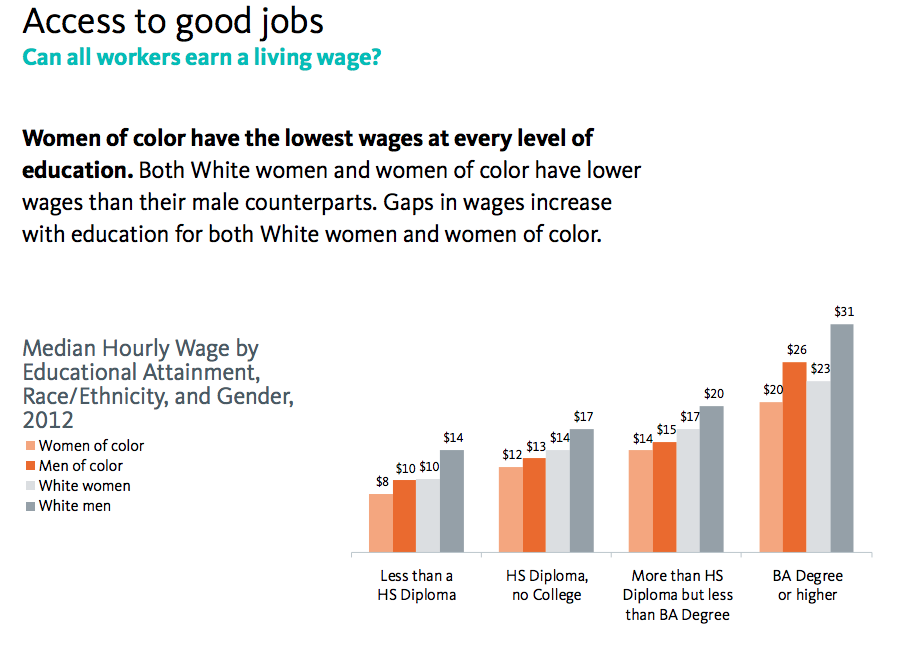
The America where race and gender create exponential inequity:

As a powerful contrast to the white male and female support to Trump, note that black women were by far least likely to vote for Trump—and they have the greatest reason to be disenfranchised (the lowest wages at every level of education, above):

The ultimate problem with the suffering working and middle class white argument for Trump’s rise is twofold: (1) white suffering may exist, but by comparison to black/brown suffering and gender suffering, white suffering remains relatively less significant, and (2) if whites are hurting, that fact should have spurred solidarity with historically marginalized groups, not the antagonism being heard from white America.

If white America ever really believed in the melting pot, believed in a country of immigrants, believed in equity for all, that may have existed in some distant and idealized past when white America saw that pot melting disparate whites into one homogenous white: equity for all who look like us (white).

Trumplandia is a white response (whitelash), not from working and middle class suffering, but against rising demands by oppressed groups (#BlackLivesMatter, Colin Kaepernick, gender neutral restrooms, marriage equity, immigration reform, etc.) for equity for all.

The only thing whites are poised to lose is their unearned privilege, but the rise of white support of Trump confirms that whites see their privilege as more important to preserve than equity for all is to attain.

“Make America Great Again” is slogan-as-code for maintaining white (and male) privilege.

#

In the tumultuous world faced by Marvin Gaye—especially war torn—he sang:

But who really cares?
Who’s willing to try?
To save our world
To save our sweet world
To save a world
That is destined…to die

Trumplandia is a defiant “Not us” from white America—and efforts to whitewash that callousness as economic angst is further proof that the dirtiest word in the U.S. to utter is “racism” because of the delicate sensibilities of the most powerful people in the country.


[1] Matthew 19:24: Again I tell you, it is easier for a camel to go through the eye of a needle than for someone who is rich to enter the kingdom of God.

Dark Mourning in America: “The world is at least/fifty percent terrible”

The best lack all conviction, while the worst
Are full of passionate intensity.

“The Second Coming,” William Butler Yeats

Although humans appear ultimately incapable of listening to and then acting upon our great capacity for art—which is an extension of our great capacity for compassion, love, and good—literature may offer some solace in a time when the US has announced itself still a racist, sexist, and xenophobic people, hiding behind the codes of “conservative,” “family values,” and “Christian nation.”

How low do people have to stoop before they have their Lady Macbeth moment:

Out, damned spot! out, I say!–One: two: why,
then, ’tis time to do’t.–Hell is murky!–Fie, my
lord, fie! a soldier, and afeard? What need we
fear who knows it, when none can call our power to
account?–Yet who would have thought the old man
to have had so much blood in him.

Shakespeare’s dramatization of guilt and being complicit is, let’s not ignore, an allusion to Pontius Pilat and the “assassination” of Jesus:

When Pilate saw that he was getting nowhere, but that instead an uproar was starting, he took water and washed his hands in front of the crowd. “I am innocent of this man’s blood,” he said. “It is your responsibility!” [Matthew 27:24, NIV]

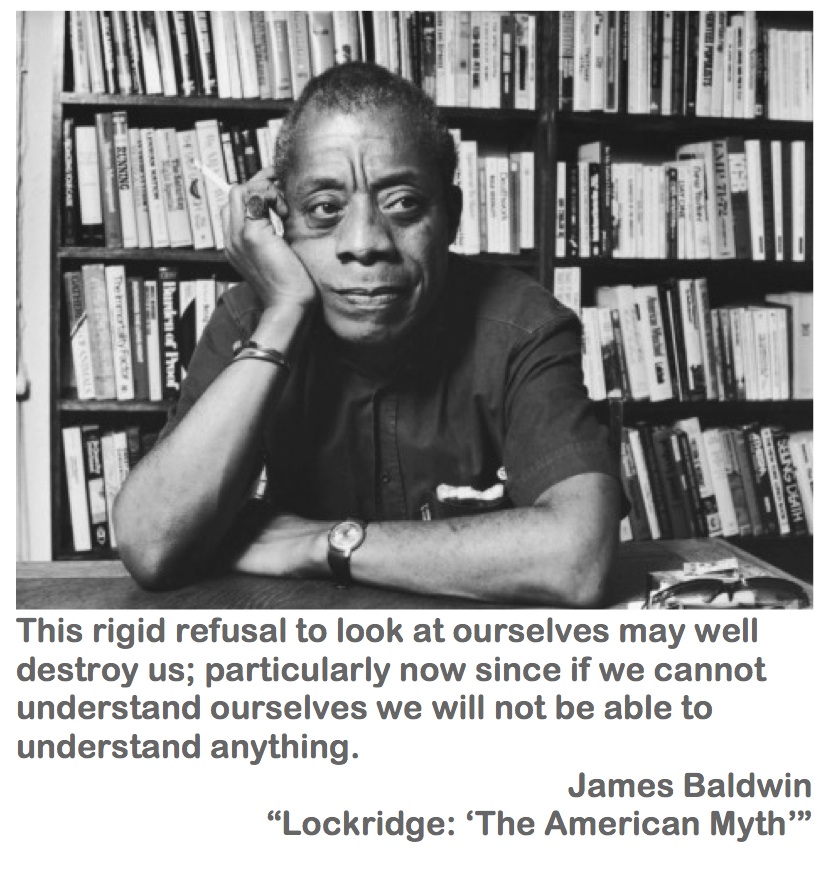
If we can have that moment in which we admit, confront, and atone for our responsibility in the evil that humans do, we must finally listen to James Baldwin:

rigid-refusal

And to Langston Hughes:

O, let America be America again—
The land that never has been yet—
And yet must be—the land where every man is free.
The land that’s mine—the poor man’s, Indian’s, Negro’s, ME—
Who made America,
Whose sweat and blood, whose faith and pain,
Whose hand at the foundry, whose plow in the rain,
Must bring back our mighty dream again.

And face our children with our failures, against which Maggie Smith struggles:

Life is short, though I keep this from my children….
The world is at least
fifty percent terrible, and that’s a conservative
estimate, though I keep this from my children….
Life is short and the world
is at least half terrible, and for every kind
stranger, there is one who would break you,
though I keep this from my children.

The US and its majority white population have the greatest opportunity before them, a free and powerful nation of riches, and daily, that opportunity is squandered because of our “rigid refusal to look at ourselves.”

The US is undeniably inequitable, and to balance among gender, race, etc., we have only two options: to take away or to give to—but in either case, white privilege is erased and white sensibilities are challenged.

There is no evidence the white majority has the ethical backbone to make changes for equity or even to tolerate them.

On a dark mourning in America, I recommend reading or rereading Margaret Atwood’s The Handmaid’s Tale—a sobering imagining of the worst of white responses to the rise of the Others they have created.

We are now on that path, and it is ours to make the decision to turn around or move forward into that oblivion.

“History proves that the white man is a devil”

The public career and life of Malcolm X are fraught with contradictions and controversy—often complicated by the Nation of Islam and its discredited leader Elijah Muhammad.

Malcolm X’s infamy—as it contrasts with the idealizing and misrepresentation of Martin Luther King Jr. as a passive radical—lies often in his sloganized “By any means necessary” and “History proves that the white man is a devil.”

While Malcolm X himself confronted some of his more controversial and confrontational stances, in 2016, the U.S. is faced with the prescience in what seemed to be hyperbole and racial anger; however, there is much to consider about the evil capacity often behind the face of white men.

Living just across the highways from my neighborhood, Todd Kohlhepp has confessed to vicious murders after police found a woman chained in a storage container for two months.

Kohlhepp represents to a disturbing degree the classic profile of serial killers and sex offenders, central of which is being a white male.

At the University of Wisconsin:

The 20-year-old student, Alec Cook, has been arrested and appeared in court on Thursday, charged with 15 crimes against five women, including sexual assault, strangulation and false imprisonment. His modus operandi, according to police and prosecutors, was to befriend fellow students and eventually entrap and viciously attack them, while keeping notebooks detailing his alleged targets.

Kohlhepp and Cook, white males of relative affluence, are no outliers. Yet, political leaders and the media persist in characterizing for the U.S. public much different images of who to fear: Mexicans, black males, Muslims.

Daily violence—including sexual aggression and assault—is a real threat in a way nearly opposite of these political and media messages; each of us should fear people who look like us, and family, friends, and acquaintances deserve nearly equal scrutiny.

Political race-baiters and the mainstream media rarely stray from the black-on-black crime message, but also always fail to add a key fact: crime is almost entirely intra-racial as the white-on-white crime rate (86%) is nearly identical to the black-on-black crime rate (94%).

Malcolm X’s rhetoric may still seem inflammatory, but James Baldwin’s more measured charges confront the same racial masking and tension:

White Americans find it as difficult as white people elsewhere do to divest themselves of the notion that they are in possession of some intrinsic value that black people need, or want. And this assumption—which, for example, makes the solution to the Negro problem depend on the speed with which Negroes accept and adopt white standards—is revealed in all kinds of striking ways, from Bobby Kennedy’s assurance that a Negro can become President in forty years to the unfortunate tone of warm congratulation with which so many liberals address their Negro equals. It is the Negro, of course, who is presumed to have become equal—an achievement that not only proves the comforting fact that perseverance has no color but also overwhelmingly corroborates the white man’s sense of his own value.

White men control the political and media narratives, and thus, white males are bathed in the compassionate light of the white male gaze of power—everyone else becomes the feared Other.

The hatred spewed by Donald Trump is not solely what should be feared in this context, but that he personifies and speaks to “the white man’s sense of his own value” that seeks to erase that Other, as Astra Taylor reported from a Trump rally in North Carolina:

A few months ago Trump had rallied in Wilmington, North Carolina, the site of America’s only and largely forgotten coup. In 1898, in the waning days of Reconstruction, rioting white supremacists overthrew a multiracial progressive “fusion” government, deposing democratically elected leaders of both races and killing black citizens mercilessly. After that, populism in North Carolina, as in the South more broadly, was a white affair. At his rally near the site of that historic, shocking savagery, Trump suggested “the Second Amendment people” do something about Hillary.

The Trump narrative is essentially racist, and almost entirely false, Jason Stanley explains:

The chief authoritarian values are law and order. In Trump’s value system, nonwhites and non-Christians are the chief threats to law and order. Trump knows that reality does not call for a value-system like his; violent crime is at almost historic lows in the United States. Trump is thundering about a crime wave of historic proportions, because he is an authoritarian using his speech to define a simple reality that legitimates his value system, leading voters to adopt it. Its strength is that it conveys his power to define reality. Its weakness is that it obviously contradicts it.

And thus, Trump has public support from the KKK and Nazi groups for a reason; and that support is distinct from public support for any of the other presidential candidates, none of which draw hate groups into the light.

In A Dialogue between James Baldwin and Nikki Giovanni, Baldwin argues, “The reason people think it’s important to be white is that they think it’s important not to be black”:

It’s not the world that was my oppressor, because what the world does to you, if the world does it to you long enough and effectively enough, you begin to do to yourself. You become a collaborator, an accomplice of your own murderers, because you believe the same things they do. They think it’s important to be white and you think it’s important to be white; they think it’s a shame to be black and you think it’s a shame to be black. And you have no corroboration around you of any other sense of life.

Yes, we must be vigilant about the white gaze and the male gaze, both of which, as Baldwin witnessed, corrupt the agent and object of that gaze, but we must be as vigilant about the white male accusatory finger designed to keep everyone else’s gaze somewhere other than where the most power, and too often, the most evil reside.

“the white man’s sense of his own value”: James Baldwin’s The Fire Next Time

White Americans find it as difficult as white people elsewhere do to divest themselves of the notion that they are in possession of some intrinsic value that black people need, or want. And this assumption—which, for example, makes the solution to the Negro problem depend on the speed with which Negroes accept and adopt white standards—is revealed in all kinds of striking ways, from Bobby Kennedy’s assurance that a Negro can become President in forty years to the unfortunate tone of warm congratulation with which so many liberals address their Negro equals. It is the Negro, of course, who is presumed to have become equal—an achievement that not only proves the comforting fact that perseverance has no color but also overwhelmingly corroborates the white man’s sense of his own value.

Why James Baldwin’s The Fire Next Time Still Matters

baldwin2_1050x700
Baldwin in London, 1969;via Wikimedia Commons

the_fire_next_time
A 1960s edition of Baldwin’s The Fire Next Time (via Flickr user Robert Huffstutter)

1 November 2016 Reader: “Matters of power, state violence, extreme poverty, institutional racism”

The rise of Trumpism and how to fight it, Dorian Bon

Even leaving aside the possibility of marauding, right-wing poll-watchers, other questions will have come up for readers of this website: Why is Donald Trump’s bigotry and aggressive chauvinism finding such a large audience? How can so many millions of people who don’t have millions in their bank accounts be planning to vote for him after everything we know?

More generally: Where is the momentum on the far right coming from? Where is it going? And what can be done to stop it?

Trump’s Inconvenient Racial Truth, Nikole Hannah-Jones

To be clear, I am not arguing that the man who called for the execution of the since-exonerated Central Park Five (and who still insists on their guilt) and who seeks nationwide implementation of the stop-and-frisk program ruled unconstitutional in New York City, and who warns that voting in heavily black cities is rigged, is a racial progressive who will enact policies that will help black communities. Nor am I saying black voters should buy what Trump is selling. (And they aren’t: A poll released last week by The New York Times Upshot/Siena College of likely voters in Pennsylvania found that “no black respondent from Philadelphia supported Mr. Trump in the survey.”)

What I am saying is that when Trump claims Democratic governance has failed black people, when he asks “the blacks” what they have to lose, he is asking a poorly stated version of a question that many black Americans have long asked themselves. What dividends, exactly, has their decades-long loyalty to the Democratic ticket paid them? By brushing Trump’s criticism off as merely cynical or clueless rantings, we are missing an opportunity to have a real discussion of the failures of progressivism and Democratic leadership when it comes to black Americans.

Dont Walk That Line! Why Schools Need To Create And Measure Positive Climates, Andre Perry

As researchers on positive school climate note, the “personality” of a school is an expression of how teachers, students, family members and community perceive the milieu.

In other words, a school doesn’t have to be mean to be good. Treating students with care and respect increases academic performance among students from low socioeconomic backgrounds, higher than if a school placed a singular single focus on academics.

Researchers for this study pulled evidence from multiple studies from around the world to understand the relationships between socioeconomic status, school climate, and academic achievement to help academics and practitioners alike understand what a positive climate is and why ultimately it can boost academic achievement.

Why I Have No Sympathy for Angry White Men, Stacey Patton

Why isn’t anyone suggesting that these beleaguered White men respond to their relatively new “hard times” by working hard and pulling themselves up by their bootstraps? Where are the people calling on these beleaguered Whites to develop empathy and compassion for those who have long been suffering, like African-Americans and other people of color? Why do we need to understand this community? Why is the opposite never suggested as a potential option? Is it because White men are simply not willing to emerge from their bubble and acknowledge the humanity of those they deem “other?” Or is it because they are unable to see beyond their own reality?

What we’re witnessing is racist populism all over again. Trump is following a historical pattern by stoking the racism, but especially as a rich White man pitting disenfranchised poor White people against Black people and especially Black people in low-income areas, telling them to intimidate and attack them at his rallies and at the polls, much in the same way poor Whites were pitted against poor Black people by elite White people to ensure there wouldn’t be a class uprising.

“Trump is emancipating unbridled hatred” – Interview: Rina Soloveitchik, Judith Butler

Butler: What Trump is emancipating is unbridled hatred and, as we see recently, forms of sexual action that don’t even care about anybody’s consent. Since when did we have to ask women whether they are okay with being touched, or why? He does not actually say that, but that is exactly what he is indicating. It liberates people, their rage, and their hatred. And these people may be wealthy, they may be poor, they may be in the middle; they feel themselves to have been repressed or censored by the left, by the feminists, by the movement for civil rights and equality, by Obama’s presidency, which allowed a black man to represent the nation.

Unthinkable Politics and the Dead Bodies of Children, Henry A. Giroux

Matters of power, state violence, extreme poverty, institutional racism, a broken criminal justice system, the school to prison pipeline and the existence of the mass incarceration state, among other important matters, rarely if ever enter her discourse and yet these are major issues negatively affecting the lives of millions of children in the United States. And her alleged regard for children falls apart in light of her hawkish policies on global regime change, drone attacks and cyber-warfare, and her unqualified support for the warfare state. Her alleged support for children abroad does not capture the larger reality they face from when their countries are invaded, attacked by drones and subject to contemporary forms of indiscriminate violence. Rather than critique the US as a powerful engine of violence, Clinton expands its imperialist role around the globe. This is a key point in light of her defense of the rights of children, because her warmongering ideology puts children in the path of lethal violence.

Rejecting Cultural Literacy for Culturally Relevant: From Baldwin to Cole, “the custodian of a black body”

…to cease fleeing from reality and begin to change it.

James Baldwin, The Fire Next Time

Haunting the American character still is a fact confronted early in Teju Cole’s Black Body: Rereading James Baldwin’s “Stranger in the Village” (originally published in The New Yorker 19 August 2014 but also opening Cole’s Known and Strange Things): that Baldwin, Martin Luther King Jr., and John Coltrane are all “people who could still be with us.”

Living, Cole means—because, of course, they remain with us in ways that are both beautiful and disturbing.

Retracing Baldwin’s time in Switzerland and his essay spawned from that visit, Cole recognizes Baldwin was “depressed and distracted” during his trip in the 1950s—in part due to the “absurdity” of being a stranger during his travels as well as alienated in his home city of New York through the fact of the manufactured concept of race.

Cole experiences a “body-double moment” that emphasizes a physical self-consciousness of being black and male; being “like [Baldwin],” Cole catalogues insecurities of the flesh, building to:

and feel myself in all places, from New York City to rural Switzerland, the custodian of a black body, and have to find the language for all of what that means to me and to the people who look at me.

This racialized and genderized self-consciousness, Cole details, is cultivated in being surveilled; “glances,” in Cole’s diction, but commonly identified as the “gaze,” whether the white gaze or the male gaze.

“To be a stranger is to be looked at,” Cole explains, “but to be black is to be looked at especially.” Hard, Cole means, as in the perpetual policing of the black body.

Cole’s “custodian” echoes Baldwin’s witnessing—bound as the two men are by what Baldwin captures in “‘People are trapped in history, and history is trapped in them.'”

The black body and the American character—both Baldwin and Cole demand—are inextricable. But for Baldwin, Western culture forced him to conclude: “‘I was an interloper; this was not my heritage.'”

However, Cole, shifting to Ralph Ellison, embraces Western art despite the lingering weight he shares with Baldwin: “I have experienced in my own body the undimmed fury he felt about pervasive, limiting racism.”

Continuing the scarred mosaic of history, Cole’s contemporary reality will not allow him to escape “the news online”:

There I found an unending sequence of crises: in the Middle East, in Africa, in Russia, and everywhere else, really. Pain was general. But within that larger distress was a set of linked stories, and thinking about “Stranger in the Village,” thinking with its help, was like injecting a contrast dye into my encounter with the news. The American police continued shooting unarmed black men, or killing them in other ways. The protests that followed, in black communities, were countered with violence by a police force that is becoming indistinguishable from an invading army. People began to see a connection between the various events: the shootings, the fatal choke hold, the stories of who was not given life-saving medication. And black communities were flooded with outrage and grief.

Like Baldwin in 1966, Cole cannot escape the policing of the black body, the political “obsession with cleaning, with cleansing,” that “policymakers believe that going after misdemeanors is a way of preëmpting major crimes.”

Dropped like a stone too heavy to carry any further, Cole concludes:

But the black body comes pre-judged, and as a result it is placed in needless jeopardy. To be black is to bear the brunt of selective enforcement of the law, and to inhabit a psychic unsteadiness in which there is no guarantee of personal safety. You are a black body first, before you are a kid walking down the street or a Harvard professor who has misplaced his keys.

Endless surveilling, constant policing the black body are fed by the “fantasy about the disposability of black life [that] is a constant in American history.”

Cole as custodian witnesses that “American racism has many moving parts, and has had enough centuries in which to evolve an impressive camouflage….Like misogyny, it is atmospheric. You don’t see it at first. But understanding comes.”

But there remains one more damning stone to drop: “black American life is disposable from the point of view of policing, sentencing, economic policy, and countless terrifying forms of disregard”—one of which, left unnamed by Cole, is formal education.

#

An educational dinosaur who refuses extinction, E.D. Hirsch yet again offers a plea for cultural literacy, folded into the decades-old standards debate.

There is a disturbing irony about a torch bearer of the dominant culture lobbying for that culture to remain dominant—specifically through the codified curriculum of the formal education system.

Hirsch cloaks his message in an unaddressed assumption that knowledge can be somehow politically neutral; it’s all about the role of knowledge in teaching students how to read, you see.

But official curriculum and the current state of high-stakes accountability can never be disentangled from power—who can and does decide what knowledge matters.

Just as Cole above confronts how art, culture, and race intersect—among Cole, Baldwin, and Ellison—when the knowledge that matters is the province of some people (read “white,” “male,” and “affluent”), other people become the Other, marginalized by their identified lack of the knowledge that matters.

Cultural literacy/knowledge as that which is objective, easily identified, and then easily dispensed is the fertile soil within which the status quo of society and formal education thrive. Like the literal policing of the black body in the streets, education becomes an act of “cleansing” the Other of their heritage to make room for cultural literacy/knowledge writ large.

And the status quo of the streets and the hallways must not be allowed to remain: where black girls are policed for their hair, the same hair that is fetishized, rendered exotic; where black boys are seen as older than their biological ages; where the black body has been so demonized that blacks themselves embrace the punishing, cleansing, of their own flesh.

If we pretend knowledge is politically neutral, that whoever is in power has the right to decide what knowledge matters, and if we define reading in a way that depends on that cultural knowledge for anyone to be considered literate, then we are failing to read and re-read the world as it is in order to make a new world.

Not the world as it was during Baldwin’s life. Not the world as it is during Cole’s life.

The “obscene American forms of white supremacy” are the parents of cultural literacy/knowledge.

And this white gaze has also created “no excuses” charter schools that “fix” black, brown, and poor students.

White privilege and its cognate racism, as Cole notes, are invisible: “You don’t see it at first.”

The “at first,” however, must not be undervalued.

To see privilege and racism requires not cultural literacy, but critical literacy—reading and re-reading the world, writing and re-writing the world—fostered in a context of culturally relevant pedagogy.

From Baldwin as witness to Cole as “custodian of the black body,” the message about how our society and our schools must change is not absent but “preferably unheard.”

Change must happen, but it must not “shame or defame black people and [black] organizations,” Adrienne Dixson and Andre Perry argue, concluding with a stone of their own: “Be accountable to black people.”

Cultural literacy is stasis, not change. It is accountable to white privilege.

Haunting the American character still is Baldwin demanding that we must “cease fleeing from reality and begin to change it.”

Deplorables Unmasked

Something deplorable happened on the way to claiming the U.S. is a Christian nation of free people where everyone regardless of race, creed, religion, or gender has the same opportunities at life, liberty, and the pursuit of happiness.

And it wasn’t Donald Trump. Or better expressed, it wasn’t only Donald Trump.

Once Trump secured the nomination for president of the Republican Party, many scrambled to caution about condemning Trump’s supporters, not painting them with too broad and negative a brush.

Especially in the mainstream media, few, nearly none, would venture to utter words such as “racist,” “sexist,” “xenophobe,” or even “lie.”

Trump and his running mate have skated along literally piling lies on top of lies—including lies about not saying provable things, including Trump opening his most recent apology with lies.

But what is truly deplorable is Trump both represents and has unmasked the ugly truth about the U.S.: we are a nation of deplorables, not as outliers, but as a substantial population of our country.

As I was driving down I-85 in South Carolina on the morning after the suddenly shocking* recording of Trump being exactly who he has always been, I saw a large, black SUV in front of me with this bumper sticker:

deplorable

It has become conventional wisdom to brush off Trump’s obnoxious bravado as part of his reality show persona, while adding that his supporters are more nuanced in their support for his candidacy.

But the harsh truth is that Trump is deplorable and so are his supporters—and so are many so-called decent Americans.

Cliches become cliches often because they are true, and one truism seems quite important at this moment: when someone shows you who they really are, be sure to pay attention.

And people often reveal who they really are when they think they are in private, when they think they are among their own kind.

Men hanging out with other men often sound like the Trump comments being rebuked now as if this isn’t common language and attitudes.

Having been born, grown up, and now living in the South, I can assure you when whites are in seemingly safe environs, the racism rears its ugly head in subtle and blunt ways.

But it is even worse than that.

Now that we have yet more evidence of who Trump is, who his enablers are, the carefully prepared political backpedaling tells us just as much as any hot mic:

“I am sickened by what I heard today,” [Paul] Ryan said through a spokesman, about five hours after The Washington Post published a 2005 recording of Trump boasting of groping women and trying to have sex with a married woman. “Women are to be championed and revered, not objectified. I hope Mr. Trump treats this situation with the seriousness it deserves and works to demonstrate to the country that he has greater respect for women than this clip suggests.

Gross, pig sexist being chastised by his more well-groomed but equally clueless sexist—as part and parcel of who the Republican Party has always been, as part and parcel of who many in the U.S. remain to be:

When Trump vilified Mexicans and Muslims, when Trump repeatedly stirs racism and caters to openly racist groups, the mainstream political response remains trapped in respecting human dignity only by close association—currently the hot take in the mainstream press is to speak with reverence about mothers and daughters.

A people has no moral compass, no ethical grounding if the only way anyone can respect human dignity is by association.

If you have to know or be related to people with other statuses than yours to care about their human dignity, you are deplorable.

Some may now try to burn at the stake the Frankenstein’s monster, Donald Trump, but to do so without acknowledging Dr. Frankenstein is misguided and shallow political theater.

Trump as bogus billionaire entrepreneur, as con-man reality star is the white male prototype of what it means to be an American: America built this.

And, as much as we wish to deny it, we are America.

The America who tells Colin Kaepernick not to sully our sacred football with politics—while failing to see that opening every football game with the National Anthem is political.

The America who responds to #BlackLivesMatter with All Lives Matter—while refusing to admit that guns matter more than any lives.

The America that polices how some people raise their fists—while “land of the free and home of the brave” proves to be false on both counts.

Something deplorable happened on the way to claiming the U.S. is a Christian nation of free people where everyone regardless of race, creed, religion, or gender has the same opportunities at life, liberty, and the pursuit of happiness.

Something deplorable is right there in the mirror.


* One must ask, I think, why now? See More Than 150 Republican Leaders Don’t Support Donald Trump. Here’s When They Reached Their Breaking Point.

Disciplinary Bias by Race and Gender Begins in Preschool

As reported by Cory Turner for NPR:

“What we found was exactly what we expected based on the rates at which children are expelled from preschool programs,” Gilliam says. “Teachers looked more at the black children than the white children, and they looked specifically more at the African-American boy.”

Indeed, according to recent data from the U.S. Department of Education, black children are 3.6 times more likely to be suspended from preschool than white children. Put another way, black children account for roughly 19 percent of all preschoolers, but nearly half of preschoolers who get suspended.

One reason that number is so high, Gilliam suggests, is that teachers spend more time focused on their black students, expecting bad behavior. “If you look for something in one place, that’s the only place you can typically find it.”

Further Turner notes:

It’s impossible to separate these findings from today’s broader, cultural context — of disproportionately high suspension rates for black boys and young men throughout the school years, of America’s school-to-prison pipeline, and, most immediately, of the drumbeat of stories about black men being killed by police.

These findings parallel Michelle Alexander’s claims about racial inequity in policing and the criminal justice system—a dynamic disturbingly grounded in education and education reform.

The study itself finds:

Preschool expulsions and the disproportionate expulsion of Black boys have gained attention in recent years, but little has been done to understand the underlying causes behind this issue. This study examined the potential role of preschool educators’ implicit biases as a viable partial explanation behind disparities in preschool expulsions. Participants were recruited at a large conference of early educators and completed two tasks. In Task 1, participants were primed to expect challenging behaviors (although none were present) while watching a video of preschoolers, balanced by sex and race, engaging in typical activities, as the participants’ eye gazes were tracked. In Task 2, participants read a standardized vignette of a preschooler with challenging behavior and were randomized to receive the vignette with the child’s name implying either a Black boy, Black girl, White boy, or White girl, as well as randomized to receive the vignette with or without background information on the child’s family environment. Findings revealed that when expecting challenging behaviors teachers gazed longer at Black children, especially Black boys. Findings also suggested that implicit biases may differ depending on teacher race. Providing family background information resulted in lowered severity ratings when teacher and child race matched, but resulted in increased severity ratings when their race did not match. No differences were found based on recommendations regarding suspension or expulsion, except that Black teachers in general recommended longer periods of disciplinary exclusion regardless of child gender/race. Recommendations for future research and policy regarding teacher training are offered. (abstract)

The Whitest Thing I Could Do

Let me tell y’all what it’s like
Being male, middle-class, and white
It’s a bitch, if you don’t believe
Listen up to my new CD

“Rockin’ the Suburbs,” Ben Folds

Sunday, I drove to Athens, GA, with friends to do the whitest thing I could do—attend a CAKE concert.

The most recent concert I attended was The National in Asheville, NC—very white—and before that, R.E.M. in Atlanta, GA—extremely white.

As a writer and a teacher, a significant amount of my time and energy is devoted to race, racism, white privilege, and inequity—particularly as those intersect education.

And while I have often outed myself as a redneck and confronted my own tremendous privilege that has contributed to my professional success, I have not ventured into my whiteness in any way other than to interrogate its mostly harmful contributions to a people’s claimed commitment to life, liberty, and the pursuit of happiness for all regardless of race or any status.

Sitting in The Classic Center in Athens as the lights were still up and the crowd gathered, I confirmed what I suspected: a crowd as far as I saw entirely white, many couples, and a wide array of ages clustering in their 30s and 40s.

The crowd and the concert were incredibly amiable; people were having fun, and the band in its typical way was casual, sardonic, and on form.

I don’t know by experience, but I suspect the mostly all-white crowds at, say, concerts for country music singers/bands are quite distinct from the chill, nerd-heavy fans of CAKE, a California band who records in a solar-powered studio, abandoned a lucrative major label, and flaunts their leftist politics through their eclectic musical style and smart-to-sarcastic lyrics from frontman John McCrea.

The concert was oddly low key and energetic with McCrea initiating a faux-battle between two halves of the crowd to highlight, as he invoked, that we all really have more in common than not.

CAKE began playing about 10-15 minutes after the scheduled start, with no opening act, but with a planned intermission and a tree give-away.

I am going to hazard a guess that the auditorium that night was filled with mostly good people—despite the goofy white-folk swaying and occasional unimpressive aisle dancing.

I will also hazard that most people attending and many who could have simply witnessed the crowd would be compelled to identify those attending as just a normal gathering of average folk.

And here where I cannot set aside my discomfort at my own inescapable whiteness.

“Privilege,” Roxane Gay examines, “is a right or immunity granted as a peculiar benefit, advantage, or favor,” continuing:

There is racial privilege, gender (and identity) privilege, heterosexual privilege, economic privilege, able-bodied privilege, educational privilege, religious privilege and the list goes on and on. At some point, you have to surrender to the kinds of privilege you hold because everyone has something someone else doesn’t….

One of the hardest things I’ve ever had to do is accept and acknowledge my privilege. This is something I am still working on. I’m a woman, a person of color, and the child of immigrants but I also grew up middle class and then upper middle class. My parents raised my siblings and I in a strict but loving environment. They were and are happily married so I didn’t have to deal with divorce or crappy intramarital dynamics. I attended elite schools. My master’s and doctoral degrees were funded. I got a tenure track position my first time out. My bills are paid. I have the time and resources for frivolity. I am reasonably well published. I have an agent so I have every reason to believe my novel will find a home. My life has been far from perfect but I have a whole lot of privilege. It’s somewhat embarrassing for me to accept just how much privilege I have.

Black and female, Gay speaks directly to the necessity of admitting privilege and then what I cannot avoid now, what I could not avoid while sitting at the concert: embarrassment.

It is a disturbing and distinct—but mostly ignored—fact that to pay for, drive to, and then attend a music concert is the consequence of a tremendous amount of time and financial privilege.

To utter “normal” or “average,” too, is a concession to the centeredness of “white” and to perpetuate the marginalizing of the Other (read as “not white”).

Despite my belief in the value and importance of art and pop culture, they are luxuries, they may be frivolous.

The people that could be fed, the suffering that could be comforted—while privileged white folk sing along to “Sheep Go to Heaven” and “Satan Is My Motor.”

The world, I know, is not a zero-sum game; it is possible for some to have without others going without.

But that is not the case in the U.S. White privilege has and continues to deny for some while catapulting others—and it is exponentially increased by gender, sexual orientation, and religious affiliation.

This sense of embarrassment has risen recently as well when I was being interviewed about my struggles with anxiety. While I am now eager to share, I paused during the interview and added that I hoped I didn’t sound as if I was whining—fearing I was echoing the persona in Ben Fold’s “Rockin’ the Suburbs” who groans, “All alone in my white-boy pain.”

My first concert was in Greenville, SC, during the late 1970s, and the acts were Mother’s Finest, Heat Wave, and Earth, Wind, and Fire. I drove a handful of my black teammates from the varsity basketball team to the event, and saw no other white people that night.

Yellow pot smoke filled the auditorium, and while I was a non-smoker, I occasionally and dutifully passed along a joint casually working its way down the row of seats.

In most ways, it is incredibly hard to fathom that night and that me as well as the journey from my conflicted racist and redneck past to sitting in the audience a couple nights ago truly happy and very much enjoying being at the CAKE concert.

That teenaged me has been replaced and is always here inside me.

And maybe it is because of that I remain quite uncertain about what to do with this embarrassment.

All of us walk around in the statuses given us—along with the privileges and disadvantages that they bring.

I am at peace with my own confrontations of my privilege, with my own commitments to dismantle those privileges and to guard against using them as weapons or to pretend they are what I have earned.

Yet, the embarrassment remains:

Narcotics cannot still the Tooth
That nibbles at the soul –

Dickinson, I think, offers a hint that this embarrassment from privilege is the unexplainable human quality too few experience—a conscience, a moral response to the “This World.”

And so I am left with my whiteness and an embarrassment of riches that afforded me the oasis of sitting in the audience and driven to happiness from the the trumpet of Vince DiFiore, a happiness about being alive and the possibilities of the human condition.

This, I think, is our greatest justification about art.

“Jesus wrote a blank check,” I sing in my mind:

One I haven’t cashed quite yet
I hope I got a little more time
I hope it’s not the end of the line.