Category Archives: race

Confronting the “Soft Bigotry of Low Expectations”

A a political refrain and mantra from the “no excuses” reform movement, the “soft bigotry of low expectations” has resonated among many stakeholders in education.

As Education Week has reported, a new report seems to confirm that among vulnerable populations there is a significant concern about low expectations for black and brown children (and likely among poor, English language learner, and special needs children as well).

The problem with the “low expectations” claim, however, is that the political and education reform use of the slogan is dishonest and misleading, while the new report offers an excellent reframing of how significant and important the concern is.

The “no excuses” movement has positioned the public against schools and teachers serving vulnerable populations as simply not trying hard enough, thus “low expectations.” Concurrently, vulnerable students themselves have been characterized as lacking “grit,” not trying hard enough.

In that vacuum created by politicians and reformers, education policy has increasingly demanded less and less of schools, teachers, and those vulnerable students by increasing the standards and testing focus of education.

The great and disturbing irony of the “no excuses” and “low expectations” movement is that test-prep is cheating black/brown students, poor students, ELL students, and special needs students of challenging educations—while mischaracterizing the ways in which traditional schooling has failed those students historically.

Is there a problem among progressives and white, middle-class teachers who view black/brown and poor students through paternalistic and reductive/deficit lenses?

Yes, there absolutely remains a failure among too many educators who lack a culturally responsive view of teaching, who remain trapped in deficit ideologies such as the “word gap” and a need for “other people’s children” to have basic skills (see the work of Lisa Delpit).

And even more troubling is that among many educators, there is a problem with distorted “high expectations” about discipline, resulting in the criminalization of black and brown children in our schools.

Therefore, I am in no way discounting that there exists a “soft bigotry of low expectations,” but I am rejecting the use of that slogan among “no excuses” reformers who push for racist and classist high-stakes testing as gate keepers and for the expansion of segregating charter schools that increase harsh and racist discipline policies also found in traditional public schools.

New Education Majority: Attitudes and Aspirations of Parents and Families of Color offers a chance for education advocates to reconsider the sloganification of education reform, and to listen to the exact vulnerable populations many “Superman” and “miracle school” saviors (most of whom have no education background, but so have paternalistic missionary zeal) claim to be serving.

The reality of low expectations for vulnerable populations of students include the following:

  • Underfunding and inequitably funding schools serving vulnerable populations of students.
  • Failing to address teacher certification and years of experience for schools and courses serving vulnerable populations of students.
  • Continuing to allow gatekeeping to track “other people’s children” into test-prep while white and affluent students have inequitable access to Advanced Placement, International Baccalaureate, and gifted programs.
  • Masking student/teacher class ratios behind school averages while vulnerable populations of students sit in large classes in the same schools where white and affluent students benefit from low ratios (typically in those AP, IB, and gifted courses).

The problems we continue to ignore in society and education are anchored in race and class inequity: being white and affluent continues to heap tremendous benefits while being of color and poor is a stunning and often inescapable burden.

Those inequities, as well, cannot be overcome by school-only reform policies, particularly when the most popular reforms are themselves perpetuating race and class inequity.

If parental choice and the market place matter (more refrains you hear among the “no excuses” crowd), why do we ignore that the most affluent parents in the U.S. tend to choose private schools with rich curricular options (including a wide array of the arts), low student/teacher ratios, and a glaring absence of test-prep, standards-based coursework?

The answer isn’t pretty: the “no excuses” reform movement is not about the best interests of vulnerable populations of students or vulnerable communities, but about their own investments in education reform.

As I have noted before, we must not trust advocates invested in education reform at the expense of the children and communities those reforms claim to serve.

We must, instead, begin to listen to vulnerable populations who are suffering the negative consequences of race and class inequity, advocates of children and communities.

It is among the “we” who are privileged to listen and then act to create both social and educational policy from an equity of opportunity perspective and not an accountability perspective that further marginalizes children and communities who need our public institutions the most.
Are Racially Inequitable Outcomes Racist?

Among what may seem to be marginally related policies and conditions, these all have one startling thing in common—grade retention, school discipline, NCAA athletics, incarceration, “grit,” “no excuses,” zero-tolerance, high-stakes testing (such as the SAT and ACT), charter schools and school choice—and that commonality is observable racially inequitable outcomes that are significantly negative for blacks.

My own experiences with exploring and confronting race and racism through my public writing has shown that many people vigorously resist acknowledging racism and will contort themselves in unbelievable ways to avoid accepting facts and data that show racism exists.

Common responses include “I am not a racist,” “I am sure the people who started X didn’t intend to be racist,” “White people experience racism too,” and “Everyone has the same opportunities in this country.”

And while I continue to compile a stunning list of ways in which racial inequity and racism profoundly impact negatively black people, resistance to terms such as “white privilege” and “racism” remain robust.

In the wake of the NCAA Final Four, Patrick Hruby has attempted a similar tactic I have used in order to unmask the racial inequity in college athletics by carefully working readers through the evidence in order to come to an uncomfortable conclusion about the financial exploitation of college athletes (money-making sports being disproportionately black) by the NCAA and colleges/universities (leadership and those profiting being overwhelmingly white) along racial lines:

Understand this: there’s nothing inherently racist about amateurism itself. And there’s no reason to believe that its defenders and proponents—including current NCAA president Mark Emmert—are motivated by racial animus….

And yet, while the NCAA’s intent is color-blind, the impact of amateurism is anything but. In American law, there is a concept called adverse impact, in which, essentially, some facially neutral rules that have an unjustified adverse impact on a particular group can be challenged as discriminatory….Similarly, sociologists speak of structural racism when analyzing public policies that have a disproportionately negative impact on minority individuals, families, and communities. State lottery systems that essentially move money from predominantly lower-class African-American ticket buyers to predominantly middle-and-upper-class white school districts fit the bill; so does a War on Drugs that disproportionately incarcerates young black men; so does a recent decision by officials in Maricopa County, Arizona, to drastically cut the number of presidential primary polling stations in and around Phoenix, which unnecessarily made voting far more difficult for the residents of a non-white majority city.

Big-time college sports fall under the same conceptual umbrella. Amateurism rules restrain campus athletes—and only campus athletes, not campus musicians or campus writers—from earning a free-market income, accepting whatever money, goods, or services someone else wants to give them. And guess what? In the revenue sports of Division I football and men’s basketball, where most of the fan interest and television dollars are, the athletes are disproportionately black.

And herein lies the problem with refusing to equate racially inequitable outcomes with racism.

Hruby’s detailed unmasking of the NCAA comes also during the troubling rise of Trump in presidential politics—another marker for how many scramble to find any cause other than racism.

Trump’s rise is not exclusively the result of overt and unexamined racism, but a significant amount of his success is easily traced to a wide spectrum of racism.

However, from the rise of Trump to the so-called popularity of charter schools to the school-to-prison pipeline and to the spread of third-grade retention policies, all of these and more are fueled by racism because racism, we must acknowledge, is most insidious when it isn’t overt, when the racist person or the racist act is unconscious, unacknowledged.

The impact of racism in NCAA sports, as Hruby details, is the elegant racism Ta-Nahisi Coates unpacked when Donald Sterling became the NBA’s face for oafish racism (along with Clive Bundy in popular culture).

What has occurred in the U.S. since the mid-1960s is an end to placard racism, the end of “White Only” signs on bathroom and restaurant doors.

What has not occurred in the U.S. yet is an end to seeing black boys as significantly older than their biological ages, an end to tracking black children into segregated schools and reductive courses, an end to incarcerating black men—and this is a list that could go on for several pages.

Racial (and class) equity will never occur in the U.S. until the white power structure admits that racially inequitable outcomes are in fact racist.

White privilege is a powerful narcotic that numbs white elites to the harm that privilege causes black and brown people, but it is also a powerful narcotic that pits poor whites against black and brown people because poor whites believe their whiteness gives them the chance at great wealth held by only a few.

That the NCAA maintains a structure within which black athletes produce wealth enjoyed almost exclusively by white elites is an undeniable fact and a startling example of the elegant racism eroding the soul of a free people—an elegant racism eating at the roots of public education, the judicial system, the economic system, and nearly ever aspect of the country.

Racially inequitable outcomes are racist, and this must be admitted in order to be confronted and then to be eliminated.

Race and Education: A Reader

What ‘white folks who teach in the hood’ get wrong about education, Kenya Downs

I think framing this hero teacher narrative, particularly for folks who are not from these communities, is problematic. The model of a hero going to save this savage other is a piece of a narrative that we can trace back to colonialism; it isn’t just relegated to teaching and learning. It’s a historical narrative and that’s why it still exists because, in many ways, it is part of the bones of America. It is part of the structure of this country. And unless we come to grips with the fact that even in our collective American history that’s problematic, we’re going to keep reinforcing it. Not only are we setting the kids up to fail and the educators up to fail, but most importantly, we are creating a societal model that positions young people as unable to be saved.

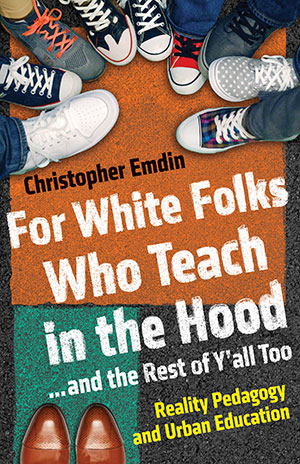
For White Folks Who Teach in the Hood…and the Rest of Y’all Too, Chris Emdin

978-080700640-5

Black boys know too well what it feels like to be a problem — let’s channel that knowledge into innovation, Andre Perry

In some states, fewer than 90 percent of black boys are reading at grade level and dropout rates for males of color continue to be much higher than for other groups. We certainly need solutions, but we don’t need any more “gap closing” measures.

Gap closing implies a white male standard, which actually is the source of institutional racism that needs to be fixed. In this regard, the achievement gap is a process and product that we need to smash up in tiny little pieces.

No one should be surprised that while black males achieve in schools and colleges a gap remains or has even grown. Success won’t be declared when black men and boys catch up to white men; organizations need to catch up with justice.

The overwhelming whiteness of U.S. private schools, in six maps and charts, Emma Brown

“The fact is that, over the years, African American families and non-white families have come to understand that these private schools are not schools that are open to them, especially in light of their traditional role and history related to desegregation of public schools,” he said.

The report recalls how private-school enrollment grew a half-century ago as courts were ordering public schools to integrate. The pattern was particularly pronounced in the South, where massive resistance to integration led to rapid private-school enrollment growth. Even as private-school enrollment has fallen across much of the country in recent decades, it has continued to grow in the South.

Sunday 20 March 2016 Reader: in Just-/spring?

In many regions of this planet, humans are gifted the changing seasons, including the drift into hibernation and then the rebirth of spring.

One of my favorite poems has always been [in Just-] by e.e. cummings—in part because I read the “Just” as both “only” and the root of “justice,” wondering if in fact spring is just in the human sense of that justice or more so in the less ethics-grounded justice of natural dynamics.

As we slip into spring, then, I offer a smattering of varied readings, many of which should help in meditating on our human sense of justice.

Questioning the Questions Asked about Education

Considering all the things I like about Twitter, having discussions or debates by Tweeting is not one of them because I often get lost and the character count works against elaboration and nuance.

Yesterday, I was added to a debate that appears to be about the impact of poverty on student achievement—and a central question about why some high-poverty students excel although most do not. One person seems to be seeking research that focuses on comparing high-poverty students against each other to tease out the reasons for why some achieve higher than most.

First, let’s consider that when we talk about student achievement we are almost always defaulting to high-stakes test scores. In that context, we must frame all questions about success, excelling, and/or achievement within some solid facts about what standardized tests reveal (and what they don’t).

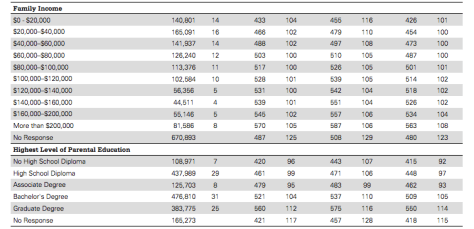
The SAT remains a fair representation of how all student scores on high-stakes standardized testing remain strongly correlated with race, social class, parental education levels, and gender. See for example from the 2015 SAT:

2015 SAT ethnicity

2015 SAT fam income lev edu

Therefore, in virtually all high-stakes standardized data sets, we find that being affluent, white, and male correlate strongly with high scores while being poor, of color, and female correlate with low scores.

Therefore, when we ask why do some (a few) high-poverty students excel while most do not, we could just as easily ask why do some (a few) wealthy students score low when most do not. And these are in fact the same question for a couple of reasons:

  • Poor students with high test scores and affluent students with low test scores are statistical outliers, and thus, provide little descriptive power for making decisions about the general populations of students. [As I cannot stress this enough, please reread that sentence until you get it.]
  • The question about why do some low-income students excel is a loaded question (and that we do not ask the parallel question about the few affluent students who score low is telling) because the real intent of that question is to suggest that student achievement is mostly controlled by the student, her/his teacher, and her/his school. Therefore, by isolating why some low-income students excel, we would be able to “fix” the majority of low income students, their teachers, and their schools.

This second point is huge, and complex, because it is deeply flawed in its essential implication. Student achievement remains in the U.S. a stronger indicator of social realities than student effort/ability, teacher quality, or school effectiveness.

That stated, could student achievement be positively impacted by addressing individual student qualities, teacher quality, or school effectiveness? Of course, and what education reform is attempting in these areas continues to be more harmful than helpful.

For example, charter schools and Teach For America are increasing educational inequity for the vulnerable populations of students (greater segregation and assigning low-income students of color beginning teachers without adequate training).

Now, if I return to the Twitter debate, yes, there are high-quality researchers looking at why low-income students struggle and achieve (see Sean Reardon here, here, and here), but the fundamental question about comparing success and failure within low-income student populations is an inherently flawed process that focuses our gaze almost exclusively on individuals while giving systemic forces a pass—the exact systemic forces that account for the greatest percentage of the scores we use to claim success or failure.

That social class, race, and gender are predictive of student scores on high-stakes standardized testing is not fatalism (using those characteristics as an excuse to do nothing), but a call to shift proportionately our questions to both systemic and individual sources for why some students excel and some struggle in formal schooling.

Race, class, and gender inequity in our society drive low test scores for many students—students who are then too often mis-served by inequitable school practices and policies such as tracking, teacher assignments, and discipline codes.

Why do some high-poverty students excel academically while most do not is one hell of a complicated question. But in most cases, it is the wrong question because of the misguided implications at its root (discussed above) and we remain unwilling to address social inequity and continue to use inequitable tools (high-stakes standardized tests) that create the very gaps we claim we want to close.

We need to prioritize questions about our broken systems before we can even begin to assess why individual students compare differently than their peers—and even then, outliers will never serve as valid gauges for all students.

Let Us Not in Righteous Indignation Fail to See

Why do you look at the speck of sawdust in your brother’s eye and pay no attention to the plank in your own eye?

Matthew 7:3

I resist as least weekly, it seems, to name directly yet another disturbing example of how “no excuses” approaches to teaching mostly black/ brown and poor children are inexcusable, abusive, and disgusting.

But a recent video prompted two responses that are important to highlight and need no further explanation—from Jose Vilson and Shree Chauhan:

this is nothing new

daily


The Ugly “Good Teacher” Discussion Few Are Confronting

“The King will reply, ‘Truly I tell you, whatever you did for one of the least of these brothers and sisters of mine, you did for me.'”

Matthew 25:40

The gold standard, I think, for thinking about education reform and more narrow concerns such as teacher quality is the complex and confrontational approach of Lisa Delpit, who anchors her perspective with how we teach and treat “other people’s children”—black and brown children, impoverished children.

And from that perspective we have the ugly “good teacher” discussion few are willing to confront: Vulnerable populations of children and their families are where and how we experiment with education, where and how we adopt policies and practices no affluent and white families would tolerate for their children: Teach For America, “no excuses,” zero tolerance.

High-poverty and majority-minority schools are burdened not just with social inequity hurdles but also with systemic and often unspoken practices that include having incredibly high teacher turn over because these “problem” schools are entry points for teachers to find “better” jobs (see Teachers at Low-Income Schools Deserve Respect).

Just as insidious is the systemic and often unspoken practice in all schools that “low-level” classes of students are assigned new teachers, who must endure those populations of students until they can have the “good” classes within that school.

These ugly practices grounded in racism and classism are at the root of why advocates for education reform who focus on race and class remain mostly dissatisfied with both sides of the mainstream education reform debate.

The edu-reformers are all-in on race and class tone-deaf practices—TFA, “no excuses,” zero tolerance—but the advocates for public education and progressive reform have failed to admit how the traditional public school system has historically failed “other people’s children” through the wink-wink-nod-nod approach to assigning teachers.

Too often, teachers are complicit in and fail to confront the system that marginalizes vulnerable populations of students as collateral damage of teacher advancement.

During my 18 years of public school teaching, even among teachers, the common sense attitude was that “good” teachers were assigned Advanced Placement, and teaching “low-level” classes was a negative commentary on the teacher’s ability. As department chair, I worked to assign each teacher a couple classes she/he requested, and then tried to balance every teacher’s load with a range of class levels and types.

While I was working on my dissertation, writing a biography of educator Lou LaBrant, I was profoundly struck by a point of irritation she expressed in her memoir. LaBrant noted that she had her best teachers in her doctoral program, at the end of her formal education, but that progression, she believed, is backward in that children need their best teachers in the beginning of formal education, not the end.

Our vulnerable populations of students must be served first in our public school system: assigned experienced and qualified teachers, placed in classes with low teacher/student ratios, guaranteed access to the most challenging courses and curriculums, and promised safe, diverse schools with equitable, supportive disciplinary practices.

Everything else is a distraction from what truly matters.

Denying Racism Continues to Have an Evidence Problem: A Reader

The evidence of racism—and not just race as a marker—continues to make denying racism a fool’s errand (yet, it persists). Here are some powerful reads that counter those deniers:

Politics, the Super Bowl, and, of course, the Children

This was supposed to be another post about good teachers because I was invited to speak to a class of 4th graders about writing public opinion pieces and that experience confirmed my recent assertion that to know if a teacher is good just watch and listen to the students.

The short version of that blog: the students were vibrant and smart—reflecting just how wonderful their teacher is.

During that visit, however, the teacher asked if we could have a brief debate so the students could think about how to pose their arguments. When a student asked what I was thinking about writing next, I mentioned the Super Bowl halftime show, specifically Beyoncé’s performance.

For several minutes, I was confronted by a classroom of children adamant that Beyoncé and her backup dancers were inappropriate for the show; their clothing and dancing, the children argued, were not appropriate for children watching on TV and attending the game.

I asked them to consider how we have different standards for how women dress and behave, and I asked about whether it was appropriate for children to watch the NFL, considering the violence of the sport, and the commercials, such as those for beer.

The children never budged, noting that children, in fact, play football (boys are just violent, they argued) and rambling into a very casual acceptance of children having guns and knives (for hunting).

But Beyoncé? Not appropriate for prime time (and the children).

Of course, these students were mostly voicing the opinion of their parents and other adults, highlighting, I think, the influence of every child’s home on who they are and how they think.

These students’ arguments also reflect something that almost no one is addressing about the Super Bowl: everything about the Super Bowl is political. Everything.

Those who criticize Beyoncé for her political performance and chastise the hoodied Cam Newton for over-celebrating throughout the season and his sulking post-Super Bowl defeat are silent during the NFL’s ritualistic flag waving and hiding behind the U.S. military—some of the many shields the NFL hopes mask the orgy of violence that is professional football; are somehow OK with Coldplay and Bruno Mars; and likely didn’t uttered a peep when All-American white hero straight out of Pleasantville, Peyton Manning, spouted a Gronk-like beer comment, pouted and didn’t shake hands after one of his Super Bowl defeats, and (like Cam, who was criticized) kept his helmet on while shaking hands with Russell Wilson, another Super Bowl defeat.

Just as every second of the Super Bowl is political, every moment of the gosh-darn industry that is Peyton Manning is political.

And Manning’s politics is aimed right at your red-white-and-blue bank account.

But the politics of capitalism and consumerism that buoy white male privilege in the U.S. is at least shielded, if not invisible, behind the confetti and celebration of yet another ascension to pinnacle by a Great White Quarterback (Beer and pizza, anyone!).

This is not about Beyoncé being political and Coldplay/Bruno Mars not being political.

This is not about Cam being political and Peyton not being political.

This is about the racialized notion of “political” (and “not appropriate for children”) and the very American and very ugly symbolism of the NFL shield.

Peyton, Coldplay/Bruno Mars (very safe and male pop music), and the NFL’s patriotic posturing are simply the shielded politics of those in power, of white privilege, of male privilege.

Beyoncé—along with her backup dancers and her song—and Cam are complicated elements in the politics of resistance (both real and perceived)—and of course, we can have none of that. You know, the children.

Listen

Super Bowl Aftermath: Beyoncé, Cam Newton, and “Unapologetic Blackness”