Category Archives: race

Understanding Poverty, Racism, and Privilege Again for the First Time

Once again, predictably, when my South Carolina should focus on education opportunity, not accountability was published at The State, comments included convoluted arguments demonizing people who are poor while discounting racism because “I was poor but I worked hard and succeeded” (this last claim invariably comes from a white person who is oblivious to the example proving the power of white privilege even against the weight of poverty).

Recently, as well, Teaching Tolerance confronted Ruby Payne’s poverty industry that speaks to and perpetuates stereotypes about poverty, race, and privilege (see here for research discrediting Payne’s work).

My public work addressing poverty, race, and education consistently reinforces that political leaders, the media, and much of the public in the U.S. suffer corrosive and inaccurate views of poverty, race, and privilege—stereotypes that are incredibly powerful.

When I argue about the need to address poverty directly, many respond by claiming anyone can succeed if she/he simply works hard enough. When I argue about the need to address racism, many concede poverty is burdensome, but add that racism no longer exists—again, people of color simply fail to take advantage of the opportunities all people have in the U.S.

Despite the great potential of social media and online publications with commentary (a way to democratize whose voices matter), those open forums allow anyone to respond un-vetted and perpetuate one of the great failures of public debate—arguing a single example proves or disproves a generalization: One black person excelled means there is no racism; “I was poor but” proves everyone has an equal opportunity.

Evidence appears ineffective against stereotypes—the illogical and irrational—but I invite you to step away from your assumptions and understand poverty, racism, and privilege again for the first time.

Focusing on poverty, the most enduring myths include some of the following (see the reader below for ample evidence disproving each):

  • Adults and children living in poverty somehow deserve that condition because they do not work hard enough, lacking the “grit” that successful people have.
  • The impoverished struggle because of their inferior literacy skills, often referred to as the “word gap.”
  • The culture of poverty is the result of a number of qualities among the poor, and thus, it is up to the poor themselves to break that cycle.
  • Poverty is a sham because of a number of common sense observations: the impoverished often seem to be obese and many people in poverty still own things (TVs, cars, cell phones).
  • The poor are prone to criminal behavior and substance abuse.

Research, however, refutes and discredits all of these.

One of the most powerful ways to reject false narratives about the poor is to consider that in the U.S., the cheapest foods are high in fat and processed sugar; and thus, it is a matter of practicality that the poor tend toward obesity.

Good health and safety are more expensive—shopping at Whole Foods or purchasing a car with added safety features—and thus both are accessed more easily by privilege.

Yet, we are a people stuck in false narratives about meritocracy and rugged individualism.

To understand poverty, racism, and privilege, however, systemic dynamics such as slack and scarcity must be examined. Sendhil Mullainathan and Eldar Shafir in their Scarcity: Why Having Too Little Means So Much examine the research base that shows the same person behaves differently under slack and scarcity.

Privilege begets privilege because slack allows a great deal of room for failure, and poverty begets poverty because the margins are so tight that irrational behavior seems rational.

But, again, these dynamics are the result of the conditions and not inherent qualities in individuals.

Below I offer a reader because the facts about poverty, racism, and privilege are dramatically different than the false narratives we live with in the U.S. For even good people with good intentions, the myths are hard to set aside.

A Reader: Understanding Poverty, Racism, and Privilege Again for the First Time

Scarcity: Why Having Too Little Means So Much, Sendhil Mullainathan and Eldar Shafir

George Saunders’s Allegory of Scarcity and Slack

Miseducating Teachers about the Poor: A Critical Analysis of Ruby Payne’s Claims about Poverty, Bomer, et al.

Pathologizing the Language and Culture of Poor Children, Curt Dudley-Marling and Krista Lucas

Savage Unrealities, Paul C. Gorski

The Myth of the Culture of Poverty, Paul C. Gorski

Problematizing Payne and Understanding Poverty: An Analysis with Data from the 2000 Census, Jennifer C. Ng and John L. Rury [pdf]

The Culture of Poverty Reloaded

Now What?

Additionally many educators no longer feel a sense of responsibility for engaging difficult questions because educational institutions reward them for avoiding controversy and confirming the status quo.

The Answer is Not at the Back of the Book, Seneca Vaught

19 January 2016. It is the day after the official holiday commemorating Martin Luther King Jr. and MLK’s actual birthday—a span of days blanketed with tributes as well as every conceivable way one man’s words and legacy can be twisted to suit a need.

MLK Day 2016 passed in the wake of #ReclaimMLK, #BlackLivesMatter, and #OscarsSoWhite (just to note a few), and now we walk and talk through the days before Black History Month.

Now what?

MLK Day and Black History Month are mostly so much tokenism and appropriation—or better phrased misappropriation.

As the #ReclaimMLK movement has emphasized, MLK has become a whitewashed martyr, a passive radical serving the purposes of the privileged.

I began teaching the radical MLK over thirty years ago, along side Booker T. Washington, W.E.B. Du Bois, and Malcolm X as well as Gandhi. Eventually I added Howard Zinn’s People’s History.

This was in rural upstate South Carolina in the 1980s and 1990s. This was not a popular or easy thing to do. But it taught me some valuable lessons as a privileged white male.

Race, class, and gender are irrefutable markers for privilege and oppression, but those markers are not the roots of that privilege and oppression.

Privilege is about ideas, privileged ideas.

MLK the passive radical is allowed because sanitized ideas are safe for those in power. The real MLK, radical anti-war, radical anti-capitalism—these ideas are not allowed, remain purposefully muted.

As Arundhati Roy has explained, “We know of course there’s really no such thing as the ‘voiceless’. There are only the deliberately silenced, or the preferably unheard.”

Now what? is informed by the Bill Cosby problems—and yes, I mean plural.

The Cosby sexual predator problem has taken years to rise through the Cosby problem deliberately silenced, and preferably unheard: Cosby’s sit-com fame and popularity as a public black-shamer.

Cosby thrived and survived his own demons in part because despite his surface markers of disadvantage, he was embraced for his ideas, ones that conformed to the messages of the privileged class—boot straps and all that.

And it is no stretch to note that the silenced and unheard Cosby problem has been replayed when Hillary Clinton (against her burden of gender) received applauds for her “what if white people suffered as black people do” stump speech.

Yes, there is privilege in all its blindingly white light like the myopic #AllLivesMatter.

What if a free people refused to tolerate anyone’s indignity remains silenced, unheard.

Privilege is an idea, a series of ideas—ones that can be and are voiced by a wide variety of people who look like privilege and look like oppression.

If we want to embrace MLK as a martyr for a color-blind society, we must admit that privilege feeds on seeing, but wilts under the scrutiny of listening. It is not that we should not see race, class, and gender, but that we must listen to the messages behind what we see.

Privilege twists MLK into a cartoon and builds walls around anyone willing to tell the story.

Privilege does not want to hear that equal rights do not mean equal opportunity.

Privilege is threatened by critical education, critical media, critical citizens.

“The purpose of history is not to confirm the answers,” Seneca Vaught explains, “but to challenge the assumptions and raise new questions about the past that relate to the present.”

19 January 2016. A week and a half before Black History Month 2016.

Now what?

MLK Day 2016: A Reader

In the US in 2016—and specifically for educators—the need to confront racism must remain central to all efforts to overcome inequity and injustice. Among the privileged—white-, male-, heterosexual-skewed—there is no room for “yes, but,” although there remains ample room for stepping back, being silent, and then listening as first steps to offering solidarity in the action needed to confront the false narratives of “meritocracy” and “rugged individualism,” and then to overcome the irrefutable inequities linked to race, class, gender, and sexuality.

One commitment is to resist the whitewashing of Martin Luther King Jr. as a passive radical. So here, I offer some readings, varied and important, but pathways to honoring the radical MLK and to resisting the lingering dream deferred.

Final Words of Advice/ “Where do we go from here?” (1967), Martin Luther King Jr.

MLK poverty

The Trumpet of Conscience, Martin Luther King Jr.

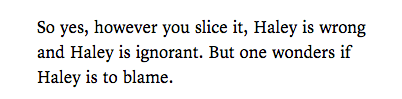
Leonard Pitts Jr.: Haley’s fairy tale ignores our history

haleyEnslaved Africans of George Washington Depicted as ‘Happy and Joyful’ in New Children’s Book

The Forgotten, Radical Martin Luther King Jr., Matt Berman

Martin Luther King, Jr.: Christian Radical—And Saint, Elizabeth Stoker Bruenig

Read This Before Co-Opting MLK Jr., Jose Vilson

The Revisionist’s Martin Luther King Jr., “I Have A Dream For Most Of Us,” Jose Vilson

Harlem, Langston Hughes

Let America Be America Again, Langston Hughes

The white man pathology: inside the fandom of Sanders and Trump, Stephen Marche

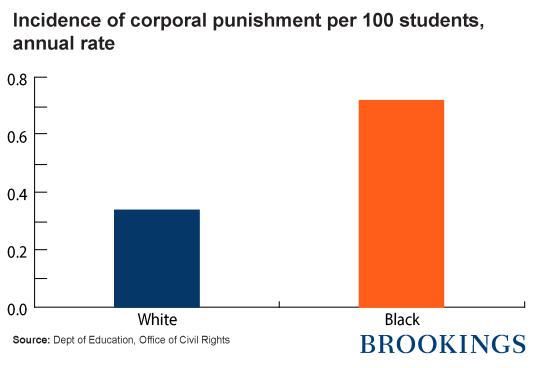
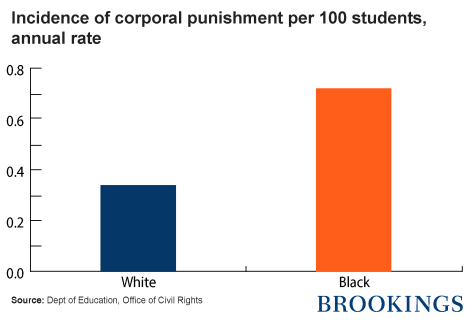
Schools, black children, and corporal punishment, Dick Startz

figure-1

“Please—a little less love, and a little more common decency.”

The Causal Effects of Cultural Relevance: Evidence from an Ethnic Studies CurriculumThomas Dee, Emily Penner

Questioning Payne | Teaching Tolerance

Toolkit for “Questioning Payne” | Teaching Tolerance

50 Years After Selma, White Lives Still Matter More, Stacey Patton

The Oscars’ Racist Refusal to Honor Modern Black Heroes, Stereo Williams

Should We Marvel at a Black Captain America?

The Martian: Allegory of Whose Lives Matter

Nicolas Sparks and the Allegory of Pretty White People Who Struggle until Everything Works Out

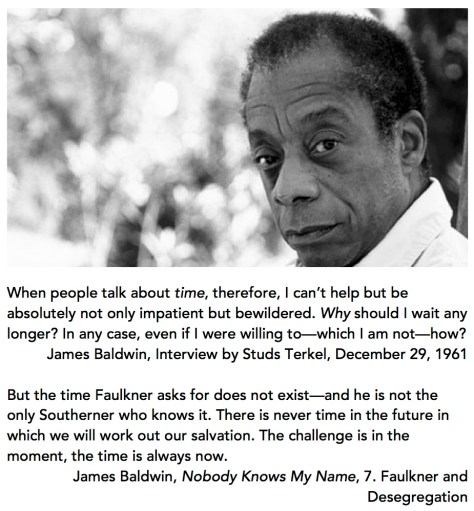
James Baldwin: “the time is always now”

the-time-is-always-now

“Please—a little less love, and a little more common decency.”

I wish that people who are conventionally supposed to love each other would say to each other, when they fight, “Please—a little less love, and a little more common decency.”

Slapstick or Lonesome No More!, Kurt Vonnegut

I was a public high school English teacher for almost two decades in the rural upstate of South Carolina.

My first years were nearly overwhelming—as they are for most beginning teachers. And I would concede that much of that struggling could easily be categorized as classroom management challenges (although having five different preps, 15 different textbooks, and classes as large as 35 students certainly didn’t help).

Yet, then and now, as I approach the middle of my third decade teaching, I tend to reject the terms “discipline” and “classroom management” because they carry connotations I cannot endorse.

First, framing classroom management as something separate from pedagogy, I believe, is a mistake. In other words, effective and engaging pedagogy creates the environment that renders so-called (and generic) classroom management strategies unnecessary.

Next, most claims about “discipline” and “classroom management” remain trapped in reductive behavioristic ideology as well as authoritarian views of the teacher (in which authority is linked by default to the position).

As a critical educator, I seek to be authoritative, not authoritarian (see Paulo Freire). In other words, I forefront the human dignity and agency of my students, I seek always to model the person and learner I feel my students should emulate, and I work diligently to earn the respect of my students, in part, because of my expertise and credibility in terms of what content I am teaching.

But having taught public school, I know the real world is messy: students become confrontational with their peers and even teachers. School can be (and in some places often is) a physically and psychologically dangerous and uncomfortable place, rendering learning less important.

And I also recognize that each teacher is legally and morally the central figure of authority in any classroom. Yes, as a teacher, I must assert that authority any time the safety, health, or opportunity to learn of any students is threatened.

So when I am teaching pre-service teacher candidates, I urge them to take certain steps in their day-to-day interactions with students as well as in confrontational events.

I urge them always to speak to students with “please” and “thank you.” I stress that whenever students become loud, belligerent, or threatening, the teacher must lower her/his voice, mediate her/his language, increase her/his patience, and seek ways to give the student space and time in order to protect all innocent students and the upset student.

I say “yes, sir” and “no ma’am” to students because my father raised me that way. However, my father’s own authoritarian style (“do as I say, not as I do”) also imprinted on me my fear of hypocrisy; therefore, I seek always to have higher standards for my own behavior than for the behavior of my students.

All of that—and more—is to say that when I read A ‘No-Nonsense’ Classroom Where Teachers Don’t Say ‘Please’ I was horrified because of both the abusive treatment of children and the (not surprising) cavalier endorsement by NPR.

The problems are almost too numerous to list, but I’ll try.

First, the so-called “unique teaching method”—”no-nonsense nurturing”—is a program (from “Center for Transformative Teacher Training, an education consulting company based in San Francisco”), and thus, NPR’s reporting proves to be little more than a PR campaign for that company.

Next, these harsh and dehumanizing methods are yet more of the larger “no excuses” ideology that targets primarily children in poverty and black/brown children. In other words, there is a general willingness to endorse authoritarian methods as long as the children are “other people’s children”—code for the poor and racial minorities.

And then, related, the direct justification for that authoritarianism is that parents choose this for their children.

Here, I want to stress again what I have examined before (see here and here):

  • Be skeptical of idealizing parental choice. Parents can and do make horrible choices for their children, and children should not be condemned only to the coincidences of their births.
  • Many scholars have addressed the self-defeating choices within racial minority communities that stem from unhealthy dynamics related to being a marginalized and oppressed people; see Michelle Alexander on black neighborhoods calling for greater police presence and Stacy Patton (here and here) on blacks disproportionately embracing corporal punishment. I have applied that same dynamic to blacks choosing “no excuses” charter schools.

While the NPR article notes that these practices “[make] some education specialists uncomfortable,” I must note this is not about being “uncomfortable.”

These practices are not providing “structure,” but are dehumanizing.

As well, these practices are racist and classist, and ultimately abusive. Period.

Our vulnerable populations of students already have unfair and harsh lives outside of school. Doubling down on indignity during the school day is not the answer.

If we cannot change the world (and I suspect we can’t), we can provide all children the sorts of environments all children deserve in their school day—environments of kindness, compassion, safety, and challenges.

To paraphrase Vonnegut, then, Please—a little less “no nonsense,” and a little more common decency.

See Also

If you’re a teacher, say “please” and “thank you,” Ray Salazar

Schools, black children, and corporal punishment

figure-1

A New Year’s Reader

Spanking children slows cognitive development and increases risk of criminal behavior, expert says

[See also The Stream: Should parents spare the spank]

On the Impossibility of Teaching Creative Writing, Tara Skurtu

[See also Teaching the Unteachable, Kurt Vonnegut; Writing, Unteachable or Mistaught?]

New education law: a lot of suds, William Mathis

[See also Doubling Down (Again) by Reverting, Not Changing: The Exponential Failures of Education Legislation]

A Lecture From the Lectured, John Barone, Cassandra Chaplinsky, Taylor Ehnle, John Heaney, Riley Jackson, Zoe Kaler, Rachael Kossy, Benjamin Lane, Thomas Lawrence, Jessica Lee, Sarah Lullo, Kevin McCammack, Daniel Seeder, Carly Smith, and Demetrius Wade

Is the Drive for Success Making Our Children Sick? Vicki Abeles

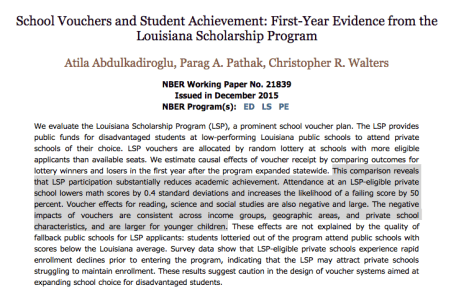
School Vouchers and Student Achievement: First-Year Evidence from the Louisiana Scholarship ProgramAtila Abdulkadiroglu, Parag A. Pathak, and Christopher R. Walters

vouchers LA

The Subtle Linguistics of Polite White Supremacy, Yawo Brown

To the White Parents of my Black Son’s Friends

The Moynihan Report ResurrectedSam Klug

The “Objectively Reasonable” Shooting of #TamirRice: A Reader

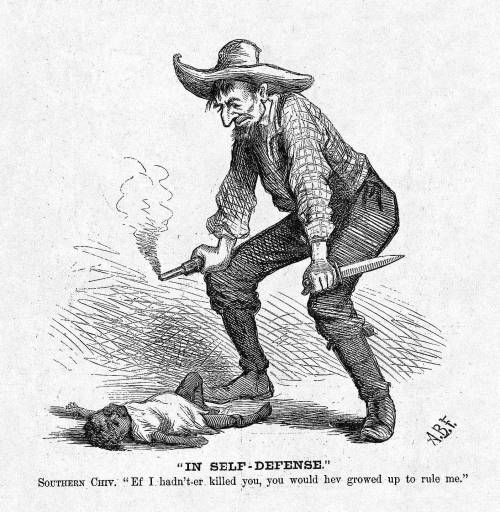
“In Self Defense,” A.B. Frost, Harper’s Weekly (October 28, 1876)

inselfdefense5w

(1934) W.E.B. Du Bois, “A Negro Nation Within a Nation”

The colored people of America are coming to face the fact quite calmly that most white Americans do not like them, and are planning neither for their survival, nor for their definite future if it involves free, self-assertive modern manhood. This does not mean all Americans. A saving few are worried about the Negro problem; a still larger group are not ill-disposed, but they fear prevailing public opinion. The great mass of Americans are, however, merely representatives of average humanity. They muddle along with their own affairs and scarcely can be expected to take seriously the affairs of strangers or people whom they partly fear and partly despise.

For many years it was the theory of most Negro leaders that this attitude was the insensibility of ignorance and inexperience, that white America did not know of or realize the continuing plight of the Negro.  Accordingly, for the lat two decades, we have striven by book and periodical, by speech and appeal, by various dramatic methods of agitation, to put the essential facts before the American people.  Today there can be no doubt that Americans know the facts; and yet they remain for the most part indifferent and unmoved.

A Report from Occupied Territory, James Baldwin, The Nation (July 11, 1966)

You will note that there is not a suggestion of any kind of appeal to justice, and no suggestion of any recompense for the grave and gratuitous damage which this man has endured. His tone is simply the tone of one who has miraculously survived—he might have died; as it is, he is merely half blind. You will also note that the patch over his eye has had the effect of making him, more than ever, the target of the police. It is a dishonorable wound, not earned in a foreign jungle but in the domestic one—not that this would make any difference at all to the nevertheless insuperably patriotic policeman—and it proves that he is a “bad nigger.” (“Bad niggers,” in America, as elsewhere, have always been watched and have usually been killed.) The police, who have certainly done their best to kill him, have also provided themselves with a pretext derisoire by filing three criminal charges against him. He is charged with beating up a schoolteacher, upsetting a fruit stand, and assaulting the (armed) police. Furthermore, he did all of these things in the space of a single city block, and simultaneously….

This is why those pious calls to “respect the law,” always to be heard from prominent citizens each time the ghetto explodes, are so obscene. The law is meant to be my servant and not my master, still less my torturer and my murderer. To respect the law, in the context in which the American Negro finds himself, is simply to surrender his self-respect.

The horrifying lesson of Tamir Rice: White America will use “objectivity” to justify the murder of black children, Brittney Cooper

Last week, a group of legal experts ruled the November 2014 police shooting of 12-year old Tamir Rice “objectively reasonable.” Rice was shot as he sat in a local park, near the recreation center where he frequently played, holding a pellet gun. When officers responded to 911 calls that a “guy was sitting in the park pointing a gun at people,” they did not know that 195-pound Tamir Rice was only 12….

It is entirely unreasonable for a young boy, someone’s child, to end up dead at the hands of law enforcement when he did not objectively pose a threat. He was a child playing with a toy. In a park. That is what children do. There was nothing unreasonable about his activities. He was playing with a gun openly in an open-carry state. He was playing with his gun in a gun-driven national culture that does not think the killings of innocent college students or little children warrant more robust gun control laws.

The plot of one of our iconic American movies, “A Christmas Story,” is about a nine-year old boy wanting nothing more for Christmas than a “Red Ryder air rifle.” In the film, the adults in his life repeatedly warn Raphie, the protagonist, that he’ll “shoot his eye out,” with the weapon. Many adults who saw Tamir Rice the day he was killed warned him to be careful with his toy gun, too. The adults in Tamir Rice’s life weren’t worried that he would harm himself, but rather that the police would “reasonably” assess the 12 year old to be a dangerous criminal.

The legal murder of Tamir Rice, Ta-Nehisi Coates

This is where my own questions begin: Is our tolerance for the lethal violence of the police rooted in the fact that lethal violence in our society is relatively common? Put differently, murder in America is much more common than in other developed countries. Is this how we have made our peace with that fact? Our world is, in some real sense, more dangerous. In recognition of this, have we basically said to the police, “Do what you will?” And in the case of Stand Your Ground, has this “Do what you will” ethic even extended to the citizenry? And if that is the case, then is there a line that can be drawn from Tamir Rice to Walter Scott to Sandy Hook to Trayvon Martin?

The Paranoid Style of American Policing, Ta-Nehisi Coates

When policing is delegitimized, when it becomes an occupying force, the community suffers. The neighbor-on-neighbor violence in Chicago, and in black communities around the country, is not an optical illusion. Policing is (one) part of the solution to that violence. But if citizens don’t trust officers, then policing can’t actually work. And in Chicago, it is very hard to muster reasons for trust.

When Bettie Jones’s brother displays zero confidence in an investigation into the killing of his sister, he is not being cynical. He is shrewdly observing a government that executed a young man and sought to hide that fact from citizens. He is intelligently assessing a local government which, for two decades,ran a torture ring. What we have made of our police departments America, what we have ordered them to do, is a direct challenge to any usable definition of democracy. A state that allows its agents to kill, to beat, to tase, without any real sanction, has ceased to govern and has commenced to simply rule.

White police are killing black kids: The cops get off, because the system protects the lives it values, Brittney Cooper

Who will fight when the cops run in guns blazing without regard or care for the lives they have been called to protect and serve?

The answer is no one. No one will fight for us. And when we fight for ourselves, they kill us for that, too. When we stand up and decry injustice, our rage becomes the pretext for even more state-sanctioned violence, repression, and disenfranchisement.

We’ve said it all before. At this point, White Americans know the racial refuse of this nation is a stinking, rotting sore. But far too many of them continue to walk around acting, as the country folks of my youth would say, as if their shit don’t stink. For those of us who view Black lives as something more than the incidentally odoriferous fertilizer for white supremacy, the stench of rotting Black flesh is almost too much bear.

Most Murders Are within Same Race

Like “thug” and “disruptive students,” a much more racially charged and racist refrain is “black on black” crime.

The phrase includes race and is factual—although fatally incomplete.

As well, many of the most credible and critical voices confronting racism are apt to concede the looming problem of blacks killing blacks—such as Ta-Nehisi Coates arguing that “[w]hen policing is delegitimized, when it becomes an occupying force, the community suffers”:

It will not do to note that 99 percent of the time the police mediate conflicts without killing people anymore than it will do for a restaurant to note that 99 percent of the time rats don’t run through the dining room. Nor will it do to point out that most black citizens are killed by other black citizens [emphasis added], not police officers, anymore than it will do to point out that most American citizens are killed by other American citizens, not terrorists. If officers cannot be expected to act any better than ordinary citizens, why call them in the first place? Why invest them with any more power?

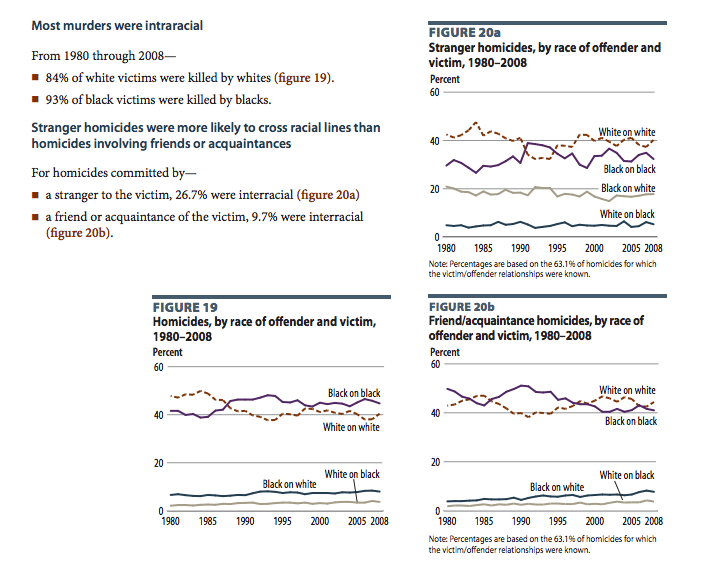
The issue is not the fact of black on black crime, but that crime and homicide are overwhelmingly within race:

murders intraracial
U.S. Department of Justice: Homicide Trends in the United States, 1980-2008 (November 2011). 

Crime and homicides are the result of familiarity and proximity. Our families, our social circles, our neighborhoods, and our communities are far more dangerous to each of us than any stranger or any unfamiliar territory. And as long as familiarity and proximity remain mostly segregated, our crimes and murders are likely to remain within the same race.

To utter “black on black” crime in order to claim a causal relationship between race and crime is dishonest. Race in crime is a marker, not a cause agent, especially not a cause agent unique to any race.

Confronting Privilege in the New Year: “when you’ve been used to privilege, equality feels like prejudice”

A former student and current wonderful early-career teacher texted me yesterday because someone had shared with her the inane “I’m not going to apologize for my white privilege” article that is all the rage among white privilege deniers.

Nearly as disturbing as the pervasive and corrosive influence of racism is the reality that the more whites are confronted with evidence of white privilege and racism, the more likely whites are to cling to their denial. Research from 2015 confirms:

What happens when people are faced with evidence that their group benefits from privilege? We suggest such evidence will be threatening and that people will claim hardships to manage this threat. These claims of hardship allow individuals to deny that they personally benefit from privilege, while still accepting that group-level inequity exists. Experiments 1a and 1b show that Whites exposed to evidence of racial privilege claim to have suffered more personal life hardships than those not exposed to evidence of privilege.

Throughout 2015, I have been cataloguing the overwhelming evidence of white privilege and racism, but I am discouraged about both the abundance of that evidence and the ineffectiveness of presenting it to those clinging fervently to their white denial.

Humans are drawn to patterns, both the recognition of patterns and the creation of patterns. Maybe anthropologists and sociologists would argue that in part that attraction is about survival and comfort. I suspect this pattern fetish in humans is also at the root of seeking out others like us (see any school lunch room where students are allowed to sit where they please), and I fear it is also the foundation for the very worst of humans—our racism, sexism, classism, and seething anger at the Other.

This is not some historical low point of human history—U.S. slavery, the Holocaust, the Japanese internment—but a seemingly credible point of debate among presidential hopefuls and their supporters who are calling from banning Muslims from U.S. soil.

And as the hashtags have continued to increase (#BlackLivesMatter, #TamirRice, and then too, too many to list) so has the backlash, the denial—just as the research above confirms.

We stand at the cusp of one of our greatest pattern urges, the arbitrary designating of the passing of time. Soon a new year will be upon the West (yes, even the calendar is a force of privilege, a way to mask subjectivity as objective, universal), and at least one voice has suggested there is hope: “I believe – I hope – that a great rewriting is slowly, surely underway,” writes Laurie Penny.

Penny’s examination of the latest Star Wars film offers a much more detailed and powerful investigation than my own look at The Martian, but we do tread similar ground; notably Penny explains:

The people who are upset that the faces of fiction are changing are right to worry. It’s a fundamental challenge to a worldview that’s been too comfortable for too long. The part of our cultural imagination that places white Western men at the centre of every story is the same part that legitimises racism and sexism. The part of our collective mythos that encourages every girl and brown boy to identify and empathise with white male heroes is the same part that reacts with rage when white boys are asked to imagine themselves in anyone else’s shoes.

I struggle to share Penny’s optimism—because of the horrifying specter of the unfathomable nastiness in both our presidential politics and our pop culture, both of which expose the “white interpretive horizon.”

Yet, I think Penny makes a powerful observation that may be the key to believing change is upon us:

Let’s not get carried away here. These stories and retellings are still exceptions. Women are still paid less, respected less and promoted less at almost every level of every creative industry. For every Jessica Jones there’s a Daredevil, whose female characters exist solely to get rescued, provide the protagonists with some pneumatic exposition, or both. For every Orphan Black there’s Mr Robot and Narcos and you know, sometimes I wonder if perhaps I watch too much television. The point is that what we have right now isn’t equality yet. It’s nothing like equality. But it’s still enough to enrage the old guard because when you’ve been used to privilege, equality feels like prejudice. [emphasis added]

White privilege is an iceberg; very little is visible above the surface, and for those of us with that privilege, it is ours to interrogate what lies beneath in order to understand and dismantle it.

“I came to explore the wreck,” explains the speaker of Adrienne Rich’s “Diving into the Wreck”:

the thing I came for:
the wreck and not the story of the wreck
the thing itself and not the myth

As Penny explains when unpacking “[t]he rage that white men have been expressing, loudly, violently”:

Like a screaming toddler denied a sweet, it becomes more righteous the more it reminds itself that after all, it’s only a story.

Only a story. Only the things we tell to keep out the darkness. Only the myths and fables that save us from despair, to establish power and destroy it, to teach each other how to be good, to describe the limits of desire, to keep us breathing and fighting and yearning and striving when it’d be so much easier to give in. Only the constitutive ingredients of every human society since the Stone age.

Only a story. Only the most important thing in the whole world.

This is our wreck, a story of a people blinded by the myth of meritocracy while steering the ship headlong into the iceberg we pretend isn’t there.

We must write better stories, fictional and real. A new year is arbitrary, yes, but it serves us well to listen to the refrain “the time is always now.”

See Also

What to do when you’re not the hero any more, Laurie Penny

On Nerd Entitlement, Laurie Penny

Hello from the same side, Robin James

The horrifying lesson of Tamir Rice: White America will use “objectivity” to justify the murder of black children, Brittney Cooper

Confronting Privilege to Teach about Privilege

Bearing Witness: Hypocrisy, Not Ideology

Responsibilities of Privilege: Bearing Witness, pt. 2

White Denial

High Cost of White Denial (Updated)


UPDATED: The Martian: Allegory of Whose Lives Matter

[Spoiler Alert: This post begins at the end of Andy Weir’s The Martian. Those who have not read the novel or watched the film are duly warned. Also, profanity.]

UPDATE: In the wake of the Brock Turner rape case and verdict—in which the judge and Turner’s father are more concerned about Turner than his victim—I am moved to suggest that the examination of The Martian below serves as a powerful allegory for rape culture in the U.S. as a subset of how white male lives matter above everyone else’s. As well, this novel speaks to the Baylor University scandal.

See also: Wealthy Teen Nearly Experiences Consequence and College Basketball Star Heroically Overcomes Tragic Rape He Committed (when parody is true and thus less funny).


As I was reading Andy Weir’s The Martian, I had an increasingly uneasy feeling—but not the one I assume Weir intended.

41-ykfaghdl-_sx302_bo1204203200_
Weir’s novel gained popularity when made into a film starring Matt Damon.

The uneasiness came in part from my realization that I did not like the main character marooned on Mars, Mark Watney, growing to complete dislike when near the end as Watney is nerd-whining, he hopes that if he survives, his notoriety will finally snare him plenty of women.

But the greater part of the uneasiness came from not worrying about Watney’s suvival—or moving methodically from each intricately detailed disaster and then to the miraculous Watney solution (science!)—but from stepping back from the novel’s premise into the real world to ask, How much money do we spend to make clear whose lives matter in the U.S.?

And then the novel ends with a final log entry from Watney, an entry that confirms my uneasiness:

The cost of my survival must have been hundreds of millions of dollars. All to save one dorky botanist. Why bother?

Well, okay. I know the answer to that. Part of it might be what I represent: progress, science, and the interplanetary future we’ve dreamed of for century. But really, they did it because every human being has a basic instinct to help each other out. It might not seem that way sometimes, but it’s true. (pp. 368-369)

This motif of how much a society will spend to save a life has also been applied to Matt Damon, star of the film; it costs $200 billion to save him in The Martian and $1 trillion in all his movies. Appears in Hollywood, this is a bit of a joke.

Weir’s novel is mostly compelling for the quick read and science, but Michael Crichton’s The Andromeda Strain does some of the same techniques, and much better. All in all, Weir’s novel is an interesting idea not fully formed as art—somewhat because of a lack of craft, but mostly because it appears Weir, Watney (and all the characters), and the intended audience suffer from a complete lack of critical awareness—punctuated by Watney’s hokey claim about our “basic human instinct to help each other out.”

The big problem with The Martian is what Robin James calls the “white interpretive horizon”; in the novel/film, that means Watney embodies all that is glorious about the Great White Male. What Watney represents is the vapid Ayn Rand rugged individual myth that is as thin a veil of white privilege as the rigged tarp ripped free when Watney launches away from Mars. And with a significant edit, we must confront that our “basic human instinct” is to help those who look like us—but not other people’s children.

The “white interpretive horizon” is so entrenched in popular culture that films such as Gravity contort the female lead into, well, the Great White Male. And of course, Hollywood can turn anyone into a hero (as long as he is white).

James builds to this conclusion, highlighting, I think, the essential failure of The Martian:

Both Trump’s conservativism and “Hello”’s liberalism expect everyone in the universe, and the universe itself, to reflect their interpretive horizon back to them because this horizon is “natural”; other horizons are disgusting or hilariously awful. This is no mere naturalistic fallacy, which assumes that natural means good. Shaped by the lived experience of white people and whiteness, these horizons are themselves white. Both fandoms treat whiteness as the natural foundation of their respective communities, and this common white supremacy is what makes liberal “Hello” fandom as dangerous as reactionary Trump fandom. We need to disrupt neoliberal white supremacist interpretive horizons in the same way #BlackLivesMatter interrupt Trump rallies.

Writing a year ago about the fatal shooting of Tamir Rice by a police officer, Charles Blow admits:

An extended video released last week of the shooting death of Tamir Rice in Cleveland appears to show an unconscionable level of human depravity on the part of the officer who shot him, a stunning disregard for the value of his life and a callousness toward the people who loved him.

And thus: “His black life didn’t seem to matter. But it does.”

As I finished The Martian, the Tamir Rice narrative continued, darker but just as predictable as the Watney story. Kirtsen West Savali reported:

Today, a grand jury in Cleveland, Ohio does what this system does. They put an exclamation point on the statement that black lives don’t matter. That black children do not matter. That being young, black and free is a crime punishable immediately by death.

For over a year, there has been a chorus of people demanding some semblance of justice for 12-year-old Tamir Rice’s family, without daring to acknowledge that impossible hope that flickers each time another black person falls victim to state-sanctioned terror.

Let’s set aside the thought experiment of a Great White Male marooned on Mars for a moment. I simply do not doubt we’d spend billions to save that astronaut as it plays out in the fictional world.

Instead, let’s try another thought experiment.

How much money are we willing to commit to saving one black male in any city across the U.S.?

But this isn’t even a thought experiment. We have already spoken.

The U.S. spends billions and billions to wage war, drop bombs from drones killing men, women, and children who are simply victims of geographical proximity (and are overwhelmingly brown and “not Christian”).

All the while the political and public will resists increasing minimum wage, welfare, or any use of funds that would prove that black and brown lives matter right here on our own fertile soil.

Blow ended his piece with: “The world must be made to acknowledge that Tamir Rice’s life mattered.”

And more, I’d argue—to prove lives matter by preventing the seemingly inevitable lives cut down literally by bullets but figuratively because Watney’s claim about our basic instinct is the stuff of the “white interpretive horizon”; in other words, bullshit.

See Also

What to do when you’re not the hero any more, Laurie Penny

The people who are upset that the faces of fiction are changing are right to worry. It’s a fundamental challenge to a worldview that’s been too comfortable for too long. The part of our cultural imagination that places white Western men at the centre of every story is the same part that legitimises racism and sexism. The part of our collective mythos that encourages every girl and brown boy to identify and empathise with white male heroes is the same part that reacts with rage when white boys are asked to imagine themselves in anyone else’s shoes.

UPDATED: Mainstream Media in (Perpetual) Crisis: More Education Meat Grinder

UPDATE: Note Holly Yettick’s One Small Droplet: News Media Coverage of Peer-Reviewed and University-Based Education Research and Academic Expertise; see abstract:

Most members of the American public will never read this article. Instead, they will obtain much of their information about education from the news media. Yet little academic research has examined the type or quality of education research and expertise they will find there. Through the lens of gatekeeping theory, this mixed-methods study aims to address that gap by examining the prevalence of news media citations of evidence that has undergone the quality-control measure of peer review and expertise associated with academics generally required to have expertise in their fields. Results suggest that, unlike science or medical journalists, education writers virtually never cite peer-reviewed research. Nor do they use the American Educational Research Association as a resource. Academic experts are also underrepresented in news media coverage, especially when compared to government officials [bold aded]. Barriers between the news media and academia include structural differences between research on education and the medical or life sciences as well as journalists’ lack of knowledge of the definition and value of peer review and tendency to apply and misapply news values to social science research and expertise.

“‘Only four out of ten U.S. children finish high school, only one out of five who finish high school goes to college’”: This spells doom for the U.S. economy, or to be more accurate, this spelled doom for the U.S. economy.

Except it didn’t, of course, as it is a quote in a 1947 issue of Time from John Ward Studebaker, a former school superintendent who served as U.S. Commissioner of Education (analogous to today’s Secretary of Education) in the mid-1940s.

Jump forward to 26 December 2015 and The New York TimesAs Graduation Rates Rise, Experts Fear Diplomas Come Up Short. Motoko Rich, as in the Time article, builds her case on Secretary of Education Arne Duncan, as Susan Ohanian confronts:

Here’s a front page. above-the-fold New York Times non-story that’s a perfect depiction of damning schools every-which-way. Schools with low graduation rates are depicted as failures; improve graduation rates, and then the diplomas they’re handing out are judged to have no meaning. And the Times gives the departing Secretary of Education star billing on this issue.

Quotation of the Day
The goal is not just high school graduation. The goal is being truly college and career ready.

–ARNE DUNCAN, the departing secretary of
education, on the United States 82 percent graduation rate in 2013-14, the highest on record.–New York Times, Dec. 27, 2015

Along with the meat grinder of incessantly new high-stakes accountability standards and testing over the past thirty-plus years, U.S. public education has been demonized since the mid-1900s and relentlessly framed within crisis discourse by the mainstream media for a century.

Rich’s cover piece spends an inordinate amount of energy to twist public schools into that crisis image while making no effort to investigate or challenge Duncan (a life-long appointee with no expertise in education and no credibility as a leader in education) or to unpack the stale platitudes and unsubstantiated claims about education reaching back at least to the Time article.

Duncan and Rich share, in fact, no experience or education in teaching as well as the disproportionate power of their voices in the field despite that lack of expertise.

On the other hand, I taught public high school English in rural South Carolina (not far from the school Rich highlights), have been an educator in SC over 30 years total, have a doctorate in education that emphasized the history of the field, and now am a teacher educator at a university just a couple miles from the school in Rich’s piece (I know teachers there, and have had several teacher candidates placed there for field work). As well, I taught journalism and was the faculty sponsor of the school newspaper, and have been a professional writer for about the same amount of time as I have been teaching, including writing and publishing a good deal of journalism (mostly about education).

This is not, however, an attack on Duncan or Rich—because they are not unique but typical of the mismatch of high-level voice with a lack of expertise.

Mainstream media appear fatally wed to only one version of the U.S. public education story: crisis.

And thus, journalists reach out to the same know-nothings (political leaders, political appointees, think-tank talking heads) and reproduce the same stories over and over and over [1].

Here, then, let me offer a few keys to moving beyond the reductive crisis-meme-as-education-journalism:

  • Public education has never been and is not now in crisis. “Crisis” is the wrong metaphor for entrenched patterns that have existed over a century. A jet plane crash landing into the Hudson River is a crisis; public education suffers under forces far more complicated than a crisis.
  • Metrics such as highs-takes test scores and graduation rates have always and currently tell us more about the conditions of children’s lives than to what degree public schools are effective.
  • Short-hand terms such as “college and career ready” and “grade-level reading” are little more than hokum; they are the inadequate verbal versions of the metrics noted above.
  • The nebulous relationship between the quality of education in the U.S. and the fragility of the U.S. economy simply has never existed. Throughout the past century, no one has ever found any direct or clear positive correlation between measures of educational quality in the U.S. and the strength of the U.S. economy.
  • Yes, racial and class segregation is on the rise in the U.S., and so-called majority-minority schools as well as high-poverty schools are quickly becoming the norm of public education. While demographics of race and class remain strongly correlated with the metrics we use to label schools as failing, the problem lies in the data (high-stakes tests remain race, class, and gender biased), not necessarily the students, teachers, or administrators.
  • However, historically and currently, public education’s great failures are two-fold: (1) public schools reflect the staggering social inequities of the U.S. culture, and (2) public schools too often perpetuate those same inequities (for example, tracking and disciplinary policies).

The mainstream media’s meat grinder of crisis-only reporting on public education achieves some extremely powerful and corrosive consequences.

First, the public remains grossly misinformed about public schools as a foundational institution in a democracy.

Next, that misleading and inaccurate crisis narrative fuels the political myopia behind remaining within the same education policy paradigm that has never addressed the real problems and never achieved the promises attached to each new policy (see from NCLB to ESSA).

And finally, this fact remains: Political and public will in the U.S. has failed public education; it has not failed us.

Mainstream media remain trapped in the education crisis narrative, I think, because neither the media nor the collective political/public consciousness is willing to confront some really ugly truths beneath the cultural commitment to the powerful and flawed rugged individual mythology in the U.S.: America is a classist, racist, and sexist society.

We are committed to allowing privilege beget privilege and to pretending that fruits of privilege are the result of effort and merit.

There is no crisis in education, but our democracy is being held hostage by incompetent politicians and a compliant mainstream media—all of which, ironically, would be served well by the sort of universal public education envisioned by the tarnished founding fathers’ idealistic (and hypocritical) rhetoric [2].

[1] See Educational Expertise, Advocacy, and Media Influence, Joel R. Malin and Christopher Lubienski; The Research that Reaches the Public: Who Produces the Educational Research Mentioned in the News Media?, Holly Yettick; The Media and Educational Research: What We Know vs. What the Public Hears, Alex Molnar

[2] See Thomas Jefferson’s argument for a democracy embracing education:

The object [of my education bill was] to bring into action that mass of talents which lies buried in poverty in every country for want of the means of development, and thus give activity to a mass of mind which in proportion to our population shall be the double or treble of what it is in most countries. ([1817], pp. 275-276)

The less wealthy people, . .by the bill for a general education, would be qualified to understand their rights, to maintain them, and to exercise with intelligence their parts in self-government; and all this would be effected without the violation of a single natural right of any one individual citizen. (p. 50)

To all of which is added a selection from the elementary schools of subjects of the most promising genius, whose parents are too poor to give them further education, to be carried at the public expense through the colleges and university.  (p. 275)

By that part of our plan which prescribes the selection of the youths of genius from among the classes of the Poor, we hope to avail the State of those talents which nature has sown as liberally among the poor as the rich, but which perish without use, if not sought for and cultivated. But of all the views of this law none is more important none more legitimate, than that of rendering the people the safe, as they are the ultimate, guardians of their own liberty. (p. 276)

The tax which will be paid for this purpose is not more than the thousandth part of what will be paid to kings, priests and nobles who will rise up among us if we leave the people in ignorance. (p. 278)