
Category Archives: race

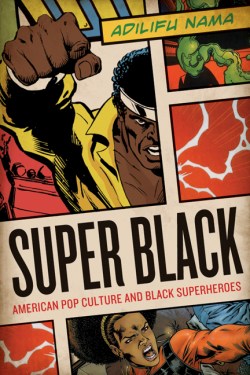
Recommended: Adilifu Nama’s Super Black

In his Introduction of Super Black: American Pop Culture and Black SuperheroesAdilifu Nama, associate professor of African American Studies at Loyola Marymount University, shares his mid-1970s trip to the toy store, where he excitedly anticipated buying superhero figures.

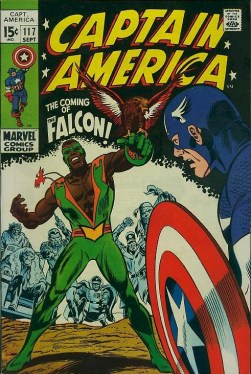
“[I]t was the Falcon that captured my imagination most and cemented my attachment to virtually all things superhero,” he notes. “Why? He was a black man that could fly” (p. 1).
9780292726741
Super Black: American Pop Culture and Black Superheroes, Adilify Nama (University of Texas Press, 2011)

Around the same time, although about a decade older, I was also deeply entrenched in the Marvel Universe, which in hindsight was—along with science fiction novels—one of the doors opening to my stepping beyond my working-class roots in a white community steeped in racism and conservative ideology. I too was fascinated by the Falcon, who brought me back again and again to Captain America, a superhero I found less than compelling.
captain-america-117
The origin of the Falcon in Captain America 117 (Marvel Comics, September 1969).

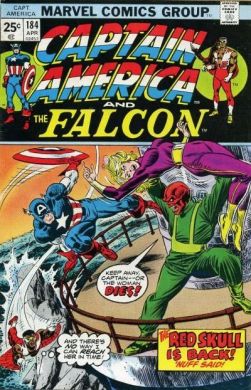
Nama asserts that Captain America losing his sidekick, Bucky, was part of “events [that] were just an interesting prelude to one of the most remarkable aspects of the Captain America comic book series: his pairing with the first African American superhero, the Falcon” (p. 69).
bff94fd3e276dab19192211a4cb876f4
Captain America and the Flacon ran as a co-titled comic from 1971-1978.

Since around 1940, superhero comic books and superheroes have held a solid and important spot in U.S. pop culture, and as pop culture, comic books as a medium (genre) have demonstrated the same sort of flaws and brilliance found in other media, such as film (which Nama addresses in Chapter 5 as well as his Black Space: Imagining Race in Science Fiction Film).

Pop culture often reflects, perpetuates, and confronts the very worst of the culture it serves—in terms of racism, sexism, classism, and the like. Comic books have been, and still are, no different.

Nama’s work is exceptional for his diligent commitment to outlining the role of black superheroes, primarily from Marvel and DC, while avoiding the failures often found in other critiques:

In short, the bulk of analysis concerning black superheroes has come to obvious conclusions, is embarrassingly reductive, and neglects to draw deeper connections across significant cultural dynamics, social trends, and historical events….Either black superheroes are critiqued as updated racial stereotypes from America’s comic-book past, or they are uncritically affixed to the blaxploitation film craze as negative representations of blackness. (p. 3)
tumblr_ngrfi5gdor1u496xso1_500
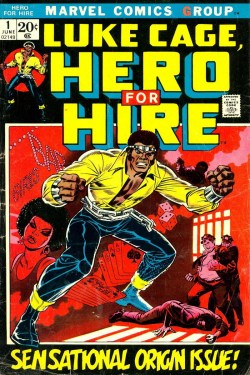
Luke Cage, Hero for Hire, represents the often contradictory representation of black superheroes in the context of blaxploitation film conventions.

Instead, Nama “adopts a poststructural approach that is not beholden to…authorial intent and intensely surface perceptions,” but I must add that despite the scholarly focus, this is an accessible volume for a general readership interested in comic books, pop culture, and race (p. 5).

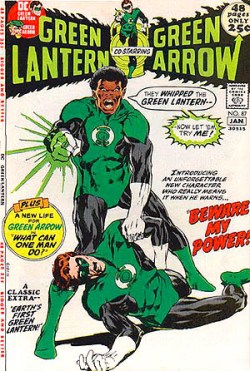
While offering a wonderful assortment of images, including a high-gloss four-page gallery about a third of the way through, Nama weaves an engaging discussion of the rise of socially conscious comic books (Dennis O’Neil and Neil Adam’s Green Lantern Co-Starring Green Arrow, DC, 1970-1972), “seminal black superheroes,” the tension of black and white superhero combinations, “white-to-black makeovers” of superheroes, and as noted about, black superheroes in TV and movies (pp. 6, 7).
gl087
The full-color, gloss insert includes vibrant images such as the original Black Lantern from January 1971-1972 (DC).

Throughout the volume, Nama offers an impressive outline of the black superhero in mainstream comic books while including a powerful examination of the relationship between comic books and the complicated history of race in the U.S.

My own evolving understanding of race in superhero comic books is increasingly informed by James Baldwin and Ta-Nehisi CoatesBaldwin’s confrontation of the specter or whiteness and Coates’s rejecting that “[t]he black freedom struggle is…about raising a race of hyper-moral super-humans.”

In the words of a comic book fan and scholar, Nama, I think, honors both Baldwin and Coates, a perspective that resists judging race in comic books through a white lens or against a distorted bar of perfection:

Where but in superhero comics did black people visit alternative worlds, travel in rocket ships, invent and command futuristic technology, or experience time travel? (p. 66)

By coming neither to glorify nor demonize black superheroes in mainstream comic books and pop culture, Nama succeeds in reaching beyond the pages of those books and showing readers how race joins everyone in the same journey:

American blacks and whites are ultimately bound to one another fused by history and  circumstances, fate and fortune, dreams deferred and hopes realized, and when either party tries to destructively deny or sever the interconnected and interdependent nature of the relationship, both parties suffer. (p. 88)

However, comic books as manifestations of the culture they popularize are inevitably anchored by the white privilege of that real world. “Black superheroes should never be just a colorized version of the original,” Nama argues, adding:

because that would affirm notions that African Americans are at best a passive reflection and at worst a pathological reaction to white America. To the contrary, blacks have simultaneously retained a distinct form of black racial identity and worldview along with absorbing American folkways, mores, and taboos. Black superheroes, like the black folks they symbolize, must express that dynamic, whether they are completely original, an overt imitation of a white figure, or somewhere in between the two. (p. 125)

Ultimately, Nama’s scholarship is lifted by his childhood love for a black man who could fly—the Falcon merging in his boyhood mind with Dr. J—and readers are apt to enjoy this volume as much as the comic books it honors.

See Also

Black Goliath: “Some Black Super Dude,” 

Black Lightning Always Strikes Twice! – Double-Consciousness as a Super-Power

Black Communities of the 30th Century: Racial Assimilation and Ahistoricity in Superhero Comics

The Man Who Lived Twice! (If You Can Call That Living): Marvel’s Brother Voodoo

Humanity Not Included: DC’s Cyborg and the Mechanization of the Black Body, Robert Jones, Jr.
Should We Marvel at a Black Captain America?

The Captain White America Needs

Resisting Good/Bad Teacher/Police Frame and Confronting Systemic Flaws in Education, Law Enforcement

[Expanded and revised at Alternet: A Few Bad Actors? A Former Teacher on Classroom Cops]

The Spring Valley High controversy created by the excessive force used by a police officer on campus represents the intersection of the wider and growing public debates about so-called bad teachers and bad police.

Let me clarify first that I was a public school teacher for 18 years, and I have family members and good friends who are or were police officers. Speaking about the fields of teaching and law enforcement, I would typically be supportive of the individual people who choose these professions that are primarily about serving the public good. Of course, I have dear friends and family members I also consider to be wonderful people, good people who are also outstanding in their professions as teachers and police officers.

I have also heard these good people say and watched them do things that are detrimental to children and adults, things steeped in racism, homophobia, sexism, and classism.

As a teacher (coach and parents, also), I often made mistakes, ones that were detrimental to students and teens. I also came home from teaching on more than one instance with students’ blood splattered on my clothes after breaking up fights. Once, I stood face-to-face with a student of mine who had come on campus with a shotgun planning to shoot a female with whom he had developed an unhealthy fascination.

I am not under the delusion that teachers and police officers must be perfect, and I am well aware that both professions are sometimes (teaching) and often (law enforcement) extremely dangerous for the professionals who are not financially compensated in ways that match their responsibility or the dangers they encounter.

As well, I have almost no tolerance for the political and public demonizing of bad teachers and bad police officers—the finger-pointing at manufactured scapegoats similar to the Reagan era “welfare queen,” which we know was an ugly, racist tactic that misrepresented welfare recipients; the finger-pointing at black-on-black crime that willfully ignores that white-on-white crime is essentially at the same rate (virtually all crime is within race, that is).

Therefore, we are in a difficult position as a society, one that requires all of us to consider the black girl being slammed to the classroom floor against the shooting and killing of Tamir Rice.

To step back from “she should have just done as she was told,” to refrain from blaming the victim.

In fact, we need to refrain from pointing fingers at individuals because many teacher and police officer errors in judgment and tragic behaviors are the result of the larger systemic flaws in our society and the institutions of formal education and criminal justice.

Responding to the incident at Spring Valley High, Camika Royal, a professor of urban education at Loyola University in Maryland, explained:

“Instead of making her cell phone and/or her behavior the focus of his class, he could have told her he would deal with her after class,” Royal wrote in an email to TakePart. “Because of his choice not to let it go, to contact the administrator instead, he kept students from learning, and he disrupted the learning environment.”

In the classroom, wrote Royal, “power struggles with students rarely end well.”

It appears the student put away her phone, but didn’t want to hand it over. This was a situation escalated by the adults in authority. The infraction could easily have been addressed after class.

While far more tragic, Tamir Rice’s life also was extinguished because the officer with authority escalated the situation, over-reacted.

I want to stress that such over-reactions must not be discounted or trivialized as individual behaviors, but must be recognized as the result of normalized expectations, cultural tolerance of how some people, including children, can and should be treated.

As I have examined before, why were public discussions about domestic abuse of women prompted by NFL high-profile incidences absent support for hitting women, but the concurrent debates about hitting children all included pro-spanking arguments?

Because of a lingering normalized acceptance of hitting children that is entirely refuted by research and the medical profession.

Teachers and police officers (including black teachers and police officers) are themselves agents of pervasive systemic biases that continue to disproportionately and negatively impact people and children of color: black children are perceived as being older than their biological ages, black children are punished in school while white children are prescribed medications or provided counseling, black communities are targeted more often by law enforcement, blacks are charged and convicted at higher rates than whites for the same infractions, and blacks and whites use recreational drugs at the same rates but blacks are significantly more likely to be punished for that use.

Just as there is no safe or positive amount of corporal punishment for children—and just as the evidence shows that corporal punishment makes children aggressive and violent adults—the research is powerful that police in the hallways and zero tolerance policies in schools both disproportionately target majority-minority schools and criminalize students.

Yes, we must take care to address individual cases such as the one at Spring Valley High, but if we focus all of our energy on who to blame and if or how we should punish the police officer, we are likely to allow the larger forces to exist that will insure we will continue to face these avoidable situations again and again.

The best day in my teaching career was when I learned to de-escalate tension between me and a student. That day I began creating a classroom in which we all could avoid conflict and disruptions. Most of that change was mine to recognize and to manage—not the teens who were in my care.

The teen at Spring Valley High should never have been slammed to the floor, and Tamir Rice should be alive. Just as teachers and police officers need not be perfect, neither of these young people should have to be perfect to avoid violence and death at the hands of people charged to protect and serve them.

The first step to a solution is admitting the problem: Education and law enforcement in the U.S. are both poisoned by the facts of racism remaining in our culture. Denying that fact is embracing that racism.

Teachers and police officers need not be perfect, but teaching and law enforcement must be better, and we must make that happen immediately.

See Also

Rejecting Police in the Hallways: A Reader

All the White Responses (and the Game Is Rigged)

All the White Responses (and the Game Is Rigged)

When a black female high school student was wrestled violently from her desk and slammed to the floor by a police officer in Columbia, SC, many responded with outrage across the nation, confronting the mounting evidence that black lives do not matter—even in the supposed sanctuary of a public school.

Many also raised voices once again about the significant negative impact that zero tolerance policies and police in the hallways have on black and brown students, both male and female. As Kathleen Nolan has documented, zero tolerance policies and police in the hallways often criminalize children, a dynamic almost exclusively impacting black, brown, and impoverished children.

Assistant professor of Communication Studies at Clemson University, Chenjerai Kumanyika added yet another in-state moment of violence between police officers and youths to his advocacy for social justice and equity. In fact, Kumanyika represents the power of highlighting that #BlackLivesMatter is a necessary mantra that both targets and transcends race since he has stood beside the parents and supporters of a white teen shot and killed by a police officer and raised his voice against the excessive police violence experienced by a black girl in her desk and apparently endorsed by the school leadership.

However, among the outrage and calls for both racial equity and justice for all, we have the white responses of “yes, but”—such as this letter to the editor in The State:

It seems unbelievable that a school resource officer would respond in a physical manner because the student was disrespectful. We would expect the teacher to be in charge, and we would certainly expect any student to respond to the direct commands of a teacher or an assistant principal, but both of these school officials relied on the school resource officer to comply with their request to remove the student from the classroom.

Now we have lots of folks who were not present in the classroom, and have no direct knowledge of the student’s actions, providing guidance in how to handle an unresponsive student.

At some point we have to recognize authority will be obeyed and that enforcement consequences may be ugly beyond our expectations. I don’t have to agree with legal commands, but I do have to obey them.

“If they just did what they were told” is the coded racist response to the outrage; it is a comment heard and read about the black girl being slammed to the ground, but not echoing against the growing skepticism about a police officer shooting and killing a white male teen.

The “yes, but” responses among white and privileged commentary on police in the hallways represent the larger white denial about racism and white privilege.

The U.S. was founded (by white privileged men) through widespread refusal to obey the law. Women’s rights were gained through widespread refusal to obey the law. Civil rights were demanded through widespread refusal to obey the law.

And in 2015, ample evidence shows that neither the criminal justice system nor school disciplinary policies are equitable in terms of who is targeted and the severity of the punishments.

In a society or a school where laws and rules are themselves practiced along racial lines, as Martin Luther King Jr. implored, the right thing to do will be not to do as we are told.

But that is not a mandate for children or youth—although they too must be supported when they do take those stances. That mandate is for all adults of conscience, especially adults of conscience and privilege, and our voices must not waver when the people charged to protect and serve us take the lives and dignity of our children—because any child is everyone’s child, or we are a people without any moral authority to demand that anyone obey the laws and rules.

There is no excuse for “yes, but” from the lips or keyboards of white privilege.

These are times for listening, for having our own zero tolerance policies for abuses of power and the remaining cancer of racism among our society.

We are well past the time, also, to admit that the winners always love the rules of the game and to confront as well that this game is rigged [1].

First, then, we must demand a level playing field, one upon which every child is sacred, every person is judged on the content of their character.

Otherwise, “This rigid refusal to look at ourselves may well destroy us,” James Baldwin argued; “particularly now since if we cannot understand ourselves we will not be able to understand anything” (Baldwin, 1998, p. 593).

And the most tragic among that destruction will continue to be children and youth—too often “other people’s children.”

Baldwin, J. (1998). James Baldwin: Collected essays. New York, NY: The Library of America.

See Also

What happened in South Carolina is a daily risk for black children, Stacey Patton

Dear Black Children: Everyone Can Beat You!, Stacey Patton

She was guilty of being a black girl: The mundane terror of police violence in American schools, Brittney Cooper

Where Are Black Children Safe? Roxane Gay

[1] See Why are working class kids less likely to get elite jobs? They study too hard at college, Henry Farrell:

rules of the game

Why Do the Privileged View Equity as “Hard Work”?

Let’s start with this: Privileged people in the U.S. embrace what amounts to a lie—that success is mostly the result of effort, notably that education is the key to success.

However, the evidence is overwhelming that being born wealthy trumps effort (including educational attainment) by people born into poverty and especially by black and brown people regardless of socioeconomic status.

White, wealth, and male privilege remains the most powerful combination in the U.S.

Let’s also note that formal education, instead of eradicating inequity, often works to reflect and even expand the equity gap for impoverished, black, and brown children [1]. And “other people’s children” experience much harsher disciplinary policies in those schools, such as zero tolerance, that reflect and perpetuate race and class inequity as well.

And it may be that the root of this disturbing gap between what the privileged claim and the reality of being born and living in the U.S. is that those in power argue that taking action for equity is “hard work,” and thus themselves lack the grit or growth mindset (qualities being used—projected onto as deficits—to further demonize poor, black, and brown children) to actually do what is necessary to close the equity gap.

For example, although mind-numbingly late, some are beginning to recognize the racially inequitable discriminatory practices among many so-called “no excuses” charter schools, such as Success Academy. Yet, when those practices are confronted, we read these caveats:

The challenge posed to Success Academy and similar charter schools by the U.S. Department of Justice and U.S. Department of Education’s guidance on student discipline is serious. To be in conformance with civil rights law, these schools will need to make radical reforms to their “no excuses” school culture and practices. Now that Moskowitz has laid down the gauntlet on this issue, many eyes will be on the Obama administration for its response. Changing policies, practices and cultures to make schools into safe and welcoming places that do not resort to the excessive and discriminatory use of suspensions and expulsions is hard, challenging work.

Ending discriminatory practices that disproportionately impact black and brown children living in poverty is “hard, challenging work”? Really?

In my home state of South Carolina, we discover, that despite decades of gross negligence of high-poverty, majority-black public schools in pockets mostly throughout the lower part of the state, the response is much the same:

It is difficult to know how to do that — although it would be much less difficult if we stopped worrying about turf protection and job protections and making sure the right people get lucrative contracts and pursuing our ideological goals.

It is difficult to get our legislators and our governor to ignore those distractions. But it is their job to do that….

The sad thing is that as difficult as it will be for our leaders to develop a plan and our teachers to implement it, the hardest part could be convincing ourselves that it’s worth doing.

In case we missed it, educational equity for all children in SC (read “poor,” read “black”) is “difficult.” Again, really?

The racist and classist stereotyping at the end of privileged finger-pointing is disgusting—calls for some children simply to work harder, blaming impoverished parents for not caring about education or their children, and making cavalier and rash arguments about either the great failure of schools and teachers or idealistic promises about schools and teachers.

No, it is neither hard nor difficult to do the right thing. It is simply that those with privilege in the U.S. do not care about equity, do not care about marginalized people or children. While the words say “hard” and “difficult,” the actions speak much louder: We do not care.

“There is never time in the future in which we will work out our salvation,” James Baldwin warned at mid-twentieth century. “The challenge is in the moment, the time is always now.”

Let’s end with this: The challenge is not for the poor, not for black and brown people; the challenge is for those who have the power to change things but remain impotent because that challenge is “hard,” that challenge is “difficult.”

[1] Poor, black, and brown children disproportionately are subjected to larger class sizes, un-/under-certified teachers, underfunded schools, and reduced curriculums (test prep).

This Week in Whitemansplaining: Gun-Fetish Fatalism and Thinly Veiled Racism

This week, in the U.S. where the female nipple is more dangerous than a gun, Jay Ambrose assures us that gun violence, including mass shootings at a daily pace, cannot be curbed by laws restricting gun ownership because Russia and single-parent families.

Ambrose throws up his hands at trying gun laws—”probably futile”—because, you know, Russia. And then the real kicker:

But President Barack Obama himself has underlined the single-parent linkage with crime, and some of the most prestigious think tanks in the land — conservative, liberal and in between — have produced impressive analytical and statistical backing for the proposition.

Along with his gun-fetish fatalism (“the charade of more gun control”), Ambrose offers thinly veiled racism with “single-parent families” (a corrosive trigger similar to Reagan’s “welfare queen”) and “gang shooters” (right in their with “thug” and “black-on-black crime” as the sort of racism allowed in polite company).

By the end of his whitemansplaining, Ambrose characterizes “mass shootings” as “a tiny percentage of all the killings,” which he again claims are more a result of single-parent families than gun-lust in the U.S.

But the key in the final paragraph is his shout out to “decent citizens defending themselves with guns,” and we should ask who those people look like.

This callous and hollow commentary comes just after I have read and responded to 24 first-year writing students’ essays; that assignment required them to write a public piece in an on-line format—using hyperlinks for support and images/video to augment their exposition or argument.

If I were to toss Ambrose’s piece into the pile, I would be forced to ask why he cherry-picked Russia—ignoring the powerful and persuasive evidence from European and Scandinavian countries with strong gun restrictions and incredibly rare mass shootings.

I also would ask why, if his evidence is so compelling, he fails to offer any hyperlinks to all that evidence—depending instead on shallow and coded rhetoric (the last refuge of the incompetent and deceptive).

With just a small amount of effort, Ambrose—if he were sincere—could point to the Department of Justice data that show crime and gun violence are extremely complicated topics but also refute the racist implications of his piece: all violent crime is almost entirely within race (“84% of white victims were killed by whites” and “93% of black victims were killed by blacks”; see page 13).

A little more research and Ambrose would find that single-parent families are also a very complicated part of the U.S.; notable is that despite popular assumptions whites are the largest number (9,289,000 compared to 6,427,000/ black and 7,044,000/ Hispanic/ Latino).

Ambrose’s entire pitch depends on making sweeping and unsupportable claims that seem true to the general public; his assertions and the ugly implications (which he either does with intent or is so privileged he cannot see his own racism) are the very worst of what counts as public commentary in the U.S.

While we must not make the same errors in logic and rhetoric that Ambrose does, it seems far more credible to state that gun-fetish fatalism and racism are greater causes of our violent nation than single-parent families.

Once again, Ambrose and his ilk need to stop their whitemansplaining and take a long hard look in the mirror.

Greenville News: COMMENTARY: Are black children criminalized in schools?

COMMENTARY: Are black children criminalized in schools?

Following the Annie E. Casey Foundation’s 2015 Kids Count report showing South Carolina children are facing even greater challenges, research from the Center for the Study of Race and Equity in Education (University of Pennsylvania) reveals that in SC and Greenville County black children are being disproportionately disciplined in our schools.

Just as the Kids Count data show racial inequity at the root of childhood challenges in our state, suspension and expulsion rates fall along racial lines between white and black students.

Across SC, “Blacks were 36% of students in school districts across the state, but comprised 60% of suspensions and 62% of expulsions,” including the SC Public Charter School having one of the highest ratios, 2.7 times disproportional. And in Greenville County, composed of 23.4% black students, the suspension rate for black students was double that enrollment at 47.4%.

However, the statistics themselves are not the whole story since research also shows that black children are targeted more often and treated differently than white children for the same behaviors. Reporting on the study in ColorLines, Kenrya Rankin Naasel explains:

When black students exhibit behavioral problems at school, administrators are more likely to call the police than to secure medical interventions. In fact, the study found that the more black students who attend a school, the more likely the people in charge are to call the police, rather than a doctor.

David Ramey, assistant professor of sociology and criminology (Penn State), in a press release notes that these finding match a larger body of research:

The bulk of my earlier research looked at how, for the same minor levels of misbehaviors—for example, classroom disruptions, talking back—white kids tend to get viewed as having ADHD, or having some sort of behavioral problem, while black kids are viewed as being unruly and unwilling to learn.

Further, beyond school, black children are viewed by police and others as being much older than their biological ages, and thus, Stacey Patton, a senior enterprise reporter at the Chronicle of Higher Education, argues, “Black America has again been reminded that its children are not seen as worthy of being alive—in part because they are not seen as children at all, but as menacing threats to white lives.”

From Emmett Till to Tamir Rice, Patton notes, the criminalization of black children in schools is amplified in the loss of young black life in streets.

Michelle Alexander’s The New Jim Crow has exposed that the U.S. judicial system, in fact, targets and punishes blacks differently for the same behaviors as whites. For example, Alexander notes that police units sweep high-poverty black neighborhoods for illegal recreation drugs but do not sweep college campuses, where drugs are just as likely but the population tends to be white and affluent.

In SC and Greenville County, then, we must begin to examine in our schools how our policies are criminalizing black students at a great cost to their lives as well as to the welfare of the state and area.

A first step is to acknowledge racial bias in perceptions about black children and then to examine not only the data on racial disparities in discipline outcomes but also the actual policies and practices in our schools.

Particularly in schools and when dealing with children of any race, punishments such as suspension and expulsion are likely harmful options that should not occur until interventions are implemented that address the needs of all children living in challenging environments.

Child behaviors identified as “bad” are often the consequences of life experiences not of any child’s making. In other words, school discipline policies may too often be punishing children for conditions not in their or even their parents’ control.

Disproportionate school discipline along racial lines reflects and perpetuates racial inequity in society and in our criminal justice system. Increasingly, research suggests that schools are creating a criminal class of black children instead of providing those children the support and guidance every child deserves to have a full and rich life.

SC and Greenville County schools face tremendous challenges because of pockets of poverty, but to neglect the lingering racism that compounds the weight of poverty guarantees failure for our schools and some children we are choosing to condemn instead of cherish.

See

Mass Incarceration, Visualized

The Enduring Myth of Black Criminality

12-Year-Old Black Student Suspended for Staring at White Classmate Indicates a Bigger Problem With Unequal Discipline – Atlanta Blackstar 

Criminalizing Blackness: A Mississippi Community College’s School-to-Jail Pipeline

Ten Years After Katrina: Lessons from Charleston, SC

Mention a coastal city notable for both its diverse cultural history and the twin scars of natural disasters as well as the human-made cancers of racism and generational poverty, and most people across the U.S. will think New Orleans, especially now as we confront the ten-year anniversary of Hurricane Katrina and the decade of a city rebuilding itself.

However, South Carolina’s Charleston fits that same complicated and troubling profile.

Charleston also shares with New Orleans the historical failure of public schools to serve poor and black children and families, which has resulted in both cities being the target of wide-scale and often reckless education reform driven mostly by political and ideological forces.

While I have regularly criticized mainstream media for covering education and education reform carelessly, I was genuinely impressed with The Post and Courier (Charleston, SC) publishing an extensive and detailed examination of education reform in the large school district serving the city: Left Behind: The unintended consequences of school choice.

This news account and the related data are actually not new for those of us having taught in SC for decades. It takes very little effort to recognize that both traditional public schools (how they are funded, how teachers are assigned, how students are tracked, etc.) and education reform driven by accountability and market forces over the past three decades have not served well vulnerable populations of students, black and high-poverty children.

Charleston is just one example of the Corridor of Shame that has been highlighted in SC for decades, in fact, through the legal system and a widely heralded documentary.

It also isn’t news that the political leadership and even the public in SC have failed to acknowledge the problems of racial and socioeconomic inequity in any real ways that address public policy.

Nonetheless, the P&C‘s Left Behind series is a rare and fertile opportunity to change all that because the coverage does, despite some flaws, present the complicated challenges that face both public education and society, challenges that are inextricable from confronting racism and poverty.

Regretfully, one of the responses to this series is also nothing new—and entirely predictable: a South Carolina Policy Council (SCPC) Op-Ed titled School choice is a solution, not a problem.

First, I must emphasize that reducing the lessons of Charleston public schools to a narrow debate about school choice is a fatal distraction that will never serve students, families, and the community well.

Next, as I have examined on far too many occasions, free market think tanks (and think tanks masquerading as university departments) will never represent accurately school choice because they have committed entirely to one ideological focus that trumps any different or larger goals—such as educational equity for black and poor children.

On the SCPC’s web site, they clearly express their one and only position:

The South Carolina Policy Council was founded in 1986 as an independent, private, non-partisan research organization to promote the principles of limited government, free enterprise, and individual liberty and responsibility in the state of South Carolina.

The Op-Ed response to Left Behind, then, is peppered with cherry-picking, overstatements, and loaded nods to “gold-standard research,” but the claims are advocacy, and not credible conclusions about either the results or promise of school choice in its many and shifting forms (vouchers, tuition tax credits, public school choice, charter schools).

Having spent more than a year doing a book-length examination of school choice, I regret that the debate remains trapped in ideological and political squabbles while children are in fact left behind.

So what do we know about school choice? (See Bruce Baker, The Shanker Blog, and the National Education Policy Center for extensive reviews of the research on choice and charter schools.)

  • Private, public, and charter schools have about the same range of measurable student outcomes, regardless of the school type and strongly correlated with the socioeconomic status of the child’s home. (See this discussion of “charterness.”)
  • Research on school choice has shown mixed results at best, but even when some choice has shown promise of, for example, raising test scores for black, brown, and poor students, those increased scores are linked to selectivity, attrition, greater funding, and extended school days/years—none of which have anything to do with the consequences of choice and all of which expose those “gains” as false success.
  • School choice, notably charter schools, has been strongly linked with increasing racial and socioeconomic inequity: increased segregation, inequitable disciplinary policies and outcomes.
  • SC advocacy for charter schools as the newest school choice commitment fails to acknowledge that charter schools in the state are overwhelmingly about the same and often worse than comparable public schools (see analysis of 2011 and 2013 data here), and the South Carolina Public Charter School District is among the top four worst districts in the state for racially inequitable discipline with blacks constituting about 19% of the enrollment but over 50% of suspensions/expulsions.

The research on school choice does not support the claims made by SCPC, and the rhetoric is also deeply flawed.

School choice advocates often fall back on “poor children deserve the same choices that rich children enjoy.”

However, several problems exist within this seemingly logical assertion.

The greatest flaw is suggesting that affluent and mostly white affluent children are thriving because of choice is itself a lie, a mask for the reality that the key to their success is their wealth and privilege. Being born into a wealthy family trumps educational attainment, and white privilege trumps educational attainment by blacks (see here and here).

In its most disturbing form, then, school choice advocacy is a distraction from the consequences of racism and poverty, both of which are reflected in and perpetuated by the education system.

Further, arguing that we must see school choice as a solution fails for essential conditions in a democracy.

For example, no one should have to wait for the Invisible Hand of the market so they have access to health care, justice, safety, or education. The great irony is that for the free market to work, a people must first secure the foundations of public institutions.

As Martin Luther King Jr. stressed in 1967: “We are likely to find that the problems of housing and education, instead of preceding the elimination of poverty, will themselves be affected if poverty is first abolished.”

A full and robust commitment to public institutions, specifically universal public education, is essential to the concurrent commitment to the free market.The paradox is thus: In order for choice of most kinds to work in a free society, some essential institutions must render choice unnecessary in terms of health care, justice, safety, or education.

As we can witness in New Orleans, the lessons of education and education reform in Charleston are two-fold: (1) historically and currently, traditional public schools have failed/do fail vulnerable populations, specifically black and poor children, and (2) accountability-based and free-market education reform has also not alleviated the burdens of racism and poverty, but has too often exacerbated the devastating consequences of both.

Criminalizing Black Children and #BlackLivesMatter: A Reader

The Essence of Innocence: Consequences of Dehumanizing Black Children

The social category “children” defines a group of individuals who are perceived to be distinct, with essential characteristics including innocence and the need for protection (Haslam, Rothschild, & Ernst, 2000). The present research examined whether Black boys are given the protections of childhood equally to their peers. We tested 3 hypotheses: (a) that Black boys are seen as less “childlike” than their White peers, (b) that the characteristics associated with childhood will be applied less when thinking specifically about Black boys relative to White boys, and (c) that these trends would be exacerbated in contexts where Black males are dehumanized by associating them (implicitly) with apes (Goff, Eberhardt, Williams, & Jackson, 2008). We expected, derivative of these 3 principal hypotheses, that individuals would perceive Black boys as being more responsible for their actions and as being more appropriate targets for police violence. We find support for these hypotheses across 4 studies using laboratory, field, and translational (mixed laboratory/field) methods. We find converging evidence that Black boys are seen as older and less innocent and that they prompt a less essential conception of childhood than do their White same-age peers. Further, our findings demonstrate that the Black/ape association predicted actual racial disparities in police violence toward children. These data represent the first attitude/behavior matching of its kind in a policing context. Taken together, this research suggests that dehumanization is a uniquely dangerous intergroup attitude, that intergroup perception of children is underexplored, and that both topics should be research priorities.

In America, black children don’t get to be children, Stacey Patton

In 1955, after 14-year-old Emmett Till was beaten and killed by a group of white men, one of his killers said Till “looked like a man.” I’ve found this pattern in news accounts of lynchings of black boys and girls from 1880 to the early 1950s, in which witnesses and journalists fixated on the size of victims who ranged from 8 to 19 years old. These victims were accused of sexually assaulting white girls and women, stealing, slapping white babies, poisoning their employers, fighting with their white playmates, or protecting black girls from sexual assault at the hands of white men. Or they were lynched for no reason at all.

Study: For Behavioral Problems, Black Students See Cops, Whites See Docs, Kenrya Rankin Naasel

A study in the latest issue of Sociology of Education found what many parents already know: When black students exhibit behavioral problems at school, administrators are more likely to call the police than to secure medical interventions. In fact, the study found that the more black students who attend a school, the more likely the people in charge are to call the police, rather than a doctor. It also revealed that schools with larger populations of black students have overall higher suspension rates, while their whiter counterparts had more kids enrolled in special needs programs. Schools with large Hispanic populations were less likely to call the either the police or a doctor.

The Social Structure of Criminalized and Medicalized School Discipline, David M. Ramey

In this article, the author examines how school- and district-level racial/ethnic and socioeconomic compositions influence schools’ use of different types of criminalized and medicalized school discipline. Using a large data set containing information on over 60,000 schools in over 6,000 districts, the authors uses multilevel modeling and a group-mean modeling strategy to answer several important questions about school discipline. First, how do school- and district-level racial and ethnic compositions influence criminalized school discipline and medicalization? Second, how do levels of school and district economic disadvantage influence criminalized school discipline and medicalization? Third, how does district-level economic disadvantage moderate the relationship between school racial/ethnic composition and criminalized school discipline and medicalization? The results generally support hypotheses that schools and districts with relatively larger minority and poor populations are more likely to implement criminalized disciplinary policies, including suspensions and expulsion or police referrals or arrests, and less likely to medicalize students through behavioral plans put in place through laws such as Section 504 of the Rehabilitation Act and the Individuals with Disabilities Education Act. However, results from cross-level interaction models suggest that district-level economic disadvantage moderates the influence of school racial composition on criminalized school discipline and medicalization.

Schools with higher black, minority populations call cops, not docs

The study builds on prior research that looked at how educators assessed the behavior of individual students based on race.

“The bulk of my earlier research looked at how, for the same minor levels of misbehaviors — for example, classroom disruptions, talking back — white kids tend to get viewed as having ADHD, or having some sort of behavioral problem, while black kids are viewed as being unruly and unwilling to learn,” said Ramey.

Police in the Hallways: Discipline in an Urban High School, Kathleen Nolan

Review: Police in the Hallways: Confronting the “Culture of Control,” P. L. Thomas