Category Archives: race

On Public Debate, Naming the Enemy, and White Privilege: “a most disagreeable mirror”

Let’s start with one of the most heated public and political issues in the U.S. for at least four decades since Roe v. Wade: the abortion debate.

How does that debate resonate differently if framed as Pro-Life v. Pro-Abortion when compared to Anti-Abortion v. Pro-Choice? Or how does that debate resonate differently if framed as the rights of the unborn child versus women’s rights?

But the abortion debate reveals more than just the power of naming the enemy in that contest of ideologies because the abortion debate has often devolved into mostly a struggle for power, one that leaves in its wake both the claimed concern for the unborn child and women. In other words, too often the abortion debate is about scoring public points or making political hay—and not about the welfare of marginalized human beings, especially in the context of race and racism (without the intervention of the courts, affluent white women had access to reproductive rights that poor black women were denied).

And then if we dig deeper, the abortion debate in its most extreme and insensitive forms also becomes a battle between privileged agents, ones who ignore the race and class issues that significantly overlap the more narrow debate about access to abortion or reproductive rights.

For several years now, I have watched and participated in an increasingly hostile education reform debate that has many of the same characteristics I have identified above.

Early in my public (and evolving) role writing about that reform (in the more recent of thirty-plus years advocating for reform as part of my daily practice as a classroom teacher at both the high school and higher education levels), I found the need to define the debate as a struggle between No Excuses Reformers (NER)—who focus on in-school only reform as accountability—and Social Context Reformers (SCR)—who call for both social and educational reform as equity—aligning myself with the latter.

Also early in that public effort, I confronted directly and even interacted with some of the prominent agents of NER, something I gradually stopped doing. However, those contentious exchanges inevitably spurred my being framed as anti-reform.

Coming from advocates of NER, that label offended me greatly—again because I entered education and then committed my work as a teacher for decades to very unpopular reforms such as expanding the canon to include black and female writers, ending tracking, and erasing the masked racial bigotry of my small home town that was reflected in the high school’s disciplinary and curricular practices.

However, recently Andre Perry and Angela Dye have also used the label “anti-reform” and then I came across this Tweet:

Here I had to step back from my entrenched knee-jerk response to the “anti-reform” label because for Perry, Dye, and Thinnes, the use of “anti-reform” is in the context of many people I have framed as SCR advocates becoming so committed to fighting NER, Perry has noted “that overwhelmingly white movements pursuing change for black and brown communities are inherently paternalistic.” In other words, the two dominant voices debating education reform are often indistinguishable in their missionary zeal and their tendency to ignore the very communities, families, and children historically and currently mis-served by both reform agendas and traditional public schooling.

Thinnes has also commented further (here and here), reaching a powerful and important conclusion:

Exploring these [nuanced] questions [about TFA] this last year have helped start to move me from my own simplistic “us and them” camp mentality; to recognize the richness of the social justice commitments that many individuals are bringing to many sectors and orgs; to wonder what kind of systemic transformation ‘we’ actually envision; and to question who it is, exactly, that ‘we’ are really fighting for.

For me, then, I must stress that when NER advocates toss out the label “anti-reform,” I am skeptical, even cynical, about the intention, but “anti-reform” works for Perry, Dye, and Thinnes in a much different and significant way: This is a warning flag, a vital warning flag, that all along the so-called education reform spectrum, as Thinnes notes, the “us v. them” mentality allows “reform” to be yet another insensitive and blunt baseball bat swung in self-righteousness, battering indiscriminately.

Thirty-plus years into intensive state and federal education reform have not resulted in the sorts of educational or social outcomes politicians have promised and the public has expected. In fact, the reforms themselves have increasingly become secondary to the war and those poised to benefit from that reform debate.

Perry, Dye, and Thinnes—among others—require us to step back from that debate and recognize that white privilege/white denial remain the poisons infecting the so-called “both sides,” whether we label those sides NER v. SCR or reformers v. anti-reformers.

Social and educational justice advocacy that forefronts race and racism must unite everyone dedicated to education reform, and in doing so, this must stop being a war of privilege, one that is deaf and blind to the voices and interests of black, brown, and poor people.

In the August 1965 Ebony, James Baldwin began “The White Man’s Guilt”: “I have often wondered, and it is not a pleasant wonder, just what what white Americans talk about with one another,” adding:

I wonder this because they do not, after all, seem to find very much to say to me, and I concluded long ago that they found the color of my skin inhibitory. This color seems to operate as a most disagreeable mirror, and a great deal of one’s energy is expended in reassuring white Americans that they do not see what they see.

It is 50 years later, and Baldwin’s incisive confrontation of white-as-blind, white-as-deaf to the black condition, of the “most disagreeable mirror” is now being replicated in an education war too often being fought as if the greatest historical and current failure of education doesn’t involve black, brown, and poor people.

Baldwin’s refrain—”White man, hear me!”—in the context of the education reform movement being too white to matter, in the context of #BlackLivesMatter, demands an end to white privilege and white denial that maintain the burden of the accusatory gaze on black, brown, and poor communities, families, and students.

“[P]eople who imagine that history flatters them (as it does, indeed, since they wrote it),” Baldwin argued, “are impaled on their history like a butterfly on a pin and become incapable of seeing or changing themselves, or the world.”

This is the education reform movement challenged by Perry, Dye, and Thinnes—a battle between mostly white advocates, impaled on their own missionary zeal and demanding that other people do what they themselves are incapable of doing.

Before us we have an enemy we seem to refuse to name, the white privilege at the root of the historical failure of universal public education and the remaining white privilege derailing both sides of the reform debate.

From New Orleans to #BlackLivesMatter, the echo of Baldwin’s “White man, hear me!” remains drowned out beneath the white noise of reform debate.

The responsibility lies with that privilege to see ourselves, to change ourselves, and thus to change the world we have created and maintained.

See Also

Why Liberals Separate Race from Class

On Misreading: The Critical Need to Step Back and See Again

The moment a person forms a theory, his imagination sees, in every object, only the traits which favor that theory.

Thomas Jefferson to Charles Thomson, 1787

Teaching literature as a high school English teacher often requires covering the canon through survey courses. This means, of course, we teachers of English often assign and discuss writers and works we simply do not like.

One writer I don’t particularly care for is [gasp] Robert Frost—the poems aren’t my cup of tea and his attitude about free verse rubs me the wrong way.

But unlike my ambivalent thoughts about Frost’s poetry and snobbery, I simply detest misreading Frost and those incessant posters:

In fact, one of my favorite, ironically, poems to teach was “The Road Not Taken”—first, because it lends itself to stressing the importance of reading the text carefully to students, and second because many if not most of my students had seen the posters and had the poem mis-taught to them in previous grades.

Typically, the end of the poem is used to make vapid and inspirational claims about being different, taking the path others have failed to try.

However, even a slightly careful reading of the poem reveals that the text itself no fewer than three times states the two roads are essentially the same: “as just as fair,” “Had worn them really about the same,” and “And both that morning equally lay.”

So when I came across Stephen Lynch’s article on David Orr’s The Road Not Taken, I was nearly giddy:

The poem is praised as an ode of individuality, to not follow the pack even though the path may be more difficult.

Except Frost notes early in the poem that the two roads were “worn . . . really about the same.” There is no difference. It’s only later, when the narrator recounts this moment, that he says he took the road less traveled.

“This is the kind of claim we make when we want to comfort or blame ourselves by assuming that our current position is the product of our own choices (as opposed to what was chosen for us, or allotted to us by chance),” Orr writes.

“The poem isn’t a salute to can-do individualism,” he continues. “It’s a commentary on the self-deception we practice when constructing the story of our own lives.”

And thus we are forced to confront the Jefferson quote above: many in the U.S. see a message of rugged individualism in everything they see regardless of that theme existing or evidence confirming that ideology.

If this were confined to poetry, we could simply let it lie, but consider two aspects of Ronald Reagan’s political career—long enough in the past to view somewhat dispassionately but recent enough to remain relevant during the 2015-2016 presidential campaign years.

Reagan gained a tremendous amount of political capital on his “welfare queen” refrain, and somehow maintained his Teflon image despite George H.W. Bush’s charge that Reaganomics was “voodoo economics.”

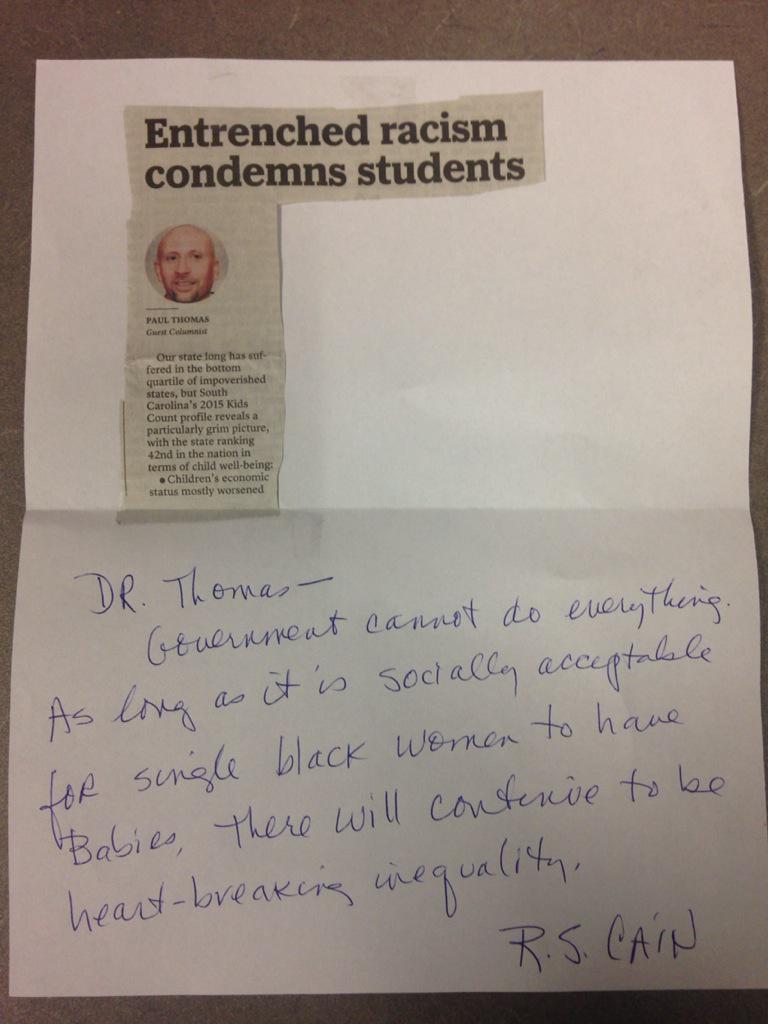
Both can be traced to the public’s tendency to see what they want to see despite evidence to the contrary. The U.S. public believes poverty is the result of laziness and continue to harbor racist associations with both poverty and that laziness. As I have shared, just recently I received a negative response to a piece I wrote on racism that blamed inequity on single black mothers, despite single white mothers far outnumbering and Hispanic/Latino single mothers surpassing single black mothers.

The Great American Myth includes that the wealthy have earned their wealthy, the poor (lazy) deserve their poverty, education is the great equalizer, and anybody can succeed if he/she would just work hard enough, and evidence (the abundance of evidence) to the contrary is nearly worthless against that mythology.

This is not simply about partisan politics—because the same proclivity to see what we believe and thus not recognize systemic forces corrupts mainstream efforts at both education reform and daily teaching.

Just as a few examples, policies and practices built on “grit” research and narratives as well as “growth mindset” are essentially flawed because they fall victim to gazing on the individual, diagnosing deficits, and then correcting those deficits—a misdiagnosis that misread the consequences of systemic inequity as individual culpability.

The harsh reality is that in the U.S. educational and social/economic success are the result not of effort or merit, but the coincidence of any person’s socioeconomic and racial backgrounds.

Claims that teaching poor and black/brown children “grit” and a “growth mindset” will reap great rewards for those students are trapped in the deficit gaze narrowly on individuals—not unlike those who misread Frost or continue to cling to Reagan’s nasty “welfare queen” scapegoat.

This is where the critical imperative requires that we always step back from our belief systems and force ourselves to consider the entire and complex reality driven by both systemic and individual dynamics.

So if we loop back to the actual woman Reagan used to create the “welfare queen” smear campaign on all single black mothers who are poor, we discover a very complicated reality about this individual woman, but we also must temper ourselves against drawing sweeping generalizations that are not supported by easily accessible evidence.

And we should also ask why many are apt to make such damning jumps from one black woman to all black women when those same people do not make such leaps about individual serial killers, often white males who are well educated.

It is a trivial nerd/teacher fantasy to hope that we stop the misreading of a rather boring Robert Frost poem, but it is no small thing to expect us to stop allowing claims that are at their core racist and classist (“grit,” “growth mindset,” the “word gap,” etc.) to hide behind the mask of science or the cult of celebrity driving them, it is no small thing to speak against presidential candidates who continue to race-bait (black-on-black crime) and poverty-bait (dead-beats on welfare) the public as Reagan did.

To do so, we must have the courage to choose a road “less traveled by,” a journey that begins with taking one step back.

Please View (and Listen)

James Baldwin and Black Lives, Eddie Glaude

The Legacy of James Baldwin

Beware the Roadbuilders Redux: Education Reform Wars Fail Race, Again

A classic analogy is Mothra vs. Godzilla, but a more contemporary comparison—and one to be highlighted in upcoming Marvel superhero films—is Marvel’s Civil Wars.

First, the larger situation involves two powerful forces, both of which are driven by the missionary zeal of being on the right side, that wage war against each other while those who both sides claim to serve is trampled beneath them as collateral, and mostly ignored, damage.

More specifically, Marvel’s Civil War involves two legions of superheroes (and villains) who side with either Iron Man or Captain America (the two powerful forces characterized by missionary zeal and reckless disregard for citizens), but notable in this war is that the X-Men are neutral, as is Black Panther—serving as embodiments in the comic book universe of the Other (identified groups marginalized by status: race, sexual/gender identities, poverty).

Finally, what does this template represent? I recommend reading carefully Andre Perry’s Education reform is working in New Orleans – just like white privilege—notably:

White critics of education reform should especially include themselves in the power structure. Yes, the neo-liberal, market-driven, corporate anti-reform critique isn’t the only frame that robs black people of their voice.

I wish white folk would hear me when I say the pro-/anti-reform frame doesn’t work for black folk. If anything, our position in the social world makes us reformers. Black folk never had the luxury of defending status quo. New Orleans needed to make radical changes in education as part of larger hurricane preparedness plan. Getting a college degree is the kind of protection black people need. Cynicism isn’t protection.

Perry confronts that the rise of education reformers dedicated to bureaucratic and technocratic reform as well as the concurrent reaction to that reform agenda among those championing an idealized faith in public education have in common their willingness to both trample and ignore the black and high-poverty communities, parents, and students both groups often claim to represent.

This education reform war, like Marvel’s Civil War, fails, as Perry has noted before, the problems of race and racism: “But let’s also stipulate that overwhelmingly white movements pursuing change for black and brown communities are inherently paternalistic.”

Perry concludes about the “overwhelmingly white” education reform wars: “We need less ‘reform’ and more social justice.”

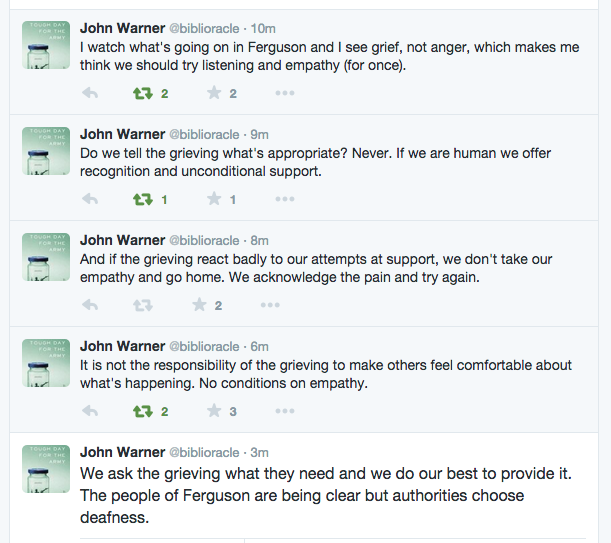
Posting on Twitter in the wake of the anniversary of Ferguson, John Warner strikes a similar chord in terms of broader failures of social justice advocacy:

listening and empathy

While I entered public education dedicated to teaching as a form of activism for social justice, I can speak hear as someone who has certainly failed my own goals (confronting poverty and racism) by allowing much of my work both to feed and appear to feed the exact failure Perry and others have identified.

As I have been addressing for some time, the tensions of race and racism have been a central struggle of doing public work—although in my daily teaching, during my 18 years as a high school teacher and then more than a decade as a teacher educator, has remained more securely tethered to causes of social justice related to poverty and racism.

Lashing out against Teach For America and charter schools (among all school choice) by me and others has certainly served to ignore and even erase voices and issues connected to race.

But I also recognize the ineffectiveness of nuanced positions since my approach to Common Core has not fit within either the so-called reformer stance (pro Common Core) or the jumbled stance among idealistic public school advocates (some are for and some are against Common Core).

It is well past time, then, to emphasize that the recent thirty-years of education reform characterized by accountability built on standards and testing as well as the rise of TFA and charter schools would never have occurred if public education had been serving black and poor children as well as all formal schooling has served white and affluent children.

Education policy, then, is as complicated as social policy in the U.S.—where those in power and the public appear either reluctant or resistant to confronting the entrenched weight of race and class on social and educational equity.

And while political and public opinion are against us, those concerned with social justice linked to race and class equity must commit first to listening to and working with (not for) the communities, parents, and students who have been mis-served for decades by social and educational institutions and policies, specifically black and impoverished communities, parents, and students.

Missionary zeal and paternalism are burdens of both the education reformers and the public school advocates taking up arms against those reforms.

Broad stroke support for and rejections of any of these reforms are prone to be tone deaf and detrimental to claimed commitments for equity and social justice.

Evoking the very real and devastating realities mirrored in bad science fiction and Marvel’s Civil War, Perry argues: “New Orleanians don’t need an all-or-nothing, slash-and-burn system. We have inevitable hurricanes for that.”

And then:

Black folk are always the collateral damage of privileged people’s broad-stroke critiques. And the white criticisms of reform always negate black involvement and dare I say positive contribution toward change. We should validate the suffering, death and destruction that occurred during and in the aftermath of Katrina. But “awfulizing” isn’t the way to get there.

We don’t need the white, privileged, anti-reform framework developed by three or four white critics to deny the voices we need to uplift.

For me, the image I have evoked of political education reformers as the roadbuilders remains a valid metaphor, but it is incomplete and has too often served as just more noise drowning out those who must be heard.

So who is willing to stop the uproar against misguided and often tone-deaf education reform from the political elite long enough to listen to the black and poor communities who have witnessed decades of negligence by public institutions?

Reminder

Good intentions are not enough: a decolonizing intercultural education, Paul C. Gorski

High Cost of White Denial (Updated)

My Op-Ed in The State (Columbia, SC) paper, Entrenched racism drives down SC child-well-being scores, prompted both email responses and a few posted comments online.

A recurring theme of the negative feedback reflects entrenched white denial, offering insight to why our political leadership tends to avoid addressing directly systemic racism and social class inequity and exposing why the Republican candidates thrive despite what should otherwise be viewed as a collection of buffoons at best and racists, sexists, and classists at worst.

Any time racism and class inequity are confronted, the “individual responsibility” response rings strong. As well, the “I was poor but succeeded” mantra is shuffled out.

What is always notable, however, is that the overwhelming evidence of racism and classism is never directly addressed. White denial always remains trapped in slogans and anecdote.

For example, one online comment addresses the evidence I provided with “if whites are getting paid more than blacks.” If?

The pattern of race-based inequity within the same educational level is not a question, but a fact.

Yet, white denial must hedge evidence in order to continue to cling to the delusion of racial fairness.

How does individual responsibility instead of systemic racism explain the race-based income inequity above? How does individual responsibility instead of systemic racism explain that white high school dropouts have the same probability of employment as blacks with some college?

probability employment

The social and policy implications of white denial are significant, but white denial also pervades our schools, notably in schools that serve black and brown children living in communities experiencing concentrated poverty such as New Orleans, Detroit, or the Corridor of Shame in my own South Carolina.

In that context, one comment online is particularly disturbing since it is from a white person who claims to have taught for decades in SC, including years in the Corridor of Shame. This educator blames the parents and students, concluding “I didn’t see any entrenched racism, there is no institutional racism.”

No child should be taught by teachers who blame them for their disadvantages. Of all institutions, schools cannot tolerate white denial.

Destroying the promises of democracy and universal public education, white denial is the warm blanket of delusion that comforts the privileged and keeps them slumbering at the expense of those adults and children suffering the weight of racism and classism.

We must not compound that further by denying that the current race for the presidency is a reflection of that white denial and its power to embrace slogans over reality.

Race and class nastiness resonates among those suffering from white denial, but facts fall on deaf ears.

White denial has real consequences; thus, we must keep in mind that clowns have nowhere to perform without someone building the circus.

Postscript

White denial sent by postal mail:

government

And for the record:

U.S. Children in Single-Mother Families

white single parent famsSingle Parents Aren’t the Problem, Ivory A. Toldson

Children In Single-Parent Families By Race

single parent by race

Post-postscript

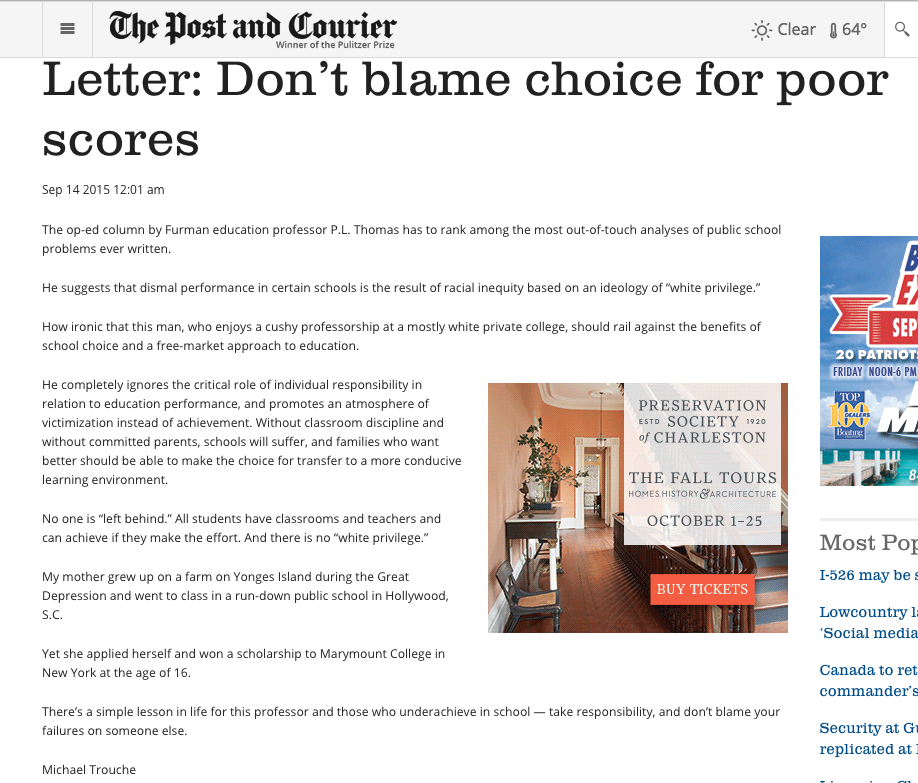
After my Op-Ed on school choice ran in the Post and Courier, the P&C ran a letter that literally states, “And there is no ‘white privilege.'” Also great and disturbing evidence of the fight we face since the writer uses every tactic imaginable except addressing the evidence—attacking me, using one example to claim a generalization:

white denial PandC

The State (Columbia, SC): Entrenched racism drives down SC child-well-being scores

Entrenched racism drives down SC child-well-being scores

[full unedited text below]

Two facts about children and poverty are especially disturbing: children make up about 1/3 of people in the U.S. in poverty, but raising children expands those in poverty to 43%.

For South Carolina, children and poverty present a particularly challenging reality, captured by the Annie E. Casey Foundation’s 2015 Kids Count data book.

Our state has long suffered in the bottom quartile of impoverished states in the U.S., but SC’s 2015 Kids Count profile reveals a grim picture with the state ranking 42nd in the nation in terms of child well-being:

  • SC children’s economic status has mostly worsened from 2008 to 2013 with 290,000 children in poverty, 376,000 children with parents lacking secure employment, and 349, 000 children in households with burdensome housing costs.
  • SC children’s educational opportunities remain inequitable. The percentage of children attending preschool has worsened, and so-called proficiency levels in math and reading have mixed results while high school graduation remains, although improved overall, elusive to those young people most in need of education.
  • Healthcare for SC’s children has improved, but 73,000 children remain without healthcare in the state.
  • SC’s children also face harsh community challenges. 420,000 children live in single-parent homes, an increase from 2008 to 2013, and more children, 161,000, live in high-poverty communities now than a few years ago.

The summer of 2015 has brought an intense spotlight on SC with the racist shooting of nine black citizens gathered in their church. Along with that tragedy, many in the state have continued to claim that we as a people embrace heritage and not hate.

However, political leaders and the public rarely identify the exact and real conditions behind claims of “heritage” and “tradition.” In SC and all across the South, our heritage includes crippling economic inequity and entrenched racism—both of which condemn our children to their ZIP codes, not the content of their character, being their destiny.

In the U.S., despite lingering and false stereotypes of “welfare queens,” 80% of people in poverty are from vulnerable populations: children, the elderly, the disabled, students, and the working poor.

As well, despite educational attainment, racial inequity remains powerful. Even with the same level of education, whites earn more than Hispanics and blacks. And blacks with some college have the same probability of employment as white high school dropouts.

Congressman James E. Clyburn has called for SC both to appreciate the symbolism of removing the Confederate battle flag from state grounds and to commit to substantive policy addressing the great weight of poverty and racism that our state still carries, a weight that is particularly harmful to our children.

Clyburn identifies healthcare and voting rights as policy SC must address, but there are many commitments to the lives of our children we could make to give substance to refrains of “heritage”:

  • Insure, as Clyburn notes, that all children in SC have healthcare from conception until their early 20s.
  • Seek public policy that supports all families with children, focusing on ensuring that having children doesn’t push any family into poverty.
  • Abandon the fruitless education accountability process and replace our school reform efforts with a focus on equity of opportunity: equitable K-12 and higher education funding across the state, equitable teacher assignments for all students, access to high-quality courses for all students, and quality alternatives for anyone to complete high school and college degrees despite age or background with substantial financial support.
  • Create stable and well-paying work for the people of SC that reinforces everyone’s access to healthcare and retirement/savings.
  • Confront directly and comprehensively the reality in SC that the state has enough money, but that our problem is the inequitable distribution of that capital. The infamous Corridor of Shame was not created by our school system, but the education inequity that it reveals is a reflection of the larger socioeconomic injustice across our state.

American novelist and public intellectual James Baldwin confronted Noble Prize winning author William Faulkner in the early years of the civil rights struggle in the U.S. because Faulkner called for patience among blacks in the South.

Baldwin responded with words that should resonate today in SC: “There is never time in the future in which we will work out our salvation. The challenge is in the moment, the time is always now.”

This Is My Post on Ta-Nehisi Coates: “The Burden of Living among Dreamers”

Under President Barack Obama, instead of hope and change, the U.S. has been offered ample and disturbing evidence that we are not a post-racial country.

As the 2016 presidential race heats up, the U.S. is now forced to confront an inevitable reality: a post-Obama U.S.

From the Sandy Hook school shooting to the racist massacre in Charleston, South Carolina, President Obama stood before the country and the world in a way that those holding the office before him and those now seeking the office after him surely could not have matched, will not be able to match.

Obama under the weight of Nobel Peace Prize winner and “first black president” was destined to fall short—personifying the racial dilemma exposed by Ta-Nehisi Coates in March 2014:

There is no evidence that black people are less responsible, less moral, or less upstanding in their dealings with America nor with themselves. But there is overwhelming evidence that America is irresponsible, immoral, and unconscionable in its dealings with black people and with itself. Urging African-Americans to become superhuman is great advice if you are concerned with creating extraordinary individuals. It is terrible advice if you are concerned with creating an equitable society. The black freedom struggle is not about raising a race of hyper-moral super-humans. It is about all people garnering the right to live like the normal humans they are.

In 2015, while popular and critical opinions of Obama have risen in many ways, it is now fashionable to praise Coates, who has released a book-length letter to his his son, Between the World and Me.

Like Obama, Coates has been tossed immediately into rarified air, comparisons that virtually no one could survive. Herself a Nobel Prize winner, Toni Morrison, in fact, has joined the chorus anointing Coates the next James Baldwin.

Between has also proven to be an irresistible land mine for black male public intellectuals as well as pontificating and tragically un-self-aware white-mansplainers.

Conversely, several black women scholars and journalists have found Between a powerful entry point for encouraging a much needed conversation about race, class, and gender.

The array of responses presents lessons in grace and the absence of grace that Obama spoke to while eulogizing South Carolina state Senator Clementa Pinckney.

My status as privileged (white, male) former redneck and current academic is not intended here to justify, explain, qualify, or endorse Coates or his book. In fact, if you haven’t been reading Coates, if you haven’t read his book, you should be doing those and not reading yet another post about Coates and his book.

If nothing else, this is about that paradox grounded in the racism of the U.S. that produced Coates as well as the book he has written; the racism of the U.S. that is producing the son to whom Coates writes for everyone else to witness.

“Of course we chose nothing,” Coates writes:

We did not design the streets. We do not fund them. We do not preserve them. But I was there, nevertheless, charged like all the others with the protection of my body….

The black world was expanding before me, and I could see now that that world was more than a photonegative of that of the people who believe they are white. “White America” is a syndicate arrayed to protect its exclusive power to dominate and control our bodies. Sometimes this power is direct (lynching), and sometimes it is insidious (redlining). But however it appears, the power of domination and exclusion is central to the belief in being white, and without it, “white people” would cease to exist for want of reasons. (pp. 22, 42)

#

From his candidacy and through Obama’s tenure as president, I have drifted from skepticism to cynicism about the promise of a black president to change policy or the hearts and minds of privileged Americans.

I harbor no delusion that the people who should read Coates slowly and carefully, with hearts and minds open to hard truths, will do so.

Despite overwhelming evidence of systemic racism, whites in the U.S. remain resistant, if not incapable of admitting their own culpability in racism. In fact, research shows “Whites exposed to evidence of racial privilege claim to have suffered more personal life hardships than those not exposed to evidence of privilege.”

Coates lived what research details:

But my experience in this world has been that the people who believe themselves white are obsessed with the politics of personal exoneration. And the word racist, to them, conjures, if not a tobacco-spitting oaf, then something just as fantastic—an orc, troll, or gorgon….There are no racists in America, or at least none that the people who need to be white know personally. (p. 97)

For those who believe themselves white, everything is about “me”—except for racism, of course.

And since the connection has been made, let’s admit that James Baldwin was too often ignored while he lived and has nearly disappeared since his death. If Baldwin was one of the, if not the, greatest witnesses among writers and public intellectuals—and I believe that to be the case—how can we expect Coates to achieve what Baldwin could not?

Ours, then, among the privileged is to resist raising a bar so high that Coates is doomed to fail.

Ours, then, among the privileged is to refuse the “yes, but” trivialization of a black man’s interrogation of this racist world.

Ours, then, among the privileged is to listen, to stand with in order to build a more perfect union that, ironically, will never again create a Baldwin or a Coates-as-Baldwin in the way those men have been formed.

#

Coates creates a powerful refrain throughout his book, the Dream.

That refrain is an unmasking of people who think they are white, a denunciation of a world that forces black males to define themselves against that whiteness.

As an educator, I am compelled to highlight a central message from Coates about formal schooling: “I had been reading and writing beyond the purview of the schools all my life” (p. 37).

Ultimately, Coates left college—and we must hear Langston Hughes’s “Theme for English B” in the background:

I wanted to pursue things, but I could not match the means of knowing that came naturally to me with the expectations of professors. The pursuit of knowing was freedom to me, the right to declare your own curiosities and follow them through all manner of books. I was made for the library, not the classroom. The classroom was a jail of other people’s interests. The library was open, unending, free. (p. 48)

Formal schooling is a mechanism of the Dream, Coates discovered:

The Dream thrives on generalization, on limiting the number of possible questions, on privileging immediate answers. The Dream is the enemy of all art, courageous thinking, and honest writing. And it became clear that this was not just for the dreams concocted by Americans to justify themselves but also for the dreams that I had conjured to replace them. I had thought that I must mirror the outside world, create a carbon copy of white claims to civilization. (p. 50)

The world Coates interrogates failed him and fails his son in the streets and the classroom; this we must admit is an inexcusable consequence of both enduring racism and the recalcitrance of the privileged to acknowledge systemic racism.

“And still you are called to struggle,” Coates tells his son and his readers, “not because it assures you victory but because it assures you an honorable and sane life” (p. 97).

#

“As I learn from you,” concludes the speaker of “Theme for English B”:

I guess you learn from me—
although you’re older—and white—
and somewhat more free.

Hughes was Hughes, Baldwin was Baldwin, and Coates is Coates.

The themes are too often the same, however, and it is well past time that the somewhat more free who believe themselves white set themselves aside and learn without qualification from those who have been declared black.

See Also

“I look at the world,” Langston Hughes

remnant 57: “forced on me from above” [Haruki Murakami on school]

“Men with Wicked Histories Often Enjoyed Lives of Comfort…Buried with Honor”

The life of teenager Billy Parham during the 1930s and across the Southwest of the U.S. and Mexico entrances readers of Cormac McCarthy’s The Crossing with a number of embedded stories along the way.

In one narrative-within-a-narrative late in section three, Billy hears a retelling of the philosophical pronouncements of a sepulturero (gravedigger, undertaker):

He said that while one would like to say that God will punish those who do such things [blinding a man in a horrible act] and that people often speak in just this way it was his experience that God could not be spoken for and that men with wicked histories often enjoyed lives of comfort and that they died in peace and were buried with honor. He said that it was a mistake to expect too much of justice in the world. He said that the notion that evil is seldom rewarded was greatly overspoken for if there were no advantage to it then men would shun it and how could virtue then be attached to its repudiation?

This second volume in the Border Trilogy, like the first volume (All the Pretty Horses), meanders often back to foundational questions about justice. The undertaker’s beliefs excerpted above end with a question that the novel leaves at the feet of readers, although other characters comment on it as well

As South Carolina has wrestled with this exact same issue in the form of a flag once flying atop the state capitol and then on state grounds as a bitter compromise, we must admit the undertaker is not cynical at all, but telling Truth.

Buildings, monuments, and statues honor our “men with wicked histories,” and as long as they do, we cannot claim any real interest in justice.

Removing Confederate Battle Flag from State Grounds Facing, Not Erasing, History

Often ignored behind the whitewashed myth of the Founding Fathers and the so-called birth of a nation is that the Declaration of Independence was strategically limited to only white males due to, in part, delegates from South Carolina who balked on including language rejecting slavery.

My home state of South Carolina was also first to secede from the Union, hand-in-hand with Georgia, Mississippi, Texas, and Virginia in, explicitly, defense of slavery. South Carolina rebuked the Union for its “deference to the opinions and wishes of the other slaveholding States,” such as Mississippi who declared bluntly: “Our position is thoroughly identified with the institution of slavery– the greatest material interest of the world.”

Even as slavery began to collapse under the weight of its inhumanity and immorality, free whites in South Carolina increased the number of slaves—with nearly half of families owning slaves by 1850—at the beginning of the Civil War.

My home state of South Carolina also offered the political world John C. Calhoun, Ben Tillman, and Strom Thurmond—embodiments of racism as political capital.

And in the past few days, my home state of South Carolina has once again paraded in front of the U.S. and the world the bitter clinging to tarnished symbols and strident shouting of empty slogans that temporarily stalled the long-overdue act of bringing down the Confederate battle flag from state grounds.

#

Throughout the 1980s and 1990s, I taught in the rural upstate South Carolina high school I attended as a student.

One of my non-fiction units for American literature included a consideration of persuasive writing, beginning with Ralph Waldo Emerson and Henry David Thoreau and then examining Thoreau’s influence on Gandhi and Martin Luther King Jr.

The last works of that unit focused on Booker T. Washington, W.E.B. Du Bois, King, and Malcolm X—a dedicated and extended honoring of black history and debate that was much more than a token nod such as black history month.

One moment when I was handing out King’s “Letter from Birmingham City Jail” remains with me to this day.

A white male student brushed the photocopy of King’s letter off his desk top and into the floor with a hissed, “I ain’t reading that nigger.”

My class included black students, but my being white and this student’s own life experience had taught him his perverse righteous indignation was entirely justified; he might as well has snarled “heritage, not hate.”

More calmly than I should have, I returned the handout to his desk with my hand on the papers, and looking him in the eye explained he would never say that word again in my room, and he would in fact read what I had assigned.

For many if not all of my students, this was probably the first time they had witnessed a white male—from their home town, in fact—take such a stand.

In all-white situations throughout my life in the South, racist slurs and veiled racist comments and jokes have been and remain a cruel norm.

#

The debate about removing the Confederate battle flag from South Carolina state grounds has not been the shining moment our state or the nation deserves. The rhetoric has too often been lies about the flag somehow not being a racist banner of slavery from the beginning, the narratives have mostly omitted the racist intent of resurrecting that flag in the early 1960s as an ugly middle finger to desegregation and civil rights for blacks, and the state representatives and senators who were democratically elected but chose to clutch still that flag have exposed ugly truths about denial and racial inequity surviving and even thriving today.

Bringing down that flag is a symbolic act itself, but it is also a movement that must continue to include real admissions about race inequity and new policies that make this world a better place.

To bring down a flag, to change the names of buildings, to remove statues—these are necessary acts of facing, not erasing, history.

Memorials that honor the dishonorable are indignities to the true value of history, or even heritage.

There is no dishonor in admitting our failures; in fact, facing our past and acknowledging man’s inhumanity to humans (and such gender-biased language is suitable here) is the most honorable thing we can do.

If there is any dignity in democracy, the next step after symbolically removing that flag must be removing the elected officials who have tied their voices and their names to a lost cause that was corrupt from the beginning.

See

Here are the 20 lawmakers who voted against removing the Confederate flag

We Can, and We Must

I remembered it had been one of Mother’s pet ideas—she was always voicing it—that in the long run one gets used to anything.

The Stranger, Albert Camus (Trans. Stuart Gilbert)

Pamela Cantor offers her medical perspective to the education reform debate that tends to focus on high-poverty schools disproportionately serving  black and brown children:

The argument that says we can’t fix education until we fix poverty is a false one [1]. We can’t fix poverty or the other adverse events of children’s lives, but we can “fix” the impact of stress on the developing brain. In fact, we have to. We can and must teach schools and teachers how to do this now.

Lurking beneath the good intentions of this charge, however, is the false dichotomy of fatalism that is common among a wide range of education reformers.

For children living in poverty—a stressful and toxic life of unjust scarcity—this “we” has chosen simultaneously to concede that “we” can do nothing about poverty, racism, and inequity, but those impoverished children have been sentenced to both their lives of poverty and then formal education that replicates the stress of the lives (which “we” demand they set aside somehow just by walking through the doors of schools) through mantras of “no excuses,” manufactured lessons in “grit,” and race- and class-biased high-stakes testing that doubles down on stress and anxiety.

The false dichotomy of fatalism has built a world in which privileged adults with the power to tolerate this world or to change this world are afforded excuses (“We can’t fix poverty or the other adverse events of children’s lives”), but powerless and impoverished children are dehumanized with the demand of “no excuses.”

“I have always rejected fatalism,” writes Paulo Freire:

I prefer rebelliousness because it affirms my status as a person who has never given in to the manipulations and strategies designed to reduce the human person to nothing. The recently proclaimed death of history, which symbolizes the death of utopia, of our right to dream, reinforces without doubt the claims that imprison our freedom. This makes the struggle for the restoration of utopia all the more necessary. Educational practice itself, as an experience in humanization, must be impregnated with this ideal.

Meursault in Albert Camus’s The Stranger confesses and embraces human resignation, the fatalism that the world happens to us, that a world in which we are alive or dead is no different, that a world of freedom or prison is simply something “we” get used to.

Margaret Atwood offers a more detailed and darkly disturbing vision in The Handmaid’s Tale and Offred/June, who has been shaped a different woman in her lives before and after the fall of the world “we” know and the brave new world of Gilead.

The world “we” have created is neither existential fiction nor speculative dystopian fiction; the world “we” have created is far more terrible.

“Why exactly was I sad?” asks Ta-Nehisi Coates in Letter to My Son, as he confronts a “failed” guest appearance on a news show:

I came out of the studio and walked for a while. It was a calm December day. Families, believing themselves white, were out on the streets. Infants, raised to be white, were bundled in strollers. And I was sad for these people, much as I was sad for the host and sad for all the people out there watching and reveling in a specious hope. I realized then why I was sad. When the journalist asked me about my body, it was like she was asking me to awaken her from the most gorgeous dream. I have seen that dream all my life. It is perfect houses with nice lawns. It is Memorial Day cookouts, block associations, and driveways. The Dream is tree-houses and the Cub Scouts. And for so long I have wanted to escape into the Dream, to fold my country over my head like a blanket. But this has never been an option because the Dream rests on our backs, the bedding made from our bodies. And knowing this, knowing that the Dream persists by warring with the known world, I was sad for the host, I was sad for all those families, I was sad for my country, but above all, in that moment, I was sad for you.

July 5, 2015, is in too many ways ample evidence not of celebration but disappointment, one grounded in the exact document of declaration that prompts annual flag waving each July in the United States of America.

As “we” rebelled from the British crown, “we” pronounced to “hold these truths to be self-evident, that all men are created equal, that they are endowed by their Creator with certain unalienable Rights, that among these are Life, Liberty and the pursuit of Happiness”—excluding black humans shackled by slavery and those second-class humans, women.

Thomas Jefferson had faced slavery in the original draft of this declaration, but due to the pressure of Southern heritage and the Invisible Hand of the all-mighty market, “we” included only some men, despite the rhetoric otherwise.

More than 100 years passed before the rhetoric of law approached the apparent original intent of declaring independence, but the clock continues to tick as “we” throw up our hands when “we” don’t have them covering our eyes.

Coates above quotes James Baldwin because Coates recognizes in his own life as well as the life of his son that as Baldwin declared:

To be a Negro in this country and to be relatively conscious, is to be in a rage almost all the time. So the first part of the problem is how to control the rage so that it won’t destroy you. Part of the rage is this: it isn’t only what is happening to you, but it’s what’s happening around you all of the time, in the face of the most extraordinary and criminal indifference, the indifference and ignorance of most white people in this country.

“Indifference and ignorance of most white people in this country” is the fatalism “we” embody each time “we” claim nothing can be done about poverty, racism, or inequity—each time “we” ask more of children, the poor, the marginalized and dehumanized than of ourselves.

“We,” I regret, have chosen a resignation and paralysis that benefits the “we” “who believe that they are white,” as Coates channels Baldwin.

Freire believed, however, “we” can transform into we by “reject[ing] fatalism.”

We can, and we must.

[1] While I believe this first comment is a straw man argument (since many are calling for both equity-based reform of society and schools, and this smacks of implying some are using poverty as an excuse), Cantor should consider that Martin Luther King Jr. asserted: “We are likely to find that the problems of housing and education, instead of preceding the elimination of poverty, will themselves be affected if poverty is first abolished.”

From “Remediation” to “No Excuses”: The Indignity of Deficit Thinking

Speaking in Savannah, Georgia, March 21, 1861, in his “Corner Stone” Speech, Alexander H. Stephens, Vice President of the Confederate States of America, carefully enumerated the justification for secession among Southern states.

At length, Stephens addressed slavery: “The new [Confederate] constitution has put at rest, forever, all the agitating questions relating to our peculiar institution African slavery as it exists amongst us the proper status of the negro in our form of civilization.”

That “proper status”—according to Stephens and the declarations of secession by Georgia, Mississippi, South Carolina, Texas, Virginia— was misrepresented in the U.S. Constitution, that “rested upon the assumption of the equality of races. This was an error.”

The Confederacy, instead, embraced “the great truth that the negro is not equal to the white man; that slavery subordination to the superior race is his natural and normal condition.” Stephens chastised the North because “[t]hey assume that the negro is equal, and hence conclude that he is entitled to equal privileges and rights with the white man.”

Stephens called on the triple bedrocks of authority in his statement of the inequality of the races—science, law, and religion:

This, our new government, is the first, in the history of the world, based upon this great physical, philosophical, and moral truth. This truth has been slow in the process of its development, like all other truths in the various departments of science….

With us, all of the white race, however high or low, rich or poor, are equal in the eye of the law. Not so with the negro. Subordination is his place. He, by nature, or by the curse against Canaan, is fitted for that condition which he occupies in our system.

=

While apologists for Southern heritage remain unable or unwilling to confront the blatant racism of the Confederacy, many today remain nearly universal in our inability or unwillingness to recognize and then confront racism, classism, and sexism in the form of deficit thinking.

Deficit thinking, as Stephens represented, is imposing onto groups or individuals deficits as the primary characteristics of their humanity. In education, deficit thinking is pervasive and the foundational mechanism for formal schooling as an institution that reflects and perpetuates bigotry, inequity, and marginalization of people based on status instead of merit.

Some deficit thinking appears nearly harmless because of its common-place use—for example, the term and concept of “remediation.”

Remediation as a normalized deficit concept is at the heart of the third-grade retention movement masquerading as reading policy.

Remediation is built on several flawed assumptions: (i) learning is predictably linear and sequential, (ii) so-called skills such as reading can be accurately quantified (as in “grade level”), and (iii) some “types” of learning (associated with rates and/or biological ages of the students) are lesser than others (basic skills versus higher-order thinking skills, for example).

Remediation also fails a basic point of logic: If remediation is teaching a student something that student doesn’t know, isn’t all teaching remediation?

Remediation, then, is deficit thinking because we must first establish “third grade reading” and then test children in order to label them deficient—and thus the ultimate flaw of grade retention is allowing that seemingly scientific but biased quantifying to represent the entirety of any student.

=

Many key ideologies and practices in the education reform movement, as well, are masks for deficit thinking: culture of poverty, “grit,” the “word gap,” and “no excuses.”

As deficit thinking, all of these are driven by and contribute to unacknowledged racism and classism (often among those claiming to be fighting bias and inequity).

To say “poverty is not an excuse” or that student success depends on “grit” is to “blame the victim” since the focus of these slogans and the educational practices built on them highlight the students as deficient and thus needing to be “fixed.”

The lineage from the bald-faced racism of Stephens to the paternalistic and coded racism/classism of “grit,” “no excuses,” and the “word gap” is deficit thinking.

The racism of the Confederacy did not hide behind code, but more than 150 years later, we are faced with finding the will to decode and debunk the deficit thinking that is just as corrosive to individuals and society as corner-stone speeches.

Remediation, grade retention, lessons in “grit,” “no excuses” charter schools, strategies to end the “word gap”—these all disproportionately target black, brown, and poor children.

Those ideologies and practices, however, do not validate claims of deficient children, but expose a deficit of basic humanity among those in positions to honor the dignity of all children, but instead continue to choose otherwise.

=

About 100 years after Stephens’s racist declaration of secession, author Ralph Ellison concluded in “What These Children Are Like”: “I’m fascinated by this whole question of language.”

“The great body of Negro slang–that unorthodox language–exists,” Ellison explained:

precisely because Negroes need words which will communicate, which will designate the objects, processes, manners and subtleties of their urban experience with the least amount of distortion from the outside. So the problem is, once again, what do we choose and what do we reject of that which the greater society makes available? These kids with whom we’re concerned, these dropouts, are living critics of their environment, of our society and our educational system, and they are quite savage critics of some of their teachers.

Ellison’s lecture to teachers was an extended confrontation of deficit thinking, a powerful refuting of seeing black children and anyone’s language as deficient. His talk ended with a stirring plea:

I don’t know what intelligence is. But this I do know, both from life and from literature: whenever you reduce human life to two plus two equals four, the human element within the human animal says, “I don’t give a damn.” You can work on that basis, but the kids cannot. If you can show me how I can cling to that which is real to me, while teaching me a way into the larger society, then I will not only drop my defenses and my hostility, but I will sing your praises and help you to make the desert bear fruit.

Deficit thinking in its many forms is fruitless for its indignity.

For Further Reading

The Moynihan Report at Fifty, Stephen Steinberg

Letter to the Editor: The Moynihan Report at Fifty, Daniel Geary

The Moynihan Report Is Turning 50. Its Ideas on Black Poverty Were Wrong Then and Are Wrong Now, Daniel Geary