Category Archives: race

What Matters: The Day Is

The challenge is in the moment, the time is always now.

James Baldwin

I.

The day is Friday, 26 June 2015.

My daughter, Jessica, sits in our brown recliner, holding an ice pack on her broken nose with her right hand and cradling her one-year-old daughter, Skylar, in her left arm.

I stand leaning over at the waist in the middle of the living room. Two trickles of bloods run down my left shin from my knee cap. My ring finger and thumb on my right hand are throbbing, jammed, and my left hip is tightening, bruised I am sure. I breathe heavily and am covered in sweat, Jessica asking if I am all right.

No more than ten minutes earlier, Jessica pulls into our driveway with Skylar and her white box-head lab, Sasha. I hurry outside to help her and notice, finally, she has Sasha in a collar and on a leash.

As Jessica leads Sasha to our fenced-in backyard to play with our yellow lab (Sasha’s half-sister), Zoe, I walk around the car to unbuckle Skylar from her car seat.

Just as I have the car seat straps undone and my hands under Skylar’s arms, I look up and notice Jessica is bent over with her face in her hands. Jessica is screaming.

The dogs are both out of the fence, I also notice, before I realize what Jessica is shouting: “I think Zoe broke my nose.”

In the next impossibly long second, I recognize I have three obligations—my granddaughter, my frantic daughter, and two dogs now running away.

These are decisions that are not decisions, moments when the universe demands that we notice what matters.

I carefully lift Skylar out of her car seat and hold her tight in my right arm. I try to call for Zoe and Sasha as I hurry toward Jessica, still leaning over with her face in her hands and screaming.

I put my left arm around Jessica and tell her we are going inside, everything will be fine.

When she looks up at me and moves her hands, there is no blood, and although I can tell something has hit her nose, the injury seems not as bad as I feared.

In our house, I tell Jessica to sit in the recliner, and I grab an ice pack wrapping it in a paper towel for her to hold on her nose. Only a few seconds pass before Jessica tells me she can hold Skylar, to go look for the dogs.

The day is scorching, another during a long June week of 100-degree heat index days. No dogs are in sight.

I call for Zoe and Sasha, whistle, and clap my hands, but our entire neighborhood seems completely deserted.

Sasha, I learn later, has run away just the day before at our house; she is a runner like our family chocolate lab Hershey, who we had to put down along with our black lab within a month of each other in the summer of 2014.

I trot into the road in front of our house, still calling, clapping, and whistling. Then I catch sight of the dogs down through the cul-de-sac, chasing each other behind a neighbor’s house.

I call for Zoe and run.

Zoe turns and sprints toward me, but Sasha remains at the edge of the woods between the neighbor’s house and a larger road outside the neighborhood.

I hurry but avoid running toward Sasha who pauses until I am close, and then she darts away again.

At 54, without thinking, I do something I have only seen on TV, movies, and cartoons; I sprint two or three steps and dive, reaching for the leash dragging behind Sasha.

Scrambling back to my feet, my right shoe twisted and only half way on, I somehow have the leash in my right hand, and immediately begin jogging back to our house with Sasha and coaxing Zoe trailing along. But about halfway there, Sasha twists and pulls out of the collar.

I continue to run and call after them both, noticing a car coming down the road.

The momentum works. Sasha, Zoe, and I run back to our house, and then the dogs tumble through the fence gate as if everything is perfectly fine.

II.

The day is Friday, 26 June 2015.

From the White House, the President of the United States, Barack Obama, addresses the nation about the Supreme Court ruling against states’ banning same-sex marriage:

Progress on this journey often comes in small increments. Sometimes two steps forward, one step back, compelled by the persistent effort of dedicated citizens. And then sometimes there are days like this, when that slow, steady effort is rewarded with justice that arrives like a thunderbolt.

This morning, the Supreme Court recognized that the Constitution guarantees marriage equality. In doing so, they have reaffirmed that all Americans are entitled to the equal protection of the law; that all people should be treated equally, regardless of who they are or who they love.

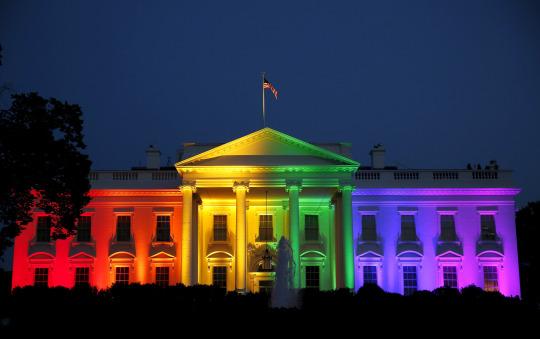
That night, the White House is illuminated with rainbow colors.

In between during mid-afternoon, President Obama speaks in Charleston, South Carolina—at the Emanuel AME Church where only days before nine black people where massacred in a racist act of terrorism. Here, he is behind a pulpit, eulogizing South Carolina state Senator Clementa Pinckney.

“The Bible calls us to hope,” Obama begins, “to persevere and have faith in things not seen.”

About Pinckney, Obama stresses: “No wonder one of his Senate colleagues remembered Senator Pinckney as ‘the most gentle of the 46 of us, the best of the 46 of us.'”

Praising Pinckney builds to Obama’s larger message: “This whole week, I’ve been reflecting on this idea of grace.”

Behind Obama, congregation leaders in purple robes lend an impromptu chorus punctuated by the organist off camera. “Amazing Grace” and “purple mountains majesty” rise beyond the tragedy of the moment and spread across the nation like a rainbow.

III.

The day is today.

Today is.

That is not a question before you.

The question before you is always “What matters?” and then “What will I do?”

James Baldwin’s “They Can’t Turn Back” (1960): “On such small signs and symbols does the southern cabala depend”

James Baldwin published “They Can’t Turn Back” in 1960 just as I was about to enter this world.

Baldwin—black, gay and from the North—was witnessing a world from which I—white, straight and from the South—would in many ways be exempt, although it was the same world.

In this essay, Baldwin was charged by Mademoiselle to report on student activism in Florida after the Greensboro (North Carolina) sit-in, which the editors framed, in part, as follows:

More than any other event, the Greensboro sit-in launched the 1960s, a decade of political activism and students were on the cutting edge of social change. In 1960, the writer James Baldwin visited Tallahassee, Florida. to report on student activism there. Baldwin ruminated on the underlying causes of black protests and marveled at the militancy and idealism of the younger generation. To Baldwin, the movement challenged all Americans to rethink whether “We really want to be free” and whether freedom applied to all Americans or only to part of the population.

“I am the only Negro passenger at Tallahassee’s shambles of an airport,” Baldwin begins, as he paints an immediate picture of the tensions between blacks and whites that defined his world: “If she were smiling at me that way I would expect to shake her hand. But if I should put out my hand, panic, bafflement, and horror would then overtake that face, the atmosphere would darken, and danger, even the threat of death, would immediately fill the air.”

In Charleston, South Carolina—about 300 miles away from Greensboro and 55 years later—racial tensions have escalated from “threat” to execution. In the wake of the mass shooting of the #Charleston9 (an eerie and disturbing echo of the Little Rock Nine), the political and public response has focused on the Confederate battle flag on the Capitol grounds in SC as well as in both government and private contexts across the South and U.S.

Time and place, then, do not erase the power of Baldwin’s second paragraph:

On such small signs and symbols does the southern cabala depend, and that is why I find the South so eerie and exhausting. This system of signs and nuances covers the mined terrain of the unspoken—the forever unspeakable—and everyone in the region knows his way across this field. This knowledge that a gesture can blow up a town is what the South refers to when it speaks of its “folkways.” The fact that the gesture is not made is what the South calls “excellent race relations.” It is impossible for any northern Negro to become an adept of this mystery, not because the South’s racial attitudes are not found in the North but because it has never been the North’s necessity to construct an entire way of life on the legend of the Negro’s inferiority. That is why the battle of Negro students for freedom here is really an attempt to free the entire region from the irrational terror that has ruled it for so long.

“They Can’t Turn Back”

The South Baldwin describes was cracking under the weight of “separate but equal” as that myth crashed into a rising refrain of civil rights. As Baldwin notes, “the viewpoint of the white majority” dictated the narratives about and for blacks—and whites.

Today, as the South and the nation wrestles with symbolism—a flag—we also confront a tarnished and enduring myth-turned-slogan, “Heritage Not Hate,” as Tony Horwitz explains:

Some of those who invoke the “heritage, not hate” mantra are disingenuous. On the day of the shooting, I was in rural east Texas, touring a small town with a businessman who displayed the rebel flag on his truck. After telling me “it’s heritage, not hate,” he proceeded to refer to a black neighborhood as “Niggertown” and rant against the Martin Luther King, Jr. holiday.

Most flag defenders, however, are sincere when they say they cherish the banner as a symbol of their ancestors’ valor. About 20 percent of white Southern males of military age died in the Civil War. In South Carolina the toll was even higher, and thousands more were left maimed, their farms and homes in ruins. For many descendants of Southern soldiers, the rebel flag recalls that sacrifice, and taking it down dishonors those who fought under the banner. No one wants to be asked to spit on their ancestors’ graves….

But a deeper problem remains, and not just among those who cherish the Confederacy. Nationwide, Americans still cling to a deeply sanitized and Southern-fried understanding of the Civil War. More often than not, when I talk to people about the conflict, I hear that it was about abstract principles like “state sovereignty” and “the Southern way of life.” Surveys confirm this. In 2011, at the start of the war’s sesquicentennial, the Pew Research Center asked more than 1500 Americans their view as to “the main cause of the Civil War.” Only 38 percent said the main cause was slavery, compared to 48 percent who answered states’ rights.


For Baldwin in the turbulent cusp of the 1950s/1960s at Florida Agricultural and Mechanical University:

The South is very beautiful but its beauty makes one sad because the lives that people live, and have lived here, are so ugly that now they cannot even speak to one another. It does not demand much reflection to be appalled at the inevitable state of mind achieved by people who dare not speak freely about those things which most disturb them….

It is very nearly impossible, after all, to become an educated person in a country so distrustful of the independent mind. The fact that F.A.M.U. is a Negro university merely serves to demonstrate this American principle more clearly: and the pressure now being placed on the Negro administration and faculty by the white Florida State Board of Control further hampers the university’s effectiveness as a training ground for future citizens. In fact, if the Florida State Board of Control has its way, Florida will no longer produce citizens, only black and white sheep. I do not think or, more accurately, I refuse to think that it will have its way but, at the moment, all that prevents this are the sorely menaced students and a handful of even more sorely menaced teachers and preachers.

“They Can’t Turn Back”

Our contemporary world remains too often silent, just as our institutions of education continue to be in the service of the status quo—failing more often than not the very students most in need of public and higher education. Just as Baldwin’s recognition of the power of symbolism in the South speaks to today, his words strike also at the heart of the return of segregated and inequitable schooling across the entire U.S.:

For the segregated school system in the South has always been used by the southern states as a means of controlling Negroes. When one considers the lengths to which the South has gone to prevent the Negro from ever becoming, or even feeling like, an equal, it is clear that the southern states could not have used schools in any other way.

In his role as witness, Baldwin details his own journey among black leaders and students in Florida, and one student leads him to note:

But this [the historical perspective] does not, and cannot exist, either privately or publicly, in a country that has told itself so many lies about its history, that, in sober fact, has yet to excavate its history from the rubble of romance. Nowhere is this clearer than in the South today, for if the tissue of myths that has for so long been propagated as southern history had any actual validity, the white people of the South would be far less tormented people and the present generation of Negro students could never have been produced.

“They Can’t Turn Back”

For SC and the U.S., pulling down a flag is not an act of erasing history, but a moment, a momentum for facing a history long masked behind the veneer of whitewashing.

Baldwin’s time spent with student protestors in Florida spurred in him angst—an angst not unlike those who fear now that the flag removal will be but a passing symbolic act with little real change to follow: “And all this, I think to myself, will only be a page in history. I cannot help wondering what kind of page it will be, whether we are hourly, in this country now, recording our salvation or our doom,” Baldwin muses.

However, Baldwin’s closing words suggest hope, a hope embodied in young blacks then who were in a different world than the one into which Baldwin was born. And Baldwin believed in the promise of young black activism grounded in a bold recognition of the real history of race in the U.S.:

They [black student activists] cannot be diverted. It seems to me that they are the only people in this country now who really believe in freedom. Insofar as they can make it real for themselves, they will make it real for all of us. The question with which they present the nation is whether or not we really want to be free. It is because these students remain so closely related to their past that they are able to face with such authority a population ignorant of its history and enslaved by a myth. And by this population I do not mean merely the unhappy people who make up the southern mobs. I have in mind nearly all Americans.

These students prove unmistakably what most people in this country have yet to discover: that time is real.

“They Can’t Turn Back”

Hope and angst are with us in the wake of the mass shooting in Charleston, in the wake of political leaders who defended the Confederate flag on one Friday (and for years) only to reverse course after a weekend (and likely some motivation from the very CEOs politicians had invoked as evidence the flag was not a real issue), in the vacuum of the national refusal to confront the violent gun culture that arms the racism we are begrudgingly admitting.

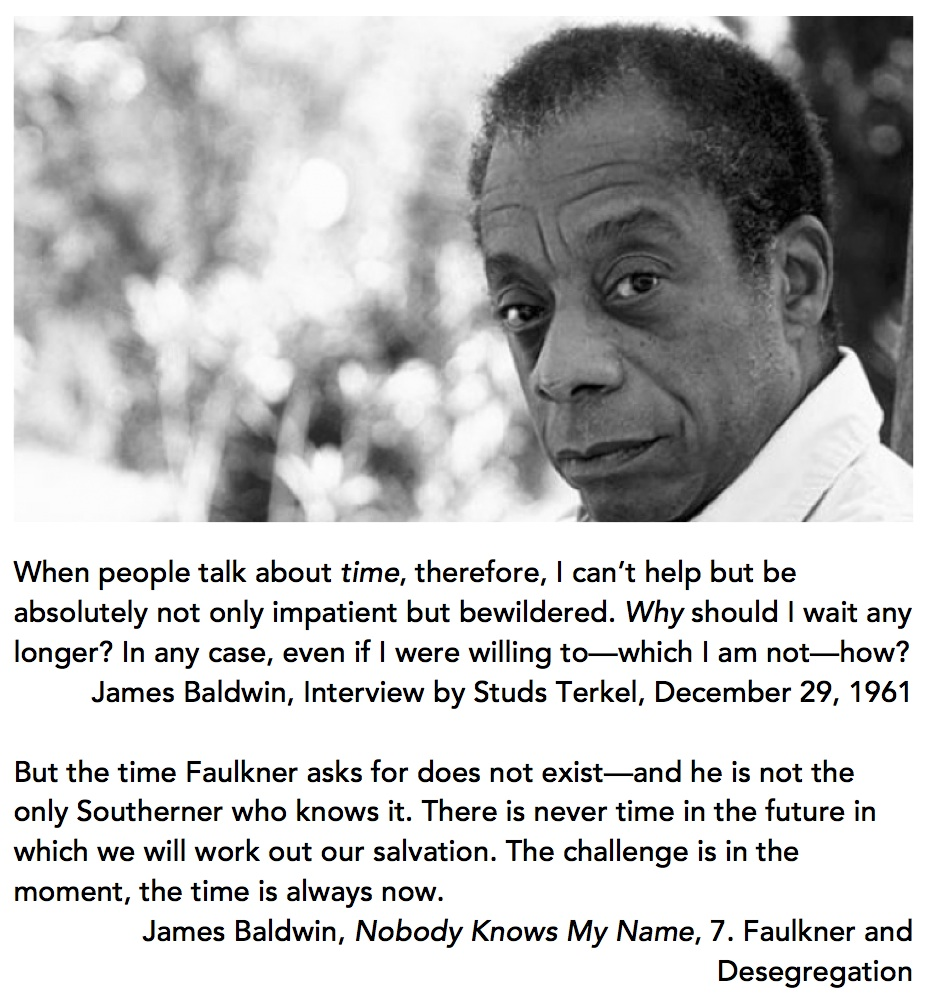
In Baldwin’s refuting of William Faulkner—white calls for patience from blacks—we have more evidence of the relevance of Baldwin in a time of racial unrest:

But the time Faulkner asks for does not exist—and he is not the only Southerner who knows is. There is never time in the future in which we will work out our salvation. The challenge is in the moment, the time is always now.

“Faulkner and Desegregation,” Nobody Knows My Name

Dear White Folk Who Say You “Don’t See Race”

Dear White Folk Who Say You “Don’t See Race”:

I am a white male, and when you see me, you should immediately notice both—because the parts of who I am are ultimately the whole.

To say to someone you don’t see race (or gender), you are in effect refusing to see the person, you are dehumanizing the person as somehow not worthy of being fully seen.

But there are also a few points of logic that make “I don’t see race” truly offensive.

First, the only reason to make the effort not to see race is the implication that once you see race you have racist or bigoted thoughts or actions connected to race.

Second, to consciously not see race (which is an odd concept to begin with since eyesight doesn’t allow us to filter) or to make a false claim of not seeing race also simultaneously prohibits you from seeing racism.

“I don’t see race” is admitting “I refuse to acknowledge racism”—and denying racism has a real evidence problem.

Those who claim “I don’t see race,” then, are likely either racists who are fronting (consciously or unconsciously) or people who consider themselves “good people” but by taking a so-called neutral stance are actually supporting the status quo of racism in the U.S.

Humans have recognizable nuances and differences, and it is ours to denounce equating surface differences as signals of deficits or stereotypes.

We cannot see each other as fully human by refusing to see any of our parts, including the social construction of race that we associate with how we look.

For those of us—especially those of who are white—committed to racial equity in the U.S., we must resist “I don’t see race” and instead seek for ourselves and others: “I see human dignity in all races.”

SC’s Market Ethics and Moral Vacuum

Charleston, South Carolina in just a few months has forced the state and the nation to witness the racial injustice of law enforcement and the horror of violent racism, but these incidences that reflect a larger culture of violence and racism in the U.S. have spurred media and political insult in the form of denial.

The Wall Street Journal, as examined by Scott Eric Kaufman, declared an end to systemic racism:

“The universal condemnation of the murders at the Emanuel AME Church” demonstrates that — Walter Scott notwithstanding — “the system and philosophy of institutionalized racism identified by Dr. King [in his response to the Birmingham bombing] no longer exists.”

And SC governor Nikki Haley continued her refrain reaching back to her campaign mantras:

“What I can tell you is over the last three and a half years, I spent a lot of my days on the phones with CEOs and recruiting jobs to this state,” Haley said. “I can honestly say I have not had one conversation with a single CEO about the Confederate flag.”

Conceding that South Carolina had suffered an image problem in the past, Haley asserted that the state had moved beyond those days.

The mainstream media and elected officials reflect that—despite claims of the U.S. being a Christian nation and the South being the Bible Belt—responses to the racist massacre at the AME church in Charleston exposes we are a people existing in a moral vacuum, we are a people shackled to market ethics.

Governor Haley believes that CEOs outside of SC have the power to determine for the people of the state what is or isn’t offensive. Her comment is a stark testament to her political commitments—but Haley is also a typical if not universal embodiment of politics-as-market-ethics.

And the media share poll after poll—a sort of perverse popularized market-democracy—as well as measured debates of “both sides” to entrench further that those sides have equal moral weight.

Moral imperatives are above market forces, above democratic mechanisms, above debate.

The market and even democracy remained, at best, often silent during all sorts of assaults on human dignity; U.S. slavery, women’s equality, civil rights, marriage equality—all of these existed with the market and popular opinion in support of (and often depending on) denying fellow humans their humanity.

Moral imperatives require leaders with integrity, open eyes, open ears, and open minds for human dignity.

Many people have lamented that after the mass shooting of children at Sandy Hook Elementary, we failed to let go of the death-grip on our sacred guns. And many have gone further to admit that the mass shooting of nine blacks in church is doomed to the same failure to see, to confront, and to act.

These are not cynical responses to horrors; these are admissions of our moral vacuum.

Just as the racist murderer of people gathered in their place of worship is not some isolated incident, the WSJ and Haley are not isolated examples of tone-deaf media and politicians.

The WSJ and Haley are who we are.

The market has spoken.

“To Dismantle Systems of Violence”

The geographical coincidence of my birth often leaves me disappointed and embarrassed—mortified.

I am a son of the South, more specifically South Carolina. And while my birthplace and current home are in the Upstate and nearly as far from Charleston, SC, as one can be and remain in the state, the massacre, the racist terrorism now known as #AMEShooting left me yesterday certain that words were destined to be inadequate.

So when I read Sally Kohn on Twitter, I was compelled to respond:

While tone-deaf and insincere political rhetoric neither starts nor ends with Nikki Haley, Mark Sanford, or Lindsey Graham in SC or across the U.S., there is a certain inexcusable arrogant nastiness I hear when these so-called leaders speak.

Why? Because I am from here, and as a white male Southerner, I know what white people say when only white people are around, what men say when only men are around, what straight people say when only straight people are around.

I have done it. I bear witness to it daily.

I live among the Bible thumping “heritage is not hate” crowd that knows next to nothing about either religious charity or the scarred history to which they cling like a decaying corpse.

I have also witnessed a nation morn heinous violence followed by President Obama making a plea for “all our children”—only to witness also how nothing changed because the real American value is not being a Christian nation or protecting the land of the free but a commitment to unadulterated violence and hatred symbolized by the insult to human decency known as the right to bear arms.

As I was wrestling with the futility of words, I read Nicole Nguyen’s Education Scholars: Challenging Racial Injustice Begins With Us, in which she offers a powerful challenge:

As public transit riders shuffled on and off the train, I began to understand that we cannot solve complex social problems like institutional racism within the prototypical ivory tower as armchair critics. Our scholarship cannot merely inform our own ideas and advance our own careers. If we are to train future teachers, principals, and education researchers, we must recognize how schools perpetuate and disrupt systems of inequality, nourish the critical consciousness of our students, model antiracist and decolonizing pedagogies, and build the tool kits necessary for creating more-democratic schools.

If we are to counter the oppressive systems of inequality that brutalize youths, we cannot do it alone. We must marshal the intellect of all those who board the train, young people in particular. We do not need university solutions to public problems.

Nguyen’s words should be read in full, but she concludes with a clear “mission of colleges of education: to serve as political allies of the young people in our communities to dismantle systems of violence.”

I humbly add this is the mission of every denizen of a place called “free,” called “just.”

I also read Ta-Nehisi Coates’s Take Down the Confederate Flag—Now, pausing at his “Cowardice, too, is heritage.”

Violence through the barrel of a gun, violence spat in a racial slur, violence flapping in the breeze on statehouse grounds—these are all cowardice.

As is the paralysis that follows that violence each time.

Because not taking action seems to be a heritage that unites every region of this country.

Baldwin

High-stakes, Standardized Tests Are “Master’s Tools,” Not Tools for Social Justice

Christina Duncan Evans argues that the high-stakes testing opt-out movement “ignores a major function of testing,” which she identifies as: “A major reason we use standardized tests is to make the case that there’s large-scale educational injustice in our nation.”

As an advocate for educational equity and social justice, Evans explains:

States don’t have a very good track record of providing equitable access to education to all of their students, and the federal government should ensure that American school quality is consistent. This has made me an advocate of standardized testing, following the logic that we can’t solve achievement gaps unless we measure them first.

Before examining this commitment to standardized testing (also found among civil rights organizations), I want to highlight that public education and state government have had a long history, continuing today, of failing miserably black, brown, and poor children and adults.

The evidence of lingering race and class inequity in the U.S. is staggering, and that inequity is too often replicated and perpetuated in public schooling—through inequitable access to rich curriculum and experienced, qualified teachers, for example.

As well, there is a troubling aspect to the opt-out movement along with the backlash against Common Core; as Andre Perry states, reinforcing Evans:

Take it from black and brown children who are used to being tested. Students will overcome. However, privileged adults who aren’t used to being tested may never stop crying.

The opt-out and Common Core backlash have exposed an unintended lesson about U.S. public education and society: As long as punitive and biased practices impact mostly or exclusively black, brown, and poor children (think “grit” and “no excuses”), the mainstream world of white privilege and wealth remains silent.

However, Perry also concedes that “having the ability to compare performances among groups hasn’t brought educational justice to black and brown students.”

In other words, and this is my main concern, the accountability era over the past thirty years—based significantly on standards and high-stakes testing—has not confronted and eroded race and class inequity, but in fact, and notably because of the central roles of standardized testing, race and class inequity has become even more entrenched in our schools and society.

Standardized testing remains biased by race, class, and gender, and thus, continues a warped tradition in the U.S. of masking bias as science; consider IQ testing and the current claims about “grit.”

High-stakes, standardized tests are, as Audre Lorde stresses, “the master’s tools.”

For those of us seeking educational and social equity and justice, then, we must heed Lorde’s call:

For the master’s tools will never dismantle the master’s house. They may allow us temporarily to beat him at his own game, but they will never enable us to bring about genuine change….

The essential flaw with continuing to cling to high-stakes standardized testing is two-fold: (1) the tests are race, class, and gender biased, and (2) the demand that we raise test scores keeps all the attention on outcomes (and not the policies and practices that create the inequity).

As such, the demand remains that black, brown, and poor children (and adults) are themselves flawed and must be “fixed” (see Paul Gorski on “blaming the victim”).

This second flaw is also addressed by Lorde: “This is an old and primary tool of all oppressors to keep the oppressed occupied with the master’s concerns.”

Testing is never any better than a proxy, a representation of something else (student learning, teacher quality, school quality), but testing is never a valid proxy for equity or justice—always instead a fatal distraction. As I have argued before:

Testing, in effect, does not provide data for addressing the equity/achievement gap, testing has created those gaps, labeled those gaps, and marginalized those below the codified level of standard.

The accountability movement and the increased stakes linked to standardized testing have focused the gaze even more narrowly on individual children and educators. That tunnel-vision allows the privileged to avoid addressing social and educational inequity because marginalized groups are forced to work at the “master’s concerns,” not their own.

If we are determined to find data to highlight educational inequity so that we can address it, let us turn that gaze to the inequity of opportunity. For example, Rebecca Klein reports:

In Mississippi’s Carroll County school district, there are no advanced placement courses, no foreign language classes and not enough textbooks for children to take home at night. Until last year, students on the high school football team had to change clothes in a makeshift room that previously functioned as a chicken coop….

Schools in Mississippi are provided with some of the lowest levels of state and local funding in the nation, according to two reports released simultaneously Monday detailing disparities in school resources around the country. For most of the past 10 years, the state has failed to live up to its own law requiring certain funding levels for schools.

Unfortunate circumstances like the ones in Carroll County can be seen across the country, say the reports from the Leadership Conference Education Fund and the Education Law Center, a New Jersey legal and advocacy group.

The abundance of evidence of social and educational inequity is overwhelming, and continuing to mis-measure it through relentless and punitive standardized testing is inexcusable.

Lorde concludes:

Racism and homophobia are real conditions of all our lives in this place and time. I urge each one of us here to reach down into that deep place of knowledge inside herself and touch that terror and loathing of any difference that lives there. See whose face it wears. Then the personal as the political can begin to illuminate all our choices.

Advocating for social justice in our schools must include the choice not to bend to high-stakes standardized testing, but to unmask “raising test scores” as the “master’s tools”—and then to demand we turn our gaze to the inequity of opportunities condemning another generation of children to the “master’s concerns,” and not their own.

The Real American Success Story

In the early 1990s after we had moved into our first stand-alone home (having lived in an owned townhouse a few years), my wife and I bought a Honda Accord—a typically American milestone of having finally risen above our station as Honda Civic owners.

As I was dong the paperwork for this car, I realized that the sale price was the same as what my parents had paid for their house in 1971 (a house, by the way, that still is more square footage than any house I have ever owned): $22,500.

I am one generation removed from the white working-class idealists who are my parents, both having been raised in the South during the 1950s—my mother the daughter of a mill worker and my father the son of a gas station owner.

Buying that Honda Accord, however, did not at that moment fill me with pride or a sense accomplishment. It made me feel extremely uncomfortable. I even called my father and told him about the coincidence of the prices of a car for me and the house my parents had worked themselves nearly to death to own.

My parents’ house sits on the largest lot of a local golf course, their having bought it as the course was being built and then scraped and clawed until they had the $1000 downpayment. Their monthly mortgage payment was also less than many of my car payments.

And while most people—especially my parents—would hold me up as proof of all that is Right with the U.S., I have to raise a hand of caution.

Yes, I have worked hard, but most of my success has come in academic settings—being a top student, and then working my way through undergraduate and graduate degrees while also having two careers, first as a high school teacher and now as a professor. To be perfectly blunt and honest, my success has been built on tremendous privilege—being white and male—and what appears to be hard work to many has in fact not been that hard for me at all.

Success in education depends a great deal on reading and writing—two behaviors that are for me both a joy and mostly easy to do.

#

In his Reaching and Teaching Students in Poverty, Paul C. Gorski notes “that many of us were raised to believe that the United States and its schools represent a meritocracy, wherein people achieve what they achieve based solely on their merit, so that all achievement is deserved rather than rendered” (pp. 14-15).

Historically, this American success story has been “tied to the Horatio Alger myth (Pascale, 2005) and the notions of rugged individualism and an ethic of self-sacrifice,” Gorski explains—what we often reduce to as “pulling ones self up by the bootstraps.”

However, this myth is nothing more than a twisted fairy tale—one that normalizes outliers and depends on a very ugly and false characterization of people in poverty: The impoverished, the subtext goes, create their poverty through their laziness.

The mostly false American success story keeps the accusatory gaze always on people in poverty so that little attention is paid to the larger forces of inequity in the U.S.

Gorski warns, “[M]ost of what poor people have in common has nothing to do with their culture or dispositions [ie., charges of laziness]. Instead, it has to do with what they experience, such as the bias and lack of access to basic needs” (p. 26).

#

Social forces—many of which are created and then perpetuated by privilege—drive conditions of scarcity (poverty) and slack (privilege) that are then reflected in the conditions surrounding and behaviors by individual people (see Sendhil Mullainathan and Eldar Shafir’s Scarcity: Why Having Too Little Means So Much).

Therefore, we must confront the real American success story, the one that is typical of life in the U.S. and not one that misrepresents outliers as the expectations for everyone.

In the U.S., the floors of the penthouse of the wealthy are incredibly secure and stable, the few cracks are nearly as tight as they are rare. The best road to success in the U.S. is to be born wealthy.

As well, the ceilings on the basement of poverty are incredibly secure, allowing only a rare fortunate few through by superhuman efforts.

Instead of Horatio Alger, then, we must look to our own former president George W. Bush, who regularly joked about his C-student status, and whose SAT score both reflected a score higher than his GPA and fell below most of his peers accepted in Ivy League educations (an ironic two-fer that exposes the SAT as mostly a measure of wealth and privilege as well as showing how connectedness, being a legacy, is a privileged version of affirmative action).

George W. Bush has been very open as well about his struggle with alcoholism and his relatively unimpressive efforts at adulthood until he was nearly 40. Despite those hurdles and signs of laziness, he acquired part-ownership of the Texas Rangers and then became governor of Texas and president of the U.S.

I must, then, conclude that in the U.S., we have two Americas, and the one George W. Bush represents is the real American success story that exposes the key to achievement—not the content of ones character, but the coincidence of ones birth.

#

Writing in the New York Times, Susan Dynarski reports:

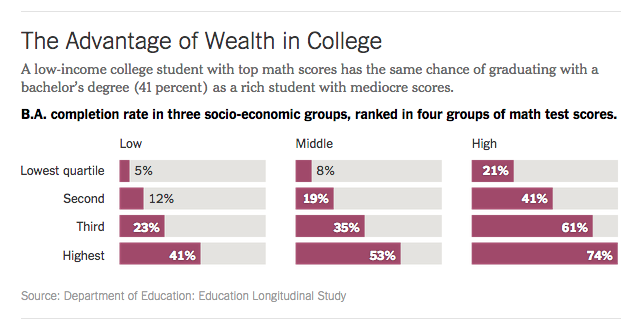
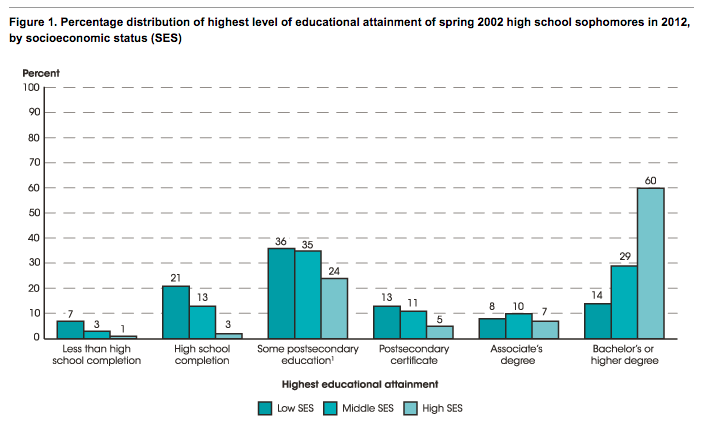
Rich and poor students don’t merely enroll in college at different rates; they also complete it at different rates. The graduation gap is even wider than the enrollment gap.

These sobering facts come from a longitudinal study and a connected report. And the data are stunning, but clear:

vantage of wealth in college
Source: Department of Education: Education Longitudinal Study

edu attainment distribution SES
SOURCE: U.S. Department of Education, National Center for Education Statistics, Education Longitudinal Study of 2002 (ELS:2002), Base Year and Third Follow-up. See Digest of Education Statistics 2014, table 104.91.

Further, Dynarski continues, and then concludes:

Academic skills in high school, at least as measured by a standardized math test, explain only a small part of the socioeconomic gap in educational attainment.

Here’s another startling comparison: A poor teenager with top scores and a rich teenager with mediocre scores are equally likely to graduate with a bachelor’s degree. In both groups, 41 percent receive a degree by their late 20s.

And even among the affluent students with the lowest scores, 21 percent managed to receive a bachelor’s degree, compared with just 5 percent of the poorest students. Put bluntly, class trumps ability when it comes to college graduation.

Poor students are increasingly falling behind well-off children in their test scores, as recent research by Sean Reardon at Stanford University shows.

That is, any poor children who manage to score at the top of the class are increasingly beating the odds. Yet even when they beat the odds in high school, they still must fight a new set of tough odds when it comes to completing college.

#

Steph Curry has gained a well-deserved high level of recognition as the NBA League MYV in the 2014-2015 season. Like Grant Hill, Curry is the black son of a successful and wealthy professional athlete.

Curry is recognized as a hard worker—practicing at rates and amounts that most people cannot comprehend.

An ideal role model for black males in the U.S.?

Not according to high school English teacher Matt Amaral, who recently posted Dear Steph Curry, Now That You Are MVP Please Don’t Come Visit My High School and asked of Curry: “But I have to ask you to do me a solid and make sure you don’t ever come visit my high school.”

Amaral is making a concession I have argued above.

Curry is an outlier, and the personification of a potentially corrosive promise: You can be anything if you just work hard enough.

Well, no, that isn’t true.

So those of us who are parents and educators are put in a truly ugly position.

I love to inspire and encourage young people. I dearly and deeply love young people.

But I also cringe at the adult proclivity to lie in order not to face themselves the ugly truths they create and perpetuate—often by refusing to face them.

There is tremendous value in hard work and effort for the sake of hard work and effort.

And, yes, the world should be a meritocracy, the world should be fair.

Pretending it is while it isn’t, wrapping our young in shallow feel-good slogans and stories—these are sure ways never to achieve the equity we say we love in the U.S.

If we do not want to tell students the real American success story—the one about winning the birth lottery—we damn well better do something to create a better story instead of continuing to lie to children and ourselves.

Because, as you know, it is entirely within your power to make things different, right?

See Also

UPDATED (Again): Grit, Education Narratives Veneer for White, Wealth Privilege

Telling Poor, Smart Kids That All It Takes Is Hard Work to Be as Successful as Their Wealthy Peers Is a Blatant Lie, Taylor Gordon

The Unintended (and Mostly Ignored) Lesson of Common Core: Race Inequity

You would be well advised to read Andre Perry’s examination of Common Core and race, carefully and possibly more than once: How Common Core serves white folks a sliver of the black experience.

I would also like to draw your attention to two key points that may get lost in the provocative and powerful crux of Perry’s piece:

I simply can’t manufacture the passion for or against curricula reboots or changes that eventually must happen. I’m sure there’s someone still lobbying for Home Economics as a required course, but gladly most have progressed. The researcher in me can’t argue against wanting a better means to measure educational performance nationwide. However, having the ability to compare performances among groups hasn’t brought educational justice to black and brown students [emphasis added]. Still, I know that kids overcome….

As Sen. Lamar Alexander-Tenn., chairman of the Senate Committee on Health, Education, Labor and Pensions, and Sen. Patty Murray, D-Wash. rewrite No Child Left Behind, they must consider giving teachers the freedom to teach while providing consequences to those districts and schools that don’t provide the education all students deserve [emphasis added].

Finally, I want to make two responses to Perry’s piece—with the caveat that I am not suggesting my perspective is better but that I have held nuanced differences with some of the important issues Perry is raising.

First, unlike Perry, I do not support Common Core because I do not support any standards changes as well as the inevitable high-stakes testing standards-based reform produce because—as Perry himself notes above—standards and high-stakes testing have not (and will/can not) create the equity in education all children deserve.

And finally, I am an advocate for the inverse of what Perry has scathingly recognized about the backlash against Common Core: “Common Core is serving white folks a sliver of the black experience.”

Education reform needs to make two dramatic shifts: (1) Commit to social reform first, and then (2) address equity of opportunity for all students (again, as Perry notes above).

My grand plan would be not that we subject privileged children (mostly white) to the horribly inadequate and criminally reduced educational experiences that have failed black and brown children for decades, but that we grant black and brown children the dignity they deserve by guaranteeing them the rich and rewarding educational experiences that privileged children have received on top of their privileged lives for decades as well.

As Perry highlights:

Black, brown and poor people take tests every single day. Confrontations with police, hunger, unemployment and biased teachers overshadow the feelings of taking computerized tests. Low expectations, a lack of inclusion, a leaky teacher pipeline for communities of color, and punishing disciplinary policies [hyperlink added] all threaten authentic learning and teaching more than PARCC and Smarter Balanced tests ever will.

For good reason, people in the ’hood have always been more worried with how test results are used.

It is no flippant call to say that all black and brown children deserve the schooling Barack Obama’s daughter have—and not the abusive and insulting “no excuses” charter schools many now must endure.

Ultimately, any aspect of the Common Core debate is an inexcusable distraction—”it’s easier to shout down Common Core than battle for a viable solution to our accountability problem,” Perry acknowledges—and it is thus vital that we open our eyes as Perry demands we do.

#Isuck: On the Heart, the Vulnerable, and Listening

“You must listen to me.”
Muhammad Ali

The 2015 Assault on Mt. Mitchell was the 40th anniversary of a challenging cycling event that begins in Spartanburg, SC and covers over 100 miles to the top of Mt. Mitchell, the highest point east of the Mississippi River.

Mount Mitchell State Park, Mount Mitchell Tower. Edward Farr (2014-11-11)

Including this year’s event, I have been riding the Assault since 1988, entering about 18 times. As I lined up a few days ago, the 6 AM temperature was already over 70 degrees, and heat is my kryptonite. So despite my hope otherwise, within fewer than 15 miles, I knew my day was going to end well short of the top of the mountain.

About three or so hours later, I rolled into Marion, the 75-mile mark, and abandoned.

When I uploaded my ride to Strava, I labeled it “I suck.” In part, the label was a typical effort to deflect, to mask among those of us with low self-esteem—self-deprecating humor. The numerous “likes” this received on Strava was interesting, and funny: Were my friends “liking” that I suck? Were they confirming that I suck?

With a cumulative 10,000+ feet of climbing, the Assault route is very hard, rolling and challenging hills throughout the first 30-40 miles, and then a short mountain climb, Bill’s Mountain, at about the 50-mile mark.

During the 2015 Assault on Mt. Mitchell, I stop at the Bill’s Mountain rest stop where good cycling friends Kelly and Steve treat me kindly.

The ride from Bill’s Mountain to Marion, the campground where all riders are brought after ascending Mt. Mitchell some 30-plus miles farther on the route, includes rolling and steep grunt hills.

This year, I dropped from the front group at the 12-13-mile mark—although in 2014 (and many years in the past), I stayed with the front group past Marion and onto the challenging first extended climb (3-4 miles) along Highway 80 leading to the Blue Ridge Parkway.

My 2014 Assault has proven to be even more significant after this year. Despite being with the top riders after almost 80 of over 100 miles of the event, I nearly quit in 2014. I became increasingly depressed as I climbed Highway 80, and then creeped along the next 12-plus miles of the Parkway, concluding with the hellish final 5 miles in Mt. Mitchell State Park.

However, at the age of 53, I discovered once I finished in 2014, I have achieved my highest placing ever, 58 out of more than 800 participants and over 600 finishers.

Endurance cycling is often as much psychological as physical, and especially for me, the competition is primarily with myself—pushing myself when I am on the edge, surpassing what I have accomplished before, performing along with cyclists much younger and much more gifted than I am.

Age—I struggle to admit—becomes a terrible weight on this self-competition, the realization that my best efforts must begin to always fall short of my younger self. This is a cruelty of sport that is humbling at best and demoralizing at worst.

My early life as a serious cyclist was spent often with two riding partners, Don and Dave—both were older and much stronger cyclists. On most rides, they dropped me, and often, they berated me.

On Tuesdays, we went to the Donaldson Center near Greenville, SC to do a practice race around a 7-mile loop. The practice race began with a warm-up lap, but I was typically dropped quickly in the first race lap (practice races were about 3-4 laps early in the summer, expanding to a 10-lap race on the longest daylight of the summer).

Dave was adamant in those early years that I was just quitting—that all I had to do was push myself and I’d discover I could remain with the main pack. I was certain Dave was wrong, that these cyclists were just better than me.

That was well over twenty years ago, and not long after Dave admonished me in those first several weeks of doing the practice race, I discovered Dave was right. I held on, I finished the practice races, and I discovered a hobby that continues to teach me the value of pushing myself.

In many ways, despite my advancing age, I have been a much better and stronger cyclist throughout my mid-40s and into my mid-50s than when I was racing in my 30s.

Once I was dropped from the front group during this year’s Assault, I had to confront that my heart wasn’t in it. I think in part, that is the result of growing older and wiser, and a large part has to do with what now occupies my heart.

My daughter and granddaughter certainly have recaptured and captured a significant amount of my passion. As a serious cyclist for 30 years, I have put cycling before many things, but in the last year, I have set aside riding, happily, to see my daughter and granddaughter (my longest drought away from the bicycle was when my daughter was young and I spent a large amount of my life supporting her being a soccer player).

I don’t believe our hearts are finite—we can love deeply people and things without having to choose what things and people receive our love and what things and people do not.

But as the heat of this year’s ride intersected with my heart being strongly drawn to people I love and not my own cycling, I was both open to simply stopping the ride early as well as at peace with that decision.

Nonetheless, while my heart wasn’t fully in the ride, my heart also hurt at having failed me.

Those painful miles between psychologically abandoning the event in the first hour and then physically abandoning the ride in Marion were travelled by a vulnerable man.

Periodically, I found myself in groups with my cycling friends, some of whom were also struggling mightily.

On one the hardest hills before reaching Marion, I saw a friend and said, “It’s hot.” He immediately said, “It’s not the heat, it’s the humidity.”

Matt Bruenig has recently explained and shown graphically that over 80% of the poor are “vulnerable populations.”

As a white male with a lucrative and stable career, I am certainly not among the vulnerable, but my cycling hobby (one I can pursue because of my privilege) often renders me vulnerable—stressed, overwhelmed, depressed, and distressed.

The unintended consequence of this hobby, for me, includes those moments when I am forced to consider those who have no choice about being among the vulnerable.

A poor child cannot abandon that poverty—although I was allowed to abandon with almost no consequences this year during the Assault.

As well, while in a self-induced vulnerable state, when a friend did not listen to me (“It’s hot” was a genuine and all-too-real expression of my reality) and immediately imposed his view over mine, I was further deflated.

That mostly inconsequential moment has remained with me especially since I am now teaching a May course on educational documentaries and asking my students to listen to perspectives (of the poor, or racial minorities) that are often different from their own, and that directly challenge beliefs they have never questioned.

My students are facing how documentaries choose whose voice matters, whose voice is allowed—but they are also being challenged to listen while setting aside a perspective they prefer, a perspective that keeps them from listening with any sort of empathy for how another person’s life is.

My #Isuck tag for my athletic failure, I believe, is a way to embrace a humility that is necessary for my own recognition of my humanity and the humanity of everyone else.

Arrogance has a way of appearing to pay off in sport and life, but the consequences of that arrogance are tremendous because in our arrogance we are denying our human dignity, and the dignity of others.

There must always be room in our hearts for allowing the voices of the vulnerable, of course, but we must also be eager to listen to stories of others or the Others as if they are our own because they are.

From #Ferguson to #BaltimoreUprising, voices are being raised, demanding they be heard.

In the web of those tragedies, Tamir Rice, too, has had his life reduced to a hashtag—and is mostly forgotten while those in power seek to rewrite his story in his absence. But his story lives in his family members—who are we if we are willing to listen with open hearts.

Those of us fortunate not to be among the vulnerable are bound by our privileges to listen with empathy and then to act—but the vulnerable should not have to demand that we do.

Mostly in the U.S., we the privileged have abandoned that responsibility, and when we do, we must admit #Wesuck.

Anatomy of a Political/Personal Poem

Politics, succinctly stated, is the negotiation of power among agents (humans, mostly, but one could argue along literary lines, humans versus nature, etc.). As a critical educator, I argue we cannot avoid being political; to claim you are not being political is being political—as expressed in Howard Zinn’s observation that you cannot be neutral on a moving train.

Below, I want to annotate a new poem of mine, as it represents the inescapable intersection of the political and the personal. As a writer, I occasionally bring my own writing into the classroom in order to be a witness to investigating a text.

My high school English students always felt very skeptical of English-teacher-as-text-authority holding forth about Writer X or Writer Y using this metaphor or symbol. Students often asked, How do you know Writer X did that on purpose?

So with my own work, I can truly reveal what is beneath a poem (the iceberg metaphor about art is useful here, but inadequate, I think, because I want something more organic such as a huge root system beneath a tree that continues to spread). I can help a student tease through my intent as well as how meaning may spring from those places where my conscious intent was lacking in the original writing.

On a companion blog, I have discussed this more broadly before, but my Poet Self is a different beast than my prose self. Poetry tends to come to me (often the first lines simply ask/demand to be written, feeling mostly not of my making but more that I have received them), and then I typically compose the full poem over several recursive hours of writing, reading, reading aloud, and re-shaping as I discover what the poem is intending to say.

What films I am watching, what books I am reading, what music I am listening to—these all become dialogues with my Poet Self, many times fueling the initial inspiration to write (and thus, many of my poems have quotes at the beginning, as below).

In an effort to avoid the cumbersome (and possibly slipping directly into the cumbersome), I am using bracketed notation, including the notations first, and then including the entire poem last—as I am not completely sure how best to format all this on a blog.

Anatomy of a Political/Personal Poem

[1] After talking to a friend who also loves The National, I have been listening to several of their albums over and over while driving to work. I love “Slipped” and noticed its use of season and that overlapped my spring motif for this piece. These lines also speak to the central two repeated lines about the inadequacy of making guarantees.

[2] One Monday, two hail storms pelted my university, the first during the morning while I sat in my office. That day was eerie in the changing weather patterns and this opening did just come to me, the first line and then I began to play with radar representations of storms, which established “screen” and “color” motifs for the poem.

[3] Pollock, O’Keefe, and cummings helped me think about representation of reality through art (what is True versus what is true/fact). The poem (as are many of my poems) is a not-so-subtle tribute to cummings in the lower-case versus uppercase as well as the use of & to suggest two/multiple things as one.

[4] Since #BaltimoreUprising has emerged as the shorthand for the current unrest in Baltimore, I have not been able to shake the power of “rising”—I think of The Dark Knight Rises, Phoenix/Jean Grey from the X-Men, and the enduring myths of rebirth.

[5] Although ending the first section, I came back to these lines over and over until I recognized the need to emphasize this poem is about calls to notice what we ignore, miss—on both personal and political levels. Nature demands we pay attention to our puniness, but humans fail again and again due to our arrogance. Humility comes from looking up and then really looking.

[6] Yes, literally I sat through two hail storms, and yes, literally, I am addressing my granddaughter. Throughout my poetry, I have examined the weight of not noticing until too late “the last time,” but with my granddaughter, I have become more aware of “first times.” The hyperlink is to my first poem about my granddaughter, written before she was born and even before we knew her gender. I use “sky” in poems about her as her name is Skylar.

[7] As I continued to shape and re-shape the poem—polish, prune, and always choosing the right (only?) word—I recognized that the piece demanded a “mother” motif—one I allowed to remain fairly hidden or mostly implied. In a blog post, I have examined more directly the Western/Christian use of Nature to mythologize human ideas about evil/good (specifically with snakes), and those ideas are suggested here.

[8] Storytelling, mythologizing—what story does weather radar tell? What about mainstream cable news? I am almost always thinking about Margaret Atwood’s examination of telling and retelling (notably in The Handmaid’s Tale). As I was coming to see the poem as “finished,” I realized the power of repeating these lines in both the context of my granddaughter (the personal) and the uprising in Baltimore (the political). I hope the “we” and “you” are both necessarily ambiguous and directly evocative of real people in real situations of passion and human frailty.

[9] Although this section, I feel, pulls together central motifs about “motherhood,” “Nature,” and storytelling/mythologizing, I must again confess this actually happened. People have been telling my daughter this “story” about snakes in springtime, and she paused sharing this with me one morning on her way out to work as I was there to provide care for my granddaughter. My daughter and I are worriers, anxious souls. We don’t need to hear such things. Here I also decided to use italics to offer some sense of discourse, some agents of actual telling. Again, as part of my visual self (cummings, comic books, films), I feel the poem sporadically zooming in and then pulling back—both the writer telling a story but also the camera capturing the story.

[10] The cable news section builds and then extends the motifs, but I struggled with how to blend this element with the personal sections that were much easier, natural to compose. I watched the Baltimore coverage as it happened, mostly flipping between CNN and MSNBC, using Twitter to guide me—experiencing how an event unfolding in real time is shaped by who and how the story if composed.

[11] My poem titles tend to include a main and then parenthetical title. Typically, as I start a poem I have only the main title and then a parenthetical reveals itself. “Baltimore is burning” was that organic element here, simple and alliterative as well as disturbing.

[12] These two lines echo and reinforce the first two lines with the “screen” and “color” motifs. The use of “yellow” and “black” also carry layers of connotation. The “yellow” of literal fire on the TV screen but “yellow” carries both “cowardice” and “caution” while “black” captures the literal night as well as race. “Blossom” also is central to the concepts of spring (as seasonal and as political renewal) while adding some tension to images that are positive and negative, sometimes simultaneously (flowers and fires can blossom).

[13] The hardest and slowest developing lines of the poem are these four. I struggled against slipping into mere commentary (losing the poetic), but I also wrestled with my urge to confront “minstrel show” and “black face” as part of the unmasking of racist mainstream media coverage while striking an objective pose of presenting both sides. The allusion to Fox News remains, but I never fully formed the thought of MSNBC being “Minstrel Show NBC.” The puppeteering and make-up (masking) felt necessary, but not satisfying until I placed this section as parenthetical, a bit of mechanical cloaking to reinforce the masking motif.

[14] The Baltimore refrains originally were all “is” sentences, but despite the importance of “Baltimore is burning,” I moved toward “Baltimore [verb]” and played with quite a number of combinations of verbs. “Witnesses” is a very subtle allusion to James Baldwin, and more directly, “explodes” (as I hyperlink) is an allusion to Langston Hughes’ “Harlem.” The natural and human-made storms are blended by the last section, framing the poem with storm, hail, and wind.

[15] I return to italics to suggest someone is speaking to some audience, but here the ambiguity is much more significant and purposefully broad. I like the rhythm of the “if” statements, and one of the best edits of the poem, I think, was being drawn to one of my favorite R.E.M. songs, “The Flowers of Guatemala,” a beautiful and powerful political song about Central America/U.S. politics. I lift almost directly “The flowers cover everything,” and share the song’s focus on paying attention to the masked, invisible: “There’s something here I find hard to ignore.”

[16] Completing the news image earlier of “minstrel show,” I return to the soot of the Baltimore fires turning everyone black, in black face, as a plea to “If everyone looked the same, would we do better?” The repetition of “recognize” also links back to the parenthetical commentary on the news media and reinforces the tension between paying attention and masking.

[17] Especially in poems, but essays as well, I seek always to frame so I had to return to “Baltimore is rising” even though I had elected to use the “Baltimore [verb]” constructions to open the last section. I was stuck for a while with “Baltimore is Phoenix,” which seemed both to work and falter. Here is where my revision strategy of reading aloud over and over was key. “Baltimore is burning/ Phoenix rising” sounded right aloud. Alluding to Harlem, directly addressing Baltimore, and Phoenix as a city name felt suggestive as well.

[18] I liked these lines as a bit of sincere resignation of grandparent/parent to child when I first wrote them (never edited, and felt right immediately). In the context of Baltimore and the ambiguity of that last section about “we” and “you,” I think, the lines work well to pull most of the key motifs and themes together, specifically the idea of “story telling” as both seeking and blurring Truth/truth.

first spring (Baltimore is burning)

“It’ll be summer in Dallas/ Before you realize/ That I’ll never be/ Anything you ever want me to be”
“Slipped,” The National [1]

thunderstorms blossom on the radar
green yellow red maroon [2]

like animated flower bouquets created by
Jackson Pollock Georgia O’Keefe & e.e. cummings [3]

because springtime is rising again [4]

hail taps my office window
rattled by wind gusts in shared rhythm

this season demands i pay attention
this building storm lifts my eyes [5]

/

precious child of my child
this is your first spring [6]

your first angry sky
your first thunder&lightning

we will hold&comfort you
but only you can understand Mother Nature [7]

we can tell you stories in soothing tones
but we cannot guarantee anything [8]

except our hearts are filled with you
etched forever into the bones of us

/

this is the story they are telling my daughter

snakes can smell when you are nursing
slithering into your house for the milk

snakes will strangle nursing babies
sleeping&dreaming in their cribs alone

my child who is a mother tells me this
her eyes&voice beg of me a mother’s plea

what is a mother to do what is a mother to do
if even Nature conspires against her baby [9]

/

the news tells me this story in the last days of April [10]

Baltimore is burning [11]
thugs rioting&looting

flames blossom on the TV screen
yellow black yellow black [12]

(if you look close enough you can recognize
the strings&make-up but not the puppeteers

performing this 21st-century minstrel show
masquerading as fair&balanced reality TV) [13]

/

Baltimore cries
Baltimore witnesses

like the first thunderstorm of spring
tossing hail&wind against your window

Baltimore shouts
Baltimore explodes [14]

if the fires are large enough
if the fires burn long enough

if the soot covers over everything [15]
painting every single face black

will you listen will you look
will you recognize will you act [16]

Baltimore is burning
Phoenix rising [17]

we can tell you stories in soothing tones
but we cannot guarantee anything [18]

—P.L. Thomas