Category Archives: race

#BaltimoreUprising and the Politics of “Myths That Deform Us”

They know they would not like to be black here. If they know that, they know everything they need to know. And whatever else they say is a lie….The American idea of progress, when Americans talk about progress, they mean how fast I become white. And it’s a trick bag because they know perfectly well I can never become white….

James Baldwin, 15 January 1979

Politics in the U.S. is carefully and meticulously restrained, walled off as mere partisan politics, the manufactured and mostly illusion of choice (hence, of democracy) between Republicans and Democrats—both of which are in the service of capitalism, commercialism, and consumerism.

As such, Republicans and Democrats are different sides of the same economic coin, both depending on the false threat of socialism and both fostering the narrow and distorted gaze always on economics. The U.S. has no capacity for looking away from the coin and toward what the coin represents: Power.

Not to be too simplistic, but the system is irrelevant because the powerful few will always work that system to maintain power, and thus to keep the vast majority subservient. In that respect, the former USSR serves well to show that so-called communism works in many of the same ways as capitalism to serve the few.

Capitalism, communism, socialism, and even democracy, then, are not really economic or political systems as much as they are stories, mythologies—ways of framing the world to serve the needs of the powerful at the expense of the powerless.

Made popular by Bill Moyers, Joseph Campbell spent his career seeking ways to bring a better understanding of comparative religion studies and mythology into pop culture. Campbell explained that “[m]yth basically serve four functions”: mystical, cosmological, sociological, and pedagogical.

The third function, sociological, “[supports] and [validates] a certain social order”:

And here’s where the myths vary enormously from place to place. You can have a whole mythology for polygamy, a whole mythology for monogamy. Either one’s okay. It depends on where you are. It is this sociological function of myth that has taken over the world—and it is out of date. (p. 31)

As a powerful example, Moyers and Campbell discussed the representation of serpents/snakes in myths, starting with the Christian Garden of Eden myth, but also highlighting the parallel Bassari legend. “It’s very much the same story,” Campbell explained (p. 45).

And from this, Campbell noted where the sociological functions vary regarding serpents/snakes: “Now the snake in most cultures is given a positive interpretation,” he added (p. 47). However, the Christian framing is uniquely negative:

Moyers: In the Christian story the serpent is the seducer.

Campbell: That amounts to a refusal to affirm life. In the biblical tradition we have inherited, life is corrupt, and every natural impulse is sinful unless it has been circumcised or baptized. The serpent was the one who brought sin into the world. And the woman was the one who handed the apple to the man. The identification of the woman with sin, of the serpent with sin, and thus of life with sin, is the twist that has been given to the whole story in the biblical myth and doctrine of the Fall.

Moyers: Does the idea of woman as sinner appear in other mythologies?

Campbell: No, I don’t know of it elsewhere. (p. 47)

In its sociological function, the myth of the Fall serves men, the power and purity of men by imposing sin onto serpents/snakes and women.

Paulo Freire confronts the power of myth:

To the extent that I become clearer about my choices and my dreams, which are substantively political and attributively pedagogical, and to the extent that I recognize that though an educator I am also a political agent, I can better understand why I fear and realize how far we still have to go to improve our democracy. I also understand that as we put into practice an education that critically provokes the learner’s consciousness, we are necessarily working against the myths that deform us. As we confront such myths, we also face the dominant power because those myths are nothing but the expression of this power, of its ideology. (p. 41)

#BaltimoreUprising and the Politics of “Myths That Deform Us”

The abrupt shooting of Tamir Rice offered a horrifying moment to confront the “myths that deform us,” as Stacey Patton explained, placing Rice’s shooting within the historical context of Emmitt Till.

As well, Rice’s shooting has been informed by research showing that black children are mis-seen as being older, even by people in authority (such as police officers, teachers).

The relentless string of highly publicized shootings of black males has now exploded in Baltimore, a perverse real-world allegory of the consequences of the sociological function of “myths that deform us.”

Placing as we should all of the incidences from Trayvon Martin until today (since memory in the U.S. is brief, ahistorical), we must acknowledge that blacks live daily under the “myths that deform us,” often myths ascribed to the power of Church and God: biblical arguments for slavery, biblical arguments against inter-racial marriage, biblical arguments for beating children (and parallel marginalizing and dehumanizing women with the Word of God).

The Western/Christian iconography and symbolism preaches black is evil and white is pure: the corrupt that must be purified and the pristine that must be preserved.

These “myths that deform us” have also been given the veneer of science—IQ and decades of standardized tests that serve the interests of white, affluent males, keeping people of color, the poor, and women behind the wall of not measuring up.

Watching #BaltimoreUprising requires that we listen to and look at carefully in order to confront the Thug Myth being used to maintain with perpetual surveillance a culture of compliance shaped by and for white privilege.

Race itself is a myth, a human construction, not a biological fact. The associations (prejudices, stereotypes) with race (young black males are thugs, looters, rioters) are no more true than snakes are evil.

Those who control the myths (that deform us) have fashioned these stories in their honor, for their gain.

As Baltimore rises, those who deny racism continue to have an evidence problem, one that must serve to crumble their “myths that deform us.”

#BaltimoreUprising exposes that white privilege cares more about private property than human life—even as a black man sits in the White House.

We must tear down the wall.

Incident, #BaltimoreUprising 2015

“And I must say tonight that a riot is the language of the unheard.”
Martin Luther King Jr., “The Other America” 14 March 1968

“We know of course there’s really no such thing as the ‘voiceless’. There are only the deliberately silenced, or the preferably unheard.”
Arundhati Roy, “Peace and the new corporate liberation theology,” The 2004 Sydney Peace Prize Lecture

“The law is meant to be my servant and not my master, still less my torturer and my murderer.”
James Baldwin, “A Report from Occupied Territory,” The Nation 11 July 1966.

Countee Cullen’s “Incident” is a powerful and disturbing confrontation of racism as well as the enduring impact of racial slurs: “And so I smiled, but he poked out/His tongue, and called me, ‘Nigger.’/…That’s all that I remember.”

In the last days of April 2015, Cullen’s Baltimore has once again answered a haunting question about another city, “Harlem” by Langston Hughes: “Or does it explode?”

“Rioting broke out on Monday in Baltimore,” begins Ta-Nehisi Coates, adding—

an angry response to the death of Freddie Gray, a death my native city seems powerless to explain. Gray did not die mysteriously in some back alley but in the custody of the city’s publicly appointed guardians of order. And yet the mayor of that city and the commissioner of that city’s police still have no idea what happened. I suspect this is not because the mayor and police commissioner are bad people, but because the state of Maryland prioritizes the protection of police officers charged with abuse over the citizens who fall under its purview.

The citizens who live in West Baltimore, where the rioting began, intuitively understand this. I grew up across the street from Mondawmin Mall, where today’s riots began.

I read these words in the wake of watching this incident on mainstream news coverage, the same media that covered the avalanche in Napal as the death of a Google executive.

The coverage of Baltimore became an avalanche of “thug” punctuating comments by political leaders—white and black—and commentators.

And then one of the cable news talking heads interrupted one guest to lecture her about “paddy wagon” as an offensive term—a whitewashed interlude before the onslaught of “thug” resumed.

Coates concludes: “When nonviolence is preached as an attempt to evade the repercussions of political brutality, it betrays itself”—exposing that in the decades since King, “the preferably unheard” remain ignored, marginalized, the victims of the relentless daily violence of poverty and discrimination. But their circumstances as well as their options for raising their voices are determined for them, for the benefit of those who tolerate and perpetuate that daily violence.

The day after this recurring incident of Baltimore 2015 erupted, I write this while being the care provider for my bi-racial granddaughter, only 9 months old.

She is the glorious embodiment of racial harmony, but she has yet to recognize the world for all its remaining evils.

Our privilege will insulate her in many ways against the inequities that have fueled Baltimore’s unrest, but someday she too likely will feel the sting that shaped the speaker of Cullen’s poem.

At least as long as the calculated white gaze and accusatory finger remains selectively on who and what and refuses to confront and address why.

What If Standardized Tests Were Biased Against Whites, Males, Affluent?

In my Marvel collecting days, I bought the first issue of What If?—begun in February of 1977 with “What If Spider-Man Joined the Fantastic Four?”

Marvel and DC have since then ventured into rewriting their comic book universes and even creating alternate universes for such thought experiments, but in the late 1970s, this was exciting stuff.

So much so, I want to apply this concept to standardized testing to ask the following:

1972 2014 SAT M v. F

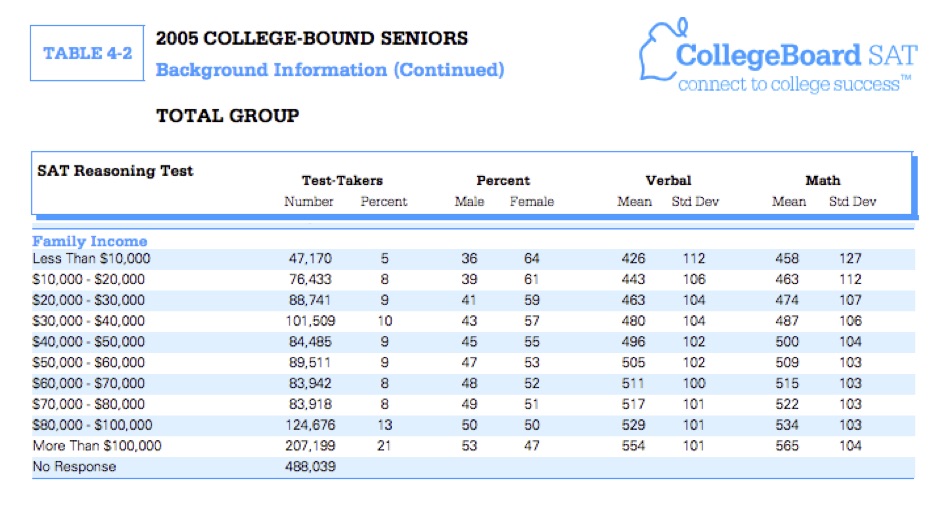
  • What if standardized tests were biased against white, affluent males in ways that denied them access to college? Data from the 2005 SAT (the last year they separated data by gender and wealth) show that impoverished females disproportionately take the SAT while affluent males disproportionately take the SAT; see this chart:

2005 SAT M v. F plus wealth

  • What if standardized tests used to retain children in 3rd grade disproportionately retained while, affluent males? Grade retention impacts significantly impoverished and minority students, both pre-high-stakes accountability and then post-NCLB. From a 2000 research analysis of grade retention:

We review the policy context of school retention and show that age-grade retardation has been common and growing in American schools from the 1970s through the 1990s. Our analysis focuses on the period from 1972 to 1998 and on grade retardation at ages 6, 9, 12, 15, and 17. By age 9, the odds of graderetardation among African-American and Hispanic youth are 50 percent larger than among White youth, but these differentials are almost entirely explained by social and economic deprivation among minority youth, along with unfavorable geographic location. Because rates of age-grade retardation have increased at the same time that social background conditions have become more favorable to rapid progress through school, the observed trend toward more age-grade retardation substantially understates growth in the practice of holding students back in school. While there is presently little evidence of direct race-ethnic discrimination in progress through the elementary and secondary grades, the recent movement toward high stakes testing for promotion could magnify race-ethnic differentials in retention.

And then from a 2013-2014 position statement from the International Reading Association:

African American and Hispanic students and students living in poverty are most affected by grade retention practices that use the results of high-stakes assessments for decision making. Achievement patterns reveal wide disparities between the achievement of white students and that of African Americans and Hispanics (National Center for Education Statistics, 2011); thus, it follows that there would be similar differences in the number of students retained in each subgroup. In 2009–2010, African American students represented 49% and 56% of the third and fourth graders who were retained, respectively, which was disproportionate to their representation in those grades; Hispanic students were twice as likely to be retained than their white counterparts (Adams, Robelen, & Shah, 2012)….

  • What if standardized tests were biased against white, affluent males, denying them high school graduation? Also from the IRA position statement:

As with the outcomes of third-grade retention policies, African Americans, Hispanics, and students living in poverty are most affected by the use of high-stakes assessments for diploma decisions….

Policymakers may believe that linking grade retention and high school graduation to students’ results on high-stakes assessments will motivate students to perform better, but instead, evidence indicates that these practices have harsh and lasting consequences for students academically, psychologically, socially, and economically (Baker & Lang, 2012; Jimerson, 1999; Jimerson, Anderson, & Whipple, 2002; Norton, 2011; Walker & Madhere, 1987; Yamamoto & Byrnes, 1984).

I must, then, ask broadly, what if standardized tests were historically and then currently a powerful metric that closed doors for determining the educational and life opportunities of while, affluent males?

Would there be the same unyielding defense of the necessity for high-stakes tests?

Bonus What If…?

What if, instead of declaring race-based considerations for college admission illegal, we banned the use of legacy admissions? Historically and currently, for the outlier white, affluent male who does not score high on standardized tests of college admission another door is open wide, legacy admissions.

#WalterScott: A Reader

“The law is meant to be my servant and not my master, still less my torturer and my murderer.”
“A Report from Occupied Territory,” James Baldwin (The Nation, July 11, 1966)

Black Death Has Become a Cultural Spectacle: Why the Walter Scott Tragedy Won’t Change White America’s Mind, Brittney Cooper

Cooper bad applesThe Myth of Police Reform, Ta-Nehisi Coates

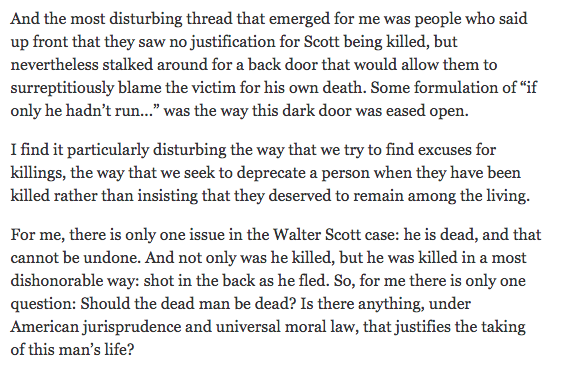
Coates Scott flee

When Cops Cry Wolf, Frank Serpico

Serpico testi-lyingWalter Scott Is Not on Trial, Charles Blow

Blow on Walter Scott

Walter Scott, just another ‘isolated incident’?, Leonard Pitts Jr.

Pitts Walter ScottAt Walter Scott’s Funeral, An Unexpected Conversation, Chenjerai Kumanyika

Clemson N Chas

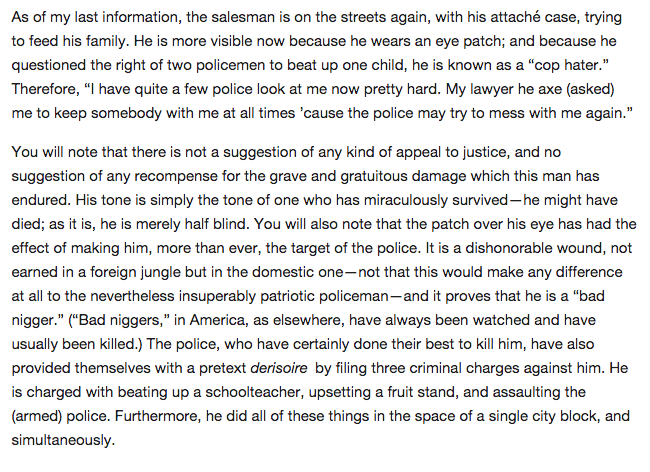
“A Report from Occupied Territory,” James Baldwin

Baldwin bad niggerBolton: Don’t forget Walter Scott while protesting North Charleston shooting

Bolton: ‘You run, you die’ isn’t effective policing

White Denial

Police Officers and Teachers: Confronting Corrupt Cultures, Avoiding “Bad Police/Teacher” Narratives

Police Officers and Teachers: Confronting Corrupt Cultures, Avoiding “Bad Police/Teacher” Narratives

Officer Michael Slager shooting and killing Walter Scott in North Charleston, South Carolina—with a video discrediting Slager’s version of the events (and exposing what Frank Serpico calls “testi-lying”)—has cast another dark cloud over justice in the U.S.

More recent revelations of Slager laughing after the shooting add, if possible, even more incredible to an already horrifying series of events. The context of that laughter, however, must not be ignored:

In the recording, a man the paper identified as Slager can be heard asking an unnamed senior officer what would happen next.

“They’re gonna tell you you’re gonna be out for a couple of days and we’ll come back and interview you then,” the senior officer is heard saying in the clip. “They’re not going to ask you any kind of questions right now. They’ll take your weapon and we’ll go from there. That’s pretty much it.”

The senior officer also urged Slager to write down his recollections of the incident.

“The last one we had, they waited a couple of days to interview officially, like, sit down and tell what happened. By the time you get home, it would probably be a good idea to kind of jot down your thoughts on what happened,” he advised. “You know, once the adrenaline quits pumping.”

“It’s pumping,” Slager said, laughing as he spoke.

This exchange appears to be a specific example of yet another norm of policing in the U.S.—one different but related to the inequity of criminal justice for black males—in that using deadly force requires officers simply to wait a few days until it all passes over. Deadly force seems all too common place, and essentially poses almost no consequences for the officer, who nervous, pumped up, and deeply calloused by his work, simply laughs.

I think we will make a terrible mistake if we simply conclude Slager is either a “bad apple” or inherently (although isolated) soulless. Dehumanizing police officer will not address the great failure of policing that dehumanizes black males.

Instead, we should be asking, what could possibly have led to Slager’s shooting, dishonesty, and laughter? Just as we should be asking, why would so many Atlanta teachers change test answers?

My wife and I combined have over 50 years as educators, and her father was a highway patrolman in SC. So is our nephew. I have several close friends who are police officers.

In other words, I am deeply sympathetic to the difficulties of serving as either a teacher or a police officer. But I am simultaneously, because of my intimate knowledge of both fields, highly protective of the necessity for teachers and police officers to serve and protect—not breech the dignity of those they serve.

I have the highest standards for teachers and police officers, and I fear the U.S. is increasingly moving to a careless demonizing of both professions.

The “bad” teacher myth had already begun when the spectacle of police officer shootings of black men reached a critical mass in the media, demanding the U.S. pay attention (despite racial inequity in the justice system being a historical reality in this country).

The current intense focus, then, on police officers and teachers requires careful consideration.

First, we must admit that all professions have a range of quality among the members of any profession; as well, we must admit that some professions have necessarily less tolerance for low quality within the profession—such as airline pilots, surgeons, pharmacists, and I would argue, teachers and police officers.

Next, even within those professions requiring high standards for members and low tolerance for weak members, we cannot discount how the working environment and norms of the profession are reflected in professionals’ behavior.

A pharmacist required to fill prescriptions at too high a rate is more likely to make mistakes. A pilot required to fly too many hours in a short span of time is more likely to make life-threatening errors.

Policing and teaching as service fields are certainly not exempt from those realities. Policing and teaching, in fact, share the consequence of both professions being much harder under the weight of impoverished communities, especially in urban settings, that are disproportionately racially majority minority.

As many have noted, the teacher cheating scandal in Atlanta may reflect more significantly the corrupt culture of high-stakes accountability than the individual faults of those teachers convicted.

Also being recognized is that police shootings of black men are equally powerful reflections of a racially inequitable criminal justice culture that also seems in the U.S. to have too low a bar for the use of deadly force—at least for some (black and male) suspects.

In the U.S., I believe, we do not know if we have a police officer and teacher quality problem because the cultures within which both work are so corrupted that police officer and teacher behavior can be misread as “bad apples” (or an “isolated incident”) instead of agents or consequences of the “burden of the impossible.”

If we care about teacher quality, we must significantly change the culture of teaching and learning by ending high-stakes accountability and competition within our schools.

If we care about police officer quality, we must significantly change the culture of deadly force (which many other countries have accomplished) and racially biased criminal justice.

Our schools and criminal justice system are too often ugly reflections of the worst aspects of our society—despite political and popular claims that both public institutions are designed to support and even build the life, liberty, and pursuit of happiness we claim to embrace for everyone.

As such, we must start by avoiding the urge to blame “bad” police and “bad” teachers and instead by confronting how the norms of policing and teaching too often produce police and teacher behavior that is harmful to our entire way of living, especially for the impoverished and racial minorities who most need public institutions to serve and protect them.

White Denial

[Atypical of my blog posts, please note that words often deemed offensive are included below.]

During the controversy over former LA Clippers’ owner Donald Sterling expressing racist comments on a recording by a companion, I highlighted Ta-Nehisi Coates confronting “oafish racists” as a public and political target to express token outrage but ignore systemic and lingering racism.

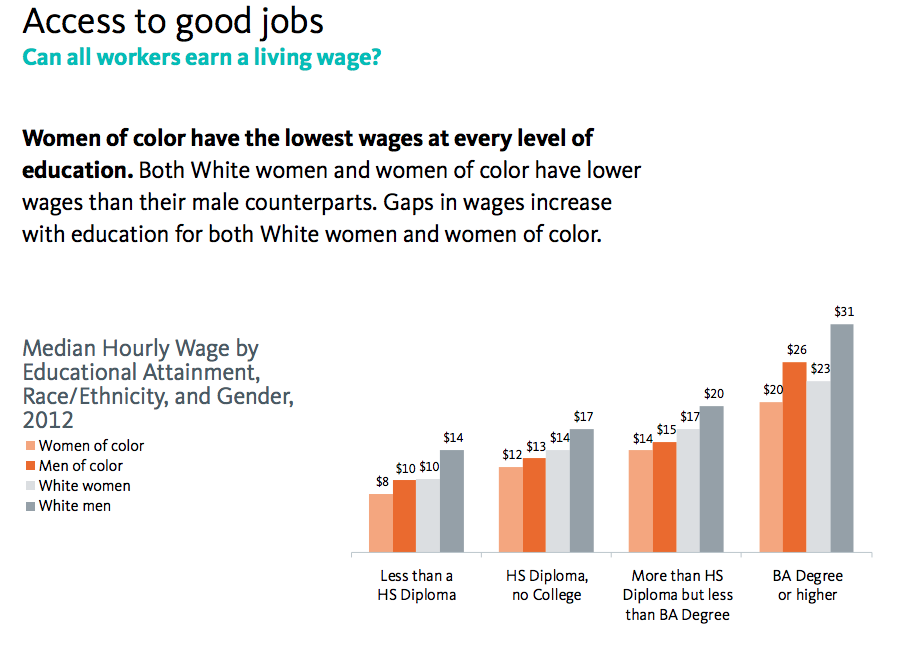
In many ways, businesses placing “No Blacks” signs in their windows were easier to refute than the less overt racism found when blacks and whites with the same education from elite universities receive inequitable opportunities for work, skewed in favor of whites. Or the blunt racism and sexism exposed by data:

access to good jobs race gender

That context serves well to understand how a young college student-athlete whispering “nigga” with a live mic nearby and a police shooting and killing of an unarmed black man in North Charleston, SC again speak to how white denial of racism perpetuates racism, especially when that denial is subtle.

First, a Kentucky basketball player trash talking off the court—when he should have been better aware of his surroundings—appears (and in many ways is) less significant than the shooting and killing of an(other) unarmed black male by a white police officer who also, as the video reveals, went to extraordinary and disturbing lengths to create a lie about his inexcusable actions.

However, the reactions to these separate events are very much equally illustrative of white denial of racism as a mechanism for perpetuating racism.

As a life-long Southerner and 30-plus-year educator, I have witnessed both the most vile use of “nigger” as a dehumanizing racial slur and a common response to blacks using “nigger”/”nigga”: Why can blacks say that to other blacks but whites can’t say it?

This is a common-sense mask for racism.

The common sense mistake in this claim is placing the offensive power within the word itself, instead of the context of its use and the agents involved, who uses the word and toward whom.

As listed below [1], marginalized and oppressed groups have often reappropriated slurs as an act of empowerment. Thus, the use of “nigger”/”nigga” between equals and the intent of that use are profoundly different than a white person (as an agent of white privilege) using that term to “put in her/his place” a black person (a target of oppression).

Since “nigger” is a volatile word (one I do not use and prefer that others do not use), let me offer another example.

I have also witnessed the use of “boy” as a way to demean others, both as a racist slur and as an attack on manhood—particularly in the South. In almost all ways, “boy” is a harmless word, but when an adult white male uses “boy” toward an adult black male, the word carries a level of offense nearing “nigger”; in fact, as the direct racial slur has become more publicly taboo, words such as “boy” and “thug” have gained weight as offensive words that seem covert to the users.

And yet, I hear no one claiming that “boy” should be banished from use by everyone.

Further, the evidence of the use of “nigger”/”nigga” in non-offensive ways within a racial minority comes from the slurred/marginalized people themselves. To reject or discount that claim is itself an act of marginalization, a denunciation of the value of a people’s voice—and thus, racism.

Next, the shooting and killing of Walter Scott by a police officer has entered the seemingly endless narrative of the U.S. that itself reveals the country is not post-racial. Shootings of black males by police are stunningly common, often controversial, and nearly always coupled with equivocation by the white/privileged majority.

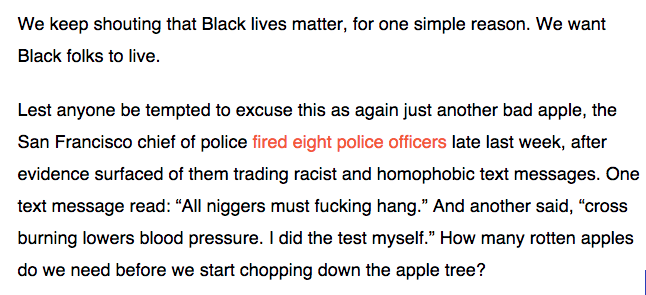
That Scott’s killing is documented by a video that also exposes the officer’s horrifying dishonesty, one would expect the equivocations to be nearly silent; however, the subtle racism following Scott’s shooting is the “rogue cop” argument, the concession that all professions have some “bad apples” (that phrasing particularly tone deaf and offensive since a 50-year-old, unarmed man was shot 8 times in the back and killed by an officer sworn to protect and serve). Or as Leonard Pitts Jr. confronts, discounting each shooting as an “isolated incident.”

Reducing Scott’s shooting to “one bad apple” is denying systemic racism in the U.S. judicial system. It is turning a blind eye to the reality than many countries have police forces that rarely, almost never, use deadly force. It is embracing a culture of violence that remains unpunished among the ordained, glorified in popular media and entertainment, and swiftly punished among the marginalized.

The “one bad apple” denial keeps the gaze superficial, in order to deny systemic racism, and fails to witness when even black police officers are agents of a racist system (in ways replicated all throughout history and society when individuals from an oppressed group are themselves drawn into the bigotry codified by policy, law, or tradition).

To remain unable to listen to the context of a racial slur while also waving off the shooting of an unarmed black man by a police officer as a regrettable outlier—these are acts of subtle racism that perpetuate systemic racism.

And here, once again, we must return to Coates, and we must listen—especially whites in denial:

Elegant racism is invisible, supple, and enduring. It disguises itself in the national vocabulary, avoids epithets and didacticism. Grace is the singular marker of elegant racism. One should never underestimate the touch needed to, say, injure the voting rights of black people without ever saying their names. Elegant racism lives at the border of white shame. Elegant racism was the poll tax. Elegant racism is voter-ID laws….

A racism that invites the bipartisan condemnation of Barack Obama and Mitch McConnell must necessarily be minor. A racism that invites the condemnation of Sean Hannity can’t be much of a threat. But a racism, condemnable by all civilized people, must make itself manifest now and again so that we may celebrate how far we have come. Meanwhile racism, elegant, lovely, monstrous, carries on.

[1] See on language/slur reappropriation:

The Reappropriation of Stigmatizing Labels: Implications for Social Identity, Adam D. Galinsky, Kurt Hugenberg, Carla Groom and Galen Bodenhausen

The semantics of slurs: A refutation of pure expressivism, Adam M. Croom

Appropriating a Slur: Semantic Looping in the African-American Usage of Nigga, Andrew T. Jacobs

Matt Barnes, the N-Word and Reappropriation, Jonah Hall

‘Cunt’ Should Not Be a Bad Word, Katie J.M. Baker

Laurie Penny: In defence of the “C” word

Reclaiming “Cunt,” “Bitch,” “Slut,” and more

The feminist mistake, Zoe Williams


Race to Disgrace

A society is defined by what is tolerated and for whom—and by whom.

In a country with a moral center, or at least a moral free press, this story would be a scathing exposé, spurring public denunciation.

But in the U.S., it is a story about “polarizing methods and superior results”—a gutless mess of misinformation and “fair and balanced” journalism that includes this dispassionate reporting:

At one point, her leadership resident — what the network calls assistant principals — criticized her for not responding strongly enough when a student made a mistake. The leadership resident told her that she should have taken the student’s paper and ripped it up in front of her. Students were not supposed to go to the restroom during practice tests, she said, and she heard a leader from another school praise the dedication of a child who had wet his pants rather than take a break.

What is the common characteristic of students in punitive, test-prep “no excuses” charter schools, like the one above, all across the U.S.?

What is the common characteristic of the teachers found guilty in the Atlanta cheating scandal?

What is the common characteristic of the professional educators fired (and replaced by TFA recruits) after Hurricane Katrina in New Orleans?

The answer is the same as, What is the characteristic of who is disproportionately in U.S. prisons? Disproportionately arrested, charged, and convicted of crimes? Disproportionately disciplined in U.S. public and charter schools, expelled as early as pre-K?

The answer: The race to disgrace is black in the U.S.—a country without a moral center, without a moral free press.

From Crenshaw to Hartsville: Race, Poverty, and Education Reform

In order to avoid the existential hell known as I-85 where morning commuters creep along bug-like in a daily Kafkan nightmare, I take winding backroads through the Upstate of South Carolina to my university.

Recently, I noticed a real estate sign advertising a new neighborhood with an added bright yellow sign above signaling, “RIVERSIDE SCHOOLS.”

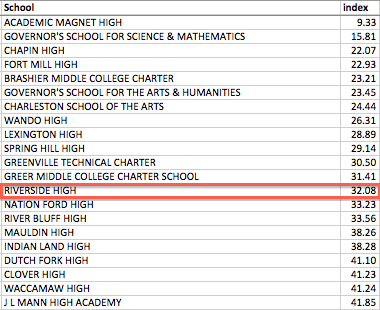
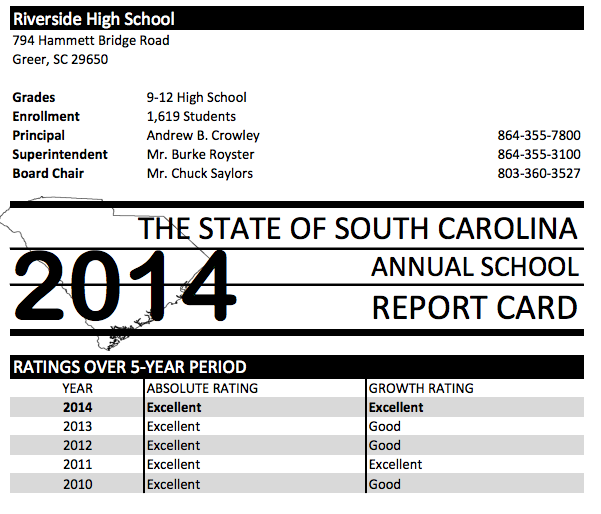
Children in this housing development will attend, eventually, Riverside High, which is ranked 13th lowest of 237 SC high schools in the 2014 Poverty Index, has Excellent/Excellent ratings on the 2014 SC report card, and tests only 51/341 students on subsidized meals and 25/341 with limited English proficiency:

Riverside HS PI 2014

Riverside HS 2014 report card 1Among four other comparable high schools in the state, they all are rated Excellent:

Riverside HS schools like ours 2014Having placed student teachers at Riverside High, and knowing faculty there, I can attest that this is a wonderful school, and students are both supported and challenged.

The real estate sign struck me especially since I had viewed two new educational documentaries: Crenshaw, a film by activist Lena Jackson on the Los Angeles school, and 180 Days: Hartsville, focusing on two schools—Thornwell School for the Arts and West Hartsville Elementary School—along the infamous I-95 Corridor of Shame in my home state of SC.

While nearly 2500 miles apart and politically/culturally worlds apart, Los Angeles and Hartsville reflect powerful narratives about the intersections of race, poverty, and education reform. As well, they offer nuance to those intersections since Creshaw High is high-poverty, majority-minority in an urban setting while Hartsville’s elementary schools are high-poverty, majority-minorty in the rural South.

Before discussing each documentary separately, let me highlight what they share as entry points into reconsidering race, poverty, and education reform:

  • Public schools both serve and reflect the communities within which they sit.
  • Race and poverty significantly impact academic achievement, and thus, when schools, teachers, and students are labeled, ranked, and judged by test scores, high-poverty and majority-minority schools are disproportionately identified as “failing.”
  • Political leadership often expresses support for education and public schools, but implements policies that appear tone deaf to the communities they represent.
  • Education reform advocates ignore the failure of popular policies.
  • Demands of effort and not embracing excuses dominate political and educational rhetoric (despite ample evidence that effort is trumped by racism/classism).
  • Parents, students, and teachers are often passionate about education, regardless of economic status or race.

Crenshaw: Disenfranchising through Take Over Strategies

Crenshaw is, as David B. Cohen explains, a “cautionary tale” about school take overs narrowly and education reform built on accountability broadly.

Jackson does a wonderful job in 20 minutes introducing viewers to the students, parents, and teachers whose lives and learning/teaching are dramatically disrupted by converting Crenshaw High into a magnet school as part of a take over plan.

This film is an excellent introduction to how so-called good intentions of political education reform is not only insufficient, but also harmful.

The take over of Crenshaw disenfranchises the students, parents, and teachers highlighted in the documentary and exposes that political leadership (school board and Superintendent John Deasy) often fails to be culturally sensitive or appropriately responsive to the needs of the people they serve.

Ultimately, as in New Orleans, Crenshaw and the take over represent a failure to identify the sources of entrenched problems, to listen to the people whose lives are being impacted by policy, and to be open to alternative views of both problems and solutions.

Crenshaw High is now and has been for decades a reflection of deep and serious social inequity fueled by racism, classism, and an unresponsive political establishment.

Changing a school’s name, firing the adults who have dedicated their lives to students, and ignoring the parents of those students—these appear to be the worst possible actions available, and regretfully, what more and more political leaders seem determined to do.

Hartsville: It’s All about the Tests (I Mean, Children)

As a life-long resident of and career-long educator in SC, I have lived and witnessed the historical and lingering racism and poverty that scar our state and our schools.

In my education foundations and educational documentary courses, I show Corridor of Shame, and we examine issues related to pockets of poverty across SC and school funding.

I also highlight how problematic Corridor is as a documentary since it depends on maudlin music and slow-motion shots of children looking forlorn. The inequity along I-95 in SC needs no emotional appeal; the conditions are inexcusable, and any reasonable person can see that.

In that context, I was nervous about 180 Days: Hartsville—although I do trust and respect co-producer Sam Chaltain and feel that the documentary does offer a much more complex portrayal of education reform, race, and poverty in SC than Corridor.

Broadly, depending on how audiences interpret the narratives of the film, 180 Days: Hartsville challenges the effectiveness of accountability-based reform that focuses on in-school policies only.

That “depending,” however, is huge.

Yes, the two schools and the central family highlighted are wonderful and accurate representations of the huge challenges of public schools in a high-poverty community.

I find the educators, parents, and students extremely compelling and genuine—a tribute to the care taken with the film.

There are also moments that need to be paused, digested carefully: the burdens of working minimum-wage jobs, the pressures of being a child living in poverty and trying to succeed in school, the passion and compassion of educators, and the determination of a parent working two jobs and raising two children alone.

Statistics flashed on the screen and audio/video snippets of political rhetoric against cuts to education funding—these also demand greater critical consideration.

But I am left deeply concerned that too many viewers will not respond as I did to the relentless influence of testing the film captures throughout—because the film is also punctuated with adults expressing a “no excuses” mentality, again with the best intentions.

These educators are supportive and positive, but those qualities cannot temper the weight of testing that has become the end-all, be-all of public schooling—especially for our high-poverty, majority-minority schools.

Viewers watch a highly dedicated principal at Thornwell School for the Arts giving pep talks to entire grade levels of students as well as students preparing to take MAP tests, computerized commercial programs that give detailed and nearly immediate feedback and claim to be strongly correlated with high-stakes state testing.

Viewers also watch as students’ names are moved on a board in front of those students so that each child is listed under her/his status according to the tests.

The money and time spent on MAP and the public labeling of students—not to mention, Where are the arts?—should prompt us all to end the madness that is high-stakes accountability. But, again, I fear many viewers found the story compelling because the educators and students were working so hard, and are characterized as being uniquely successful.

And it is at that last point we must pause.

First, schools that are outliers are not evidence of any need for policy, or for any standard by which to judge all schools. Outliers are outliers for a reason.

But, as well, consider Thornwell School for the Arts 2014 school report card:

Thornwell 2014 report card

And how does Thornwell School for the Arts look against comparable schools across SC?:

Thornwell schools like ours 2014

While the film suggests nearly “miracle” outcomes, the school, in fact, continues to struggle under the burdens of poverty and race; as the classifications above show, the school is typical of schools with similar students.

The film highlights only one of the two ways in which SC evaluates schools—the annual state report card that has been in use for most of SC’s decades of accountability and the federal accountability report (in 2014, Thornwell School for the Arts received a B/86.7 and West Hartsville Elementary, a B/81.1).

Without context, and careful analysis of what data are being portrayed along with why and how (former Superintendent Mick Zais [R] manipulated the federal accountability reports in order to criss-cross the state to “prove” poverty doesn’t matter, for example), viewers are apt to fall under the impression that schools struggling against poverty just need to demand more from educators and children.

However, for me, the key scene is when the principal at West Hartsville Elementary must confront the tremendously complex issues surrounding Rashon, ones that are often outside the ability of the school or even his mother to control.

180 Days: Hartsville is a story of place. It is, like Crenshaw, a cautionary tale, but I suspect one easily misinterpreted.

I think the intent behind this film is to offer Hartsville as a model for education reform addressing race and poverty because the efforts of the educators and students are remarkable and community business has committed to addressing the complex elements of poverty in the area and schools.

However, the film actually reveals that accountability has failed SC and the entire U.S.

How?

The relentless and dehumanizing focus on data—as if people are somehow not involved.

Ultimately what connects Crenshaw in Los Angeles to two elementary schools in SC is this mostly ignored fact: political rhetoric and tone-deaf education policy are not curative but part of the disease.

Once again, there are no miracles—but there are very real and very harmful consequences to demanding the impossible from schools, educators, parents, and children who are ultimately the victims of the racism and poverty political leaders refuse to acknowledge or erase.

For Additional Reading

What If Education Reform Got It All Wrong in the First Place?, Bill Raden

If there is a lesson in evidence-based research for California policymakers, say Orfield and Gandara, it is that there are limitations to what even the most inspired teachers alone can achieve in a society plagued with inequities.

“I studied a really rich district in Massachusetts,” Orfield noted, “and the kids from the housing projects in the city were just hugely behind when they arrived at school. The schools actually made as much progress each year as the [wealthier] kids did, but the gap never closed at all. So the schools were doing their job, but society wasn’t.”

“I always say, if money doesn’t matter, then why is it that people who have money send their kids to schools that have many, many more resources?” Gandara adds. “I think fundamentally the problem is that other developed nations have social systems that support families and children in a variety of ways: with childcare, with good health care, with recreational opportunities—with lots of things that support healthy development. We have dumped it all on the schools and said, ‘We’re really not going to provide any of these services. You deal with it, schools.’”

No Child Left Behind fails to work ‘miracles,’ spurs cheating

Conservative Talking Points Wrong for SC Education

South Carolina and Education Reform: A Reader

2014 NCUEA Fall Conference: Thirty Years of Accountability Deserves an F

Unpacking Education and Teacher Impact

Disaster Capitalism and Charter Schools: Revisiting New Orleans Post-Katrina

Endgame: Disaster Capitalism, New Orleans, and the Charter Scam

NPR Whitewashes Charter Schools and Disaster Capitalism in New Orleans

The State (Columbia, SC): Hartsville documentary reminds us of failures of SC education ‘reform’ efforts

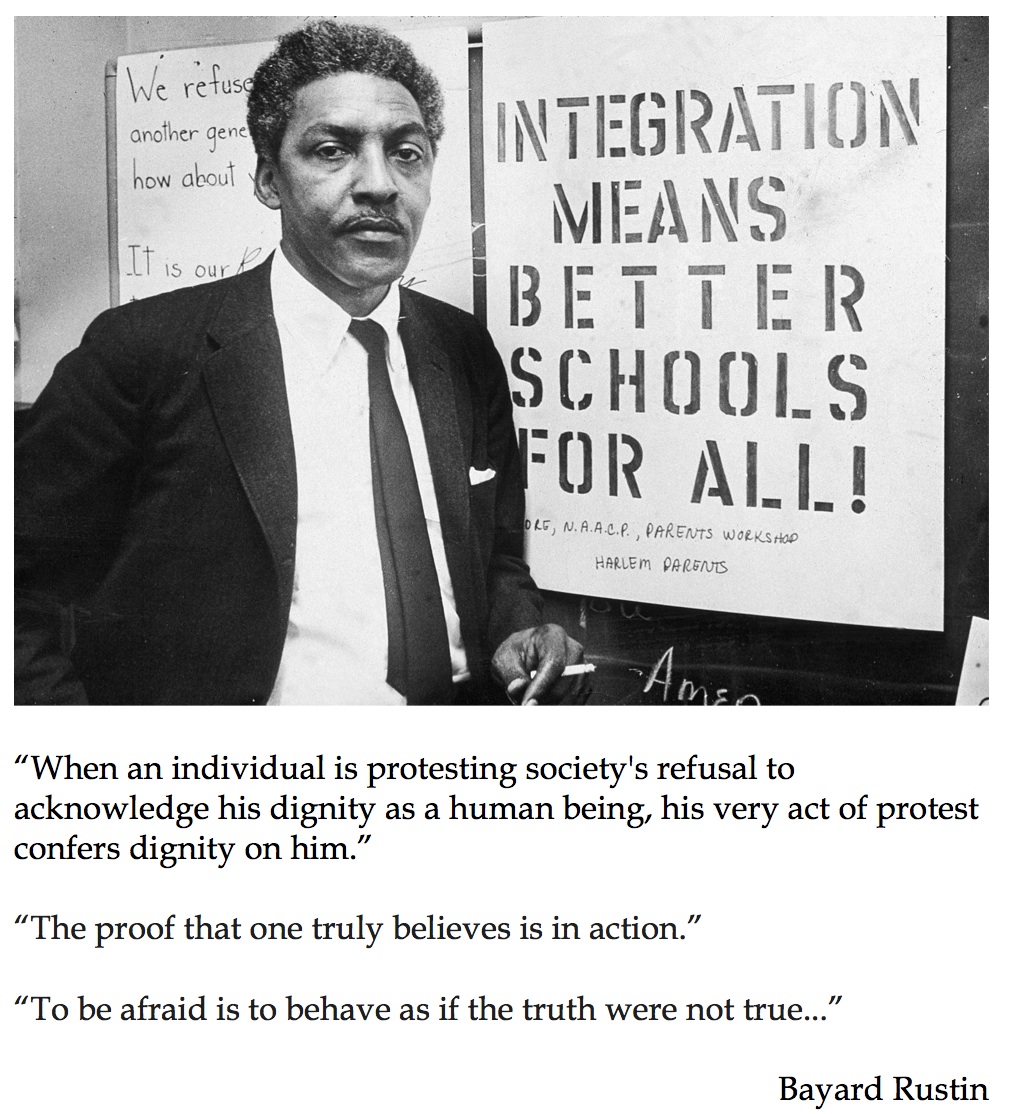
Bayard Rustin (March 17, 1912 – August 24, 1987): A Reader

Bayard Rustin (March 17, 1912 – August 24, 1987):

Bayard Rustin was born in West Chester, Pennsylvania, on March 17, 1912. He moved to New York in the 1930s and was involved in pacifist groups and early civil rights protests. Combining non-violent resistance with organizational skills, he was a key adviser to Martin Luther King Jr. in the 1960s. Though he was arrested several times for his own civil disobedience and open homosexuality, he continued to fight for equality. He died in New York City on August 24, 1987.

“The First Freedom Ride:” Bayard Rustin On His Work With CORE

FBI Records: Bayard Rustin

Bayard Rustin: Who Is This Man?

Obama Awards Bayard Rustin the Presidential Medal of Freedom, Peter Dreier

Demands of the March on Washington

Bayard Rustin, organizer of the March on Washington, was crucial to the movement, Steve Hendrix

Bayard Rustin: the gay black pacifist at the heart of the March on Washington, Gary Younge

Bayard Rustin: The Man Homophobia Almost Erased From History, Steven Thrasher

Brother Outsider: The Life of Bayard Rustin

Who Designed the March on Washington?, Henry Louis Gates, Jr.

Bayard Rustin: Martin Luther King’s Views on Gay People

A violent path traveled by a nonviolent man

Presidential Medal of Freedom Ceremony

President Obama awarded the Medal of Freedom to 16 people. The 2013 recipients were women’s rights activist Gloria Steinem; former President Bill Clinton; talk show host and actress Oprah Winfrey; the late astronaut Sally Ride; for Chicago Cubs shortstop Ernie Banks; former Washington Post executive editor Ben Bradlee; the late Senator Daniel Inouye (D-HI); country music star Loretta Lynn; former Senator Dick Lugar (R-IN); cognitive psychologist Daniel Kahneman; chemist and environmental scientist Mario Molina; the late civil rights activist Bayard Rustin; jazz musician Arturo Sandoval; basketball coach Dean Smith; civil rights leader Cordy Tindell “C.T.” Vivian; and appellate judge Patricia Wald.

Avoiding Patricia Arquette Moments in Education Reform

When Patricia Arquette called for equal pay for women after being awarded the Best Supporting Actress Oscar in late February 2015, Meryl Streep stood, cheering, and Hillary Clinton voiced her support as well.

However, social media began to catalog a much different response, notably by black Haitian writer of Bad Feminist Roxane Gay and Imani Gandy, attorney and political journalist advocating for women’s rights, who explained:

With those words—whether intentional or not (and personally, I believe it was unintentional)—Patricia Arquette gave voice to a system of structural erasure that has been the gold standard in the feminist movement since well before Sojourner Truth stood up and declared “Ain’t I A Woman?”

That erasure assumes that all men are white men and all people of color are men. And that erasure leaves women of color wondering where they fit into all of this.

In a follow up blog, Gandy adds:

My conversation with [Nicole Sandler] got me thinking about the conversations that I have with white women about privilege and why it tends to devolve into shenanigans and feelings of ill-will (as it unfortunately has with Nicole).

Oftentimes when I have these conversations with white women, they’ve never heard the term white privilege before, or if they have, they dismiss it as inapplicable to them.

Arquette represents the dangers of good intentions in the context of unexamined privilege, as Gandy confronts above and then emphasizes:

Here’s the thing about privilege: There are all kinds. There’s privilege based on race, gender, sexual orientation, gender identity, religion, citizenship status, and on and on. (A great primer on the concept is Peggy McIntosh’s “White Privilege: Unpacking the Privilege Knapsack.”)

And you know what? Almost every single person on the planet has privilege in some form or another.

Me? I have class privilege. I make a decent living now and I grew up upper-middle class. I never wanted for anything. And I rarely want for anything now. (Certainly the things that Iwant are luxury items that I really don’t need. I mean, I’ve got my eye on a Michael Kors purse, but do I need it? Hardly.)

Additionally, Arquette as a white woman offers an important moment for the education reform debate, notably since education has its own Arquette in the form of Ruby Payne.

“The current teaching population in the U.S. comprises mostly white, middle-class women,” explain Sato and Lensmire in their analysis of Payne’s claims about poverty and why those discredited stereotypes are nonetheless embraced:

Osei-Kofi (2005) thinks that Payne’s stereotypes provide the well-meaning educator with a certain “guilty voyeuristic pleasure” as they get to affirm their own normalcy against the “comfortably familiar” image of the poor as pathological. Payne plays on our sense of ourselves as normal, the norm, as well as on our sense of the poor as different, other.

Sato and Lensmire then quote Osei-Kofi:

“Based on this depiction of the poor, educators become perfectly situated to take on the role of middle-class, primarily white, saviors of children in poverty by being ‘good’ role models, and teaching these children the so-called hidden rules of middle-class. Through the objectification of the poor, educators are implicitly positioned as the true histor- ical subjects with ability to act in creating social change.” (Osei-Kofi 2005, p. 370; emphasis added)

Bomer, and others, have exposed the same dynamic, including how Payne misrepresents poverty and race in her frameworks:

Racializing the representations of poverty means that Payne is portraying poor people as people of color, rather than acknowledging the fact that most poor people in the US are white (Roberts, 2004). By doing so, Payne is perpetuating negative stereotypes by equating poverty with people of color. Although there is a correlation between race and class, this does not justify her use of racialized “case studies.”

Payne’s audience of teachers is primarily white, female, and middle class, so their probable shared perspective makes it likely that such signals will be understood as racial. Given that the truth claims do not explicitly address the relationships between poverty, race, ethnicity, and gender, we are merely pointing out the absence of such considerations from Payne’s work.

And despite a growing body of research refuting Payne’s claims about class and race, Payne continues to prosper on her self-published books and workshops and has often been defiant—a cycle not unlike Arquette’s defense of her comments and advocacy—as Gorski notes:

For example, in response to a critique of A Framework published by Teachers College Record (Gorski, 2006b), Payne (2006a) writes: “Gorski states that his lens is critical social theory. My theoretical lens is economic pragmatism. The two theoretical frames are almost polar opposites.”

Indeed.

Well-intentioned people, then, unwilling to examine their own privilege and then defiant against the voices of others who speak from marginalized perspectives are as apt to derail the call for equity in education reform as the so-called corporate reformers.

As I have detailed in literacy education, uncritical embracing of the “word gap” reveals the blinders of privilege and then leads directly to policy distorted by racism, classism, and sexism—policy, then, that perpetuates inequity while claiming to be reform.

As Gandy explains above, everyone must be open to examining her/his own privilege, even when she/he feels primarily to be in a marginalized status (such as white women), but that self-examination is often hard since the factors are so close and familiar.

While watching an HBO’s Real Sports episode on Death on Everest recently, I was struck how the relationship between Shirpas and mostly affluent and often white mountain climbers is a stark but real example of the danger and power of privilege: White wealth pays to defer great risk and even death from the climbers to the Shirpas.

A context such as that—also examined in Death and Anger on Everest by Jon Krakauer—may offer the distance needed to understand privilege before turning the mirror on ourselves and those near us.

Nonetheless, as much as the Arquette controversy is important for a national examination of privilege, it is also a key moment for committing to avoiding more Arquette moments within education, where there is no room for privilege or the status quo of racism, classism, and sexism.