This was a period, the 1870s, wherein scientific method, with its supposed objectivity and neutrality to values, was thought to be the answer to all problems. There is no better example of the confusion and opportunism springing from this false assumption than the relation of American social science to the Negro problem. And let us make no easy distinctions here between Northern and Southern social scientists; both groups used their graphs, charts and other paraphernalia to prove the Negro’s biological, psychological, intellectual and moral inferiority, one group to justify the South’s exploitation of Negroes, and the other to justify the North’s refusal to do anything basic about it. Here was a science whose role, beneath its illusionary non-concern with values, was to reconcile the practical morality of American capitalism with the ideal morality of the American Creed.
And:
The most striking example of this failure is to be seen in the New Deal administration’s perpetuation of a Jim Crow army, and the shamefaced support of it given by the Communists. It would be easy—on the basis of some of the slogans attributed to Negro people by the Communists from time to time, and the New Deal’s frequent retreats on Negro issues—to question the sincerity of these two groups. Or, in the case of the New Deal, to attribute its failure to its desire to hold power in a concrete political situation, while the failure of the Communists could be laid to “Red perfidy.” But this would be silly. Sincerity is not a quality that one expects of political parties, not even revolutionary ones. To question their sincerity makes room for the old idea of paternalism, and the corny notion that these groups have an obligation to “do something for the Negro.”
John Proctor: Because it is my name! Because I cannot have another in my life! Because I lie and sign myself to lies! Because I am not worth the dust on the feet of them you have hanged! How may I live without my name? I have given you my soul; leave me my name!
While Proctor speaks to the association between a name and honor, names also carry the burdens of gender and heritage. “I have guarded my name as people/ in other times kept their own clipped hair,” begins the speaker in Barbara Kingsolver’s “Naming Myself” from Another America. Later, she explains:
I could shed my name in the middle of life, the ordinary thing, and it would flee along with childhood and dead grandmothers to that Limbo for discontinued maiden names.
But it would grow restless there. I know this. It would ride over leaf smoke mountains and steal horses.
Names also represent race and the lingering weight of the heaviest shackles of history. To that, Malcolm X explains his name:
“It’s true, South Carolinians would do well to remember Tillman’s legacy,” argues Paul Bowers, addressing directly the naming of Tillman Hall:
But we shouldn’t honor it, which is exactly what we’re doing by keeping his name on a building at a public university….
It’s another thing entirely for it to be named after Tillman, a progenitor and perpetuator of American apartheid who led lynch mobs during Reconstruction and boasted about it until his dying day.
Remembering history, the worst scars of history, is different than honoring those scars of history. And naming—whether it be a person’s name or a building’s—treads a thin line between remembering (as not to make the same mistake again) and honoring.
This is the field where the battle did not happen,… where no monument stands,…
No people killed—or were killed—on this ground hallowed by neglect and an air so tame that people celebrate it by forgetting its name.
The South presents a history that must not be forgotten, but includes much that should not be honored—including the person, ideologies, acts, and name of Benjamin Tillman.
And somewhere between John Proctor’s impassioned but fictionalized plea and Malcolm X’s steadfast and reasonable refusal to accept the name given him lies my recognition that what we name anyone or anything, and why, is powerful evidence of what we remember and why—and ultimately what we honor beneath claims otherwise.
Most Southern terror lynching victims were killed on sites that remain unmarked and unrecognized. The Southern landscape is cluttered with plaques, statues, and monuments that record, celebrate, and lionize generations of American defenders of white supremacy, including public officials and private citizens who perpetrated violent crimes against black citizens during the era of racial terror [emphasis added]. The absence of a prominent public memorial acknowledging racial terrorism is a powerful statement about our failure to value the African Americans who were killed or gravely wounded in this brutal campaign of racial violence. National commemoration of the atrocities inflicted on African Americans during decades of racial terrorism would begin building trust between the survivors of racial terrorism and the governments and legal systems that failed to protect them. (p. 22)
Sandra Cisneros’s The House on Mango Street has a chapter “My Name” that begins, “In English my name means hope,” adding, “It was my great-grandmother’s name and now it is mine”:
She looked out the window her whole life, the way so many women sit their sadness on an elbow. I wonder if she made the best with what she got or was she sorry because she couldn’t be all things she wanted to be. Esperanza. I have inherited her name, but I don’t want to inherit her place by the window. (pp. 4-5)
Tradition is static, like “forgotten.” A name given, a name chiseled in granite, a name uttered each time someone gives directions.
Remembering in order to remain steadfast against the mistakes of the past does not require the echo of names, and renaming becomes an act of defiance and recognition, as Esperanza proclaims: “I would like to baptize myself under a new name, a name more like the real me, the one nobody sees” (p. 5).
The call to rename Tillman Hall, then, is not about erasing or forgetting, but about the baptism of re-naming as an act of courage, a claiming of honor too often denied and too often ignored. The refusal to rename Tillman Hall proves James Baldwin right, although he made these observations sixty years ago:
[The South] clings to the myth of its past but it is being inexorably changed, meanwhile, by an entirely un-mythical present: its habits and its self-interest are at war. Everyone in the South feels this and this is why there is such panic on the bottom and such impotence at the top. …
[I]t is, admittedly, a difficult task to try to tell people the truth and it is clear that most Southern politicians have no intention of attempting it….
This failure to look reality in the face diminishes a nation as it diminishes a person. (“Nobody Knows My Name: A Letter from the South”)
Renaming is a baptism long overdue in the Bible Belt.
After the 2015 Grammy Awards show following closely the 2015 Super Bowl, I am pressed to ask, Is Kanye West the music industry’s Marshawn Lynch?
Let’s start with the short answer: Yes, because although Kayne is accused of talking too much and Lynch, too little, they both are powerful voices against the racism most people in the U.S. refuse to acknowledge.
Just as I have examined about how the media and public have responded differently to Lynch’s and Rob Gronkowski’s behaviors, Kanye’s challenge to Beck’s Grammy and Beyonce not receiving the award presents yet another uncomfortable black and white picture.
Although many want to frame the Kanye/Beck controversy as an either/or debate, several seemingly contradictory truths exist:
Beck is a deserving artist, and his recent album warrants recognition for its high-level of artistic quality. [Note: I am a huge Beck fan.]
Beyonce is a deserving artist, and absent institutional and societal racism and sexism, determining between Beck and Beyonce as more deserving may be possible.
The Grammy Awards, like the Oscars, and like the NFL, remain as likely to be corrupted by racism and sexism as most mainstream institutions in the U.S.
Beck’s Grammy may reflect institutional racism as much as it does his deserving artistry.
Beyonce not winning may show that institutional racism remains more powerful than recognition of artistic merit.
Ultimately, Kanye and Lynch prompt similar reactions because, although their methods differ, they are perceived as powerful black men who don’t know their proper place—tinged with public finger wagging for their biting the hand that feeds them.
Lynch must speak when the NFL demands; Kayne must remain silent when the music industry demands.
Again, as the public and media wink-wink-nudge-nudge relationship with Gronkowski (whose public behavior rarely rises above that of a 12-year-old, albeit a 12-year-old who happens to be old enough to drink) demonstrates, Kanye, Lynch, and Sherman are mostly guilty of being black.
Many, then, wish to keep the public and accusatory gaze on Kanye’s and Lynch’s behavior so that no one has to address directly their inherent and credible message about the weight of race, gender, and class—even among racial minorities with tremendous financial and professional success.
Preferring Beck over Beyonce or Beyonce over Beck is not an act of racism necessarily, but marginalizing Kanye or misrepresenting his protest as an attack of Beck is certainly making a case that despite what you think of Kanye, he sees something others wish he didn’t, and he is willing to speak up when others wish he wouldn’t.
Lynch has received considerable criticism for his behavior during required media sessions as well as crotch-grabbing after scoring touch downs.
Greenberg has more or less argued that much of that criticism (except for the crotch grabbing) is misguided, including calling for everyone to leave Lynch alone. Since Arizona Cardinals linebacker Larry Foote (and others) has recently claimed Lynch is a dangerous role model, especially for inner-city youth, Greenberg pointed to Gronkowski’s comments to Kimmel, offered jokingly:
“I got pushed or something, and it was the last game of the year, and I was like, ‘Screw it, I’m throwing some haymakers,'” Gronkowski said Monday night.
Further, Greenberg highlighted that Gronkowski had also said the last book he read was in ninth grade, To Kill a Mockingbird, pointing out that Gronkowski had attended the University of Arizona.
The intersection of judgmental reactions to Lynch with, as Greenberg emphasized, most people viewing Gronkowski (playfully referred to as “Gronk”) as a lovable goof who likes to have a good time, partying and dancing (even after post-season loses), prompted Greenberg to wonder why Lynch and Gronkowski receive such different public responses.
Two important messages are presented in that intersection and Greenberg’s inability to understand it.
First, the closing seconds of Super Bowl XLIX included a “scrum that marred the end” of the game, ESPN reported, noting Gronkowski was not ejected. While viewing the fight with Kimmel, Gronkowski laughed about the incident:
“I don’t think I did. Roger, no, I did not,” the tight end said with a smile when asked by Kimmel whether he threw punches, referring to commissioner Roger Goodell.
Gronkowski said he did not want the league to fine him, jokingly saying he needed money for an upgraded party bus.
“Roger, that wasn’t me,” Gronkowski said as video replay of the fight was aired during the interview.
In a season highlighted by the NFL receiving several black eyes and bloody noses for players involved in off-the-field violence and the league appearing to fumble how to handle those public failures, and against the on-going pressure and fines bombarding Lynch mainly for not talking to the media, both the fight and Gronkowski’s role in and attitude about it expose the cavalier and hypocritical barbarism of the NFL itself.
Every play in the NFL depends on violence—but only the sort of violence endorsed by the shield. Fights after a violent play are forbidden (apparently because the sport has some sort of ethical code?). And violence off the field is now also forbidden since those incidences have been made public.
Especially New England fans, but virtually everyone who weighed in on the fight, directly and indirectly drifted into why Lynch receives more criticism and hatred than Gronkowski—those Seahawks revealed who they really are (hint: thugs).
Setting aside that moralizing by Patriots or Patriots fans may be one of the most hypocritical events in all of sports, how the media and public responded leads to an explanation for Greenberg’s question.
The NFL maintains a tight grip on its shield, hoping to hide behind it, but the inherent hypocrisy of the sport and business is gradually being exposed. As well, the NFL provides ample evidence of the power of racism remaining in the U.S.
The media and public cry, Why doesn’t Lynch know his place?
Those different responses are literally black and white.
Of the two, the far worse role model is Gronkowski—whose nudge-nudge-wink-wink to “Roger” was clearly disrespecting authority (but remains safely in the Joe-Namath playboy template of good ol’ U.S.A. middle-class hypocrisy), whose response to the fight never rose above what we should expect from a nine-year-old, and whose reading comment may be the most troubling of all.
Of the two, Lynch deserves a much different response—as Jay Smooth explains far more eloquently than I could.
Delusion is a powerful thing, and in the U.S., our entertainment is certainly some of the ugliest examples of our delusions.
Those delusions of entertainment, however, reveal some hard truths.
The selective barbarism of the NFL is our barbarism.
But the most barbaric reality about the NFL is the racism shielded as moralizing condemning Lynch but exempt for Gronkowski.
Bearing witness from privilege, as I have examined, walks very close to a line that must not be crossed—a line between honoring and listening versus man/whitesplaining.
This is intended as the former, admitting full well the dangers of good intentions.
New York Times critic Maureen Dowd saw “Selma” last week “in a theater of full of black teenagers.” Her ethnographic impressions of the “stunned” emotional responses that these D.C. teenagers had to seeing four little girls blown up in an Alabama church basement and watching civil rights leaders viciously clubbed during a march in Selma reek of the kind of voyeuristic and clueless white gaze often used to devalue and pathologize urban youth. They become fascinating objects of study to those who don’t get to spend a lot of time with them.
And it is precisely these kinds of impressions from white people, the inability to make sense of genuine black emotion, the inability to recognize what filmic representations that respect the interior lives of black people actually might look like, that have contributed to the disingenuous backlash against the Selma film.
Read Cooper’s piece, entirely, carefully, and more than once—until her concluding points resonate:
The recent tragic killings of unarmed youth have surely taught us that if we don’t work from a presumption of black humanity, facts don’t mean very much in our interpretation of events.
More than that, those in power choose the “facts” that matter.
And then, as Cooper mentions Toni Morrison, watch Morrison:
Dowd and Charlie Rose embody the “voyeuristic and clueless white gaze” driven by their privilege and the veneer of good intentions: Dowd and Rose assuming the pose of thoughtful, measured, and professional (mostly because of their status).
Finally, Sendhil Mullainathan places lingering, systemic racial discrimination within good intentions:
Arguments about race are often heated and anecdotal. As a social scientist, I naturally turn to empirical research for answers. As it turns out, an impressive body of research spanning decades addresses just these issues — and leads to some uncomfortable conclusions and makes us look at this debate from a different angle….
But this widespread discrimination is not necessarily a sign of widespread conscious prejudice….
This kind of discrimination — crisply articulated in a 1995 article by the psychologists Mahzarin Banaji of Harvard and Anthony Greenwald of the University of Washington — has been studied by dozens of researchers who have documented implicit bias outside of our awareness….
Ugly pockets of conscious bigotry remain in this country, but most discrimination is more insidious. The urge to find and call out the bigot is powerful, and doing so is satisfying. But it is also a way to let ourselves off the hook. Rather than point fingers outward, we should look inward — and examine how, despite best intentions, we discriminate in ways big and small.
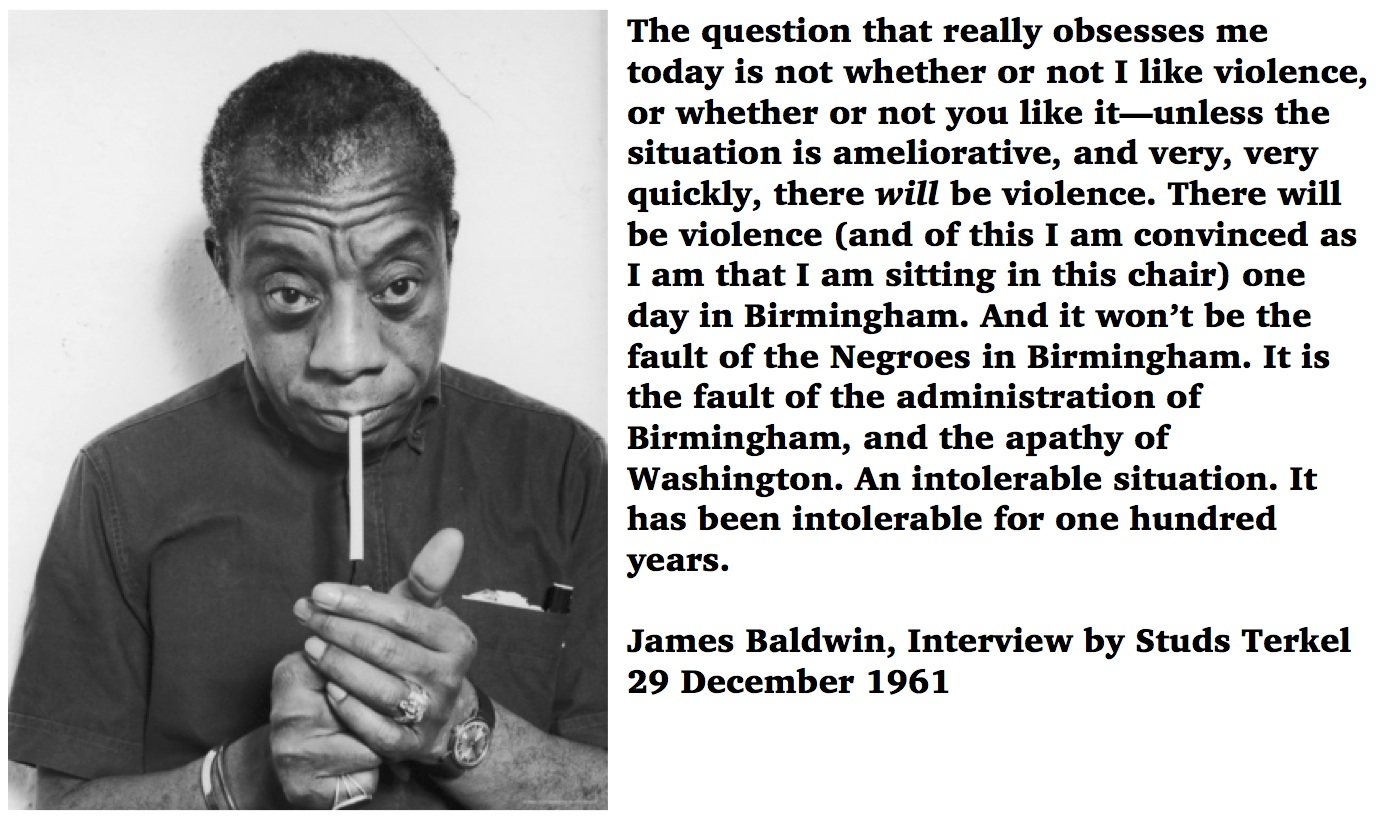
Any real change implies the breakup of the world as one has always known it, the loss of all that gave one an identity, the end of safety. And at such a moment, unable to see and not daring to imagine what the future will now bring forth, one clings to what one knew, or thought one knew; to what one possessed or dreamed that one possessed. Yet, it is only when a man is able , without bitterness or self-pity, to surrender a dream he has long cherished or a privilege he has long possessed that he is set free—he has set himself free—for higher dreams, for greater privileges.
Whether you are from the South—as I am, approaching my 54th year in the area where I was born—or not, here is how you can come to understand the South: Read William Faulkner’s “A Rose for Emily,” James Baldwin’s “Faulkner and Desegregation,” and M.E. Bradford’s “Faulkner, James Baldwin, and the South.”
In the shocking ending to “A Rose for Emily,” the town (that community and place so sacred to Faulkner, as Bradford emphasizes) and the reader discover that Emily has spent much of her life sleeping with the corpse of her mysteriously vanished lover. Not to be overly simplistic, but in that scene, Emily is the South and her act is the cancerous core of what best captures that region’s ideological commitment—cling to the corpse of tradition no matter what.
It is the steadfast clinging that matters, not the thing itself.
Baldwin’s response to Faulkner’s call for Southern blacks to be patient about integration at mid-twentieth century deftly dismantles the inherent contradictions, the incessant paternalism, and the disturbing lack of awareness embodied by Faulkner himself. While Faulkner seems oblivious to the message in his own work, Baldwin, a black man from Harlem, the North, echoes the warning of “A Rose for Emily”:
[S]o far from trying to correct it, Southerners, who seem to be characterized by a species of defiance most perverse when it is most despairing, have clung to it [emphasis added], at incalculable cost to themselves, as the only conceivable and as an absolutely sacrosanct way of life. They have never seriously conceded that their social structure was mad. They have insisted, on the contrary, that everyone who criticized it was mad.
Further, Baldwin’s understanding of the South remains as perceptive now as when he originally confronted Faulkner:
It is apparently very difficult to be at once a Southerner and an American….It is only the American Southerner who seems to be fighting, in his own entrails, a peculiar, ghastly, and perpetual war with all the rest of the country….
The difficulty, perhaps, is that the Southerner clings to two entirely antithetical doctrines, two legends, two histories….
The Southern tradition, which is, after all, all that Faulkner is talking about, is not a tradition at all: when Faulkner evokes it, he is simply evoking a legend which contains an accusation. And that accusation, stated far more simply than it should be, is that the North, in winning the war, left the South only one means of asserting its identity and that means was the Negro.
And finally to grasp fully the South, Bradford’s apologist reading of Faulkner (punctuated with “We in the South”) as well as a distinct misreading of Baldwin offers the full shape that characterizes the South: Faulkner as embodiment, Emily as metaphor, Baldwin as moral witness, and Bradford as contorted intellectual justification.
However, in the South, this is never merely academic or something past.
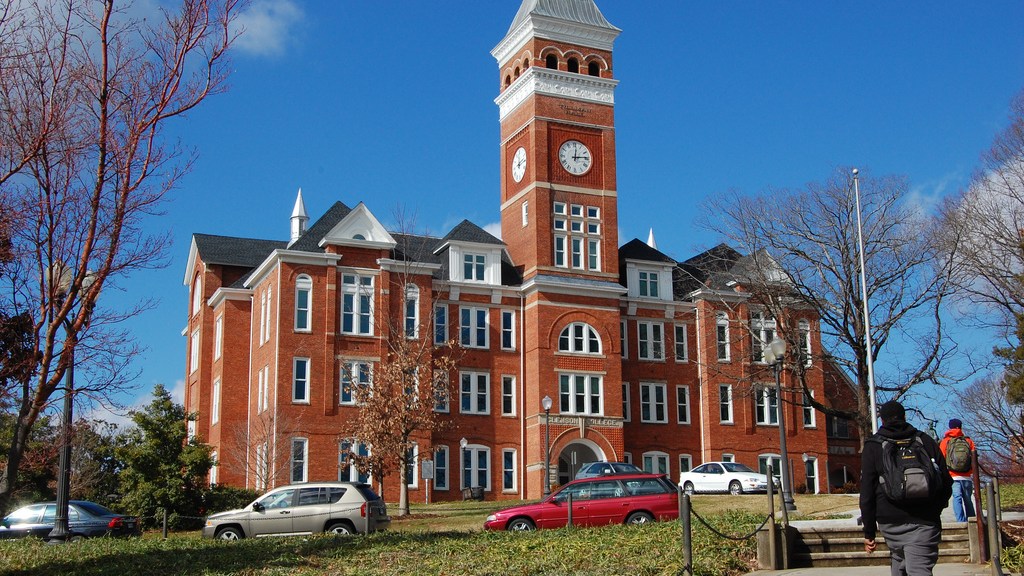
Clemson’s Tillman Hall and the Tragedy of Southern Tradition
It is currently being recreated in the Tillman Hall debate at Clemson University—not as a unique case, but a representative one, Clemson University in its founding, its physical plant, and the myriad names with which it is associated
Tillman Hall at Clemson University bears the name of a former South Carolina governor, Benjamin Tillman, who “established an agricultural school that would become Clemson College, as well as Winthrop College.”
Those not from the South likely find these recurring tensions unfathomable, notably the never-ending battles about the Confederate flag that remains on the capitol grounds after decades flying atop the Statehouse.
Apologists for tradition in the South, like Bradford for Faulkner, expose the contradictory mindset confronted by Baldwin. Those who rush to add “yes, but…” in defense of Tillman, for example, are likely to interject the “yes, but…” strategy to refute Martin Luther King Jr.
“Yes, but” Tillman was governor and if not for him, no Clemson!
“Yes, but” King was a socialist and adulterer.
As a life-long Southerner, I have witnessed these patterns regularly throughout my life. It is the logic of the South.
Again, as Baldwin recognized, the South clings like Emily not to tradition but to the fabricated legend. And it is there that the hypocrisy of “yes, but…” is fully exposed.
Apologists for Tillman cling to Tillman’s ill-gotten status during his life, a status reflecting the most dehumanizing qualities of the South during Reconstruction and the early twentieth century.
Critics of Tillman, however, recognize that his racism outweighs any so-called accomplishments.
Tillman went to the U.S. Senate in 1895, where he remained until his death in 1918. He used the Senate floor and the Chatauqua circuit to become the nation’s loudest and most famous proponent of white supremacy, or in his own words, “preaching to those people the gospel of white supremacy according to Tillman.”
“It’s true, South Carolinians would do well to remember Tillman’s legacy,” argues Paul Bowers, addressing directly the naming of Tillman Hall:
But we shouldn’t honor it, which is exactly what we’re doing by keeping his name on a building at a public university….
It’s another thing entirely for it to be named after Tillman, a progenitor and perpetuator of American apartheid who led lynch mobs during Reconstruction and boasted about it until his dying day.
To honor Tillman as well as many others like him is to make Emily’s mistake—clinging to a corpse that should be buried beneath a marker, not to honor but to remind us of all that we must not embrace again.
Apologists for tradition are emboldened by those calling for patience, like Faulkner, who prompted Baldwin to punctuate his essay with urgency:
But the time Faulkner asks for does not exist— and he is not the only Southerner who knows it. There is never time in the future in which we will work out our salvation. The challenge is in the moment, the time is always now.
Technically, in order to celebrate the first black Captain America, we’d have to resort to the sort of contortions common in the comic book universe—the time machine.
Truth: Red, White & Black was a seven-issue series in 2003 with, yes, a black Captain America [1], as Joshua Yehl noted when the more recent announcement of a black Captain America surfaced: “While it is notable that this will be a black Captain America, it turns out that he’s not the first. Isaiah Bradley was not only the first black Captain America, but he held the mantle even before Steve Rogers.”
But the comic book universe is also noted for acting as if the same-old-same-old is NEW!!! for decades—with reboots (and more reboots), renumbering long-standing titles, killing superheroes, having those superheroes’ sidekicks take over for the dead superheroes, and then resurrecting the superheroes.
Tonight on The Colbert Report, Marvel Comics’ Chief Creative Officer Joe Quesada revealed that the new Captain America is Sam Wilson aka The Falcon.
With Steve Rogers losing his super powers in the pages of his solo series written by Rick Remender, readers have been guessing who the new Captain America would be, and now we have our answer. General audiences will recognize Falcon from this summer’s Captain America: The Winter Soldier movie with Anthony Mackie playing the winged superhero.
The new Captain America by Stuart Immonen
A few aspects of this move to have a black Captain America are worth noting. First, as the announcement above shows, Marvel’s commitment to films is significantly impacting their comics.
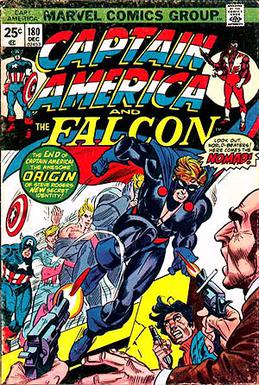
My serious comic book collecting years were mainly in the 1970s, and I was drawn always to Captain America because The Falcon was one of my favorite characters. The series featured The Falcon by name and image on each issue’s cover for most of the 1970s, in fact.
Captain America #180 (Dec. 1974). Art by Gil Kane and Frank Giacoia.
My teenaged self lurking below a few decades of the 50+ self is, then, quite excited about Sam Wilson/Captain America; however, that adolescent nerd-glee is significantly tempered by the social justice adult I have become, leaving me to ask: Should we marvel at a black Captain America?
Captain America #25 opens with Steve Rogers remembering Sam Wilson—Wilson’s warrior nature, his losing both parents (minister and community organizer) and raising a brother and sister, his resilience in the face of prejudice. Notably as well, Sam Wilson was, according to Rogers, “just a man. A man dedicated to showing what one person could accomplish after a lifetime of misfortune.”
Too often, comic book narratives remain firmly entrenched in the cliche (of course, if your audience is primarily children/teens, most anything can seem new to them, and is), but where comic book narratives have failed over about eight decades is that they mostly reflect social norms, even the biases and stereotypes (see Hugh Ryan on Wonder Woman), uncritically.
Readers in the first pages of issue #25 are led to believe (as the surrounding superheroes do) that Wilson has died heroically—and Rogers is about to pronounce Wilson a martyr. Until Wilson speaks.
The issue then turns to the aging Steve Rogers, no longer invigorated by super-soldier serum, who speaks to The Avengers in order to announce Sam Wilson/Captain America. This reboot ends with Wilson/Captain America in a hybrid uniform—red, white, and blue, Captain’s shield, and Falcon wings—shouting, “Avengers assemble!”
The All-New Captain America #1, interestingly, comes in a variant edition—all-white cardboard cover with only the title blazoned across the top. And with a somber and powerful opening page in which Sam Wilson recalls his father’s sermons and death, and his mother’s murder soon after, building to a refrain alluding the Martin Luther King Jr.’s dream, the black Captain America takes flight.
I mentioned Wonder Woman above because I am now reading Jill Lepore’s The Secret History of Wonder Woman. If Wonder Woman was born out of the rise of twentieth century feminism, as Lepore details, and then the series itself in action and image contradicts those feminist ideals, what good a female superhero?
And there I am stuck about the black Captain America, built up in Captain America #25 as the rugged individual, the exceptional human (superhuman) who lifted himself up by the bootstraps (wings didn’t hurt, there) and overcame every obstacle, including racism.
There is no evidence that black people are less responsible, less moral, or less upstanding in their dealings with America nor with themselves. But there is overwhelming evidence that America is irresponsible, immoral, and unconscionable in its dealings with black people and with itself. Urging African-Americans to become superhuman is great advice if you are concerned with creating extraordinary individuals. It is terrible advice if you are concerned with creating an equitable society. The black freedom struggle is not about raising a race of hyper-moral super-humans. It is about all people garnering the right to live like the normal humans they are.
If a black Captain America reinforces the “terrible advice” confronted by Coates, if black Captain American continues to perpetuate crass militarism and unbridled vigilante violence, I am left to ask, what good a black superhero?




 dr. p.l. (paul) thomas