Category Archives: race

Testing the Education Market, Cashing In, and Failing Social Justice Again

On Black Friday 2014—when the U.S. officially begins the Christmas holiday season, revealing that we mostly worship consumerism (all else is mere decoration)—we are poised to be distracted once again from those things that really matter. Shopping feeding frenzies will allow Ferguson and Tamir Rice to fade away for the privileged—while those most directly impacted by racism and classism, poverty and austerity remain trapped in those realities.

History is proof that these failures have lingered, and that they fade. Listen to James Baldwin. Listen to Martin Luther King Jr.

But in the narrower education reform debate, we have also allowed ourselves to be distracted, mostly by the Common Core debate itself. As I have stated more times that I care to note, that Common Core advocates have sustained the debate is both a waste of our precious time and proof that Common Core has won.

As well, we are misguided whenever we argue that Common Core uniquely is the problem—instead of recognizing that Common Core is but a current form of a continual failure in education, accountability built on standards and high-stakes testing.

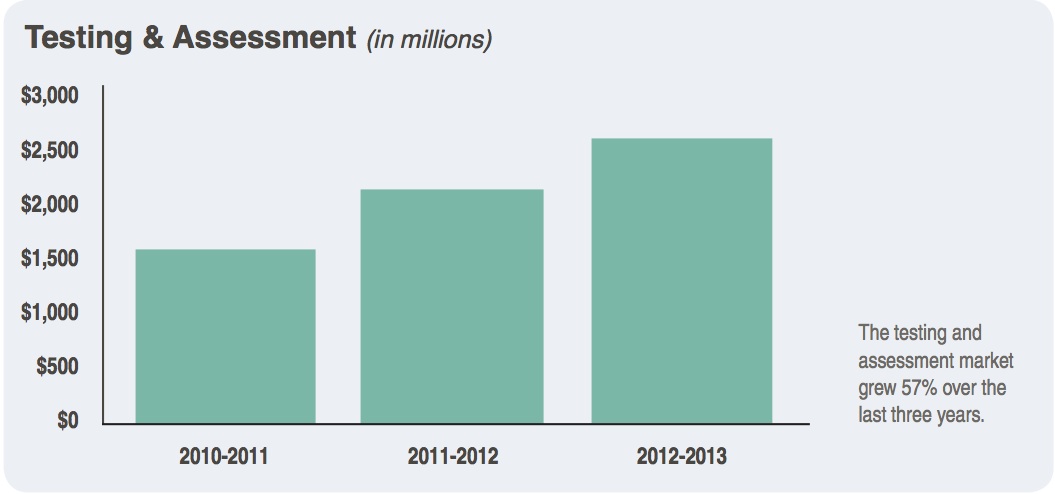
With the release of Behind the Data: Testing and Assessment—A PreK-12 U.S. Education Technology Market Report*, we have yet another opportunity to confront that Common Core is the problem, not the solution, because it is the source of a powerful drain on public resources in education that are not now invested in conditions related to racial and class inequity in our public schools.

Richards and Stebbins (2014) explain:

The PreK-12 testing and assessment market segment has experienced remarkable growth over the last several years. This growth has occurred in difficult economic times during an overall PreK-12 budget and spending decline….

Participants almost universally identified four key factors affecting the recent growth of the digital testing and assessment market segment:

1) The Common Core State Standards are Changing Curricula

2) The Rollout of Common Core Assessments are Galvanizing Activity….

(Executive Summary, pp. 1, 2)

testing and assessment 57 percent
(Richards & Stebbins 2014).

So as I have argued before, Common Core advocacy is market-driven, benefiting those invested in its adoption. But we must also acknowledge that that market success is at the expense of the very students who most need our public schools.

And there is the problem—not the end of cursive, not how we teach math, not whether the standards are age-appropriate.

Common Core is a continuation of failing social justice, draining public resources from needed actions that confront directly the inexcusable inequities of our schools, inequities often reflecting the tragic inequities of our society:

As the absence or presence of rigorous or national standards says nothing about equity, educational quality, or the provision of adequate educational services, there is no reason to expect CCSS or any other standards initiative to be an effective educational reform by itself. (Mathis, 2012, 2 of 5)

Who will be held accountable for the cost of feeding the education market while starving our marginalized children’s hope?

Reference

Richards, J., & Stebbins, L. (2014). Behind the Data: Testing and Assessment—A PreK-12 U.S. Education Technology Market Report. Washington, D.C.: Software & Information Industry Association.

* Thanks to Schools Matter for posting, and thus, drawing my attention to the study.

Listen 2 and Watch: #Ferguson #FergusonDecision #TamirRice

And I must say tonight that a riot is the language of the unheard. And what is it America has failed to hear? It has failed to hear that the plight of the negro poor has worsened…. It has failed to hear that the promises of freedom and justice have not been met. And it has failed to hear that large segments of white society are more concerned about tranquility and the status quo than about justice and humanity.

Rev. Martin Luther King Jr., “The Other America” 14 March 1968

Elahe Izadi and Peter Holley report:

A rookie Cleveland police officer responding to a 911 call jumped out of a cruiser and within seconds shot and killed a 12-year-old boy wielding what later turned out to be a BB gun, according to surveillance video released by authorities Wednesday.

Video of the fatal Saturday shooting of Tamir Rice, 12, by officer Timothy Loehmann, 26, was made public at the request of Tamir’s family. “It is our belief that this situation could have been avoided and that Tamir should still be here with us. The video shows one thing distinctly: the police officers reacted quickly,” reads a statement from the family, who also called on the community to remain calm. [See video at beginning of the report.]

Later in the report, Izadi and Holley add:

The gun turned out to be an Airsoft gun. Authorities had said it resembled a semiautomatic handgun and lacked the orange safety marker intended to signal that it’s a fake.

“Shots fired, male down, um, black male, maybe 20,” one of the officers radioed in. “Black hand gun.”

Stacey Patton’s In America, black children don’t get to be children calls our attention to a historical reality that illuminates the shooting of Tamir Rice:

In 1955, after 14-year-old Emmett Till was beaten and killed by a group of white men, one of his killers said Till “looked like a man.” I’ve found this pattern in news accounts of lynchings of black boys and girls from 1880 to the early 1950s, in which witnesses and journalists fixated on the size of victims who ranged from 8 to 19 years old. These victims were accused of sexually assaulting white girls and women, stealing, slapping white babies, poisoning their employers, fighting with their white playmates, or protecting black girls from sexual assault at the hands of white men. Or they were lynched for no reason at all.

And from the Journal of Personality and Social Psychology, “The Essence of Innocence: Consequences of Dehumanizing Black Children,” the abstract reads:

The social category “children” defines a group of individuals who are perceived to be distinct, with essential characteristics including innocence and the need for protection (Haslam, Rothschild, & Ernst, 2000). The present research examined whether Black boys are given the protections of childhood equally to their peers. We tested 3 hypotheses: (a) that Black boys are seen as less “childlike” than their White peers, (b) that the characteristics associated with childhood will be applied less when thinking specifically about Black boys relative to White boys, and (c) that these trends would be exacerbated in contexts where Black males are dehumanized by associating them (implicitly) with apes (Goff, Eberhardt, Williams, & Jackson, 2008). We expected, derivative of these 3 principal hypotheses, that individuals would perceive Black boys as being more responsible for their actions and as being more appropriate targets for police violence. We find support for these hypotheses across 4 studies using laboratory, field, and translational (mixed laboratory/field) methods. We find converging evidence that Black boys are seen as older and less innocent and that they prompt a less essential conception of childhood than do their White same-age peers. Further, our findings demonstrate that the Black/ape association predicted actual racial disparities in police violence toward children. These data represent the first attitude/behavior matching of its kind in a policing context. Taken together, this research suggests that dehumanization is a uniquely dangerous intergroup attitude, that intergroup perception of children is underexplored, and that both topics should be research priorities.

And thus, if you think “I don’t understand rioters,” or “I’m tired of all this about Ferguson,” or “Why does it always have to be about race,” please do the following: (i) do not say or write any of those thoughts, (ii) open your eyes and your ears, (iii) watch and listen with empathy and not with judgment, and then (iv) ask yourself what you can do to insure that no one feels again the genuine need to protest, a need bred in the toxic soil of powerlessness.

Listen. Watch.

Related

Happening Yesterday, Happened Tomorrow: Teaching the ongoing murders of black men, Renee Watson

Education in Black and White: Beware the Roadbuilders

On Children and Childhood

“They’re All Our Children”

Email to My Students: “the luxury of being thankful”

In addition to the absence of coordination and sufficiency, the programs of the past all have another common failing — they are indirect. Each seeks to solve poverty by first solving something else.

I am now convinced that the simplest approach will prove to be the most effective — the solution to poverty is to abolish it directly by a now widely discussed measure: the guaranteed income.

Martin Luther King Jr., “Final Words of Advice”

“I am a writer, nothing more, nothing less,” begins Roxane Gay in the wake of a grand jury decision not to charge Darren Wilson in the killing of Michael Brown, adding, “In the face of injustice, I only have words and words can only do so much.”

On a much smaller scale, I too am a writer—and I am a teacher, Selves inextricable one from the other. My initial response to the grand jury’s inaction has been near paralysis, especially as a writer who mostly offers this blog; it seems appropriate that I shut up, take a moratorium and do as many have requested—listen.

Gay’s “I only have words and words can only do so much” haunts me, haunts me in the context of Martin Luther King Jr.’s words offered above—that tension between “indirect” and “direct” action.

Teaching and writing often feel merely “indirect”—symbolic, impotent, shouting down an empty well.

This is an awful feeling if, like me, you are compelled to be a writer-teacher, a teacher-writer.

Not as a conscious plan (in the way I am a poet), but typical of my twin compulsions to teach and to write, I finally landed at the keyboard this morning, composing to my three fall classes of students an email—such arrogance, such intrusion while these beautiful and wonderful young people slip away from college for a holiday, Thanksgiving.

Being a writer is the perpetual state of hyperawareness of one’s frailty and inadequacy combined with the relentless inevitable, sharing your words with a mostly anonymous audience. A writer’s writer, J.D. Salinger (flawed possibly to the inexcusable) has already captured how I offer my email below to the readers of this blog: “As nearly as possible in the spirit of Matthew Salinger, age one, urging a luncheon companion to accept a cool lima bean” (dedication for Franny and Zooey).

#

[Email to my students]

I do love you all. It is a very special thing to be given the task of teaching, to have students randomly assigned to your care, your responsibility.

Sometimes, that charge is more than I can handle, but I am only human (and aging, slipping into decrepitude, and thus, not as flawed in some ways as in my youth, but flawed in new and different ways).

Especially at Furman, and especially in our teens and 20s, it is easy to miss the world around us (I did mostly, and often, and well past then)—to empathize fully and genuinely with that world, those people unlike us.

So excuse this intrusion on your holiday … and do not feel obligated in any way to care about this now, or instead of turkey, or instead of just doing nothing, or instead of enjoying family or friends or someone you love … no one should deny you any of those things, and especially not me …

And now, teacher-Me: This essay is wonderfully written (what it says, yes, but how it is written, crafted):

Why We Won’t Wait, Robin D.G. Kelley

And here are some poems of mine pulled out of the rubble of this horrible thing we allow in the US, a callousness about the lives of (especially) young black men:

Four Poems: For Jordan Davis and Trayvon Martin

I think, let us be thankful for we have many people and things that bring us happiness, but could we also find ways to insure that everyone has the opportunities to share the luxury of being thankful?

To you, then, accept as you wish a virtual side-hug, handshake, or your preferred virtual display of affection.

#Ferguson #FergusonDecision Listen

“The law is meant to be my servant and not my master, still less my torturer and my murderer.” James Baldwin. The Nation. July 11, 1966.

“As JRR Tolkien reminded us, the only people who inveigh against escape are jailers.” Neil Gaiman. October 15, 2013

“If you’re not careful, the newspapers will have you hating the people who are being oppressed, and loving the people who are doing the oppressing.” Malcolm X

In several ways, I have seen on social media: “Dear white people, listen” [1]—coming in the wake of the failure to charge Darren Wilson for shooting Michael Brown.

Here, I want to catalogue those voices that speak to that need to listen.

Listen

Harlem, Lanston Hughes

Only Words, Roxane Gay

Ferguson isn’t about black rage against cops. It’s white rage against progress., Carol Anderson

As a police officer kills without consequence in Ferguson, let’s look at profiling, education’s silent serial killer for black kids, Andre Perry

Week 13: Put Your Hands Where My Eyes Can See, Jose Vilson

I am utterly undone: My struggle with Black rage and fear after Ferguson, Brittney Cooper

Ferguson is not a special case, Tony N. Brown

Why We Won’t Wait, Robin D.G. Kelley

Telling My Son About Ferguson, Michelle Alexander

Barack Obama, Ferguson, and the Evidence of Things Unsaid, Ta-Nehisi Coates

The Gospel of Rudy Giuliani, Ta-Nehisi Coates

Ferguson, goddamn: No indictment for Darren Wilson is no surprise. This is why we protest, Syreeta McFadden

In America, black children don’t get to be children, Stacey Patton

Fury After Ferguson, Charles M. Blow

The Illipsis: Jay Smooth on Ferguson, Riots & Human Limits

Kareem Abdul-Jabbar: White People Feel Targeted by the Ferguson Protests—Welcome to Our World

A Report from Occupied Territory, James Baldwin

The Master’s Tools Will Never Dismantle the Master’s House, Audre Lorde

“The truth is…” James Baldwin

“To be afraid is to behave as if the truth were not true…” Bayard Rustin

Toni Morrison, the White Gaze, Race, and Writing

“This rigid refusal to look at ourselves may well destroy us” James Baldwin

From Baldwin to Coates: Denying Racism, Ignoring Evidence

James Baldwin (Aug. 2, 1924 – Dec. 1, 1987)

[1] Our Silence Means More Violence: An Open Letter to Fellow White People, Carl Gibson

Related

Race matters in school discipline and incarceration

Illinois School Bans Discussions of Michael Brown’s Death

Nastiness, Failed Logic of Racism Denial

While we can never make statistically valid claims about who and what is posted in online comments, I believe those comments represent common beliefs more than we’d like to admit.

Possibly the nastiest and most troubling comments occur when I publish something about race and racism, as in this piece in The State (Columbia, SC) about racial inequity in school discipline and mass incarceration.

Let’s consider some of the failed logic:

  • “I don’t believe your statistics and here are some statistics that prove my point”—this comment reveals the power of seeking support for a belief someone will never release. What is also interesting is that this approach almost always shifts entirely the discussion, not actually refuting the original statistical evidence: to reject racism in mass incarceration, for example, single-mother birth rates are cited.
  • Racism denial almost always plays the poverty card, but in the racial inequity of mass incarceration, that point falls flat. Impoverished white males outnumber black males 2 to 1; thus, incarceration is not more significantly a function of poverty than race, since black males outnumber white males 6 to 1 in prison.
  • Racism denial also has a favorite statistic: black on black crime rates. However, white on white crime rates are about the same as black on black crime rates, both over 80%. In fact, crime in the U.S. is typically within race and by someone the victim knows (often family). If within-race crime rates explained mass incarceration, then blacks and whites would be about equally represented in prisons.
  • And finally, I have been told by email that I don’t know anything about being a police officer since I have never been a police officer—these denials are by white former officers who, of course, know nothing about being black (using their logic). Much of what I offer about the racism of school discipline and the judicial system is based on the research and lived experienced of blacks, to me a much more credible source of understanding the inequity.

The raw data on school discipline and mass incarceration are undeniable in terms of racial inequity. As I noted, that requires a careful and nuanced consideration of the many reasons that inequity exists. In the case of mass incarceration, Michelle Alexander has offered a detailed examination that uncovers significant racism in who is arrested, how (and if) people are charged, and what sentences are handed down.

Decades of research also shows racial inequity in school discipline and then high and disturbing correlations between school discipline and incarceration rates.

Denial of racism in school discipline and incarceration, from the nasty to the illogical, is embracing school and judicial realities that mis-serve black children and black young adults—and then mis-serves us all.

Asking why these inequities exist so that they can be eradicated is a call for justice, not a plea for anarchy.

It’s Privilege (and Race), not Effort

In the tradition of Mel Riddile (see here and here), I want to assert: In the U.S., it’s privilege (and race), not effort.

The U.S. has a powerful addiction to a false myth, the myth of meritocracy—that success comes from hard work and that failure comes from laziness. Against that myth consider the following:

  • Matt O’Brien reports: “Even poor kids who do everything right don’t do much better than rich kids who do everything wrong. Advantages and disadvantages, in other words, tend to perpetuate themselves.”
  • Matt Bruenig concludes, based on data from the Pew’s Economic Mobility Project: “So, you are 2.5x more likely to be a rich adult if you were born rich and never bothered to go to college than if you were born poor and, against all odds, went to college and graduated….Therefore, the answer to the question in the title is that you are better off being born rich regardless of whether you go to college than being born poor and getting a college degree.”
  • Drawing on the report Young Invincibles, Susan Adams explains: “African-Americans college students are about as likely to get hired as whites who have dropped out of high school.”
  • Bruenig also notes: “Black families with college degrees have a mean wealth of $162.8k, which is effectively the same as the mean wealth of white families with less than a high school education.”

The evidence refutes the myth, then, since race and the economic status of any child’s home are far more powerful influences on success than effort. As long as we cling to the false myth and fail to dismantle privilege, however, meritocracy will never become a reality.

Proposal: Invisible Young Men: 21st Century Reports from Occupied Territory

Below is a draft proposal for an edited volume. I am seeking possible co-editor(s) as well as potential contributors. Please contact me at paul.thomas@furman.edu if you are interested in either co-editing or contributing. Once I have interest and a revised proposal, I will seek a publisher and then post a formal call for chapter proposals.

Invisible Young Men: 21st Century Reports from Occupied Territory

P.L. Thomas, editor

Publisher: TBD

With his Invisible Man, Ralph Ellison’s narrator announced on the first page: “I am invisible, understand, simply because people refuse to see me.” Ellison was soon embraced by the mainstream world of literary fiction at mid-twentieth century, but he also created tensions among those identifying with left-leaning African American arts and civil rights movements—especially among the radicals.

Now at one hundred years since Ellison’s birth and more than fifty years since Invisible Man was published, the rich paradox of the invisible black man in the U.S. at mid-twentieth century must be viewed through the lens of Martin Luther King Jr.’s and Malcolm X’s assassinations—and the more recent controversies surrounding the shootings of Trayvon MartinJordan Davis, and Michael Brown as well as the controversies surrounding Richard Sherman and Marcus Smart.

Ellison’s invisible man recognized that mainstream (and white) America refused to see him, but African American males in the second decade of the twenty-first century are now faced with another reality of being mis-seen as “thugs”—criminals by their very existence.

African American males know this reality of being mis-seen as soon as they enter school or walk the streets. In his 1966 “A Report from Occupied Territory,” James Baldwin confronted the African American experience for young men—a confrontation that echoes across the U.S. today:

This is why those pious calls to “respect the law,” always to be heard from prominent citizens each time the ghetto explodes, are so obscene. The law is meant to be my servant and not my master, still less my torturer and my murderer. To respect the law, in the context in which the American Negro finds himself, is simply to surrender his self-respect….

These things happen, in all our Harlems, every single day. If we ignore this fact, and our common responsibility to change this fact, we are sealing our doom. Here is the boy, Daniel Hamm, speaking—speaking of his country, which has sworn to bung peace and freedom to so many millions. “They don’t want us here. They don’t want us—period! All they want us to do is work on these penny-ante jobs for them—and that’s it. And beat our heads in whenever they feel like it. They don’t want us on the street ’cause the World’s Fair is coming. And they figure that all black people are hoodlums anyway, or bums, with no character of our own. So they put us off the streets, so their friends from Europe, Paris or Vietnam—wherever they come from—can come and see this supposed-to-be great city.”

There is a very bitter prescience in what this boy—this “bad nigger”—is saying, and he was not born knowing it. We taught it to him in seventeen years. He is draft age now, and if he were not in jail, would very probably be on his way to Southeast Asia. Many of his contemporaries are there, and the American Government and the American press are extremely proud of them. They are dying there like flies; they are dying in the streets of all our Harlems far more hideously than flies. A member of my family said to me when we learned of the bombing of the four little girls in the Birmingham Sunday school, “Well, they don’t need us for work no more. Where are they building the gas ovens?” Many Negroes feel this; there is no way not to feel it. Alas, we know our countrymen, municipalities, judges, politicians, policemen and draft boards very well. There is more than one way to skin a cat, and more than one way to get bad niggers off the streets. No one in Harlem will ever believe that The Harlem Six are guilty—God knows their guilt has certainly not been proved. Harlem knows, though, that they have been abused and possibly destroyed, and Harlem knows why—we have lived with it since our eyes opened on the world. One is in the impossible position of being unable to believe a word one’s countrymen say. “I can’t believe what you say,” the song goes, “because I see what you do”—and one is also under the necessity of escaping the jungle of one’s situation into any other jungle whatever. It is the bitterest possible comment on our situation now that the suspicion is alive in so many breasts that America has at last found a way of dealing with the Negro problem. “They don’t want us—period!” The meek shall inherit the earth, it is said. This presents a very bleak image to those who live in occupied territory. The meek Southeast Asians, those who remain, shall have their free elections, and the meek American Negroes—those who survive—shall enter the Great Society.

In these historical and contemporary contexts, this volume seeks to gather a wide range of voices addressing the following:

  • Racial inequity in formal education disproportionately impacting African American males—expulsion and suspension, teacher quality access, course access.
  • African American males and the allure of sports as a “way out.”
  • Mass incarceration and the African American male.
  • Additional?

References

Alexander, M. (2012). The new Jim Crow: Mass incarceration in the age of colorblindness (Rev. ed.). New York, NY: New Press.

Baldwin, J. (1966, July 11). A report from occupied territory. The Nation. Retrieved from http://www.thenation.com/article/159618/report-occupied-territory

Baldwin, J. (1998). James Baldwin: Collected essays. New York, NY: Library of America.

Carr, S. (2013). Hope against hope: Three schools, one city, and the struggle to educate America’s children. New York, NY: Bloomsbury Press.

The Center for Civil Rights Remedies. (2013, January). A summary of new research. Closing the school discipline gap: Research to policy. Los Angeles, CA: The Civil Rights Project. Retrieved from http://civilrightsproject.ucla.edu/events/2013/summary-of-new-research-closing-the-school-discipline-gap-research-to-policy/

Christensen, L. (2011/2012 Winter). The classroom-to-prison pipeline. Rethinking Schools, 26(2). Retrieved from http://www.rethinkingschools.org/restrict.asp?path=archive/26_02/26_02_christensen.shtml

Criminalizing children at school. (2013, April 18). The New York Times. Retrieved from http://www.nytimes.com/2013/04/19/opinion/criminalizing-children-at-school.html

Deleuze, G. (1992, Winter). Postscript on the societies of control. October, 59, pp. 3-7. Retrieved from https://files.nyu.edu/dnm232/public/deleuze_postcript.pdf

Delpit, L. (2006). Other people’s children: Cultural conflict in the classroom. New York, NY: The New Press.

Ellison, R. (1952). Invisible man. New York, NY: Vintage International.

Foucault, M. (1995). III. Discipline. 3. Panopticism. Discipline & punish: The birth of the prison. Trans. A Sheridan. Vintage, 2nd ed. Retrieved fromhttp://foucault.info/documents/disciplineAndPunish/foucault.disciplineAndPunish.panOpticism.html

Foucault, M. (1984). The Foucault reader. Ed. P. Rabinow. New York, NY: Pantheon Books.

Freire, P. (1998). Pedagogy of freedom: Ethics, democracy, and civic courage. Trans. P. Clarke. New York, NY: Rowman & Littlefield Publishers, Inc.

Gilliam, W. S. (2005, May 4). Prekindergarteners left behind: Expulsion rates in state prekindergarten systems. Yale University Child Study Center. Retrieved from http://www.hartfordinfo.org/issues/wsd/education/NationalPreKExpulsionPaper.pdf

Jones, S., & Maurer, M. (2013, April 29). Ronald Reagan made the war on drugs a race to incarceration. Truthout. Retrieved from http://www.truth-out.org/opinion/item/16065-ronald-reagan-made-the-war-on-drugs-a-race-to-incarcerate

Kaba, M., & Edwards, F. (2012, January). Policing Chicago public schools: A gateway to the school-to-prison pipeline. Project NIA. Retrieved fromhttp://policeinschools.files.wordpress.com/2011/12/policing-chicago-public-schools-final2.pdf

Lewin, T. (2012, March 6). Black students face more discipline, data suggests. The New York Times. Retrieved from http://www.nytimes.com/2012/03/06/education/black-students-face-more-harsh-discipline-data-shows.html

Miron, G., Urschel, J. L., Mathis, W, J., & Tornquist, E. (2010). Schools without Diversity: Education management organizations, charter schools and the demographic stratification of the American school system. Boulder, CO and Tempe, AZ: Education and the Public Interest Center & Education Policy Research Unit. Retrieved from http://epicpolicy.org/publication/schools-without-diversity

Nolan, K. (2011). Police in the hallways: Discipline in an urban high school. Minneapolis, MN: University of Minnesota Press. [Kindle edition]

Peske, H. G., & Haycock, K. (2006, June). Teaching inequality: How poor and minority students are shortchanged on teacher quality. Washington DC: The Education Trust, Inc. Retrieved from http://www.edtrust.org/sites/edtrust.org/files/publications/files/TQReportJune2006.pdf

Siegel-Hawley, G., & Frankenber, E. (2012, September). Southern slippage: Growing school segregation in the most desegregated region of the country. Los Angeles, CA: The Civil Rights Project. Retrieved from http://civilrightsproject.ucla.edu/research/k-12-education/integration-and-diversity/mlk-national/southern-slippage-growing-school-segregation-in-the-most-desegregated-region-of-the-country/hawley-MLK-South-2012.pdf

Thomas, P. L. (2014). Invisible young men: African American males, academics, and athletics English Journal, 104(1), 75-78.

Wagner, P. (2012, August 28). Incarceration if not an equal opportunity punishment. Prison Policy Initiative. Retrieved from http://www.prisonpolicy.org/articles/notequal.html

Woodson, C. G. (1933). The mis-education of the negro. New York, NY: Tribeca Books.

Denying White Privilege Has an Evidence Problem

If I had to guess, I suspect Bill O’Reilly fancies himself more akin to George Will, Newt Gingrich, or Cal Thomas than Rush Limbaugh or Glenn Beck. But speculating on that self-delusion isn’t really necessary because the reality is that all of these white, male pundits share a single quality: privilege.

And thus, it is all the more baffling when O’Reilly holds forth on denying privilege, prompting Charles Blow to conclude perfectly: “Only a man bathing in privilege would be blind to that.”

The “that” to which O’Reilly is blind, of course, is his own privilege built on his being white and male.

It is there that self-delusion is powerful, rendering O’Reilly and his fellow white-male punditry incapable of seeing their self-delusion; thus we have some perverse inversion of Ralph Ellison’s narrator confronting his own invisibility because he is black.

To deny privilege garnered from being a white male reminds me of the same sort of delusion found among Libertarians who champion their rugged individualism—”I did it on my own!”—while remaining incapable of seeing that no one does anything on “her/his own.”

No one.

There is likely a tremendous amount of low self-esteem lurking beneath these white, male pundits who hold forth on anything with a gusto found mostly among 15-year-old boys. In fact, these white, male pundits are essentially suffering arrested development.

And the really ugly truth is that as long as white males dominate U.S. culture in terms of power and wealth, that dynamic creates an echo chamber in which blind-but-loud pundits like O’Reilly speak to the actual and the normalized white male essence of the country.

It is nearly as tiring and cannot be unrelated: We must become so weary of young black males being slaughtered in our country that we do something about it—for and with them, and not to them—and we must also become weary of a ruling elite born on third base (white, male) and confusing that with hitting a triple.

I am sick to my bones with a country that demonizes the powerless while worshipping the privileged.

I am sick to my bones with a country that will not see the human value of its children.

I am sick to my bones with a country that allows the list of names simply to grow: Trayvon Martin, Jordan Davis, Michael Brown …

And I am sick to my bones with a country that creates wealth and celebrity for toxic white males.

It’s inexcusable, it’s embarrassing.

It’s exhausting to repeat, but necessary: we need a moratorium on white men pontification on race, class, and gender.

See Also

Denying Racism Has an Evidence Problem

The Mistrial of Jordan Davis: More Evidence Problems for Denying Racism

From Baldwin to Coates: Denying Racism, Ignoring Evidence

Denying Impact of Poverty Has an Evidence Problem

Howard Zinn: “education cannot be neutral on the critical issues of our time”

[Header Photo by Ankush Minda on Unsplash]

24 August 1922—Howard Zinn was born. His life and career spanned the twentieth century and into the first decade of the twenty-first. It is his memoir, You Can’t Be Neutral on a Moving Train: A Personal History of Our Times, for me, that speaks to the enduring power of Zinn’s metaphor, particularly for teachers.

Historically and currently, teacher remain under the demand that their teaching—and even their lives—remain neutral, not political. University professors—such as Zinn—also face disciplinary and public expectations of objectivity, dispassion—their work as public intellectuals either shunned or unrecognized.

In that context, K-12 education and university education suffer the same ultimate failure found in journalism, a flawed pursuit of objectivity, the faux-neutral pose of representing both sides.

So on the day of Zinn’s birth, it continues to be important not only to read and listen to Zinn, but also to act on Zinn, for it is action, after all, that Zinn lived and called for.

“When I became a teacher,” Zinn explains in You Can’t Be Neutral on a Moving Train, “I could not possibly keep out of the classroom my own experiences”:

I have often wondered how so many teachers manage to spend a year with a group of students and never reveal who they are, what kind of lives they have led, where their ideas come from, what they believe in, or what they want for themselves, for their students, and for the world.

Does not the very fact of that concealment teach something terrible—that you can separate the study of literature, history, philosophy, politics, the arts, from your own life, your deepest convictions about right and wrong?

Concealment is a political act, and in the face of the tragedy surrounding the police shooting of Michael Brown, the educational response has been exactly that, concealment. But as poet Adrienne Rich has confronted:

The study of silence has long engrossed me. The matrix of a poet’s work consists not only of what is there to be absorbed and worked on, but also of what is missing, desaparecido, rendered unspeakable, thus unthinkable.

Instead of striking the masked political poses of neutrality, objectivity, and dispassion, Zinn called for transparency:

In my teaching I never concealed my political views: my detestation of war and militarism, my anger at racial inequality, my belief in democratic socialism, in a rational and just distribution of the world’s wealth. I made clear my abhorrence of any kind of bullying, whether by powerful nations over weaker ones, governments over their citizens, employers over employees, or by anyone, on the Right or the Left, who thinks they have a monopoly on the truth.

Having taught in rural Southern public schools for 18 years and then 13 more years in higher education, I can attest that Zinn’s argument is challenged only because of the positions he holds and not because he took positions. You see, in K-12 classrooms, especially in history classes, textbooks, curriculum, and teachers always represented positions by framing as neutral the mainstream perspectives found among them all: a blind allegiance to capitalism, representing the U.S. as a righteous military victor, whitewashing every struggle in the country’s history, celebrating the wealthy and powerful while turning a blind eye to their many sins.

It has never been that our classrooms are neutral, as Zinn confronts, but that our classrooms have been passive passengers on the moving train of social and cultural indoctrination, the sort of indoctrination that benefits the few who have wealth and power built on their privilege at the expense of the many—workers, racial minorities, women, children, and the impoverished.

As Zinn recognized:

This mixing of activism and teaching, this insistence that education cannot be neutral on the critical issues of our time, this movement back and forth from the classroom to the struggles outside by teachers who hope their students will do the same, has always frightened the guardians of traditional education. They prefer that education simply prepare the new generation to take its proper place in the old order, not to question that order.

And although written well before the current education reform movement built on accountability, standards, and high-stakes testing, Zinn’s memoir has identified the Orwellian reality of that movement: Those decrying the status quo are those in service of the status quo. Education reform is the pursuit of maintaining, not reforming.

This call for teaching as activism was join by Zinn’s disciplinary challenge as well:

History can come in handy. If you were born yesterday, with no knowledge of the past, you might easily accept whatever the government tells you. But knowing a bit of history—while it would not absolutely prove the government was lying in a given instance—might make you skeptical, lead you to ask questions, make it more likely that you would find out the truth.

Here, Zinn recognizes both the power of disciplinary knowledge and the concurrent danger of codified disciplinary knowledge (prescriptive standards, curriculum). Zinn’s confrontation, then, speaks to the foundational principles expressed by critical scholar Kincheloe:

Thus, proponents of critical pedagogy understand that every dimension of schooling and every form of educational practice are politically contested spaces. Shaped by history and challenged by a wide range of interest groups, educational practice is a fuzzy concept as it takes place in numerous settings, is shaped by a plethora of often-invisible forces, and can operate even in the name of democracy and justice to be totalitarian and oppressive.

These critical principles replace the dissembling of neutrality in the classroom, as Kincheloe explains:

Recognition of these educational politics suggests that teachers take a position and make it understandable to their students. They do not, however, have the right to impose these positions on their students [emphasis in original]….

In this context it is not the advocates of critical pedagogy who are most often guilty of impositional teaching but many of the mainstream critics themselves. When mainstream opponents of critical pedagogy promote the notion that all language and political behavior that oppose the dominant ideology are forms of indoctrination, they forget how experience is shaped by unequal forms of power. To refuse to name the forces that produce human suffering and exploitation is to take a position that supports oppression and powers that perpetuate it. The argument that any position opposing the actions of dominant power wielders is problematic. It is tantamount to saying that one who admits her oppositional political sentiments and makes them known to students is guilty of indoctrination, while one who hides her consent to dominant power and the status quo it has produced from her students is operating in an objective and neutral manner.

“Critical pedagogy wants to know who’s indoctrinating whom,” Kincheloe concludes. Teaching and history as activism, for Zinn, were moral imperatives, and thus:

From that moment on, I was no longer a liberal, a believer in the self-correcting character of American democracy. I was a radical, believing that something fundamental was wrong in this country—not just the existence of poverty amidst great wealth, not just the horrible treatment of black people, but something rotten at the root. The situation required not just a new president or new laws, but an uprooting of the old order, the introduction of a new kind of society—cooperative, peaceful, egalitarian.

Zinn, activist, radical, speaks to us now, the “us” of any classroom, the “us” charged with the learning and lives of any child:

From the start, my teaching was infused with my own history. I would try to be fair to other points of view, but I wanted more than “objectivity”; I wanted students to leave my classes not just better informed, but more prepared to relinquish the safety of silence, more prepared to speak up, to act against injustice wherever they saw it. This, of course, was a recipe for trouble.

Today on the date of Zinn’s birth, I argue, it is a recipe we must follow.