Category Archives: race

More on Two Americas

Recently, I posed an argument about two Americas, personified by George W. Bush and Neil deGrasse Tyson.

Over the past few days, the controversy surrounding Donald Sterling has offered even more evidence of two Americas. Let’s start with the unlikeliest of places—the ever-ineloquent Charles Barkley, who weighed into the Sterling situation by noting that Barkley (and other NBA players) is Black, but he isn’t Black:

While there are many things jumbled and fumbled in Barkley’s comments, we must not ignore his recognition of the powerful connection between race and class in the U.S.

In fact, Sterling’s own contradictory and illogical mixture of racism and sexism exposed in his taped conversation with his girlfriend is a perverse manifesto that reflects Barkley’s garbled argument, a recognition of two Americas, I think, well articulated by Jesse Myerson:

The logic of capitalism and racism are the same in this regard – those in power develop attitudes of supremacy to justify reaping the spoils of mass social repression. Sterling, the owner, regards the players as inferior to him and people like him, since they don’t “make the game.” Sterling, the racist, regards black people as inferior to him and people like him, unfit to live, say, in Sterling’s real estate holdings. There is only one Sterling, the players are black, and the supremacist ideologies are effectively indistinct.

The NBA is a microcosm of the corrosive power of capitalism to create the necessary two Americas that feed the possibility of capitalism itself. Black athletes are well rewarded—and it seems by the likes of Sterling, thus tolerated—because they contribute to the perpetuation of the white and privileged ownership in spite of the racism remaining among the privileged.

The two Americas, then, are a complex mix of both race and class, or more accurately, a segregation of both race and class that continues to allow only some token access into the larger context of privilege (but race remains a marker for the tolerated).

Far beneath this sensationalized radar, however, is yet another story of two Americas—one acted out in perpetuity throughout the South, or as I have labeled my home region, the self-defeating South.

Jillian Berman’s When It Comes To Health Care, There Are 2 Americas, And These Maps Are Proof presents a stark picture of two Americas:

Many of the worst states for health care have several things in common. They’re mostly in the South and are more likely to be among the poorest in the nation. Many of them have long had unusually tight standards for applicants to qualify for Medicaid, said Schoen, and many have been slow to expand children’s health insurance.

What’s more, 16 of the 26 states at the bottom of the Commonwealth Fund’s scorecard aren’t expanding Medicaid under the Affordable Care Act, also known as Obamacare….

Black Americans are likely to suffer disproportionately from these policies. More than two-thirds of poor, uninsured blacks live in states not expanding Medicaid, according to a December 2013 New York Times report. Already, the rate of avoidable early deaths among blacks is twice as high as among whites in many states, Commonwealth found. That gap is even wider in states with higher early death rates overall.

The healthcare debate shows that two Americas result from a complex mix of race and class—but again driven by a misplaced faith in the free market (capitalism) blended with an irrational distrust of “government” by the very people most likely to be mis-served by the Invisible Hand but well served by a robust Commons. This refusal to embrace universal healthcare (or something like it) is mirrored in the same antagonism toward unions throughout the South, yet another wedge that insures two Americas continue.

And since I opened this post with the ineloquent, I must offer the final words to a poet, who confronts the two Americas, grounded in geography, race, and class:

Where Is Outrage for Systemic Racism?

Where is the outrage for this?

The New Jim Crow

Where is the outrage for this?

Incarceration is not an equal opportunity punishment

Incarceration Rates by Race and Ethnicity, 2010

Where is the outrage for this?

Revealing New Truths About Our Nation’s Schools

Where is the outrage for this?

A Generation Later: What We’ve Learned about Zero Tolerance in Schools

Where is the outrage for this?

The Long-Term Effects of Moving to Opportunity on Youth Outcomes

Where is the outrage for this?

Housing Costs, Zoning, and Access to High-Scoring Schools

Where is the outrage for this?

A Rotting Apple

And thus …

No Country for Young Children of Color

While I have argued that we basically do not like children in the U.S., there is considerable evidence that being born a child of color puts those children at a disadvantage relative to white children.

Based on the Kids Count report, Race for Results, Smriti Sinha has declared:

Black families pondering a move to the Midwest might want to read this, especially if they have young children. According to a national report, Wisconsin has been ranked the worst state in the country when it comes to racial disparities for children.

But the entire U.S. does not fare well in terms of addressing the needs faced by children of color.

“Opportunity has been a constant theme in our country’s narrative, beginning with the waves of immigrants who arrived from across the globe in search of a better life,” the report begins, adding, “Last year, for the first time, more children of color were born in the United States than white children” (p. 1).

Opportunity, then, in the future of the U.S. will be increasingly multi-racial, but access to opportunity does not have to remain a race, a competition among those races.

Yet, children who happen to be born white in the U.S., and especially if they are born affluent, start well ahead in the so-called race of life.

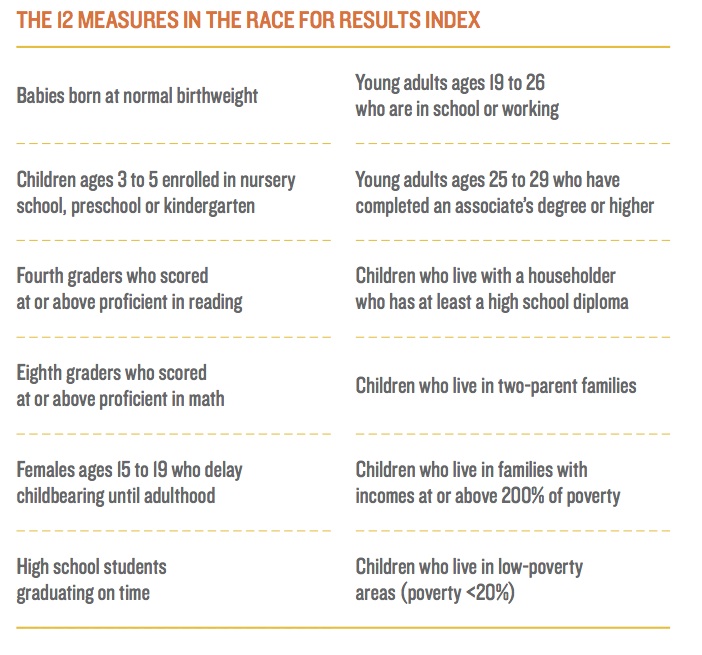
Social inequity remains grounded significantly in race and class, as measured in 12 indicators in The Race for Results Index (see p. 6):

12 indicators of The Race for Results Index

[click to enlarge]

Broadly, the report finds:

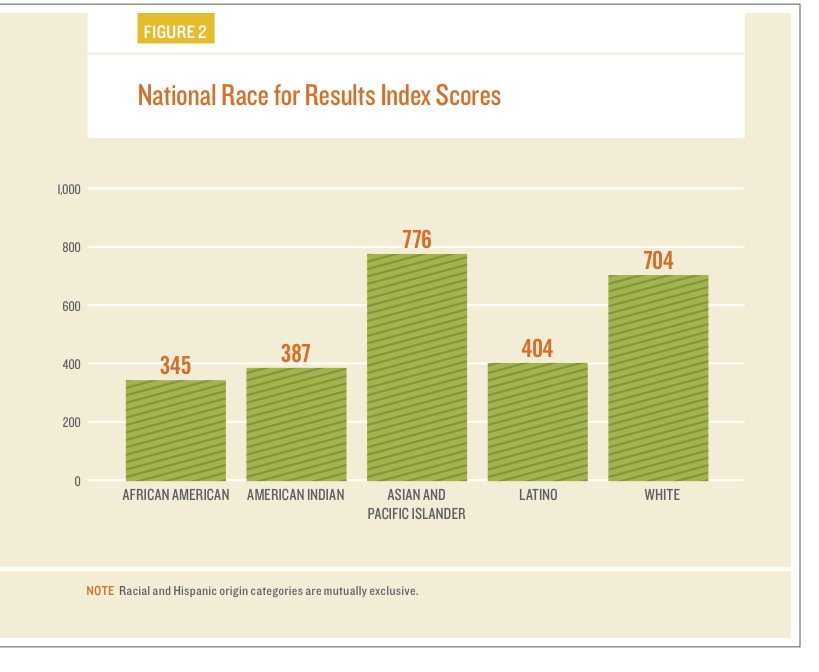
As the national data show, no one group has all children meeting all milestones. African-American, American Indian and Latino children face some of the biggest obstacles on the pathway to opportunity. As Figure 2 illustrates, Asian and Pacific Islander children have the highest index score at 776, followed by white children at 704. Scores for Latino (404), American Indian (387) and African-American (345) children are considerably lower. (p. 8)

Index scores by race

[click to enlarge]

While the overall inequity for African American and Latino/a children [1] is nation-wide, many states—often high-poverty and high-minority states (such as my home state of SC)—rank low in childhood opportunity for children of color:

state by state Afican American

[click to enlarge]

state by state Latino/a

[click to enlarge]

The report concludes with four recommendations:

RECOMMENDATION 1

Gather and analyze racial and ethnic data to inform all phases of programs, policies and decision making….

RECOMMENDATION 2

Use data and impact assessment tools to target investments to yield the greatest impact for children of color….

RECOMMENDATION 3

Develop and implement promising and evidence-based programs and practices focused on improving outcomes for children and youth of color….

RECOMMENDATION 4

Integrate economic inclusion strategies within economic and workforce development efforts….(pp. 22-28)

Ultimately, the report argues:

As profound demographic shifts, technological advances and changes in global competition race toward us, no individual can afford to ignore the fact that regardless of our own racial background or socioeconomic position, we are inextricably interconnected as a society. We must view all children in America as our own — and as key contributors to our nation’s future. (p. 28)

As I have stated about the paradox of race, the U.S. is neither a post-racial country, nor should that be our goal. Along with genuinely acting as if “they’re all our children,” we must see race as a part of an equitable society and set aside reducing life to a race to the top that must sacrifice some for the good of a few.

[1] This post focuses on the racial dynamic of white, African American, and Latino/a since my work primarily addresses SC, where that dynamic is dominant. Not addressing the remaining ethnic groups in the report is not intended to marginalize those children or the significance of any racial minority.

Two Americas: George W. Bush and Neil deGrasse Tyson

This country was founded on the idea of concentrating wealth in the hands of a few white men,” Mychal Denzel Smith asserts in “We Built This Country on Inequality,” adding, “That that persists today isn’t a flaw in the design. Everything is working as the founders intended.”

Smith’s claim has two parts that challenge the Great American Myth of meritocracy: those two parts being then and now.

At the turn of the twentieth century, from 1899 until 1908, the buildings that constitute Clemson University in South Carolina were built by convict labor, as explained in Lyn Riddle’s report detailing the research of Clemson assistant professor of English Rhondda Thomas:

So far, [Thomas] has documented the names of 572 men, all but 29 of them African Americans.

They made a million bricks to build Tillman Hall. They built Hardin Hall, the oldest classroom building, and Trustee House, home to the first chemistry professor. They cleared the land and built dikes. The oldest was 67, the youngest 12.

“They made it possible for South Carolina to get back on its feet, to educate young men to make a contribution,” Thomas said.

They were but a step away from the sharecroppers and slaves who preceded them, Thomas said. Some likely were former slaves and most certainly the sons of former slaves.

“Their labor was valued but not their lives,” she said. “It is carrying on the slavery institution.”

In fact, she said, the convicts were legally known as slaves of the state.

Smith’s assertion about then is disturbingly grounded in stories such as this one—an American infrastructure and economy built on the backs of slaves, prisoners, and exploited workers. To deny that past requires ignoring the facts of history, a history not peculiar to the South but certainly prevalent here.

But what of Smith’s argument about inequity now?

It is 2014 and there are two Americas: one America inhabited by George W. Bush and another America inhabited by Neil deGrasse Tyson.

In George W. Bush’s America, the birth right of privilege creates a set of circumstances in which being white and wealthy equals a person having to try repeatedly to fail—and even then, the safety net of privilege is likely to work.

Bush himself has joked about his mediocre academic achievement at Yale, but few ever discuss how a C student from Yale eventually went to Harvard graduate school. Bush’s privilege powered him straight through minimal effort as a student (even though he enjoyed a legacy entrance to Yale virtually anyone would covet), his own personal struggle with alcohol, and (again by his own admission) a relatively unimpressive career until he entered politics. The son of a president and a child of an extremely powerful and wealthy family of “old” money suggest his successful runs to be governor of Texas and two-time president of the U.S. were inevitable.

To be blunt, George W. Bush had only to get out of his own way on his journey, one that is now being punctuated by his having an art showing that almost no one else would be afforded. In fact, the George W. Bush art showings are the ideal examples of the America that runs on privilege: It isn’t what you do, but who you are (and money doesn’t hurt). “That gentle, civilised art can wipe away a surprising quantity of blood,” Jonathan Jones muses.

But there is another America, the one in which Neil deGrasse Tyson lives:

I’ve never been female. But I have been black my whole life, and, so, let me perhaps offer some insight from that perspective, because there are many similar social issues related to access to equal opportunity that we find in the black community as well as in the community of women, in a white male dominated society, and I’ll be brief, ’cause I want to try to get more questions.

When I look at, throughout my life, I’ve noticed that I’ve wanted to do astrophysics since I was nine years old, my first visit to the Hayden Planetarium. (I was a little younger than Victor at the time, although he did it before I did.) And so I got to see how the world around me reacted to my expression of these ambitions, and all I can say is, the fact that I wanted to be a scientist, an astrophysicist, was, hands down, the path of most resistance through the forces of nature, the forces of society. Any time I expressed this interest, teachers would say, “Oh, don’t you want to be an athlete? Oh, don’t you want to”– I wanted to become something that was outside of the paradigms of expectation of the people in power. And so, fortunately my depth of interest was so deep, and so fueled, enriched, that every one of these curveballs that I was thrown, and fences built in front of me, and hills that I had to climb, I just leaped for more fuel and I kept going.

In this America, the momentum of privilege is replaced by the anchors of bias—racism, classism, sexism. Tyson continues:

I walked out of a store one time, and the alarm went off, and, so they came running to me. I walked through the gate at the same time a white male walked through the gate, and that guy just walked off with the stolen goods, knowing that they would stop me and not him. That’s an interesting exploitation of this — what a scam that was! I think people should do that more often….

So my life experience tells me that when you don’t find blacks in the sciences, you don’t find women in the sciences, I know that these forces are real, and I had to survive them in order to get where I am today. So before we talk about genetic differences, you’ve got to come up with a system where there’s equal opportunity, then we can have that conversation.”

And this America remains now, as Smith recognizes:

[T]he architects and gatekeepers of American racism have always worn neckties. They have always been a part of the American political system….

It’s easy to focus on the most vicious and dramatic forms of racist violence faced by past generations as the site of “real” racism. If we do, we can also point out the perpetrators of that violence and rightly condemn them for their actions. But we can’t lose sight of the fact that those individuals alone didn’t write America’s racial codes. It’s much harder to talk about how that violence was only reinforcing the system of political, economic and cultural racism that made America possible. That history indicts far more people, both past and present.

And this America is the world in which Ta-Nehisi Coates and his son live:

On Sunday, I took my son to see two movies at a French film festival that was in town. The local train was out. We walked over to Amsterdam to flag down a cab. The cab rolled right past us and picked up two young-ish white women. It’s sort of amazing how often that happens. It’s sort of amazing how often you think you are going to be permitted to act as Americans do and instead receive the reminder—”Oh that’s right, we are just some niggers. I almost forgot.”…

I think of that cab driver passing me by on Amsterdam. We are not on the block anymore. We are in America, where our absence of virtue is presumed, and we must eat disrespect in sight of our sons. And who can be mad in America? Racism is just the wind, here. Racism is but the rain.

There was a time in the U.S., then, when the criminalization of powder cocaine and crack were distinctly different, an ugly snapshot of the two Americas detailed above. Once that inequity became too much for political leaders to ignore, those same leaders used that inequity to make distracting and mostly symbolic efforts to address the race- and class-based differences in punishment.

But now? Now continues the two Americas because, as Michelle Alexander details in depth, the U.S. remains in an era of mass incarceration that disproportionately impacts African Americans, notably males:

Although rates of drug use and selling are comparable across racial lines, people of color are far more likely to be stopped, searched, arrested, prosecuted, convicted and incarcerated for drug law violations than are whites. Higher arrest and incarceration rates for African Americans and Latinos are not reflective of increased prevalence of drug use or sales in these communities, but rather of a law enforcement focus on urban areas, on lower-income communities and on communities of color as well as inequitable treatment by the criminal justice system. We believe that the mass criminalization of people of color, particularly young African American men, is as profound a system of racial control as the Jim Crow laws were in this country until the mid-1960s. (Race and the Drug War)

Two Americas exist, but not as one of then and one of now.

Two Americas exist now, and as Thomas concludes about convict labor building Clemson University, “‘History is hidden in plain sight,'” and Riddle adds:

Consider that a building built by convicts is named for Ben Tillman, a former governor who as a U.S. senator in 1900 said in a speech in Congress, “We of the South have never recognized the right of the Negro to govern the white man, and we never will.”

I must add that the history of inequity continues in plain sight as a condition of now, although too many choose instead to gaze at the inadequate portraits of a privileged past president with too much time on his paint-stained hands.

“There’s a Muslim in America Named Muhammad Ali”

There’s a Muslim in America named Muhammad Ali.

Louis Farrakhan, The Trials of Muhammad Ali

The Trials of Muhammad Ali opens with contrasting responses to Muhammad Ali, highlighted by the awkward ceremony in which George W. Bush awarded Ali the Presidential Medal of Freedom.

The Trials of Muhammad Ali

The documentary follows footage of that ceremony with Louis Farrakan struggling with Ali’s pronouncement that Ali was “still a nigger.”

David Zirin calls The Trials of Muhammad Ali “the best documentary ever made about the most famous draft-resister in human history,” situating the documentary against the Will Smith bio-pic and other documentaries. I felt the same tension between trying to recreate Ali and the historical Ali when I watched HBO’s Muhammad Ali’s Greatest Fight (see my earlier post, Ali: “You must listen to me”).

To me, that historical and complicated Ali remains out of reach for many in the U.S.:

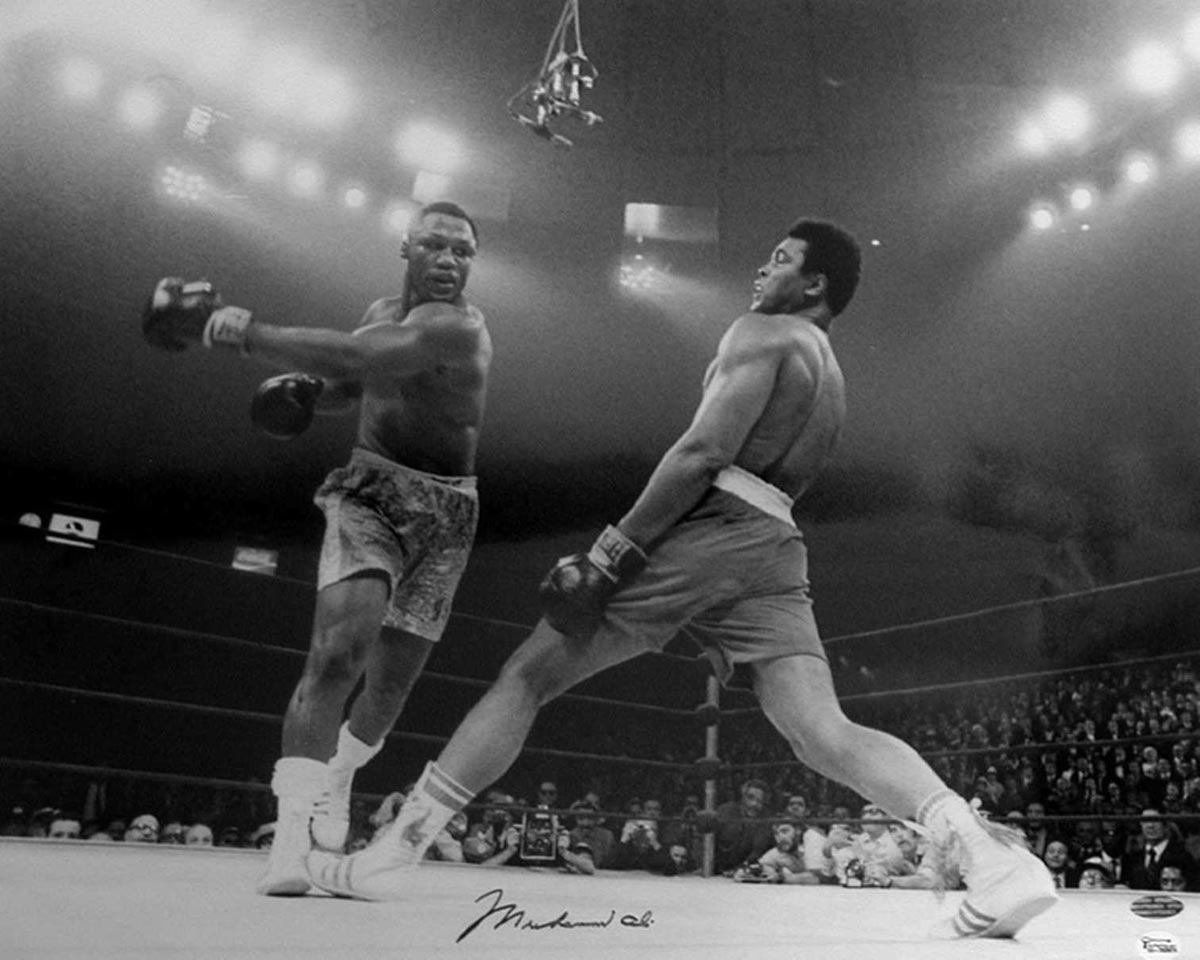
Muhammad Ali vs. Joe Frazier in Fight of the Century, Madison Square Garden in New York City, New York, 1971

The documentary ran on PBS and can be viewed streaming online, but I remain uncertain—despite the power of the documentary—about the American character in 2014 and whether or not we can fully connect with a black man who floated like a butterfly and stung like a bee in a white world.

My reservations, however, do not deter me from recommending that everyone tries by starting with this documentary that forces viewers to confront the uncomfortable.

David Susskind calls Ali a “simplistic fool,” and Jerry Lewis adds that Ali is a “big bag of wind”—just two of numerous scenes in which white men berate and demean Ali.

Ali smiles. Ali jabs with his wit and even with a cool detachment.

Black Nationalism and the Nation of Islam are characters in this documentary, as are Farrakhan, Elijah Muhammad, Malcolm X, Martin Luther King Jr., John Carlos, and Tommy Smith (just to highlight a few)—with Ali always at the center of the tensions this part of U.S. history entails.

The literal trial of Ali was his refusal to serve in Vietnam, but the film also dramatizes in detailed fashion how Ali as a converted Muslim was a trial for Ali and the U.S.

A key scene, for me, is sports writer Robert Lipsyte discussing how the New York Times refused to print Muhammad Ali’s Muslim name, maintaining Cassius Clay, to which Lipsyte states: “Nobody asked John Wayne or Rock Hudson what their names were.”

The history of Ali during the volatile 1960s and into the 1970s, the focus of the documentary, is the history of the U.S. Both are complicated, and both are filled with contradictions.

If you want to come closer to understanding both Ali and the often ignored aspects of U.S. history—the Civil Rights Era that dare not be uttered—then you should view The Trials of Muhammad Ali.

Since viewing the documentary twice, I am left wrestling with Farrakhan smiling as he speaks about Ali battering opponents and taunting them with “What’s my name?”

And now that refrain haunts me as does Ali’s “You must listen to me.”

I am not sure that we must, but I know we should.

For Further Consideration

The Eleven Men Behind Cassius Clay

Malcolm X: A Life of Reinvention, Manning Marable

Middlesex, Jeffrey Eugenides

Seeking Equity: Not “If,” But “How” and “Why”

The Paradox of Race in the U.S.

The paradox of race in the U.S.: In order to become a culture in which race does not matter, race must always matter.

Due this coming June, my first granddaughter will be born into this world a bi-racial child during the second term of the first bi-racial president of the U.S.

The symbolic power of that coincidence is, I think, significant, but the realities of the U.S.—I regret to add—far outweigh that symbolism (consider that Obama is popularly referred to as “Black,” and not bi-racial, and how that designation reflects not race, but racism).

It is 2014, and the U.S. suffers from a cultural blindness to the lingering scars of racism, sexism, and classism. U.S. mass incarceration disproportionately destroys the lives of African American males: White males outnumber African American males in the U.S. about 6 to 1, yet prisons hold African American males at a 6 to 1 ratio over White males. African Americans and Whites use recreational drugs at about the same rates, as well, but African Americans are overwhelmingly and disproportionately targeted, arrested, and imprisoned for that drug use.

The realities of inequity for women in the U.S. are disturbingly parallel.

However, Zak Cheney-Rice’s National Geographic Concludes What Americans Will Look Like in 2050, and It’s Beautiful details that the U.S. my granddaughter will experience is, in fact, increasingly multi-racial:

The Wall Street Journal reported a few years back that 15% of new marriages in 2010 were between individuals of different races. It’s unclear whether they’ve included same-sex unions in the count, but as currently stated, this number is more than double what it was 25 years ago. The proportion of intermarriages also varied by race, with “9% of whites, 17% of blacks, 26% of Hispanics and 28% of Asians [marrying] outside their ethnic or racial group.” Interracial unions now account for 8.4% of all marriages in the U.S. (please see the images and charts)

As the number of bi-racial and multi-racial children increase in the U.S., we may find that the pervasive blindness to the -isms that deform our culture is replaced by a will to confront as well as end those -isms.

But, what keeps those -isms alive, I think, is the wrong goal—a call for a post-racial U.S.

Humans will always necessarily be, individually and collectively, defined by the coincidences of race, gender, and sexuality—those qualities that we do not choose. And children (as well as adults) will always be defined by the class each is born into through no decision or action of that individual.

What we should be seeking, then, is a post-racism society, not a post-racial society; a post-sexism society, a post-classism society, a post-homophobic, post-heteronormative society.

Much of literature is the artist’s effort to remove blinders from a people.

In American literature, a recurring theme is that the American Dream is a lie (or at best, far from being realized)—even though many in the U.S. remain capable of reading, celebrating, and then completely missing that point with key works such as The Great Gatsby.

Aging and quite likely crumbling under the weight of something like Alzheimer’s, Willy Loman becomes convinced that he literally is worth more dead than alive—because he loses his ability to earn a living but holds a life insurance policy.

Arthur Miller’s Death of a Salesman is a damning work of drama and even more directly challenging the American Dream than Fitzgerald’s modern classic.

But for all the critical insight found in both Salesman and Gatsby, the two works also leave out a great deal—a great deal about the interplay among race, class, gender, and that American Dream as a lie.

However, Lorraine Hansberry returns to the American Dream in A Raisin in the Sun in order to hold up to the U.S. and the world what Salesman and Gatsby mostly ignore.

Walter Younger, like Willy Loman, faces the weight of a “dream deferred,” personifying Langston Hughes’s questions in “Harlem.”

Few if any works of literature surpass Hansberry’s masterful dramatization of race, class, gender, and the “heavy load” that is not just a “dream deferred” but a dream that is reserved for only some (white) people.

Both Willy Loman and Walter Younger are tragic figures in the modernist sense; and these two men share a burden of reaching for and believing in a dream promised that turns out to be a mirage.

But Walter suffers exponentially, not because of his race, but because of racism—how the people with power respond to his race.

In a post-racial world, Walter being African American would be erased, and with that, part of his Being would be erased. The quest for a post-racial world maintains a racialized gaze on Walter, and not the agents of racism.

Walter does not suffer oppression because of his race; he suffers oppression because of racism.

And that, I think, is one of the many nuanced messages of a surprisingly optimistic play (much like Alice Walker’s A Color Purple) that asks audiences to see and even recognize—not ignore—race, class, and gender in the context of social realities that are themselves what must be changed. Not the people who are the consequences of their race, gender, and class.

Having just co-edited a volume on James Baldwin, I cannot imagine Baldwin calling for a post-racial U.S., one in which we pretend race doesn’t exist. I can imagine Baldwin informing anyone willing to listen that the problem remaining in the U.S. is not anyone’s race, but the eye of the beholder.

In the recently published Jimmy’s Blues and Other Poems by Baldwin, the opening poem, “Staggerlee wonders,” begins:

I always wonder
what they think the niggers are doing
while they, the pink and alabaster pragmatists,
are containing
Russia
and defining and re-defining and re-aligning
China,
nobly restraining themselves, meanwhile,
from blowing up that earth
which they have already
blasphemed into dung

And I hear Baldwin, and I imagine him saying we must see each other fully in order to be no longer blinded by our -isms.

My granddaughter will be born a bi-racial child in the U.S. where the half of her which is African American will be the default for calling her “Black” and where women still earn about 3/4s what men do for the same labor.

She is likely to feel the dehumanizing realities about her own worth that send Willy to suicide. She is likely to share the frustrations Beneatha and Ruth Younger personify.

Those realities give me pause, sadden me. And I share with Walter a good deal of anger.

In another modern classic of American drama, Thornton Wilder’s Our TownEmily grows from childhood to falling in love to marriage and to her own too-early death. In the final act, Emily views her life in replay from beyond and exclaims: “I can’t look at everything hard enough.”

She then turns to the Stage Manager and asks, distraught: “Do any human beings ever realize life while they live it—every, every minute?” And the Stage Manager replies, “No—Saints and poets maybe—they do some.”

My hope lies in our ability to “look at everything hard enough.”

To pay attention—not to ignore, not to pretend in the way that calling for a post-racial U.S. is pretending.

The paradox of race in the U.S.: In order to become a culture in which race does not matter, race must always matter.

National Poetry Month: “What is the message when some children are not represented in those books?”

National Poetry Month 2014 comes not on “little cat feet,” like Carl Sandberg’s “Fog,” but in the wake of Walter Dean Myers and his son, Christopher, responding to reports of the whitewashing of books for children. Walter Dean Myers explains:

But there was something missing. I needed more than the characters in the Bible to identify with, or even the characters in Arthur Miller’s plays or my beloved Balzac. As I discovered who I was, a black teenager in a white-dominated world, I saw that these characters, these lives, were not mine. I didn’t want to become the “black” representative, or some shining example of diversity. What I wanted, needed really, was to become an integral and valued part of the mosaic that I saw around me.

Myers identifies James Baldwin as the moment he discovered what was missing, and then Myers asks:

Books transmit values. They explore our common humanity. What is the message when some children are not represented in those books? Where are the future white personnel managers going to get their ideas of people of color? Where are the future white loan officers and future white politicians going to get their knowledge of people of color? Where are black children going to get a sense of who they are and what they can be?

National Poetry Month 2014 also comes just as we have Baldwin’s Jimmy’s Blues and Other Poems, which includes a beautiful and inspired Introduction by Nikky Finney:

Jimmy’s Blues and Other Poems, James Baldwin

As we search for ways in which to insure that students, as Myers did, find what is missing in the texts students are often required to read, I recommend the poetry of Baldwin and Finney. Along with Finney’s full Introduction above, students can access Finney’s Playing by Ear, Praying for Rain: The Poetry of James Baldwin, and then their poetry (see Nikky Fnney at Poetry Foundation).

These entry points to poetry can then lead to multi-genre/mode/form considerations, such as The Most Powerful Piece of Film Criticism Ever Written—about Baldwin’s The Devil Finds Work. Noah Berlatsky’s essay includes two important links as well to another African American writer, Ta-Nehisi Coates, inspired by Baldwin (see Jose Vilson on Baldwin as well):

Along with seeking texts that have people who look like all our students, we must also consider language. A wonderful bi-lingual poetry unit can be developed from two beautiful and powerful books: Barbara Kingsolver’s Another America and Jorge Luis Borges’s Borges: Selected Poems (see Borges at Poetry Foundation), Kingsolver’s translated from English to Spanish and Borges’s translated from Spanish to English:

Another American
Borges: Selected Poems

Myers ends his essay by confronting how texts represent African Americans and how African American males, specifically, are impacted:

And what are the books that are being published about blacks? Joe Morton, the actor who starred in “The Brother From Another Planet,” has said that all but a few motion pictures being made about blacks are about blacks as victims. In them, we are always struggling to overcome either slavery or racism. Book publishing is little better. Black history is usually depicted as folklore about slavery, and then a fast-forward to the civil rights movement. Then I’m told that black children, and boys in particular, don’t read. Small wonder.

“There is work to be done,” Myers concludes, and National Poetry Month is an ideal time to start, or continue that work.

Additional Reading

Reading Out of Context: “But there was something missing,” Walter Dean Myers

From Baldwin to Coates: Denying Racism, Ignoring Evidence

remnant 20: “your absence will sadden other afternoons”

Assorted thoughts on poetry

James Baldwin: Challenging Authors

Reading, Learning, Teaching Barbara Kingsolver

College Athletes’ Academic Cheating a Harbinger of a Failed System

Margaret Atwood’s narrator, June/Offred, characterizes her situation in the dystopian speculative world of The Handmaid’s Tale:

Apart from the details, this could be a college guest room, for the less distinguished visitors; or a room in a rooming house, of former times, for ladies in reduced circumstances. This is what we are now. The circumstances have been reduced; for those of us who still have circumstances….

In reduced circumstances you have to believe all kinds of things. I believe in thought transference now, vibrations in the ether, that sort of junk. I never used to….

In reduced circumstances the desire to live attaches itself to strange objects. I would like a pet: a bird, say, or a cat. A familiar. Anything at all familiar. A rat would do, in a pinch, but there’s no chance of that. (pp. 8, 105, 111)

In her reduced circumstances as a handmaid—her entire existence focusing on becoming pregnant by a Commander to whom she is assigned, potentially a series of three before she is cast aside as infertile, thus useless—June/Offred’s fantasies about her Commander turn murderous:

I think about how I could take the back of the toilet apart, the toilet in my own bathroom, on a bath night, quickly and quietly, so Cora outside on the chair would not hear me. I could get the sharp lever out and hide it in my sleeve, and smuggle it into the Commander’s study, the next time, because after a request like that there’s always a next time, whether you say yes or no. I think about how I could approach the Commander, to kiss him, here alone, and take off his jacket, as if to allow or invite something further, some approach to true love, and put my arms around him and slip the lever out from the sleeve and drive the sharp end into him suddenly, between his ribs. I think about the blood coming out of him, hot as soup, sexual, over my hand. (pp. 139-140)

The novel reveals no evidence that June in her life in “former times” has been anything other than a relatively typical young woman with a family and a normal life. Atwood asks readers to consider her reduced circumstances (ones she does not create, ones she has no power to change alone) and how they shape the individuals in this disturbing Brave New World.

Atwood’s “reduced circumstances” are a narrative and fictional examination through a novelist’s perspective—a thought experiment replicated in the graphic novels and TV series The Walking Dead, as the comic book creator Robert Kirkman explains: “I want to explore how people deal with the extreme situations and how these events change [emphasis in original] them. I’m in this for the long haul.”

Research on human behavior has revealed, as well, that the same human behaves differently as the situations around change, what Sendhil Mullainathan and Eldar Shafir in Scarcity: Why Having Too Little Means So Much define as “scarcity” and “slack.” The “reduced circumstances” of The Handmaid’s Tale, then, is a state of “scarcity,” and poverty is one of the most common types of scarcity:

One cannot take a vacation from poverty [emphasis added]. Simply deciding not to be poor—even for a bit—is never an option….

Still, one prevailing view explains the strong correlation between poverty and failure by saying failure causes poverty.

Our data suggest causality runs at least as strongly in the other direction [emphasis added]: that poverty—the scarcity mindset—causes failure.(pp. 148, 155)

Given that we hold highly negative stereotypes about the poor, essentially defined by a failure (they are poor!), it is natural to attribute personal failure to them….Accidents of birth—such as what continent you are born on—have a large effect on your chance of being poor….The failures of the poor are part and parcel of the misfortune of being poor in the first place. Under these conditions, we all would have (and have!) failed. (pp. 154, 155, 161)

We are faced with a perplexing problem that sets up a clash between a powerful cultural ideal (the rugged individual and the allure of individual accountability) against a compelling research base that, as Mullainathan and Shafir offer, suggests individual behavior is at least as likely to represent systemic conditions, and not individual qualities (either those that are fixed or those can be learned, such as “grit”).

Although they may seem unrelated narrowly, two academic cheating phenomena are ideal examples of this perplexing problem—attempting to tease out individual culpability from systemic forces.

One consequence of the high-stakes era of accountability in public education has been the seemingly endless accounts of cheating on high-stakes testing; the most notorious being the DC eraser-gate under the reign of Michelle Rhee but also scandals such as the one in Georgia.

Academic cheating by college athletes has also been exposed recently, notably associated with the University of North Carolina. But college athletes cheating to remain eligible is not anything new; for example, Florida State University has received similar criticism for ignoring or covering up the academic deficiencies of athletes in the past.

It is at this point—the academic cheating and dodging of college athletes—that I want to focus on the concept of “reduced circumstances” and “scarcity” in order to consider where the source of these outcomes lie.

A few additional points inform this consideration.

First, college athletes at Northwestern University are seeking to form a union so that they can gain some degree of autonomy over their circumstances as college athletes—circumstances dictated by the NCAA. This move by athletes themselves appears to match a call by Andre Perry, his being specifically about graduation rates:

Black athletes have no choice but to play a major role in their own success. They must take full advantage of the scholarships afforded to them in spite of the climate. But some athletes have to pay a political price to force institutions to cater to black males’ academic talents. Graduation is a team effort, but black athletes must flex their political muscle to pave a way from the stadiums in January to the graduation stages in May.

Perry’s argument is one that focuses on individual agency and the athletes’ ability to rise above “the climate.”

However, David Zirin, discussing a Meet the Press examination of the NCAA and the circumstances of college athletes, seeks a systemic focus:

Yet far more glaring than the content of the discussion was what the discussion was missing. This is not surprising given the parties sitting around the table, but there was zero discussion about how institutionalized racism animates the amassed wealth of the NCAA, the top college coaches and the power conferences. It does not take Cornel West to point out that the revenue producing sports of basketball and football are overwhelmingly populated by African-American athletes. The population of the United States that is most desperate for an escape out of poverty is the population that has gotten the rawest possible deal from an NCAA, which is actively benefiting from this state of affairs….

The issue of the NCAA is a racial justice issue.

The public and the media, I believe, have already sided with blaming the athletes as well as blaming a failure of leadership and accountability among coaches and university administration, including presidents.

For example, the media has rushed to identify a student paper (a bare paragraph) as an example of the cheating at UNC, a claim now refuted by the whistleblower in the scandal, Mary Willingham. That rush and misrepresentation highlight, however, where the accusatory gaze is likely to remain—on the student athlete as culpable, on the coaches, professors, and universities.

As Zirin asks, what will be missing?

Few will consider that the academic scandal among student athletes at UNC—like the cheating scandals on high-stakes tests in public schools—is powerful evidence of a flawed system, one that places young people in “reduced circumstances” and then their behavior is changed.

As I have argued before [*see the entire post included below] (from a position of my own experiences as a teacher and scholastic coach and as someone who advocates for student athletes), school-based athletics in the U.S. corrupts both sport and academics. The entire scholastic sports dynamic is the essential problem.

There simply is no natural relationship between athletics and academics, and by creating a context in which young people are coerced into academics by linking their participation in athletics to their classroom achievement, we are devaluing both athletics and academics.

So I see a solution to the tension between Perry’s call for athlete agency and Zirin’s call for confronting systemic racism: We must address the conditions first so that we can clearly see to what extent individuals can and should be held accountable.

It seems simple enough, but if student athletes were not required to achieve certain academic outcomes (attendance, grades, graduation), then there would be no need to cheat. Hold athletes accountable for that which is athletic, and then hold students accountable for that which is academic. But don’t continue to conflate the two artificially because we want to create the appearance that we believe academics matter more than athletics (we don’t and they aren’t).

In conditions of scarcity—demanding of anyone outcomes over which that person has no control or no hope of accomplishing without a change in systemic conditions (such as academic outcomes an athlete is not prepared or able to accomplish or closing an achievement gap between populations of students)—the same person behaves differently than if that person were in a condition of abundance or privilege, “slack” as Mullainathan and Shafir call it.

Let’s turn to The Walking Dead, a world created by Kirkman, as he explains, in which “extreme situations…change” people.

In season 4 episode 14, “Look at the Flowers,” Carol, who has already demonstrated her ability to take extreme measures in “reduced circumstances” (season 4 episode 2, “Under My Skin”), offers another example paralleling June/Offred, as Dalton Ross explains:

If you thought Carol had a zero-tolerance attitude when she killed and burned two bodies back at the prison to stop the spread of a deadly virus, tonight she went truly sub-zero. The insanity began when little Lizzie stabbed and killed her sister Mika to prove that she would come back to life, leaving Carol to knife Mika’s brain to stop her from coming back as a zombie. She and Tyreese then had to decide what to do with Lizzie, with Carol saying that, “We can’t sleep with her and Judith under the same roof. She can’t be around other people.” And with that, Carol walked Lizzie outside, told her to “look at the flowers,” and then put a bullet in her brain.

Two children die, one at the hands of Carol, and that scene reminded me immediately of John Steinbeck’s Of Mice and Men, when George shoots his best friend Lenny.

After Lenny has killed Curley’s wife and run away to the hiding spot he and George have already designated, George finds Lenny:

George had been listening to the distant sounds. For a moment he was business-like. “Look acrost the river, Lennie, an’ I’ll tell you so you can almost see it.” (p. 103)

George and Lenny are hired hands, workers, pursuing their own American Dream. That pursuit has been difficult, including George trying to overcome Lenny having the mind of a child guiding the powerful and large body of a man. And it is in this final scene that George, like Carol, finds himself in “reduced circumstances.” While Lenny gazes across the river, George tells the same story he’s told hundreds of times, about the farm they will buy and the rabbits Lenny will tend as his own, and then:

And George raised the gun and steadied it, and he brought the muzzle of it close to the back of Lennie’s head. The hand shook violently, but his face set and his hand steadied. He pulled the trigger. The crash of the shot rolled up the hills and rolled down again. Lennie jarred, and then settled slowly forward to the sand, and he lay without quivering. (p. 105)

Cultural assumptions are powerful lenses for judging outcomes.

If we assume the “dumb jock” stereotype to be true, we point our fingers at the student athletes as cheaters and allow our gaze never to consider that the entire system is failing those student athletes.

If we assume people in poverty are lazy (and use that as a mask for lingering racist stereotypes of African American and Latino/a students and people), we point our fingers and say they simply aren’t trying hard enough; they need “grit.” And we fail to recognize and confront the pervasive racism, classism, and sexism that constitute the “reduced circumstances” of their lives.

Of course, college athletes should not be cheating to maintain their access to participating in sports, but it may be important to consider who is responsible for putting them in that situation to begin with—and who benefits most from maintaining that system.

***

*An Honest Proposal: End Scholastic Sport in the U.S. (originally posted at Daily Kos 14 August 2011)

While teaching the introductory education course at my university, I have taught many of our athletes, and they often immediately make an extra effort to engage with me once I explain to them that I was a high school English teacher for 18 years, including many years as the head soccer coach for the boys and girls teams. I also tell them that my wife is a P.E. teacher as well as a varsity/junior varsity volleyball coach and varsity assistant/junior varsity head soccer coach.

My daughter was an elite high school and club soccer player throughout her academic life as well.

One semester, a young man from England sat in my class as a member of the university’s soccer team. He was a popular and thoughtful young man whose British accent garnered him a good deal of attention, but I was most struck by his willingness to discuss how the U.S. and his native England approached education and sport differently.

Soccer is an interesting sport through which to view those differences since, as this young man personified, many soccer athletes come to the U.S. for their education after they have come to terms with their not attaining the professional career they had been striving to achieve.

Yes, this young man was older than his peers and viewed sport in the U.S. as a ticket to education, but he was quick to note that he thought the direct connection between education and sport in the U.S. is ridiculous; no such connection exists in many countries outside the U.S. where sport is a club, not scholastic, activity.

And when I saw a recent story at Education Week titled “NCAA Approves Higher Academic Standards for Athletes,” I immediately thought about my soccer student from England, and I have been mulling this for some time: It is time we stop not only the charade that is “higher standards for student-athletes,” but also the corrosive connection between education and team sport.

The education reform we should address and never even mention is ending scholastic sports entirely in the U.S.

First, at the philosophical level, by creating an artificial relationship between academics and athletics (consider the unique leverage we use athletics for to coerce children to engage in their academics), we are devaluing both.

If academics truly matter, then why are we spending so much energy bribing and manipulating students to take their studies seriously?

And if athletics are truly less important than academics (along with band, chorus, art, drama, etc.), then why are so many professional lives spent in fields connected to athletics?

The truth is that academics and athletics are valuable in and of themselves, and that no real relationship exists between the two. Children and adults should be allowed and encouraged to engage in either without being held hostage to artificial guidelines—such as grade and graduation requirements for student-athletes in K-12 or college athletics.

In my life and career as an educator, I have witnessed hundreds of young people with gifts and passions that are daily trivialized and dampened because the adult world has fabricated coercive and dishonest mechanisms to shape children in ways that conform to false cultural narratives (high school algebra matters more than basketball, for example).

I have taught students gifted in art, who suffered in real ways taking required math courses; I have taught gifted athletes who were banished from sport teams due to grades, withering in classes and filled with resentment instead of being inspired to turn to their books because their sport was taken away; and I could make a list like this that goes on for pages.

It is both dehumanizing and dishonest to use sport to coerce children and young adults to suffer through the academics that we have deemed essential for them.

Now, on a practical level, athletic teams associated with schools and colleges are at the heart of the culture in the U.S.—parallel to the love and affection for local soccer clubs in England, for example.

I think that cultural aspect of scholastic sport matters and can and should be preserved, but that this is also corrupted by the dishonest and manipulative political game of claiming to have high standards for student-athletes when we know that at all levels these claims are little more than wink-wink, nod-nod.

My solution, then, is to end all scholastic sport in education throughout the U.S. and replace that with a club system that includes schools and colleges fielding club teams.

At the K-12 levels, club teams could be sponsored by any school that wishes to sponsor a team, and these teams would be delineated by age groups—common in club sport—but the schools would not be required to monitor their athletes’ grades or anything related to their schooling (just as we do not require any businesses to monitor their teen employees). In fact, the club associated with the schools would not have to include only students from that school.

K-12 schools would likely focus on community athletes, many of which will be in their schools, but the removal of the false connection between any student’s ability and desire for either schooling or sport would eliminate huge and tedious bureaucracy; corrosive tension among students, coaches, and educators; and superficial and erroneous cultural messages about “what matters.”

Here is also another important and practical matter related to scholastic sport—the inordinate amount of funding and time spent on managing athletics and athletic facilities at the school level. When we alleviate schools of scholastic sport, we also shift facilities to the club level, where public and private entities who wish to preserve sport can step in and assume these responsibilities.

At the college levels, colleges and universities would also field club teams—which could continue to be monitored by the NCAA—but their players would be drawn into those clubs for athletic purposes only, likely as a stepping stone to professional teams. Colleges and universities would be free to offer scholarships to those athletes wishing to attend college, but this would be purely within the purview of the colleges/universities and the athletes who wish to gain an education.

The end of scholastic sport is an end to hypocrisy, it is an acknowledgement that sport and academics both matter, and it is an education reform we never mention but could implement immediately with positive outcomes for everyone involved.

So-called high academic standards for student-athletes are not about students, athletes, or any sort of respect for the academic life. So-called high academic standards for student-athletes are more political pontificating and, worst of all, more of the tremendous coercion practices at the heart of a misguided American culture that claims one thing—the pursuit of individual freedom and democracy—while instituting another—the codifying of indoctrinating and manipulating the country’s children through our foundational institutions.

Ending scholastic sport is the first step toward honoring sport, academics, and the humanity of the youth of our free society.

Reclaiming “No Excuses”: A Reader

With Waiting for excuses for the inexcusable, Leonard Pitts Jr. offers us all a watershed moment—one that involves reclaiming the language and the narratives in order to take direct action against the one thing we refuse to acknowledge or change in the U.S., racism.

“What excuses will they make this time?” Pitts begins, emphasizing:

Meaning that cadre of letters-to-the-editor writers and conservative pundits who so reliably say such stupid things whenever the subject is race. Indeed, race is the third rail of American conscience; to touch it is to be zapped by rationalizations, justifications and lies that defy reason, but that some must embrace to preserve for themselves the fiction of liberty and justice for all. Otherwise, they’d have to face the fact that advantage and disadvantage, health and sickness, wealth and poverty, life and death, are still parceled out according to melanin content of skin.

And then Pitts makes a case that must stand as a model for any and all who seek the sort of equity and dignity that political leaders pay lip service to while ensuring nothing of the kind: Pitts presents evidence in the face of ideological claims with no basis in evidence:

One waits, then, with morbid fascination to see what excuse those folks will make as federal data released last week reveal that African-American children are significantly more likely to be suspended – from preschool. Repeating for emphasis: public preschool, that phase of education where the curriculum encompasses colors, shapes, finger painting and counting to 10. Apparently, our capacity for bias extends even there. According to the Department of Education, while black kids make up about 18 percent of those attending preschool, they account for 42 percent of those who are suspended once – and nearly half of those suspended more than once.

Let us then all confront The Undeniables:

  • Ideological narratives and policies built on those narratives—”grit,” “no excuses,” and “zero tolerance”—are almost exclusively driven by the privileged.
  • Those same policies and narratives are almost exclusively imposed on marginalized groups of students—African American, Latino/a, impoverished (see for example, the KIPP model, its primary focus, and its mantra: Work hard. Be nice.).
  • The consequences of those narratives and policies serve to maintain the interests of the privileged at the expense of the marginalized.

As I have been arguing repeatedly because the evidence is overwhelming: Anyone denying racism in the U.S. has an evidence problem (See Denying Racism Has an Evidence ProblemThe Mistrial of Jordan Davis: More Evidence Problems for Denying RacismFrom Baldwin to Coates: Denying Racism, Ignoring Evidence).

Yes, it is time for “grit” (often defined as “perseverance and passion for long-term goals”). We must not waver from demanding an end to inequity in the form of racism, classism, and sexism.

Yes, it is time for “no excuses.” As Pitts explains, there are no excuses for the “made up facts,” the dodges, and the fabricated fairy tales designed to maintain the current imbalance of opportunity in the U.S. (see the Gritty White Hope lesson on Steve Jobs presented by NPR without any criticism).

Yes, it is time for “zero tolerance.” We must have zero tolerance for the false narratives (see the roots of seeking ideological narratives to prop up capitalistic goals) perpetuated by the privileged to keep most everyone else in a state of the compliant worker.

And thus, a reader:

Waiting for excuses for the inexcusable, Leonard Pitts Jr.

The Secret Lives of Inner-City Black Males, Ta-Nehisi Coates

Black Pathology and the Closing of the Progressive Mind, Ta-Nehisi Coates

The New Jim Crow, Michelle Alexander

Prekindergarteners Left Behind: Expulsion Rates in State Prekindergarten Programs, Walter S. Gilliam (2005)

Implementing Policies to Reduce the Likelihood of Preschool Expulsion, Walter S. Gilliam (2008)

Police in the Hallways: Discipline in an Urban High School, Kathleen Nolan

Denying Racism Has an Evidence Problem

The Mistrial of Jordan Davis: More Evidence Problems for Denying Racism

End Zero-Tolerance Policies: A Reader

Civil Rights Issue of Our Time?

Beyond “Doubly Disadvantaged”: Race, Class, and Gender in U.S. Schools and Society

Are We (Finally) Ready to Face Teacher Education’s Race Problem?

The teacher quality and teacher education debates have been absent a fundamental acknowledgement of race in the same way that school quality and education reform have mostly ignored race.

Some are taking the recent Office of Civil Rights reports on inequitable discipline policies and access to quality teachers and courses as evidence that education reform may soon confront the race problem in education.

In Educating today’s kids requires different skills, Lewis W. Diuguid accomplishes two notable things: the piece is a rare mainstream media article getting education commentary right, and Diuguid confronts the race problem and the related deficit perspective problem that tarnish education policy and reform:

We’re repeatedly told of an achievement gap, with students of color trailing their white classmates. But that casts the blame on minority students, parents and teachers.

Central to the power of Diuguid’s commentary is that it is informed by the work of Gloria Ladson-Billings, University of Wisconsin-Madison:

Ladson-Billings referred to the gap as “an education debt.” She defines it in historical, economic, social, political and moral inequities affecting communities of color. The debt includes it being illegal to teach slaves followed by 100 years of unequal education for black children.

While the mainstream press and education reform agenda remain distracted by the whitewashed “achievement gap”—a metric not only identified by but created by standardized testing—many critical researchers and educators have called for examining the wider systemic inequities grounded in racism, classism, and sexism that create gaps reflected in and perpetuated by schools.

Ladson-Billings offers ways in which we must begin to examine racial inequities not only in discipline and academics in the schools, but also in the racial make-up of the teacher workforce and the barriers to candidates of color in current teacher education models.

For example, Ladson-Billings examines “the demographic and cultural mismatch that makes it difficult for teachers to be successful with K-12 students and makes it difficult for teacher educators to be successful with prospective teachers” (“Is the Team All Right?, p. 229):

Our teacher education programs are filled with White, middle-class, monolingual female students who will have the responsibility of teaching in school communities serving students who are culturally, linguistically, ethnically, racially, and economically different from them. Our teacher education literature is replete with this reality (see, e.g., Cochran-Smith, 1995; Grant & Secada, 1990; Ladson-Billings, 1999; Zeichner, 1992). However, much of the literature on diversity and teacher education is silent on the cultural homogeneity of the teacher education faculty. Teacher educators are overwhelmingly White (Grant & Gillette, 1987), and their positions as college- and university-level faculty place them much further away from the realities of urban classrooms and communities serving students and families of color. Despite verbal pronouncements about commitments to equity and diversity, many teacher educators never have to seriously act on these commitments because they are rarely in situations that make such a demand on them. (“Is the Team All Right?,” p. 230)

Ladson-Billings identifies a parallel problem in teacher education and the teaching workforce that faces the wider U.S. society and its public institutions, such as public education: Race is either addressed in trivializing or marginalizing ways or not at all.

Just as the racial inequity in school-based discipline, teacher assignment, and course access must be exposed and reformed, teacher education has several race-related issues that Ladson-Billings and others have been raising for years:

  • The racial make-up of the teacher workforce.
  • The masking of addressing race in education and teacher education behind terminology such as “diversity.”
  • Isolating and stereotyping professors and scholars of color.
  • Perpetuating deficit perspectives about children of color:

Searches of the literature base indicate that when one uses the descriptor, “Black education,” one is directed to see, “culturally deprived” and “culturally disadvantaged.” Thus, the educational research literature, when it considers African American learners at all, has constructed all African American children, regardless of economic or social circumstance, within the deficit paradigm (Bettleheim, 1965; Bloom, Davis, & Hess, 1965; Ornstein & Viaro, 1968). (“Fighting for Our Lives,” p. 206)

  • A failure to fully engage with critical race theory as a powerful mechanism for addressing issue of race in education and teacher education.

Toward the end of his commentary, Diuguid highlights a key point from Ladson-Billings about deficit perspectives and children of color:

“This is a new way of thinking about culture and thinking about students,” she said. “Young people are not slackers.”

And from this, Diuguid explains Ladson-Billings remains hopeful.

Let’s hope, then, that Diuguid’s commentary is the beginning—like the Obama administration’s concerns about racial inequities in discipline—of something about which we can all be hopeful.

Ladson-Billings Articles Referenced [click HERE for access]

Is the Team All Right?: Diversity and Teacher Education. Journal of Teacher Education, May/Jun2005, Vol. 56 Issue 3, pp. 229-234.

It’s Your World, I’m Just Trying to Explain It: Understanding Our Epistemological and Methodological Challenges. Qualitative Inquiry, February 2003, Vol. 9 Issue 1, pp. 5-12.

Fighting for Our Lives: Preparing Teachers To Teach African American Students. Journal of Teacher Education, May-June 2000, Vol. 51(3). pp. 206-214.

The evolving role of critical race theory in educational scholarship. Race, Ethnicity & Education, March 2005, Vol. 8 Issue 1, pp. 115-119.

Just Showing Up: Supporting Early Literacy through Teachers’ Professional Communities (with Gomez, Mary Louise). Phi Delta Kappan, May 2001, Vol. 82 Issue 9, pp. 675-680.

For Related Reading

Smagorinsky on Authentic Teacher Evaluation

What’s Wrong with Teacher Education?

Conditions v. Outcomes: More on What’s Wrong with Teacher Education (and Accountability)? pt. 2

“We Brought It Upon Ourselves”: University-Based Teacher Education and the Emergence of Boot-Camp-Style Routes to Teacher Certification, Daniel Friedrich

Linguistics of White Racism: Racist discourse strategy in US politics, Kathryn McCafferty

educator, public scholar, poet&writer – academic freedom isn't free